

Accurate predictions on small data with a tabular foundation model
Open accessThe DOI matches its Crossref record; 64 of the 64 references it cites were found in a registry or an index; 1 of the 31 sources its claims cite were checked for support.
Abstract
Tabular data, spreadsheets organized in rows and columns, are ubiquitous across scientific fields, from biomedicine to particle physics to economics and climate science 1,2. The fundamental prediction task of filling in missing values of a label column based on the rest of the columns is essential for various applications as diverse as biomedical risk models, drug discovery and materials science. Although deep learning has revolutionized learning from raw data and led to numerous high-profile success stories 3–5, gradient-boosted decision trees 6–9 have dominated tabular data for the past 20 years. Here we present the Tabular Prior-data Fitted Network (TabPFN), a tabular foundation model that outperforms all previous methods on datasets with up to 10,000 samples by a wide margin, using substantially less training time. In 2.8 s, TabPFN outperforms an ensemble of the strongest baselines tuned for 4 h in a classification setting. As a generative transformer-based foundation model, this model also allows fine-tuning, data generation, density estimation and learning reusable embeddings. TabPFN is a learning algorithm that is itself learned across millions of synthetic datasets, demonstrating the power of this approach for algorithm development. By improving modelling abilities across diverse fields, TabPFN has the potential to accelerate scientific discovery and enhance important decision-making in various domains.
Overview
CoChat Summary
TL;DR
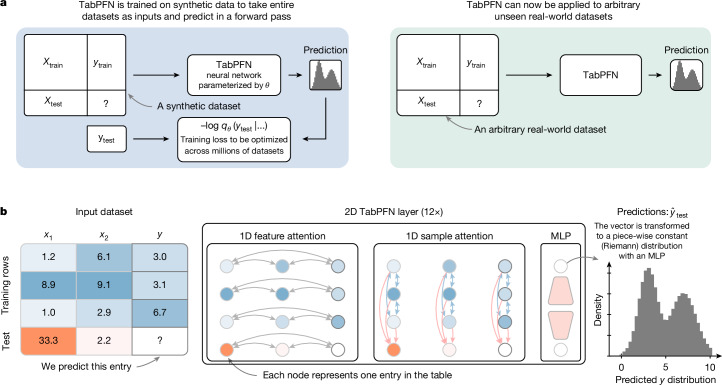
TabPFN is a tabular foundation model pretrained on millions of synthetic datasets that uses in-context learning to outperform prior methods on small- to medium-sized tabular data up to 10,000 samples and 500 features. It delivers strong classification and regression performance in a single forward pass and also supports fine-tuning, data generation, density estimation, reusable embeddings, and interpretability.
Key findings
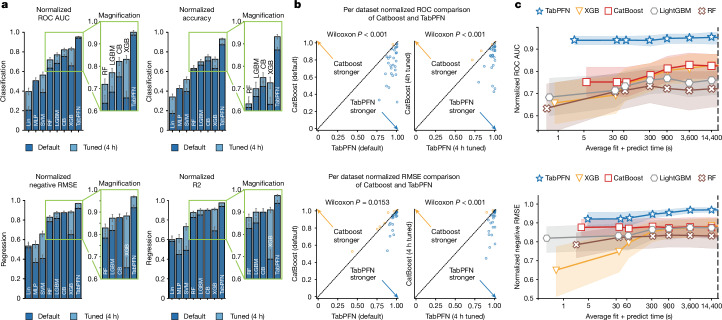
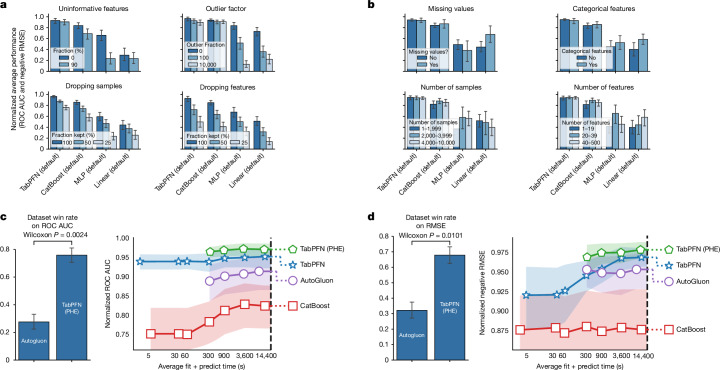
- On benchmarks with 29 classification and 28 regression datasets up to 10,000 samples, 500 features, and 10 classes, TabPFN outperformed tuned baselines. Classification normalized ROC AUC: TabPFN default 0.939 vs CatBoost default 0.752; tuned TabPFN 0.952 vs tuned CatBoost 0.822. Regression normalized RMSE: TabPFN default 0.923 vs CatBoost default 0.872; tuned TabPFN 0.968 vs tuned CatBoost 0.875.
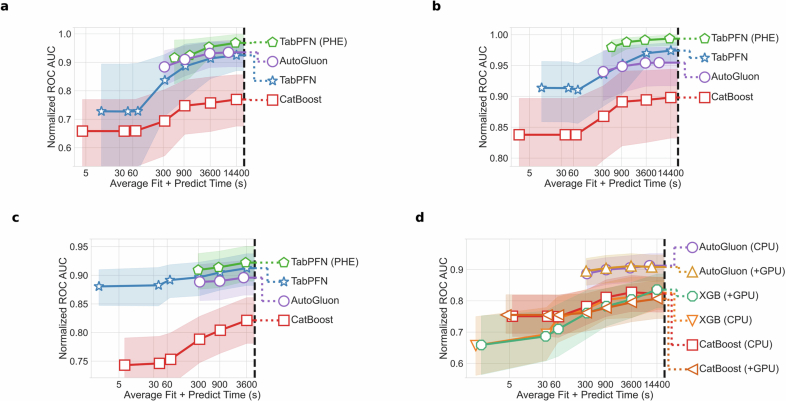
- TabPFN default took 2.8 s for classification and 4.8 s for regression on average, outperforming baselines tuned for 4 h—a speedup of 5,140× for classification and 3,000× for regression. TabPFN (PHE) reached average normalized ROC AUC 0.971 vs 0.939 for TabPFN default and 0.914 for AutoGluon; for regression, TabPFN (PHE) outperformed AutoGluon allowed 4 h after a 300 s tuning budget, a 48× speedup.
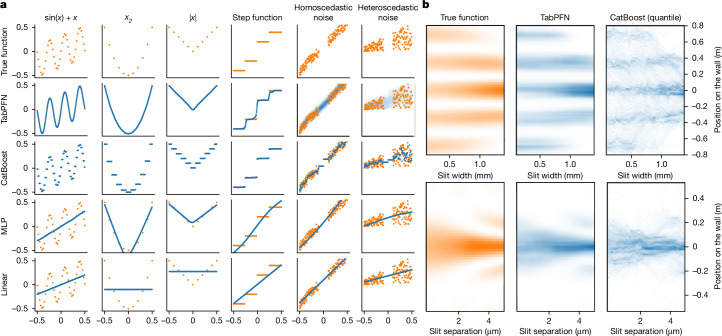
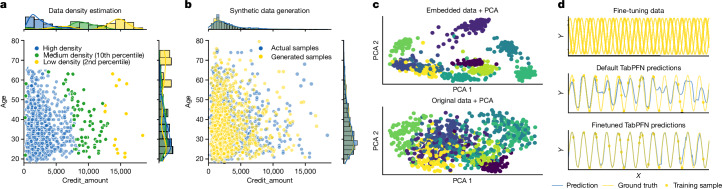
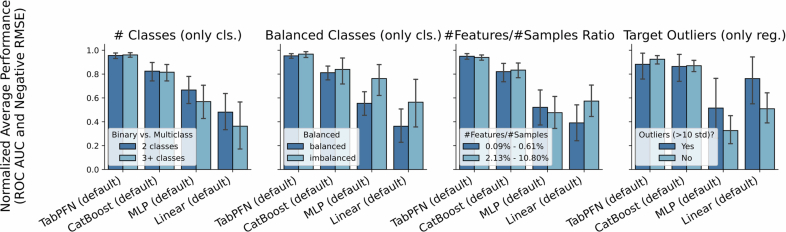
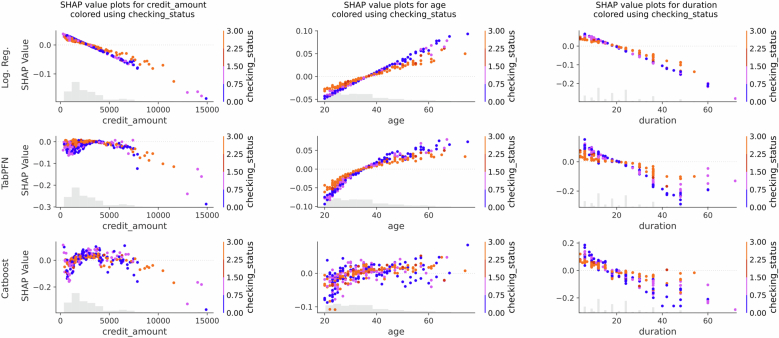
- TabPFN was robust to uninformative features and outliers, and with half the samples it performed as well as the next best method using all samples. It also demonstrated foundation-model abilities including density estimation, synthetic data generation, learned embeddings, fine-tuning, and SHAP-based feature importance.
Methods
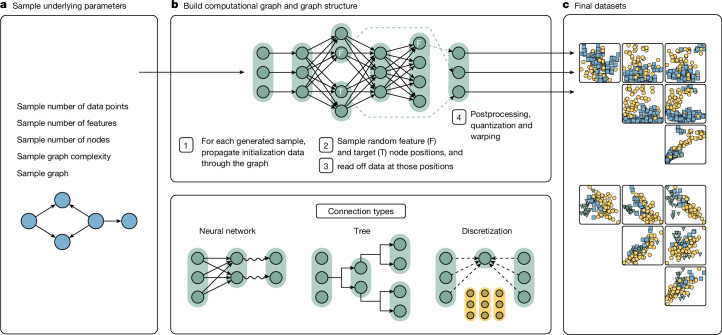
- TabPFN was pretrained on synthetic tabular datasets generated from structural causal models: around 100 million synthetic datasets per model training, with final models trained for approximately 2,000,000 steps at batch size 64 datasets, corresponding to around 130,000,000 synthetically generated datasets each.
- The architecture is a transformer encoder variant that treats each table cell as a separate position and uses two-way attention: each cell attends to other features in its row, then to the same feature across its column. At inference, training samples are provided as context and predictions are made in a single forward pass via in-context learning; train-state caching enables reuse for multiple test inferences.
- Evaluation used the AutoML Benchmark and OpenML-CTR23, with 29 classification and 28 regression datasets up to 10,000 samples, 500 features, and 10 classes. Each dataset and method was run for 10 repetitions with different random seeds and 90% train/10% test splits; hyperparameters were tuned by random search with five-fold cross-validation using time budgets from 30 s to 4 h. Metrics were ROC AUC and accuracy for classification, and R² and negative RMSE for regression, normalized per dataset.
Limitations
- The paper states that TabPFN inference may be slower than highly optimized approaches such as CatBoost; memory usage scales linearly with dataset size and can be prohibitive for very large datasets; and evaluation focused on datasets with up to 10,000 samples and 500 features, so scalability to larger datasets requires further study.
- The paper also states TabPFN is not optimized for real-time inference: for a dataset with 10,000 rows and 10 columns, it requires 0.2 s (0.6 s without GPU) to predict one sample, whereas CatBoost default can do so in 0.0002 s.
- The paper notes that for larger datasets and highly non-smooth regression datasets, CatBoost, XGBoost, or AutoGluon are likely to outperform TabPFN, and that natively the method is limited to predicting at most 10 classes unless pretrained on more classes or adapted with approaches such as one-vs-one, one-vs-rest, or ECOC.
Model-written summary. Check it against the paper before relying on it.
Integrity signals
Registry
Cites
Statistics
Figures
Verification
Claims the paper makes
1 Valid · 6 Not valid · 17 Not checked · 72 Own results and interpretations
The sources with a verdict support this claim; the rest weren’t checked yet, have no full text we could read, or their verdicts aren’t rated yet.
In the paper
“For larger datasets and highly non-smooth regression datasets, approaches such as CatBoost9, XGB7 or AutoGluon40 are likely to outperform TabPFN.”
§ Accurate predictions on small data with a tabular foundation model > Methods > User guide
What the sources say
- Check pendingcites [9] Prokhorenkova, L., Gusev, G., Vorobev, A., Dorogush, A. & Gulin, A. CatBoost: unbiased boosting with categorical features. In Proc. 30th International Conference on Advances in Neural Information Processing Systems (eds Bengio, S. et al.) 6639–6649 (Curran Associates, 2018). source
- Supportedcites [7] Chen, T. & Guestrin, C. Xgboost: A scalable tree boosting system. In Proc. 22nd ACM SIGKDD International Conference on Knowledge Discovery and Data Mining (eds Krishnapuram, B. et al.) 785–794 (ACM Press, 2016). source
The citation is offered to identify the system 'XGB' named in the citing sentence, and our copy is that system's paper: the Abstract and Introduction (KDD '16) describe XGBoost as 'a scalable end-to-end tree boosting system' that 'scales beyond billions of examples using far fewer resources than existing systems', used 'to achieve state-of-the-art results on many machine learning challenges'. The Introduction (p.1) further notes 17 of 29 Kaggle winning solutions in 2015 used XGBoost, and the evaluation sections report it running >10x faster than Spark MLLib/H2O on the 1.7-billion-example Criteo data, consistent with the 'larger datasets' framing. The head-to-head comparison against TabPFN and the 'highly non-smooth regression' qualification are the citing authors' own conclusion (TabPFN postdates this source) and are not attributed to this paper, so nothing here is unsupported for the part this citation carries. (LLM, conf=0.85)
- Check pendingcites [40] Erickson, N. et al. Autogluon-tabular: robust and accurate automl for structured data. Preprint at https://arxiv.org/abs/2003.06505 (2020). source
hedgedstates a possible cause- Asserted: passes — The authors put it forward as true.
- Checkable: passes — It can be checked against evidence.
- Load-bearing: unclear — It is unclear whether the paper’s conclusions depend on it.
- Based: passes — The paper gives a reason why it holds.
A result the paper states — it cites no source for it, so there is none to check. The quote shows it is in the paper.
In the paper
“This new supervised tabular learning method can be applied to any small- to moderate-sized dataset and yields dominant performance for datasets with up to 10,000 samples and 500 features.”
§ Accurate predictions on small data with a tabular foundation model > Main
plainstates a causen = 10,000- Asserted: passes — The authors put it forward as true.
- Checkable: passes — It can be checked against evidence.
- Load-bearing: passes — The paper’s conclusions depend on it.
- Based: passes — The paper gives a reason why it holds.
A result the paper reports from its own data — it cites no other source for it, so there is none to check. The quote shows it is in the paper.
In the paper
“We extract and visualize learned embeddings from the mfeat-factors dataset in Fig. 6c, showing improved class separation compared with the raw data on the first two principal components.”
§ Accurate predictions on small data with a tabular foundation model > Foundation model with interpretability
plainstates a cause- Asserted: passes — The authors put it forward as true.
- Checkable: passes — It can be checked against evidence.
- Load-bearing: unclear — It is unclear whether the paper’s conclusions depend on it.
- Based: passes — The paper gives a reason why it holds.
A result the paper reports from its own data — it cites no other source for it, so there is none to check. The quote shows it is in the paper.
In the paper
“we found that pre-processing inputs can help performance”
§ Accurate predictions on small data with a tabular foundation model > Methods > Details on the neural architecture
plainstates a possible cause- Asserted: passes — The authors put it forward as true.
- Checkable: passes — It can be checked against evidence.
- Load-bearing: unclear — It is unclear whether the paper’s conclusions depend on it.
- Based: passes — The paper gives a reason why it holds.
In the paper
“As our models are not fully permutation invariant, for each ensemble member, we shuffle the feature order, approximating order invariance64.”
§ Accurate predictions on small data with a tabular foundation model > Methods > Inference details
What the sources say
- Not checked yetcites [64] Murphy, R. L., Srinivasan, B., Rao, V. A. & Ribeiro, B. Janossy pooling: learning deep permutation-invariant functions for variable-size inputs. In Proc. 7th International Conference on Learning Representations (ICLR, 2019). source
plain- Asserted: passes — The authors put it forward as true.
- Checkable: passes — It can be checked against evidence.
- Load-bearing: passes — The paper’s conclusions depend on it.
- Based: passes — The paper gives a reason why it holds.
25 more claims
Create a free account to see all 96 claims and to verify the 28 references still open.
- Probably not a substantial claim. 32
- It may state two separate claims as one. 47
Self-check
Percentages, sums and reported differences re-computed from the paper’s own numbers.
Each contradiction between two passages listed here was confirmed by an independent check.
Rated minor: it would not touch a result — a value no result rests on, a p-value that stays on the same side of the significance level, or a conflict that is clerical, resolved elsewhere in the paper, or outside its own findings.
In the paper
§ Accurate predictions on small data with a tabular foundation model > Quantitative analysis > Comparison with tuned ensemble methods
“In just 2.8 s, TabPFN (default) outperforms AutoGluon for classification tasks, even if AutoGluon is allowed up to 4 h, a 5.140× speedup.”
§ Accurate predictions on small data with a tabular foundation model > Quantitative analysis > Comparison with state-of-the-art baselines
“The default of TabPFN, taking 2.8 s on average for classification and 4.8 s for regression, outperforms all baselines, even when tuning them for 4 h—a speedup of 5,140× and 3,000×, respectively.”
Rated minor: it would not touch a result — a value no result rests on, a p-value that stays on the same side of the significance level, or a conflict that is clerical, resolved elsewhere in the paper, or outside its own findings.
In the paper
§ Accurate predictions on small data with a tabular foundation model > Quantitative analysis
“TabPFN was pre-trained once using eight NVIDIA RTX 2080 GPUs over 2 weeks”
§ Accurate predictions on small data with a tabular foundation model > Methods > Training details
“One training run requires around 2 weeks on one node with eight Nvidia RTX 2080 Ti GPUs.”
Rated minor: it would not touch a result — a value no result rests on, a p-value that stays on the same side of the significance level, or a conflict that is clerical, resolved elsewhere in the paper, or outside its own findings.
In the paper
§ Accurate predictions on small data with a tabular foundation model > An architecture designed for tables
“This design enables the architecture to be invariant to the order of both samples and features”
§ Accurate predictions on small data with a tabular foundation model > Methods > Inference details
“As our models are not fully permutation invariant, for each ensemble member, we shuffle the feature order, approximating order invariance64.”
Citations
Cites
Breiman, L. (2001) · Machine Learning · doi:10.1023/a:1010933404324 · Cited by 133,538
Vaswani, A., Shazeer, N., Parmar, N., Uszkoreit, J., Jones, L., Gomez, A. N., Kaiser, L., & Polosukhin, I. (2017) · arXiv · doi:10.48550/arxiv.1706.03762 · Cited by 120,404
Distinctive Image Features from Scale-Invariant Keypoints
Lowe, D. G. (2004) · International Journal of Computer Vision · doi:10.1023/b:visi.0000029664.99615.94 · Cited by 62,647 · cited 2×
“Hand-designed features in computer vision, such as SIFT (Scale Invariant Feature Transform) 10 and HOG (Histogram of Oriented Gradients) 11 , have been replaced by learned convolutions; grammar-based approaches in natural language processing have been replaced by learned transformers 12 ; and the design of customized…”
Cortes, C., & Vapnik, V. (1995) · Machine Learning · doi:10.1007/bf00994018 · Cited by 59,421
XGBoost: A Scalable Tree Boosting System
Chen, T., & Guestrin, C. (2016) · Proceedings of the 22nd ACM SIGKDD International Conference on Knowledge Discovery and Data Mining · doi:10.1145/2939672.2939785 · Cited by 54,569
Highly accurate protein structure prediction with AlphaFold
Jumper, J., Evans, R., Pritzel, A., Green, T., Figurnov, M., Ronneberger, O., Tunyasuvunakool, K., Bates, R., Žídek, A., Potapenko, A., et al. (2021) · Nature · doi:10.1038/s41586-021-03819-2 · Cited by 43,764
Histograms of Oriented Gradients for Human Detection
Dalal, N., & Triggs, B. (2005) · 2005 IEEE Computer Society Conference on Computer Vision and Pattern Recognition (CVPR'05) · doi:10.1109/cvpr.2005.177 · Cited by 33,584
Greedy function approximation: A gradient boosting machine
Friedman, J. H. (2001) · The Annals of Statistics · doi:10.1214/aos/1013203451 · Cited by 30,731 · cited 2×
“The list of development datasets can be found in Supplementary Tables 5 and 6.”
Language Models are Few-Shot Learners
Brown, T. B., Mann, B., Ryder, N., Subbiah, M., Kaplan, J., Dhariwal, P., Neelakantan, A., Shyam, P., Sastry, G., Askell, A., et al. (2020) · arXiv · doi:10.48550/arxiv.2005.14165 · Cited by 23,372 · cited 1×
“We build on a preliminary version of TabPFN 23 , which demonstrated the applicability of in-context-learning 17 for tabular data in principle but had many limitations that rendered it inapplicable in most cases.”
Quinlan, J. R. (1986) · Machine Learning · doi:10.1007/bf00116251 · Cited by 21,439
Research works printed but not linked: 11
- van Breugel, B. & van der Schaar, M. Position: why tabular foundation models should be a research priority. In Proc. 41st International Conference on Machine Learning 48976–48993 (PMLR, 2024).
- Akyürek, E., Schuurmans, D., Andreas, J., Ma, T. & Zhou, D. What learning algorithm is in-context learning? Investigations with linear models. In Proc. The Eleventh International Conference on Learning Representations (ICLR, 2023).
- Müller, S., Hollmann, N., Pineda-Arango, S., Grabocka, J. & Hutter, F. Transformers can do Bayesian inference. In Proc.The Tenth International Conference on Learning Representations (ICLR, 2022).
- Kingma, D. & Ba, J. Adam: A method for stochastic optimization. In Proc. International Conference on Learning Representations (ICLR, 2015).
- Bahdanau, D., Cho, K. & Bengio, Y. Neural machine translation by jointly learning to align and translate. In Proc. 3rd International Conference on Learning Representations (eds Bengio, Y. & LeCun, Y.) (ICLR, 2015).
- Gorishniy, Y., Rubachev, I., Khrulkov, V. & Babenko, A. Revisiting deep learning models for tabular data. In Proc. Advances in Neural Information Processing Systems 34 (eds Ranzato, M. et al.) 18932–18943 (NeurIPS, 2021).
- Fischer, S. F., Feurer, M. & Bischl, B. OpenML-CTR23 – a curated tabular regression benchmarking suite. In Proc. AutoML Conference 2023 (Workshop) (AutoML, 2023).
- Lundberg, S. M. & Lee, S.-I. A unified approach to interpreting model predictions. In Proc.Advances in Neural Information Processing Systems (eds Guyon, I. et al.) Vol. 30, 4765–4774 (Curran Associates, 2017).
- Nagler, T. Statistical foundations of prior-data fitted networks. In Proc. 40th International Conference on Machine Learning (eds Krause, A. et al.) Vol. 202, 25660–25676 (PMLR, 2023).
- Müller, S., Feurer, M., Hollmann, N. & Hutter, F. PFNS4BO: in-context learning for Bayesian optimization. In Proc. 40th International Conference on Machine Learning 25444–25470 (PMLR, 2023).
- Loshchilov, I. & Hutter, F. SGDR: Stochastic gradient descent with warm restarts. In Proc. 5th International Conference on Learning Representations (ICLR, 2017).
Cited by
Items 1,701–1,800 of 2,324
Kim, S., Jo, S. H., & Chae, M. (2026) · arXiv (Cornell University) · doi:10.48550/arxiv.2610.01143
TabNSM: Neural Sparse Mixer for Tabular RegressionPreprint
Eslamian, A., & Cheng, Q. S. (2026) · arXiv (Cornell University) · doi:10.48550/arxiv.2608.18026
TPdsm: a method based on TabPFN for prediction of deleterious synonymous mutations
Zeng, B., Hu, M., Cui, Z., Zhou, S., & Dai, W. (2026) · Bioinformatics Advances · doi:10.1093/bioadv/vbag194
Yang, A., Qi, P., Yuan, Q., Yu, G., Yang, H., Li, Z. J., & Cai, Y. (2026) · arXiv (Cornell University) · doi:10.48550/arxiv.2609.21646
Kan, Y., Wang, N., Zhou, W. Q., Cheng, X., Cao, X., Li, Y., Xu, W., Zeng, S., Zhang, Z., Yang, L., et al. (2026) · Environmental Pollution · doi:10.1016/j.envpol.2026.129240
A Foundation Model for Policy In-Context Longitudinal Causal Effect EstimationPreprint
Chen, W., Gan, K., Lu, M., Jing, Z., Wang, F., Poon, H., Naumann, T., & Argaw, P. (2026) · arXiv (Cornell University) · doi:10.48550/arxiv.2610.32863
Adversarial Multiplicity: Cherry-Picked Models and the Limits of DisclosurePreprint
Chou, C. C., Huynh, B. Q., Koenecke, A., & Chin, E. T. (2026) · arXiv (Cornell University) · doi:10.48550/arxiv.2611.07378
A Conformal Selection Framework for Individual Treatment Beneficiaries with Auxiliary External DataPreprint
Liu, J., Zhu, K., & Wang, X. (2026) · arXiv (Cornell University) · doi:10.48550/arxiv.2606.31954
BSTabDiff: Block-Subunit Diffusion Priors for High-Dimensional Tabular Data GenerationPreprint
Habib, A. Z. S. B., Ahamed, M. Y., Gyawali, P., Doretto, G., & Adjeroh, D. (2026) · arXiv (Cornell University) · doi:10.48550/arxiv.2606.09257
Support-Compiled Feature Folding: More Evidence at Lower Memory Across Tabular Foundation ModelsPreprint
Zhou, T., Jin, B., Wang, X., Yang, L., Wang, W., Peng, B., Ye, M., Gu, J., & Sun, L. (2026) · arXiv (Cornell University) · doi:10.48550/arxiv.2609.28208
Zhang, W., Yu, J., Wang, Y., Liu, T., Sang, T., Xu, H., Tian, T., Ma, S., & Wang, S. (2026) · Food Control · doi:10.1016/j.foodcont.2026.112701
Proceedings 36. Workshop Computational Intelligence : Berlin, 19. – 20. November 2026
Schulte, H., Hoffmann, F., & Mikut, R. (2026) · Repository KITopen (Karlsruhe Institute of Technology) · doi:10.5445/ir/1000197311
Li, C., Zhou, R., Wang, S., Yan, R., Yang, C., Sun, X., Xu, H., & Lu, J. (2026) · arXiv (Cornell University) · doi:10.48550/arxiv.2610.32994
Prior-data fitted networks for variable selectionPreprint
Melikechi, O. (2026) · arXiv (Cornell University) · doi:10.48550/arxiv.2611.05966
Demirkiran, E. T. (2026) · Research Square · doi:10.21203/rs.3.rs-11112632/v1
Learning based on neurovectors for tabular data: a new neural network approachPreprint
Husillos, J. C., Gallego, A., Roma, A., & Troncoso, A. (2025) · arXiv (Cornell University) · doi:10.48550/arxiv.2506.07185
Modeling cosolvent effects on solubility in supercritical CO2 using data-driven approaches
Makarov, D. M., Kalikin, N. N., Gurikov, P. A., & Budkov, Y. A. (2026) · The Journal of Supercritical Fluids · doi:10.1016/j.supflu.2026.106979
A Comparative Analysis of Prediction Intervals for Forecasting in the Recycling Sector
Becker, J., Bommert, A., Rehof, J., & Pauly, M. (2026) · Lecture notes in logistics · doi:10.1007/978-3-032-19343-8_11
Lin, Y., Martin, E. D., Conte, G., Aquino, D., Pedone, C., Redaelli, A., Barbieri, R., Fariselli, L., & Ferrante, S. (2026) · arXiv (Cornell University) · doi:10.48550/arxiv.2604.24230
Active Tabular Augmentation via Policy-Guided Diffusion Inpainting
Zhang, Z., Yang, S., Prenkaj, B., & Kasneci, G. (2026) · International Conference on Machine Learning · doi:10.48550/arxiv.2605.10315
Kravchenko, E., Zhelnin, M., Minkina, T., Jelagin, D., Ali, M. H., & Cheeseman, C. R. (2026) · Journal of Materials in Civil Engineering · doi:10.1061/jmcee7.mteng-22568
Ferdous, S. N., Ahire, J. P., Bergman, R. D., Li, X., & Wang, J. (2026) · Ecological Informatics · doi:10.1016/j.ecoinf.2026.103836
Zhang, Z., Zhu, W., Zhang, Q., Li, Y., Li, S., & Chu, B. (2026) · Environmental Development · doi:10.1016/j.envdev.2026.101498
Mendez, D., Martín-Maroto, F., & de Polavieja, G. G. (2026) · arXiv (Cornell University) · doi:10.48550/arxiv.2605.22155
FLOATBench: A Dataset and Benchmark for Floating Offshore Wind Turbine Tower FatiguePreprint
Ribeiro, J. A., Ribeiro, B. A., Pimenta, F., Tavares, S., & Ahmed, F. (2026) · arXiv (Cornell University) · doi:10.48550/arxiv.2605.25717
A Surface-based Multimodal Framework for Multitask Analysis in Alzheimer's DiseasePreprint
Huang, S., Zhang, J., Zhong, L., Yue, J., Xia, Y., Wang, X., & Shi, Y. (2026) · arXiv (Cornell University) · doi:10.48550/arxiv.2606.15692
Chen, S., Saban, N., Hargreaves, C., & Wang, H. (2026) · arXiv (Cornell University) · doi:10.48550/arxiv.2606.31976
Saçılık, K., Çetin, N., Kavuncuoğlu, E., & Cheein, F. A. (2026) · Computers and Electronics in Agriculture · doi:10.1016/j.compag.2026.112147
Prastyo, E. H. A., Nugroho, M. W., Firdaus, R. A. J., & Vitadiar, T. Z. (2026) · Journal of Embedded Systems Security and Intelligent Systems · doi:10.59562/jessi.v7i2.12634
Xiangshi, L., Wang, S., Zeng, Z., Cao, S., & Zhang, S. (2026) · Smart Agricultural Technology · doi:10.1016/j.atech.2026.102441
Tang, W., Jia, Z., Wang, J., Tang, W., Zhang, W., Yan, L., Wang, Z., Yao, L., Wu, S., & Yang, T. (2026) · Materials & Design · doi:10.1016/j.matdes.2026.116742
From field-scale to large-scale spectral libraries: Tabular foundation models in soil spectroscopy
Barkov, V., Schmidinger, J., Gebbers, R., & Atzmueller, M. (2026) · Geoderma · doi:10.48550/arxiv.2608.00608
Optimizing the Rainwater Harvesting and Roof Sprinkling System to Adapt to Urban Extreme Heat
Yu, J., Oleson, K. W., Qin, Y., Zhao, L., Topping, D. O., & Zheng, Z. (2026) · Earth s Future · doi:10.1029/2026ef008876
Data-Driven Discovery of Boronic Acid Catalysts for Amidation ReactionsPreprint
Weller, H., & Schnitzer, T. (2026) · ChemRxiv · doi:10.26434/chemrxiv.15003365/v3
Global temperature calibrations based on 3-hydroxy fatty acids in lacustrine settingsPreprint
Ke, S., Sabatier, P., Anquetil, C., & Huguet, A. (2026) · EarthArXiv (California Digital Library) · doi:10.31223/x5jr4g
VoLTE-puheluiden laatuongelmien juurisyyluokittelu pakettidatasta
Kinnunen, S. (2026) · Aaltodoc (Aalto University)
Newton, T. J. (2026) · EarthArXiv (California Digital Library) · doi:10.31223/x51v3g
Yu, M., Jang, H. S., Shin, S., Kim, S., & Park, S. M. (2026) · Materials Today Communications · doi:10.1016/j.mtcomm.2026.115973
Contextual Token Rotation Ensembles for Tabular LearningPreprint
Gao, S., Penev, S. I., & Li, L. (2026) · Research Square · doi:10.21203/rs.3.rs-10595716/v1
Predicting root-zone soil moisture using a small sample deep learning approach
Xie, Y., Tian, J., Zhang, Y., Zhang, X., Wang, L., Wei, H., Wang, X., & Tang, Z. (2026) · Journal of Hydrology · doi:10.1016/j.jhydrol.2026.136348
Wang, Z., Zhao, J., & Chen, Q. (2026) · Sustainability · doi:10.3390/su18179058
Räty, J., Kukkonen, M., Peltomäki, J., Balázs, A., Toivonen, J., Pitkänen, T. P., Myllymäki, M., Kangas, A. S., Pohjankukka, J., & Packalén, P. (2026) · SSRN Electronic Journal · doi:10.2139/ssrn.7439437
Campi, M., Huber, A. M., & Goehring, T. (2026) · medRxiv · doi:10.64898/2026.09.07.26362458
Benchmarking Python-packages for time series feature extraction on manufacturing data
Seidler, C. T., Müller, D., Wolf, S., Eigenbrod, H., & Huber, M. F. (2026) · Expert Systems with Applications · doi:10.1016/j.eswa.2026.134418
SAGE-Loop: Reliable Closed-Loop LLM-Driven AutoML with Trial-and-Correction and Adaptive EnsemblingPreprint
Gu, J., Cui, S., Luo, X., & Yu, H. (2026) · arXiv (Cornell University) · doi:10.48550/arxiv.2609.12455
Kisa, E., & Kısa, A. (2026) · Frontiers in Health Services · doi:10.3389/frhs.2026.1893109
Nijim, M. Z. A., Abghari, S., & Boeva, V. (2026) · Communications in computer and information science · doi:10.1007/978-981-92-5190-2_2
Yang, P., He, X., Zhang, H., Feng, Z., Wen, L., Wen, L., Xu, Y., Chen, B., Xiao, M., Chen, X., et al. (2026) · Nature Communications · doi:10.1038/s41467-026-77409-z
Inductive Sample-Relation Augmentation for Simple Regression Models
Chen, Y. (2026) · International Conference on Artificial Intelligence, Internet of Things and Cloud Computing Technology (AIoTC) · doi:10.1109/aiotc71250.2026.11688502
Duan, Y., Liu, S., Qiao, L. I. U., Wu, K., Yang, X., Yi-Yuan, S. H. E. N., & Xie, F. (2026) · Advances in Climate Change Research · doi:10.1016/j.accre.2026.09.010
Song, M., Zhang, H., Ding, Y., Fan, Y., Wang, Z., Xie, Y., Xu, L., & Huang, W. (2026) · IEEE Journal of Selected Topics in Applied Earth Observations and Remote Sensing · doi:10.1109/jstars.2026.3737084
Zhang, Z., Xiao, E., Dou, Y., Hu, B., Liang, G., Wang, H., Tang, X., & Lei, R. (2026) · Cold Regions Science and Technology · doi:10.1016/j.coldregions.2026.105163
Radvanský, M., & Radvanský, M. (2026) · Research Square · doi:10.21203/rs.3.rs-10947390/v1
Upendra, R. R., Dorais, A., Meyer, J., Pouret, A., Stappas, A. L., Ramprasath, D. K., Ganapathy, V., Palczewski, T., & Li, M. (2026) · arXiv (Cornell University) · doi:10.48550/arxiv.2609.36417
Fayez, M. A., & Salim, S. S. (2026) · Scientific Reports · doi:10.1038/s41598-026-73565-w
Molecular Property Prediction under Structural Shift with Tabular Foundation ModelsPreprint
Lee, J., Lee, D., Jeong, M., & Yoo, J. (2026) · arXiv (Cornell University) · doi:10.48550/arxiv.2609.38744
Gonçalves, R. L. D. N., de Oliveira, T. A., da Silva, S. J., Silva, M. K. B., Campos, J. C., Nascimento, R. C. A. M., de Souza, E. A., & Amorim, L. V. (2026) · Scientific Reports · doi:10.1038/s41598-026-72944-7
Lu, J., Yan, Z., Ma, B., Cheng, H., Liao, J., Duan, N., & Xu, F. (2026) · Journal of Industrial and Engineering Chemistry · doi:10.1016/j.jiec.2026.09.034
Agung, P. P., & Tahalele, P. L. (2026) · Journal of Artificial Intelligence and Software Engineering (J-AISE) · doi:10.30811/jaise.v6i2.9157
From Prompts to Trees: Effective LLM-Guided Tree Generation for Few-Shot Tabular Classification
Qiu, Y., Du, Z., Diao, Y., He, B., & Li, Q. (2026) · Conference on Empirical Methods in Natural Language Processing (EMNLP) · doi:10.18653/2026.emnlp-main.588
Song, Z., Wu, S., Man, W., Yu, S., Zeng, Y., Nie, Q., Li, Z., Du, X., & Zhang, X. (2026) · Remote Sensing · doi:10.3390/rs18203470
Probabilistic Forecasting of Electric Vehicle Charging in a Time-varying Hierarchical InfrastructurePreprint
Principato, G., Amara-Ouali, Y., Goude, Y., Hamrouche, B., & Poggi, J. (2026) · arXiv (Cornell University) · doi:10.48550/arxiv.2610.13588
TabGift: A Context-Efficient Foundation Model for Tabular Data GenerationPreprint
Li, Y.-S., Jiang, J., & Ye, H.-J. (2026) · arXiv (Cornell University) · doi:10.48550/arxiv.2610.16990
Universal Semantic Enhancement for Weakly Supervised Anomaly DetectionPreprint
Zhou, S., Xie, Y., Yuan, H., & Zhou, Y. (2026) · arXiv (Cornell University) · doi:10.48550/arxiv.2610.23765
Овчинников, Г. П., & Суворов, С. В. (2026) · Вестник науки · doi:10.68367/33474
Beyond the Vote: When Do LLMs Add Value to Retrieval-Based Tabular Classification?Preprint
Wang, Z., Nie, Y., Ma, J., & Li, Y. (2026) · arXiv (Cornell University) · doi:10.48550/arxiv.2610.29520
Nikzad, M. H., & Ansaripour, A. (2026) · Materials & Design · doi:10.1016/j.matdes.2026.117337
Zhang, L., Ni, W., Liu, Z., Li, Y., Yang, H., & Zhou, S. (2026) · Animals · doi:10.3390/ani16213361
Long-Term Dynamics of Esca Disease in Western SwitzerlandPreprint
Wilhelm, M., Monod, V., Fabre, A., Viret, O., Zufferey, V., Gindro, K., & Dubuis, P. (2026) · bioRxiv (Cold Spring Harbor Laboratory) · doi:10.64898/2026.10.28.762386
Ha, J., Sung, M. S., Jang, H. S., Shin, S., Kim, S.-J., & Park, S. M. (2026) · Journal of Materials Research and Technology · doi:10.1016/j.jmrt.2026.10.241
Shi, J., Li, Z., Liu, G., & Kaishan, 宋. S. (2026) · Ecological Indicators · doi:10.1016/j.ecolind.2026.115812
Wang, S., Song, X., Yang, X., Cheng, X., Zhang, H., & Li, Y. (2026) · Journal of Building Engineering · doi:10.1016/j.jobe.2026.117699
Context-Aware Pruning for Ordering-Based Causal Discovery
Sohn, J., Song, S., Jeong, W., Shon, Y., & Suk, H. (2026) · ACM International Conference on Information and Knowledge Management (CIKM) · doi:10.1145/3799682.3840946
Meng, F., Zhou, Y., Wang, X., Liu, Y., Sun, A., Kahaer, Y., & Yue, S. (2026) · Research Square · doi:10.21203/rs.3.rs-10873743/v1
Mapping chronic environmental pressure in Goa using machine learning and deep learning
Das, M., Gupta, S. K., Kanga, S., Pandey, D. K., Sajan, B., Meraj, G., & Singh, S. K. (2026) · Asian Journal of Water Environment and Pollution · doi:10.36922/ajwep026340243
Jin, F., Jia, H., Zhao, Y., Wang, Y., Guo, Q., Su, G., & Liu, Z. (2026) · Processes · doi:10.3390/pr14213570
Huang, Z., & Wu, P. (2026) · Neurocomputing · doi:10.1016/j.neucom.2026.135596
Out-of-the-Box Tabular Foundation Models for Bayesian Optimization in Materials DiscoveryPreprint
Flöge, K., Bing, S., Grinsztajn, L., Kalfon, E., Purucker, L., Hollmann, N., & Hutter, F. (2026) · arXiv (Cornell University) · doi:10.48550/arxiv.2611.12491
Self-citationWeckstein, A. R., Dahabreh, I. J., Žitnik, M., Hernández–Díaz, S., & Schneeweiss, S. (2026) · arXiv (Cornell University) · doi:10.48550/arxiv.2611.11381
PBE-assisted machine learning of HSE06+SOC photovoltaic efficiency in halide perovskitesPreprint
Haidry, A. A., Mandebvu, C. R., & Fatima, Q. (2026) · Research Square · doi:10.21203/rs.3.rs-11482596/v1
Accurate predictions of properties of energetic materials with tabular foundation modelsPreprint
Glomsrud, V. K. N., Bynke, M., Olsen, L. H. B., & Christensen, D. (2026) · arXiv (Cornell University) · doi:10.48550/arxiv.2611.14462
TabOmics: A Small, Open Tabular Foundation Model for Wide Omics DataPreprint
López-García, A., Bote-Curiel, L., Gimeno-Blanes, F. J., Rojo‐Álvarez, J. L., & Muñoz-Romero, S. (2026) · arXiv (Cornell University) · doi:10.48550/arxiv.2611.15329
Li, X., Su, J., Fan, Y., 謝英達, Liu, H., Wei, T., Yao, R., Yu, R., Lu, Z., Sun, B., et al. (2026) · Frontiers in Oncology · doi:10.3389/fonc.2026.1894987
Xu, H., Fu, Q., Chen, J., Liu, L., Tang, X., & Shen, H. (2026) · Journal of Intelligent Manufacturing · doi:10.1007/s10845-026-02977-2
Two Is Enough: Binary Classification Priors Suffice for Multi-Class In-Context Tabular PredictionPreprint
Cheng, Z., Han, S., Suo, J., & Wang, Z. (2026) · arXiv (Cornell University) · doi:10.48550/arxiv.2610.27569
Fang, J., Chen, W., Xu, L., & Bi, X.-A. (2026) · Pattern Recognition · doi:10.1016/j.patcog.2026.114383
The Syntheticity Grand Challenge: Why AI Needs a Foundational Theory of Syntheticity
Wang, X., Asif, H. S., & Vaidya, J. S. (2026) · doi:10.1145/3806096.3844872
Dang, T., Phung, T. H., Nguyen, S. L., & Nguyen, T. (2026) · arXiv (Cornell University) · doi:10.48550/arxiv.2607.11269
Ewing, M. T. (2026) · Research Square · doi:10.21203/rs.3.rs-10898531/v1
Luo, R., Zhang, Z., Xu, G., Li, H., Lin, X., Liu, R., Liu, J., & Dong, X. (2026) · Journal of Materials Chemistry A · doi:10.1039/d6ta07972e
Islam, M. R., & Mohammed, W. (2026) · arXiv (Cornell University) · doi:10.48550/arxiv.2608.18174
Roberts, C., Yamamoto, R., Fawnia, Z., Mistry, P. K., Treves, I., Decker, A. L., Sallie, S. N., Chatham, C., Aftab, A., Wang, K. L., et al. (2025) · Research Square · doi:10.21203/rs.3.rs-7060126/v1
Gu, H., Zhang, D., Yi, S., & Wang, C. (2026) · Measurement Science and Technology · doi:10.1088/1361-6501/ae9571
Closing the Context Gap: Activation Alignment for Tabular In-Context LearningPreprint
Zeldes, Y. (2026) · arXiv (Cornell University) · doi:10.48550/arxiv.2610.06679
Liu, Y., Tian, F., Nie, Y., Wu, Z., & Li, H. (2026) · IEEE International Symposium on Olfaction and Electronic Nose (ISOEN) · doi:10.1109/isoen68725.2026.11665352
Inference on counterfactual distributions using martingale posteriorsPreprint
Steiner, G., & Steel, M. (2026) · arXiv (Cornell University) · doi:10.48550/arxiv.2607.24143
Aprendizado por Transferência na Construção de Modelos Preditivos de Doença Renal Crônica
Caetano, G. V. S., Reinheimer, I. C., de melo, S., BELLINASO, M. E. S., Ribeiro, L. M., de Quadros, I. V., MATTIELLO, G. A., Rodrigues, R. J. K., Poli-De-Figueiredo¹, C. E., & Silva, L. A. L. (2025) · Escola Regional de Aprendizado de Máquina e Inteligência Artificial da Região Sul (ERAMIA-RS) · doi:10.5753/eramiars.2025.16714
Metadata
- Authors
- Hollmann, N., Müller, S., Purucker, L., Krishnakumar, A., Körfer, M., Hoo, S. B., Schirrmeister, R. T., & Hutter, F.
- Affiliations
- University of Freiburg (DE)
- Corresponding author
- Hollmann, Noah
- Müller, Samuel
- Hutter, Frank
- ORCID
- Venue
- Nature
- Published
- 2025-01-08
- Volume
- 637
- Issue
- 8045
- Pages
- 319-326
- ISSN
- 0028-0836 (ISSN-L)
- 1476-4687
- PMC
- PMC11711098
- OpenAlex
- W4406170795
- Semantic Scholar
- 6b238b17e419c7dd3912b9845449496bfb0a571a
- Cited by
- 2,323
- References
- 63
- Citations by year
- 2026: 1829 · 2025: 487
- FWCI
- 417.80
- Type
- journal article
- Language
- en
- Open access
- hybrid
- doi.org
- Licence
- cc-by
- creativecommons.org/licenses/by/4.0 (tdm)
- creativecommons.org/licenses/by/4.0 (vor)
- Locations
- Nature (publishedVersion, cc-by)
- PubMed Central (publishedVersion, cc-by)
- PubMed (publishedVersion)
- RePEc: Research Papers in Economics (submittedVersion)
- Funders
- European Commission (101045765)
- Deutsche Forschungsgemeinschaft (INST 39/963-1, “INST 39/963-1 FUGG”, SFB1597, 417962828, 39/963-1, 499552394)
- Hector Stiftung
- Topics
- Physical Sciences › Computer Science › Artificial Intelligence › Machine Learning and Data Classification
- Physical Sciences › Computer Science › Artificial Intelligence › Neural Networks and Applications
- Physical Sciences › Computer Science › Artificial Intelligence › Domain Adaptation and Few-Shot Learning
- Keywords
- tabular data, tabular foundation models, TabPFN, missing data estimation, small data, generative transformers, synthetic data, fine-tuning, density estimation, embeddings, gradient boosting decision tree, tabular data classification
About these checks
Registry, retraction, Cites and statistics results are computed, not judged, with one exception: a printed reference that no index lists is read once by a model before it counts as a citation error. Claims are extracted by a model and kept only when their quote appears verbatim in the text; each cited source is then checked, with a model’s help, for whether it says what the claim relies on. Those verdicts can be wrong — read the claim’s quote and the cited source before relying on one.
A language model drew the claims from the paper on 2026-11-24, under version 3 of the claim definition (model deepseek-v4.1-flash, prompt extract-v3).
A second model labelled each claim on 2026-11-24 (model jev-1.13-20260917, definition revision gold-guideline-v0.2).
Cited sources are checked with a language model’s help (qwen3.8-omni-flash).
Statistics and arithmetic are recomputed, not judged.
Confidence bands are shown only for fields calibrated on our annotated test set. None is calibrated yet, so no band is shown.
What counts as a claim ›How we measure confidence ›How we check this ›
Are you an author, or do you see a problem with this page? Request a review
Data sources
Bibliographic data: Semantic Scholar, OpenAlex, Crossref.
Contains information from the Semantic Scholar Academic Graph Datasets, made available under the ODC Attribution License (ODC-BY 1.0).
Semantic Scholar’s data is described in: Kinney, R., et al. (2023). The Semantic Scholar Open Data Platform. arXiv:2301.10140.
