

Hardware-efficient quantum error correction via concatenated bosonic qubits
Open accessThe DOI matches its Crossref record; 80 of the 88 references it cites were found in a registry or an index; 75 of the 87 sources its claims cite were checked for support.
Abstract
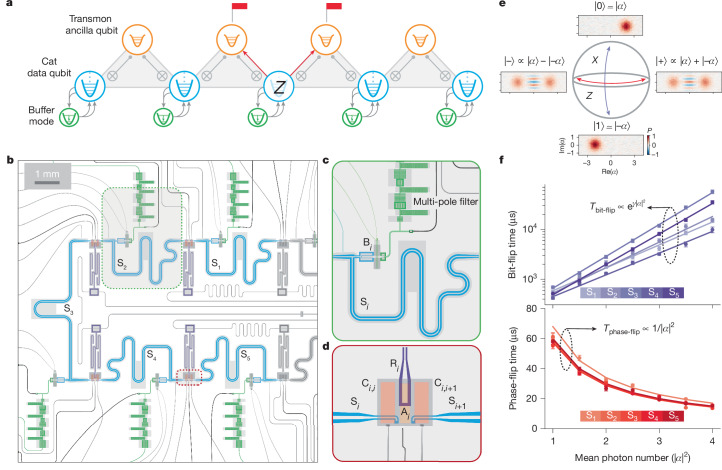
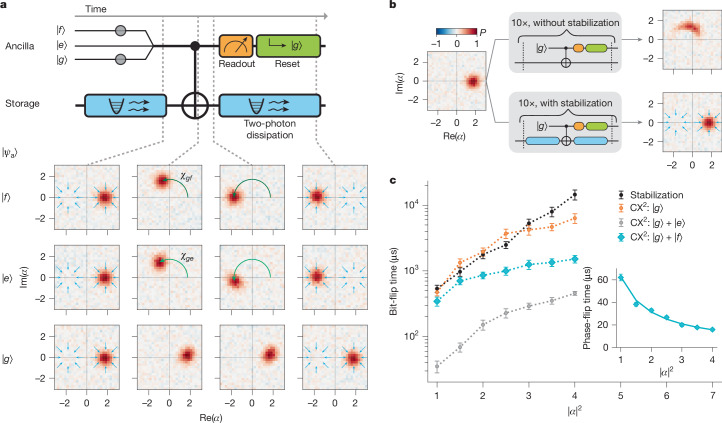
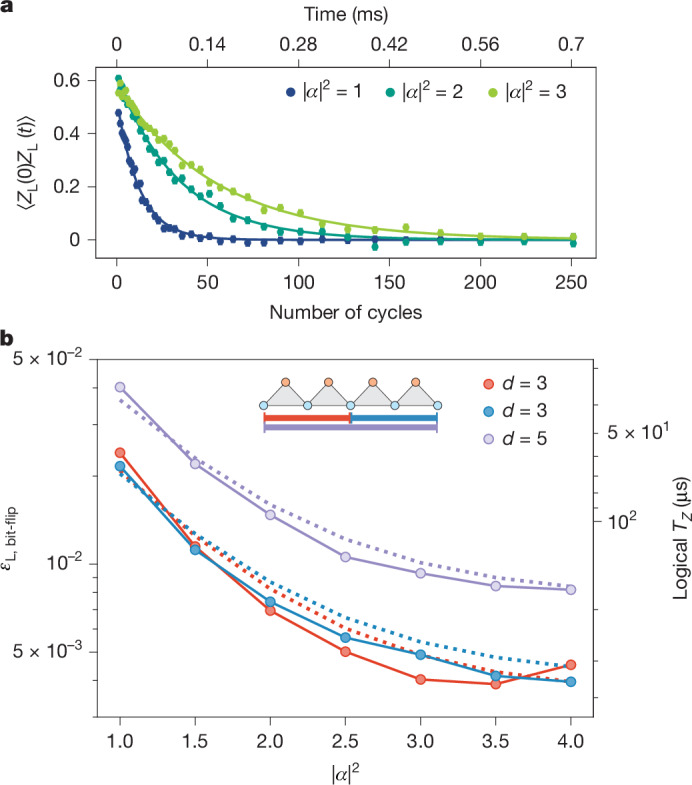
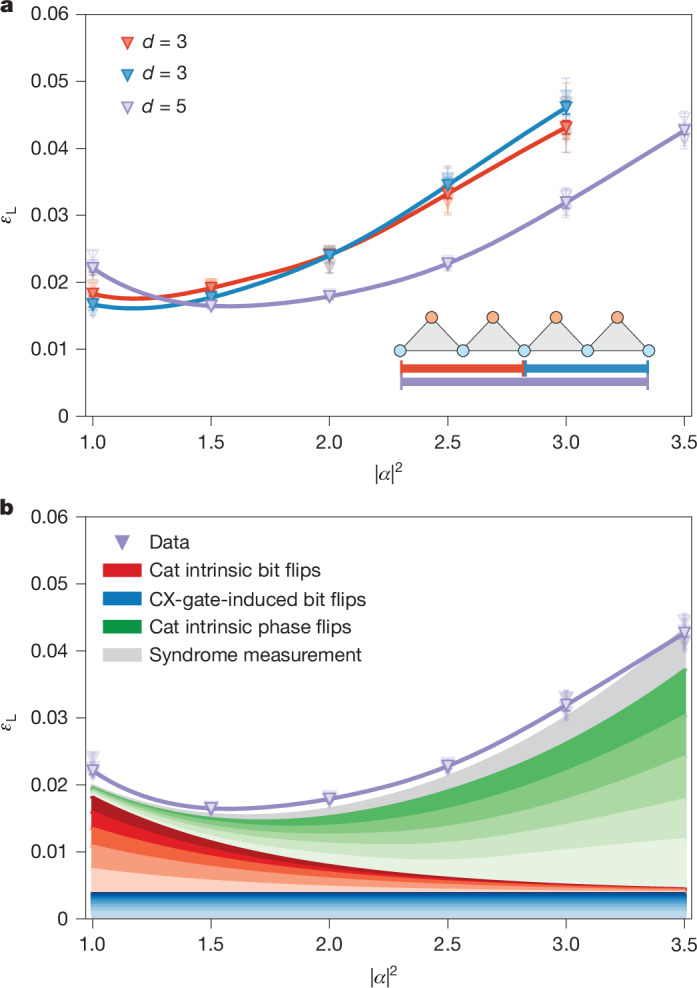
To solve problems of practical importance1,2, quantum computers probably need to incorporate quantum error correction, in which a logical qubit is redundantly encoded in many noisy physical qubits3–5. The large physical-qubit overhead associated with error correction motivates the search for more hardware-efficient approaches6–18. Here, using a superconducting quantum circuit19, we realize a logical qubit memory formed from the concatenation of encoded bosonic cat qubits with an outer repetition code of distance d = 5 (ref. 10). A stabilizing circuit passively protects cat qubits against bit flips20–24. The repetition code, using ancilla transmons for syndrome measurement, corrects cat qubit phase flips. We study the performance and scaling of the logical qubit memory, finding that the phase-flip correcting repetition code operates below the threshold. The logical bit-flip error is suppressed with increasing cat qubit mean photon number, enabled by our realization of a cat-transmon noise-biased CX gate. The minimum measured logical error per cycle is on average 1.75(2)% for the distance-3 code sections, and 1.65(3)% for the distance-5 code. Despite the increased number of fault locations of the distance-5 code, the high degree of noise bias preserved during error correction enables comparable performance. These results, where the intrinsic error suppression of the bosonic encodings enables us to use a hardware-efficient outer error-correcting code, indicate that concatenated bosonic codes can be a compelling model for reaching fault-tolerant quantum computation. Bosonic qubits can be engineered to feature intrinsic protection against certain kinds of errors, which makes quantum error correction across many bosonic qubits possible with less overhead.
Overview
CoChat Summary
TL;DR
This paper demonstrates a superconducting logical qubit memory built from concatenated bosonic cat qubits plus an outer distance-5 repetition code, using noise-biased CX gates for syndrome extraction. The best measured logical error per cycle is 1.65 ± 0.03% for the distance-5 section and 1.75 ± 0.02% on average for the distance-3 sections, showing hardware-efficient error correction with preserved noise bias.
Key findings
- The device consists of five bosonic storage modes and four ancilla transmons; the storage modes have average \(T_1 > 60\,\mu s\) and average \(T_2 > 80\,\mu s\).
- At \(|\alpha|^2 = 2\), the cat qubits achieve greater than 1 ms bit-flip times and 27–33 \(\mu s\) phase-flip times, corresponding to a noise bias greater than 30.
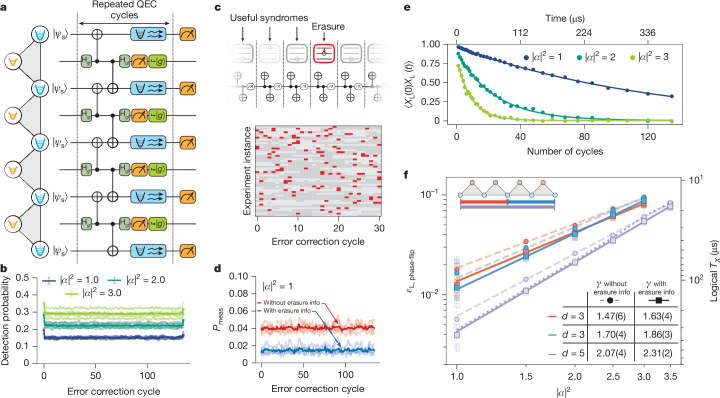
- The best-measured overall logical error per cycle for the distance-5 section is \(1.65 \pm 0.03\%\) at \(|\alpha|^2 = 1.5\); the distance-3 sections reach \(1.83 \pm 0.03\%\) and \(1.67 \pm 0.04\%\) at \(|\alpha|^2 = 1\), with average \(1.75 \pm 0.02\%\).
- With erasure information incorporated, the logical phase-flip rate is reduced by about 20% at \(|\alpha|^2 = 1.5\) for \(d=5\), and syndrome-measurement error probability is reduced by over a factor of two at \(|\alpha|^2 = 1\).
Methods
- Built a microfabricated superconducting circuit implementing a distance-5 repetition cat code: five cat-qubit data modes stabilized by two-photon dissipation and four transmon ancillas for stabilizer measurement.
- Used a noise-biased CX gate based on tunable dispersive coupling and \(\chi\)-matching, with ancilla states encoded as \(|0_a\rangle = |g\rangle\) and \(|1_a\rangle = |f\rangle\), to measure repetition-code syndromes.
- Quantified performance by repeated syndrome-extraction cycles, decoding with minimum-weight perfect matching, and extracting logical bit-flip and phase-flip rates from exponential fits to logical-operator decay.
Limitations
- The paper states that a repetition code of biased-noise qubits does not possess a proper asymptotic threshold because physical bit-flip errors are uncorrectable and set a lower bound on logical error.
- The logical performance is currently dominated by intrinsic cat bit-flip and phase-flip errors, and ancilla-induced bit-flip errors remain a concern, though not the present limiting factor.
- Evident from the text: the reported code is a logical memory demonstration rather than a full fault-tolerant computer, and several projected improvements are described as idealized or contingent on better coherence times and gate performance.
Model-written summary. Check it against the paper before relying on it.
Integrity signals
Registry
Cites
Statistics
Figures
Verification
Claims the paper makes
19 Valid · 3 Not valid · 1 Not checked · 69 Own results and interpretations
Some cited sources support this claim and some don’t — read each source’s verdict below.
In the paper
“A stabilizing circuit passively protects cat qubits against bit flips20–24.”
§ Hardware-efficient quantum error correction via concatenated bosonic qubits > Abstract
What the sources say
- Disputedcites [20] Mirrahimi, M. et al. Dynamically protected cat-qubits: a new paradigm for universal quantum computation. New J. Phys. 16, 045014 (2014). sourceExperimental — accuracy not yet measured
The Summary and conclusions says the driven dissipative process suppresses phase-flip errors, while single-photon decay produces bit-flip errors. It says protection against that decay requires continuously monitoring photon-number parity, rather than passive protection by the stabilizing process. (LLM, conf=0.88)
Checked by a reasoning model — may be wrong.
- Partly supportedcites [21] Leghtas, Z. et al. Confining the state of light to a quantum manifold by engineered two-photon loss. Science 347, 853–857 (2015). 25700514 sourceExperimental — accuracy not yet measured
The main text (p. 1) says engineered two-photon loss confines the oscillator to a manifold of two opposite-phase states, supporting passive stabilization. It does not establish protection against bit flips: the same passage says the system cannot correct errors within that manifold, and single-photon loss causes decoherence there. (LLM, conf=0.87)
- Disputedcites [22] Touzard, S. et al. Coherent oscillations inside a quantum manifold stabilized by dissipation. Phys. Rev. X 8, 021005 (2018). sourceExperimental — accuracy not yet measured
Our copy of Touzard et al. (Phase-flips characterization, supp.) states the opposite polarity of protection: 'if the temperature of our system had been 0K, our manifold stabilization would have protected the encoding against phase-flips exponentially with the average number of photons.' On bit flips it says they are not removed by the stabilization but grow with cat size — single-photon jumps 'correspond to bit-flips within the encoding manifold which eventually destroy the coherence of the encoded qubit... at a rate 2nκ₁' (Abstract/main text), and 'Although encoding with a Schrödinger cat state of larger amplitude increases the bit-flip rate, given by 2nκ₁...' (Phase-flips characterization). The paper only notes that the gate operation 'is not affected by the dominant source of errors: bit-flips' and that remaining bit-flips 'can be corrected by fault-tolerant joint parity measurements' — i.e. active/corrected after the fact, not passively protected by the stabilizing circuit. So this source supports stabilization protecting against phase-flips, not bit flips. (LLM, conf=0.82)
Checked by a reasoning model — may be wrong.
- Supportedcites [23] Lescanne, R. et al. Exponential suppression of bit-flips in a qubit encoded in an oscillator. Nat. Phys. 16, 509–513 (2020). source
The paper reports that a Josephson circuit couples the cat-qubit mode to its environment and enabled an exponential decrease in bit-flip rate (p. 4). Its Fig. 1 description (p. 1) explains that the resulting dynamics stabilizes the cat-qubit states and suppresses bit flips, supporting the paraphrase of passive protection. (LLM, conf=0.93)
- Supportedcites [24] Putterman, H. et al. Preserving phase coherence and linearity in cat qubits with exponential bit-flip suppression. Preprint at https://arxiv.org/abs/2409.17556 (2024). source
The Introduction (p. 1) says that stabilizing the oscillator in the cat-qubit state manifold is necessary for exponential protection against bit-flip errors, and describes the engineered two-photon dissipation that provides that stabilization. The Introduction (p. 2) reports exponentially suppressed bit-flip rates in the resulting device. (LLM, conf=0.90)
plainstates a cause- Asserted: passes — The authors put it forward as true.
- Checkable: passes — It can be checked against evidence.
- Load-bearing: passes — The paper’s conclusions depend on it.
- Based: passes — The paper gives a reason why it holds.
- Disputed
Some cited sources support this claim and some don’t — read each source’s verdict below.
In the paper
“Some of these experiments are approaching26, or have surpassed28, the threshold at which scaling of the error-correcting code size leads to exponential improvements in the logical qubit error rate.”
§ Hardware-efficient quantum error correction via concatenated bosonic qubits > Main
What the sources say
- Disputedcites [26] Google Qunatum AI et al. Suppressing quantum errors by scaling a surface code logical qubit. Nature 614, 676–681 (2023). 36813892 PMC9946823 sourceExperimental — accuracy not yet measured
The citation is attached to “have surpassed” the threshold. In “Towards large-scale quantum error correction,” the paper instead says its device is close to threshold and estimates that component performance must improve by at least 20% to move below it. It describes the observed improvement with code size as a finite-size crossover, not the exponential suppression expected below threshold. (LLM, conf=0.88)
Checked by a reasoning model — may be wrong.
- Supportedcites [28] Google Quantum AI and Collaborators. Quantum error correction below the surface code threshold. Nature10.1038/s41586-024-08449-y (2024). PMC11864966 39653125 source
The Main section explains that below the critical threshold, increasing code distance suppresses logical error exponentially. The Outlook reports that this experiment demonstrated below-threshold surface-code memory, with logical error per cycle more than halved each time code distance increased by two. Page numbers are not supplied in our copy. (LLM, conf=0.94)
plainstates a cause- Asserted: passes — The authors put it forward as true.
- Checkable: passes — It can be checked against evidence.
- Load-bearing: unclear — It is unclear whether the paper’s conclusions depend on it.
- Based: passes — The paper gives a reason why it holds.
- Disputed
Some cited sources support this claim and some don’t — read each source’s verdict below.
In the paper
“This was proposed in ref. 10, but existing proposals for cat–cat CX gates are hampered by large control errors10,12,15.”
§ Hardware-efficient quantum error correction via concatenated bosonic qubits > Conclusion and outlook
What the sources say
- Disputedcites [10] Guillaud, J. & Mirrahimi, M. Repetition cat qubits for fault-tolerant quantum computation. Phys. Rev. X 9, 041053 (2019). sourceExperimental — accuracy not yet measured
Section VII (page unavailable) says pump fluctuations during the proposed cat–cat CNOT gate cause only small geometric-phase fluctuations and an effective phase-flip error. Section VI likewise says the gate's precision is not affected by imprecision in the rotation angle. The paper does not describe its proposal as hampered by large control errors; it makes the contrary point about robustness to these control fluctuations. (LLM, conf=0.85)
Checked by a reasoning model — may be wrong.
- Partly supportedcites [12] Guillaud, J. & Mirrahimi, M. Error rates and resource overheads of repetition cat qubits. Phys. Rev. A 103, 042413 (2021). sourceExperimental — accuracy not yet measured
Section II (p. 3) describes a cat-qubit CX proposal and phase-flip errors arising from finite adiabaticity, but says those errors can be reduced with a feed-forward Hamiltonian. It does not say that existing proposals are hampered by large control errors; Section B (p. 7) instead reports high-fidelity logical CNOT gates under its modeled errors. (LLM, conf=0.77)
- Partly supportedcites [15] Chamberland, C. et al. Building a fault-tolerant quantum computer using concatenated cat codes. PRX Quantum 3, 010329 (2022). sourceExperimental — accuracy not yet measured
The CNOT discussion (section B, page unavailable) says the proposed cat-qubit gate has residual nonadiabatic error, and Appendix D, §4 identifies the compensating Hamiltonian as a significant error source. These passages support the existence of gate errors, but they do not establish that existing proposals are hampered by large control errors, such as inaccuracies in applied controls. (LLM, conf=0.76)
plainstates a cause- Asserted: passes — The authors put it forward as true.
- Checkable: passes — It can be checked against evidence.
- Load-bearing: passes — The paper’s conclusions depend on it.
- Based: passes — The paper gives a reason why it holds.
- Disputed
The cited sources support only part of this claim — read each source’s verdict below.
In the paper
“Here, using a superconducting quantum circuit19, we realize a logical qubit memory formed from the concatenation of encoded bosonic cat qubits with an outer repetition code of distance d = 5 (ref. 10).”
§ Hardware-efficient quantum error correction via concatenated bosonic qubits > Abstract
What the sources say
- Supportedcites [19] Blais, A., Huang, R.-S., Wallraff, A., Girvin, S. M. & Schoelkopf, R. J. Cavity quantum electrodynamics for superconducting electrical circuits: An architecture for quantum computation. Phys. Rev. A 69, 062320 (2004). source
Citation 19 is attached to “superconducting quantum circuit,” not to the citing authors’ claim that they realized a distance-5 cat-qubit memory. Section III (p. 3) describes the source paper’s proposed superconducting-circuit architecture, supporting that identification. The memory realization is not attributed to this source. (LLM, conf=0.93)
- Partly supportedcites [10] Guillaud, J. & Mirrahimi, M. Repetition cat qubits for fault-tolerant quantum computation. Phys. Rev. X 9, 041053 (2019). sourceExperimental — accuracy not yet measured
Our copy of Guillaud & Mirrahimi (2019) clearly supplies the scheme the citation is offered for: Sec. III states 'In order to extend the protection to phase-flip errors, we propose to embed the cat qubits in a repetition code (Fig. 2)', with the code C1 defined by the n-1 stabilizers S_j = X_j X_{j+1} and phase-flip correcting capacity (n-1)/2, i.e. concatenation of bosonic cat qubits with an outer repetition code. However, the paper formulates this for a general length-n code and illustrates it with n = 3 (Fig. 7 caption); no passage of our copy specifies a distance d = 5 (searches: 'distance d = 5 / five data cat qubits', 'n = 5 repetition code logical qubit memory'), so that specific parameter sits with the citing experiment rather than with this source. Note also that this source is a theoretical proposal ('a promising candidate for a first demonstration'), not a realization in a superconducting circuit — but the citing sentence credits the realization to itself and to ref. 19, so that is not a mismatch here. (LLM, conf=0.75)
plain- Asserted: passes — The authors put it forward as true.
- Checkable: passes — It can be checked against evidence.
- Load-bearing: passes — The paper’s conclusions depend on it.
- Based: passes — The paper gives a reason why it holds.
- Supported
The cited sources support only part of this claim — read each source’s verdict below.
In the paper
“For quantum computers to solve problems in materials design, quantum chemistry and cryptography, in which known speed-ups relative to classical computations are attainable, currently proposed algorithms require trillions of qubit gate operations to be applied in an error-free manner1,2.”
§ Hardware-efficient quantum error correction via concatenated bosonic qubits > Main
What the sources say
- Partly supportedcites [1] Gidney, C. & Ekerå, M. How to factor 2048 bit RSA integers in 8 hours using 20 million noisy qubits. Quantum 5, 433 (2021). sourceExperimental — accuracy not yet measured
The opening passage and Section 1.1 give large circuit-cost estimates for cryptographic problems, and Section 3.1 describes error correction to manage gate errors. The paper does not extend those estimates to materials design or quantum chemistry, and its stated count for factoring a 2048-bit RSA integer is approximately 3 billion Toffoli gates, not trillions. It also models noisy operations rather than requiring physical gates to be error-free. (LLM, conf=0.86)
- Partly supportedcites [2] Dalzell, A. M. et al. Quantum algorithms: a survey of applications and end-to-end complexities. Preprint at https://arxiv.org/abs/2310.03011 (2023). sourceExperimental — accuracy not yet measured
The Molecule(s) & references table reports 10^12–10^14 T/Toffoli gates for some lithium-ion battery molecules, supporting trillion-scale estimates for some chemistry problems. But the Outlook estimates billions, not trillions, of Toffoli gates to break practical cryptosystems. The survey therefore does not support presenting trillions of operations as a requirement across all three areas. (LLM, conf=0.88)
plain- Asserted: passes — The authors put it forward as true.
- Checkable: passes — It can be checked against evidence.
- Load-bearing: passes — The paper’s conclusions depend on it.
- Based: passes — The paper gives a reason why it holds.
- Partly supported
55 more claims · 11 with their cited sources checked
Create a free account to see all 92 claims and to verify the 4 references still open.
- Probably not a substantial claim. 9
- It may state two separate claims as one. 25
Citations
Cites
Error Detecting and Error Correcting Codes
Hamming, R. W. (1950) · Bell System Technical Journal · doi:10.1002/j.1538-7305.1950.tb00463.x · Cited by 5,377
Scheme for reducing decoherence in quantum computer memory
Shor, P. W. (1995) · Physical Review A · doi:10.1103/physreva.52.r2493 · Cited by 4,479 · cited 2×
“It is worth mentioning them, because this strategy could go a long way.”
Surface codes: Towards practical large-scale quantum computation
Fowler, A. G., Mariantoni, M., Martinis, J. M., & Cleland, A. N. (2012) · Physical Review A · doi:10.1103/physreva.86.032324 · Cited by 3,059 · cited 2×
“Prof. Zaki Leghtas.”
Blais, A., Huang, R.-S., Wallraff, A., Girvin, S. M., & Schoelkopf, R. J. (2004) · Physical Review A · doi:10.1103/physreva.69.062320 · Cited by 2,989
Dennis, E., Kitaev, A., Landahl, A., & Preskill, J. (2002) · Journal of Mathematical Physics · doi:10.1063/1.1499754 · Cited by 1,768
Self-citationEncoding a qubit in an oscillator
Gottesman, D., Kitaev, A., & Preskill, J. (2001) · Physical Review A · doi:10.1103/physreva.64.012310 · Cited by 1,532 · cited 1×
“This is a novel result: cat qubits were demonstrated on their own, and planar QEC codes such as the surface code as well, but the repetition code of noise-biased bosonic qubits is a first (to my knowledge).”
Self-citationDennis, E., Kitaev, A., Landahl, A., & Preskill, J. (2001) · CERN Document Server (European Organization for Nuclear Research) · Cited by 1,485
Self-citationLogical quantum processor based on reconfigurable atom arrays
Bluvstein, D., Evered, S. J., Geim, A. A., Li, S. H., Zhou, H., Manovitz, T., Ebadi, S., Cain, M., Kalinowski, M., Hangleiter, D., et al. (2024) · Nature · doi:10.1038/s41586-023-06927-3 · Cited by 1,119 · cited 1×
“Referee #2 (Remarks to the Author) The authors report on a quantum logical memory experiment, realizing a distance-5 repetition code of bosonic cat qubits, on a superconducting circuit architecture.”
Suppressing quantum errors by scaling a surface code logical qubit
Google Quantum, A. I., Acharya, R., Aleiner, I., Allen, R., Andersen, T. I., Ansmann, M., Arute, F., Arya, K., Asfaw, A., Atalaya, J., et al. (2023) · Nature · doi:10.1038/s41586-022-05434-1 · Cited by 1,103 · cited 2×
“Referee #2 (Remarks to the Author) The authors report on a quantum logical memory experiment, realizing a distance-5 repetition code of bosonic cat qubits, on a superconducting circuit architecture.”
Extending the lifetime of a quantum bit with error correction in superconducting circuits
Ofek, N., Petrenko, A., Heeres, R., Reinhold, P., Leghtas, Z., Vlastakis, B., Liu, Y., Frunzio, L., Girvin, S. M., Jiang, L., et al. (2016) · Nature · doi:10.1038/nature18949 · Cited by 941 · cited 1×
“The authors cleverly address this using a g-f encoding of the ancilla qubits, matching the dispersive shifts, and detecting erasures when the f-state decays to e.”
Self-citation
Cited by
Scaling and logic in the colour code on a superconducting quantum processor
Lacroix, N., Bourassa, A., Heras, F. J. H., Zhang, L. M., Bausch, J., Senior, A. W., Edlich, T., Shutty, N., Sivak, V., Bengtsson, A., et al. (2025) · Nature · doi:10.1038/s41586-025-09061-4 · Cited by 51
Self-citationBeyond NISQ: The Megaquop Machine
Preskill, J. P. (2025) · ACM Transactions on Quantum Computing · doi:10.1145/3723153 · Cited by 151
Self-citationLiu, Y., Singh, S., Smith, K. C., Crane, E., Martyn, J. M., Eickbusch, A., Schuckert, A., Li, R. D., Sinanan-Singh, J., Soley, M. B., et al. (2026) · PRX Quantum · doi:10.1103/4rf7-9tfx · Cited by 171
Criticality-Enhanced Quantum Sensing with a Parametric Superconducting Resonator
Beaulieu, G., Minganti, F., Frasca, S., Scigliuzzo, M., Felicetti, S., Candia, R. D., & Scarlino, P. (2025) · PRX Quantum · doi:10.1103/prxquantum.6.020301 · Cited by 69
“This type of resonator plays a key role in superconducting quantum technology, such as in Josephson parametric amplifier [72] and cat qubits [71, 73, 74], both of which are build on systems nearly identical to the one considered here.”
LDPC-cat codes for low-overhead quantum computing in 2D
Ruiz, D., Guillaud, J., Leverrier, A., Mirrahimi, M., & Vuillot, C. (2025) · Nature Communications · doi:10.1038/s41467-025-56298-8 · Cited by 91
“Flip chip technology enables connections between corresponding qubits in the memory layer and the computing layer.”
Automating quantum computing laboratory experiments with an agent-based AI framework
Cao, S., Zhang, Z., Alghadeer, M., Fasciati, S. D., Piscitelli, M., Bakr, M. S., Leek, P., & Aspuru‐Guzik, A. (2025) · Patterns · doi:10.1016/j.patter.2025.101372 · Cited by 78
Qutrit toric code and parafermions in trapped ions
Iqbal, M., Lyons, A., Lo, C. F. B., Tantivasadakarn, N., Dreiling, J., Foltz, C., Gatterman, T. M., Gresh, D., Hewitt, N., Holliman, C. A., et al. (2025) · Nature Communications · doi:10.1038/s41467-025-61391-z · Cited by 43
Quantum-enhanced multiparameter sensing in a single mode
Valahu, C. H., Stafford, M. P., Huang, Z., Matsos, V. G., Millican, M. J., Chalermpusitarak, T., Menicucci, N. C., Combes, J., Baragiola, B. Q., & Tan, T. R. (2025) · Science Advances · doi:10.1126/sciadv.adw9757 · Cited by 48
Preserving Phase Coherence and Linearity in Cat Qubits with Exponential Bit-Flip Suppression
(2025) · doi:10.1103/physrevx.15.011070 · Cited by 12
“…forward, it will be important to drive the noise bias of cat qubits many orders of magnitude higher, from the 10 3 level of this work to levels approaching 10 7 , in order to fully realize the potential for hardware-efficient quantum error correction at algorithmically-relevant error rates [45].”
Self-citationPreserving phase coherence and linearity in cat qubits with exponential bit-flip suppression
Putterman, H., Noh, K., Patel, R. N., Peairs, G. A., MacCabe, G. S., Lee, M., Aghaeimeibodi, S., Hann, C. T., Jarrige, I., Marcaud, G., et al. (2024) · arXiv · doi:10.48550/arxiv.2409.17556 · Cited by 12
Self-citationActive Leakage Cancellation in Single Qubit Gates
Chiaro, B., & Zhang, Y. (2025) · Physical Review Letters · doi:10.1103/4kz9-w97h · Cited by 23
“While below-threshold quantum error correction (QEC) performance has been demonstrated recently [1– 3], further advancement requires improving the performance of the physical qubit quantum gates.”
Blueprint for fault-tolerant quantum computation with topological qubit arrays
Aasen, D., Aghaee, M., Alam, Z., Andrzejczuk, M., Antipov, A., Astafev, M., Avilovas, L., Barzegar, A., Bauer, B., Becker, J., et al. (2025) · Physical Review Research · doi:10.1103/qx36-4rv1 · Cited by 110
Measurement-free, scalable, and fault-tolerant universal quantum computing
Butt, F., Locher, D. F., Brechtelsbauer, K., Büchler, H. P., & Müller, M. (2025) · Science Advances · doi:10.1126/sciadv.adv2590 · Cited by 28
Chaotic and quantum dynamics in driven-dissipative bosonic chains
Ferrari, F., Minganti, F., Aron, C., & Savona, V. (2025) · Communications Physics · doi:10.1038/s42005-025-02314-8 · Cited by 17
“…circuit QED architectures are nowadays able to control tens of coupled nonlinear oscillators, enabling the experimental realization of atom-photon bound states 10 – 12 , two-dimensional Bose-Hubbard lattices 13 , quantum chaotic and thermalized models 14 – 16 and concatenated bosonic qubits 17 .”
In the Shadow of the Hadamard Test: Using the Garbage State for Good and Further Modifications
Faehrmann, P. K., Eisert, J., & Kueng, R. (2025) · Physical Review Letters · doi:10.1103/cqjw-kl8s · Cited by 19
“After the recent demonstration of the first logical quantum computations [1–5], we are on the verge of leaving the era of noisy, intermediate-scale quantum devices (NISQ) [6] and entering the era of early fault tolerance or intermediate scale-quantum devices (ISQ) [7] and the megaquop machine [8],…”
Hybrid Cat-Transmon Architecture for Scalable, Hardware-Efficient Quantum Error Correction
Hann, C. T., Noh, K., Putterman, H., Matheny, M. H., Iverson, J. K., Fang, M. T., Chamberland, C., Painter, O. J., & Brandão, F. G. S. L. (2025) · PRX Quantum · doi:10.1103/75x7-5ysv · Cited by 24
Self-citationQuantum error correction for long chains of trapped ions
Ye, M., & Delfosse, N. (2025) · Quantum · doi:10.22331/q-2025-11-27-1920 · Cited by 43
“Quantum error correction schemes have been optimized for several other hardware platforms such as Majorana qubits [13, 49], neutral atoms [5, 51, 56, 68, 73], cat qubits [28, 55, 59], photonic qubits [3, 16, 20, 70] or short ion chains with shuttling [48, 60, 61].”
Letting the Tiger out of Its Cage: Bosonic Coding without Concatenation
Xu, Y., Wang, Y., Vuillot, C., & Albert, V. V. (2025) · Physical Review X · doi:10.1103/ls5r-vj7r · Cited by 27
“Hardware-efficient implementations of a concatenated cat codes have been proposed [76, 135, 136] and the repetition-cat code is recently implemented [20] in the superconducting-circuit platform.”
A universal circuit set using the S3 quantum double
Chen, L., Ren, Y., Fan, R., & Jaffe, A. M. (2025) · npj Quantum Information · doi:10.1038/s41534-025-01063-4 · Cited by 21
Self-citationBosonic quantum error correction using squeezed Fock states
Bashmakova, E. N., Korolev, S. B., & Golubeva, T. Y. (2025) · Physical Review A · doi:10.1103/97yt-nzg2 · Cited by 8
“The ] report authors of [61 error rates on the order of 10 − 3 .”
Engineering the nonlinearity of bosonic modes with a multiloop SQUID
Hua, Z., Xu, Y., Wang, W., Ma, Y., Zhou, J., Cai, W., Ai, H., Liu, Y.-X., Li, M., Zou, C., et al. (2025) · Physical Review Applied · doi:10.1103/physrevapplied.23.054031 · Cited by 10
Error-Corrected Fermionic Quantum Processors with Neutral Atoms
Ott, R., González-Cuadra, D., Zache, T. V., Zoller, P., Kaufman, A. M., & Pichler, H. (2025) · Physical Review Letters · doi:10.1103/zkpl-hh28 · Cited by 27
Fast microwave-driven two-qubit gates between fluxonium qubits with a transmon coupler
Singh, S., Huang, E. Y., Hu, J., Yilmaz, F., Zwanenburg, M. F. S., Kumaravadivel, P., Wang, S., Stefanski, T. V., & Andersen, C. K. (2026) · Physical Review Applied · doi:10.1103/yxf3-jtx5 · Cited by 14
Du, P., Zhang, J., Zhang, T., Yang, R., & Gao, J. (2025) · Scientific Reports · doi:10.1038/s41598-025-02899-8 · Cited by 13
Logical qubits with erasure conversion using metastable neutral atoms
Zhang, B., Liu, G., Bornet, G., Horvath, S. P., Peng, P., Ma, S., Huang, S., Puri, S., & Thompson, J. D. (2026) · Nature Physics · doi:10.1038/s41567-026-03309-0 · Cited by 57
“Qubits with biased Pauli noise can be used to raise the threshold and lower the overhead 15,16 , motivating recent studies of bosonic qubits 17–19 .”
Minami, S., Nakaji, K., Suzuki, Y., Aspuru‐Guzik, A., & Kadowaki, T. (2025) · Digital Discovery · doi:10.1039/d5dd00138b · Cited by 24
A Review of Formal Methods in Quantum-Circuit Verification
Govindankutty, A. (2026) · Electronics · doi:10.3390/electronics15051125 · Cited by 4
Chaos and quantum regimes in n -photon-driven dissipative bosonic chains
Kruglikov, L., Ferrari, F., & Savona, V. (2025) · Physical Review A · doi:10.1103/dx11-jxbq · Cited by 4
“This setting enabled the experimental investigation of many-body phases of matter [3–6], the coherent manipulation of atom-photon bound states [7–9], the study of quantum chaotic dynamics [10], as well as the implementation of quantum error correction schemes [11–15].”
Lumped-element broadband SNAIL parametric amplifier with on-chip pump filter for multiplexed readout
Joshi, V., Hazra, S., Ding, A. Z., Miano, A., Dai, W., Umasankar, G., Koottandavida, A., Liu, G., Frunzio, L., & Devoret, M. (2025) · Physical Review Applied · doi:10.1103/5l86-pw21 · Cited by 5
More buck-per-shot: Why learning trumps mitigation in noisy quantum sensing
Ijaz, A., Alderete, C. H., Sauvage, F., Cincio, Ł., Cerezo, M., & Goh, M. L. (2025) · Materials Today Quantum · doi:10.1016/j.mtquan.2025.100042 · Cited by 12
Dissipating Quartets of Excitations in a Superconducting Circuit
Vanselow, A., Beauseigneur, B., Lattier, L., Villiers, M., Denis, A., Morfin, P., Leghtas, Z., & Campagne-Ibarcq, P. (2026) · Physical Review X · doi:10.1103/bjpc-8xcf · Cited by 18
“In principle, low-order interactions can still be safely used leveraging a biased-noise auxiliary mode [58–60], error-transparent interactions [29, 61–64] or carefully controlling the noise spectrum of the dissipative environment [65], but the experimental implementation of these ideas is a major…”
The impact of single-photon loss on symmetry breaking quantum error correction
Han, Y., Yang, Y., Cui, J., & Zhao, R. (2025) · Physica Scripta · doi:10.1088/1402-4896/adc3d7 · Cited by 2
Measurement-Free Quantum Error Correction Optimized for Biased Noise
Brechtelsbauer, K., Butt, F., Locher, D. F., Higuera-Quintero, S., Weber, S., Müller, M., & Büchler, H. P. (2025) · PRX Quantum · doi:10.1103/wsnf-prwl · Cited by 8
“Note, while in general weight-2 errors cannot be corrected in the [[7 , 1 , 3]] Steane code, this is possible when encoding the | 0 L ⟩ -state, since here the desired logical state is known.”
Two-Mode Bosonic State Tomography with Single-Shot Joint-Parity Measurement of a Trapped Ion
Jeon, H., Kang, J., Choi, W., Kim, K., You, J., & Kim, T. (2025) · PRX Quantum · doi:10.1103/wsqr-j9f4 · Cited by 15
“The cat code has advantages such as hardware-efficient error correction and the ability to exploit strongly biased noise—where phase-flip errors occur much more frequently † These two authors contributed equally ‡ taehyun@snu.ac.kr than bit-flip errors [6, 7].”
Compact quantum dot models for analog microwave co-simulation
Peri, L., Gomez-Saiz, A., Ford, C. J. B., & Gonzalez-Zalba, M. F. (2025) · npj Quantum Information · doi:10.1038/s41534-025-01140-8 · Cited by 6
“Quantum computation has achieved remarkable progress over the past decade, demonstrating unprecedented computational capabilities and potential 1 – 7 .”
InterQnet: A Heterogeneous Full-Stack Approach to Co-Designing Scalable Quantum Networks
Chung, J., Dilley, D., Eastman, E. M., Gonzales, A., Hokenstad, K., Islam, M. S., Jorapur, V., Petrullo, J., Li, A. C. Y., Li, B., et al. (2026) · IEEE Transactions on Quantum Engineering · doi:10.1109/tqe.2026.3674887 · Cited by 13
“For bosonic quantum systems, error-correction protocols have been experimentally demonstrated in [91], [92], [93], [94], and [95].”
Self-citationJoven, K. J., Das, E. R., Bierman, J., Majumdar, A., Heris, M. H., & Liu, Y. (2026) · APL Computational Physics · doi:10.1063/5.0312254 · Cited by 13
Mitigating cosmic-ray-like correlated events with a modular quantum processor
Wu, X., Joshi, Y. J., Yan, H., Andersson, G., Anferov, A., Conner, C. R., Karimi, B., King, A. M., Li, S., Malc, H. L., et al. (2025) · Physical Review Applied · doi:10.1103/4ctq-r6w6 · Cited by 13
Viewing protected superconducting qubits through the lens of the cat qubit
Lieu, S., Rosenfeld, E., Noh, K., & Hann, C. T. (2025) · Physical Review A · doi:10.1103/p8fy-qdc8 · Cited by 5
Self-citationQuantum utility-scale error mitigation for quantum quench dynamics in Heisenberg spin chains
Choi, S., Chowdhury, T. A., & Yu, K. (2026) · Physica Scripta · doi:10.1088/1402-4896/ae37a8 · Cited by 10
Efficient scheme for generating a W-type optical entangled cat state
Ni, J.-H., Bin, L., Kang, Y., Su, Q.-P., & Yang, C. (2025) · Applied Physics Letters · doi:10.1063/5.0273339 · Cited by 2
Overhead in Quantum Circuits with Time-Multiplexed Qubit Control
Richter, M., Strandberg, I., Gasparinetti, S., & Kockum, A. F. (2026) · PRX Quantum · doi:10.1103/82cj-lfzy · Cited by 9
“Novel cat–transmon hybrid architectures also exhibit comparatively long gate times in the range of 200 ns to 400 ns [76, 77].”
Quantum advantage for learning shallow neural networks with natural data distributions
Lewis, L., Gilboa, D., & McClean, J. R. (2025) · Nature Communications · doi:10.1038/s41467-025-68097-2 · Cited by 13
Optimal Fidelity Estimation from Binary Measurements for Discrete and Continuous Variable Systems
Fawzi, O., Oufkir, A., & Salzmann, R. (2025) · PRX Quantum · doi:10.1103/qd1c-1fk9 · Cited by 20
The Path to Powerful Quantum Computers
Jaques, S. (2026) · IEEE Security and Privacy · doi:10.1109/msec.2026.3652646 · Cited by 1
Yu, Z., Wei, M., & Tan, H. (2025) · Physical Review A · doi:10.1103/rm6d-49zs · Cited by 2
Improved quantum processor logical error rates via correction and detection
Paetznick, A., Reichardt, B. W., Silva, M. P. D., Ryan-Anderson, C., Aasen, D., Bello‐Rivas, J. M., Campora, J. P., Chao, R., Chernoguzov, A., van Dam, W., et al. (2026) · Nature · doi:10.1038/s41586-026-10628-y · Cited by 30
Expedited Noise Spectroscopy of Transmon Qubits
Gupta, B., Joshi, V., Kandpal, U., Mandayam, P., Gheeraert, N., & Dhomkar, S. (2025) · Advanced Quantum Technologies · doi:10.1002/qute.202500109 · Cited by 7
Performance characterization of a multi-module quantum processor with static inter-chip couplers
Norris, G. J., Dalton, K., Zanuz, D. C., Rommens, A. J., Flasby, A., Panah, M. B., Swiadek, F., Scarato, C., Hellings, C., Besse, J.-C., et al. (2026) · EPJ Quantum Technology · doi:10.1140/epjqt/s40507-026-00469-z · Cited by 27
“Firstly, modular designs allow minimal, optimized fabrication procedures to be used for each chip depending on its functionality, possibly improving coherence times [19].”
Martínez, J. E., Schnabl, P., del Moral, J. O., Dastbasteh, R., Crespo, P. M., & Otxoa, R. M. (2026) · Physical Review Applied · doi:10.1103/q7w6-nljp · Cited by 10
Leverrier, A. (2026) · Quantum · doi:10.22331/q-2026-02-09-2000 · Cited by 3
“Recent experimental progress towards demonstrating cat [7, 8, 9] or GKP [10, 11, 12] encodings is particularly encouraging and suggests to look for potential alternative bosonic codes that would combine a good resistance to loss with a universal gate set.”
Udupa, A., Hillmann, T., Ahmed, R. G., Smirne, A., & Ferrini, G. (2026) · Physical Review Research · doi:10.1103/xfv4-8dq7 · Cited by 5
General Approach to Error Detection of Bosonic Codes via Phase Estimation
Jin, Y.-D., Zhang, S.-Y., Andersen, U. L., & Ma, W.-L. (2025) · Physical Review Letters · doi:10.1103/h6rv-hz81 · Cited by 3
“…stabilizer or symmetry operators [56, 57], even those involving multiple systems or higher-dimensional eigenspaces constituting the next generation of bosonic codes, such as multimode entangled codes [58– 60], hybrid concatenation codes [61, 62], and codes addressing exotic error channels [63, 64].”
Fault-tolerant interfaces for modular quantum computing on diverse qubit platforms
Marqversen, F. K., Baranes, G., Sirotin, M. A., & Borregaard, J. (2026) · Physical Review Research · doi:10.1103/ds45-fm9n · Cited by 15
“This progress has been driven by various qubit platforms including atomic [1–7] and superconducting qubits [8–10].”
Solitonic Andreev spin qubits from Andreev states in Corbino Josephson junctions
San-José, P., & Prada, E. (2026) · Physical Review Research · doi:10.1103/nnzv-7nqy · Cited by 3
“Majorana-based topological qubits [4–6] or cat-state qubits [7, 8] are prime examples of the latter.”
Fluxonium as a Control Qubit for Bosonic Quantum Information
Nie, K., Bradford, J. N., Mandal, S., Bista, A., Pfaff, W., & Kou, A. (2026) · PRX Quantum · doi:10.1103/dgwk-w3jj · Cited by 8
Linear Quantum Coupler for Clean Bosonic Control
Maiti, A., Garmon, J. W. O., Lu, Y., Miano, A., Frunzio, L., & Schoelkopf, R. J. (2025) · PRX Quantum · doi:10.1103/7rnm-rxhh · Cited by 3
Unfolded distillation: very low-cost magic state preparation for biased-noise qubits
Ruiz, D., Guillaud, J., Vuillot, C., & Mirrahimi, M. (2026) · npj Quantum Information · doi:10.1038/s41534-026-01197-z · Cited by 20
“Indeed, since unfolded distillation can tolerate a high level of bit-flip errors, an architecture that combines cat qubits as data qubits and transmon qubits as an-cilla qubits could be advantageous [38, 39].”
Gaussian boson sampling of ozone: Vibronic structure of the Wulf band and intersystem crossing rate
Khoroshkin, K., Valiev, R. R., Valiulina, L. I., Черепанов, В. Н. (. Р., Filippova, E. O., & Merzlikin, B. S. (2026) · Chemical Physics Letters · doi:10.1016/j.cplett.2026.142658 · Cited by 1
Variational Quantum Algorithm for Photonic Crystals(Invited Paper)
Chen, L., Li, X., Su, J., Huang, S., Cai, Z., Yu, Z., Ning, Y., Xiao, Q., Zhang, J., Ma, Q., et al. (2025) · Electromagnetic waves · doi:10.2528/pier25081203 · Cited by 3
Self-citationQuantum Error Correction with Superpositions of Squeezed Fock States
Zeng, Y., Quijandría, F., Gneiting, C., & Nori, F. (2026) · Physical Review Letters · doi:10.1103/hr5f-lvy7 · Cited by 9
“While logical error rates cannot be arbitrarily suppressed in these architectures, concate-nating bosonic codes with other error-correcting codes, such as the surface code, provides a promising route toward comprehensive error suppression and large-scale fault-tolerant quantum computation [29–31].”
Frequency-Noise-Insensitive Universal Control of Kerr-Cat Qubits
Seifert, L. M., Hann, C. T., & Noh, K. (2025) · Physical Review Letters · doi:10.1103/fyft-6kqg · Cited by 2
Self-citationAnim, F. S., & Rahman, M. S. (2025) · IEEE International Conference on Quantum Photonics, Artificial Intelligence & Networking (QPAIN) · doi:10.1109/qpain66474.2025.11171660 · Cited by 1
“Landmark systems such as Google’s Sycamore [8], Willow and IBM’s Quantum Platform [9], Microsoft’s Majorana 1 chip [10], Zuchongzhi 3.0 [11], and Amazon’s Ocelot [12] highlight the rapid strides in scalability and error correction.”
InfluentialA Review of Formal Methods in Quantum Circuit VerificationPreprint
Govindankutty, A. (2026) · Qeios · doi:10.32388/h7d715.3
Cat states in one- and two-mode Z 3 Rabi models
Lotkov, A. I., Kurlov, D. V., Kozin, V. K., Klinovaja, J., & Loss, D. (2026) · Physical Review Research · doi:10.1103/bvk8-kxmy · Cited by 2
Recent Advances in Quantum Error Correction Codes for Superconducting Quantum Computing
Wang, Z., Gao, G., & 武光明 (2026) · International Symposium on Computer Technology and Information Science (ISCTIS) · doi:10.1109/isctis70043.2026.11572651
Park, S. H., Choi, G., Kim, E., Park, G., Choi, J., Choi, J., Chong, Y., Lee, Y., & Hahn, S. (2026) · npj Quantum Information · doi:10.1038/s41534-026-01187-1 · Cited by 2
Carde, L., Gautier, R., Didier, N., Petrescu, A., Cohen, J., & McDonald, A. (2026) · Physical Review Letters · doi:10.1103/q981-pd5j · Cited by 17
qudit: High-Performance Simulator for Qudit Systems
Seksaria, M., Mishra, A., & Prabhakar, A. K. (2025) · Supercomputing India (SCI) · doi:10.1109/sci68648.2025.11333840 · Cited by 1
“This feature is handy for exploring relatively newer hybrid quantum architectures [9].”
Self-citationComplex-Ray Geometry and the Emergence of Projective Qubits
Menard, K. A. (2026) · International Journal of Theoretical Physics · doi:10.1007/s10773-026-06456-5
Wei, M., Yang, C., & Tan, H. (2026) · Physical Review A · doi:10.1103/skp5-nn4m
Experimental signatures of a Z ^ X ^ beam-splitter interaction between Kerr-cat and transmon qubits
Anonymous, Cole, H. H., Goderya, H., Hao, Z., Chang, Y.-C., Shaw, T. M., Kargioti, A., & Shankar, S. (2026) · Physical Review Applied · doi:10.1103/sbsz-l4g5
Tensor-network representation of excitations in Josephson-junction arrays
Anonymous, Cohen, J., & Petrescu, A. (2026) · Physical Review Applied · doi:10.1103/tpym-dxkx · Cited by 1
Feedforward suppression of readout-induced faults in quantum error correction
Shirizly, L., Meirom, D., Carroll, M. S., & Landa, H. (2025) · Physical Review A · doi:10.1103/ght4-yqmb · Cited by 7
A study of qubit modalities in contemporary quantum computing
Govindankutty, A. (2026) · Discover Quantum Science · doi:10.1007/s44464-026-00033-9 · Cited by 1
Madheswaran, D. K., Krishna, R., & Gopi, S. (2025) · Global Journal of Energy Technology Research Updates · doi:10.15377/2409-5818.2025.12.7
Kramers-Protected Hardware-Efficient Error Correction with Andreev Spin Qubits
Lu, H., Day, I. A., Akhmerov, A., van Heck, B., & Fatemi, V. (2025) · Physical Review Letters · doi:10.1103/lqf3-6r5z · Cited by 12
Qubit-induced strong Wigner negativity at steady state
Liu, Y., & Li, J. (2026) · Applied Physics Letters · doi:10.1063/5.0352690 · Cited by 1
Quantum and Hybrid Machine‐Learning Models for Materials‐Science Tasks
Wang, L., Gong, Y., & Pei, Z. (2026) · Advanced Quantum Technologies · doi:10.1002/qute.202500501 · Cited by 6
“One of the major hardware components of quantum computers is quantum bits or qubits, which can be realized by various physical entities [4], such as photons [5], trapped ions [6], superconductors [7], bosons [8], etc.”
Chiral cat code: Enhanced error correction induced by higher-order nonlinearities
Labay-Mora, A., Mercurio, A., Savona, V., Giorgi, G. L., & Minganti, F. (2026) · Physical Review Research · doi:10.1103/kt69-mwf7 · Cited by 6
“Furthermore, we will consider configurations with large κ ϕ , imagining concatenated architectures of highly-nonlinear and driven elements, where dephasing is expected to be further increased [13] with respect to that of a single component.”
InfluentialA method of an on-demand beamsplitter for trapped-ion quantum computers
Nishi, T. (2026) · Journal of Physics B Atomic Molecular and Optical Physics · doi:10.1088/1361-6455/ae407d
A Review of Formal Methods in Quantum Circuit VerificationPreprint
Govindankutty, A. (2026) · Qeios · doi:10.32388/h7d715.4
Arm qubit: A superconducting qubit co-designed for coherence and coupling
Anonymous, Yen, A., Chen, S., & O’Brien, K. P. (2026) · Physical Review Applied · doi:10.1103/3l3b-7jsm
An entangling gate for dual-rail erasure qubits
Mehta, N., Teoh, J. D., Noh, T., Agrawal, A., Anderson, A., Birdsall, B., Brahmbhatt, A., Byrd, W., Cabrera, A., Cacioppo, M., et al. (2026) · Nature · doi:10.1038/s41586-026-10822-y · Cited by 4
Developments in superconducting erasure qubits for hardware-efficient quantum error correction
Violaris, M., Henaut, L., Wills, J. R., Consani, G., Friel, J., & Vlastakis, B. (2026) · Materials for Quantum Technology · doi:10.1088/2633-4356/ae9236 · Cited by 1
“The approach is being actively explored by academic groups (e.g. Yale, Caltech) and industry (e.g. Alice & Bob, AWS), with small-scale demonstrations exhibiting the requisite biased noise [68, 23, 69].”
A Review of Formal Methods in Quantum Circuit VerificationPreprint
Govindankutty, A. (2025) · Qeios · doi:10.32388/h7d715
A Review of Formal Methods in Quantum Circuit VerificationPreprint
Govindankutty, A. (2026) · Qeios · doi:10.32388/h7d715.2
Opportunities in full-stack design of low-overhead fault-tolerant quantum computation
Zhou, H., Cain, M., & Lukin, M. D. (2025) · Nature Computational Science · doi:10.1038/s43588-025-00895-6 · Cited by 15
“One interesting case is the Kerr cat 156 or dissipative cat superconducting qubit 153,157,158 , which follows a line of work exploring encoding a logical qubit into an oscillator 159,160 , and allows the implementation of a universal bias-preserving logical gate set 154 .”
HOPPER: A Hop-by-hop Entanglement Distribution Protocol for Asynchronous Quantum Networks
(2026) · doi:10.1109/icccn69946.2026.11662702
“While there are ongoing commendable efforts towards achieving so-called Quantum Error Correction (QEC), e.g., with bosonic logical qubits [17], there is a wide consensus in the research community that quantum technologies will remain “noisy” in the medium-term.”
Erasure Conversion in Integer Fluxonium Qubits
Wang, J., Mencia, R., Manucharyan, V., & Vavilov, M. (2026) · PRX Quantum · doi:10.1103/jszm-48h7 · Cited by 5
“The g-f qubit is related to the spin-locked g-f transmon in [10] and the g-f transmon ancilla used in a recent dissipative cat experiment [25].”
Passive Quantum Error Correction of Photon Loss at Breakeven
Shirol, S., van Geldern, S., Xi, H., & Wang, C. (2026) · Physical Review X · doi:10.1103/nvbm-97vs · Cited by 12
“To overcome this limit, active QEC has been a focus of pursuit using e.g. the surface code for transmon qubits [16, 17], the repetition code for dissipative cat qubits [18], and a variety of bosonic codes [19–24].”
A Review of Formal Methods in Quantum Circuit VerificationPreprint
Govindankutty, A. (2026) · Qeios · doi:10.32388/h7d715.5
Quantum Computing for Molecular Systems: Part I: Quantum Circuit and Measurement
Singh, H., Majumder, S., & Mishra, S. (2026) · Resonance · doi:10.1007/s12045-026-1993-4
Lin, M., & Noh, K. (2025) · Physical Review A · doi:10.1103/physreva.111.052445 · Cited by 5
Self-citationZhu, X., & Xu, L. (2026) · Advanced Quantum Technologies · doi:10.1002/qute.202500975
Transmon Qubit Using Sn as a Junction Superconductor
Purkayastha, A., Sharma, A., Patel, P. J., Chen, A., Dempsey, C. P., Asodekar, S., Sinha, S., Tomasian, M., Pendharkar, M., Palmstrøm, C. J., et al. (2026) · Nano Letters · doi:10.1021/acs.nanolett.5c05276 · Cited by 8
“Leaps forward may come from algorithmic [5], architectural [6] and wiring improvements [7].”
A Review of Formal Methods in Quantum Circuit VerificationPreprint
Govindankutty, A. (2026) · Qeios · doi:10.32388/h7d715.6
Metadata
- Authors
- Putterman, H., Noh, K., Hann, C. T., MacCabe, G. S., Aghaeimeibodi, S., Patel, R. N., Lee, M., Jones, W. M., Moradinejad, H., Rodriguez, R., Mahuli, N., Rose, J., Owens, J. C., Levine, H., Rosenfeld, E., Reinhold, P., Moncelsi, L., Alcid, J. A., Alidoust, N., Arrangoiz-Arriola, P., Barnett, J., Bienias, P., Carson, H. A., Chen, C., Chen, L., Chinkezian, H., Chisholm, E. M., Chou, M.-H., Clerk, A., Clifford, A., Cosmic, R., Curiel, A. V., Davis, E., DeLorenzo, L., D’Ewart, J. M., Diky, A., D’Souza, N., Dumitrescu, P. T., Eisenmann, S., Elkhouly, E., Evenbly, G., Fang, M. T., Fang, Y., Fling, M. J., Fon, W., Garcia, G., Gorshkov, A. V., Grant, J. A., Gray, M. J., Grimberg, S., Grimsmo, A. L., Haim, A., Hand, J., He, Y., Hernandez, M., Hover, D., Hung, J. S. C., Hunt, M., Iverson, J., Jarrige, I., Jaskula, J.-C., Jiang, L., Kalaee, M., Karabalin, R., Karalekas, P. J., Keller, A. J., Khalajhedayati, A., Kubica, A., Lee, H., Leroux, C., Lieu, S., Ly, V., Madrigal, K. V., Marcaud, G., McCabe, G., Miles, C., Milsted, A., Minguzzi, J., Mishra, A., Mukherjee, B., Naghiloo, M., Oblepias, E., Ortuno, G., Pagdilao, J., Pancotti, N., Panduro, A., Paquette, J., Park, M., Peairs, G. A., Perello, D., Peterson, E. C., Ponte, S., Preskill, J., Qiao, J., Refael, G., Resnick, R., Retzker, A., Reyna, O. A., Runyan, M., Ryan, C. A., Sahmoud, A., Sanchez, E., Sanil, R., Sankar, K., Sato, Y., Scaffidi, T., Siavoshi, S., Sivarajah, P., Skogland, T., Su, C.-J., Swenson, L. J., Teo, S. M., Tomada, A., Torlai, G., Wollack, E. A., Ye, Y., Zerrudo, J. A., Zhang, K., Brandão, F. G. S. L., Matheny, M. H., & Painter, O.
- Affiliations
- Amazon (United States) (US)
- Google (United States) (US)
- University of Chicago (US)
- Yale University (US)
- California Institute of Technology (US)
- Hebrew University of Jerusalem (IL)
- University of California, Irvine (US)
- Corresponding author
- Putterman, Harald
- Painter, Oskar
- ORCID
- Putterman, Harald
- Noh, Kyungjoo
- Hann, Connor T.
- MacCabe, Gregory S.
- Aghaeimeibodi, Shahriar
- Patel, Rishi N.
- Lee, Menyoung
- Jones, William M.
- Moradinejad, Hesam
- Owens, John Clai
- Levine, Harry
- Rosenfeld, Emma
- Reinhold, Philip
- Moncelsi, Lorenzo
- Barnett, James
- Carson, Hugh A.
- Chen, Li
- Chou, Ming-Han
- Clerk, Aashish
- Davis, Erik
- Dumitrescu, Philipp T.
- Eisenmann, Shmuel
- Elkhouly, Essam
- Evenbly, Glen
- Fang, Yawen
- Gorshkov, Alexey V.
- Gray, Mason J.
- Grimberg, Sebastian
- Grimsmo, Arne L.
- Hover, David
- Hung, Jimmy S. C.
- Jarrige, Ignace
- Jaskula, Jean-Christophe
- Jiang, Liang
- Karalekas, Peter J.
- Keller, Andrew J.
- Khalajhedayati, Amirhossein
- Kubica, Aleksander
- Lee, Hanho
- Marcaud, Guillaume
- McCabe, Gavin
- Milsted, Ashley
- Mishra, Anurag
- Mukherjee, Biswaroop
- Naghiloo, Mahdi
- Pancotti, Nicola
- Park, Minje
- Peairs, Gregory A.
- Perello, David
- Preskill, John
- Qiao, Johnson
- Refael, Gil
- Retzker, Alex
- Ryan, Colm A.
- Sankar, Krishanu
- Scaffidi, Thomas
- Sivarajah, Prasahnt
- Teo, Stephanie M.
- Torlai, Giacomo
- Wollack, E. Alex
- Ye, Yufeng
- Zhang, Kailing
- Brandão, Fernando G. S. L.
- Matheny, Matthew H.
- Painter, Oskar
- Venue
- Nature
- Published
- 2025-02-26
- Volume
- 638
- Issue
- 8052
- Pages
- 927-934
- ISSN
- 0028-0836 (ISSN-L)
- 1476-4687
- PMC
- PMC11864976
- OpenAlex
- W4407957966
- Semantic Scholar
- 2c21ed9cd19e343be17c32dd39a3bf756f6c23e9
- Cited by
- 108
- References
- 88
- Citations by year
- 2026: 51 · 2025: 57
- FWCI
- 42.98
- Type
- journal article
- Language
- en
- Open access
- hybrid
- doi.org
- Licence
- cc-by-nc-nd
- creativecommons.org/licenses/by-nc-nd/4.0 (tdm)
- creativecommons.org/licenses/by-nc-nd/4.0 (vor)
- Locations
- Nature (publishedVersion, cc-by-nc-nd)
- PubMed Central (publishedVersion, cc-by-nc-nd)
- PubMed (publishedVersion)
- arXiv (Cornell University) (submittedVersion)
- RePEc: Research Papers in Economics (submittedVersion)
- arXiv (Cornell University)
- Funders
- California Institute of Technology
- Topics
- Physical Sciences › Computer Science › Artificial Intelligence › Quantum Computing Algorithms and Architecture
- Physical Sciences › Physics and Astronomy › Atomic and Molecular Physics, and Optics › Quantum Information and Cryptography
- Physical Sciences › Physics and Astronomy › Atomic and Molecular Physics, and Optics › Quantum Mechanics and Applications
- Keywords
- quantum error correction, cat qubits, repetition codes, superconducting qubits, transmon qubits, fault-tolerant quantum computing, hardware overhead
About these checks
Registry, retraction, Cites and statistics results are computed, not judged, with one exception: a printed reference that no index lists is read once by a model before it counts as a citation error. Claims are extracted by a model and kept only when their quote appears verbatim in the text; each cited source is then checked, with a model’s help, for whether it says what the claim relies on. Those verdicts can be wrong — read the claim’s quote and the cited source before relying on one.
The claim verdicts this report counts are experimental: their accuracy is not yet measured.
A language model drew the claims from the paper on 2026-09-30, under version 3 of the claim definition (model deepseek-v4.1-flash, prompt extract-v3).
A second model labelled each claim on 2026-09-30 (model jev-1.13-20260917, definition revision gold-guideline-v0.2).
Cited sources are checked with a language model’s help (gpt-6-sol and qwen3.8-omni-flash).
Statistics and arithmetic are recomputed, not judged.
Confidence bands are shown only for fields calibrated on our annotated test set. None is calibrated yet, so no band is shown.
What counts as a claim ›How we measure confidence ›How we check this ›
Are you an author, or do you see a problem with this page? Request a review
Data sources
Bibliographic data: Semantic Scholar, OpenAlex, Crossref.
Contains information from the Semantic Scholar Academic Graph Datasets, made available under the ODC Attribution License (ODC-BY 1.0).
Semantic Scholar’s data is described in: Kinney, R., et al. (2023). The Semantic Scholar Open Data Platform. arXiv:2301.10140.
