

Adversarial testing of global neuronal workspace and integrated information theories of consciousness
Open accessThe DOI matches its Crossref record; 113 of the 127 references it cites were found in a registry or an index; 21 of the 43 sources its claims cite were checked for support.
Abstract
Abstract Different theories explain how subjective experience arises from brain activity 1,2 . These theories have independently accrued evidence, but have not been directly compared 3 . Here we present an open science adversarial collaboration directly juxtaposing integrated information theory (IIT) 4,5 and global neuronal workspace theory (GNWT) 6–10 via a theory-neutral consortium 11–13 . The theory proponents and the consortium developed and preregistered the experimental design, divergent predictions, expected outcomes and interpretation thereof 12 . Human participants ( n = 256) viewed suprathreshold stimuli for variable durations while neural activity was measured with functional magnetic resonance imaging, magnetoencephalography and intracranial electroencephalography. We found information about conscious content in visual, ventrotemporal and inferior frontal cortex, with sustained responses in occipital and lateral temporal cortex reflecting stimulus duration, and content-specific synchronization between frontal and early visual areas. These results align with some predictions of IIT and GNWT, while substantially challenging key tenets of both theories. For IIT, a lack of sustained synchronization within the posterior cortex contradicts the claim that network connectivity specifies consciousness. GNWT is challenged by the general lack of ignition at stimulus offset and limited representation of certain conscious dimensions in the prefrontal cortex. These challenges extend to other theories of consciousness that share some of the predictions tested here 14–17 . Beyond challenging the theories, we present an alternative approach to advance cognitive neuroscience through principled, theory-driven, collaborative research and highlight the need for a quantitative framework for systematic theory testing and building.
Overview
CoChat Summary
TL;DR
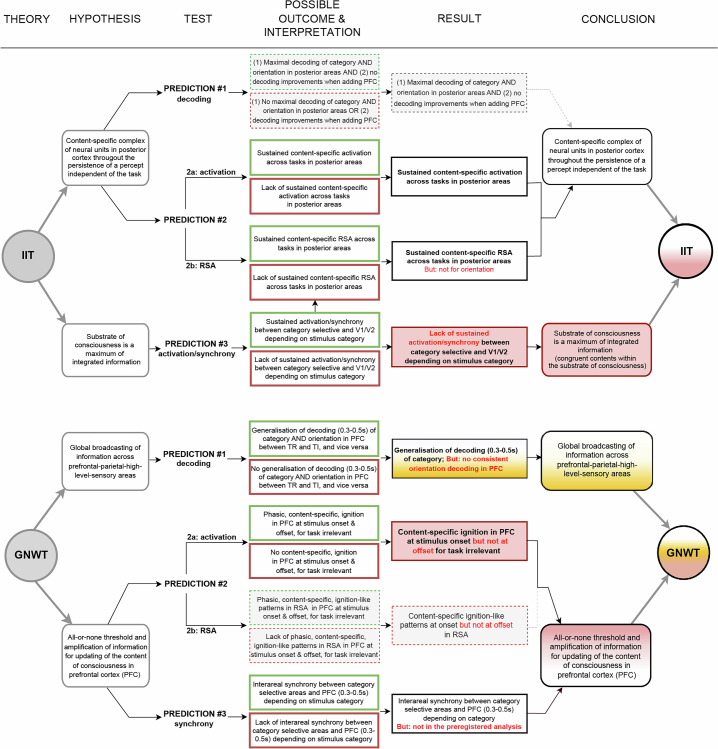
In a preregistered adversarial collaboration, 256 participants viewed suprathreshold visual stimuli while fMRI, MEG and iEEG measured neural activity to directly test integrated information theory (IIT) and global neuronal workspace theory (GNWT). Results aligned with some predictions of both theories but substantially challenged key tenets of each, especially sustained posterior synchronization for IIT and offset ignition/PFC content representation for GNWT.
Key findings
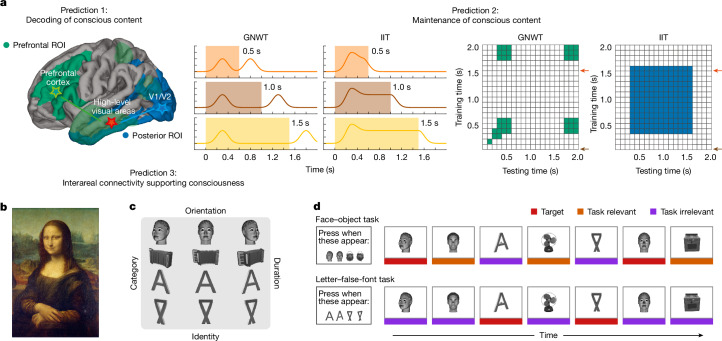
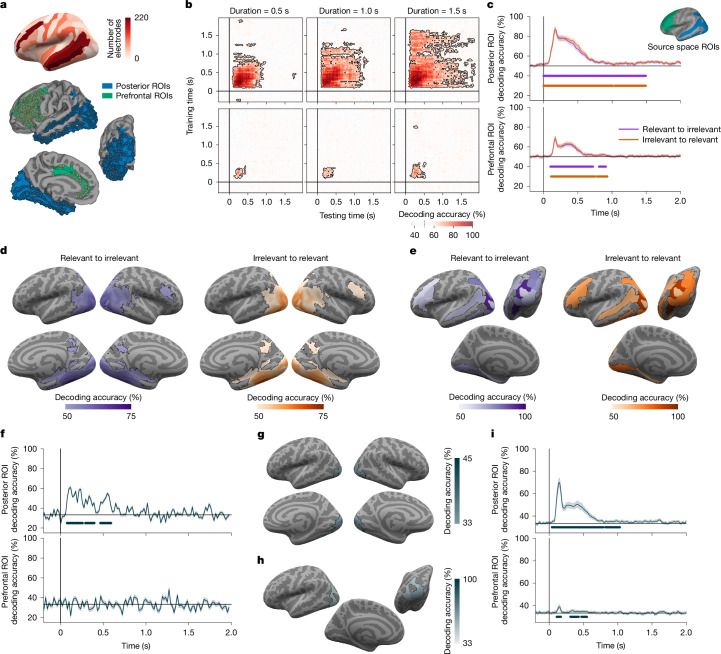
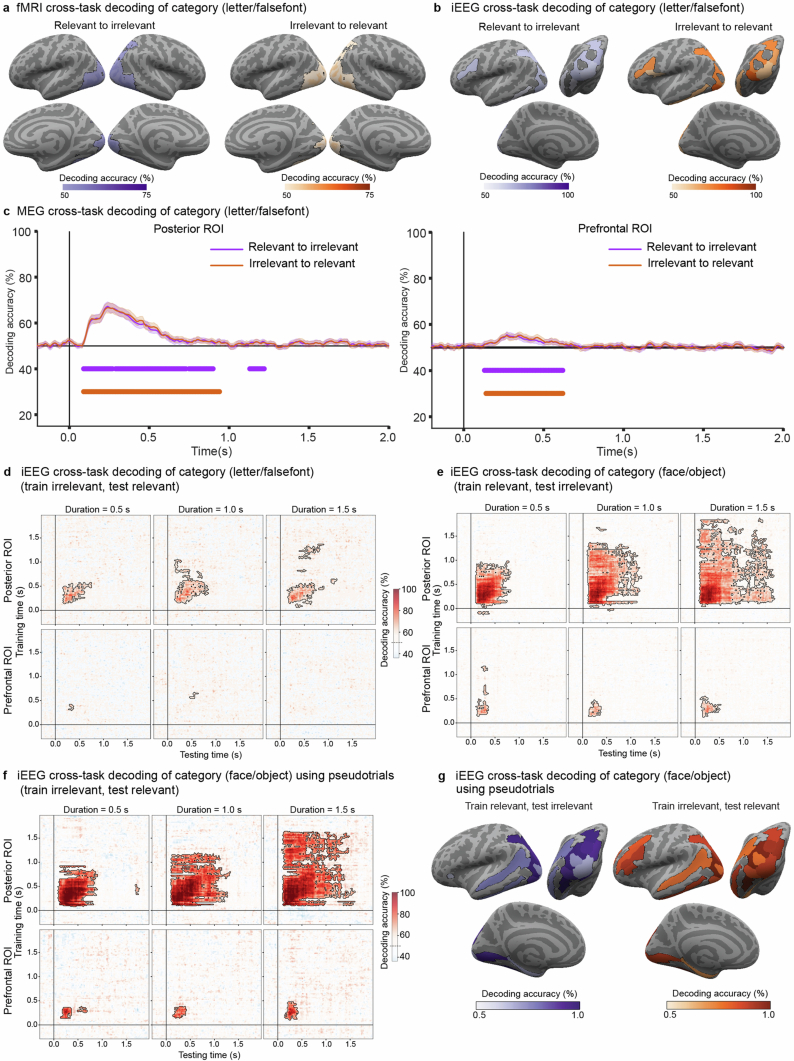
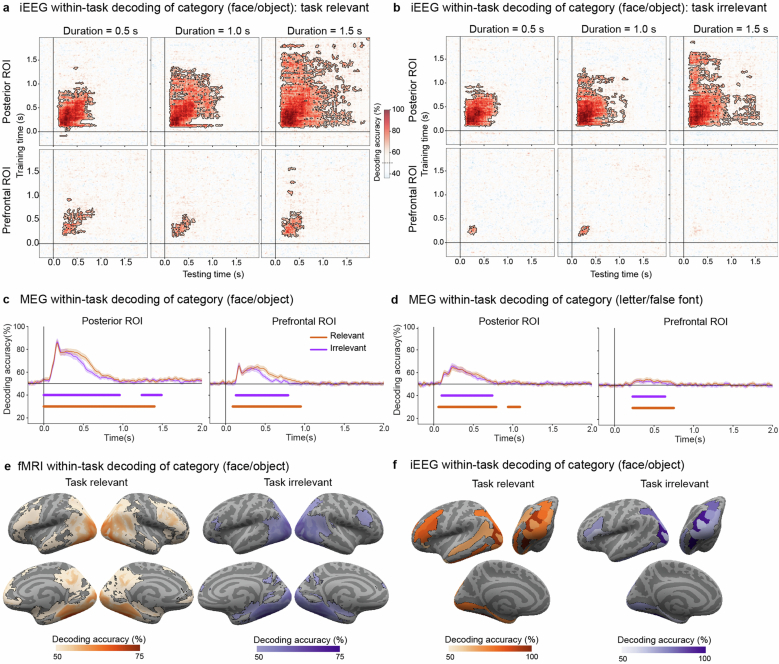
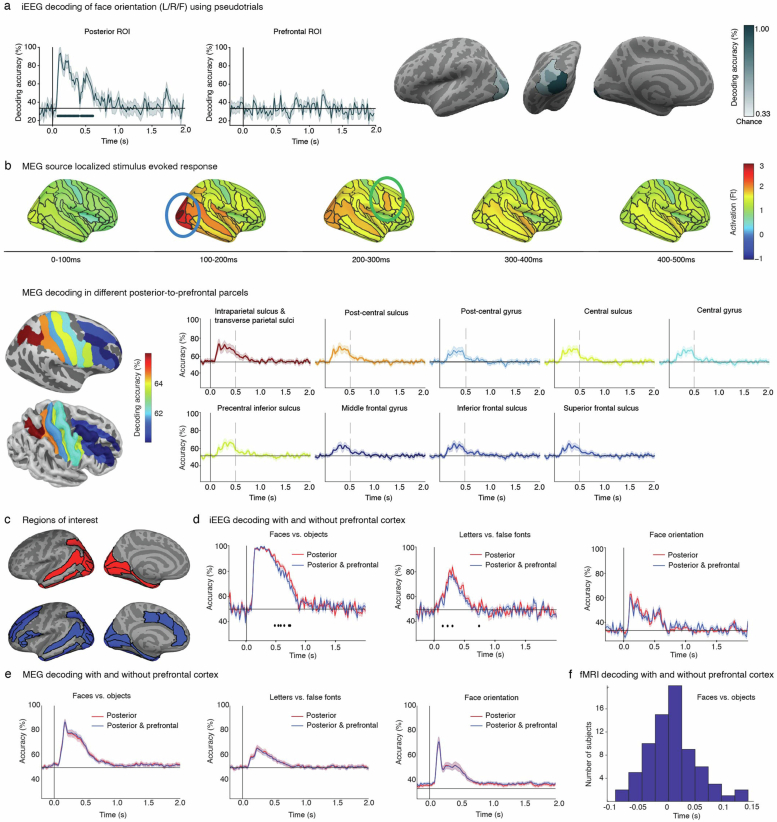
- Category decoding occurred in both posterior and prefrontal ROIs across modalities: iEEG posterior face–object decoding exceeded 95% cross-task accuracy, whereas PFC decoding was approximately 70% and restricted to approximately 0.2–0.4 s; fMRI showed approximately 75% posterior and approximately 60% PFC decoding. Orientation decoding was robust in posterior ROIs (iEEG approximately 95%, fMRI approximately 45%, MEG approximately 75%) but mostly absent in PFC (iEEG BF01 = 5.11–8.65; fMRI BF01 = 3–71.5 in 34–55% of PFC voxels). Adding PFC ROIs did not improve decoding, with strong Bayesian evidence against improvement (for example, face–object iEEG BF01 = 1.94 × 10⁴; MEG BF01 = 3.05).
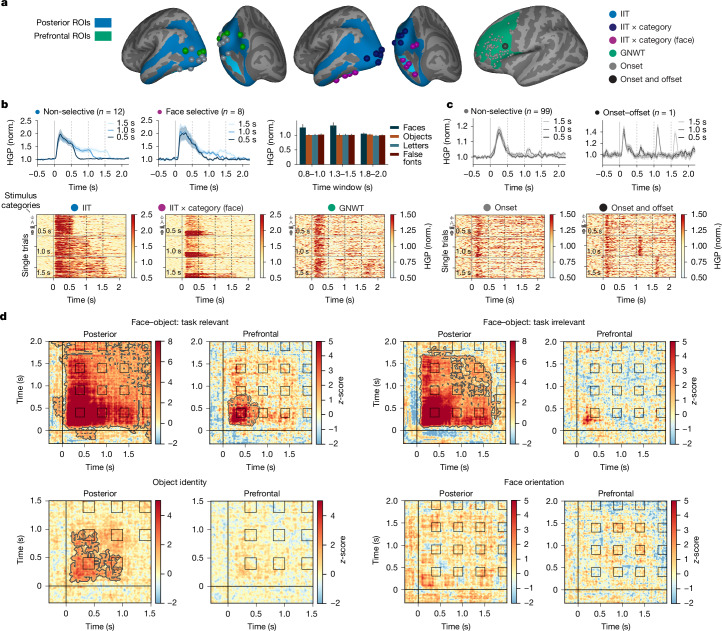
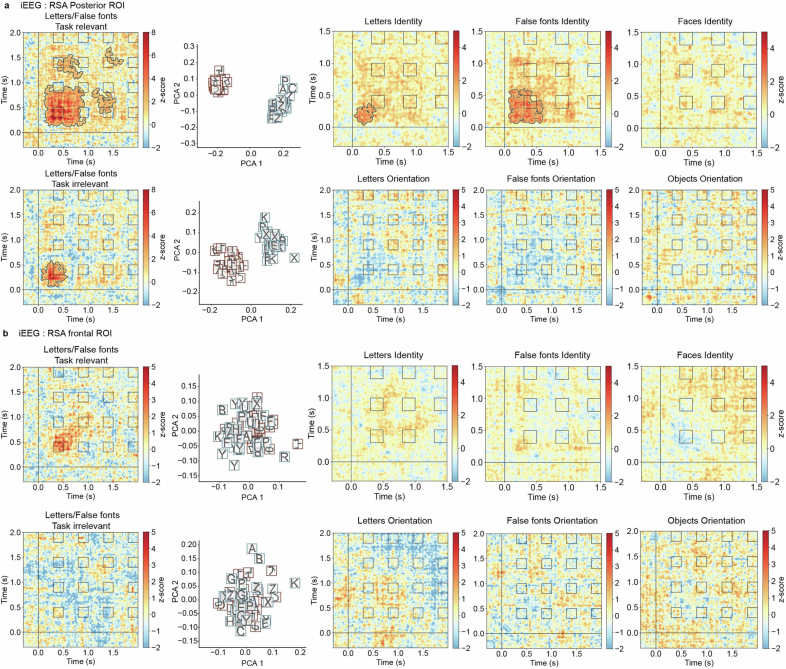
- For maintenance, 25 of 657 posterior iEEG electrodes showed sustained activity tracking stimulus duration, but only 15% (8 of 53) of face-selective electrodes did so; PFC showed 99 non-selective and 24 category-selective onset responses, yet none of 655 PFC electrodes showed the GNWT-predicted onset-and-offset profile (BF01 > 3 for all PFC electrodes). Cross-temporal RSA revealed sustained face–object representation in posterior cortex and transient onset-only representation in PFC, not offset.
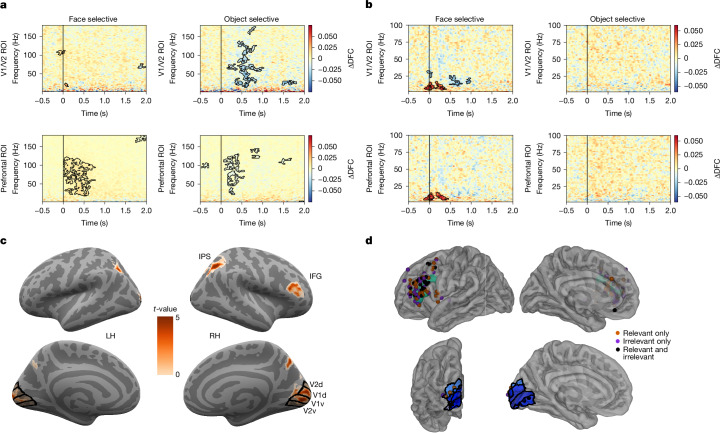
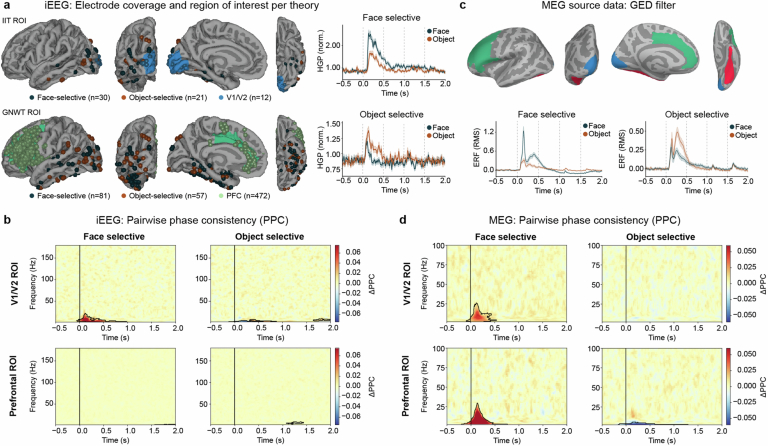
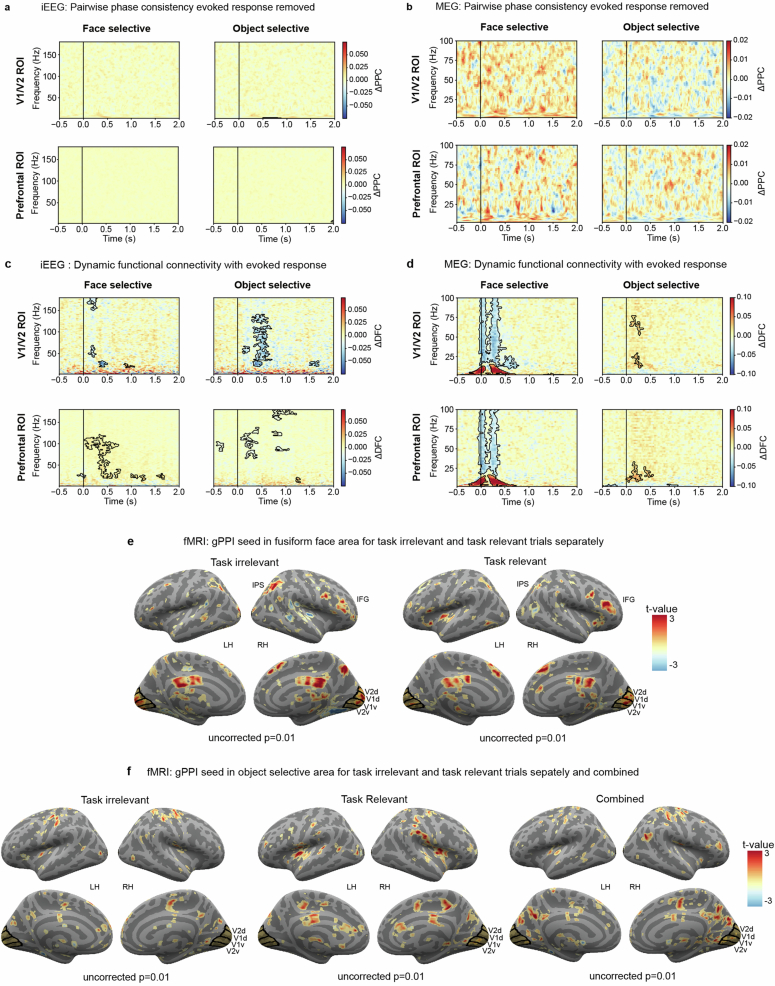
- For connectivity, the preregistered pairwise phase consistency metric supported neither theory. Exploratory dynamic functional connectivity in iEEG showed brief object-selective V1/V2 connectivity, predominantly in gamma, and PFC connectivity with both face- and object-selective areas in the GNWT-predicted window; fMRI generalized psychophysiological interaction showed FFA content-selective connectivity with V1/V2, inferior frontal gyrus and intraparietal sulcus, but no object-selective PFC/V1/V2 connectivity (62–94% of PFC voxels showed BF01 = 3–7.75 for the null).
Methods
- Preregistered adversarial collaboration with theory-neutral teams; 256 participants total (fMRI n = 120, MEG n = 102, iEEG n = 34), with reported replication analyses on MEG n = 65, fMRI n = 73 and iEEG n = 29 for decoding. Participants viewed single suprathreshold stimuli varying in category (faces, objects, letters, false fonts), identity, orientation (front, left, right) and duration (0.5, 1.0, 1.5 s), with task relevance manipulated across blocks.
- Multimodal design combined fMRI, MEG and iEEG; for MEG and fMRI, one-third of data were used for analysis optimization and two-thirds for preregistered replication testing, whereas iEEG used a different strategy due to data rarity. Analyses included cross-task decoding, linear mixed models of duration tracking, cross-temporal representational similarity analysis, pairwise phase consistency, dynamic functional connectivity, generalized psychophysiological interaction and Bayesian tests.
Limitations
- Stated in the paper: residual task engagement with category cannot be entirely ruled out; the approach falls short of encompassing full phenomenal richness; and the data lack single-unit recordings. The paper also notes sparse iEEG sampling of V1/V2 (12 electrodes versus 472 in PFC), possible MEG signal leakage from posterior regions, and that phase estimation from macroscopic recordings is susceptible to noise.
- Evident from the text: the biological focus means theorists could respond to challenges by modifying proposed biological implementations while retaining the mathematical or computational core, and some predictions overlap with other theories, so the results may not isolate IIT or GNWT uniquely.
Model-written summary. Check it against the paper before relying on it.
Integrity signals
Registry
Cites
Statistics
Figures
Verification
Claims the paper makes
16 Valid · 0 Not valid · 11 Not checked · 159 Own results and interpretations
The sources with a verdict support this claim; the rest weren’t checked yet, have no full text we could read, or their verdicts aren’t rated yet.
In the paper
“These results align with two independent studies using comparable methods42,43.”
§ Adversarial testing of global neuronal workspace and integrated information theories of consciousness > Maintenance of conscious content
What the sources say
- Supportedcites [42] Vishne, G., Gerber, E. M., Knight, R. T. & Deouell, L. Y. Distinct ventral stream and prefrontal cortex representational dynamics during sustained conscious visual perception. Cell Rep. 42, 112752 (2023). 37422763 PMC10530642 source
The Introduction describes an empirical study of visual perception in ten patients with implanted electrodes. The Results report time-resolved decoding and temporal-generalization analyses of visual representations, supporting the citation’s use as an example of an independent study using these methods. The citing sentence does not specify its own results, so the precise alignment cannot be assessed from this source alone. (LLM, conf=0.83)
- Not checked — no full text of the sourcecites [43] Broday-Dvir, R., Norman, Y., Harel, M., Mehta, A. D. & Malach, R. Perceptual stability reflected in neuronal pattern similarities in human visual cortex. Cell Rep. 42, 112614 (2023). 37285270 source
plainstates an association- Asserted: passes — The authors put it forward as true.
- Checkable: passes — It can be checked against evidence.
- Load-bearing: unclear — It is unclear whether the paper’s conclusions depend on it.
- Based: passes — The paper gives a reason why it holds.
- Supported
Every source the paper cites for this claim was checked and supports it.
In the paper
“This clear update to the content of consciousness should have been represented somehow by the global workspace12.”
§ Adversarial testing of global neuronal workspace and integrated information theories of consciousness > Discussion
What the sources say
- Supportedcites [12] Melloni, L. et al. An adversarial collaboration protocol for testing contrasting predictions of global neuronal workspace and integrated information theory. PLoS ONE 18, e0268577 (2023). 36763595 PMC9916582 source
The Introduction’s ‘Differential predictions of the theories’ section says that GNW expects a brief ignition at stimulus offset when the offset is consciously detected and updates the conscious internal model. The planned-analyses section likewise describes possible workspace ignitions at offset as updates to conscious perception. These passages support the claim about a consciously experienced change at the onset of a blank screen; the prediction is conditional on that change being consciously detected. (LLM, conf=0.90)
boostedstates a cause- Asserted: passes — The authors put it forward as true.
- Checkable: passes — It can be checked against evidence.
- Load-bearing: passes — The paper’s conclusions depend on it.
- Based: passes — The paper gives a reason why it holds.
- Rests on an assumption not shown here.
- Supported
The sources with a verdict support this claim; the rest weren’t checked yet, have no full text we could read, or their verdicts aren’t rated yet.
In the paper
“This departs from the traditional contrastive method, which compares the presence and absence of consciousness but conflates it with other cognitive processes (for example, decision-making or memory formation)56–58.”
§ Adversarial testing of global neuronal workspace and integrated information theories of consciousness > Discussion
What the sources say
- Supportedcites [56] Aru, J., Bachmann, T., Singer, W. & Melloni, L. Distilling the neural correlates of consciousness. Neurosci. Biobehav. Rev. 36, 737–746 (2012). 22192881 source
Section 1.1 describes contrastive analysis as comparing trials with and without conscious perception. The Conclusions state that this comparison can confound the neural correlates of consciousness with processes that precede or follow perception; sections 2.2 and 2.3 give decision bias and memory formation as examples of such processes. (LLM, conf=0.91)
- Supportedcites [57] Lepauvre, A. & Melloni, L. The search for the neural correlate of consciousness: progress and challenges. Philos. Mind Sci.10.33735/phimisci.2021.87 (2021). source
Section 1.1 describes the contrastive method as comparing conscious and unconscious states or contents. Section 1.2 says this comparison can confound the neural correlate of consciousness with other processes, explicitly naming memory encoding and decision-making. (LLM, conf=0.94)
- Not checked — no full text of the sourcecites [58] Tsuchiya, N., Wilke, M., Frässle, S. & Lamme, V. A. F. No-report paradigms: extracting the true neural correlates of consciousness. Trends Cogn. Sci. 19, 757–770 (2015). 26585549 source
plainstates a cause- Asserted: passes — The authors put it forward as true.
- Checkable: passes — It can be checked against evidence.
- Load-bearing: passes — The paper’s conclusions depend on it.
- Based: passes — The paper gives a reason why it holds.
- Supported
Every source the paper cites for this claim was checked and supports it.
In the paper
“the prediction of GNWT about PFC is shared by those higher-order theories of consciousness that hypothesize that PFC actually supplies the content of visual consciousness (for example, ref. 17)”
§ Adversarial testing of global neuronal workspace and integrated information theories of consciousness > Discussion
What the sources say
- Supportedcites [17] Brown, R., Lau, H. & LeDoux, J. E. Understanding the higher-order approach to consciousness. Trends Cogn. Sci. 23, 754–768 (2019). 31375408 source
In the section discussing whether HOT locates consciousness in PFC (page not provided), the paper distinguishes theories that use PFC to index visual content in sensory areas from HOROR theory, in which the higher-order state in PFC itself is phenomenally conscious. That supports the citing sentence’s qualified reference to those higher-order theories that assign PFC a more direct role in conscious content; it does not imply that all higher-order theories do so. (LLM, conf=0.85)
plainstates an association- Asserted: passes — The authors put it forward as true.
- Checkable: passes — It can be checked against evidence.
- Load-bearing: passes — The paper’s conclusions depend on it.
- Based: passes — The paper gives a reason why it holds.
- Supported
A result the paper reports from its own data — it cites no other source for it, so there is none to check. The quote shows it is in the paper.
In the paper
“In posterior cortex ROIs, 25 electrodes (out of 657) measured sustained activity tracking stimulus duration”
§ Adversarial testing of global neuronal workspace and integrated information theories of consciousness > Maintenance of conscious content
plainstates an association- Asserted: passes — The authors put it forward as true.
- Checkable: passes — It can be checked against evidence.
- Load-bearing: passes — The paper’s conclusions depend on it.
- Based: passes — The paper gives a reason why it holds.
- Rests on an assumption not shown here.
86 more claims
Create a free account to see all 186 claims and to verify the 3 references still open.
- It may state two separate claims as one. 46
- Probably not a substantial claim. 59
- The quote only partly states this claim. 2
Claims other papers make about this one
Each is checked against this paper’s own text: does it say what the citing paper says it does?
The source backs part of the claim, not all of it — or backs it for a different population, condition or comparison.
In the citing paper
“Adversarial experiments typically generate mixed results that do not fully confirm the predictions of one theoretical position or another”
From Integrated information and predictive processing theories of consciousness: An adversarial collaborative review (2026) · cites this paper as Cogitate Consortium et al., 2025
Experimental — accuracy not yet measuredThe cited source says what the claim attributes to it.
In the citing paper
“while contemporary theories [2,3] and recent adversarial collaborations [49] often omit explicit claims about how subcortical structures like the thalamus support conscious states and content (but see [4,31,50–52]) despite its known importance [40,44,53–55]”
From Testing circuit-level theories of consciousness in humans (2026) · cites this paper as [49]
Self-check
Percentages, sums and reported differences re-computed from the paper’s own numbers.
Each contradiction between two passages listed here was confirmed by an independent check.
Rated minor: it would not touch a result — a value no result rests on, a p-value that stays on the same side of the significance level, or a conflict that is clerical, resolved elsewhere in the paper, or outside its own findings.
In the paper
§ Adversarial testing of global neuronal workspace and integrated information theories of consciousness > Decoding of conscious content
“the theories would pass the test if decoding is possible for both category (in at least one category pairing) and orientation (in at least one category), but would fail otherwise.”
§ Adversarial testing of global neuronal workspace and integrated information theories of consciousness > Discussion
“We adopted a lenient falsificationist approach, in which evidence for any tested feature (for example, decoding of category or orientation) was sufficient to rule out failure, rather than requiring consistency across all features.”
Rated minor: it would not touch a result — a value no result rests on, a p-value that stays on the same side of the significance level, or a conflict that is clerical, resolved elsewhere in the paper, or outside its own findings.
In the paper
§ Adversarial testing of global neuronal workspace and integrated information theories of consciousness > Interareal connectivity
“Given the sparse electrode coverage, the requirement to focus on ‘activated’ electrodes (see Methods) was relaxed, although restricting it to only activated electrodes yielded similar results.”
§ Adversarial testing of global neuronal workspace and integrated information theories of consciousness > Methods > Analysis strategy
“For iEEG, the PPC analysis included electrodes in V1/V2 visual areas, in PFC ROIs (see Supplementary Table 26), and face-selective and object-selective electrodes (see ‘Identification of task-responsive channels’), as long as they were ‘active’ during the task.”
Citations
Cites
Controlling the False Discovery Rate: A Practical and Powerful Approach to Multiple Testing
Benjamini, Y., & Hochberg, Y. (1995) · Journal of the Royal Statistical Society Series B: Statistical Methodology · doi:10.1111/j.2517-6161.1995.tb02031.x · Cited by 109,482 · cited 7×
“FDR was used to correct for multiple comparisons across ROIs.”
InfluentialMatplotlib: a 2D graphics environment
Hunter, J. D. (2007) · Computing in Science & Engineering · doi:10.1109/mcse.2007.55 · Cited by 39,249 · cited 1×
“Plots were generated using Matplotlib (3.3.2) 109 .”
InfluentialSciPy 1.0: fundamental algorithms for scientific computing in Python
Virtanen, P., Gommers, R., Oliphant, T. E., Haberland, M., Reddy, T., Cournapeau, D., Burovski, E., Peterson, P., Weckesser, W., Bright, J., et al. (2020) · Nature Methods · doi:10.1038/s41592-019-0686-2 · Cited by 38,430 · cited 1×
“Additional, analysis-specific, fMRI data preprocessing was performed using FSL 6.0.2 (FMRIB Software Library) 94 , Statistical Parametric Mapping (SPM 12) software 95 , and custom Python scripts (using NiBabel (3.2.2) 96 and SciPy (1.8.0) 97 after the above-outlined general preprocessing.”
InfluentialHarris, C. R., Millman, K. J., van der Walt, S. J., Gommers, R., Virtanen, P., Cournapeau, D., Wieser, E., Taylor, J., Berg, S., Smith, N. J., et al. (2020) · Nature · doi:10.1038/s41586-020-2649-2 · Cited by 23,826
Harris, C., Millman, K., van der Walt, S., Gommers, R., Virtanen, P., Cournapeau, D., Wieser, E., Taylor, J., Berg, S., Smith, N., et al. (2020) · RePEc: Research Papers in Economics · Cited by 17,844
Advances in functional and structural MR image analysis and implementation as FSL
Smith, S. M., Jenkinson, M., Woolrich, M. W., Beckmann, C. F., Behrens, T. E. J., Johansen-Berg, H., Bannister, P. R., De Luca, M., Drobnjak, I., Flitney, D. E., et al. (2004) · NeuroImage · doi:10.1016/j.neuroimage.2004.07.051 · Cited by 13,630
Desikan, R. S., Ségonne, F., Fischl, B., Quinn, B. T., Dickerson, B. C., Blacker, D., Buckner, R. L., Dale, A. M., Maguire, R. P., Hyman, B. T., et al. (2006) · NeuroImage · doi:10.1016/j.neuroimage.2006.01.021 · Cited by 13,324 · cited 1×
“Single-trial covariance matrices were computed separately for signal and reference for all vertices within the fusiform ROI identified from the FreeSurfer parcellation using the Desikan atlas 116 , and the Euclidean distance between them was z -scored.”
The VideoToolbox software for visual psychophysics: transforming numbers into movies
Pelli, D. G. (1997) · Spatial Vision · doi:10.1163/156856897x00366 · Cited by 11,098
Data Structures for Statistical Computing in Python
McKinney, W. (2010) · Proceedings of the Python in Science Conference · doi:10.25080/majora-92bf1922-00a · Cited by 11,032
Cortical Surface-Based Analysis
Dale, A. M., Fischl, B., & Sereno, M. I. (1999) · NeuroImage · doi:10.1006/nimg.1998.0395 · Cited by 10,910
Research works printed but not linked: 5
- Dehaene, S. Consciousness and the Brain: Deciphering How the Brain Codes Our Thoughts (Penguin, 2014).
- Jackendoff, R. Consciousness and the Computational Mind (MIT Press, 1987).
- Popper, K. The Logic of Scientific Discovery (Routledge, 1935).
- Penny, W., Friston, K., Ashburner, J., Kiebel, S. & Nichols, T. Statistical Parametric Mapping: the Analysis of Funtional Brain Images 1st edn (Elsevier/Academic Press, 2007).
- Nadeau, C. & Bengio, Y. in Advances in Neural Information Processing Systems 12 (eds Solla, S. A., Leen, T. K. & Müller, K.-R.) 307–313 (MIT Press, 2000).
Cited by
Consciousness science: where are we, where are we going, and what if we get there?
Cleeremans, A., Mudrik, L., & Seth, A. K. (2025) · Frontiers in Science · doi:10.3389/fsci.2025.1546279 · Cited by 52
Self-citationBodien, Y. G., Busl, K. M., Chang, C. W. J., Claassen, J., Gaspard, N., Gosseries, O., Helbok, R., Massimini, M., Naccache, L., Newcombe, V., et al. (2025) · Intensive Care Medicine · doi:10.1007/s00134-025-08224-1 · Cited by 37
Kurkin, S., Mayorova, L. A., Khorev, V. S., Николаевна, П. Е., Radutnaya, M., Леонидовна, Б. Е., & Hramov, A. E. (2025) · Chaos Solitons & Fractals · doi:10.1016/j.chaos.2025.117008 · Cited by 21
Sandved-Smith, L., Bogotá, J. D., Hohwy, J., Kiverstein, J. D., & Lutz, A. (2025) · Neuroscience of Consciousness · doi:10.1093/nc/niaf016 · Cited by 36
Covert consciousness: what’s in a name?
Aubinet, C., Claassen, J., Edlow, B. L., Fischer, D. B., Gosseries, O., Koch, C., Kondziella, D., Massimini, M., & Young, M. J. (2025) · Brain · doi:10.1093/brain/awaf349 · Cited by 13
“9-11 In parallel, advances in the clinical arts and in resuscitation technologies and infrastructure enabled patients with severe brain injuries due to cardiac arrest, traumatic brain injury, stroke or opioid overdose to survive.”
Self-citationMake science more collegial: why the time for ‘adversarial collaboration’ has come
(2025) · Nature · doi:10.1038/d41586-025-01379-3 · Cited by 13
Towards a Possible Definition of Consciousness
Vitas, M. (2025) · BioSystems · doi:10.1016/j.biosystems.2025.105526 · Cited by 9
Neural correlates of consciousness in an auditory no-report fMRI study
Dellert, T., Balster, H., Schloßmacher, I., Bruchmann, M., Moeck, R., & Straube, T. (2025) · Current Biology · doi:10.1016/j.cub.2025.10.026 · Cited by 15
On a confusion about there being two types of consciousness
Mudrik, L., Faivre, N., Pitts, M. A., & Schurger, A. (2025) · Trends in Cognitive Sciences · doi:10.1016/j.tics.2025.11.012 · Cited by 15
Self-citationNeural correlates of pure presence
Boly, M., Smith, R., Borrego, G. V., Pozuelos, J. P., Alauddin, T., Malinowski, P., & Tononi, G. (2024) · doi:10.1101/2024.04.18.590081 · Cited by 7
Self-citationNaccache, L., Sergent, C., Dehaene, S., Wang, X.-J., Farisco, M., & Changeux, J. (2025) · Neuroscience of Consciousness · doi:10.1093/nc/niaf037 · Cited by 15
“In these conditions, a systematic awareness of stimulus offset seems unlikely (as stressed on p.122 of the Supplementary Online Material of (Cogitate et al. 2025) by S.D.).”
Self-citationSeedat, A., Lepauvre, A., Jeschke, J., Górska, U., Armendáriz, M., Bendtz, K., Henin, S. E., Hirschhorn, R., Brown, T., Jensen, E., et al. (2025) · Scientific Data · doi:10.1038/s41597-025-04833-z · Cited by 9
Self-citationFragmentation and multithreading of experience in the default-mode network
Yazin, F., Majumdar, G., Bramley, N. R., & Hoffman, P. (2025) · Nature Communications · doi:10.1038/s41467-025-63522-y · Cited by 13
“Indeed, such an ambiguous conclusion was observed in a recent adversarial experiment 61 , which pit these two theories against each other.”
EMI model: A scale free biophysical framework for human consciousness, cognition and behaviour
Firaux, T., Tuszyński, J. A., & Cavaglià, M. (2025) · Biosystems · doi:10.1016/j.biosystems.2025.105674 · Cited by 7
Строение атома с точки зрения гипотезы Acta Universi (AU)Preprint
Ященко, Д. (2026) · doi:10.24108/preprints-3116374 · Cited by 4
Testing circuit-level theories of consciousness in humans
Dykstra, A. R., Zhu, Y., Fernandez Pujol, C., Zhou, D. W., Jones, S. R., Marvan, T., & Bonaiuto, J. J. (2026) · Trends in Cognitive Sciences · doi:10.1016/j.tics.2025.08.012 · Cited by 3
“Finally, while contemporary theories [2,3] and recent adversarial collaborations [49] often omit explicit claims about how subcortical structures like the thalamus support conscious states and content (but see [4,31,50 – 52]) despite its known importance [40,44,53 – 55], both AAT and DIT outline…”
Confronting the connectivity crisis in human M/EEG research
Jensen, O. B., Park, H., & Ferrante, O. (2025) · Trends in Cognitive Sciences · doi:10.1016/j.tics.2025.09.001 · Cited by 4
“…oscillatory interactions, for example, in the gamma band, have often been proposed to reflect task-modulated interareal functional connectivity [1,3,4], there are few findings based on data from electroencephalography (EEG) or magnetoencephalography (MEG) that replicate across tasks and…”
Self-citationAdversarial Collaboration as a Strategy for Credible Biomedical Science
Kent, D., & Ioannidis, J. P. A. (2026) · JAMA · doi:10.1001/jama.2025.23911 · Cited by 5
Beta and Gamma Dynamics in Attentional Networks Predict Conscious Reports
Spagna, A., Liu, J., & Bartolomeo, P. (2026) · Journal of Neuroscience · doi:10.1523/jneurosci.0590-25.2026 · Cited by 8
The multiple generator hypothesis of consciousness
Kirkeby-Hinrup, A., Fink, S. B., & Overgaard, M. S. (2025) · Neuroscience of Consciousness · doi:10.1093/nc/niaf035 · Cited by 5
“…is not a call to arms, but merely to highlight an unexplored area opened up by the MGH. Targeted approaches, such as scrutinizing the COGITATE data (Melloni et al. 2023; Consortium et al. 2025) in light of the MGH are promising (and less labor-intensive) a lterna-tives to full scale revisionism.”
Shoham, A., Broday-Dvir, R., Yaron, I., Yovel, G., & Malach, R. (2025) · Communications Biology · doi:10.1038/s42003-025-08497-8 · Cited by 6
Schiffer, F. (2025) · Medical Hypotheses · doi:10.1016/j.mehy.2025.111738 · Cited by 5
Without birth, without death—issues in the research of nondual awareness or consciousness itself
Josipovic, Z. (2025) · Frontiers in Psychology · doi:10.3389/fpsyg.2025.1665826 · Cited by 3
A methodological guideline for consciousness assessment via neural electrophysiological activity
Ping, A., Guan, L.-Z., Wang, Y., Yang, S., Yang, C., Hu, X., Tu, Y., Chen, H., Li, W., & Li, X. (2025) · Military Medical Research · doi:10.1186/s40779-025-00682-4 · Cited by 3
“Over the past decades, advances in neuroimaging have accelerated research on the neural correlates of consciousness (NCC), the minimal neural mechanisms sufficient to support specific conscious experiences [1–4].”
Self-citationSynchronization, Information, and Brain Dynamics in Consciousness Research
Esteban, F. J., Vargas, E., Langa, J. A., & Toscano, F. S. (2026) · Applied Sciences · doi:10.3390/app16021056 · Cited by 4
Gibbons, M., McBride, E. G., Venkatasubbaiah, R. H., Khalili‐Ardali, M., Kuyat, J. R., Gale, S., LaFehr, V., Vogler, N. W., Ravandi, M. A. K., Tsai, M.-J., et al. (2026) · PLoS ONE · doi:10.1371/journal.pone.0342770 · Cited by 3
Self-citationAgent Behavior Prediction Based on a Dynamic Cognitive Model
Palagin, O., Symonov, D., & Symonova, O. (2026) · Cybernetics and Systems Analysis · doi:10.1007/s10559-026-00856-5 · Cited by 2
Bandara, K. H., Rowe, E., & Garrido, M. I. (2025) · Neuroscience of Consciousness · doi:10.1093/nc/niaf033 · Cited by 3
“This has been best exemplified by a recent large-scale adversarial collaboration (Cogitate Consortium 2025).”
Newen, A., & Montemayor, C. (2025) · Philosophical Transactions of the Royal Society B Biological Sciences · doi:10.1098/rstb.2024.0314 · Cited by 11
“…highlight that despite all the differences, all three theories insist that neocortical areas are essential for processing phenomenal consciousness: IIT predicts a key role for processing conscious content in posterior cortex, whereas GNWT emphasizes a necessary role for the prefrontal cortex [47].”
Corcoran, A. W., Haun, A. M., Dorman, R., Tononi, G., Friston, K. J., & Pennartz, C. M. A. (2026) · Neuroscience & Biobehavioral Reviews · doi:10.1016/j.neubiorev.2026.106742 · Cited by 2
Self-citationThree arguments against metaphysical structuralism in consciousness research
Negro, N. (2025) · Synthese · doi:10.1007/s11229-025-05103-6 · Cited by 7
Are You a Closet Dualist? Evidence From Brief Implicit Association Task
Berent, I., & Sansiveri, A. (2025) · Open Mind · doi:10.1162/opmi.a.7 · Cited by 2
“” Indeed, Dualism remains a topic of lively debate in philosophy; the controversy regarding the “ hard problem of consciousness ” presents a notable example (e.g., Chalmers, 1996; Cogitate Consortium et al., 2025).”
Value saturation: Architecture of subjective necessity
Trukovich, J. J. (2025) · Biosystems · doi:10.1016/j.biosystems.2025.105642 · Cited by 1
There can be more to consciousness research than theory testing
Overgaard, M. S., Fazekas, P., Kirkeby-Hinrup, A., et al. (2025) · Communications Psychology · doi:10.1038/s44271-025-00357-9 · Cited by 1
From rivals to partners: adversarial collaboration in ecology and evolution
Gefaell, J., & Uller, T. (2025) · Trends in Ecology & Evolution · doi:10.1016/j.tree.2025.11.001 · Cited by 2
The performance of mind: from movement, mental states, and consciousness
Cheron, G. A., & Cebolla, A. M. (2026) · Frontiers in Psychology · doi:10.3389/fpsyg.2025.1736933 · Cited by 1
Analyzing the concept of independence in psychedelic research
Cheung, K., Ehrenkranz, R. C., Earp, B. D., Jacobs, E., & Yaden, D. B. (2026) · Accountability in Research · doi:10.1080/08989621.2025.2601225 · Cited by 1
“This adversarial collaboration involves two theories of consciousness (global neuronal workspace theory and integrated information theory), and aims to provide substantial evidence for one, or another, of the theories (Cogitate Consortium, Ferrante et al. 2025).”
Three propositions about conscious experience and their implications for theories of consciousness
White, P. A. (2026) · Consciousness and Cognition · doi:10.1016/j.concog.2026.103994 · Cited by 2
Inferring neural sources from electroencephalography: foundations and frontiers
Phillips, A. R., Vakilna, Y. S., EPMoghaddam, D., Banta, A. R., Mosher, J. C., & Aazhang, B. (2026) · Journal of Neural Engineering · doi:10.1088/1741-2552/ae3e16 · Cited by 8
Human superior colliculus pathways represent the form and motion of looming objects
Thieu, M. K., Sethi, M., Aberman, E., & Kragel, P. A. (2026) · Cell Reports · doi:10.1016/j.celrep.2026.117033 · Cited by 2
“41,42 106 Consistent with these perspectives, neural decoding studies have demonstrated that the content of visual awareness can be read out from neural activity within visual, parietal, and prefrontal cortices 45,107,108 but not from signals in the midbrain.”
A neuroscientific hypothesis on the physical nature of consciousness
Ukachoke, C. (2026) · Frontiers in Human Neuroscience · doi:10.3389/fnhum.2026.1758344 · Cited by 1
“Mechanisms commonly invoked include reentrant processing, synchronous oscillations, gamma-band resonances, and predictive coding (Del Pin et al., 2021; Doerig et al., 2021; Sattin et al., 2021; Signorelli et al., 2021; Seth and Bayne, 2022; Storm et al., 2024; Cogitate Consortium et al., 2025).”
Human consciousness and cognition go hand in hand, but require different types of explanations
Boly, M. (2026) · Aperture Neuro · doi:10.52294/001c.158354 · Cited by 2
Self-citationBiological Complexity and Cognitive Evolution
Jedlička, P., Varchola, J., & Betinsky, J. (2026) · Biological Theory · doi:10.1007/s13752-026-00532-z · Cited by 1
Explanation, scope, and perspective: sources of schismogenesis in consciousness science
Ellia, F., & Tsuchiya, N. (2026) · Trends in Cognitive Sciences · doi:10.1016/j.tics.2026.03.005 · Cited by 6
Bhatla, N., Cheong, K. C. T., Takahashi, S., Lay, C., Fiedeldey, M., Liang, K., Mao, M., Wu, Y.-F., Lu, S., Yun, K., et al. (2026) · Current Biology · doi:10.1016/j.cub.2026.03.031 · Cited by 3
“Empirical and theoretical work has connected a variety of brain areas and activity patterns to subjective experience, 1–8 but testing whether these cause conscious experiences in humans remains challenging because the causal interventions that would be required are imprecise, of insufficient scale,…”
Advances of conductive hydrogel materials in bioelectronics for electrophysiological monitoring
Zhong, H., Tang, X., Chen, X., Zhan, Y., Gao, S., & Sun, Q. (2026) · Applied Materials Today · doi:10.1016/j.apmt.2026.103231 · Cited by 8
Tretter, F., Löffler‐Stastka, H., Braun, H., Schleim, S., Falkenburg, B., Hastedt, H., Northoff, G., Fuchs, T., Kotchoubey, B., Maderthaner, R., et al. (2026) · Frontiers in Integrative Neuroscience · doi:10.3389/fnint.2026.1792478 · Cited by 3
“In this situation, an epistemological perspective might be useful to assess the explanatory potential of different theories (Stefanelli, 2023; Cogitate Consortium et al., 2025).”
Clarifications about there being two necessary conditions for consciousness
Mudrik, L., Faivre, N., Pitts, M., & Schurger, A. (2026) · Trends in Cognitive Sciences · doi:10.1016/j.tics.2026.06.003 · Cited by 1
Self-citationThe Physiology of Mental Representations: From Single Neurons to Circuits
Constantinidis, C., Everling, S., Treue, S., Wong, R. K., Wang, M., Yang, S., & Martínez-Trujillo, J. (2026) · Biological Psychiatry · doi:10.1016/j.biopsych.2026.09.009 · Cited by 1
Self-citationGlymphoVasomotor Field (GVF) theory: a non-neuronal scaffolding for brain rhythms and consciousness
Bhatt, S. S., Sbaih, O. I., Habermann, S., Shahrour, N., Weatherdon, E., & Tornatore, C. (2025) · Medical Hypotheses · doi:10.1016/j.mehy.2025.111763 · Cited by 2
Chis-Ciure, R. (2025) · Philosophical Explorations · doi:10.1080/13869795.2025.2550245 · Cited by 3
“There is no consensus on a paradigm to study the problem (Chis-Ciure, Melloni, and Northoff 2024; Cogitate Consortium et al. 2025; Melloni et al. 2021; Michel et al. 2019; Yaron et al. 2022) – the recent exchange between Klincewicz et al. (2025) and Tononi et al. (2025) tells it all – which means…”
Escolà‐Gascón, Á., Drinkwater, K. G., Denovan, A., Dagnall, N., & Benito‐León, J. (2025) · Neuroscience & Biobehavioral Reviews · doi:10.1016/j.neubiorev.2025.106430 · Cited by 2
Bandara, K. H., Rowe, E., & Garrido, M. I. (2024) · bioRxiv (Cold Spring Harbor Laboratory) · doi:10.1101/2024.11.02.621640 · Cited by 1
Dayathilake, K. L. S. (2025) · doi:10.33774/coe-2022-m70hf-v20
Dayathilake, K. L. S. (2025) · doi:10.33774/coe-2022-m70hf-v21
Common Phenomenal and Neural Substrate Geometry in Visual Motion PerceptionPreprint
Robinson, K., Zeleznikow-Johnston, A., Wu, J., Yoshimura, Y., & Tsuchiya, N. (2025) · bioRxiv (Cold Spring Harbor Laboratory) · doi:10.1101/2025.10.01.679834 · Cited by 2
“…and flexibilities in possible parameter spaces that need to be tested for such computation (Leung et al., 2021), we strongly recommend such a project to be reviewed in the Registered Report format (Nosek and Lakens, 2014; Rowe et al., 2024; Cogitate Consortium et al., 2025; Leung et al., 2025).”
Six Theories Quietly Agree That Consciousness Is ExperiencePreprint
Stewart, A. (2026) · SSRN Electronic Journal · doi:10.2139/ssrn.7025719 · Cited by 3
Can Consciousness Nudge Randomness?Preprint
Holmberg, U. (2025) · doi:10.31219/osf.io/epbdt_v2
Randomness, Quantum Uncertainty, and Emergence: A Suggestion for Testing the Seemingly UntestablePreprint
Schilling, A. (2025) · Preprints.org · doi:10.20944/preprints202601.0792.v2
Neural correlates of consciousness in an auditory no-report fMRI studyPreprint
Dellert, T., Balster, H., Schloßmacher, I., Bruchmann, M., Moeck, R., & Straube, T. (2025) · bioRxiv (Cold Spring Harbor Laboratory) · doi:10.1101/2025.05.16.654468 · Cited by 2
Truth and Reality: An Interdisciplinary-Holistic Framework
Călınescu, A. (2025) · Integrated Journal for Research in Arts and Humanities · doi:10.55544/ijrah.5.4.10
Truth and Reality: An Interdisciplinary-Holistic FrameworkPreprint
anon, A. (2025) · SSRN Electronic Journal · doi:10.2139/ssrn.5364220
Imagined Speech Reconstruction with 3D Neural Metabolism and Large Language Model IntegrationPreprint
Rajagopal, G., Chaudhari, A., LaRocco, J., Xue, J., Zachariah, E., Varanasi, S., & Rothman, D. L. (2025) · bioRxiv (Cold Spring Harbor Laboratory) · doi:10.1101/2025.07.30.667805 · Cited by 1
Hope, A. (2025) · Lodz Papers in Pragmatics · doi:10.1515/lpp-2024-0030
James, O., & Kim, Y. (2025) · bioRxiv (Cold Spring Harbor Laboratory) · doi:10.1101/2025.09.24.677967
Huang, L. (2025) · Review of General Psychology · doi:10.1177/10892680251380430 · Cited by 2
Consciousness: Moving forward by going backward
Koch, C. (2025) · Current Biology · doi:10.1016/j.cub.2025.10.073
Self-citationIntegrated Workspace with Subjective Modeling (IWSM) Theory of ConsciousnessPreprint
Muhlert, M. (2025) · SSRN Electronic Journal · doi:10.2139/ssrn.5681532
États modifiés de la conscience : Revue systématique PRISMA et preuve de concept
Rajadurai, G. K., Fahim, C., Nicole, S., & Martin-Söelch, C. (2025) · Cortica · doi:10.26034/cortica.2025.8924
Automatic binding of basic sensory features requires consciousnessPreprint
Han, Z., Zhu, H., Chu, Q., Wu, Y., Chen, X., Wang, Y., Li, S., Teng, X., Wong, P. C. M., Yao, C., et al. (2025) · bioRxiv (Cold Spring Harbor Laboratory) · doi:10.64898/2025.12.10.693567 · Cited by 1
Noise-induced maximization of integrated information in FitzHugh-Nagumo networks
Li, Z., & Zaikin, A. A. (2026) · Physical Review Research · doi:10.1103/dftc-vzvv · Cited by 1
A late meta-stable code of conscious access in the absence of reportPreprint
Hutchinson, B. T., Dehaene, S., Slagter, H. A., & Pitts, M. A. (2026) · bioRxiv (Cold Spring Harbor Laboratory) · doi:10.64898/2026.01.30.702733 · Cited by 2
Self-citationWhat Smart AIs Can Do without Consciousness
Strasser, A. (2026) · Journal of Artificial Intelligence and Consciousness · doi:10.1142/s2705078526400023
Toward a Realistic Encoding Model of Auditory Affective Understanding in the Brain
Pan, G., Yang, Y., Chen, S., Wang, X., Liu, L., Zheng, H., & Tang, S. (2026) · IEEE Transactions on Affective Computing · doi:10.1109/taffc.2026.3670015 · Cited by 2
“Theaudiodecomposition strategiesemployedinthisworkare grounded in the principles of hierarchical and parallel auditory processing [12], [13], and attentional mechanisms [16], [17] in the human brain.”
Self-citationQualia from quantum magic: a quantum resource approach to phenomenal consciousness
Viswanathan, G. M. (2026) · Frontiers in Physics · doi:10.3389/fphy.2025.1715825
AGENT BEHAVIOR PREDICTION BASED ON A DYNAMIC COGNITIVE MODEL
Palagin, O. V., Symonov, D., & Symonova, O. (2026) · Kibernetyka ta Systemnyi Analiz · doi:10.34229/kca2522-9664.26.2.1
Reappraising intuitions about consciousness
Kim, C., & Chong, S. C. (2026) · Frontiers in Psychology · doi:10.3389/fpsyg.2026.1747924
Two routes to efficient action control? Satisficing vs. optimising
Voigt, L., Harris, D., Raab, M., & Wilson, M. (2026) · International Journal of Sport and Exercise Psychology · doi:10.1080/1612197x.2026.2652872 · Cited by 1
Towards Adversarial Collaboration in HCI Research
Nov, O., Knijnenburg, B. P., & Tan, F. F.-Y. (2026) · CHI Conference Extended Abstracts on Human Factors in Computing Systems (CHI EA) · doi:10.1145/3772363.3798609 · Cited by 1
“Originally applied in the cognitive and behavioral sciences (e.g., to adjudicate between competing models of judgment bias [22]), AC has since been applied across multiple social science domains [10, 13], with evidence that it enhances the reliability and validity of research findings [5].”
What ethical AI and robots could mean: a conceptual and ethical reflection
Sedláková, J. (2026) · Frontiers in Robotics and AI · doi:10.3389/frobt.2026.1769361
“Yet, we lack a unified account of consciousness even in humans (Ferrante et al., 2025).”
Peters, A., Hense, A., Bruchmann, M., Dellert, T., Schloßmacher, I., Moeck, R., & Straube, T. (2026) · Neuroscience of Consciousness · doi:10.1093/nc/niag012 · Cited by 1
“For example, IIT of consciousness predicts that conscious content is sustained in the posterior ‘hot zone’ by neuralactivity throughout the duration of the conscious experience (Tononi et al. 2016).”
InfluentialBen‐Soussan, T. D., Lamas, L., & Paoletti, P. (2026) · Frontiers in Human Neuroscience · doi:10.3389/fnhum.2026.1810861
“…is typically related to one’s psychological changes, the persistent failure to identify a definitive neural signature for the subjective experience (Cogitate Consortium et al., 2025) lead to hypothesize about a collective synergy as a source for broader systemic coherence, according to which the…”
Distinct frontal lobe subregions mediate the emergence and reporting of visual consciousness
Zhang, Y., Li, X., Jin, Z., Zhang, J., & Li, L. (2026) · NeuroImage · doi:10.1016/j.neuroimage.2026.121964
When Consciousness Cannot Be Identified: A Descent-Theoretic Framework for Scientific AdmissibilityPreprint
Alami, D. (2026) · SSRN Electronic Journal · doi:10.2139/ssrn.6702939
Zhang, Y., Wang, X. J., Xu, Y., Yu, Y., Tan, Y., Wu, H., He, S., Wang, L., & Wang, F. (2026) · bioRxiv (Cold Spring Harbor Laboratory) · doi:10.64898/2026.05.04.722649 · Cited by 1
Murray, C. H., Dzirasa, K., Sawyer, D. W., Waconda-Lewis, K., Pollack, L., & Muglia, L. J. (2026) · Frontiers in Psychology · doi:10.3389/fpsyg.2026.1751131 · Cited by 1
“According to RPT, an initial feedforward sweep through early sensory areas enables basic processing, but it is the reentrant (feedback) activity of neuronal signals looping back into earlier sensory areas that produces conscious awareness.”
InfluentialAn open-access multi-site fMRI dataset for investigating conscious visual perception
Khalaf, A. F., Richter, D., Vidal, Y., Górska, U., Hirschhorn, R., Das, D., Kahraman, K. S. T., Sripad, P., Taheriyan, F., Mudrik, L., et al. (2026) · Scientific Data · doi:10.1038/s41597-026-07377-y
“This paper concerns the fMRI data included in the analyses of the first experiment (N = 118), which focused on the neural correlates of the content and duration of visual experience, under different task conditions 17,23 .”
InfluentialSelf-citationPulvinar pathways as skip connections in deep neural networks for vision
Zarrinabadi, N., Casanova, C., & Cortes, N. (2026) · Frontiers in Neuroimaging · doi:10.3389/fnimg.2026.1800369
AI assists adversarial collaboration in debate on minority salience
Mellers, B. A., Yuan, L., Zhou, Y., Mauboussin, I., Lao, E. C., Corio, B., Satopää, V., Ungar, L., Bhatia, S., Clark, C. J., et al. (2026) · Proceedings of the National Academy of Sciences · doi:10.1073/pnas.2535311123
An open multi-center MEG-EEG dataset for studying conscious visual perception
Liu, L., Ferrante, O., Ghafari, T., Hetenyi, D., Yang, S., Hirschhorn, R., Górska, U., Sripad, P., Taheriyan, F., Brown, T., et al. (2026) · Scientific Data · doi:10.1038/s41597-026-07350-9
“With the proponents of the two theories, the Cogitate team has devised two experiments to test their respective predictions, embracing a rigorous experimental approach and adhering to the principles of open science 2,3,8 .”
InfluentialSelf-citationHe, L., Zhang, Z., Wang, Y., Meng, Q., Jiang, Y., Xu, W., Wu, J., Sheng, J., Ye, Z., & Ding, X. (2026) · Consciousness and Cognition · doi:10.1016/j.concog.2026.104075 · Cited by 1
The hard problem of consciousness
Schlicht, T. (2026) · Elsevier eBooks · doi:10.1016/b978-0-443-29258-3.00028-8
Fraser, A. G. (2026) · European Heart Journal - Digital Health · doi:10.1093/ehjdh/ztag095
“4 There are many neurophysiological theories of consciousness, 21,22 and whether it might be developed in AI systems is controversial.”
Rich Experience and Sparse Awareness: Sensing More Than We Know
berlinger, A., & Eitam, B. (2026) · Cambridge University Press eBooks · doi:10.1017/9781009757126 · Cited by 1
A human intracranial map of consciousness returning from anesthesiaPreprint
Chen, X., Zhang, H., Deng, X., Ren, Y., Liu, Y., Wang, J., Xu, S., Ji, Y., Yang, Z., Jia, W., et al. (2026) · bioRxiv (Cold Spring Harbor Laboratory) · doi:10.64898/2026.06.17.732807
The genuine problem of consciousness
Jack, A. I., Robbins, P., Friedman, J. P., & Roepstorff, A. (2026) · Elsevier eBooks · doi:10.1016/b978-0-443-29258-3.00037-9 · Cited by 1
Magnani, F. G., Cacciatore, M., Clementi, L., Barbadoro, F., Ippoliti, C., Sebastiano, D. R., Stanziano, M., Nigri, A., Medina, J. P., Rosazza, C., et al. (2026) · Neuroscience & Biobehavioral Reviews · doi:10.1016/j.neubiorev.2026.106837 · Cited by 1
The Neural Correlates of Consciousness Project and its historical bias: Elements of critique
van Leeuwen, C. (2026) · Elsevier eBooks · doi:10.1016/b978-0-443-29258-3.00076-8
Computational modeling of consciousness
Simione, L. (2026) · Elsevier eBooks · doi:10.1016/b978-0-443-29258-3.00068-9
Bryant, A. G., & Whyte, C. J. (2026) · Neuroscience of Consciousness · doi:10.1093/nc/niag029 · Cited by 1
“All data were obtained from the COGITATE Consortium ( COGITATE Consortium et al. 2025) as prepared for a functional connectivity data science challenge (cf. https://www.arc-cogitate.com/biomag-2024) ( Liu et al. 2024).”
Influential
Metadata
- Authors
- Cogitate Consortium, Ferrante, O., Gorska-Klimowska, U., Henin, S., Hirschhorn, R., Khalaf, A., Lepauvre, A., Liu, L., Richter, D., Vidal, Y., Bonacchi, N., Brown, T., Sripad, P., Armendariz, M., Bendtz, K., Ghafari, T., Hetenyi, D., Jeschke, J., Kozma, C., Mazumder, D. R., Montenegro, S., Seedat, A., Sharafeldin, A., Yang, S., Baillet, S., Chalmers, D. J., Cichy, R. M., Fallon, F., Panagiotaropoulos, T. I., Blumenfeld, H., de Lange, F. P., Devore, S., Jensen, O., Kreiman, G., Luo, H., Boly, M., Dehaene, S., Koch, C., Tononi, G., Pitts, M., Mudrik, L., & Melloni, L.
- Affiliations
- University of Birmingham (GB)
- New York University (US)
- Tel Aviv University (IL)
- Yale University (US)
- Radboud University Nijmegen (NL)
- Beijing Language and Culture University (CN)
- ISPA - Instituto Universitário (PT)
- Max Planck Institute for Empirical Aesthetics (DE)
- Boston Children's Hospital (US)
- University of Oxford (GB)
- UCL Queen Square Institute of Neurology (GB)
- University of Wisconsin–Madison (US)
- Georgia Institute of Technology (US)
- University of Amsterdam (NL)
- Montreal Neurological Institute and Hospital (CA)
- Humboldt-Universität zu Berlin (DE)
- St. John's University (US)
- National and Kapodistrian University of Athens (GR)
- Peking University (CN)
- Inserm (FR)
- Reed College (US)
- ORCID
- Ferrante, Oscar
- Gorska-Klimowska, Urszula
- Henin, Simon
- Hirschhorn, Rony
- Khalaf, Aya
- Lepauvre, Alex
- Liu, Ling
- Richter, David
- Vidal, Yamil
- Bonacchi, Niccolò
- Brown, Tanya
- Sripad, Praveen
- Armendariz, Marcelo
- Bendtz, Katarina
- Ghafari, Tara
- Hetenyi, Dorottya
- Kozma, Csaba
- Mazumder, David R.
- Montenegro, Stephanie
- Seedat, Alia
- Sharafeldin, Abdelrahman
- Yang, Shujun
- Baillet, Sylvain
- Chalmers, David J.
- Cichy, Radoslaw M.
- Fallon, Francis
- Panagiotaropoulos, Theofanis I.
- Blumenfeld, Hal
- de Lange, Floris P.
- Devore, Sasha
- Jensen, Ole
- Kreiman, Gabriel
- Luo, Huan
- Boly, Melanie
- Dehaene, Stanislas
- Koch, Christof
- Tononi, Giulio
- Pitts, Michael
- Mudrik, Liad
- Melloni, Lucia
- Venue
- Nature
- Published
- 2025-04-30
- Volume
- 642
- Issue
- 8066
- Pages
- 133-142
- ISSN
- 0028-0836 (ISSN-L)
- 1476-4687
- PMC
- PMC12137136
- OpenAlex
- W4410019332
- Semantic Scholar
- f57187d8ba537c22f95a93e244a98e765d746585
- Cited by
- 136
- References
- 127
- Citations by year
- 2026: 89 · 2025: 47
- FWCI
- 141.40
- Type
- journal article
- Language
- en
- Open access
- hybrid
- doi.org
- Licence
- cc-by
- creativecommons.org/licenses/by/4.0 (tdm)
- creativecommons.org/licenses/by/4.0 (vor)
- Locations
- Nature (publishedVersion, cc-by)
- Europe PMC (PubMed Central) (publishedVersion, cc-by)
- PubMed Central (publishedVersion, cc-by)
- PubMed (publishedVersion)
- University of Birmingham Research Portal (University of Birmingham) (publishedVersion, cc-by)
- Universitätsbibliographie, Universität Duisburg-Essen (submittedVersion)
- Lirias (KU Leuven) (submittedVersion, cc-by)
- Refubium (Universitätsbibliothek der Freien Universität Berlin) (submittedVersion, cc-by)
- Radboud Repository (Radboud University) (submittedVersion)
- Universitätsbibliothek der FU Berlin Hochschulschriftenstelle u. Dokumentenserver (cc-by)
- Funders
- National Institute of General Medical Sciences (T32GM144273)
- Topics
- Social Sciences › Arts and Humanities › Philosophy › Philosophy and Theoretical Science
- Life Sciences › Neuroscience › Cognitive Neuroscience › Neural dynamics and brain function
- Life Sciences › Neuroscience › Cognitive Neuroscience › Visual perception and processing mechanisms
- Keywords
- theory of consciousness, integrated information theory, global neuronal workspace theory, adversarial collaboration, preregistration, visual awareness, neuronal synchronization, prefrontal cortex, inferior frontal cortex, stimulus duration, theory testing, open science
- MeSH terms
- Adult, Brain, Consciousness, Electroencephalography, Female, Humans, Information Theory, Magnetic Resonance Imaging, Male, Models, Neurological, Neurons, Magnetoencephalography, Young Adult
About these checks
Registry, retraction, Cites and statistics results are computed, not judged, with one exception: a printed reference that no index lists is read once by a model before it counts as a citation error. Claims are extracted by a model and kept only when their quote appears verbatim in the text; each cited source is then checked, with a model’s help, for whether it says what the claim relies on. Those verdicts can be wrong — read the claim’s quote and the cited source before relying on one.
The claim verdicts this report counts are experimental: their accuracy is not yet measured.
A language model drew the claims from the paper on 2026-10-10, under version 3 of the claim definition (model deepseek-v4.1-flash, prompt extract-v3).
A second model labelled each claim on 2026-10-10 (model jev-1.13-20260917, definition revision gold-guideline-v0.2).
Cited sources are checked with a language model’s help (gpt-6-sol).
Statistics and arithmetic are recomputed, not judged.
Confidence bands are shown only for fields calibrated on our annotated test set. None is calibrated yet, so no band is shown.
What counts as a claim ›How we measure confidence ›How we check this ›
Are you an author, or do you see a problem with this page? Request a review
Data sources
Bibliographic data: Semantic Scholar, OpenAlex, Crossref.
Contains information from the Semantic Scholar Academic Graph Datasets, made available under the ODC Attribution License (ODC-BY 1.0).
Semantic Scholar’s data is described in: Kinney, R., et al. (2023). The Semantic Scholar Open Data Platform. arXiv:2301.10140.
