

Adversarial testing of global neuronal workspace and integrated information theories of consciousness
Open accessThe DOI matches its Crossref record; 113 of the 127 references it cites were found in a registry or an index; 21 of the 43 sources its claims cite were checked for support.
Abstract
Abstract Different theories explain how subjective experience arises from brain activity 1,2 . These theories have independently accrued evidence, but have not been directly compared 3 . Here we present an open science adversarial collaboration directly juxtaposing integrated information theory (IIT) 4,5 and global neuronal workspace theory (GNWT) 6–10 via a theory-neutral consortium 11–13 . The theory proponents and the consortium developed and preregistered the experimental design, divergent predictions, expected outcomes and interpretation thereof 12 . Human participants ( n = 256) viewed suprathreshold stimuli for variable durations while neural activity was measured with functional magnetic resonance imaging, magnetoencephalography and intracranial electroencephalography. We found information about conscious content in visual, ventrotemporal and inferior frontal cortex, with sustained responses in occipital and lateral temporal cortex reflecting stimulus duration, and content-specific synchronization between frontal and early visual areas. These results align with some predictions of IIT and GNWT, while substantially challenging key tenets of both theories. For IIT, a lack of sustained synchronization within the posterior cortex contradicts the claim that network connectivity specifies consciousness. GNWT is challenged by the general lack of ignition at stimulus offset and limited representation of certain conscious dimensions in the prefrontal cortex. These challenges extend to other theories of consciousness that share some of the predictions tested here 14–17 . Beyond challenging the theories, we present an alternative approach to advance cognitive neuroscience through principled, theory-driven, collaborative research and highlight the need for a quantitative framework for systematic theory testing and building.
Overview
CoChat Summary
TL;DR
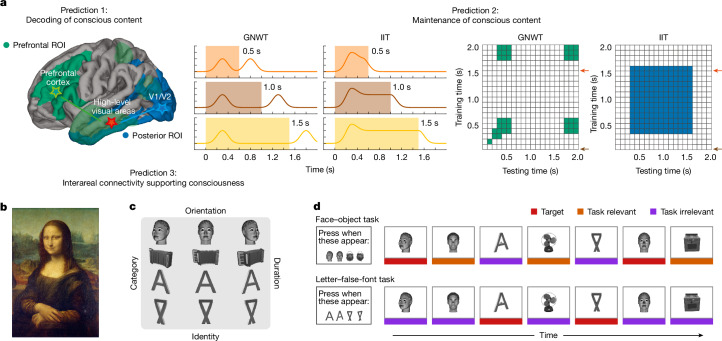
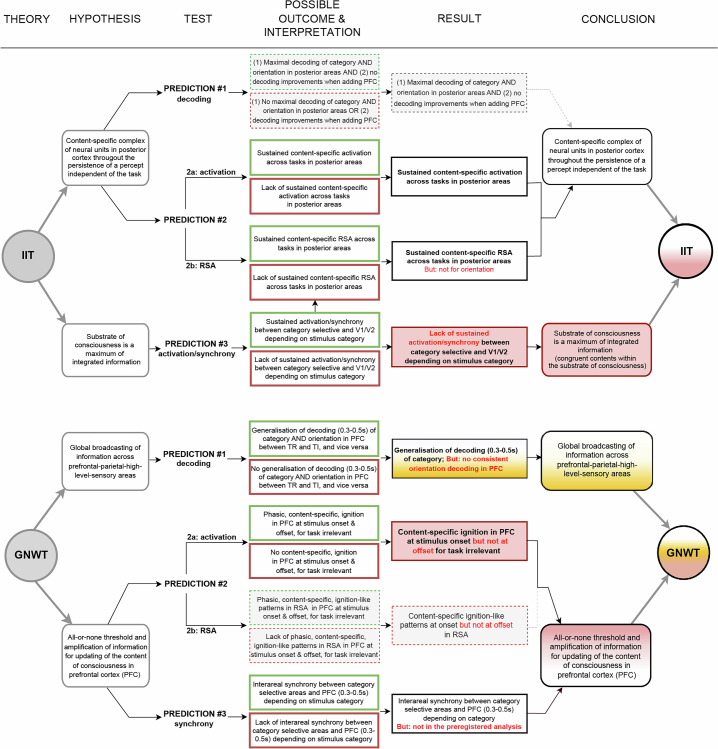
In a preregistered adversarial collaboration, 256 participants viewed suprathreshold visual stimuli while fMRI, MEG and iEEG measured neural activity to directly test integrated information theory (IIT) and global neuronal workspace theory (GNWT). Results aligned with some predictions of both theories but substantially challenged key tenets of each, especially sustained posterior synchronization for IIT and offset ignition/PFC content representation for GNWT.
Key findings
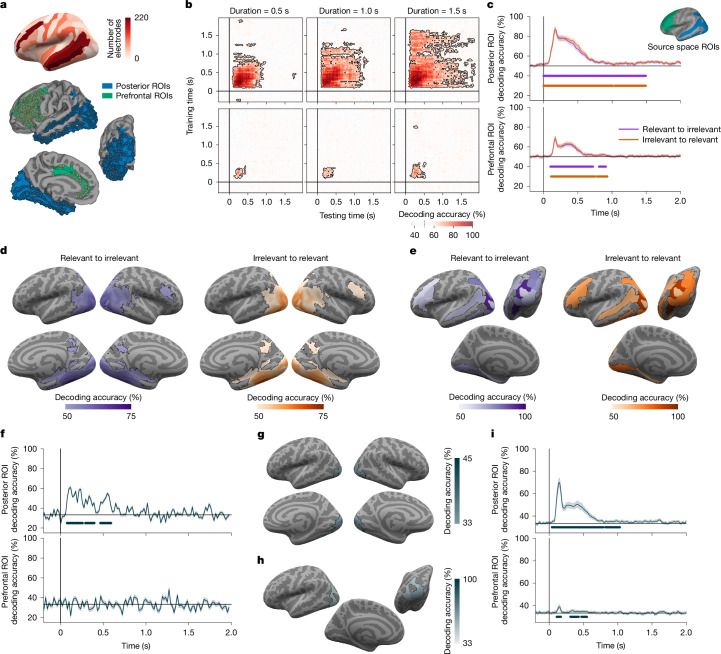
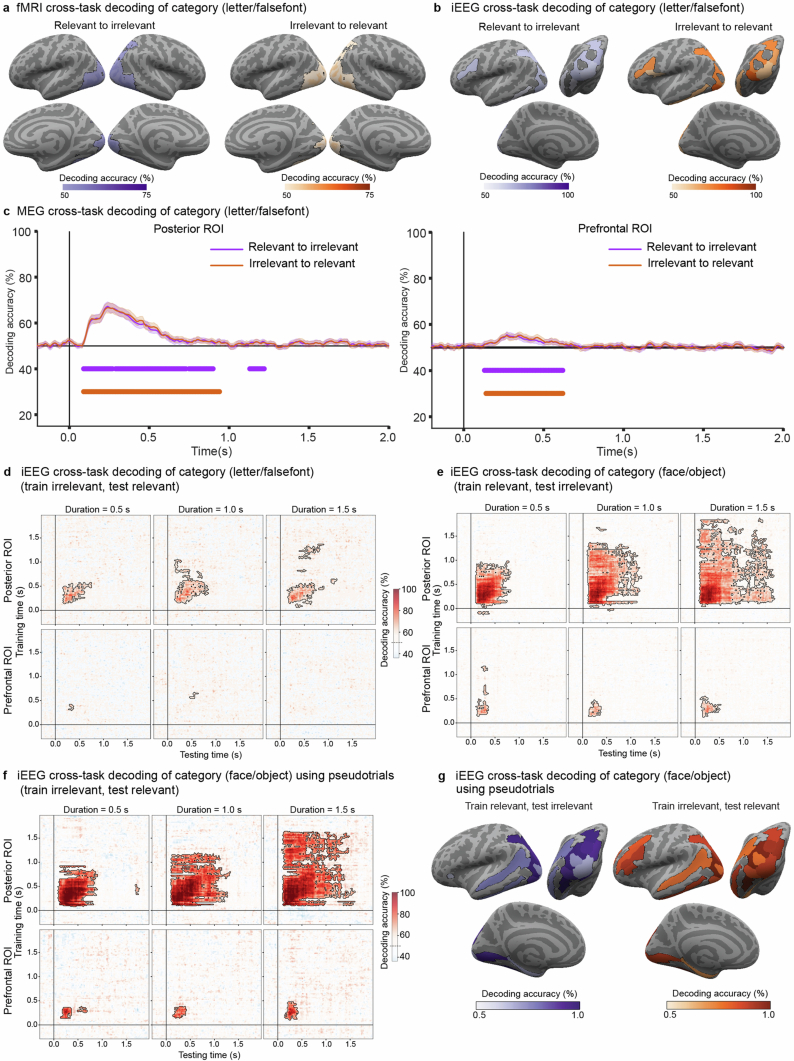
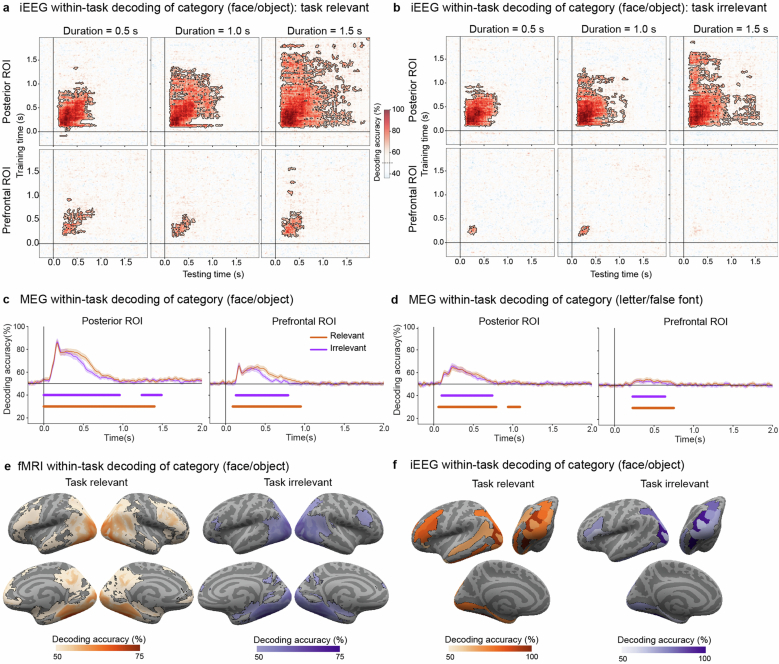
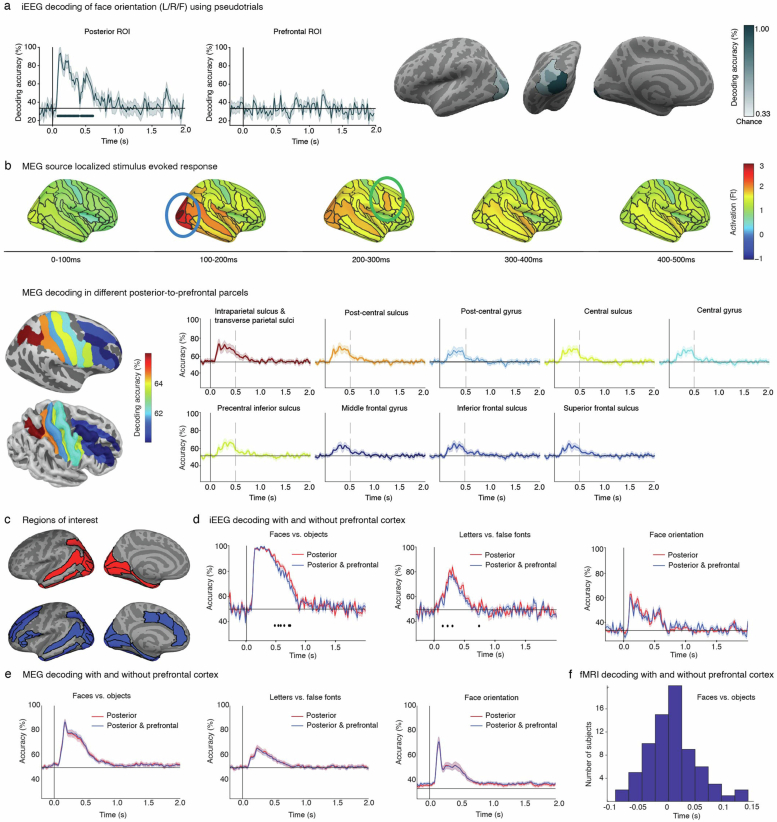
- Category decoding occurred in both posterior and prefrontal ROIs across modalities: iEEG posterior face–object decoding exceeded 95% cross-task accuracy, whereas PFC decoding was approximately 70% and restricted to approximately 0.2–0.4 s; fMRI showed approximately 75% posterior and approximately 60% PFC decoding. Orientation decoding was robust in posterior ROIs (iEEG approximately 95%, fMRI approximately 45%, MEG approximately 75%) but mostly absent in PFC (iEEG BF01 = 5.11–8.65; fMRI BF01 = 3–71.5 in 34–55% of PFC voxels). Adding PFC ROIs did not improve decoding, with strong Bayesian evidence against improvement (for example, face–object iEEG BF01 = 1.94 × 10⁴; MEG BF01 = 3.05).
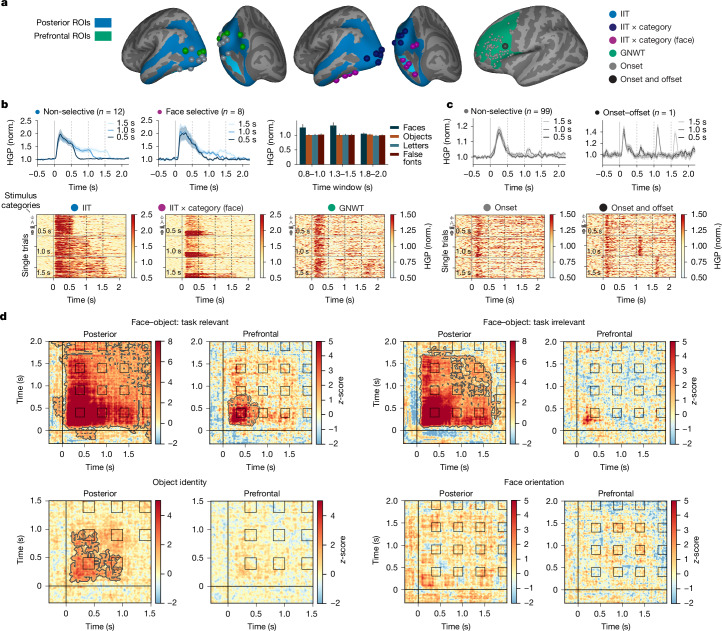
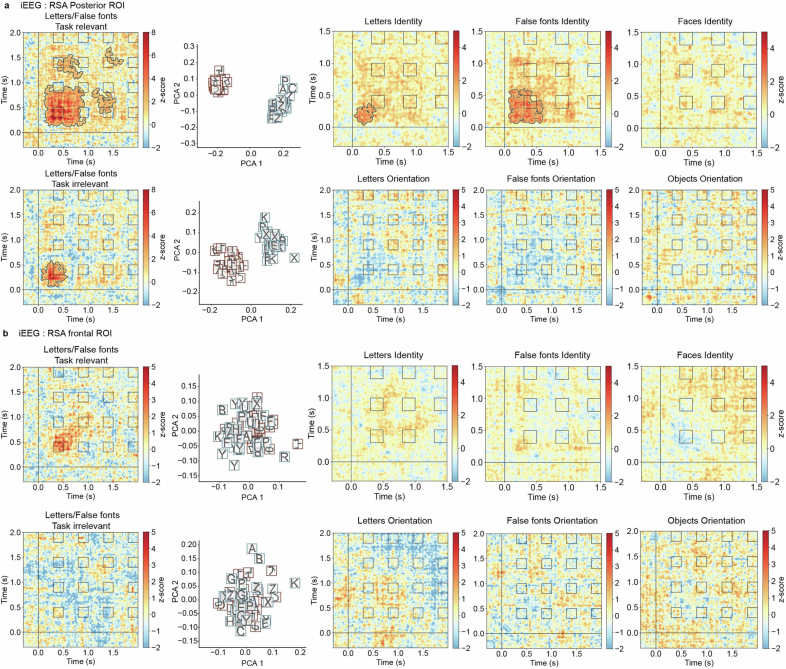
- For maintenance, 25 of 657 posterior iEEG electrodes showed sustained activity tracking stimulus duration, but only 15% (8 of 53) of face-selective electrodes did so; PFC showed 99 non-selective and 24 category-selective onset responses, yet none of 655 PFC electrodes showed the GNWT-predicted onset-and-offset profile (BF01 > 3 for all PFC electrodes). Cross-temporal RSA revealed sustained face–object representation in posterior cortex and transient onset-only representation in PFC, not offset.
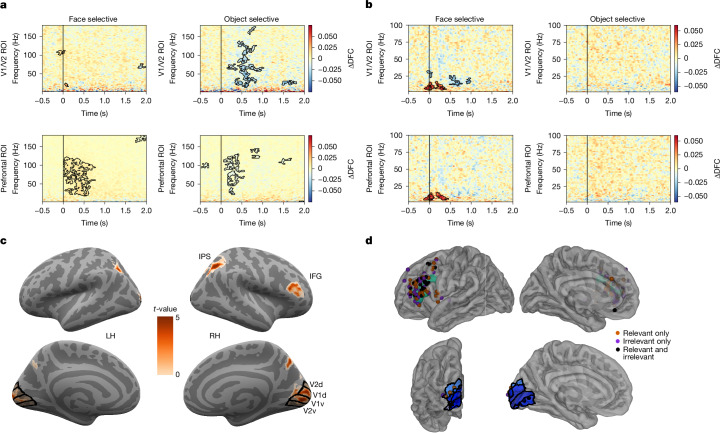
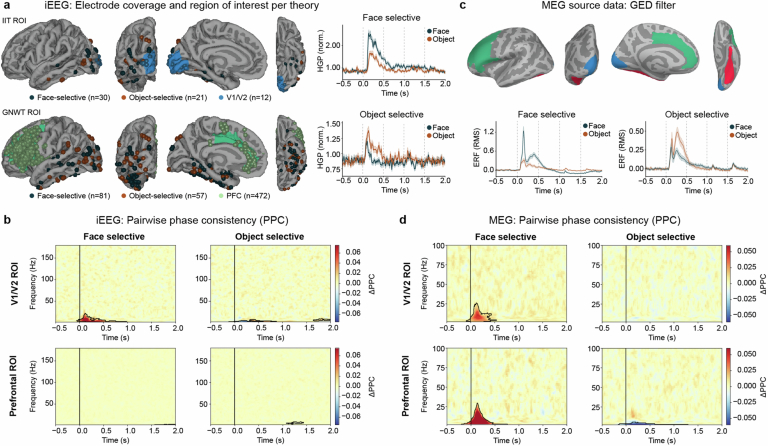
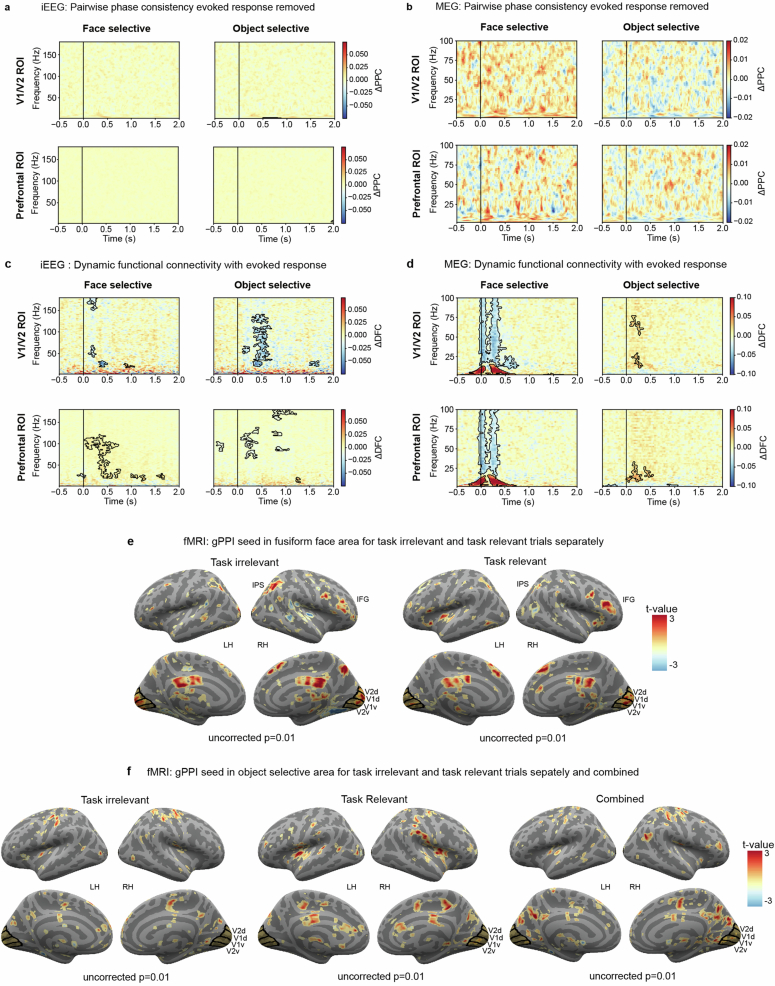
- For connectivity, the preregistered pairwise phase consistency metric supported neither theory. Exploratory dynamic functional connectivity in iEEG showed brief object-selective V1/V2 connectivity, predominantly in gamma, and PFC connectivity with both face- and object-selective areas in the GNWT-predicted window; fMRI generalized psychophysiological interaction showed FFA content-selective connectivity with V1/V2, inferior frontal gyrus and intraparietal sulcus, but no object-selective PFC/V1/V2 connectivity (62–94% of PFC voxels showed BF01 = 3–7.75 for the null).
Methods
- Preregistered adversarial collaboration with theory-neutral teams; 256 participants total (fMRI n = 120, MEG n = 102, iEEG n = 34), with reported replication analyses on MEG n = 65, fMRI n = 73 and iEEG n = 29 for decoding. Participants viewed single suprathreshold stimuli varying in category (faces, objects, letters, false fonts), identity, orientation (front, left, right) and duration (0.5, 1.0, 1.5 s), with task relevance manipulated across blocks.
- Multimodal design combined fMRI, MEG and iEEG; for MEG and fMRI, one-third of data were used for analysis optimization and two-thirds for preregistered replication testing, whereas iEEG used a different strategy due to data rarity. Analyses included cross-task decoding, linear mixed models of duration tracking, cross-temporal representational similarity analysis, pairwise phase consistency, dynamic functional connectivity, generalized psychophysiological interaction and Bayesian tests.
Limitations
- Stated in the paper: residual task engagement with category cannot be entirely ruled out; the approach falls short of encompassing full phenomenal richness; and the data lack single-unit recordings. The paper also notes sparse iEEG sampling of V1/V2 (12 electrodes versus 472 in PFC), possible MEG signal leakage from posterior regions, and that phase estimation from macroscopic recordings is susceptible to noise.
- Evident from the text: the biological focus means theorists could respond to challenges by modifying proposed biological implementations while retaining the mathematical or computational core, and some predictions overlap with other theories, so the results may not isolate IIT or GNWT uniquely.
Model-written summary. Check it against the paper before relying on it.
Integrity signals
Registry
Cites
Statistics
Figures
Verification
Claims the paper makes
16 Valid · 0 Not valid · 11 Not checked · 159 Own results and interpretations
The sources with a verdict support this claim; the rest weren’t checked yet, have no full text we could read, or their verdicts aren’t rated yet.
In the paper
“These results align with two independent studies using comparable methods42,43.”
§ Adversarial testing of global neuronal workspace and integrated information theories of consciousness > Maintenance of conscious content
What the sources say
- Supportedcites [42] Vishne, G., Gerber, E. M., Knight, R. T. & Deouell, L. Y. Distinct ventral stream and prefrontal cortex representational dynamics during sustained conscious visual perception. Cell Rep. 42, 112752 (2023). 37422763 PMC10530642 source
The Introduction describes an empirical study of visual perception in ten patients with implanted electrodes. The Results report time-resolved decoding and temporal-generalization analyses of visual representations, supporting the citation’s use as an example of an independent study using these methods. The citing sentence does not specify its own results, so the precise alignment cannot be assessed from this source alone. (LLM, conf=0.83)
- Not checked — no full text of the sourcecites [43] Broday-Dvir, R., Norman, Y., Harel, M., Mehta, A. D. & Malach, R. Perceptual stability reflected in neuronal pattern similarities in human visual cortex. Cell Rep. 42, 112614 (2023). 37285270 source
plainstates an association- Asserted: passes — The authors put it forward as true.
- Checkable: passes — It can be checked against evidence.
- Load-bearing: unclear — It is unclear whether the paper’s conclusions depend on it.
- Based: passes — The paper gives a reason why it holds.
- Supported
Every source the paper cites for this claim was checked and supports it.
In the paper
“This clear update to the content of consciousness should have been represented somehow by the global workspace12.”
§ Adversarial testing of global neuronal workspace and integrated information theories of consciousness > Discussion
What the sources say
- Supportedcites [12] Melloni, L. et al. An adversarial collaboration protocol for testing contrasting predictions of global neuronal workspace and integrated information theory. PLoS ONE 18, e0268577 (2023). 36763595 PMC9916582 source
The Introduction’s ‘Differential predictions of the theories’ section says that GNW expects a brief ignition at stimulus offset when the offset is consciously detected and updates the conscious internal model. The planned-analyses section likewise describes possible workspace ignitions at offset as updates to conscious perception. These passages support the claim about a consciously experienced change at the onset of a blank screen; the prediction is conditional on that change being consciously detected. (LLM, conf=0.90)
boostedstates a cause- Asserted: passes — The authors put it forward as true.
- Checkable: passes — It can be checked against evidence.
- Load-bearing: passes — The paper’s conclusions depend on it.
- Based: passes — The paper gives a reason why it holds.
- Rests on an assumption not shown here.
- Supported
The sources with a verdict support this claim; the rest weren’t checked yet, have no full text we could read, or their verdicts aren’t rated yet.
In the paper
“This departs from the traditional contrastive method, which compares the presence and absence of consciousness but conflates it with other cognitive processes (for example, decision-making or memory formation)56–58.”
§ Adversarial testing of global neuronal workspace and integrated information theories of consciousness > Discussion
What the sources say
- Supportedcites [56] Aru, J., Bachmann, T., Singer, W. & Melloni, L. Distilling the neural correlates of consciousness. Neurosci. Biobehav. Rev. 36, 737–746 (2012). 22192881 source
Section 1.1 describes contrastive analysis as comparing trials with and without conscious perception. The Conclusions state that this comparison can confound the neural correlates of consciousness with processes that precede or follow perception; sections 2.2 and 2.3 give decision bias and memory formation as examples of such processes. (LLM, conf=0.91)
- Supportedcites [57] Lepauvre, A. & Melloni, L. The search for the neural correlate of consciousness: progress and challenges. Philos. Mind Sci.10.33735/phimisci.2021.87 (2021). source
Section 1.1 describes the contrastive method as comparing conscious and unconscious states or contents. Section 1.2 says this comparison can confound the neural correlate of consciousness with other processes, explicitly naming memory encoding and decision-making. (LLM, conf=0.94)
- Not checked — no full text of the sourcecites [58] Tsuchiya, N., Wilke, M., Frässle, S. & Lamme, V. A. F. No-report paradigms: extracting the true neural correlates of consciousness. Trends Cogn. Sci. 19, 757–770 (2015). 26585549 source
plainstates a cause- Asserted: passes — The authors put it forward as true.
- Checkable: passes — It can be checked against evidence.
- Load-bearing: passes — The paper’s conclusions depend on it.
- Based: passes — The paper gives a reason why it holds.
- Supported
Every source the paper cites for this claim was checked and supports it.
In the paper
“the prediction of GNWT about PFC is shared by those higher-order theories of consciousness that hypothesize that PFC actually supplies the content of visual consciousness (for example, ref. 17)”
§ Adversarial testing of global neuronal workspace and integrated information theories of consciousness > Discussion
What the sources say
- Supportedcites [17] Brown, R., Lau, H. & LeDoux, J. E. Understanding the higher-order approach to consciousness. Trends Cogn. Sci. 23, 754–768 (2019). 31375408 source
In the section discussing whether HOT locates consciousness in PFC (page not provided), the paper distinguishes theories that use PFC to index visual content in sensory areas from HOROR theory, in which the higher-order state in PFC itself is phenomenally conscious. That supports the citing sentence’s qualified reference to those higher-order theories that assign PFC a more direct role in conscious content; it does not imply that all higher-order theories do so. (LLM, conf=0.85)
plainstates an association- Asserted: passes — The authors put it forward as true.
- Checkable: passes — It can be checked against evidence.
- Load-bearing: passes — The paper’s conclusions depend on it.
- Based: passes — The paper gives a reason why it holds.
- Supported
A result the paper reports from its own data — it cites no other source for it, so there is none to check. The quote shows it is in the paper.
In the paper
“In posterior cortex ROIs, 25 electrodes (out of 657) measured sustained activity tracking stimulus duration”
§ Adversarial testing of global neuronal workspace and integrated information theories of consciousness > Maintenance of conscious content
plainstates an association- Asserted: passes — The authors put it forward as true.
- Checkable: passes — It can be checked against evidence.
- Load-bearing: passes — The paper’s conclusions depend on it.
- Based: passes — The paper gives a reason why it holds.
- Rests on an assumption not shown here.
86 more claims
Create a free account to see all 186 claims and to verify the 3 references still open.
- It may state two separate claims as one. 46
- Probably not a substantial claim. 59
- The quote only partly states this claim. 2
Claims other papers make about this one
Each is checked against this paper’s own text: does it say what the citing paper says it does?
The source backs part of the claim, not all of it — or backs it for a different population, condition or comparison.
In the citing paper
“Adversarial experiments typically generate mixed results that do not fully confirm the predictions of one theoretical position or another”
From Integrated information and predictive processing theories of consciousness: An adversarial collaborative review (2026) · cites this paper as Cogitate Consortium et al., 2025
Experimental — accuracy not yet measuredThe cited source says what the claim attributes to it.
In the citing paper
“while contemporary theories [2,3] and recent adversarial collaborations [49] often omit explicit claims about how subcortical structures like the thalamus support conscious states and content (but see [4,31,50–52]) despite its known importance [40,44,53–55]”
From Testing circuit-level theories of consciousness in humans (2026) · cites this paper as [49]
Self-check
Percentages, sums and reported differences re-computed from the paper’s own numbers.
Each contradiction between two passages listed here was confirmed by an independent check.
Rated minor: it would not touch a result — a value no result rests on, a p-value that stays on the same side of the significance level, or a conflict that is clerical, resolved elsewhere in the paper, or outside its own findings.
In the paper
§ Adversarial testing of global neuronal workspace and integrated information theories of consciousness > Decoding of conscious content
“the theories would pass the test if decoding is possible for both category (in at least one category pairing) and orientation (in at least one category), but would fail otherwise.”
§ Adversarial testing of global neuronal workspace and integrated information theories of consciousness > Discussion
“We adopted a lenient falsificationist approach, in which evidence for any tested feature (for example, decoding of category or orientation) was sufficient to rule out failure, rather than requiring consistency across all features.”
Rated minor: it would not touch a result — a value no result rests on, a p-value that stays on the same side of the significance level, or a conflict that is clerical, resolved elsewhere in the paper, or outside its own findings.
In the paper
§ Adversarial testing of global neuronal workspace and integrated information theories of consciousness > Interareal connectivity
“Given the sparse electrode coverage, the requirement to focus on ‘activated’ electrodes (see Methods) was relaxed, although restricting it to only activated electrodes yielded similar results.”
§ Adversarial testing of global neuronal workspace and integrated information theories of consciousness > Methods > Analysis strategy
“For iEEG, the PPC analysis included electrodes in V1/V2 visual areas, in PFC ROIs (see Supplementary Table 26), and face-selective and object-selective electrodes (see ‘Identification of task-responsive channels’), as long as they were ‘active’ during the task.”
Citations
Cites
Controlling the False Discovery Rate: A Practical and Powerful Approach to Multiple Testing
Benjamini, Y., & Hochberg, Y. (1995) · Journal of the Royal Statistical Society Series B: Statistical Methodology · doi:10.1111/j.2517-6161.1995.tb02031.x · Cited by 109,482 · cited 7×
“FDR was used to correct for multiple comparisons across ROIs.”
InfluentialMatplotlib: a 2D graphics environment
Hunter, J. D. (2007) · Computing in Science & Engineering · doi:10.1109/mcse.2007.55 · Cited by 39,249 · cited 1×
“Plots were generated using Matplotlib (3.3.2) 109 .”
InfluentialSciPy 1.0: fundamental algorithms for scientific computing in Python
Virtanen, P., Gommers, R., Oliphant, T. E., Haberland, M., Reddy, T., Cournapeau, D., Burovski, E., Peterson, P., Weckesser, W., Bright, J., et al. (2020) · Nature Methods · doi:10.1038/s41592-019-0686-2 · Cited by 38,430 · cited 1×
“Additional, analysis-specific, fMRI data preprocessing was performed using FSL 6.0.2 (FMRIB Software Library) 94 , Statistical Parametric Mapping (SPM 12) software 95 , and custom Python scripts (using NiBabel (3.2.2) 96 and SciPy (1.8.0) 97 after the above-outlined general preprocessing.”
InfluentialHarris, C. R., Millman, K. J., van der Walt, S. J., Gommers, R., Virtanen, P., Cournapeau, D., Wieser, E., Taylor, J., Berg, S., Smith, N. J., et al. (2020) · Nature · doi:10.1038/s41586-020-2649-2 · Cited by 23,826
Harris, C., Millman, K., van der Walt, S., Gommers, R., Virtanen, P., Cournapeau, D., Wieser, E., Taylor, J., Berg, S., Smith, N., et al. (2020) · RePEc: Research Papers in Economics · Cited by 17,844
Advances in functional and structural MR image analysis and implementation as FSL
Smith, S. M., Jenkinson, M., Woolrich, M. W., Beckmann, C. F., Behrens, T. E. J., Johansen-Berg, H., Bannister, P. R., De Luca, M., Drobnjak, I., Flitney, D. E., et al. (2004) · NeuroImage · doi:10.1016/j.neuroimage.2004.07.051 · Cited by 13,630
Desikan, R. S., Ségonne, F., Fischl, B., Quinn, B. T., Dickerson, B. C., Blacker, D., Buckner, R. L., Dale, A. M., Maguire, R. P., Hyman, B. T., et al. (2006) · NeuroImage · doi:10.1016/j.neuroimage.2006.01.021 · Cited by 13,324 · cited 1×
“Single-trial covariance matrices were computed separately for signal and reference for all vertices within the fusiform ROI identified from the FreeSurfer parcellation using the Desikan atlas 116 , and the Euclidean distance between them was z -scored.”
The VideoToolbox software for visual psychophysics: transforming numbers into movies
Pelli, D. G. (1997) · Spatial Vision · doi:10.1163/156856897x00366 · Cited by 11,098
Data Structures for Statistical Computing in Python
McKinney, W. (2010) · Proceedings of the Python in Science Conference · doi:10.25080/majora-92bf1922-00a · Cited by 11,032
Cortical Surface-Based Analysis
Dale, A. M., Fischl, B., & Sereno, M. I. (1999) · NeuroImage · doi:10.1006/nimg.1998.0395 · Cited by 10,910
SciPy 1.0: fundamental algorithms for scientific computing in Python
Virtanen, P., Gommers, R., Oliphant, T. E., Haberland, M., Reddy, T., Cournapeau, D., Burovski, E., Peterson, P., Weckesser, W., Bright, J., et al. (2019) · Apollo - University of Cambridge Repository · doi:10.17863/cam.64134 · Cited by 10,460
Independent component analysis: algorithms and applications
Hyvärinen, A., & Oja, E. (2000) · Neural Networks · doi:10.1016/s0893-6080(00)00026-5 · Cited by 8,705 · cited 1×
“FastICA 82 was used to detect and remove cardiac and ocular components from the data for each participant (mean = 2.90 components, s.d. = 0.92).”
InfluentialNonparametric statistical testing of EEG- and MEG-data
Maris, E., & Oostenveld, R. (2007) · Journal of Neuroscience Methods · doi:10.1016/j.jneumeth.2007.03.024 · Cited by 8,496 · cited 3×
“To quantify content-specific synchrony enhancement, the difference in PPC was computed between within-category and across-category trials (for example, for face-selective sites, the change in PPC was computed between faces versus objects trials) using a cluster-based permutation test 106 .”
InfluentialNonparametric permutation tests for functional neuroimaging: A primer with examples
Nichols, T. E., & Holmes, A. P. (2002) · Human Brain Mapping · doi:10.1002/hbm.1058 · Cited by 6,256
Extensional versus intuitive reasoning: The conjunction fallacy in probability judgment.
Tversky, A., & Kahneman, D. (1983) · Psychological Review · doi:10.1037/0033-295x.90.4.293 · Cited by 3,991 · cited 1×
“Testing both category and orientation decoding constitutes a stringent test, as it requires two conditions to be satisfied, increasing the likelihood of failures 36 , while capturing the critical multidimension-ality of conscious content, that is, phenomenological richness (Fig.”
Falsification and the Methodology of Scientific Research Programmes
Lakatos, I. (1976) · Can Theories be Refuted? · doi:10.1007/978-94-010-1863-0_14 · Cited by 3,915
fMRIPrep: A robust preprocessing pipeline for functional MRI
Esteban, O., Markiewicz, C. J., Blair, R. W., Moodie, C. A., Isik, A. I., Erramuzpe, A., Kent, J. D., Goncalves, M., DuPre, E., Snyder, M., et al. (2019) · Nature Methods · doi:10.1038/s41592-018-0235-4 · Cited by 3,905
Bayesian t tests for accepting and rejecting the null hypothesis
Rouder, J. N., Speckman, P. L., Sun, D., Morey, R. D., & Iverson, G. (2009) · Psychonomic Bulletin & Review · doi:10.3758/pbr.16.2.225 · Cited by 3,688 · cited 1×
“A Bayesian t -test 76 was used to quantify evidence for non-responsiveness.”
Belief in the law of small numbers.
Tversky, A., & Kahneman, D. (1971) · Psychological Bulletin · doi:10.1037/h0031322 · Cited by 3,246 · cited 1×
“…12 to reduce setup differences and confirmatory bias 22 (see sections 1 and 2 in Supplementary Information), and (5) implemented an analysis optimization phase (one-third of the sample) followed by a final testing phase (two-thirds of the sample) on independent data for result validation 33 .”
Automatic parcellation of human cortical gyri and sulci using standard anatomical nomenclature
Destrieux, C., Fischl, B., Dale, A., & Halgren, E. (2010) · NeuroImage · doi:10.1016/j.neuroimage.2010.06.010 · Cited by 2,956 · cited 3×
“As each theory specified a set of anatomical ROIs, after electrode localization, electrodes were labelled according to the Freesurfer-based Destrieux atlas segmentation 72,73 and/or Wang atlas segmentation 74 .”
Driving fast-spiking cells induces gamma rhythm and controls sensory responses
Cardin, J. A., Carlén, M., Meletis, K., Knoblich, U., Zhang, F., Deisseroth, K., Tsai, L.-H., & Moore, C. I. (2009) · Nature · doi:10.1038/nature08002 · Cited by 2,603 · cited 1×
“Gamma activity was analysed because of its close link to neuronal spiking 47 , which IIT considers a constituent property of the physical substrate of consciousness 5 .”
Experimental and theoretical approaches to conscious processing
Dehaene, S., & Changeux, J.-P. (2011) · Neuron · doi:10.1016/j.neuron.2011.03.018 · Cited by 2,573
Self-citationTowards a cognitive neuroscience of consciousness: basic evidence and a workspace framework
Dehaene, S. (2001) · Cognition · doi:10.1016/s0010-0277(00)00123-2 · Cited by 2,498
Self-citationA practical solution to the pervasive problems ofp values
Wagenmakers, E.-J. (2007) · Psychonomic Bulletin & Review · doi:10.3758/bf03194105 · Cited by 2,490 · cited 1×
“BIC was used to define the winning model and we computed Bayes factors based on the difference in BIC values, comparing the GNWT model (with or without interaction) against either the null model (intercept only) or the time-window model (capturing amplitude changes over time) 111 .”
The distinct modes of vision offered by feedforward and recurrent processing
Lamme, V. A. F., & Roelfsema, P. R. (2000) · Trends in Neurosciences · doi:10.1016/s0166-2236(00)01657-x · Cited by 2,338 · cited 5×
“They were determined per participant based on the Destrieux atlas 73 including both hemispheres, and then resampled to standard MNI space (see Supplementary Table 26).”
InfluentialNipype: A Flexible, Lightweight and Extensible Neuroimaging Data Processing Framework in Python
Gorgolewski, K., Burns, C. D., Madison, C., Clark, D., Halchenko, Y. O., Waskom, M. L., & Ghosh, S. S. (2011) · Frontiers in Neuroinformatics · doi:10.3389/fninf.2011.00013 · Cited by 2,186
A Generalized Solution of the Orthogonal Procrustes Problem
Schönemann, P. H. (1966) · Psychometrika · doi:10.1007/bf02289451 · Cited by 2,040 · cited 1×
“The PCA components were aligned across repetitions using Procrustes alignment and averaged together for visualization purposes 113,114 .”
Interpreting magnetic fields of the brain: minimum norm estimates
Hämäläinen, M. S., & Ilmoniemi, R. J. (1994) · Medical & Biological Engineering & Computing · doi:10.1007/bf02512476 · Cited by 1,995
MNE software for processing MEG and EEG data
Gramfort, A., Luessi, M., Larson, E., Engemann, D. A., Strohmeier, D., Brodbeck, C., Parkkonen, L., & Hämäläinen, M. S. (2014) · NeuroImage · doi:10.1016/j.neuroimage.2013.10.027 · Cited by 1,951 · cited 2×
“24.0) 68 .”
InfluentialSatterthwaite, T. D., Elliott, M. A., Gerraty, R. T., Ruparel, K., Loughead, J., Calkins, M. E., Eickhoff, S. B., Hakonarson, H., Gur, R. C., Gur, R. E., et al. (2013) · NeuroImage · doi:10.1016/j.neuroimage.2012.08.052 · Cited by 1,881 · cited 1×
“We approximated degrees of freedom using the Satterthwaite method 99 .”
Dynamic Statistical Parametric Mapping
Dale, A. M., Liu, A. K., Fischl, B. R., Buckner, R. L., Belliveau, J. W., Lewine, J. D., & Halgren, E. (2000) · Neuron · doi:10.1016/s0896-6273(00)81138-1 · Cited by 1,787
Pingouin: statistics in Python
Vallat, R. (2018) · Journal of Open Source Software · doi:10.21105/joss.01026 · Cited by 1,780 · cited 1×
“Equivalence to baseline was established using a JZS Bayes factor test, with a Cauchy prior ( r scale value of 0.707, as implemented in Pingouin (0.5.1) 121 .”
InfluentialIntegrated information theory: from consciousness to its physical substrate
Tononi, G., Boly, M., Massimini, M., & Koch, C. (2016) · Nature Reviews Neuroscience · doi:10.1038/nrn.2016.44 · Cited by 1,727
Self-citationNeural correlates of consciousness: progress and problems
Koch, C., Massimini, M., Boly, M., & Tononi, G. (2016) · Nature Reviews Neuroscience · doi:10.1038/nrn.2016.22 · Cited by 1,600 · cited 2×
“Before this study, predictions from IIT and GNWT were typically tested with one data modality at a time 23,24 , leaving room for negative results to be easily attributed to the limitations of the chosen modality 51 .”
Self-citationMcLaren, D. G., Ries, M. L., Xu, G., & Johnson, S. C. (2012) · NeuroImage · doi:10.1016/j.neuroimage.2012.03.068 · Cited by 1,445 · cited 7×
“For fMRI, connectivity was assessed through gPPI implemented in SPM 119 .”
InfluentialMicrosaccades uncover the orientation of covert attention
Engbert, R., & Kliegl, R. (2003) · Vision Research · doi:10.1016/s0042-6989(03)00084-1 · Cited by 1,390 · cited 1×
“Saccades were further corroborated using the Engbert and Kliegl 103 algorithm.”
Deconvolution of Impulse Response in Event-Related BOLD fMRI1
Glover, G. H. (1999) · NeuroImage · doi:10.1006/nimg.1998.0419 · Cited by 1,386
A neuronal model of a global workspace in effortful cognitive tasks
Dehaene, S., Kerszberg, M., & Changeux, J.-P. (1998) · Proceedings of the National Academy of Sciences · doi:10.1073/pnas.95.24.14529 · Cited by 1,347
Self-citationConscious Processing and the Global Neuronal Workspace Hypothesis
Mashour, G. A., Roelfsema, P., Changeux, J.-P., & Dehaene, S. (2020) · Neuron · doi:10.1016/j.neuron.2020.01.026 · Cited by 1,164 · cited 4×
“Before this study, predictions from IIT and GNWT were typically tested with one data modality at a time 23,24 , leaving room for negative results to be easily attributed to the limitations of the chosen modality 51 .”
InfluentialSelf-citationThe first step for neuroimaging data analysis: DICOM to NIfTI conversion
Li, X., Morgan, P. S., Ashburner, J., Smith, J., & Rorden, C. (2016) · Journal of Neuroscience Methods · doi:10.1016/j.jneumeth.2016.03.001 · Cited by 1,073
Manning, J. R., Jacobs, J., Fried, I., & Kahana, M. J. (2009) · The Journal of Neuroscience · doi:10.1523/jneurosci.2041-09.2009 · Cited by 973 · cited 1×
“Most analyses focused on the high-gamma power as it closely correlated with neural spiking activity 71 and with the BOLD signal 37 .”
MRIQC: Advancing the automatic prediction of image quality in MRI from unseen sites
Esteban, O., Birman, D., Schaer, M., Koyejo, O. O., Poldrack, R. A., & Gorgolewski, K. J. (2017) · PLOS ONE · doi:10.1371/journal.pone.0184661 · Cited by 920
Corrections for extreme proportions and their biasing effects on estimated values ofd′
Hautus, M. J. (1995) · Behavior Research Methods, Instruments, & Computers · doi:10.3758/bf03203619 · Cited by 894 · cited 1×
“98), false alarms and reaction times were computed per category and stimulus duration, separately (false alarms were also calculated per task relevance, without duration) and per modality (iEEG, MEG and fMRI).”
Seth, A. K., & Bayne, T. (2022) · Nature Reviews Neuroscience · doi:10.1038/s41583-022-00587-4 · Cited by 880 · cited 3×
“Different theories explain how subjective experience arises from brain activity 1,2 .”
What is consciousness, and could machines have it?
Dehaene, S., Lau, H., & Kouider, S. (2017) · Science · doi:10.1126/science.aan8871 · Cited by 855 · cited 1×
“Here we present an open science adversarial collaboration directly juxtaposing integrated information theory (IIT) 4,5 and global neuronal workspace theory (GNWT) 6–10 via a theory-neutral consortium 11–13 .”
Self-citation‘Activity-silent’ working memory in prefrontal cortex: a dynamic coding framework
Stokes, M. G. (2015) · Trends in Cognitive Sciences · doi:10.1016/j.tics.2015.05.004 · Cited by 850
Haegens, S., Nácher, V., Luna, R., Romo, R., & Jensen, O. (2011) · Proceedings of the National Academy of Sciences · doi:10.1073/pnas.1117190108 · Cited by 738 · cited 1×
“We also examined alpha band activity (8–13 Hz), which negatively correlates with neural spiking activity 40,41 .”
Self-citationDeconvolving BOLD activation in event-related designs for multivoxel pattern classification analyses
Mumford, J. A., Turner, B. O., Ashby, F. G., & Poldrack, R. A. (2012) · NeuroImage · doi:10.1016/j.neuroimage.2011.08.076 · Cited by 726 · cited 1×
“A non-spatially smoothed parameter estimate map was obtained by fitting a GLM per event with that event as the regressor of interest and all the other remaining events as one regressor of no interest 108 as implemented in NiBetaSeries (0.6.0) package.”
InfluentialRay, S., Crone, N. E., Niebur, E., Franaszczuk, P. J., & Hsiao, S. S. (2008) · The Journal of Neuroscience · doi:10.1523/jneurosci.2848-08.2008 · Cited by 722 · cited 1×
“In the iEEG data, pattern classifiers were trained on high gamma frequency band (70–150 Hz), which correlates with spiking activity 37,38 , at each time point in the task-irrelevant condition, and tested in the task-relevant condition, for each stimulus duration and category, and across all…”
Probabilistic Maps of Visual Topography in Human Cortex
Wang, L., Mruczek, R. E. B., Arcaro, M. J., & Kastner, S. (2015) · Cerebral Cortex · doi:10.1093/cercor/bhu277 · Cited by 712 · cited 3×
“As each theory specified a set of anatomical ROIs, after electrode localization, electrodes were labelled according to the Freesurfer-based Destrieux atlas segmentation 72,73 and/or Wang atlas segmentation 74 .”
Nir, Y., Fisch, L., Mukamel, R., Gelbard-Sagiv, H., Arieli, A., Fried, I., & Malach, R. (2007) · Current Biology · doi:10.1016/j.cub.2007.06.066 · Cited by 621 · cited 2×
“In the iEEG data, pattern classifiers were trained on high gamma frequency band (70–150 Hz), which correlates with spiking activity 37,38 , at each time point in the task-irrelevant condition, and tested in the task-relevant condition, for each stimulus duration and category, and across all…”
Distilling the neural correlates of consciousness
Aru, J., Bachmann, T., Singer, W., & Melloni, L. (2012) · Neuroscience & Biobehavioral Reviews · doi:10.1016/j.neubiorev.2011.12.003 · Cited by 589
Self-citationUnderstanding the Higher-Order Approach to Consciousness
Brown, R., Lau, H., & LeDoux, J. E. (2019) · Trends in Cognitive Sciences · doi:10.1016/j.tics.2019.06.009 · Cited by 573 · cited 3×
“These challenges extend to other theories of consciousness that share some of the predictions tested here 14–17 .”
No-Report Paradigms: Extracting the True Neural Correlates of Consciousness
Tsuchiya, N., Wilke, M., Frässle, S., & Lamme, V. A. F. (2015) · Trends in Cognitive Sciences · doi:10.1016/j.tics.2015.10.002 · Cited by 551 · cited 1×
“This departs from the traditional contrastive method, which compares the presence and absence of consciousness but conflates it with other cognitive processes (for example, decision-making or memory formation) 56–58 .”
Suppression of Interference and Artifacts by the Signal Space Separation Method
Taulu, S., Kajola, M., & Simola, J. (2004) · Brain Topography · doi:10.1023/b:brat.0000032864.93890.f9 · Cited by 541
The pairwise phase consistency: A bias-free measure of rhythmic neuronal synchronization
Vinck, M., van Wingerden, M., Womelsdorf, T., Fries, P., & Pennartz, C. M. A. (2010) · NeuroImage · doi:10.1016/j.neuroimage.2010.01.073 · Cited by 494 · cited 16×
“For both iEEG and MEG, PPC 46 was computed between each category-selective time series (face selective and object selective) and either the V1/V2 or the PFC time series.”
InfluentialDo frequency representations eliminate conjunction effects? An exercise in adversarial collaboration
Mellers, B., Hertwig, R., & Kahneman, D. (2001) · Psychological Science · doi:10.1111/1467-9280.00350 · Cited by 448 · cited 2×
“Embracing this spirit, and adhering to guidelines for structuring adversarial collaborations 21 , we opted for a three-voice discussion format, acknowledging that despite stringent testing of incompatible theoretical views, different interpretations of the same evidence may persist.”
Converging Intracranial Markers of Conscious Access
Gaillard, R., Dehaene, S., Adam, C., Clémenceau, S., Hasboun, D., Baulac, M., Cohen, L., & Naccache, L. (2009) · PLoS Biology · doi:10.1371/journal.pbio.1000061 · Cited by 440 · cited 1×
“By contrast, GNWT predicts brief, late-phase metastable connectivity (more than 0.25 s) with information sharing between the PFC and category-specific areas, manifested in long-range gamma-band or beta-band synchronization 45 .”
InfluentialSelf-citationBinocular rivalry: frontal activity relates to introspection and action but not to perception
Frässle, S., Sommer, J., Jansen, A., Naber, M., & Einhäuser, W. (2014) · The Journal of Neuroscience · doi:10.1523/jneurosci.4403-13.2014 · Cited by 409 · cited 1×
“Both theories predict that conscious content should be evident in theory-relevant areas independently of other cognitive processes (for example, report and task); thus, conscious content should be present irrespective of task manipulations 34,35 .”
Stelzer, J., Chen, Y., & Turner, R. (2013) · NeuroImage · doi:10.1016/j.neuroimage.2012.09.063 · Cited by 372 · cited 1×
“Cluster-based permutation tests 112 , z -score threshold of z = 1.5 for clustering, were used to evaluate significance.”
InfluentialInce, R. A. A., Giordano, B. L., Kayser, C., Rousselet, G. A., Gross, J., & Schyns, P. G. (2017) · Human Brain Mapping · doi:10.1002/hbm.23471 · Cited by 366 · cited 1×
“The SVM cost function was weighted by the number of trials per class to reduce bias to the class with the highest number.”
Comparative study of techniques for large-scale feature selection
(1994) · Machine Intelligence and Pattern Recognition · doi:10.1016/b978-0-444-81892-8.50040-7 · Cited by 307
Wang, J.-Z., Williamson, S. J., & Kaufman, L. (1992) · IEEE Transactions on Biomedical Engineering · doi:10.1109/10.142641 · Cited by 299
Albantakis, L., Barbosa, L., Findlay, G., Grasso, M., Haun, A. M., Marshall, W., Mayner, W. G. P., Zaeemzadeh, A., Boly, M., Juel, B. E., et al. (2023) · PLoS Computational Biology · doi:10.1371/journal.pcbi.1011465 · Cited by 292 · cited 3×
“Here we present an open science adversarial collaboration directly juxtaposing integrated information theory (IIT) 4,5 and global neuronal workspace theory (GNWT) 6–10 via a theory-neutral consortium 11–13 .”
Self-citationWhat Is a Neural Correlate of Consciousness?
Chalmers, D. J. (2000) · Neural Correlates of Consciousness · doi:10.7551/mitpress/4928.003.0004 · Cited by 273
Self-citationNorthoff, G., & Lamme, V. (2020) · Neuroscience & Biobehavioral Reviews · doi:10.1016/j.neubiorev.2020.07.019 · Cited by 247
Automated model selection in covariance estimation and spatial whitening of MEG and EEG signals
Engemann, D. A., & Gramfort, A. (2015) · NeuroImage · doi:10.1016/j.neuroimage.2014.12.040 · Cited by 203
Making the hard problem of consciousness easier
Melloni, L., Mudrik, L., Pitts, M., & Koch, C. (2021) · Science · doi:10.1126/science.abj3259 · Cited by 190 · cited 3×
“To advance this goal, we tested two theories of consciousness, through a large-scale, open-science adversarial collaboration 11,12,20–22 aimed at accelerating progress in consciousness research by building on constructive disagreement.”
Self-citationCichy, R. M., & Pantazis, D. (2017) · NeuroImage · doi:10.1016/j.neuroimage.2017.07.023 · Cited by 180
Self-citationMEG-BIDS, the brain imaging data structure extended to magnetoencephalography
Niso, G., Gorgolewski, K. J., Bock, E., Brooks, T. L., Flandin, G., Gramfort, A., Henson, R. N., Jas, M., Litvak, V., T. Moreau, J., et al. (2018) · Scientific Data · doi:10.1038/sdata.2018.110 · Cited by 170 · cited 3×
“The MEG data were converted to BIDS 78 us-ing MNE-BIDS 79 , and preprocessed following the FLUX Pipeline 80 in MNE-Python (v0.”
Self-citationA novel blink detection method based on pupillometry noise
Hershman, R., Henik, A., & Cohen, N. (2018) · Behavior Research Methods · doi:10.3758/s13428-017-1008-1 · Cited by 169 · cited 1×
“Blinks were detected using the Hershman algorithm 101 , and removed with 200-ms padding 102 .”
Holdgraf, C., Appelhoff, S., Bickel, S., Bouchard, K., D’Ambrosio, S., David, O., Devinsky, O., Dichter, B., Flinker, A., Foster, B. L., et al. (2019) · Scientific Data · doi:10.1038/s41597-019-0105-7 · Cited by 165 · cited 3×
“The MEG data were converted to BIDS 78 us-ing MNE-BIDS 79 , and preprocessed following the FLUX Pipeline 80 in MNE-Python (v0.”
Optimal referencing for stereo-electroencephalographic (SEEG) recordings
Li, G., Jiang, S., Paraskevopoulou, S. E., Wang, M., Xu, Y., Wu, Z., Chen, L., Zhang, D., & Schalk, G. (2018) · NeuroImage · doi:10.1016/j.neuroimage.2018.08.020 · Cited by 159 · cited 1×
“Electrodes were re-referenced to a Laplacian scheme 69 , whereas bipolar referencing was used for electrodes at the edge of a strip, grid or stereo EEG, and the signal was localized at the midpoint (Euclidean distance) between the two electrodes.”
Experiences of collaborative research
Kahneman, D. (2003) · American Psychologist · doi:10.1037/0003-066x.58.9.723 · Cited by 149
Spontaneous Microsaccades Reflect Shifts in Covert Attention
Yuval-Greenberg, S., Merriam, E. P., & Heeger, D. J. (2014) · The Journal of Neuroscience · doi:10.1523/jneurosci.0582-14.2014 · Cited by 149 · cited 1×
“Blinks were detected using the Hershman algorithm 101 , and removed with 200-ms padding 102 .”
The ConTraSt database for analysing and comparing empirical studies of consciousness theories
Yaron, I., Melloni, L., Pitts, M., & Mudrik, L. (2022) · Nature Human Behaviour · doi:10.1038/s41562-021-01284-5 · Cited by 147 · cited 5×
“These theories have independently accrued evidence, but have not been directly compared 3 .”
InfluentialSelf-citationWhy Does Space Feel the Way it Does? Towards a Principled Account of Spatial Experience
Haun, A., & Tononi, G. (2019) · Entropy · doi:10.3390/e21121160 · Cited by 143 · cited 6×
“They were determined per participant based on the Destrieux atlas 73 including both hemispheres, and then resampled to standard MNI space (see Supplementary Table 26).”
InfluentialSelf-citationCleeremans, A., Achoui, D., Beauny, A., Keuninckx, L., Martin, J.-R., Muñoz-Moldes, S., Vuillaume, L., & de Heering, A. (2020) · Trends in Cognitive Sciences · doi:10.1016/j.tics.2019.11.011 · Cited by 142 · cited 1×
“52,53).”
MNE-BIDS: Organizing electrophysiological data into the BIDS format and facilitating their analysis
Appelhoff, S., Sanderson, M., Brooks, T., van Vliet, M., Quentin, R., Holdgraf, C., Chaumon, M., Mikulan, E., Tavabi, K., Höchenberger, R., et al. (2019) · Journal of Open Source Software · doi:10.21105/joss.01896 · Cited by 138 · cited 1×
“The MEG data were converted to BIDS 78 us-ing MNE-BIDS 79 , and preprocessed following the FLUX Pipeline 80 in MNE-Python (v0.”
Prosocial motives underlie scientific censorship by scientists: A perspective and research agenda
Clark, C. J., Jussim, L. J., Frey, K., Stevens, S. T., al‐Gharbi, M., Aquino, K. F., Bailey, J. M., Barbaro, N., Baumeister, R. F., Bleske-Rechek, A. L., et al. (2023) · Proceedings of the National Academy of Sciences · doi:10.1073/pnas.2301642120 · Cited by 130
Cohen, M. X. (2021) · NeuroImage · doi:10.1016/j.neuroimage.2021.118809 · Cited by 129 · cited 1×
“For MEG, the category-selective single-trial time courses used to define the ROIs for PPC analysis were extracted using the generalized eigenvalue decomposition (GED) method 115 .”
Iemi, L., Gwilliams, L., Samaha, J., Auksztulewicz, R., Cycowicz, Y. M., King, J.-R., Nikulin, V. V., Thesen, T., Doyle, W., Devinsky, O., et al. (2021) · NeuroImage · doi:10.1016/j.neuroimage.2021.118746 · Cited by 128 · cited 1×
“We also examined alpha band activity (8–13 Hz), which negatively correlates with neural spiking activity 40,41 .”
Self-citationGrossman, S., Gaziv, G., Yeagle, E. M., Harel, M., Mégevand, P., Groppe, D. M., Khuvis, S., Herrero, J. L., Irani, M., Mehta, A. D., et al. (2019) · Nature Communications · doi:10.1038/s41467-019-12623-6 · Cited by 116 · cited 1×
“Brain activity was recorded with a combination of intracranially subdural platinum-iridium electrodes embedded in SILASTIC sheets (2.3-mm diameter contacts, Ad-Tech Medical Instrument and PMT Corporation) and/or depth stereo-electroencephalographic platinum-iridium electrodes (PMT Corporation; 0.8…”
InfluentialMRIQC: Advancing the Automatic Prediction of Image Quality in MRI from Unseen SitesPreprint
Estéban, O., Birman, D., Schaer, M., et al. (2017) · bioRxiv (Cold Spring Harbor Laboratory) · doi:10.1101/111294 · Cited by 114
Melloni, L., Mudrik, L., Pitts, M., Bendtz, K., Ferrante, O., Gorska, U., Hirschhorn, R., Khalaf, A., Kozma, C., Lepauvre, A., et al. (2023) · PLoS ONE · doi:10.1371/journal.pone.0268577 · Cited by 113 · cited 18×
“The theory proponents and the consortium developed and preregistered the experimental design, divergent predictions, expected outcomes and interpretation thereof 12 .”
InfluentialSelf-citationAwareness as inference in a higher-order state space
Fleming, S. M. (2020) · Neuroscience of Consciousness · doi:10.1093/nc/niz020 · Cited by 111
Kapoor, V., Dwarakanath, A., Safavi, S., Werner, J., Besserve, M., Panagiotaropoulos, T. I., & Logothetis, N. K. (2022) · Nature Communications · doi:10.1038/s41467-022-28897-2 · Cited by 111 · cited 1×
“Both theories predict that conscious content should be evident in theory-relevant areas independently of other cognitive processes (for example, report and task); thus, conscious content should be present irrespective of task manipulations 34,35 .”
Self-citationExplanatory profiles of models of consciousness - towards a systematic classification
Signorelli, C. M., Szczotka, J., & Prentner, R. (2021) · Neuroscience of Consciousness · doi:10.1093/nc/niab021 · Cited by 91 · cited 5×
“Different theories explain how subjective experience arises from brain activity 1,2 .”
InfluentialThe HOROR theory of phenomenal consciousness
Brown, R. (2015) · Philosophical Studies · doi:10.1007/s11098-014-0388-7 · Cited by 83 · cited 1×
“Another consequence is that some predictions (and their associated consequences) may overlap with other theories of consciousness that share similar biological bases, such as higher-order theories 16,17 in the PFC and local recurrency theories 14,26 in the visual cortex.”
Encoding model of temporal processing in human visual cortex
Stigliani, A., Jeska, B., & Grill-Spector, K. (2017) · Proceedings of the National Academy of Sciences · doi:10.1073/pnas.1704877114 · Cited by 78
FLUX: A pipeline for MEG analysis
Ferrante, O., Liu, L., Minarik, T., Górska, U., Ghafari, T., Luo, H., & Jensen, O. B. (2022) · NeuroImage · doi:10.1016/j.neuroimage.2022.119047 · Cited by 78 · cited 1×
“The MEG data were converted to BIDS 78 us-ing MNE-BIDS 79 , and preprocessed following the FLUX Pipeline 80 in MNE-Python (v0.”
Self-citationPosterior and anterior cortex—where is the difference that makes the difference?
Koch, C., Massimini, M., Boly, M., & Tononi, G. (2016) · Nature Reviews Neuroscience · doi:10.1038/nrn.2016.105 · Cited by 68 · cited 1×
“Finally, we tested IIT’s prediction that prefrontal regions do not contribute further information beyond that specified by posterior areas (or may even degrade performance by introducing noise) 39 .”
Self-citationBIDScoin: A User-Friendly Application to Convert Source Data to Brain Imaging Data Structure
Zwiers, M. P., Moia, S., & Oostenveld, R. (2022) · Frontiers in Neuroinformatics · doi:10.3389/fninf.2021.770608 · Cited by 67
Tasks and their role in visual neuroscience
Kay, K., Bonnen, K., Denison, R. N., Arcaro, M. J., & Barack, D. L. (2023) · Neuron · doi:10.1016/j.neuron.2023.03.022 · Cited by 61 · cited 1×
“Task relevance served to rule out the effect of task demands, as opposed to conscious perception per se, on the observed effects 62 .”
Local neuronal relational structures underlying the contents of human conscious experience
Malach, R. (2021) · Neuroscience of Consciousness · doi:10.1093/nc/niab028 · Cited by 53
Keep your enemies close: Adversarial collaborations will improve behavioral science.
Clark, C. J., Costello, T., Mitchell, G., & Tetlock, P. E. (2022) · Journal of Applied Research in Memory and Cognition · doi:10.1037/mac0000004 · Cited by 47 · cited 2×
“The GNWT instead posits that consciousness arises from global broadcasting and late amplification (or ‘ignition’) of information across inter-connected networks of higher-order sensory, parietal and especially prefrontal cortex (PFC) 6,9,23 .”
InfluentialVishne, G., Gerber, E. M., Knight, R. T., & Deouell, L. Y. (2023) · Cell Reports · doi:10.1016/j.celrep.2023.112752 · Cited by 46 · cited 1×
“These results align with two independent studies using comparable methods 42,43 .”
Lamme, V. (2015) · Theoretical Philosophy/MIND Group – JGU Mainz · doi:10.15502/9783958570092 · Cited by 45 · cited 3×
“These challenges extend to other theories of consciousness that share some of the predictions tested here 14–17 .”
Category-Selectivity in Human Visual Cortex Follows Cortical Topology: A Grouped icEEG Study
Kadipasaoglu, C. M., Conner, C. R., Whaley, M. L., Baboyan, V. G., & Tandon, N. (2016) · PLoS ONE · doi:10.1371/journal.pone.0157109 · Cited by 45 · cited 1×
“To determine category selectivity for faces, objects, letters and false fonts in the high gamma, we followed the method of Kadipasaoglu and colleagues 77 .”
Cortical representation of persistent visual stimuli
Gerber, E. M., Golan, T., Knight, R. T., & Deouell, L. Y. (2017) · NeuroImage · doi:10.1016/j.neuroimage.2017.08.028 · Cited by 38 · cited 1×
“IIT predicts that conscious content is maximal in posterior brain areas, whereas GNWT predicts a necessary role for PFC. Prediction 2 pertains to the maintenance of conscious percepts over time 28–30 .”
The search for the neural correlate of consciousness: Progress and challenges
Lepauvre, A., & Melloni, L. (2021) · Philosophy and the Mind Sciences · doi:10.33735/phimisci.2021.87 · Cited by 38 · cited 1×
“LOC seeds were constrained to the ‘middle occipital gyrus (O2; lateral occipital gyrus)’ and the ‘middle occipital sulcus and lunatus sulcus’ (Destrieux ROIs 2 and 21 for FFA, and ROIs 19 and 57 for LOC; see ‘Anatomical ROIs’).”
Self-citationApproximate Objective Bayes Factors From P-Values and Sample Size: The 3p√n RulePreprint
Wagenmakers, E. (2022) · PsyArXiv (OSF Preprints) · doi:10.31234/osf.io/egydq · Cited by 30 · cited 1×
“To estimate Bayesian information criterion (BIC) differences between the original and null logistic models, we used the P values and sample size 100 (p_to_bf package in R).”
Procrustes-based distances for exploring between-matrices similarity
Andreella, A., Santis, R. D., Vesely, A., & Finos, L. (2023) · Statistical Methods & Applications · doi:10.1007/s10260-023-00689-y · Cited by 30 · cited 1×
“The PCA components were aligned across repetitions using Procrustes alignment and averaged together for visualization purposes 113,114 .”
Invariant Temporal Dynamics Underlie Perceptual Stability in Human Visual Cortex
Podvalny, E., Yeagle, E. M., Mégevand, P., Sarid, N., Harel, M., Chechik, G., Mehta, A. D., & Malach, R. (2016) · Current Biology · doi:10.1016/j.cub.2016.11.024 · Cited by 29 · cited 1×
“IIT predicts that conscious content is maximal in posterior brain areas, whereas GNWT predicts a necessary role for PFC. Prediction 2 pertains to the maintenance of conscious percepts over time 28–30 .”
When attended and conscious perception deactivates fronto-parietal regions
Farooqui, A. A., & Manly, T. (2017) · Cortex · doi:10.1016/j.cortex.2017.09.004 · Cited by 28
Perceptual stability reflected in neuronal pattern similarities in human visual cortex
Broday-Dvir, R., Norman, Y., Harel, M., Mehta, A. D., & Malach, R. (2023) · Cell Reports · doi:10.1016/j.celrep.2023.112614 · Cited by 28
Li, R., Ryu, J. H., Vincent, P., Springer, M., Kluger, D., Levinsohn, E. A., Chen, Y., Chen, H., & Blumenfeld, H. (2021) · NeuroImage · doi:10.1016/j.neuroimage.2021.117873 · Cited by 26 · cited 1×
“…proposed below might overestimate the neural correlates of consciousness and that the fast-event-related design adopted here might be suboptimal to detect activity changes in the salience network 120 , that is, potentially underestimating some regions that might be involved in conscious processing.”
Self-citationA measure centrality index for systematic empirical comparison of consciousness theories
Chis-Ciure, R., Melloni, L., & Northoff, G. (2024) · Neuroscience & Biobehavioral Reviews · doi:10.1016/j.neubiorev.2024.105670 · Cited by 22 · cited 1×
“Such a framework would enhance systematic theory building in an era of accumulating results 60 .”
Self-citationCombrisson, E., Basanisi, R., Lima, V., Ince, R. A. A., & Brovelli, A. (2022) · The Journal of Open Source Software · doi:10.21105/joss.03842 · Cited by 21 · cited 1×
“The SVM cost function was weighted by the number of trials per class to reduce bias to the class with the highest number.”
An embarrassment of richnesses: the PFC isn’t the content NCC
Kozuch, B. (2024) · Neuroscience of Consciousness · doi:10.1093/nc/niae017 · Cited by 9 · cited 1×
“However, the MEG results were sensitive to parameter choices, and signal leakage from posterior sites could not be ruled out (see sections 6.1.1 and 6.1.3.2 in Supplementary Information).”
InfluentialA standardized framework to test event-based experiments
Lepauvre, A., Hirschhorn, R., Bendtz, K., Mudrik, L., & Melloni, L. (2024) · Behavior Research Methods · doi:10.3758/s13428-024-02508-y · Cited by 9 · cited 1×
“…a stringent and comprehensive tests of the theories in humans, (3) predefined large samples to increase statistical power, (4) followed standardized 32 and preregistered protocols 12 to reduce setup differences and confirmatory bias 22 (see sections 1 and 2 in Supplementary Information), and (5)…”
Self-citationMelloni, L. (2022) · Journal of Applied Research in Memory and Cognition · doi:10.1037/mac0000009 · Cited by 7
Self-citationLiu, L., Ferrante, O., Ghafari, T., Hetenyi, D., Yang, S., Hirschhorn, R., Górska, U., Bonacchi, N., Brown, T., Das, D., et al. (2024) · Max Planck Digital Library · doi:10.17617/1.wqa3-wk71 · Cited by 3
Self-citationKhalaf, A. F., Richter, D., Vidal, Y., Górska, U., Hirschhorn, R., Bonacchi, N., Brown, T., Das, D., Kahraman, K. S. T., Sripad, P., et al. (2024) · Max Planck Digital Library · doi:10.17617/1.8ax5-t263 · Cited by 3
Self-citationSeedat, A., Lepauvre, A., Górska, U., Armendáriz, M., Bendtz, K., Henin, S. E., Hirschhorn, R., Brown, T., Jensen, E., Kozma, C. A., et al. (2024) · Max Planck Digital Library · doi:10.17617/1.6qpg-gz82 · Cited by 3
Self-citationCogitate Consortium, Ferrante, O., Górska, U., Henin, S. E., Hirschhorn, R., Khalaf, A. F., Lepauvre, A., Liu, L., Richter, D., Vidal, Y., et al. (2025) · Max Planck Digital Library · doi:10.17617/1.k278-n152 · Cited by 3
Self-citationKhalaf, A. F., Richter, D., Vidal, Y., Górska, U., Hirschhorn, R., Bonacchi, N., Brown, T., Das, D., Kahraman, K. S. T., Sripad, P., et al. (2024) · Max Planck Digital Library · doi:10.17617/1.dhjj-er02 · Cited by 2
Self-citationSeedat, A., Lepauvre, A., Górska, U., Armendáriz, M., Bendtz, K., Henin, S. E., Hirschhorn, R., Brown, T., Jensen, E., Kozma, C. A., et al. (2024) · Max Planck Digital Library · doi:10.17617/1.cqyn-9a87 · Cited by 2
Self-citationLiu, L., Ferrante, O., Ghafari, T., Hetenyi, D., Yang, S., Hirschhorn, R., Górska, U., Bonacchi, N., Brown, T., Das, D., et al. (2024) · Max Planck Digital Library · doi:10.17617/1.nzwp-7j89 · Cited by 2
Self-citationCogitate-consortium/cogitate-experiment-code: v1.0
Cogitate Consortium, Ferrante, O., Górska, U., Hirschhorn, R., Khalaf, A. F., Lepauvre, A., Liu, L., Richter, D., Bendtz, K., Mazumder, D. R., et al. (2024) · Zenodo (CERN European Organization for Nuclear Research) · doi:10.5281/zenodo.14362838 · Cited by 2
Self-citationCogitate - preregistration v4 - December 2022
Dehaene, S., Hirschhorn, R., Bendtz, K., Devore, S., de Lange, F., Kozma, C., Fallon, F., Jensen, O., Chalmers, D., Armendariz, M., et al. (2022) · OSF · doi:10.17605/osf.io/92tbg · Cited by 1
Self-citationCogitate Consortium MSP-1 Analysis Code
Cogitate Consortium, Ferrante, O., Górska, U., Henin, S. E., Hirschhorn, R., Khalaf, A. F., Lepauvre, A., Liu, L., Richter, D., Vidal, Y., et al. (2024) · Zenodo (CERN European Organization for Nuclear Research) · doi:10.5281/zenodo.13891327 · Cited by 1
Self-citation
Research works printed but not linked: 5
- Dehaene, S. Consciousness and the Brain: Deciphering How the Brain Codes Our Thoughts (Penguin, 2014).
- Jackendoff, R. Consciousness and the Computational Mind (MIT Press, 1987).
- Popper, K. The Logic of Scientific Discovery (Routledge, 1935).
- Penny, W., Friston, K., Ashburner, J., Kiebel, S. & Nichols, T. Statistical Parametric Mapping: the Analysis of Funtional Brain Images 1st edn (Elsevier/Academic Press, 2007).
- Nadeau, C. & Bengio, Y. in Advances in Neural Information Processing Systems 12 (eds Solla, S. A., Leen, T. K. & Müller, K.-R.) 307–313 (MIT Press, 2000).
Cited by
Consciousness science: where are we, where are we going, and what if we get there?
Cleeremans, A., Mudrik, L., & Seth, A. K. (2025) · Frontiers in Science · doi:10.3389/fsci.2025.1546279 · Cited by 51
Self-citationBodien, Y. G., Busl, K. M., Chang, C. W. J., Claassen, J., Gaspard, N., Gosseries, O., Helbok, R., Massimini, M., Naccache, L., Newcombe, V., et al. (2025) · Intensive Care Medicine · doi:10.1007/s00134-025-08224-1 · Cited by 37
Kurkin, S., Mayorova, L. A., Khorev, V. S., Николаевна, П. Е., Radutnaya, M., Леонидовна, Б. Е., & Hramov, A. E. (2025) · Chaos Solitons & Fractals · doi:10.1016/j.chaos.2025.117008 · Cited by 21
Sandved-Smith, L., Bogotá, J. D., Hohwy, J., Kiverstein, J. D., & Lutz, A. (2025) · Neuroscience of Consciousness · doi:10.1093/nc/niaf016 · Cited by 36
Covert consciousness: what’s in a name?
Aubinet, C., Claassen, J., Edlow, B. L., Fischer, D. B., Gosseries, O., Koch, C., Kondziella, D., Massimini, M., & Young, M. J. (2025) · Brain · doi:10.1093/brain/awaf349 · Cited by 13
“9-11 In parallel, advances in the clinical arts and in resuscitation technologies and infrastructure enabled patients with severe brain injuries due to cardiac arrest, traumatic brain injury, stroke or opioid overdose to survive.”
Self-citation
Metadata
- Authors
- Cogitate Consortium, Ferrante, O., Gorska-Klimowska, U., Henin, S., Hirschhorn, R., Khalaf, A., Lepauvre, A., Liu, L., Richter, D., Vidal, Y., Bonacchi, N., Brown, T., Sripad, P., Armendariz, M., Bendtz, K., Ghafari, T., Hetenyi, D., Jeschke, J., Kozma, C., Mazumder, D. R., Montenegro, S., Seedat, A., Sharafeldin, A., Yang, S., Baillet, S., Chalmers, D. J., Cichy, R. M., Fallon, F., Panagiotaropoulos, T. I., Blumenfeld, H., de Lange, F. P., Devore, S., Jensen, O., Kreiman, G., Luo, H., Boly, M., Dehaene, S., Koch, C., Tononi, G., Pitts, M., Mudrik, L., & Melloni, L.
- Affiliations
- University of Birmingham (GB)
- New York University (US)
- Tel Aviv University (IL)
- Yale University (US)
- Radboud University Nijmegen (NL)
- Beijing Language and Culture University (CN)
- ISPA - Instituto Universitário (PT)
- Max Planck Institute for Empirical Aesthetics (DE)
- Boston Children's Hospital (US)
- University of Oxford (GB)
- UCL Queen Square Institute of Neurology (GB)
- University of Wisconsin–Madison (US)
- Georgia Institute of Technology (US)
- University of Amsterdam (NL)
- Montreal Neurological Institute and Hospital (CA)
- Humboldt-Universität zu Berlin (DE)
- St. John's University (US)
- National and Kapodistrian University of Athens (GR)
- Peking University (CN)
- Inserm (FR)
- Reed College (US)
- ORCID
- Ferrante, Oscar
- Gorska-Klimowska, Urszula
- Henin, Simon
- Hirschhorn, Rony
- Khalaf, Aya
- Lepauvre, Alex
- Liu, Ling
- Richter, David
- Vidal, Yamil
- Bonacchi, Niccolò
- Brown, Tanya
- Sripad, Praveen
- Armendariz, Marcelo
- Bendtz, Katarina
- Ghafari, Tara
- Hetenyi, Dorottya
- Kozma, Csaba
- Mazumder, David R.
- Montenegro, Stephanie
- Seedat, Alia
- Sharafeldin, Abdelrahman
- Yang, Shujun
- Baillet, Sylvain
- Chalmers, David J.
- Cichy, Radoslaw M.
- Fallon, Francis
- Panagiotaropoulos, Theofanis I.
- Blumenfeld, Hal
- de Lange, Floris P.
- Devore, Sasha
- Jensen, Ole
- Kreiman, Gabriel
- Luo, Huan
- Boly, Melanie
- Dehaene, Stanislas
- Koch, Christof
- Tononi, Giulio
- Pitts, Michael
- Mudrik, Liad
- Melloni, Lucia
- Venue
- Nature
- Published
- 2025-04-30
- Volume
- 642
- Issue
- 8066
- Pages
- 133-142
- ISSN
- 0028-0836 (ISSN-L)
- 1476-4687
- PMC
- PMC12137136
- OpenAlex
- W4410019332
- Cited by
- 136
- References
- 127
- Citations by year
- 2026: 89 · 2025: 47
- FWCI
- 141.40
- Type
- journal article
- Language
- en
- Open access
- hybrid
- doi.org
- Licence
- cc-by
- creativecommons.org/licenses/by/4.0 (tdm)
- creativecommons.org/licenses/by/4.0 (vor)
- Locations
- Nature (publishedVersion, cc-by)
- Europe PMC (PubMed Central) (publishedVersion, cc-by)
- PubMed Central (publishedVersion, cc-by)
- PubMed (publishedVersion)
- University of Birmingham Research Portal (University of Birmingham) (publishedVersion, cc-by)
- Universitätsbibliographie, Universität Duisburg-Essen (submittedVersion)
- Lirias (KU Leuven) (submittedVersion, cc-by)
- Refubium (Universitätsbibliothek der Freien Universität Berlin) (submittedVersion, cc-by)
- Radboud Repository (Radboud University) (submittedVersion)
- Universitätsbibliothek der FU Berlin Hochschulschriftenstelle u. Dokumentenserver (cc-by)
- Funders
- National Institute of General Medical Sciences (T32GM144273)
- Topics
- Social Sciences › Arts and Humanities › Philosophy › Philosophy and Theoretical Science
- Life Sciences › Neuroscience › Cognitive Neuroscience › Neural dynamics and brain function
- Life Sciences › Neuroscience › Cognitive Neuroscience › Visual perception and processing mechanisms
- Keywords
- theory of consciousness, integrated information theory, global neuronal workspace theory, adversarial collaboration, preregistration, visual awareness, neuronal synchronization, prefrontal cortex, inferior frontal cortex, stimulus duration, theory testing, open science
- MeSH terms
- Adult, Brain, Consciousness, Electroencephalography, Female, Humans, Information Theory, Magnetic Resonance Imaging, Male, Models, Neurological, Neurons, Magnetoencephalography, Young Adult
About these checks
Registry, retraction, Cites and statistics results are computed, not judged, with one exception: a printed reference that no index lists is read once by a model before it counts as a citation error. Claims are extracted by a model and kept only when their quote appears verbatim in the text; each cited source is then checked, with a model’s help, for whether it says what the claim relies on. Those verdicts can be wrong — read the claim’s quote and the cited source before relying on one.
The claim verdicts this report counts are experimental: their accuracy is not yet measured.
A language model drew the claims from the paper on 2026-10-10, under version 3 of the claim definition (model deepseek-v4.1-flash, prompt extract-v3).
A second model labelled each claim on 2026-10-10 (model jev-1.13-20260917, definition revision gold-guideline-v0.2).
Cited sources are checked with a language model’s help (gpt-6-sol).
Statistics and arithmetic are recomputed, not judged.
Confidence bands are shown only for fields calibrated on our annotated test set. None is calibrated yet, so no band is shown.
What counts as a claim ›How we measure confidence ›How we check this ›
Are you an author, or do you see a problem with this page? Request a review
Data sources
Bibliographic data: Semantic Scholar, OpenAlex, Crossref.
Contains information from the Semantic Scholar Academic Graph Datasets, made available under the ODC Attribution License (ODC-BY 1.0).
Semantic Scholar’s data is described in: Kinney, R., et al. (2023). The Semantic Scholar Open Data Platform. arXiv:2301.10140.
