

Human de novo mutation rates from a four-generation pedigree reference
Open accessPublished version of a preprint
The DOI matches its Crossref record; 123 of the 123 references it cites were found in a registry or an index; none of the 82 sources its claims cite is checked for support yet.
Abstract
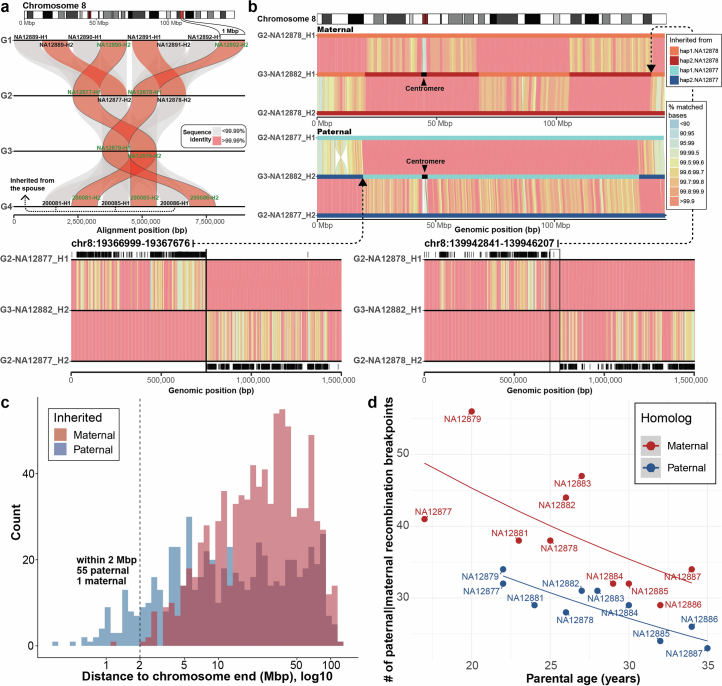
Understanding the human de novo mutation (DNM) rate requires complete sequence information 1 . Here using five complementary short-read and long-read sequencing technologies, we phased and assembled more than 95% of each diploid human genome in a four-generation, twenty-eight-member family (CEPH 1463). We estimate 98–206 DNMs per transmission, including 74.5 de novo single-nucleotide variants, 7.4 non-tandem repeat indels, 65.3 de novo indels or structural variants originating from tandem repeats, and 4.4 centromeric DNMs. Among male individuals, we find 12.4 de novo Y chromosome events per generation. Short tandem repeats and variable-number tandem repeats are the most mutable, with 32 loci exhibiting recurrent mutation through the generations. We accurately assemble 288 centromeres and six Y chromosomes across the generations and demonstrate that the DNM rate varies by an order of magnitude depending on repeat content, length and sequence identity. We show a strong paternal bias (75–81%) for all forms of germline DNM, yet we estimate that 16% of de novo single-nucleotide variants are postzygotic in origin with no paternal bias, including early germline mosaic mutations. We place all this variation in the context of a high-resolution recombination map (~3.4 kb breakpoint resolution) and find no correlation between meiotic crossover and de novo structural variants. These near-telomere-to-telomere familial genomes provide a truth set to understand the most fundamental processes underlying human genetic variation.
Overview
CoChat Summary
TL;DR
This study uses a four-generation, 28-member CEPH 1463 pedigree and five sequencing technologies to build phased, near-telomere-to-telomere assemblies and estimate human de novo mutation rates across variant classes. It reports 98–206 DNMs per transmission (average 152), strong paternal bias, 16% postzygotic SNVs, and elevated mutation in repeats, centromeres, and Y heterochromatin.
Key findings
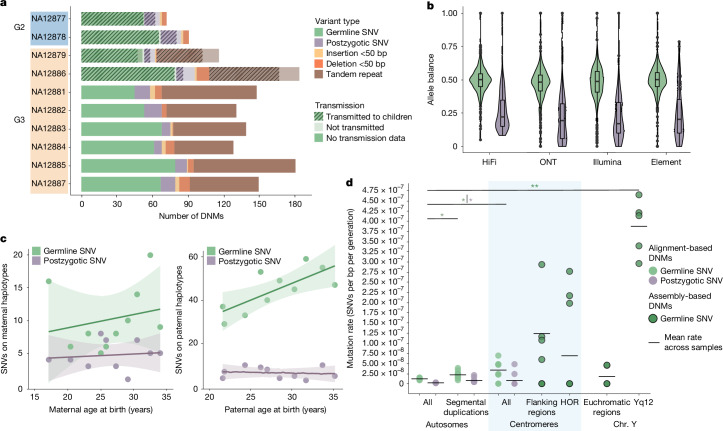
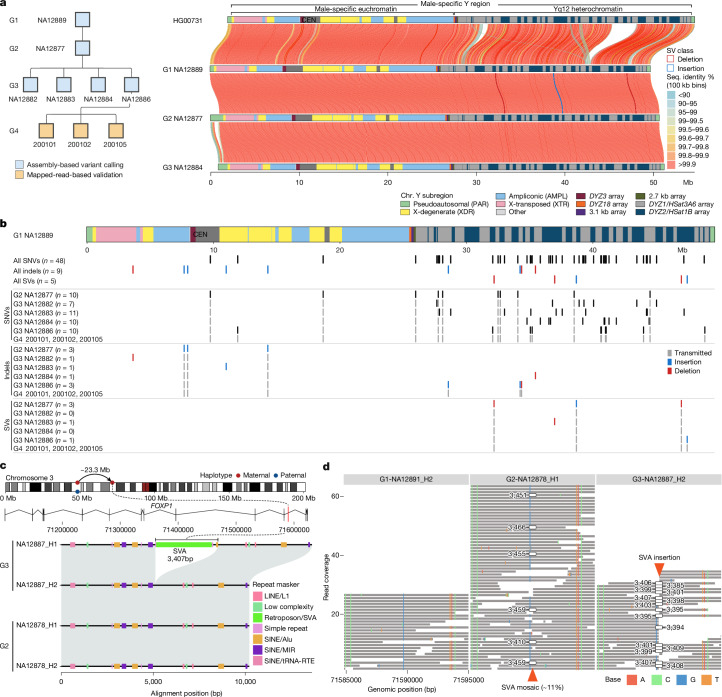
- Across transmissions, the authors estimate 98–206 DNMs per transmission (average 152), including 74.5 de novo SNVs, 7.4 non-tandem repeat indels, 65.3 de novo indels or SVs from tandem repeats, and 4.4 centromeric DNMs; among male individuals, 12.4 de novo Y chromosome events per generation.
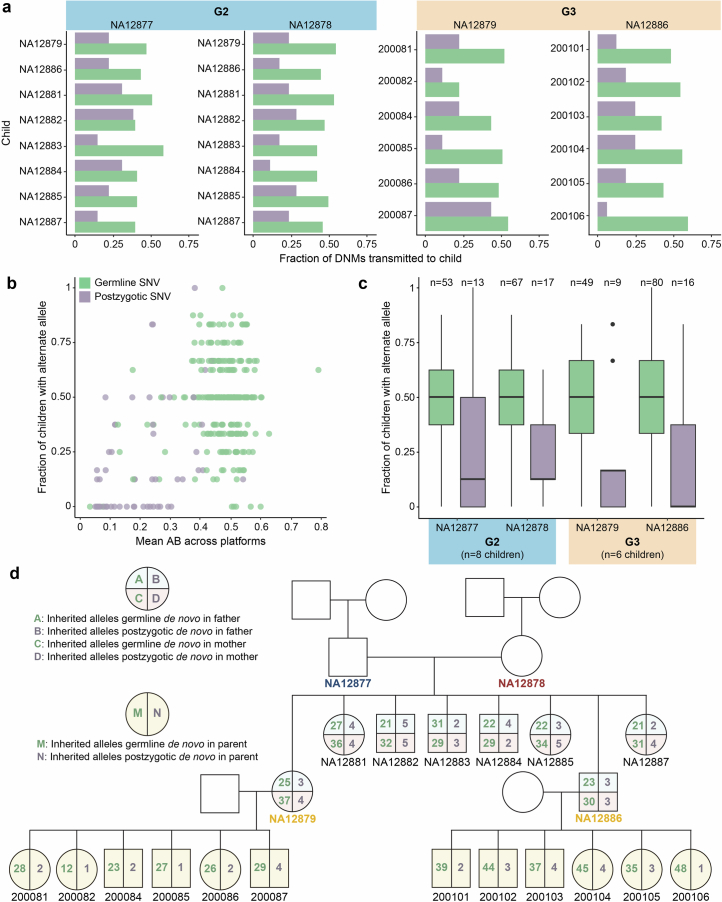
- Germline DNMs show a strong paternal bias of 75–81% for all forms, with a paternal age effect of +1.55 germline DNMs per year (two-sided t-test, P = 0.013); 16% of de novo SNVs (119/745) are postzygotic in origin and show no paternal bias.
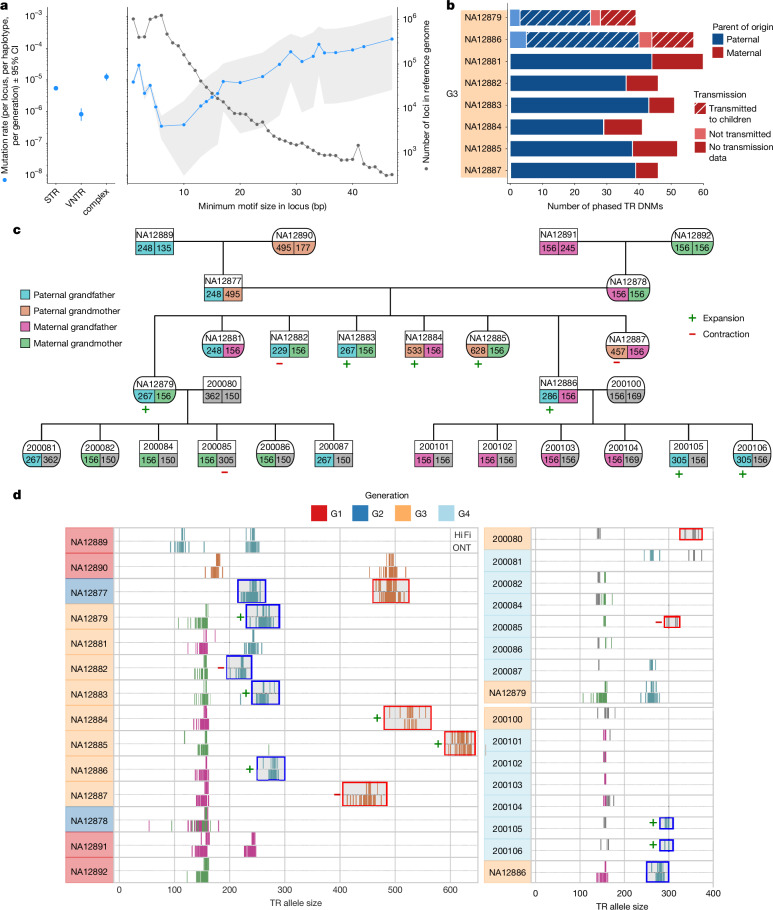
- Tandem repeats are highly mutable: 32 loci show recurrent mutation, the TR DNM rate is 4.74 × 10⁻⁶ per locus per haplotype per generation (STR 5.50 × 10⁻⁶; VNTR 0.83 × 10⁻⁶), and 75.0% of phased de novo TR alleles are paternal.
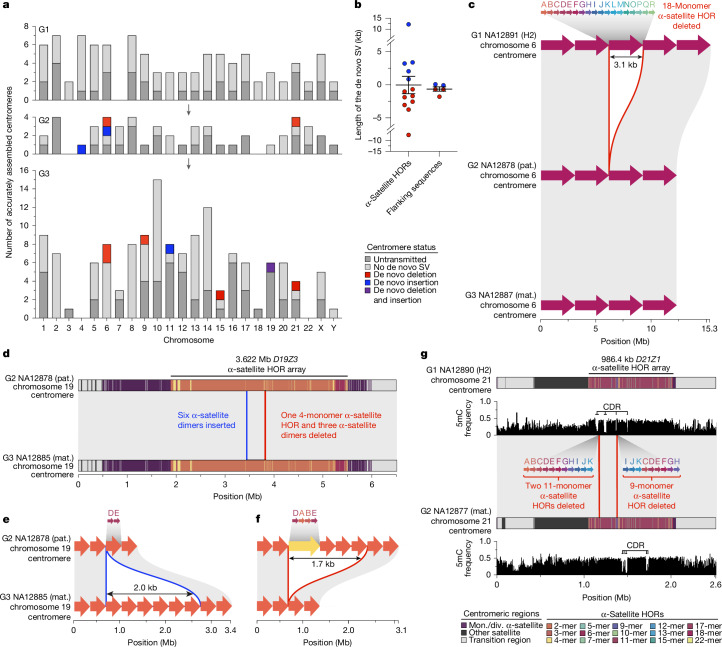
- The authors assemble 288 centromeres and six Y chromosomes, identify 18 de novo SVs among 150 centromere transmissions, estimate a centromeric SNV rate of 4.94 × 10⁻⁸ and a Y MSY SNV rate of 1.99 × 10⁻⁷, and find no correlation between meiotic crossover and de novo SVs.
Methods
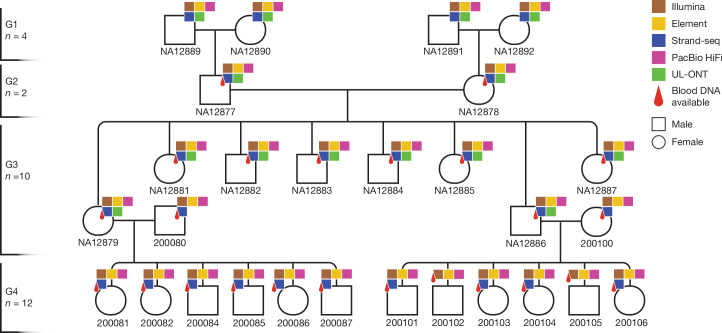
- The study sequenced the four-generation, 28-member CEPH 1463 family with five technologies: PacBio HiFi, ultra-long Oxford Nanopore Technologies, Strand-seq, Illumina, and Element AVITI; blood-derived DNA was used for variant discovery, with cell lines used for UL-ONT and Strand-seq.
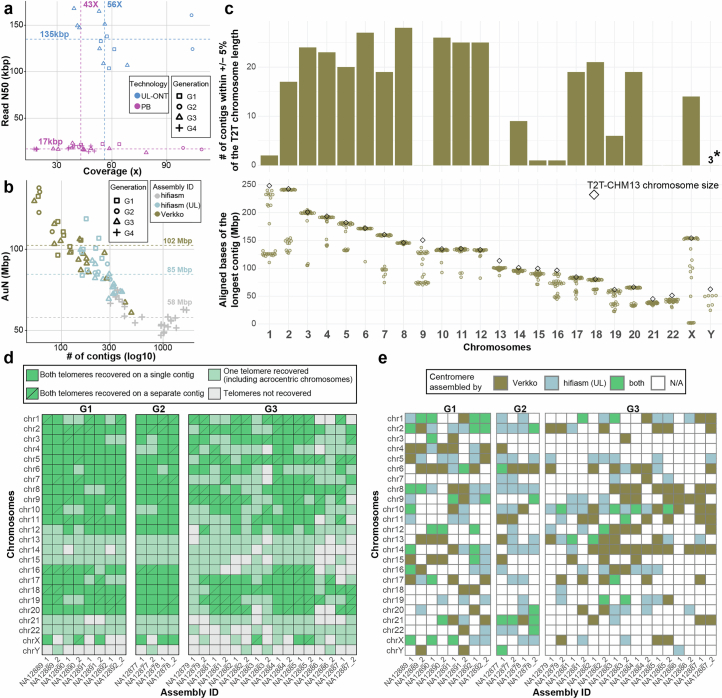
- Phased genome assemblies were generated with Verkko and hifiasm, phasing and assembling more than 95% of each diploid genome; 288 centromeres and six Y chromosomes were assembled, and variants were validated using Mendelian consistency and transmission across generations.
- DNM discovery used HiFi reads aligned to T2T-CHM13 with orthogonal ONT, Illumina, and Element validation; TRs were genotyped with TRGT and TRGT-denovo; recombination breakpoints were mapped using Strand-seq, inheritance vectors, and trio-based phased assemblies; mutation rates were calculated per callable base pair or locus.
Limitations
- The paper states that homopolymers remain challenging even with Element data, acrocentric regions could not be characterized, and DNM discovery was limited to the first three generations of one multigenerational family, with G4 used mainly for validation.
- The authors state that familial variation depends on genetic background and that many more families will be required for reliable mutation-rate estimates, especially in complex genomic regions.
- The text makes evident that small sample sizes limit power for some comparisons, such as de novo versus postzygotic mutational spectra and transmitted PZM enrichment in SDs; it also notes that blood-derived sequencing cannot demonstrate that every PZM is present in multiple tissues, and that five intragenerational recurrent TR events may reflect parental germline mosaicism rather than recurrent mutation.
Model-written summary. Check it against the paper before relying on it.
Integrity signals
Registry
Cites
Statistics
Figures
Verification
Claims the paper makes
0 Valid · 0 Not valid · 48 Not checked · 191 Own results and interpretations
In the paper
“We identified a total of 5.95 million single-nucleotide variants (SNVs) and indels and 35,662 structural variants (SVs)—all of which are Mendelian consistent across the second and third generations (Methods, Supplementary Table 5, Supplementary Fig. 13 and Data availability)18.”
§ Human de novo mutation rates from a four-generation pedigree reference > A multigenerational variant callset
What the sources say
- Not checked yetcites [18] Kronenberg, Z. et al. The Platinum Pedigree: a long-read benchmark for genetic variants. Preprint at bioRxiv10.1101/2024.10.02.616333 (2024). PMC12533576 40759746 source
plainSingle case- Asserted: passes — The authors put it forward as true.
- Checkable: passes — It can be checked against evidence.
- Load-bearing: passes — The paper’s conclusions depend on it.
- Based: passes — The paper gives a reason why it holds.
- Rests on an assumption not shown here.
A result the paper reports from its own data — it cites no other source for it, so there is none to check. The quote shows it is in the paper.
In the paper
“We estimate 98–206 DNMs per transmission, including 74.5 de novo single-nucleotide variants, 7.4 non-tandem repeat indels, 65.3 de novo indels or structural variants originating from tandem repeats, and 4.4 centromeric DNMs.”
§ Human de novo mutation rates from a four-generation pedigree reference > Abstract
hedged- Asserted: passes — The authors put it forward as true.
- Checkable: passes — It can be checked against evidence.
- Load-bearing: passes — The paper’s conclusions depend on it.
- Based: passes — The paper gives a reason why it holds.
- Rests on an assumption not shown here.
A result the paper reports from its own data — it cites no other source for it, so there is none to check. The quote shows it is in the paper.
In the paper
“We accurately assemble 288 centromeres and six Y chromosomes across the generations and demonstrate that the DNM rate varies by an order of magnitude depending on repeat content, length and sequence identity.”
§ Human de novo mutation rates from a four-generation pedigree reference > Abstract
plain- Asserted: passes — The authors put it forward as true.
- Checkable: passes — It can be checked against evidence.
- Load-bearing: passes — The paper’s conclusions depend on it.
- Based: passes — The paper gives a reason why it holds.
- Rests on an assumption not shown here.
A result the paper reports from its own data — it cites no other source for it, so there is none to check. The quote shows it is in the paper.
In the paper
“Moreover, 42.3% (213 out of 504) of non-acrocentric chromosomes are spanned in a single contig with canonical telomere repeats at each end (Methods, Extended Data Fig. 1d, Supplementary Fig. 3 and Supplementary Table 3).”
§ Human de novo mutation rates from a four-generation pedigree reference > Genome sequence and assembly
plain- Asserted: passes — The authors put it forward as true.
- Checkable: passes — It can be checked against evidence.
- Load-bearing: unclear — It is unclear whether the paper’s conclusions depend on it.
- Based: passes — The paper gives a reason why it holds.
A result the paper reports from its own data — it cites no other source for it, so there is none to check. The quote shows it is in the paper.
In the paper
“Short tandem repeats and variable-number tandem repeats are the most mutable, with 32 loci exhibiting recurrent mutation through the generations.”
§ Human de novo mutation rates from a four-generation pedigree reference > Abstract
plainstates an associationSingle case- Asserted: passes — The authors put it forward as true.
- Checkable: passes — It can be checked against evidence.
- Load-bearing: passes — The paper’s conclusions depend on it.
- Based: passes — The paper gives a reason why it holds.
- Rests on an assumption not shown here.
99 more claims
Create a free account to see all 239 claims and to verify the 82 references still open.
- Probably not a substantial claim. 75
- It may state two separate claims as one. 86
Self-check
Percentages, sums and reported differences re-computed from the paper’s own numbers.
Each contradiction between two passages listed here was confirmed by an independent check.
Rated minor: it would not touch a result — a value no result rests on, a p-value that stays on the same side of the significance level, or a conflict that is clerical, resolved elsewhere in the paper, or outside its own findings.
In the paper
§ Human de novo mutation rates from a four-generation pedigree reference > Centromere transmission and de novo SVs
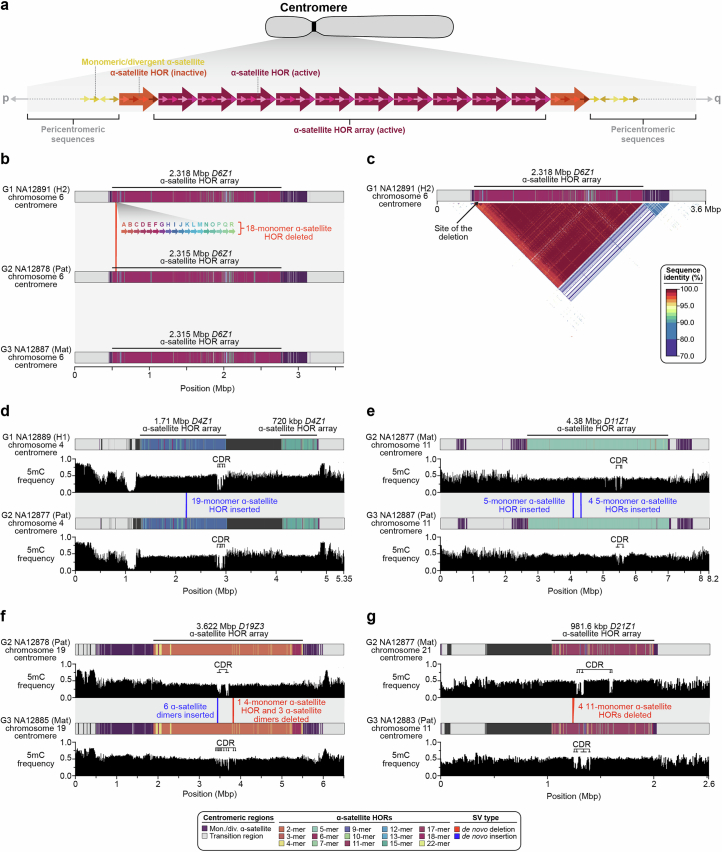
“One transmission from chromosome 9 involves both a gain of 2,052 bp (six dimer α-satellite HOR units) and a loss of 1,710 bp (one 4-mer α-satellite HOR and three α-satellite dimer units) in a single G2-to-G3 transmission (Fig. 4d–f).”
§ Human de novo mutation rates from a four-generation pedigree reference > Centromere transmission and de novo SVs
“d, An example of a de novo insertion and deletion in the chromosome 19 α-satellite HOR array of G3-NA12885.”
Rated minor: it would not touch a result — a value no result rests on, a p-value that stays on the same side of the significance level, or a conflict that is clerical, resolved elsewhere in the paper, or outside its own findings.
In the paper
§ Human de novo mutation rates from a four-generation pedigree reference > Methods > Y-chromosomal analysis
“Detailed analysis of Y-chromosomal DNMs focused on seven male individuals”
§ Human de novo mutation rates from a four-generation pedigree reference > Methods > Y-chromosomal analysis
“G1-NA12889, G2-NA12877, G3-NA12882, G3-NA12883, G3-NA12884 and G3-NA12886”
Rated minor: it would not touch a result — a value no result rests on, a p-value that stays on the same side of the significance level, or a conflict that is clerical, resolved elsewhere in the paper, or outside its own findings.
In the paper
§ Human de novo mutation rates from a four-generation pedigree reference > Y chromosome mutations
“from G3-NA12866 to his three male descendants in G4”
§ Human de novo mutation rates from a four-generation pedigree reference > Y chromosome mutations
“from G3-NA12886 to his male descendants in G4”
Citations
Cites
The Sequence Alignment/Map format and SAMtools
Li, H., Handsaker, B., Wysoker, A., Fennell, T., Ruan, J., Homer, N., Marth, G., Abecasis, G., Durbin, R., & 1000 Genome Project Data Processing Subgroup (2009) · Bioinformatics · doi:10.1093/bioinformatics/btp352 · Cited by 62,041
MAFFT Multiple Sequence Alignment Software Version 7: Improvements in Performance and Usability
Katoh, K., & Standley, D. M. (2013) · Molecular Biology and Evolution · doi:10.1093/molbev/mst010 · Cited by 46,209
MUSCLE: multiple sequence alignment with high accuracy and high throughput
Edgar, R. C. (2004) · Nucleic Acids Research · doi:10.1093/nar/gkh340 · Cited by 44,662
RAxML version 8: a tool for phylogenetic analysis and post-analysis of large phylogenies
Stamatakis, A. (2014) · Bioinformatics · doi:10.1093/bioinformatics/btu033 · Cited by 32,291
BEDTools: a flexible suite of utilities for comparing genomic features
Quinlan, A. R., & Hall, I. M. (2010) · Bioinformatics · doi:10.1093/bioinformatics/btq033 · Cited by 27,437
Self-citationMAFFT: a novel method for rapid multiple sequence alignment based on fast Fourier transform
Katoh, K. (2002) · Nucleic Acids Research · doi:10.1093/nar/gkf436 · Cited by 17,027
The variant call format and VCFtools
Danecek, P., Auton, A., Abecasis, G., Albers, C. A., Banks, E., DePristo, M. A., Handsaker, R. E., Lunter, G., Marth, G. T., Sherry, S. T., et al. (2011) · Bioinformatics · doi:10.1093/bioinformatics/btr330 · Cited by 16,200
Robinson, J. T., Thorvaldsdóttir, H., Winckler, W., Guttman, M., Lander, E. S., Getz, G., & Mesirov, J. P. (2011) · Nature Biotechnology · doi:10.1038/nbt.1754 · Cited by 15,390
Twelve years of SAMtools and BCFtools
Danecek, P., Bonfield, J. K., Liddle, J., Marshall, J., Ohan, V., Pollard, M. O., Whitwham, A., Keane, T., McCarthy, S. A., Davies, R. M., et al. (2021) · GigaScience · doi:10.1093/gigascience/giab008 · Cited by 15,343 · cited 1×
“BCFtools 101,102 (v.1.16) was used with a minimum base quality 20, mapping quality 20 and ploidy 1.”
InfluentialMinimap2: Pairwise alignment for nucleotide sequences
Li, H. (2018) · Bioinformatics · doi:10.1093/bioinformatics/bty191 · Cited by 14,807
Cited by
Complex genetic variation in nearly complete human genomes
Logsdon, G. A., Ebert, P., Audano, P. A., Loftus, M. G., Porubskỳ, D., Ebler, J., Yilmaz, F., Hallast, P., Prodanov, T., Yoo, D., et al. (2025) · Nature · doi:10.1038/s41586-025-09140-6 · Cited by 213
“25 and 26).”
Self-citationSperm sequencing reveals extensive positive selection in the male germline
Neville, M. D. C., Lawson, A. R. J., Sanghvi, R., Abascal, F., Pham, M. H., Cagan, A., Nicola, P. A., Bayzetinova, T., Baez‐Ortega, A., Roberts, K., et al. (2025) · Nature · doi:10.1038/s41586-025-09448-3 · Cited by 65
“Although long-read sequencing studies have begun to explore these in sperm 57 and trios 58 , further work is needed to capture the full range of human germline variation and its impact on offspring.”
Toward clinical long-read genome sequencing for rare diseases
Eisfeldt, J., Ek, M., Nordenskjöld, M., & Lindstrand, A. (2025) · Nature Genetics · doi:10.1038/s41588-025-02160-y · Cited by 55
Antipov, D., Rautiainen, M., Nurk, S., Walenz, B. P., Solar, S. J., Phillippy, A. M., & Koren, S. (2025) · Genome Research · doi:10.1101/gr.280383.124 · Cited by 52
“Existing reference-free tools such as Flagger (Liao et al. 2023) and NucFrec (Vollger et al. 2019) produce a high number of false-positive predictions and are not always consistent with each other (Porubsky et al. 2025), making it challenging to use them without manual curation of their results.”
The Platinum Pedigree: a long-read benchmark for genetic variants
Kronenberg, Z. N., Nolan, C., Porubskỳ, D., Mokveld, T., Rowell, W. J., Lee, S. Y., Dolzhenko, E., Chang, P.-C., Holt, J., Saunders, C. T., et al. (2025) · Nature Methods · doi:10.1038/s41592-025-02750-y · Cited by 51
“In a recent study the four-generation CEPH-1463 pedigree was sequenced using multiple technologies (Supplementary Table 1) and analyzed to study the de novo mutation rate for SNVs, indels, TRs and SVs 11 .”
InfluentialSelf-citation
Metadata
- Authors
- Porubsky, D., Dashnow, H., Sasani, T. A., Logsdon, G. A., Hallast, P., Noyes, M. D., Kronenberg, Z. N., Mokveld, T., Koundinya, N., Nolan, C., Steely, C. J., Guarracino, A., Dolzhenko, E., Harvey, W. T., Rowell, W. J., Grigorev, K., Nicholas, T. J., Goldberg, M. E., Oshima, K. K., Lin, J., Ebert, P., Watkins, W. S., Leung, T. Y., Hanlon, V. C. T., McGee, S., Pedersen, B. S., Happ, H. C., Jeong, H., Munson, K. M., Hoekzema, K., Chan, D. D., Wang, Y., Knuth, J., Garcia, G. H., Fanslow, C., Lambert, C., Lee, C., Smith, J. D., Levy, S., Mason, C. E., Garrison, E., Lansdorp, P. M., Neklason, D. W., Jorde, L. B., Quinlan, A. R., Eberle, M. A., & Eichler, E. E.
- Affiliations
- University of Utah (US)
- University of Washington (US)
- The Jackson Laboratory for Genomic Medicine (US)
- Pacific Biosciences (United States) (US)
- University of Kentucky (US)
- University of Tennessee Health Science Center (US)
- Ames Research Center (US)
- University of Pennsylvania (US)
- Düsseldorf University Hospital (DE)
- BC Cancer Agency (CA)
- Elements Biosciences (United States) (US)
- Weill Cornell Medicine (US)
- Howard Hughes Medical Institute (US)
- Corresponding author
- Eichler, Evan E.
- ORCID
- Porubsky, David
- Dashnow, Harriet
- Sasani, Thomas A.
- Logsdon, Glennis A.
- Hallast, Pille
- Noyes, Michelle D.
- Kronenberg, Zev N.
- Mokveld, Tom
- Koundinya, Nidhi
- Nolan, Cillian
- Steely, Cody J.
- Guarracino, Andrea
- Dolzhenko, Egor
- Harvey, William T.
- Rowell, William J.
- Grigorev, Kirill
- Nicholas, Thomas J.
- Goldberg, Michael E.
- Oshima, Keisuke K.
- Lin, Jiadong
- Ebert, Peter
- Watkins, W. Scott
- Hanlon, Vincent C. T.
- McGee, Sean
- Pedersen, Brent S.
- Happ, Hannah C.
- Jeong, Hyeonsoo
- Munson, Katherine M.
- Hoekzema, Kendra
- Wang, Yanni
- Knuth, Jordan
- Garcia, Gage H.
- Lee, Charles
- Smith, Joshua D.
- Levy, Shawn
- Mason, Christopher E.
- Garrison, Erik
- Lansdorp, Peter M.
- Neklason, Deborah W.
- Jorde, Lynn B.
- Quinlan, Aaron R.
- Eberle, Michael A.
- Eichler, Evan E.
- Venue
- Nature
- Published
- 2025-04-23
- Volume
- 643
- Issue
- 8071
- Pages
- 427-436
- ISSN
- 0028-0836 (ISSN-L)
- 1476-4687
- PMC
- PMC12240836
- OpenAlex
- W4409729484
- Cited by
- 151
- References
- 120
- Citations by year
- 2026: 102 · 2025: 45
- FWCI
- 48.94
- Type
- journal article
- Language
- en
- Open access
- hybrid
- doi.org
- Licence
- cc-by
- creativecommons.org/licenses/by/4.0 (tdm)
- creativecommons.org/licenses/by/4.0 (vor)
- Locations
- Nature (publishedVersion, cc-by)
- bioRxiv (Cold Spring Harbor Laboratory) (submittedVersion, cc-by-nc-nd)
- Europe PMC (PubMed Central) (publishedVersion, cc-by)
- PubMed Central (publishedVersion, cc-by)
- PubMed (publishedVersion)
- PubMed Central (submittedVersion, cc-by-nc-nd)
- PubMed (submittedVersion)
- Funders
- Howard Hughes Medical Institute
- Simons Foundation (810018EE)
- Simons Foundation Autism Research Initiative (810018EE)
- National Institutes of Health (GM12878, 1s10od034321-01, HG007497, GM147352, UM1TR004409, RC2TR004391)
- Canadian Institutes of Health Research (159787)
- National Institute on Aging (P30AG072946)
- National Institute of Mental Health (R01MH101221)
- National Human Genome Research Institute (R00HG011657, K99HG012796, R01HG002385, R00HG012796, T32HG008962, R01HG010169, U24HG007497)
- National Institute of General Medical Sciences (GM12878, GM12884, K99GM147352, R35GM118335, R00GM147352)
- National Center for Advancing Translational Sciences
- Topics
- Life Sciences › Biochemistry, Genetics and Molecular Biology › Genetics › Genomic variations and chromosomal abnormalities
- Life Sciences › Biochemistry, Genetics and Molecular Biology › Genetics › Genomics and Rare Diseases
- Life Sciences › Biochemistry, Genetics and Molecular Biology › Molecular Biology › Genomics and Phylogenetic Studies
- Keywords
- germline mutations, diploid genome assembly, centromere, Y chromosome, microsatellite markers, variable number tandem repeats, structural variants, postzygotic mutation, germline mosaicism, crossover, human genetic variation
- MeSH terms
- Centromere, Female, Humans, Male, Pedigree, Genome, Human, Germ-Line Mutation, Polymorphism, Single Nucleotide, Chromosomes, Human, Y, INDEL Mutation, Mutation Rate
About these checks
Registry, retraction, Cites and statistics results are computed, not judged, with one exception: a printed reference that no index lists is read once by a model before it counts as a citation error. Claims are extracted by a model and kept only when their quote appears verbatim in the text; each cited source is then checked, with a model’s help, for whether it says what the claim relies on. Those verdicts can be wrong — read the claim’s quote and the cited source before relying on one.
A language model drew the claims from the paper on 2026-11-28, under version 3 of the claim definition (model deepseek-v4.1-flash, prompt extract-v3).
A second model labelled each claim on 2026-11-28 (model jev-1.13-20260917, definition revision gold-guideline-v0.2).
Statistics and arithmetic are recomputed, not judged.
Confidence bands are shown only for fields calibrated on our annotated test set. None is calibrated yet, so no band is shown.
What counts as a claim ›How we measure confidence ›How we check this ›
Are you an author, or do you see a problem with this page? Request a review
How to cite
Cite CoChat for the checks on this page, and the paper for its own findings.
- This page
- CoChat. (2026). Citation check: Human de novo mutation rates from a four-generation pedigree reference. https://app.cochat.ai/papers/10.1038/s41586-025-08922-2
- The paper
- Porubsky, D., Dashnow, H., Sasani, T. A., Logsdon, G. A., Hallast, P., Noyes, M. D., Kronenberg, Z. N., Mokveld, T., Koundinya, N., Nolan, C., Steely, C. J., Guarracino, A., Dolzhenko, E., Harvey, W. T., Rowell, W. J., Grigorev, K., Nicholas, T. J., Goldberg, M. E., Oshima, K. K., . . . Eichler, E. E. (2025). Human de novo mutation rates from a four-generation pedigree reference. Nature. https://doi.org/10.1038/s41586-025-08922-2
Data sources
Bibliographic data: Semantic Scholar, OpenAlex, Crossref.
Contains information from the Semantic Scholar Academic Graph Datasets, made available under the ODC Attribution License (ODC-BY 1.0).
Semantic Scholar’s data is described in: Kinney, R., et al. (2023). The Semantic Scholar Open Data Platform. arXiv:2301.10140.
