

Scaling and logic in the colour code on a superconducting quantum processor
Open accessThe DOI matches its Crossref record; 73 of the 74 references it cites were found in a registry or an index; 33 of the 41 sources its claims cite were checked for support.
Abstract
Quantum error correction [1–4] is essential for bridging the gap between the error rates of physical devices and the extremely low error rates required for quantum algorithms. Recent error-correction demonstrations on superconducting processors [5–8] have focused primarily on the surface code [9], which offers a high error threshold but poses limitations for logical operations. The color code [10] enables more efficient logic, but it requires more complex stabilizer measurements and decoding. Measuring these stabilizers in planar architectures like superconducting qubits is challenging, and realizations of color codes [11–19] have not addressed performance scaling with code size on any platform. Here, we present a comprehensive demonstration of the color code on a superconducting processor [8]. Scaling the code distance from three to five suppresses logical errors by a factor of Λ 3/5 = 1.56(4). Simulations indicate this performance is below the threshold of the color code, and the color code may become more efficient than the surface code following modest device improvements. We test transversal Clifford gates with logical randomized benchmarking [20] and inject magic states [21], a key resource for universal computation, achieving fidelities exceeding 99 % with post-selection. Finally, we teleport logical states between color codes using lattice surgery [22]. This work establishes the color code as a compelling research direction to realize fault-tolerant quantum computation on superconducting processors in the near future.
Overview
CoChat Summary
## TL;DR
The paper reports a superconducting-processor demonstration of the colour code, showing logical error suppression when scaling from distance 3 to 5 and implementing several fault-tolerant building blocks. It also characterizes transversal Clifford gates, high-fidelity magic state injection, and logical-state teleportation with lattice surgery.
## Key findings
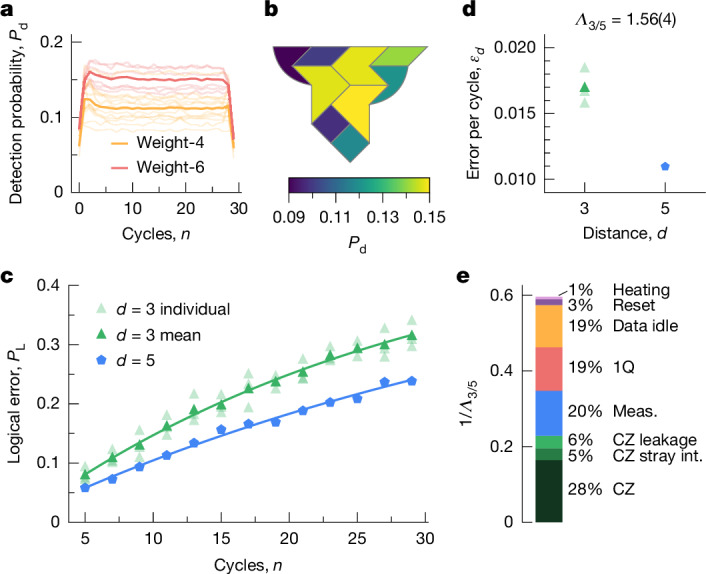
- Scaling the colour code from distance 3 to 5 suppresses logical errors by a factor of Λ3/5 = 1.56(4); with the neural-network decoder the authors report ε5 = 0.0110(2).
- For distance-5 memory experiments, the average error-detection probability was Pd,6 = 0.149 for weight-6 stabilizers versus Pd,4 = 0.112 for boundary weight-4 stabilizers.
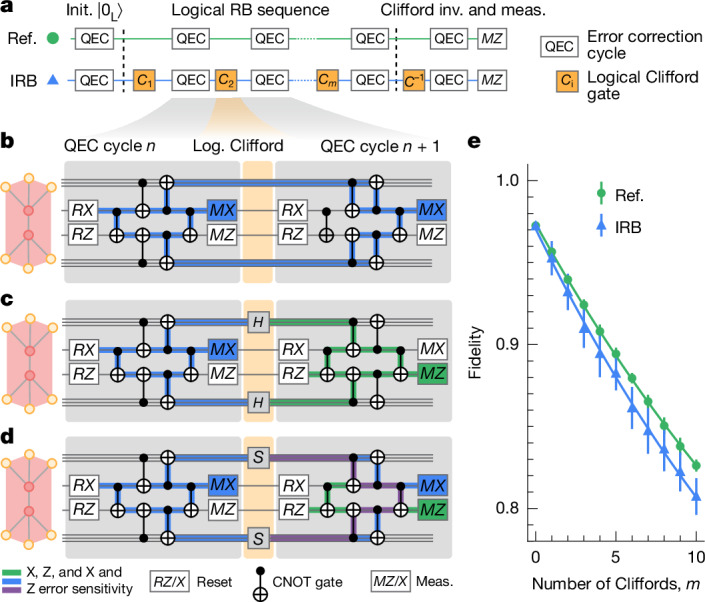
- Logical randomized benchmarking on a distance-3 code gives an average logical Clifford gate error of εC = 0.0027(3).
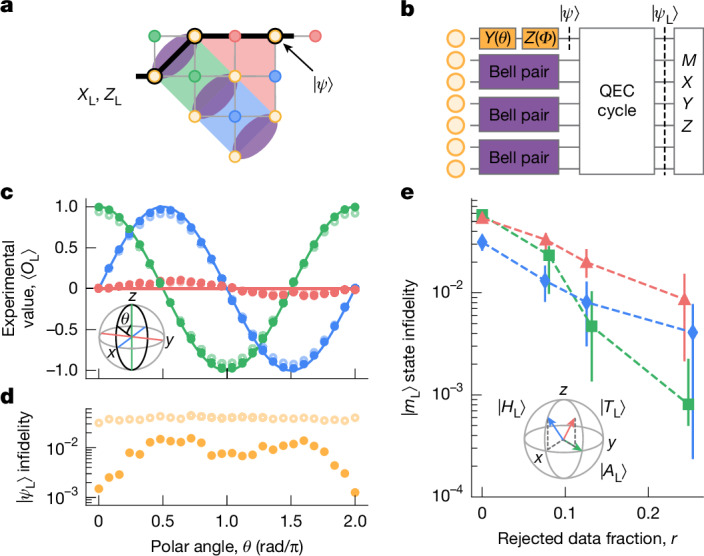
- Magic state injection achieves average infidelity 0.039(3) with the Möbius decoder and 0.009(4) with post-selection (retaining 74.8% of runs); for specific magic states, post-selection infidelities are reported with retained data fractions of 75.2%, 74.6%, and 75.7%.
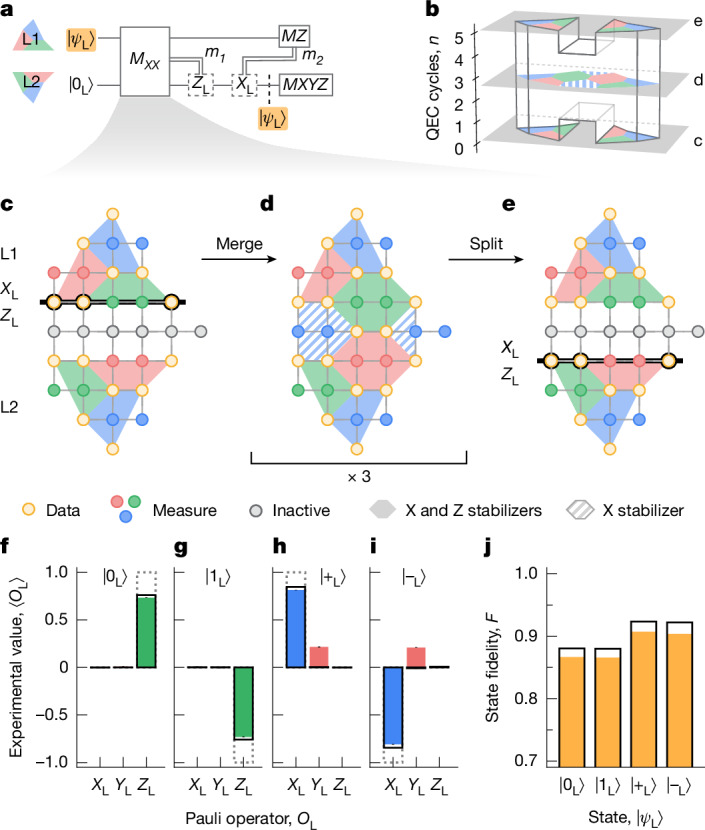
- Lattice-surgery teleportation of four logical input states yields decoded fidelities between 86.5(1)% and 90.7(1)%.
## Methods
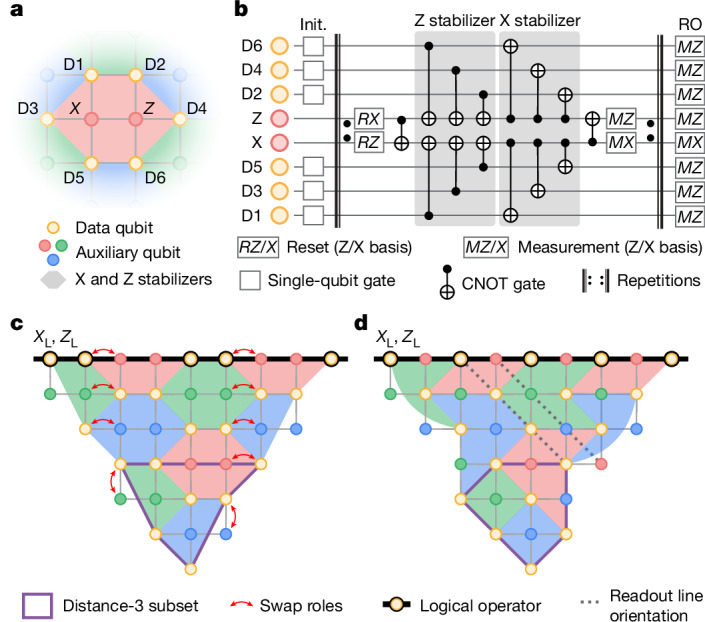
- Experimental demonstration on the 72-qubit Willow superconducting processor using a hexagonal colour-code layout embedded in a square grid, with 19 data qubits and 18 auxiliary qubits for the distance-5 logical qubit.
- Distance-scaling experiments: initialize logical states in the X and Z bases, run up to n = 29 error-correction cycles, measure final data qubits, and fit logical-error probabilities to extract per-cycle logical error and suppression factor.
- Analysis uses new decoding strategies, including a neural-network decoder (AlphaQubit) and the Möbius decoder (Chromobius), plus logical randomized benchmarking, magic-state tomography, and lattice-surgery-based teleportation protocols.
## Limitations
- The paper states that the observed performance is below the colour-code threshold; simulations suggest the colour code may only become more qubit-efficient than the surface code after modest device improvements or about a factor of four improvement in physical error rates.
- The text notes that the magic-state injection protocol is not fault-tolerant against an error on the injection data qubit, because it starts from a single physical qubit; this is an inherent protocol limitation stated in the paper.
- Evident from the text: the work demonstrates key building blocks, but does not present full large-scale fault-tolerant quantum computation; several results are limited to distance-3 or distance-5 codes and to post-selected state-injection performance.
Model-written summary. Check it against the paper before relying on it.
Integrity signals
Registry
Cites
Statistics
Figures
Verification
Claims the paper makes
17 Valid · 2 Not valid · 1 Not checked · 18 Own results and interpretations
Every source the paper cites for this claim was checked and supports it.
In the paper
“With a neural-network decoder (AlphaQubit)51, we obtain Λ3/5 = 1.56(4) and ε5 = 0.0110(2).”
§ Scaling and logic in the colour code on a superconducting quantum processor > Distance scaling
What the sources say
- Supportedcites [51] Bausch, J. et al. Learning high-accuracy error decoding for quantum processors. Nature 635, 834–840 (2024). 39567694 PMC11602728 source
The citation is attached to the identification of AlphaQubit as a neural-network decoder, not to the citing authors’ colour-code error rate. The source explicitly identifies AlphaQubit as a neural network in Methods > Model details (page unavailable). (LLM, conf=0.94)
plain- Asserted: passes — The authors put it forward as true.
- Checkable: passes — It can be checked against evidence.
- Load-bearing: passes — The paper’s conclusions depend on it.
- Based: passes — The paper gives a reason why it holds.
- Supported
The cited sources support only part of this claim — read each source’s verdict below.
In the paper
“Nevertheless, recent advances in superconducting qubit performance8, improvements in decoding algorithms39,40,45–47 and optimized error-syndrome extraction circuits44,47 now open new possibilities for implementing the colour code on existing hardware.”
§ Scaling and logic in the colour code on a superconducting quantum processor > Main
What the sources say
- Supportedcites [8] Google Quantum AI. Quantum error correction below the surface code threshold. Nature 638, 920–926 (2025). 39653125 PMC11864966 source
The citation to this paper is attached to the phrase about advances in superconducting qubit performance, not the later claims about decoding algorithms or syndrome-extraction circuits. In “A surface code memory below threshold,” the paper reports improved operational fidelities for its superconducting transmon qubits compared with earlier processors. (LLM, conf=0.93)
- Partly supportedcites [39] Zhang, J., Wu, Y.-C. & Guo, G.-P. Facilitating practical fault-tolerant quantum computing based on color codes. Phys. Rev. Res. 6, 033086 (2024). sourceExperimental — accuracy not yet measured
Zhang et al. (2024) clearly support the decoding half of the claim: the abstract (p. 1) and Sec. I (p. 2) present improved decoding graphs/weights raising the 6,6,6 triangular color code threshold to 0.47%, and Sec. I (p. 1) states color codes are compatible with real hardware constrained to 2-D local architectures. However, our copy never mentions superconducting qubit performance or advances in physical qubit quality, and it does not report optimized syndrome-extraction circuits itself — Sec. I (p. 2) and the Conclusion (p. 15) explicitly credit higher-through-circuit-optimization results to Ref. [37] (Gidney and Jones) and say their own threshold is the best 'without circuit optimization'. So the 'superconducting qubit performance' and 'optimized error-syndrome extraction circuits' components of the cited sentence are not supported by this source. (LLM, conf=0.72)
- Supportedcites [40] Lee, S.-H., Li, A. & Bartlett, S. D. Color code decoder with improved scaling for correcting circuit-level noise. Quantum 9, 1609 (2025). source
The cited sentence attaches this source to the 'improvements in decoding algorithms' clause, and our copy is exactly that: the Abstract and Introduction (Sec. 1) introduce a concatenated-MWPM color-code decoder that reaches near-optimal sub-threshold scaling (p_fail ~ p^{d/2}) under circuit-level noise, unlike previous matching-based decoders. Sec. 5 (Remarks) states the practical implication directly — 'we therefore anticipate that our decoder enhances the practicality of employing color codes in quantum computing' — and Sec. 4.3 additionally optimizes the CNOT schedule of the syndrome-extraction circuit, while Sec. 1 credits recent superconducting/neutral-atom/trapped-ion color-code experiments (Ref. [17]) as the hardware backdrop. The 'superconducting qubit performance' and 'optimized extraction circuit' specifics are carried by the sentence's other citations, not by this one, so nothing attributed here is unsupported. (LLM, conf=0.85)
plainstates a cause- Asserted: passes — The authors put it forward as true.
- Checkable: passes — It can be checked against evidence.
- Load-bearing: passes — The paper’s conclusions depend on it.
- Based: passes — The paper gives a reason why it holds.
- Supported
Every source the paper cites for this claim was checked and supports it.
In the paper
“Moreover, these colour codes require more elaborate decoding strategies, and conventional colour code syndrome extraction circuits require higher connectivity than four-nearest-neighbour architectures35,44, which is difficult to realize on superconducting devices.”
§ Scaling and logic in the colour code on a superconducting quantum processor > Main
What the sources say
- Supportedcites [35] Landahl, A. J., Anderson, J. T. & Rice, P. R. Fault-tolerant quantum computing with color codes. Preprint at https://arxiv.org/abs/1108.5738 (2011). source
In B. Syndrome extraction (p. 6), the paper says each data qubit must be checked by six different syndrome bits; its circuit description (pp. 5–6) places syndrome qubits at face centers and has data qubits interact with them. That conventional extraction scheme therefore requires more than four direct connections per data qubit, although the paper describes the connections as nearest-neighbor on its 2D geometry. (LLM, conf=0.90)
- Supportedcites [44] Takada, Y. & Fujii, K. Improving threshold for fault-tolerant color-code quantum computing by flagged weight optimization. PRX Quantum 5, 030352 (2024). source
The Conventional syndrome measurement circuit section (p. 4) says the conventional method uses one ancilla qubit to measure each stabilizer, interacting with the data qubits it acts on. The Color codes section (p. 3) describes hexagonal and octagonal faces, so measuring those faces conventionally requires an ancilla to interact with more than four data qubits. The Introduction (p. 2) also says the proposed cat-state method reduces connectivity requirements, particularly for superconducting architectures. (LLM, conf=0.88)
plainstates a cause- Asserted: passes — The authors put it forward as true.
- Checkable: passes — It can be checked against evidence.
- Load-bearing: passes — The paper’s conclusions depend on it.
- Based: passes — The paper gives a reason why it holds.
- Supported
The cited sources support only part of this claim — read each source’s verdict below.
In the paper
“Lattice surgery22,39,43,56 enables the efficient realization of multi-qubit fault-tolerant operations, such as the CNOT gate, with only nearest-neighbour interactions.”
§ Scaling and logic in the colour code on a superconducting quantum processor > State teleportation using lattice surgery
What the sources say
- Supportedcites [22] Horsman, D., Fowler, A. G., Devitt, S. & Van Meter, R. Surface code quantum computing by lattice surgery. New J. Phys. 14, 123011 (2012). source
The Introduction says lattice-surgery operations require only nearest-neighbour physical interactions, maintain full fault tolerance, and can be combined into logical gates including a CNOT. Section 4.1 constructs the fault-tolerant CNOT, while Section 7.3 describes a 53-physical-qubit implementation, supporting the efficiency characterization. (LLM, conf=0.94)
- Supportedcites [39] Zhang, J., Wu, Y.-C. & Guo, G.-P. Facilitating practical fault-tolerant quantum computing based on color codes. Phys. Rev. Res. 6, 033086 (2024). source
Sec. II.B (p. 3) states lattice surgery is 'a measurement-based scheme allowing for efficient implementation of universal gate sets by fault-tolerant logical multi-body Pauli operator measurements' and that it 'only requires 2-D qubit layout and local interactions'; the Introduction (p. 1) adds that it 'retains locality constraints' and implements logical gates including Clifford gates, while Sec. II.C (p. 4) says logical Clifford gates in topological codes 'are typically easier to implement by lattice surgery'. The claim's example, a two-qubit Clifford (CNOT) operation, falls within the multi-qubit logical Clifford/2-qubit logical Pauli-measurement capabilities our copy attributes to lattice surgery, though the paper does not name the logical CNOT explicitly (its 'CNOT' passages, p. 7 and p. 9, refer to physical CNOT schedules in stabilizer measurement circuits). (LLM, conf=0.82)
- Partly supportedcites [43] Thomsen, F., Kesselring, M. S., Bartlett, S. D. & Brown, B. J. Low-overhead quantum computing with the color code. Phys. Rev. Res. 6, 043125 (2024). sourceExperimental — accuracy not yet measured
The Overview (p. 2) describes fault-tolerant logical operations performed through lattice surgery, and the Introduction (p. 1) describes a resource-efficient, two-dimensional architecture with nearest-neighbour readout. Our copy does not specifically show a CNOT gate implemented by lattice surgery using only nearest-neighbour interactions, so that example is not established by the cited paper. (LLM, conf=0.82)
plainstates a cause- Asserted: passes — The authors put it forward as true.
- Checkable: passes — It can be checked against evidence.
- Load-bearing: passes — The paper’s conclusions depend on it.
- Based: passes — The paper gives a reason why it holds.
- Supported
The cited sources support only part of this claim — read each source’s verdict below.
In the paper
“However, colour codes have a stricter error threshold than surface codes because of their higher weight stabilizer measurements35.”
§ Scaling and logic in the colour code on a superconducting quantum processor > Main
What the sources say
- Partly supportedcites [35] Landahl, A. J., Anderson, J. T. & Rice, P. R. Fault-tolerant quantum computing with color codes. Preprint at https://arxiv.org/abs/1108.5738 (2011). sourceExperimental — accuracy not yet measured
In C. Circuit-level noise model (p. 14), the paper reports a lower threshold for 4.8.8 color codes than for 4.4.4.4 surface codes and says it believes the difference arises from higher-weight stabilizers and their larger measurement circuits. The claim omits that noise-model restriction and presents the proposed explanation as certain. In A. Code capacity noise model (p. 11), the color-code threshold is instead slightly higher. (LLM, conf=0.88)
plainstates a cause- Asserted: passes — The authors put it forward as true.
- Checkable: passes — It can be checked against evidence.
- Load-bearing: unclear — It is unclear whether the paper’s conclusions depend on it.
- Based: passes — The paper gives a reason why it holds.
- Partly supported
22 more claims · 6 with their cited sources checked
Create a free account to see all 38 claims and to verify the 7 references still open.
- Probably not a substantial claim. 7
- It may state two separate claims as one. 7
- The quote only partly states this claim. 1
Claims other papers make about this one
Each is checked against this paper’s own text: does it say what the citing paper says it does?
The source backs part of the claim, not all of it — or backs it for a different population, condition or comparison.
In the citing paper
“Over the past several years, there has been vast progress made in both theory, with the introduction of novel code constructions, improvements in code parameters, and decoding algorithms, and experiment, with advancements in the quality of qubits, coherence times, and gate fidelities, and even some early demonstrations of logical error suppression below threshold and small fault-tolerant primitiv”
From Quantum error correction and fault tolerance: A comprehensive tutorial (2026) · cites this paper as [35]
Experimental — accuracy not yet measured
Citations
Cites
Teleporting an unknown quantum state via dual classical and Einstein-Podolsky-Rosen channels
Bennett, C. H., Brassard, G., Crépeau, C., Jozsa, R., Peres, A., & Wootters, W. K. (1993) · Physical Review Letters · doi:10.1103/physrevlett.70.1895 · Cited by 13,703 · cited 1×
“…we showcase the lattice surgery framework using an M XX parity measurement, which measures the two-qubit Pauli operator ˆ X L1 ˆ X L2 , along with a classical Pauli frame update to teleport [21, 76] a logical state, | Ψ L ⟩ , from one logical qubit to another, represented schemat-ically in Fig.”
Quantum Computing in the NISQ era and beyond
Preskill, J. (2018) · Quantum · doi:10.22331/q-2018-08-06-79 · Cited by 8,830
Fault-tolerant quantum computation by anyons
Kitaev, A. Y. (2003) · Annals of Physics · doi:10.1016/s0003-4916(02)00018-0 · Cited by 7,238
Communication via one- and two-particle operators on Einstein-Podolsky-Rosen states
Bennett, C. H., & Wiesner, S. J. (1992) · Physical Review Letters · doi:10.1103/physrevlett.69.2881 · Cited by 5,470
Scheme for reducing decoherence in quantum computer memory
Shor, P. W. (1995) · Physical Review A · doi:10.1103/physreva.52.r2493 · Cited by 4,479 · cited 3×
“Quantum error correction (QEC) offers a solution to bridge this gap by encoding logical qubits across multiple physical qubits [1, 2].”
Polynomial-time algorithms for prime factorization and discrete logarithms on a quantum computer
Shor, P. W. (1999) · SIAM Review · doi:10.1137/s0036144598347011 · Cited by 3,904
Charge-insensitive qubit design derived from the Cooper pair box
Koch, J., Yu, T. M., Gambetta, J., Houck, A. A., Schuster, D. I., Majer, J., Blais, A., Devoret, M. H., Girvin, S. M., & Schoelkopf, R. J. (2007) · Physical Review A · doi:10.1103/physreva.76.042319 · Cited by 3,351
Lloyd, S. (1996) · Science · doi:10.1126/science.273.5278.1073 · Cited by 3,088
Surface codes: Towards practical large-scale quantum computation
Fowler, A. G., Mariantoni, M., Martinis, J. M., & Cleland, A. N. (2012) · Physical Review A · doi:10.1103/physreva.86.032324 · Cited by 3,059 · cited 2×
“For instance, the conventional syndrome extraction circuit for the color code [10–13] requires flag qubits [14] to ensure fault-tolerance.”
Self-citationEdmonds, J. (1965) · Canadian Journal of Mathematics · doi:10.4153/cjm-1965-045-4 · Cited by 2,428 · cited 1×
“As expected, weight-6 stabilizers exhibit a higher error detection prob-4 Because each data qubit in the bulk participates in three stabilizers per basis (compared to two for the surface code), efficient matching-based decoders [60–63] cannot be used directly [55].”
Circuit quantum electrodynamics
Blais, A., Grimsmo, A. L., Girvin, S. M., & Wallraff, A. (2021) · Reviews of Modern Physics · doi:10.1103/revmodphys.93.025005 · Cited by 1,931
Dennis, E., Kitaev, A., Landahl, A., & Preskill, J. (2002) · Journal of Mathematical Physics · doi:10.1063/1.1499754 · Cited by 1,768
Universal quantum computation with ideal Clifford gates and noisy ancillas
Bravyi, S., & Kitaev, A. (2005) · Physical Review A · doi:10.1103/physreva.71.022316 · Cited by 1,525 · cited 5×
“Compared to other decoders that use similar decomposition methods [26], connecting the boundaries enables more accurate weighting of the relative costs of matching syndrome elements to a boundary (typically underestimated when graphs are disconnected) versus matching them to other syndrome elements…”
InfluentialSimulated Quantum Computation of Molecular Energies
Aspuru-Guzik, A., Dutoi, A. D., Love, P. J., & Head-Gordon, M. (2005) · Science · doi:10.1126/science.1113479 · Cited by 1,418
Quantum error correction for quantum memories
Terhal, B. M. (2015) · Reviews of Modern Physics · doi:10.1103/revmodphys.87.307 · Cited by 1,354
Multiple-particle interference and quantum error correction
(1996) · Proceedings of the Royal Society of London. Series A: Mathematical, Physical and Engineering Sciences · doi:10.1098/rspa.1996.0136 · Cited by 1,284
Logical quantum processor based on reconfigurable atom arrays
Bluvstein, D., Evered, S. J., Geim, A. A., Li, S. H., Zhou, H., Manovitz, T., Ebadi, S., Cain, M., Kalinowski, M., Hangleiter, D., et al. (2024) · Nature · doi:10.1038/s41586-023-06927-3 · Cited by 1,119 · cited 1×
“As a result, error suppression by increasing the color code size has not yet been demonstrated on any experimental platform.”
Simple Pulses for Elimination of Leakage in Weakly Nonlinear Qubits
Motzoi, F., Gambetta, J. M., Rebentrost, P., & Wilhelm, F. K. (2009) · Physical Review Letters · doi:10.1103/physrevlett.103.110501 · Cited by 814
Quantum error correction below the surface code threshold
Collaborators, G. Q. A. A., Acharya, R., Abanin, D. A., Aghababaie-Beni, L., Aleiner, I., Andersen, T. I., Ansmann, M., Arute, F., Arya, K., Asfaw, A., et al. (2025) · Nature · doi:10.1038/s41586-024-08449-y · Cited by 778 · cited 4×
“However, most practical quantum computing applications require gate error rates far below what current physical devices can achieve [31].”
InfluentialSelf-citationStabilizer Codes and Quantum Error Correction
Gottesman, D. (1997) · arXiv · doi:10.48550/arxiv.quant-ph/9705052 · Cited by 753
A simple formula for the average gate fidelity of a quantum dynamical operation
Nielsen, M. A. (2002) · Physics Letters A · doi:10.1016/s0375-9601(02)01272-0 · Cited by 725
Topological Quantum Distillation
Bombin, H., & Martin-Delgado, M. A. (2006) · Physical Review Letters · doi:10.1103/physrevlett.97.180501 · Cited by 700
Realizing repeated quantum error correction in a distance-three surface code
Krinner, S., Lacroix, N., Remm, A., Di Paolo, A., Genois, E., Leroux, C., Hellings, C., Lazar, S., Swiadek, F., Herrmann, J., et al. (2022) · Nature · doi:10.1038/s41586-022-04566-8 · Cited by 686 · cited 3×
“QEC implementations with superconducting qubits [7–9, 11, 34–36] have predominantly focused on the surface code [14] or variants thereof [37, 38], although alternative approaches such as bosonic encodings are also being explored [39, 40].”
Self-citationKnill, E., Laflamme, R., & Zurek, W. H. (1998) · Science · doi:10.1126/science.279.5349.342 · Cited by 663
Surface code quantum computing by lattice surgery
Horsman, D., Fowler, A. G., Devitt, S., & Meter, R. V. (2012) · New Journal of Physics · doi:10.1088/1367-2630/14/12/123011 · Cited by 598 · cited 2×
“Lattice surgery [27, 46, 50, 75] enables the efficient realization of multi-qubit fault-tolerant operations, such as the CNOT-gate, with only nearest-neighbor interactions.”
Self-citationRoads towards fault-tolerant universal quantum computation
Campbell, E. T., Terhal, B. M., & Vuillot, C. (2017) · Nature · doi:10.1038/nature23460 · Cited by 596 · cited 2×
“To inject an arbitrary state | ψ L ⟩ into a distance-three logical qubit, we first prepare the desired state on a physical qubit and then use a fault-tolerant protocol [40, 41] to expand the color code from a degenerate distance d = 1 code to a d = 3 code.”
The Heisenberg Representation of Quantum Computers
Gottesman, D. (1998) · arXiv · doi:10.48550/arxiv.quant-ph/9807006 · Cited by 489
Restrictions on Transversal Encoded Quantum Gate Sets
Eastin, B., & Knill, E. (2009) · Physical Review Letters · doi:10.1103/physrevlett.102.110502 · Cited by 457 · cited 2×
“For the color code, extending the transversal gate set with a non-Clifford single-qubit T -gate ( π/ 4 rotation around the z axis) suffices to perform all single-qubit logical operations necessary for universal quantum computation.”
Efficient Measurement of Quantum Gate Error by Interleaved Randomized Benchmarking
Magesan, E., Gambetta, J. M., Johnson, B. R., Ryan, C. A., Chow, J. M., Merkel, S. T., da Silva, M. P., Keefe, G. A., Rothwell, M. B., Ohki, T. A., et al. (2012) · Physical Review Letters · doi:10.1103/physrevlett.109.080505 · Cited by 428
A Game of Surface Codes: Large-Scale Quantum Computing with Lattice Surgery
Litinski, D. (2019) · Quantum · doi:10.22331/q-2019-03-05-128 · Cited by 408
Real-time quantum error correction beyond break-even
Sivak, V. V., Eickbusch, A., Royer, B., Singh, S., Tsioutsios, I., Ganjam, S., Miano, A., Brock, B. L., Ding, A. Z., Frunzio, L., et al. (2023) · Nature · doi:10.1038/s41586-023-05782-6 · Cited by 407 · cited 2×
“QEC implementations with superconducting qubits [7–9, 11, 34–36] have predominantly focused on the surface code [14] or variants thereof [37, 38], although alternative approaches such as bosonic encodings are also being explored [39, 40].”
Self-citationQuantum computations on a topologically encoded qubit
Nigg, D., Müller, M., Martinez, E. A., Schindler, P., Hennrich, M., Monz, T., Martin-Delgado, M. A., & Blatt, R. (2014) · Science · doi:10.1126/science.1253742 · Cited by 400
Realization of Real-Time Fault-Tolerant Quantum Error Correction
Ryan-Anderson, C., Bohnet, J. G., Lee, K., Gresh, D., Hankin, A., Gaebler, J. P., Francois, D., Chernoguzov, A., Lucchetti, D., Brown, N. C., et al. (2021) · Physical Review X · doi:10.1103/physrevx.11.041058 · Cited by 306
Demonstration of fault-tolerant universal quantum gate operations
Postler, L., Heuβen, S., Pogorelov, I., Rispler, M., Feldker, T., Meth, M., Marciniak, C. D., Stricker, R., Ringbauer, M., Blatt, R., et al. (2022) · Nature · doi:10.1038/s41586-022-04721-1 · Cited by 287 · cited 3×
“Similarly to other conditional Pauli operations in this circuit, this gate is not applied physically but instead commuted through the circuit in pre-processing by our error correction software [18].”
Bonilla Ataides, J. P., Tuckett, D. K., Bartlett, S. D., Flammia, S. T., & Brown, B. J. (2021) · Nature Communications · doi:10.1038/s41467-021-22274-1 · Cited by 262
Topological and Subsystem Codes on Low-Degree Graphs with Flag Qubits
Chamberland, C., Zhu, G., Yoder, T. J., Hertzberg, J. B., & Cross, A. W. (2020) · Physical Review X · doi:10.1103/physrevx.10.011022 · Cited by 223 · cited 1×
“QEC implementations with superconducting qubits [7–9, 11, 34–36] have predominantly focused on the surface code [14] or variants thereof [37, 38], although alternative approaches such as bosonic encodings are also being explored [39, 40].”
Magic State Distillation: Not as Costly as You Think
Litinski, D. (2019) · Quantum · doi:10.22331/q-2019-12-02-205 · Cited by 220
Sparse blossom: correcting a million errors per core second with minimum-weight matching
Higgott, O., & Gidney, C. (2025) · Quantum · doi:10.22331/q-2025-01-20-1600 · Cited by 180
Self-citationOptimal resources for topological two-dimensional stabilizer codes: Comparative study
Bombin, H., & Martin-Delgado, M. A. (2007) · Physical Review A · doi:10.1103/physreva.76.012305 · Cited by 178 · cited 1×
“Color codes [15, 42] allow for more efficient logical operations and require fewer qubits than the surface code to encode a logical qubit at a fixed code distance [43].”
Sparse Blossom: correcting a million errors per core second with minimum-weight matching
Higgott, O., & Gidney, C. (2023) · arXiv · doi:10.48550/arxiv.2303.15933 · Cited by 148
Self-citationQuantum Universality from Magic States Distillation Applied to CSS Codes
Reichardt, B. W. (2005) · Quantum Information Processing · doi:10.1007/s11128-005-7654-8 · Cited by 143 · cited 1×
“These high-fidelity magic states surpass the threshold required for magic state distillation [26, 72], exceed the fidelities achieved in other state injection experiments in superconducting circuits [9, 35, 73, 74], and lie on the Pareto front balancing infidelity and data rejection when compared…”
Logical-qubit operations in an error-detecting surface code
(2021) · doi:10.1038/s41567-021-01423-9 · Cited by 141
Logical-qubit operations in an error-detecting surface code
(2021) · doi:10.21203/rs.3.rs-380732/v1 · Cited by 141
Encoding a magic state with beyond break-even fidelity
Gupta, R. S., Sundaresan, N., Alexander, T., Wood, C. J., Merkel, S. T., Healy, M. B., Hillenbrand, M., Jochym-O’Connor, T., Wootton, J. R., Yoder, T. J., et al. (2024) · Nature · doi:10.1038/s41586-023-06846-3 · Cited by 115 · cited 1×
“…required for magic state distillation [26, 72], exceed the fidelities achieved in other state injection experiments in superconducting circuits [9, 35, 73, 74], and lie on the Pareto front balancing infidelity and data rejection when compared to state injections on other platforms (see Appendix H).”
Hardware-efficient quantum error correction via concatenated bosonic qubits
Putterman, H., Noh, K., Hann, C. T., MacCabe, G. S., Aghaeimeibodi, S., Patel, R. N., Lee, M., Jones, W. M., Moradinejad, H., Rodriguez, R., et al. (2025) · Nature · doi:10.1038/s41586-025-08642-7 · Cited by 108
Self-citationSundaresan, N., Yoder, T. J., Kim, Y., Li, M., Chen, E. H., Harper, G., Thorbeck, T., Cross, A. W., Córcoles, A. D., & Takita, M. (2023) · Nature Communications · doi:10.1038/s41467-023-38247-5 · Cited by 108 · cited 1×
“QEC implementations with superconducting qubits [7–9, 11, 34–36] have predominantly focused on the surface code [14] or variants thereof [37, 38], although alternative approaches such as bosonic encodings are also being explored [39, 40].”
Learning high-accuracy error decoding for quantum processors
Bausch, J., Senior, A. W., Heras, F. J. H., Edlich, T., Davies, A., Newman, M., Jones, C., Satzinger, K., Niu, M. Y., Blackwell, S., et al. (2024) · Nature · doi:10.1038/s41586-024-08148-8 · Cited by 106 · cited 2×
“Therefore, we employ novel decoding strategies [42, 52, 55, 64] to infer whether logical errors have occurred; see Appendix E for an overview of the different decoders used in this work.”
Self-citationA magic state’s fidelity can be superior to the operations that created it
Li, Y. (2015) · New Journal of Physics · doi:10.1088/1367-2630/17/2/023037 · Cited by 88
Self-citationFault-tolerant quantum computing with color codes
Landahl, A. J., Anderson, J. T., & Rice, P. R. (2011) · arXiv · doi:10.48550/arxiv.1108.5738 · Cited by 79
Creating Entangled Logical Qubits in the Heavy-Hex Lattice with Topological Codes
Hetényi, B., & Wootton, J. R. (2024) · PRX Quantum · doi:10.1103/prxquantum.5.040334 · Cited by 71
Demonstration of Fault-Tolerant Steane Quantum Error Correction
Postler, L., Butt, F., Pogorelov, I., Marciniak, C. D., Heußen, S., Blatt, R., Schindler, P., Rispler, M., Müller, M., & Monz, T. (2024) · PRX Quantum · doi:10.1103/prxquantum.5.030326 · Cited by 66 · cited 2×
“In this work, we explore three decoders for the color code: a möbius decoder (Chromobius) [2], a most-likely-error (MLE) decoder, and a neural-network decoder (Al-phaQubit) [24].”
Neural network decoder for topological color codes with circuit level noise
Baireuther, P., Caio, M. D., Criger, B., Beenakker, C. W. J., & O’Brien, T. E. (2019) · New Journal of Physics · doi:10.1088/1367-2630/aaf29e · Cited by 65
Braiding by Majorana tracking and long-range CNOT gates with color codes
Litinski, D., & von Oppen, F. (2017) · Physical review. B./Physical review. B · doi:10.1103/physrevb.96.205413 · Cited by 55
High-fidelity teleportation of a logical qubit using transversal gates and lattice surgery
Ryan-Anderson, C., Brown, N. C., Baldwin, C. H., Dreiling, J. M., Foltz, C., Gaebler, J. P., Gatterman, T. M., Hewitt, N., Holliman, C., Horst, C. V., et al. (2024) · Science · doi:10.1126/science.adp6016 · Cited by 52
Ye, Y., He, T., Huang, H.-L., Wei, Z., Zhang, Y., Zhao, Y., Wu, D., Zhu, Q., Guan, H., Cao, S., et al. (2023) · Physical Review Letters · doi:10.1103/physrevlett.131.210603 · Cited by 52
Self-citationDemonstration of logical qubits and repeated error correction with better-than-physical error rates
Paetznick, A., da Silva, M. P., Ryan-Anderson, C., Bello-Rivas, J. M., Campora, J. P., Chernoguzov, A., Dreiling, J. M., Foltz, C., Frachon, F., Gaebler, J. P., et al. (2024) · arXiv · doi:10.48550/arxiv.2404.02280 · Cited by 42
Fault-tolerant interface between quantum memories and quantum processors
Poulsen Nautrup, H., Friis, N., & Briegel, H. J. (2017) · Nature Communications · doi:10.1038/s41467-017-01418-2 · Cited by 40
Decoder for the Triangular Color Code by Matching on a Möbius Strip
Sahay, K., & Brown, B. J. (2022) · PRX Quantum · doi:10.1103/prxquantum.3.010310 · Cited by 38
Implementing Fault-tolerant Entangling Gates on the Five-qubit Code and the Color Code
Ryan-Anderson, C., Brown, N. C., Allman, M. S., Arkin, B., Asa-Attuah, G., Baldwin, C., Berg, J., Bohnet, J. G., Braxton, S., Burdick, N., et al. (2022) · arXiv · doi:10.48550/arxiv.2208.01863 · Cited by 38 · cited 2×
“These comparisons for individual auxiliary qubits between two consecutive cycles are referred to as syndrome elements (also sometimes called detectors [19]) and take a value of 1 if an error is detected by the syndrome extraction circuit, and 0 otherwise.”
Quantum computing by color-code lattice surgery
Landahl, A. J., & Ryan-Anderson, C. (2014) · arXiv (Cornell University) · doi:10.48550/arxiv.1407.5103 · Cited by 32
An Introduction to Topological Quantum Codes
Bombin, H. (2013) · arXiv · doi:10.48550/arxiv.1311.0277 · Cited by 25
Shutty, N., & Chamberland, C. (2022) · Physical Review Applied · doi:10.1103/physrevapplied.18.014072 · Cited by 23
Self-citationEfficient Magic State Distillation by Zero-Level Distillation
Itogawa, T., Takada, Y., Hirano, Y., & Fujii, K. (2025) · PRX Quantum · doi:10.1103/thxx-njr6 · Cited by 22
Logical Randomized Benchmarking
Combes, J., Granade, C., Ferrie, C., & Flammia, S. T. (2017) · arXiv · doi:10.48550/arxiv.1702.03688 · Cited by 20
Color code decoder with improved scaling for correcting circuit-level noise
Lee, S.-H., Li, A., & Bartlett, S. D. (2025) · Quantum · doi:10.22331/q-2025-01-27-1609 · Cited by 16 · cited 2×
“This comprehensive demonstration establishes the color code as a promising approach for resource-efficient, fault-tolerant quantum computation on superconducting circuits.”
Low-overhead quantum computing with the color code
Thomsen, F., Kesselring, M. S., Bartlett, S. D., & Brown, B. J. (2024) · Physical Review Research · doi:10.1103/physrevresearch.6.043125 · Cited by 15 · cited 3×
“Lattice surgery [27, 46, 50, 75] enables the efficient realization of multi-qubit fault-tolerant operations, such as the CNOT-gate, with only nearest-neighbor interactions.”
Facilitating practical fault-tolerant quantum computing based on color codes
Zhang, J., Wu, Y.-C., & Guo, G.-P. (2024) · Physical Review Research · doi:10.1103/physrevresearch.6.033086 · Cited by 12
Self-citationImproving Threshold for Fault-Tolerant Color-Code Quantum Computing by Flagged Weight Optimization
Takada, Y., & Fujii, K. (2024) · PRX Quantum · doi:10.1103/prxquantum.5.030352 · Cited by 10
Magic state cultivation: growing T states as cheap as CNOT gates
Gidney, C., Shutty, N., & Jones, C. (2024) · arXiv · doi:10.48550/arxiv.2409.17595 · Cited by 9
Self-citationMayer, K., Ryan-Anderson, C., Brown, N., Durso-Sabina, E., Baldwin, C. H., Hayes, D., Dreiling, J. M., Foltz, C., Gaebler, J. P., Gatterman, T. M., et al. (2024) · arXiv · doi:10.48550/arxiv.2404.08616 · Cited by 4
New circuits and an open source decoder for the color code
Gidney, C., & Jones, C. (2023) · arXiv · doi:10.48550/arxiv.2312.08813 · Cited by 3
(2023) · doi:10.48550/arxiv.2305.15972 · Cited by 1
Self-citationData for "Scaling and logic in the color code on a superconducting quantum processor"
Google Quantum, A. I. (2024) · Zenodo (CERN European Organization for Nuclear Research) · doi:10.5281/zenodo.14238943 · Cited by 1
Cited by
Demonstration of low-overhead quantum error correction codes
Wang, K., Lu, Z., Zhang, C., Liu, G., Chen, J., Wang, Y., Wu, Y., Xu, S., Zhu, X., Jin, F., et al. (2026) · Nature Physics · doi:10.1038/s41567-025-03157-4 · Cited by 124
Self-citationHe, T., Lin, W., Wang, R., Li, Y., Bei, J., Cai, J., Cao, S., Chen, D., Chen, K., Chen, X., et al. (2025) · Physical Review Letters · doi:10.1103/rqkg-dw31 · Cited by 14
Self-citationLattice surgery realized on two distance-three repetition codes with superconducting qubits
Besedin, I. S., Kerschbaum, M., Knoll, J., Hesner, I., Bödeker, L., Colmenárez, L., Hofele, L., Lacroix, N., Hellings, C., Swiadek, F., et al. (2026) · Nature Physics · doi:10.1038/s41567-025-03090-6 · Cited by 67
Self-citationQuantum error correction for long chains of trapped ions
Ye, M., & Delfosse, N. (2025) · Quantum · doi:10.22331/q-2025-11-27-1920 · Cited by 43
Powering new therapeutics with precision mitochondrial editing
(2025) · Nature Biotechnology · doi:10.1038/s41587-025-02693-x · Cited by 4
Metadata
- Authors
- Lacroix, N., Bourassa, A., Heras, F. J. H., Zhang, L. M., Bausch, J., Senior, A. W., Edlich, T., Shutty, N., Sivak, V., Bengtsson, A., McEwen, M., Higgott, O., Kafri, D., Claes, J., Morvan, A., Chen, Z., Zalcman, A., Madhuk, S., Acharya, R., Aghababaie Beni, L., Aigeldinger, G., Alcaraz, R., Andersen, T. I., Ansmann, M., Arute, F., Arya, K., Asfaw, A., Atalaya, J., Babbush, R., Ballard, B., Bardin, J. C., Bilmes, A., Blackwell, S., Bovaird, J., Bowers, D., Brill, L., Broughton, M., Browne, D. A., Buchea, B., Buckley, B. B., Burger, T., Burkett, B., Bushnell, N., Cabrera, A., Campero, J., Chang, H.-S., Chiaro, B., Chih, L.-Y., Cleland, A. Y., Cogan, J., Collins, R., Conner, P., Courtney, W., Crook, A. L., Curtin, B., Das, S., Demura, S., De Lorenzo, L., Di Paolo, A., Donohoe, P., Drozdov, I., Dunsworth, A., Eickbusch, A., Elbag, A. M., Elzouka, M., Erickson, C., Ferreira, V. S., Flores Burgos, L., Forati, E., Fowler, A. G., Foxen, B., Ganjam, S., Garcia, G., Gasca, R., Genois, É., Giang, W., Gilboa, D., Gosula, R., Grajales Dau, A., Graumann, D., Greene, A., Gross, J. A., Ha, T., Habegger, S., Hansen, M., Harrigan, M. P., Harrington, S. D., Heslin, S., Heu, P., Hiltermann, R., Hilton, J., Hong, S., Huang, H.-Y., Huff, A., Huggins, W. J., Jeffrey, E., Jiang, Z., Jin, X., Joshi, C., Juhas, P., Kabel, A., Kang, H., Karamlou, A. H., Kechedzhi, K., Khaire, T., Khattar, T., Khezri, M., Kim, S., Klimov, P. V., Kobrin, B., Korotkov, A. N., Kostritsa, F., Kreikebaum, J. M., Kurilovich, V. D., Landhuis, D., Lange-Dei, T., Langley, B. W., Laptev, P., Lau, K.-M., Ledford, J., Lee, K., Lester, B. J., Le Guevel, L., Li, W. Y., Li, Y., Lill, A. T., Livingston, W. P., Locharla, A., Lucero, E., Lundahl, D., Lunt, A., Maloney, A., Mandrà, S., Martin, L. S., Martin, O., Maxfield, C., McClean, J. R., Meeks, S., Megrant, A., Miao, K. C., Molavi, R., Molina, S., Montazeri, S., Movassagh, R., Neill, C., Newman, M., Nguyen, A., Nguyen, M., Ni, C.-H., Niu, M. Y., Oas, L., Oliver, W. D., Orosco, R., Ottosson, K., Pizzuto, A., Potter, R., Pritchard, O., Quintana, C., Ramachandran, G., Reagor, M. J., Resnick, R., Rhodes, D. M., Roberts, G., Rosenberg, E., Rosenfeld, E., Rossi, E., Roushan, P., Sankaragomathi, K., Schurkus, H. F., Shearn, M. J., Shorter, A., Shvarts, V., Small, S., Smith, W. C., Springer, S., Sterling, G., Suchard, J., Szasz, A., Sztein, A., Thor, D., Tomita, E., Torres, A., Torunbalci, M. M., Vaishnav, A., Vargas, J., Vdovichev, S., Vidal, G., Vollgraff Heidweiller, C., Waltman, S., Waltz, J., Wang, S. X., Ware, B., Weidel, T., White, T., Wong, K., Woo, B. W. K., Woodson, M., Xing, C., Yao, Z. J., Yeh, P., Ying, B., Yoo, J., Yosri, N., Young, G., Zhang, Y., Zhu, N., Zobrist, N., Neven, H., Kohli, P., Davies, A., Boixo, S., Kelly, J., Jones, C., Gidney, C., & Satzinger, K. J.
- Affiliations
- Google (United States) (US)
- Google DeepMind (United Kingdom) (GB)
- Corresponding author
- Lacroix, N.
- Bourassa, A.
- Satzinger, K. J.
- ORCID
- Lacroix, N.
- Bourassa, A.
- Heras, F. J. H.
- Zhang, L. M.
- Bausch, J.
- Senior, A. W.
- Edlich, T.
- Shutty, N.
- Sivak, V.
- Bengtsson, A.
- McEwen, M.
- Higgott, O.
- Kafri, D.
- Claes, J.
- Morvan, A.
- Zalcman, A.
- Andersen, T. I.
- Ansmann, M.
- Arute, F.
- Arya, K.
- Asfaw, A.
- Atalaya, J.
- Babbush, R.
- Bardin, J. C.
- Bilmes, A.
- Bovaird, J.
- Broughton, M.
- Buckley, B. B.
- Burkett, B.
- Bushnell, N.
- Cabrera, A.
- Chang, H.-S.
- Chih, L.-Y.
- Cleland, A. Y.
- Cogan, J.
- Curtin, B.
- Das, S.
- Demura, S.
- Di Paolo, A.
- Drozdov, I.
- Dunsworth, A.
- Eickbusch, A.
- Erickson, C.
- Forati, E.
- Fowler, A. G.
- Foxen, B.
- Ganjam, S.
- Genois, É.
- Gosula, R.
- Greene, A.
- Gross, J. A.
- Habegger, S.
- Harrigan, M. P.
- Harrington, S. D.
- Hong, S.
- Huang, H.-Y.
- Huggins, W. J.
- Jeffrey, E.
- Jiang, Z.
- Juhas, P.
- Kang, H.
- Karamlou, A. H.
- Kechedzhi, K.
- Khattar, T.
- Kim, S.
- Klimov, P. V.
- Kreikebaum, J. Mark
- Kurilovich, V. D.
- Landhuis, D.
- Lester, B. J.
- Le Guevel, L.
- Lill, A. T.
- Livingston, W. P.
- Locharla, A.
- Lucero, E.
- Mandrà, S.
- Martin, L. S.
- McClean, J. R.
- Megrant, A.
- Miao, K. C.
- Montazeri, S.
- Movassagh, R.
- Neill, C.
- Newman, M.
- Nguyen, M.
- Ni, C.-H.
- Niu, M. Y.
- Oliver, W. D.
- Pizzuto, A.
- Reagor, M. J.
- Rhodes, D. M.
- Rosenberg, E.
- Rosenfeld, E.
- Roushan, P.
- Sankaragomathi, K.
- Schurkus, H. F.
- Shearn, M. J.
- Smith, W. Clarke
- Szasz, A.
- Thor, D.
- Tomita, E.
- Vargas, J.
- Vidal, G.
- Vollgraff Heidweiller, C.
- Waltman, S.
- Waltz, J.
- Wang, S. X.
- Ware, B.
- White, T.
- Woo, B. W. K.
- Woodson, M.
- Xing, C.
- Yeh, P.
- Ying, B.
- Yoo, J.
- Yosri, N.
- Zhang, Y.
- Zhu, N.
- Zobrist, N.
- Neven, H.
- Kohli, P.
- Davies, A.
- Boixo, S.
- Kelly, J.
- Satzinger, K. J.
- Venue
- Nature
- Published
- 2025-05-26
- Volume
- 645
- Issue
- 8081
- Pages
- 614-619
- ISSN
- 0028-0836 (ISSN-L)
- 1476-4687
- PMC
- PMC12443611
- OpenAlex
- W4410741913
- Cited by
- 51
- References
- 58
- Citations by year
- 2026: 34 · 2025: 17
- FWCI
- 20.30
- Type
- journal article
- Language
- en
- Open access
- hybrid
- doi.org
- Licence
- cc-by-nc-nd
- creativecommons.org/licenses/by-nc-nd/4.0 (tdm)
- creativecommons.org/licenses/by-nc-nd/4.0 (vor)
- Locations
- Nature (publishedVersion, cc-by-nc-nd)
- Europe PMC (PubMed Central) (publishedVersion, cc-by-nc-nd)
- PubMed (publishedVersion)
- PubMed Central (publishedVersion, cc-by-nc-nd)
- Repository for Publications and Research Data (ETH Zurich) (publishedVersion, cc-by-nc-nd)
- arXiv (Cornell University) (submittedVersion, cc-by)
- arXiv (Cornell University) (cc-by)
- ETH Zürich Research Collection
- Funders
- DeepMind
- Topics
- Physical Sciences › Computer Science › Artificial Intelligence › Quantum Computing Algorithms and Architecture
- Physical Sciences › Physics and Astronomy › Atomic and Molecular Physics, and Optics › Quantum Information and Cryptography
- Physical Sciences › Physics and Astronomy › Atomic and Molecular Physics, and Optics › Quantum many-body systems
- Keywords
- color codes, quantum error correction, superconducting qubits, magic state distillation, lattice surgery, fault-tolerant quantum computing
About these checks
Registry, retraction, Cites and statistics results are computed, not judged, with one exception: a printed reference that no index lists is read once by a model before it counts as a citation error. Claims are extracted by a model and kept only when their quote appears verbatim in the text; each cited source is then checked, with a model’s help, for whether it says what the claim relies on. Those verdicts can be wrong — read the claim’s quote and the cited source before relying on one.
The claim verdicts this report counts are experimental: their accuracy is not yet measured.
A language model drew the claims from the paper on 2026-10-10, under version 3 of the claim definition (model deepseek-v4.1-flash, prompt extract-v3).
A second model labelled each claim on 2026-10-10 (model jev-1.13-20260917, definition revision gold-guideline-v0.2).
Cited sources are checked with a language model’s help (gpt-6-sol and qwen3.8-omni-flash).
Statistics and arithmetic are recomputed, not judged.
Confidence bands are shown only for fields calibrated on our annotated test set. None is calibrated yet, so no band is shown.
What counts as a claim ›How we measure confidence ›How we check this ›
Are you an author, or do you see a problem with this page? Request a review
Data sources
Bibliographic data: Semantic Scholar, OpenAlex, Crossref.
Contains information from the Semantic Scholar Academic Graph Datasets, made available under the ODC Attribution License (ODC-BY 1.0).
Semantic Scholar’s data is described in: Kinney, R., et al. (2023). The Semantic Scholar Open Data Platform. arXiv:2301.10140.
