

The DOI matches its Crossref record; 111 of the 111 references it cites were found in a registry or an index; 19 of the 40 sources its claims cite were checked for support.
Advancing regulatory variant effect prediction with AlphaGenome
Open accessPublished version of a preprint
Abstract
Deep learning models that predict functional genomic measurements from DNA sequences are powerful tools for deciphering the genetic regulatory code. Existing methods involve a trade-off between input sequence length and prediction resolution, thereby limiting their modality scope and performance 1–5 . We present AlphaGenome, a unified DNA sequence model, which takes as input 1 Mb of DNA sequence and predicts thousands of functional genomic tracks up to single-base-pair resolution across diverse modalities. The modalities include gene expression, transcription initiation, chromatin accessibility, histone modifications, transcription factor binding, chromatin contact maps, splice site usage and splice junction coordinates and strength. Trained on human and mouse genomes, AlphaGenome matches or exceeds the strongest available external models in 25 of 26 evaluations of variant effect prediction. The ability of AlphaGenome to simultaneously score variant effects across all modalities accurately recapitulates the mechanisms of clinically relevant variants near the TAL1 oncogene 6 . To facilitate broader use, we provide tools for making genome track and variant effect predictions from sequence.
Overview
AI snapshot
Written from the paper’s full text.
TL;DR
AlphaGenome is a unified DNA sequence-to-function model that takes 1 Mb of DNA and predicts thousands of functional genomic tracks up to single-base-pair resolution across expression, splicing, chromatin, binding and contact-map modalities. It matches or exceeds the strongest external models in 25 of 26 variant effect evaluations and 22 of 24 genome track evaluations, enabling multimodal interpretation of regulatory variants.
Key findings
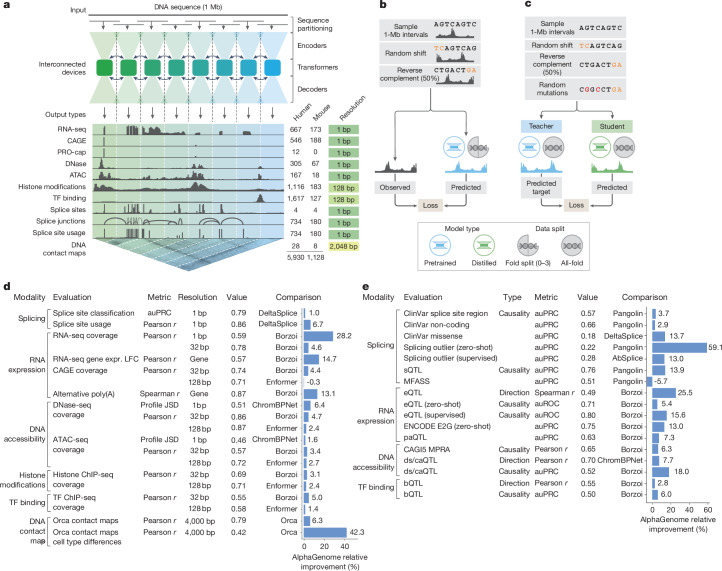
- AlphaGenome predicts 5,930 human or 1,128 mouse genome tracks across 11 modalities from 1-Mb input, including RNA-seq, CAGE, PRO-cap, splice sites/usage/junctions, DNase, ATAC-seq, histone ChIP-seq, transcription factor binding and contact maps.
- For genome track prediction, AlphaGenome outperformed external models on 22 of 24 evaluations, including +14.7% relative improvement in cell-type-specific gene-level expression log-fold change versus Borzoi, contact map Pearson r +6.3% and cell-type-specific differences +42.3% versus Orca, +15% total counts Pearson r versus ProCapNet, and +1.6% ATAC / +9.5% DNase profile Jensen–Shannon divergence versus ChromBPNet.
- For variant effect prediction, AlphaGenome matched or outperformed external models on 25 of 26 evaluations, including eQTL sign prediction +25.5% versus Borzoi and accessibility QTL +8.0% versus ChromBPNet. It achieved SOTA splicing variant prediction on six of seven benchmarks, with ClinVar auPRC 0.66 versus 0.64 by Pangolin for deep intronic/synonymous, 0.57 versus 0.55 for splice region, and 0.18 versus 0.16 for missense; on MFASS it reached auPRC 0.54 versus Pangolin 0.51 and SpliceAI/DeltaSplice 0.49.
- Multimodal scoring recapitulated TAL1 oncogene mechanisms: for chr. 1: 47239296: C>ACG, AlphaGenome predicted increased TAL1 expression 7.5 kb away, activating H3K27ac/H3K4me1, decreased repressive marks, and a MYB motif at the variant position.
Methods
- Model architecture: U-Net-inspired backbone producing 1D embeddings at 1-bp and 128-bp resolution and 2D embeddings at 2,048-bp resolution; convolutional layers model local patterns and transformer blocks model longer-range dependencies. Base-pair-resolution training on 1-Mb sequences uses sequence parallelism across eight interconnected TPU v3 devices.
- Training: two-stage process. Pretraining used a 4-fold cross-validation scheme to produce fold-specific models and all-fold teacher models; distillation then trained a single student model to reproduce an ensemble of all-fold teachers using augmented and mutationally perturbed input sequences. The distilled student runs in less than 1 s on an NVIDIA H100 GPU per variant.
- Evaluation: 24 genome track evaluations across all 11 modalities and 26 variant effect benchmarks, compared against the strongest available external model per task. Ablations assessed target resolution, sequence length, ensembling, distillation and multimodal training. Detailed methods are in the Supplementary Information.
Limitations
- Stated by the paper: accurately capturing distal regulatory elements more than 100 kb away remains a continuing objective; recapitulating tissue-specific patterns across cellular contexts and predicting condition-specific variant effects remain challenging; training and evaluations are heavily focused on protein-coding genes, with future work needed for non-coding genes such as microRNAs; species coverage is limited to human and mouse and evaluations are primarily human-focused; the model has not been benchmarked on personal genome prediction; and complex trait analysis is limited because AlphaGenome predicts molecular consequences rather than broader biological and environmental contributions.
- Also stated: performance decays with distance to the target gene/TSS and to the polyadenylation site; high score thresholds enrich for causal variant candidates but at low recall, particularly for GWAS variants; and further improvements are needed for intermediate splicing efficiencies and tissue-specific splicing nuances.
- Evident from the text: the paper reports occasional underprediction of expression impact for alternative polyadenylation and notes that both AlphaGenome and Borzoi still underestimate the impact of very distal enhancers.
Model-written summary. Check it against the paper before relying on it.
Integrity signals
Registry
Cites
Statistics
Figures
Verification
Claims the paper makes
94 Own result · 20 Own interpretation · 18 No basis given · 9 Sources not found · 5 Supported · 5 Partly supported · 4 Not checked yet · 2 Supported so far · 2 No full text of the sources · 1 Couldn’t confirm · 1 Own method · accuracy not yet measured
Every source the paper cites for this claim was checked and supports it.
In the paper
“Given that more than 98% of observed genetic variation in humans is non-coding7, global characterization of the complex effects of this vast majority of variants remains intractable without computational predictions.”
§ Advancing regulatory variant effect prediction with AlphaGenome > Main
What the sources say
- Supportedcites [7] Halldorsson, B. V. et al. The sequences of 150,119 genomes in the UK Biobank. Nature 607, 732–740 (2022). source
Table 1 in “SNPs and indels” lists 6,380,795 coding variants among approximately 558 million WGS variants across its annotation categories. Coding variants therefore account for about 1.1% of those observed, supporting the claim that more than 98% are non-coding in this human cohort. (LLM, conf=0.88)
plain- Asserted: passes — The authors put it forward as true.
- Checkable: passes — It can be checked against evidence.
- Load-bearing: passes — The paper’s conclusions depend on it.
- Based: passes — The paper gives a reason why it holds.
- Supported
The cited sources support only part of this claim — read each source’s verdict below.
In the paper
“The ability of AlphaGenome to simultaneously score variant effects across all modalities accurately recapitulates the mechanisms of clinically relevant variants near the TAL1 oncogene6.”
§ Advancing regulatory variant effect prediction with AlphaGenome > Abstract
What the sources say
- Partly supportedcites [6] Mansour, M. R. et al. Oncogene regulation. An oncogenic super-enhancer formed through somatic mutation of a noncoding intergenic element. Science 346, 1373–1377 (2014). sourceExperimental — accuracy not yet measured
The supplied passages (labeled Abstract in our copy) describe TAL1-region mutations in T-ALL samples and their mechanism: newly created MYB binding sites nucleate a super-enhancer that increases TAL1 expression. They do not evaluate AlphaGenome, its scoring across modalities, or whether its predictions accurately recapitulate those mechanisms. (LLM, conf=0.88)
plaindirect- Asserted: passes — The authors put it forward as true.
- Checkable: passes — It can be checked against evidence.
- Load-bearing: passes — The paper’s conclusions depend on it.
- Based: passes — The paper gives a reason why it holds.
- Partly supported
The cited sources support only part of this claim — read each source’s verdict below.
In the paper
“Existing methods involve a trade-off between input sequence length and prediction resolution, thereby limiting their modality scope and performance1–5.”
§ Advancing regulatory variant effect prediction with AlphaGenome > Abstract
What the sources say
- Partly supportedcites [1] Avsec, Ž. et al. Effective gene expression prediction from sequence by integrating long-range interactions. Nat. Methods 18, 1196–1203 (2021). sourceExperimental — accuracy not yet measured
The Methods (Model architecture; page unavailable) describe a trade-off for Enformer: finer prediction resolution would increase the sequence length entering its attention layers and make computation intractable on available hardware. The Results (Enformer improves gene expression prediction; page unavailable) also say previous models reached less-distant elements. The paper does not establish that existing methods generally trade input length against resolution or that this trade-off limits their modality scope. (LLM, conf=0.82)
- Partly supportedcites [2] Linder, J., Srivastava, D. & Yuan, H. Predicting RNA-seq coverage from DNA sequence as a unifying model of gene regulation. Nat. Genet. 57, 949–961 (2025). sourceExperimental — accuracy not yet measured
The Results (RNA-seq model design; page unavailable) explicitly describe a computational trade-off between sequence length and prediction resolution. The Methods (Model; page unavailable) explain how insufficient length or coarse resolution can obstruct learning, and the Main section describes earlier models’ narrower assay focus. The paper does not explicitly establish that this trade-off is what limits existing methods’ modality scope and performance overall. (LLM, conf=0.82)
- Partly supportedcites [3] Zhou, J. Sequence-based modeling of three-dimensional genome architecture from kilobase to chromosome scale. Nat. Genet. 54, 725–734 (2022). sourceExperimental — accuracy not yet measured
The Introduction (page unavailable) says earlier sequence models did not predict large-scale genome organization beyond 1 Mb, limiting predictions of large structures and structural-variant effects. The Results describe using coarser resolution at longer distances and report a small improvement in local predictions from larger sequence context. The paper does not establish that a length–resolution trade-off in existing methods limits their modality scope or overall performance. (LLM, conf=0.83)
- Not checked — no full text of the sourcecites [4] Jaganathan, K. et al. Predicting splicing from primary sequence with deep learning. Cell 176, 535–548 (2019). source
- Partly supportedcites [5] Kelley, D. R., Snoek, J. & Rinn, J. L. Basset: learning the regulatory code of the accessible genome with deep convolutional neural networks. Genome Res. 26, 990–999 (2016). sourceExperimental — accuracy not yet measured
The Discussion says prior sequence-kernel methods lose positional information, while position-specific kernels can suffer in predictive performance; it also says Basset offers finer nucleotide-level resolution than annotation-overlap approaches. It does not describe a trade-off between input sequence length and prediction resolution or say that such a trade-off limits modality scope. (LLM, conf=0.78)
plaindirect- Asserted: passes — The authors put it forward as true.
- Checkable: passes — It can be checked against evidence.
- Load-bearing: passes — The paper’s conclusions depend on it.
- Based: passes — The paper gives a reason why it holds.
- Partly supported
The cited sources support only part of this claim — read each source’s verdict below.
In the paper
“For instance, 99% (465 of 471) of validated enhancer–gene pairs fall within 1 Mb (ref. 12).”
§ Advancing regulatory variant effect prediction with AlphaGenome > Unifying DNA sequence-to-function model
What the sources say
- Partly supportedcites [12] Gschwind, A. R. et al. An encyclopedia of enhancer-gene regulatory interactions in the human genome. Preprint at bioRxiv https://doi.org/10.1101/2023.11.09.563812 (2023). sourceExperimental — accuracy not yet measured
The Genome-wide maps of regulatory interactions section (page unavailable) says most predicted enhancer–gene interactions span short distances and that this is consistent with CRISPR perturbation results. The Supervised classification section reports 472 CRISPR-positive pairs, but our copy does not give the claimed count of 465 of 471 or establish that 99% of validated pairs fall within 1 Mb. (LLM, conf=0.83)
plain- Asserted: passes — The authors put it forward as true.
- Checkable: passes — It can be checked against evidence.
- Load-bearing: passes — The paper’s conclusions depend on it.
- Based: passes — The paper gives a reason why it holds.
- Partly supported
The cited sources support only part of this claim — read each source’s verdict below.
In the paper
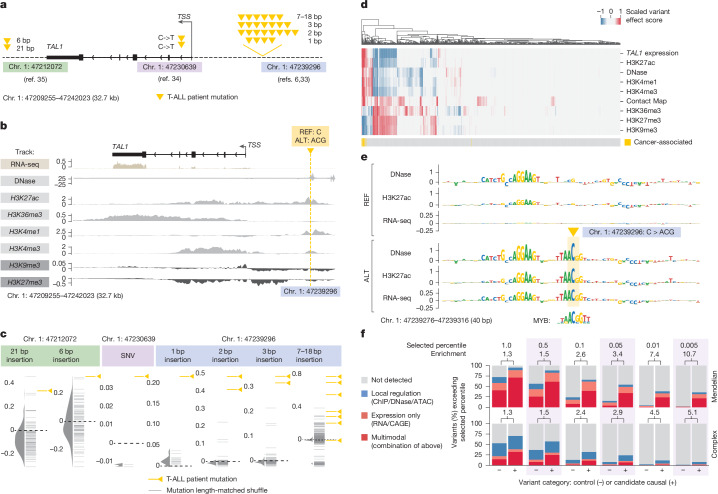
“Detailed ALT–REF predictions for an oncogenic insertion (chr. 1: 47239296: C>ACG) characterized in ref. 6. Shown are differences between AlphaGenome predictions between the ALT and REF sequences of the variant in CD34+ CMP tracks. The ALT sequence increases expression of the TAL1 gene 7.5 kb away.”
§ Advancing regulatory variant effect prediction with AlphaGenome > Main
What the sources say
- Partly supportedcites [6] Mansour, M. R. et al. Oncogene regulation. An oncogenic super-enhancer formed through somatic mutation of a noncoding intergenic element. Science 346, 1373–1377 (2014). sourceExperimental — accuracy not yet measured
The paper’s main text (page unavailable in our copy) describes oncogenic insertions at a hotspot 7.5 kb upstream of TAL1 and concludes that they drive TAL1 overexpression. It does not identify the insertion as chr. 1:47239296:C>ACG, so our copy does not establish that this exact ALT allele is one it characterized. The AlphaGenome predictions are the citing authors’ analysis, not a finding attributed to this source. (LLM, conf=0.78)
plaindirectSingle case- Asserted: passes — The authors put it forward as true.
- Checkable: passes — It can be checked against evidence.
- Load-bearing: passes — The paper’s conclusions depend on it.
- Based: passes — The paper gives a reason why it holds.
- Partly supported
Every source the paper cites for this claim was checked and supports it.
In the paper
“We evaluated three groups of gain-of-function mutations affecting the TAL1 gene in T cell acute lymphoblastic leukaemia (T-ALL): a cluster of 5′ neo-enhancer mutations upstream of the TAL1 TSS6,33, an intronic single-nucleotide variant (SNV)34 and a 3′ neo-enhancer35.”
- Also stated in: § Multimodal view of variant effects · boosted
“All three variant groups were shown to converge on a common mechanism—upregulation of the TAL1 oncogene (Fig. 6a,b).”
§ Advancing regulatory variant effect prediction with AlphaGenome > Multimodal view of variant effects
What the sources say
- Supportedcites [6] Mansour, M. R. et al. Oncogene regulation. An oncogenic super-enhancer formed through somatic mutation of a noncoding intergenic element. Science 346, 1373–1377 (2014). source
The citation to this paper is attached to the 5′ neo-enhancer mutations, not the separately cited intronic SNV or 3′ neo-enhancer. The passage describing a hotspot 7.5 kb upstream of the TAL1 transcription start site reports that its indel mutations generate a super-enhancer driving TAL1 overexpression in T-ALL. (LLM, conf=0.93)
- Supportedcites [33] Liu, Y. et al. The genomic landscape of pediatric and young adult T-lineage acute lymphoblastic leukemia. Nat. Genet. 49, 1211–1218 (2017). source
The section “Somatic alterations targeting transcriptional regulators” reports upstream TAL1 non-coding mutations that create a MYB-binding site and identifies 15 cases with identical or similar mutations. This supports the 5′ upstream mutation group to which this source is cited in the printed sentence; the intronic SNV and 3′ enhancer have separate citations. (LLM, conf=0.91)
- Supportedcites [34] Liu, Y. et al. Discovery of regulatory noncoding variants in individual cancer genomes by using cis-X. Nat. Genet. 52, 811–818 (2020). source
The citation is attached to the intronic SNV, not to all three mutation groups. In Results, “A recurrent intronic mutation activating TAL1 expression,” the paper identifies a recurrent C-to-T mutation in TAL1 intron 1 in T-ALL and links it to increased TAL1 expression and enhancer activity. (LLM, conf=0.93)
- Supportedcites [35] Smith, C. et al. TAL1 activation in T-cell acute lymphoblastic leukemia: a novel oncogenic 3′ neo-enhancer. Haematologica 108, 1259–1271 (2023). source
The Introduction describes upstream microinsertions, an intronic point mutation, and a newly discovered downstream microinsertion as distinct routes to TAL1 expression in T-ALL. The Abstract and Discussion report that the downstream mutation forms a 3′ neo-enhancer that activates TAL1. The paper supports convergence on TAL1 upregulation, though it does not say all three mutations use the same transcription factor. (LLM, conf=0.92)
boosteddirect- Asserted: passes — The authors put it forward as true.
- Checkable: passes — It can be checked against evidence.
- Load-bearing: passes — The paper’s conclusions depend on it.
- Based: passes — The paper gives a reason why it holds.
- Also stated in: § Multimodal view of variant effects · boosted
The sources with a verdict support this claim; the rest weren’t checked yet, have no full text we could read, or their verdicts aren’t rated yet.
In the paper
“We have not yet benchmarked the model on personal genome prediction, which is a known weakness of models in this space40,41.”
§ Advancing regulatory variant effect prediction with AlphaGenome > Discussion
What the sources say
- Not checked yetcites [40] Sasse, A. et al. Benchmarking of deep neural networks for predicting personal gene expression from DNA sequence highlights shortcomings. Nat. Genet. 55, 2060–2064 (2023). source
Checked before — its earlier verdict is held back until a new check runs.
- Supportedcites [41] Huang, C. et al. Personal transcriptome variation is poorly explained by current genomic deep learning models. Nat. Genet. 55, 2056–2059 (2023). source
The citation supports the claim that personal-genome prediction is a weakness of models in this space, not the citing authors’ statement that they have not yet benchmarked AlphaGenome. The Main section (page not supplied) reports that four sequence-to-expression models underperform when predicting expression differences across individuals from personal DNA sequences. (LLM, conf=0.92)
plain- Asserted: passes — The authors put it forward as true.
- Checkable: passes — It can be checked against evidence.
- Load-bearing: unclear — It is unclear whether the paper’s conclusions depend on it.
- Based: passes — The paper gives a reason why it holds.
- Not checked yet
The paper states this without a source or data behind it here, so there is nothing to check it against. The quote shows it is in the paper.
In the paper
“Here we present AlphaGenome, a model that unifies multimodal prediction, long-sequence context and base-pair resolution into a single framework.”
§ Advancing regulatory variant effect prediction with AlphaGenome > Main
plain- Asserted: passes — The authors put it forward as true.
- Checkable: passes — It can be checked against evidence.
- Load-bearing: passes — The paper’s conclusions depend on it.
- Based: passes — The paper gives a reason why it holds.
The paper states this without a source or data behind it here, so there is nothing to check it against. The quote shows it is in the paper.
In the paper
“The modalities include gene expression, transcription initiation, chromatin accessibility, histone modifications, transcription factor binding, chromatin contact maps, splice site usage and splice junction coordinates and strength.”
§ Advancing regulatory variant effect prediction with AlphaGenome > Abstract
plain- Asserted: passes — The authors put it forward as true.
- Checkable: passes — It can be checked against evidence.
- Load-bearing: passes — The paper’s conclusions depend on it.
- Based: passes — The paper gives a reason why it holds.
The paper states this without a source or data behind it here, so there is nothing to check it against. The quote shows it is in the paper.
In the paper
“The splicing predictions of AlphaGenome include a new splice junction prediction approach alongside splice site usage prediction.”
§ Advancing regulatory variant effect prediction with AlphaGenome > Main
plain- Asserted: passes — The authors put it forward as true.
- Checkable: passes — It can be checked against evidence.
- Load-bearing: unclear — It is unclear whether the paper’s conclusions depend on it.
- Based: passes — The paper gives a reason why it holds.
- It may state two separate claims as one. 44
- Probably not a substantial claim. 27
- The quote only partly states this claim. 1
Every source the paper cites for this claim was checked and supports it.
In the paper
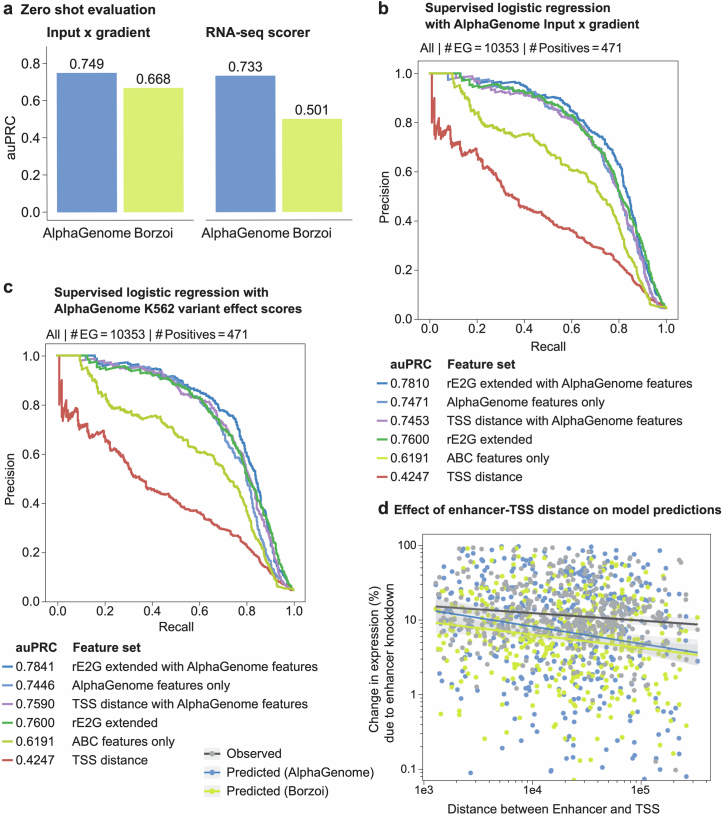
“Enhancer–gene linking performance (ENCODE–rE2G CRISPRi dataset12). Zero-shot evaluation: performance (auPRC) comparison stratified by enhancer-to-TSS distance. Supervised evaluation: AlphaGenome input gradient score integrated into ENCODE–rE2G extended and ENCODE–rE2G models.”
§ Advancing regulatory variant effect prediction with AlphaGenome > Main
What the sources say
- Supportedcites [12] Gschwind, A. R. et al. An encyclopedia of enhancer-gene regulatory interactions in the human genome. Preprint at bioRxiv https://doi.org/10.1101/2023.11.09.563812 (2023). source
The citation is attached to the identification of the ENCODE–rE2G CRISPRi dataset, not to the citing paper’s AlphaGenome evaluations. In “Supervised classification of enhancer-gene regulatory interactions” (page unavailable), the source describes its aggregated CRISPR-tested element–gene dataset, drawn mostly from CRISPRi experiments, and its use to train and evaluate ENCODE-rE2G. (LLM, conf=0.91)
plain- Asserted: passes — The authors put it forward as true.
- Checkable: passes — It can be checked against evidence.
- Load-bearing: passes — The paper’s conclusions depend on it.
- Based: passes — The paper gives a reason why it holds.
It may state two separate claims as one.
- Supported
Every source the paper cites for this claim was checked and supports it.
In the paper
“This distilled student model, as shown previously14, achieved improved robustness and variant effect prediction accuracy in a single model instance, making predictions across all modelled modalities and cell types with a single device call per variant.”
§ Advancing regulatory variant effect prediction with AlphaGenome > Unifying DNA sequence-to-function model
What the sources say
- Supportedcites [14] Zhou, J., Rizzo, K., Tang, Z. & Koo, P. K. Uncertainty-aware genomic deep learning with knowledge distillation. Preprint at bioRxiv https://doi.org/10.1101/2024.11.13.623485 (2024). source
The Results section on zero-shot variant effect generalization reports that distilled models generally had stronger correlations with experimentally measured variant effects than standard-trained models. The Results section on covariate shifts reports improved generalization with augmentation, and the section on approximating deep ensembles identifies the student as an individual model trained from an ensemble. (LLM, conf=0.91)
plaindirect- Asserted: passes — The authors put it forward as true.
- Checkable: passes — It can be checked against evidence.
- Load-bearing: passes — The paper’s conclusions depend on it.
- Based: passes — The paper gives a reason why it holds.
It may state two separate claims as one.
- Supported
The cited sources support only part of this claim — read each source’s verdict below.
In the paper
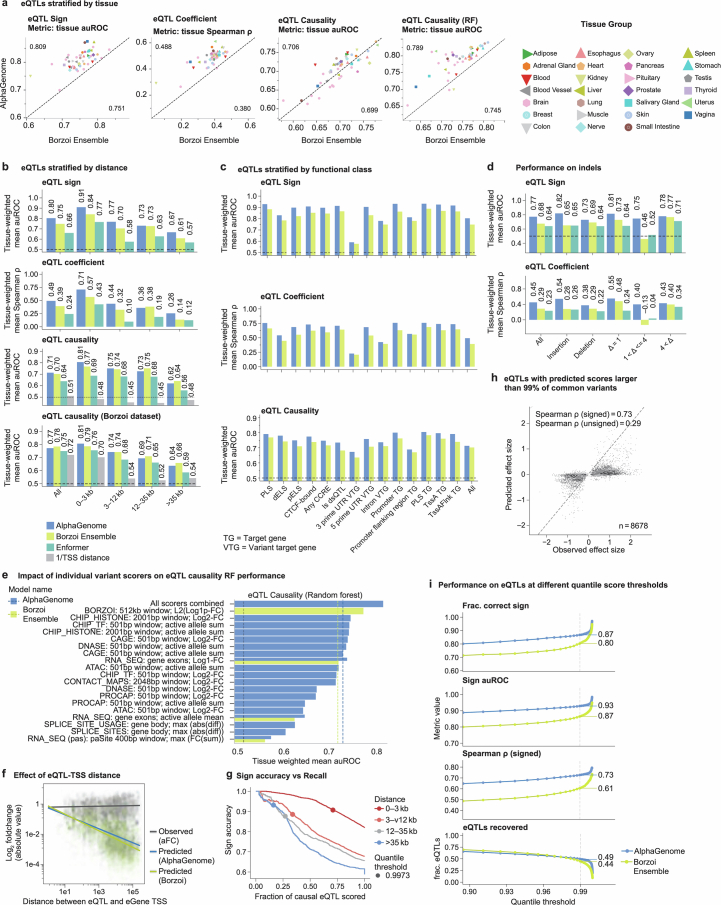
“As previously reported26, performance decays with distance to the target gene across all eQTL tasks (Extended Data Fig. 5f).”
§ Advancing regulatory variant effect prediction with AlphaGenome > Performance across gene expression tasks > Improved prediction of eQTL effects
What the sources say
- Partly supportedcites [26] Karollus, A., Mauermeier, T. & Gagneur, J. Current sequence-based models capture gene expression determinants in promoters but mostly ignore distal enhancers. Genome Biol. 24, 56 (2023). sourceExperimental — accuracy not yet measured
In Results, ‘Most distal eQTLs do not have a meaningful impact on expression predictions’ (Fig. 6A–B), the paper reports that Enformer’s predicted eQTL effects decay rapidly with distance to the target gene’s TSS. It does not establish that performance decays across all eQTL tasks; it also reports no systematic distance-related decay in the measured eQTL effect sizes. (LLM, conf=0.86)
plaincorrelational- Asserted: passes — The authors put it forward as true.
- Checkable: passes — It can be checked against evidence.
- Load-bearing: fails — The paper’s conclusions may not depend on it.
- Based: passes — The paper gives a reason why it holds.
Probably not a substantial claim. The paper’s conclusions may not depend on it.
- Partly supported
The sources with a verdict support this claim; the rest weren’t checked yet, have no full text we could read, or their verdicts aren’t rated yet.
In the paper
“Beyond impacting isoform composition through splicing modulation, non-coding variants can influence traits and cause diseases by altering gene expression23,24.”
§ Advancing regulatory variant effect prediction with AlphaGenome > Performance across gene expression tasks
What the sources say
- Not checked — no full text of the sourcecites [23] Albert, F. W. & Kruglyak, L. The role of regulatory variation in complex traits and disease. Nat. Rev. Genet. 16, 197–212 (2015). source
- Supportedcites [24] Maurano, M. T. et al. Systematic localization of common disease-associated variation in regulatory DNA. Science 337, 1190–1195 (2012). source
The Abstract links disease- and trait-associated noncoding variants to transcriptional regulatory mechanisms, including promoters, enhancers, and expression quantitative trait loci. The Discussion reports that disease- and trait-associated variants occur in regulatory DNA and can perturb transcription factor networks, supporting the claim that altered gene regulation can influence traits and disease. No page numbers are provided in our copy. (LLM, conf=0.89)
plaindirect- Asserted: passes — The authors put it forward as true.
- Checkable: passes — It can be checked against evidence.
- Load-bearing: passes — The paper’s conclusions depend on it.
- Based: passes — The paper gives a reason why it holds.
Probably not a substantial claim. It may state two separate claims as one.
The cited sources that could be checked couldn’t confirm or dispute this claim.
In the paper
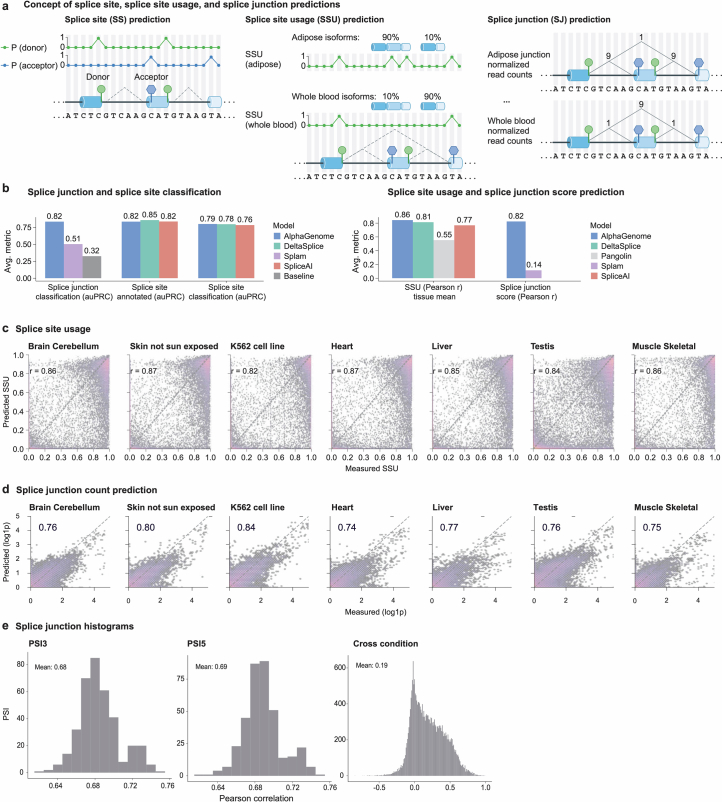
“Predicted versus observed splice junction read counts (log(1 + x) transformed; n = 1,344,738) and Pearson r between them in selected human tissues known for having distinct splicing patterns49.”
§ Advancing regulatory variant effect prediction with AlphaGenome > Main
What the sources say
- Could not verifycites [49] Ling, J. P. et al. ASCOT identifies key regulators of neuronal subtype-specific splicing. Nat. Commun. 11, 137 (2020). sourceExperimental — accuracy not yet measured
The Methods section on Snaptron compilations describes tables of observed splice-junction counts, and the Results discuss splicing patterns in human tissues. Neither passage reports a predicted-versus-observed count comparison, a log(1 + x) transformation, Pearson r, or n = 1,344,738. Searches for those terms found no matching passage in our copy. (LLM, conf=0.72)
plaincorrelationaln = 1,344,738- Asserted: passes — The authors put it forward as true.
- Checkable: passes — It can be checked against evidence.
- Load-bearing: passes — The paper’s conclusions depend on it.
- Based: passes — The paper gives a reason why it holds.
Probably not a substantial claim. It may state two separate claims as one.
- Could not verify
Every source the paper cites for this claim was checked and supports it.
In the paper
“By contrast, the alternative sequence introduced a MYB motif at the variant position predicted to increase TAL1 expression, chromatin accessibility and H3K27ac chromatin marks (Fig. 6e), as discovered previously6.”
§ Advancing regulatory variant effect prediction with AlphaGenome > Multimodal view of variant effects
What the sources say
- Supportedcites [6] Mansour, M. R. et al. Oncogene regulation. An oncogenic super-enhancer formed through somatic mutation of a noncoding intergenic element. Science 346, 1373–1377 (2014). source
The supplied passages (labelled Abstract) report that mutations at the TAL1 enhancer introduce MYB binding motifs and drive TAL1 overexpression. They also propose that MYB recruits CBP, producing abundant H3K27 acetylation that opens chromatin; this supports the citing sentence’s predicted increases in H3K27ac and accessibility. (LLM, conf=0.91)
plaindirectSingle case- Asserted: passes — The authors put it forward as true.
- Checkable: passes — It can be checked against evidence.
- Load-bearing: passes — The paper’s conclusions depend on it.
- Based: passes — The paper gives a reason why it holds.
It may state two separate claims as one.
- Supported
The paper states this without a source or data behind it here, so there is nothing to check it against. The quote shows it is in the paper.
In the paper
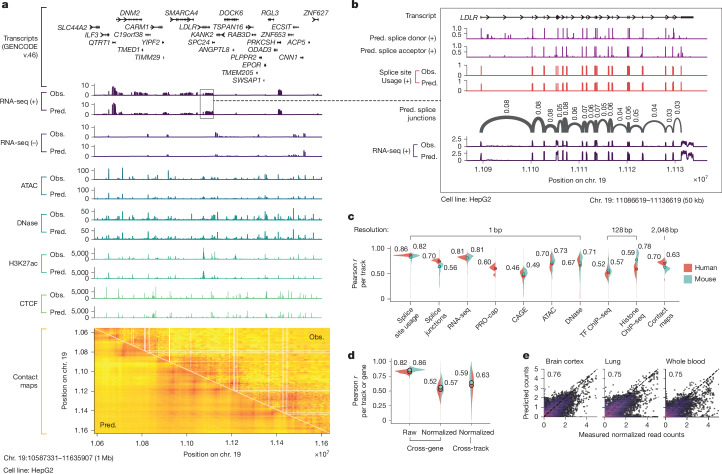
“The model takes 1 Mb of DNA sequence as input and predicts a diverse range of genome tracks across numerous cell types.”
§ Advancing regulatory variant effect prediction with AlphaGenome > Main
plaindirect- Asserted: passes — The authors put it forward as true.
- Checkable: passes — It can be checked against evidence.
- Load-bearing: passes — The paper’s conclusions depend on it.
- Based: passes — The paper gives a reason why it holds.
It may state two separate claims as one.
A result the paper reports from its own data — it cites no other source for it, so there is none to check. The quote shows it is in the paper.
In the paper
“AlphaGenome achieved SOTA performance on 22 of 24 genome track prediction tasks and 25 of 26 variant effect prediction tasks.”
§ Advancing regulatory variant effect prediction with AlphaGenome > Main
plain- Asserted: passes — The authors put it forward as true.
- Checkable: passes — It can be checked against evidence.
- Load-bearing: passes — The paper’s conclusions depend on it.
- Based: passes — The paper gives a reason why it holds.
It may state two separate claims as one.
A result the paper reports from its own data — it cites no other source for it, so there is none to check. The quote shows it is in the paper.
In the paper
“On splicing (Extended Data Fig. 2a), AlphaGenome accurately predicts splice sites (Extended Data Fig. 2b) and splice site usage (Extended Data Fig. 2b,c).”
§ Advancing regulatory variant effect prediction with AlphaGenome > Improved track prediction performance
plaincorrelational- Asserted: passes — The authors put it forward as true.
- Checkable: passes — It can be checked against evidence.
- Load-bearing: passes — The paper’s conclusions depend on it.
- Based: passes — The paper gives a reason why it holds.
It may state two separate claims as one.
None of the sources cited for this claim have been checked yet.
In the paper
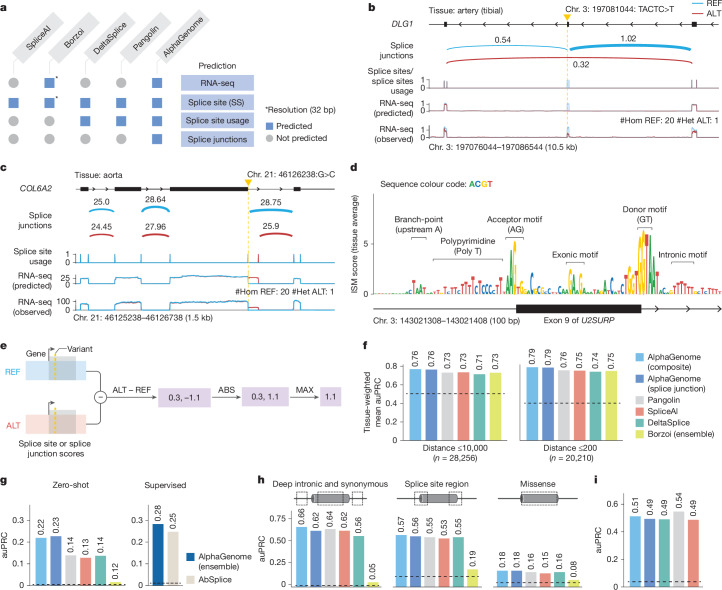
“MFASS splicing variant classification (MPRA-tested variants). auPRC on the classification of experimentally validated splice-disrupting variants (data from Chong et al.22).”
§ Advancing regulatory variant effect prediction with AlphaGenome > Main
What the sources say
- Not checked yetcites Chong et al. [22] Chong, R. et al. A multiplexed assay for exon recognition reveals that an unappreciated fraction of rare genetic variants cause large-effect splicing disruptions. Mol. Cell 73, 183–194 (2019). source
Checked before — its earlier verdict is held back until a new check runs.
plain- Asserted: passes — The authors put it forward as true.
- Checkable: passes — It can be checked against evidence.
- Load-bearing: passes — The paper’s conclusions depend on it.
- Based: passes — The paper gives a reason why it holds.
Probably not a substantial claim.
- Not checked yet
A result the paper reports from its own data — it cites no other source for it, so there is none to check. The quote shows it is in the paper.
In the paper
“Although AlphaGenome demonstrates the ability to predict tissue-specific alternative splicing in some instances (Supplementary Fig. 1), further improvements are needed to precisely predict intermediate splicing efficiencies and to capture tissue-specific nuances (Extended Data Fig. 2c,e).”
§ Advancing regulatory variant effect prediction with AlphaGenome > Improved track prediction performance
boosted- Asserted: passes — The authors put it forward as true.
- Checkable: passes — It can be checked against evidence.
- Load-bearing: unclear — It is unclear whether the paper’s conclusions depend on it.
- Based: passes — The paper gives a reason why it holds.
It may state two separate claims as one.
A result the paper reports from its own data — it cites no other source for it, so there is none to check. The quote shows it is in the paper.
In the paper
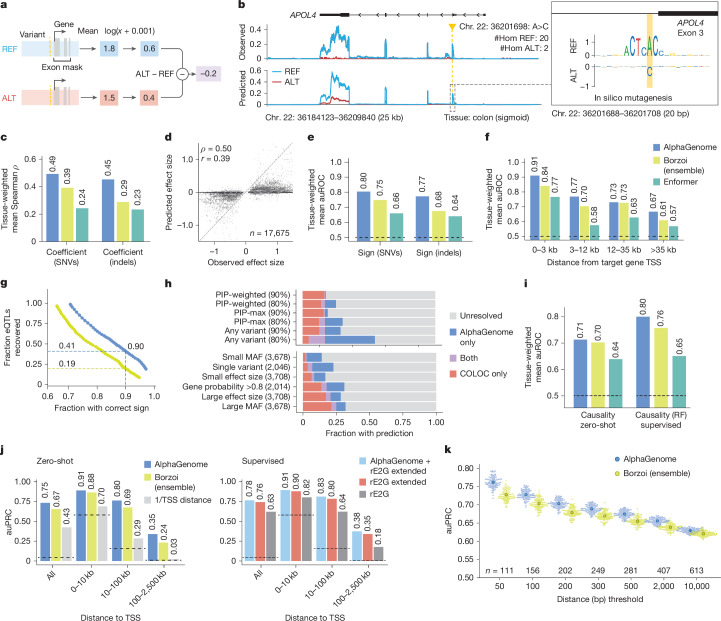
“AlphaGenome demonstrated improved prediction of both the magnitude (‘coefficient’; Spearman ρ with SuSiE25 β posterior) and direction (‘sign’; area under the receiver operating characteristic (auROC) curve) of eQTL effects compared with the previous SOTA (Borzoi) (Fig. 4c–f).”
§ Advancing regulatory variant effect prediction with AlphaGenome > Performance across gene expression tasks > Improved prediction of eQTL effects
boosteddirect- Asserted: passes — The authors put it forward as true.
- Checkable: passes — It can be checked against evidence.
- Load-bearing: passes — The paper’s conclusions depend on it.
- Based: passes — The paper gives a reason why it holds.
It may state two separate claims as one.
A result the paper reports from its own data — it cites no other source for it, so there is none to check. The quote shows it is in the paper.
In the paper
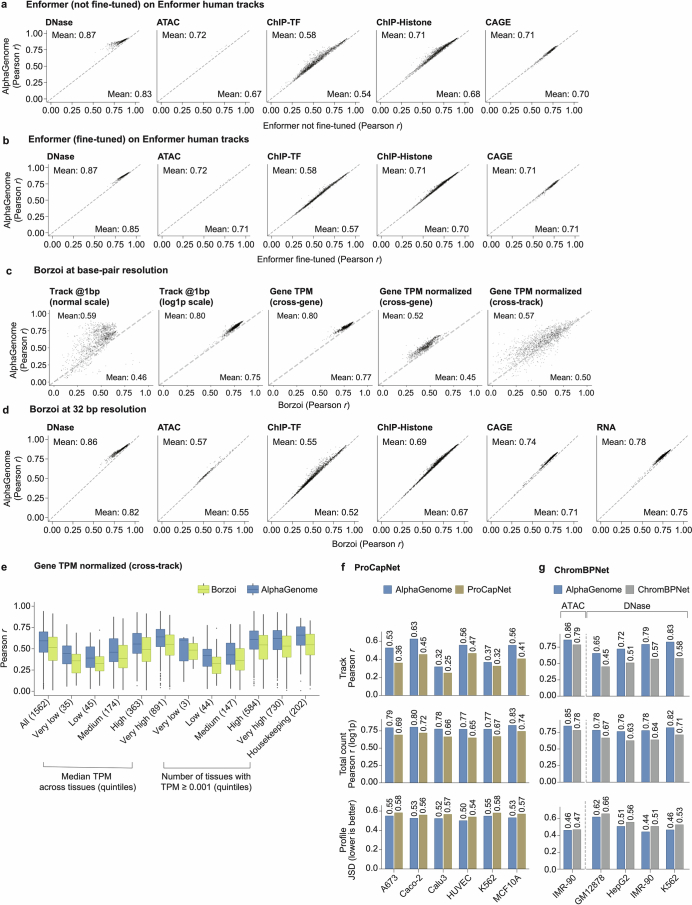
“Track prediction performance evaluation across different modalities. Violin plots display the distribution of Pearson correlations between predicted and observed tracks evaluated on held-out test intervals.”
§ Advancing regulatory variant effect prediction with AlphaGenome > Main
plaincorrelational- Asserted: passes — The authors put it forward as true.
- Checkable: passes — It can be checked against evidence.
- Load-bearing: passes — The paper’s conclusions depend on it.
- Based: passes — The paper gives a reason why it holds.
Probably not a substantial claim.
A result the paper reports from its own data — it cites no other source for it, so there is none to check. The quote shows it is in the paper.
In the paper
“its composite scores outperformed the existing best method in each category across all three variant categories: deep intronic and synonymous (area under the precision–recall curve (auPRC) 0.66 versus 0.64 by Pangolin), splice region (auPRC 0.57 versus 0.55 by Pangolin) and missense (auPRC 0.18 versus 0.16 by DeltaSplice and Pangolin”
§ Advancing regulatory variant effect prediction with AlphaGenome > Improved splicing variant predictions
plaincorrelational- Asserted: passes — The authors put it forward as true.
- Checkable: passes — It can be checked against evidence.
- Load-bearing: passes — The paper’s conclusions depend on it.
- Based: passes — The paper gives a reason why it holds.
It may state two separate claims as one.
The paper states this without a source or data behind it here, so there is nothing to check it against. The quote shows it is in the paper.
In the paper
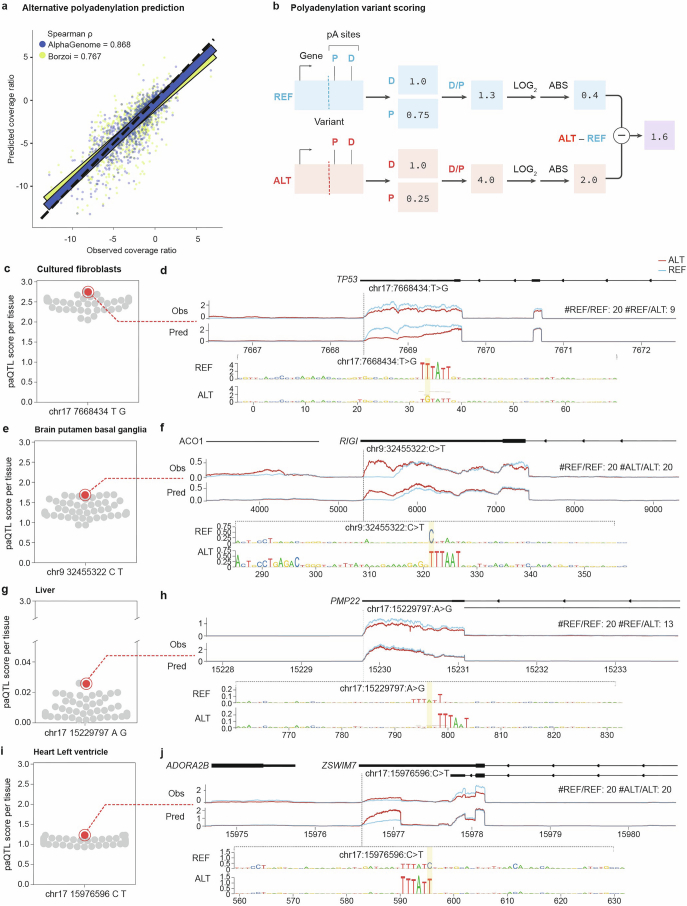
“Performance (auPRC) of paQTL variant effect prediction, thresholded by distance from the polyadenylation site.”
§ Advancing regulatory variant effect prediction with AlphaGenome > Main
plaincorrelational- Asserted: passes — The authors put it forward as true.
- Checkable: passes — It can be checked against evidence.
- Load-bearing: fails — The paper’s conclusions may not depend on it.
- Based: passes — The paper gives a reason why it holds.
Probably not a substantial claim. The paper’s conclusions may not depend on it.
A result the paper reports from its own data — it cites no other source for it, so there is none to check. The quote shows it is in the paper.
In the paper
“AlphaGenome predicts all three of these quantities alongside direct RNA-seq coverage prediction, thereby providing a more comprehensive view of the splicing-related molecular consequences of variants (Fig. 3a).”
§ Advancing regulatory variant effect prediction with AlphaGenome > Improved splicing variant predictions
plain- Asserted: passes — The authors put it forward as true.
- Checkable: passes — It can be checked against evidence.
- Load-bearing: passes — The paper’s conclusions depend on it.
- Based: passes — The paper gives a reason why it holds.
It may state two separate claims as one.
In the paper
“Coverage of predictions across GWAS loci. Fraction of GWAS credible sets (from Open Targets52) with a predicted direction of effect for a plausible target gene, comparing AlphaGenome predictions to the eQTL co-localization approach.”
§ Advancing regulatory variant effect prediction with AlphaGenome > Main
What the sources say
- Not matchedcites Open Targets52
Couldn’t be matched to a paper in Crossref, so it can’t be checked.
plaincorrelational- Asserted: passes — The authors put it forward as true.
- Checkable: passes — It can be checked against evidence.
- Load-bearing: passes — The paper’s conclusions depend on it.
- Based: passes — The paper gives a reason why it holds.
Probably not a substantial claim.
- Not matched
A result the paper reports from its own data — it cites no other source for it, so there is none to check. The quote shows it is in the paper.
In the paper
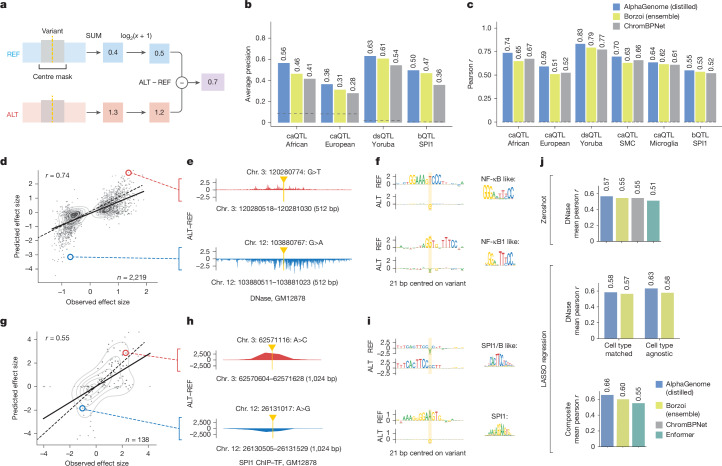
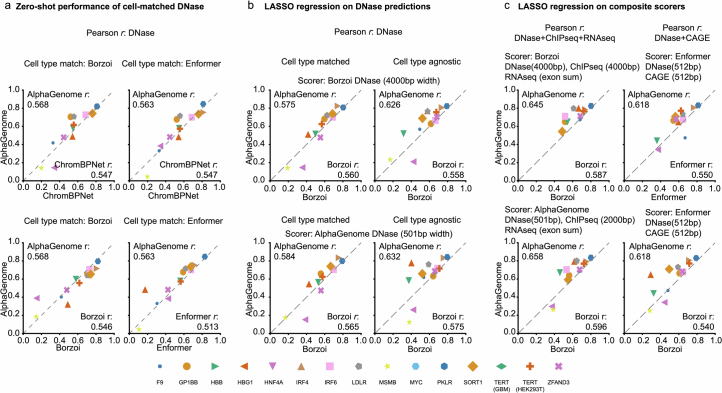
“CAGI5 MPRA challenge performance (average across loci; mean Pearson r). Top, zero-shot using cell-type-matched DNase; middle, LASSO regression using cell-type-matched or agnostic DNase; bottom, LASSO regression using multimodal features (DNase + RNA + histone ChIP-seq output types for AlphaGenome and Borzoi; DNase + CAGE output types for Enformer) and all cell types.”
§ Advancing regulatory variant effect prediction with AlphaGenome > Main
plain- Asserted: passes — The authors put it forward as true.
- Checkable: passes — It can be checked against evidence.
- Load-bearing: passes — The paper’s conclusions depend on it.
- Based: passes — The paper gives a reason why it holds.
Probably not a substantial claim.
A result the paper reports from its own data — it cites no other source for it, so there is none to check. The quote shows it is in the paper.
In the paper
“eQTL sign prediction performance stratified by different variant-to-TSS distance bins (SNVs only).”
§ Advancing regulatory variant effect prediction with AlphaGenome > Main
plain- Asserted: passes — The authors put it forward as true.
- Checkable: passes — It can be checked against evidence.
- Load-bearing: fails — The paper’s conclusions may not depend on it.
- Based: passes — The paper gives a reason why it holds.
Probably not a substantial claim. The paper’s conclusions may not depend on it.
A result the paper reports from its own data — it cites no other source for it, so there is none to check. The quote shows it is in the paper.
In the paper
“Performance comparison of AlphaGenome, Borzoi and ChromBPNet on QTL causality (b; average precision) and QTL effect size (c; Pearson r) across QTL types and ancestries.”
§ Advancing regulatory variant effect prediction with AlphaGenome > Main
plaincorrelational- Asserted: passes — The authors put it forward as true.
- Checkable: passes — It can be checked against evidence.
- Load-bearing: passes — The paper’s conclusions depend on it.
- Based: passes — The paper gives a reason why it holds.
Probably not a substantial claim.
A result the paper reports from its own data — it cites no other source for it, so there is none to check. The quote shows it is in the paper.
In the paper
“Comparison of performance (auROC) at distinguishing causal from non-causal eQTLs (‘causality’) using both zero-shot and supervised approaches (Methods).”
§ Advancing regulatory variant effect prediction with AlphaGenome > Main
plain- Asserted: passes — The authors put it forward as true.
- Checkable: passes — It can be checked against evidence.
- Load-bearing: passes — The paper’s conclusions depend on it.
- Based: passes — The paper gives a reason why it holds.
Probably not a substantial claim.
A result the paper reports from its own data — it cites no other source for it, so there is none to check. The quote shows it is in the paper.
In the paper
“Comparison of performance (Spearman’s ρ) at predicting the effect size of eQTLs across 49 GTEx tissues (‘coefficient’) for different models and variant sets.”
§ Advancing regulatory variant effect prediction with AlphaGenome > Main
plaincorrelational- Asserted: passes — The authors put it forward as true.
- Checkable: passes — It can be checked against evidence.
- Load-bearing: passes — The paper’s conclusions depend on it.
- Based: passes — The paper gives a reason why it holds.
Probably not a substantial claim.
A result the paper reports from its own data — it cites no other source for it, so there is none to check. The quote shows it is in the paper.
In the paper
“Although overall expression levels are predicted well, accurately capturing cell-type-specific expression deviations remains a challenging task (Fig. 2d and Supplementary Fig. 2j).”
§ Advancing regulatory variant effect prediction with AlphaGenome > Improved track prediction performance
plain- Asserted: passes — The authors put it forward as true.
- Checkable: passes — It can be checked against evidence.
- Load-bearing: unclear — It is unclear whether the paper’s conclusions depend on it.
- Based: passes — The paper gives a reason why it holds.
It may state two separate claims as one.
A result the paper reports from its own data — it cites no other source for it, so there is none to check. The quote shows it is in the paper.
In the paper
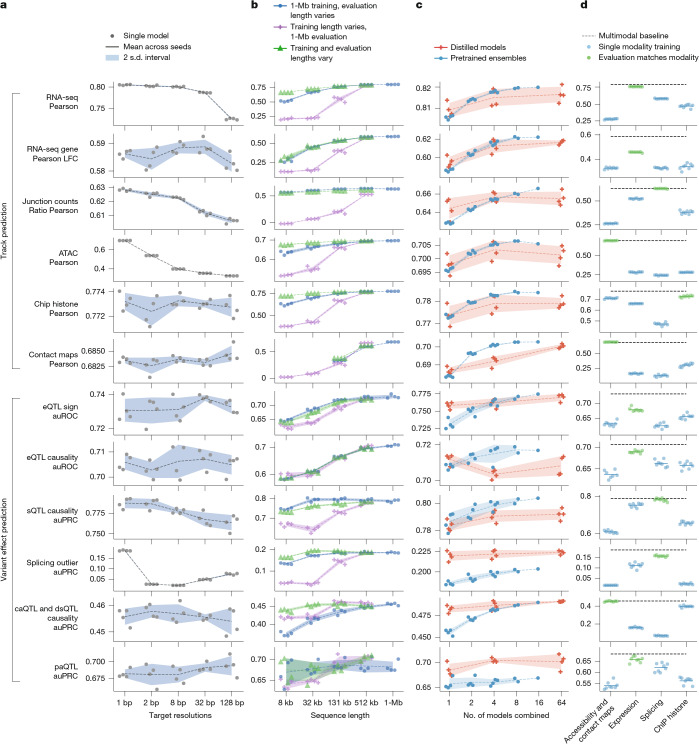
“Impact of the number of sub-models in ensembling and distillation. Performance comparison for mean ensembles of pretrained models (blue dots/contours; x axis indicates ensemble size) versus single models produced by distillation using 1, 4 or 64 teacher models (orange crosses/contours; x axis indicates number of teachers).”
§ Advancing regulatory variant effect prediction with AlphaGenome > Main
plaincorrelationaln = 4- Asserted: passes — The authors put it forward as true.
- Checkable: passes — It can be checked against evidence.
- Load-bearing: passes — The paper’s conclusions depend on it.
- Based: passes — The paper gives a reason why it holds.
Probably not a substantial claim. It may state two separate claims as one.
A result the paper reports from its own data — it cites no other source for it, so there is none to check. The quote shows it is in the paper.
In the paper
“Using a threshold calibrated to 80% accuracy on eQTLs (Fig. 4g), AlphaGenome assigned a confident sign prediction for at least one variant in 49% of GWAS credible sets (11% using a conservative PIP-weighted scoring approach; Fig. 4h).”
§ Advancing regulatory variant effect prediction with AlphaGenome > Performance across gene expression tasks > Improved prediction of eQTL effects
plain- Asserted: passes — The authors put it forward as true.
- Checkable: passes — It can be checked against evidence.
- Load-bearing: passes — The paper’s conclusions depend on it.
- Based: passes — The paper gives a reason why it holds.
It may state two separate claims as one.
A result the paper reports from its own data — it cites no other source for it, so there is none to check. The quote shows it is in the paper.
In the paper
“The alternative ‘C’ allele is associated with lower expression of APOL4 in GTEx data (sum of single effects (SuSiE) ‘β posterior’ = −0.709; posterior inclusion probability (PIP) > 0.9), and both the RNA-seq coverage and direction of effect are recapitulated by the predictions of AlphaGenome (variant score = −1.52; quantile score = −1.00; Methods).”
§ Advancing regulatory variant effect prediction with AlphaGenome > Performance across gene expression tasks > Improved prediction of eQTL effects
plaincorrelational- Asserted: passes — The authors put it forward as true.
- Checkable: passes — It can be checked against evidence.
- Load-bearing: unclear — It is unclear whether the paper’s conclusions depend on it.
- Based: passes — The paper gives a reason why it holds.
It may state two separate claims as one.
A result the paper reports from its own data — it cites no other source for it, so there is none to check. The quote shows it is in the paper.
In the paper
“AlphaGenome improved the tissue-weighted mean Spearman ρ from 0.39 to 0.49 and the mean sign auROC from 0.75 to 0.80.”
§ Advancing regulatory variant effect prediction with AlphaGenome > Performance across gene expression tasks > Improved prediction of eQTL effects
plaindirect- Asserted: passes — The authors put it forward as true.
- Checkable: passes — It can be checked against evidence.
- Load-bearing: passes — The paper’s conclusions depend on it.
- Based: passes — The paper gives a reason why it holds.
It may state two separate claims as one.
The paper states this without a source or data behind it here, so there is nothing to check it against. The quote shows it is in the paper.
In the paper
“RNA-seq, ATAC-seq and DNase-seq track predictions are at 1-bp resolution; H3K27ac and CTCF ChIP-seq are at 128-bp resolution; and contact maps are at 2,048-bp resolution.”
§ Advancing regulatory variant effect prediction with AlphaGenome > Main
plain- Asserted: passes — The authors put it forward as true.
- Checkable: passes — It can be checked against evidence.
- Load-bearing: fails — The paper’s conclusions may not depend on it.
- Based: passes — The paper gives a reason why it holds.
Probably not a substantial claim. The paper’s conclusions may not depend on it. It may state two separate claims as one.
A result the paper reports from its own data — it cites no other source for it, so there is none to check. The quote shows it is in the paper.
In the paper
“Impact of multimodal learning. Performance comparison evaluating models trained only on specific modality groups (blue dots; n = 8 seeds per group, highlighted in green if the modality matches the evaluation metric) against the full multimodal model (black dashed line; n = 4 seeds average).”
§ Advancing regulatory variant effect prediction with AlphaGenome > Main
plainn = 8- Asserted: passes — The authors put it forward as true.
- Checkable: passes — It can be checked against evidence.
- Load-bearing: passes — The paper’s conclusions depend on it.
- Based: passes — The paper gives a reason why it holds.
Probably not a substantial claim.
A result the paper reports from its own data — it cites no other source for it, so there is none to check. The quote shows it is in the paper.
In the paper
“Comparison of performance (auROC) at predicting the direction of effect of eQTLs (‘sign’) for different models and variant sets.”
§ Advancing regulatory variant effect prediction with AlphaGenome > Main
plaincorrelational- Asserted: passes — The authors put it forward as true.
- Checkable: passes — It can be checked against evidence.
- Load-bearing: passes — The paper’s conclusions depend on it.
- Based: passes — The paper gives a reason why it holds.
Probably not a substantial claim.
In the paper
“Comparison of AlphaGenome composite and splice junction scorers versus other methods for classifying fine-mapped sQTL variants. Variants are stratified into two groups by distance to the splice site, as done in Borzoi2. Tissue-specific auPRCs were averaged and weighted by variant count per tissue.”
§ Advancing regulatory variant effect prediction with AlphaGenome > Main
What the sources say
- Not matchedcites Borzoi2
Couldn’t be matched to a paper in Crossref, so it can’t be checked.
plain- Asserted: passes — The authors put it forward as true.
- Checkable: passes — It can be checked against evidence.
- Load-bearing: passes — The paper’s conclusions depend on it.
- Based: passes — The paper gives a reason why it holds.
Probably not a substantial claim. It may state two separate claims as one.
- Not matched
A result the paper reports from its own data — it cites no other source for it, so there is none to check. The quote shows it is in the paper.
In the paper
“Predicted TAL1 expression change (ALT–REF) in CD34+ CMPs. RNA-seq variant scores for TAL1 expression in CD34+ CMPs. Oncogenic mutations (orange) are compared with randomly sampled, length-matched indels (grey).”
§ Advancing regulatory variant effect prediction with AlphaGenome > Main
plain- Asserted: passes — The authors put it forward as true.
- Checkable: passes — It can be checked against evidence.
- Load-bearing: passes — The paper’s conclusions depend on it.
- Based: passes — The paper gives a reason why it holds.
Probably not a substantial claim. It may state two separate claims as one.
A result the paper reports from its own data — it cites no other source for it, so there is none to check. The quote shows it is in the paper.
In the paper
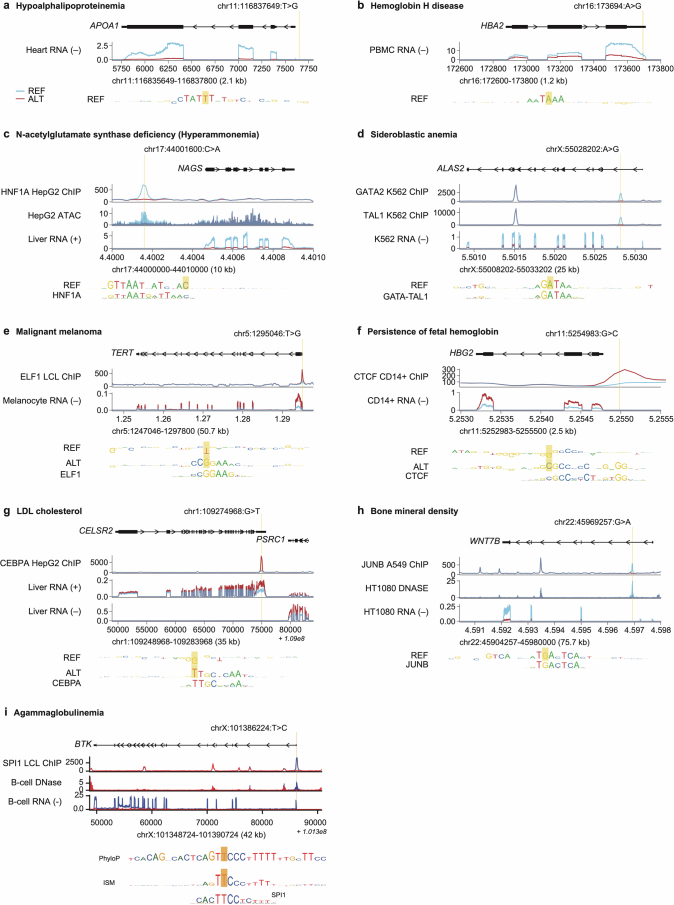
“AlphaGenome accurately predicts variant effects on chromatin accessibility and SPI1 transcription factor binding.”
§ Advancing regulatory variant effect prediction with AlphaGenome > Main
plaincorrelational- Asserted: passes — The authors put it forward as true.
- Checkable: passes — It can be checked against evidence.
- Load-bearing: passes — The paper’s conclusions depend on it.
- Based: passes — The paper gives a reason why it holds.
It may state two separate claims as one.
The paper states this without a source or data behind it here, so there is nothing to check it against. The quote shows it is in the paper.
In the paper
“Taking less than 1 s on an NVIDIA H100 GPU, the student model is highly efficient for large-scale variant effect prediction relative to the alternative approach of ensembling several independently trained models.”
§ Advancing regulatory variant effect prediction with AlphaGenome > Unifying DNA sequence-to-function model
plain- Asserted: passes — The authors put it forward as true.
- Checkable: passes — It can be checked against evidence.
- Load-bearing: passes — The paper’s conclusions depend on it.
- Based: passes — The paper gives a reason why it holds.
It may state two separate claims as one.
A result the paper reports from its own data — it cites no other source for it, so there is none to check. The quote shows it is in the paper.
In the paper
“AlphaGenome accurately predicted this established consequence across all levels: a substantial reduction in the predicted usage of the affected exon’s splice site, loss of predicted junctions linking the skipped exon edges, emergence of a putative junction bypassing the exon and strong decrease in predicted RNA-seq coverage of the exon.”
§ Advancing regulatory variant effect prediction with AlphaGenome > Improved splicing variant predictions
plaindirectSingle case- Asserted: passes — The authors put it forward as true.
- Checkable: passes — It can be checked against evidence.
- Load-bearing: passes — The paper’s conclusions depend on it.
- Based: passes — The paper gives a reason why it holds.
It may state two separate claims as one.
A result the paper reports from its own data — it cites no other source for it, so there is none to check. The quote shows it is in the paper.
In the paper
“Notably, AlphaGenome exhibited a +14.7% relative improvement in cell-type-specific gene-level expression log-fold change prediction compared with Borzoi2, another multimodal sequence model (Fig. 1e and stratified metrics in Extended Data Fig. 3e).”
§ Advancing regulatory variant effect prediction with AlphaGenome > Performance overview
plaincorrelational- Asserted: passes — The authors put it forward as true.
- Checkable: passes — It can be checked against evidence.
- Load-bearing: passes — The paper’s conclusions depend on it.
- Based: passes — The paper gives a reason why it holds.
The quote only partly states this claim.
A result the paper reports from its own data — it cites no other source for it, so there is none to check. The quote shows it is in the paper.
In the paper
“Impact of target resolution. Performance comparison across models trained to predict targets (DNA accessibility, gene expression and splicing) at varying resolutions (x axis; 1–128 bp).”
§ Advancing regulatory variant effect prediction with AlphaGenome > Main
plaincorrelationaln = 4- Asserted: passes — The authors put it forward as true.
- Checkable: passes — It can be checked against evidence.
- Load-bearing: fails — The paper’s conclusions may not depend on it.
- Based: passes — The paper gives a reason why it holds.
Probably not a substantial claim. The paper’s conclusions may not depend on it.
A result the paper reports from its own data — it cites no other source for it, so there is none to check. The quote shows it is in the paper.
In the paper
“Comparison of AlphaGenome-predicted variant scores and observed effect sizes (SuSiE β posterior) for 17,675 fine-mapped GTEx eQTLs (SNVs). Each point is a unique variant/gene/tissue combination. Spearman’s ρ (signed) = 0.50; Spearman’s ρ (unsigned; absolute values) = 0.10. Pearson’s r (signed) = 0.39; Pearson’s r (unsigned; absolute values) = 0.20.”
§ Advancing regulatory variant effect prediction with AlphaGenome > Main
plaincorrelational- Asserted: passes — The authors put it forward as true.
- Checkable: passes — It can be checked against evidence.
- Load-bearing: passes — The paper’s conclusions depend on it.
- Based: passes — The paper gives a reason why it holds.
It may state two separate claims as one.
A result the paper reports from its own data — it cites no other source for it, so there is none to check. The quote shows it is in the paper.
In the paper
“When assessing the ability of AlphaGenome to predict whether rare variants disrupt splicing using data from a massively parallel splicing minigene reporter assay (multiplexed functional assay of splicing using SORT-seq (MFASS))22, it was outperformed by Pangolin (auPRC 0.54 versus 0.51) but surpassed SpliceAI and DeltaSplice (both auPRC 0.49; Fig. 3i).”
§ Advancing regulatory variant effect prediction with AlphaGenome > Improved splicing variant predictions
plain- Asserted: passes — The authors put it forward as true.
- Checkable: passes — It can be checked against evidence.
- Load-bearing: passes — The paper’s conclusions depend on it.
- Based: passes — The paper gives a reason why it holds.
It may state two separate claims as one.
A result the paper reports from its own data — it cites no other source for it, so there is none to check. The quote shows it is in the paper.
In the paper
“Setting a high threshold on the quantitative scores of AlphaGenome (for example, predicted expression change) strongly enriched for causal variant candidates among matched controls (Fig. 6f), although at the cost of low recall, particularly for GWAS variants.”
§ Advancing regulatory variant effect prediction with AlphaGenome > Multimodal view of variant effects
boostedcorrelational- Asserted: passes — The authors put it forward as true.
- Checkable: passes — It can be checked against evidence.
- Load-bearing: passes — The paper’s conclusions depend on it.
- Based: passes — The paper gives a reason why it holds.
It may state two separate claims as one.
A result the paper reports from its own data — it cites no other source for it, so there is none to check. The quote shows it is in the paper.
In the paper
“Cumulative addition experiments showed that although track predictions improved most when their relevant data types were added, variant effect tasks benefited most from the initial inclusion of expression and accessibility data, with diminishing returns from subsequent modality additions (Supplementary Fig. 12, right panel).”
§ Advancing regulatory variant effect prediction with AlphaGenome > Model and data ablations
plaindirect- Asserted: passes — The authors put it forward as true.
- Checkable: passes — It can be checked against evidence.
- Load-bearing: passes — The paper’s conclusions depend on it.
- Based: passes — The paper gives a reason why it holds.
It may state two separate claims as one.
A result the paper reports from its own data — it cites no other source for it, so there is none to check. The quote shows it is in the paper.
In the paper
“This benefit was task-dependent; for example, predicting accessibility variants was effective using only accessibility data, whereas predicting eQTLs benefited from the full multimodal input (a more complete set of experiments is shown in Supplementary Fig. 12).”
§ Advancing regulatory variant effect prediction with AlphaGenome > Model and data ablations
plaindirect- Asserted: passes — The authors put it forward as true.
- Checkable: passes — It can be checked against evidence.
- Load-bearing: passes — The paper’s conclusions depend on it.
- Based: passes — The paper gives a reason why it holds.
It may state two separate claims as one.
A result the paper reports from its own data — it cites no other source for it, so there is none to check. The quote shows it is in the paper.
In the paper
“ISM revealed that AlphaGenome learned the relevance of the canonical polyadenylation motif and could detect variants that disrupt or create this motif (Extended Data Fig. 6c–h), although it occasionally underpredicted the expression impact (Extended Data Fig. 6i,j).”
§ Advancing regulatory variant effect prediction with AlphaGenome > Performance across gene expression tasks > Improved prediction of 3′ polyadenylation QTL effects
plaindirect- Asserted: passes — The authors put it forward as true.
- Checkable: passes — It can be checked against evidence.
- Load-bearing: passes — The paper’s conclusions depend on it.
- Based: passes — The paper gives a reason why it holds.
It may state two separate claims as one.
A result the paper reports from its own data — it cites no other source for it, so there is none to check. The quote shows it is in the paper.
In the paper
“This strong performance generalized across more datasets, including European ancestry caQTLs, Yoruba ancestry DNase sensitivity QTLs and predictions within specific cell types such as microglia and cardiac smooth muscle cells.”
§ Advancing regulatory variant effect prediction with AlphaGenome > Improved prediction of chromatin accessibility, DNase sensitivity and binding QTLs
boostedcorrelational- Asserted: passes — The authors put it forward as true.
- Checkable: passes — It can be checked against evidence.
- Load-bearing: passes — The paper’s conclusions depend on it.
- Based: passes — The paper gives a reason why it holds.
It may state two separate claims as one.
A result the paper reports from its own data — it cites no other source for it, so there is none to check. The quote shows it is in the paper.
In the paper
“However, leveraging the predictions of AlphaGenome within a supervised framework boosted performance on the causality task; training a random forest model using the scores of AlphaGenome from several modalities increased the mean auROC from 0.68 to 0.75, also surpassing previous SOTA performance (mean auROC 0.71 for Borzoi; Fig. 4i).”
§ Advancing regulatory variant effect prediction with AlphaGenome > Performance across gene expression tasks > Improved prediction of eQTL effects
plaindirect- Asserted: passes — The authors put it forward as true.
- Checkable: passes — It can be checked against evidence.
- Load-bearing: passes — The paper’s conclusions depend on it.
- Based: passes — The paper gives a reason why it holds.
It may state two separate claims as one.
A result the paper reports from its own data — it cites no other source for it, so there is none to check. The quote shows it is in the paper.
In the paper
“It also predicted decreased levels of the repressive histone marks H3K9me3 and H3K27me3 near the TAL1 TSS and elevated active transcription mark H3K36me3 across the TAL1 gene body, both of which are concordant with its predicted increase in TAL1 mRNA expression levels (Fig. 6b).”
§ Advancing regulatory variant effect prediction with AlphaGenome > Multimodal view of variant effects
plaincorrelational- Asserted: passes — The authors put it forward as true.
- Checkable: passes — It can be checked against evidence.
- Load-bearing: passes — The paper’s conclusions depend on it.
- Based: passes — The paper gives a reason why it holds.
It may state two separate claims as one.
- Rests on an assumption: CD34+ common myeloid progenitor (CMP) data is the closest available match to the T-ALL cell of origin.
A result the paper reports from its own data — it cites no other source for it, so there is none to check. The quote shows it is in the paper.
In the paper
“It also strongly outperformed the simpler DNase-based ENCODE–rE2G model and a distance-to-TSS baseline.”
§ Advancing regulatory variant effect prediction with AlphaGenome > Performance across gene expression tasks > Competitive enhancer–gene linking
boosteddirect- Asserted: passes — The authors put it forward as true.
- Checkable: passes — It can be checked against evidence.
- Load-bearing: passes — The paper’s conclusions depend on it.
- Based: passes — The paper gives a reason why it holds.
It may state two separate claims as one.
A result the paper reports from its own data — it cites no other source for it, so there is none to check. The quote shows it is in the paper.
In the paper
“Complementary experiments showed that excluding single modality groups during training typically resulted in only modest performance decreases, suggesting redundancy between modalities (Supplementary Fig. 12, left panel).”
§ Advancing regulatory variant effect prediction with AlphaGenome > Model and data ablations
hedgeddirect- Asserted: passes — The authors put it forward as true.
- Checkable: passes — It can be checked against evidence.
- Load-bearing: unclear — It is unclear whether the paper’s conclusions depend on it.
- Based: passes — The paper gives a reason why it holds.
It may state two separate claims as one.
A result the paper reports from its own data — it cites no other source for it, so there is none to check. The quote shows it is in the paper.
In the paper
“AlphaGenome consistently achieved SOTA performance compared with both Borzoi and the specialized ChromBPNet model. This was observed across QTL types and ancestries, both in predicting QTL causality (average precision; Fig. 5b and Supplementary Fig. 9) and in correlating with experimentally determined effect sizes (‘coefficient’; Pearson r; Fig. 5c and Supplementary Fig. 9).”
§ Advancing regulatory variant effect prediction with AlphaGenome > Improved prediction of chromatin accessibility, DNase sensitivity and binding QTLs
plaincorrelational- Asserted: passes — The authors put it forward as true.
- Checkable: passes — It can be checked against evidence.
- Load-bearing: passes — The paper’s conclusions depend on it.
- Based: passes — The paper gives a reason why it holds.
It may state two separate claims as one.
A result the paper reports from its own data — it cites no other source for it, so there is none to check. The quote shows it is in the paper.
In the paper
“AlphaGenome outperformed Borzoi at all considered distances, although the predictive accuracy of both models declined with distance to the polyadenylation site (Fig. 4k and Supplementary Table 5).”
§ Advancing regulatory variant effect prediction with AlphaGenome > Performance across gene expression tasks > Improved prediction of 3′ polyadenylation QTL effects
plaincorrelational- Asserted: passes — The authors put it forward as true.
- Checkable: passes — It can be checked against evidence.
- Load-bearing: passes — The paper’s conclusions depend on it.
- Based: passes — The paper gives a reason why it holds.
It may state two separate claims as one.
The paper states this without a source or data behind it here, so there is nothing to check it against. The quote shows it is in the paper.
In the paper
“Our species coverage remains limited to human and mouse, and the evaluations in this study are primarily human-focused.”
§ Advancing regulatory variant effect prediction with AlphaGenome > Discussion
plain- Asserted: passes — The authors put it forward as true.
- Checkable: passes — It can be checked against evidence.
- Load-bearing: unclear — It is unclear whether the paper’s conclusions depend on it.
- Based: passes — The paper gives a reason why it holds.
It may state two separate claims as one.
None of the sources cited for this claim could be matched to a paper in Crossref, so there is nothing to check it against.
In the paper
“Models such as Enformer1 and Borzoi2 can process longer sequences (approximately 200–500 kb) to capture broader context but at the cost of reducing output resolution (128-bp or 32-bp bins), which can blur fine-scale regulatory features such as splice sites, transcription factor footprints or polyadenylation sites.”
§ Advancing regulatory variant effect prediction with AlphaGenome > Main
What the sources say
- Not matchedcites Enformer1
Couldn’t be matched to a paper in Crossref, so it can’t be checked.
- Not matchedcites Borzoi2
Couldn’t be matched to a paper in Crossref, so it can’t be checked.
plaindirect- Asserted: passes — The authors put it forward as true.
- Checkable: passes — It can be checked against evidence.
- Load-bearing: passes — The paper’s conclusions depend on it.
- Based: passes — The paper gives a reason why it holds.
It may state two separate claims as one.
- Not matched
None of the sources cited for this claim could be matched to a paper in Crossref, so there is nothing to check it against.
In the paper
“Although models such as SpliceAI4, BPNet8 and ProCapNet9 provide base-resolution predictions, they are restricted to short input sequences (for example, 10 kb or less), and thus may miss the influence of distal regulatory elements.”
§ Advancing regulatory variant effect prediction with AlphaGenome > Main
What the sources say
- Not matchedcites SpliceAI4
Couldn’t be matched to a paper in Crossref, so it can’t be checked.
- Not matchedcites BPNet8
Couldn’t be matched to a paper in Crossref, so it can’t be checked.
- Not matchedcites ProCapNet9
Couldn’t be matched to a paper in Crossref, so it can’t be checked.
hedgedconditional- Asserted: passes — The authors put it forward as true.
- Checkable: passes — It can be checked against evidence.
- Load-bearing: passes — The paper’s conclusions depend on it.
- Based: passes — The paper gives a reason why it holds.
It may state two separate claims as one.
- Not matched
The paper states this without a source or data behind it here, so there is nothing to check it against. The quote shows it is in the paper.
In the paper
“A second trade-off exists between capturing diverse modalities versus specializing in one or a few.”
§ Advancing regulatory variant effect prediction with AlphaGenome > Main
plaincorrelational- Asserted: passes — The authors put it forward as true.
- Checkable: passes — It can be checked against evidence.
- Load-bearing: passes — The paper’s conclusions depend on it.
- Based: passes — The paper gives a reason why it holds.
Probably not a substantial claim.
The paper states this without a source or data behind it here, so there is nothing to check it against. The quote shows it is in the paper.
In the paper
“However, these more generalist models can lag behind their specialized counterparts on certain tasks, such as splicing, or may lack particular modalities, such as contact maps.”
§ Advancing regulatory variant effect prediction with AlphaGenome > Main
hedgedconditional- Asserted: passes — The authors put it forward as true.
- Checkable: passes — It can be checked against evidence.
- Load-bearing: passes — The paper’s conclusions depend on it.
- Based: passes — The paper gives a reason why it holds.
Probably not a substantial claim. It may state two separate claims as one.
A conclusion the paper draws from its own results — it cites no other source for it, so there is none to check. The quote shows it is in the paper.
In the paper
“Furthermore, ISM around the variant indicates a possible nucleotide splice donor sequence motif, which is disrupted by the variant, thereby leading to an aberrant transcript and reduced expression (Fig. 4b; inset).”
§ Advancing regulatory variant effect prediction with AlphaGenome > Performance across gene expression tasks > Improved prediction of eQTL effects
hedgeddirectSingle case- Asserted: passes — The authors put it forward as true.
- Checkable: passes — It can be checked against evidence.
- Load-bearing: unclear — It is unclear whether the paper’s conclusions depend on it.
- Based: passes — The paper gives a reason why it holds.
It may state two separate claims as one.
What the paper did — it cites no source for this, so there is none to check. The quote shows it is in the paper.
In the paper
“Both competing models and AlphaGenome pretrained fold-split models were evaluated on held-out genome regions unseen during model training.”
§ Advancing regulatory variant effect prediction with AlphaGenome > Main
plain- Asserted: passes — The authors put it forward as true.
- Checkable: passes — It can be checked against evidence.
- Load-bearing: passes — The paper’s conclusions depend on it.
- Based: passes — The paper gives a reason why it holds.
Probably not a substantial claim.
In the paper
“One of the main ways genetic variants cause disease is by disrupting splicing15, a process that produces mature RNA sequences by excising introns and ligating exons at splice junctions.”
§ Advancing regulatory variant effect prediction with AlphaGenome > Improved splicing variant predictions
What the sources say
- Not checked — no full text of the sourcecites [15] López-Bigas, N., Audit, B., Ouzounis, C., Parra, G. & Guigó, R. Are splicing mutations the most frequent cause of hereditary disease? FEBS Lett. 579, 1900–1903 (2005). source
plaindirect- Asserted: passes — The authors put it forward as true.
- Checkable: passes — It can be checked against evidence.
- Load-bearing: fails — The paper’s conclusions may not depend on it.
- Based: passes — The paper gives a reason why it holds.
Probably not a substantial claim. The paper’s conclusions may not depend on it.
A conclusion the paper draws from its own results — it cites no other source for it, so there is none to check. The quote shows it is in the paper.
In the paper
“Collectively, these results demonstrate that AlphaGenome more accurately models both genome tracks and variant effects.”
§ Advancing regulatory variant effect prediction with AlphaGenome > Performance overview
boostedcorrelational- Asserted: passes — The authors put it forward as true.
- Checkable: passes — It can be checked against evidence.
- Load-bearing: passes — The paper’s conclusions depend on it.
- Based: passes — The paper gives a reason why it holds.
It may state two separate claims as one.
- Rests on an assumption: Generalization to unseen genome intervals is a prerequisite for high-quality variant effect prediction.
A conclusion the paper draws from its own results — it cites no other source for it, so there is none to check. The quote shows it is in the paper.
In the paper
“Moreover, although the model predicts tissue-specific and cell-type-specific genome tracks with some success, accurately recapitulating tissue-specific patterns across cellular contexts and predicting condition-specific variant effects remain challenging.”
§ Advancing regulatory variant effect prediction with AlphaGenome > Discussion
plain- Asserted: passes — The authors put it forward as true.
- Checkable: passes — It can be checked against evidence.
- Load-bearing: passes — The paper’s conclusions depend on it.
- Based: passes — The paper gives a reason why it holds.
It may state two separate claims as one.
A conclusion the paper draws from its own results — it cites no other source for it, so there is none to check. The quote shows it is in the paper.
In the paper
“Furthermore, the new capability of AlphaGenome to directly model splice junctions enables a more holistic view of splice-disrupting variants.”
§ Advancing regulatory variant effect prediction with AlphaGenome > Discussion
plaindirect- Asserted: passes — The authors put it forward as true.
- Checkable: passes — It can be checked against evidence.
- Load-bearing: fails — The paper’s conclusions may not depend on it.
- Based: fails — The paper may give no reason why it holds.
Probably not a substantial claim. The paper’s conclusions may not depend on it. The paper may give no reason why it holds.
None of the sources cited for this claim have been checked yet.
In the paper
“Although models of molecular effect do not directly predict phenotypic consequences (Supplementary Note (trait-altering variants) and Supplementary Fig. 11)”
§ Advancing regulatory variant effect prediction with AlphaGenome > Multimodal view of variant effects
plain- Asserted: passes — The authors put it forward as true.
- Checkable: passes — It can be checked against evidence.
- Load-bearing: passes — The paper’s conclusions depend on it.
- Based: passes — The paper gives a reason why it holds.
Probably not a substantial claim.
A conclusion the paper draws from its own results — it cites no other source for it, so there is none to check. The quote shows it is in the paper.
In the paper
“Accurately capturing the influence of distal regulatory elements (more than 100 kb away) remains a continuing objective.”
§ Advancing regulatory variant effect prediction with AlphaGenome > Discussion
plain- Asserted: passes — The authors put it forward as true.
- Checkable: passes — It can be checked against evidence.
- Load-bearing: fails — The paper’s conclusions may not depend on it.
- Based: passes — The paper gives a reason why it holds.
Probably not a substantial claim. The paper’s conclusions may not depend on it.
A conclusion the paper draws from its own results — it cites no other source for it, so there is none to check. The quote shows it is in the paper.
In the paper
“Overall, these analyses highlight the strong performance of AlphaGenome in predicting variant effects on chromatin states in QTL benchmarks, as well as its ability to leverage accessibility predictions to model the regulatory activity of sequences as measured by MPRAs.”
§ Advancing regulatory variant effect prediction with AlphaGenome > Improved prediction of chromatin accessibility, DNase sensitivity and binding QTLs
boostedcorrelational- Asserted: passes — The authors put it forward as true.
- Checkable: passes — It can be checked against evidence.
- Load-bearing: passes — The paper’s conclusions depend on it.
- Based: passes — The paper gives a reason why it holds.
It may state two separate claims as one.
A conclusion the paper draws from its own results — it cites no other source for it, so there is none to check. The quote shows it is in the paper.
In the paper
“In summary, AlphaGenome provides a powerful and unified model for analysing the regulatory genome.”
§ Advancing regulatory variant effect prediction with AlphaGenome > Discussion
boosted- Asserted: passes — The authors put it forward as true.
- Checkable: fails — It may be too vague to check against evidence.
- Load-bearing: passes — The paper’s conclusions depend on it.
- Based: fails — The paper may give no reason why it holds.
Probably not a substantial claim. It may be too vague to check against evidence. The paper may give no reason why it holds.
The paper relies on this without support.
Successfully trained sequence-to-function models can accurately predict experimental measurements from input sequences.
“Successfully trained sequence-to-function models accurately predict experimental measurements from input sequences.”
The paper relies on this without support.
Comparing genome track predictions from an alternative sequence versus a reference sequence allows prediction of the molecular effects of variants.
“Furthermore, by comparing genome track predictions from an alternative sequence versus a reference sequence, these models can predict the molecular effects of variants.”
The paper relies on this without support.
Generalization to unseen genome intervals is a prerequisite for high-quality variant effect prediction.
“we first assessed its generalization to unseen genome intervals, a prerequisite for high-quality variant effect prediction.”
The paper relies on this without support.
Tissue-specific gene expression is modulated by enhancer–promoter interactions, often involving enhancers in distal genomic regions.
“given that tissue-specific gene expression is modulated by enhancer–promoter interactions, often involving enhancers in distal genomic regions.”
The paper relies on this without support.
CD34+ common myeloid progenitor (CMP) data is the closest available match to the T-ALL cell of origin.
“we analysed predictions in CD34+ common myeloid progenitor (CMP) data, the closest available match to the T-ALL cell of origin.”
The paper relies on this without support.
MPRAs measure the regulatory activity of short DNA sequences, a process closely linked to local chromatin accessibility and transcription factor binding.
“MPRAs measure the regulatory activity of short DNA sequences (typically through reporter gene expression), a process closely linked to local chromatin accessibility and transcription factor binding.”
The paper relies on this without support.
The RNA-seq tracks labelled thymus, CMP and haematopoietic multipotent progenitor cells are relevant to T-ALL biology.
“the difference in oncogenic versus shuffled mutations is most pronounced in T-ALL-relevant tracks such as ‘thymus’, ‘CMP’ and ‘haematopoietic multipotent progenitor cells’ (Supplementary Fig. 10).”
Self-check
Percentages, sums and reported differences re-computed from the paper’s own numbers.
Each contradiction between two passages listed here was confirmed by an independent check.
Rated minor: it would not touch a result — a value no result rests on, a p-value that stays on the same side of the significance level, or a conflict that is clerical, resolved elsewhere in the paper, or outside its own findings.
In the paper
§ Advancing regulatory variant effect prediction with AlphaGenome > Performance overview
“Notably, AlphaGenome exhibited a +14.7% relative improvement in cell-type-specific gene-level expression log-fold change prediction compared with Borzoi2, another multimodal sequence model (Fig. 1e and stratified metrics in Extended Data Fig. 3e).”
§ Advancing regulatory variant effect prediction with AlphaGenome > Main
“e, Variant effect prediction: distilled all-fold model.”
Citations
Cites
U-Net: Convolutional Networks for Biomedical Image Segmentation
Ronneberger, O., Fischer, P., & Brox, T. (2015) · Lecture notes in computer science · doi:10.1007/978-3-319-24574-4_28 · Cited by 99,404
Scikit-learn: Machine Learning in Python
Pedregosa, F., Varoquaux, G., Gramfort, A., Michel, V., Thirion, B., Grisel, O., Blondel, M., Müller, A., Nothman, J., Louppe, G., et al. (2012) · arXiv · doi:10.48550/arxiv.1201.0490 · Cited by 71,016
STAR: ultrafast universal RNA-seq aligner
Dobin, A., Davis, C. A., Schlesinger, F., Drenkow, J., Zaleski, C., Jha, S., Batut, P., Chaisson, M., & Gingeras, T. R. (2013) · Bioinformatics · doi:10.1093/bioinformatics/bts635 · Cited by 51,709
Highly accurate protein structure prediction with AlphaFold
Jumper, J., Evans, R., Pritzel, A., Green, T., Figurnov, M., Ronneberger, O., Tunyasuvunakool, K., Bates, R., Žídek, A., Potapenko, A., et al. (2021) · Nature · doi:10.1038/s41586-021-03819-2 · Cited by 43,764
Self-citationAn integrated encyclopedia of DNA elements in the human genome
The ENCODE Project Consortium (2012) · Nature · doi:10.1038/nature11247 · Cited by 18,072
Twelve years of SAMtools and BCFtools
Danecek, P., Bonfield, J., Liddle, J., Marshall, J., Ohan, V., Pollard, M., Whitwham, A., Keane, T., McCarthy, S., Davies, R. M., et al. (2021) · GigaScience · doi:10.1093/gigascience/giab008 · Cited by 16,298
The Ensembl Variant Effect Predictor
McLaren, W., Gil, L., Hunt, S. E., Riat, H. S., Ritchie, G. R. S., Thormann, A., Flicek, P., & Cunningham, F. (2016) · Genome Biology · doi:10.1186/s13059-016-0974-4 · Cited by 8,099
Integrative analysis of 111 reference human epigenomes
Roadmap Epigenomics Consortium, Kundaje, A., Meuleman, W., Ernst, J., Bilenky, M., Yen, A., Heravi-Moussavi, A., Kheradpour, P., Zhang, Z., Wang, J., et al. (2015) · Nature · doi:10.1038/nature14248 · Cited by 6,368
The GTEx Consortium atlas of genetic regulatory effects across human tissues
The GTEx Consortium, Aguet, F., Anand, S., Ardlie, K. G., Gabriel, S., Getz, G. A., Graubert, A., Hadley, K., Handsaker, R. E., Huang, K. H., et al. (2020) · Science · doi:10.1126/science.aaz1776 · Cited by 5,547
Self-citationGiambartolomei, C., Vukcevic, D., Schadt, E. E., Franke, L., Hingorani, A. D., Wallace, C., & Plagnol, V. (2014) · PLoS Genetics · doi:10.1371/journal.pgen.1004383 · Cited by 4,261
Cited by
Sorted by citations
Benchmarking DNA foundation models for genomic and genetic tasks
Feng, H., Wu, L., Zhao, B., Huff, C. D., Zhang, J. J., Wu, J., Lin, L., Wei, P., & Wu, C. (2025) · Nature Communications · doi:10.1038/s41467-025-65823-8 · Cited by 83
Harnessing artificial intelligence to advance CRISPR-based genome editing technologies
Thomson, T., Li, G. L., Strilchuk, A. W., Cui, H., Wang, B., & Li, B. (2025) · Nature Reviews Genetics · doi:10.1038/s41576-025-00907-1 · Cited by 34
Advancing bioinformatics with language models: components, applications, and perspectives
Liu, J., Yang, M., Yu, Y., Xu, H., Wang, T., Li, K., & Zhou, X. (2026) · Briefings in Bioinformatics · doi:10.1093/bib/bbag367 · Cited by 66
Fine-tuning sequence-to-expression models on personal genome and transcriptome data
Rastogi, R., Reddy, A. J., Chung, R., & Ioannidis, N. M. (2026) · Genome biology · doi:10.1186/s13059-026-04091-1 · Cited by 22
CREsted: modeling genomic and synthetic cell-type-specific enhancers across tissues and species
Kempynck, N., Winter, S. D., Blaauw, C. H., Konstantakos, V., Ekşi, E. C., Dieltiens, S., Abaffyová, D., Bercier, V., Taskiran, I. I., Hulselmans, G. J., et al. (2026) · Nature Methods · doi:10.1038/s41592-026-03057-2 · Cited by 29
Chromatin-dependent motif syntax defines differentiation trajectories
Durdu, S., Iskar, M., Isbel, L., Hoerner, L., Wirbelauer, C., Burger, L., Heß, D., Iešmantavičius, V., & Schübeler, D. (2025) · Molecular Cell · doi:10.1016/j.molcel.2025.07.005 · Cited by 19
Park, K., & Jeon, M. (2025) · Pharmaceuticals · doi:10.3390/ph18121793 · Cited by 20
Computational frameworks for enhanced extracellular vesicle biomarker discovery
Kim, J., Yang, J. D., Agopian, V. G., Zhu, Y., Tseng, H., & You, S. (2026) · Experimental & Molecular Medicine · doi:10.1038/s12276-025-01622-x · Cited by 17
Genos: a human-centric genomic foundation model
Lin, A., Xie, B., Cheng, Y., Wang, C., Chen, D., Wang, E., Lü, F., Xue, G.-R., Zhang, H., Zhan, J., et al. (2025) · GigaScience · doi:10.1093/gigascience/giaf132 · Cited by 15
Ye, C., Benegas, G., Albors, C., Li, J. C., Prillo, S., Fields, P. D., Clarke, B., & Song, Y. S. (2025) · bioRxiv (Cold Spring Harbor Laboratory) · doi:10.1101/2025.09.21.677619 · Cited by 12
Convergence of machine learning and genomics for precision oncology
Reardon, B. M., Culhane, A. C., & Allen, E. M. V. (2026) · Nature reviews. Cancer · doi:10.1038/s41568-025-00897-6 · Cited by 14
Richter, M., & Admasu, A. S. (2025) · International Journal of Molecular Sciences · doi:10.3390/ijms26146795 · Cited by 9
Pakpahan, I., Sihombing, M., Liu, H., Wang, M., Su, Z., & Fang, M. (2026) · GigaScience · doi:10.1093/gigascience/giag004 · Cited by 10
An encyclopedia of human enhancer–gene regulatory interactions
Gschwind, A. R., Mualim, K. S., Karbalayghareh, A., Sheth, M. U., Dey, K. K., Jagoda, E., Nurtdinov, R., Xi, W., Tan, A. S., Galante, J., et al. (2026) · Nature · doi:10.1038/s41586-026-10781-4 · Cited by 161
“We share the full benchmarking pipeline to enable further refinement and comparison of predictive models (for example, scE2G 39 , AlphaGe-nome 40 and EPCOT 41 ; ‘Code availability’).”
Self-citationThe genetic foundations of convergent traits
Allard, J. B., & Kumar, S. (2026) · Nature Reviews Genetics · doi:10.1038/s41576-026-00933-7 · Cited by 13
Sequencing approaches in hereditary cancer testing: strengths, limitations and future directions
Belhadj, S., Hatch, C. J., LaDuca, H., Horton, C., Berger, S. I., & Karam, R. (2026) · European Journal of Human Genetics · doi:10.1038/s41431-026-02078-x · Cited by 8
Tools and tactics for studying alternative splicing
Sousa‐Luís, R., & Carmo‐Fonseca, M. (2026) · Nature Reviews Genetics · doi:10.1038/s41576-026-00952-4 · Cited by 8
HydraRNA: a hybrid architecture based full-length RNA language model
Li, G., Jiang, F., Zhu, J., Cui, H., Wang, Z., & Chen, W. (2025) · Genome Biology · doi:10.1186/s13059-025-03853-7 · Cited by 10
Quantum Computing for Genomics: Conceptual Challenges and Practical Perspectives
Maurizio, A., & Mazzola, G. (2025) · PRX Life · doi:10.1103/h49j-bsc6 · Cited by 17
Large language models for biological sequence analysis in infectious disease research
Luo, J., Cai, X., & Li, Y. (2025) · Biosafety and Health · doi:10.1016/j.bsheal.2025.09.007 · Cited by 7
Abriata, L. A. (2026) · Communications Biology · doi:10.1038/s42003-026-10112-3 · Cited by 8
McAnany, C. E., Weilert, M., Mehta, G., Kamulegeya, F., Gardner, J., Schreiber, J. M., Kundaje, A. B., & Zeitlinger, J. (2026) · Nature Communications · doi:10.1038/s41467-026-74807-1 · Cited by 6
Reimagining research papers as interactive and reliable AI agents
Miao, J., Davis, J. R., Zhang, Y., Pritchard, J. K., & Zou, J. (2026) · Nature · doi:10.1038/s41586-026-11044-y · Cited by 59
A multi-tissue atlas of genetic regulatory effects in sheepPreprint
Gong, M., Zhuang, Z., Sun, X., Xu, Y., Zhang, H.-H., Wang, Y., Guan, D., Li, R., Lu, X., Bai, Z., et al. (2025) · bioRxiv (Cold Spring Harbor Laboratory) · doi:10.1101/2025.11.03.686346 · Cited by 9
The Last Decade of Medicinal Plant Genomics: Advances and Challenges
Chen, J., Zhang, Y., Li, Y., Liu, Y., Li, Q. X., Lv, Z., Georgiev, M. I., & Liao, P. (2025) · Engineering · doi:10.1016/j.eng.2025.09.024 · Cited by 5
Lee, J., Kim, D. H., Choi, J.-W., Shong, M., & Lee, C. K. (2025) · Journal of Inflammation Research · doi:10.2147/jir.s546260 · Cited by 6
The DNA dialect: a comprehensive guide to pretrained genomic language models
Veiner, M., & Supek, F. (2026) · Molecular Systems Biology · doi:10.1038/s44320-025-00184-4 · Cited by 10
Genetic analysis of circulating metabolic traits in 619,372 individuals
Tambets, R., Jesse, M., Kronberg, J., van der Graaf, A., Abner, E., Võsa, U., Rahu, I., Taba, N., Kolde, A., Yarish, D., et al. (2026) · Nature · doi:10.1038/s41586-026-10532-5 · Cited by 28
“This analysis revealed three high-confidence colocalizations between pulmonary embolism and plasma lactate at the GP6 (rs1654425, 19-55027612-T-C, cluster 25; Extended Data Fig.”
InfluentialArtificial intelligence tools for enzyme engineering and metabolic engineering
Volk, M., Pillalamarri, V. K., Guo, R., Liu, G., & Zhao, H. (2026) · Current Opinion in Biotechnology · doi:10.1016/j.copbio.2026.103522 · Cited by 5
Towards the construction of a virtual yeast
Qian, L., Zhou, Z., Zhou, P., Dong, Z., Zhang, X., Dai, Z., Gao, Z., Sun, S., Roy, K. R., Wang, S., et al. (2026) · Nature · doi:10.1038/s41586-026-10574-9 · Cited by 11
Designing AI-programmable therapeutics with the EDEN family of foundation modelsPreprint
Munsamy, G., Ayres, G., Greco, C., Kam, K. Y. K., Minto-Cowcher, G., John, J. S., Bohnuud, T., Bakalar, M. H., Chow, W., Pecoraro, R. J., et al. (2026) · bioRxiv (Cold Spring Harbor Laboratory) · doi:10.64898/2026.01.12.699009 · Cited by 5
Mitsumori, R., Ozaki, K., Saito, Y., Shigemizu, D., Iwata, A., Murayama, S., Akishita, M., Arai, T., Niida, S., & Toba, K. (2025) · Journal of Human Genetics · doi:10.1038/s10038-025-01438-7 · Cited by 4
Liu, K., Luo, Z., Zhang, W., Pan, Q., Su, X., Yang, Z., Zhang, Q., Wang, B., Tang, B., he, Z., et al. (2026) · Molecular Cancer · doi:10.1186/s12943-026-02589-7 · Cited by 7
Toward life with a 19–amino acid alphabet through generative artificial intelligence design
Liu, L., Rochereau, C., Kozlov, S., Urtecho, G., Liu, X., Zhao, J., Wang, J., Huang, Y., Qu, Y., Zhang, Z., et al. (2026) · Science · doi:10.1126/science.aeb5171 · Cited by 7
PLANeT: Understanding and leveraging the genome of land plants for a sustainable future
Wang, L., Amar, M., Arbizu, C. I., Bowman, J. L., Cannon, C. H., Cantrill, D. J., Cao, X., Chen, S., Chen, X., Chen, X., et al. (2026) · Cell · doi:10.1016/j.cell.2026.01.026 · Cited by 4
Genomic language model-based genomic prediction in plant breeding
Alagarasan, G., Li, H., Xu, Y., Crossa, J. L., & Varshney, R. K. (2026) · Trends in Plant Science · doi:10.1016/j.tplants.2026.04.012 · Cited by 6
Translating functional molecular knowledge into crop-breeding success
Ramstein, G. P., Zhai, J., Buckler, E. S., Tenaillon, M. I., & Jannink, J. (2026) · Nature Reviews Genetics · doi:10.1038/s41576-026-00968-w · Cited by 7
“These various data types have proved more useful for variant effect prediction compared to RNA abundance data alone 53,54 .”
del Río, J. S., Talavera, A., Fernández‐Pozo, N., Veredas, F. J., & Claros, M. G. (2025) · Journal of Experimental Botany · doi:10.1093/jxb/eraf498 · Cited by 6
Rockenbach, K., Zanini, S. F., Tidy, A. C., Morris, R. J., Wells, R., & Golicz, A. A. (2026) · PLANT PHYSIOLOGY · doi:10.1093/plphys/kiag473 · Cited by 5
Zambon, M., Mantica, F., Dias, M., Frazer, J., & Irimia, M. (2025) · Current Opinion in Genetics & Development · doi:10.1016/j.gde.2025.102387 · Cited by 4
Generative Design of Cell Type-Specific RNA Splicing Elements for Programmable Gene RegulationPreprint
Chen, X. D., Jim, M., Vallurupalli, M., Cao, K., Torres, A. N., Leong, W., Zhang, Y., Wollensak, D., Gong, Q., Sun, J., et al. (2025) · bioRxiv (Cold Spring Harbor Laboratory) · doi:10.1101/2025.11.05.686847 · Cited by 5
Sharing approaches in predictive genomics across animals, plants and humans
Arirangan, S., de Oliveira, L. F., Hasan, M. N., Sherman, A. B., Tuinstra, M. R., Brito, L. F., Wedow, R., & Tegtmeyer, M. (2026) · Nature Genetics · doi:10.1038/s41588-025-02491-w · Cited by 4
Computational tools for tandem repeat detection using long-read sequencing
Liu, Q., & Li, J. (2026) · Briefings in Bioinformatics · doi:10.1093/bib/bbag031 · Cited by 5
Mechanisms of inflammatory bowel diseases: Insights from human genetics and chemical biology
Graham, D. B., & Xavier, R. J. (2026) · Immunity · doi:10.1016/j.immuni.2026.04.002 · Cited by 3
Decoding extremophiles: insights from bioinformatics, machine learning, and data-driven approaches
Chasapi, M. N., Kontis, N., Lehmann, R., Tasneem, R., Patel, N. S., Khan, S. A., de Morentin, X. M., Chasapi, I. N., Aplakidou, E., Γαλάρας, Α., et al. (2026) · Briefings in Bioinformatics · doi:10.1093/bib/bbag236 · Cited by 4
Decoding common and rare noncoding variant effects across cellular and developmental contexts
Marderstein, A. R., Kundu, S., Padhi, E. M., Deshpande, S., Wang, A., Robb, E., Sun, Y., Yun, C. M., Pomales-Matos, D. A., Xie, Y., et al. (2026) · Nature Genetics · doi:10.1038/s41588-026-02619-6 · Cited by 18
Decoding disease complexity: Multi-Omics integration and AI in precision medicine
Amini, H., & Wang, J. (2026) · The Journal of Precision Medicine Health and Disease · doi:10.1016/j.premed.2026.100047 · Cited by 3
Advances and challenges of splicing prediction with AI
Shen, N., You, N., & Liu, C. (2026) · Nature Genetics · doi:10.1038/s41588-026-02629-4 · Cited by 4
“Nucleotide-level prediction is intuitively considered the ideal resolution and has therefore been widely adopted in many state-of-the-art deep-learning algorithms, including SpliceAI 13 , Pangolin 16 , SpTransformer 17 , Nucleotide Transformer 21 and AlphaGe-nome 22 .”
InfluentialInferring binding specificities of human transcription factors with the wisdom of crowds
Gryzunov, N., Penzar, D., Kamenets, V., Vyaltsev, V., Kozin, I., Eliseeva, I. A., Nozdrin, V., Vorontsov, I. E., Bushuev, S., Strekalovskikh, V. V., et al. (2026) · Cell Reports · doi:10.1016/j.celrep.2026.118025 · Cited by 3
Somatic epimutations cap genetic determinism in the human diploid chromatin epigenome
Vollger, M. R., Swanson, E. G., Neph, S. J., Mallory, B. J., Dubocanin, D., Ho, C., Cheng, Y.-H. H., Ranchalis, J., Munson, K. M., Sedeño-Cortés, A. E., et al. (2026) · Cell · doi:10.1016/j.cell.2026.09.034 · Cited by 38
Predicting the regulatory genome
Tiwari, S., Karbalayghareh, A., & Leslie, C. S. (2025) · Nature Reviews Genetics · doi:10.1038/s41576-025-00887-2 · Cited by 3
3D genome sequencing technology in its mid-teens: past, present, and future
Chai, H., & Ruan, Y. (2025) · Trends in Genetics · doi:10.1016/j.tig.2025.07.010 · Cited by 4
Context-dependent regulatory variants in Alzheimer’s diseasePreprint
Chen, Z., Liu, Y., Brown, A. R., Sestili, H. H., Ramamurthy, E., Xiong, X., Prokopenko, D., Phan, B. N., Gadey, L., van de Weerd, R., et al. (2025) · bioRxiv (Cold Spring Harbor Laboratory) · doi:10.1101/2025.07.11.659973 · Cited by 3
Genomic heterogeneity inflates the performance of variant pathogenicity predictions
Lu, B., Liu, X., Lin, P., & Brandes, N. (2026) · Nature Communications · doi:10.1101/2025.09.05.674459 · Cited by 4
Ghosal, S., Barhomi, Y., Ganapathi, T., Krystosik, A., Krishnan, L., Guntury, S., Li, D., Initiative, A. D. N., Casale, F. P., & Karaletsos, T. (2025) · bioRxiv (Cold Spring Harbor Laboratory) · doi:10.1101/2025.10.31.685862 · Cited by 4
Evolutionary transfer learning enables organism-wide inference of mammalian enhancer landscapesPreprint
Qiu, C., Daza, R. M., Welsh, I. C., Patwardhan, R. P., Martin, B. K., Li, T. W., Yang, S., Mannens, C. C. A., Winter, S. D., Kempynck, N., et al. (2026) · bioRxiv (Cold Spring Harbor Laboratory) · doi:10.62329/hxkk6249 · Cited by 4
Lee, C., Davenport, M. H., & Jarvis, E. D. (2026) · bioRxiv (Cold Spring Harbor Laboratory) · doi:10.64898/2026.04.21.719679 · Cited by 3
“141 142 To estimate the effect of the CCG insertion in humans, we used the human hg38 genome assembly allele as the reference (REF) and the chimpanzee-like allele as the alternate (ALT), and computed matched-null-calibrated AlphaGenome RNA effects across tissues using Alpha-GENIE ( https://alpha-genie.net; calibration…”
InfluentialDe-extinction and beyond: trait design powered by generative AI
Wang, S., Li, W., & Feng, G. (2025) · Trends in biotechnology · doi:10.1016/j.tibtech.2025.09.015 · Cited by 2
“Those Evenings of the Brain – When Not a Moon Disclose a Sign”
Deary, I. J., Harris, S. E., Fürtjes, A. E., & Cox, S. R. (2026) · Intelligence & Cognitive Abilities · doi:10.65550/001c.154856 · Cited by 3
Crop metabolic engineering towards enhanced resistance to pests and pathogens
Wang, J., Yang, J., Yu, J., Liu, Y., Wang, Y., El‐Demerdash, A., Zhou, W., & Wu, D. (2026) · The Crop Journal · doi:10.1016/j.cj.2026.01.001 · Cited by 2
Navigating the promise and pitfalls of artificial intelligence
(2026) · Nature Microbiology · doi:10.1038/s41564-026-02300-y · Cited by 2
Mapping the gene regulatory landscape of archaic hominin introgression in modern Papuans
Comerford, M., Vespasiani, D. M., Shukla, N., Cook, L. E., Yermakovich, D., Dannemann, M., Leavesley, M., Kinipi, C., Ricaut, F., Brucato, N., et al. (2026) · PLoS Genetics · doi:10.1371/journal.pgen.1012067 · Cited by 2
From foundation models to autonomous agents in biology
Huang, S., Lang, M., Chen, Z., Yang, C., Huang, X., Mohtashaminia, Z., & Peng, Y. (2026) · Genomics Communications · doi:10.48130/gcomm-0026-0005 · Cited by 4
AI-driven discovery in protein science for immunology and infectious disease research
Helmy, M., Shafei, F. S. E., Pellegrina, D. V. D. S., Jin, L., Alhossary, A., Wilson, H. L., Mansour, T. A., & Selvarajoo, K. (2026) · Frontiers in Bioinformatics · doi:10.3389/fbinf.2026.1760257 · Cited by 2
Game of clones: decipher lineage plasticity in hormone-driven cancers
Leonita, A., Cheng, S., Warrick, J., Kim, I. Y., Deng, S., & Mu, P. (2026) · Cellular and Molecular Life Sciences · doi:10.1007/s00018-026-06171-8 · Cited by 2
Yang, J. H., & Bashor, C. J. (2026) · Advanced Drug Delivery Reviews · doi:10.1016/j.addr.2026.115883 · Cited by 3
Rainford, P. F., Occhipinti, A., Wang, B., Stepney, S., Angione, C., Verma, S., Marucci, L., Sharma, K., Harris, S. A., Füchslin, R. M., et al. (2026) · Nature Communications · doi:10.1038/s41467-026-72667-3 · Cited by 2
Liang, M., Li, C., Zhang, W.-P., & Wang, D. (2026) · Bioresource Technology · doi:10.1016/j.biortech.2026.134833 · Cited by 2
Hwang, S., Lee, M. J., Gong, J., Park, I. G., Kim, M., Cho, J., Kang, J., Kim, U., Lee, Y., Park, S., et al. (2026) · Journal of Chemical Information and Modeling · doi:10.1021/acs.jcim.6c01314 · Cited by 2
Toward generalizable and interpretable AI in regulatory genomics
NAGAI, M., Murphy, A. E., Rizzo, K., & Koo, P. K. (2026) · Nature Genetics · doi:10.1038/s41588-026-02670-3 · Cited by 11
“Multitask models share supervision across experiments, allowing them to learn regulatory features that recur across conditions while benefiting from larger effective training sets 8,9,11 .”
Guo, C., Hua, D., Gan, S., Zhang, Y.-D., Liu, H., Ding, M., Cao, M., Wen, Q., Chen, Y., Lu, J., et al. (2026) · Molecular Biology and Evolution · doi:10.1093/molbev/msag190 · Cited by 4
Benchmarking biomedical foundation models
Sáez-Rodríguez, J., Schäfer, P. S. L., Kalavros, N., & Stolovitzky, G. A. (2026) · Nature Methods · doi:10.1038/s41592-026-03182-y · Cited by 6
Machine learning tools for deciphering the regulatory logic of enhancers in health and disease
Foutadakis, S., Bourika, V., Styliara, I., Koufargyris, P., Safarika, A., & Karakike, E. (2025) · Frontiers in Genetics · doi:10.3389/fgene.2025.1603687 · Cited by 2
Aberrant splicing prediction during human organ developmentPreprint
Wagner, N., Неверов, А., Martin-Geary, A. C., Londhe, S., Schröder, C., Yépez, V. A., Whiffin, N., & Gagneur, J. (2025) · bioRxiv (Cold Spring Harbor Laboratory) · doi:10.1101/2025.07.16.665183 · Cited by 3
Quantification method affects replicability of eQTL analysis, colocalization and TWAS
Head, S. T., Bresnahan, S. T., Chang, Y.-H., Shah, V. M., Cole, N. R., Wu, W., & Bhattacharya, A. (2026) · Nature Genetics · doi:10.1038/s41588-026-02827-0 · Cited by 4
Uniform processing and analysis of IGVF massively parallel reporter assay data with MPRAsnakeflowPreprint
Rosen, J. D., Vasanthakumari, A. D., Salomon, K., de Lange, N., Dash, P. M., Keukeleire, P., Hassan, A., Barrera, A., Krupkin, B., Oualline, G., et al. (2026) · Genome Research · doi:10.1101/gr.281462.125 · Cited by 5
FlashRNA: An Efficient Model for Regulatory GenomicsPreprint
Jung, A., Zhu, H., Gao, A. J., Li, R., Slobodyanyuk, M., Chu, V., Lim, D., Lee, L. J., Celaj, A., & Frey, B. J. (2025) · bioRxiv (Cold Spring Harbor Laboratory) · doi:10.1101/2025.10.14.682350 · Cited by 4
Liu, S., Zhang, W., & Regev, O. (2025) · bioRxiv (Cold Spring Harbor Laboratory) · doi:10.1101/2025.11.28.691252 · Cited by 2
Winter, S. D., Mannens, C. C. A., Christiaens, V., Vandepoel, R., Hu, L., Linnarsson, S., & Aerts, S. (2026) · bioRxiv (Cold Spring Harbor Laboratory) · doi:10.64898/2026.01.14.699402 · Cited by 5
Matos, M. R., Ghatan, S., Bankier, S., Thompson, T. V., Lundy, K., Suzuki, M., Doña-Termine, R., Stauber, J., Reynolds, D. M., Rosales, K., et al. (2026) · medRxiv · doi:10.64898/2026.01.27.26344979 · Cited by 3
Sweeney, M. D., & Kang, H. M. (2026) · bioRxiv (Cold Spring Harbor Laboratory) · doi:10.64898/2026.02.04.703796 · Cited by 3
Genetic architecture of Alzheimer’s disease is enriched in peripheral immune and metabolic programsPreprint
Cunha, C., Avelli, M. P., Romero-Lado, M. J., Martínez, R., Belanich, J. R., Jones, T. R., Claussnitzer, M., Loos, R. J. F., & Kilpeläinen, T. O. (2026) · medRxiv · doi:10.64898/2026.02.09.26344392 · Cited by 2
BOTANIC-0: a series of foundation models for plant genomic dataPreprint
du Terrail, J. O., Marchand, T., Cabeli, V., Khadir, Z., Véran, C., & Strouk, L. (2026) · bioRxiv (Cold Spring Harbor Laboratory) · doi:10.64898/2026.02.23.706817 · Cited by 2
“It is also interesting to note that the recently published foundation model AlphaGenome [42] was trained on human and mouse DNA using a purely supervised paradigm rather than MLM, highlighting that self-supervision is not the only viable strategy to build genomic foundation models.”
Sex-specific Genetic Regulatory Effects in ChickensPreprint
Zhang, H., Lin, B., Xi, Y., Zhu, D., Peng, C., Tu, J., Liu, H., Guan, D., Ouyang, Q., Liu, B., et al. (2026) · bioRxiv (Cold Spring Harbor Laboratory) · doi:10.64898/2026.02.26.708179 · Cited by 2
GROQ-seq Enables Cross-site Reproducibility for High-Throughput Measurement of Protein FunctionPreprint
Spinner, A., Ross, D., Cortade, D. L., Ikonomova, S. P., Baranowski, C., Dhroso, A., Apel, A. R., Sheldon, K. N., Duquette, C., Densmore, D. M., et al. (2026) · bioRxiv (Cold Spring Harbor Laboratory) · doi:10.64898/2026.04.07.716961 · Cited by 2
“Unlike genomics 15–17 and protein structure prediction 1,2,18,19 , which benefit from decades of standardized data accumulation, protein function datasets remain bespoke.”
Interpretable variant effect prediction from genomic foundation model representationsPreprint
Pearce, M. T., Dooms, T., Yamamoto, R., Ayanian, S., Ryu, A. J., Meehl, J., Molnar, C., Kiiskinen, T., Bissell, M., Hazra, D., et al. (2026) · bioRxiv (Cold Spring Harbor Laboratory) · doi:10.64898/2026.04.10.717844 · Cited by 7
Drusinsky, S., & Pollard, K. S. (2026) · bioRxiv (Cold Spring Harbor Laboratory) · doi:10.64898/2026.09.08.750172 · Cited by 4
“Though S2F models – including AlphaGenome[1], the current state-of-the-art – are highly performant on these tasks, these evaluation strategies ultimately fail to establish the extent to which S2F models prominently upweight causal variants above nearby non-causal ones, as is needed to evaluate their fine-mapping capab…”
InfluentialGoogle DeepMind won a Nobel prize for AI: can it produce the next big breakthrough?
Gibney, E. (2025) · Nature · doi:10.1038/d41586-025-03713-1 · Cited by 2
Somatostatin-Expressing Neurons Regulate Sleep Deprivation and Recovery
Kobayashi, K., & Taguchi, Y. (2026) · Genes · doi:10.3390/genes17010051 · Cited by 1
Moving beyond monogenic disorders in clinical healthcare
Kämpe, A. J., Picard, O. B., Eisfeldt, J., & Lindstrand, A. (2026) · Nature Biotechnology · doi:10.1038/s41587-025-02931-2 · Cited by 1
Ball, P. (2026) · The Lancet · doi:10.1016/s0140-6736(26)00265-5 · Cited by 1
The AlphaGenome deep learning model predicts effects of non-coding variants
Gankin, D., & Beltrão, P. (2026) · Nature Structural & Molecular Biology · doi:10.1038/s41594-026-01763-1 · Cited by 3
Yu, Y.-H., Dai, W.-C., Jiang, Z.-H., & Yang, T.-H. (2026) · Computer Methods and Programs in Biomedicine · doi:10.1016/j.cmpb.2026.109314 · Cited by 1
Bailey, J., Spina, S. C., Hu, A., Phan, N., Getman, R. B., & Kimmel, B. R. (2026) · ACS Engineering Au · doi:10.1021/acsengineeringau.5c00099 · Cited by 3
Artificial Intelligence in Transcriptomics: From Human-in-the-Loop to Agentic AI
Gentile, G., Morello, G., Cognata, V. L., Guarnaccia, M. C., & Cavallaro, S. (2026) · Journal of Personalized Medicine · doi:10.3390/jpm16040181 · Cited by 4
“It is able to predict gene expression from DNA sequences, from variant effects to regulatory elements, and can perform comprehensive genomic analysis [50].”
As 5mC enters a programmable era: charted avenues for cancer understanding and intervention
Shi, Q., Liu, P., Zhu, J.-K., & Sun, S. (2026) · Oral Science and Homeostatic Medicine · doi:10.26599/oshm.2026.9610044 · Cited by 1
Advances in genomics-driven genetic decoding and genomic design breeding in tomato
Ding, Z., Fei, Z., Huang, S., & Wu, Y. N. (2026) · Horticulture Research · doi:10.1093/hr/uhag172 · Cited by 2
“Trained on human and mouse genomes, AlphaGenome matched or exceeded the performance of current best-in-class external models in 25 out of 26 variant effect prediction benchmarks, representing a significant advance in deep learning for ‘sequence -to -function’ prediction [ 96].”
InfluentialShaikh, K., Thanki, R., & Shah, S. (2026) · Synthesis lectures on engineering, science, and technology · doi:10.1007/978-3-032-25486-3_4
Genomic variation drives plant flavor diversification
Hu, H., Hao, Y., Zhou, Y., Zhang, X., Xia, R., & Liao, P. (2026) · Journal of Integrative Plant Biology · doi:10.1111/jipb.70283 · Cited by 1
Gene Therapy for Cardiomyopathy: Tools, Targets, and Trials
Agarwal, R. (2026) · Circulation Heart Failure · doi:10.1161/circheartfailure.125.013361 · Cited by 1
Metadata
- Authors
- Avsec, Ž., Latysheva, N., Cheng, J., Novati, G., Taylor, K. R., Ward, T., Bycroft, C., Nicolaisen, L., Arvaniti, E., Pan, J., Thomas, R., Dutordoir, V., Perino, M., De, S., Karollus, A., Gayoso, A., Sargeant, T., Mottram, A., Wong, L. H., Drotár, P., Kosiorek, A., Senior, A., Tanburn, R., Applebaum, T., Basu, S., Hassabis, D., & Kohli, P.
- Affiliations
- Google DeepMind (United Kingdom) (GB)
- Corresponding author
- Kohli, Pushmeet
- ORCID
- Avsec, Žiga
- Cheng, Jun
- Novati, Guido
- Taylor, Kyle R.
- Ward, Tom
- Bycroft, Clare
- Nicolaisen, Lauren
- Arvaniti, Eirini
- Thomas, Raina
- Dutordoir, Vincent
- Perino, Matteo
- De, Soham
- Karollus, Alexander
- Gayoso, Adam
- Mottram, Anne
- Wong, Lai Hong
- Kosiorek, Adam
- Senior, Andrew
- Applebaum, Taylor
- Basu, Souradeep
- Hassabis, Demis
- Kohli, Pushmeet
- Venue
- Nature
- Published
- 2026-01-28
- Volume
- 649
- Issue
- 8099
- Pages
- 1206-1218
- ISSN
- 0028-0836 (ISSN-L)
- 1476-4687
- PMC
- PMC12851941
- OpenAlex
- W7125967877
- Semantic Scholar
- c8d5014d457c4d2c6d8acb5558e3d618c46ba735
- Cited by
- 373
- References
- 110
- Citations by year
- 2026: 330
- FWCI
- 598.07
- Type
- journal article
- Language
- en
- Open access
- hybrid
- doi.org
- Locations
- Nature (publishedVersion, cc-by)
- bioRxiv (Cold Spring Harbor Laboratory) (acceptedVersion, cc-by-nc)
- PubMed (publishedVersion)
- Europe PMC (PubMed Central) (submittedVersion, cc-by)
- PubMed Central (submittedVersion, cc-by)
- Topics
- Life Sciences › Biochemistry, Genetics and Molecular Biology › Molecular Biology › Genomics and Chromatin Dynamics
- Life Sciences › Biochemistry, Genetics and Molecular Biology › Genetics › Genetic Associations and Epidemiology
- Life Sciences › Biochemistry, Genetics and Molecular Biology › Genetics › Genomics and Rare Diseases
- Keywords
- AlphaGenome, variant effect prediction, gene expression prediction, transcription initiation, chromatin accessibility, histone modifications, transcription factor binding, chromatin contact maps, single base pair resolution, regulatory variants, human and mouse genomes
- MeSH terms
- Deep Learning, Animals, Chromatin, Gene Expression Regulation, Humans, Models, Genetic, Proto-Oncogene Proteins, Transcription Factors, Genetic Variation, Genome, Human, Genome, Sequence Analysis, DNA, RNA Splice Sites, Genomics, Mice
About these checks
Registry, retraction, Cites and statistics results are computed, not judged, with one exception: a printed reference that no index lists is read once by a model before it counts as a citation error. Claims are extracted by a model and kept only when their quote appears verbatim in the text; each cited source is then checked, with a model’s help, for whether it says what the claim relies on. Those verdicts can be wrong — read the claim’s quote and the cited source before relying on one.
A language model drew the claims from the paper on 2026-10-20, under version 3 of the claim definition (model deepseek-v4.1-flash, prompt extract-v3).
A second model labelled each claim on 2026-10-20 (model jev-1.13-20260917, definition revision gold-guideline-v0.2).
Cited sources are checked with a language model’s help (gpt-6-sol).
Statistics and arithmetic are recomputed, not judged.
Confidence bands are shown only for fields calibrated on our annotated test set. None is calibrated yet, so no band is shown.
What counts as a claim ›How we measure confidence ›How we check this ›
Are you an author, or do you see a problem with this page? Request a review
