

The DOI matches its Crossref record; 111 of the 111 references it cites were found in a registry or an index; 19 of the 40 sources its claims cite were checked for support.
Advancing regulatory variant effect prediction with AlphaGenome
Open accessPublished version of a preprint
Abstract
Deep learning models that predict functional genomic measurements from DNA sequences are powerful tools for deciphering the genetic regulatory code. Existing methods involve a trade-off between input sequence length and prediction resolution, thereby limiting their modality scope and performance 1–5 . We present AlphaGenome, a unified DNA sequence model, which takes as input 1 Mb of DNA sequence and predicts thousands of functional genomic tracks up to single-base-pair resolution across diverse modalities. The modalities include gene expression, transcription initiation, chromatin accessibility, histone modifications, transcription factor binding, chromatin contact maps, splice site usage and splice junction coordinates and strength. Trained on human and mouse genomes, AlphaGenome matches or exceeds the strongest available external models in 25 of 26 evaluations of variant effect prediction. The ability of AlphaGenome to simultaneously score variant effects across all modalities accurately recapitulates the mechanisms of clinically relevant variants near the TAL1 oncogene 6 . To facilitate broader use, we provide tools for making genome track and variant effect predictions from sequence.
Overview
AI snapshot
Written from the paper’s full text.
TL;DR
AlphaGenome is a unified DNA sequence-to-function model that takes 1 Mb of DNA and predicts thousands of functional genomic tracks up to single-base-pair resolution across expression, splicing, chromatin, binding and contact-map modalities. It matches or exceeds the strongest external models in 25 of 26 variant effect evaluations and 22 of 24 genome track evaluations, enabling multimodal interpretation of regulatory variants.
Key findings
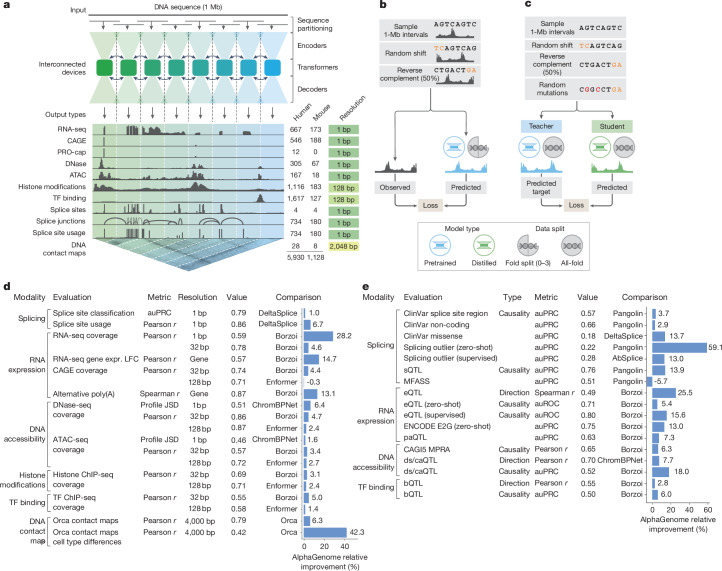
- AlphaGenome predicts 5,930 human or 1,128 mouse genome tracks across 11 modalities from 1-Mb input, including RNA-seq, CAGE, PRO-cap, splice sites/usage/junctions, DNase, ATAC-seq, histone ChIP-seq, transcription factor binding and contact maps.
- For genome track prediction, AlphaGenome outperformed external models on 22 of 24 evaluations, including +14.7% relative improvement in cell-type-specific gene-level expression log-fold change versus Borzoi, contact map Pearson r +6.3% and cell-type-specific differences +42.3% versus Orca, +15% total counts Pearson r versus ProCapNet, and +1.6% ATAC / +9.5% DNase profile Jensen–Shannon divergence versus ChromBPNet.
- For variant effect prediction, AlphaGenome matched or outperformed external models on 25 of 26 evaluations, including eQTL sign prediction +25.5% versus Borzoi and accessibility QTL +8.0% versus ChromBPNet. It achieved SOTA splicing variant prediction on six of seven benchmarks, with ClinVar auPRC 0.66 versus 0.64 by Pangolin for deep intronic/synonymous, 0.57 versus 0.55 for splice region, and 0.18 versus 0.16 for missense; on MFASS it reached auPRC 0.54 versus Pangolin 0.51 and SpliceAI/DeltaSplice 0.49.
- Multimodal scoring recapitulated TAL1 oncogene mechanisms: for chr. 1: 47239296: C>ACG, AlphaGenome predicted increased TAL1 expression 7.5 kb away, activating H3K27ac/H3K4me1, decreased repressive marks, and a MYB motif at the variant position.
Methods
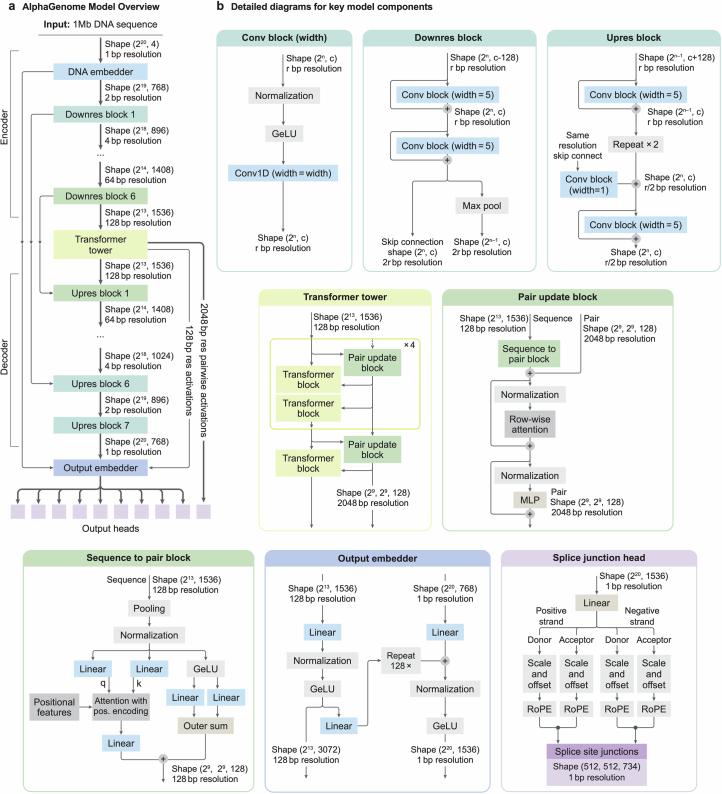
- Model architecture: U-Net-inspired backbone producing 1D embeddings at 1-bp and 128-bp resolution and 2D embeddings at 2,048-bp resolution; convolutional layers model local patterns and transformer blocks model longer-range dependencies. Base-pair-resolution training on 1-Mb sequences uses sequence parallelism across eight interconnected TPU v3 devices.
- Training: two-stage process. Pretraining used a 4-fold cross-validation scheme to produce fold-specific models and all-fold teacher models; distillation then trained a single student model to reproduce an ensemble of all-fold teachers using augmented and mutationally perturbed input sequences. The distilled student runs in less than 1 s on an NVIDIA H100 GPU per variant.
- Evaluation: 24 genome track evaluations across all 11 modalities and 26 variant effect benchmarks, compared against the strongest available external model per task. Ablations assessed target resolution, sequence length, ensembling, distillation and multimodal training. Detailed methods are in the Supplementary Information.
Limitations
- Stated by the paper: accurately capturing distal regulatory elements more than 100 kb away remains a continuing objective; recapitulating tissue-specific patterns across cellular contexts and predicting condition-specific variant effects remain challenging; training and evaluations are heavily focused on protein-coding genes, with future work needed for non-coding genes such as microRNAs; species coverage is limited to human and mouse and evaluations are primarily human-focused; the model has not been benchmarked on personal genome prediction; and complex trait analysis is limited because AlphaGenome predicts molecular consequences rather than broader biological and environmental contributions.
- Also stated: performance decays with distance to the target gene/TSS and to the polyadenylation site; high score thresholds enrich for causal variant candidates but at low recall, particularly for GWAS variants; and further improvements are needed for intermediate splicing efficiencies and tissue-specific splicing nuances.
- Evident from the text: the paper reports occasional underprediction of expression impact for alternative polyadenylation and notes that both AlphaGenome and Borzoi still underestimate the impact of very distal enhancers.
Model-written summary. Check it against the paper before relying on it.
Integrity signals
Registry
Cites
Statistics
Figures
Verification
Claims the paper makes
94 Own result · 20 Own interpretation · 18 No basis given · 9 Sources not found · 5 Supported · 5 Partly supported · 4 Not checked yet · 2 Supported so far · 2 No full text of the sources · 1 Couldn’t confirm · 1 Own method · accuracy not yet measured
Every source the paper cites for this claim was checked and supports it.
In the paper
“Given that more than 98% of observed genetic variation in humans is non-coding7, global characterization of the complex effects of this vast majority of variants remains intractable without computational predictions.”
§ Advancing regulatory variant effect prediction with AlphaGenome > Main
What the sources say
- Supportedcites [7] Halldorsson, B. V. et al. The sequences of 150,119 genomes in the UK Biobank. Nature 607, 732–740 (2022). source
Table 1 in “SNPs and indels” lists 6,380,795 coding variants among approximately 558 million WGS variants across its annotation categories. Coding variants therefore account for about 1.1% of those observed, supporting the claim that more than 98% are non-coding in this human cohort. (LLM, conf=0.88)
plain- Asserted: passes — The authors put it forward as true.
- Checkable: passes — It can be checked against evidence.
- Load-bearing: passes — The paper’s conclusions depend on it.
- Based: passes — The paper gives a reason why it holds.
- Supported
The cited sources support only part of this claim — read each source’s verdict below.
In the paper
“The ability of AlphaGenome to simultaneously score variant effects across all modalities accurately recapitulates the mechanisms of clinically relevant variants near the TAL1 oncogene6.”
§ Advancing regulatory variant effect prediction with AlphaGenome > Abstract
What the sources say
- Partly supportedcites [6] Mansour, M. R. et al. Oncogene regulation. An oncogenic super-enhancer formed through somatic mutation of a noncoding intergenic element. Science 346, 1373–1377 (2014). sourceExperimental — accuracy not yet measured
The supplied passages (labeled Abstract in our copy) describe TAL1-region mutations in T-ALL samples and their mechanism: newly created MYB binding sites nucleate a super-enhancer that increases TAL1 expression. They do not evaluate AlphaGenome, its scoring across modalities, or whether its predictions accurately recapitulate those mechanisms. (LLM, conf=0.88)
plaindirect- Asserted: passes — The authors put it forward as true.
- Checkable: passes — It can be checked against evidence.
- Load-bearing: passes — The paper’s conclusions depend on it.
- Based: passes — The paper gives a reason why it holds.
- Partly supported
The cited sources support only part of this claim — read each source’s verdict below.
In the paper
“Existing methods involve a trade-off between input sequence length and prediction resolution, thereby limiting their modality scope and performance1–5.”
§ Advancing regulatory variant effect prediction with AlphaGenome > Abstract
What the sources say
- Partly supportedcites [1] Avsec, Ž. et al. Effective gene expression prediction from sequence by integrating long-range interactions. Nat. Methods 18, 1196–1203 (2021). sourceExperimental — accuracy not yet measured
The Methods (Model architecture; page unavailable) describe a trade-off for Enformer: finer prediction resolution would increase the sequence length entering its attention layers and make computation intractable on available hardware. The Results (Enformer improves gene expression prediction; page unavailable) also say previous models reached less-distant elements. The paper does not establish that existing methods generally trade input length against resolution or that this trade-off limits their modality scope. (LLM, conf=0.82)
- Partly supportedcites [2] Linder, J., Srivastava, D. & Yuan, H. Predicting RNA-seq coverage from DNA sequence as a unifying model of gene regulation. Nat. Genet. 57, 949–961 (2025). sourceExperimental — accuracy not yet measured
The Results (RNA-seq model design; page unavailable) explicitly describe a computational trade-off between sequence length and prediction resolution. The Methods (Model; page unavailable) explain how insufficient length or coarse resolution can obstruct learning, and the Main section describes earlier models’ narrower assay focus. The paper does not explicitly establish that this trade-off is what limits existing methods’ modality scope and performance overall. (LLM, conf=0.82)
- Partly supportedcites [3] Zhou, J. Sequence-based modeling of three-dimensional genome architecture from kilobase to chromosome scale. Nat. Genet. 54, 725–734 (2022). sourceExperimental — accuracy not yet measured
The Introduction (page unavailable) says earlier sequence models did not predict large-scale genome organization beyond 1 Mb, limiting predictions of large structures and structural-variant effects. The Results describe using coarser resolution at longer distances and report a small improvement in local predictions from larger sequence context. The paper does not establish that a length–resolution trade-off in existing methods limits their modality scope or overall performance. (LLM, conf=0.83)
- Not checked — no full text of the sourcecites [4] Jaganathan, K. et al. Predicting splicing from primary sequence with deep learning. Cell 176, 535–548 (2019). source
- Partly supportedcites [5] Kelley, D. R., Snoek, J. & Rinn, J. L. Basset: learning the regulatory code of the accessible genome with deep convolutional neural networks. Genome Res. 26, 990–999 (2016). sourceExperimental — accuracy not yet measured
The Discussion says prior sequence-kernel methods lose positional information, while position-specific kernels can suffer in predictive performance; it also says Basset offers finer nucleotide-level resolution than annotation-overlap approaches. It does not describe a trade-off between input sequence length and prediction resolution or say that such a trade-off limits modality scope. (LLM, conf=0.78)
plaindirect- Asserted: passes — The authors put it forward as true.
- Checkable: passes — It can be checked against evidence.
- Load-bearing: passes — The paper’s conclusions depend on it.
- Based: passes — The paper gives a reason why it holds.
- Partly supported
The cited sources support only part of this claim — read each source’s verdict below.
In the paper
“For instance, 99% (465 of 471) of validated enhancer–gene pairs fall within 1 Mb (ref. 12).”
§ Advancing regulatory variant effect prediction with AlphaGenome > Unifying DNA sequence-to-function model
What the sources say
- Partly supportedcites [12] Gschwind, A. R. et al. An encyclopedia of enhancer-gene regulatory interactions in the human genome. Preprint at bioRxiv https://doi.org/10.1101/2023.11.09.563812 (2023). sourceExperimental — accuracy not yet measured
The Genome-wide maps of regulatory interactions section (page unavailable) says most predicted enhancer–gene interactions span short distances and that this is consistent with CRISPR perturbation results. The Supervised classification section reports 472 CRISPR-positive pairs, but our copy does not give the claimed count of 465 of 471 or establish that 99% of validated pairs fall within 1 Mb. (LLM, conf=0.83)
plain- Asserted: passes — The authors put it forward as true.
- Checkable: passes — It can be checked against evidence.
- Load-bearing: passes — The paper’s conclusions depend on it.
- Based: passes — The paper gives a reason why it holds.
- Partly supported
The cited sources support only part of this claim — read each source’s verdict below.
In the paper
“Detailed ALT–REF predictions for an oncogenic insertion (chr. 1: 47239296: C>ACG) characterized in ref. 6. Shown are differences between AlphaGenome predictions between the ALT and REF sequences of the variant in CD34+ CMP tracks. The ALT sequence increases expression of the TAL1 gene 7.5 kb away.”
§ Advancing regulatory variant effect prediction with AlphaGenome > Main
What the sources say
- Partly supportedcites [6] Mansour, M. R. et al. Oncogene regulation. An oncogenic super-enhancer formed through somatic mutation of a noncoding intergenic element. Science 346, 1373–1377 (2014). sourceExperimental — accuracy not yet measured
The paper’s main text (page unavailable in our copy) describes oncogenic insertions at a hotspot 7.5 kb upstream of TAL1 and concludes that they drive TAL1 overexpression. It does not identify the insertion as chr. 1:47239296:C>ACG, so our copy does not establish that this exact ALT allele is one it characterized. The AlphaGenome predictions are the citing authors’ analysis, not a finding attributed to this source. (LLM, conf=0.78)
plaindirectSingle case- Asserted: passes — The authors put it forward as true.
- Checkable: passes — It can be checked against evidence.
- Load-bearing: passes — The paper’s conclusions depend on it.
- Based: passes — The paper gives a reason why it holds.
- Partly supported
Every source the paper cites for this claim was checked and supports it.
In the paper
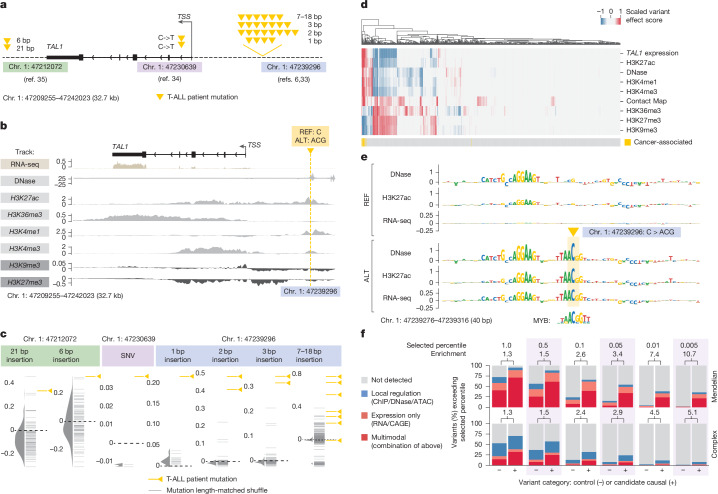
“We evaluated three groups of gain-of-function mutations affecting the TAL1 gene in T cell acute lymphoblastic leukaemia (T-ALL): a cluster of 5′ neo-enhancer mutations upstream of the TAL1 TSS6,33, an intronic single-nucleotide variant (SNV)34 and a 3′ neo-enhancer35.”
- Also stated in: § Multimodal view of variant effects · boosted
“All three variant groups were shown to converge on a common mechanism—upregulation of the TAL1 oncogene (Fig. 6a,b).”
§ Advancing regulatory variant effect prediction with AlphaGenome > Multimodal view of variant effects
What the sources say
- Supportedcites [6] Mansour, M. R. et al. Oncogene regulation. An oncogenic super-enhancer formed through somatic mutation of a noncoding intergenic element. Science 346, 1373–1377 (2014). source
The citation to this paper is attached to the 5′ neo-enhancer mutations, not the separately cited intronic SNV or 3′ neo-enhancer. The passage describing a hotspot 7.5 kb upstream of the TAL1 transcription start site reports that its indel mutations generate a super-enhancer driving TAL1 overexpression in T-ALL. (LLM, conf=0.93)
- Supportedcites [33] Liu, Y. et al. The genomic landscape of pediatric and young adult T-lineage acute lymphoblastic leukemia. Nat. Genet. 49, 1211–1218 (2017). source
The section “Somatic alterations targeting transcriptional regulators” reports upstream TAL1 non-coding mutations that create a MYB-binding site and identifies 15 cases with identical or similar mutations. This supports the 5′ upstream mutation group to which this source is cited in the printed sentence; the intronic SNV and 3′ enhancer have separate citations. (LLM, conf=0.91)
- Supportedcites [34] Liu, Y. et al. Discovery of regulatory noncoding variants in individual cancer genomes by using cis-X. Nat. Genet. 52, 811–818 (2020). source
The citation is attached to the intronic SNV, not to all three mutation groups. In Results, “A recurrent intronic mutation activating TAL1 expression,” the paper identifies a recurrent C-to-T mutation in TAL1 intron 1 in T-ALL and links it to increased TAL1 expression and enhancer activity. (LLM, conf=0.93)
- Supportedcites [35] Smith, C. et al. TAL1 activation in T-cell acute lymphoblastic leukemia: a novel oncogenic 3′ neo-enhancer. Haematologica 108, 1259–1271 (2023). source
The Introduction describes upstream microinsertions, an intronic point mutation, and a newly discovered downstream microinsertion as distinct routes to TAL1 expression in T-ALL. The Abstract and Discussion report that the downstream mutation forms a 3′ neo-enhancer that activates TAL1. The paper supports convergence on TAL1 upregulation, though it does not say all three mutations use the same transcription factor. (LLM, conf=0.92)
boosteddirect- Asserted: passes — The authors put it forward as true.
- Checkable: passes — It can be checked against evidence.
- Load-bearing: passes — The paper’s conclusions depend on it.
- Based: passes — The paper gives a reason why it holds.
- Also stated in: § Multimodal view of variant effects · boosted
The sources with a verdict support this claim; the rest weren’t checked yet, have no full text we could read, or their verdicts aren’t rated yet.
In the paper
“We have not yet benchmarked the model on personal genome prediction, which is a known weakness of models in this space40,41.”
§ Advancing regulatory variant effect prediction with AlphaGenome > Discussion
What the sources say
- Not checked yetcites [40] Sasse, A. et al. Benchmarking of deep neural networks for predicting personal gene expression from DNA sequence highlights shortcomings. Nat. Genet. 55, 2060–2064 (2023). source
Checked before — its earlier verdict is held back until a new check runs.
- Supportedcites [41] Huang, C. et al. Personal transcriptome variation is poorly explained by current genomic deep learning models. Nat. Genet. 55, 2056–2059 (2023). source
The citation supports the claim that personal-genome prediction is a weakness of models in this space, not the citing authors’ statement that they have not yet benchmarked AlphaGenome. The Main section (page not supplied) reports that four sequence-to-expression models underperform when predicting expression differences across individuals from personal DNA sequences. (LLM, conf=0.92)
plain- Asserted: passes — The authors put it forward as true.
- Checkable: passes — It can be checked against evidence.
- Load-bearing: unclear — It is unclear whether the paper’s conclusions depend on it.
- Based: passes — The paper gives a reason why it holds.
- Not checked yet
The paper states this without a source or data behind it here, so there is nothing to check it against. The quote shows it is in the paper.
In the paper
“Here we present AlphaGenome, a model that unifies multimodal prediction, long-sequence context and base-pair resolution into a single framework.”
§ Advancing regulatory variant effect prediction with AlphaGenome > Main
plain- Asserted: passes — The authors put it forward as true.
- Checkable: passes — It can be checked against evidence.
- Load-bearing: passes — The paper’s conclusions depend on it.
- Based: passes — The paper gives a reason why it holds.
The paper states this without a source or data behind it here, so there is nothing to check it against. The quote shows it is in the paper.
In the paper
“The modalities include gene expression, transcription initiation, chromatin accessibility, histone modifications, transcription factor binding, chromatin contact maps, splice site usage and splice junction coordinates and strength.”
§ Advancing regulatory variant effect prediction with AlphaGenome > Abstract
plain- Asserted: passes — The authors put it forward as true.
- Checkable: passes — It can be checked against evidence.
- Load-bearing: passes — The paper’s conclusions depend on it.
- Based: passes — The paper gives a reason why it holds.
The paper states this without a source or data behind it here, so there is nothing to check it against. The quote shows it is in the paper.
In the paper
“The splicing predictions of AlphaGenome include a new splice junction prediction approach alongside splice site usage prediction.”
§ Advancing regulatory variant effect prediction with AlphaGenome > Main
plain- Asserted: passes — The authors put it forward as true.
- Checkable: passes — It can be checked against evidence.
- Load-bearing: unclear — It is unclear whether the paper’s conclusions depend on it.
- Based: passes — The paper gives a reason why it holds.
A result the paper reports from its own data — it cites no other source for it, so there is none to check. The quote shows it is in the paper.
In the paper
“AlphaGenome processes 1 Mb of DNA sequences and species identity (human/mouse) to predict 5,930 human or 1,128 mouse genome tracks across diverse cell types and 11 output types at specific resolutions (far right).”
§ Advancing regulatory variant effect prediction with AlphaGenome > Main
plaindirect- Asserted: passes — The authors put it forward as true.
- Checkable: passes — It can be checked against evidence.
- Load-bearing: passes — The paper’s conclusions depend on it.
- Based: passes — The paper gives a reason why it holds.
The paper states this without a source or data behind it here, so there is nothing to check it against. The quote shows it is in the paper.
In the paper
“Trained on human and mouse genomes, AlphaGenome matches or exceeds the strongest available external models in 25 of 26 evaluations of variant effect prediction.”
§ Advancing regulatory variant effect prediction with AlphaGenome > Abstract
plain- Asserted: passes — The authors put it forward as true.
- Checkable: passes — It can be checked against evidence.
- Load-bearing: passes — The paper’s conclusions depend on it.
- Based: passes — The paper gives a reason why it holds.
The paper states this without a source or data behind it here, so there is nothing to check it against. The quote shows it is in the paper.
In the paper
“We present AlphaGenome, a unified DNA sequence model, which takes as input 1 Mb of DNA sequence and predicts thousands of functional genomic tracks up to single-base-pair resolution across diverse modalities.”
§ Advancing regulatory variant effect prediction with AlphaGenome > Abstract
plain- Asserted: passes — The authors put it forward as true.
- Checkable: passes — It can be checked against evidence.
- Load-bearing: passes — The paper’s conclusions depend on it.
- Based: passes — The paper gives a reason why it holds.
A result the paper reports from its own data — it cites no other source for it, so there is none to check. The quote shows it is in the paper.
In the paper
“such as sign prediction for expression QTLs (eQTLs; +25.5% versus Borzoi2)”
§ Advancing regulatory variant effect prediction with AlphaGenome > Performance overview
plaincorrelational- Asserted: passes — The authors put it forward as true.
- Checkable: passes — It can be checked against evidence.
- Load-bearing: passes — The paper’s conclusions depend on it.
- Based: passes — The paper gives a reason why it holds.
A result the paper reports from its own data — it cites no other source for it, so there is none to check. The quote shows it is in the paper.
In the paper
“and accessibility QTL (+8.0% versus ChromBPNet10, averaged across five datasets; Methods)”
§ Advancing regulatory variant effect prediction with AlphaGenome > Performance overview
plaincorrelational- Asserted: passes — The authors put it forward as true.
- Checkable: passes — It can be checked against evidence.
- Load-bearing: passes — The paper’s conclusions depend on it.
- Based: passes — The paper gives a reason why it holds.
A result the paper reports from its own data — it cites no other source for it, so there is none to check. The quote shows it is in the paper.
In the paper
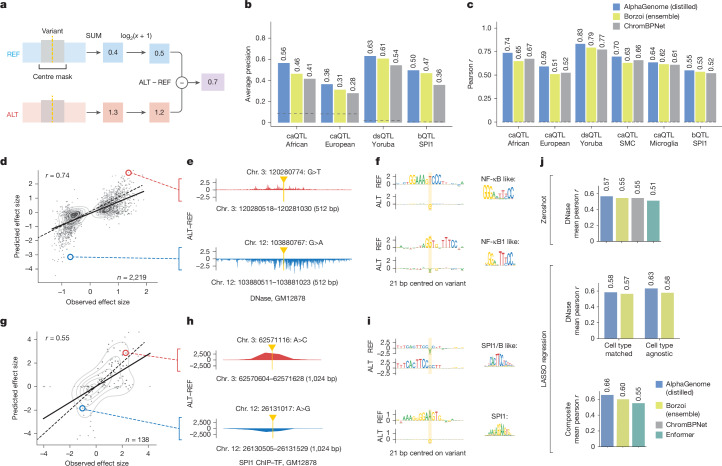
“AlphaGenome matched or outperformed the external models on 25 of 26 evaluations (Fig. 1e and Supplementary Table 4).”
§ Advancing regulatory variant effect prediction with AlphaGenome > Performance overview
plain- Asserted: passes — The authors put it forward as true.
- Checkable: passes — It can be checked against evidence.
- Load-bearing: passes — The paper’s conclusions depend on it.
- Based: passes — The paper gives a reason why it holds.
A result the paper reports from its own data — it cites no other source for it, so there is none to check. The quote shows it is in the paper.
In the paper
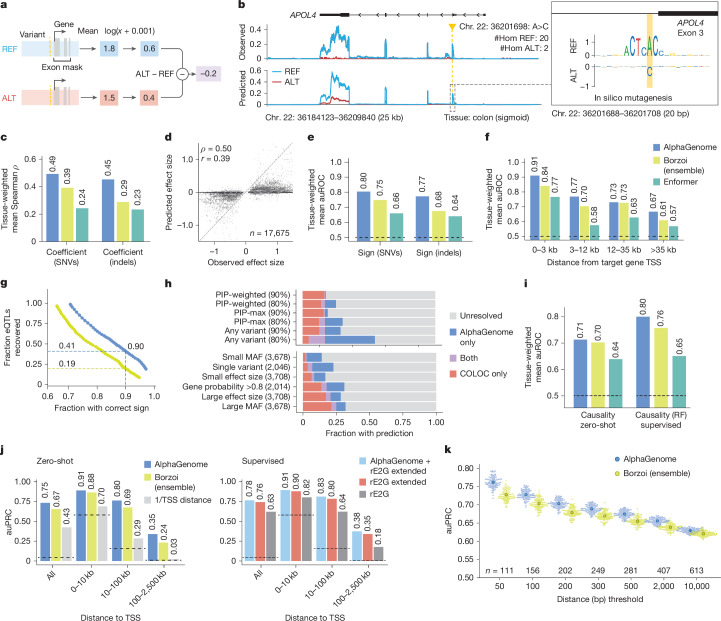
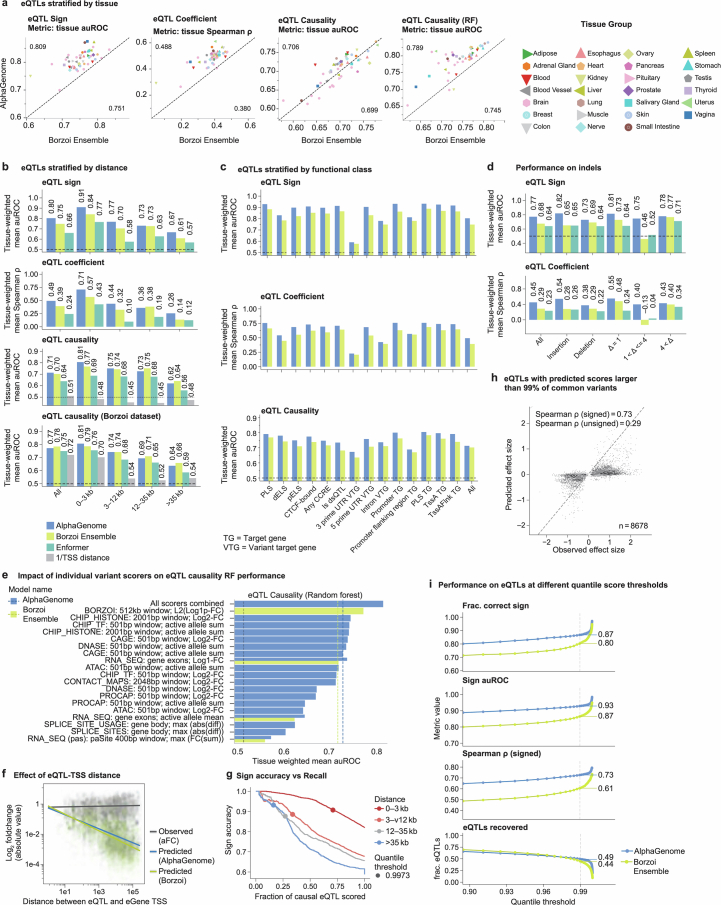
“However, AlphaGenome exhibited mild improvement on sign/coefficient prediction for distal variants (greater than 35 kb; Fig. 4f and Extended Data Fig. 5b), and top-scoring predictions exhibited high sign accuracy across distance categories (Extended Data Fig. 5g).”
§ Advancing regulatory variant effect prediction with AlphaGenome > Performance across gene expression tasks > Improved prediction of eQTL effects
plaincorrelational- Asserted: passes — The authors put it forward as true.
- Checkable: passes — It can be checked against evidence.
- Load-bearing: unclear — It is unclear whether the paper’s conclusions depend on it.
- Based: passes — The paper gives a reason why it holds.
A result the paper reports from its own data — it cites no other source for it, so there is none to check. The quote shows it is in the paper.
In the paper
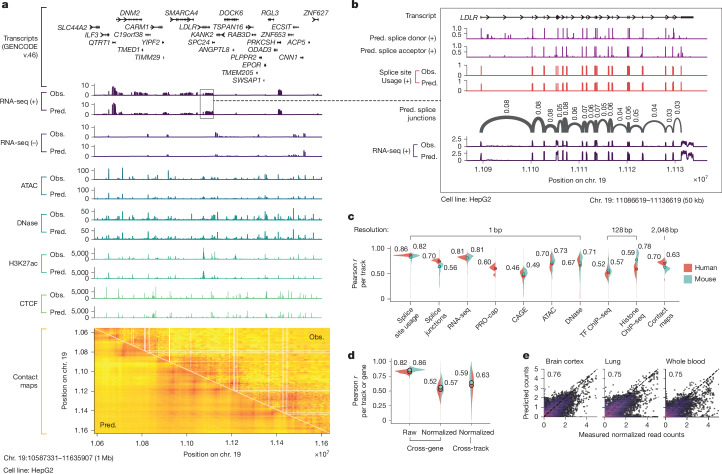
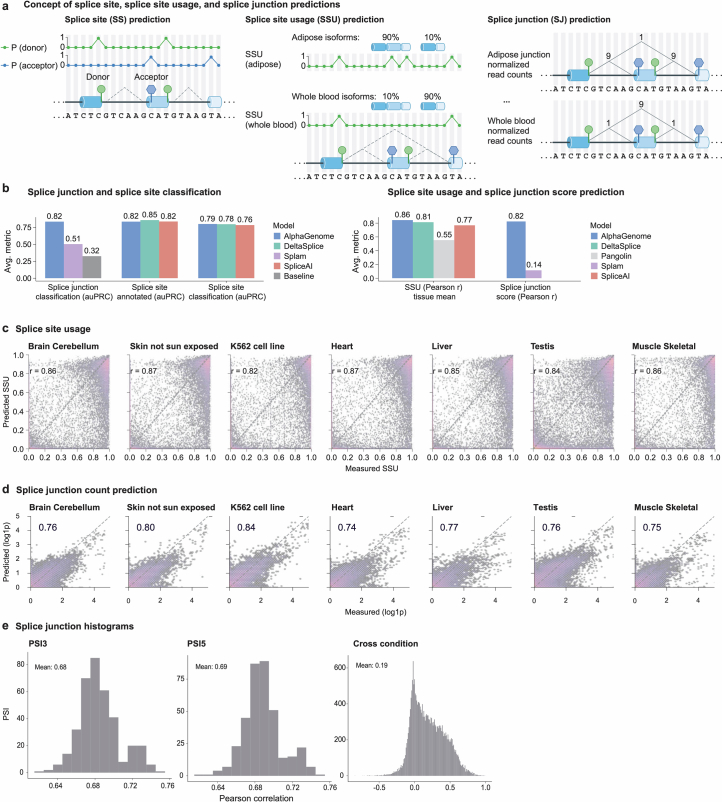
“As an example, predicted HepG2 genome tracks over the LDLR gene showcased strand-specific, base-pair-resolution RNA-seq coverage over exons, along with predicted splice sites, splice site usage and splice junction read coverage (Fig. 2b).”
§ Advancing regulatory variant effect prediction with AlphaGenome > Improved track prediction performance
plainSingle case- Asserted: passes — The authors put it forward as true.
- Checkable: passes — It can be checked against evidence.
- Load-bearing: unclear — It is unclear whether the paper’s conclusions depend on it.
- Based: passes — The paper gives a reason why it holds.
A result the paper reports from its own data — it cites no other source for it, so there is none to check. The quote shows it is in the paper.
In the paper
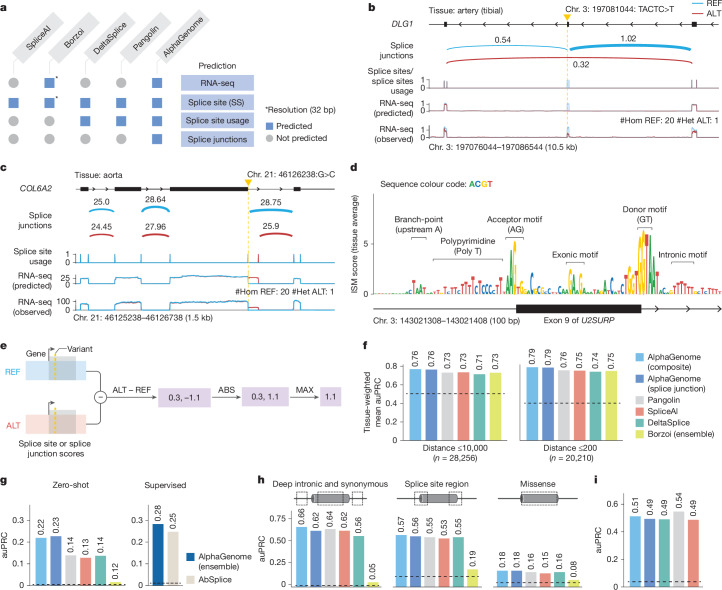
“Similarly, the predictions of AlphaGenome accurately captured the new splice junction and extended exon induced by the chr. 21: 46126238: G>C variant, an effect observed in a heterozygous GTEx RNA-seq sample (Fig. 3c).”
§ Advancing regulatory variant effect prediction with AlphaGenome > Improved splicing variant predictions
plaincorrelationalSingle case- Asserted: passes — The authors put it forward as true.
- Checkable: passes — It can be checked against evidence.
- Load-bearing: passes — The paper’s conclusions depend on it.
- Based: passes — The paper gives a reason why it holds.
The paper states this without a source or data behind it here, so there is nothing to check it against. The quote shows it is in the paper.
In the paper
“It simultaneously predicts 5,930 human or 1,128 mouse genome tracks across 11 modalities covering gene expression (RNA-seq, CAGE and PRO-cap), detailed splicing patterns (splice sites, splice site usage and splice junctions), chromatin state (DNase, ATAC-seq, histone modifications and transcription factor binding) and chromatin contact maps.”
§ Advancing regulatory variant effect prediction with AlphaGenome > Unifying DNA sequence-to-function model
plain- Asserted: passes — The authors put it forward as true.
- Checkable: passes — It can be checked against evidence.
- Load-bearing: passes — The paper’s conclusions depend on it.
- Based: passes — The paper gives a reason why it holds.
A result the paper reports from its own data — it cites no other source for it, so there is none to check. The quote shows it is in the paper.
In the paper
“At a score threshold yielding 90% sign prediction accuracy, AlphaGenome recovered over twice as many GTEx eQTLs (41%) as Borzoi (19%; Fig. 4g).”
§ Advancing regulatory variant effect prediction with AlphaGenome > Performance across gene expression tasks > Improved prediction of eQTL effects
plaincorrelational- Asserted: passes — The authors put it forward as true.
- Checkable: passes — It can be checked against evidence.
- Load-bearing: passes — The paper’s conclusions depend on it.
- Based: passes — The paper gives a reason why it holds.
A result the paper reports from its own data — it cites no other source for it, so there is none to check. The quote shows it is in the paper.
In the paper
“Fold-specific, pretrained AlphaGenome models demonstrated high concordance between predicted and observed read coverage on unseen genome intervals (Fig. 2a).”
§ Advancing regulatory variant effect prediction with AlphaGenome > Improved track prediction performance
boostedcorrelational- Asserted: passes — The authors put it forward as true.
- Checkable: passes — It can be checked against evidence.
- Load-bearing: passes — The paper’s conclusions depend on it.
- Based: passes — The paper gives a reason why it holds.
A result the paper reports from its own data — it cites no other source for it, so there is none to check. The quote shows it is in the paper.
In the paper
“Quantitatively, we observed strong Pearson correlations (r) between predicted and observed signals for functional genomics tracks in both human and mouse genomes (Fig. 2c), both across all tracks and when subsetting by biosample types or data sources (Supplementary Fig. 5).”
§ Advancing regulatory variant effect prediction with AlphaGenome > Improved track prediction performance
boostedcorrelational- Asserted: passes — The authors put it forward as true.
- Checkable: passes — It can be checked against evidence.
- Load-bearing: passes — The paper’s conclusions depend on it.
- Based: passes — The paper gives a reason why it holds.
A result the paper reports from its own data — it cites no other source for it, so there is none to check. The quote shows it is in the paper.
In the paper
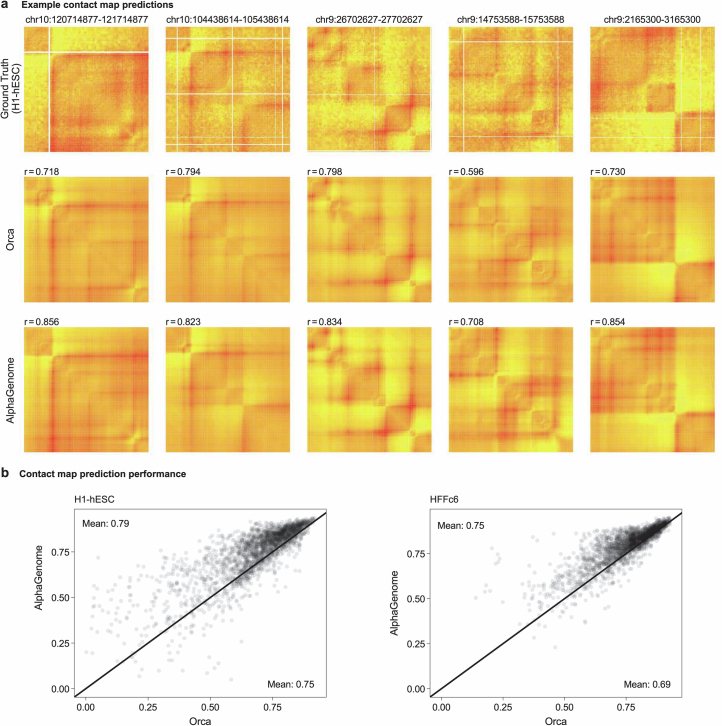
“AlphaGenome also outperformed specialized single-modality models on their respective tasks, such as Orca3 on contact maps (contact map Pearson r +6.3%; cell-type-specific differences +42.3%; Fig. 1d and Extended Data Fig. 4)”
§ Advancing regulatory variant effect prediction with AlphaGenome > Performance overview
plain- Asserted: passes — The authors put it forward as true.
- Checkable: passes — It can be checked against evidence.
- Load-bearing: passes — The paper’s conclusions depend on it.
- Based: passes — The paper gives a reason why it holds.
In the paper
“Classifying pathogenic versus benign ClinVar variants on the basis of splicing effects for deep intronic (more than 6 bp from splice sites) and synonymous (more than 3 bp from splice sites) variants, variants in the splice site region (within 6 bp intronic or 3 bp exonic) and missense variants predicted as ‘likely_benign’ by AlphaMissense51.”
§ Advancing regulatory variant effect prediction with AlphaGenome > Main
What the sources say
- Not matchedcites AlphaMissense51
Couldn’t be matched to a paper in Crossref, so it can’t be checked.
plaincorrelational- Asserted: passes — The authors put it forward as true.
- Checkable: passes — It can be checked against evidence.
- Load-bearing: passes — The paper’s conclusions depend on it.
- Based: passes — The paper gives a reason why it holds.
- Not matched
A result the paper reports from its own data — it cites no other source for it, so there is none to check. The quote shows it is in the paper.
In the paper
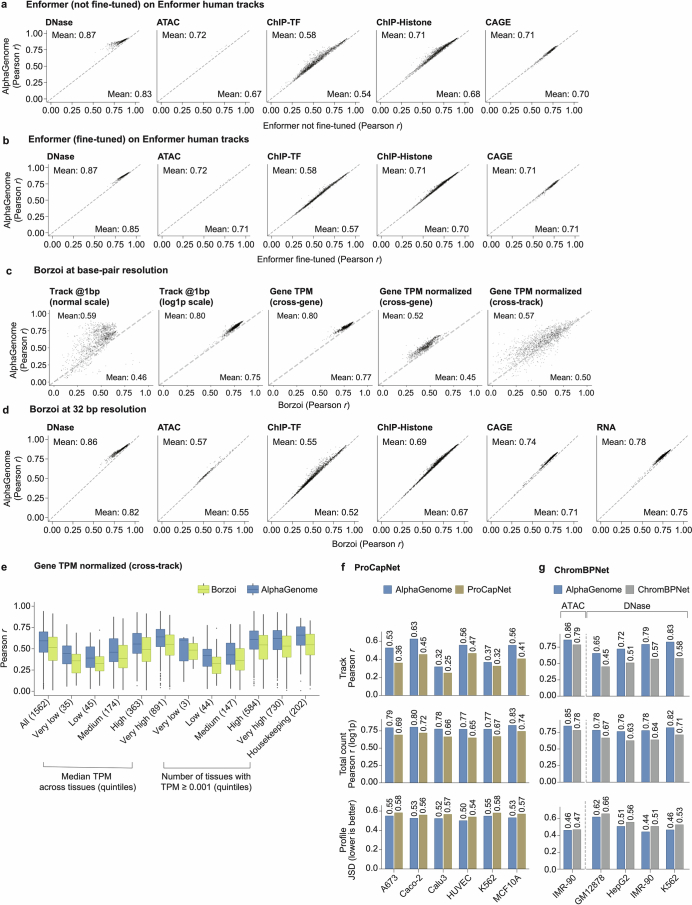
“ChromBPNet10 on accessibility (+1.6% for ATAC; +9.5% for DNase profile Jensen–Shannon divergence; Extended Data Fig. 3g).”
§ Advancing regulatory variant effect prediction with AlphaGenome > Performance overview
plaindirect- Asserted: passes — The authors put it forward as true.
- Checkable: passes — It can be checked against evidence.
- Load-bearing: passes — The paper’s conclusions depend on it.
- Based: passes — The paper gives a reason why it holds.
A result the paper reports from its own data — it cites no other source for it, so there is none to check. The quote shows it is in the paper.
In the paper
“ProCapNet9 on transcription initiation tracks (+15% total counts Pearson r; Extended Data Fig. 3f)”
§ Advancing regulatory variant effect prediction with AlphaGenome > Performance overview
plaindirect- Asserted: passes — The authors put it forward as true.
- Checkable: passes — It can be checked against evidence.
- Load-bearing: passes — The paper’s conclusions depend on it.
- Based: passes — The paper gives a reason why it holds.
A result the paper reports from its own data — it cites no other source for it, so there is none to check. The quote shows it is in the paper.
In the paper
“It also accurately predicts quantitative splice junction read coverage and PSI5 and PSI3 within various tissues, achieving high correlation with experimental measurements (Fig. 2e, Extended Data Fig. 2b,d,e and Methods).”
§ Advancing regulatory variant effect prediction with AlphaGenome > Improved track prediction performance
plaincorrelational- Asserted: passes — The authors put it forward as true.
- Checkable: passes — It can be checked against evidence.
- Load-bearing: passes — The paper’s conclusions depend on it.
- Based: passes — The paper gives a reason why it holds.
A result the paper reports from its own data — it cites no other source for it, so there is none to check. The quote shows it is in the paper.
In the paper
“For example, ISM analysis of exon 9 of the U2SURP gene and its flanking introns highlighted recognizable splicing-related sequence motifs18,19 (Fig. 3d).”
§ Advancing regulatory variant effect prediction with AlphaGenome > Improved splicing variant predictions
plaincorrelational- Asserted: passes — The authors put it forward as true.
- Checkable: passes — It can be checked against evidence.
- Load-bearing: unclear — It is unclear whether the paper’s conclusions depend on it.
- Based: passes — The paper gives a reason why it holds.
A result the paper reports from its own data — it cites no other source for it, so there is none to check. The quote shows it is in the paper.
In the paper
“Predicted versus observed effect sizes for causal SPI1 bQTLs using the GM12878 SPI1 ChIP-seq track. Signed Pearson r = 0.55; unsigned Pearson r = 0.12.”
§ Advancing regulatory variant effect prediction with AlphaGenome > Main
plaincorrelational- Asserted: passes — The authors put it forward as true.
- Checkable: passes — It can be checked against evidence.
- Load-bearing: passes — The paper’s conclusions depend on it.
- Based: passes — The paper gives a reason why it holds.
A result the paper reports from its own data — it cites no other source for it, so there is none to check. The quote shows it is in the paper.
In the paper
“AlphaGenome predicts the effect of variants on gene expression.”
§ Advancing regulatory variant effect prediction with AlphaGenome > Main
plaindirect- Asserted: passes — The authors put it forward as true.
- Checkable: passes — It can be checked against evidence.
- Load-bearing: passes — The paper’s conclusions depend on it.
- Based: passes — The paper gives a reason why it holds.
A result the paper reports from its own data — it cites no other source for it, so there is none to check. The quote shows it is in the paper.
In the paper
“Notably, the splice junction scorer alone outperformed previous approaches on all benchmarks, except ‘deep intronic and synonymous’ ClinVar and MFASS variants, underscoring the importance of modelling splicing at the junction level.”
§ Advancing regulatory variant effect prediction with AlphaGenome > Improved splicing variant predictions
plaincorrelational- Asserted: passes — The authors put it forward as true.
- Checkable: passes — It can be checked against evidence.
- Load-bearing: passes — The paper’s conclusions depend on it.
- Based: passes — The paper gives a reason why it holds.
A result the paper reports from its own data — it cites no other source for it, so there is none to check. The quote shows it is in the paper.
In the paper
“However, AlphaGenome exhibited mild improvement on sign/coefficient prediction for distal variants (greater than 35 kb; Fig. 4f and Extended Data Fig. 5b), and top-scoring predictions exhibited high sign accuracy across distance categories (Extended Data Fig. 5g).”
§ Advancing regulatory variant effect prediction with AlphaGenome > Performance across gene expression tasks > Improved prediction of eQTL effects
plaincorrelational- Asserted: passes — The authors put it forward as true.
- Checkable: passes — It can be checked against evidence.
- Load-bearing: passes — The paper’s conclusions depend on it.
- Based: passes — The paper gives a reason why it holds.
A result the paper reports from its own data — it cites no other source for it, so there is none to check. The quote shows it is in the paper.
In the paper
“AlphaGenome outperformed these external models on 22 of 24 evaluations (Fig. 1d, Extended Data Fig. 3 and Supplementary Table 3).”
§ Advancing regulatory variant effect prediction with AlphaGenome > Performance overview
plaincorrelational- Asserted: passes — The authors put it forward as true.
- Checkable: passes — It can be checked against evidence.
- Load-bearing: passes — The paper’s conclusions depend on it.
- Based: passes — The paper gives a reason why it holds.
A result the paper reports from its own data — it cites no other source for it, so there is none to check. The quote shows it is in the paper.
In the paper
“Predicted versus observed effect sizes for causal caQTLs (African ancestry). The scatterplot displays GM12878 cell line DNase predictions. Signed Pearson r = 0.74; unsigned Pearson r = 0.45.”
§ Advancing regulatory variant effect prediction with AlphaGenome > Main
plaincorrelational- Asserted: passes — The authors put it forward as true.
- Checkable: passes — It can be checked against evidence.
- Load-bearing: passes — The paper’s conclusions depend on it.
- Based: passes — The paper gives a reason why it holds.
A result the paper reports from its own data — it cites no other source for it, so there is none to check. The quote shows it is in the paper.
In the paper
“These span a variety of biological contexts, such as different tissue types, cell types and cell lines (see Supplementary Table 1 for the summary and Supplementary Table 2 for the complete metadata).”
§ Advancing regulatory variant effect prediction with AlphaGenome > Unifying DNA sequence-to-function model
plain- Asserted: passes — The authors put it forward as true.
- Checkable: passes — It can be checked against evidence.
- Load-bearing: passes — The paper’s conclusions depend on it.
- Based: passes — The paper gives a reason why it holds.
A result the paper reports from its own data — it cites no other source for it, so there is none to check. The quote shows it is in the paper.
In the paper
“Additionally, AlphaGenome outperformed Borzoi on coefficient and sign prediction for indel (insertion or deletion) eQTLs (Fig. 4c,e and Extended Data Fig. 5d).”
§ Advancing regulatory variant effect prediction with AlphaGenome > Performance across gene expression tasks > Improved prediction of eQTL effects
plain- Asserted: passes — The authors put it forward as true.
- Checkable: passes — It can be checked against evidence.
- Load-bearing: passes — The paper’s conclusions depend on it.
- Based: passes — The paper gives a reason why it holds.
A result the paper reports from its own data — it cites no other source for it, so there is none to check. The quote shows it is in the paper.
In the paper
“These improvements in coefficient and sign prediction were observed broadly across most of GTEx tissues, variant-to-transcription start site (TSS) distance bins and variant functional annotation classes (Extended Data Fig. 5a–c).”
§ Advancing regulatory variant effect prediction with AlphaGenome > Performance across gene expression tasks > Improved prediction of eQTL effects
plaincorrelational- Asserted: passes — The authors put it forward as true.
- Checkable: passes — It can be checked against evidence.
- Load-bearing: passes — The paper’s conclusions depend on it.
- Based: passes — The paper gives a reason why it holds.
A result the paper reports from its own data — it cites no other source for it, so there is none to check. The quote shows it is in the paper.
In the paper
“AlphaGenome performed best on fine-mapped splicing QTL (sQTL) classification2,20, including both single-nucleotide polymorphisms (SNPs) within 10 kb of the closest splice site and proximal variants within 200 bp of splice sites (Fig. 3f).”
§ Advancing regulatory variant effect prediction with AlphaGenome > Improved splicing variant predictions
plaincorrelational- Asserted: passes — The authors put it forward as true.
- Checkable: passes — It can be checked against evidence.
- Load-bearing: passes — The paper’s conclusions depend on it.
- Based: passes — The paper gives a reason why it holds.
A result the paper reports from its own data — it cites no other source for it, so there is none to check. The quote shows it is in the paper.
In the paper
“Furthermore, it achieved the highest performance at predicting rare SNPs and indels associated with GTEx splicing outliers in both supervised and unsupervised settings (Fig. 3g and Methods).”
§ Advancing regulatory variant effect prediction with AlphaGenome > Improved splicing variant predictions
plaincorrelational- Asserted: passes — The authors put it forward as true.
- Checkable: passes — It can be checked against evidence.
- Load-bearing: passes — The paper’s conclusions depend on it.
- Based: passes — The paper gives a reason why it holds.
None of the sources cited for this claim have been checked yet.
In the paper
“These predictions are made on the basis of 1-Mb of DNA sequence, a context length designed to encompass a substantial portion of the relevant distal regulatory landscape.”
§ Advancing regulatory variant effect prediction with AlphaGenome > Unifying DNA sequence-to-function model
plaindirect- Asserted: passes — The authors put it forward as true.
- Checkable: passes — It can be checked against evidence.
- Load-bearing: passes — The paper’s conclusions depend on it.
- Based: passes — The paper gives a reason why it holds.
The paper states this without a source or data behind it here, so there is nothing to check it against. The quote shows it is in the paper.
In the paper
“AlphaGenome is a deep learning model designed to learn the sequence basis of diverse molecular phenotypes from human and mouse DNA (Fig. 1a).”
§ Advancing regulatory variant effect prediction with AlphaGenome > Unifying DNA sequence-to-function model
plain- Asserted: passes — The authors put it forward as true.
- Checkable: passes — It can be checked against evidence.
- Load-bearing: passes — The paper’s conclusions depend on it.
- Based: passes — The paper gives a reason why it holds.
The paper states this without a source or data behind it here, so there is nothing to check it against. The quote shows it is in the paper.
In the paper
“AlphaGenome is a SOTA splicing variant effect prediction model.”
§ Advancing regulatory variant effect prediction with AlphaGenome > Main
plain- Asserted: passes — The authors put it forward as true.
- Checkable: passes — It can be checked against evidence.
- Load-bearing: passes — The paper’s conclusions depend on it.
- Based: passes — The paper gives a reason why it holds.
None of the sources cited for this claim have been checked yet.
In the paper
“For the oncogenic mutation chr. 1: 47239296: C>ACG6, AlphaGenome predicted increases in the activating histone marks H3K27ac and H3K4me1 at the variant, consistent with experimentally observed neo-enhancer formation at that position6,33 (Fig. 6b).”
§ Advancing regulatory variant effect prediction with AlphaGenome > Multimodal view of variant effects
plaindirectSingle case- Asserted: passes — The authors put it forward as true.
- Checkable: passes — It can be checked against evidence.
- Load-bearing: passes — The paper’s conclusions depend on it.
- Based: passes — The paper gives a reason why it holds.
- Rests on an assumption: CD34+ common myeloid progenitor (CMP) data is the closest available match to the T-ALL cell of origin.
A result the paper reports from its own data — it cites no other source for it, so there is none to check. The quote shows it is in the paper.
In the paper
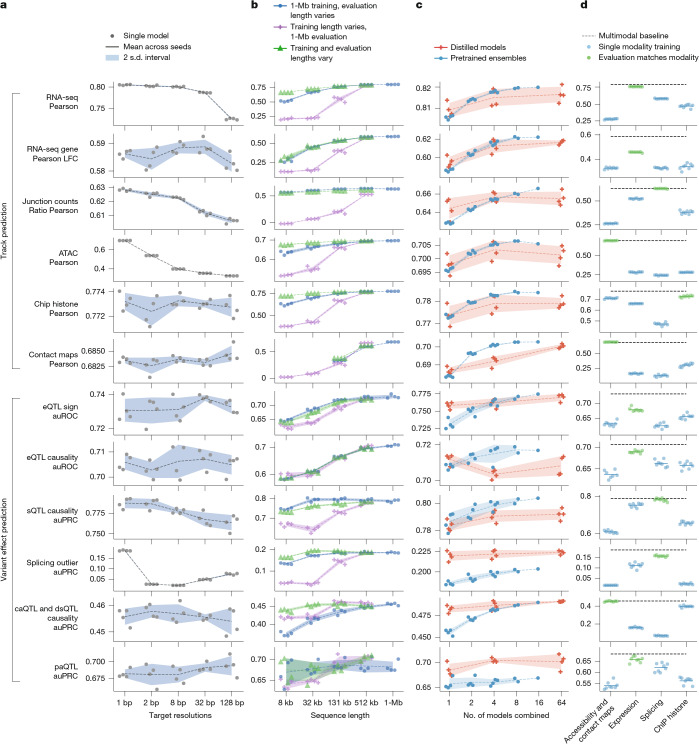
“First, models trained on longer DNA sequences (up to the full 1 Mb) outperformed those trained on shorter sequences (32 kb or less), even when the latter were evaluated using 1-Mb contexts (Fig. 7b (purple crosses) and Methods), underscoring the benefits of providing more sequence context during training.”
§ Advancing regulatory variant effect prediction with AlphaGenome > Model and data ablations
plaindirect- Asserted: passes — The authors put it forward as true.
- Checkable: passes — It can be checked against evidence.
- Load-bearing: passes — The paper’s conclusions depend on it.
- Based: passes — The paper gives a reason why it holds.
A result the paper reports from its own data — it cites no other source for it, so there is none to check. The quote shows it is in the paper.
In the paper
“Oncogenic mutations were predicted to increase TAL1 expression in CD34+ CMPs more than shuffled controls (Fig. 6c).”
§ Advancing regulatory variant effect prediction with AlphaGenome > Multimodal view of variant effects
plaindirect- Asserted: passes — The authors put it forward as true.
- Checkable: passes — It can be checked against evidence.
- Load-bearing: passes — The paper’s conclusions depend on it.
- Based: passes — The paper gives a reason why it holds.
A result the paper reports from its own data — it cites no other source for it, so there is none to check. The quote shows it is in the paper.
In the paper
“Training with target tracks at 1-bp resolution consistently yielded the best results, particularly for tasks requiring fine-scale detail, such as splicing (PSI5 and PSI3) and accessibility (ATAC), in which performance generally declined as target resolution became coarser (Fig. 7a).”
§ Advancing regulatory variant effect prediction with AlphaGenome > Model and data ablations
plaindirect- Asserted: passes — The authors put it forward as true.
- Checkable: passes — It can be checked against evidence.
- Load-bearing: passes — The paper’s conclusions depend on it.
- Based: passes — The paper gives a reason why it holds.
A result the paper reports from its own data — it cites no other source for it, so there is none to check. The quote shows it is in the paper.
In the paper
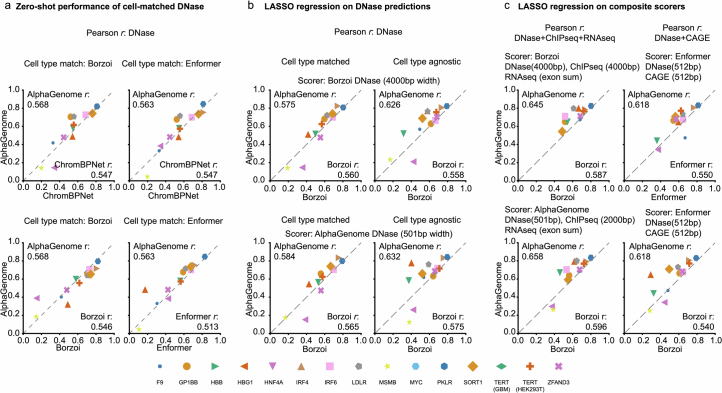
“Furthermore, aggregating features from DNase predictions across all modelled cell types using least absolute shrinkage and selection operator (LASSO) regression further improved performance over cell-type-matched DNase features and the analogous approach with the Borzoi Ensemble model (Fig. 5j, middle; Pearson r = 0.63).”
§ Advancing regulatory variant effect prediction with AlphaGenome > Improved prediction of chromatin accessibility, DNase sensitivity and binding QTLs
plaindirect- Asserted: passes — The authors put it forward as true.
- Checkable: passes — It can be checked against evidence.
- Load-bearing: passes — The paper’s conclusions depend on it.
- Based: passes — The paper gives a reason why it holds.
- Rests on an assumption: MPRAs measure the regulatory activity of short DNA sequences, a process closely linked to local chromatin accessibility and transcription factor binding.
A result the paper reports from its own data — it cites no other source for it, so there is none to check. The quote shows it is in the paper.
In the paper
“The 1-Mb-trained AlphaGenome model performed optimally when evaluated on the full 1-Mb sequence, with its performance progressively declining as shorter segments were used for inference input (Fig. 7b (blue dots)).”
§ Advancing regulatory variant effect prediction with AlphaGenome > Model and data ablations
plaincorrelational- Asserted: passes — The authors put it forward as true.
- Checkable: passes — It can be checked against evidence.
- Load-bearing: passes — The paper’s conclusions depend on it.
- Based: passes — The paper gives a reason why it holds.
The paper states this without a source or data behind it here, so there is nothing to check it against. The quote shows it is in the paper.
In the paper
“Furthermore, AlphaGenome resolved approximately 4-fold more credible sets in the lowest minor allele frequency quintile compared with COLOC, probably reflecting its reduced dependence on population genetics parameters that affect power to detect associations (Fig. 4h, stratified bars).”
§ Advancing regulatory variant effect prediction with AlphaGenome > Performance across gene expression tasks > Improved prediction of eQTL effects
hedgedcorrelational- Asserted: passes — The authors put it forward as true.
- Checkable: passes — It can be checked against evidence.
- Load-bearing: passes — The paper’s conclusions depend on it.
- Based: passes — The paper gives a reason why it holds.
A result the paper reports from its own data — it cites no other source for it, so there is none to check. The quote shows it is in the paper.
In the paper
“No mutations within 40 bp of the variant had a predicted effect on TAL1 expression in the reference sequence (Fig. 6e).”
§ Advancing regulatory variant effect prediction with AlphaGenome > Multimodal view of variant effects
plainSingle case- Asserted: passes — The authors put it forward as true.
- Checkable: passes — It can be checked against evidence.
- Load-bearing: passes — The paper’s conclusions depend on it.
- Based: passes — The paper gives a reason why it holds.
A result the paper reports from its own data — it cites no other source for it, so there is none to check. The quote shows it is in the paper.
In the paper
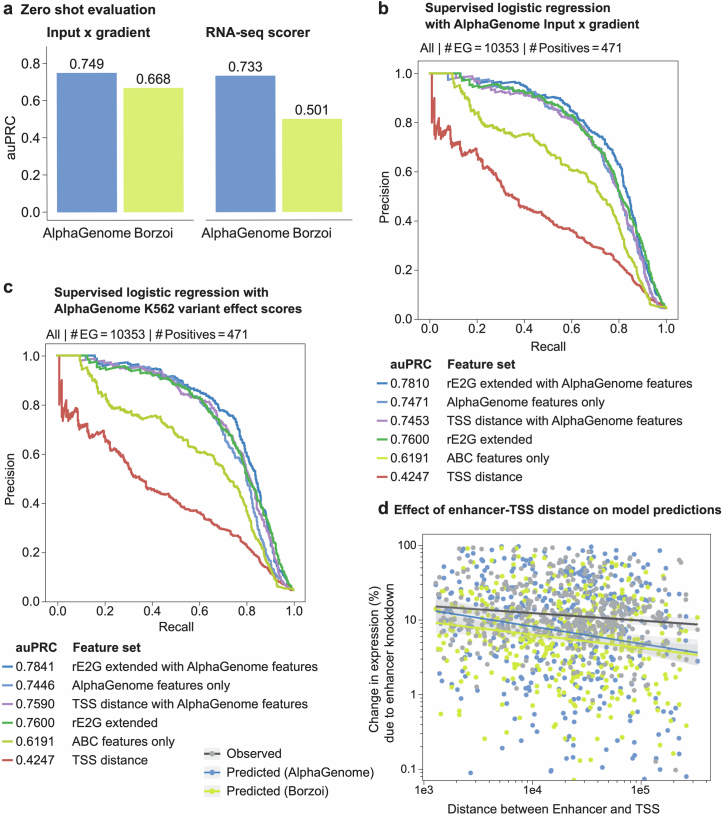
“Incorporating AlphaGenome predictions into the ENCODE–rE2G (extended) model yielded a new SOTA performance across all distance-to-TSS categories (Fig. 4j, Extended Data Fig. 7b,c and Methods).”
§ Advancing regulatory variant effect prediction with AlphaGenome > Performance across gene expression tasks > Competitive enhancer–gene linking
plaindirect- Asserted: passes — The authors put it forward as true.
- Checkable: passes — It can be checked against evidence.
- Load-bearing: passes — The paper’s conclusions depend on it.
- Based: passes — The paper gives a reason why it holds.
A result the paper reports from its own data — it cites no other source for it, so there is none to check. The quote shows it is in the paper.
In the paper
“Similarly, variant effect prediction metrics, which often aggregate effects over larger regions (such as gene bodies or exons), were also robust to resolution changes.”
§ Advancing regulatory variant effect prediction with AlphaGenome > Model and data ablations
plain- Asserted: passes — The authors put it forward as true.
- Checkable: passes — It can be checked against evidence.
- Load-bearing: unclear — It is unclear whether the paper’s conclusions depend on it.
- Based: passes — The paper gives a reason why it holds.
A result the paper reports from its own data — it cites no other source for it, so there is none to check. The quote shows it is in the paper.
In the paper
“Both our training data and evaluations are heavily focused on protein-coding genes, and future work can be done to improve coverage of non-coding genes such as microRNAs.”
§ Advancing regulatory variant effect prediction with AlphaGenome > Discussion
plain- Asserted: passes — The authors put it forward as true.
- Checkable: passes — It can be checked against evidence.
- Load-bearing: unclear — It is unclear whether the paper’s conclusions depend on it.
- Based: passes — The paper gives a reason why it holds.
A result the paper reports from its own data — it cites no other source for it, so there is none to check. The quote shows it is in the paper.
In the paper
“Furthermore, the zero-shot performance of AlphaGenome was comparable (within 1% auPRC) with the ENCODE–rE2G (extended) model, which was explicitly trained on this task and cell line data (Fig. 4j).”
§ Advancing regulatory variant effect prediction with AlphaGenome > Performance across gene expression tasks > Competitive enhancer–gene linking
plain- Asserted: passes — The authors put it forward as true.
- Checkable: passes — It can be checked against evidence.
- Load-bearing: passes — The paper’s conclusions depend on it.
- Based: passes — The paper gives a reason why it holds.
A result the paper reports from its own data — it cites no other source for it, so there is none to check. The quote shows it is in the paper.
In the paper
“The model additionally identified a second ETS-like motif nearby, which affected TAL1 expression in the alternative sequence but not in the reference sequence.”
§ Advancing regulatory variant effect prediction with AlphaGenome > Multimodal view of variant effects
plaindirectSingle case- Asserted: passes — The authors put it forward as true.
- Checkable: passes — It can be checked against evidence.
- Load-bearing: unclear — It is unclear whether the paper’s conclusions depend on it.
- Based: passes — The paper gives a reason why it holds.
A result the paper reports from its own data — it cites no other source for it, so there is none to check. The quote shows it is in the paper.
In the paper
“Distillation of even just a single teacher model was beneficial for some variant effect prediction tasks, including caQTL, splicing outlier and eQTL sign prediction tasks.”
§ Advancing regulatory variant effect prediction with AlphaGenome > Model and data ablations
plaindirect- Asserted: passes — The authors put it forward as true.
- Checkable: passes — It can be checked against evidence.
- Load-bearing: passes — The paper’s conclusions depend on it.
- Based: passes — The paper gives a reason why it holds.
A result the paper reports from its own data — it cites no other source for it, so there is none to check. The quote shows it is in the paper.
In the paper
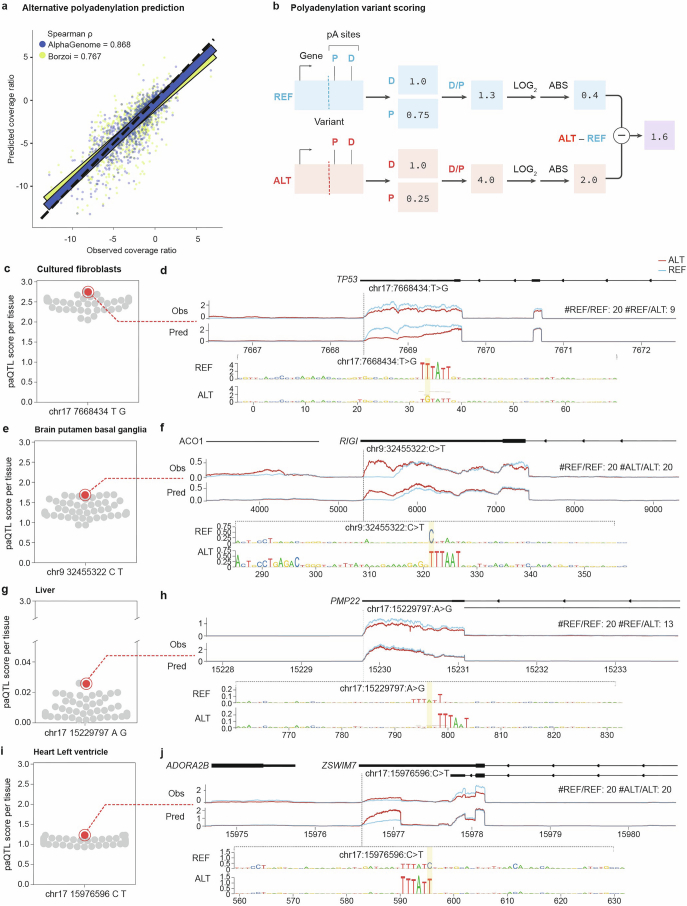
“We found that AlphaGenome achieves SOTA performance in predicting APA (Spearman ρ = 0.894 versus Borzoi’s 0.790; Extended Data Fig. 6a and Methods)2.”
§ Advancing regulatory variant effect prediction with AlphaGenome > Performance across gene expression tasks > Improved prediction of 3′ polyadenylation QTL effects
plaincorrelational- Asserted: passes — The authors put it forward as true.
- Checkable: passes — It can be checked against evidence.
- Load-bearing: passes — The paper’s conclusions depend on it.
- Based: passes — The paper gives a reason why it holds.
A result the paper reports from its own data — it cites no other source for it, so there is none to check. The quote shows it is in the paper.
In the paper
“Training on single modalities was often detrimental to variant effect prediction performance (Supplementary Fig. 12, middle panel).”
§ Advancing regulatory variant effect prediction with AlphaGenome > Model and data ablations
plaindirect- Asserted: passes — The authors put it forward as true.
- Checkable: passes — It can be checked against evidence.
- Load-bearing: passes — The paper’s conclusions depend on it.
- Based: passes — The paper gives a reason why it holds.
A result the paper reports from its own data — it cites no other source for it, so there is none to check. The quote shows it is in the paper.
In the paper
“By contrast, performance on tracks with coarser assay-specific resolution, such as contact map correlation or histone ChIP-seq correlation, was relatively insensitive to the target resolution used during training.”
§ Advancing regulatory variant effect prediction with AlphaGenome > Model and data ablations
plain- Asserted: passes — The authors put it forward as true.
- Checkable: passes — It can be checked against evidence.
- Load-bearing: unclear — It is unclear whether the paper’s conclusions depend on it.
- Based: passes — The paper gives a reason why it holds.
A result the paper reports from its own data — it cites no other source for it, so there is none to check. The quote shows it is in the paper.
In the paper
“Furthermore, ISM applied to high-impact variants revealed that predicted changes in accessibility or transcription factor binding scores generally corresponded to altered motifs for transcription factors known to modulate chromatin accessibility, such as NF-κB (Fig. 5e,f).”
§ Advancing regulatory variant effect prediction with AlphaGenome > Improved prediction of chromatin accessibility, DNase sensitivity and binding QTLs
plaincorrelational- Asserted: passes — The authors put it forward as true.
- Checkable: passes — It can be checked against evidence.
- Load-bearing: passes — The paper’s conclusions depend on it.
- Based: passes — The paper gives a reason why it holds.
A result the paper reports from its own data — it cites no other source for it, so there is none to check. The quote shows it is in the paper.
In the paper
“Notably, using features derived from variant scores across all predicted modalities provided a performance uplift in this supervised setting compared with using RNA-seq-derived scores alone (Extended Data Fig. 5e), highlighting the practical benefit of the multimodal predictions of AlphaGenome for identifying causal expression-modulating variants.”
§ Advancing regulatory variant effect prediction with AlphaGenome > Performance across gene expression tasks > Improved prediction of eQTL effects
plaindirect- Asserted: passes — The authors put it forward as true.
- Checkable: passes — It can be checked against evidence.
- Load-bearing: passes — The paper’s conclusions depend on it.
- Based: passes — The paper gives a reason why it holds.
A result the paper reports from its own data — it cites no other source for it, so there is none to check. The quote shows it is in the paper.
In the paper
“Finally, the 1-Mb-trained model, even when assessed on shorter inference contexts, often achieved comparable performance to models that were specifically trained and evaluated at those same matched shorter lengths (Fig. 7b (green triangles)).”
§ Advancing regulatory variant effect prediction with AlphaGenome > Model and data ablations
hedged- Asserted: passes — The authors put it forward as true.
- Checkable: passes — It can be checked against evidence.
- Load-bearing: passes — The paper’s conclusions depend on it.
- Based: passes — The paper gives a reason why it holds.
A result the paper reports from its own data — it cites no other source for it, so there is none to check. The quote shows it is in the paper.
In the paper
“Finally, distillation without randomly mutating the input sequence resulted in a drop in student model performance (eQTL sign, −0.06; eQTL causality, −0.01; sQTL causality, −0.01; splicing outlier, −0.015), affirming the impact of our input perturbation strategy during distillation.”
§ Advancing regulatory variant effect prediction with AlphaGenome > Model and data ablations
plaindirect- Asserted: passes — The authors put it forward as true.
- Checkable: passes — It can be checked against evidence.
- Load-bearing: passes — The paper’s conclusions depend on it.
- Based: passes — The paper gives a reason why it holds.
A result the paper reports from its own data — it cites no other source for it, so there is none to check. The quote shows it is in the paper.
In the paper
“Finally, by integrating features across several modalities and all cell types with LASSO, AlphaGenome achieved SOTA performance on the CAGI5 benchmark (Fig. 5j, bottom; Pearson r = 0.65).”
§ Advancing regulatory variant effect prediction with AlphaGenome > Improved prediction of chromatin accessibility, DNase sensitivity and binding QTLs
plaindirect- Asserted: passes — The authors put it forward as true.
- Checkable: passes — It can be checked against evidence.
- Load-bearing: passes — The paper’s conclusions depend on it.
- Based: passes — The paper gives a reason why it holds.
- Rests on an assumption: MPRAs measure the regulatory activity of short DNA sequences, a process closely linked to local chromatin accessibility and transcription factor binding.
A result the paper reports from its own data — it cites no other source for it, so there is none to check. The quote shows it is in the paper.
In the paper
“The fully multimodal model generally outperformed models trained on single modality groups, confirming the overall benefit of integrating diverse data types for learning shared representations (Fig. 7d).”
§ Advancing regulatory variant effect prediction with AlphaGenome > Model and data ablations
plaincorrelational- Asserted: passes — The authors put it forward as true.
- Checkable: passes — It can be checked against evidence.
- Load-bearing: passes — The paper’s conclusions depend on it.
- Based: passes — The paper gives a reason why it holds.
A result the paper reports from its own data — it cites no other source for it, so there is none to check. The quote shows it is in the paper.
In the paper
“Notably, the cell-type-matched DNase predictions of AlphaGenome achieved performance comparable to both ChromBPNet and the Borzoi Ensemble (Fig. 5j, top; Pearson r = 0.57).”
§ Advancing regulatory variant effect prediction with AlphaGenome > Improved prediction of chromatin accessibility, DNase sensitivity and binding QTLs
plain- Asserted: passes — The authors put it forward as true.
- Checkable: passes — It can be checked against evidence.
- Load-bearing: passes — The paper’s conclusions depend on it.
- Based: passes — The paper gives a reason why it holds.
- Rests on an assumption: MPRAs measure the regulatory activity of short DNA sequences, a process closely linked to local chromatin accessibility and transcription factor binding.
A result the paper reports from its own data — it cites no other source for it, so there is none to check. The quote shows it is in the paper.
In the paper
“By reproducing this analysis across all RNA-seq tracks, we found that the difference in oncogenic versus shuffled mutations is most pronounced in T-ALL-relevant tracks such as ‘thymus’, ‘CMP’ and ‘haematopoietic multipotent progenitor cells’ (Supplementary Fig. 10).”
§ Advancing regulatory variant effect prediction with AlphaGenome > Multimodal view of variant effects
plaincorrelational- Asserted: passes — The authors put it forward as true.
- Checkable: passes — It can be checked against evidence.
- Load-bearing: unclear — It is unclear whether the paper’s conclusions depend on it.
- Based: passes — The paper gives a reason why it holds.
- Rests on an assumption: The RNA-seq tracks labelled thymus, CMP and haematopoietic multipotent progenitor cells are relevant to T-ALL biology.
A result the paper reports from its own data — it cites no other source for it, so there is none to check. The quote shows it is in the paper.
In the paper
“Evaluated zero-shot, AlphaGenome outperformed Borzoi in identifying validated enhancer–promoter links, particularly for enhancers located beyond 10 kb from the TSS of the target gene (Fig. 4j, Extended Data Fig. 7a and Methods), although both models still underestimate the impact of very distal enhancers (Extended Data Fig. 7d).”
§ Advancing regulatory variant effect prediction with AlphaGenome > Performance across gene expression tasks > Competitive enhancer–gene linking
plain- Asserted: passes — The authors put it forward as true.
- Checkable: passes — It can be checked against evidence.
- Load-bearing: unclear — It is unclear whether the paper’s conclusions depend on it.
- Based: passes — The paper gives a reason why it holds.
A result the paper reports from its own data — it cites no other source for it, so there is none to check. The quote shows it is in the paper.
In the paper
“We next evaluated the performance of AlphaGenome across various combinations of training sequence lengths and inference context lengths, finding that training with 1-Mb input sequences and subsequently performing inference using the full 1-Mb context yielded the best overall results (Fig. 7b).”
§ Advancing regulatory variant effect prediction with AlphaGenome > Model and data ablations
plaindirect- Asserted: passes — The authors put it forward as true.
- Checkable: passes — It can be checked against evidence.
- Load-bearing: passes — The paper’s conclusions depend on it.
- Based: passes — The paper gives a reason why it holds.
A result the paper reports from its own data — it cites no other source for it, so there is none to check. The quote shows it is in the paper.
In the paper
“Evaluated zero-shot, AlphaGenome outperformed Borzoi in identifying validated enhancer–promoter links, particularly for enhancers located beyond 10 kb from the TSS of the target gene (Fig. 4j, Extended Data Fig. 7a and Methods), although both models still underestimate the impact of very distal enhancers (Extended Data Fig. 7d).”
§ Advancing regulatory variant effect prediction with AlphaGenome > Performance across gene expression tasks > Competitive enhancer–gene linking
plaincorrelational- Asserted: passes — The authors put it forward as true.
- Checkable: passes — It can be checked against evidence.
- Load-bearing: passes — The paper’s conclusions depend on it.
- Based: passes — The paper gives a reason why it holds.
- Rests on an assumption: Tissue-specific gene expression is modulated by enhancer–promoter interactions, often involving enhancers in distal genomic regions.
A result the paper reports from its own data — it cites no other source for it, so there is none to check. The quote shows it is in the paper.
In the paper
“For SPI1-specific variants, ISM further highlighted altered SPI1 motifs within the local sequence context (Fig. 5h,i).”
§ Advancing regulatory variant effect prediction with AlphaGenome > Improved prediction of chromatin accessibility, DNase sensitivity and binding QTLs
plaincorrelational- Asserted: passes — The authors put it forward as true.
- Checkable: passes — It can be checked against evidence.
- Load-bearing: unclear — It is unclear whether the paper’s conclusions depend on it.
- Based: passes — The paper gives a reason why it holds.
A result the paper reports from its own data — it cites no other source for it, so there is none to check. The quote shows it is in the paper.
In the paper
“Across modalities, oncogenic variants exhibited a distinct predicted mechanism compared with shuffled controls, as shown through unsupervised clustering (Fig. 6d).”
§ Advancing regulatory variant effect prediction with AlphaGenome > Multimodal view of variant effects
plaincorrelational- Asserted: passes — The authors put it forward as true.
- Checkable: passes — It can be checked against evidence.
- Load-bearing: passes — The paper’s conclusions depend on it.
- Based: passes — The paper gives a reason why it holds.
A result the paper reports from its own data — it cites no other source for it, so there is none to check. The quote shows it is in the paper.
In the paper
“The performance of AlphaGenome on distinguishing fine-mapped eQTLs from distance-matched variants (‘causality’; auROC) was comparable with Borzoi (Fig. 4i).”
§ Advancing regulatory variant effect prediction with AlphaGenome > Performance across gene expression tasks > Improved prediction of eQTL effects
plain- Asserted: passes — The authors put it forward as true.
- Checkable: passes — It can be checked against evidence.
- Load-bearing: unclear — It is unclear whether the paper’s conclusions depend on it.
- Based: passes — The paper gives a reason why it holds.
A result the paper reports from its own data — it cites no other source for it, so there is none to check. The quote shows it is in the paper.
In the paper
“AlphaGenome and a widely used co-localization method for sign prediction (COLOC H4 > 0.95)27 resolved the direction of effect for largely non-overlapping sets of loci (Fig. 4h).”
§ Advancing regulatory variant effect prediction with AlphaGenome > Performance across gene expression tasks > Improved prediction of eQTL effects
plaincorrelational- Asserted: passes — The authors put it forward as true.
- Checkable: passes — It can be checked against evidence.
- Load-bearing: passes — The paper’s conclusions depend on it.
- Based: passes — The paper gives a reason why it holds.
A result the paper reports from its own data — it cites no other source for it, so there is none to check. The quote shows it is in the paper.
In the paper
“AlphaGenome outperformed Borzoi on this task (all paQTLs within 10 kb of PAS, auPRC 0.629 versus Borzoi’s 0.621; proximal paQTLs within 50 bp of PAS, auPRC 0.762 versus Borzoi’s 0.727).”
§ Advancing regulatory variant effect prediction with AlphaGenome > Performance across gene expression tasks > Improved prediction of 3′ polyadenylation QTL effects
plaincorrelational- Asserted: passes — The authors put it forward as true.
- Checkable: passes — It can be checked against evidence.
- Load-bearing: passes — The paper’s conclusions depend on it.
- Based: passes — The paper gives a reason why it holds.
The paper states this without a source or data behind it here, so there is nothing to check it against. The quote shows it is in the paper.
In the paper
“First, often owing to computational limitations, models must trade off between capturing long-range genomic interactions and achieving nucleotide-level predictive resolution.”
§ Advancing regulatory variant effect prediction with AlphaGenome > Main
plaindirect- Asserted: passes — The authors put it forward as true.
- Checkable: passes — It can be checked against evidence.
- Load-bearing: passes — The paper’s conclusions depend on it.
- Based: passes — The paper gives a reason why it holds.
None of the sources cited for this claim could be matched to a paper in Crossref, so there is nothing to check it against.
In the paper
“Several state-of-the-art (SOTA) models are highly specialized for single modalities, such as SpliceAI4 for splice site prediction, ChromBPNet10 for local chromatin accessibility and Orca3 for three-dimensional genome architecture.”
§ Advancing regulatory variant effect prediction with AlphaGenome > Main
What the sources say
- Not matchedcites SpliceAI4
Couldn’t be matched to a paper in Crossref, so it can’t be checked.
- Not matchedcites ChromBPNet10
Couldn’t be matched to a paper in Crossref, so it can’t be checked.
- Not matchedcites Orca3
Couldn’t be matched to a paper in Crossref, so it can’t be checked.
plain- Asserted: passes — The authors put it forward as true.
- Checkable: passes — It can be checked against evidence.
- Load-bearing: passes — The paper’s conclusions depend on it.
- Based: passes — The paper gives a reason why it holds.
- Not matched
A conclusion the paper draws from its own results — it cites no other source for it, so there is none to check. The quote shows it is in the paper.
In the paper
“Given that more than 98% of observed genetic variation in humans is non-coding7, global characterization of the complex effects of this vast majority of variants remains intractable without computational predictions.”
§ Advancing regulatory variant effect prediction with AlphaGenome > Main
plaindirect- Asserted: passes — The authors put it forward as true.
- Checkable: passes — It can be checked against evidence.
- Load-bearing: passes — The paper’s conclusions depend on it.
- Based: passes — The paper gives a reason why it holds.
None of the sources cited for this claim could be matched to a paper in Crossref, so there is nothing to check it against.
In the paper
“Even within a single modality like splicing, specialized models such as SpliceAI4 or Pangolin11 predict certain aspects (such as splice site prediction) while omitting others (such as splice junction prediction or competition between splice sites).”
§ Advancing regulatory variant effect prediction with AlphaGenome > Main
What the sources say
- Not matchedcites SpliceAI4
Couldn’t be matched to a paper in Crossref, so it can’t be checked.
- Not matchedcites Pangolin11
Couldn’t be matched to a paper in Crossref, so it can’t be checked.
plain- Asserted: passes — The authors put it forward as true.
- Checkable: passes — It can be checked against evidence.
- Load-bearing: passes — The paper’s conclusions depend on it.
- Based: passes — The paper gives a reason why it holds.
- Not matched
The paper states this without a source or data behind it here, so there is nothing to check it against. The quote shows it is in the paper.
In the paper
“Currently, deep learning-based sequence-to-function models face two fundamental trade-offs constraining their ability to predict how variants affect diverse modes of biological regulation.”
§ Advancing regulatory variant effect prediction with AlphaGenome > Main
plaindirect- Asserted: passes — The authors put it forward as true.
- Checkable: passes — It can be checked against evidence.
- Load-bearing: passes — The paper’s conclusions depend on it.
- Based: passes — The paper gives a reason why it holds.
A conclusion the paper draws from its own results — it cites no other source for it, so there is none to check. The quote shows it is in the paper.
In the paper
“However, specialized models alone are insufficient for capturing the diverse molecular consequences of variants across modalities.”
§ Advancing regulatory variant effect prediction with AlphaGenome > Main
plaindirect- Asserted: passes — The authors put it forward as true.
- Checkable: passes — It can be checked against evidence.
- Load-bearing: passes — The paper’s conclusions depend on it.
- Based: passes — The paper gives a reason why it holds.
In the paper
“ISM-derived sequence logos for REF/ALT alleles from e, suggesting variant disruption or modulation of transcription factor binding motifs. Putative binding factors and JASPAR53 matrix IDs (MA0105.1 and MA0105.3) are indicated on the right.”
§ Advancing regulatory variant effect prediction with AlphaGenome > Main
What the sources say
- Not matchedcites JASPAR53
Couldn’t be matched to a paper in Crossref, so it can’t be checked.
hedgedconditional- Asserted: passes — The authors put it forward as true.
- Checkable: passes — It can be checked against evidence.
- Load-bearing: unclear — It is unclear whether the paper’s conclusions depend on it.
- Based: passes — The paper gives a reason why it holds.
- Not matched
In the paper
“ISM-derived sequence logos for REF and ALT alleles of example SPI1 bQTLs from h, suggesting potential impacts such as creation or disruption of SPI1 or related motifs. The putative binding factors and JASPAR matrix IDs (MA0081.2 and MA0080.5) are indicated on the right.”
§ Advancing regulatory variant effect prediction with AlphaGenome > Main
What the sources say
- Not matchedcites JASPAR53
Couldn’t be matched to a paper in Crossref, so it can’t be checked.
hedgedconditional- Asserted: passes — The authors put it forward as true.
- Checkable: passes — It can be checked against evidence.
- Load-bearing: unclear — It is unclear whether the paper’s conclusions depend on it.
- Based: passes — The paper gives a reason why it holds.
- Not matched
A conclusion the paper draws from its own results — it cites no other source for it, so there is none to check. The quote shows it is in the paper.
In the paper
“In summary, AlphaGenome achieves SOTA splicing variant effect prediction on six of seven benchmarks, providing a more comprehensive view of altered splicing events and transcript structure.”
§ Advancing regulatory variant effect prediction with AlphaGenome > Improved splicing variant predictions
plain- Asserted: passes — The authors put it forward as true.
- Checkable: passes — It can be checked against evidence.
- Load-bearing: passes — The paper’s conclusions depend on it.
- Based: passes — The paper gives a reason why it holds.
In the paper
“Finally, application to complex trait analysis is limited because AlphaGenome predicts molecular consequences of variants, whereas these phenotypes involve broader biological processes (including gene function, development and environmental factors) and gene-to-disease effects42 beyond the direct sequence-to-function scope of the model.”
§ Advancing regulatory variant effect prediction with AlphaGenome > Discussion
What the sources say
- Not checked — no full text of the sourcecites [42] Finucane, H. K. et al. Variant scoring performance across selection regimes depends on variant-to-gene and gene-to-disease components. Preprint at bioRxiv https://doi.org/10.1101/2024.09.17.613327 (2024). source
plaindirect- Asserted: passes — The authors put it forward as true.
- Checkable: passes — It can be checked against evidence.
- Load-bearing: passes — The paper’s conclusions depend on it.
- Based: passes — The paper gives a reason why it holds.
A conclusion the paper draws from its own results — it cites no other source for it, so there is none to check. The quote shows it is in the paper.
In the paper
“A core strength is its efficient multimodal variant effect prediction, which simultaneously scores variant impacts across all predicted modalities in a single inference pass.”
§ Advancing regulatory variant effect prediction with AlphaGenome > Discussion
plain- Asserted: passes — The authors put it forward as true.
- Checkable: passes — It can be checked against evidence.
- Load-bearing: passes — The paper’s conclusions depend on it.
- Based: passes — The paper gives a reason why it holds.
A conclusion the paper draws from its own results — it cites no other source for it, so there is none to check. The quote shows it is in the paper.
In the paper
“Furthermore, AlphaGenome resolved approximately 4-fold more credible sets in the lowest minor allele frequency quintile compared with COLOC, probably reflecting its reduced dependence on population genetics parameters that affect power to detect associations (Fig. 4h, stratified bars).”
§ Advancing regulatory variant effect prediction with AlphaGenome > Performance across gene expression tasks > Improved prediction of eQTL effects
hedgedconditional- Asserted: passes — The authors put it forward as true.
- Checkable: passes — It can be checked against evidence.
- Load-bearing: passes — The paper’s conclusions depend on it.
- Based: passes — The paper gives a reason why it holds.
A conclusion the paper draws from its own results — it cites no other source for it, so there is none to check. The quote shows it is in the paper.
In the paper
“Overall, distillation offers a way to achieve strong performance with reduced inference cost compared with evaluating large ensembles, facilitated by scalable training strategies such as assigning one unique teacher per training device (Methods).”
§ Advancing regulatory variant effect prediction with AlphaGenome > Model and data ablations
plaindirect- Asserted: passes — The authors put it forward as true.
- Checkable: passes — It can be checked against evidence.
- Load-bearing: passes — The paper’s conclusions depend on it.
- Based: passes — The paper gives a reason why it holds.
A conclusion the paper draws from its own results — it cites no other source for it, so there is none to check. The quote shows it is in the paper.
In the paper
“Together, these results demonstrate the value of the unified multimodal approach for achieving broad and high performance, particularly for tasks integrating diverse regulatory signals.”
§ Advancing regulatory variant effect prediction with AlphaGenome > Model and data ablations
boosteddirect- Asserted: passes — The authors put it forward as true.
- Checkable: passes — It can be checked against evidence.
- Load-bearing: passes — The paper’s conclusions depend on it.
- Based: passes — The paper gives a reason why it holds.
A conclusion the paper draws from its own results — it cites no other source for it, so there is none to check. The quote shows it is in the paper.
In the paper
“This implies that the same model trained on the full 1-Mb sequence can also be used with a more limited context at inference time, providing an option for further increasing prediction speed if needed.”
§ Advancing regulatory variant effect prediction with AlphaGenome > Model and data ablations
plainconditional- Asserted: passes — The authors put it forward as true.
- Checkable: passes — It can be checked against evidence.
- Load-bearing: passes — The paper’s conclusions depend on it.
- Based: passes — The paper gives a reason why it holds.
A conclusion the paper draws from its own results — it cites no other source for it, so there is none to check. The quote shows it is in the paper.
In the paper
“Altogether, these results demonstrate the improved capacity of AlphaGenome to capture long-range functional regulatory connections directly from sequence, which is vital for interpreting distal genetic variants.”
§ Advancing regulatory variant effect prediction with AlphaGenome > Performance across gene expression tasks > Competitive enhancer–gene linking
boosteddirect- Asserted: passes — The authors put it forward as true.
- Checkable: passes — It can be checked against evidence.
- Load-bearing: passes — The paper’s conclusions depend on it.
- Based: passes — The paper gives a reason why it holds.
A conclusion the paper draws from its own results — it cites no other source for it, so there is none to check. The quote shows it is in the paper.
In the paper
“Overall, these results demonstrate the improved accuracy of AlphaGenome in predicting genetic variant effects on 3′ UTR processing, a distinct regulatory mechanism, using only RNA-seq predictions and without any explicit training on polyadenylation data or associated variants.”
§ Advancing regulatory variant effect prediction with AlphaGenome > Performance across gene expression tasks > Improved prediction of 3′ polyadenylation QTL effects
boosteddirect- Asserted: passes — The authors put it forward as true.
- Checkable: passes — It can be checked against evidence.
- Load-bearing: passes — The paper’s conclusions depend on it.
- Based: passes — The paper gives a reason why it holds.
A conclusion the paper draws from its own results — it cites no other source for it, so there is none to check. The quote shows it is in the paper.
In the paper
“It matches or surpasses specialized SOTA models in regulatory variant effect prediction, underscoring the model’s relatively robust grasp of fundamental DNA regulatory principles and its value for mechanistically interpretating non-coding variation.”
§ Advancing regulatory variant effect prediction with AlphaGenome > Discussion
plain- Asserted: passes — The authors put it forward as true.
- Checkable: passes — It can be checked against evidence.
- Load-bearing: passes — The paper’s conclusions depend on it.
- Based: unclear — It is unclear why the paper says it holds.
A conclusion the paper draws from its own results — it cites no other source for it, so there is none to check. The quote shows it is in the paper.
In the paper
“This makes AlphaGenome a useful complement to conservation-based measures of deleteriousness, which are agnostic to the mechanism of action of a variant.”
§ Advancing regulatory variant effect prediction with AlphaGenome > Multimodal view of variant effects
plaincorrelational- Asserted: passes — The authors put it forward as true.
- Checkable: passes — It can be checked against evidence.
- Load-bearing: passes — The paper’s conclusions depend on it.
- Based: passes — The paper gives a reason why it holds.
A conclusion the paper draws from its own results — it cites no other source for it, so there is none to check. The quote shows it is in the paper.
In the paper
“Thus, AlphaGenome expands our ability to generate functional hypotheses about the direction of GWAS signals, particularly for low-frequency variants.”
§ Advancing regulatory variant effect prediction with AlphaGenome > Performance across gene expression tasks > Improved prediction of eQTL effects
plaindirect- Asserted: passes — The authors put it forward as true.
- Checkable: passes — It can be checked against evidence.
- Load-bearing: passes — The paper’s conclusions depend on it.
- Based: passes — The paper gives a reason why it holds.
- It may state two separate claims as one. 44
- Probably not a substantial claim. 27
- The quote only partly states this claim. 1
Every source the paper cites for this claim was checked and supports it.
In the paper
“Enhancer–gene linking performance (ENCODE–rE2G CRISPRi dataset12). Zero-shot evaluation: performance (auPRC) comparison stratified by enhancer-to-TSS distance. Supervised evaluation: AlphaGenome input gradient score integrated into ENCODE–rE2G extended and ENCODE–rE2G models.”
§ Advancing regulatory variant effect prediction with AlphaGenome > Main
What the sources say
- Supportedcites [12] Gschwind, A. R. et al. An encyclopedia of enhancer-gene regulatory interactions in the human genome. Preprint at bioRxiv https://doi.org/10.1101/2023.11.09.563812 (2023). source
The citation is attached to the identification of the ENCODE–rE2G CRISPRi dataset, not to the citing paper’s AlphaGenome evaluations. In “Supervised classification of enhancer-gene regulatory interactions” (page unavailable), the source describes its aggregated CRISPR-tested element–gene dataset, drawn mostly from CRISPRi experiments, and its use to train and evaluate ENCODE-rE2G. (LLM, conf=0.91)
plain- Asserted: passes — The authors put it forward as true.
- Checkable: passes — It can be checked against evidence.
- Load-bearing: passes — The paper’s conclusions depend on it.
- Based: passes — The paper gives a reason why it holds.
It may state two separate claims as one.
- Supported
Every source the paper cites for this claim was checked and supports it.
In the paper
“This distilled student model, as shown previously14, achieved improved robustness and variant effect prediction accuracy in a single model instance, making predictions across all modelled modalities and cell types with a single device call per variant.”
§ Advancing regulatory variant effect prediction with AlphaGenome > Unifying DNA sequence-to-function model
What the sources say
- Supportedcites [14] Zhou, J., Rizzo, K., Tang, Z. & Koo, P. K. Uncertainty-aware genomic deep learning with knowledge distillation. Preprint at bioRxiv https://doi.org/10.1101/2024.11.13.623485 (2024). source
The Results section on zero-shot variant effect generalization reports that distilled models generally had stronger correlations with experimentally measured variant effects than standard-trained models. The Results section on covariate shifts reports improved generalization with augmentation, and the section on approximating deep ensembles identifies the student as an individual model trained from an ensemble. (LLM, conf=0.91)
plaindirect- Asserted: passes — The authors put it forward as true.
- Checkable: passes — It can be checked against evidence.
- Load-bearing: passes — The paper’s conclusions depend on it.
- Based: passes — The paper gives a reason why it holds.
It may state two separate claims as one.
- Supported
The cited sources support only part of this claim — read each source’s verdict below.
In the paper
“As previously reported26, performance decays with distance to the target gene across all eQTL tasks (Extended Data Fig. 5f).”
§ Advancing regulatory variant effect prediction with AlphaGenome > Performance across gene expression tasks > Improved prediction of eQTL effects
What the sources say
- Partly supportedcites [26] Karollus, A., Mauermeier, T. & Gagneur, J. Current sequence-based models capture gene expression determinants in promoters but mostly ignore distal enhancers. Genome Biol. 24, 56 (2023). sourceExperimental — accuracy not yet measured
In Results, ‘Most distal eQTLs do not have a meaningful impact on expression predictions’ (Fig. 6A–B), the paper reports that Enformer’s predicted eQTL effects decay rapidly with distance to the target gene’s TSS. It does not establish that performance decays across all eQTL tasks; it also reports no systematic distance-related decay in the measured eQTL effect sizes. (LLM, conf=0.86)
plaincorrelational- Asserted: passes — The authors put it forward as true.
- Checkable: passes — It can be checked against evidence.
- Load-bearing: fails — The paper’s conclusions may not depend on it.
- Based: passes — The paper gives a reason why it holds.
Probably not a substantial claim. The paper’s conclusions may not depend on it.
- Partly supported
The sources with a verdict support this claim; the rest weren’t checked yet, have no full text we could read, or their verdicts aren’t rated yet.
In the paper
“Beyond impacting isoform composition through splicing modulation, non-coding variants can influence traits and cause diseases by altering gene expression23,24.”
§ Advancing regulatory variant effect prediction with AlphaGenome > Performance across gene expression tasks
What the sources say
- Not checked — no full text of the sourcecites [23] Albert, F. W. & Kruglyak, L. The role of regulatory variation in complex traits and disease. Nat. Rev. Genet. 16, 197–212 (2015). source
- Supportedcites [24] Maurano, M. T. et al. Systematic localization of common disease-associated variation in regulatory DNA. Science 337, 1190–1195 (2012). source
The Abstract links disease- and trait-associated noncoding variants to transcriptional regulatory mechanisms, including promoters, enhancers, and expression quantitative trait loci. The Discussion reports that disease- and trait-associated variants occur in regulatory DNA and can perturb transcription factor networks, supporting the claim that altered gene regulation can influence traits and disease. No page numbers are provided in our copy. (LLM, conf=0.89)
plaindirect- Asserted: passes — The authors put it forward as true.
- Checkable: passes — It can be checked against evidence.
- Load-bearing: passes — The paper’s conclusions depend on it.
- Based: passes — The paper gives a reason why it holds.
Probably not a substantial claim. It may state two separate claims as one.
The cited sources that could be checked couldn’t confirm or dispute this claim.
In the paper
“Predicted versus observed splice junction read counts (log(1 + x) transformed; n = 1,344,738) and Pearson r between them in selected human tissues known for having distinct splicing patterns49.”
§ Advancing regulatory variant effect prediction with AlphaGenome > Main
What the sources say
- Could not verifycites [49] Ling, J. P. et al. ASCOT identifies key regulators of neuronal subtype-specific splicing. Nat. Commun. 11, 137 (2020). sourceExperimental — accuracy not yet measured
The Methods section on Snaptron compilations describes tables of observed splice-junction counts, and the Results discuss splicing patterns in human tissues. Neither passage reports a predicted-versus-observed count comparison, a log(1 + x) transformation, Pearson r, or n = 1,344,738. Searches for those terms found no matching passage in our copy. (LLM, conf=0.72)
plaincorrelationaln = 1,344,738- Asserted: passes — The authors put it forward as true.
- Checkable: passes — It can be checked against evidence.
- Load-bearing: passes — The paper’s conclusions depend on it.
- Based: passes — The paper gives a reason why it holds.
Probably not a substantial claim. It may state two separate claims as one.
- Could not verify
Every source the paper cites for this claim was checked and supports it.
In the paper
“By contrast, the alternative sequence introduced a MYB motif at the variant position predicted to increase TAL1 expression, chromatin accessibility and H3K27ac chromatin marks (Fig. 6e), as discovered previously6.”
§ Advancing regulatory variant effect prediction with AlphaGenome > Multimodal view of variant effects
What the sources say
- Supportedcites [6] Mansour, M. R. et al. Oncogene regulation. An oncogenic super-enhancer formed through somatic mutation of a noncoding intergenic element. Science 346, 1373–1377 (2014). source
The supplied passages (labelled Abstract) report that mutations at the TAL1 enhancer introduce MYB binding motifs and drive TAL1 overexpression. They also propose that MYB recruits CBP, producing abundant H3K27 acetylation that opens chromatin; this supports the citing sentence’s predicted increases in H3K27ac and accessibility. (LLM, conf=0.91)
plaindirectSingle case- Asserted: passes — The authors put it forward as true.
- Checkable: passes — It can be checked against evidence.
- Load-bearing: passes — The paper’s conclusions depend on it.
- Based: passes — The paper gives a reason why it holds.
It may state two separate claims as one.
- Supported
The paper states this without a source or data behind it here, so there is nothing to check it against. The quote shows it is in the paper.
In the paper
“The model takes 1 Mb of DNA sequence as input and predicts a diverse range of genome tracks across numerous cell types.”
§ Advancing regulatory variant effect prediction with AlphaGenome > Main
plaindirect- Asserted: passes — The authors put it forward as true.
- Checkable: passes — It can be checked against evidence.
- Load-bearing: passes — The paper’s conclusions depend on it.
- Based: passes — The paper gives a reason why it holds.
It may state two separate claims as one.
A result the paper reports from its own data — it cites no other source for it, so there is none to check. The quote shows it is in the paper.
In the paper
“AlphaGenome achieved SOTA performance on 22 of 24 genome track prediction tasks and 25 of 26 variant effect prediction tasks.”
§ Advancing regulatory variant effect prediction with AlphaGenome > Main
plain- Asserted: passes — The authors put it forward as true.
- Checkable: passes — It can be checked against evidence.
- Load-bearing: passes — The paper’s conclusions depend on it.
- Based: passes — The paper gives a reason why it holds.
It may state two separate claims as one.
A result the paper reports from its own data — it cites no other source for it, so there is none to check. The quote shows it is in the paper.
In the paper
“On splicing (Extended Data Fig. 2a), AlphaGenome accurately predicts splice sites (Extended Data Fig. 2b) and splice site usage (Extended Data Fig. 2b,c).”
§ Advancing regulatory variant effect prediction with AlphaGenome > Improved track prediction performance
plaincorrelational- Asserted: passes — The authors put it forward as true.
- Checkable: passes — It can be checked against evidence.
- Load-bearing: passes — The paper’s conclusions depend on it.
- Based: passes — The paper gives a reason why it holds.
It may state two separate claims as one.
None of the sources cited for this claim have been checked yet.
In the paper
“MFASS splicing variant classification (MPRA-tested variants). auPRC on the classification of experimentally validated splice-disrupting variants (data from Chong et al.22).”
§ Advancing regulatory variant effect prediction with AlphaGenome > Main
What the sources say
- Not checked yetcites Chong et al. [22] Chong, R. et al. A multiplexed assay for exon recognition reveals that an unappreciated fraction of rare genetic variants cause large-effect splicing disruptions. Mol. Cell 73, 183–194 (2019). source
Checked before — its earlier verdict is held back until a new check runs.
plain- Asserted: passes — The authors put it forward as true.
- Checkable: passes — It can be checked against evidence.
- Load-bearing: passes — The paper’s conclusions depend on it.
- Based: passes — The paper gives a reason why it holds.
Probably not a substantial claim.
- Not checked yet
A result the paper reports from its own data — it cites no other source for it, so there is none to check. The quote shows it is in the paper.
In the paper
“Although AlphaGenome demonstrates the ability to predict tissue-specific alternative splicing in some instances (Supplementary Fig. 1), further improvements are needed to precisely predict intermediate splicing efficiencies and to capture tissue-specific nuances (Extended Data Fig. 2c,e).”
§ Advancing regulatory variant effect prediction with AlphaGenome > Improved track prediction performance
boosted- Asserted: passes — The authors put it forward as true.
- Checkable: passes — It can be checked against evidence.
- Load-bearing: unclear — It is unclear whether the paper’s conclusions depend on it.
- Based: passes — The paper gives a reason why it holds.
It may state two separate claims as one.
A result the paper reports from its own data — it cites no other source for it, so there is none to check. The quote shows it is in the paper.
In the paper
“AlphaGenome demonstrated improved prediction of both the magnitude (‘coefficient’; Spearman ρ with SuSiE25 β posterior) and direction (‘sign’; area under the receiver operating characteristic (auROC) curve) of eQTL effects compared with the previous SOTA (Borzoi) (Fig. 4c–f).”
§ Advancing regulatory variant effect prediction with AlphaGenome > Performance across gene expression tasks > Improved prediction of eQTL effects
boosteddirect- Asserted: passes — The authors put it forward as true.
- Checkable: passes — It can be checked against evidence.
- Load-bearing: passes — The paper’s conclusions depend on it.
- Based: passes — The paper gives a reason why it holds.
It may state two separate claims as one.
A result the paper reports from its own data — it cites no other source for it, so there is none to check. The quote shows it is in the paper.
In the paper
“Track prediction performance evaluation across different modalities. Violin plots display the distribution of Pearson correlations between predicted and observed tracks evaluated on held-out test intervals.”
§ Advancing regulatory variant effect prediction with AlphaGenome > Main
plaincorrelational- Asserted: passes — The authors put it forward as true.
- Checkable: passes — It can be checked against evidence.
- Load-bearing: passes — The paper’s conclusions depend on it.
- Based: passes — The paper gives a reason why it holds.
Probably not a substantial claim.
A result the paper reports from its own data — it cites no other source for it, so there is none to check. The quote shows it is in the paper.
In the paper
“its composite scores outperformed the existing best method in each category across all three variant categories: deep intronic and synonymous (area under the precision–recall curve (auPRC) 0.66 versus 0.64 by Pangolin), splice region (auPRC 0.57 versus 0.55 by Pangolin) and missense (auPRC 0.18 versus 0.16 by DeltaSplice and Pangolin”
§ Advancing regulatory variant effect prediction with AlphaGenome > Improved splicing variant predictions
plaincorrelational- Asserted: passes — The authors put it forward as true.
- Checkable: passes — It can be checked against evidence.
- Load-bearing: passes — The paper’s conclusions depend on it.
- Based: passes — The paper gives a reason why it holds.
It may state two separate claims as one.
The paper states this without a source or data behind it here, so there is nothing to check it against. The quote shows it is in the paper.
In the paper
“Performance (auPRC) of paQTL variant effect prediction, thresholded by distance from the polyadenylation site.”
§ Advancing regulatory variant effect prediction with AlphaGenome > Main
plaincorrelational- Asserted: passes — The authors put it forward as true.
- Checkable: passes — It can be checked against evidence.
- Load-bearing: fails — The paper’s conclusions may not depend on it.
- Based: passes — The paper gives a reason why it holds.
Probably not a substantial claim. The paper’s conclusions may not depend on it.
A result the paper reports from its own data — it cites no other source for it, so there is none to check. The quote shows it is in the paper.
In the paper
“AlphaGenome predicts all three of these quantities alongside direct RNA-seq coverage prediction, thereby providing a more comprehensive view of the splicing-related molecular consequences of variants (Fig. 3a).”
§ Advancing regulatory variant effect prediction with AlphaGenome > Improved splicing variant predictions
plain- Asserted: passes — The authors put it forward as true.
- Checkable: passes — It can be checked against evidence.
- Load-bearing: passes — The paper’s conclusions depend on it.
- Based: passes — The paper gives a reason why it holds.
It may state two separate claims as one.
In the paper
“Coverage of predictions across GWAS loci. Fraction of GWAS credible sets (from Open Targets52) with a predicted direction of effect for a plausible target gene, comparing AlphaGenome predictions to the eQTL co-localization approach.”
§ Advancing regulatory variant effect prediction with AlphaGenome > Main
What the sources say
- Not matchedcites Open Targets52
Couldn’t be matched to a paper in Crossref, so it can’t be checked.
plaincorrelational- Asserted: passes — The authors put it forward as true.
- Checkable: passes — It can be checked against evidence.
- Load-bearing: passes — The paper’s conclusions depend on it.
- Based: passes — The paper gives a reason why it holds.
Probably not a substantial claim.
- Not matched
A result the paper reports from its own data — it cites no other source for it, so there is none to check. The quote shows it is in the paper.
In the paper
“CAGI5 MPRA challenge performance (average across loci; mean Pearson r). Top, zero-shot using cell-type-matched DNase; middle, LASSO regression using cell-type-matched or agnostic DNase; bottom, LASSO regression using multimodal features (DNase + RNA + histone ChIP-seq output types for AlphaGenome and Borzoi; DNase + CAGE output types for Enformer) and all cell types.”
§ Advancing regulatory variant effect prediction with AlphaGenome > Main
plain- Asserted: passes — The authors put it forward as true.
- Checkable: passes — It can be checked against evidence.
- Load-bearing: passes — The paper’s conclusions depend on it.
- Based: passes — The paper gives a reason why it holds.
Probably not a substantial claim.
A result the paper reports from its own data — it cites no other source for it, so there is none to check. The quote shows it is in the paper.
In the paper
“eQTL sign prediction performance stratified by different variant-to-TSS distance bins (SNVs only).”
§ Advancing regulatory variant effect prediction with AlphaGenome > Main
plain- Asserted: passes — The authors put it forward as true.
- Checkable: passes — It can be checked against evidence.
- Load-bearing: fails — The paper’s conclusions may not depend on it.
- Based: passes — The paper gives a reason why it holds.
Probably not a substantial claim. The paper’s conclusions may not depend on it.
A result the paper reports from its own data — it cites no other source for it, so there is none to check. The quote shows it is in the paper.
In the paper
“Performance comparison of AlphaGenome, Borzoi and ChromBPNet on QTL causality (b; average precision) and QTL effect size (c; Pearson r) across QTL types and ancestries.”
§ Advancing regulatory variant effect prediction with AlphaGenome > Main
plaincorrelational- Asserted: passes — The authors put it forward as true.
- Checkable: passes — It can be checked against evidence.
- Load-bearing: passes — The paper’s conclusions depend on it.
- Based: passes — The paper gives a reason why it holds.
Probably not a substantial claim.
A result the paper reports from its own data — it cites no other source for it, so there is none to check. The quote shows it is in the paper.
In the paper
“Comparison of performance (auROC) at distinguishing causal from non-causal eQTLs (‘causality’) using both zero-shot and supervised approaches (Methods).”
§ Advancing regulatory variant effect prediction with AlphaGenome > Main
plain- Asserted: passes — The authors put it forward as true.
- Checkable: passes — It can be checked against evidence.
- Load-bearing: passes — The paper’s conclusions depend on it.
- Based: passes — The paper gives a reason why it holds.
Probably not a substantial claim.
A result the paper reports from its own data — it cites no other source for it, so there is none to check. The quote shows it is in the paper.
In the paper
“Comparison of performance (Spearman’s ρ) at predicting the effect size of eQTLs across 49 GTEx tissues (‘coefficient’) for different models and variant sets.”
§ Advancing regulatory variant effect prediction with AlphaGenome > Main
plaincorrelational- Asserted: passes — The authors put it forward as true.
- Checkable: passes — It can be checked against evidence.
- Load-bearing: passes — The paper’s conclusions depend on it.
- Based: passes — The paper gives a reason why it holds.
Probably not a substantial claim.
A result the paper reports from its own data — it cites no other source for it, so there is none to check. The quote shows it is in the paper.
In the paper
“Although overall expression levels are predicted well, accurately capturing cell-type-specific expression deviations remains a challenging task (Fig. 2d and Supplementary Fig. 2j).”
§ Advancing regulatory variant effect prediction with AlphaGenome > Improved track prediction performance
plain- Asserted: passes — The authors put it forward as true.
- Checkable: passes — It can be checked against evidence.
- Load-bearing: unclear — It is unclear whether the paper’s conclusions depend on it.
- Based: passes — The paper gives a reason why it holds.
It may state two separate claims as one.
A result the paper reports from its own data — it cites no other source for it, so there is none to check. The quote shows it is in the paper.
In the paper
“Impact of the number of sub-models in ensembling and distillation. Performance comparison for mean ensembles of pretrained models (blue dots/contours; x axis indicates ensemble size) versus single models produced by distillation using 1, 4 or 64 teacher models (orange crosses/contours; x axis indicates number of teachers).”
§ Advancing regulatory variant effect prediction with AlphaGenome > Main
plaincorrelationaln = 4- Asserted: passes — The authors put it forward as true.
- Checkable: passes — It can be checked against evidence.
- Load-bearing: passes — The paper’s conclusions depend on it.
- Based: passes — The paper gives a reason why it holds.
Probably not a substantial claim. It may state two separate claims as one.
A result the paper reports from its own data — it cites no other source for it, so there is none to check. The quote shows it is in the paper.
In the paper
“Using a threshold calibrated to 80% accuracy on eQTLs (Fig. 4g), AlphaGenome assigned a confident sign prediction for at least one variant in 49% of GWAS credible sets (11% using a conservative PIP-weighted scoring approach; Fig. 4h).”
§ Advancing regulatory variant effect prediction with AlphaGenome > Performance across gene expression tasks > Improved prediction of eQTL effects
plain- Asserted: passes — The authors put it forward as true.
- Checkable: passes — It can be checked against evidence.
- Load-bearing: passes — The paper’s conclusions depend on it.
- Based: passes — The paper gives a reason why it holds.
It may state two separate claims as one.
A result the paper reports from its own data — it cites no other source for it, so there is none to check. The quote shows it is in the paper.
In the paper
“The alternative ‘C’ allele is associated with lower expression of APOL4 in GTEx data (sum of single effects (SuSiE) ‘β posterior’ = −0.709; posterior inclusion probability (PIP) > 0.9), and both the RNA-seq coverage and direction of effect are recapitulated by the predictions of AlphaGenome (variant score = −1.52; quantile score = −1.00; Methods).”
§ Advancing regulatory variant effect prediction with AlphaGenome > Performance across gene expression tasks > Improved prediction of eQTL effects
plaincorrelational- Asserted: passes — The authors put it forward as true.
- Checkable: passes — It can be checked against evidence.
- Load-bearing: unclear — It is unclear whether the paper’s conclusions depend on it.
- Based: passes — The paper gives a reason why it holds.
It may state two separate claims as one.
A result the paper reports from its own data — it cites no other source for it, so there is none to check. The quote shows it is in the paper.
In the paper
“AlphaGenome improved the tissue-weighted mean Spearman ρ from 0.39 to 0.49 and the mean sign auROC from 0.75 to 0.80.”
§ Advancing regulatory variant effect prediction with AlphaGenome > Performance across gene expression tasks > Improved prediction of eQTL effects
plaindirect- Asserted: passes — The authors put it forward as true.
- Checkable: passes — It can be checked against evidence.
- Load-bearing: passes — The paper’s conclusions depend on it.
- Based: passes — The paper gives a reason why it holds.
It may state two separate claims as one.
The paper states this without a source or data behind it here, so there is nothing to check it against. The quote shows it is in the paper.
In the paper
“RNA-seq, ATAC-seq and DNase-seq track predictions are at 1-bp resolution; H3K27ac and CTCF ChIP-seq are at 128-bp resolution; and contact maps are at 2,048-bp resolution.”
§ Advancing regulatory variant effect prediction with AlphaGenome > Main
plain- Asserted: passes — The authors put it forward as true.
- Checkable: passes — It can be checked against evidence.
- Load-bearing: fails — The paper’s conclusions may not depend on it.
- Based: passes — The paper gives a reason why it holds.
Probably not a substantial claim. The paper’s conclusions may not depend on it. It may state two separate claims as one.
A result the paper reports from its own data — it cites no other source for it, so there is none to check. The quote shows it is in the paper.
In the paper
“Impact of multimodal learning. Performance comparison evaluating models trained only on specific modality groups (blue dots; n = 8 seeds per group, highlighted in green if the modality matches the evaluation metric) against the full multimodal model (black dashed line; n = 4 seeds average).”
§ Advancing regulatory variant effect prediction with AlphaGenome > Main
plainn = 8- Asserted: passes — The authors put it forward as true.
- Checkable: passes — It can be checked against evidence.
- Load-bearing: passes — The paper’s conclusions depend on it.
- Based: passes — The paper gives a reason why it holds.
Probably not a substantial claim.
A result the paper reports from its own data — it cites no other source for it, so there is none to check. The quote shows it is in the paper.
In the paper
“Comparison of performance (auROC) at predicting the direction of effect of eQTLs (‘sign’) for different models and variant sets.”
§ Advancing regulatory variant effect prediction with AlphaGenome > Main
plaincorrelational- Asserted: passes — The authors put it forward as true.
- Checkable: passes — It can be checked against evidence.
- Load-bearing: passes — The paper’s conclusions depend on it.
- Based: passes — The paper gives a reason why it holds.
Probably not a substantial claim.
In the paper
“Comparison of AlphaGenome composite and splice junction scorers versus other methods for classifying fine-mapped sQTL variants. Variants are stratified into two groups by distance to the splice site, as done in Borzoi2. Tissue-specific auPRCs were averaged and weighted by variant count per tissue.”
§ Advancing regulatory variant effect prediction with AlphaGenome > Main
What the sources say
- Not matchedcites Borzoi2
Couldn’t be matched to a paper in Crossref, so it can’t be checked.
plain- Asserted: passes — The authors put it forward as true.
- Checkable: passes — It can be checked against evidence.
- Load-bearing: passes — The paper’s conclusions depend on it.
- Based: passes — The paper gives a reason why it holds.
Probably not a substantial claim. It may state two separate claims as one.
- Not matched
A result the paper reports from its own data — it cites no other source for it, so there is none to check. The quote shows it is in the paper.
In the paper
“Predicted TAL1 expression change (ALT–REF) in CD34+ CMPs. RNA-seq variant scores for TAL1 expression in CD34+ CMPs. Oncogenic mutations (orange) are compared with randomly sampled, length-matched indels (grey).”
§ Advancing regulatory variant effect prediction with AlphaGenome > Main
plain- Asserted: passes — The authors put it forward as true.
- Checkable: passes — It can be checked against evidence.
- Load-bearing: passes — The paper’s conclusions depend on it.
- Based: passes — The paper gives a reason why it holds.
Probably not a substantial claim. It may state two separate claims as one.
A result the paper reports from its own data — it cites no other source for it, so there is none to check. The quote shows it is in the paper.
In the paper
“AlphaGenome accurately predicts variant effects on chromatin accessibility and SPI1 transcription factor binding.”
§ Advancing regulatory variant effect prediction with AlphaGenome > Main
plaincorrelational- Asserted: passes — The authors put it forward as true.
- Checkable: passes — It can be checked against evidence.
- Load-bearing: passes — The paper’s conclusions depend on it.
- Based: passes — The paper gives a reason why it holds.
It may state two separate claims as one.
The paper states this without a source or data behind it here, so there is nothing to check it against. The quote shows it is in the paper.
In the paper
“Taking less than 1 s on an NVIDIA H100 GPU, the student model is highly efficient for large-scale variant effect prediction relative to the alternative approach of ensembling several independently trained models.”
§ Advancing regulatory variant effect prediction with AlphaGenome > Unifying DNA sequence-to-function model
plain- Asserted: passes — The authors put it forward as true.
- Checkable: passes — It can be checked against evidence.
- Load-bearing: passes — The paper’s conclusions depend on it.
- Based: passes — The paper gives a reason why it holds.
It may state two separate claims as one.
A result the paper reports from its own data — it cites no other source for it, so there is none to check. The quote shows it is in the paper.
In the paper
“AlphaGenome accurately predicted this established consequence across all levels: a substantial reduction in the predicted usage of the affected exon’s splice site, loss of predicted junctions linking the skipped exon edges, emergence of a putative junction bypassing the exon and strong decrease in predicted RNA-seq coverage of the exon.”
§ Advancing regulatory variant effect prediction with AlphaGenome > Improved splicing variant predictions
plaindirectSingle case- Asserted: passes — The authors put it forward as true.
- Checkable: passes — It can be checked against evidence.
- Load-bearing: passes — The paper’s conclusions depend on it.
- Based: passes — The paper gives a reason why it holds.
It may state two separate claims as one.
A result the paper reports from its own data — it cites no other source for it, so there is none to check. The quote shows it is in the paper.
In the paper
“Notably, AlphaGenome exhibited a +14.7% relative improvement in cell-type-specific gene-level expression log-fold change prediction compared with Borzoi2, another multimodal sequence model (Fig. 1e and stratified metrics in Extended Data Fig. 3e).”
§ Advancing regulatory variant effect prediction with AlphaGenome > Performance overview
plaincorrelational- Asserted: passes — The authors put it forward as true.
- Checkable: passes — It can be checked against evidence.
- Load-bearing: passes — The paper’s conclusions depend on it.
- Based: passes — The paper gives a reason why it holds.
The quote only partly states this claim.
A result the paper reports from its own data — it cites no other source for it, so there is none to check. The quote shows it is in the paper.
In the paper
“Impact of target resolution. Performance comparison across models trained to predict targets (DNA accessibility, gene expression and splicing) at varying resolutions (x axis; 1–128 bp).”
§ Advancing regulatory variant effect prediction with AlphaGenome > Main
plaincorrelationaln = 4- Asserted: passes — The authors put it forward as true.
- Checkable: passes — It can be checked against evidence.
- Load-bearing: fails — The paper’s conclusions may not depend on it.
- Based: passes — The paper gives a reason why it holds.
Probably not a substantial claim. The paper’s conclusions may not depend on it.
A result the paper reports from its own data — it cites no other source for it, so there is none to check. The quote shows it is in the paper.
In the paper
“Comparison of AlphaGenome-predicted variant scores and observed effect sizes (SuSiE β posterior) for 17,675 fine-mapped GTEx eQTLs (SNVs). Each point is a unique variant/gene/tissue combination. Spearman’s ρ (signed) = 0.50; Spearman’s ρ (unsigned; absolute values) = 0.10. Pearson’s r (signed) = 0.39; Pearson’s r (unsigned; absolute values) = 0.20.”
§ Advancing regulatory variant effect prediction with AlphaGenome > Main
plaincorrelational- Asserted: passes — The authors put it forward as true.
- Checkable: passes — It can be checked against evidence.
- Load-bearing: passes — The paper’s conclusions depend on it.
- Based: passes — The paper gives a reason why it holds.
It may state two separate claims as one.
A result the paper reports from its own data — it cites no other source for it, so there is none to check. The quote shows it is in the paper.
In the paper
“When assessing the ability of AlphaGenome to predict whether rare variants disrupt splicing using data from a massively parallel splicing minigene reporter assay (multiplexed functional assay of splicing using SORT-seq (MFASS))22, it was outperformed by Pangolin (auPRC 0.54 versus 0.51) but surpassed SpliceAI and DeltaSplice (both auPRC 0.49; Fig. 3i).”
§ Advancing regulatory variant effect prediction with AlphaGenome > Improved splicing variant predictions
plain- Asserted: passes — The authors put it forward as true.
- Checkable: passes — It can be checked against evidence.
- Load-bearing: passes — The paper’s conclusions depend on it.
- Based: passes — The paper gives a reason why it holds.
It may state two separate claims as one.
A result the paper reports from its own data — it cites no other source for it, so there is none to check. The quote shows it is in the paper.
In the paper
“Setting a high threshold on the quantitative scores of AlphaGenome (for example, predicted expression change) strongly enriched for causal variant candidates among matched controls (Fig. 6f), although at the cost of low recall, particularly for GWAS variants.”
§ Advancing regulatory variant effect prediction with AlphaGenome > Multimodal view of variant effects
boostedcorrelational- Asserted: passes — The authors put it forward as true.
- Checkable: passes — It can be checked against evidence.
- Load-bearing: passes — The paper’s conclusions depend on it.
- Based: passes — The paper gives a reason why it holds.
It may state two separate claims as one.
A result the paper reports from its own data — it cites no other source for it, so there is none to check. The quote shows it is in the paper.
In the paper
“Cumulative addition experiments showed that although track predictions improved most when their relevant data types were added, variant effect tasks benefited most from the initial inclusion of expression and accessibility data, with diminishing returns from subsequent modality additions (Supplementary Fig. 12, right panel).”
§ Advancing regulatory variant effect prediction with AlphaGenome > Model and data ablations
plaindirect- Asserted: passes — The authors put it forward as true.
- Checkable: passes — It can be checked against evidence.
- Load-bearing: passes — The paper’s conclusions depend on it.
- Based: passes — The paper gives a reason why it holds.
It may state two separate claims as one.
A result the paper reports from its own data — it cites no other source for it, so there is none to check. The quote shows it is in the paper.
In the paper
“This benefit was task-dependent; for example, predicting accessibility variants was effective using only accessibility data, whereas predicting eQTLs benefited from the full multimodal input (a more complete set of experiments is shown in Supplementary Fig. 12).”
§ Advancing regulatory variant effect prediction with AlphaGenome > Model and data ablations
plaindirect- Asserted: passes — The authors put it forward as true.
- Checkable: passes — It can be checked against evidence.
- Load-bearing: passes — The paper’s conclusions depend on it.
- Based: passes — The paper gives a reason why it holds.
It may state two separate claims as one.
A result the paper reports from its own data — it cites no other source for it, so there is none to check. The quote shows it is in the paper.
In the paper
“ISM revealed that AlphaGenome learned the relevance of the canonical polyadenylation motif and could detect variants that disrupt or create this motif (Extended Data Fig. 6c–h), although it occasionally underpredicted the expression impact (Extended Data Fig. 6i,j).”
§ Advancing regulatory variant effect prediction with AlphaGenome > Performance across gene expression tasks > Improved prediction of 3′ polyadenylation QTL effects
plaindirect- Asserted: passes — The authors put it forward as true.
- Checkable: passes — It can be checked against evidence.
- Load-bearing: passes — The paper’s conclusions depend on it.
- Based: passes — The paper gives a reason why it holds.
It may state two separate claims as one.
A result the paper reports from its own data — it cites no other source for it, so there is none to check. The quote shows it is in the paper.
In the paper
“This strong performance generalized across more datasets, including European ancestry caQTLs, Yoruba ancestry DNase sensitivity QTLs and predictions within specific cell types such as microglia and cardiac smooth muscle cells.”
§ Advancing regulatory variant effect prediction with AlphaGenome > Improved prediction of chromatin accessibility, DNase sensitivity and binding QTLs
boostedcorrelational- Asserted: passes — The authors put it forward as true.
- Checkable: passes — It can be checked against evidence.
- Load-bearing: passes — The paper’s conclusions depend on it.
- Based: passes — The paper gives a reason why it holds.
It may state two separate claims as one.
A result the paper reports from its own data — it cites no other source for it, so there is none to check. The quote shows it is in the paper.
In the paper
“However, leveraging the predictions of AlphaGenome within a supervised framework boosted performance on the causality task; training a random forest model using the scores of AlphaGenome from several modalities increased the mean auROC from 0.68 to 0.75, also surpassing previous SOTA performance (mean auROC 0.71 for Borzoi; Fig. 4i).”
§ Advancing regulatory variant effect prediction with AlphaGenome > Performance across gene expression tasks > Improved prediction of eQTL effects
plaindirect- Asserted: passes — The authors put it forward as true.
- Checkable: passes — It can be checked against evidence.
- Load-bearing: passes — The paper’s conclusions depend on it.
- Based: passes — The paper gives a reason why it holds.
It may state two separate claims as one.
A result the paper reports from its own data — it cites no other source for it, so there is none to check. The quote shows it is in the paper.
In the paper
“It also predicted decreased levels of the repressive histone marks H3K9me3 and H3K27me3 near the TAL1 TSS and elevated active transcription mark H3K36me3 across the TAL1 gene body, both of which are concordant with its predicted increase in TAL1 mRNA expression levels (Fig. 6b).”
§ Advancing regulatory variant effect prediction with AlphaGenome > Multimodal view of variant effects
plaincorrelational- Asserted: passes — The authors put it forward as true.
- Checkable: passes — It can be checked against evidence.
- Load-bearing: passes — The paper’s conclusions depend on it.
- Based: passes — The paper gives a reason why it holds.
It may state two separate claims as one.
- Rests on an assumption: CD34+ common myeloid progenitor (CMP) data is the closest available match to the T-ALL cell of origin.
A result the paper reports from its own data — it cites no other source for it, so there is none to check. The quote shows it is in the paper.
In the paper
“It also strongly outperformed the simpler DNase-based ENCODE–rE2G model and a distance-to-TSS baseline.”
§ Advancing regulatory variant effect prediction with AlphaGenome > Performance across gene expression tasks > Competitive enhancer–gene linking
boosteddirect- Asserted: passes — The authors put it forward as true.
- Checkable: passes — It can be checked against evidence.
- Load-bearing: passes — The paper’s conclusions depend on it.
- Based: passes — The paper gives a reason why it holds.
It may state two separate claims as one.
A result the paper reports from its own data — it cites no other source for it, so there is none to check. The quote shows it is in the paper.
In the paper
“Complementary experiments showed that excluding single modality groups during training typically resulted in only modest performance decreases, suggesting redundancy between modalities (Supplementary Fig. 12, left panel).”
§ Advancing regulatory variant effect prediction with AlphaGenome > Model and data ablations
hedgeddirect- Asserted: passes — The authors put it forward as true.
- Checkable: passes — It can be checked against evidence.
- Load-bearing: unclear — It is unclear whether the paper’s conclusions depend on it.
- Based: passes — The paper gives a reason why it holds.
It may state two separate claims as one.
A result the paper reports from its own data — it cites no other source for it, so there is none to check. The quote shows it is in the paper.
In the paper
“AlphaGenome consistently achieved SOTA performance compared with both Borzoi and the specialized ChromBPNet model. This was observed across QTL types and ancestries, both in predicting QTL causality (average precision; Fig. 5b and Supplementary Fig. 9) and in correlating with experimentally determined effect sizes (‘coefficient’; Pearson r; Fig. 5c and Supplementary Fig. 9).”
§ Advancing regulatory variant effect prediction with AlphaGenome > Improved prediction of chromatin accessibility, DNase sensitivity and binding QTLs
plaincorrelational- Asserted: passes — The authors put it forward as true.
- Checkable: passes — It can be checked against evidence.
- Load-bearing: passes — The paper’s conclusions depend on it.
- Based: passes — The paper gives a reason why it holds.
It may state two separate claims as one.
A result the paper reports from its own data — it cites no other source for it, so there is none to check. The quote shows it is in the paper.
In the paper
“AlphaGenome outperformed Borzoi at all considered distances, although the predictive accuracy of both models declined with distance to the polyadenylation site (Fig. 4k and Supplementary Table 5).”
§ Advancing regulatory variant effect prediction with AlphaGenome > Performance across gene expression tasks > Improved prediction of 3′ polyadenylation QTL effects
plaincorrelational- Asserted: passes — The authors put it forward as true.
- Checkable: passes — It can be checked against evidence.
- Load-bearing: passes — The paper’s conclusions depend on it.
- Based: passes — The paper gives a reason why it holds.
It may state two separate claims as one.
The paper states this without a source or data behind it here, so there is nothing to check it against. The quote shows it is in the paper.
In the paper
“Our species coverage remains limited to human and mouse, and the evaluations in this study are primarily human-focused.”
§ Advancing regulatory variant effect prediction with AlphaGenome > Discussion
plain- Asserted: passes — The authors put it forward as true.
- Checkable: passes — It can be checked against evidence.
- Load-bearing: unclear — It is unclear whether the paper’s conclusions depend on it.
- Based: passes — The paper gives a reason why it holds.
It may state two separate claims as one.
None of the sources cited for this claim could be matched to a paper in Crossref, so there is nothing to check it against.
In the paper
“Models such as Enformer1 and Borzoi2 can process longer sequences (approximately 200–500 kb) to capture broader context but at the cost of reducing output resolution (128-bp or 32-bp bins), which can blur fine-scale regulatory features such as splice sites, transcription factor footprints or polyadenylation sites.”
§ Advancing regulatory variant effect prediction with AlphaGenome > Main
What the sources say
- Not matchedcites Enformer1
Couldn’t be matched to a paper in Crossref, so it can’t be checked.
- Not matchedcites Borzoi2
Couldn’t be matched to a paper in Crossref, so it can’t be checked.
plaindirect- Asserted: passes — The authors put it forward as true.
- Checkable: passes — It can be checked against evidence.
- Load-bearing: passes — The paper’s conclusions depend on it.
- Based: passes — The paper gives a reason why it holds.
It may state two separate claims as one.
- Not matched
None of the sources cited for this claim could be matched to a paper in Crossref, so there is nothing to check it against.
In the paper
“Although models such as SpliceAI4, BPNet8 and ProCapNet9 provide base-resolution predictions, they are restricted to short input sequences (for example, 10 kb or less), and thus may miss the influence of distal regulatory elements.”
§ Advancing regulatory variant effect prediction with AlphaGenome > Main
What the sources say
- Not matchedcites SpliceAI4
Couldn’t be matched to a paper in Crossref, so it can’t be checked.
- Not matchedcites BPNet8
Couldn’t be matched to a paper in Crossref, so it can’t be checked.
- Not matchedcites ProCapNet9
Couldn’t be matched to a paper in Crossref, so it can’t be checked.
hedgedconditional- Asserted: passes — The authors put it forward as true.
- Checkable: passes — It can be checked against evidence.
- Load-bearing: passes — The paper’s conclusions depend on it.
- Based: passes — The paper gives a reason why it holds.
It may state two separate claims as one.
- Not matched
The paper states this without a source or data behind it here, so there is nothing to check it against. The quote shows it is in the paper.
In the paper
“A second trade-off exists between capturing diverse modalities versus specializing in one or a few.”
§ Advancing regulatory variant effect prediction with AlphaGenome > Main
plaincorrelational- Asserted: passes — The authors put it forward as true.
- Checkable: passes — It can be checked against evidence.
- Load-bearing: passes — The paper’s conclusions depend on it.
- Based: passes — The paper gives a reason why it holds.
Probably not a substantial claim.
The paper states this without a source or data behind it here, so there is nothing to check it against. The quote shows it is in the paper.
In the paper
“However, these more generalist models can lag behind their specialized counterparts on certain tasks, such as splicing, or may lack particular modalities, such as contact maps.”
§ Advancing regulatory variant effect prediction with AlphaGenome > Main
hedgedconditional- Asserted: passes — The authors put it forward as true.
- Checkable: passes — It can be checked against evidence.
- Load-bearing: passes — The paper’s conclusions depend on it.
- Based: passes — The paper gives a reason why it holds.
Probably not a substantial claim. It may state two separate claims as one.
A conclusion the paper draws from its own results — it cites no other source for it, so there is none to check. The quote shows it is in the paper.
In the paper
“Furthermore, ISM around the variant indicates a possible nucleotide splice donor sequence motif, which is disrupted by the variant, thereby leading to an aberrant transcript and reduced expression (Fig. 4b; inset).”
§ Advancing regulatory variant effect prediction with AlphaGenome > Performance across gene expression tasks > Improved prediction of eQTL effects
hedgeddirectSingle case- Asserted: passes — The authors put it forward as true.
- Checkable: passes — It can be checked against evidence.
- Load-bearing: unclear — It is unclear whether the paper’s conclusions depend on it.
- Based: passes — The paper gives a reason why it holds.
It may state two separate claims as one.
What the paper did — it cites no source for this, so there is none to check. The quote shows it is in the paper.
In the paper
“Both competing models and AlphaGenome pretrained fold-split models were evaluated on held-out genome regions unseen during model training.”
§ Advancing regulatory variant effect prediction with AlphaGenome > Main
plain- Asserted: passes — The authors put it forward as true.
- Checkable: passes — It can be checked against evidence.
- Load-bearing: passes — The paper’s conclusions depend on it.
- Based: passes — The paper gives a reason why it holds.
Probably not a substantial claim.
In the paper
“One of the main ways genetic variants cause disease is by disrupting splicing15, a process that produces mature RNA sequences by excising introns and ligating exons at splice junctions.”
§ Advancing regulatory variant effect prediction with AlphaGenome > Improved splicing variant predictions
What the sources say
- Not checked — no full text of the sourcecites [15] López-Bigas, N., Audit, B., Ouzounis, C., Parra, G. & Guigó, R. Are splicing mutations the most frequent cause of hereditary disease? FEBS Lett. 579, 1900–1903 (2005). source
plaindirect- Asserted: passes — The authors put it forward as true.
- Checkable: passes — It can be checked against evidence.
- Load-bearing: fails — The paper’s conclusions may not depend on it.
- Based: passes — The paper gives a reason why it holds.
Probably not a substantial claim. The paper’s conclusions may not depend on it.
A conclusion the paper draws from its own results — it cites no other source for it, so there is none to check. The quote shows it is in the paper.
In the paper
“Collectively, these results demonstrate that AlphaGenome more accurately models both genome tracks and variant effects.”
§ Advancing regulatory variant effect prediction with AlphaGenome > Performance overview
boostedcorrelational- Asserted: passes — The authors put it forward as true.
- Checkable: passes — It can be checked against evidence.
- Load-bearing: passes — The paper’s conclusions depend on it.
- Based: passes — The paper gives a reason why it holds.
It may state two separate claims as one.
- Rests on an assumption: Generalization to unseen genome intervals is a prerequisite for high-quality variant effect prediction.
A conclusion the paper draws from its own results — it cites no other source for it, so there is none to check. The quote shows it is in the paper.
In the paper
“Moreover, although the model predicts tissue-specific and cell-type-specific genome tracks with some success, accurately recapitulating tissue-specific patterns across cellular contexts and predicting condition-specific variant effects remain challenging.”
§ Advancing regulatory variant effect prediction with AlphaGenome > Discussion
plain- Asserted: passes — The authors put it forward as true.
- Checkable: passes — It can be checked against evidence.
- Load-bearing: passes — The paper’s conclusions depend on it.
- Based: passes — The paper gives a reason why it holds.
It may state two separate claims as one.
A conclusion the paper draws from its own results — it cites no other source for it, so there is none to check. The quote shows it is in the paper.
In the paper
“Furthermore, the new capability of AlphaGenome to directly model splice junctions enables a more holistic view of splice-disrupting variants.”
§ Advancing regulatory variant effect prediction with AlphaGenome > Discussion
plaindirect- Asserted: passes — The authors put it forward as true.
- Checkable: passes — It can be checked against evidence.
- Load-bearing: fails — The paper’s conclusions may not depend on it.
- Based: fails — The paper may give no reason why it holds.
Probably not a substantial claim. The paper’s conclusions may not depend on it. The paper may give no reason why it holds.
None of the sources cited for this claim have been checked yet.
In the paper
“Although models of molecular effect do not directly predict phenotypic consequences (Supplementary Note (trait-altering variants) and Supplementary Fig. 11)”
§ Advancing regulatory variant effect prediction with AlphaGenome > Multimodal view of variant effects
plain- Asserted: passes — The authors put it forward as true.
- Checkable: passes — It can be checked against evidence.
- Load-bearing: passes — The paper’s conclusions depend on it.
- Based: passes — The paper gives a reason why it holds.
Probably not a substantial claim.
A conclusion the paper draws from its own results — it cites no other source for it, so there is none to check. The quote shows it is in the paper.
In the paper
“Accurately capturing the influence of distal regulatory elements (more than 100 kb away) remains a continuing objective.”
§ Advancing regulatory variant effect prediction with AlphaGenome > Discussion
plain- Asserted: passes — The authors put it forward as true.
- Checkable: passes — It can be checked against evidence.
- Load-bearing: fails — The paper’s conclusions may not depend on it.
- Based: passes — The paper gives a reason why it holds.
Probably not a substantial claim. The paper’s conclusions may not depend on it.
A conclusion the paper draws from its own results — it cites no other source for it, so there is none to check. The quote shows it is in the paper.
In the paper
“Overall, these analyses highlight the strong performance of AlphaGenome in predicting variant effects on chromatin states in QTL benchmarks, as well as its ability to leverage accessibility predictions to model the regulatory activity of sequences as measured by MPRAs.”
§ Advancing regulatory variant effect prediction with AlphaGenome > Improved prediction of chromatin accessibility, DNase sensitivity and binding QTLs
boostedcorrelational- Asserted: passes — The authors put it forward as true.
- Checkable: passes — It can be checked against evidence.
- Load-bearing: passes — The paper’s conclusions depend on it.
- Based: passes — The paper gives a reason why it holds.
It may state two separate claims as one.
A conclusion the paper draws from its own results — it cites no other source for it, so there is none to check. The quote shows it is in the paper.
In the paper
“In summary, AlphaGenome provides a powerful and unified model for analysing the regulatory genome.”
§ Advancing regulatory variant effect prediction with AlphaGenome > Discussion
boosted- Asserted: passes — The authors put it forward as true.
- Checkable: fails — It may be too vague to check against evidence.
- Load-bearing: passes — The paper’s conclusions depend on it.
- Based: fails — The paper may give no reason why it holds.
Probably not a substantial claim. It may be too vague to check against evidence. The paper may give no reason why it holds.
The paper relies on this without support.
Successfully trained sequence-to-function models can accurately predict experimental measurements from input sequences.
“Successfully trained sequence-to-function models accurately predict experimental measurements from input sequences.”
The paper relies on this without support.
Comparing genome track predictions from an alternative sequence versus a reference sequence allows prediction of the molecular effects of variants.
“Furthermore, by comparing genome track predictions from an alternative sequence versus a reference sequence, these models can predict the molecular effects of variants.”
The paper relies on this without support.
Generalization to unseen genome intervals is a prerequisite for high-quality variant effect prediction.
“we first assessed its generalization to unseen genome intervals, a prerequisite for high-quality variant effect prediction.”
The paper relies on this without support.
Tissue-specific gene expression is modulated by enhancer–promoter interactions, often involving enhancers in distal genomic regions.
“given that tissue-specific gene expression is modulated by enhancer–promoter interactions, often involving enhancers in distal genomic regions.”
The paper relies on this without support.
CD34+ common myeloid progenitor (CMP) data is the closest available match to the T-ALL cell of origin.
“we analysed predictions in CD34+ common myeloid progenitor (CMP) data, the closest available match to the T-ALL cell of origin.”
The paper relies on this without support.
MPRAs measure the regulatory activity of short DNA sequences, a process closely linked to local chromatin accessibility and transcription factor binding.
“MPRAs measure the regulatory activity of short DNA sequences (typically through reporter gene expression), a process closely linked to local chromatin accessibility and transcription factor binding.”
The paper relies on this without support.
The RNA-seq tracks labelled thymus, CMP and haematopoietic multipotent progenitor cells are relevant to T-ALL biology.
“the difference in oncogenic versus shuffled mutations is most pronounced in T-ALL-relevant tracks such as ‘thymus’, ‘CMP’ and ‘haematopoietic multipotent progenitor cells’ (Supplementary Fig. 10).”
Self-check
Percentages, sums and reported differences re-computed from the paper’s own numbers.
Each contradiction between two passages listed here was confirmed by an independent check.
Rated minor: it would not touch a result — a value no result rests on, a p-value that stays on the same side of the significance level, or a conflict that is clerical, resolved elsewhere in the paper, or outside its own findings.
In the paper
§ Advancing regulatory variant effect prediction with AlphaGenome > Performance overview
“Notably, AlphaGenome exhibited a +14.7% relative improvement in cell-type-specific gene-level expression log-fold change prediction compared with Borzoi2, another multimodal sequence model (Fig. 1e and stratified metrics in Extended Data Fig. 3e).”
§ Advancing regulatory variant effect prediction with AlphaGenome > Main
“e, Variant effect prediction: distilled all-fold model.”
Citations
Cites
U-Net: Convolutional Networks for Biomedical Image Segmentation
Ronneberger, O., Fischer, P., & Brox, T. (2015) · Lecture notes in computer science · doi:10.1007/978-3-319-24574-4_28 · Cited by 99,404
Scikit-learn: Machine Learning in Python
Pedregosa, F., Varoquaux, G., Gramfort, A., Michel, V., Thirion, B., Grisel, O., Blondel, M., Müller, A., Nothman, J., Louppe, G., et al. (2012) · arXiv · doi:10.48550/arxiv.1201.0490 · Cited by 71,016
STAR: ultrafast universal RNA-seq aligner
Dobin, A., Davis, C. A., Schlesinger, F., Drenkow, J., Zaleski, C., Jha, S., Batut, P., Chaisson, M., & Gingeras, T. R. (2013) · Bioinformatics · doi:10.1093/bioinformatics/bts635 · Cited by 51,709
Highly accurate protein structure prediction with AlphaFold
Jumper, J., Evans, R., Pritzel, A., Green, T., Figurnov, M., Ronneberger, O., Tunyasuvunakool, K., Bates, R., Žídek, A., Potapenko, A., et al. (2021) · Nature · doi:10.1038/s41586-021-03819-2 · Cited by 43,764
Self-citationAn integrated encyclopedia of DNA elements in the human genome
The ENCODE Project Consortium (2012) · Nature · doi:10.1038/nature11247 · Cited by 18,072
Twelve years of SAMtools and BCFtools
Danecek, P., Bonfield, J., Liddle, J., Marshall, J., Ohan, V., Pollard, M., Whitwham, A., Keane, T., McCarthy, S., Davies, R. M., et al. (2021) · GigaScience · doi:10.1093/gigascience/giab008 · Cited by 16,298
The Ensembl Variant Effect Predictor
McLaren, W., Gil, L., Hunt, S. E., Riat, H. S., Ritchie, G. R. S., Thormann, A., Flicek, P., & Cunningham, F. (2016) · Genome Biology · doi:10.1186/s13059-016-0974-4 · Cited by 8,099
Integrative analysis of 111 reference human epigenomes
Roadmap Epigenomics Consortium, Kundaje, A., Meuleman, W., Ernst, J., Bilenky, M., Yen, A., Heravi-Moussavi, A., Kheradpour, P., Zhang, Z., Wang, J., et al. (2015) · Nature · doi:10.1038/nature14248 · Cited by 6,368
The GTEx Consortium atlas of genetic regulatory effects across human tissues
The GTEx Consortium, Aguet, F., Anand, S., Ardlie, K. G., Gabriel, S., Getz, G. A., Graubert, A., Hadley, K., Handsaker, R. E., Huang, K. H., et al. (2020) · Science · doi:10.1126/science.aaz1776 · Cited by 5,547
Self-citationGiambartolomei, C., Vukcevic, D., Schadt, E. E., Franke, L., Hingorani, A. D., Wallace, C., & Plagnol, V. (2014) · PLoS Genetics · doi:10.1371/journal.pgen.1004383 · Cited by 4,261
Cited by
Sorted by citations
Benchmarking DNA foundation models for genomic and genetic tasks
Feng, H., Wu, L., Zhao, B., Huff, C. D., Zhang, J. J., Wu, J., Lin, L., Wei, P., & Wu, C. (2025) · Nature Communications · doi:10.1038/s41467-025-65823-8 · Cited by 83
Harnessing artificial intelligence to advance CRISPR-based genome editing technologies
Thomson, T., Li, G. L., Strilchuk, A. W., Cui, H., Wang, B., & Li, B. (2025) · Nature Reviews Genetics · doi:10.1038/s41576-025-00907-1 · Cited by 34
Advancing bioinformatics with language models: components, applications, and perspectives
Liu, J., Yang, M., Yu, Y., Xu, H., Wang, T., Li, K., & Zhou, X. (2026) · Briefings in Bioinformatics · doi:10.1093/bib/bbag367 · Cited by 66
Fine-tuning sequence-to-expression models on personal genome and transcriptome data
Rastogi, R., Reddy, A. J., Chung, R., & Ioannidis, N. M. (2026) · Genome biology · doi:10.1186/s13059-026-04091-1 · Cited by 22
CREsted: modeling genomic and synthetic cell-type-specific enhancers across tissues and species
Kempynck, N., Winter, S. D., Blaauw, C. H., Konstantakos, V., Ekşi, E. C., Dieltiens, S., Abaffyová, D., Bercier, V., Taskiran, I. I., Hulselmans, G. J., et al. (2026) · Nature Methods · doi:10.1038/s41592-026-03057-2 · Cited by 29
Metadata
- Authors
- Avsec, Ž., Latysheva, N., Cheng, J., Novati, G., Taylor, K. R., Ward, T., Bycroft, C., Nicolaisen, L., Arvaniti, E., Pan, J., Thomas, R., Dutordoir, V., Perino, M., De, S., Karollus, A., Gayoso, A., Sargeant, T., Mottram, A., Wong, L. H., Drotár, P., Kosiorek, A., Senior, A., Tanburn, R., Applebaum, T., Basu, S., Hassabis, D., & Kohli, P.
- Affiliations
- Google DeepMind (United Kingdom) (GB)
- Corresponding author
- Kohli, Pushmeet
- ORCID
- Avsec, Žiga
- Cheng, Jun
- Novati, Guido
- Taylor, Kyle R.
- Ward, Tom
- Bycroft, Clare
- Nicolaisen, Lauren
- Arvaniti, Eirini
- Thomas, Raina
- Dutordoir, Vincent
- Perino, Matteo
- De, Soham
- Karollus, Alexander
- Gayoso, Adam
- Mottram, Anne
- Wong, Lai Hong
- Kosiorek, Adam
- Senior, Andrew
- Applebaum, Taylor
- Basu, Souradeep
- Hassabis, Demis
- Kohli, Pushmeet
- Venue
- Nature
- Published
- 2026-01-28
- Volume
- 649
- Issue
- 8099
- Pages
- 1206-1218
- ISSN
- 0028-0836 (ISSN-L)
- 1476-4687
- PMC
- PMC12851941
- OpenAlex
- W7125967877
- Semantic Scholar
- c8d5014d457c4d2c6d8acb5558e3d618c46ba735
- Cited by
- 373
- References
- 110
- Citations by year
- 2026: 330
- FWCI
- 598.07
- Type
- journal article
- Language
- en
- Open access
- hybrid
- doi.org
- Locations
- Nature (publishedVersion, cc-by)
- bioRxiv (Cold Spring Harbor Laboratory) (acceptedVersion, cc-by-nc)
- PubMed (publishedVersion)
- Europe PMC (PubMed Central) (submittedVersion, cc-by)
- PubMed Central (submittedVersion, cc-by)
- Topics
- Life Sciences › Biochemistry, Genetics and Molecular Biology › Molecular Biology › Genomics and Chromatin Dynamics
- Life Sciences › Biochemistry, Genetics and Molecular Biology › Genetics › Genetic Associations and Epidemiology
- Life Sciences › Biochemistry, Genetics and Molecular Biology › Genetics › Genomics and Rare Diseases
- Keywords
- AlphaGenome, variant effect prediction, gene expression prediction, transcription initiation, chromatin accessibility, histone modifications, transcription factor binding, chromatin contact maps, single base pair resolution, regulatory variants, human and mouse genomes
- MeSH terms
- Deep Learning, Animals, Chromatin, Gene Expression Regulation, Humans, Models, Genetic, Proto-Oncogene Proteins, Transcription Factors, Genetic Variation, Genome, Human, Genome, Sequence Analysis, DNA, RNA Splice Sites, Genomics, Mice
About these checks
Registry, retraction, Cites and statistics results are computed, not judged, with one exception: a printed reference that no index lists is read once by a model before it counts as a citation error. Claims are extracted by a model and kept only when their quote appears verbatim in the text; each cited source is then checked, with a model’s help, for whether it says what the claim relies on. Those verdicts can be wrong — read the claim’s quote and the cited source before relying on one.
A language model drew the claims from the paper on 2026-10-20, under version 3 of the claim definition (model deepseek-v4.1-flash, prompt extract-v3).
A second model labelled each claim on 2026-10-20 (model jev-1.13-20260917, definition revision gold-guideline-v0.2).
Cited sources are checked with a language model’s help (gpt-6-sol).
Statistics and arithmetic are recomputed, not judged.
Confidence bands are shown only for fields calibrated on our annotated test set. None is calibrated yet, so no band is shown.
What counts as a claim ›How we measure confidence ›How we check this ›
Are you an author, or do you see a problem with this page? Request a review
