

The DOI matches its Crossref record; 40 of the 41 references it cites were found in a registry or an index; none of the 6 sources its claims cite is checked for support yet.
Correlates of protection against symptomatic and asymptomatic SARS-CoV-2 infection
Open accessAbstract
The global supply of COVID-19 vaccines remains limited. An understanding of the immune response that is predictive of protection could facilitate rapid licensure of new vaccines. Data from a randomized efficacy trial of the ChAdOx1 nCoV-19 (AZD1222) vaccine in the United Kingdom was analyzed to determine the antibody levels associated with protection against SARS-CoV-2. Binding and neutralizing antibodies at 28 days after the second dose were measured in infected and noninfected vaccine recipients. Higher levels of all immune markers were correlated with a reduced risk of symptomatic infection. A vaccine efficacy of 80% against symptomatic infection with majority Alpha (B.1.1.7) variant of SARS-CoV-2 was achieved with 264 (95% CI: 108, 806) binding antibody units (BAU)/ml: and 506 (95% CI: 135, not computed (beyond data range) (NC)) BAU/ml for anti-spike and anti-RBD antibodies, and 26 (95% CI: NC, NC) international unit (IU)/ml and 247 (95% CI: 101, NC) normalized neutralization titers (NF 50) for pseudovirus and live-virus neutralization, respectively. Immune markers were not correlated with asymptomatic infections at the 5% significance level. These data can be used to bridge to new populations using validated assays, and allow extrapolation of efficacy estimates to new COVID-19 vaccines.
Overview
AI snapshot
Written from the paper’s full text.
TL;DR
In the UK COV002 trial, higher anti-spike IgG, anti-RBD IgG, pseudovirus neutralizing, and live-virus neutralizing antibody levels at 28 days after a second ChAdOx1 nCoV-19 dose were associated with lower risk of symptomatic COVID-19, but not asymptomatic infection. Antibody values corresponding to 80% vaccine efficacy against primary symptomatic COVID-19 were 264 BAU/ml for anti-spike IgG, 506 BAU/ml for anti-RBD IgG, 26 IU/ml for pseudovirus neutralization, and 247 NF50 for live-virus neutralization.
Key findings
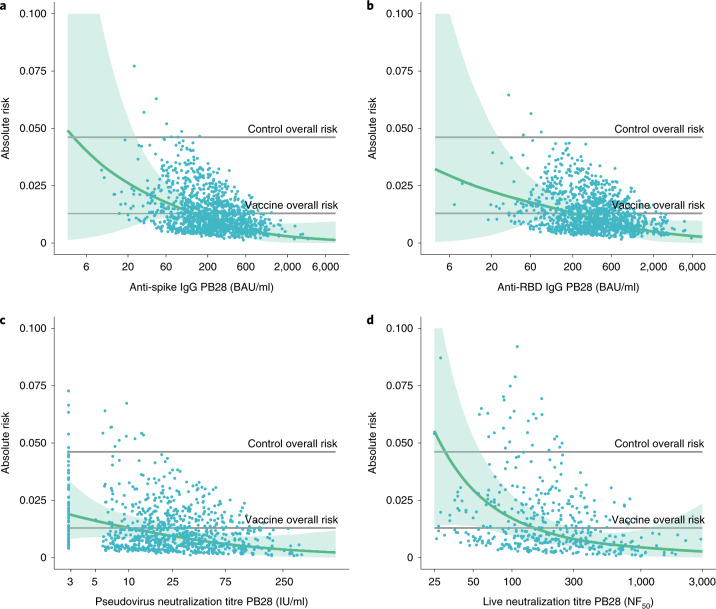
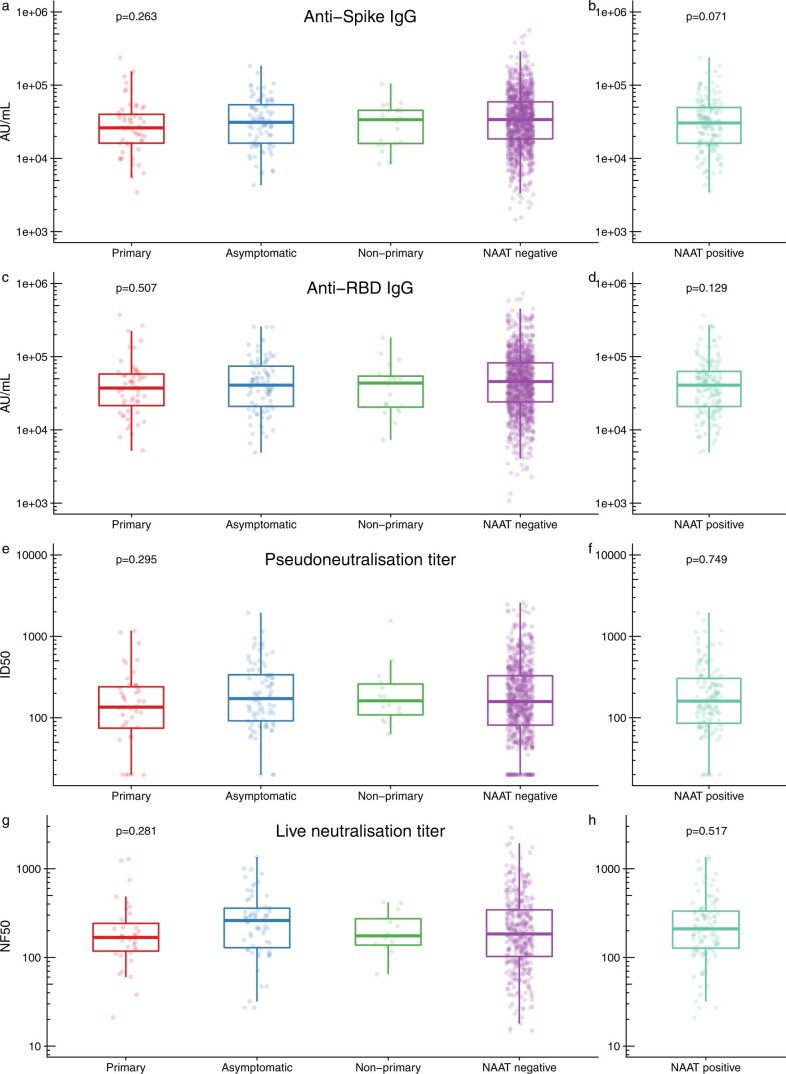
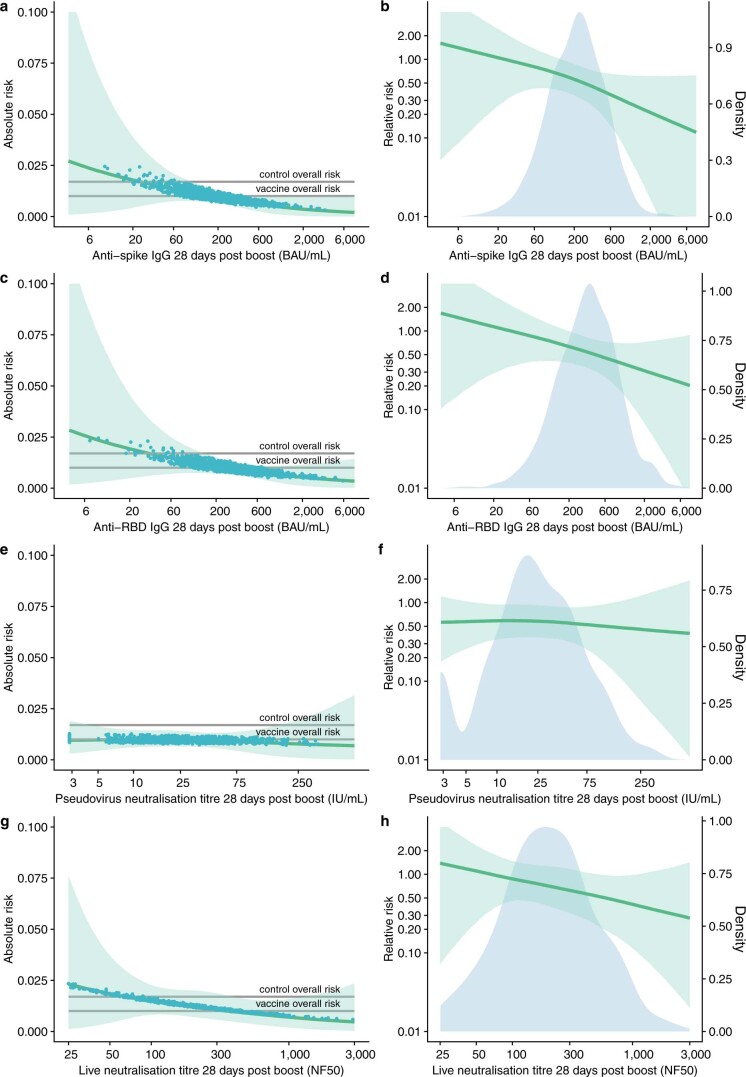
- Among 4,372 participants in the correlates population, there were 174 breakthrough NAAT+ SARS-CoV-2 infections; correlates analysis included 171 cases and 1,404 noncases with at least one assay readout. Risk of symptomatic COVID-19 decreased with increasing anti-spike IgG (P = 0.003), anti-RBD IgG (P = 0.018), pseudovirus neutralization titer (P = 0.005), and live-virus neutralization titer (P < 0.001).
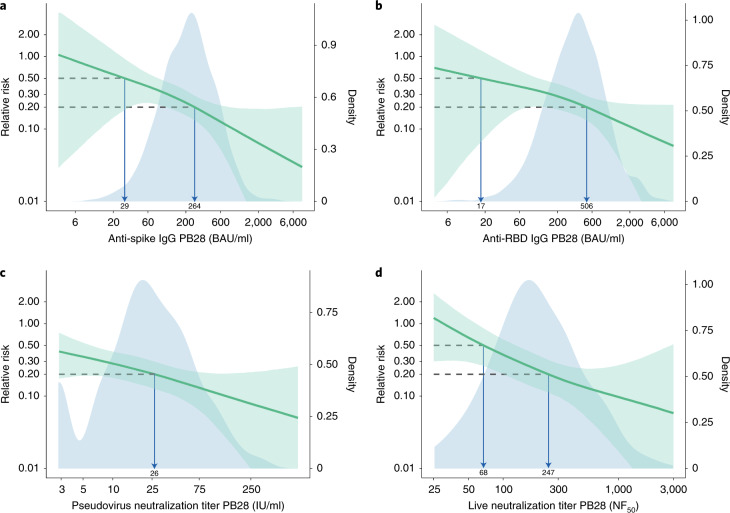
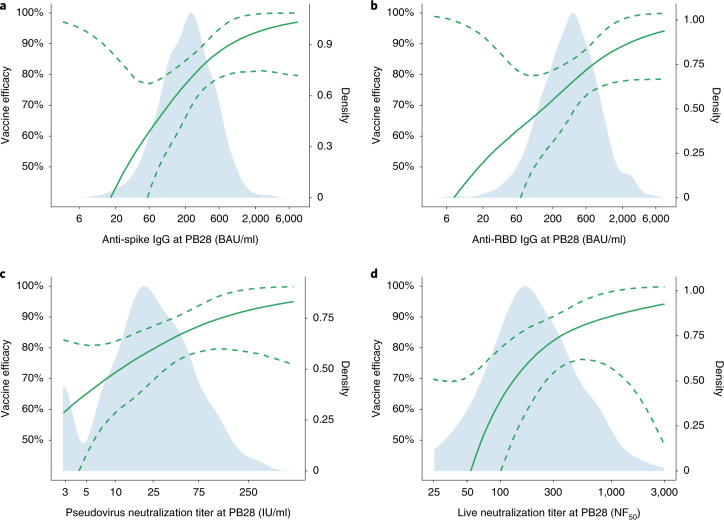
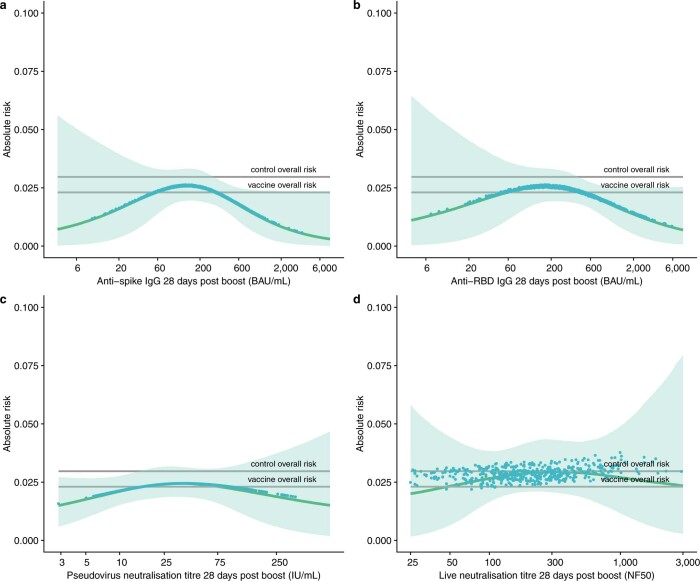
- The antibody level associated with 80% VE against primary symptomatic COVID-19 was 40,923 AU/ml anti-spike IgG, equivalent to 264 BAU/ml (95% CI: 108, 806); 506 BAU/ml anti-RBD IgG (95% CI: 135, NC); 26 IU/ml pseudovirus neutralization (95% CI: NC, NC); and 247 NF50 live-virus neutralization (95% CI: 101, NC).
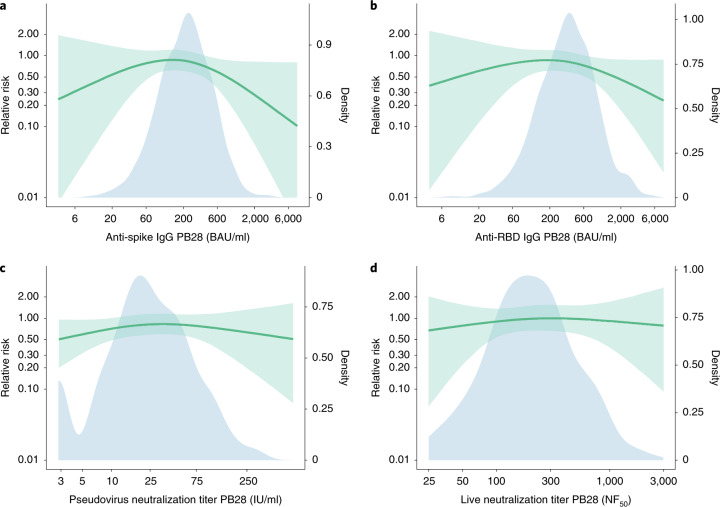
- No significant associations were found between any assay and protection against asymptomatic infection, including in sensitivity analysis restricting to high viral load (all P > 0.05).
- For symptomatic cases with shortness of breath, 80% VE was achieved at lower immune marker levels than for symptomatic cases in general; no significant associations were observed for symptomatic cases without shortness of breath (all P > 0.05).
Methods
- Data came from COV002, a phase 2/3 randomized single-blind vaccine efficacy trial across 19 UK sites; participants were randomized to ChAdOx1 nCoV-19 or MenACWY control. The correlates population included baseline SARS-CoV-2 N-protein-seronegative participants with a PB28 visit within 14–42 days after the second dose and follow-up to at least 7 days after PB28; the correlates cohort comprised those with biomarker data.
- Immune markers measured at PB28 were anti-spike IgG, anti-RBD IgG, pseudovirus neutralization, and live-virus neutralization, converted to WHO international standard units. Outcomes were primary symptomatic COVID-19 (NAAT+ with at least one qualifying symptom) and asymptomatic infection (NAAT+ on weekly self-swab with no symptoms).
- Log-transformed immune markers were analyzed with generalized additive models for binary outcomes using cubic spline smooths, adjusted for baseline exposure risk and weighted by inverse probability weights for sample availability. Correlates of VE were derived by comparing predicted absolute risk with the MenACWY control population risk; 95% CIs used 10,000 bootstrap samples.
Limitations
- Stated: analyses were based on a mainly white UK population with cases mostly due to B.1.177 and B.1.1.7 variants, so modeled relationships may not apply where other variants dominate or different neutralization strains are used. Many analyses were conducted and P values are unadjusted for multiple comparisons. Results apply to two doses of ChAdOx1 nCoV-19 and may not apply to a single dose or other COVID-19 vaccines. Age profile was not explored due to few older adults; T cells and humoral–cellular interactions were not evaluated; mechanistic versus nonmechanistic correlates could not be determined. No vaccinated participants were hospitalized, so correlates against severe disease or hospitalization could not be assessed. Wide CIs around estimates should be noted, and no single threshold indicated sterilizing immunity.
- Evident from the text: the correlates relate to protection against mild disease, defined as NAAT+ with at least one symptom, during the subsequent 4- to 6-month period, and represent antibody levels at 28 days after a second dose rather than at the time of exposure.
Model-written summary. Check it against the paper before relying on it.
Integrity signals
Registry
Cites
Statistics
Figures
Verification
Claims the paper makes
29 Own result · 18 Own method · 7 Own interpretation · 6 Not checked yet · 3 No basis given
A result the paper reports from its own data — it cites no other source for it, so there is none to check. The quote shows it is in the paper.
In the paper
“The risk of symptomatic COVID-19 decreased with increasing levels of anti-spike IgG (P = 0.003), anti-RBD IgG (P = 0.018), pseudovirus neutralization titer (P = 0.005), and live-virus neutralization titer (P < 0.001)”
§ Correlates of protection > Results
plaincorrelational- Asserted: passes — The authors put it forward as true.
- Checkable: passes — It can be checked against evidence.
- Load-bearing: passes — The paper’s conclusions depend on it.
- Based: passes — The paper gives a reason why it holds.
A result the paper reports from its own data — it cites no other source for it, so there is none to check. The quote shows it is in the paper.
In the paper
“The risk of symptomatic COVID-19 decreased with increasing levels of anti-spike IgG (P = 0.003)”
§ Correlates of protection > Results
plaincorrelational- Asserted: passes — The authors put it forward as true.
- Checkable: passes — It can be checked against evidence.
- Load-bearing: passes — The paper’s conclusions depend on it.
- Based: passes — The paper gives a reason why it holds.
A result the paper reports from its own data — it cites no other source for it, so there is none to check. The quote shows it is in the paper.
In the paper
“The risk of symptomatic COVID-19 decreased with increasing levels of anti-spike IgG (P = 0.003), anti-RBD IgG (P = 0.018), pseudovirus neutralization titer (P = 0.005), and live-virus neutralization titer (P < 0.001)”
§ Correlates of protection > Results
plaincorrelational- Asserted: passes — The authors put it forward as true.
- Checkable: passes — It can be checked against evidence.
- Load-bearing: passes — The paper’s conclusions depend on it.
- Based: passes — The paper gives a reason why it holds.
A result the paper reports from its own data — it cites no other source for it, so there is none to check. The quote shows it is in the paper.
In the paper
“The risk of symptomatic COVID-19 decreased with increasing levels of anti-spike IgG (P = 0.003), anti-RBD IgG (P = 0.018), pseudovirus neutralization titer (P = 0.005), and live-virus neutralization titer (P < 0.001)”
§ Correlates of protection > Results
plaincorrelational- Asserted: passes — The authors put it forward as true.
- Checkable: passes — It can be checked against evidence.
- Load-bearing: passes — The paper’s conclusions depend on it.
- Based: passes — The paper gives a reason why it holds.
The paper states this without a source or data behind it here, so there is nothing to check it against. The quote shows it is in the paper.
In the paper
“Not all participants with results from the pseudovirus neutralization titer also have results from the anti-spike, anti-RBD, and live neutralizing antibody titers.”
§ Correlates of protection > Imputation of censored antibody values.
plain- Asserted: passes — The authors put it forward as true.
- Checkable: passes — It can be checked against evidence.
- Load-bearing: unclear — It is unclear whether the paper’s conclusions depend on it.
- Based: passes — The paper gives a reason why it holds.
A result the paper reports from its own data — it cites no other source for it, so there is none to check. The quote shows it is in the paper.
In the paper
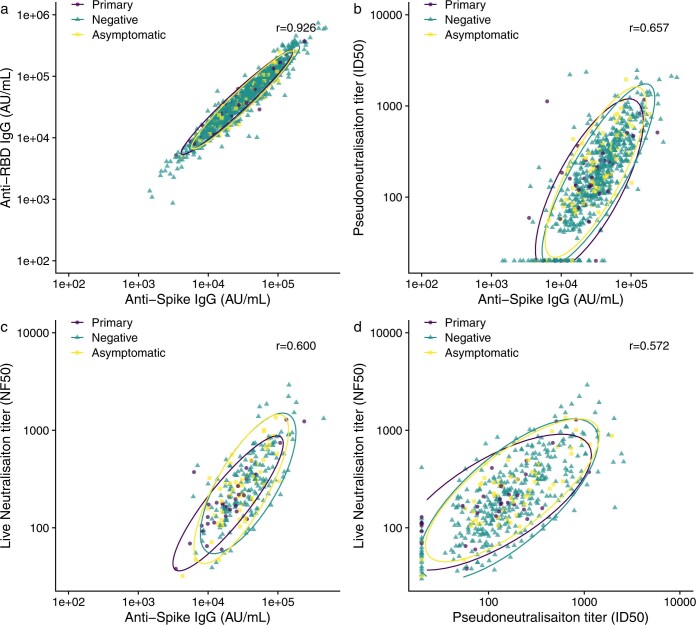
“Non-normalized live-virus neutralization titers (ND 50 ) were less highly correlated with anti-spike IgG (r = 0.411) and pseudovirus neutralization titers (r = 0.305).”
§ Correlates of protection > Results
plaincorrelational- Asserted: passes — The authors put it forward as true.
- Checkable: passes — It can be checked against evidence.
- Load-bearing: unclear — It is unclear whether the paper’s conclusions depend on it.
- Based: passes — The paper gives a reason why it holds.
A result the paper reports from its own data — it cites no other source for it, so there is none to check. The quote shows it is in the paper.
In the paper
“For anti-RBD IgG, 80% efficacy was achieved with median antibody level of 506 (95% CI: 135, not computed (NC)) BAU/ml”
§ Correlates of protection > Results
plaincorrelational- Asserted: passes — The authors put it forward as true.
- Checkable: passes — It can be checked against evidence.
- Load-bearing: passes — The paper’s conclusions depend on it.
- Based: passes — The paper gives a reason why it holds.
A result the paper reports from its own data — it cites no other source for it, so there is none to check. The quote shows it is in the paper.
In the paper
“For pseudovirus and live-virus neutralizing antibody titers, values of 26 (95% CI: NC, NC) IU/ml and 247 (95% CI: 101, NC) normalized neutralization titers (NF 50 ), respectively, were associated with 80% VE against symptomatic infection”
§ Correlates of protection > Results
plaincorrelational- Asserted: passes — The authors put it forward as true.
- Checkable: passes — It can be checked against evidence.
- Load-bearing: passes — The paper’s conclusions depend on it.
- Based: passes — The paper gives a reason why it holds.
A result the paper reports from its own data — it cites no other source for it, so there is none to check. The quote shows it is in the paper.
In the paper
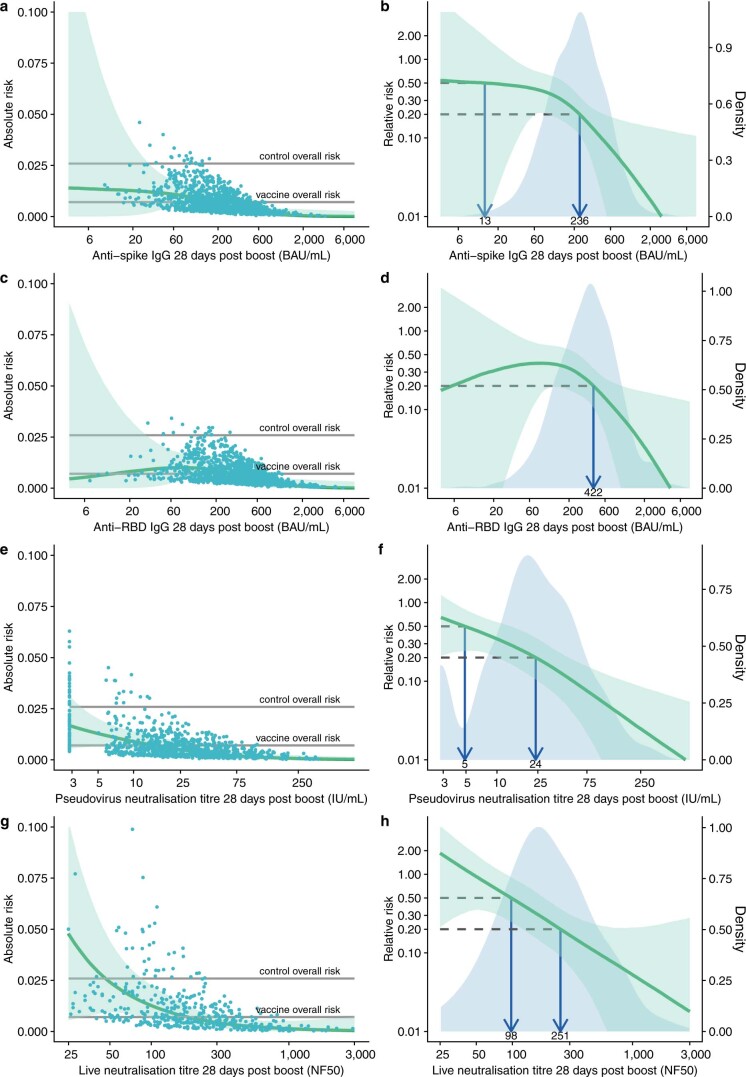
“No values from these assays were associated with protection against asymptomatic infection (Supplementary Table 4)”
§ Correlates of protection > Results
plain- Asserted: passes — The authors put it forward as true.
- Checkable: passes — It can be checked against evidence.
- Load-bearing: passes — The paper’s conclusions depend on it.
- Based: passes — The paper gives a reason why it holds.
A result the paper reports from its own data — it cites no other source for it, so there is none to check. The quote shows it is in the paper.
In the paper
“the results presented here show that there is no single threshold value for any of the assays investigated that was indicative of sterilizing immunity in our data.”
§ Correlates of protection > Discussion
plain- Asserted: passes — The authors put it forward as true.
- Checkable: passes — It can be checked against evidence.
- Load-bearing: passes — The paper’s conclusions depend on it.
- Based: passes — The paper gives a reason why it holds.
- It may state two separate claims as one. 10
- Probably not a substantial claim. 23
A result the paper reports from its own data — it cites no other source for it, so there is none to check. The quote shows it is in the paper.
In the paper
“In our baseline exposure model developed among the MenACWY control group, younger age and being a healthcare worker facing more than one patient with COVID-19 per day were associated with a higher risk of being NAAT+.”
§ Correlates of protection > Results
plaincorrelational- Asserted: passes — The authors put it forward as true.
- Checkable: passes — It can be checked against evidence.
- Load-bearing: unclear — It is unclear whether the paper’s conclusions depend on it.
- Based: passes — The paper gives a reason why it holds.
It may state two separate claims as one.
A result the paper reports from its own data — it cites no other source for it, so there is none to check. The quote shows it is in the paper.
In the paper
“VE against primary symptomatic COVID-19 as a function of immune markers measured at PB28.”
§ Correlates of protection > Reporting Summary.
plaincorrelationaln = 52- Asserted: passes — The authors put it forward as true.
- Checkable: passes — It can be checked against evidence.
- Load-bearing: passes — The paper’s conclusions depend on it.
- Based: passes — The paper gives a reason why it holds.
Probably not a substantial claim.
A result the paper reports from its own data — it cites no other source for it, so there is none to check. The quote shows it is in the paper.
In the paper
“Predicted absolute risk of primary symptomatic COVID-19 as a function of immune markers measured at PB28 by generalized additive regression.”
§ Correlates of protection > Reporting Summary.
plaincorrelationaln = 52- Asserted: passes — The authors put it forward as true.
- Checkable: passes — It can be checked against evidence.
- Load-bearing: passes — The paper’s conclusions depend on it.
- Based: passes — The paper gives a reason why it holds.
Probably not a substantial claim.
A result the paper reports from its own data — it cites no other source for it, so there is none to check. The quote shows it is in the paper.
In the paper
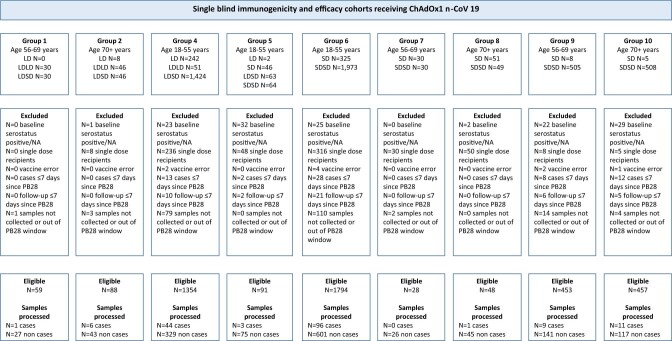
“Data were available for at least one of four assay readouts (anti-spike IgG, anti-receptor binding domain (RBD) IgG, pseudovirus neutralization assay, and live-virus neutralization) for 171 out of 174 (98.3%) cases and 1,404 out of 4,195 (33.5%) noncases.”
§ Correlates of protection > Results
plain- Asserted: passes — The authors put it forward as true.
- Checkable: passes — It can be checked against evidence.
- Load-bearing: passes — The paper’s conclusions depend on it.
- Based: passes — The paper gives a reason why it holds.
Probably not a substantial claim.
A result the paper reports from its own data — it cites no other source for it, so there is none to check. The quote shows it is in the paper.
In the paper
“People in the case group were younger, with 84.2% being aged 18-55 years, compared with 71.6% of the noncase group”
§ Correlates of protection > Results
plaincorrelational- Asserted: passes — The authors put it forward as true.
- Checkable: passes — It can be checked against evidence.
- Load-bearing: fails — The paper’s conclusions may not depend on it.
- Based: passes — The paper gives a reason why it holds.
Probably not a substantial claim. The paper’s conclusions may not depend on it.
A result the paper reports from its own data — it cites no other source for it, so there is none to check. The quote shows it is in the paper.
In the paper
“and were more likely to be healthcare workers (62.0% were healthcare workers compared with 57.5% of the noncase group, Table 1).”
§ Correlates of protection > Results
plaincorrelational- Asserted: passes — The authors put it forward as true.
- Checkable: passes — It can be checked against evidence.
- Load-bearing: fails — The paper’s conclusions may not depend on it.
- Based: passes — The paper gives a reason why it holds.
Probably not a substantial claim. The paper’s conclusions may not depend on it.
A result the paper reports from its own data — it cites no other source for it, so there is none to check. The quote shows it is in the paper.
In the paper
“Relative risk of primary symptomatic COVID-19 among vaccine recipients compared with MenACWY control arm participants as a function of immune markers measured at PB28.”
§ Correlates of protection > Reporting Summary.
plaincorrelationaln = 52- Asserted: passes — The authors put it forward as true.
- Checkable: passes — It can be checked against evidence.
- Load-bearing: passes — The paper’s conclusions depend on it.
- Based: passes — The paper gives a reason why it holds.
Probably not a substantial claim.
A result the paper reports from its own data — it cites no other source for it, so there is none to check. The quote shows it is in the paper.
In the paper
“Relative risk of asymptomatic SARS-CoV-2 infection among vaccine recipients compared with the MenACWY control arm participants as a function of immune markers measured at PB28.”
§ Correlates of protection > Reporting Summary.
plaincorrelationaln = 91- Asserted: passes — The authors put it forward as true.
- Checkable: passes — It can be checked against evidence.
- Load-bearing: passes — The paper’s conclusions depend on it.
- Based: passes — The paper gives a reason why it holds.
Probably not a substantial claim.
What the paper did — it cites no source for this, so there is none to check. The quote shows it is in the paper.
In the paper
“To account for potential of misclassification in asymptomatic infections, a sensitivity analysis was conducted excluding cases with lower viral loads (defined as those for whom all returned PCR positive tests had a CT value ≥ 30), as these are potential false positives.”
§ Correlates of protection > Sensitivity analyses. Viral load.
plain- Asserted: passes — The authors put it forward as true.
- Checkable: passes — It can be checked against evidence.
- Load-bearing: fails — The paper’s conclusions may not depend on it.
- Based: passes — The paper gives a reason why it holds.
Probably not a substantial claim. The paper’s conclusions may not depend on it.
A conclusion the paper draws from its own results — it cites no other source for it, so there is none to check. The quote shows it is in the paper.
In the paper
“These observations indicate that the reduced neutralizing capacity against B.1.351and other variants of concern, might drive reduced protection against initial infection, and perhaps transmission, but protection against severe disease is maintained.”
§ Correlates of protection > Discussion
hedgedconditional- Asserted: passes — The authors put it forward as true.
- Checkable: passes — It can be checked against evidence.
- Load-bearing: passes — The paper’s conclusions depend on it.
- Based: passes — The paper gives a reason why it holds.
It may state two separate claims as one.
What the paper did — it cites no source for this, so there is none to check. The quote shows it is in the paper.
In the paper
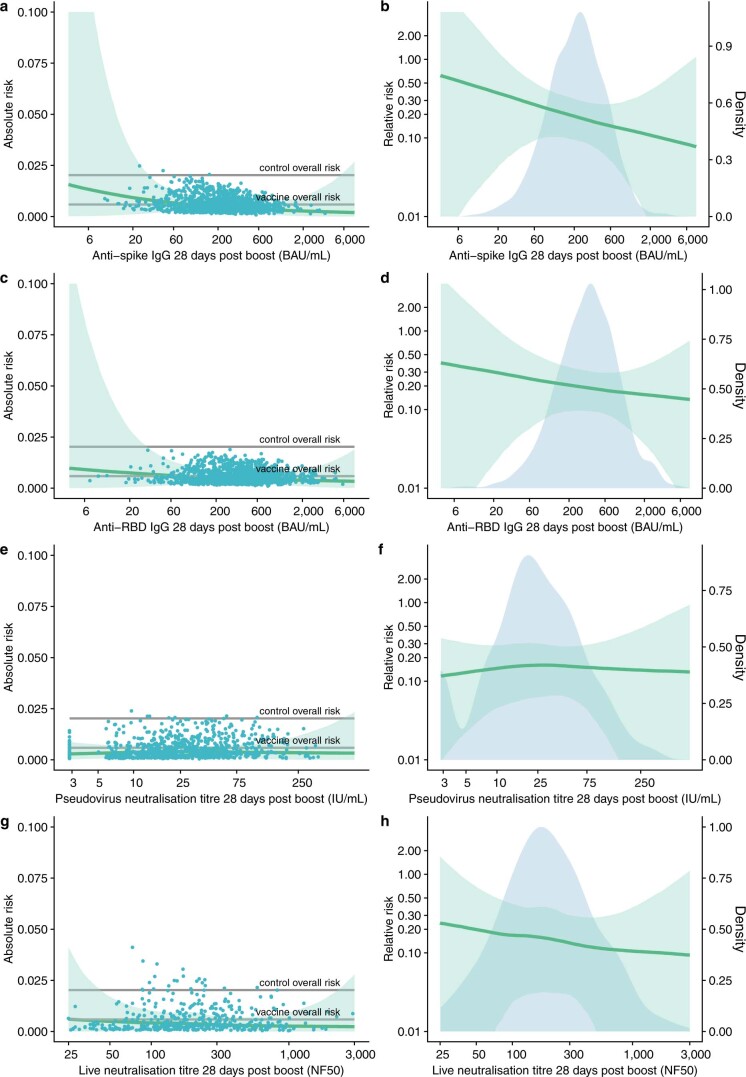
“Sensitivity analysis showing absolute and relative risk primary symptomatic SARS-CoV-2 infection with 3 or more COVID-19 symptoms as a function of immune markers measured at day 28 post-second dose.”
§ Correlates of protection > Reporting Summary.
plaincorrelationaln = 32- Asserted: passes — The authors put it forward as true.
- Checkable: passes — It can be checked against evidence.
- Load-bearing: passes — The paper’s conclusions depend on it.
- Based: passes — The paper gives a reason why it holds.
Probably not a substantial claim.
What the paper did — it cites no source for this, so there is none to check. The quote shows it is in the paper.
In the paper
“We performed a sensitivity analysis to account for the potential bias caused by imputing LLOQ / 2.”
§ Correlates of protection > Imputation of censored antibody values.
plain- Asserted: passes — The authors put it forward as true.
- Checkable: passes — It can be checked against evidence.
- Load-bearing: fails — The paper’s conclusions may not depend on it.
- Based: passes — The paper gives a reason why it holds.
Probably not a substantial claim. The paper’s conclusions may not depend on it.
What the paper did — it cites no source for this, so there is none to check. The quote shows it is in the paper.
In the paper
“Correlates may also vary according to age profile, but this was not explored in our study due to the small number of older adults recruited.”
§ Correlates of protection > Discussion
hedgedconditional- Asserted: passes — The authors put it forward as true.
- Checkable: passes — It can be checked against evidence.
- Load-bearing: fails — The paper’s conclusions may not depend on it.
- Based: passes — The paper gives a reason why it holds.
Probably not a substantial claim. The paper’s conclusions may not depend on it. It may state two separate claims as one.
What the paper did — it cites no source for this, so there is none to check. The quote shows it is in the paper.
In the paper
“Sensitivity analysis showing absolute and relative risk of asymptomatic SARS-CoV-2 infection as a function of immune markers measured at 28 days post second dose excluding cases with low viral load (Ct ≥ 30).”
§ Correlates of protection > Reporting Summary.
plaincorrelational- Asserted: passes — The authors put it forward as true.
- Checkable: passes — It can be checked against evidence.
- Load-bearing: fails — The paper’s conclusions may not depend on it.
- Based: passes — The paper gives a reason why it holds.
Probably not a substantial claim. The paper’s conclusions may not depend on it.
What the paper did — it cites no source for this, so there is none to check. The quote shows it is in the paper.
In the paper
“Sensitivity analysis showing absolute and relative risk of primary symptomatic SARS-CoV-2 infection in participants with no symptoms of shortness of breath as a function of immune markers measured at day 28 post-second dose.”
§ Correlates of protection > Reporting Summary.
plaincorrelationaln = 24- Asserted: passes — The authors put it forward as true.
- Checkable: passes — It can be checked against evidence.
- Load-bearing: fails — The paper’s conclusions may not depend on it.
- Based: passes — The paper gives a reason why it holds.
Probably not a substantial claim. The paper’s conclusions may not depend on it.
What the paper did — it cites no source for this, so there is none to check. The quote shows it is in the paper.
In the paper
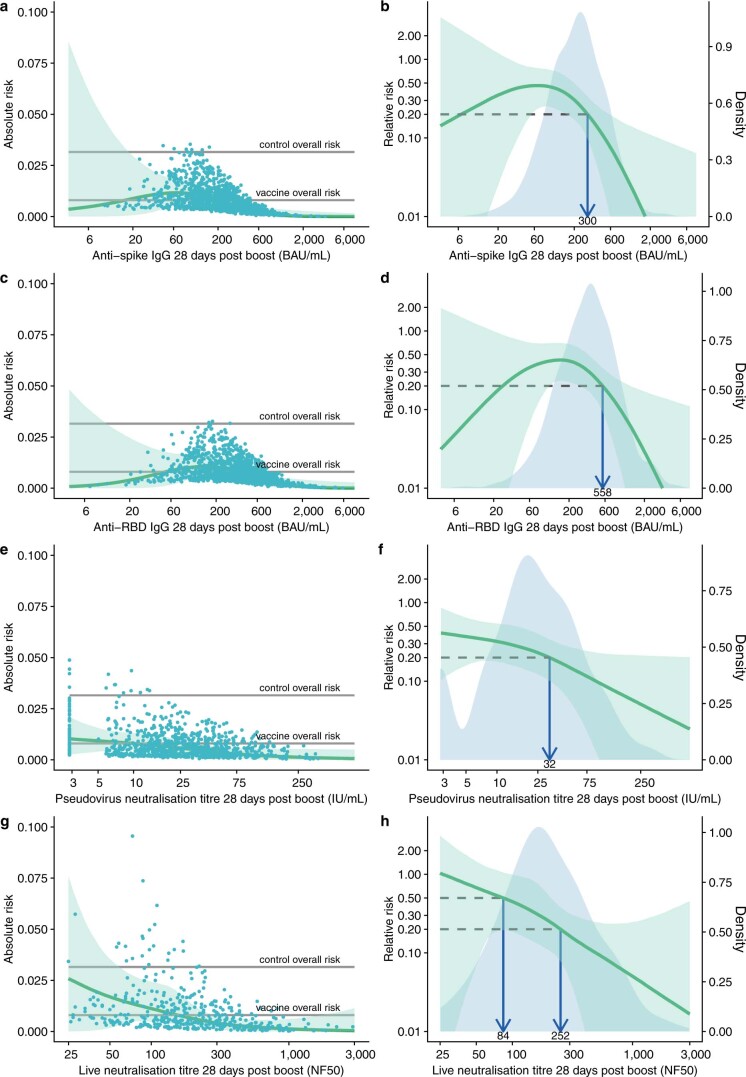
“Sensitivity analysis showing absolute and relative risk of primary symptomatic SARS-CoV-2 infection in participants with symptoms of shortness of breath as a function of immune markers measured at day 28 post-second dose.”
§ Correlates of protection > Reporting Summary.
plaincorrelationaln = 28- Asserted: passes — The authors put it forward as true.
- Checkable: passes — It can be checked against evidence.
- Load-bearing: fails — The paper’s conclusions may not depend on it.
- Based: passes — The paper gives a reason why it holds.
Probably not a substantial claim. The paper’s conclusions may not depend on it.
A conclusion the paper draws from its own results — it cites no other source for it, so there is none to check. The quote shows it is in the paper.
In the paper
“A trial of a new vaccine that works through similar immune mechanisms and which produces antibody responses that are above the correlate values reported here in at least 50% of participants (that is, it has a similar or higher median), might be expected to have similar efficacy against the clinical endpoints used in our UK trial, and higher efficacy against more severe endpoints.”
§ Correlates of protection > Discussion
hedgedconditional- Asserted: passes — The authors put it forward as true.
- Checkable: passes — It can be checked against evidence.
- Load-bearing: passes — The paper’s conclusions depend on it.
- Based: passes — The paper gives a reason why it holds.
It may state two separate claims as one.
- Rests on an assumption: No study to date has defined a correlate of protection against SARS-CoV-2 infection or disease that can be used by regulators and vaccine developers.
A conclusion the paper draws from its own results — it cites no other source for it, so there is none to check. The quote shows it is in the paper.
In the paper
“Instead, the probability of infection decreases on average with higher immune responses, but substantial variation exists between individuals.”
§ Correlates of protection > Discussion
plaincorrelational- Asserted: passes — The authors put it forward as true.
- Checkable: passes — It can be checked against evidence.
- Load-bearing: passes — The paper’s conclusions depend on it.
- Based: passes — The paper gives a reason why it holds.
It may state two separate claims as one.
What the paper did — it cites no source for this, so there is none to check. The quote shows it is in the paper.
In the paper
“We then estimated the CoR by GAM, adjusting for the baseline risk exposure and weighting by inverse probability weights.”
§ Correlates of protection > Bootstrap.
hedged- Asserted: passes — The authors put it forward as true.
- Checkable: passes — It can be checked against evidence.
- Load-bearing: passes — The paper’s conclusions depend on it.
- Based: passes — The paper gives a reason why it holds.
Probably not a substantial claim.
In the paper
“Similarly, ChAdOx1 nCoV-19-vaccinated hamsters, with low neutralizing titers against B.1.351,were fully protected against LRTI following challenge with B.1.351,despite no evidence of protection against shedding of virus from the upper airway 29 .”
§ Correlates of protection > Discussion
What the sources say
- Not checked yetcites [29] Fischer, R. J., et al. ChAdOx1 nCoV-19 (AZD1222) protects hamsters against SARS-CoV-2 B.1.351 and B.1.1.7 disease. Nature Comm. (in the press).
plain- Asserted: passes — The authors put it forward as true.
- Checkable: passes — It can be checked against evidence.
- Load-bearing: passes — The paper’s conclusions depend on it.
- Based: passes — The paper gives a reason why it holds.
It may state two separate claims as one.
What the paper did — it cites no source for this, so there is none to check. The quote shows it is in the paper.
In the paper
“The logit-transformed predicted baseline exposure risk was included as a linear covariate in the GAM model.”
§ Correlates of protection > Correlates or risk.
plain- Asserted: passes — The authors put it forward as true.
- Checkable: passes — It can be checked against evidence.
- Load-bearing: fails — The paper’s conclusions may not depend on it.
- Based: passes — The paper gives a reason why it holds.
Probably not a substantial claim. The paper’s conclusions may not depend on it.
- Rests on an assumption: Baseline exposure risk predicted from the MenACWY control population is applicable to the ChAdOx1 nCoV-19 correlates cohort.
In the paper
“Protection against upper respiratory tract or asymptomatic infections may be more closely associated with the presence of secretory IgA on the mucosal surface which was not measured in this study 30 .”
§ Correlates of protection > Discussion
What the sources say
- Not checked yetcites [30] Wang, Z. et al. Enhanced SARS-CoV-2 neutralization by dimeric IgA. Sci. Transl. Med. 13, eabf1555 (2021). source
hedgedcorrelational- Asserted: passes — The authors put it forward as true.
- Checkable: passes — It can be checked against evidence.
- Load-bearing: unclear — It is unclear whether the paper’s conclusions depend on it.
- Based: passes — The paper gives a reason why it holds.
It may state two separate claims as one.
What the paper did — it cites no source for this, so there is none to check. The quote shows it is in the paper.
In the paper
“Samples were tested blinded to case status.”
§ Correlates of protection > Immune markers and time points.
plain- Asserted: passes — The authors put it forward as true.
- Checkable: passes — It can be checked against evidence.
- Load-bearing: passes — The paper’s conclusions depend on it.
- Based: passes — The paper gives a reason why it holds.
Probably not a substantial claim.
In the paper
“It has previously been shown that protection against lower respiratory tract infection (LRTI) may be easier to achieve than against upper respiratory tract infection (URTI), as challenge studies in rhesus macaques have shown stronger correlation between neutralizing titers and the level of subgenomic messenger RNA in bronchoalveolar lavage samples than in nasal swab samples 28 .”
§ Correlates of protection > Discussion
What the sources say
- Not checked yetcites [28] van Doremalen, N. et al. ChAdOx1 nCoV-19 vaccine prevents SARS-CoV-2 pneumonia in rhesus macaques. Nature 586, 578–582 (2020). source
hedgedconditional- Asserted: passes — The authors put it forward as true.
- Checkable: passes — It can be checked against evidence.
- Load-bearing: fails — The paper’s conclusions may not depend on it.
- Based: passes — The paper gives a reason why it holds.
Probably not a substantial claim. The paper’s conclusions may not depend on it.
What the paper did — it cites no source for this, so there is none to check. The quote shows it is in the paper.
In the paper
“These analyses are based on cases of COVID-19 detected in a mainly white population in the United Kingdom, which were mostly due to B.1.177and B.1.1.7 variants.”
§ Correlates of protection > Discussion
plain- Asserted: passes — The authors put it forward as true.
- Checkable: passes — It can be checked against evidence.
- Load-bearing: passes — The paper’s conclusions depend on it.
- Based: passes — The paper gives a reason why it holds.
It may state two separate claims as one.
What the paper did — it cites no source for this, so there is none to check. The quote shows it is in the paper.
In the paper
“The data included in this analysis comes from participants enrolled in COV002 (registration NCT04400838), a phase 2/3 randomized single-blind vaccine efficacy trial conducted across 19 sites in the United Kingdom.”
§ Correlates of protection > Study description.
plain- Asserted: passes — The authors put it forward as true.
- Checkable: passes — It can be checked against evidence.
- Load-bearing: passes — The paper’s conclusions depend on it.
- Based: passes — The paper gives a reason why it holds.
Probably not a substantial claim. It may state two separate claims as one.
What the paper did — it cites no source for this, so there is none to check. The quote shows it is in the paper.
In the paper
“For each bootstrap sample, we calculated the inverse probability weights to account for sampling bias.”
§ Correlates of protection > Bootstrap.
plain- Asserted: passes — The authors put it forward as true.
- Checkable: passes — It can be checked against evidence.
- Load-bearing: passes — The paper’s conclusions depend on it.
- Based: passes — The paper gives a reason why it holds.
Probably not a substantial claim.
In the paper
“When a bootstrap is required for missing data, Brand et al. found single imputation embedded inside a bootstrap showed better statistical properties than other methods 43 .”
§ Correlates of protection > Imputation of censored antibody values.
What the sources say
- Not checked yetcites [43] Brand, J., van Buuren, S., le Cessie, S. & van den Hout, W. Combining multiple imputation and bootstrap in the analysis of cost‐effectiveness trial data. Stat. Med. 38, 210–220 (2019). source
plaincorrelational- Asserted: passes — The authors put it forward as true.
- Checkable: passes — It can be checked against evidence.
- Load-bearing: fails — The paper’s conclusions may not depend on it.
- Based: passes — The paper gives a reason why it holds.
Probably not a substantial claim. The paper’s conclusions may not depend on it.
What the paper did — it cites no source for this, so there is none to check. The quote shows it is in the paper.
In the paper
“All endpoints were evaluated by a blinded independent clinical review committee.”
§ Correlates of protection > Study description.
plain- Asserted: passes — The authors put it forward as true.
- Checkable: passes — It can be checked against evidence.
- Load-bearing: fails — The paper’s conclusions may not depend on it.
- Based: passes — The paper gives a reason why it holds.
Probably not a substantial claim. The paper’s conclusions may not depend on it.
A conclusion the paper draws from its own results — it cites no other source for it, so there is none to check. The quote shows it is in the paper.
In the paper
“These data can be used to extrapolate efficacy estimates for new vaccines that use similar immune mechanisms and where efficacy data is unavailable.”
§ Correlates of protection > Discussion
plaincorrelational- Asserted: passes — The authors put it forward as true.
- Checkable: fails — It may be too vague to check against evidence.
- Load-bearing: passes — The paper’s conclusions depend on it.
- Based: passes — The paper gives a reason why it holds.
Probably not a substantial claim. It may be too vague to check against evidence.
- Rests on an assumption: No study to date has defined a correlate of protection against SARS-CoV-2 infection or disease that can be used by regulators and vaccine developers.
What the paper did — it cites no source for this, so there is none to check. The quote shows it is in the paper.
In the paper
“Furthermore, these analyses have been conducted on samples taken after two doses of ChAdOx1 nCoV-19 and might not apply to protection afforded by a single dose of the same vaccine or other COVID-19 vaccines.”
§ Correlates of protection > Discussion
hedged- Asserted: passes — The authors put it forward as true.
- Checkable: passes — It can be checked against evidence.
- Load-bearing: unclear — It is unclear whether the paper’s conclusions depend on it.
- Based: passes — The paper gives a reason why it holds.
It may state two separate claims as one.
The authors state this as an assumption.
The mechanism of missingness for samples that were not tested is missing at random.
“We assume the mechanism of missingness for samples that were not tested to be missing at random 39 .”
The paper relies on this without support.
No study to date has defined a correlate of protection against SARS-CoV-2 infection or disease that can be used by regulators and vaccine developers.
“Nevertheless, no study to date has defined a correlate of protection against SARS-CoV-2 infection or disease that can be used by regulators and vaccine developers.”
The paper relies on this without support.
Baseline exposure risk predicted from the MenACWY control population is applicable to the ChAdOx1 nCoV-19 correlates cohort.
“The linear predictor from the risk model developed using the MenACWY control population was used to predict the baseline risk of exposure in the ChAdOx1 nCoV-19 correlates cohort.”
The authors state this as an assumption.
The confidence ellipses for correlations assume a t-distribution.
“95% confidence ellipses assuming a t-distribution are shown for each outcome (primary symptomatic cases, asymptomatic cases and negative controls).”
Claims other papers make about this one
Each is checked against this paper’s own text: does it say what the citing paper says it does?
In the citing paper
“Neutralizing antibody responses are also believed to be critical for protection against COVID-19 by BNT vaccination”
From The Omicron variant is highly resistant against antibody-mediated neutralization: Implications for control of the COVID-19 pandemic (2022) · cites this paper as Feng et al., 2021
Citations
Cites
Safety and Efficacy of the BNT162b2 mRNA Covid-19 Vaccine
Polack, F. P., Thomas, S. J., Kitchin, N., Absalon, J., Gurtman, A., Lockhart, S., Perez, J. L., Pérez Marc, G., Moreira, E. D., Zerbini, C., et al. (2020) · New England Journal of Medicine · doi:10.1056/nejmoa2034577 · Cited by 14,592
Wood, S. N. (2010) · Journal of the Royal Statistical Society Series B (Statistical Methodology) · doi:10.1111/j.1467-9868.2010.00749.x · Cited by 7,538
Sterne, J. A. C., White, I. R., Carlin, J. B., Spratt, M., Royston, P., Kenward, M. G., Wood, A. M., & Carpenter, J. R. (2009) · BMJ · doi:10.1136/bmj.b2393 · Cited by 7,299
Voysey, M., Clemens, S. A. C., Madhi, S. A., Weckx, L. Y., Folegatti, P. M., Aley, P. K., Angus, B., Baillie, V. L., Barnabas, S. L., Bhorat, Q. E., et al. (2021) · The Lancet · doi:10.1016/s0140-6736(20)32661-1 · Cited by 4,616
Self-citationKhoury, D. S., Cromer, D., Reynaldi, A., Schlub, T. E., Wheatley, A. K., Juno, J. A., Subbarao, K., Kent, S. J., Triccas, J. A., & Davenport, M. P. (2021) · Nature Medicine · doi:10.1038/s41591-021-01377-8 · Cited by 3,742
Folegatti, P. M., Ewer, K. J., Aley, P. K., Angus, B., Becker, S., Belij-Rammerstorfer, S., Bellamy, D., Bibi, S., Bittaye, M., Clutterbuck, E. A., et al. (2020) · The Lancet · doi:10.1016/s0140-6736(20)31604-4 · Cited by 2,419
Self-citationMulligan, M. J., Lyke, K. E., Kitchin, N., Absalon, J., Gurtman, A., Lockhart, S., Neuzil, K., Raabe, V., Bailey, R., Swanson, K. A., et al. (2020) · doi:10.1101/2020.06.30.20142570 · Cited by 1,569
Haas, E. J., Angulo, F. J., McLaughlin, J. M., Anis, E., Singer, S. R., Khan, F., Brooks, N., Smaja, M., Mircus, G., Pan, K., et al. (2021) · The Lancet · doi:10.1016/s0140-6736(21)00947-8 · Cited by 1,564
Lopez Bernal, J., Andrews, N., Gower, C., Robertson, C., Stowe, J., Tessier, E., Simmons, R., Cottrell, S., Roberts, R., O’Doherty, M., et al. (2021) · BMJ · doi:10.1136/bmj.n1088 · Cited by 1,389
Ramasamy, M. N., Minassian, A. M., Ewer, K. J., Flaxman, A. L., Folegatti, P. M., Owens, D. R., Voysey, M., Aley, P. K., Angus, B., Babbage, G., et al. (2020) · The Lancet · doi:10.1016/s0140-6736(20)32466-1 · Cited by 1,324
Self-citation
Research works printed but not linked: 2
- Kemp, A. AZD1222 US Phase III trial met primary efficacy endpoint in preventing COVID-19 at interim analysis. https://www.astrazeneca.com/media-centre/press-releases/2021/astrazeneca-us-vaccine-trial-met-primary-endpoint.html (2021).
- Box, G. E. & Tiao, G. C. Bayesian Inference in Statistical Analysis (John Wiley & Sons, 2011).
Cited by
Sorted by citations
Items 201–300 of 1,000
Halfmann, P., Loeffler, K., Duffy, A., Kuroda, M., Yang, J. E., Wright, E., Kawaoka, Y., & Kane, R. S. (2024) · Nature Communications · doi:10.1038/s41467-024-45495-6 · Cited by 31
Nkumama, I. N., Ogwang, R., Odera, D., Musasia, F. K., Mwai, K., Nyamako, L., Murungi, L., Tuju, J., Fürle, K., Rosenkranz, M., et al. (2024) · Immunity · doi:10.1016/j.immuni.2024.05.001 · Cited by 32
A government-led effort to identify correlates of protection for COVID-19 vaccines
Koup, R. A., Donis, R. O., Gilbert, P. B., Li, A. W., Shah, N. A., & Houchens, C. R. (2021) · Nature Medicine · doi:10.1038/s41591-021-01484-6 · Cited by 31
Jantarabenjakul, W., Chantasrisawad, N., Puthanakit, T., Wacharapluesadee, S., Hirankarn, N., Ruenjaiman, V., Paitoonpong, L., Suwanpimolkul, G., Torvorapanit, P., Pradit, R., et al. (2021) · Asian Pacific Journal of Allergy and Immunology · doi:10.12932/ap-250721-1197 · Cited by 31
Tolf, A., Wiberg, A., Müller, M., Nazir, F. H., Pavlović, I., Laurén, I., Mangsbo, S. M., & Burman, J. (2022) · JAMA Network Open · doi:10.1001/jamanetworkopen.2022.11497 · Cited by 32
Xu, K., Fan, C., Han, Y., Dai, L., & Gao, G. F. (2022) · International Immunology · doi:10.1093/intimm/dxac031 · Cited by 31
Piñana, J. L., Vázquez, L., Calabuig, M., López‐Corral, L., Martin‐Martin, G., Villalón, L., Sanz‐Linares, G., Conesa, V., Sánchez‐Salinas, A., Gago, B., et al. (2023) · Blood Cancer Journal · doi:10.1038/s41408-022-00778-3 · Cited by 31
Barateau, V., Peyrot, L., Saade, C., Pozzetto, B., Brengel‐Pesce, K., Elsensohn, M., Allatif, O., Guibert, N., Compagnon, C., Mariano, N., et al. (2023) · Science Translational Medicine · doi:10.1126/scitranslmed.ade0550 · Cited by 33
Choice of SARS-CoV-2 diagnostic test: challenges and key considerations for the future
Baldanti, F., Ganguly, N. K., Wang, G., Möckel, M., O'Neill, L. A. J., Renz, H. E., Ferreira, C. E. D. S., Tateda, K., & Pol, B. J. V. D. (2022) · Critical Reviews in Clinical Laboratory Sciences · doi:10.1080/10408363.2022.2045250 · Cited by 31
Bajwa, H. M., Novak, F., Nilsson, A. C., Nielsen, C., Holm, D. K., Østergaard, K., Witt, A. H., Byg, K., Johansen, I. S., Mittl, K., et al. (2022) · Multiple Sclerosis and Related Disorders · doi:10.1016/j.msard.2022.103729 · Cited by 32
de Boer, S. E., Berger, S. P., van Leer‐Buter, C., Kroesen, B., van Baarle, D., Sanders, J., & on behalf of the OPTIMIZE study group (2022) · Transplantation · doi:10.1097/tp.0000000000004177 · Cited by 30
Regele, F., Heinzel, A., Hu, K., Raab, L., Eskandary, F. A., Faé, I., Zelzer, S., Böhmig, G. A., Bond, G., Fischer, G., et al. (2022) · Frontiers in Medicine · doi:10.3389/fmed.2022.914424 · Cited by 30
Kinetics of the SARS-CoV-2 Antibody Avidity Response Following Infection and Vaccination
García, L., Woudenberg, T., Rosado, J., Dyer, A. H., Donnadieu, F., Planas, D., Bruel, T., Schwartz, O., Prazuck, T., Velay, A., et al. (2022) · Viruses · doi:10.3390/v14071491 · Cited by 33
Post-vaccination T cell immunity to omicron
Jacobsen, H., Jiménez, V. C., Sitaras, I., Bar‐Zeev, N., Čičin‐Šain, L., Higdon, M. M., & Knoll, M. D. (2022) · Frontiers in Immunology · doi:10.3389/fimmu.2022.944713 · Cited by 30
Kemlin, D., Gemander, N., Depickère, S., Olislagers, V., Georges, D., Waegemans, A., Pannus, P., Lemy, A., Goossens, M. E., Desombere, I., et al. (2023) · American Journal of Transplantation · doi:10.1016/j.ajt.2023.02.015 · Cited by 33
Goodyear, C. S., Patel, A. K., Barnes, E. J., Willicombe, M. K., Siebert, S., de Silva, T. I., Snowden, J. A., Lim, S. H., Bowden, S. J., Billingham, L. J., et al. (2024) · The Lancet Rheumatology · doi:10.1016/s2665-9913(24)00065-1 · Cited by 29
Spencer, A. J., Morris, S. J., Ulaszewska, M., Powers, C., Kailath, R., Bissett, C., Truby, A., Thakur, N., Newman, J., Allen, E. R., et al. (2022) · EBioMedicine · doi:10.1016/j.ebiom.2022.103902 · Cited by 31
Self-citationAileni, M., Rohela, G. K., Jogam, P., Soujanya, S., & Zhang, B. (2022) · Cells · doi:10.3390/cells11071182 · Cited by 30
Meunier, L., Sanavio, M., Dumortier, J., Meszaros, M., Faure, S., Bedoya, J. U., Echenne, M., Boillot, O., Debourdeau, A., & Pageaux, G. (2022) · Liver International · doi:10.1111/liv.15258 · Cited by 29
Comparison of the measured values of quantitative SARS-CoV-2 spike antibody assays
Müller, L., Kannenberg, J., Biemann, R., Hönemann, M., Ackermann, G., & Jassoy, C. (2022) · Journal of Clinical Virology · doi:10.1016/j.jcv.2022.105269 · Cited by 29
Graninger, M., Jani, C. M., Reuberger, E., Prüger, K., Gaspar, P., Springer, D. N., Borsodi, C., Weidner, L., Rabady, S., Puchhammer‐Stöckl, E., et al. (2023) · Microbiology Spectrum · doi:10.1128/spectrum.02314-22 · Cited by 29
Kapłonek, P., Deng, Y., Lee, J. S.-L., Zar, H. J., Zavadska, D., Johnson, M., Lauffenburger, D. A., Goldblatt, D., & Alter, G. (2023) · Cell Reports Medicine · doi:10.1016/j.xcrm.2023.101048 · Cited by 32
Kapłonek, P., Cizmeci, D., Kwatra, G., Izu, A., Lee, J. S.-L., Bertera, H. L., Fischinger, S., Mann, C. J., Amanat, F., Wang, W., et al. (2023) · Nature Immunology · doi:10.1038/s41590-023-01513-1 · Cited by 30
Self-citationTracking immune correlates of protection for emerging SARS-CoV-2 variants
Nilles, E. J., Paulino, C. T., Aubin, M. D. S., Duke, W., Jarolı́m, P., Sánchez, I. M., Murray, K. O., Lau, C. L., Gutiérrez, E. Z., Skewes-Ramm, R., et al. (2023) · The Lancet Infectious Diseases · doi:10.1016/s1473-3099(23)00001-4 · Cited by 28
Salvagno, G. L., Henry, B. M., Pighi, L., NITTO, S. D., Gianfilippi, G., & Lippi, G. (2021) · Clinical Chemistry and Laboratory Medicine (CCLM) · doi:10.1515/cclm-2021-1184 · Cited by 27
Jackson, S., Marshall, J. L., Mawer, A., Ramon, R. L., Harris, S. A., Satti, I., Hughes, E., Preston-Jones, H., Puig, I. C., Longet, S., et al. (2024) · The Lancet Microbe · doi:10.1016/s2666-5247(24)00025-9 · Cited by 28
Self-citationYanis, A., Haddadin, Z., Spieker, A. J., Waqfi, D., Rankin, D. A., Talj, R., Thomas, L. D., Birdwell, K. A., Ezzell, L. J., Blair, M. A., et al. (2021) · Transplant Infectious Disease · doi:10.1111/tid.13772 · Cited by 28
Matusali, G., Sberna, G., Meschi, S., Gramigna, G., Colavita, F., Lapa, D., Francalancia, M., Bettini, A., Capobianchi, M. R., Puro, V., et al. (2022) · Viruses · doi:10.3390/v14020312 · Cited by 27
A fourth SARS-CoV-2 mRNA vaccine in strictly seronegative kidney transplant recipients
Masset, C., Benotmane, I., Dantal, J., Garandeau, C., Gauthier-Vargas, G., Cantarovich, D., Meurette, A., Giral, M., Caillard, S., & Blancho, G. (2022) · Kidney International · doi:10.1016/j.kint.2022.01.017 · Cited by 27
Wang, X., Bai, H., Ma, J., Qin, H., Jiang, T., Mao, W., Zeng, Q., Hu, F., Teng, Y., Fan, L., et al. (2021) · Frontiers in Immunology · doi:10.3389/fimmu.2022.812514 · Cited by 28
Zhan, H., Gao, H., Liu, Y., Zhang, X., Li, H., Li, X., Wang, L., Li, C., Li, B., Wang, Y., et al. (2022) · Journal of Medical Virology · doi:10.1002/jmv.28428 · Cited by 27
Nelson, C. E., Foreman, T. W., Fukutani, E. R., Kauffman, K. D., Sakai, S., Fleegle, J. D., Gomez, F., Program, N. T. I., Gould, S. T., Nouën, C. L., et al. (2024) · PLoS Pathogens · doi:10.1371/journal.ppat.1012339 · Cited by 28
Sheng, W., Chang, S., Lin, P., Hsieh, M., Chang, H., Cheng, C., Yang, H., Pan, C., Ieong, S., Chao, T., et al. (2022) · Journal of the Formosan Medical Association · doi:10.1016/j.jfma.2022.02.020 · Cited by 26
Volkmann, A., Koopman, G., Mooij, P., Verschoor, E. J., Verstrepen, B. E., Bogers, W. M. J. M., Idorn, M., Paludan, S. R., Vang, S., Nielsen, M. A., et al. (2022) · Frontiers in Immunology · doi:10.3389/fimmu.2022.857440 · Cited by 27
Strength and durability of antibody responses to BNT162b2 and CoronaVac
Cowling, B. J., Wong, I. O. L., Shiu, E. Y. C., Lai, A. Y. T., Cheng, S. M. S., Chaothai, S., Kwan, K. K. H., Martín-Sánchez, M., Poon, L. L. M., Ip, D., et al. (2022) · Vaccine · doi:10.1016/j.vaccine.2022.05.033 · Cited by 26
Assawasaksakul, T., Lertussavavivat, T., Sathitratanacheewin, S., Oudomying, N., Vichaiwattana, P., Wanlapakorn, N., Poovorawan, Y., Avihingsanon, Y., Assawasaksakul, N., Buranapraditkun, S., et al. (2022) · Vaccines · doi:10.3390/vaccines10060853 · Cited by 26
Ono, S., Michihata, N., Yamana, H., Uemura, K., Ono, Y., Jo, T., & Yasunaga, H. (2022) · Clinical Infectious Diseases · doi:10.1093/cid/ciac763 · Cited by 26
Frommert, L. M., de Silva, A. N. A., Zernicke, J., Scholz, V., Braun, T., Jeworowski, L. M., Schwarz, T., Tober‐Lau, P., ten Hagen, A., Habermann, E., et al. (2022) · RMD Open · doi:10.1136/rmdopen-2022-002650 · Cited by 27
Mallah, S. I., AlAwadhi, A. I., Jawad, J. S., Wasif, P., Alsaffar, B., Alalawi, E., Mohamed, A., Butler, A. E., Alalawi, B., Qayed, D., et al. (2023) · Vaccine · doi:10.1016/j.vaccine.2023.01.032 · Cited by 27
Arashiro, T., Arai, S., Kinoshita, R., Otani, K., Miyamoto, S., Yoneoka, D., Kamigaki, T., Takahashi, H., Hibino, H., Okuyama, M., et al. (2023) · Influenza and Other Respiratory Viruses · doi:10.1111/irv.13094 · Cited by 26
Leung, N., Cheng, S. M. S., Cohen, C. A., Martín-Sánchez, M., Au, N. Y. M., Luk, L. L. H., Tsang, L. C. H., Kwan, K. K. H., Chaothai, S., Fung, L. W. C., et al. (2023) · The Lancet Microbe · doi:10.1016/s2666-5247(23)00216-1 · Cited by 27
Clinical Utility of SARS-CoV-2 Serological Testing and Defining a Correlate of Protection
Sobhani, K., Cheng, S. C., Binder, R. A., Mantis, N. J., Crawford, J. M., Okoye, N. C., Braun, J. G., Joung, S. Y., Wang, M., Lozanski, G., et al. (2023) · Vaccines · doi:10.3390/vaccines11111644 · Cited by 26
The influence of interval between doses on response to vaccines
Rodrigues, C. M. C., & Plotkin, S. A. (2021) · Vaccine · doi:10.1016/j.vaccine.2021.10.050 · Cited by 25
Charmetant, X., Espi, M., Barba, T., Ovize, A., Morélon, E., Mathieu, C., & Thaunat, O. (2022) · American Journal of Transplantation · doi:10.1111/ajt.16990 · Cited by 25
Mason, A. E., Kasl, P., Hartogensis, W., Natale, J. L., Dilchert, S., Dasgupta, S., Purawat, S., Chowdhary, A., Anglo, C., Veasna, D., et al. (2022) · Vaccines · doi:10.3390/vaccines10020264 · Cited by 25
Bruminhent, J., Setthaudom, C., Kitpermkiat, R., Kiertiburanakul, S., Malathum, K., Assanatham, M., Nongnuch, A., Phuphuakrat, A., Chaumdee, P., Janphram, C., et al. (2022) · Scientific Reports · doi:10.1038/s41598-022-07574-w · Cited by 25
Ramasamy, R. (2022) · Viruses · doi:10.3390/v14050933 · Cited by 25
Chen, X., Wang, W., Chen, X., Wu, Q., Sun, R., Ge, S., Zheng, N., Lu, W., Yang, J., Rodewald, L. E., et al. (2022) · BMC Medicine · doi:10.1186/s12916-022-02249-9 · Cited by 25
Antibody and B Cell Responses to SARS-CoV-2 Infection and Vaccination: The End of the Beginning
Röltgen, K., & Boyd, S. D. (2023) · Annual Review of Pathology Mechanisms of Disease · doi:10.1146/annurev-pathmechdis-031521-042754 · Cited by 25
Pérez, C. M., Aguilar, R., Jiménez, A., Salmerón, G., Canyelles, M., Rubio, R., Vidal, M., Cuamba, I., Barrios, D., Díaz, N., et al. (2024) · BMC Medicine · doi:10.1186/s12916-024-03304-3 · Cited by 28
Benning, L., Morath, C. P., Bartenschlager, M., Nusshag, C., Kälble, F., Buylaert, M., Schaier, M., Beimler, J., Klein, K., Grenz, J., et al. (2021) · Clinical Journal of the American Society of Nephrology · doi:10.2215/cjn.11820921 · Cited by 24
Kister, I., Patskovsky, Y., Curtin, R., Pei, J., Perdomo, K., Rimler, Z., Voloshyna, I., Samanovic, M. I., Cornelius, A. R., Velmurugu, Y., et al. (2022) · Annals of Neurology · doi:10.1002/ana.26346 · Cited by 24
Suntronwong, N., Yorsaeng, R., Puenpa, J., Auphimai, C., Thongmee, T., Vichaiwattana, P., Kanokudom, S., Duangchinda, T., Chantima, W., Pakchotanon, P., et al. (2022) · Vaccines · doi:10.3390/vaccines10030391 · Cited by 24
Lafont, E., Péré, H., Lebeaux, D., Cheminet, G., Thervet, É., Guillemain, R., & Flahault, A. (2022) · Journal of Antimicrobial Chemotherapy · doi:10.1093/jac/dkac253 · Cited by 24
Espeseth, A. S., Yuan, M., Citron, M. P., Reiserova, L., Morrow, G., Wilson, A. J., Horton, M. S., Rukhman, M., Kinek, K. C., Hou, F., et al. (2022) · EBioMedicine · doi:10.1016/j.ebiom.2022.104203 · Cited by 24
Benning, L., Morath, C. P., Kühn, T., Bartenschlager, M., Kim, H., Beimler, J., Buylaert, M., Nußhag, C., Kälble, F., Reineke, M., et al. (2022) · Frontiers in Medicine · doi:10.3389/fmed.2022.958293 · Cited by 25
Ailsworth, S. M., Keshavarz, B., Richards, N. E., Workman, L. J., Murphy, D. D., Nelson, M. R., Platts‐Mills, T. A. E., & Wilson, J. M. (2022) · Annals of Allergy Asthma & Immunology · doi:10.1016/j.anai.2022.10.003 · Cited by 24
Foster, W. S., Lee, J. L., Thakur, N., Newman, J., Spencer, A. J., Davies, S. E., Woods, D., Godfrey, L., Hay, I. M., Innocentin, S., et al. (2022) · Cell Reports Medicine · doi:10.1016/j.xcrm.2022.100845 · Cited by 25
Self-citationHeftdal, L. D., Pérez‐Alós, L., Hasselbalch, R. B., Hansen, C. B., Hamm, S. R., Møller, D. L., Pries‐Heje, M. M., Fogh, K., Gerstoft, J., Grønbæk, K., et al. (2023) · EBioMedicine · doi:10.1016/j.ebiom.2023.104661 · Cited by 24
Monitoring of SARS-CoV-2 Specific Antibodies after Vaccination
Guiomar, R., Santos, A. J., Melo, A. M., Costa, I., Matos, R., Rodrigues, A. P., Kislaya, I., Silva, A. S., Roque, C., Nunes, C., et al. (2022) · Vaccines · doi:10.3390/vaccines10020154 · Cited by 24
Werbel, W. A., & Segev, D. L. (2022) · American Journal of Transplantation · doi:10.1111/ajt.16993 · Cited by 23
Impact of SARS‐CoV‐2 infection on vaccine‐induced immune responses over time
Havervall, S., Marking, U. W., Greilert‐Norin, N., Gordon, M., Ng, H., Christ, W., Phillipson, M., Nilsson, P., Hober, S., Blom, K. G., et al. (2022) · Clinical & Translational Immunology · doi:10.1002/cti2.1388 · Cited by 24
Wilkins, D. E., Aksyuk, A. A., Ruzin, A. V., Tuffy, K. M., Green, T., Greway, R., Fikes, B., Bonhomme, C. J., Esser, M. T., & Kelly, E. J. (2022) · Clinical & Translational Immunology · doi:10.1002/cti2.1385 · Cited by 23
Self-citationLeonard, E. K., Pellitero, M. A., Jülg, B. D., Spangler, J. B., & Arroyo‐Currás, N. (2022) · Journal of the American Chemical Society · doi:10.1021/jacs.2c02537 · Cited by 23
Assawasaksakul, T., Sathitratanacheewin, S., Vichaiwattana, P., Wanlapakorn, N., Poovorawan, Y., Avihingsanon, Y., Assawasaksakul, N., & Kittanamongkolchai, W. (2022) · Lupus Science & Medicine · doi:10.1136/lupus-2022-000726 · Cited by 24
Eales, O. D., Page, A. J., Martins, L. D. O., Wang, H., Bodinier, B., Haw, D., Jonnerby, J., Atchison, C. J., Robson, S. C., Connor, T. R., et al. (2022) · BMC Infectious Diseases · doi:10.1186/s12879-022-07628-4 · Cited by 23
Self-citationMontez‐Rath, M. E., García, P., Han, J., Cadden, L., Hunsader, P., Morgan, C., KERSCHMANN, R. L., Beyer, P., Dittrich, M. O., Block, G. A., et al. (2022) · Journal of the American Society of Nephrology · doi:10.1681/asn.2022040504 · Cited by 23
Humoral immunity to SARS-CoV-2 elicited by combination COVID-19 vaccination regimens
Wang, Z., Muecksch, F., Münn, F., Cho, A., Zong, S., Raspe, R., Ramos, V., Johnson, B., Tanfous, T. B., DaSilva, J., et al. (2022) · The Journal of Experimental Medicine · doi:10.1084/jem.20220826 · Cited by 24
Asamoah-Boaheng, M., Goldfarb, D. A., Karim, M. E., O’Brien, S. F., Wall, N., Drews, S. J., Barakauskas, V., Jassem, A. N., & Grunau, B. E. (2022) · The Journal of Infectious Diseases · doi:10.1093/infdis/jiac403 · Cited by 22
Loubet, P., Wittkop, L., Ninove, L., Chalouni, M., Barrou, B., Blay, J., Hourmant, M., Thouvenot, É., Laville, M., Laviolle, B., et al. (2022) · Clinical Microbiology and Infection · doi:10.1016/j.cmi.2022.10.009 · Cited by 23
Madhi, S. A., Kwatra, G., Richardson, S. I., Koen, A. L., Baillie, V. L., Cutland, C., Fairlie, L., Padayachee, S. D., Dheda, K. U. J., Barnabas, S. L., et al. (2022) · The Lancet Infectious Diseases · doi:10.1016/s1473-3099(22)00596-5 · Cited by 25
Self-citationNilles, E. J., Paulino, C. T., Aubin, M. D. S., Restrepo, A. C., Mayfield, H. J., Dumas, D., Finch, E., Garnier, S., Etienne, M. C., Iselin, L., et al. (2022) · The Lancet Regional Health - Americas · doi:10.1016/j.lana.2022.100390 · Cited by 23
Bjørlykke, K. H., Ørbo, H. S., Tveter, A. T., Jyssum, I., Sexton, J., Tran, T. T., Christensen, I. E., Kro, G. B., Kvien, T. K., Jahnsen, J., et al. (2022) · The Lancet Rheumatology · doi:10.1016/s2665-9913(22)00330-7 · Cited by 24
Jacob-Dolan, C., Yu, J., McMahan, K., Giffin, V. M., Chandrashekar, A., Martinot, A. J., Anioke, T., Powers, O. C., Hall, K., Hope, D. L., et al. (2023) · npj Vaccines · doi:10.1038/s41541-023-00622-0 · Cited by 23
Livieratos, A., Gogos, C. A., & Akinosoglou, K. (2024) · Viruses · doi:10.3390/v16050685 · Cited by 23
SARS-CoV-2: The Interplay Between Evolution and Host Immunity
Case, J. B., Jain, S., Suthar, M. S., & Diamond, M. (2024) · Annual Review of Immunology · doi:10.1146/annurev-immunol-083122-043054 · Cited by 26
Fox, T. A., Kirkwood, A. A., Enfield, L., O'Reilly, M. A., Arulogun, S. O., D’Sa, S., O’Nions, J., Kavi, J., Vitsaras, E., Townsend, W. M., et al. (2021) · British Journal of Haematology · doi:10.1111/bjh.17836 · Cited by 22
Malipiero, G., D’Agaro, P., Segat, L., Moratto, A., & Villalta, D. (2021) · Clinica Chimica Acta · doi:10.1016/j.cca.2021.11.023 · Cited by 22
Giménez, E., Albert, E., Zulaica, J., Torres, I., Rusu, L., Rodríguez-Moreno, A., Burgos, J. S., Peiró, S., Salas, D., Vanaclocha, H., et al. (2022) · Clinical Infectious Diseases · doi:10.1093/cid/ciac223 · Cited by 22
Immunogenicity of heterologous inactivated and adenoviral-vectored COVID-19 vaccine: Real-world data
Wanlapakorn, N., Suntronwong, N., Phowatthanasathian, H., Yorsaeng, R., Thongmee, T., Vichaiwattana, P., Auphimai, C., Wongsrisang, L., Klinfueng, S., Sudhinaraset, N., et al. (2022) · Vaccine · doi:10.1016/j.vaccine.2022.04.043 · Cited by 23
Alidjinou, E. K., Demaret, J., Corroyer-Simovic, B., Labreuche, J., Goffard, A., Trauet, J., Lupau, D., Miczek, S., Vuotto, F., Dendooven, A., et al. (2022) · The Lancet Regional Health - Europe · doi:10.1016/j.lanepe.2022.100385 · Cited by 22
Suntronwong, N., Assawakosri, S., Kanokudom, S., Yorsaeng, R., Auphimai, C., Thongmee, T., Vichaiwattana, P., Duangchinda, T., Chantima, W., Pakchotanon, P., et al. (2022) · Diagnostics · doi:10.3390/diagnostics12081781 · Cited by 22
SARS-CoV-2 immunity and vaccine strategies in people with HIV
Mullender, C., da Costa, K., Alrubayyi, A., Pett, S. L., & Peppa, D. (2022) · Oxford Open Immunology · doi:10.1093/oxfimm/iqac005 · Cited by 23
Nham, E., Ko, J., Song, K., Choi, J., Kim, E. S., Kim, H., Kim, B., Lim, H.-Y., Kim, K.-C., Jang, H., et al. (2022) · Frontiers in Immunology · doi:10.3389/fimmu.2022.968105 · Cited by 22
Efficacy of three COVID-19 vaccine doses in lung transplant recipients: a multicentre cohort study
Dauriat, G., Beaumont, L., Nguyen, L. B. L., Renaud-Picard, B., Penhouet, M., Coiffard, B., Salpin, M., Demant, X., Raymond, C. S., Carlier, N., et al. (2022) · European Respiratory Journal · doi:10.1183/13993003.00502-2022 · Cited by 22
Perez‐Saez, J., Zaballa, M.-E., Lamour, J., Yerly, S., Dubos, R., Courvoisier, D. S., Villers, J., Balavoine, J.-F., Pittet, D., Kherad, O., et al. (2023) · Nature Communications · doi:10.1038/s41467-023-38744-7 · Cited by 22
Self-citationClairon, Q., Prague, M., Planas, D., Bruel, T., Hocqueloux, L., Prazuck, T., Schwartz, O., Thiébaut, R., & Guedj, J. (2023) · PLoS Computational Biology · doi:10.1371/journal.pcbi.1011282 · Cited by 25
Abhishek, A., Peckham, N., Pade, C., Gibbons, J. M., Cureton, L., Francis, A., Barber, V. S., Williams, J. A. E., Appelbe, D. E., Eldridge, L., et al. (2023) · The Lancet Rheumatology · doi:10.1016/s2665-9913(23)00298-9 · Cited by 23
Netzl, A., Türeli, S., LeGresley, E. B., Mühlemann, B., Wilks, S. H., & Smith, D. J. (2025) · Scientific Reports · doi:10.1038/s41598-025-19578-3 · Cited by 22
Post-Vaccination Neutralization Responses to Omicron Sub-Variants
Jacobsen, H., Katzmarzyk, M., Higdon, M. M., Jiménez, V. C., Sitaras, I., Bar-Zeev, N., & Knoll, M. D. (2022) · Vaccines · doi:10.3390/vaccines10101757 · Cited by 21
Hollstein, M. M., Münsterkötter, L., Schön, M. P., Bergmann, A., Husar, T. M., Abratis, A., Eidizadeh, A., Schaffrinski, M., Zachmann, K., Schmitz, Ä., et al. (2022) · Allergy · doi:10.1111/all.15247 · Cited by 21
Leung, K. S. M., Jit, M., Leung, G. M., & Wu, J. T. K. (2022) · The Lancet Regional Health - Western Pacific · doi:10.1016/j.lanwpc.2022.100389 · Cited by 21
Low antispike antibody levels correlate with poor outcomes in COVID‐19 breakthrough hospitalizations
Sanghavi, D., Bhakta, S., Wadei, H. M., Bosch, W., Cowart, J. B., Carter, R. E., Shah, S. Z., Pollock, B. D., Neville, M. R., Oman, S. P., et al. (2022) · Journal of Internal Medicine · doi:10.1111/joim.13471 · Cited by 22
Reappraising the Value of HIV-1 Vaccine Correlates of Protection Analyses
Klasse, P. J., & Moore, J. P. (2022) · Journal of Virology · doi:10.1128/jvi.00034-22 · Cited by 23
Humoral Immunogenicity of the mRNA-1273 Vaccine in the Phase 3 Coronavirus Efficacy (COVE) Trial
Sahly, H. M. E., Baden, L. R., Essink, B. J., Montefiori, D. C., McDermont, A., Rupp, R. E., Lewis, M., Swaminathan, S., Griffin, C., Fragoso, V. G., et al. (2022) · The Journal of Infectious Diseases · doi:10.1093/infdis/jiac188 · Cited by 21
mRNA booster vaccination protects aged mice against the SARS-CoV-2 Omicron variant
Nanishi, E., McGrath, M. E., O’Meara, T. R., Barman, S., Yu, J., Wan, H., Dillen, C. A., Menon, M., Seo, H., Song, K., et al. (2022) · Communications Biology · doi:10.1038/s42003-022-03765-3 · Cited by 21
Gupta, S. L., Mantus, G. E., Manning, K. E., Ellis, M. L., Patel, M., Ciric, C. R., Lu, A., Turner, J. S., O’Halloran, J. A., Presti, R. M., et al. (2022) · Journal of Virology · doi:10.1128/jvi.00582-22 · Cited by 23
Antibody-mediated immunity to SARS-CoV-2 spike
Errico, J. M., Adams, L. J., & Fremont, D. H. (2022) · Advances in immunology · doi:10.1016/bs.ai.2022.07.001 · Cited by 22
Gaborit, B., Fernandes, S., Loubet, P., Ninove, L., Dutour, A., Cariou, B., Coupaye, M., Clément, K., Czernichow, S., Carette, C., et al. (2023) · Metabolism · doi:10.1016/j.metabol.2023.155412 · Cited by 21
Gui, Y., Li, X., Li, J., Shen, M., Zhang, M., Cao, Y., Xu, H., Li, H., Cheng, J., Pan, L., et al. (2023) · EBioMedicine · doi:10.1016/j.ebiom.2023.104586 · Cited by 21
Metadata
- Authors
- Feng, S., Phillips, D. J., White, T., Sayal, H., Aley, P. K., Bibi, S., Dold, C., Fuskova, M., Gilbert, S. C., Hirsch, I., Humphries, H. E., Jepson, B., Kelly, E. J., Plested, E., Shoemaker, K., Thomas, K. M., Vekemans, J., Villafana, T. L., Lambe, T., Pollard, A. J., Voysey, M., the Oxford COVID Vaccine Trial Group, Adlou, S., Allen, L., Angus, B., Anslow, R., Asselin, M.-C., Baker, N., Baker, P., Barlow, T., Beveridge, A., Bewley, K. R., Brown, P., Brunt, E., Buttigieg, K. R., Camara, S., Charlton, S., Chiplin, E., Cicconi, P., Clutterbuck, E. A., Collins, A. M., Coombes, N. S., Clemens, S. A. C., Davison, M., Demissie, T., Dinesh, T., Douglas, A. D., Duncan, C. J. A., Emary, K. R. W., Ewer, K. J., Felle, S., Ferreira, D. M., Finn, A., Folegatti, P. M., Fothergill, R., Fraser, S., Garlant, H., Gatcombe, L., Godwin, K. J., Goodman, A. L., Green, C. A., Hallis, B., Hart, T. C., Heath, P. T., Hill, H., Hill, A. V. S., Jenkin, D., Kasanyinga, M., Kerridge, S., Knight, C., Leung, S., Libri, V., Lillie, P. J., Marinou, S., McGlashan, J., McGregor, A. C., McInroy, L., Minassian, A. M., Mujadidi, Y. F., Penn, E. J., Petropoulos, C. J., Pollock, K. M., Proud, P. C., Provstgaard-Morys, S., Rajapaska, D., Ramasamy, M. N., Sanders, K., Shaik, I., Singh, N., Smith, A., Snape, M. D., Song, R., Shrestha, S., Sutherland, R. K., Thomson, E. C., Turner, D. P. J., Webb-Bridges, A., Wrin, T., & Williams, C. J.
- Affiliations
- University of Oxford (GB)
- AstraZeneca (United Kingdom) (GB)
- Public Health England (GB)
- AstraZeneca (United States) (US)
- AstraZeneca (Sweden) (SE)
- Liverpool School of Tropical Medicine (GB)
- University of Siena (IT)
- Newcastle upon Tyne Hospitals NHS Foundation Trust (GB)
- University of Bristol (GB)
- St Thomas' Hospital (GB)
- University Hospitals Birmingham NHS Foundation Trust (GB)
- St George's, University of London (GB)
- University of Hull (GB)
- London North West Healthcare NHS Trust (GB)
- LabCorp (United States) (US)
- NHS Lothian (GB)
- Nottingham University Hospitals NHS Trust (GB)
- Aneurin Bevan University Health Board (GB)
- Corresponding author
- Voysey, Merryn
- ORCID
- Feng, Shuo
- Phillips, Daniel J.
- Aley, Parvinder K.
- Bibi, Sagida
- Dold, Christina
- Fuskova, Michelle
- Gilbert, Sarah C.
- Hirsch, Ian
- Humphries, Holly E.
- Jepson, Brett
- Kelly, Elizabeth J.
- Plested, Emma
- Thomas, Kelly M.
- Vekemans, Johan
- Villafana, Tonya L.
- Lambe, Teresa
- Pollard, Andrew J.
- Voysey, Merryn
- Allen, Lauren
- Angus, Brian
- Anslow, Rachel
- Asselin, Marie-Claude
- Baker, Natalie
- Baker, Philip
- Bewley, Kevin R.
- Brown, Phillip
- Buttigieg, Karen R.
- Camara, Susana
- Charlton, Sue
- Cicconi, Paola
- Clutterbuck, Elizabeth A.
- Collins, Andrea M.
- Coombes, Naomi S.
- Clemens, Sue Ann Costa
- Douglas, Alexander D.
- Duncan, Christopher J. A.
- Emary, Katherine R. W.
- Ewer, Katie J.
- Felle, Sally
- Ferreira, Daniela M.
- Finn, Adam
- Folegatti, Pedro M.
- Garlant, Harriet
- Goodman, Anna L.
- Green, Christopher A.
- Hallis, Bassam
- Hart, Thomas C.
- Heath, Paul T.
- Hill, Helen
- Hill, Adrian V. S.
- Jenkin, Daniel
- Kasanyinga, Mwila
- Kerridge, Simon
- Leung, Stephanie
- Libri, Vincenzo
- Lillie, Patrick J.
- Marinou, Spyridoula
- McGregor, Alastair C.
- Minassian, Angela M.
- Mujadidi, Yama F.
- Petropoulos, Christos J.
- Pollock, Katrina M.
- Proud, Pamela C.
- Provstgaard-Morys, Samuel
- Ramasamy, Maheshi N.
- Sanders, Katherine
- Smith, Andrew
- Snape, Matthew D.
- Song, Rinn
- Sutherland, Rebecca K.
- Thomson, Emma C.
- Turner, David P. J.
- Williams, Christopher J.
- Venue
- Nature Medicine
- Published
- 2021-09-29
- Volume
- 27
- Issue
- 11
- Pages
- 2032-2040
- ISSN
- 1078-8956 (ISSN-L)
- 1546-170X
- PMC
- PMC8604724
- OpenAlex
- W3174017401
- Cited by
- 1,163
- References
- 41
- Citations by year
- 2026: 36 · 2025: 94 · 2024: 155 · 2023: 255 · 2022: 515 · 2021: 106
- FWCI
- 81.72
- Type
- journal article
- Language
- en
- Open access
- hybrid
- doi.org
- Locations
- Nature Medicine (publishedVersion, cc-by)
- medRxiv (acceptedVersion, cc-by)
- PubMed Central (publishedVersion, cc-by)
- PubMed (publishedVersion)
- Repository@Nottingham (University of Nottingham) (publishedVersion, cc-by)
- St George's Online Research Archive (St George's University of London) (acceptedVersion)
- LSTM Online Archive (Liverpool School of Tropical Medicine) (acceptedVersion)
- ePrints Soton (University of Southampton) (acceptedVersion)
- Liverpool John Moores University (acceptedVersion)
- LSHTM Research Online (London School of Hygiene and Tropical Medicine) (acceptedVersion)
- UCL Discovery (University College London) (submittedVersion)
- Repository@Nottingham (University of Nottingham) (submittedVersion, cc-by)
- University of Birmingham Research Portal (University of Birmingham) (submittedVersion, other-oa)
- Spiral (Imperial College London) (submittedVersion, cc-by)
- Funders
- DH | National Institute for Health Research (NA)
- Topics
- Health Sciences › Medicine › Infectious Diseases › SARS-CoV-2 and COVID-19 Research
- Health Sciences › Medicine › Infectious Diseases › COVID-19 Clinical Research Studies
- Life Sciences › Agricultural and Biological Sciences › Animal Science and Zoology › Animal Virus Infections Studies
- Keywords
- SARS-CoV-2, COVID-19 vaccines, vaccine efficacy, binding antibodies, neutralizing antibodies, anti-spike antibodies, anti-RBD antibodies, pseudovirus neutralization, symptomatic infection, asymptomatic infection, Alpha variant, vaccine correlates of protection, vaccine licensure
- MeSH terms
- COVID-19, SARS-CoV-2, COVID-19 Vaccines, Adolescent, Adult, Aged, Aged, 80 and over, Antibodies, Viral, Female, United Kingdom, Humans, Immunization, Secondary, Male, Middle Aged, Vaccination, Cohort Studies, Treatment Outcome, Infection Control, Young Adult, Immunity, Humoral, Antibodies, Neutralizing, Asymptomatic Infections, Patient Acuity
About these checks
Registry, retraction, Cites and statistics results are computed, not judged, with one exception: a printed reference that no index lists is read once by a model before it counts as a citation error. Claims are extracted by a model and kept only when their quote appears verbatim in the text; each cited source is then checked, with a model’s help, for whether it says what the claim relies on. Those verdicts can be wrong — read the claim’s quote and the cited source before relying on one.
A language model drew the claims from the paper on 2026-10-06, under version 3 of the claim definition (model deepseek-v4.1-flash, prompt extract-v3).
A second model labelled each claim on 2026-10-06 (model jev-1.13-20260917, definition revision gold-guideline-v0.2).
Statistics and arithmetic are recomputed, not judged.
Confidence bands are shown only for fields calibrated on our annotated test set. None is calibrated yet, so no band is shown.
What counts as a claim ›How we measure confidence ›How we check this ›
Are you an author, or do you see a problem with this page? Request a review
