

Cross-cohort gut microbiome associations with immune checkpoint inhibitor response in advanced melanoma
Open accessThe DOI matches its Crossref record; 67 of the 70 references it cites were found in a registry or an index; 11 of the 16 sources its claims cite were checked for support.
Abstract
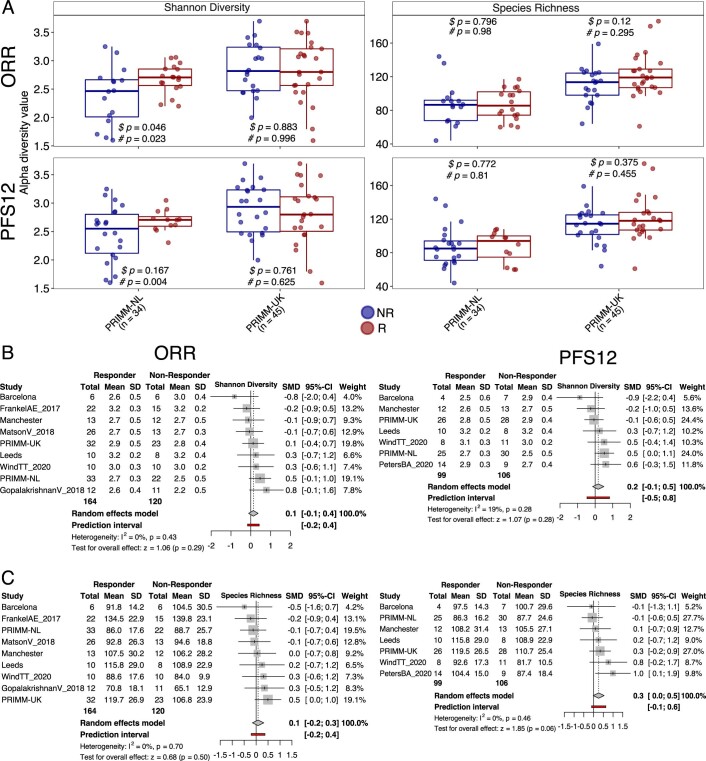
The composition of the gut microbiome has been associated with clinical responses to immune checkpoint inhibitor (ICI) treatment, but there is limited consensus on the specific microbiome characteristics linked to the clinical benefits of ICIs. We performed shotgun metagenomic sequencing of stool samples collected before ICI initiation from five observational cohorts recruiting ICI-naive patients with advanced cutaneous melanoma (n = 165). Integrating the dataset with 147 metagenomic samples from previously published studies, we found that the gut microbiome has a relevant, but cohort-dependent, association with the response to ICIs. A machine learning analysis confirmed the link between the microbiome and overall response rates (ORRs) and progression-free survival (PFS) with ICIs but also revealed limited reproducibility of microbiome-based signatures across cohorts. Accordingly, a panel of species, including Bifidobacterium pseudocatenulatum, Roseburia spp. and Akkermansia muciniphila, associated with responders was identified, but no single species could be regarded as a fully consistent biomarker across studies. Overall, the role of the human gut microbiome in ICI response appears more complex than previously thought, extending beyond differing microbial species simply present or absent in responders and nonresponders. Future studies should adopt larger sample sizes and take into account the complex interplay of clinical factors with the gut microbiome over the treatment course.
Overview
CoChat Summary
TL;DR
In five new observational cohorts of ICI-naive patients with advanced cutaneous melanoma (n = 165 baseline stool metagenomes), integrated with 147 published metagenomes, the gut microbiome was associated with ICI response but in a cohort-dependent manner. Machine learning confirmed some within-cohort predictive signal, yet no single taxonomic or functional biomarker was fully reproducible across cohorts.
Key findings
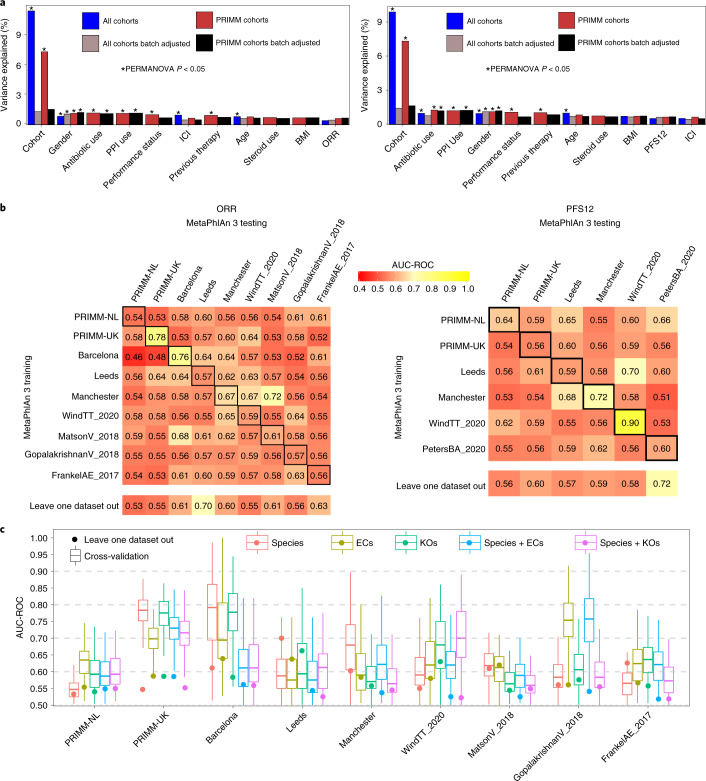
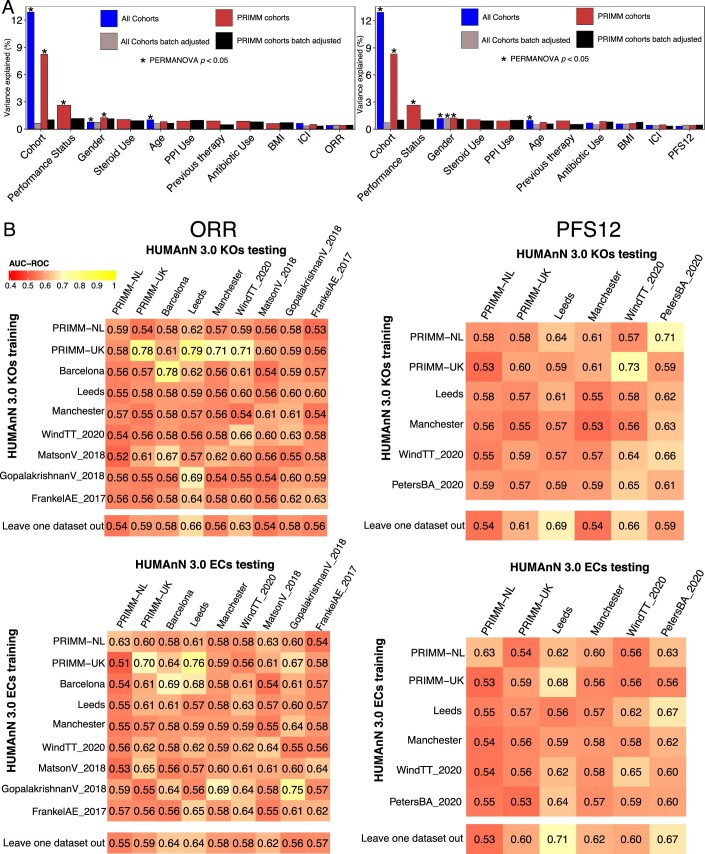
- The gut microbiome showed a relevant but cohort-dependent association with ICI response: cohort explained nearly ten times more variance than any other variable, and ORR/PFS12 explained only a limited fraction of total microbiome variation after batch correction.
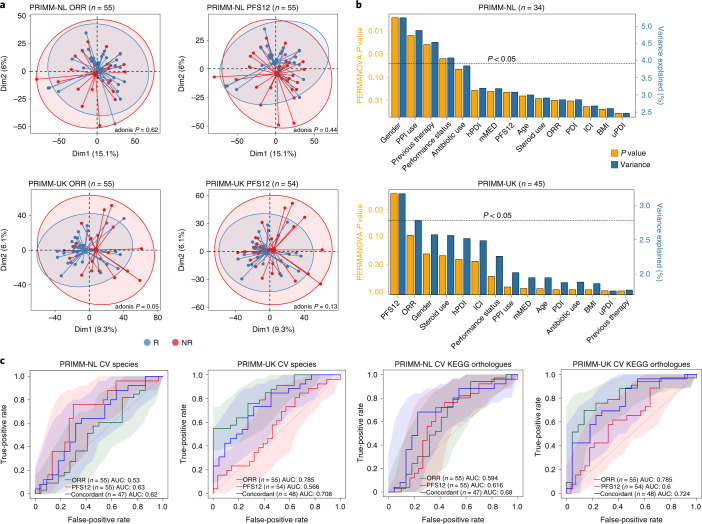
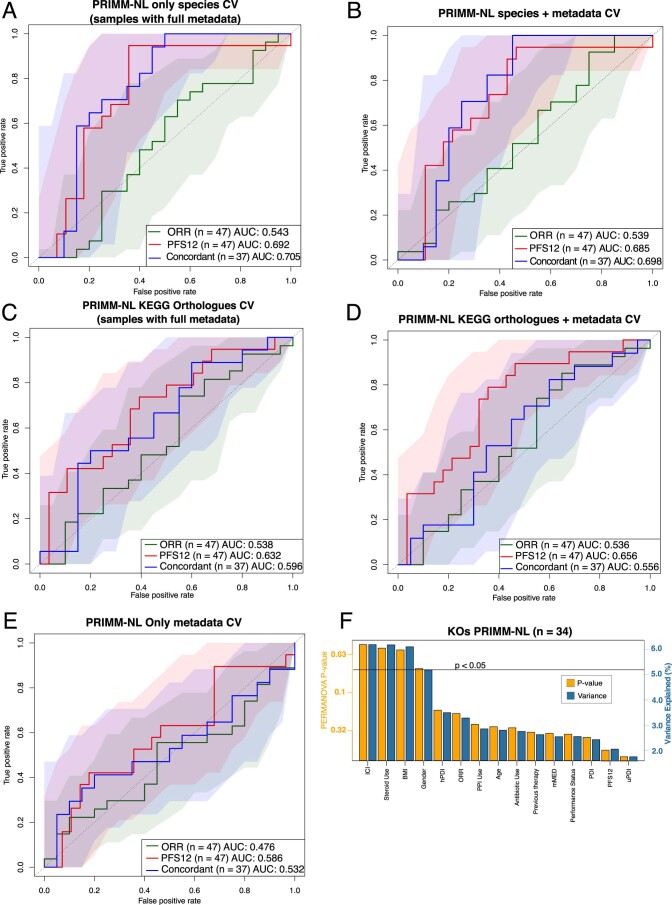
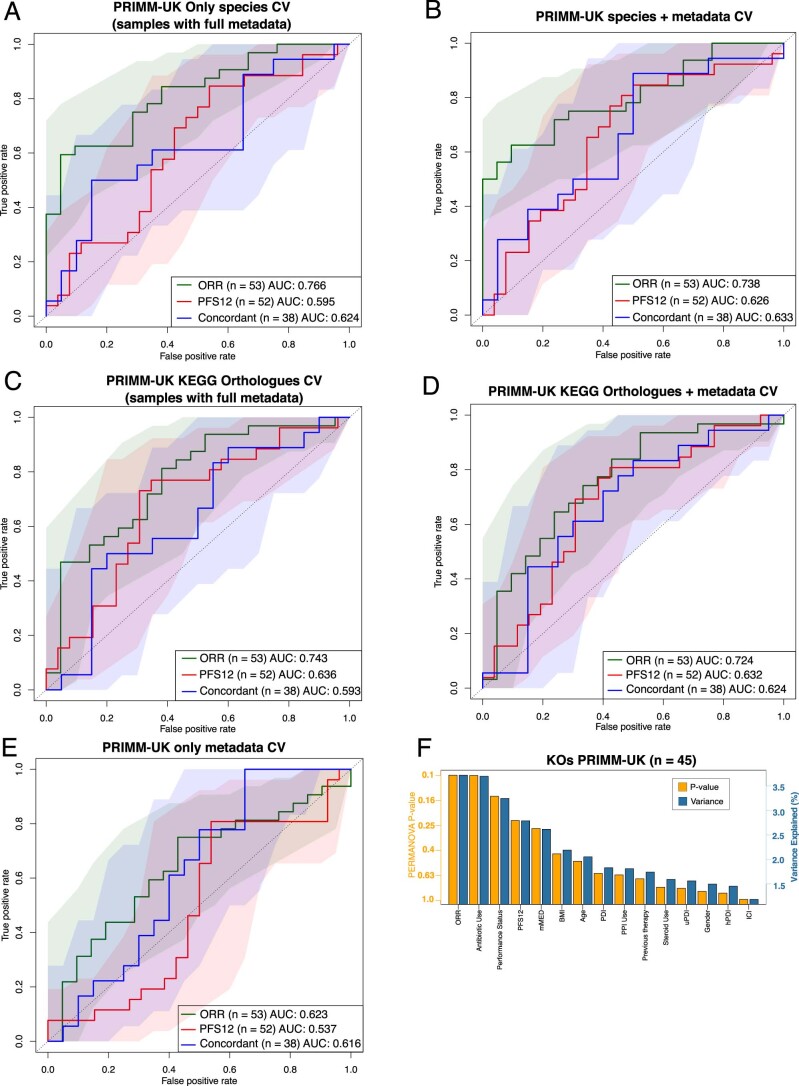
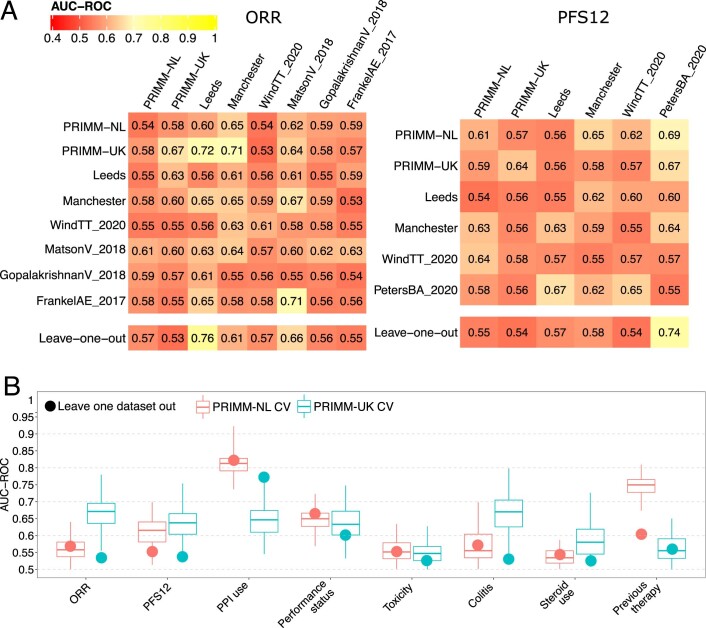
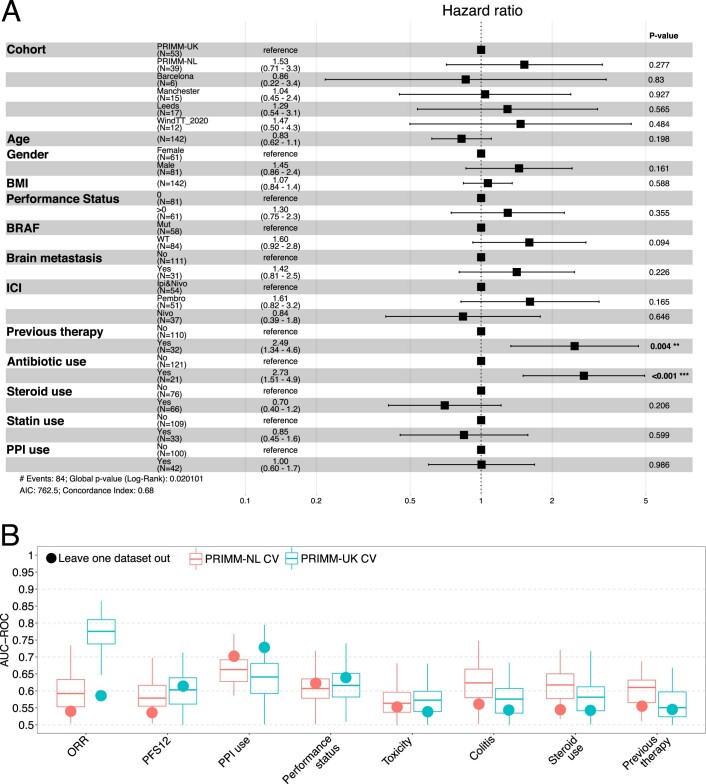
- Within-cohort machine learning prediction varied by cohort and endpoint: PRIMM-UK ORR AUC-ROC 0.78 and PRIMM-NL PFS12 AUC-ROC 0.64, whereas PRIMM-NL ORR and PRIMM-UK PFS12 were much lower (0.53 and 0.57, respectively); functional KEGG ortholog profiles exceeded AUC-ROC 0.59 for both datasets and endpoints.
- Cross-cohort prediction was limited: AUC-ROC reached 0.7 in only two cases and exceeded 0.6 in about one-third of cases (31.4%); leave-one-dataset-out models averaged 0.59 for ORR and 0.60 for PFS12.
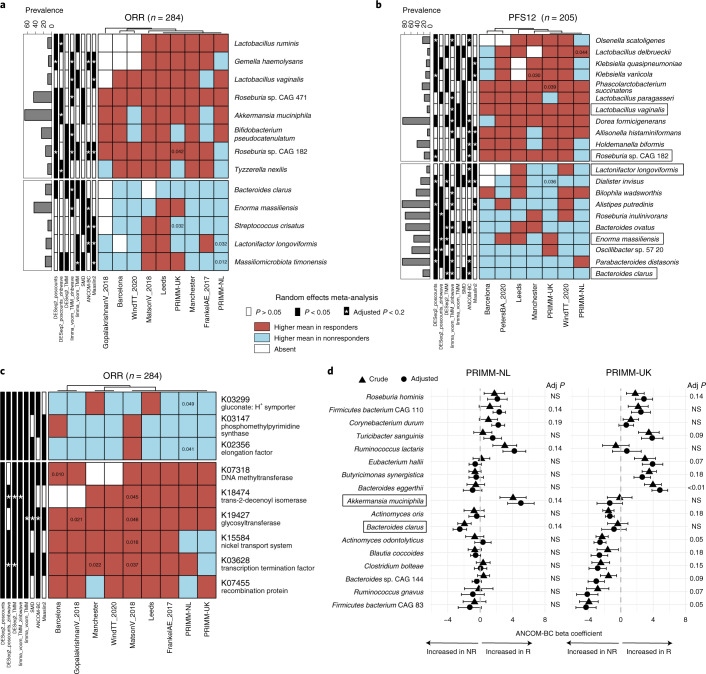
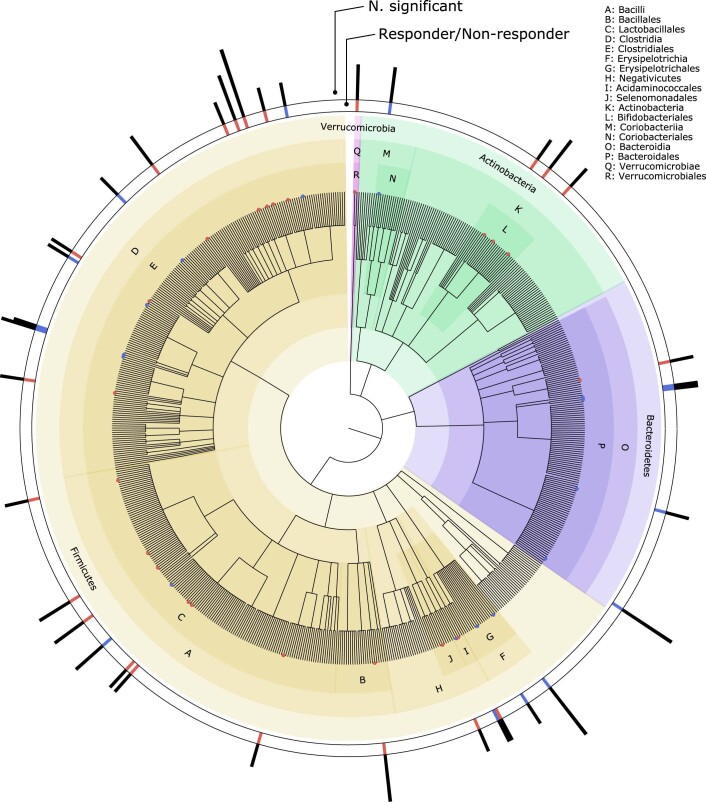
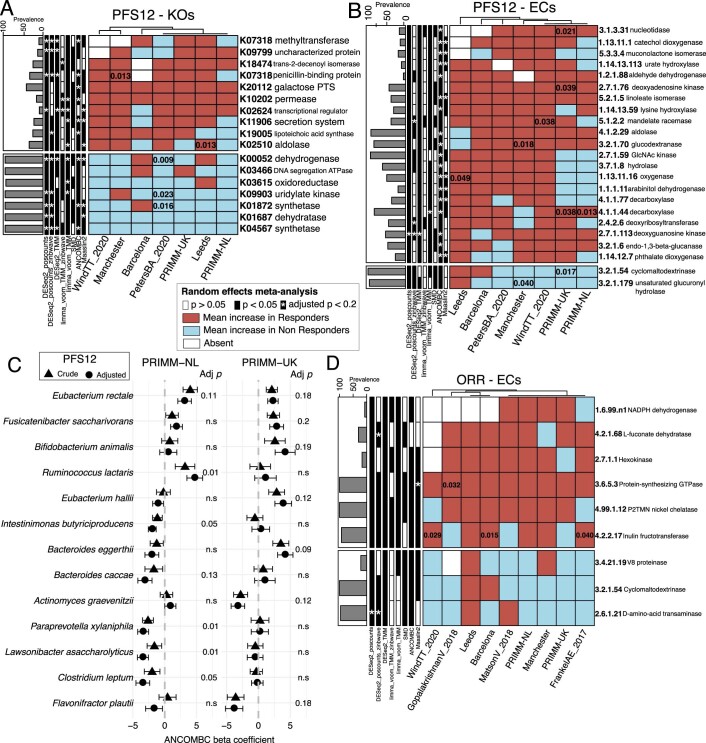
- Response-associated taxa included Roseburia sp. CAG:182 and Roseburia sp. CAG:471 for ORR, Phascolarctobacterium succinatutens and Lactobacillus vaginalis for PFS12, and Akkermansia muciniphila and Dorea formicigenerans for ORR/PFS12; Bacteroides clarus was higher in nonresponders, but no single species was a fully consistent biomarker across all datasets.
Methods
- Prospective PRIMM-UK and PRIMM-NL cohorts plus Barcelona, Leeds and Manchester cohorts recruited ICI-naive patients with unresectable stage III/IV cutaneous melanoma; baseline stool samples were collected before ICI treatment, with 175 patients recruited and 165 samples passing strict QC, analyzed alongside 147 publicly available metagenomes.
- Shotgun metagenomic sequencing averaged 7.74 Gb per sample; taxonomic and functional profiling used bioBakery 3 (MetaPhlAn 3.0, HUMAnN 3.0), identifying 608 species, 510 pathways, 6,131 KOs and 2,558 enzyme categories in the 165 samples.
- Response was classified by RECIST v1.1 as ORR (CR/PR/SD vs PD) and PFS12; analyses included PERMANOVA, an ensemble of eight differential abundance methods with random-effects meta-analysis, and SIAMCAT Lasso logistic regression with nested cross-validation, cross-study validation and leave-one-dataset-out testing.
Limitations
- Stated: individual cohort sample sizes remain small; collecting very large, properly annotated samples is inherently difficult in this clinical setting; response definition differences (ORR vs PFS12) and many confounding factors are hard to adjust for; cohort microbiome effects are strong; current methods lack characterization of the immunological interface.
- Stated: the authors call for larger sample sizes, strain-level and mucosal analyses, and extension beyond cutaneous melanoma to uveal/mucosal subtypes and other cancers.
- Evident from the reported results: cross-cohort reproducibility was limited, with modest AUC-ROC values and no single species consistently associated with response across all datasets.
Model-written summary. Check it against the paper before relying on it.
Integrity signals
Registry
Cites
Statistics
Figures
Verification
Claims the paper makes
6 Valid · 2 Not valid · 1 Not checked · 70 Own results and interpretations
The sources with a verdict support this claim; the rest weren’t checked yet, have no full text we could read, or their verdicts aren’t rated yet.
In the paper
“The gut microbiome has an important role to play in ICI response7,8, as we also confirmed here”
§ Cross-cohort gut microbiome associations with immune checkpoint inhibitor response in advanced melanoma > Discussion
What the sources say
- Not checked — no full text of the sourcecites [7] Baruch EN Fecal microbiota transplant promotes response in immunotherapy-refractory melanoma patients Science 2020 37 602 609 33303685 source
- Supportedcites [8] McQuade JL Gut microbiome modulation via fecal microbiota transplant to augment immunotherapy in patients with melanoma or other cancers. Curr. Oncol. Rep. 2020 22 74 10.1007/s11912-020-00913-y 32577835 PMC7685568 source
The Introduction says there is strong evidence that the gut microbiome shapes immunotherapy response. The ‘Background and rationale for FMT in immunotherapy’ section reports strong associations between the gut microbiome and checkpoint-blockade response in human cancer cohorts, including melanoma studies listed in the References. ‘As we also confirmed here’ refers to the citing authors’ own study, not a finding attributed to this review. (LLM, conf=0.92)
boostedstates an association- Asserted: passes — The authors put it forward as true.
- Checkable: passes — It can be checked against evidence.
- Load-bearing: passes — The paper’s conclusions depend on it.
- Based: passes — The paper gives a reason why it holds.
The sources with a verdict support this claim; the rest weren’t checked yet, have no full text we could read, or their verdicts aren’t rated yet.
In the paper
“Although we confirmed that the microbiome holds the potential to support the clinical practice for the treatment of patients with melanoma, as shown via fecal microbiota transplantation pilots7,8”
§ Cross-cohort gut microbiome associations with immune checkpoint inhibitor response in advanced melanoma > Discussion
What the sources say
- Not checked — no full text of the sourcecites [7] Baruch EN Fecal microbiota transplant promotes response in immunotherapy-refractory melanoma patients Science 2020 37 602 609 33303685 source
- Supportedcites [8] McQuade JL Gut microbiome modulation via fecal microbiota transplant to augment immunotherapy in patients with melanoma or other cancers. Curr. Oncol. Rep. 2020 22 74 10.1007/s11912-020-00913-y 32577835 PMC7685568 source
The Introduction describes microbiome modulation as a potential strategy to enhance immunotherapy response. In “Current efforts of FMT in immunotherapy” (page unavailable), the review reports preliminary responses in small melanoma FMT trials. It characterizes the field as nascent, consistent with the claim of potential rather than established clinical benefit. (LLM, conf=0.91)
hedgedstates a possible cause- Asserted: passes — The authors put it forward as true.
- Checkable: unclear — It is unclear whether it could be checked against evidence.
- Load-bearing: passes — The paper’s conclusions depend on it.
- Based: passes — The paper gives a reason why it holds.
A result the paper reports from its own data — it cites no other source for it, so there is none to check. The quote shows it is in the paper.
In the paper
“a panel of species, including Bifidobacterium pseudocatenulatum, Roseburia spp. and Akkermansia muciniphila, associated with responders was identified”
§ Cross-cohort gut microbiome associations with immune checkpoint inhibitor response in advanced melanoma > Abstract
plainstates an association- Asserted: passes — The authors put it forward as true.
- Checkable: passes — It can be checked against evidence.
- Load-bearing: passes — The paper’s conclusions depend on it.
- Based: passes — The paper gives a reason why it holds.
A result the paper reports from its own data — it cites no other source for it, so there is none to check. The quote shows it is in the paper.
In the paper
“we found a borderline statistically significant difference in the microbiome composition of responders compared to nonresponders in the PRIMM-UK cohort (permutational multivariate analysis of variance (PERMANOVA) P = 0.05, Fig. 1a)”
§ Cross-cohort gut microbiome associations with immune checkpoint inhibitor response in advanced melanoma > Results > Linking the gut microbiome with response in the PRIMM cohorts
plainstates an association- Asserted: passes — The authors put it forward as true.
- Checkable: passes — It can be checked against evidence.
- Load-bearing: passes — The paper’s conclusions depend on it.
- Based: passes — The paper gives a reason why it holds.
A result the paper reports from its own data — it cites no other source for it, so there is none to check. The quote shows it is in the paper.
In the paper
“we found that the gut microbiome has a relevant, but cohort-dependent, association with the response to ICIs.”
- Also stated in: § Linking the gut microbiome with response in the PRIMM cohorts · hedged
“These findings show that the gut microbiome does have a relevant association with response to ICIs but appears to be cohort dependent and is likely due to features of the microbial community that are not responsible for large shifts in the global microbiome composition.”
§ Cross-cohort gut microbiome associations with immune checkpoint inhibitor response in advanced melanoma > Abstract
plainstates an associationn = 165- Asserted: passes — The authors put it forward as true.
- Checkable: passes — It can be checked against evidence.
- Load-bearing: passes — The paper’s conclusions depend on it.
- Based: passes — The paper gives a reason why it holds.
- Also stated in: § Linking the gut microbiome with response in the PRIMM cohorts · hedged
23 more claims
Create a free account to see all 79 claims and every source verdict.
- Probably not a substantial claim. 24
- It may state two separate claims as one. 34
Claims other papers make about this one
Each is checked against this paper’s own text: does it say what the citing paper says it does?
The source backs part of the claim, not all of it — or backs it for a different population, condition or comparison.
In the citing paper
“In multiple cancer types, gut microbiota composition has been associated with response and adverse effects of immune checkpoint inhibitors (ICIs) [2, 3, 4].”
From Gut microbiota diversity is prognostic and associated with benefit from chemo-immunotherapy in metastatic triple-negative breast cancer (2025) · cites this paper as [2]
Experimental — accuracy not yet measuredThe source backs part of the claim, not all of it — or backs it for a different population, condition or comparison.
In the citing paper
“Associations between alpha diversity and cancer patient outcomes have been found in the setting of patients receiving hematopoietic cell transplant 29 or cervical cancer chemoradiation 30 but not in anti-PD-1 recipients with metastatic melanoma 16,18 ; thus, such associations may be treatment regimen specific.”
From A gut microbial signature for combination immune checkpoint blockade across cancer types (2024) · cites this paper as [18]
Experimental — accuracy not yet measuredThe source backs part of the claim, not all of it — or backs it for a different population, condition or comparison.
In the citing paper
“Our meta-analysis of microbial sequencing data from nine independent αPD-1-treated melanoma cohorts82–88 revealed a higher abundance of pfl, a key enzyme in bacterial formate production, linked to ICI efficacy.”
From Exercise-induced microbiota metabolite enhances CD8 T cell antitumor immunity promoting immunotherapy efficacy (2025) · cites this paper as [82]
Experimental — accuracy not yet measuredThe source backs part of the claim, not all of it — or backs it for a different population, condition or comparison.
In the citing paper
“First, correlations have been drawn across cancer indications and geographical sites between the taxonomic composition of the gut (and to some degree tumor) microbiota, and ICI responses in patients with melanoma and other cancers.”
From Melanoma and microbiota: Current understanding and future directions (2024) · cites this paper as [19]
Experimental — accuracy not yet measuredThe source backs part of the claim, not all of it — or backs it for a different population, condition or comparison.
In the citing paper
“For instance, broad-spectrum antibiotic treatment reduced the intestinal abundances of microbes in our patients such as Roseburia, Bifidobacterium or Ruminococcus spp., which were previously associated with beneficial outcomes of ICB cancer immunotherapies1,36.”
From A non-antibiotic-disrupted gut microbiome is associated with clinical responses to CD19-CAR-T cell cancer immunotherapy (2023) · cites this paper as [36]
Experimental — accuracy not yet measured
22 more claims about this paper
Create a free account to see every claim other papers make about this one.
Citations
Cites
Moderated estimation of fold change and dispersion for RNA-seq data with DESeq2
Love, M. I., Huber, W., & Anders, S. (2014) · Genome Biology · doi:10.1186/s13059-014-0550-8 · Cited by 95,106
Fast gapped-read alignment with Bowtie 2
Langmead, B., & Salzberg, S. L. (2012) · Nature Methods · doi:10.1038/nmeth.1923 · Cited by 56,400
Robinson, M. D., McCarthy, D. J., & Smyth, G. K. (2010) · Bioinformatics · doi:10.1093/bioinformatics/btp616 · Cited by 41,364
limma powers differential expression analyses for RNA-sequencing and microarray studies
Ritchie, M. E., Phipson, B., Wu, D., Hu, Y., Law, C. W., Shi, W., & Smyth, G. K. (2015) · Nucleic Acids Research · doi:10.1093/nar/gkv007 · Cited by 40,458
Adverse Renal Effects of Immune Checkpoint Inhibitors: A Narrative Review
Wanchoo, R., Karam, S., Uppal, N. N., Barta, V. S., Deray, G., Devoe, C., Launay-Vacher, V., Jhaveri, K. D., & on behalf of Cancer and Kidney International Network Workgroup on Immune Checkpoint Inhibitors (2017) · American Journal of Nephrology · doi:10.1159/000455014 · Cited by 15,256
Adjusting batch effects in microarray expression data using empirical Bayes methods
Johnson, W. E., Li, C., & Rabinovic, A. (2007) · Biostatistics · doi:10.1093/biostatistics/kxj037 · Cited by 8,658
Combined Nivolumab and Ipilimumab or Monotherapy in Untreated Melanoma
Larkin, J., Chiarion-Sileni, V., Gonzalez, R., Grob, J. J., Cowey, C. L., Lao, C. D., Schadendorf, D., Dummer, R., Smylie, M., Rutkowski, P., et al. (2015) · New England Journal of Medicine · doi:10.1056/nejmoa1504030 · Cited by 8,157
KEGG as a reference resource for gene and protein annotation
Kanehisa, M., Sato, Y., Kawashima, M., Furumichi, M., & Tanabe, M. (2016) · Nucleic Acids Research · doi:10.1093/nar/gkv1070 · Cited by 7,387
Gut microbiome influences efficacy of PD-1-based immunotherapy against epithelial tumors
Routy, B., Le Chatelier, E., Derosa, L., Duong, C. P. M., Alou, M. T., Daillère, R., Fluckiger, A., Messaoudene, M., Rauber, C., Roberti, M. P., et al. (2018) · Science · doi:10.1126/science.aan3706 · Cited by 5,671
Self-citationOverall Survival with Combined Nivolumab and Ipilimumab in Advanced Melanoma
Wolchok, J. D., Chiarion-Sileni, V., Gonzalez, R., Rutkowski, P., Grob, J.-J., Cowey, C. L., Lao, C. D., Wagstaff, J., Schadendorf, D., Ferrucci, P. F., et al. (2017) · New England Journal of Medicine · doi:10.1056/nejmoa1709684 · Cited by 5,357
Cited by
Items 101–200 of 460
Zhu, X., Huang, X., Hu, M., Sun, R., Li, J., Wang, H., Pan, X., Ma, Y., Ning, L., Tong, T., et al. (2024) · Cell Host & Microbe · doi:10.1016/j.chom.2024.03.002 · Cited by 43
Macandog, A. D. G., Catozzi, C., Capone, M., Nabinejad, A., Nanaware, P. P., Liu, S., Vinjamuri, S., Stunnenberg, J. A., Galiè, S., Jodice, M. G., et al. (2024) · Cell Host & Microbe · doi:10.1016/j.chom.2024.10.006 · Cited by 40
Self-citationRheumatic Immune-Related Adverse Events due to Immune Checkpoint Inhibitors—A 2023 Update
Dang, Q. M., Watanabe, R., Shiomi, M., Fukumoto, K., Nobashi, T. W., Okano, T., Yamada, S., & Hashimoto, M. (2023) · International Journal of Molecular Sciences · doi:10.3390/ijms24065643 · Cited by 54
A decade of advances in human gut microbiome-derived biotherapeutics
Pribyl, A. L., Hugenholtz, P., & Cooper, M. A. (2025) · Nature Microbiology · doi:10.1038/s41564-024-01896-3 · Cited by 52
Yan, S., Yu, L., Tian, F., Zhao, J., Chen, W., Chen, H., & Zhai, Q. (2023) · Food & Function · doi:10.1039/d3fo03867j · Cited by 36
Towards a Health-Associated Core Keystone (HACK) index for the human gut microbiome
(2024) · doi:10.1101/2024.05.27.596018 · Cited by 37
Toward a health-associated core keystone index for the human gut microbiome
Goel, A., Shete, O., Goswami, S., Samal, A., C.B., L., Kedia, S., Ahuja, V., O’Toole, P. W., Shanahan, F., & Ghosh, T. S. (2025) · Cell Reports · doi:10.1016/j.celrep.2025.115378 · Cited by 37
CAR-T Cell Therapy and the Gut Microbiota
Asokan, S., Cullin, N., Stein‐Thoeringer, C. K., & Elinav, E. (2023) · Cancers · doi:10.3390/cancers15030794 · Cited by 42
The role of the gut microbiota in chemotherapy response, efficacy and toxicity: a systematic review
Böhm, D. T. M. M., Russ, E., Guchelaar, H., Ziemons, J., Penders, J., Smidt, M. L., van Best, N., & Deenen, M. J. (2025) · npj Precision Oncology · doi:10.1038/s41698-025-01034-0 · Cited by 62
Wekking, D., van den Ende, T., Bijlsma, M. F., Vidal-Itriago, A., Nieuwdorp, M., & van Laarhoven, H. W. M. (2025) · Cancer Treatment Reviews · doi:10.1016/j.ctrv.2025.103025 · Cited by 46
A toolbox of machine learning software to support microbiome analysis
Marcos-Zambrano, L. J., López-Molina, V. M., Bakır-Güngör, B., Frohme, M., Karađuzović-Hadžiabdić, K., Klammsteiner, T., Ibrahimi, E., Lahti, L., Lončar-Turukalo, T., Dhamo, X., et al. (2023) · Frontiers in Microbiology · doi:10.3389/fmicb.2023.1250806 · Cited by 52
Cheng, S., Han, Z., Dai, D., Li, F., Zhang, X., Lu, M. S., Lü, Z., Wang, X., Zhou, J., Li, J., et al. (2024) · Cell Reports Medicine · doi:10.1016/j.xcrm.2023.101355 · Cited by 58
Pharmacomicrobiomics: The Role of the Gut Microbiome in Immunomodulation and Cancer Therapy
Bolte, L. A., Björk, J. R., Gaćeša, R., & Weersma, R. K. (2025) · Gastroenterology · doi:10.1053/j.gastro.2025.04.025 · Cited by 43
Self-citationGuillot, N., Roméo, B., Manesh, S. S., Milano, G., Brest, P., Zitvogel, L., Hofman, P., & Mograbi, B. (2023) · Trends in Molecular Medicine · doi:10.1016/j.molmed.2023.08.004 · Cited by 36
Self-citationRahimi, A. R., Baghernejadan, Z., Hazrati, A., Malekpour, K., Samimi, L. N., Najafi, A., Falak, R., & Khorramdelazad, H. (2025) · Biomedicine & Pharmacotherapy · doi:10.1016/j.biopha.2025.118014 · Cited by 44
Type 1 diabetes: A new vision of the disease based on endotypes
Weston, C. S., Boehm, B. O., & Pozzilli, P. (2024) · Diabetes/Metabolism Research and Reviews · doi:10.1002/dmrr.3770 · Cited by 45
Fernandes, R., Jabbarizadeh, B., Rajeh, A., Hong, M. M. Y., Baines, K. J., Ernst, S., Winquist, E., Ali, A. S., Penny, S. L., Figueredo, R., et al. (2026) · Nature Medicine · doi:10.1038/s41591-025-04183-8 · Cited by 57
Liu, Y., Altreuter, J., Bodapati, S., Cristea, S., Wong, C. J., Wu, C. J., & Michor, F. (2023) · Cell Genomics · doi:10.1016/j.xgen.2023.100444 · Cited by 48
Hadi, D. K., Baines, K. J., Jabbarizadeh, B., Miller, W. H., Jamal, R., Ernst, S., Logan, D., Bélanger, K., Esfahani, K., Elkrief, A., et al. (2025) · Journal for ImmunoTherapy of Cancer · doi:10.1136/jitc-2025-012659 · Cited by 49
Zhuang, Y.-P., Zhou, H., Chen, H., Zheng, M.-Y., Liang, Y., Gu, Y.-T., Li, W., Qiu, W., & Zhou, H. (2023) · Biomedicine & Pharmacotherapy · doi:10.1016/j.biopha.2023.115040 · Cited by 38
Effects of the intestinal microbiota on prostate cancer treatment by androgen deprivation therapy
Terrisse, S. A., Zitvogel, L., & Kroemer, G. (2022) · Microbial Cell · doi:10.15698/mic2022.12.787 · Cited by 38
Self-citationAlves Costa Silva, C., Piccinno, G., Suissa, D., Bourgin, M., Schreibelt, G., Durand, S., Birebent, R., Fidelle, M., Sow, C., Aprahamian, F., et al. (2024) · Nature Communications · doi:10.1038/s41467-024-45357-1 · Cited by 33
“Indeed, shotgun MG-based taxonomic composition of feces at baseline was associated with objective response rates in patients with stage IV melanoma treated with anti-PD-1 alone or combined to anti-CTLA-4 in several independent cohorts 28 – 31 .”
Self-citationPietrzak, B., Tomela, K., Olejnik-Schmidt, A., Galus, Ł., Mackiewicz, J., Kaczmarek, M., Mackiewicz, A., & Schmidt, M. (2022) · Cancers · doi:10.3390/cancers14215369 · Cited by 36
“A recent study conducted on several cohorts of melanoma patients treated with ICI therapies demonstrated that the association between the gut microbiome and the response to ICIs is cohort-dependent, and the microbiome-based signatures are not consistent across cohorts [7]; therefore, our data provide an important supp…”
BackgroundZhang, L., Jin, Q., Chai, D., Kuang, T., Li, C., Guan, Y., Liu, L., Wang, W., & Deng, W. (2022) · Frontiers in Pharmacology · doi:10.3389/fphar.2022.937874 · Cited by 36
Jiang, H., & Zhang, Q. (2024) · Oncology Letters · doi:10.3892/ol.2024.14221 · Cited by 36
Jamal, R., Messaoudene, M., de Figuieredo, M., & Routy, B. (2023) · Seminars in Immunology · doi:10.1016/j.smim.2023.101754 · Cited by 31
Tonneau, M., Nolin-Lapalme, A., Kazandjian, S., Auclin, E., Panasci, J., Benlaifaoui, M., Ponce, M., Al-Saleh, A., Belkaid, W., Naimi, S., et al. (2022) · OncoImmunology · doi:10.1080/2162402x.2022.2096535 · Cited by 34
Elkrief, A., Routy, B., Derosa, L., Bolte, L. A., Wargo, J. A., McQuade, J. L., & Zitvogel, L. (2025) · American Society of Clinical Oncology Educational Book · doi:10.1200/edbk-25-472902 · Cited by 43
Self-citationCheckpoint inhibitor responses can be regulated by the gut microbiota – A systematic review
Zeriouh, M., Raskov, H., Kvich, L., Gögenür, I., & Bennedsen, A. L. B. (2023) · Neoplasia · doi:10.1016/j.neo.2023.100923 · Cited by 33
Williams, K. C., Gault, A., Anderson, A. E., Stewart, C. J., Lamb, C. A., Speight, R. A., Rajan, N., Plummer, R., & Pratt, A. G. (2023) · Frontiers in Immunology · doi:10.3389/fimmu.2023.1122430 · Cited by 29
Gut microbiome and immune checkpoint inhibitor toxicity
Verheijden, R. J., van Eijs, M. J. M., Paganelli, F. L., Viveen, M. C., Rogers, M. R. C., Top, J., May, A. M., van de Wijgert, J. H. H. M., & Suijkerbuijk, K. P. M. (2025) · European Journal of Cancer · doi:10.1016/j.ejca.2025.115221 · Cited by 38
Pharma[e]cology: How the Gut Microbiome Contributes to Variations in Drug Response
Trepka, K. R., Olson, C. A., Upadhyay, V., Zhang, C., & Turnbaugh, P. J. (2024) · The Annual Review of Pharmacology and Toxicology · doi:10.1146/annurev-pharmtox-022724-100847 · Cited by 36
Haberman, Y., Kamer, I., Amir, A., Goldenberg, S., Efroni, G., Daniel‐Meshulam, I., Lobachov, A., Daher, S., Hadar, R., Gantz-Sorotsky, H., et al. (2023) · Scientific Reports · doi:10.1038/s41598-023-29136-4 · Cited by 34
Mannose Enhances Immunotherapy Efficacy in Ovarian Cancer by Modulating Gut Microbial Metabolites
Zhang, C., Wang, Y., He, M., Wang, C., Cao, K., Zhong, Y., Wang, X., Yang, M., Zhang, G., Lu, J., et al. (2025) · Cancer Research · doi:10.1158/0008-5472.can-24-3209 · Cited by 37
Cai, Y., Xiao, H., Xue, S., Li, P., Zhan, Z., Lin, J., Song, Z., Liu, J., Xu, W., Zhou, Q., et al. (2025) · Journal of Experimental & Clinical Cancer Research · doi:10.1186/s13046-025-03301-1 · Cited by 38
Song, R., Liu, F., Yu, P., Zhang, Y., & Wang, L. (2023) · Biomarker Research · doi:10.1186/s40364-023-00498-1 · Cited by 29
Role of microbiota and microbiota‐derived short‐chain fatty acids in PDAC
TEMEL, H. Y., Kaymak, Ö., Kaplan, S., Bahcivanci, B., Gkoutos, G. V., & Acharjee, A. (2022) · Cancer Medicine · doi:10.1002/cam4.5323 · Cited by 36
Microbial mechanisms to improve immune checkpoint blockade responsiveness
Griffin, M. E., & Hang, H. C. (2022) · Neoplasia · doi:10.1016/j.neo.2022.100818 · Cited by 31
Nanobodies and their derivatives: pioneering the future of cancer immunotherapy
Li, H., Zhou, Q., Cao, N., Hu, C., Wang, J., He, Y. T., Jiang, S., Li, Q., Chen, M., Li, G., et al. (2025) · Cell Communication and Signaling · doi:10.1186/s12964-025-02270-4 · Cited by 35
Knisely, A. T., Seo, Y. D., Wargo, J. A., & Chelvanambi, M. (2023) · Cancers · doi:10.3390/cancers15030777 · Cited by 32
Ullern, A., Holm, K., Røssevold, A. H., Andresen, N. K., Bang, C., Lingjærde, O. C., Naume, B., Hov, J. R., & Kyte, J. A. (2025) · Molecular Oncology · doi:10.1002/1878-0261.13760 · Cited by 25
Microbiome-Based Interventions for Food Safety and Environmental Health
Simon, B. O., Nnaji, N. D., Anumudu, C. K., Aleke, J. C., Ekwueme, C. T., Uhegwu, C. C., Ihenetu, F. C., Obioha, P., Ifedinezi, O. V., Ezechukwu, P. S., et al. (2025) · Applied Sciences · doi:10.3390/app15095219 · Cited by 29
Gut Microbiome in Patients With Early-Stage and Late-Stage Melanoma
Witt, R. G., Cass, S. H., Tran, T., Damania, A. V., Nelson, E. E., Sirmans, E., Burton, E. M., Chelvanambi, M., Johnson, S. B., Tawbi, H. A., et al. (2023) · JAMA Dermatology · doi:10.1001/jamadermatol.2023.2955 · Cited by 29
Maesaka, K., Sakamori, R., Yamada, R., Doi, A., Tahata, Y., Ohkawa, K., Oshita, M., Miyazaki, M., Yakushijin, T., Nozaki, Y., et al. (2023) · PLoS ONE · doi:10.1371/journal.pone.0281459 · Cited by 30
How Can the Microbiome Induce Carcinogenesis and Modulate Drug Resistance in Cancer Therapy?
Mendes, I., & Vale, N. (2023) · International Journal of Molecular Sciences · doi:10.3390/ijms241411855 · Cited by 24
Microbiome influence in gastric cancer progression and therapeutic strategies
Bautista, J., Maldonado-Noboa, I., Maldonado-Guerrero, D., Reinoso-Quinga, L., & López‐Cortés, A. (2025) · Frontiers in Medicine · doi:10.3389/fmed.2025.1681824 · Cited by 31
Messaoudene, M., Ferreira, S., Saint-Lu, N., Ponce, M., Truntzer, C., Boidot, R., Le Bescop, C., Loppinet, T., Corbel, T., Féger, C., et al. (2024) · Nature Communications · doi:10.1038/s41467-024-52373-8 · Cited by 24
“…cell carcinoma (RCC) revealed compelling evidence that speci fi c bacteria such as Akkermansia muciniphila, Ruminococcus, and Eubacter-ium were associated with recruitment of intratumor CD8 + T cells, interferon gamma (INF γ ) signalling pathway, and correlated with bene fi cialICI response 9 – 12 .”
Zeng, Y., Shi, Q., Liu, X., Tang, H. T., Lu, B., Zhou, Q., Xu, Y., Chen, M., Zhao, J., Li, Y., et al. (2023) · Frontiers in Oncology · doi:10.3389/fonc.2023.1144534 · Cited by 26
Impact of the ONCOBIOME network in cancer microbiome research
Zitvogel, L., Derosa, L., Routy, B., Loibl, S., Heinzerling, L., de Vries, I. J. M., Engstrand, L., ONCOBIOME Network, Silva, C. A. C., Barbieri, D., et al. (2025) · Nature Medicine · doi:10.1038/s41591-025-03608-8 · Cited by 23
“…melanoma facilitated the development of the ONCOBIOME computational analysis pipeline, corroborating a strong link between the gut microbiome and progression-free survival, but revealed limited reproducibility of metastatic melanoma GOMS across distinct publicly available datasets 19,38 .”
Self-citationGut microbiota in women: The secret of psychological and physical well-being
Marano, G., Traversi, G., Gaetani, E., Gasbarrini, A., & Mazza, M. (2023) · World Journal of Gastroenterology · doi:10.3748/wjg.v29.i45.5945 · Cited by 32
Biomarker-Driven Personalization of Neoadjuvant Immunotherapy in Melanoma
Hoeijmakers, L. L., Reijers, I. L. M., & Blank, C. U. (2023) · Cancer Discovery · doi:10.1158/2159-8290.cd-23-0352 · Cited by 28
Gut Microbiota–Related Biomarkers in Immuno-Oncology
Silva, C. A. C., Fidelle, M., Almonte, A. A., Derosa, L., & Zitvogel, L. (2025) · Annual Review of Pharmacology and Toxicology · doi:10.1146/annurev-pharmtox-061124-102218 · Cited by 22
Self-citationChen, M., Ma, L., Yu, H., Huang, S., Zhang, J., Gong, J., Yang, L., Chen, L., Luo, H., Tian, L., et al. (2023) · Frontiers in Oncology · doi:10.3389/fonc.2023.1155592 · Cited by 31
Tian, M., Fan, D., Liu, Z., Mu, X., Tao, Q., Yu, C., & Zhang, S. (2022) · Advanced Materials · doi:10.1002/adma.202205299 · Cited by 23
Shi, X., Jiang, A., Qiu, Z., Lin, A., Liu, Z., Zhu, L., Mou, W., Cheng, Q., Zhang, J., Miao, K., et al. (2024) · Frontiers of Medicine · doi:10.1007/s11684-024-1094-2 · Cited by 27
Chen, L., Li, B., Zu, M., Reis, R. L., Kundu, S. C., & Xiao, B. (2025) · Seminars in Cancer Biology · doi:10.1016/j.semcancer.2025.06.012 · Cited by 24
Diverse effects of obesity on antitumor immunity and immunotherapy
Dyck, L., & Lynch, L. (2022) · Trends in Molecular Medicine · doi:10.1016/j.molmed.2022.11.004 · Cited by 26
Proton pump inhibitors and cancer treatments: Emerging evidence against coadministration
Raoul, J., & Hansten, P. D. (2024) · Cancer Treatment Reviews · doi:10.1016/j.ctrv.2024.102794 · Cited by 28
Immune-mediated colitis after immune checkpoint inhibitor therapy
Giesler, S., Riemer, R., Lowinus, T., & Zeiser, R. (2024) · Trends in Molecular Medicine · doi:10.1016/j.molmed.2024.09.009 · Cited by 30
Wekking, D., Silva, C. A. C., Viscò, R., Denaro, N., Lambertini, M., Maccioni, A., Loddo, E., Willard-Gallo, K. E., Scartozzi, M., Derosa, L., et al. (2025) · Critical Reviews in Oncology/Hematology · doi:10.1016/j.critrevonc.2025.104767 · Cited by 30
Self-citationManghi, P., Antonello, G., Schiffer, L., Golzato, D., Wokaty, A., Beghini, F., Mirzayi, C. A., Long, K., Gravel-Pucillo, K., Piccinno, G., et al. (2025) · Nature Communications · doi:10.1038/s41467-025-66888-1 · Cited by 34
Self-citationAI Model for Predicting Anti-PD1 Response in Melanoma Using Multi-Omics Biomarkers
Gschwind, A., & Ossowski, S. (2025) · Cancers · doi:10.3390/cancers17050714 · Cited by 33
Chen, C., Deng, C., Li, Y., He, S., Liu, Y., Pan, S., Xu, W., Fang, L., Zhu, Y., Wang, Y., et al. (2025) · Journal of Translational Medicine · doi:10.1186/s12967-025-06339-z · Cited by 20
Hes, C., Desîlets, A., Tonneau, M., Ouarzadi, O. E., Sousa, M. D. F., Bahig, H., Filion, É., Nguyen‐Tan, P. F., Christopoulos, A., Benlaïfaoui, M., et al. (2023) · Oral Oncology · doi:10.1016/j.oraloncology.2023.106623 · Cited by 22
Self-citationRahman, G., Morton, J. T., Martino, C., Sepich‐Poore, G. D., Allaband, C., Guccione, C., Chen, Y., Hakim, D., Estaki, M., & Knight, R. D. (2023) · bioRxiv (Cold Spring Harbor Laboratory) · doi:10.1101/2023.01.30.526328 · Cited by 20
Microbiome modulation of tumorigenesis and immune responses
Chen, Y., Fang, Y., Lyu, Z., Tian, Y., Niu, S., Li, Y.-R., & Yang, L. (2026) · Journal of Biomedical Science · doi:10.1186/s12929-025-01208-9 · Cited by 30
Clinical Evidence for Microbiome-Based Strategies in Cancer Immunotherapy: A State-of-the-Art Review
Petrelli, F., Ghidini, A., Dottorini, L., Ghidini, M., Zaniboni, A., & Tomasello, G. (2025) · Medicina · doi:10.3390/medicina61091595 · Cited by 33
Consistent Stool Metagenomic Biomarkers Associated with the Response To Melanoma Immunotherapy
Olekhnovich, E. I., Ivanov, A. B., Babkina, A. A., Sokolov, A. A., Игоревич, У. В., Fedorov, D. E., & Ilina, E. N. (2023) · mSystems · doi:10.1128/msystems.01023-22 · Cited by 21
Impact of microbiota on breast cancer hormone therapy
Terrisse, S. A., Zitvogel, L., & Kroemer, G. (2023) · Cell Stress · doi:10.15698/cst2023.03.277 · Cited by 22
Self-citationHarnessing Bacterial Extracellular Vesicle Immune Effects for Cancer Therapy
Karaman, İ., Pathak, A., Bayık, D., & Watson, D. C. (2024) · Pathogens and Immunity · doi:10.20411/pai.v9i1.657 · Cited by 20
Expansion of a bacterial operon during cancer treatment ameliorates fluoropyrimidine toxicity
Trepka, K. R., Kidder, W. A., Kyaw, T. S., Halsey, T. M., Olson, C. A., Ortega, E. F., Noecker, C. A., Upadhyay, V., Stanfield, D., Steiding, P., et al. (2025) · Science Translational Medicine · doi:10.1126/scitranslmed.adq8870 · Cited by 30
Update on Immune Checkpoint Inhibitor Enterocolitis
Kelly‐Goss, M. R., Badran, Y. R., & Dougan, M. L. (2022) · Current Gastroenterology Reports · doi:10.1007/s11894-022-00852-7 · Cited by 19
Fecal Microbiota Transplantation as a Cancer Therapeutic
Stoff, R., Wolf, Y., & Boursi, B. (2023) · The Cancer Journal · doi:10.1097/ppo.0000000000000651 · Cited by 23
Cesano, A., Augustin, R. C., Barrea, L., Bedognetti, D., Bruno, T. C., Carturan, A., Hammer, C., Ho, W. S., Kather, J. N., Kirchhoff, T., et al. (2025) · Journal for ImmunoTherapy of Cancer · doi:10.1136/jitc-2024-008876 · Cited by 25
Microbiota-centered interventions to boost immune checkpoint blockade therapies
Almonte, A. A., Thomas, S., & Zitvogel, L. (2025) · Journal of Experimental Medicine · doi:10.1084/jem.20250378 · Cited by 19
Self-citationSun, L., Wang, X., Zhou, H., Li, R., Meng, M., Roviello, G., Oh, B., Feng, L., Yu, Z., & Wang, J. (2024) · Journal of Thoracic Disease · doi:10.21037/jtd-24-1201 · Cited by 24
Curing Stage IV Melanoma: Where Have We Been and Where Are We?
Chan, P. Y., & Corrie, P. G. (2024) · American Society of Clinical Oncology Educational Book · doi:10.1200/edbk_438654 · Cited by 20
Could the tumor-associated microbiota be the new multi-faceted player in the tumor microenvironment?
Goubet, A. (2023) · Frontiers in Oncology · doi:10.3389/fonc.2023.1185163 · Cited by 19
Microbiota: A key factor affecting and regulating the efficacy of immunotherapy
Jiang, Y., Jia, D., Sun, Y., Ding, N., & Wang, L. (2023) · Clinical and Translational Medicine · doi:10.1002/ctm2.1508 · Cited by 22
Gorgulho, J., Roderburg, C., Beier, F., Bokemeyer, C., Brümmendorf, T. H., Luedde, T., & Loosen, S. H. (2023) · Frontiers in Immunology · doi:10.3389/fimmu.2023.1206953 · Cited by 14
Gut microbiome in IBD: past, present and the future
Zhang, J., Mak, J. W. Y., & Ng, S. C. (2025) · Gut · doi:10.1136/gutjnl-2025-335626 · Cited by 28
Sigawi, T., Israeli, A., & Ilan, Y. (2024) · ImmunoTargets and Therapy · doi:10.2147/itt.s477841 · Cited by 24
Sucralose Consumption Ablates Cancer Immunotherapy Response through Microbiome Disruption
Morder, K. M., Nguyen, M., Wilfahrt, D. N., Dahmani, Z. L., Burr, A. B. P., Xie, B., Morikone, M., Nieves-Rosado, H. M., Gunn, W. G., Hurd, D. E., et al. (2025) · Cancer Discovery · doi:10.1158/2159-8290.cd-25-0247 · Cited by 30
Austin, G. I., Kav, A. B., ElNaggar, S., Park, H., Biermann, J., Uhlemann, A., Pe’er, I., & Korem, T. (2025) · Nature Microbiology · doi:10.1038/s41564-025-01954-4 · Cited by 30
Aldriwesh, M. G., Alotibi, R. S., Alqurainy, N., Alrabiah, S., Arafah, A. M., Alghoribi, M. F., & Ajina, R. (2025) · Gut Microbes · doi:10.1080/19490976.2025.2607076 · Cited by 24
‘Know thyself’ – host factors influencing cancer response to immune checkpoint inhibitors
Gunjur, A., Manrique-Rincón, A., Klein, O., Behren, A., Lawley, T. D., Welsh, S. J., & Adams, D. J. (2022) · The Journal of Pathology · doi:10.1002/path.5907 · Cited by 20
Zhou, H., Balint, D., Shi, Q., Vartanian, T., Kriegel, M. A., & Brito, I. (2024) · Annals of the Rheumatic Diseases · doi:10.1136/ard-2024-225829 · Cited by 24
Advances in capsule-based fecal microbiota transplantation: clinical applications and innovations
He, Y., Zhang, Y., Yang, D., Luo, H., & Zhou, Y. (2025) · Journal of Translational Medicine · doi:10.1186/s12967-025-07407-0 · Cited by 20
Li, J., Guo, Y., Liu, J., Guo, F., Du, L., Yang, Y. P., Li, X., & Ma, Y. (2023) · Journal for ImmunoTherapy of Cancer · doi:10.1136/jitc-2023-007420 · Cited by 19
The microbiome as a therapeutic co-driver in melanoma immuno-oncology
Bautista, J., Chávez, J. A. V., Larco, D. S. B., Martín-Aguilera, R., & López‐Cortés, A. (2025) · Frontiers in Medicine · doi:10.3389/fmed.2025.1673880 · Cited by 28
Within-host bacterial evolution and the emergence of pathogenicity
Tonkin‐Hill, G. Q., Ruis, C., Bentley, S. D., Lythgoe, K., & Bryant, J. M. (2025) · Nature Microbiology · doi:10.1038/s41564-025-02036-1 · Cited by 33
Golčić, M., Simetić, L., Herceg, D., Blažičević, K., Jovanović, G. K., Dražić, I., Belančić, A., Skočibušić, N., Palčevski, D., Rubinić, I., et al. (2023) · Cancers · doi:10.3390/cancers15113052 · Cited by 18
Pellitero, A. M., Zapata, M. E. S., Ruiz, M. G., Sesma, A., Quílez, E., Ramírez-Labrada, A., Martínez‐Lostao, L., Domingo, M. P., Esteban, P., Yubero, A., et al. (2024) · Cancers · doi:10.3390/cancers16061144 · Cited by 18
Too much water drowned the miller: Akkermansia determines immunotherapy responses
Li, L., & McAllister, F. M. (2022) · Cell Reports Medicine · doi:10.1016/j.xcrm.2022.100642 · Cited by 21
Sterility testing of germ-free mouse colonies
Dremova, O., Mimmler, M., Paeslack, N., Khuu, M. P., Gao, Z., Bosmann, M., Garo, L. P., Schön, N., Mechler, A., Beneich, Y., et al. (2023) · Frontiers in Immunology · doi:10.3389/fimmu.2023.1275109 · Cited by 22
Rethinking the rise of early-onset gastrointestinal cancers: a call to action
Weinberg, B. A., Murphy, C. C., Freyer, D. R., Greathouse, K. L., Blancato, J. K., Stoffel, E. M., Drewes, J. L., Blaes, A. H., Salsman, J. M., You, Y. N., et al. (2025) · JNCI Cancer Spectrum · doi:10.1093/jncics/pkaf002 · Cited by 20
Baseline colitogenicity and acute perturbations of gut microbiota in immunotherapy-related colitis
Shang, J., Valle, D. M. D., Britton, G. J., Mead, K., Rajpal, U., Chen-Liaw, A., Mogno, I., Li, Z., Menon, R., Gonzalez‐Kozlova, E., et al. (2024) · The Journal of Experimental Medicine · doi:10.1084/jem.20232079 · Cited by 17
Eating away cancer: the potential of diet and the microbiome for shaping immunotherapy outcome
Nguyen, N.-T. A., Jiang, Y., & McQuade, J. L. (2024) · Frontiers in Immunology · doi:10.3389/fimmu.2024.1409414 · Cited by 23
Microbiota configuration determines nutritional immune optimization
Han, S., Stacy, A., Corral, D., Link, V. M., Siqueira, M. K. D., Chi, L., Teijeiro, A., Yong, D., Pérez‐Chaparro, P. J., Bouladoux, N. J., et al. (2023) · Proceedings of the National Academy of Sciences · doi:10.1073/pnas.2304905120 · Cited by 17
Scalable log-ratio lasso regression for enhanced microbial feature selection with FLORAL
Fei, T., Funnell, T., Waters, N. R., Raj, S. S., Baichoo, M., Sadeghi, K. D., Dai, A., Miltiadous, O., Shouval, R., Lv, M., et al. (2024) · Cell Reports Methods · doi:10.1016/j.crmeth.2024.100899 · Cited by 19
Metadata
- Authors
- Lee, K. A., Thomas, A. M., Bolte, L. A., Björk, J. R., de Ruijter, L. K., Armanini, F., Asnicar, F., Blanco-Miguez, A., Board, R., Calbet-Llopart, N., Derosa, L., Dhomen, N., Brooks, K., Harland, M., Harries, M., Leeming, E. R., Lorigan, P., Manghi, P., Marais, R., Newton-Bishop, J., Nezi, L., Pinto, F., Potrony, M., Puig, S., Serra-Bellver, P., Shaw, H. M., Tamburini, S., Valpione, S., Vijay, A., Waldron, L., Zitvogel, L., Zolfo, M., de Vries, E. G. E., Nathan, P., Fehrmann, R. S. N., Bataille, V., Hospers, G. A. P., Spector, T. D., Weersma, R. K., & Segata, N.
- Affiliations
- King's College London (GB)
- University of Trento (IT)
- University Medical Center Groningen (NL)
- Lancashire Teaching Hospitals NHS Foundation Trust (GB)
- Inserm (FR)
- University of Manchester (GB)
- University of Leeds (GB)
- Guy's Hospital (GB)
- European Institute of Oncology (IT)
- Instituto de Salud Carlos III (ES)
- The Christie NHS Foundation Trust (GB)
- Mount Vernon Cancer Centre (GB)
- University of Nottingham (GB)
- City University of New York (US)
- Hospital Clínic de Barcelona (ES)
- Corresponding author
- Spector, Tim D.
- Weersma, Rinse K.
- Segata, Nicola
- ORCID
- Lee, Karla A.
- Thomas, Andrew Maltez
- Bolte, Laura A.
- Björk, Johannes R.
- de Ruijter, Laura Kist
- Armanini, Federica
- Asnicar, Francesco
- Blanco-Miguez, Aitor
- Calbet-Llopart, Neus
- Derosa, Lisa
- Dhomen, Nathalie
- Brooks, Kelly
- Harland, Mark
- Harries, Mark
- Leeming, Emily R.
- Lorigan, Paul
- Manghi, Paolo
- Marais, Richard
- Nezi, Luigi
- Pinto, Federica
- Potrony, Miriam
- Puig, Susana
- Serra-Bellver, Patricio
- Shaw, Heather M.
- Tamburini, Sabrina
- Valpione, Sara
- Vijay, Amrita
- Waldron, Levi
- Zitvogel, Laurence
- Zolfo, Moreno
- de Vries, Elisabeth G. E.
- Nathan, Paul
- Fehrmann, Rudolf S. N.
- Hospers, Geke A. P.
- Spector, Tim D.
- Weersma, Rinse K.
- Segata, Nicola
- Venue
- Nature Medicine
- Published
- 2022-02-28
- Volume
- 28
- Issue
- 3
- Pages
- 535-544
- ISSN
- 1078-8956 (ISSN-L)
- 1546-170X
- PMC
- PMC8938272
- OpenAlex
- W4214673864
- Semantic Scholar
- d4c18d58cffce0cab6831c84535e02c608d4db49
- Cited by
- 464
- References
- 70
- Citations by year
- 2026: 102 · 2025: 113 · 2024: 104 · 2023: 99 · 2022: 46
- FWCI
- 38.06
- Type
- journal article
- Language
- en
- Open access
- hybrid
- doi.org
- Licence
- cc-by
- creativecommons.org/licenses/by/4.0 (tdm)
- creativecommons.org/licenses/by/4.0 (vor)
- Locations
- Nature Medicine (publishedVersion, cc-by)
- PubMed Central (publishedVersion, cc-by)
- PubMed (publishedVersion)
- Research Explorer (The University of Manchester) (publishedVersion, other-oa)
- Repository@Nottingham (University of Nottingham) (submittedVersion, cc-by)
- Iris (University of Trento) (submittedVersion, cc-by)
- Research Portal (King's College London) (submittedVersion, cc-by)
- HAL (submittedVersion, cc-by)
- ARCA (Università Ca' Foscari Venezia) (submittedVersion, other-oa)
- University of Groningen research database (University of Groningen / Centre for Information Technology) (submittedVersion, cc-by)
- Funders
- Wellcome Trust (100282, 100282/Z/12/Z)
- Seerave Foundation (825410)
- Cancer Research UK (A27412 and A22902, A22902, A27412, 10589, 19167, 11963, 22902)
- Ministero dell’Istruzione, dell’Università e della Ricerca (H2020, RBFR13EWWI_001)
- Università degli Studi di Trento
- KWF Kankerbestrijding (10034 POINTING, 10034)
- Institut Gustave-Roussy
- National Institutes of Health (1u01ca230551-01a1, H2020, 1U01CA230551)
- Horizon 2020 Framework Programme (MASTER-818368, OncoBiome 825410, 818368, ONCOBIOME-825410 project, MASTER-818368 project, 825410)
- Medical Research Council (MR/MO19012/1, MR/M019012/1)
- Instituto de Salud Carlos III (PI15/00716, PI15/00956, H2020)
- European Regional Development Fund (H2020)
- National Cancer Institute (1U01CA230551, U01 CA230551, R01CA230551)
- Topics
- Health Sciences › Medicine › Oncology › Cancer Immunotherapy and Biomarkers
- Life Sciences › Biochemistry, Genetics and Molecular Biology › Molecular Biology › Gut microbiota and health
- Health Sciences › Medicine › Oncology › Cutaneous Melanoma Detection and Management
- Keywords
- gut microbiota, immune checkpoint inhibitors, advanced melanoma, treatment response prediction, Bifidobacterium pseudocatenulatum, Roseburia, Akkermansia muciniphila, microbiome biomarkers, overall response rate, progression-free survival, immunotherapy response
- MeSH terms
- Gastrointestinal Microbiome, Immune Checkpoint Inhibitors, Humans, Melanoma, Skin Neoplasms, Reproducibility of Results
About these checks
Registry, retraction, Cites and statistics results are computed, not judged, with one exception: a printed reference that no index lists is read once by a model before it counts as a citation error. Claims are extracted by a model and kept only when their quote appears verbatim in the text; each cited source is then checked, with a model’s help, for whether it says what the claim relies on. Those verdicts can be wrong — read the claim’s quote and the cited source before relying on one.
The claim verdicts this report counts are experimental: their accuracy is not yet measured.
A language model drew the claims from the paper on 2026-10-10, under version 3 of the claim definition (model deepseek-v4.1-flash, prompt extract-v3).
A second model labelled each claim on 2026-10-10 (model jev-1.13-20260917, definition revision gold-guideline-v0.2).
Cited sources are checked with a language model’s help (gpt-6-sol).
Statistics and arithmetic are recomputed, not judged.
Confidence bands are shown only for fields calibrated on our annotated test set. None is calibrated yet, so no band is shown.
What counts as a claim ›How we measure confidence ›How we check this ›
Are you an author, or do you see a problem with this page? Request a review
Data sources
Bibliographic data: Semantic Scholar, OpenAlex, Crossref.
Contains information from the Semantic Scholar Academic Graph Datasets, made available under the ODC Attribution License (ODC-BY 1.0).
Semantic Scholar’s data is described in: Kinney, R., et al. (2023). The Semantic Scholar Open Data Platform. arXiv:2301.10140.
