

Claudin18.2-specific CAR T cells in gastrointestinal cancers: phase 1 trial interim results
Open accessThe DOI matches its Crossref record; 40 of the 40 references it cites were found in a registry or an index.
Abstract
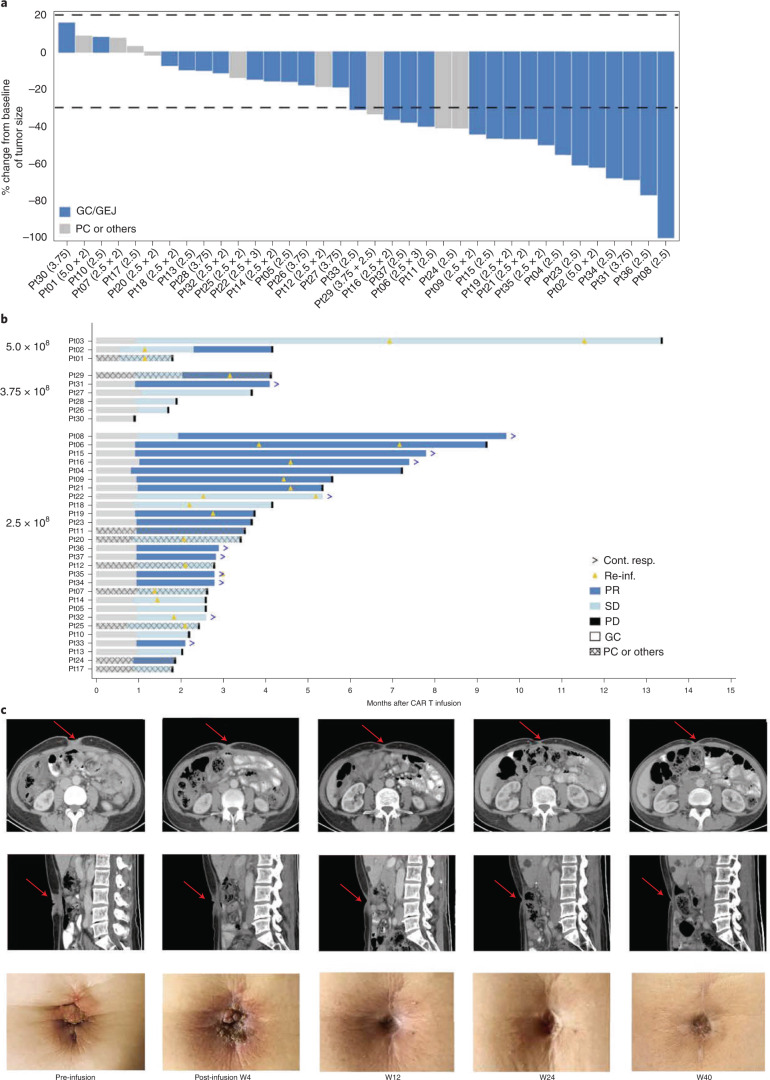
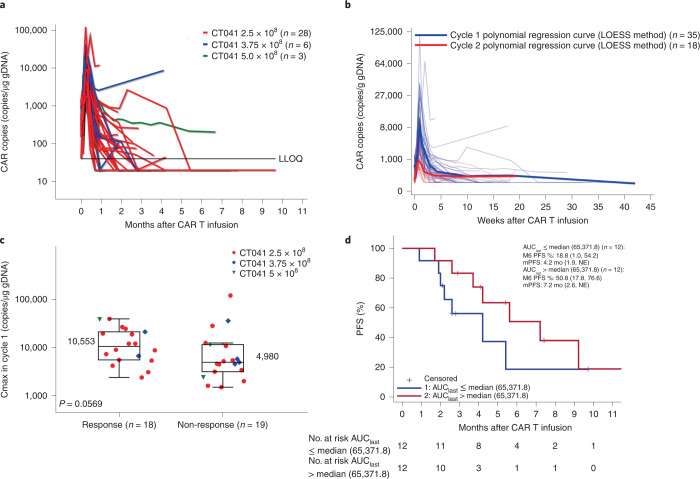
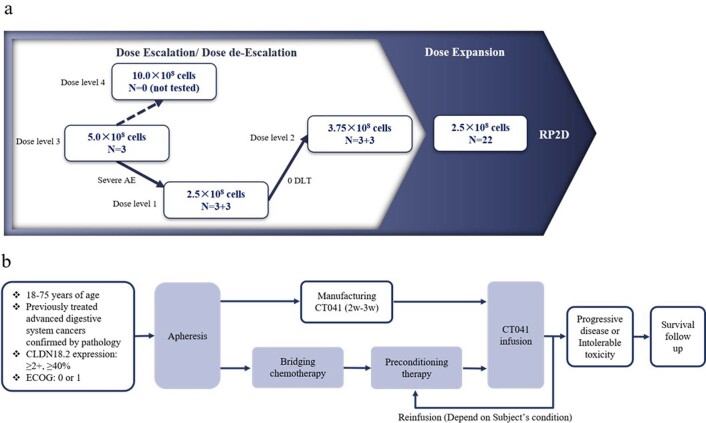
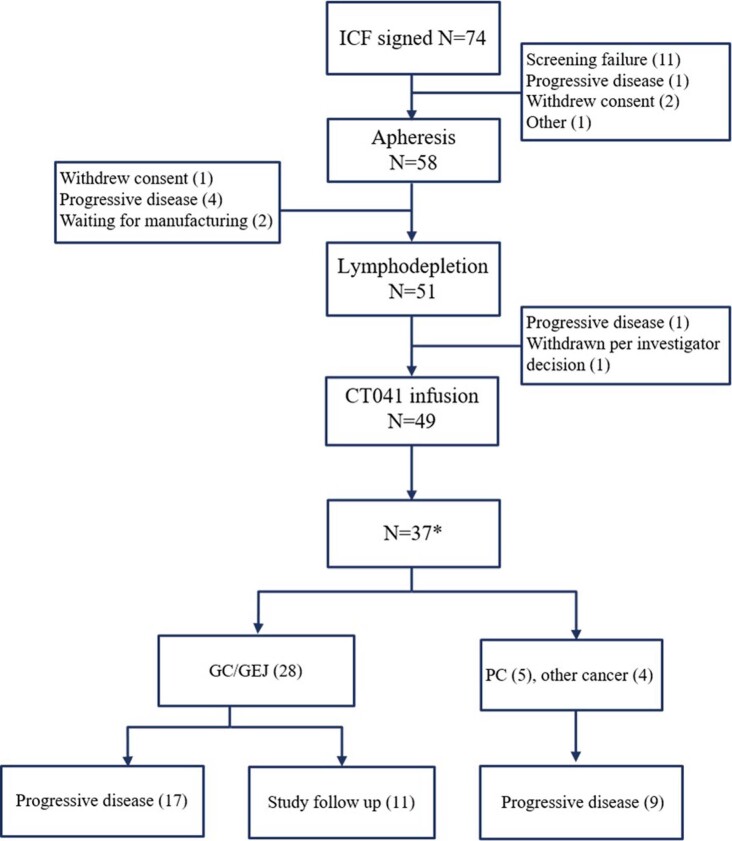
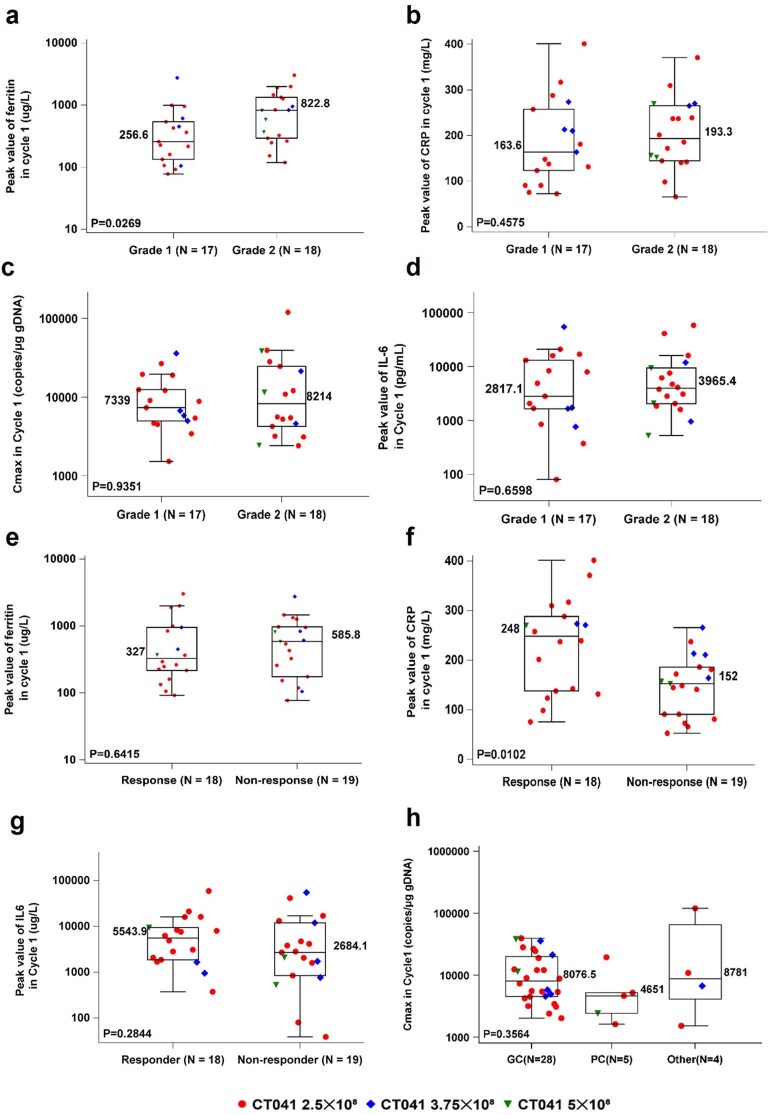
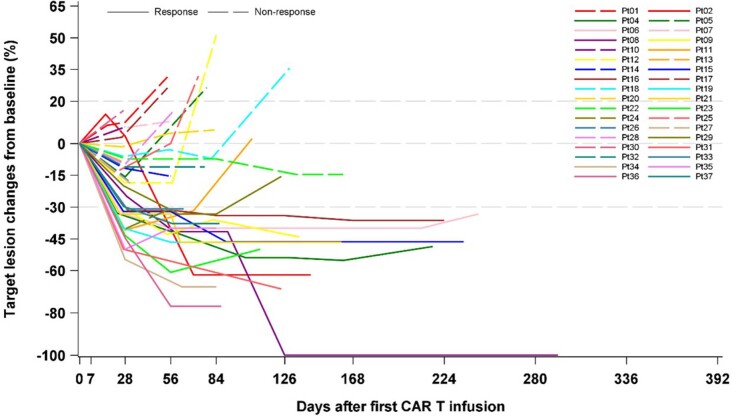
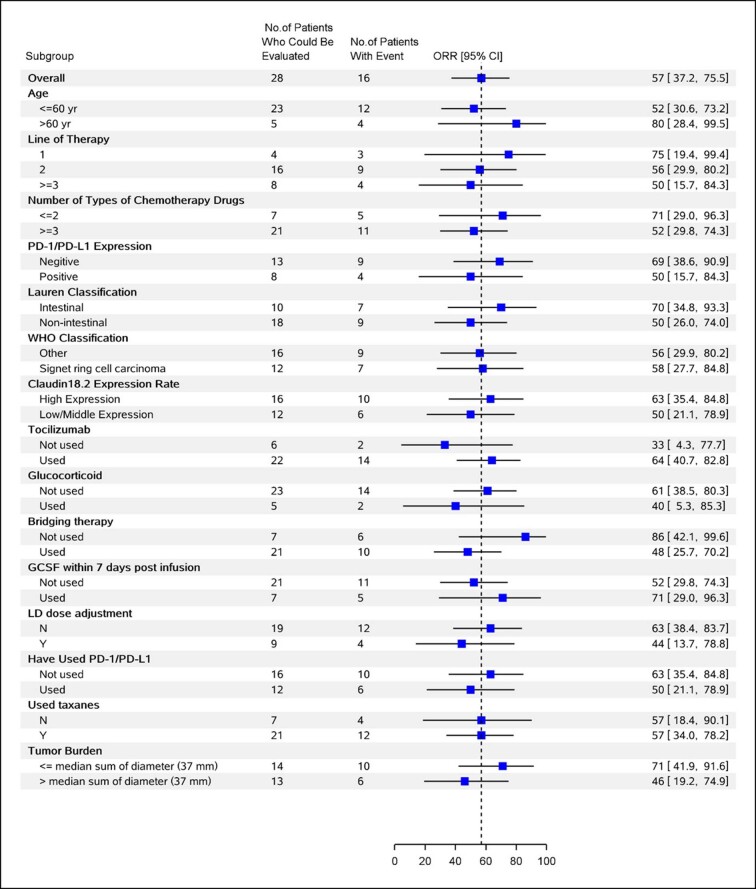
Despite success in hematologic malignancies, the treatment landscape of chimeric antigen receptor (CAR) T cell therapy for solid tumors remains limited. Claudin18.2 (CLDN18.2)-redirected CAR T cells showed promising efficacy against gastric cancer (GC) in a preclinical study. Here we report the interim analysis results of an ongoing, open-label, single-arm, phase 1 clinical trial of CLDN18.2-targeted CAR T cells (CT041) in patients with previously treated, CLDN18.2-positive digestive system cancers ( NCT03874897 ). The primary objective was safety after CT041 infusion; secondary objectives included CT041 efficacy, pharmacokinetics and immunogenicity. We treated 37 patients with one of three CT041 doses: 2.5 × 10 8 , 3.75 × 10 8 or 5.0 × 10 8 cells. All patients experienced a grade 3 or higher hematologic toxicity. Grade 1 or 2 cytokine release syndrome (CRS) occurred in 94.6% of patients. No grade 3 or higher CRS or neurotoxicities, treatment-related deaths or dose-limiting toxicities were reported. The overall response rate (ORR) and disease control rate (DCR) reached 48.6% and 73.0%, respectively. The 6-month duration of response rate was 44.8%. In patients with GC, the ORR and DCR reached 57.1% and 75.0%, respectively, and the 6-month overall survival rate was 81.2%. These initial results suggest that CT041 has promising efficacy with an acceptable safety profile in patients with heavily pretreated, CLDN18.2-positive digestive system cancers, particularly in those with GC.
Overview
The claims and statistics of this paper haven’t been checked yet.
Free: it reads the open-access text and checks the first 5 claims that cite a source we can check. Create a free account to check every claim.
Integrity signals
Registry
Cites
Statistics
Figures
Verification
Claims the paper makes
The claims and statistics of this paper haven’t been checked yet.
Free: it reads the open-access text and checks the first 5 claims that cite a source we can check. Create a free account to check every claim.
Claims other papers make about this one
Each is checked against this paper’s own text: does it say what the citing paper says it does?
The source backs part of the claim, not all of it — or backs it for a different population, condition or comparison.
In the citing paper
“Several CLDN18.2-targeting therapies have demonstrated efficacy in clinical trials for GI cancers, including antibodies, antibody-drug conjugates (ADC), and CAR-T cells (64–66).”
From Mechanisms of Resistance to Oncogenic KRAS Inhibition in Pancreatic Cancer (2024) · cites this paper as [64]
Experimental — accuracy not yet measured
Self-check
Percentages, sums and reported differences re-computed from the paper’s own numbers.
The self-check needs the paper’s full text.
Citations
Cites
Tisagenlecleucel in children and young adults with B-cell lymphoblastic leukemia
Maude, S. L., Laetsch, T. W., Buechner, J., Rives, S., Boyer, M., Bittencourt, H., Bader, P., Verneris, M. R., Stefanski, H. E., Myers, G. D., et al. (2018) · New England Journal of Medicine · doi:10.1056/nejmoa1709866 · Cited by 5,735
Tisagenlecleucel in Adult Relapsed or Refractory Diffuse Large B-Cell Lymphoma
Schuster, S. J., Bishop, M. R., Tam, C. S., Waller, E. K., Borchmann, P., McGuirk, J. P., Jäger, U., Jaglowski, S., Andreadis, C., Westin, J. R., et al. (2019) · New England Journal of Medicine · doi:10.1056/nejmoa1804980 · Cited by 4,112
Lee, D. W., Santomasso, B. D., Locke, F. L., Ghobadi, A., Turtle, C. J., Brudno, J. N., Maus, M. V., Park, J. H., Mead, E., Pavletic, S., et al. (2019) · Biology of Blood and Marrow Transplantation · doi:10.1016/j.bbmt.2018.12.758 · Cited by 3,675
Idecabtagene Vicleucel in Relapsed and Refractory Multiple Myeloma.
Munshi, N. C., Anderson, L. D., Shah, N., Madduri, D., Berdeja, J., Lonial, S., Raje, N., Lin, Y., Siegel, D., Oriol, A., et al. (2021) · New England Journal of Medicine · doi:10.1056/nejmoa2024850 · Cited by 2,560
Kang, Y.-K., Boku, N., Satoh, T., Ryu, M.-H., Chao, Y., Kato, K., Chung, H. C., Chen, J.-S., Muro, K., Kang, W. K., et al. (2017) · The Lancet · doi:10.1016/s0140-6736(17)31827-5 · Cited by 2,252
Fuchs, C. S., Doi, T., Jang, R. W., Muro, K., Satoh, T., Machado, M., Sun, W., Jalal, S. I., Shah, M. A., Metges, J.-P., et al. (2018) · JAMA Oncology · doi:10.1001/jamaoncol.2018.0013 · Cited by 1,784
Role of the tumor microenvironment in PD-L1/PD-1-mediated tumor immune escape
Jiang, X., Wang, J., Deng, X., Xiong, F., Ge, J., Xiang, B., Wu, X., Ma, J., Zhou, M., Li, X., et al. (2019) · Molecular Cancer · doi:10.1186/s12943-018-0928-4 · Cited by 1,457
Von Hoff, D. D., Ramanathan, R. K., Borad, M. J., Laheru, D. A., Smith, L. S., Wood, T. E., Korn, R. L., Desai, N., Trieu, V., Iglesias, J. L., et al. (2011) · Journal of Clinical Oncology · doi:10.1200/jco.2011.36.5742 · Cited by 1,044
Li, J., Qin, S., Xu, J., Xiong, J., Wu, C., Bai, Y., Liu, W., Tong, J., Liu, Y., Xu, R., et al. (2016) · Journal of Clinical Oncology · doi:10.1200/jco.2015.63.5995 · Cited by 972
Self-citationCAR T Cell Therapy for Solid Tumors
Newick, K., O'Brien, S., Moon, E., & Albelda, S. M. (2017) · Annual Review of Medicine · doi:10.1146/annurev-med-062315-120245 · Cited by 909
Research works printed but not linked: 1
- 1. data and code availability are available at https://doi.org/10.1038/ s41591-022-01800-8.
Cited by
Items 101–200 of 646
SMYD5 methylation of rpL40 links ribosomal output to gastric cancer
Park, J.-H., Wu, J., Szkop, K. J., Jeong, J., Jovanovic, P., Husmann, D., Flores, N. M., Francis, J. W., Chen, Y.-J. C., Benitez, A. M., et al. (2024) · Nature · doi:10.1038/s41586-024-07718-0 · Cited by 49
“CAR-T approaches are effective in treating several haematological malignancies and are being tested in clinical trials for patients with GAC 38,41 .”
Moehler, M. H., Högner, A., Wagner, D., Obermannova, R. L., Alsina, M., Thuss-Patience, P. C., van Laarhoven, H. W. M., & Smyth, E. C. (2022) · European Journal of Cancer · doi:10.1016/j.ejca.2022.08.023 · Cited by 47
A Comprehensive Review of Prognostic Factors in Patients with Gastric Adenocarcinoma
Mantziari, S., St-Amour, P., Abboretti, F., Farinha, H. T., Figueiredo, S. G., Gronnier, C., Schizas, D., Demartines, N., & Schäfer, M. (2023) · Cancers · doi:10.3390/cancers15051628 · Cited by 51
Sanctis, F. D., Dusi, S., Caligola, S., Anselmi, C., Petrova, V., Rossi, B., Angelini, G., Erdeljan, M., Wöll, S., Schlitter, A. M., et al. (2024) · Immunity · doi:10.1016/j.immuni.2024.04.021 · Cited by 48
“23,24 Here, we sought to investigate the strategies engaged by immunotherapy-resistant solid tumors.”
Reprogramming tumor-associated macrophages in gastric cancer: a pathway to enhanced immunotherapy
He, Y., Hong, Q., Chen, S., Zhou, J., & Qiu, S. (2025) · Frontiers in Immunology · doi:10.3389/fimmu.2025.1558091 · Cited by 54
Self-citationQin, H., Zhou, Z., Shi, R., Mai, Y., Xu, Y., Fu, P., Cheng, G., Zhang, Z., Chen, W., Chen, Y., et al. (2025) · Journal of Hematology & Oncology · doi:10.1186/s13045-025-01701-6 · Cited by 49
Revolutionizing gastric cancer treatment: The potential of immunotherapy
Christodoulidis, G., Koumarelas, K. E., & Kouliou, M. N. (2024) · World Journal of Gastroenterology · doi:10.3748/wjg.v30.i4.286 · Cited by 47
Chen, Y., Hou, X., Li, D., Ding, J., Liu, J., Wang, Z., Teng, F., Li, H., Zhang, F., Gu, Y., et al. (2023) · Journal of Pharmaceutical Analysis · doi:10.1016/j.jpha.2023.02.011 · Cited by 46
Self-citationQi, C., Chong, X., Zhou, T., Ma, M., Gong, J., Zhang, M., Li, J., Xiao, J., Peng, X., Liu, Z., et al. (2024) · Chinese Journal of Cancer Research · doi:10.21147/j.issn.1000-9604.2024.01.08 · Cited by 46
Self-citationCancer Immunotherapy and Delivery System: An Update
Yang, M. J., Olaoba, O. T., Zhang, C., Kimchi, E. T., Staveley-O’Carroll, K. F., & Li, G. (2022) · Pharmaceutics · doi:10.3390/pharmaceutics14081630 · Cited by 49
Zhu, J., Zhou, J., Tang, Y., Huang, R., Lu, C., Ke, Q., Zhou, Q., Zhang, J., Yang, X., Zhou, W., et al. (2025) · Cancer Cell International · doi:10.1186/s12935-025-03938-0 · Cited by 47
“It is primarily used for the treatment of gastric cancer [90] or pancreatic cancer [43].”
Self-citationXu, Y., Fu, J. L., Henderson, M., Lee, F., Jurcak, N. R., Henn, A., Wahl, J., Shao, Y., Wang, J., Lyman, M. R., et al. (2023) · Gastroenterology · doi:10.1053/j.gastro.2023.06.037 · Cited by 45
“2) T cells showed evidence for antitumor activity in GC and PDAC patients, with a manageable safety profile 11 , although PDAC had fewer and nondurable responses.”
CAR-T Cell Therapy in Ovarian Cancer: Where Are We Now?
Cutri‐French, C., Nasioudis, D., George, E. M., & Tanyi, J. L. (2024) · Diagnostics · doi:10.3390/diagnostics14080819 · Cited by 50
“2 CAR T cells in patients with advanced-stage gastric cancer, six of thirty-seven patients developed mucosal toxicity (one with grade 3 toxicity) [82].”
BackgroundBarrett, A. M., Britton, Z. T., Carrasco, R. A., Breen, S., Broggi, M. A. S., Hatke, A. L., Clark, B., Yang, C., Phipps, S., Ortiz, L., et al. (2024) · Clinical Cancer Research · doi:10.1158/1078-0432.ccr-24-1853 · Cited by 43
Diffuse Gastric Cancer: A Comprehensive Review of Molecular Features and Emerging Therapeutics
Wu, L. W., Jang, S. J., Shapiro, C., Fazlollahi, L., Wang, T. C., Ryeom, S. W., & Moy, R. H. (2024) · Targeted Oncology · doi:10.1007/s11523-024-01097-2 · Cited by 48
“2-positive gastric cancer with high representation of DGC [127].”
Claudin18.2 in Advanced Gastric Cancer
Inamoto, R., Takahashi, N., & Yamada, Y. (2023) · Cancers · doi:10.3390/cancers15245742 · Cited by 40
“2-positive gastrointestinal cancers (NCT03874897) were published [70].”
Targeting solid tumor antigens with chimeric receptors: cancer biology meets synthetic immunology
Kembuan, G. J., Kim, J. Y., Maus, M. V., & Jan, M. (2024) · Trends in cancer · doi:10.1016/j.trecan.2024.01.003 · Cited by 39
The rising roles of exosomes in the tumor microenvironment reprogramming and cancer immunotherapy
Wu, Y., Han, W., Dong, H., Liu, X., & Su, X. (2024) · MedComm · doi:10.1002/mco2.541 · Cited by 40
Shi, H., Li, A., Dai, Z., Jiao, X., Zhao, Q., Tian, J., Song, D., Wang, H., Chen, J., Zhang, X., et al. (2023) · Frontiers in Immunology · doi:10.3389/fimmu.2023.1165404 · Cited by 38
Self-citationCAR-T State of the Art and Future Challenges, A Regulatory Perspective
Giorgioni, L., Ambrosone, A., Cometa, M. F., Salvati, A. L., & Magrelli, A. (2023) · International Journal of Molecular Sciences · doi:10.3390/ijms241411803 · Cited by 38
Metastatic gastric cancer target lesion complete response with Claudin18.2-CAR T cells
Botta, G. P., Chao, J., Ma, H., Hahn, M., Sierra, G., Jia, J., Hendrix, A. Y., Fong, J. N., Ween, A., Vu, P., et al. (2024) · Journal for ImmunoTherapy of Cancer · doi:10.1136/jitc-2023-007927 · Cited by 38
Self-citationZhong, G., Zhang, X., Guo, Z., Gao, Y., Zhao, B., Liu, X., Chen, L., Qiao, J., Yu, C., Wang, L., et al. (2024) · Frontiers in Immunology · doi:10.3389/fimmu.2024.1325860 · Cited by 37
Self-citationCMG901, a Claudin18.2-specific antibody-drug conjugate, for the treatment of solid tumors
Xu, G., Liu, W., Wang, Y., Wei, X., Liu, F., He, Y., Zhang, L., Qin, S., Li, Z., Wang, C., et al. (2024) · Cell Reports Medicine · doi:10.1016/j.xcrm.2024.101710 · Cited by 41
“30 Microtubule inhibitors, including vinblastine and auristatin analogs dolastatin 10, MMAE, and MMAF, have been reported to act as potent activators of dendritic cell (DC) maturation and antigen response.”
Self-citationLim, S. H., Kuwata, T., An, M., Hong, J. Y., Kim, S. T., Matsubara, Y., Shitara, K., & Lee, J. (2025) · Journal for ImmunoTherapy of Cancer · doi:10.1136/jitc-2025-012683 · Cited by 39
“14 15 Recently, we explored the role of sequentially added PD-1 inhibitor in the altered tumor microenvironment (TME) related to cytotoxic chemotherapy in a prospective single-arm phase II sequential chemoimmunotherapy trial ( ClinicalTrial. gov identifier: NCT04249739).”
New target DDR1: A “double-edged sword” in solid tumors
Tian, Y., Bai, F., & Zhang, D. (2022) · Biochimica et Biophysica Acta (BBA) - Reviews on Cancer · doi:10.1016/j.bbcan.2022.188829 · Cited by 39
Immunotherapy for Peritoneal Carcinomatosis: Challenges and Prospective Outcomes
Ornella, M. S. C., Badrinath, N., Kim, K.-A., Kim, J. H., Cho, E., Hwang, T.-H., & Kim, J.-J. (2023) · Cancers · doi:10.3390/cancers15082383 · Cited by 37
Paul, M. S., Saibil, S. D., Kates, M., Han, S., Lien, S. C., Laister, R. C., Hezaveh, K., Kloetgen, A., Penny, S. L., Guo, T., et al. (2024) · Cell Reports Medicine · doi:10.1016/j.xcrm.2024.101465 · Cited by 43
CAR‐T‐cell products in solid tumors: Progress, challenges, and strategies
Qian, K., Li, G., Zhang, S., Fu, W., Li, T., Zhao, J., Lei, C., Wang, Y., & Hu, S. (2024) · Interdisciplinary medicine · doi:10.1002/inmd.20230047 · Cited by 41
Self-citationZhang, F., Sahu, V., Peng, K., Wang, Y., Li, T., Bala, P., Aitymbayev, D., Sahgal, P., Schaefer, A., Der, C. J., et al. (2024) · Gut · doi:10.1136/gutjnl-2023-329686 · Cited by 37
“30 However, in the context of CLDN18-ARHGAP26 fusion protein, additional studies will be needed to identify the exact localisation of the fusion gene in the cell and the suitability of therapies that require cell surface expression of CLDN18 for efficacy.”
Self-citationHematologic cytopenia post CAR T cell therapy: Etiology, potential mechanisms and perspective
Si, X., Gu, T., Liu, L., Huang, Y., Han, Y., Qian, P., & Huang, H. (2022) · Cancer Letters · doi:10.1016/j.canlet.2022.215920 · Cited by 36
Exercise Training in Elderly Cancer Patients: A Systematic Review
Giallauria, F., Testa, C., Cuomo, G., Lorenzo, A. D., Venturini, E., Lauretani, F., Maggio, M. G., Iannuzzo, G., & Vigorito, C. (2023) · Cancers · doi:10.3390/cancers15061671 · Cited by 37
“The oncological disease is the one in which these therapeutic advances have had the most impact; in perspective, more innovative therapeutic aids will likely prolong the survival or even well-manage the course of patients with advanced stage oncological disease [1].”
BackgroundMody, H. R., Ogasawara, K., Zhu, X., Miles, D., Shastri, P. N., Gokemeijer, J., Liao, M. Z., Kasichayanula, S., Yang, T., Chemuturi, N. V., et al. (2023) · Clinical Pharmacology & Therapeutics · doi:10.1002/cpt.2986 · Cited by 36
Park, S. J., Shin, K., Kim, I.-H., Hong, T. H., Lee, M., Kim, Y., & Suh, J. H. (2023) · Journal of Clinical Medicine · doi:10.3390/jcm12165394 · Cited by 34
Ventin, M., Cattaneo, G., Arya, S., Jia, J., Gelmi, M. C., Sun, Y., Maggs, L., Ksander, B. R., Verdijk, R. M., Boland, G. M., et al. (2024) · Clinical Cancer Research · doi:10.1158/1078-0432.ccr-24-0071 · Cited by 36
Abken, H. (2025) · Nature Reviews Gastroenterology & Hepatology · doi:10.1038/s41575-025-01062-y · Cited by 37
“2, despite its expression by healthy gastric mucosal cells, causing only minor toxicities 94 , which is likely due to the rapid turnover and high repair capacities of gastric epithelial stem cells that lack CLDN18.”
InfluentialYang, Y., Yang, H., Alcaina, Y., Puc, J., Birt, A., Vedvyas, Y., Gallagher, M. P., Alla, S., Riascos, M. C., McCloskey, J. E., et al. (2023) · Nature Communications · doi:10.1038/s41467-023-37646-y · Cited by 34
Unlocking T cell exhaustion: Insights and implications for CAR-T cell therapy
Xiong, D., Yu, H., & Sun, Z. (2024) · Acta Pharmaceutica Sinica B · doi:10.1016/j.apsb.2024.04.022 · Cited by 34
Miao, H., Yuan, F., Pan, C.-X., Yang, H., Wang, Z., Qi, Y., Wu, Y. Z., Zhang, Y., Liu, F., Huang, H., et al. (2025) · Medicine Plus · doi:10.1016/j.medp.2025.100087 · Cited by 35
Self-citationBarriers and solutions for CAR-T therapy in solid tumors
Tu, Z., Chen, Y., Zhang, Z., Meng, W., & Li, L. (2025) · Cancer Gene Therapy · doi:10.1038/s41417-025-00931-7 · Cited by 34
“2 in gastric cancer (NCT03874897), 94.6% of reported CRS events were categorized as grade 1-2, with no fatal cases observed [44].”
InfluentialWang, S., Qi, C., Ding, J., Li, D., Zhang, M., Ji, C., Jiang, F., Teng, F., Yu, J., Qian, X., et al. (2023) · European Journal of Nuclear Medicine and Molecular Imaging · doi:10.1007/s00259-023-06234-z · Cited by 33
Self-citationHER2+ advanced gastric cancer: Current state and opportunities (Review)
Hu, H.-H., Wang, S., Zhao, H., Chen, Z., Shi, X., & Chen, X. (2024) · International Journal of Oncology · doi:10.3892/ijo.2024.5624 · Cited by 32
Nanomaterials Boost CAR‐T Therapy for Solid Tumors
Long, J., Wang, Y., Jiang, X., Ge, J., Chen, M., Zheng, B., Wang, R., Wang, M., Xu, M., Qi, K., et al. (2024) · Advanced Healthcare Materials · doi:10.1002/adhm.202304615 · Cited by 34
Self-citationQi, C., Guo, R., Chen, Y., Li, C., Liu, C. X., Zhang, M., Zhang, C., Zhang, X., Hou, X., Chen, B., et al. (2024) · Journal of Nuclear Medicine · doi:10.2967/jnumed.123.267110 · Cited by 32
“2-speci fi c CAR-T cells, which showed that the overall response rate and disease control rate of CAR-T cells reached 48.6% and 73.0%, respectively ( 14 ).”
BackgroundInfluentialSelf-citationLei, L., Zhao, L.-Y., Cheng, R., Zhang, H., Xia, M., Chen, X., Kudriashov, V., Liu, K., Zhang, W., Jiang, H., et al. (2024) · mSystems · doi:10.1128/msystems.00089-24 · Cited by 33
Advances in cell therapy: progress and challenges in hematological and solid tumors
D'Avanzo, C., Blaeschke, F., Lysandrou, M., Ingelfinger, F., & Zeiser, R. (2024) · Trends in Pharmacological Sciences · doi:10.1016/j.tips.2024.10.016 · Cited by 34
Somatic mouse models of gastric cancer reveal genotype-specific features of metastatic disease
Leibold, J., Tsanov, K. M., Amor, C., Ho, Y.-J., Rivera, F. J. S., Feucht, J., Baslan, T., Chen, H.-A., Tian, S., Simon, J. M., et al. (2024) · Nature Cancer · doi:10.1038/s43018-023-00686-w · Cited by 32
“…well poised for use in the evaluation of new therapeutic strategies based on genetic and molecular biomarkers (extending beyond MSI status), a potentially valuable capability as such biomarkers are becoming prevalent in the evolving landscape of gastric adenocarcinoma research and treatment 53,54 .”
BackgroundMolecular mechanisms of metastatic peritoneal dissemination in gastric adenocarcinoma
Ng, D. W. J., Cyr, D. P., Khan, S., Dossa, F., Swallow, C. J., & Kazazian, K. (2025) · Cancer and Metastasis Reviews · doi:10.1007/s10555-025-10265-3 · Cited by 32
“2-targeted CAR T cells reported an overall response rate of 48.6% and a disease control rate of 73% [265].”
InfluentialYagel, G., Rimini, D., von Locquenghien, M., Avellino, R., Barboy, O., Chalan, P., Granot, G., Xie, K., Shlomi-Loubaton, S., Sheban, F., et al. (2026) · Cancer Cell · doi:10.1016/j.ccell.2025.11.009 · Cited by 32
Expression patterns of claudins in cancer
Tao, D., Guan, B., Li, H., & Zhou, C. (2023) · Heliyon · doi:10.1016/j.heliyon.2023.e21338 · Cited by 31
“2 is currently underway (NCT03874897) and has shown promising efficacy in patients with advanced or refractory gastric cancer [84].”
BackgroundAdoptive Cell Therapy for Solid Tumors: Current Status in Melanoma and Next-Generation Therapies
Haanen, J. B. A. G., Los, C., Phan, G. Q., & Warner, A. B. (2024) · American Society of Clinical Oncology Educational Book · doi:10.1200/edbk_431608 · Cited by 32
Lucia, A. D., Mazzotti, L., Gaimari, A., Zurlo, M., Maltoni, R., Cerchione, C., Bravaccini, S., Delmonte, A., Crinò, L., de Souza, P. B., et al. (2025) · Frontiers in Immunology · doi:10.3389/fimmu.2025.1515748 · Cited by 31
“In a phase I clinical trial, combined therapy involving CAR-T cells along with paclitaxel and cyclophosphamide revealed clinical improvements in 21 of the 28 patients who had previously experienced unsuccessful paclitaxel therapy (296).”
Cytokine release syndrome in solid tumors
Synnott, D., O’Reilly, D., de Freitas, D. G., & Naidoo, J. (2025) · Cancer · doi:10.1002/cncr.70069 · Cited by 34
“61 This mirrors early hemato - oncology findings, where patients with low tumor burden exhibited lower cytokine peaks after CD19 CAR -”
Targeted Therapies and Developing Precision Medicine in Gastric Cancer
Pihlak, R., Fong, C., & Starling, N. (2023) · Cancers · doi:10.3390/cancers15123248 · Cited by 30
Coengineering specificity, safety, and function into T cells for cancer immunotherapy
Attianese, G. M. P. G., Ash, S., & Irving, M. B. (2023) · Immunological Reviews · doi:10.1111/imr.13252 · Cited by 30
“2 (for gastric and pancreatic cancer), 221 and prostate-specific membrane antigen (PSMA, for treating metastatic castration-resistant prostate cancer).”
BackgroundNie, S., Song, Y., Hu, K., Zu, W., Zhang, F., Chen, L., Ma, Q., Zhou, Z., & Jiao, S. (2024) · OncoImmunology · doi:10.1080/2162402x.2024.2358590 · Cited by 30
“2 CAR-T cells (CT041) 8 indicated that the objective response rate (ORR) for 28 patients with gastric cancer and gastroesophageal-junction adenocarcinoma (GC/GEJ) was 57.1%, and the six-month overall survival rate was 81.2%.”
BackgroundInfluentialProtein isoform-centric therapeutics: expanding targets and increasing specificity
Kjer-Hansen, P., Phan, T. G., & Weatheritt, R. J. (2024) · Nature Reviews Drug Discovery · doi:10.1038/s41573-024-01025-z · Cited by 30
“The main driver of this condition is excess amounts of circulating, soluble isoforms of vascular endothelial growth factor receptor 1 (sVEGFR1) that are derived from APU and alternative splicing events and cause endothelial dysfunction 61 .”
Argueta, S., Wang, Y., Zhao, H., Diwanji, N., Gorgievski, M., Cochran, E. L., Grudzien‐Nogalska, E., D’Alessandro, J. S., McCreedy, B. J., Prod’homme, T., et al. (2024) · Frontiers in Immunology · doi:10.3389/fimmu.2024.1501365 · Cited by 31
Self-citationAdvances in CAR T-cell therapy in bile duct, pancreatic, and gastric cancers
Feng, Q., Sun, B., Xue, T., Li, R., Lin, C., Gao, Y., Sun, L., Zhuo, Y., & Wang, D. (2022) · Frontiers in Immunology · doi:10.3389/fimmu.2022.1025608 · Cited by 32
Research Progress of Immunotherapy for Gastric Cancer
Zhang, Z., Liu, N., & Sun, M. (2023) · Technology in Cancer Research & Treatment · doi:10.1177/15330338221150555 · Cited by 31
The Present and Future of Neoadjuvant and Adjuvant Therapy for Locally Advanced Gastric Cancer
Koerner, A. S., Moy, R. H., Ryeom, S. W., & Yoon, S. S. (2023) · Cancers · doi:10.3390/cancers15164114 · Cited by 30
Knocking Out CD70 Rescues CD70-Specific NanoCAR T Cells from Antigen-Induced Exhaustion
Munter, S. D., Buhl, J. L., Cock, L. D., Parys, A. V., Daneels, W., Pascal, E., Deseins, L., Ingels, J., Goetgeluk, G., Jansen, H., et al. (2024) · Cancer Immunology Research · doi:10.1158/2326-6066.cir-23-0677 · Cited by 29
Current Advances and Challenges in CAR-T Therapy for Hematological and Solid Tumors
Zhang, G., Bai, M., Du, H., Yuan, Y., Wang, Y., Fan, W., Zhu, H., Wu, D., He, P., & Xue, B. (2025) · ImmunoTargets and Therapy · doi:10.2147/itt.s519616 · Cited by 29
Self-citationLi, X., Dai, R., Xu, Q., Guo, Z., Hu, C., Sun, Y., Niu, Z., Hao, J., Zhang, M., Dai, G., et al. (2026) · BMC Medicine · doi:10.1186/s12916-025-04597-8 · Cited by 30
Self-citationChen, Y., Chen, Y., Tan, S., Zheng, Y., Liu, S., Zheng, T., Mi, Y., Lin, S., Yang, C., & Li, W. (2023) · Human Vaccines & Immunotherapeutics · doi:10.1080/21645515.2023.2186684 · Cited by 30
Tran, T. M., Thakuri, B. K. C., Nurmukhambetova, S. T., Lee, J., Hu, P., Tran, N. Q., Steimle, B. L., Dash, P., & Schneider, D. (2024) · Journal for ImmunoTherapy of Cancer · doi:10.1136/jitc-2023-008261 · Cited by 28
Kanagavalli, P., & Eissa, S. (2024) · Biosensors and Bioelectronics · doi:10.1016/j.bios.2024.116388 · Cited by 28
Ruixin, S., Yifan, L., Yansha, S., Zhou, M., Yiwei, D., Xiao-li, H., Bizhi, S., Hua, J., & Li, Z. (2024) · British Journal of Pharmacology · doi:10.1111/bph.16505 · Cited by 27
“Previously, dual-targeted CARs have demonstrated anti-tumour activities and safety in clinical research (Qi et al., 2022).”
Self-citationZhang, X., Zhao, Y., & Xu, C. (2024) · Translational Oncology · doi:10.1016/j.tranon.2024.102113 · Cited by 28
“The challenges of CAR-T cell therapy, particularly in solid tumors like gastric cancer, highlight the need for a deeper understanding of the regulatory mechanisms of tumor immunity within the tumor microenvironment (TME) [36].”
BackgroundSelf-citationGong, Y., Fei, P., Zhang, Y., Xu, Y., & Wei, J. (2025) · Advanced Science · doi:10.1002/advs.202501095 · Cited by 30
New targets and new drugs for hepatobiliary cancers
Chan, S. L., Lamarca, Á., Hsu, C., Moreno, V., Chan, L. L., & Keenan, B. P. (2025) · Journal of Hepatology · doi:10.1016/j.jhep.2025.08.018 · Cited by 28
Zhang, Y., Liang, K., Zhou, X., Zhang, X., Xu, H. J., Dai, H., Song, X., Yang, X., Liu, B., Shi, T., et al. (2023) · Cancer Science · doi:10.1111/cas.15828 · Cited by 27
Self-citationEmerging Targets for Systemic Treatment of Gastric Cancer: HER2 and Beyond
Kim, I.-H. (2023) · Journal of the Korean Gastric Cancer Association · doi:10.5230/jgc.2024.24.e6 · Cited by 31
“2-specific CAR-T cell treatment known as CT-041 demonstrated a promising ORR of 57.1% in previously treated patients with gastric cancer [150].”
BackgroundInfluentialPrecision treatment of pancreatic ductal adenocarcinoma
Wei, H., & Ren, H. (2024) · Cancer Letters · doi:10.1016/j.canlet.2024.216636 · Cited by 28
Inhibitory CARs fail to protect from immediate T cell cytotoxicity
Funk, M. A., Heller, G., Waidhofer‐Söllner, P., Leitner, J. M., & Steinberger, P. (2024) · Molecular Therapy · doi:10.1016/j.ymthe.2024.02.022 · Cited by 29
Panahizadeh, R., Panahi, P., Asghariazar, V., Makaremi, S., Noorkhajavi, G., & Safarzadeh, E. (2025) · Cancer Cell International · doi:10.1186/s12935-025-03655-8 · Cited by 29
“…trials have identified the following as critical markers for the diagnosis and management of GC: HER2, claudin 18.2 (CLDN 18.2), mesothelin (MSLN), folate receptor 1 (FOLR1), carcino-embryonic antigen (CEA) and other markers which are listed in Table 3 of ongoing clinical trials [150, 152, 153].”
InfluentialTao, D., Guan, B., Li, Z., Jiao, M., Zhou, C., & Li, H. (2023) · Pathology - Research and Practice · doi:10.1016/j.prp.2023.154699 · Cited by 26
Self-citationLi, X., Li, W., Xu, L., & Song, Y. (2023) · Chinese Medical Journal · doi:10.1097/cm9.0000000000002818 · Cited by 27
“[101] CD133 is an attractive therapeutic target for hepatocellular carcinoma (HCC).”
BackgroundCRISPR, CAR-T, and NK: Current applications and future perspectives
Khoshandam, M., Soltaninejad, H., Hamidieh, A. A., & Hosseinkhani, S. (2023) · Genes & Diseases · doi:10.1016/j.gendis.2023.101121 · Cited by 33
Pancreatic cancer in 2025: Have we found a solution?
Tonini, V., & Zanni, M. (2025) · World Journal of Gastroenterology · doi:10.3748/wjg.v31.i43.111433 · Cited by 26
Chimeric Antigen Receptor T-Cell Therapy for Solid Tumors: The Past and the Future
Srour, S. A., & Akın, S. (2022) · Journal of Immunotherapy and Precision Oncology · doi:10.36401/jipo-22-7 · Cited by 26
“8%.([52]) Of note, the cytokine release syndrome (CRS) rate was 94.”
BackgroundWang, F., Yang, Y., Du, X., Zhu, X., Hu, Y., Lu, C., Sui, L., Zhao, H., Song, K., & Yao, Q. (2023) · BMC Cancer · doi:10.1186/s12885-023-10533-x · Cited by 25
Hernández-López, P., van Diest, E., Brázda, P., Heijhuurs, S., Meringa, A. D., Heyningen, L. H. V., Riillo, C., Schwenzel, C., Zintchenko, M., Johanna, I., et al. (2023) · Nature Immunology · doi:10.1038/s41590-023-01665-0 · Cited by 26
“…of the cancer metabolome and cancer-associated stress antigens has many strategic advantages compared to other currently targeted tumor antigens that have shown clinical responses in phase I clinical trials in solid tumors, such as claudin 18.2 in gastric cancer 34 or GD2 for midline glioma 35 .”
InfluentialBeyond Chemoimmunotherapy in Advanced Non–Small Cell Lung Cancer: New Frontiers, New Challenges
Mountzios, G., Naidoo, J., Wang, C., Creelan, B., Trotier, D., Campbell, T. C., & Peters, S. (2024) · American Society of Clinical Oncology Educational Book · doi:10.1200/edbk_432526 · Cited by 25
On-target off-tumor toxicity of claudin18.2-directed CAR-T cells in preclinical models
Birocchi, F., Almazan, A. J., Parker, A. L., Bouffard, A. A., Goncalves, S., Kelly, C., Frank, J. A., Leick, M. B., Haradhvala, N. J., Kagawa, S., et al. (2025) · Nature Communications · doi:10.1038/s41467-025-61858-z · Cited by 25
“2-directed CAR-T cells often experience moderate to severe gastric toxicity and only short-lived anti-tumor responses 10,18,19 .”
InfluentialEngineered Microphysiological Systems for Testing Effectiveness of Cell-Based Cancer Immunotherapies
Campisi, M., Shelton, S. E., Chen, M., Kamm, R. D., Barbie, D. A., & Knelson, E. H. (2022) · Cancers · doi:10.3390/cancers14153561 · Cited by 25
Zhou, Z., Li, J., Hong, J., Chen, S., Chen, M., Wang, L., Lin, W., & Ye, Y. (2022) · Frontiers in Immunology · doi:10.3389/fimmu.2022.1002361 · Cited by 26
Self-citationDougé, A., El-Ghazzi, N., Lemal, R., & Rouzaire, P. (2023) · Molecular Cancer Therapeutics · doi:10.1158/1535-7163.mct-23-0310 · Cited by 26
Antibody-mediated targeting of Claudins in cancer
Vonniessen, B., Tabariès, S., & Siegel, P. M. (2024) · Frontiers in Oncology · doi:10.3389/fonc.2024.1320766 · Cited by 26
Dai, Z., Lin, X., Wang, X., Zou, X., Yan, Y. H., Wang, R., Chen, Y., Tasiheng, Y., Ma, M., Wang, X., et al. (2024) · Cancer Immunology Immunotherapy · doi:10.1007/s00262-024-03648-y · Cited by 24
Gastric Cancer Signaling Pathways and Therapeutic Applications
Wu, M., Yuan, S., Liu, K., Wang, C., & Wen, F. (2024) · Technology in Cancer Research & Treatment · doi:10.1177/15330338241271935 · Cited by 26
Bailey, S. R., Takei, H. N., Escobar, G., Kann, M. C., Bouffard, A. A., Kienka, T., Supper, V. M., Armstrong, A., Salas‐Benito, D., Phillips, M., et al. (2025) · Science Translational Medicine · doi:10.1126/scitranslmed.adp8166 · Cited by 25
CAR-Based Immunotherapy of Solid Tumours—A Survey of the Emerging Targets
Maher, J. F., & Davies, D. M. (2023) · Cancers · doi:10.3390/cancers15041171 · Cited by 23
Anti-Claudin Treatments in Gastroesophageal Adenocarcinoma: Mainstream and Upcoming Strategies
Grizzi, G., Venetis, K., Denaro, N., Bonomi, M., Celotti, A., Pagkali, A., Hahne, J. C., Tomasello, G., Petrelli, F., Fusco, N., et al. (2023) · Journal of Clinical Medicine · doi:10.3390/jcm12082973 · Cited by 23
“Recently, the interim results of a phase I clinical trial confirmed the acceptable safety profile of CT041 in 37 patients with heavily pretreated gastrointestinal cancers [44].”
BackgroundImmunotherapy for gastric cancer: Advances and challenges
Zhang, P., Zhang, C., Li, X., Chang, C., Gan, C., Ye, T., & Cao, D. (2024) · MedComm – Oncology · doi:10.1002/mog2.92 · Cited by 25
Combinational CAR T-cell therapy for solid tumors: Requisites, rationales, and trials
Misawa, K., Bhat, H., Adusumilli, P. S., & Hou, Z. (2024) · Pharmacology & Therapeutics · doi:10.1016/j.pharmthera.2024.108763 · Cited by 22
CAR Based Immunotherapy of Solid Tumours—A Clinically Based Review of Target Antigens
Maher, J. F., & Davies, D. M. (2023) · Biology · doi:10.3390/biology12020287 · Cited by 23
Yu, Y., Wu, Y., Zhang, Y., Lu, M., & Su, X. (2023) · FEBS Open Bio · doi:10.1002/2211-5463.13630 · Cited by 23
Self-citationO’Brien, N. A., McDermott, M. S. J., Zhang, J., Gong, K., Lu, M., Hoffstrom, B., Luo, T., Ayala, R., Chau, K., Liang, M., et al. (2023) · Molecular Cancer Therapeutics · doi:10.1158/1535-7163.mct-23-0353 · Cited by 22
Self-citationTang, H., Cao, Y., Zhou, Y., Ma, Y., Jiang, H., Zhang, H., Jiang, L., Yang, Q.-X., Tang, X.-M., Yang, C. K., et al. (2024) · Journal of Advanced Research · doi:10.1016/j.jare.2024.01.014 · Cited by 22
Self-citationWang, Y., Zhou, C.-P., Wang, D.-T., Ma, J., Sun, X., Wang, Y., & Zhang, Y. (2024) · Frontiers in Immunology · doi:10.3389/fimmu.2024.1343512 · Cited by 24
Self-citation
Metadata
- Authors
- Qi, C., Gong, J., Li, J., Liu, D., Qin, Y., Ge, S., Zhang, M., Peng, Z., Zhou, J., Cao, Y., Zhang, X., Lu, Z., Lu, M., Yuan, J., Wang, Z., Wang, Y., Peng, X., Gao, H., Liu, Z., Wang, H., Yuan, D., Xiao, J., Ma, H., Wang, W., Li, Z., & Shen, L.
- Affiliations
- Peking University Cancer Hospital (CN)
- First Affiliated Hospital of Zhengzhou University (CN)
- Corresponding author
- Shen, Lin
- ORCID
- Venue
- Nature Medicine
- Published
- 2022-05-09
- Volume
- 28
- Issue
- 6
- Pages
- 1189-1198
- ISSN
- 1078-8956 (ISSN-L)
- 1546-170X
- PMC
- PMC9205778
- OpenAlex
- W4229445969
- Cited by
- 604
- References
- 40
- Citations by year
- 2026: 109 · 2025: 157 · 2024: 169 · 2023: 135 · 2022: 34
- FWCI
- 51.79
- Type
- journal article
- Language
- en
- Open access
- hybrid
- doi.org
- Licence
- cc-by
- creativecommons.org/licenses/by/4.0 (tdm)
- creativecommons.org/licenses/by/4.0 (vor)
- Locations
- Nature Medicine (publishedVersion, cc-by)
- PubMed Central (publishedVersion, cc-by)
- PubMed (publishedVersion)
- Greater South Information System
- Topics
- Health Sciences › Medicine › Oncology › CAR-T cell therapy research
- Life Sciences › Immunology and Microbiology › Immunology › Immunotherapy and Immune Responses
- Health Sciences › Medicine › Oncology › Cancer Immunotherapy and Biomarkers
- Keywords
- claudin 18.2, CAR T-cell therapy, gastrointestinal cancer, gastric cancer, solid tumor immunotherapy, cytokine release syndrome, hematologic toxicity, pharmacokinetics, immunogenicity, heavily pretreated patients, overall response rate
- MeSH terms
- Cytokine Release Syndrome, Humans, Stomach Neoplasms, T-Lymphocytes, Immunotherapy, Adoptive, Claudins
About these checks
Registry, retraction, Cites and statistics results are computed, not judged, with one exception: a printed reference that no index lists is read once by a model before it counts as a citation error. Claims are extracted by a model and kept only when their quote appears verbatim in the text; each cited source is then checked, with a model’s help, for whether it says what the claim relies on. Those verdicts can be wrong — read the claim’s quote and the cited source before relying on one.
Statistics and arithmetic are recomputed, not judged.
Confidence bands are shown only for fields calibrated on our annotated test set. None is calibrated yet, so no band is shown.
What counts as a claim ›How we measure confidence ›How we check this ›
Are you an author, or do you see a problem with this page? Request a review
Data sources
Bibliographic data: Semantic Scholar, OpenAlex, Crossref.
Contains information from the Semantic Scholar Academic Graph Datasets, made available under the ODC Attribution License (ODC-BY 1.0).
Semantic Scholar’s data is described in: Kinney, R., et al. (2023). The Semantic Scholar Open Data Platform. arXiv:2301.10140.
