

Anti-tumor efficacy of a potent and selective non-covalent KRASG12D inhibitor
Open accessPublished version of a preprint
The DOI matches its Crossref record; 54 of the 54 references it cites were found in a registry or an index; 29 of the 52 sources its claims cite were checked for support.
Abstract
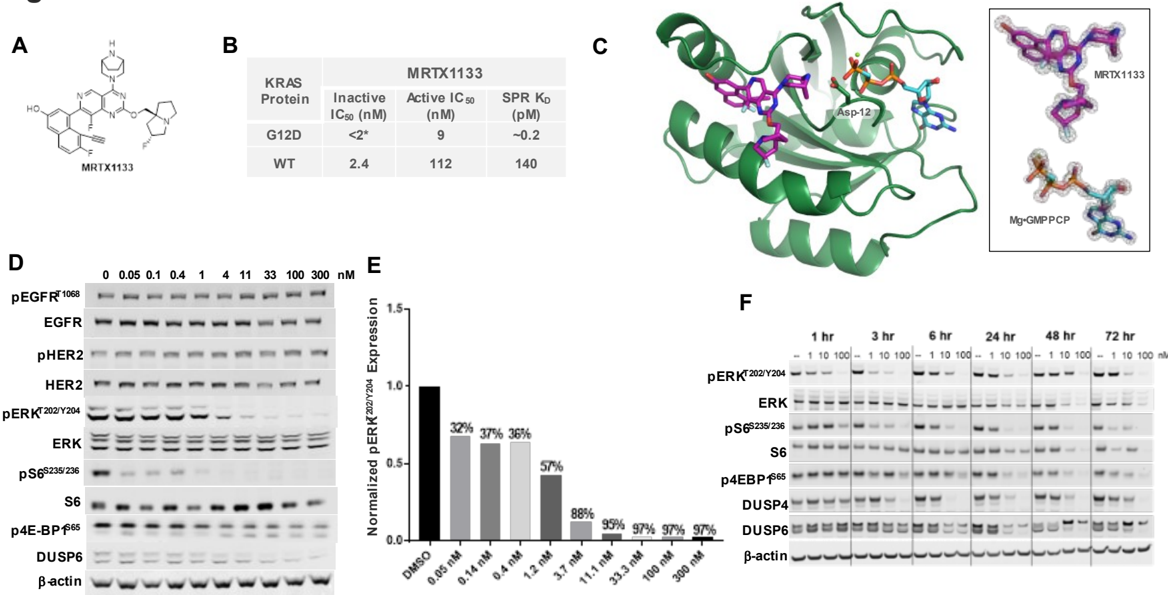
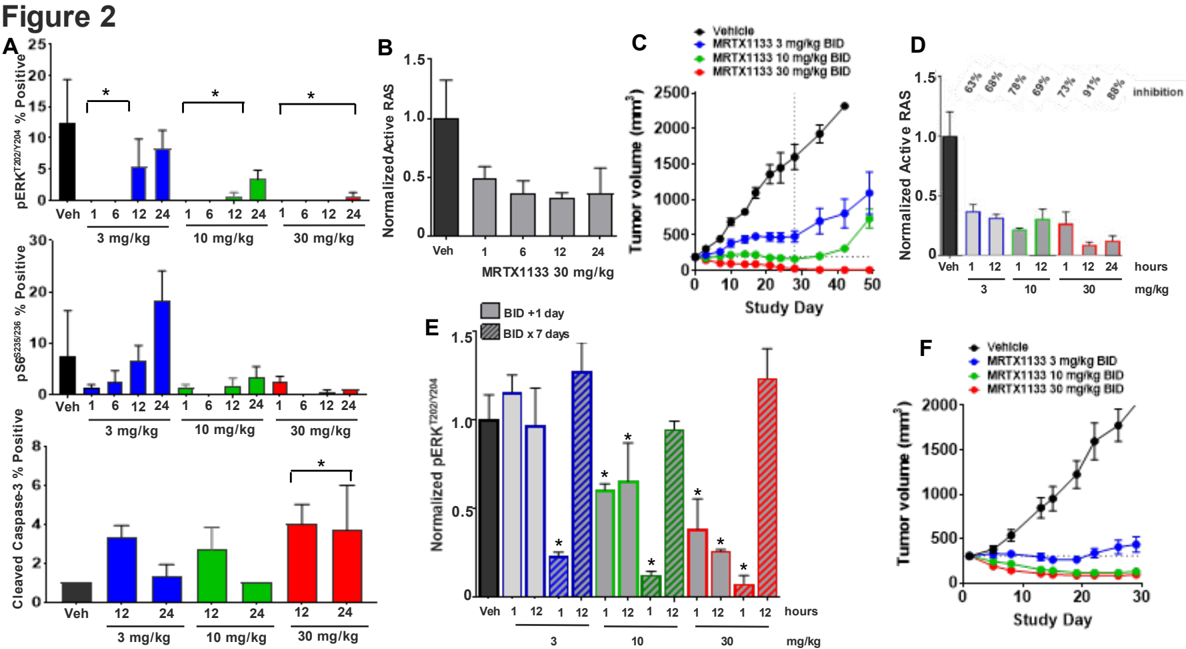
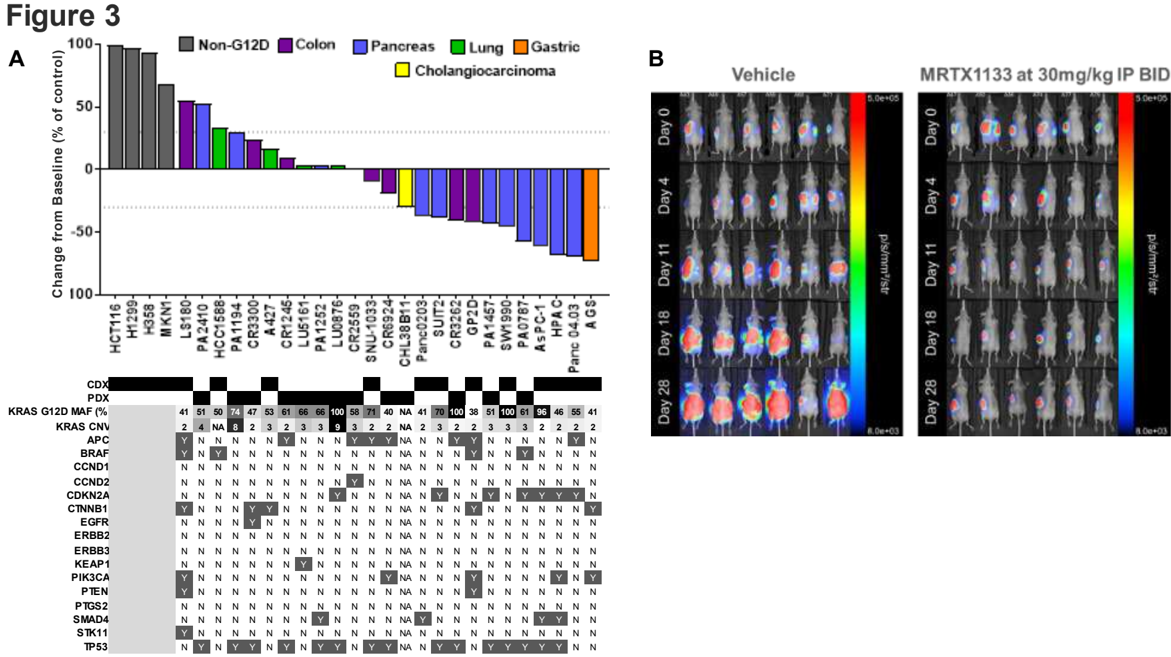
Recent progress in targeting KRAS G12C has provided both insight and inspiration for targeting alternative KRAS mutants. In this study, we evaluated the mechanism of action and anti-tumor efficacy of MRTX1133, a potent, selective and non-covalent KRAS G12D inhibitor. MRTX1133 demonstrated a high-affinity interaction with GDP-loaded KRAS G12D with K D and IC 50 values of ~0.2 pM and <2 nM, respectively, and ~700-fold selectivity for binding to KRAS G12D as compared to KRAS WT. MRTX1133 also demonstrated potent inhibition of activated KRAS G12D based on biochemical and co-crystal structural analyses. MRTX1133 inhibited ERK1/2 phosphorylation and cell viability in KRAS G12D-mutant cell lines, with median IC 50 values of ~5 nM, and demonstrated >1,000-fold selectivity compared to KRAS WT cell lines. MRTX1133 exhibited dose-dependent inhibition of KRAS-mediated signal transduction and marked tumor regression (≥30%) in a subset of KRAS G12D-mutant cell-line-derived and patient-derived xenograft models, including eight of 11 (73%) pancreatic ductal adenocarcinoma (PDAC) models. Pharmacological and CRISPR-based screens demonstrated that co-targeting KRAS G12D with putative feedback or bypass pathways, including EGFR or PI3Kα, led to enhanced anti-tumor activity. Together, these data indicate the feasibility of selectively targeting KRAS mutants with non-covalent, high-affinity small molecules and illustrate the therapeutic susceptibility and broad dependence of KRAS G12D mutation-positive tumors on mutant KRAS for tumor cell growth and survival.
Overview
CoChat Summary
TL;DR
MRTX1133 is a potent, selective, non-covalent KRASG12D inhibitor identified by structure-based drug design that binds both inactive and active KRASG12D and inhibits KRAS-dependent signaling. In preclinical models it produced marked tumor regression in KRASG12D-mutant xenografts, especially pancreatic ductal adenocarcinoma, and showed enhanced activity in rational combinations.
Key findings
- MRTX1133 bound GDP-bound KRASG12D with a SPR KD of ~0.2 pM versus 140 nM for KRAS WT (~700-fold selectivity); HTRF IC50 was <2 nM for inactive KRASG12D and 9 nM for active KRASG12D effector interaction.
- In KRASG12D-mutant cell lines, MRTX1133 inhibited pERK in 24/25 lines with IC50 values of 0.6–13.7 nM (median 6.1 nM), versus median >3,000 nM in nonKRASG12D lines; viability IC50 medians were 5.3 nM in 3D and 26 nM in 2D assays.
- In vivo, MRTX1133 at 30 mg/kg BID caused 85% regression in HPAC xenografts, 16% regression at 10 mg/kg BID, and 81% tumor growth inhibition at 3 mg/kg BID; in Panc 04.03, 10 and 30 mg/kg BID produced 60% and 74% regression, respectively.
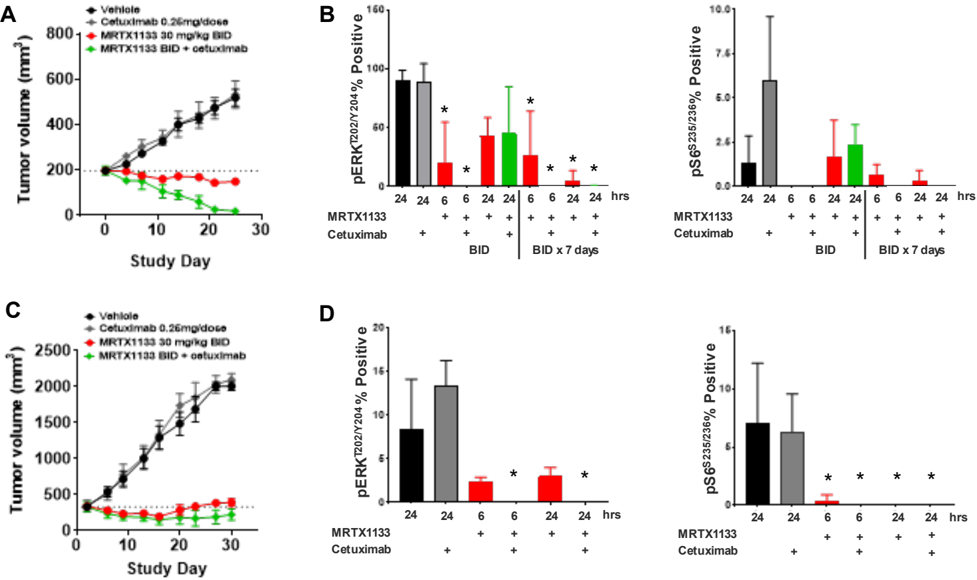
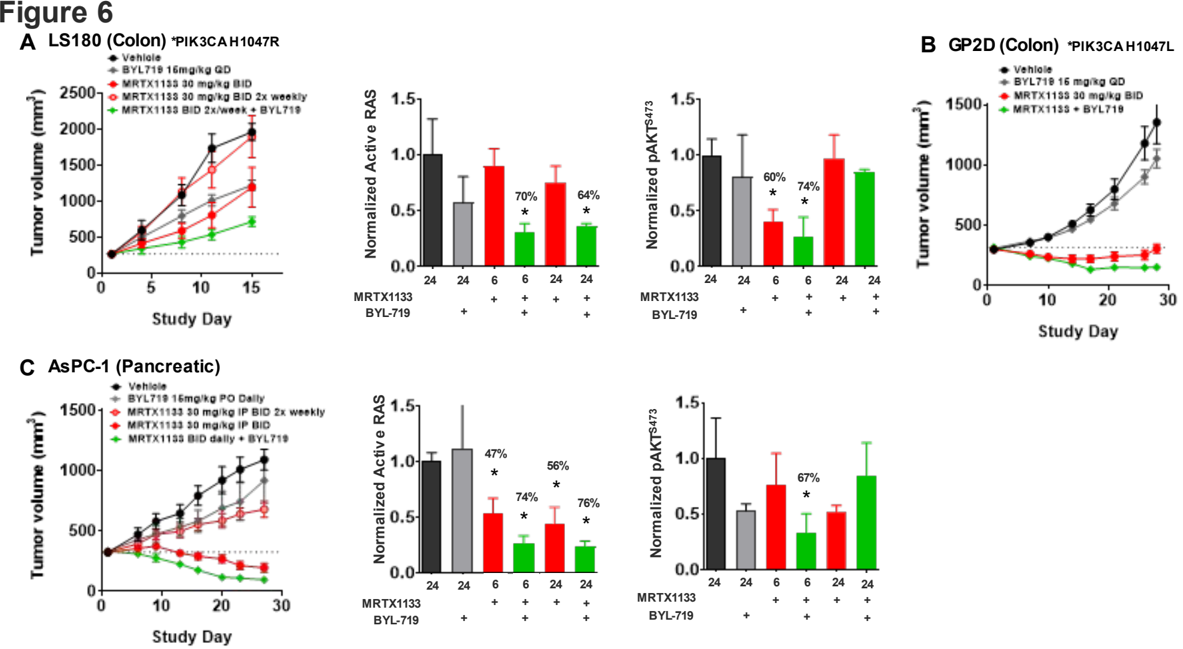
- Across 25 KRASG12D-mutant models, 11/25 had ≥30% tumor regression, including 8/11 (73%) PDAC and 2/8 (25%) CRC models; no significant efficacy was seen in four nonKRASG12D-mutant models. Cetuximab plus MRTX1133 improved anti-tumor efficacy in all 7 models tested, and BYL-719 combinations increased activity in CRC and pancreatic models.
Methods
- Structure-based drug design, SPR binding assays, HTRF competition/effector interaction assays, X-ray crystallography, and cellular signaling/viability assays across 25 KRASG12D-mutant and 7 nonKRASG12D-mutant cancer cell lines.
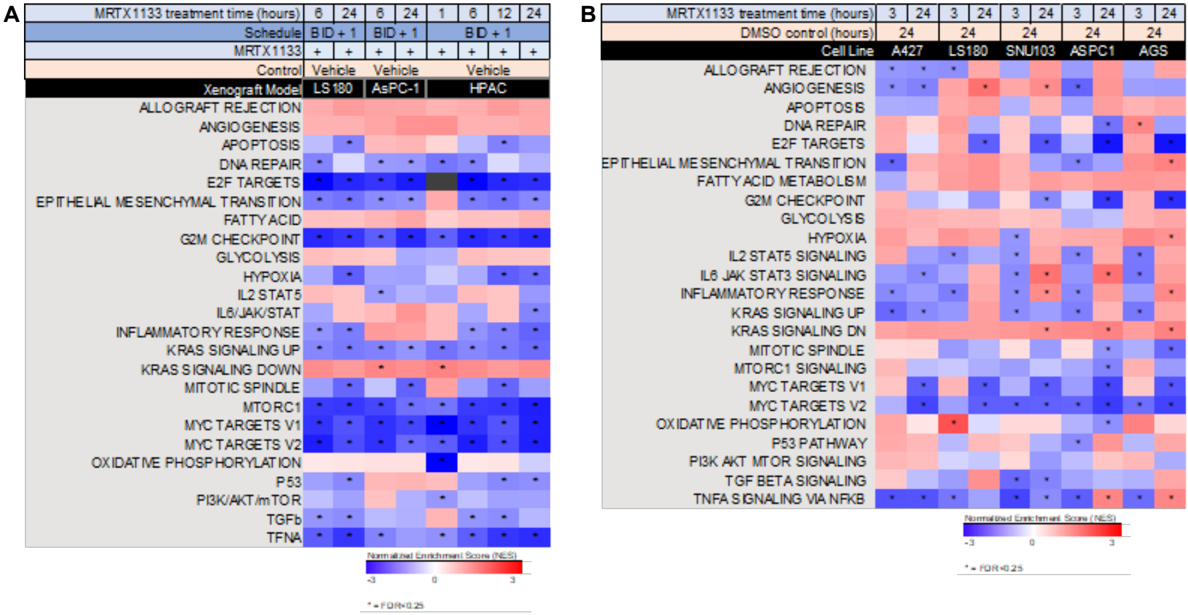
- In vivo studies used immunocompromised mice bearing subcutaneous or orthotopic cell line-derived xenografts and patient-derived xenografts; MRTX1133 was administered intraperitoneally at 3, 10, or 30 mg/kg BID, with tumor volume, immunohistochemistry, active RAS ELISA, RNAseq, CRISPR/Cas9 screens, and combination screens.
- Statistical comparisons used ANOVA or two-tailed Student’s t-test with p<0.05 considered significant; group sizes were typically n=3–6 mice per group.
Limitations
- The paper states that the level of oncogene addiction to KRASG12D in cancers harboring this mutation is not fully understood; that lower PTEN and CDKN2A RNA expression trends did not reach statistical significance; and that KEAP1 findings were from a preliminary analysis. It also notes that consequences of targeting KRAS WT in adult mammals are unknown.
- Evident from the text: all efficacy and safety data are preclinical (cell lines and mouse xenograft/orthotopic models), with no human clinical outcomes; MRTX1133 was given intraperitoneally in mice, not by a clinically validated route; and feedback reactivation of ERK/S6 was observed, which may limit response durability.
- The provided text is a preprint that explicitly states it has not undergone peer review and should not be considered conclusive.
Model-written summary. Check it against the paper before relying on it.
Integrity signals
Registry
Cites
Statistics
Figures
Verification
Claims the paper makes
13 Valid · 5 Not valid · 12 Not checked · 106 Own results and interpretations
The cited sources support only part of this claim — read each source’s verdict below.
In the paper
“Of note, in a preliminary analysis, the response rate of MRTX849 in NSCLC patients harboring mutations in both KRAS G12C and KEAP1 was reduced compared to the response rate in KRAS G12C , KEAP1 WT patients [13, 14].”
What the sources say
- Not matchedcites [13] 13. Janne, P., Rybkin, I.I., Spira, A., Riely, G.J., Papadopoulos, K.P., Sabari, J., et al. KRYSTAL-1: Updated Safety and Efficacy Data with Adagrasib (MRTX849) in NSCLC With KRASG12C Mutation From a Phase 1/2 Study . in EORTC-NCI-AACR . 2020.
Its entry has no title and year that we can search by.
- Partly supportedcites [14] 14. Skoulidis, F., B.T. Li, G.K. Dy, T.J. Price, G.S. Falchook, J. Wolf , et al. , Sotorasib for Lung Cancers with KRAS p.G12C Mutation. N Engl J Med, 2021. 384 (25): p. 2371-2381. sourceExperimental — accuracy not yet measured
The Discussion (page not provided) reports a lower response percentage in KEAP1-mutated than KEAP1-wild-type tumors, but this exploratory finding concerns sotorasib, not MRTX849. The paper therefore does not support the claim about response to MRTX849. (LLM, conf=0.88)
hedgedstates an association- Asserted: passes — The authors put it forward as true.
- Checkable: passes — It can be checked against evidence.
- Load-bearing: unclear — It is unclear whether the paper’s conclusions depend on it.
- Based: passes — The paper gives a reason why it holds.
- Not matched
The cited sources support only part of this claim — read each source’s verdict below.
In the paper
“Given the particular relevance of the EGFR pathway in the pathogenesis of pancreatic and colorectal cancers [16, 17]”
What the sources say
- Partly supportedcites [16] 16. Cunningham, D., Y. Humblet, S. Siena, D. Khayat, H. Bleiberg, A. Santoro , et al. , Cetuximab monotherapy and cetuximab plus irinotecan in irinotecan-refractory metastatic colorectal cancer. N Engl J Med, 2004. 351 (4): p. 337-45. sourceExperimental — accuracy not yet measured
The paper’s discussion of EGFR states that it is relevant to colorectal cancer and describes cancer-related processes regulated by its signaling pathway (results section; page unavailable). The copy does not make the same claim about pancreatic cancer; pancreatic cancer appears only in a cited reference title. (LLM, conf=0.88)
- Partly supportedcites [17] 17. Navas, C., I. Hernandez-Porras, A.J. Schuhmacher, M. Sibilia, C. Guerra, and M. Barbacid, EGF receptor signaling is essential for k-ras oncogene-driven pancreatic ductal adenocarcinoma. Cancer Cell, 2012. 22 (3): p. 318-30. sourceExperimental — accuracy not yet measured
The Discussion states that initiation of K-Ras-driven pancreatic lesions and cancer depends on EGFR signaling. But the Results report that K-Ras-driven intestinal tumors developed without EGFR signaling, so this paper does not support the same broad claim about colorectal cancer pathogenesis. (LLM, conf=0.88)
plainstates an association- Asserted: passes — The authors put it forward as true.
- Checkable: passes — It can be checked against evidence.
- Load-bearing: passes — The paper’s conclusions depend on it.
- Based: passes — The paper gives a reason why it holds.
- Partly supported
The cited sources that could be checked couldn’t confirm or dispute this claim.
In the paper
“Studies conducted with MRTX849 in KRAS G12C mutated nonclinical tumor cell lines and in vivo models generally demonstrated a lack of effectiveness for the combination with BYL719 [4].”
What the sources say
- Could not verifycites [4] 4. Hallin, J., L.D. Engstrom, L. Hargis, A. Calinisan, R. Aranda, D.M. Briere , et al. , The KRAS(G12C) Inhibitor MRTX849 Provides Insight toward Therapeutic Susceptibility of KRAS-Mutant Cancers in Mouse Models and Patients. Cancer Discov, 2020. 10 (1): p. 54-71. sourceExperimental — accuracy not yet measured
The Results section on the combination screen reports testing inhibitors of several pathways, including PI3K, with MRTX849, but does not identify BYL719 or report its effectiveness. Searches for BYL719, alpelisib, and PI3K-combination outcomes found no passage establishing the claimed lack of effectiveness in cell lines or in vivo models. (LLM, conf=0.72)
boosted- Asserted: passes — The authors put it forward as true.
- Checkable: passes — It can be checked against evidence.
- Load-bearing: passes — The paper’s conclusions depend on it.
- Based: passes — The paper gives a reason why it holds.
- Could not verify
The cited sources support only part of this claim — read each source’s verdict below.
In the paper
“Prior studies with KRAS G12C , RAF, and MEK inhibitors indicated that blockade of KRAS-dependent signaling activated a transcriptional program suppressing DUSP , SPRY , and ETV family genes which cooperate to mediate increased signaling flux though RTK, SOS, and MEK/ERK family members resulting in conditional bypass dependence on KRAS [4, 32-34].”
What the sources say
- Partly supportedcites [4] 4. Hallin, J., L.D. Engstrom, L. Hargis, A. Calinisan, R. Aranda, D.M. Briere , et al. , The KRAS(G12C) Inhibitor MRTX849 Provides Insight toward Therapeutic Susceptibility of KRAS-Mutant Cancers in Mouse Models and Patients. Cancer Discov, 2020. 10 (1): p. 54-71. sourceExperimental — accuracy not yet measured
Split into 2 atoms — 0 confirmed, 2 partially supported, 0 disputed, 0 misattributed, 0 unverifiable. Expand the claim to see per-atom verdicts.
- Could not verifycites [32] 37. Rozengurt, E., J. Sinnett-Smith, and K. Kisfalvi, Crosstalk between insulin/insulin-like growth factor-1 receptors and G protein-coupled receptor signaling systems: a novel target for the antidiabetic drug metformin in pancreatic cancer. Clin Cancer Res, 2010. 16 (9): p. 2505-11. sourceExperimental — accuracy not yet measured
Split into 2 atoms — 0 confirmed, 0 partially supported, 0 disputed, 0 misattributed, 2 unverifiable. Expand the claim to see per-atom verdicts.
- Could not verifycites [33] 38. Ulanet, D.B., D.L. Ludwig, C.R. Kahn, and D. Hanahan, Insulin receptor functionally enhances multistage tumor progression and conveys intrinsic resistance to IGF-1R targeted therapy. Proc Natl Acad Sci U S A, 2010. 107 (24): p. 10791-8. sourceExperimental — accuracy not yet measured
Split into 2 atoms — 0 confirmed, 0 partially supported, 0 disputed, 0 misattributed, 2 unverifiable. Expand the claim to see per-atom verdicts.
- Not checked — no full text of the sourcecites [34] 39. Cespedes, M.V., F.J. Sancho, S. Guerrero, M. Parreno, I. Casanova, M.A. Pavon , et al. , K-ras Asp12 mutant neither interacts with Raf, nor signals through Erk and is less tumorigenic than Kras Val12. Carcinogenesis, 2006. 27 (11): p. 2190-200. source
hedgedstates a cause- Asserted: passes — The authors put it forward as true.
- Checkable: passes — It can be checked against evidence.
- Load-bearing: passes — The paper’s conclusions depend on it.
- Based: passes — The paper gives a reason why it holds.
- Partly supported
The cited sources support only part of this claim — read each source’s verdict below.
In the paper
“However, studies evaluating the anti-tumor activity of KRAS G12C inhibitors indicated that the dependence of cells on KRAS mutations for growth and survival as oncogenic drivers was distinct in in vitro cell lines compared with in vivo model systems ([4, 22]).”
What the sources say
- Partly supportedcites [4] 4. Hallin, J., L.D. Engstrom, L. Hargis, A. Calinisan, R. Aranda, D.M. Briere , et al. , The KRAS(G12C) Inhibitor MRTX849 Provides Insight toward Therapeutic Susceptibility of KRAS-Mutant Cancers in Mouse Models and Patients. Cancer Discov, 2020. 10 (1): p. 54-71. sourceExperimental — accuracy not yet measured
Split into 2 atoms — 1 confirmed, 1 partially supported, 0 disputed, 0 misattributed, 0 unverifiable. Expand the claim to see per-atom verdicts.
- Supportedcites [22] 22. Janes, M.R., J. Zhang, L.S. Li, R. Hansen, U. Peters, X. Guo , et al. , Targeting KRAS Mutant Cancers with a Covalent G12C-Specific Inhibitor. Cell, 2018. 172 (3): p. 578-589 e17. source
The Results compare KRAS G12C dependency in in vitro cultures and in vivo xenograft models. The Discussion states that adherent monolayer cultures significantly underestimate KRAS dependence in vivo, while 3D cultures better predict in vivo sensitivity. Page numbers were not supplied. (LLM, conf=0.93)
hedgedstates an association- Asserted: passes — The authors put it forward as true.
- Checkable: passes — It can be checked against evidence.
- Load-bearing: passes — The paper’s conclusions depend on it.
- Based: passes — The paper gives a reason why it holds.
- Partly supported
74 more claims · 2 with their cited sources checked
Create a free account to see all 136 claims and to verify the 6 references still open.
- Probably not a substantial claim. 18
- It may state two separate claims as one. 50
Claims other papers make about this one
Each is checked against this paper’s own text: does it say what the citing paper says it does?
The source backs part of the claim, not all of it — or backs it for a different population, condition or comparison.
In the citing paper
“The intrinsic hydrolysis rate of G12C is inherently high; hence, the fact that the loss of the GAP NF1 can act as a resistance mechanism for KRAS inhibition suggests that NF1 may have KRAS-independent functions [4,56,111].”
From KRAS: Biology, Inhibition, and Mechanisms of Inhibitor Resistance (2024) · cites this paper as [56]
Experimental — accuracy not yet measuredThe source backs part of the claim, not all of it — or backs it for a different population, condition or comparison.
In the citing paper
“MRTX1133 (30 mg/kg) was administered via intraperitoneal injection, twice per day, at the maximum in vivo tolerated dose as described by the manufacturer (30, 31), causing no significant cytotoxic side effects during treatment.”
From Mechanisms of Resistance to Oncogenic KRAS Inhibition in Pancreatic Cancer (2024) · cites this paper as [30]
Experimental — accuracy not yet measuredThe source backs part of the claim, not all of it — or backs it for a different population, condition or comparison.
In the citing paper
“MRTX1133, a non-covalent inhibitor that occupies the switch-II pocket, has shown anti-tumor efficacy by hindering nucleotide exchange and effector binding. 4,5”
From Anti-tumor efficacy of HRS-4642 and its potential combination with proteasome inhibition in KRAS G12D-mutant cancer (2024) · cites this paper as [4]
Experimental — accuracy not yet measuredThe cited source says what the claim attributes to it.
In the citing paper
“Additional investigations of combination therapy strategies with MRTX1133 in preclinical models of PDAC have suggested that co-targeting of EGFR may have enhanced efficacy over monotherapy (30, 34).”
From Mechanisms of Resistance to Oncogenic KRAS Inhibition in Pancreatic Cancer (2024) · cites this paper as [30]
The cited source says what the claim attributes to it.
In the citing paper
“Recent preclinical work with MRTX1133 has demonstrated excellent responses in cell line and xenograft models of PDAC (30, 32).”
From Mechanisms of Resistance to Oncogenic KRAS Inhibition in Pancreatic Cancer (2024) · cites this paper as [30]
14 more claims about this paper
Create a free account to see every claim other papers make about this one.
Self-check
Percentages, sums and reported differences re-computed from the paper’s own numbers.
Each contradiction between two passages listed here was confirmed by an independent check.
Rated minor: it would not touch a result — a value no result rests on, a p-value that stays on the same side of the significance level, or a conflict that is clerical, resolved elsewhere in the paper, or outside its own findings.
In the paper
§ MRTX1133 Combined with BYL-719 Provides Improved Anti-tumor Response in Pancreatic and Colon Tumor Models
“Tumor volumes at Day 15 for the MRTX1133 BID daily for 2 days + cetuximab combination treatment group was determined to be statistically significant vs MRTX1133 BID daily for 2 days or BYL-719 single agent treatment groups”
§ MRTX1133 Combined with BYL-719 Provides Improved Anti-tumor Response in Pancreatic and Colon Tumor Models
“BYL-719 at 15 mg/kg daily, or the combination with the twice weekly schedule of MRTX1133 was administered intraperitoneally to mice bearing the LS180 cell line xenograft”
Citations
Cites
Subramanian, A., Tamayo, P., Mootha, V. K., Mukherjee, S., Ebert, B. L., Gillette, M. A., Paulovich, A., Pomeroy, S. L., Golub, T. R., Lander, E. S., et al. (2005) · Proceedings of the National Academy of Sciences · doi:10.1073/pnas.0506580102 · Cited by 53,625
STAR: ultrafast universal RNA-seq aligner
Dobin, A., Davis, C. A., Schlesinger, F., Drenkow, J., Zaleski, C., Jha, S., Batut, P., Chaisson, M., & Gingeras, T. R. (2013) · Bioinformatics · doi:10.1093/bioinformatics/bts635 · Cited by 51,709
limma powers differential expression analyses for RNA-sequencing and microarray studies
Ritchie, M. E., Phipson, B., Wu, D., Hu, Y., Law, C. W., Shi, W., & Smyth, G. K. (2015) · Nucleic Acids Research · doi:10.1093/nar/gkv007 · Cited by 40,458
Kabsch, W. (2010) · Acta Crystallographica Section D Biological Crystallography · doi:10.1107/s0907444909047337 · Cited by 16,463
Overview of the CCP 4 suite and current developments
Winn, M. D., Ballard, C. C., Cowtan, K. D., Dodson, E. J., Emsley, P., Evans, P. R., Keegan, R. M., Krissinel, E. B., Leslie, A. G. W., McCoy, A., et al. (2011) · Acta Crystallographica Section D Biological Crystallography · doi:10.1107/s0907444910045749 · Cited by 12,353
Comprehensive molecular characterization of human colon and rectal cancer
The Cancer Genome Atlas Network (2012) · Nature · doi:10.1038/nature11252 · Cited by 8,499
Towards automated crystallographic structure refinement with phenix.refine
Afonine, P. V., Grosse-Kunstleve, R. W., Echols, N., Headd, J. J., Moriarty, N. W., Mustyakimov, M., Terwilliger, T. C., Urzhumtsev, A., Zwart, P. H., & Adams, P. D. (2012) · Acta Crystallographica Section D Biological Crystallography · doi:10.1107/s0907444912001308 · Cited by 5,511
The consensus molecular subtypes of colorectal cancer
Guinney, J., Dienstmann, R., Wang, X., de Reyniès, A., Schlicker, A., Soneson, C., Marisa, L., Roepman, P., Nyamundanda, G., Angelino, P., et al. (2015) · Nature Medicine · doi:10.1038/nm.3967 · Cited by 5,170
Self-citationCunningham, D., Humblet, Y., Siena, S., Khayat, D., Bleiberg, H., Santoro, A., Bets, D., Mueser, M., Harstrick, A., Verslype, C., et al. (2004) · New England Journal of Medicine · doi:10.1056/nejmoa033025 · Cited by 5,035
Genomic analyses identify molecular subtypes of pancreatic cancer
Bailey, P., Chang, D. K., Nones, K., Johns, A. L., Patch, A.-M., Gingras, M.-C., Miller, D. K., Christ, A. N., Bruxner, T. J. C., Quinn, M. C., et al. (2016) · Nature · doi:10.1038/nature16965 · Cited by 3,621
Cited by
Large language models in medicine
Thirunavukarasu, A. J., Ting, D. S. J., Elangovan, K., Gutierrez, L., Tan, T. F., & Ting, D. S. W. (2023) · Nature Medicine · doi:10.1038/s41591-023-02448-8 · Cited by 3,944
“However, frequent errors in medical notes, scientific literature and other internet material will continue to hamper LLM performance; clinical practice, scientific inquiry and dissemination of knowledge are not, and will never be, executed perfectly 99,100 .”
BackgroundPancreatic cancer: Advances and challenges
Halbrook, C. J., Lyssiotis, C. A., Pasca di Magliano, M., & Maitra, A. (2023) · Cell · doi:10.1016/j.cell.2023.02.014 · Cited by 1,321
Tumor biomarkers for diagnosis, prognosis and targeted therapy
Zhou, Y., Tao, L., Qiu, J., Xu, J., Yang, X., Zhang, Y., Tian, X., Guan, X., Cen, X., & Zhao, Y. (2024) · Signal Transduction and Targeted Therapy · doi:10.1038/s41392-024-01823-2 · Cited by 720
Recent advances in targeting the “undruggable” proteins: from drug discovery to clinical trials
Xie, X., Yu, T., Li, X., Zhang, N., Foster, L. J., Peng, C., Huang, W., & He, G. (2023) · Signal Transduction and Targeted Therapy · doi:10.1038/s41392-023-01589-z · Cited by 396
Therapeutic developments in pancreatic cancer
Hu, Z. I., & O’Reilly, E. M. (2024) · Nature Reviews Gastroenterology & Hepatology · doi:10.1038/s41575-023-00840-w · Cited by 413
“MRTX1133 induced tumour regression, reduced tumour-infiltrating myeloid-derived suppressor cells (MDSCs), increased M1-like macrophages and expanded the number of tumour-infiltrating cytotoxic T cells in preclinical Kras G12D mouse tumour models 105,106 .”
Efficacy of a small-molecule inhibitor of KrasG12D in immunocompetent models of pancreatic cancer
Kemp, S. B., Cheng, N., Markosyan, N., Sor, R., Kim, I.-K., Hallin, J., Shoush, J., Quinones, L., Brown, N. V., Bassett, J. B., et al. (2023) · Cancer Discovery · doi:10.1158/2159-8290.cd-22-1066 · Cited by 370
Self-citationTranslational and therapeutic evaluation of RAS-GTP inhibition by RMC-6236 in RAS-driven cancers
Jiang, J., Jiang, L., Maldonato, B. J., Wang, Y., Holderfield, M., Aronchik, I., Winters, I. P., Salman, Z., Blaj, C., Menard, M., et al. (2024) · Cancer Discovery · doi:10.1158/2159-8290.cd-24-0027 · Cited by 343
Ferroptosis in health and disease
Berndt, C., Alborzinia, H., Amen, V. S., Ayton, S., Barayeu, U., Bartelt, A., Bayir, H., Bebber, C. M., Birsoy, K., Böttcher, J. P., et al. (2024) · Redox Biology · doi:10.1016/j.redox.2024.103211 · Cited by 334
Singhal, A., Li, B. T., & O’Reilly, E. M. (2024) · Nature Medicine · doi:10.1038/s41591-024-02903-0 · Cited by 332
“https://doi.org/10.1038/s41591-024-02903-0 effectors of KRAS in vitro and leads to robust tumor regression in human patient-derived xenografts of NSCLC, PDAC and CRC and in mouse models 56,65,67,68 .”
InfluentialMechanisms of Resistance to Oncogenic KRAS Inhibition in Pancreatic Cancer
Dilly, J., Hoffman, M. T., Abbassi, L., Li, Z., Paradiso, F., Parent, B. D., Hennessey, C. J., Jordan, A. C., Morgado, M., Dasgupta, S., et al. (2024) · Cancer Discovery · doi:10.1158/2159-8290.cd-24-0177 · Cited by 308
Self-citationMahadevan, K. K., McAndrews, K. M., LeBleu, V. S., Yang, S., Lyu, H., Li, B., Sockwell, A. M., Kirtley, M. L., Morse, S. J., Moreno Diaz, B. A., et al. (2023) · Cancer Cell · doi:10.1016/j.ccell.2023.07.002 · Cited by 258
Tumour-selective activity of RAS-GTP inhibition in pancreatic cancer
Wasko, U. N., Jiang, J., Dalton, T. C., Curiel-Garcia, A., Edwards, A. C., Wang, Y., Lee, B., Orlen, M., Tian, S., Stalnecker, C. A., et al. (2024) · Nature · doi:10.1038/s41586-024-07379-z · Cited by 209
KRAS inhibitors: resistance drivers and combinatorial strategies
Isermann, T., Sers, C., Der, C. J., & Papke, B. (2025) · Trends in Cancer · doi:10.1016/j.trecan.2024.11.009 · Cited by 196
An atlas of epithelial cell states and plasticity in lung adenocarcinoma
Han, G., Sinjab, A., Rahal, Z., Lynch, A. M., Treekitkarnmongkol, W., Liu, Y., Serrano, A. G., Feng, J., Liang, K., Khan, K., et al. (2024) · Nature · doi:10.1038/s41586-024-07113-9 · Cited by 183
Targeting cancer with small-molecule pan-KRAS degraders
Popow, J., Farnaby, W., Gollner, A., Kofink, C., Fischer, G., Wurm, M., Zollman, D., Wijaya, A., Mischerikow, N., Hasenoehrl, C., et al. (2024) · Science · doi:10.1126/science.adm8684 · Cited by 198
Arginase 1 is a key driver of immune suppression in pancreatic cancer
Menjivar, R. E., Nwosu, Z. C., Du, W., Donahue, K. L., Hong, H. S., Espinoza, C., Brown, K., Velez-Delgado, A., Yan, W., Lima, F., et al. (2023) · eLife · doi:10.7554/elife.80721 · Cited by 177
Exploiting the therapeutic implications of KRAS inhibition on tumor immunity
Molina-Arcas, M., & Downward, J. (2024) · Cancer Cell · doi:10.1016/j.ccell.2024.02.012 · Cited by 152
A Small Molecule with Big Impact: MRTX1133 Targets the KRASG12D Mutation in Pancreatic Cancer
Wei, D., Wang, L., Zuo, X., Maitra, A., & Bresalier, R. S. (2023) · Clinical Cancer Research · doi:10.1158/1078-0432.ccr-23-2098 · Cited by 193
Adeno-to-squamous transition drives resistance to KRAS inhibition in LKB1 mutant lung cancer
Tong, X., Patel, A. S., Kim, E., Li, H., Chen, Y., Li, S., Liu, S., Dilly, J., Kapner, K. S., Zhang, N., et al. (2024) · Cancer Cell · doi:10.1016/j.ccell.2024.01.012 · Cited by 142
Self-citationNext batter up! Targeting cancers with KRAS-G12D mutations
Zeissig, M. N., Ashwood, L. M., Kondrashova, O., & Sutherland, K. D. (2023) · Trends in Cancer · doi:10.1016/j.trecan.2023.07.010 · Cited by 128
Defining the KRAS- and ERK-dependent transcriptome in KRAS-mutant cancers
Klomp, J. A., Klomp, J. E., Stalnecker, C. A., Bryant, K. L., Edwards, A. C., Drizyte-Miller, K., Hibshman, P. S., Diehl, J. N., Lee, Y. S., Morales, A. J., et al. (2024) · Science · doi:10.1126/science.adk0775 · Cited by 120
Self-citationRAS signaling in carcinogenesis, cancer therapy and resistance mechanisms
Yang, X., & Wu, H. K. (2024) · Journal of Hematology & Oncology · doi:10.1186/s13045-024-01631-9 · Cited by 146
Abdoul‐Latif, F. M., Ainane, A., Aboubaker, I. H., Jalludin, M., & Ainane, T. (2023) · Pharmaceuticals · doi:10.3390/ph16081086 · Cited by 144
Zhou, C., Li, C., Luo, L., Li, X., Jia, K., He, N., Mao, S., Wang, W., Shao, C., Liu, X., et al. (2024) · Cancer Cell · doi:10.1016/j.ccell.2024.06.001 · Cited by 102
Feng, J., Hu, Z., Xia, X., Liu, X., Lian, Z., Wang, H., Wang, L., Wang, C., Zhang, X., & Pang, X. (2023) · Oncogene · doi:10.1038/s41388-023-02676-9 · Cited by 95
Organoids for Functional Precision Medicine in Advanced Pancreatic Cancer
Boilève, A., Cartry, J., Goudarzi, N., Bedja, S., Mathieu, J. R. R., Bani, M. A., Nicolle, R., Mouawia, A., Bouyakoub, R., Nicotra, C., et al. (2024) · Gastroenterology · doi:10.1053/j.gastro.2024.05.032 · Cited by 115
Impact of KRAS mutations and co-mutations on clinical outcomes in pancreatic ductal adenocarcinoma
Yousef, A., Yousef, M., Chowdhury, S., Abdilleh, K., Knafl, M., Edelkamp, P., Alfaro-Munoz, K., Chacko, R., Peterson, J., Smaglo, B. G., et al. (2024) · npj Precision Oncology · doi:10.1038/s41698-024-00505-0 · Cited by 93
Targeting KRAS in pancreatic cancer
Stickler, S., RATH, B., & Hamilton, G. (2024) · Oncology Research Featuring Preclinical and Clinical Cancer Therapeutics · doi:10.32604/or.2024.045356 · Cited by 119
Dual inhibition of KRASG12D and pan-ERBB is synergistic in pancreatic ductal adenocarcinoma
Gulay, K. C. M., Zhang, X., Pantazopoulou, V., Patel, J., Esparza, E., Pran Babu, D. S., Ogawa, S., Weitz, J., Ng, I., Mose, E. S., et al. (2023) · Cancer Research · doi:10.1158/0008-5472.can-23-1313 · Cited by 89
“MRTX1133 monotherapy resulted in some inhibition of tumor growth, consistent with prior reports (6, 7), while the combination of afatinib and MRTX1133 resulted in a greater degree of growth inhibition and increased the survival of treated animals.”
A Classical Epithelial State Drives Acute Resistance to KRAS Inhibition in Pancreatic Cancer
Singhal, A., Styers, H. C., Rub, J., Li, Z., Torborg, S. R., Kim, J. Y., Grbovic-Huezo, O., Feng, H., Tarcan, Z. C., Sahin Ozkan, H., et al. (2024) · Cancer Discovery · doi:10.1158/2159-8290.cd-24-0740 · Cited by 84
Self-citationStrain-release alkylation of Asp12 enables mutant selective targeting of K-Ras-G12D
Zheng, Q., Zhang, Z., Guiley, K. Z., & Shokat, K. M. (2024) · Nature Chemical Biology · doi:10.1038/s41589-024-01565-w · Cited by 88
Recent Advances in Therapeutic Strategies to Improve Colorectal Cancer Treatment
Gmeiner, W. H. (2024) · Cancers · doi:10.3390/cancers16051029 · Cited by 78
“Recent studies with the KRAS G12D specific inhibitor MRTX1133 [85] have, however, showed promise that this mutant form of KRAS is also druggable.”
BackgroundDigestive cancers: mechanisms, therapeutics and management
Zhan, T., Betge, J., Schulte, N., Dreikhausen, L., Hirth, M., Li, M., Weidner, P., Leipertz, A., Teufel, A., & Ebert, M. P. A. (2025) · Signal Transduction and Targeted Therapy · doi:10.1038/s41392-024-02097-4 · Cited by 100
Alveolar Differentiation Drives Resistance to KRAS Inhibition in Lung Adenocarcinoma
Li, Z., Zhuang, X., Pan, C.-H., Yan, Y., Thummalapalli, R., Hallin, J., Torborg, S., Singhal, A., Chang, J. C., Manchado, E., et al. (2024) · Cancer Discovery · doi:10.1158/2159-8290.cd-23-0289 · Cited by 74
Self-citationMYC and KRAS cooperation: from historical challenges to therapeutic opportunities in cancer
Casacuberta‐Serra, S., González-Larreategui, Í., Capitán-Leo, D., & Soucek, L. (2024) · Signal Transduction and Targeted Therapy · doi:10.1038/s41392-024-01907-z · Cited by 100
Targeting small GTPases: emerging grasps on previously untamable targets, pioneered by KRAS
Yin, G., Huang, J., Petela, J., Jiang, H., Zhang, Y., Gong, S., Wu, J., Liu, B., Shi, J., & Gao, Y. (2023) · Signal Transduction and Targeted Therapy · doi:10.1038/s41392-023-01441-4 · Cited by 82
Li, J., Liu, X.-G., Ge, R., Yin, Y., Liu, Y.-D., Lu, W.-P., Huang, M., He, X.-Y., Wang, J., Cai, G., et al. (2023) · Nature Immunology · doi:10.1038/s41590-023-01634-7 · Cited by 76
“Here we performed in vivo genome-scale CRISPR-Cas9 knockout screening, which allows the unbiased discovery of functional genes 24–27 and identified the cell-surface transmembrane protein ERMAP as a pro-phagocytosis molecule expressed by tumor cells that delivered an ‘eat me’ signal to Kupffer cells…”
MethodChen, F., Kang, R., Liu, J., & Tang, D. (2023) · Frontiers in Cell and Developmental Biology · doi:10.3389/fcell.2023.1213995 · Cited by 79
“, MRTX1133) protein, many patients remain unresponsive to these therapies (Hong et al., 2020; Skoulidis et al., 2021; Liu et al., 2022a; Hallin et al., 2022; Wang et al., 2022; Tang and Kang, 2023).”
BackgroundThe next-generation KRAS inhibitors…What comes after sotorasib and adagrasib?
Oya, Y., Imaizumi, K., & Mitsudomi, T. (2024) · Lung Cancer · doi:10.1016/j.lungcan.2024.107886 · Cited by 65
Discovery of KRAS(G12D) selective degrader ASP3082
Yoshinari, T., Nagashima, T., Ishioka, H., Inamura, K., Nishizono, Y., Tasaki, M., Iguchi, K., Suzuki, A., Sato, C., Nakayama, A., et al. (2025) · Communications Chemistry · doi:10.1038/s42004-025-01662-4 · Cited by 89
PROTACs: A novel strategy for cancer drug discovery and development
Han, X., & Sun, Y. (2023) · MedComm · doi:10.1002/mco2.290 · Cited by 78
Targeting PIKfyve-driven lipid metabolism in pancreatic cancer
Cheng, C., Hu, J., Mannan, R., He, T., Bhattacharyya, R., Magnuson, B., Wisniewski, J. P., Peters, S., Karim, S. A., MacLean, D., et al. (2025) · Nature · doi:10.1038/s41586-025-08917-z · Cited by 89
Simultaneous Covalent Modification of K-Ras(G12D) and K-Ras(G12C) with Tunable Oxirane Electrophiles
Yu, Z., He, X., Wang, R., Xu, X., Zhang, Z., Ding, K., Zhang, Z., Tan, Y., & Li, Z. (2023) · Journal of the American Chemical Society · doi:10.1021/jacs.3c05899 · Cited by 63
KRAS: Biology, Inhibition, and Mechanisms of Inhibitor Resistance
Ash, L. J., Busia-Bourdain, O., Okpattah, D., Kamel, A., Liberchuk, A., & Wolfe, A. L. (2024) · Current Oncology · doi:10.3390/curroncol31040150 · Cited by 68
“In 2022, the Shokat lab introduced a novel KRAS G12S-selective covalent inhibitor [59].”
BackgroundImproving outcomes of patients with pancreatic cancer
Dreyer, S. B., Beer, P. A., Hingorani, S. R., & Biankin, A. V. (2025) · Nature Reviews Clinical Oncology · doi:10.1038/s41571-025-01019-9 · Cited by 81
Essential Oils: Chemical Composition and Diverse Biological Activities : A Comprehensive Review
Miri, Y. B. (2025) · Natural Product Communications · doi:10.1177/1934578x241311790 · Cited by 162
The tumour microenvironment in pancreatic cancer — new clinical challenges, but more opportunities
Kung, H., Zheng, K., Zimmerman, J. W., & Zheng, L. (2025) · Nature Reviews Clinical Oncology · doi:10.1038/s41571-025-01077-z · Cited by 101
Stress granules in cancer: Adaptive dynamics and therapeutic implications
Jia, Y., Jia, R., Dai, Z., Zhou, J., Ruan, J., Chng, W. J., Cai, Z., & Zhang, X. (2024) · iScience · doi:10.1016/j.isci.2024.110359 · Cited by 72
“160,161 Research demonstrates that mutant KRAS regulates prostaglandin metabolism, particularly by enhancing the expression of cyclooxygenase-2(COX-2)anddecreasingthedegradation of 15-deoxy-D 12,14-prostaglandin J2 (15-d-PGJ2).”
BackgroundKRAS Mutation Subtypes and Their Association with Other Driver Mutations in Oncogenic Pathways
Mondal, K., Posa, M. K., Shenoy, R. P., & Roychoudhury, S. (2024) · Cells · doi:10.3390/cells13141221 · Cited by 69
“MRTX1133 showed higher affinity towards the KRAS G12D -GDP state of the protein with a dissociation constant (K D ) and drug inhibitory (IC 50 ) values of about 0.2 pM and less than 2 nM, respectively [182].”
BackgroundMethodInfluentialKras oncogene ablation prevents resistance in advanced lung adenocarcinomas
Salmón, M., Álvarez-Díaz, R., Fustero-Torre, C., Brehey, O., Lechuga, C. G., Sanclemente, M., Fernández-García, F., López-García, A., Martín-Guijarro, M. C., Rodríguez-Perales, S., et al. (2023) · Journal of Clinical Investigation · doi:10.1172/jci164413 · Cited by 52
Orlen, M., Vostrejs, W. P., Sor, R., McDevitt, J. C., Kemp, S. B., Kim, I., Kramer, A. B., Shifrin, N. T., Markosyan, N., Clendenin, C., et al. (2025) · Cancer Discovery · doi:10.1158/2159-8290.cd-24-1475 · Cited by 71
Kumarasamy, V. M., Frangou, C. G., Wang, J., Wan, Y., Dynka, A., Rosenheck, H. R., Dey, P., Abel, E. V., Knudsen, E. S., & Witkiewicz, A. K. (2024) · Cancer Research · doi:10.1158/0008-5472.can-23-2504 · Cited by 63
A neomorphic protein interface catalyzes covalent inhibition of RAS G12D aspartic acid in tumors
Weller, C. E., Burnett, G. L., Jiang, L., Chakraborty, S., Zhang, D., Vita, N. A., Dilly, J., Kim, E., Maldonato, B. J., Seamon, K. J., et al. (2025) · Science · doi:10.1126/science.ads0239 · Cited by 78
Glimmers of hope for targeting oncogenic KRAS-G12D
Tang, D., & Kang, R. (2022) · Cancer Gene Therapy · doi:10.1038/s41417-022-00561-3 · Cited by 62
KRAS: the Achilles’ heel of pancreas cancer biology
Drizyte‐Miller, K., Talabi, T., Somasundaram, A., Cox, A. D., & Der, C. J. (2025) · Journal of Clinical Investigation · doi:10.1172/jci191939 · Cited by 73
Targeting KRAS mutations in pancreatic cancer: opportunities for future strategies
Linehan, A., O’Reilly, M., McDermott, R., & O'Kane, G. M. (2024) · Frontiers in Medicine · doi:10.3389/fmed.2024.1369136 · Cited by 60
Facts and Hopes on RAS Inhibitors and Cancer Immunotherapy
Boumelha, J., Molina‐Arcas, M., & Downward, J. (2023) · Clinical Cancer Research · doi:10.1158/1078-0432.ccr-22-3655 · Cited by 46
“These include inhibitors targetingtheactiveformofKRASG12CoragainstotherKRASmutant proteins such as G12D, G12S, and G12R (22 – 24).”
BackgroundNext-generation therapies for pancreatic cancer
Buckley, C. W., & O'Reilly, E. M. (2024) · Expert Review of Gastroenterology & Hepatology · doi:10.1080/17474124.2024.2322648 · Cited by 54
“Preclinical data show that MRTX1133 reverses early PDAC growth and favorably influences tumor microenvironment (TME) by increasing intratumoral CD8+ effector T cells, decreasing myeloid infiltration, and reprograming cancer-associated fibroblasts [85,86].”
BackgroundBreakthrough in RAS targeting with pan-RAS(ON) inhibitors RMC-7977 and RMC-6236
Filis, P., Salgkamis, D., Matikas, A., & Zerdes, I. (2024) · Drug Discovery Today · doi:10.1016/j.drudis.2024.104250 · Cited by 55
Targeting KRAS in Pancreatic Ductal Adenocarcinoma: The Long Road to Cure
de Jesus, V. H. F., Mathias-Machado, M. C., de Farias, J. P. F., Aruquipa, M. P. S., Jacome, A. A. D. A., & Peixoto, R. D. (2023) · Cancers · doi:10.3390/cancers15205015 · Cited by 55
From bench to bedside: current development and emerging trend of KRAS-targeted therapy
Chen, Y., Liu, Q.-P., Xie, H., & Ding, J. (2023) · Acta Pharmacologica Sinica · doi:10.1038/s41401-023-01194-4 · Cited by 47
Cao, Q., Wu, X., Chen, Y., Qi, W., You, Y., Qiang, Y., & Cao, G. (2023) · Frontiers in Cellular and Infection Microbiology · doi:10.3389/fcimb.2023.1257638 · Cited by 38
“A large body of evidence demonstrates a close link between the pathogenesis of BLI and NSCLC (Cao et al., 2022a; Hallin et al., 2022).”
BackgroundInfluentialExploring switch II pocket conformation of KRAS(G12D) with mutant-selective monobody inhibitors
Akkapeddi, P., Hattori, T., Khan, I. M., Glasser, E., Koide, A., Ketavarapu, G., Whaby, M., Zuberi, M., Teng, K. W., Lefler, J. E., et al. (2023) · Proceedings of the National Academy of Sciences · doi:10.1073/pnas.2302485120 · Cited by 40
Feng, J., Xiao, X., Xia, X., Min, J., Tang, W., Shi, X., Xu, K., Zhou, G., Li, K., Shen, P., et al. (2025) · Cancer Cell · doi:10.1016/j.ccell.2025.07.006 · Cited by 46
McDaid, W. J., Wilson, L., Adderley, H., Martinez-Lopez, A., Baker, M. J., Searle, J., GINN, L. H., Budden, T., Aldea, M. D., Marinello, A., et al. (2024) · Molecular Cancer · doi:10.1186/s12943-024-02157-x · Cited by 50
Targeted Therapies in Pancreatic Cancer: A New Era of Precision Medicine
Li, B., Zhang, Q., Castaneda, C. N., & Cook, S. M. (2024) · Biomedicines · doi:10.3390/biomedicines12102175 · Cited by 45
“MRTX1133, a non-covalent KRAS -G12D inhibitor developed in 2021, has shown promise in preclinical studies by inhibiting KRAS nucleotide exchange and RAF1 binding, reversing early PDAC growth, and positively altering the tumor microenvironment [25–27].”
BackgroundPancreatic cancer: molecular pathogenesis and emerging therapeutic strategies
Rozengurt, E., & Eibl, G. (2026) · Signal Transduction and Targeted Therapy · doi:10.1038/s41392-025-02499-y · Cited by 66
Cytosolic acetyl-coenzyme A is a signalling metabolite to control mitophagy
Zhang, Y., Shen, X. L., Shen, Y., Wang, C., Yu, C., Han, J., Cao, S., Qian, L., Ma, M., Huang, S., et al. (2025) · Nature · doi:10.1038/s41586-025-09745-x · Cited by 58
Differential activity of MAPK signalling defines fibroblast subtypes in pancreatic cancer
Veghini, L., Pasini, D., Fang, R., Delfino, P., Filippini, D., Neander, C., Vicentini, C., Fiorini, E., Lupo, F., D’Agosto, S. L., et al. (2024) · Nature Communications · doi:10.1038/s41467-024-54975-8 · Cited by 53
Critical role for a high-plasticity cell state in lung cancer
Chan, J. E., Pan, C., Rub, J., Guzman, G., Bastl, K., Brown, E., Zhang, Z., Styers, H. C., Hartmann, G. G., Li, Z., et al. (2026) · Nature · doi:10.1038/s41586-025-09985-x · Cited by 47
Bulle, A. S., Liu, P., Seehra, K., Bansod, S., Chen, Y., Zahra, K., Somani, V., Khawar, I. A., Chen, H.-P., Dodhiawala, P. B., et al. (2024) · Nature Communications · doi:10.1038/s41467-024-46811-w · Cited by 45
Li, C., Liu, Y., Liu, C., Chen, F., Xie, Y., Zeh, H. J., Yu, C., Liu, J., Tang, D., & Kang, R. (2025) · Science Translational Medicine · doi:10.1126/scitranslmed.adp4986 · Cited by 41
Targeted nanodelivery of siRNA against KRAS G12D inhibits pancreatic cancer
Huang, R., Du, H., Cheng, L., Zhang, P., Meng, F., & Zhong, Z. (2023) · Acta Biomaterialia · doi:10.1016/j.actbio.2023.07.008 · Cited by 40
Emerging Role of Targeted Therapy in Metastatic Pancreatic Adenocarcinoma
Huffman, B. M., Ellis, H., Jordan, A. C., Freed-Pastor, W. A., Perez, K. J., Rubinson, D. A., Sethi, N. S., Singh, H., Surana, R., Wolpin, B. M., et al. (2022) · Cancers · doi:10.3390/cancers14246223 · Cited by 36
“RMC-6236 inhibits all RAS isoforms (i.e., K-, H-, and NRAS) by acting as a molecular glue to promote the binding RAS proteins to the cyclophilin A chaperone protein.”
BackgroundEmerging landscape of KRAS inhibitors in cancer treatment
Riedl, J. M., Matsubara, H., McNeil, R., Patel, P. S., de la Cruz, F. F., Gulhan, D., & Corcoran, R. B. (2026) · Cancer Cell · doi:10.1016/j.ccell.2026.01.001 · Cited by 53
Li, Y., Tang, S., Wang, H., Zhu, H., Lu, Y., Zhang, Y., Guo, S., He, J., Li, Y., Zhang, Y., et al. (2025) · Cell stem cell · doi:10.1016/j.stem.2025.07.008 · Cited by 54
Unveiling the resistance to therapies in pancreatic ductal adenocarcinoma
Shah, A., Ganguly, K., Rauth, S., Sheree, S. S., Khan, I., Ganti, A. K., Ponnusamy, M. P., Kumar, S., Jain, M., & Batra, S. K. (2024) · Drug Resistance Updates · doi:10.1016/j.drup.2024.101146 · Cited by 40
Targeting KRAS in Colorectal Cancer: A Bench to Bedside Review
Bteich, F., Mohammadi, M., Li, T., Bhat, M. A., Sofianidi, A. A., Wei, N., & Kuang, C. (2023) · International Journal of Molecular Sciences · doi:10.3390/ijms241512030 · Cited by 36
“MRTX1133 has been shown to inhibit KRAS signaling in vitro and to cause tumor regression greater than 30% in PDX models [143].”
GCLM lactylation mediated by ACAT2 promotes ferroptosis resistance in KRASG12D-mutant cancer
Chen, Y., Yan, Q., Ruan, S., Cui, J., Li, Z., Zhang, Z., Yang, J., Fang, J., Liu, S., Huang, S., et al. (2025) · Cell Reports · doi:10.1016/j.celrep.2025.115774 · Cited by 51
Han, L., Meng, L., Liu, J., Xie, Y., Kang, R., Klionsky, D. J., Tang, D., Jia, Y., & Dai, E. (2024) · Cancer Letters · doi:10.1016/j.canlet.2024.217258 · Cited by 38
Immune vulnerabilities of mutant KRAS in pancreatic cancer
Cheng, N. C., & Vonderheide, R. H. (2023) · Trends in cancer · doi:10.1016/j.trecan.2023.07.004 · Cited by 36
Non-genetic adaptive resistance to KRASG12C inhibition: EMT is not the only culprit
Ning, W., Marti, T. M., Dorn, P., & Peng, R.-W. (2022) · Frontiers in Oncology · doi:10.3389/fonc.2022.1004669 · Cited by 29
“Nevertheless, the advent of potent and selective inhibitors for KRAS is definitely not the beginning of the end, but the end of the beginning for the era of precision medicine, as this breakthrough has spurred the search for mutation-specific targeted therapies, as evidenced by the most recent development of KRAS inhi…”
BackgroundZhou, Y., Zhang, Y., Li, M., Ming, T., Zhang, C., Huang, C., Li, J., Li, F., Li, H. ‐., Zhao, E., et al. (2024) · Science Immunology · doi:10.1126/sciimmunol.ado8758 · Cited by 33
A pan-KRAS degrader for the treatment of KRAS-mutant cancers
Yang, J., Wang, Q.-L., Wang, G., Ye, J.-C., Li, Z.-Q., Wang, J.-Y., Liang, Z., Li, S., Sun, C., Liao, W., et al. (2024) · Cell Discovery · doi:10.1038/s41421-024-00699-4 · Cited by 37
Hydrophobic interactions dominate the recognition of a KRAS G12V neoantigen
Wright, K. M., DiNapoli, S. R., Miller, M. S., Azurmendi, P. A., Zhao, X., Yu, Z., Chakrabarti, M., Shi, W., Douglass, J., Hwang, M. S., et al. (2023) · Nature Communications · doi:10.1038/s41467-023-40821-w · Cited by 35
A first-in-class EGFR-directed KRAS G12V selective inhibitor
Stanland, L. J., Huggins, H. P., Sahoo, S. S., Porrello, A., Chareddy, Y. S., Azam, S. H., Perry, J. L., Pallan, P. S., Whately, K. M., Edatt, L., et al. (2025) · Cancer Cell · doi:10.1016/j.ccell.2025.05.016 · Cited by 42
Pancreatic ductal adenocarcinoma (PDAC): clinical progress in the last five years
Mosalem, O. M., Abdelhakeem, A. A. F., Abdel-Razeq, N. H., & Babiker, H. M. (2025) · Expert Opinion on Investigational Drugs · doi:10.1080/13543784.2025.2473698 · Cited by 39
“Of those, MRTX-1133, a novel non-covalent inhibitor targeting KRAS G12D mutations, is in phase I clinical trials and has shown promising preclinical data [42].”
The Evolutionary Forest of Pancreatic Cancer
Mullen, K. M., Hong, J., Attiyeh, M. A., Hayashi, A., Sakamoto, H., Kohutek, Z. A., McIntyre, C. A., Zhang, H., Makohon-Moore, A. P., Zucker, A., et al. (2024) · Cancer Discovery · doi:10.1158/2159-8290.cd-23-1541 · Cited by 29
Precision treatment of pancreatic ductal adenocarcinoma
Wei, H., & Ren, H. (2024) · Cancer Letters · doi:10.1016/j.canlet.2024.216636 · Cited by 28
Stromal-derived NRG1 enables oncogenic KRAS bypass in pancreas cancer
Han, J., Xu, J., Liu, Y., Liang, S., LaBella, K. A., Chakravarti, D., Spring, D. J., Xia, Y., & DePinho, R. A. (2023) · Genes & Development · doi:10.1101/gad.351037.123 · Cited by 30
CRISPR prime editing for unconstrained correction of oncogenic KRAS variants
Jang, G., Kweon, J., & Kim, Y. (2023) · Communications Biology · doi:10.1038/s42003-023-05052-1 · Cited by 33
“To date, there are two types of inhibitors that have been developed for KRAS in a mutant-speci fi c manner: covalent inhibitors targeting the mutated cysteine residue in KRAS G12C 7 – 10 and a selective non-covalent inhibitor of KRAS G12D 11,12 .”
Targeting Driver Oncogenes and Other Public Neoantigens Using T Cell Receptor–Based Cellular Therapy
Martinov, T., & Greenberg, P. D. (2023) · Annual Review of Cancer Biology · doi:10.1146/annurev-cancerbio-061521-082114 · Cited by 31
Evaluation of KRAS inhibitor-directed therapies for pancreatic cancer treatment
Long, S.-A., Amparo, A. M., Goodhart, G., Ahmad, S. A., & Waters, A. M. (2024) · Frontiers in Oncology · doi:10.3389/fonc.2024.1402128 · Cited by 31
Keats, M. A., Han, J. J. W., Lee, Y., Lee, C.-S., & Luo, J. (2023) · Cancer Research · doi:10.1158/0008-5472.can-23-0592 · Cited by 27
Multiple Strategies to Develop Small Molecular KRAS Directly Bound Inhibitors
Zhou, X., Ji, Y., & Zhou, J. (2023) · Molecules · doi:10.3390/molecules28083615 · Cited by 29
“Meanwhile, MRTX1133 indicated dose-dependent inhibition of KRAS-mediated signal transduction and induced significant regression of the tumors (≥30%) in the patient-derived KRAS-G12D-mutant xenograft models [80].”
BackgroundEliminating oncogenic RAS: back to the future at the drawing board
Steffen, C. L., Kaya, P., Schaffner‐Reckinger, E., & Abankwa, D. (2023) · Biochemical Society Transactions · doi:10.1042/bst20221343 · Cited by 24
Pancreatic Cancer: Pathogenesis and Clinical Studies
Zhou, K., Liu, Y., Tang, C., & Zhu, H. (2025) · MedComm · doi:10.1002/mco2.70162 · Cited by 35
Emerging Targeted Therapies in Non-Small-Cell Lung Cancer (NSCLC)
Mina, S. A., Shanshal, M., Leventakos, K., & Parikh, K. (2025) · Cancers · doi:10.3390/cancers17030353 · Cited by 35
“Preclinical studies showed significant efficacy, with tumor regression in xenograft mouse models occurring in a dose-dependent manner [34].”
Negrao, M. V., Paula, A. G., Molkentine, D. P., Hover, L. D., Nilsson, M. B., Vokes, N. I., Engstrom, L. D., Calinisan, A., Briere, D. M., Waters, L. M., et al. (2025) · Clinical Cancer Research · doi:10.1158/1078-0432.ccr-24-2310 · Cited by 41
“KEAP1 loss has also been previously reported to promote increased cellular fitness in the H2122 KRAS G12C -mutant NSCLC model and in KRAS G12D -mutant models treated with adagrasib or MRTX1133—a KRAS G12D inhibitor—respectively (20, 21).”
Self-citationDiscovery of Prodrug of MRTX1133 as an Oral Therapy for Cancers with KRASG12D Mutation
Ji, X. L., Li, Y., Kong, X., Chen, D., & Lu, J. (2023) · ACS Omega · doi:10.1021/acsomega.3c00329 · Cited by 29
Metadata
- Authors
- Hallin, J., Bowcut, V., Calinisan, A., Briere, D. M., Hargis, L., Engstrom, L. D., Laguer, J., Medwid, J., Vanderpool, D., Lifset, E., Trinh, D., Hoffman, N., Wang, X., David Lawson, J., Gunn, R. J., Smith, C. R., Thomas, N. C., Martinson, M., Bergstrom, A., Sullivan, F., Bouhana, K., Winski, S., He, L., Fernandez-Banet, J., Pavlicek, A., Haling, J. R., Rahbaek, L., Marx, M. A., Olson, P., & Christensen, J. G.
- Affiliations
- Mirati Therapeutics (United States) (US)
- Array BioPharma (United States) (US)
- Corresponding author
- Christensen, James G.
- ORCID
- Hallin, Jill
- Bowcut, Vickie
- Calinisan, Andrew
- Briere, David M.
- Hargis, Lauren
- Engstrom, Lars D.
- Laguer, Jade
- Vanderpool, Darin
- Lifset, Ella
- Wang, Xiaolun
- David Lawson, J.
- Gunn, Robin J.
- Smith, Christopher R.
- Thomas, Nicole C.
- Sullivan, Francis
- Winski, Shannon
- Fernandez-Banet, Julio
- Haling, Jacob R.
- Marx, Matthew A.
- Olson, Peter
- Christensen, James G.
- Venue
- Nature Medicine
- Published
- 2022-10
- Volume
- 28
- Issue
- 10
- Pages
- 2171-2182
- ISSN
- 1078-8956 (ISSN-L)
- 1546-170X
- OpenAlex
- W4304084008
- Semantic Scholar
- b7c117afde78d9d5211e96d5c562a1fdf63b10d7
- Cited by
- 553
- References
- 49
- Citations by year
- 2026: 159 · 2025: 159 · 2024: 138 · 2023: 90 · 2022: 7
- FWCI
- 28.97
- Type
- journal article
- Language
- en
- Open access
- green
- doi.org
- Licence
- cc-by
- www.springernature.com/gp/researchers/text-and-data-mining (tdm)
- www.springernature.com/gp/researchers/text-and-data-mining (vor)
- Locations
- Nature Medicine (publishedVersion)
- Research Square (submittedVersion, cc-by)
- PubMed (publishedVersion)
- Funders
- U.S. Department of Energy (DE‐ AC02‐06CH11357, Contract No. DE-AC02-06CH11357., AC02‐06CH11357, S10OD021527, P30 GM124165, 06CH11357, No. DE-AC02-06CH11357, DE-AC02-)
- National Institutes of Health (S10OD021527, DE-AC02–06CH11357)
- Office of Science (P30 GM124165, Contract No. DE-AC02-06CH11357, AC02‐06CH11357, DE-AC02, No. DE-AC02-06CH11357., 06CH11357, DE-AC02-06CH11357)
- National Institute of General Medical Sciences (DE-AC02-06CH11357, P30GM124165)
- Office of Research Infrastructure Programs, National Institutes of Health (S10OD021527)
- Argonne National Laboratory (DE- AC02-06-CH11357, DE-AC02, AC02–06CH11357, No. DE-AC02-06CH11357, 06CH11357, Contract No. DE-AC02-06CH11357., P30 GM124165)
- Topics
- Life Sciences › Biochemistry, Genetics and Molecular Biology › Molecular Biology › Protein Kinase Regulation and GTPase Signaling
- Life Sciences › Biochemistry, Genetics and Molecular Biology › Molecular Biology › Melanoma and MAPK Pathways
- Life Sciences › Biochemistry, Genetics and Molecular Biology › Molecular Biology › Protein Tyrosine Phosphatases
- Keywords
- KRAS G12D, MRTX1133, structure-based drug design, ERK1/2 phosphorylation, EGFR, PI3Kα, pancreatic ductal adenocarcinoma, patient-derived xenografts, antitumor efficacy, co-targeting
- MeSH terms
- Humans, Mutation, Pancreatic Neoplasms, Proto-Oncogene Proteins p21(ras), Carcinoma, Pancreatic Ductal, Cell Line, Tumor, ErbB Receptors
About these checks
Registry, retraction, Cites and statistics results are computed, not judged, with one exception: a printed reference that no index lists is read once by a model before it counts as a citation error. Claims are extracted by a model and kept only when their quote appears verbatim in the text; each cited source is then checked, with a model’s help, for whether it says what the claim relies on. Those verdicts can be wrong — read the claim’s quote and the cited source before relying on one.
The claim verdicts this report counts are experimental: their accuracy is not yet measured.
A language model drew the claims from the paper on 2026-10-10, under version 3 of the claim definition (model deepseek-v4.1-flash, prompt extract-v3).
A second model labelled each claim on 2026-10-10 (model jev-1.13-20260917, definition revision gold-guideline-v0.2).
Cited sources are checked with a language model’s help (gpt-6-sol).
Statistics and arithmetic are recomputed, not judged.
Confidence bands are shown only for fields calibrated on our annotated test set. None is calibrated yet, so no band is shown.
What counts as a claim ›How we measure confidence ›How we check this ›
Are you an author, or do you see a problem with this page? Request a review
Data sources
Bibliographic data: Semantic Scholar, OpenAlex, Crossref.
Contains information from the Semantic Scholar Academic Graph Datasets, made available under the ODC Attribution License (ODC-BY 1.0).
Semantic Scholar’s data is described in: Kinney, R., et al. (2023). The Semantic Scholar Open Data Platform. arXiv:2301.10140.
