

Association of wearable device-measured vigorous intermittent lifestyle physical activity with mortality
Open accessThe DOI matches its Crossref record; 53 of the 53 references it cites were found in a registry or an index; 23 of the 59 sources its claims cite were checked for support.
Abstract
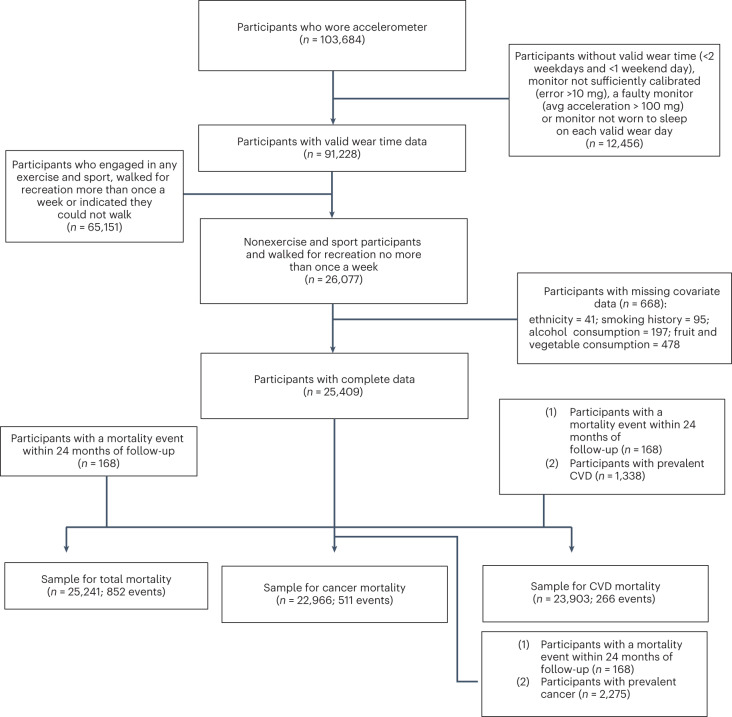
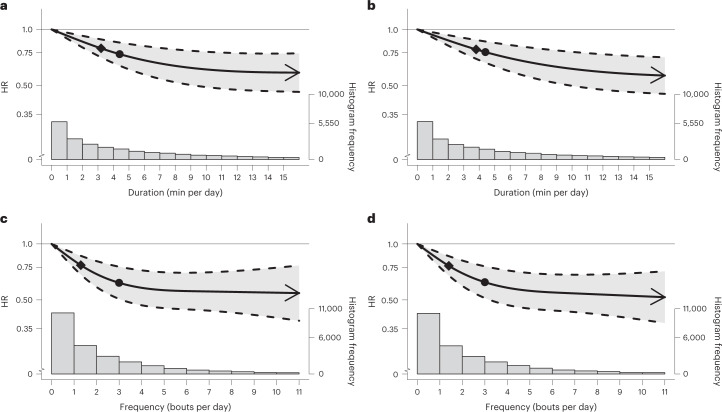
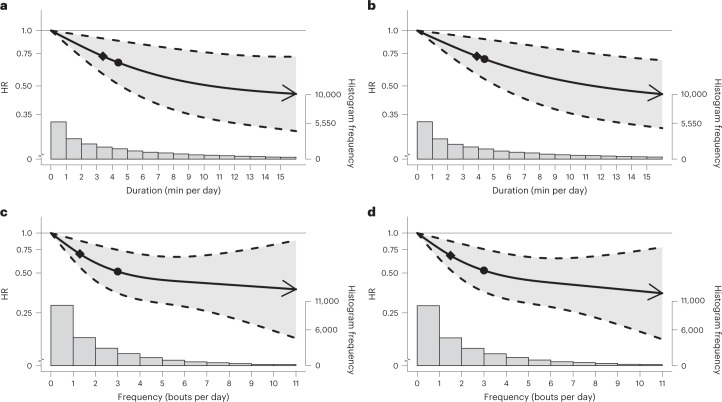
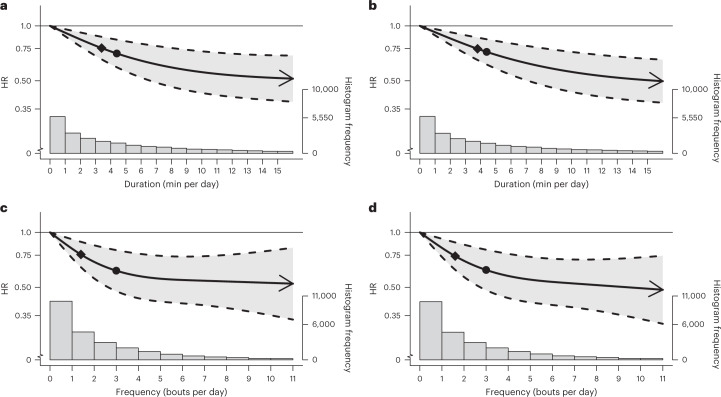
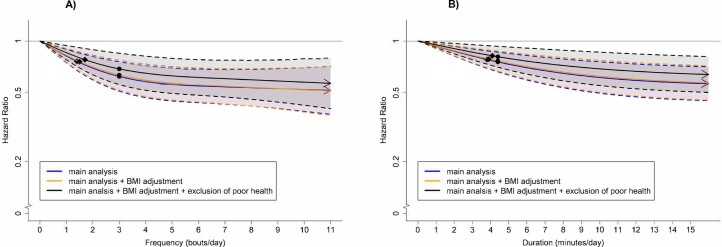
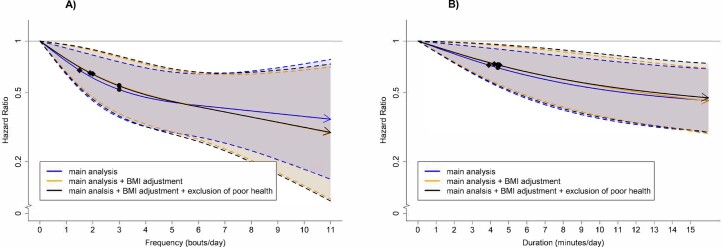
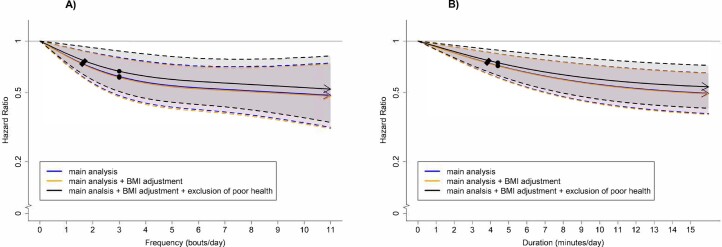
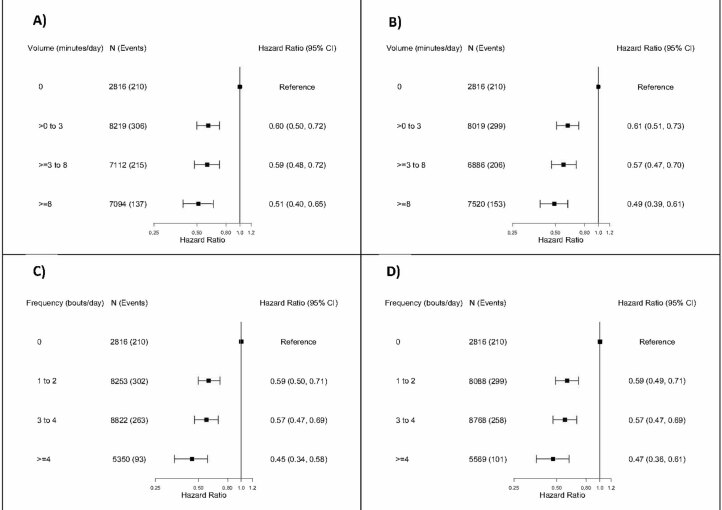
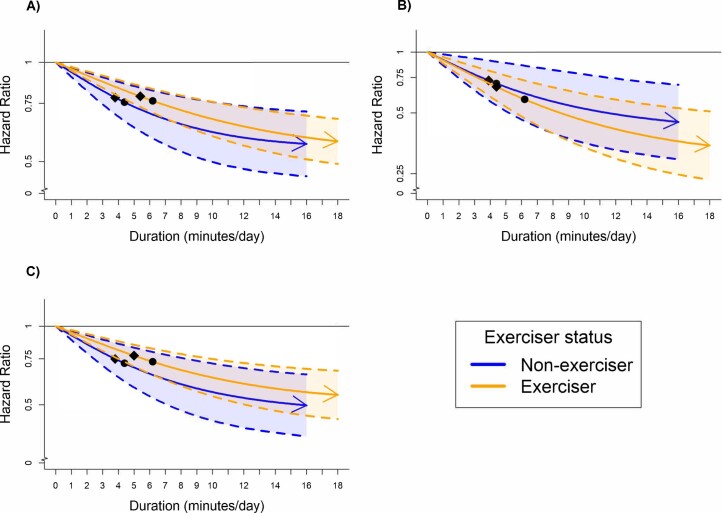
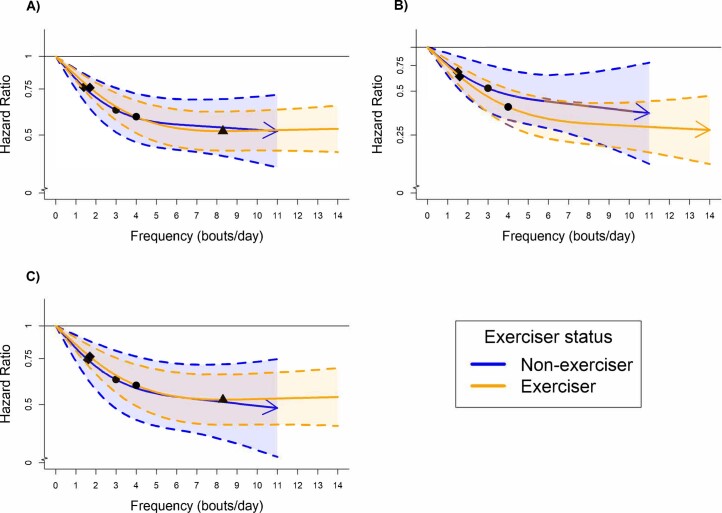
Wearable devices can capture unexplored movement patterns such as brief bursts of vigorous intermittent lifestyle physical activity (VILPA) that is embedded into everyday life, rather than being done as leisure time exercise. Here, we examined the association of VILPA with all-cause, cardiovascular disease (CVD) and cancer mortality in 25,241 nonexercisers (mean age 61.8 years, 14,178 women/11,063 men) in the UK Biobank. Over an average follow-up of 6.9 years, during which 852 deaths occurred, VILPA was inversely associated with all three of these outcomes in a near-linear fashion. Compared with participants who engaged in no VILPA, participants who engaged in VILPA at the sample median VILPA frequency of 3 length-standardized bouts per day (lasting 1 or 2 min each) showed a 38%–40% reduction in all-cause and cancer mortality risk and a 48%–49% reduction in CVD mortality risk. Moreover, the sample median VILPA duration of 4.4 min per day was associated with a 26%–30% reduction in all-cause and cancer mortality risk and a 32%–34% reduction in CVD mortality risk. We obtained similar results when repeating the above analyses for vigorous physical activity (VPA) in 62,344 UK Biobank participants who exercised (1,552 deaths, 35,290 women/27,054 men). These results indicate that small amounts of vigorous nonexercise physical activity are associated with substantially lower mortality. VILPA in nonexercisers appears to elicit similar effects to VPA in exercisers, suggesting that VILPA may be a suitable physical activity target, especially in people not able or willing to exercise.
Overview
CoChat Summary
TL;DR
In UK Biobank nonexercisers with wrist-worn accelerometry, brief vigorous intermittent lifestyle physical activity (VILPA) was associated with lower all-cause, cardiovascular disease, and cancer mortality in near-linear dose–response patterns. VILPA in nonexercisers showed associations of similar magnitude to vigorous physical activity (VPA) in exercisers.
Key findings
- Among 25,241 nonexercisers (mean age 61.8 years; 14,178 women/11,063 men), over mean 6.9 years and 852 deaths, VILPA was inversely associated with all-cause, CVD, and cancer mortality in a near-linear fashion.
- Median VILPA frequency of 3 length-standardized bouts per day (1 or 2 min each) was associated with 38%–40% lower all-cause and cancer mortality risk and 48%–49% lower CVD mortality risk versus no VILPA.
- Median VILPA duration of 4.4 min per day was associated with 26%–30% lower all-cause and cancer mortality risk and 32%–34% lower CVD mortality risk.
- Minimum VILPA doses of 3.4–4.1 min per day were associated with 22%–28% lower mortality risk; fewer than two VILPA bouts per day were associated with 24%–26% lower all-cause and cancer mortality and 33% lower CVD mortality. In 62,344 exercisers (1,552 deaths), context-agnostic VPA showed similar dose–response associations.
Methods
- Prospective cohort analysis within the UK Biobank accelerometry substudy; nonexercisers reported no leisure-time exercise and no more than one recreational walk per week, while exercisers reported any leisure-time exercise or more than one recreational walk per week.
- Physical activity intensity was classified from wrist-worn accelerometer data using a previously validated random forest classifier; VILPA bouts were defined as brief nonexercise vigorous-intensity bouts lasting up to 1 or up to 2 min, with length-standardized frequency measures.
- Cox proportional hazards and Fine–Gray subdistribution hazards models estimated dose–response associations with all-cause, CVD, and cancer mortality, adjusted for age, sex, light and moderate activity, longer VPA bouts, smoking, alcohol, sleep, diet, education, parental history, medication use, and prevalent disease.
Limitations
- The paper states reverse causation cannot be entirely ruled out, though sensitivity analyses excluding poor self-rated health and events in the first 2 years did not appreciably change results.
- The paper notes some VILPA activities (for example, carrying heavy shopping bags) may not be perfectly captured by wrist-worn accelerometers, likely leading to random measurement error and underestimation of true associations.
- The paper states a median 5.5-year lag between baseline covariate measurement and accelerometry, possible measurement error in self-reported exercise/recreational walking used for sample selection, and low UK Biobank response rate (5.5%) with limited representativeness; it also notes data sparsity and few events at higher VILPA energy expenditure levels made between-strata comparisons less conclusive.
Model-written summary. Check it against the paper before relying on it.
Integrity signals
Registry
Cites
Statistics
Figures
Verification
Claims the paper makes
6 Valid · 1 Not valid · 19 Not checked · 72 Own results and interpretations
Some cited sources support this claim and some don’t — read each source’s verdict below.
In the paper
“For a given volume of physical activity, higher contributions of VPA are associated with additional mortality risk reduction10–13.”
§ Association of wearable device-measured vigorous intermittent lifestyle physical activity with mortality > Main
What the sources say
- Not checked yetcites [10] Gebel K Effect of moderate to vigorous physical activity on all-cause mortality in middle-aged and older Australians JAMA Intern. Med. 2015 175 970 977 10.1001/jamainternmed.2015.0541 25844882 source
- Supportedcites [11] Wang Y Nie J Ferrari G Rey-Lopez JP Rezende LF Association of physical activity intensity with mortality: a national cohort study of 403 681 US adults JAMA Intern. Med. 2021 181 203 211 10.1001/jamainternmed.2020.6331 33226432 PMC7684516 source
The Key Points state that, for the same amount of total moderate-to-vigorous physical activity, participants with a greater proportion of vigorous activity had lower all-cause mortality. The Discussion repeats this finding; it does not find a consistent association for cardiovascular or cancer mortality. (LLM, conf=0.94)
- Supportedcites [12] Rey Lopez JP Gebel K Chia D Stamatakis E Associations of vigorous physical activity with all-cause, cardiovascular and cancer mortality among 64 913 adults BMJ Open Sport Exerc. Med. 2019 5 e000596 10.1136/bmjsem-2019-000596 PMC6733336 31548909 source
The Abstract (Results) reports that, holding the volume of weighted physical activity constant, participants reporting vigorous activity had additional mortality-risk reductions compared with those reporting none. The Discussion (Public health implications) likewise concludes that vigorous activity may confer larger reductions than moderate activity at a constant activity volume. (LLM, conf=0.92)
- Disputedcites [13] Rey Lopez JP Sabag A Martinez Juan M Rezende LFM Pastor-Valero M Do vigorous-intensity and moderate-intensity physical activities reduce mortality to the same extent? A systematic review and meta-analysis BMJ Open Sport Exerc. Med. 2020 6 e000775 10.1136/bmjsem-2020-000775 PMC7610342 33178440 sourceExperimental — accuracy not yet measured
The Results section reports that, after controlling for total physical activity, vigorous activity was not associated with a larger reduction in all-cause mortality than moderate activity (HR 0.95, 95% CI 0.83–1.09). The Discussion and Conclusion likewise say the two intensities may reduce mortality to the same extent, contrary to the claimed additional reduction. (LLM, conf=0.90)
Checked by a reasoning model — may be wrong.
plainstates an association- Asserted: passes — The authors put it forward as true.
- Checkable: passes — It can be checked against evidence.
- Load-bearing: passes — The paper’s conclusions depend on it.
- Based: passes — The paper gives a reason why it holds.
None of the sources cited for this claim have been checked yet.
In the paper
“Many common activities of daily living are likely to elicit relative vigorous-intensity effort in physically inactive adults with poor fitness who do not habitually exercise21, which is the majority demographic in many countries8,9,22,23.”
§ Association of wearable device-measured vigorous intermittent lifestyle physical activity with mortality > Main
What the sources say
- Not checked yetcites [21] Celis-Morales CA The association between physical activity and risk of mortality is modulated by grip strength and cardiorespiratory fitness: evidence from 498 135 UK-Biobank participants Eur. Heart J. 2017 38 116 122 28158566 PMC5837781
- Could not verifycites [8] Oja P Associations of specific types of sports and exercise with all-cause and cardiovascular-disease mortality: a cohort study of 80 306 British adults Br. J. Sports Med. 2017 51 812 817 10.1136/bjsports-2016-096822 27895075 sourceExperimental — accuracy not yet measured
Our copy of Oja et al. (2017) contains no passage making the physiological point that everyday activities constitute relative vigorous effort for unfit, inactive adults. The closest material is methodological: the Physical activity assessment section describes the questionnaire's perceived relative-intensity item ('Was the effort usually enough to make you out of breath or sweaty?') applied to sports and to domestic PA (heavy manual housework, gardening, DIY), and the Data handling section uses that item only to split participants into lower vs higher intensity. The BACKGROUND section cites Samitz et al.'s 'moderate activities of daily living' domain (RR=0.90) and notes vigorous-intensity PA 'may have a higher impact' on mortality, but never attributes relative vigorous intensity of daily-living activities to low-fit or non-exercising adults. Searches performed: 'activities of daily living vigorous relative intensity / poor fitness / inactive', 'out of breath or sweaty', 'lifestyle activities short bouts', 'vigorous intensity definition MET 6'; none returned a supporting or contrary statement, so the claim cannot be checked against this source. (LLM, conf=0.65)
- Could not verifycites [9] Stamatakis E Chaudhury M Temporal trends in adults’ sports participation patterns in England between 1997 and 2006: the Health Survey for England Br. J. Sports Med. 2008 42 901 908 10.1136/bjsm.2008.048082 18658250 sourceExperimental — accuracy not yet measured
Our copy of Stamatakis & Chaudhury (2008) is a descriptive analysis of temporal trends in sport and exercise participation in England (Abstract, Results, Discussion); no passage addresses the relative intensity that common daily activities impose on physically inactive, unfit adults. Searches for 'activities of daily living / vigorous intensity relative effort', 'cardiorespiratory fitness, deconditioned, MET threshold, household activity', and 'inactive majority prevalence' returned only the Measurements section (accelerometer criterion validity for moderate-to-vigorous activity time), the Abstract's background contrast between 'moderate-intensity activities, such as brisk walking and intense housework' and 'more vigorous sports and exercise' (citing refs 5-6, i.e. the 2004 Chief Medical Officer report and Swain & Franklin), and participation-trend results — none of which state the claim. The paper neither supports nor contradicts it; it simply does not make this point. (LLM, conf=0.72)
- Not checked yetcites [22] Lamoureux NR Temporal trends in the cardiorespiratory fitness of 2,525,827 adults between 1967 and 2016: a systematic review Sports Med. 2019 49 41 55 10.1007/s40279-018-1017-y 30390202 source
- Could not verifycites [23] Bennie JA The descriptive epidemiology of total physical activity, muscle-strengthening exercises and sedentary behaviour among Australian adults – results from the National Nutrition and Physical Activity Survey BMC Public Health 2016 16 73 10.1186/s12889-016-2736-3 26809451 PMC4727339 sourceExperimental — accuracy not yet measured
Our copy of Bennie et al. is a descriptive epidemiology paper on the National Nutrition and Physical Activity Survey: the Background (p.1) covers guideline content and global inactivity prevalence (40-60% insufficiently active [5]), the Results report proportions meeting MVPA (52.6%), strength-training (18.6%) and combined (15.0%) guidelines plus the 8.9% 'high-risk' cluster, and the Discussion covers correlates and international comparisons. No passage anywhere in our copy addresses the physiological proposition that routine activities of daily living constitute relative vigorous-intensity effort for unfit, non-exercising adults — searched 'activities of daily living / vigorous intensity', 'relative intensity, fitness, habitual exercise', 'unaccustomed everyday tasks, perceived exertion', and inactivity prevalence. The paper does establish that most Australian adults are inactive and do not habitually do strength training (Conclusions; Discussion, 'over 80 % of Australians do not engage in sufficient strength training'), but that is the demography, not the intensity claim the citation is attached to. (LLM, conf=0.72)
hedged- Asserted: passes — The authors put it forward as true.
- Checkable: passes — It can be checked against evidence.
- Load-bearing: passes — The paper’s conclusions depend on it.
- Based: passes — The paper gives a reason why it holds.
The sources with a verdict support this claim; the rest weren’t checked yet, have no full text we could read, or their verdicts aren’t rated yet.
In the paper
“The health effects of each time unit of physical activity are intensity dependent10–13.”
§ Association of wearable device-measured vigorous intermittent lifestyle physical activity with mortality > Main
What the sources say
- Not checked yetcites [10] Gebel K Effect of moderate to vigorous physical activity on all-cause mortality in middle-aged and older Australians JAMA Intern. Med. 2015 175 970 977 10.1001/jamainternmed.2015.0541 25844882 source
- Supportedcites [11] Wang Y Nie J Ferrari G Rey-Lopez JP Rezende LF Association of physical activity intensity with mortality: a national cohort study of 403 681 US adults JAMA Intern. Med. 2021 181 203 211 10.1001/jamainternmed.2020.6331 33226432 PMC7684516 source
The Discussion (page unavailable in our copy) reports that, for the same amount of total physical activity, participants doing a greater proportion at vigorous intensity had lower all-cause mortality. This supports the claim that benefits associated with a given amount of activity can depend on intensity, though the study reports an association rather than a causal effect. (LLM, conf=0.86)
- Supportedcites [12] Rey Lopez JP Gebel K Chia D Stamatakis E Associations of vigorous physical activity with all-cause, cardiovascular and cancer mortality among 64 913 adults BMJ Open Sport Exerc. Med. 2019 5 e000596 10.1136/bmjsem-2019-000596 PMC6733336 31548909 source
The Background states that one minute of vigorous activity counts approximately the same as two minutes of moderate activity for recommended health benefits. The Discussion (Public health implications) also says that, holding the amount of activity constant, vigorous activity may confer a larger reduction in mortality risk than moderate activity. Our copy provides no page numbers for these passages. (LLM, conf=0.88)
- Supportedcites [13] Rey Lopez JP Sabag A Martinez Juan M Rezende LFM Pastor-Valero M Do vigorous-intensity and moderate-intensity physical activities reduce mortality to the same extent? A systematic review and meta-analysis BMJ Open Sport Exerc. Med. 2020 6 e000775 10.1136/bmjsem-2020-000775 PMC7610342 33178440 source
The Introduction (page unavailable) reports that health guidelines count one minute of vigorous activity as two minutes of moderate activity. That supports the claim about benefits per unit of time; the paper separately notes that benefits may be similar when total energy expenditure is held constant. (LLM, conf=0.86)
plainstates an association- Asserted: passes — The authors put it forward as true.
- Checkable: passes — It can be checked against evidence.
- Load-bearing: passes — The paper’s conclusions depend on it.
- Based: passes — The paper gives a reason why it holds.
The cited sources support only part of this claim — read each source’s verdict below.
In the paper
“High-intensity interval training40 and studies of intermittent stair climbing39 have shown that VPA bursts lasting 20 s to a few minutes, performed three to five times a day, can result in substantial improvements in cardiorespiratory fitness in previously inactive adults within a few weeks, providing a plausible physiological basis14 for the associations we observed.”
§ Association of wearable device-measured vigorous intermittent lifestyle physical activity with mortality > Discussion
What the sources say
- Partly supportedcites [40] Batacan RB Duncan MJ Dalbo VJ Tucker PS Fenning AS Effects of high-intensity interval training on cardiometabolic health: a systematic review and meta-analysis of intervention studies Br. J. Sports Med. 2017 51 494 503 10.1136/bjsports-2015-095841 27797726 sourceExperimental — accuracy not yet measured
Split into 2 atoms — 0 confirmed, 2 partially supported, 0 disputed, 0 misattributed, 0 unverifiable. Expand the claim to see per-atom verdicts.
- Not checked yetcites [39] Allison MK Brief intense stair climbing improves cardiorespiratory fitness Med. Sci. Sports Exerc. 2017 49 298 307 10.1249/MSS.0000000000001188 28009784 source
- Partly supportedcites [14] Ross R Importance of assessing cardiorespiratory fitness in clinical practice: a case for fitness as a clinical vital sign: a scientific statement from the American Heart Association Circulation 2016 134 e653 e699 10.1161/CIR.0000000000000461 27881567 sourceExperimental — accuracy not yet measured
Split into 2 atoms — 0 confirmed, 2 partially supported, 0 disputed, 0 misattributed, 0 unverifiable. Expand the claim to see per-atom verdicts.
plainstates a cause- Asserted: passes — The authors put it forward as true.
- Checkable: passes — It can be checked against evidence.
- Load-bearing: passes — The paper’s conclusions depend on it.
- Based: passes — The paper gives a reason why it holds.
- Partly supported
The cited sources support only part of this claim — read each source’s verdict below.
In the paper
“Questionnaires10–12 can only capture continuous blocks of time containing a mixture of vigorous activity with interruptions and rest, rather than actual time in vigorous intensity that the wearable devices in our study could quantify.”
§ Association of wearable device-measured vigorous intermittent lifestyle physical activity with mortality > Discussion
What the sources say
- Not checked yetcites [10] Gebel K Effect of moderate to vigorous physical activity on all-cause mortality in middle-aged and older Australians JAMA Intern. Med. 2015 175 970 977 10.1001/jamainternmed.2015.0541 25844882 source
- Partly supportedcites [11] Wang Y Nie J Ferrari G Rey-Lopez JP Rezende LF Association of physical activity intensity with mortality: a national cohort study of 403 681 US adults JAMA Intern. Med. 2021 181 203 211 10.1001/jamainternmed.2020.6331 33226432 PMC7684516 sourceExperimental — accuracy not yet measured
The Assessment of Physical Activity section describes a questionnaire asking about vigorous activity lasting at least 10 minutes and its duration each time. Strengths and Limitations notes that these self-reports may have measurement error. Neither passage establishes that reported bouts include interruptions and rest or that questionnaires cannot capture actual time at vigorous intensity; the comparison with wearables belongs to the citing authors' study. (LLM, conf=0.82)
- Partly supportedcites [12] Rey Lopez JP Gebel K Chia D Stamatakis E Associations of vigorous physical activity with all-cause, cardiovascular and cancer mortality among 64 913 adults BMJ Open Sport Exerc. Med. 2019 5 e000596 10.1136/bmjsem-2019-000596 PMC6733336 31548909 sourceExperimental — accuracy not yet measured
The Methods (Measurement of exposure; page unavailable) confirm that this study measured physical activity with a questionnaire that asked about the duration and perceived intensity of sports and exercise. The Discussion (Strengths and limitations; page unavailable) notes possible recall bias, but neither passage says questionnaires can capture only continuous blocks that include interruptions and rest, or compares their estimates with wearable-device measurements of actual vigorous-intensity time. (LLM, conf=0.82)
plain- Asserted: passes — The authors put it forward as true.
- Checkable: passes — It can be checked against evidence.
- Load-bearing: passes — The paper’s conclusions depend on it.
- Based: passes — The paper gives a reason why it holds.
39 more claims
Create a free account to see all 98 claims and to verify the 36 references still open.
- It may state two separate claims as one. 31
- Probably not a substantial claim. 30
- The quote only partly states this claim. 2
- Not yet classified. 1
Claims other papers make about this one
Each is checked against this paper’s own text: does it say what the citing paper says it does?
The cited source says what the claim attributes to it.
In the citing paper
“engaging in short bursts of vigorous PA (VPA), averaging only 4.4 min daily, is associated with lower all-cause, cancer, and CVD mortality risks [66]”
From Global consensus on optimal exercise recommendations for enhancing healthy longevity in older adults (ICFSR) (2025) · cites this paper as [66]
The cited source says what the claim attributes to it.
In the citing paper
“Engaging in intermittent MVPA accumulation in shorter bouts might be an easier option, as indicated by recent studies.50,51”
The cited source says what the claim attributes to it.
In the citing paper
“Physical activity intensity was classified with a validated accelerometer-based two-level Random Forest machine learning activity scheme that first classifies activity type and then intensity.5,6,17”
In the citing paper
“Moreover, engaging in short bursts of vigorous PA (VPA), averaging only 4.4 min daily, is associated with lower all-cause, cancer, and CVD mortality risks [66].”
From Global consensus on optimal exercise recommendations for enhancing healthy longevity in older adults (ICFSR) (2025) · cites this paper as [66]
In the citing paper
“Data obtained from wearable devices show that as few as four short bouts of vigorous physical activity totalling approximately 2-3 min per day are associated with a substantially lower risk of all-cause cardiovascular disease and cancer mortality.5,6”
Self-check
Percentages, sums and reported differences re-computed from the paper’s own numbers.
Each contradiction between two passages listed here was confirmed by an independent check.
Rated major: it would touch a result — a value a result rests on, reported and recomputed p-values on opposite sides of the significance level, two passages that conflict with no sign which is right, or a cited work retracted before this paper was published.
In the paper
§ Association of wearable device-measured vigorous intermittent lifestyle physical activity with mortality > Abstract
“the sample median VILPA duration of 4.4 min per day”
§ Association of wearable device-measured vigorous intermittent lifestyle physical activity with mortality > Results > VILPA summary and nonexerciser status
“Excluding VILPA values of zero, the median and maximum VILPA daily duration was 4.0 and 16.0 min per day for both bout lengths”
Rated minor: it would not touch a result — a value no result rests on, a p-value that stays on the same side of the significance level, or a conflict that is clerical, resolved elsewhere in the paper, or outside its own findings.
In the paper
§ Association of wearable device-measured vigorous intermittent lifestyle physical activity with mortality > Results > Description of the study sample
“Number of daily VILPA bouts lasting up to 2 minutes 3–4”
§ Association of wearable device-measured vigorous intermittent lifestyle physical activity with mortality > Results > Description of the study sample
“Number of daily VILPA bouts lasting up to 2 minutes ≥4”
Rated minor: it would not touch a result — a value no result rests on, a p-value that stays on the same side of the significance level, or a conflict that is clerical, resolved elsewhere in the paper, or outside its own findings.
In the paper
§ Association of wearable device-measured vigorous intermittent lifestyle physical activity with mortality > Results > Description of the study sample
“22,699 (cancer mortality analyses) UK Biobank participants”
§ Association of wearable device-measured vigorous intermittent lifestyle physical activity with mortality > Results > Associations of VILPA with cancer mortality
“Data are shown for n = 22,966 participants with 511 events”
Citations
Cites
World Health Organization 2020 guidelines on physical activity and sedentary behaviour
Bull, F. C., Al-Ansari, S. S., Biddle, S., Borodulin, K., Buman, M. P., Cardon, G., Carty, C., Chaput, J.-P., Chastin, S., Chou, R., et al. (2020) · British Journal of Sports Medicine · doi:10.1136/bjsports-2020-102955 · Cited by 11,657
Self-citationThe Physical Activity Guidelines for Americans
Piercy, K. L., Troiano, R. P., Ballard, R. M., Carlson, S. A., Fulton, J. E., Galuska, D. A., George, S. M., & Olson, R. D. (2018) · JAMA · doi:10.1001/jama.2018.14854 · Cited by 9,755
2011 Compendium of Physical Activities: A Second Update of Codes and MET Values
AINSWORTH, B. E., HASKELL, W. L., HERRMANN, S. D., MECKES, N., BASSETT, D. R., TUDOR-LOCKE, C., GREER, J. L., VEZINA, J., WHITT-GLOVER, M. C., & LEON, A. S. (2011) · Medicine & Science in Sports & Exercise · doi:10.1249/mss.0b013e31821ece12 · Cited by 6,317 · cited 1×
“A two-stage direct observation scheme was implemented in which the participant’s movement behavior was coded for activity type and then activity intensity based on the Compendium of Physical Activities 53 .”
Fry, A., Littlejohns, T. J., Sudlow, C., Doherty, N., Adamska, L., Sprosen, T., Collins, R., & Allen, N. E. (2017) · American Journal of Epidemiology · doi:10.1093/aje/kwx246 · Cited by 3,979
Age-predicted maximal heart rate revisited
Tanaka, H., Monahan, K. D., & Seals, D. R. (2001) · Journal of the American College of Cardiology · doi:10.1016/s0735-1097(00)01054-8 · Cited by 3,775 · cited 1×
“VO 2 max was calculated using the Ebbeling treadmill test and HRmax was calculated using the Tanaka equation 47 .”
Dose-Response Analysis Using R
Ritz, C., Baty, F., Streibig, J. C., & Gerhard, D. (2015) · PLOS ONE · doi:10.1371/journal.pone.0146021 · Cited by 3,658
Ross, R., Blair, S. N., Arena, R., Church, T. S., Després, J.-P., Franklin, B. A., Haskell, W. L., Kaminsky, L. A., Levine, B. D., Lavie, C. J., et al. (2016) · Circulation · doi:10.1161/cir.0000000000000461 · Cited by 2,486 · cited 3×
“Proof-of-concept trials 39 have shown that very small doses of exercise-based intermittent VPA can have rapid and measurable effects on cardiorespiratory fitness, a key causal determinant of CVD 14 .”
Association of Leisure-Time Physical Activity With Risk of 26 Types of Cancer in 1.44 Million Adults
Moore, S. C., Lee, I.-M., Weiderpass, E., Campbell, P. T., Sampson, J. N., Kitahara, C. M., Keadle, S. K., Arem, H., Berrington de Gonzalez, A., Hartge, P., et al. (2016) · JAMA Internal Medicine · doi:10.1001/jamainternmed.2016.1548 · Cited by 1,487
Practical recommendations for reportingFine‐Gray model analyses for competing risk data
Austin, P. C., & Fine, J. P. (2017) · Statistics in Medicine · doi:10.1002/sim.7501 · Cited by 1,271
Doherty, A., Jackson, D., Hammerla, N., Plötz, T., Olivier, P., Granat, M. H., White, T., van Hees, V. T., Trenell, M. I., Owen, C. G., et al. (2017) · PLOS ONE · doi:10.1371/journal.pone.0169649 · Cited by 1,250 · cited 2×
“© The Author(s) 2022 https://doi.org/10.1038/s41591-022-02100-x Between 2013 and 2015 (median 5.5 years after the baseline measurements), 103,684 UK Biobank participants wore a wrist-worn accelerometer for 7 days 24,25 .”
InfluentialSelf-citation
Research works printed but not linked: 1
- World Health Organization. Global Recommendations on Physical Activity for Health (World Health Organization, 2010). 26180873
Cited by
Izquierdo, M., de Souto Barreto, P., Arai, H., Bischoff-Ferrari, H. A., Cadore, E. L., Cesari, M., Chen, L.-K., Coen, P. M., Courneya, K. S., Duque, G., et al. (2025) · The Journal of nutrition, health and aging · doi:10.1016/j.jnha.2024.100401 · Cited by 273
Transforming Cardiovascular Care With Artificial Intelligence: From Discovery to Practice
Khera, R., Oikonomou, E. K., Nadkarni, G. N., Morley, J. R., Wiens, J., Butte, A. J., & Topol, E. J. (2024) · Journal of the American College of Cardiology · doi:10.1016/j.jacc.2024.05.003 · Cited by 264
A Perspective on High-Intensity Interval Training for Performance and Health
Coates, A. M., Joyner, M. J., Little, J. P., Jones, A. M., & Gibala, M. J. (2023) · Sports Medicine · doi:10.1007/s40279-023-01938-6 · Cited by 246
“The potential benefit of even small amounts of vigorous physical activity on health was recently shown by Stama-takis et al. [115].”
BackgroundSelf-citationAccelerometer-derived "weekend warrior" physical activity and incident cardiovascular disease
Khurshid, S., Al-Alusi, M. A., Churchill, T. W., Guseh, J. S., & Ellinor, P. T. (2023) · JAMA · doi:10.1001/jama.2023.10875 · Cited by 204
Zheng, N. S., Annis, J., Master, H., Han, L., Gleichauf, K., Ching, J. H., Nasser, M., Coleman, P., Desine, S., Ruderfer, D. M., et al. (2024) · Nature Medicine · doi:10.1038/s41591-024-03155-8 · Cited by 194
Western diets and chronic diseases
Adolph, T. E., & Tilg, H. (2024) · Nature Medicine · doi:10.1038/s41591-024-03165-6 · Cited by 191
“Indeed, epidemiologic, experimental and clinical evidence draws a clear picture: the Westernization of diet but also the consumption of alcohol 212 , drugs 213 , cigarette smoke 12,214 , salt intake 215 and a sedentary lifestyle 216,217 make people sick.”
Physical Activity Over the Lifecourse and Cardiovascular Disease
Perry, A. S., Dooley, E. E., Master, H., Spartano, N. L., Brittain, E. L., & Pettee Gabriel, K. (2023) · Circulation Research · doi:10.1161/circresaha.123.322121 · Cited by 188
Wearable Devices: Implications for Precision Medicine and the Future of Health Care
Babu, M., Lautman, Z., Lin, X., Sobota, M. H. B., & Snyder, M. P. (2024) · Annual Review of Medicine · doi:10.1146/annurev-med-052422-020437 · Cited by 181
Ahmadi, M. N., Hamer, M., Gill, J. M. R., Murphy, M., Sanders, J. P., Doherty, A., & Stamatakis, E. (2023) · The Lancet Public Health · doi:10.1016/s2468-2667(23)00183-4 · Cited by 172
Self-citationBlodgett, J. M., Ahmadi, M. N., Atkin, A. J., CHASTIN, S. F. M., Chan, H., Suorsa, K., Bakker, E. A., Hettiarcachchi, P., Johansson, P. J., Sherar, L. B., et al. (2023) · European Heart Journal · doi:10.1093/eurheartj/ehad717 · Cited by 172
Self-citationStamatakis, E., Ahmadi, M. N., Friedenreich, C. M., Blodgett, J. M., Koster, A., Holtermann, A., Atkin, A., Rangul, V., Sherar, L. B., Teixeira-Pinto, A., et al. (2023) · JAMA Oncology · doi:10.1001/jamaoncol.2023.1830 · Cited by 163
Self-citationNeuroprotective mechanisms of exercise and the importance of fitness for healthy brain ageing
Tari, A. R., Walker, T. L., Huuha, A. M., Sando, S. B., & Wisloff, U. (2025) · The Lancet · doi:10.1016/s0140-6736(25)00184-9 · Cited by 159
Doherty, C., Baldwin, M., Keogh, A., Caulfield, B., & Argent, R. (2024) · Sports Medicine · doi:10.1007/s40279-024-02077-2 · Cited by 133
“Meanwhile, vast data repositories are being cultivated through national initiatives such as the All of Us program from the National Institutes of Health (NIH) [60] and the UK Biobank [61].”
Jones, M. D., Clifford, B. K., Stamatakis, E., & Gibbs, M. T. (2024) · Sports Medicine · doi:10.1007/s40279-023-01983-1 · Cited by 117
Self-citationDose–response associations, physical activity intensity and mortality risk: A narrative review
Ekelund, U., Sánchez-Lastra, M. A., Dalene, K. E., & Tarp, J. (2023) · Journal of sport and health science/Journal of Sport and Health Science · doi:10.1016/j.jshs.2023.09.006 · Cited by 115
Transforming wearable data into personal health insights using large language model agents
Merrill, M. A., Paruchuri, A., Rezaei, N., Kovacs, G., Perez, J., Liu, Y., Schenck, E., Hammerquist, N., Sunshine, J., Tailor, S. A., et al. (2026) · Nature Communications · doi:10.1038/s41467-025-67922-y · Cited by 106
Yin, M., Li, H., Bai, M., Liu, H., Chen, Z., Deng, J., Deng, S., Chuan, M., Vollaard, N. B. J., Little, J. P., et al. (2023) · Applied Physiology, Nutrition, and Metabolism · doi:10.1139/apnm-2023-0329 · Cited by 93
Ekelund, U., Tarp, J., Ding, D., Sánchez-Lastra, M. A., Dalene, K. E., Anderssen, S. A., Steene‐Johannessen, J., Hansen, B., Morseth, B., Hopstock, L. A., et al. (2026) · The Lancet · doi:10.1016/s0140-6736(25)02219-6 · Cited by 90
A role for the cerebellum in motor-triggered alleviation of anxiety
Zhang, X., Wu, W.-X., Shen, L.-P., Ji, M., Zhao, P., Yu, L., Yin, J., Xie, S.-T., Xie, Y.-Y., Zhang, Y.-X., et al. (2024) · Neuron · doi:10.1016/j.neuron.2024.01.007 · Cited by 75
Biomarkers of aging: from molecules and surrogates to physiology and function
Furrer, R., & Handschin, C. (2025) · Physiological Reviews · doi:10.1152/physrev.00045.2024 · Cited by 74
O’Donovan, G., Petermann-Rocha, F. E., Ferrari, G., Lee, I.-M. M., Hamer, M., Stamatakis, E., Sarmiento, O. L., Ibáñez, A. M., & López-Jaramillo, P. A. (2024) · British Journal of Sports Medicine · doi:10.1136/bjsports-2023-107612 · Cited by 66
Self-citationThe Impact of Exercise on Immunity, Metabolism, and Atherosclerosis
Meyer-Lindemann, U., Moggio, A., Dutsch, A., Kessler, T., & Sager, H. B. (2023) · International Journal of Molecular Sciences · doi:10.3390/ijms24043394 · Cited by 67
Sabag, A., Ahmadi, M. N., François, M. E., Postnova, S., Cistulli, P. A., Fontana, L., & Stamatakis, E. (2024) · Diabetes Care · doi:10.2337/dc23-2448 · Cited by 65
Self-citationNyberg, S. T., Frank, P., Pentti, J., Alfredsson, L. S., Ervasti, J. M., Goldberg, M., Knutsson, A., Koskinen, A., Lallukka, T. M., Nordin, M., et al. (2025) · The Lancet Public Health · doi:10.1016/s2468-2667(24)00300-1 · Cited by 65
Self-citationThøgersen‐Ntoumani, C., Kritz, M., Grunseit, A. C., Chau, J. Y., Ahmadi, M., Holtermann, A., Koster, A., Tudor-Locke, C. E., Johnson, N. A., Sherrington, C., et al. (2023) · International Journal of Behavioral Nutrition and Physical Activity · doi:10.1186/s12966-023-01480-8 · Cited by 63
Self-citationYin, M., Deng, S., Chen, Z., Zhang, B., Zheng, H., Bai, M., Li, H., Zhang, X., Deng, J., Liu, Q., et al. (2024) · Applied Physiology, Nutrition, and Metabolism · doi:10.1139/apnm-2023-0593 · Cited by 47
Dose Response of Incidental Physical Activity Against Cardiovascular Events and Mortality
Stamatakis, E., Biswas, R. K., Koemel, N. A., Sabag, A., Pulsford, R. M., Atkin, A. J., Stathi, A., Cheng, S. W. M., Thøgersen‐Ntoumani, C., Blodgett, J. M., et al. (2025) · Circulation · doi:10.1161/circulationaha.124.072253 · Cited by 60
Self-citationYin, M., Li, Y., Aziz, A. R., Buffey, A., Bishop, D. J., Bao, D., Nassis, G. P., Islam, H., Wang, H., Fyfe, J. J., et al. (2026) · Journal of Sport and Health Science · doi:10.1016/j.jshs.2025.101088 · Cited by 35
Stamatakis, E., Ahmadi, M. N., Biswas, R. K., Cruz, B. D. P., Thøgersen‐Ntoumani, C., MURPHY, M. H., Sabag, A., Lear, S. A., Gill, J. M., Chow, C. K., et al. (2024) · British Journal of Sports Medicine · doi:10.1136/bjsports-2024-108484 · Cited by 54
Self-citationJamieson, A., Chico, T., Jones, S. H., Chaturvedi, N., Hughes, A. D., & Orini, M. (2025) · npj Cardiovascular Health · doi:10.1038/s44325-025-00082-6 · Cited by 52
Muse, E. D., & Topol, E. J. (2024) · Cell Metabolism · doi:10.1016/j.cmet.2024.02.002 · Cited by 50
Gill, J. M., Chico, T. J., Doherty, A., Dunn, J., Ekelund, U., Katzmarzyk, P. T., Milton, K., Murphy, M. H., & Stamatakis, E. (2023) · British Journal of Sports Medicine · doi:10.1136/bjsports-2023-106822 · Cited by 49
Self-citationBlodgett, J. M., Ahmadi, M. N., Atkin, A. J., Pulsford, R. M., Rangul, V., CHASTIN, S. F. M., Chan, H., Suorsa, K., Bakker, E. A., Gupta, N., et al. (2024) · Circulation · doi:10.1161/circulationaha.124.069820 · Cited by 49
Self-citationRodríguez, M. Á., Quintana-Cepedal, M., Cheval, B., Thøgersen-Ntoumani, C., Crespo, I., & Olmedillas, H. (2026) · British Journal of Sports Medicine · doi:10.1136/bjsports-2025-110027 · Cited by 39
Self-citationAhmadi, M. N., Blodgett, J. M., Atkin, A. J., Chan, H., Cruz, B. D. P., Suorsa, K., Bakker, E. A., Pulsford, R. M., Mielke, G. I., Johansson, P. J., et al. (2024) · Diabetologia · doi:10.1007/s00125-024-06090-y · Cited by 46
Self-citationYin, M., Xu, K., Deng, J., Deng, S., Chen, Z., Zhang, B., Zhong, Y., Li, H., Zhang, X., Toledo, M. J. L., et al. (2024) · Scandinavian Journal of Medicine and Science in Sports · doi:10.1111/sms.14769 · Cited by 47
Sánchez-Lastra, M. A., Ding, D., Cruz, B. D. P., Dalene, K. E., Pérez, C. A., Ekelund, U., & Tarp, J. (2023) · British Journal of Sports Medicine · doi:10.1136/bjsports-2023-107252 · Cited by 47
Determinants of physical activity in community-dwelling older adults: an umbrella review
D’Amore, C., Saunders, S., Bhatnagar, N., Griffith, L. E., Richardson, J. A., & Beauchamp, M. (2023) · International Journal of Behavioral Nutrition and Physical Activity · doi:10.1186/s12966-023-01528-9 · Cited by 45
Rezende, L. F. M., Ahmadi, M. N., Ferrari, G., Cruz, B. D. P., Lee, I.-M. M., Ekelund, U., & Stamatakis, E. (2024) · International Journal of Behavioral Nutrition and Physical Activity · doi:10.1186/s12966-024-01615-5 · Cited by 44
Self-citationKoemel, N. A., Ahmadi, M. N., Biswas, R. K., Koster, A., Atkin, A. J., Sabag, A., & Stamatakis, E. (2024) · European Journal of Preventive Cardiology · doi:10.1093/eurjpc/zwae316 · Cited by 42
Self-citationHerold, F., Zou, L., Theobald, P., Manser, P., Falck, R. S., Yu, Q., Liu-Ambrose, T. Y. L., Hillman, C. H., Kramer, A. F., Erickson, K. I., et al. (2025) · European Journal of Applied Physiology · doi:10.1007/s00421-025-05858-3 · Cited by 44
Self-citationWan, K., Dai, Z., Wong, P., Huang, Y., Lei, E. F., Little, J. P., Lin, F., & Tam, B. T. (2025) · Scandinavian Journal of Medicine and Science in Sports · doi:10.1111/sms.70114 · Cited by 42
Biswas, R. K., Ahmadi, M. N., Bauman, A. E., Milton, K. E., Koemel, N. A., & Stamatakis, E. (2025) · Nature Communications · doi:10.1038/s41467-025-63475-2 · Cited by 41
Self-citationHuang, Z., Zhuang, X., Huang, R., Liu, M., Xu, X., Fan, Z., Dai, R., Li, H., Xiong, Z., Guo, Y., et al. (2024) · JAMA Network Open · doi:10.1001/jamanetworkopen.2024.0219 · Cited by 39
Sohn, J. H., Mutlu, B., Latorre‐Muro, P., Liang, J., Bennett, C. F., Sharabi, K., Kantorovic, N., Jedrychowski, M. P., Gygi, S. P., Banks, A. S., et al. (2023) · Cell Metabolism · doi:10.1016/j.cmet.2023.06.015 · Cited by 39
Stork, M., Marcotte‐Chénard, A., Jung, M. E., & Little, J. P. (2023) · Applied Physiology, Nutrition, and Metabolism · doi:10.1139/apnm-2023-0128 · Cited by 38
Data Analytics in Physical Activity Studies With Accelerometers: Scoping Review
Liang, Y., Wang, C. I., & Hsiao, C. K. (2024) · Journal of Medical Internet Research · doi:10.2196/59497 · Cited by 37
Bailey, C. P., Dodd, K. W., McClain, J. J., Seo, I., Wheeler, W., & Wolff‐Hughes, D. L. (2025) · Medicine & Science in Sports & Exercise · doi:10.1249/mss.0000000000003804 · Cited by 34
Xiang, B., Zhou, Y., Wu, X., & Zhou, X. (2023) · Hypertension · doi:10.1161/hypertensionaha.123.21663 · Cited by 34
New principles, the benefits, and practices for fostering a physically active lifestyle
Rozanski, A. (2023) · Progress in Cardiovascular Diseases · doi:10.1016/j.pcad.2023.04.002 · Cited by 34
Stamatakis, E., Koemel, N. A., Biswas, R. K., Ahmadi, M. N., Allman-Farinelli, M. A., Trost, S. G., Eroglu, E. I., Cruz, B. D. P., Bin, Y. S., Postnova, S., et al. (2025) · BMC Medicine · doi:10.1186/s12916-024-03833-x · Cited by 31
Self-citationHansen, D., Coninx, K., Beckers, P. J., Cornelissen, V., Kouidi, E. J., Neunhäeuserer, D., Niebauer, J., Spruit, M. A., Takken, T., & Dendale, P. (2023) · European Journal of Preventive Cardiology · doi:10.1093/eurjpc/zwad232 · Cited by 30
López‐Bueno, R., Yang, L., Stamatakis, E., & Cruz, B. D. P. (2023) · The Lancet Healthy Longevity · doi:10.1016/s2666-7568(23)00212-x · Cited by 30
Self-citationDose/Exposure Relationship of Exercise and Distant Recurrence in Primary Breast Cancer
Soldato, D., Michiels, S., Havas, J., Meglio, A. D., Pagliuca, M., Franzoi, M. A., Pistilli, B., Iyengar, N. M., Cottu, P. H., Lerebours, F., et al. (2024) · Journal of Clinical Oncology · doi:10.1200/jco.23.01959 · Cited by 30
Zhu, W., Liu, J., Lou, H., Mu, F.-Z., & Li, B. (2024) · BMC Psychology · doi:10.1186/s40359-024-02276-6 · Cited by 28
Yin, M., Zheng, H., Bai, M., Huang, G., Chen, Z., Deng, S., Lyu, M., Deng, J., Zhang, B., Li, H., et al. (2024) · Scandinavian Journal of Medicine and Science in Sports · doi:10.1111/sms.14771 · Cited by 28
Nishio, R., Dohi, T., Yokoyama, M., Nakade, T., Takahashi, N., Chikata, Y., Endo, H., Nishiyama, H., Okai, I., Iwata, H., et al. (2024) · JMIR mHealth and uHealth · doi:10.2196/63797 · Cited by 23
Koemel, N. A., Biswas, R. K., Ahmadi, M. N., Teixeira-Pinto, A. M., Hamer, M., Rezende, L. F. M., Mitchell, J. J., Leech, R. M., Sawan, M. J., Allman-Farinelli, M. A., et al. (2026) · EClinicalMedicine · doi:10.1016/j.eclinm.2025.103741 · Cited by 27
Self-citationAhmadi, M. N., Coenen, P., Straker, L. M., & Stamatakis, E. (2024) · International Journal of Epidemiology · doi:10.1093/ije/dyae136 · Cited by 27
Self-citationFitness Trackers to Guide Advice on Activity Prescription
Lee, I.-M. M., Keadle, S. K., & Matthews, C. E. (2023) · JAMA · doi:10.1001/jama.2023.19332 · Cited by 26
Zhu, Y., Wu, Y., Cheng, J., Liang, H., Chang, Q., Lin, F., Li, D., Zhou, X., Chen, X., Pan, P., et al. (2024) · The Science of The Total Environment · doi:10.1016/j.scitotenv.2024.173120 · Cited by 26
Liang, Y. Y., He, Y., Huang, P., Feng, H., Li, H., Ai, S., Du, J., Xue, H., Liu, Y., Zhang, J., et al. (2025) · Journal of Sport and Health Science · doi:10.1016/j.jshs.2024.100973 · Cited by 25
“50,51 Interestingly, we found that the minimum dose of MVPA required to effectively prevent diabetic vascular events was much lower than the currently recommended level.”
Exercise intensity governs tumor control in mice with breast cancer
Gomes-Santos, I. L., Kumar, A. S., Hauth, F., Meyer, M. N., Shiferaw, S. Z., Amoozgar, Z., Jain, R. K., & Fukumura, D. (2024) · Frontiers in Immunology · doi:10.3389/fimmu.2024.1339232 · Cited by 25
Tarp, J., Dalene, K. E., Fagerland, M. W., Steene-Johannesen, J., Hansen, B. H., Anderssen, S. A., Hagströmer, M., Dohrn, I., Dempsey, P. C., Wijndaele, K., et al. (2024) · American Journal of Preventive Medicine · doi:10.1016/j.amepre.2024.07.022 · Cited by 25
Stamatakis, E., Ahmadi, M. N., Elphick, T., Huang, B., Paudel, S., Teixeira-Pinto, A. M., Chen, L., Cruz, B. D. P., Lai, Y., Holtermann, A., et al. (2024) · Journal of sport and health science/Journal of Sport and Health Science · doi:10.1016/j.jshs.2024.03.002 · Cited by 24
Self-citationStamatakis, E., Ahmadi, M. N., MURPHY, M. H., Chico, T., Milton, K. E., Cruz, B. D. P., Katzmarzyk, P. T., Lee, I.-M. M., & Gill, J. M. R. (2023) · British Journal of Sports Medicine · doi:10.1136/bjsports-2023-106869 · Cited by 24
Self-citationPhysical Activity Promotion in the Evolving Work Landscape
Whitsel, L. P., Ablah, E. A., Pronk, N. P., Huneycutt, F., Imboden, M. T., Anderson, D. R., Peterson, N. E., Yocke, S. E., Sterling, C., Zendell, A. L., et al. (2023) · American Journal of Health Promotion · doi:10.1177/08901171231172013b · Cited by 22
Ahmadi, M. N., Holtermann, A., Tudor-Locke, C. E., Koster, A., Johnson, N. A., Chau, J. Y., WEI, L., Sabag, A., Maher, C. A., Thøgersen‐Ntoumani, C., et al. (2024) · Medicine & Science in Sports & Exercise · doi:10.1249/mss.0000000000003521 · Cited by 22
Self-citationKoemel, N. A., Ahmadi, M. N., Biswas, R. K., Thøgersen‐Ntoumani, C., Teixeira-Pinto, A. M., Chow, C. K., Harezlak, J., & Stamatakis, E. (2026) · International Journal of Behavioral Nutrition and Physical Activity · doi:10.1186/s12966-026-01876-2 · Cited by 20
Self-citationBrañas, F., Díaz-Álvarez, J., Fernández-Luna, J., Brolen, B. V., Molina, R. G., Moreno, E., Ryan, P., Martínez‐Sanz, J., Luna, L., Martínez, M., et al. (2024) · Frontiers in Public Health · doi:10.3389/fpubh.2024.1373910 · Cited by 20
Ram, A., Summers, S. J., Booth, J., Gibbs, M. T., & Jones, M. D. (2023) · Musculoskeletal Care · doi:10.1002/msc.1734 · Cited by 19
Physical Exercise and Health, 2: Benefits Associated With Different Levels and Patterns of Activity
Andrade, C. (2023) · The Journal of Clinical Psychiatry · doi:10.4088/jcp.23f15110 · Cited by 19
Oliva, H. N. P., Oliveira, G. M., Oliva, I. O., Cassilhas, R. C., de Paula, A. M. B., & Monteiro-Júnior, R. S. (2023) · Neuroscience Letters · doi:10.1016/j.neulet.2023.137511 · Cited by 19
Urgent need for integrating physical exercise into geriatric medicine: a call to action
Izquierdo, M., & Fiatarone Singh, M. (2023) · British Journal of Sports Medicine · doi:10.1136/bjsports-2023-106912 · Cited by 17
Even a small dose of physical activity can be good medicine
Lee, I.-M. M., Powell, K. E., Sarmiento, O. L., & Hallal, P. C. (2025) · Nature Medicine · doi:10.1038/s41591-024-03396-7 · Cited by 18
Fridolfsson, J., Ekblom‐Bak, E., Ekblom, Ö. B., Bergström, G. M. L., Arvidsson, D., & Börjesson, M. (2024) · British Journal of Sports Medicine · doi:10.1136/bjsports-2023-107451 · Cited by 16
Neudorfer, M., Kumar, D., Smeddinck, J. D., Kulnik, S. T., Niebauer, J., Treff, G., & Sareban, M. (2024) · Scandinavian Journal of Medicine and Science in Sports · doi:10.1111/sms.14756 · Cited by 17
Bian, W., Biswas, R. K., Ahmadi, M. N., Bin, Y. S., Postnova, S., Phillips, A. J. K., Koemel, N. A., Chaput, J., Rajaratnam, S. M. W., Cistulli, P. A., et al. (2025) · BMC Public Health · doi:10.1186/s12889-025-21649-z · Cited by 17
Self-citationLiao, D., Li, H., Chen, H., Lai, S., Tang, X., Qiu, C., Du, L., Huang, H.-X., Xiong, Z., Kuang, L., et al. (2025) · Journal of the American Heart Association · doi:10.1161/jaha.124.039225 · Cited by 16
Physical Activity and Cancer Incidence and Mortality: Current Evidence and Biological Mechanisms
Kruk, J., Aboul-Enein, B. H., Gołębiewska, M. E., Duchnik, E., Czerniak, U., & Marchlewicz, M. (2025) · Cancers · doi:10.3390/cancers17091410 · Cited by 16
Wei, J., Shen, M., Li, S., Xiao, Y., Luo, D., Ferrari, G., Lee, D. H., Rezende, L. F. M., Gill, J. M. R., Ahmadi, M. N., et al. (2026) · European Heart Journal · doi:10.1093/eurheartj/ehag168 · Cited by 16
Self-citationRowlands, A. V., Schwendinger, F., Razieh, C., Henson, J. J., Goldney, J., Kingsnorth, A. P., Davies, M. J., Khunti, K., Zaccardi, F., & Yates, T. E. (2025) · Journal of sport and health science/Journal of Sport and Health Science · doi:10.1016/j.jshs.2025.101078 · Cited by 16
Self-reported walking pace and 10-year cause-specific mortality: A UK biobank investigation
Goldney, J., Dempsey, P. C., Henson, J. J., Rowlands, A. V., Bhattacharjee, A., Chudasama, Y., Razieh, C., Laukkanen, J. A., Davies, M. J., Khunti, K., et al. (2023) · Progress in Cardiovascular Diseases · doi:10.1016/j.pcad.2023.09.003 · Cited by 15
Fichtner, U. A., Tinsel, I., Sehlbrede, M., Maiwald, P., Bischoff, M., Metzner, G., Schlett, C., Brame, J., Kohl, J., König, D., et al. (2024) · Internet Interventions · doi:10.1016/j.invent.2024.100762 · Cited by 14
Reyes‐Molina, D., Zapata‐Lamana, R., Nazar, G., Cigarroa, I., Ruiz, J. R., Parrado, E., Losilla, J.-M., & Celis-Morales, C. A. (2025) · Scandinavian Journal of Medicine and Science in Sports · doi:10.1111/sms.70015 · Cited by 14
Cruz, B. D. P., Ahmadi, M. N., Sabag, A., Saint‐Maurice, P. F., Lee, I.-M. M., & Stamatakis, E. (2025) · Annals of Internal Medicine · doi:10.7326/annals-25-01547 · Cited by 14
Self-citationA large-scale observational study of the causal effects of a behavioral health nudge
Nazaret, A., & Sapiro, G. (2023) · Science Advances · doi:10.1126/sciadv.adi1752 · Cited by 13
Machine Learning Applications in Acute Coronary Syndrome: Diagnosis, Outcomes and Management
Nie, S., Zhang, S., Zhao, Y., Li, X., Xu, H., Wang, Y., Wang, X., & Zhu, M. (2024) · Advances in Therapy · doi:10.1007/s12325-024-03060-z · Cited by 13
Gába, A., Hartwig, T. B., Jašková, P., Sanders, T., Dygrýn, J., Vencálek, O., Antczak, D., Conigrave, J. H., Parker, P. D., Cruz, B. D. P., et al. (2024) · Sports Medicine · doi:10.1007/s40279-024-02148-4 · Cited by 13
Ahmadi, M. N., Sabag, A., Biswas, R. K., Cruz, B. D. P., Chow, C., O’Sullivan, J., Eijsvogels, T. M. H., & Stamatakis, E. (2026) · British Journal of Sports Medicine · doi:10.1136/bjsports-2025-109894 · Cited by 14
Self-citationAssociation between accelerometer-derived physical activity and incident cardiac arrest
Peng, Z., Nan, W., & Xing, Z. (2023) · EP Europace · doi:10.1093/europace/euad353 · Cited by 13
Pang, B., Moullin, J. C., Thompson, C., Thøgersen‐Ntoumani, C., Stamatakis, E., & McVeigh, J. A. (2024) · Journal of Aging and Physical Activity · doi:10.1123/japa.2022-0405 · Cited by 13
Self-citationYin, M., Li, H., Zhang, B., & Li, Y. (2024) · Sports Medicine · doi:10.1007/s40279-024-02080-7 · Cited by 13
Functional quantile principal component analysis
Méndez-Civieta, Á., Wei, Y., Diaz, K. M., & Goldsmith, J. (2024) · Biostatistics · doi:10.1093/biostatistics/kxae040 · Cited by 12
Koemel, N. A., Biswas, R. K., Simpson, S. J., Rezende, L. F. M., Wang, T., Bauman, A. E., Raubenheimer, D., Allman-Farinelli, M. A., Cistulli, P. A., Ahmadi, M. N., et al. (2026) · European Journal of Preventive Cardiology · doi:10.1093/eurjpc/zwag141 · Cited by 12
Self-citationObesity and lifespan, a complex tango
Díaz‐Ruiz, A., Price, N. L., Ferrucci, L., & de Cabo, R. (2023) · Science Translational Medicine · doi:10.1126/scitranslmed.adh1175 · Cited by 12
Thøgersen‐Ntoumani, C., Grunseit, A. C., Holtermann, A., Steiner, S., Tudor‐Locke, C., Koster, A., Johnson, N. A., Maher, C. A., Ahmadi, M. N., Chau, J. Y., et al. (2024) · BMC Public Health · doi:10.1186/s12889-024-19549-9 · Cited by 12
Self-citationLiao, Y., Yu, J., Zhan, Y., Liu, Y., Zhou, Y., Wang, H., Liu, X., Wang, W., Ma, Y., & Lan, F. (2024) · PLoS ONE · doi:10.1371/journal.pone.0303858 · Cited by 11
Graham, B., & Farrell, M. (2024) · Expert Systems with Applications · doi:10.1016/j.eswa.2024.126195 · Cited by 11
Men, J., Zhao, C., Xiang, C., Zhu, G., Yu, Z., Wang, P., Wu, S., Zhang, Y., Li, Y., Wang, L., et al. (2025) · Frontiers in Endocrinology · doi:10.3389/fendo.2025.1526991 · Cited by 12
Metadata
- Authors
- Stamatakis, E., Ahmadi, M. N., Gill, J. M. R., Thøgersen-Ntoumani, C., Gibala, M. J., Doherty, A., & Hamer, M.
- Affiliations
- The University of Sydney (AU)
- University of Glasgow (GB)
- McMaster University (CA)
- University of Oxford (GB)
- University College London (GB)
- Corresponding author
- Stamatakis, Emmanuel
- ORCID
- Venue
- Nature Medicine
- Published
- 2022-12
- Volume
- 28
- Issue
- 12
- Pages
- 2521-2529
- ISSN
- 1078-8956 (ISSN-L)
- 1546-170X
- PMC
- PMC9800274
- OpenAlex
- W4311501860
- Semantic Scholar
- bdd0964a9400eba3465e7af46665a4d6ba985a8c
- Cited by
- 336
- References
- 51
- Citations by year
- 2026: 80 · 2025: 77 · 2024: 117 · 2023: 62
- FWCI
- 39.58
- Type
- journal article
- Language
- en
- Open access
- hybrid
- doi.org
- Licence
- cc-by
- creativecommons.org/licenses/by/4.0 (tdm)
- creativecommons.org/licenses/by/4.0 (vor, 7 d)
- Locations
- Nature Medicine (publishedVersion, cc-by)
- PubMed Central (publishedVersion, cc-by)
- PubMed (publishedVersion)
- ENLIGHTEN (Jurnal Bimbingan dan Konseling Islam) (acceptedVersion, cc-by-sa)
- University of Southern Denmark Research Portal (University of Southern Denmark) (submittedVersion, cc-by)
- UCL Discovery (University College London) (submittedVersion)
- Funders
- Department of Health | National Health and Medical Research Council (APP1180812, APP 1194510)
- Wellcome Trust (223100/Z/21/Z)
- British Heart Foundation (RE/18/3/34214)
- Topics
- Health Sciences › Medicine › Public Health, Environmental and Occupational Health › Physical Activity and Health
- Health Sciences › Medicine › Physiology (medical) › Cardiovascular and exercise physiology
- Physical Sciences › Computer Science › Computer Vision and Pattern Recognition › Context-Aware Activity Recognition Systems
- Keywords
- wearable devices, all-cause mortality, cardiovascular mortality, cancer mortality
- MeSH terms
- Cardiovascular Diseases, Female, Humans, Leisure Activities, Life Style, Male, Middle Aged, Mortality, Neoplasms, Exercise
About these checks
Registry, retraction, Cites and statistics results are computed, not judged, with one exception: a printed reference that no index lists is read once by a model before it counts as a citation error. Claims are extracted by a model and kept only when their quote appears verbatim in the text; each cited source is then checked, with a model’s help, for whether it says what the claim relies on. Those verdicts can be wrong — read the claim’s quote and the cited source before relying on one.
The claim verdicts this report counts are experimental: their accuracy is not yet measured.
A language model drew the claims from the paper on 2026-10-05, under version 3 of the claim definition (model deepseek-v4.1-flash, prompt extract-v3).
A second model labelled each claim on 2026-10-05 (model jev-1.13-20260917, definition revision gold-guideline-v0.2).
Cited sources are checked with a language model’s help (gpt-6-sol and qwen3.8-omni-flash).
Statistics and arithmetic are recomputed, not judged.
Confidence bands are shown only for fields calibrated on our annotated test set. None is calibrated yet, so no band is shown.
What counts as a claim ›How we measure confidence ›How we check this ›
Are you an author, or do you see a problem with this page? Request a review
Data sources
Bibliographic data: Semantic Scholar, OpenAlex, Crossref.
Contains information from the Semantic Scholar Academic Graph Datasets, made available under the ODC Attribution License (ODC-BY 1.0).
Semantic Scholar’s data is described in: Kinney, R., et al. (2023). The Semantic Scholar Open Data Platform. arXiv:2301.10140.
