

Subretinal timrepigene emparvovec in adult men with choroideremia: a randomized phase 3 trial
Open accessThe DOI matches its Crossref record; 35 of the 35 references it cites were found in a registry or an index.
Abstract
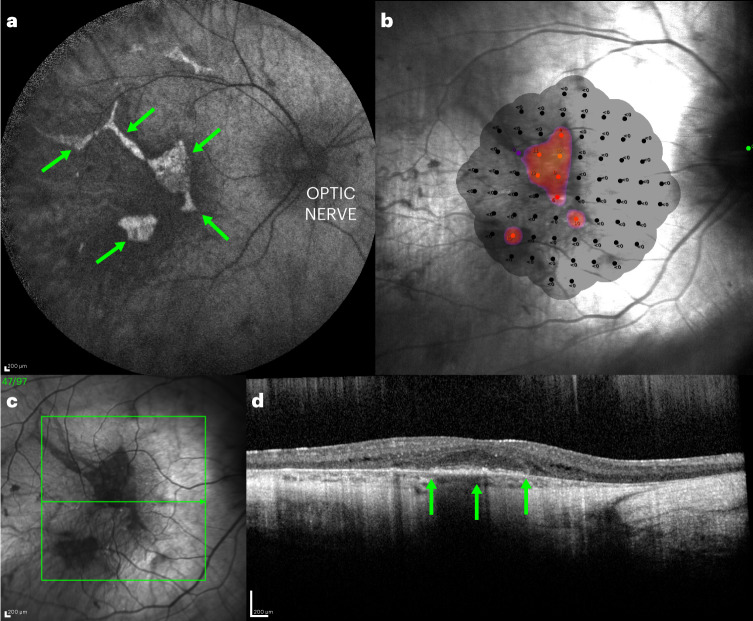
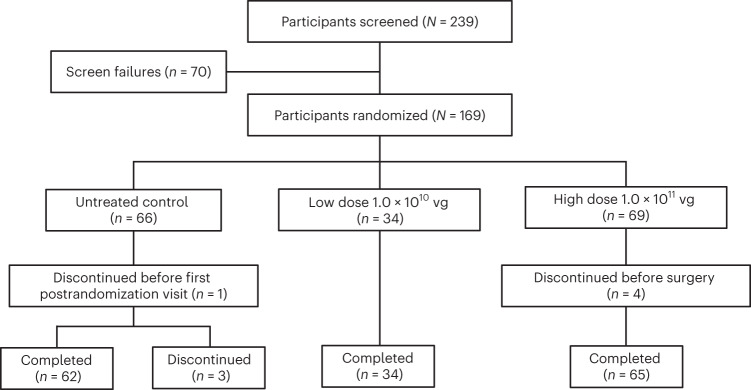
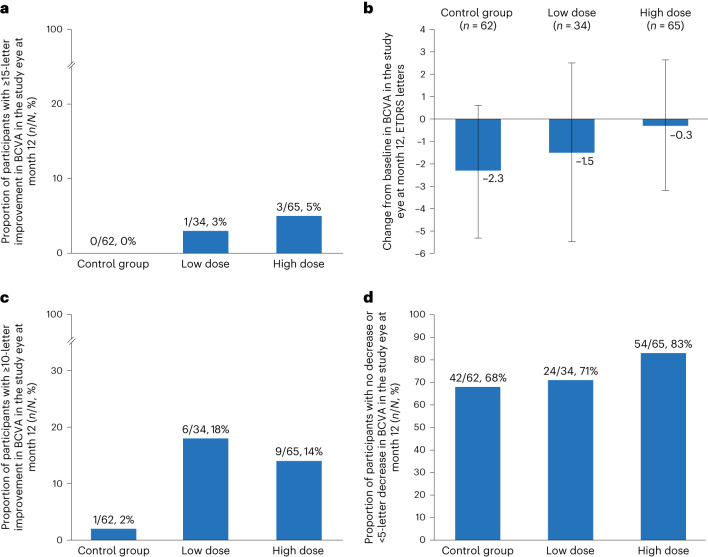
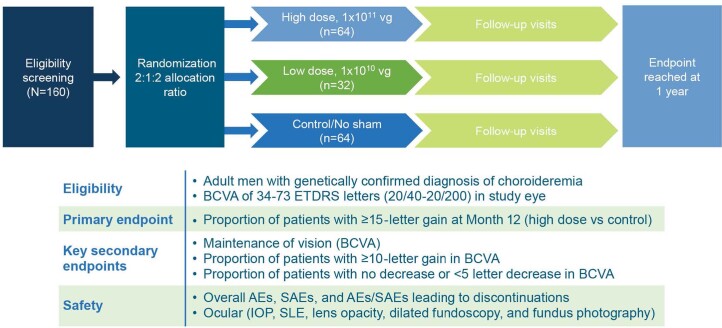
Choroideremia is a rare, X-linked retinal degeneration resulting in progressive vision loss. A randomized, masked, phase 3 clinical trial evaluated the safety and efficacy over 12 months of follow-up in adult males with choroideremia randomized to receive a high-dose (1.0 × 10 11 vector genomes (vg); n = 69) or low-dose (1.0 × 10 10 vg; n = 34) subretinal injection of the AAV2-vector-based gene therapy timrepigene emparvovec versus non-treated control ( n = 66). Most treatment-emergent adverse events were mild or moderate. The trial did not meet its primary endpoint of best-corrected visual acuity (BCVA) improvement. In the primary endpoint analysis, three of 65 participants (5%) in the high-dose group, one of 34 (3%) participants in the low-dose group and zero of 62 (0%) participants in the control group had ≥15-letter Early Treatment Diabetic Retinopathy Study (ETDRS) improvement from baseline BCVA at 12 months (high dose, P = 0.245 versus control; low dose, P = 0.354 versus control). As the primary endpoint was not met, key secondary endpoints were not tested for significance. In a key secondary endpoint, nine of 65 (14%), six of 35 (18%) and one of 62 (2%) participants in the high-dose, low-dose and control groups, respectively, experienced ≥10-letter ETDRS improvement from baseline BCVA at 12 months. Potential opportunities to enhance future gene therapy studies for choroideremia include optimization of entry criteria (more preserved retinal area), surgical techniques and clinical endpoints. EudraCT registration: 2015-003958-41 .
Overview
The claims and statistics of this paper haven’t been checked yet.
Free: it reads the open-access text and checks the first 5 claims that cite a source we can check. Create a free account to check every claim.
Integrity signals
Registry
Cites
Statistics
Figures
Verification
Claims the paper makes
The claims and statistics of this paper haven’t been checked yet.
Free: it reads the open-access text and checks the first 5 claims that cite a source we can check. Create a free account to check every claim.
Claims other papers make about this one
Each is checked against this paper’s own text: does it say what the citing paper says it does?
The cited source says what the claim attributes to it.
In the citing paper
“Many trials also do not report the incidence of intraocular inflammation longitudinally at each assessment timepoint (MacLaren et al., 2023; Khanani et al., 2024a; J. J. Wang et al., 2024).”
From Gene Therapy-Associated Uveitis (GTAU): Understanding and mitigating the adverse immune response in retinal gene therapy (2025) · cites this paper as MacLaren et al., 2023
Self-check
Percentages, sums and reported differences re-computed from the paper’s own numbers.
The self-check needs the paper’s full text.
Citations
Cites
Maguire, A. M., High, K. A., Auricchio, A., Wright, J. F., Pierce, E. A., Testa, F., Mingozzi, F., Bennicelli, J. L., Ying, G.-S., Rossi, S., et al. (2009) · The Lancet · doi:10.1016/s0140-6736(09)61836-5 · Cited by 865
MacLaren, R. E., Groppe, M., Barnard, A. R., Cottriall, C. L., Tolmachova, T., Seymour, L., Clark, K. R., During, M. J., Cremers, F. P. M., Black, G. C. M., et al. (2014) · The Lancet · doi:10.1016/s0140-6736(13)62117-0 · Cited by 796
Self-citationBennett, J., Maguire, A. M., Cideciyan, A. V., Schnell, M., Glover, E., Anand, V., Aleman, T. S., Chirmule, N., Gupta, A. R., Huang, Y., et al. (1999) · Proceedings of the National Academy of Sciences · doi:10.1073/pnas.96.17.9920 · Cited by 242
Pharmaceutical development of AAV-based gene therapy products for the eye
Rodrigues, G. A., Shalaev, E., Karami, T. K., Cunningham, J., Slater, N. K. H., & Rivers, H. M. (2019) · Pharmaceutical Research · doi:10.1007/s11095-018-2554-7 · Cited by 213 · cited 5×
“Adeno-associated viral vectors, such as adeno-associated virus serotype 2 (AAV2), have been shown to achieve efficient transduction of photoreceptors and RPE after subretinal injection and have an acceptable safety profile 19,21–24 .”
BackgroundInfluentialTechnique of retinal gene therapy: delivery of viral vector into the subretinal space
Xue, K., Groppe, M., Salvetti, A. P., & MacLaren, R. E. (2017) · Eye · doi:10.1038/eye.2017.158 · Cited by 191
Self-citationBeneficial effects on vision in patients undergoing retinal gene therapy for choroideremia
Xue, K., Jolly, J. K., Barnard, A. R., Rudenko, A., Salvetti, A. P., Patrício, M. I., Edwards, T. L., Groppe, M., Orlans, H. O., Tolmachova, T., et al. (2018) · Nature Medicine · doi:10.1038/s41591-018-0185-5 · Cited by 185 · cited 1×
“The dose range of vector employed was based on previous clinical trials using the AAV2 vector with a chicken β-actin promoter 26,37 and investigator-driven clinical studies in which AAV2-REP1 was administered to patients with choroideremia 26–28 , 38 .”
MethodSelf-citationTwo-Year Results After AAV2-Mediated Gene Therapy for Choroideremia: The Alberta Experience
Dimopoulos, I. S., Hoang, S. C., Radziwon, A., Binczyk, N. M., Seabra, M. C., MacLaren, R. E., Somani, R., Tennant, M. T. S., & MacDonald, I. M. (2018) · American Journal of Ophthalmology · doi:10.1016/j.ajo.2018.06.011 · Cited by 175 · cited 1×
“The dose range of vector employed was based on previous clinical trials using the AAV2 vector with a chicken β-actin promoter 26,37 and investigator-driven clinical studies in which AAV2-REP1 was administered to patients with choroideremia 26–28 , 38 .”
MethodSelf-citationChoroideremia gene therapy phase 2 clinical trial: 24-month results
Lam, B. L., Davis, J. L., Gregori, N. Z., MacLaren, R. E., Girach, A., Verriotto, J. D., Rodriguez, B., Rosa, P. R., Zhang, X., & Feuer, W. J. (2019) · American Journal of Ophthalmology · doi:10.1016/j.ajo.2018.09.012 · Cited by 161
Self-citationChoroideremia: A review of general findings and pathogenesis
Coussa, R. G., & Traboulsi, E. I. (2012) · Ophthalmic Genetics · doi:10.3109/13816810.2011.620056 · Cited by 127 · cited 2×
“CHM mutations decrease REP1 expression, leading to degeneration of the retinal pigment epithelium (RPE), photoreceptors and choroid 3,17 .”
BackgroundTaking Stock of Retinal Gene Therapy: Looking Back and Moving Forward
Bennett, J. (2017) · Molecular Therapy · doi:10.1016/j.ymthe.2017.03.008 · Cited by 109 · cited 1×
“…gene expression without the need for genomic integration of transgenic material; the blood-ocular barrier facilitates immune privilege, limiting immunological response to gene therapy products; and gene transduction may be achieved at a low dose, potentially reducing manufacturing burden 18,19 .”
Background
Research works printed but not linked: 1
- European Medicines Agency. EU Regulatory Workshop – Ophthalmology – Summary and Report. https://www.ema.europa.eu/en/documents/report/european-union-regulatory-workshop-ophthalmology-summary-report_en.pdf (2012).
Cited by
Wang, J.-H., Zhan, W., Gallagher, T. L., & Gao, G. (2024) · Molecular Therapy · doi:10.1016/j.ymthe.2024.10.017 · Cited by 54
Update on Clinical Trial Endpoints in Gene Therapy Trials for Inherited Retinal Diseases
Igoe, J., Lam, B. L., & Gregori, N. Z. (2024) · Journal of Clinical Medicine · doi:10.3390/jcm13185512 · Cited by 36
“Authors of the trial publication noted that optimizing inclusion and exclusion criteria and selecting different endpoints would improve the evaluation of the trial outcomes [254].”
BackgroundSelf-citationToward low-cost gene therapy: mRNA-based therapeutics for treatment of inherited retinal diseases
Antas, P., Carvalho, C., Cabral-Teixeira, J., de Lemos, L., & Seabra, M. C. (2023) · Trends in Molecular Medicine · doi:10.1016/j.molmed.2023.11.009 · Cited by 36
Gene Therapies in Clinical Development to Treat Retinal Disorders
McClements, M. E., Elsayed, M. E. A. A., Major, L., de la Cámara, C. M.-F., & MacLaren, R. E. (2024) · Molecular Diagnosis & Therapy · doi:10.1007/s40291-024-00722-0 · Cited by 31
“This vector has been through phase I/II trials and, more recently, the phase III STAR clinical trial, which have confirmed this treatment (AAV2.CAG.REP1) to be well tolerated at 1 × 10 11 vector genomes in 69 male individuals and 1 × 10 10 vector genomes in 34 male individuals [30].”
MethodSelf-citationAdeno-associated virus therapies: Pioneering solutions for human genetic diseases
Liu, D., Tian, L., Liu, L., Che, X., Li, X., Liu, C., & Wu, G. (2024) · Cytokine & Growth Factor Reviews · doi:10.1016/j.cytogfr.2024.09.003 · Cited by 32
Purdy, R., John, M., Bray, A., Clare, A. J., Copland, D. A., Chan, Y. K., Henderson, R. H., Nerinckx, F., Leroy, B. P., Yang, P., et al. (2025) · Progress in Retinal and Eye Research · doi:10.1016/j.preteyeres.2025.101354 · Cited by 24
Self-citationChen, K.-S., Chan, H.-C., & Chan, C.-M. (2025) · Drugs · doi:10.1007/s40265-025-02237-2 · Cited by 27
“A recent phase 3 trial did not meet its primary efficacy endpoint for visual acuity improvement in the overall population, but some treated patients showed significant vision preservation compared with untreated counterparts, indicating therapeutic potential if administered early [115, 116].”
Parafoveal cone function in choroideremia assessed with adaptive optics optoretinography
Xu, P., Cooper, R. F., Jiang, Y. Y., & Morgan, J. I. W. (2024) · Scientific Reports · doi:10.1038/s41598-024-58059-x · Cited by 19
“The present study showed the ORG was reduced even in cases where visual acuity was 20/20 and foveal sensitivity approached normal values.”
MacLaren, R. E., Audo, I., Fischer, M. D., Huckfeldt, R. M., Lam, B. L., Pennesi, M. E., Sisk, R., Gow, J. A., Li, J., Zhu, K., et al. (2024) · Human Gene Therapy · doi:10.1089/hum.2024.017 · Cited by 15
Self-citationChoroideremia: The Endpoint Endgame
Elsayed, M. E. A. A., Taylor, L. J., Josan, A. S., Fischer, M. D., & MacLaren, R. E. (2023) · International Journal of Molecular Sciences · doi:10.3390/ijms241814354 · Cited by 17
Self-citationThe clinical safety landscape for ocular AAV gene therapies: A systematic review and meta-analysis
Liu, Z., Zhang, H., Jia, H., Wang, H., Huang, Z., Tang, Y., Wang, Z., Hu, J., Zhao, X., Li, T., et al. (2025) · iScience · doi:10.1016/j.isci.2025.112265 · Cited by 22
Jia, R., Chen, S., Wang, L., Zhang, J., Qu, B., Qiao, J., Meng, X., Yu, S., Liu, X., Xu, B., et al. (2025) · Progress in Retinal and Eye Research · doi:10.1016/j.preteyeres.2025.101377 · Cited by 17
Retinal Imaging Findings in Inherited Retinal Diseases
Corradetti, G., Verma, A., Tojjar, J., Almidani, L., Oncel, D., Emamverdi, M., Bradley, A., Lindenberg, S., Nittala, M. G., & Sadda, S. R. (2024) · Journal of Clinical Medicine · doi:10.3390/jcm13072079 · Cited by 16
Genetic therapies and potential therapeutic applications of CRISPR activators in the eye
Ng, B., Kaukonen, M. K., McClements, M. E., Shamsnajafabadi, H., MacLaren, R. E., & Cehajic‐Kapetanovic, J. (2024) · Progress in Retinal and Eye Research · doi:10.1016/j.preteyeres.2024.101289 · Cited by 14
Self-citationMacLaren, R. E., Lam, B. L., Fischer, M. D., Holz, F. G., Pennesi, M. E., Birch, D. G., Sankila, E., Meunier, I., Stepien, K. E., Sallum, J. M. F., et al. (2024) · American Journal of Ophthalmology · doi:10.1016/j.ajo.2024.01.022 · Cited by 10
Self-citationCehajic‐Kapetanovic, J., Bellini, M. P., Taylor, L. J., Yusuf, I. H., Soomro, T., da Cruz, L., & MacLaren, R. E. (2024) · Efficacy and Mechanism Evaluation · doi:10.3310/wara5730 · Cited by 17
Self-citationThirunavukarasu, A. J., Raji, S., & Cehajic‐Kapetanovic, J. (2025) · Gene Therapy · doi:10.1038/s41434-025-00552-7 · Cited by 11
AlEissa, M. M., Alhawsawi, A. A., Alonazi, R. H., Magharbil, E., Aljahdali, A., ALBalawi, H. B., Alali, N. M., Hameed, S., Abu‐Amero, K. K., & Magliyah, M. (2025) · Genes · doi:10.3390/genes16070847 · Cited by 8
“The trial showed notable clinical improvements (with a two-line gain in BCVA), but it fell short of the three-line gain in BCVA [12] regulatory approval criteria.”
A soft micron accuracy robot design and clinical validation for retinal surgery
Chen, Y., Guo, X., Ye, X., Jiang, T., Chen, H., Yu, J., Yang, G., Knoll, A., Cui, D., Zhou, M., et al. (2025) · Microsystems & Nanoengineering · doi:10.1038/s41378-025-01002-5 · Cited by 8
“The operator repeats the above tasks by hand (see Supplementary Video 4).”
InfluentialUpdate on Gene Therapy Clinical Trials for Eye Diseases
Lonfat, N., Leon, L. M., Punzo, C., & Khanna, H. (2025) · Human Gene Therapy · doi:10.1177/10430342251379824 · Cited by 8
Therapies for Inherited Retinal Dystrophies: What is Enough?
Leroy, B. P., Daly, A., Héon, E., Sahel, J., & Dollfus, H. (2024) · Drug Discovery Today · doi:10.1016/j.drudis.2024.104095 · Cited by 7
Tan, T., Dai, P., Hensman, J., Király, P., Fenner, B. J., Liu, Y., Goh, R. S. M., Han, I. C., Ting, D. S. W., Boon, C. J. F., et al. (2025) · Acta Ophthalmologica · doi:10.1111/aos.17485 · Cited by 6
Self-citationUpdates on protein-prenylation and associated inherited retinopathies
Ashok, S., & Rao, S. R. (2024) · Frontiers in Ophthalmology · doi:10.3389/fopht.2024.1410874 · Cited by 7
“The work highlights the need to consider the stage of disease, anatomical differences, surgical variability, and dose administration among participants (76).”
BackgroundGene Augmentation of CHM Using Non-Viral Episomal Vectors in Models of Choroideremia
Toualbi, L., Toms, M., Almeida, P. V., Harbottle, R. P., & Moosajee, M. (2023) · International Journal of Molecular Sciences · doi:10.3390/ijms242015225 · Cited by 5
“…a phase I/II trial (NCT02341807) did not report differences in visual acuity between injected and un-injected eyes at 2 years post-surgery, and a phase III multicentre study (NCT03496012) failed to meet the primary endpoints and key secondary endpoints after 12 months post-treatment [5,16].”
BackgroundEngineered red Opto-mGluR6 Opsins, a red-shifted optogenetic excitation tool, an in vitro study
Shamsnajafabadi, H., Soheili, Z., Sadeghi, M., Samiee, S., Ghasemi, P., Zibaii, M. I., Pourbadie, H. G., Ahmadieh, H., Pirmardan, E. R., Salehi, N., et al. (2024) · PLoS ONE · doi:10.1371/journal.pone.0311102 · Cited by 4
Retinal Patterns and the Role of Autofluorescence in Choroideremia
Poli, F. E., MacLaren, R. E., & Cehajic‐Kapetanovic, J. (2024) · Genes · doi:10.3390/genes15111471 · Cited by 4
Self-citationNanoparticle-Based gene therapy strategies in retinal delivery
Foster, T., Lim, P., Wagle, S. R., Ionescu, C. M., Kovačević, B., McLenachan, S., Carvalho, L. S., Brunet, A. A., Mooranian, A., & Al‐Salami, H. (2025) · Journal of drug targeting · doi:10.1080/1061186x.2024.2433563 · Cited by 6
Gene therapy for choroideremia: progress, potential and pitfalls
Elsayed, M. E. A. A., Cehajic‐Kapetanovic, J., & MacLaren, R. E. (2025) · Expert Opinion on Biological Therapy · doi:10.1080/14712598.2025.2459850 · Cited by 5
“REP1 (timrepigene emparvovec) compared to a non-surgical control in individuals with choroideremia over a 12-month period [9].”
Self-citationBerger, A., Johnson, C. D., Marmorstein, A. D., & Scruggs, B. A. (2025) · Clinical and Experimental Ophthalmology · doi:10.1111/ceo.14593 · Cited by 6
Ranked Importance of Visual Function Outcome Measures in Choroideremia Clinical Trials
Josan, A. S., Taylor, L. J., Xue, K., Cehajic‐Kapetanovic, J., & MacLaren, R. E. (2024) · Investigative Ophthalmology & Visual Science · doi:10.1167/iovs.65.13.58 · Cited by 5
Self-citationGene therapy for Bietti crystalline corneoretinal dystrophy: A phase 1/2 clinical trial
Yang, L., Xing, D., Zhang, J., Liu, B., Jiang, X., Chen, S., Li, W., Qu, B., Qiao, J., Feng, X., et al. (2026) · Molecular Therapy · doi:10.1016/j.ymthe.2026.01.005 · Cited by 4
Ng, B., Tan, T., Костин, В. В., MacLaren, R. E., & Cehajic‐Kapetanovic, J. (2025) · Translational Vision Science & Technology · doi:10.1167/tvst.14.6.2 · Cited by 4
Self-citationEvaluating ocular health in retinal gene therapies
Kwok, E., Alam, K., Lim, J. K. H., Niyazmand, H., Tang, V. T. S., Trinh, H., Chen, F. K., & Charng, J. (2025) · Clinical and Experimental Optometry · doi:10.1080/08164622.2025.2457429 · Cited by 2
“62 In RP, both SWAF and NIRAF show the classical finding of a hyperautofluorescent ring area which decreases exponentially with disease progression and can be a potential clinical trial endpoint.”
Duncan, J. L., Maguire, M. G., McDaniel, L. S., Doucet, N. R., Audo, I. S., Ayala, A. R., Cheetham, J. K., Cheng, P., Durham, T. A., Huckfeldt, R. M., et al. (2025) · American Journal of Ophthalmology · doi:10.1016/j.ajo.2025.03.039 · Cited by 2
Self-citationApproval of retinal gene therapies in the US and Europe based on visual acuity and microperimetry
Josan, A. S., Raji, S., & MacLaren, R. E. (2025) · Expert Review of Ophthalmology · doi:10.1080/17469899.2025.2487544 · Cited by 2
“A solution to overcome the ceiling effect in patients with good baseline LLVA may be to exclude those with higher LLVA values, in a similar way to how BCVA was used in a recent choroideremia phase III trial [11].”
Self-citationFischer, M. D., Audo, I. S., Gaucher, D., Holz, F. G., Kessel, L., Russell, S., Katarina, Š., Rousso, D. L., Maier, R., Clemens, A., et al. (2026) · Ophthalmology Science · doi:10.1016/j.xops.2026.101090 · Cited by 2
Self-citationmRNA delivery to the retina restores REP1 function in choroideremia
de Lemos, L., Antas, P., Carvalho, C., Castro, M., Bruno, D., Fonseca, A. F., Rakshit, S., & Seabra, M. C. (2026) · Molecular Therapy Advances · doi:10.1016/j.omta.2026.201768 · Cited by 2
Cerolini, S., Bennett, J., Leroy, B. P., Durham, T. A., Coates, C., Pletcher, M. T., Lacey, S., & Alemán, T. S. (2024) · Translational Vision Science & Technology · doi:10.1167/tvst.13.8.17 · Cited by 1
Visual Neurorestoration: An Expert Review of Current Strategies for Restoring Vision in Humans
Cavaleri, J., Lin, M. P., Wu, K., Gilbert, Z. D., Huang, C. Y., Lo, Y. T., Garimella, V., Dallas, J., Briggs, R. G., Borja, A. J., et al. (2025) · Brain Sciences · doi:10.3390/brainsci15111170 · Cited by 1
Biard, L., Lévy, V., Chevret, S., Künkele, A., Grunwald, S., Aiuti, A., Møller, B. K., Debets, R., Mielke, S., Eldere, J. V., et al. (2025) · Molecular Therapy Advances · doi:10.1016/j.omta.2025.201651 · Cited by 1
Precision Is Not Enough: When Tools Outpace Translation in Ocular Gene Therapy
Elsayed, M. E. A. A., & MacLaren, R. E. (2026) · Genes · doi:10.3390/genes17030283 · Cited by 1
“The requirement that pivotal trials demonstrate a three-line (15-letter) gain in best-corrected visual acuity (BCVA) on the ETDRS scale constrains enrolment to individuals with sufficiently poor baseline vision to permit detectable improvement [151].”
Self-citationChen, K.-Y., Chan, H.-C., & Chan, C.-M. (2026) · EClinicalMedicine · doi:10.1016/j.eclinm.2026.103923 · Cited by 1
“34 In other studies, patients experienced significant adverse events related to vector administration, and two notable adverse events occurred among six treated subjects in separate studies.”
InfluentialPhase I/II Study of NGGT001 Gene Therapy for Bietti Crystalline Dystrophy
Chen, X., Yang, L., Wang, G., Liu, Y., Qu, G., Jiang, L., Liu, Y., & Li, X. (2026) · Ophthalmology Science · doi:10.1016/j.xops.2026.101269 · Cited by 1
Inherited retinal degenerations: clinical phenotypes and emerging therapies
Uyhazi, K. E., O'Neil, E. C., Alemán, T. S., & Cideciyan, A. V. (2026) · The Lancet · doi:10.1016/s0140-6736(26)00766-x · Cited by 5
Quantification of Ocular Gene Therapy–Related Inflammation Using the VRMACS Grading System
Elsayed, M. E. A. A., & MacLaren, R. E. (2026) · Ophthalmology Science · doi:10.1016/j.xops.2026.101316 · Cited by 1
Self-citationUnderstanding the Biology in Current Cell and Gene Therapy for Treating Macular Diseases
Qiu, T. G. (2023) · IntechOpen eBooks · doi:10.5772/intechopen.1003722
The Mechanism of Adeno-associated Virus (AAV) Gene Therapy
Huang, J. (2024) · Highlights in Science Engineering and Technology · doi:10.54097/ma9x1289
“Seeing Stars”: The Gene Therapy Revolution
Mercer, G., Ballios, B. G., & Kertes, P. J. (2025) · Advances in experimental medicine and biology · doi:10.1007/978-3-031-72230-1_59
One down but many more to go: the state of gene therapy for inherited retinal disease
Tan, T., Sun, C., Poh, S. S. J., Lim, J., Teo, J. X. J., Dey, S., Chua, Z., Guo, J., Wang, Z., Tay, H. G., et al. (2025) · Regenerative Medicine · doi:10.1080/17460751.2025.2571360
Spatiotemporal Motion Prediction of Intraocular Microsurgical Robot in Non-Visible Regions
Deng, Y., Li, Z., Ye, Q., Zhai, Y., Yu, W., Yu, Z., & Bian, G. (2025) · IEEE/RSJ International Conference on Intelligent Robots and Systems (IROS) · doi:10.1109/iros60139.2025.11246705
Amjad, A., Ali, M. R., Ali, U., & Mahato, R. K. (2025) · Annals of Medicine and Surgery · doi:10.1097/ms9.0000000000004588
“Loss-of-function (LoF) null mutations have been the classical genotype, and gene therapy protocols (e.g., AAV2-REP1) assume minimal residual REP-1 activity [ 2 ] .”
Sourd, C., Quinn, J., John, M. C., de la Cámara, C. M.-F., Wickramasinghe, L. C., Attar, M., Shamsnajafabadi, H., Salman, A., Cowley, S. A., Dendrou, C. A., et al. (2026) · Molecular Therapy Advances · doi:10.1016/j.omta.2026.201726 · Cited by 2
Self-citationGene therapy development for retinal diseases
Reichel, F. F., Bellingrath, J.-S., Király, P., & FISCHER, M. D. (2026) · Handbook of clinical neurology · doi:10.1016/b978-0-443-22212-2.00016-1
Self-citationGene therapy in patients with choroideremia: a meta-analysis of clinical trials
Guerrero, P. R., Ridruejo-Ortega, B., González-Barros, D., Silva-Schultz, S., Stalmashka, T., Molinero-Sicilia, L., Benites, G., Rivera‐Izquierdo, M., Usategui-Martín, R., & Pastor‐Idoate, S. (2026) · Graefe s Archive for Clinical and Experimental Ophthalmology · doi:10.1007/s00417-026-07326-w
Beyond innovation: why rare disease gene therapy needs a reset
Elsayed, M. E. A. A., & MacLaren, R. E. (2026) · Expert Opinion on Biological Therapy · doi:10.1080/14712598.2026.2706035
“Patients who developed amblyopia secondary to early-onset visual deprivation, or whose retinal degeneration has progressed beyond a threshold for cellular rescue, may have a fundamentally different capacity to benefit from gene therapy than patients treated earlier in the disease course [15].”
Self-citationPerivascular Astrocytic Gliosis Induced by Retinal Gene Therapy
Elsayed, M. E. A. A., Seitz, I. P., Fischer, M. D., & MacLaren, R. E. (2026) · Human Gene Therapy · doi:10.1177/10430342261469741
Self-citationMacha, N. N., & Yu, M. (2026) · Journal of Clinical Medicine · doi:10.3390/jcm15166492
“Additionally, a phase 3 choroideremia gene therapy trial failed its primary endpoint of ≥ 15-letter BCVA improvement despite signs of biological efficacy [6].”
The subretinal space: from surgical target to therapeutic compartment — A narrative review
Grieco, G., Carlà, M. M., Stefano, G. D., & Tamburrelli, C. (2026) · Survey of Ophthalmology · doi:10.1016/j.survophthal.2026.08.013
Metadata
- Authors
- MacLaren, R. E., Fischer, M. D., Gow, J. A., Lam, B. L., Sankila, E.-M. K., Girach, A., Panda, S., Yoon, D., Zhao, G., & Pennesi, M. E.
- Affiliations
- University of Oxford (GB)
- University of Tübingen (DE)
- Biogen (United States) (US)
- University of Miami (US)
- University of Helsinki (FI)
- Oregon Health & Science University (US)
- Corresponding author
- MacLaren, Robert E.
- ORCID
- Venue
- Nature Medicine
- Published
- 2023-10
- Volume
- 29
- Issue
- 10
- Pages
- 2464-2472
- ISSN
- 1078-8956 (ISSN-L)
- 1546-170X
- PMC
- PMC10579095
- OpenAlex
- W4387451521
- Semantic Scholar
- bd3001ba34cd056ab68944f2c86f090c145f4132
- Cited by
- 58
- References
- 35
- Citations by year
- 2026: 15 · 2025: 22 · 2024: 17 · 2023: 4
- FWCI
- 5.15
- Type
- journal article
- Language
- en
- Open access
- hybrid
- doi.org
- Licence
- cc-by
- creativecommons.org/licenses/by/4.0 (tdm)
- creativecommons.org/licenses/by/4.0 (vor, 8 d)
- Locations
- Nature Medicine (publishedVersion, cc-by)
- PubMed Central (publishedVersion, cc-by)
- PubMed (publishedVersion)
- Figshare (submittedVersion, cc-by)
- Työväentutkimus Vuosikirja (submittedVersion)
- Funders
- This study was funded by Biogen.
- Topics
- Health Sciences › Medicine › Ophthalmology › Retinal Development and Disorders
- Life Sciences › Biochemistry, Genetics and Molecular Biology › Genetics › Virus-based gene therapy research
- Health Sciences › Medicine › Ophthalmology › Retinal Diseases and Treatments
- Keywords
- choroideremia, subretinal gene therapy, X-linked retinal degeneration, best-corrected visual acuity, treatment-emergent adverse events, dose comparison, adult male patient
- MeSH terms
- Adult, Diabetic Retinopathy, Humans, Male, Retina, Visual Acuity, Genetic Therapy, Choroideremia
About these checks
Registry, retraction, Cites and statistics results are computed, not judged, with one exception: a printed reference that no index lists is read once by a model before it counts as a citation error. Claims are extracted by a model and kept only when their quote appears verbatim in the text; each cited source is then checked, with a model’s help, for whether it says what the claim relies on. Those verdicts can be wrong — read the claim’s quote and the cited source before relying on one.
Statistics and arithmetic are recomputed, not judged.
Confidence bands are shown only for fields calibrated on our annotated test set. None is calibrated yet, so no band is shown.
What counts as a claim ›How we measure confidence ›How we check this ›
Are you an author, or do you see a problem with this page? Request a review
Data sources
Bibliographic data: Semantic Scholar, OpenAlex, Crossref.
Contains information from the Semantic Scholar Academic Graph Datasets, made available under the ODC Attribution License (ODC-BY 1.0).
Semantic Scholar’s data is described in: Kinney, R., et al. (2023). The Semantic Scholar Open Data Platform. arXiv:2301.10140.
