

Subretinal timrepigene emparvovec in adult men with choroideremia: a randomized phase 3 trial
Open accessThe DOI matches its Crossref record; 35 of the 35 references it cites were found in a registry or an index.
Abstract
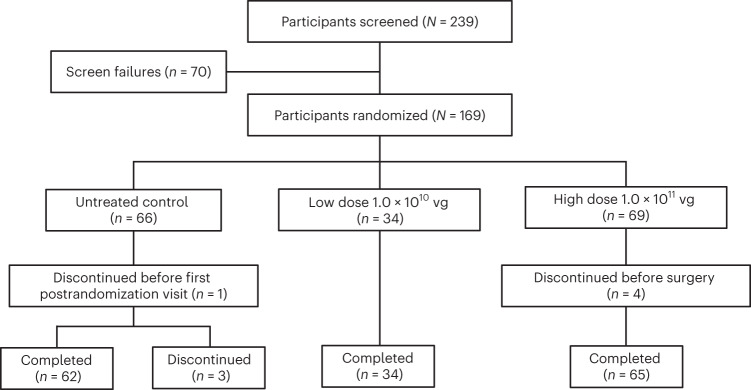
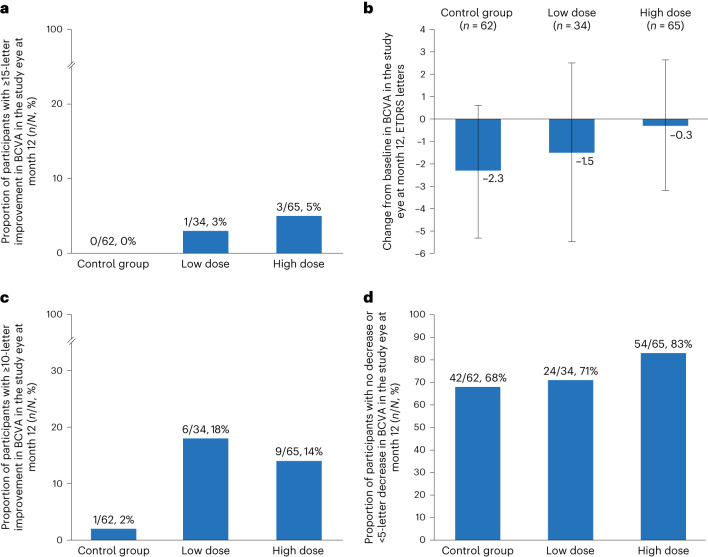
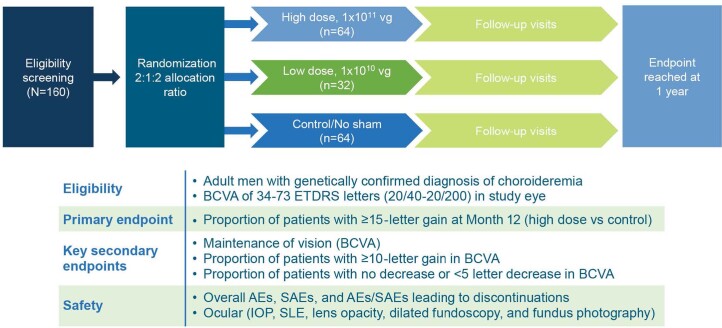
Choroideremia is a rare, X-linked retinal degeneration resulting in progressive vision loss. A randomized, masked, phase 3 clinical trial evaluated the safety and efficacy over 12 months of follow-up in adult males with choroideremia randomized to receive a high-dose (1.0 × 10 11 vector genomes (vg); n = 69) or low-dose (1.0 × 10 10 vg; n = 34) subretinal injection of the AAV2-vector-based gene therapy timrepigene emparvovec versus non-treated control ( n = 66). Most treatment-emergent adverse events were mild or moderate. The trial did not meet its primary endpoint of best-corrected visual acuity (BCVA) improvement. In the primary endpoint analysis, three of 65 participants (5%) in the high-dose group, one of 34 (3%) participants in the low-dose group and zero of 62 (0%) participants in the control group had ≥15-letter Early Treatment Diabetic Retinopathy Study (ETDRS) improvement from baseline BCVA at 12 months (high dose, P = 0.245 versus control; low dose, P = 0.354 versus control). As the primary endpoint was not met, key secondary endpoints were not tested for significance. In a key secondary endpoint, nine of 65 (14%), six of 35 (18%) and one of 62 (2%) participants in the high-dose, low-dose and control groups, respectively, experienced ≥10-letter ETDRS improvement from baseline BCVA at 12 months. Potential opportunities to enhance future gene therapy studies for choroideremia include optimization of entry criteria (more preserved retinal area), surgical techniques and clinical endpoints. EudraCT registration: 2015-003958-41 .
Overview
The claims and statistics of this paper haven’t been checked yet.
Free: it reads the open-access text and checks the first 5 claims that cite a source we can check. Create a free account to check every claim.
Integrity signals
Registry
Cites
Statistics
Figures
Verification
Claims the paper makes
The claims and statistics of this paper haven’t been checked yet.
Free: it reads the open-access text and checks the first 5 claims that cite a source we can check. Create a free account to check every claim.
Claims other papers make about this one
Each is checked against this paper’s own text: does it say what the citing paper says it does?
The cited source says what the claim attributes to it.
In the citing paper
“Many trials also do not report the incidence of intraocular inflammation longitudinally at each assessment timepoint (MacLaren et al., 2023; Khanani et al., 2024a; J. J. Wang et al., 2024).”
From Gene Therapy-Associated Uveitis (GTAU): Understanding and mitigating the adverse immune response in retinal gene therapy (2025) · cites this paper as MacLaren et al., 2023
Self-check
Percentages, sums and reported differences re-computed from the paper’s own numbers.
The self-check needs the paper’s full text.
Citations
Cites
Maguire, A. M., High, K. A., Auricchio, A., Wright, J. F., Pierce, E. A., Testa, F., Mingozzi, F., Bennicelli, J. L., Ying, G.-S., Rossi, S., et al. (2009) · The Lancet · doi:10.1016/s0140-6736(09)61836-5 · Cited by 865
MacLaren, R. E., Groppe, M., Barnard, A. R., Cottriall, C. L., Tolmachova, T., Seymour, L., Clark, K. R., During, M. J., Cremers, F. P. M., Black, G. C. M., et al. (2014) · The Lancet · doi:10.1016/s0140-6736(13)62117-0 · Cited by 796
Self-citationBennett, J., Maguire, A. M., Cideciyan, A. V., Schnell, M., Glover, E., Anand, V., Aleman, T. S., Chirmule, N., Gupta, A. R., Huang, Y., et al. (1999) · Proceedings of the National Academy of Sciences · doi:10.1073/pnas.96.17.9920 · Cited by 242
Pharmaceutical development of AAV-based gene therapy products for the eye
Rodrigues, G. A., Shalaev, E., Karami, T. K., Cunningham, J., Slater, N. K. H., & Rivers, H. M. (2019) · Pharmaceutical Research · doi:10.1007/s11095-018-2554-7 · Cited by 213 · cited 5×
“Adeno-associated viral vectors, such as adeno-associated virus serotype 2 (AAV2), have been shown to achieve efficient transduction of photoreceptors and RPE after subretinal injection and have an acceptable safety profile 19,21–24 .”
BackgroundInfluentialTechnique of retinal gene therapy: delivery of viral vector into the subretinal space
Xue, K., Groppe, M., Salvetti, A. P., & MacLaren, R. E. (2017) · Eye · doi:10.1038/eye.2017.158 · Cited by 191
Self-citationBeneficial effects on vision in patients undergoing retinal gene therapy for choroideremia
Xue, K., Jolly, J. K., Barnard, A. R., Rudenko, A., Salvetti, A. P., Patrício, M. I., Edwards, T. L., Groppe, M., Orlans, H. O., Tolmachova, T., et al. (2018) · Nature Medicine · doi:10.1038/s41591-018-0185-5 · Cited by 185 · cited 1×
“The dose range of vector employed was based on previous clinical trials using the AAV2 vector with a chicken β-actin promoter 26,37 and investigator-driven clinical studies in which AAV2-REP1 was administered to patients with choroideremia 26–28 , 38 .”
MethodSelf-citationTwo-Year Results After AAV2-Mediated Gene Therapy for Choroideremia: The Alberta Experience
Dimopoulos, I. S., Hoang, S. C., Radziwon, A., Binczyk, N. M., Seabra, M. C., MacLaren, R. E., Somani, R., Tennant, M. T. S., & MacDonald, I. M. (2018) · American Journal of Ophthalmology · doi:10.1016/j.ajo.2018.06.011 · Cited by 175 · cited 1×
“The dose range of vector employed was based on previous clinical trials using the AAV2 vector with a chicken β-actin promoter 26,37 and investigator-driven clinical studies in which AAV2-REP1 was administered to patients with choroideremia 26–28 , 38 .”
MethodSelf-citationChoroideremia gene therapy phase 2 clinical trial: 24-month results
Lam, B. L., Davis, J. L., Gregori, N. Z., MacLaren, R. E., Girach, A., Verriotto, J. D., Rodriguez, B., Rosa, P. R., Zhang, X., & Feuer, W. J. (2019) · American Journal of Ophthalmology · doi:10.1016/j.ajo.2018.09.012 · Cited by 161
Self-citationChoroideremia: A review of general findings and pathogenesis
Coussa, R. G., & Traboulsi, E. I. (2012) · Ophthalmic Genetics · doi:10.3109/13816810.2011.620056 · Cited by 127 · cited 2×
“CHM mutations decrease REP1 expression, leading to degeneration of the retinal pigment epithelium (RPE), photoreceptors and choroid 3,17 .”
BackgroundTaking Stock of Retinal Gene Therapy: Looking Back and Moving Forward
Bennett, J. (2017) · Molecular Therapy · doi:10.1016/j.ymthe.2017.03.008 · Cited by 109 · cited 1×
“…gene expression without the need for genomic integration of transgenic material; the blood-ocular barrier facilitates immune privilege, limiting immunological response to gene therapy products; and gene transduction may be achieved at a low dose, potentially reducing manufacturing burden 18,19 .”
BackgroundJolly, J. K., Xue, K., Edwards, T. L., Groppe, M., & MacLaren, R. E. (2017) · Investigative Opthalmology & Visual Science · doi:10.1167/iovs.17-22486 · Cited by 96 · cited 1×
“The micro-perimetry data, however, were generally found to be inconsistent, with most participants unable to perform the test accurately or scoring zero because of the advanced nature of their disease when the degeneration has undermined the fovea 31 .”
BackgroundSelf-citationClinical Perspectives and Trends: Microperimetry as a Trial Endpoint in Retinal Disease
Yang, Y., & Dunbar, H. (2021) · Ophthalmologica · doi:10.1159/000515148 · Cited by 96 · cited 2×
“There has been a recent uptake in the use of microperimetry in interventional retinal disease trials, including in choroideremia, and it has potential to succeed in a future trial as a clinical endpoint for earlier-stage patients 34 .”
BackgroundFischer, M. D., Ochakovski, G. A., Beier, B., Seitz, I. P., Vaheb, Y., Kortuem, C., Reichel, F. F. L., Kuehlewein, L., Kahle, N. A., Peters, T., et al. (2019) · JAMA Ophthalmology · doi:10.1001/jamaophthalmol.2019.3278 · Cited by 92
Self-citationTolmachova, T., Tolmachov, O. E., Barnard, A. R., de Silva, S. R., Lipinski, D. M., Walker, N. J., MacLaren, R. E., & Seabra, M. C. (2013) · Journal of Molecular Medicine · doi:10.1007/s00109-013-1006-4 · Cited by 91 · cited 2×
“These observations of both safety and tropism efficacy provide the optimal rationale for the AAV2 choroideremia gene therapeutic strategy 19,23 .”
BackgroundSelf-citationA practical diagnostic test for choroideremia
MacDonald, I. M., Mah, D. Y., Ho, Y. K., Lewis, R. A., & Seabra, M. C. (1998) · Ophthalmology · doi:10.1016/s0161-6420(98)99031-5 · Cited by 89 · cited 1×
“Slow and progressive vision loss associated with choroideremia starts from the periphery of the visual field, and best-corrected visual acuity (BCVA) decreases as the disease advances with age 12–14 .”
BackgroundClinical and Genetic Features of Choroideremia in Childhood
Khan, K. N., Islam, F., Moore, A. T., & Michaelides, M. (2016) · Ophthalmology · doi:10.1016/j.ophtha.2016.06.051 · Cited by 82
AAV-Mediated Gene Therapy for Choroideremia: Preclinical Studies in Personalized Models
Vasireddy, V., Mills, J. A., Gaddameedi, R., Basner-Tschakarjan, E., Kohnke, M., Black, A. D., Alexandrov, K., Zhou, S., Maguire, A. M., Chung, D. C., et al. (2013) · PLoS ONE · doi:10.1371/journal.pone.0061396 · Cited by 79 · cited 1×
“Adeno-associated viral vectors, such as adeno-associated virus serotype 2 (AAV2), have been shown to achieve efficient transduction of photoreceptors and RPE after subretinal injection and have an acceptable safety profile 19,21–24 .”
BackgroundVisual Function and Central Retinal Structure in Choroideremia
Heon, E., Alabduljalil, T., McGuigan, D. B., Cideciyan, A. V., Li, S., Chen, S., & Jacobson, S. G. (2016) · Investigative Opthalmology & Visual Science · doi:10.1167/iovs.15-18421 · Cited by 74
Prevalence of Generalized Retinal Dystrophy in Denmark
Bertelsen, M., Jensen, H. S., Bregnhøj, J. F., & Rosenberg, T. (2014) · Ophthalmic Epidemiology · doi:10.3109/09286586.2014.929710 · Cited by 64
Freund, P. R., Sergeev, Y. V., & MacDonald, I. M. (2016) · Molecular Genetics & Genomic Medicine · doi:10.1002/mgg3.208 · Cited by 61 · cited 2×
“Choroideremia initially presents in childhood and early adolescence as night blindness 9–11 .”
BackgroundChoroideremia: from genetic and clinical phenotyping to gene therapy and future treatments
Mitsios, A., Dubis, A. M., & Moosajee, M. (2018) · Therapeutic Advances in Ophthalmology · doi:10.1177/2515841418817490 · Cited by 61 · cited 6×
“Adeno-associated viral vectors, such as adeno-associated virus serotype 2 (AAV2), have been shown to achieve efficient transduction of photoreceptors and RPE after subretinal injection and have an acceptable safety profile 19,21–24 .”
BackgroundInfluentialGene therapy for choroideremia: in vitro rescue mediated by recombinant adenovirus
Anand, V., Barral, D. C., Zeng, Y., Brunsmann, F., Maguire, A. M., Seabra, M. C., & Bennett, J. (2003) · Vision Research · doi:10.1016/s0042-6989(02)00389-9 · Cited by 59 · cited 1×
“Adeno-associated viral vectors, such as adeno-associated virus serotype 2 (AAV2), have been shown to achieve efficient transduction of photoreceptors and RPE after subretinal injection and have an acceptable safety profile 19,21–24 .”
BackgroundPatrício, M. I., Barnard, A. R., Orlans, H. O., McClements, M. E., & MacLaren, R. E. (2017) · Molecular Therapy - Nucleic Acids · doi:10.1016/j.omtn.2016.12.006 · Cited by 59 · cited 1×
“Inclusion of the inactivated woodchuck hepatitis virus post-transcriptional regulatory element (WPRE) may further boost retinal gene expression of the REP1 protein by up to a log unit in some cases 25 .”
BackgroundSelf-citationHas retinal gene therapy come of age? From bench to bedside and back to bench
Trapani, I., & Auricchio, A. (2019) · Human Molecular Genetics · doi:10.1093/hmg/ddz130 · Cited by 50 · cited 1×
“Viral vector–based gene therapy is being widely studied in both preclinical and clinical settings for the treatment of choroideremia and other inherited retinal dystrophies 6,20 .”
BackgroundMultimodal assessment of choroideremia patients defines pre-treatment characteristics
Seitz, I. P., Zhour, A., Kohl, S., Llavona, P., Peter, T., Wilhelm, B., Zrenner, E., Ueffing, M., Bartz‐Schmidt, K. U., & Fischer, M. D. (2015) · Graefe s Archive for Clinical and Experimental Ophthalmology · doi:10.1007/s00417-015-2976-4 · Cited by 45
Self-citationCHOROIDEREMIA: Retinal Degeneration With an Unmet Need
Pennesi, M. E., Birch, D. G., Duncan, J. L., Bennett, J., & Girach, A. (2019) · Retina · doi:10.1097/iae.0000000000002553 · Cited by 45 · cited 2×
“…success with the surgery could, therefore, potentially be an additional confounder for the treat-ment effect in participants with advanced choroideremia, as there may have been only a small preserved retinal area for vector delivery, which might not have been accurately targeted in every case 35 .”
BackgroundSelf-citationPathogenic mechanisms and the prospect of gene therapy for choroideremia
Dimopoulos, I. S., Chan, S., MacLaren, R. E., & MacDonald, I. M. (2015) · Expert Opinion on Orphan Drugs · doi:10.1517/21678707.2015.1046434 · Cited by 37 · cited 1×
“Viral vector–based gene therapy is being widely studied in both preclinical and clinical settings for the treatment of choroideremia and other inherited retinal dystrophies 6,20 .”
BackgroundSelf-citationShen, L. L., Ahluwalia, A., Sun, M., Young, B. K., Nardini, H. K. G., & Priore, L. V. D. (2020) · British Journal of Ophthalmology · doi:10.1136/bjophthalmol-2020-316028 · Cited by 30 · cited 2×
“Natural history studies have reported a transition age from slow to rapid BCVA decline of ~39 years 15 .”
BackgroundFry, L. E., Patrício, M. I., Williams, J. P., Aylward, J. W., Hewitt, H., Clouston, P., Xue, K., Barnard, A. R., & MacLaren, R. E. (2019) · JAMA Ophthalmology · doi:10.1001/jamaophthalmol.2019.5071 · Cited by 20
Self-citationHagag, A. M., Mitsios, A., Narayan, A. R., Abbouda, A., Webster, A. R., Dubis, A. M., & Moosajee, M. (2020) · Eye · doi:10.1038/s41433-020-0974-1 · Cited by 19 · cited 1×
“In a cohort of patients with choroider-emia who were grouped by age 50 years or ≥50 years, visual acuity was observed not to change significantly in either age group over the 1-year follow-up period 33 .”
BackgroundProkofyeva, E., Wilke, R. G. H., Lotz, G., Troeger, E., Straßer, T., & Zrenner, E. (2009) · Graefe s Archive for Clinical and Experimental Ophthalmology · doi:10.1007/s00417-009-1059-9 · Cited by 16 · cited 1×
“Choroideremia initially presents in childhood and early adolescence as night blindness 9–11 .”
Backgroundvan Schuppen, S. M., Talib, M., Bergen, A. A. B., ten Brink, J. B., Florijn, R. J., Boon, C. J. F., & van Schooneveld, M. J. (2017) · Retina · doi:10.1097/iae.0000000000001844 · Cited by 14
Nanda, A., Salvetti, A. P., de la Cámara, C. M.-F., & MacLaren, R. E. (2018) · Ophthalmic Genetics · doi:10.1080/13816810.2018.1430242 · Cited by 13 · cited 1×
“The condition is likely underdiagnosed because of its similarities in early stages to other inherited retinal diseases, such as retinitis pigmentosa 2,8 .”
BackgroundSelf-citationBilateral visual acuity decline in males with choroideremia: a pooled, cross-sectional meta-analysis
Bozkaya, D., Zou, H., Lu, C., Tsao, N., & Lam, B. L. (2022) · BMC Ophthalmology · doi:10.1186/s12886-022-02250-z · Cited by 9 · cited 1×
“Furthermore, the small preserved retinal area may not be normal given that BCVA is reduced and the area may not tolerate subretinal injection well compared to intervention in milder disease with better-preserved retinas 35,36 .”
BackgroundSelf-citationChoroideremia: Toward Regulatory Approval of Retinal Gene Therapy
Yusuf, I. H., & MacLaren, R. E. (2023) · Cold Spring Harbor Perspectives in Medicine · doi:10.1101/cshperspect.a041279 · Cited by 6
Self-citation
Research works printed but not linked: 1
- European Medicines Agency. EU Regulatory Workshop – Ophthalmology – Summary and Report. https://www.ema.europa.eu/en/documents/report/european-union-regulatory-workshop-ophthalmology-summary-report_en.pdf (2012).
Cited by
Wang, J.-H., Zhan, W., Gallagher, T. L., & Gao, G. (2024) · Molecular Therapy · doi:10.1016/j.ymthe.2024.10.017 · Cited by 54
Update on Clinical Trial Endpoints in Gene Therapy Trials for Inherited Retinal Diseases
Igoe, J., Lam, B. L., & Gregori, N. Z. (2024) · Journal of Clinical Medicine · doi:10.3390/jcm13185512 · Cited by 36
“Authors of the trial publication noted that optimizing inclusion and exclusion criteria and selecting different endpoints would improve the evaluation of the trial outcomes [254].”
BackgroundSelf-citationToward low-cost gene therapy: mRNA-based therapeutics for treatment of inherited retinal diseases
Antas, P., Carvalho, C., Cabral-Teixeira, J., de Lemos, L., & Seabra, M. C. (2023) · Trends in Molecular Medicine · doi:10.1016/j.molmed.2023.11.009 · Cited by 36
Gene Therapies in Clinical Development to Treat Retinal Disorders
McClements, M. E., Elsayed, M. E. A. A., Major, L., de la Cámara, C. M.-F., & MacLaren, R. E. (2024) · Molecular Diagnosis & Therapy · doi:10.1007/s40291-024-00722-0 · Cited by 31
“This vector has been through phase I/II trials and, more recently, the phase III STAR clinical trial, which have confirmed this treatment (AAV2.CAG.REP1) to be well tolerated at 1 × 10 11 vector genomes in 69 male individuals and 1 × 10 10 vector genomes in 34 male individuals [30].”
MethodSelf-citationAdeno-associated virus therapies: Pioneering solutions for human genetic diseases
Liu, D., Tian, L., Liu, L., Che, X., Li, X., Liu, C., & Wu, G. (2024) · Cytokine & Growth Factor Reviews · doi:10.1016/j.cytogfr.2024.09.003 · Cited by 32
Metadata
- Authors
- MacLaren, R. E., Fischer, M. D., Gow, J. A., Lam, B. L., Sankila, E.-M. K., Girach, A., Panda, S., Yoon, D., Zhao, G., & Pennesi, M. E.
- Affiliations
- University of Oxford (GB)
- University of Tübingen (DE)
- Biogen (United States) (US)
- University of Miami (US)
- University of Helsinki (FI)
- Oregon Health & Science University (US)
- Corresponding author
- MacLaren, Robert E.
- ORCID
- Venue
- Nature Medicine
- Published
- 2023-10
- Volume
- 29
- Issue
- 10
- Pages
- 2464-2472
- ISSN
- 1078-8956 (ISSN-L)
- 1546-170X
- PMC
- PMC10579095
- OpenAlex
- W4387451521
- Cited by
- 58
- References
- 35
- Citations by year
- 2026: 15 · 2025: 22 · 2024: 17 · 2023: 4
- FWCI
- 5.15
- Type
- journal article
- Language
- en
- Open access
- hybrid
- doi.org
- Licence
- cc-by
- creativecommons.org/licenses/by/4.0 (tdm)
- creativecommons.org/licenses/by/4.0 (vor, 8 d)
- Locations
- Nature Medicine (publishedVersion, cc-by)
- PubMed Central (publishedVersion, cc-by)
- PubMed (publishedVersion)
- Figshare (submittedVersion, cc-by)
- Työväentutkimus Vuosikirja (submittedVersion)
- Funders
- This study was funded by Biogen.
- Topics
- Health Sciences › Medicine › Ophthalmology › Retinal Development and Disorders
- Life Sciences › Biochemistry, Genetics and Molecular Biology › Genetics › Virus-based gene therapy research
- Health Sciences › Medicine › Ophthalmology › Retinal Diseases and Treatments
- Keywords
- choroideremia, subretinal gene therapy, X-linked retinal degeneration, best-corrected visual acuity, treatment-emergent adverse events, dose comparison, adult male patient
- MeSH terms
- Adult, Diabetic Retinopathy, Humans, Male, Retina, Visual Acuity, Genetic Therapy, Choroideremia
About these checks
Registry, retraction, Cites and statistics results are computed, not judged, with one exception: a printed reference that no index lists is read once by a model before it counts as a citation error. Claims are extracted by a model and kept only when their quote appears verbatim in the text; each cited source is then checked, with a model’s help, for whether it says what the claim relies on. Those verdicts can be wrong — read the claim’s quote and the cited source before relying on one.
Statistics and arithmetic are recomputed, not judged.
Confidence bands are shown only for fields calibrated on our annotated test set. None is calibrated yet, so no band is shown.
What counts as a claim ›How we measure confidence ›How we check this ›
Are you an author, or do you see a problem with this page? Request a review
Data sources
Bibliographic data: Semantic Scholar, OpenAlex, Crossref.
Contains information from the Semantic Scholar Academic Graph Datasets, made available under the ODC Attribution License (ODC-BY 1.0).
Semantic Scholar’s data is described in: Kinney, R., et al. (2023). The Semantic Scholar Open Data Platform. arXiv:2301.10140.
