

Long-term kidney outcomes of semaglutide in obesity and cardiovascular disease in the SELECT trial
Open accessThe DOI matches its Crossref record; 62 of the 62 references it cites were found in a registry or an index.
Abstract
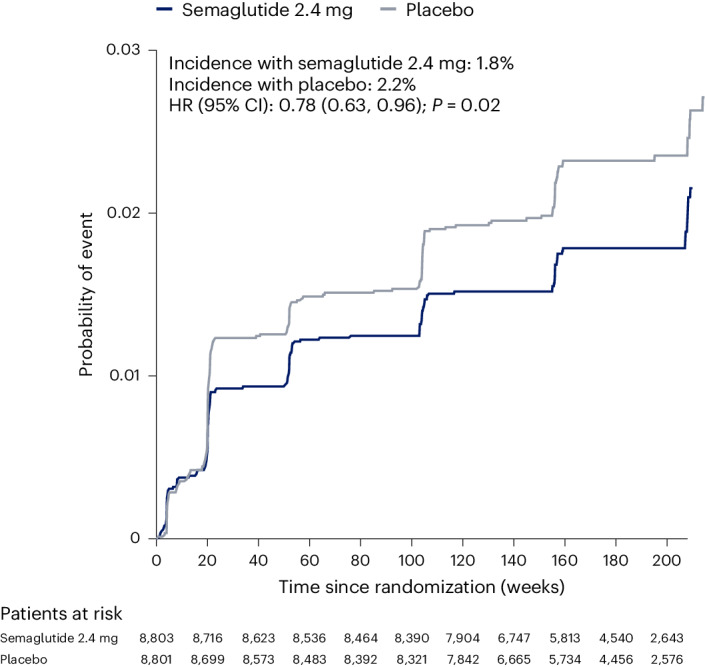
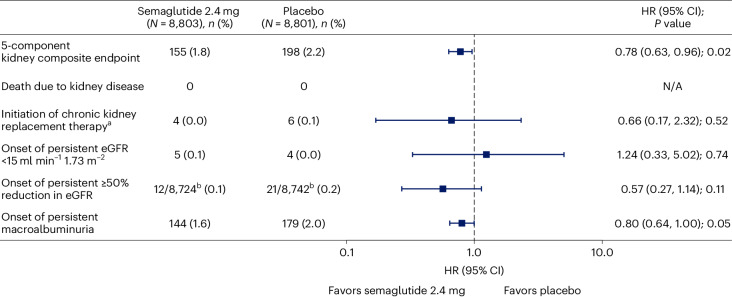
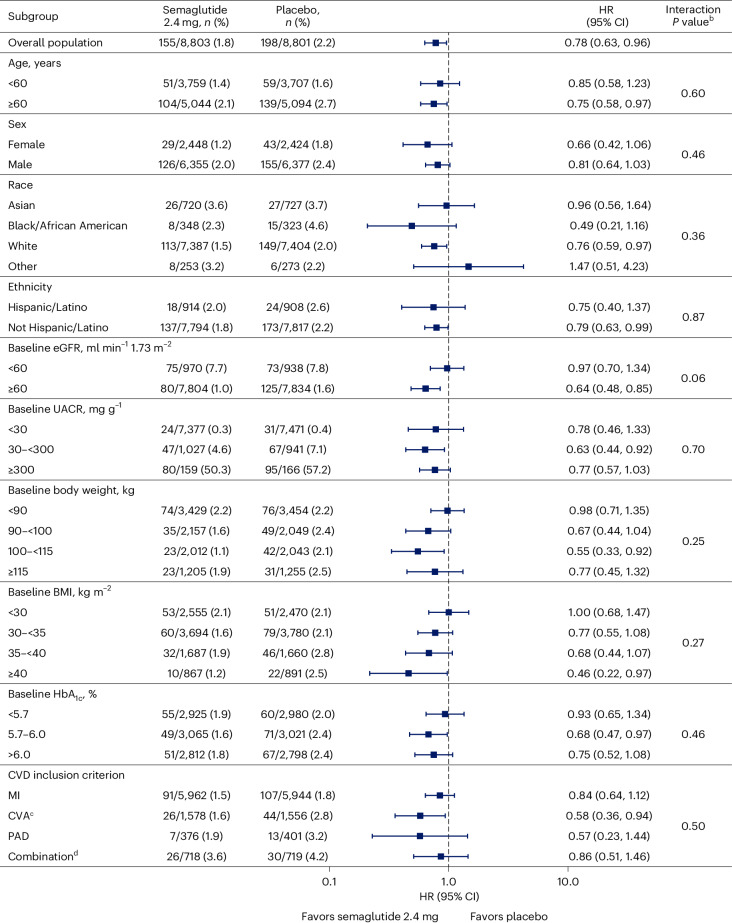
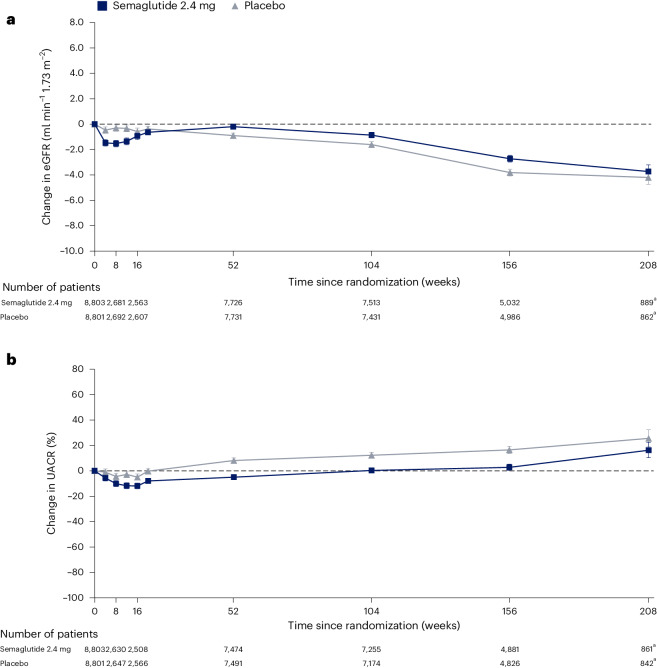
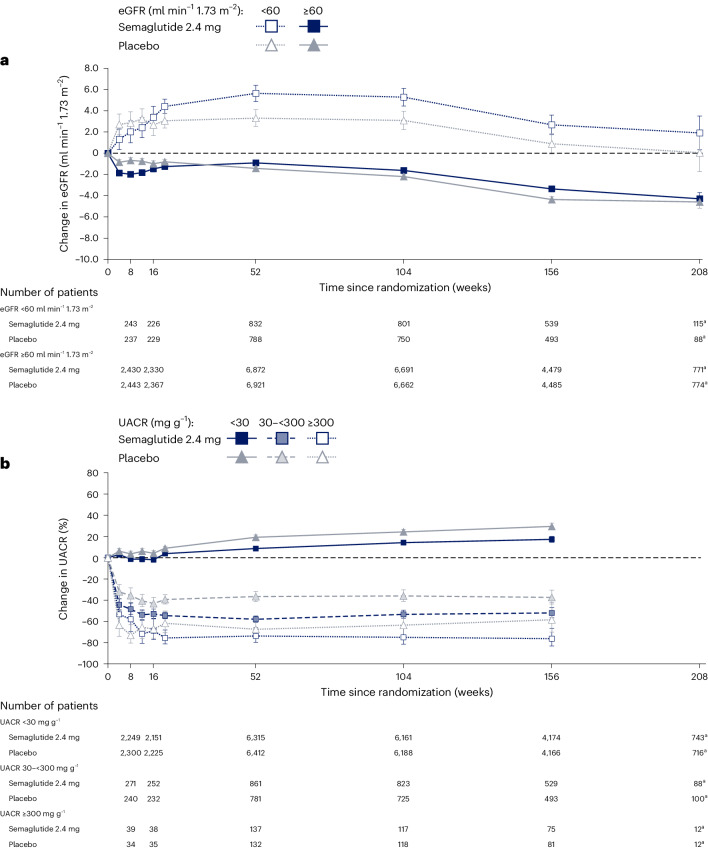
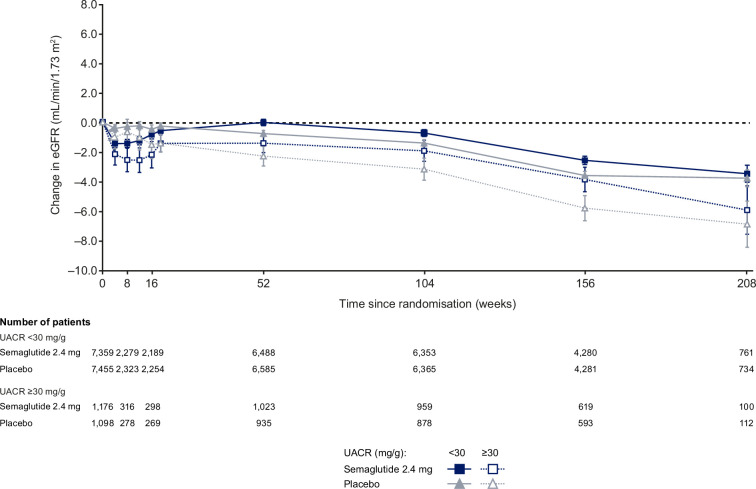
The SELECT trial previously reported a 20% reduction in major adverse cardiovascular events with semaglutide ( n = 8,803) versus placebo ( n = 8,801) in patients with overweight/obesity and established cardiovascular disease, without diabetes. In the present study, we examined the effect of once-weekly semaglutide 2.4 mg on kidney outcomes in the SELECT trial. The incidence of the pre-specified main composite kidney endpoint (death from kidney disease, initiation of chronic kidney replacement therapy, onset of persistent estimated glomerular filtration rate (eGFR) < 15 ml min −1 1.73 m − 2 , persistent ≥50% reduction in eGFR or onset of persistent macroalbuminuria) was lower with semaglutide (1.8%) versus placebo (2.2%): hazard ratio (HR) = 0.78; 95% confidence interval (CI) 0.63, 0.96; P = 0.02. The treatment benefit at 104 weeks for eGFR was 0.75 ml min −1 1.73 m − 2 (95% CI 0.43, 1.06; P < 0.001) overall and 2.19 ml min −1 1.73 m − 2 (95% CI 1.00, 3.38; P < 0.001) in patients with baseline eGFR <60 ml min −1 1.73 m − 2 . These results suggest a benefit of semaglutide on kidney outcomes in individuals with overweight/obesity, without diabetes. ClinicalTrials.gov identifier: NCT03574597 .
Overview
The claims and statistics of this paper haven’t been checked yet.
Free: it reads the open-access text and checks the first 5 claims that cite a source we can check. Create a free account to check every claim.
Integrity signals
Registry
Cites
Statistics
Figures
Verification
Claims the paper makes
The claims and statistics of this paper haven’t been checked yet.
Free: it reads the open-access text and checks the first 5 claims that cite a source we can check. Create a free account to check every claim.
Claims other papers make about this one
Each is checked against this paper’s own text: does it say what the citing paper says it does?
The source backs part of the claim, not all of it — or backs it for a different population, condition or comparison.
In the citing paper
“semaglutide can reduce the progression of chronic kidney disease in patients with and without diabetes and even in those taking SGLT2 inhibitors [12–14].”
From New drugs for the treatment of obesity: do we need approaches to preserve muscle mass? (2025) · cites this paper as [12]
Experimental — accuracy not yet measuredThe source backs part of the claim, not all of it — or backs it for a different population, condition or comparison.
In the citing paper
“Subgroup analyses from various cardiovascular outcomes trials have also shown that GLP-1 RAs may benefit kidney-related outcomes, including reductions in albuminuria, slower declines in estimated glomerular filtration rate, and a decreased risk of end-stage kidney disease in patients with and without diabetes.30,31”
From The expanding role of GLP-1 receptor agonists: a narrative review of current evidence and future directions (2025) · cites this paper as [30]
Experimental — accuracy not yet measuredThe source backs part of the claim, not all of it — or backs it for a different population, condition or comparison.
In the citing paper
“In the SELECT trial, semaglutide 2.4 mg reduced a composite renal endpoint (≥ 50% eGFR decline, macroalbuminuria onset, or need for renal replacement therapy) by 22% vs. placebo [17].”
From Precision obesity medicine: A phenotype-guided framework for pharmacologic therapy across the lifespan (2025) · cites this paper as [17]
Experimental — accuracy not yet measuredThe cited source says what the claim attributes to it.
In the citing paper
“The SELECT trial, a CVOT of subcutaneous semaglutide (2•4 mg once weekly) versus placebo in people with overweight or obesity with an established diagnosis of ASCVD, found a 22% lower relative risk (HR 0•78, 95% CI 0•63-0•96) for a composite kidney outcome”
From GLP-1 receptor agonists and next-generation incretin-based medications: metabolic, cardiovascular, and renal benefits (2026) · cites this paper as [50]
The cited source says what the claim attributes to it.
In the citing paper
“At 104 weeks of treatment, eGFR had declined less in the semaglutide arm (–0.86 mL/min/1.73 m2) versus the placebo arm (–1.61 mL/min/1.73 m2).”
From GLP-1 agonists in the treatment of chronic kidney disease in type 2 diabetes and obesity (2025) · cites this paper as [86]
1 more claim about this paper
Create a free account to see every claim other papers make about this one.
Self-check
Percentages, sums and reported differences re-computed from the paper’s own numbers.
The self-check needs the paper’s full text.
Citations
Cites
Toprak, O., Kurt, H., Sarı, Y., Şarkış, C., Us, H., & Kırık, A. (2017) · Kidney and Blood Pressure Research · doi:10.1159/000468530 · Cited by 29,627
A New Equation to Estimate Glomerular Filtration Rate
Levey, A. S., Stevens, L. A., Schmid, C. H., Zhang, Y. (., Castro, A. F., Feldman, H. I., Kusek, J. W., Eggers, P., Van Lente, F., Greene, T., et al. (2009) · Annals of Internal Medicine · doi:10.7326/0003-4819-150-9-200905050-00006 · Cited by 25,603
KDIGO 2024 clinical practice guideline for the evaluation and management of chronic kidney disease
Stevens, P. E., Ahmed, S. B., Carrero, J. J., Foster, B., Francis, A., Hall, R. K., Herrington, W. G., Hill, G., Inker, L. A., Kazancıoğlu, R., et al. (2024) · Kidney International · doi:10.1016/j.kint.2023.10.018 · Cited by 8,530
Liraglutide and Cardiovascular Outcomes in Type 2 Diabetes
Marso, S. P., Daniels, G. H., Brown-Frandsen, K., Kristensen, P., Mann, J. F. E., Nauck, M. A., Nissen, S. E., Pocock, S., Poulter, N. R., Ravn, L. S., et al. (2016) · New England Journal of Medicine · doi:10.1056/nejmoa1603827 · Cited by 7,629 · cited 3×
“12,18,19,21–27).”
BackgroundResultSelf-citationSemaglutide and Cardiovascular Outcomes in Patients with Type 2 Diabetes
Marso, S. P., Bain, S. C., Consoli, A., Eliaschewitz, F. G., Jódar, E., Leiter, L. A., Lingvay, I., Rosenstock, J., Seufert, J., Warren, M. L., et al. (2016) · New England Journal of Medicine · doi:10.1056/nejmoa1607141 · Cited by 6,900
Self-citationEstimating glomerular filtration rate from serum creatinine and cystatin C
Inker, L. A., Schmid, C. H., Tighiouart, H., Eckfeldt, J. H., Feldman, H. I., Greene, T., Kusek, J. W., Manzi, J., Van Lente, F., Zhang, Y. L., et al. (2012) · New England Journal of Medicine · doi:10.1056/nejmoa1114248 · Cited by 4,102 · cited 1×
“However, its use is now advocated, as this has been shown to improve the predictive performance of eGFR for measured GFR 42 in the general population and in the context of weight loss 43 .”
Semaglutide and Cardiovascular Outcomes in Obesity without Diabetes
Lincoff, A. M., Brown-Frandsen, K., Colhoun, H. M., Deanfield, J., Emerson, S. S., Esbjerg, S., Hardt-Lindberg, S., Hovingh, G. K., Kahn, S. E., Kushner, R. F., et al. (2023) · New England Journal of Medicine · doi:10.1056/nejmoa2307563 · Cited by 3,236 · cited 2×
“As reported previously 13 , permanent premature discontinuation occurred in 2,351 patients (26.7”
BackgroundInfluentialSelf-citationGerstein, H. C., Colhoun, H. M., Dagenais, G. R., Diaz, R., Lakshmanan, M., Pais, P., Probstfield, J., Riesmeyer, J. S., Riddle, M. C., Rydén, L., et al. (2019) · The Lancet · doi:10.1016/s0140-6736(19)31149-3 · Cited by 3,163 · cited 2×
“12,18,19,21–27).”
BackgroundSelf-citationLixisenatide in Patients with Type 2 Diabetes and Acute Coronary Syndrome
Pfeffer, M. A., Claggett, B., Diaz, R., Dickstein, K., Gerstein, H. C., Køber, L. V., Lawson, F. C., Ping, L., Wei, X., Lewis, E. F., et al. (2015) · New England Journal of Medicine · doi:10.1056/nejmoa1509225 · Cited by 2,409
Effects of once-weekly exenatide on cardiovascular outcomes in type 2 diabetes
Holman, R. R., Bethel, M. A., Mentz, R. J., Thompson, V. P., Lokhnygina, Y., Buse, J. B., Chan, J. C., Choi, J., Gustavson, S. M., Iqbal, N., et al. (2017) · New England Journal of Medicine · doi:10.1056/nejmoa1612917 · Cited by 2,162
Oral Semaglutide and Cardiovascular Outcomes in Patients with Type 2 Diabetes
Husain, M., Birkenfeld, A. L., Donsmark, M., Dungan, K., Eliaschewitz, F. G., Franco, D. R., Jeppesen, O. K., Lingvay, I., Mosenzon, O., Pedersen, S. D., et al. (2019) · New England Journal of Medicine · doi:10.1056/nejmoa1901118 · Cited by 1,997
Self-citationMediation Analysis: A Practitioner's Guide
VanderWeele, T. J. (2016) · Annual Review of Public Health · doi:10.1146/annurev-publhealth-032315-021402 · Cited by 1,985
Hernandez, A. F., Green, J. B., Janmohamed, S., D'Agostino, R. B., Granger, C. B., Jones, N. P., Leiter, L. A., Rosenberg, A. E., Sigmon, K. N., Somerville, M. C., et al. (2018) · The Lancet · doi:10.1016/s0140-6736(18)32261-x · Cited by 1,829 · cited 2×
“12,18,19,21–27).”
BackgroundSattar, N., Lee, M. M. Y., Kristensen, S. L., Branch, K. R. H., Del Prato, S., Khurmi, N. S., Lam, C. S. P., Lopes, R. D., McMurray, J. J. V., Pratley, R. E., et al. (2021) · The Lancet Diabetes & Endocrinology · doi:10.1016/s2213-8587(21)00203-5 · Cited by 1,599 · cited 10×
“Glucagon-like peptide-1 (GLP-1) receptor agonists (GLP-1RAs) may have such direct kidney protective effects, with some evidence of altered expression of fibrosis-associated and inflammation-associated genes and down-regulation of the receptor for advanced glycation end products 9–11 .”
BackgroundMethodResultInfluentialObesity-related glomerulopathy: An emerging epidemic
Kambham, N., Markowitz, G. S., Valeri, A. M., Lin, J., & D'Agati, V. D. (2001) · Kidney International · doi:10.1046/j.1523-1755.2001.0590041498.x · Cited by 1,286 · cited 1×
“As an additional safety measure, all patients in Europe had additional laboratory data collection at weeks 4, 8, 12 and 16, with creatinine and UACR tests performed at the central laboratory, and the CKD-EPI 2021 equation used for eGFR.”
MethodLiraglutide and renal outcomes in type 2 diabetes
Mann, J. F. E., Ørsted, D. D., Brown-Frandsen, K., Marso, S. P., Poulter, N. R., Rasmussen, S., Tornøe, K., Zinman, B., & Buse, J. B. (2017) · New England Journal of Medicine · doi:10.1056/nejmoa1616011 · Cited by 1,253
Self-citationThe Efficiency of Cox's Likelihood Function for Censored Data
Efron, B. (1977) · Journal of the American Statistical Association · doi:10.1080/01621459.1977.10480613 · Cited by 1,228 · cited 1×
“Tied events were handled using the Exact method 54,55 , if possible, or Efron’s method 56 , if not.”
MethodThe Statistical Analysis of Failure Time Data.
Cohen, A. C., Kalbfleisch, J. D., & Prentice, R. L. (1982) · Journal of the American Statistical Association · doi:10.2307/2287285 · Cited by 958
Levey, A. S., Eckardt, K.-U., Dorman, N. M., Christiansen, S. L., Hoorn, E. J., Ingelfinger, J. R., Inker, L. A., Levin, A., Mehrotra, R., Palevsky, P. M., et al. (2020) · Kidney International · doi:10.1016/j.kint.2020.02.010 · Cited by 731 · cited 1×
“Although the original study protocol used the terms ‘5-component nephropathy composite’ and ‘acute renal failure’, here, we rephrased these as ‘5-component kidney composite’ and ‘acute kidney failure’, in line with recent nomenclature guidance introduced since the writing of the protocol 53 .”
MethodObesity, kidney dysfunction and hypertension: mechanistic links
Hall, J. E., do Carmo, J. M., da Silva, A. A., Wang, Z., & Hall, M. E. (2019) · Nature Reviews Nephrology · doi:10.1038/s41581-019-0145-4 · Cited by 654
Gerstein, H. C., Colhoun, H. M., Dagenais, G. R., Diaz, R., Lakshmanan, M., Pais, P., Probstfield, J., Botros, F. T., Riddle, M. C., Rydén, L., et al. (2019) · The Lancet · doi:10.1016/s0140-6736(19)31150-x · Cited by 638 · cited 3×
“12,18,19,21–27).”
BackgroundResultSelf-citationLevey, A. S., Gansevoort, R. T., Coresh, J., Inker, L. A., Heerspink, H. L., Grams, M. E., Greene, T., Tighiouart, H., Matsushita, K., Ballew, S. H., et al. (2020) · American Journal of Kidney Diseases · doi:10.1053/j.ajkd.2019.06.009 · Cited by 591 · cited 2×
“…of 0.72 ml min −1 1.73 m −2 per year mean difference in total GFR slope over 2 years confers a 97.5% probability of clinical benefit (HR ~ 0.7) over the longer term in the endpoints of doubling of serum creatinine, incidence of eGFR 15 ml min −1 1.73 m −2 or end-stage kidney disease 15,16 .”
BackgroundMethodInfluentialAnti-Inflammatory Effects of GLP-1-Based Therapies beyond Glucose Control
Lee, Y.-S., & Jun, H.-S. (2016) · Mediators of Inflammation · doi:10.1155/2016/3094642 · Cited by 530 · cited 1×
“There is also some evidence of direct effects of GLP-1RAs on the kidney, including glomerular hemodynamic effects, reductions in inflammation and oxidative stress, increased natriuresis and diuresis and altered expression of the receptor for advanced glycation end products 9,11,20,31,32 .”
BackgroundGLP-1 and the kidney: from physiology to pharmacology and outcomes in diabetes
Muskiet, M. H. A., Tonneijck, L., Smits, M. M., van Baar, M. J. B., Kramer, M. H. H., Hoorn, E. J., Joles, J. A., & van Raalte, D. H. (2017) · Nature Reviews Nephrology · doi:10.1038/nrneph.2017.123 · Cited by 407 · cited 1×
“There is also some evidence of direct effects of GLP-1RAs on the kidney, including glomerular hemodynamic effects, reductions in inflammation and oxidative stress, increased natriuresis and diuresis and altered expression of the receptor for advanced glycation end products 9,11,20,31,32 .”
BackgroundHeerspink, H. J. L., Greene, T., Tighiouart, H., Gansevoort, R. T., Coresh, J., Simon, A. L., Chan, T. M., Hou, F. F., Lewis, J. B., Locatelli, F., et al. (2019) · The Lancet Diabetes & Endocrinology · doi:10.1016/s2213-8587(18)30314-0 · Cited by 397 · cited 1×
“To put these treatment benefits into context, a meta-analysis of trials showed that a 30% reduction in estimated UACR predicts a 27% lower hazard risk of the clinical endpoint of doubling of serum creatinine, incidence of eGFR 15 ml min −1 1.73 m −2 or end-stage kidney disease 17 .”
MethodInfluentialHoltkamp, F. A., de Zeeuw, D., Thomas, M. C., Cooper, M. E., de Graeff, P. A., Hillege, H. J. L., Parving, H.-H., Brenner, B. M., Shahinfar, S., & Lambers Heerspink, H. J. (2011) · Kidney International · doi:10.1038/ki.2011.79 · Cited by 364
Garofalo, C., Borrelli, S., Minutolo, R., Chiodini, P., De Nicola, L., & Conte, G. (2017) · Kidney International · doi:10.1016/j.kint.2016.12.013 · Cited by 363
Inker, L. A., Heerspink, H. J. L., Tighiouart, H., Levey, A. S., Coresh, J., Gansevoort, R. T., Simon, A. L., Ying, J., Beck, G. J., Wanner, C., et al. (2019) · Journal of the American Society of Nephrology · doi:10.1681/asn.2019010007 · Cited by 310 · cited 1×
“…of 0.72 ml min −1 1.73 m −2 per year mean difference in total GFR slope over 2 years confers a 97.5% probability of clinical benefit (HR ~ 0.7) over the longer term in the endpoints of doubling of serum creatinine, incidence of eGFR 15 ml min −1 1.73 m −2 or end-stage kidney disease 15,16 .”
BackgroundInfluentialHeerspink, H. J. L., Sattar, N., Pavo, I., Haupt, A., Duffin, K. L., Yang, Z., Wiese, R. J., Tuttle, K. R., & Cherney, D. Z. I. (2022) · The Lancet Diabetes & Endocrinology · doi:10.1016/s2213-8587(22)00243-1 · Cited by 306 · cited 2×
“Reassuringly, this acute drop in eGFR associated with treatments that have longer-term benefit on eGFR was noted for sodium–glucose co-transporter-2 inhibitors, for renin–angiotensin–system inhibitors and for tirzepatide 28,45–47 .”
BackgroundSelf-citationApplied Mixed Models in Medicine
Brown, H., & Prescott, R. (2014) · doi:10.1002/9781118778210 · Cited by 282
Obesity and chronic kidney disease
Jiang, Z., Wang, Y., Zhao, X., Cui, H., Han, M., Ren, X., Gang, X., & Wang, G. (2023) · American Journal of Physiology-Endocrinology and Metabolism · doi:10.1152/ajpendo.00179.2022 · Cited by 267
Ryan, D. H., Lingvay, I., Colhoun, H. M., Deanfield, J., Emerson, S. S., Kahn, S. E., Kushner, R. F., Marso, S., Plutzky, J., Brown-Frandsen, K., et al. (2020) · American Heart Journal · doi:10.1016/j.ahj.2020.07.008 · Cited by 249
Self-citationDevelopment of Risk Prediction Equations for Incident Chronic Kidney Disease
Nelson, R. G., Grams, M. E., Ballew, S. H., Sang, Y., Azizi, F., Chadban, S. J., Chaker, L., Dunning, S. C., Fox, C., Hirakawa, Y., et al. (2019) · JAMA · doi:10.1001/jama.2019.17379 · Cited by 247
Rossing, P., Baeres, F. M. M., Bakris, G., Bosch-Traberg, H., Gislum, M., Gough, S. C. L., Idorn, T., Lawson, J., Mahaffey, K. W., Mann, J. F. E., et al. (2023) · Nephrology Dialysis Transplantation · doi:10.1093/ndt/gfad009 · Cited by 242 · cited 1×
“…n = 1,210) with overweight and obesity, which found significant reductions in UACR with semaglutide 1.0 mg and 2.4 mg weekly, with differences versus placebo of −28.0% and −32.9%, respectively 20 , resulting from an increase in UACR in the placebo group and a decrease in the semaglutide group 14 .”
BackgroundInfluentialSelf-citationCystatin C as a biomarker of chronic kidney disease: latest developments
Benoit, S. W., Ciccia, E. A., & Devarajan, P. (2020) · Expert Review of Molecular Diagnostics · doi:10.1080/14737159.2020.1768849 · Cited by 209 · cited 1×
“Cystatin C is not affected by muscle mass, but the difficulty in the setting of obesity and weight loss is that it may be affected by fat mass 40,41 .”
BackgroundOshima, M., Jardine, M. J., Agarwal, R., Bakris, G., Cannon, C. P., Charytan, D. M., de Zeeuw, D., Edwards, R., Greene, T., Levin, A., et al. (2021) · Kidney International · doi:10.1016/j.kint.2020.10.042 · Cited by 166 · cited 1×
“Reassuringly, this acute drop in eGFR associated with treatments that have longer-term benefit on eGFR was noted for sodium–glucose co-transporter-2 inhibitors, for renin–angiotensin–system inhibitors and for tirzepatide 28,45–47 .”
BackgroundSourris, K. C., Ding, Y., Maxwell, S. S., Al-sharea, A., Kantharidis, P., Mohan, M., Rosado, C. J., Penfold, S. A., Haase, C., Xu, Y., et al. (2024) · Kidney International · doi:10.1016/j.kint.2023.09.029 · Cited by 143 · cited 2×
“There is also some evidence of direct effects of GLP-1RAs on the kidney, including glomerular hemodynamic effects, reductions in inflammation and oxidative stress, increased natriuresis and diuresis and altered expression of the receptor for advanced glycation end products 9,11,20,31,32 .”
BackgroundMichos, E. D., Bakris, G. L., Rodbard, H. W., & Tuttle, K. R. (2023) · American Journal of Preventive Cardiology · doi:10.1016/j.ajpc.2023.100502 · Cited by 125 · cited 2×
“There is also some evidence of direct effects of GLP-1RAs on the kidney, including glomerular hemodynamic effects, reductions in inflammation and oxidative stress, increased natriuresis and diuresis and altered expression of the receptor for advanced glycation end products 9,11,20,31,32 .”
BackgroundSelf-citationObesity and kidney disease: Hidden consequences of the epidemic
Kovesdy, C., Furth, S. L., & Zoccali, C. (2017) · Physiology International · doi:10.1556/2060.104.2017.1.9 · Cited by 124
Potential kidney protection with liraglutide and semaglutide: Exploratory mediation analysis
Mann, J. F. E., Buse, J. B., Idorn, T., Leiter, L. A., Pratley, R. E., Rasmussen, S., Vilsbøll, T., Wolthers, B., & Perkovic, V. (2021) · Diabetes, Obesity and Metabolism · doi:10.1111/dom.14443 · Cited by 120 · cited 1×
“A previous mediation analysis in the LEADER and SUSTAIN-6 trials in individuals with type 2 diabetes suggested that reductions in HbA 1c and systolic blood pressure may moderately mediate kidney benefits of liraglutide and semaglutide 30 .”
MethodSelf-citationBivariate linear mixed models using SAS proc MIXED
Thiébaut, R., Jacqmin-Gadda, H., Chêne, G., Leport, C., & Commenges, D. (2002) · Computer Methods and Programs in Biomedicine · doi:10.1016/s0169-2607(02)00017-2 · Cited by 118 · cited 1×
“The correlations between the change in these factors and eGFR at week 104 were derived from an MMRM using the bivariate model as specified by Thiebaut et al. 58 .”
MethodLingvay, I., Brown‐Frandsen, K., Colhoun, H. M., Deanfield, J., Emerson, S. S., Esbjerg, S., Hardt‐Lindberg, S., Hovingh, G. K., Kahn, S. E., Kushner, R. F., et al. (2023) · Obesity · doi:10.1002/oby.23621 · Cited by 113
Self-citationHeerspink, H. J. L., Apperloo, E., Davies, M., Dicker, D., Kandler, K., Rosenstock, J., Sørrig, R., Lawson, J., Zeuthen, N., & Cherney, D. (2023) · Diabetes Care · doi:10.2337/dc22-1889 · Cited by 98 · cited 3×
“…n = 1,210) with overweight and obesity, which found significant reductions in UACR with semaglutide 1.0 mg and 2.4 mg weekly, with differences versus placebo of −28.0% and −32.9%, respectively 20 , resulting from an increase in UACR in the placebo group and a decrease in the semaglutide group 14 .”
BackgroundMethodInfluentialChew-Harris, J. S. C., Florkowski, C. M., George, P. M., Elmslie, J. L., & Endre, Z. H. (2013) · Annals of Clinical Biochemistry: International Journal of Laboratory Medicine · doi:10.1258/acb.2012.011241 · Cited by 85 · cited 1×
“Cystatin C is not affected by muscle mass, but the difficulty in the setting of obesity and weight loss is that it may be affected by fat mass 40,41 .”
BackgroundConventional and genetic evidence on the association between adiposity and CKD
Zhu, P., Herrington, W. G., Haynes, R., Emberson, J., Landray, M. J., Sudlow, C. L. M., Woodward, M., Baigent, C., Lewington, S., & Staplin, N. (2021) · Journal of the American Society of Nephrology · doi:10.1681/asn.2020050679 · Cited by 83
Inker, L. A., Couture, S. J., Tighiouart, H., Abraham, A. G., Beck, G. J., Feldman, H. I., Greene, T., Gudnason, V., Karger, A. B., Eckfeldt, J. H., et al. (2021) · American Journal of Kidney Diseases · doi:10.1053/j.ajkd.2020.11.005 · Cited by 78 · cited 3×
“Blood samples were collected at screening, at weeks 20, 52, 104, 156 and 208, and at the end of treatment. eGFR values were calculated centrally based on serum creatinine using the Chronic Kidney Disease Epidemiology Collaboration (CKD-EPI) 2009 creatinine equation 51 , with sensitivity analyses…”
MethodCreatinine‐based equations for the adjustment of drug dosage in an obese population
Bouquegneau, A., Vidal‐Petiot, E., Moranne, O. P., Mariat, C., Boffa, J., Vrtovsnik, F., Scheen, A., Krzesinski, J.-M., Flamant, M., & Delanaye, P. (2016) · British Journal of Clinical Pharmacology · doi:10.1111/bcp.12817 · Cited by 74
Obesity and kidney disease: hidden consequences of the epidemic
Kovesdy, C. P., Furth, S. L., Zoccali, C., Li, P. K., García-García, G., Benghanem-Gharbi, M., Bollaert, R., Dupuis, S., Erk, T., Kalantar‐Zadeh, K., et al. (2016) · Kidney International · doi:10.1016/j.kint.2016.10.019 · Cited by 73
Kidney Function in Obesity—Challenges in Indexing and Estimation
Chang, A. R., Zafar, W., & Grams, M. E. (2018) · Advances in Chronic Kidney Disease · doi:10.1053/j.ackd.2017.10.007 · Cited by 73 · cited 2×
“However, its use is now advocated, as this has been shown to improve the predictive performance of eGFR for measured GFR 42 in the general population and in the context of weight loss 43 .”
BackgroundEfficient computation of subset selection probabilities with application to Cox regression
DELONG, D. M., GUIRGUIS, G. H., & SO, Y. C. (1994) · Biometrika · doi:10.1093/biomet/81.3.607 · Cited by 56 · cited 1×
“Tied events were handled using the Exact method 54,55 , if possible, or Efron’s method 56 , if not.”
MethodHeerspink, H. J. L., Sattar, N., Pavo, I., Haupt, A., Duffin, K. L., Yang, Z., Wiese, R. J., Wilson, J. M., Hemmingway, A., Cherney, D. Z. I., et al. (2023) · Diabetes Care · doi:10.2337/dc23-0261 · Cited by 53 · cited 1×
“In a recent post hoc analysis, the effect of tirzepatide on eGFR was similar regardless of whether creatinine or cystatin C was used 44 .”
BackgroundSelf-citationErtugliflozin and Slope of Chronic eGFR: Prespecified Analyses from the Randomized VERTIS CV Trial
Cherney, D. Z. I., Cosentino, F., Dagogo-Jack, S. E., McGuire, D. K., Pratley, R. E., Frederich, R. C., Maldonado, M., Liu, C., Liu, J., Pong, A., et al. (2021) · Clinical Journal of the American Society of Nephrology · doi:10.2215/cjn.01130121 · Cited by 52 · cited 1×
“Reassuringly, this acute drop in eGFR associated with treatments that have longer-term benefit on eGFR was noted for sodium–glucose co-transporter-2 inhibitors, for renin–angiotensin–system inhibitors and for tirzepatide 28,45–47 .”
BackgroundLiraglutide and Renal Outcomes in Type 2 Diabetes.
Mann, J. F. E., Ørsted, D. D., & Buse, J. B. (2017) · PubMed · doi:10.1056/nejmc1713042 · Cited by 45
Self-citationPerformance of Indexed and Nonindexed Estimated GFR
Titan, S., Miao, S., Tighiouart, H., Chen, N., Shi, H., Zhang, L., Zuo, L., Froissart, M., Rossing, P. R., GRUBB, A. O., et al. (2020) · American Journal of Kidney Diseases · doi:10.1053/j.ajkd.2020.04.010 · Cited by 39 · cited 1×
“Thus, whether the CKD-EPI creatinine-based eGFR is as reasonable a proxy for indexed mGFR in the settings of obesity and large changes in body weight is unclear, and studies of this question are conflicting 34–37 .”
BackgroundPerformance of glomerular filtration rate estimating equations before and after bariatric surgery
Chang, A. R., George, J., Levey, A. S., Coresh, J., Grams, M. E., & Inker, L. A. (2020) · Kidney Medicine · doi:10.1016/j.xkme.2020.08.008 · Cited by 38
Ye, C., Kong, L., Zhao, Z., Li, M., Wang, S., Lin, H., Xu, Y., Lu, J., Chen, Y., Xu, Y., et al. (2021) · The Journal of Clinical Endocrinology & Metabolism · doi:10.1210/clinem/dgab633 · Cited by 37
Lee, Y., Anvari, S., Chu, M. M., Lovrics, O., Khondker, A., Malhan, R., Aditya, I., Doumouras, A. G., Walsh, M. W., & Hong, D. (2021) · Nephrology · doi:10.1111/nep.13958 · Cited by 35 · cited 1×
“The acute period included data from baseline to week 16 in eGFR postoperatively 29 .”
MethodSevere obesity and the impact of medical weight loss on estimated glomerular filtration rate
Rothberg, A. E., McEwen, L. N., & Herman, W. H. (2020) · PLoS ONE · doi:10.1371/journal.pone.0228984 · Cited by 28 · cited 1×
“A recent editorial advocated for the use of deindexed eGFR in the setting of weight loss 33,38 , but this is not a recommendation in the recent guidelines from the Kidney Disease Improving Global Outcomes (KDIGO) organization 39 .”
MethodBjornstad, P., Cherney, D., Lawson, J., Møntegaard, C., Pruijm, M. T., Tuttle, K. R., Vrhnjak, B., & Kretzler, M. (2022) · Nephrology Dialysis Transplantation · doi:10.1093/ndt/gfac070.013 · Cited by 27
Self-citationLiraglutide Improves the Kidney Function in a Murine Model of Chronic Kidney Disease
Ougaard, M. E., Sembach, F. E., Jensen, H. E., Pyke, C., Knudsen, L. B., & Kvist, P. H. (2020) · Nephron · doi:10.1159/000509418 · Cited by 19
Rothberg, A. E., & Herman, W. H. (2024) · Nephrology Dialysis Transplantation · doi:10.1093/ndt/gfae024 · Cited by 14 · cited 2×
“A recent editorial advocated for the use of deindexed eGFR in the setting of weight loss 33,38 , but this is not a recommendation in the recent guidelines from the Kidney Disease Improving Global Outcomes (KDIGO) organization 39 .”
BackgroundMethodDomislovic, M., Domislović, V., Fuček, M., Jelaković, A., Gellineo, L., Dika, Z., & Jelaković, B. (2022) · Kidney & Blood Pressure Research · doi:10.1159/000526115 · Cited by 12 · cited 1×
“Thus, whether the CKD-EPI creatinine-based eGFR is as reasonable a proxy for indexed mGFR in the settings of obesity and large changes in body weight is unclear, and studies of this question are conflicting 34–37 .”
Background
Cited by
Phase 3 Trial of Semaglutide in Metabolic Dysfunction–Associated Steatohepatitis
Sanyal, A. J., Newsome, P. N., Kliers, I., Østergaard, L. H., Long, M. T., Kjær, M. S., Cali, A. M. G., Bugianesi, E., Rinella, M. E., Roden, M., et al. (2025) · New England Journal of Medicine · doi:10.1056/nejmoa2413258 · Cited by 1,115
Badve, S. V., Bilal, A., Lee, M. M. Y., Sattar, N., Gerstein, H. C., Ruff, C. T., McMurray, J. J. V., Rossing, P., Bakris, G., Mahaffey, K. W., et al. (2025) · The Lancet Diabetes & Endocrinology · doi:10.1016/s2213-8587(24)00271-7 · Cited by 359
Self-citationPalaniappan, L. P., Allen, N. B., Almarzooq, Z. I., Anderson, C. A. M., Arora, P., Avery, C. L., Baker-Smith, C. M., Bansal, N., Currie, M. E., Earlie, R. S., et al. (2026) · Circulation · doi:10.1161/cir.0000000000001412 · Cited by 242
GLP-1-based therapies for diabetes, obesity and beyond
Drucker, D. J. (2025) · Nature Reviews Drug Discovery · doi:10.1038/s41573-025-01183-8 · Cited by 236
“…end-point (kidney-related death, new requirement for kidney replacement therapy, onset of persistent eGFR 15 ml min –1 per 1.73 m –2 , persistent ≥50% reduction in eGFR or onset of persistent macroalbuminuria), with rates of 1.8% with semaglutide versus 2.2% with placebo (hazard ratio 0.78) 120 .”
InfluentialChen, V. L., Morgan, T. R., Rotman, Y., Patton, H. M., Cusi, K., Kanwal, F., & Kim, W. R. (2025) · Hepatology · doi:10.1097/hep.0000000000001112 · Cited by 205
Metadata
- Authors
- Colhoun, H. M., Lingvay, I., Brown, P. M., Deanfield, J., Brown-Frandsen, K., Kahn, S. E., Plutzky, J., Node, K., Parkhomenko, A., Rydén, L., Wilding, J. P. H., Mann, J. F. E., Tuttle, K. R., Idorn, T., Rathor, N., & Lincoff, A. M.
- Affiliations
- Institute of Genetics and Cancer (GB)
- The University of Texas Southwestern Medical Center (US)
- Novo Nordisk (Denmark) (DK)
- University College London (GB)
- University of Washington (US)
- Brigham and Women's Hospital (US)
- Saga University (JP)
- National Scientific Center "M.D. Strazhesko Institute of Cardiology" (UA)
- Karolinska Institutet (SE)
- University of Liverpool (GB)
- Friedrich-Alexander-Universität Erlangen-Nürnberg (DE)
- Cleveland Clinic Lerner College of Medicine (US)
- Corresponding author
- Colhoun, Helen M.
- ORCID
- Venue
- Nature Medicine
- Published
- 2024-05-25
- Volume
- 30
- Issue
- 7
- Pages
- 2058-2066
- ISSN
- 1078-8956 (ISSN-L)
- 1546-170X
- PMC
- PMC11271413
- OpenAlex
- W4399012115
- Cited by
- 238
- References
- 62
- Citations by year
- 2026: 83 · 2025: 109 · 2024: 46
- FWCI
- 67.86
- Type
- journal article
- Language
- en
- Open access
- hybrid
- doi.org
- Licence
- cc-by
- creativecommons.org/licenses/by/4.0 (tdm)
- creativecommons.org/licenses/by/4.0 (vor)
- Locations
- Nature Medicine (publishedVersion, cc-by)
- PubMed Central (publishedVersion, cc-by)
- PubMed (publishedVersion)
- Edinburgh Research Explorer (University of Edinburgh) (submittedVersion, cc-by)
- Funders
- Novo Nordisk A/S
- Topics
- Health Sciences › Medicine › Nephrology › Chronic Kidney Disease and Diabetes
- Health Sciences › Medicine › Endocrinology, Diabetes and Metabolism › Diabetes Treatment and Management
- Health Sciences › Medicine › Pharmacology (medical) › Pharmacology and Obesity Treatment
- Keywords
- semaglutide, renal outcomes, obesity, cardiovascular disease, estimated glomerular filtration rate decline, chronic kidney disease, macroalbuminuria, renal replacement therapy, GLP-1 receptor agonists, SELECT trial, non-diabetic patients
- MeSH terms
- Semaglutide, Aged, Cardiovascular Diseases, Glucagon-Like Peptides, Female, Glomerular Filtration Rate, Humans, Kidney, Kidney Diseases, Male, Middle Aged, Obesity, Treatment Outcome
About these checks
Registry, retraction, Cites and statistics results are computed, not judged, with one exception: a printed reference that no index lists is read once by a model before it counts as a citation error. Claims are extracted by a model and kept only when their quote appears verbatim in the text; each cited source is then checked, with a model’s help, for whether it says what the claim relies on. Those verdicts can be wrong — read the claim’s quote and the cited source before relying on one.
Statistics and arithmetic are recomputed, not judged.
Confidence bands are shown only for fields calibrated on our annotated test set. None is calibrated yet, so no band is shown.
What counts as a claim ›How we measure confidence ›How we check this ›
Are you an author, or do you see a problem with this page? Request a review
Data sources
Bibliographic data: Semantic Scholar, OpenAlex, Crossref.
Contains information from the Semantic Scholar Academic Graph Datasets, made available under the ODC Attribution License (ODC-BY 1.0).
Semantic Scholar’s data is described in: Kinney, R., et al. (2023). The Semantic Scholar Open Data Platform. arXiv:2301.10140.
