

Accurate prediction of protein–nucleic acid complexes using RoseTTAFoldNA
Open accessThe DOI matches its Crossref record; 35 of the 35 references it cites were found in a registry or an index.
Abstract
Protein–RNA and protein–DNA complexes play critical roles in biology. Despite considerable recent advances in protein structure prediction, the prediction of the structures of protein–nucleic acid complexes without homology to known complexes is a largely unsolved problem. Here we extend the RoseTTAFold machine learning protein-structure-prediction approach to additionally predict nucleic acid and protein–nucleic acid complexes. We develop a single trained network, RoseTTAFoldNA, that rapidly produces three-dimensional structure models with confidence estimates for protein–DNA and protein–RNA complexes. Here we show that confident predictions have considerably higher accuracy than current state-of-the-art methods. RoseTTAFoldNA should be broadly useful for modeling the structure of naturally occurring protein–nucleic acid complexes, and for designing sequence-specific RNA and DNA-binding proteins.
Overview
The claims and statistics of this paper haven’t been checked yet.
Free: it reads the open-access text and checks the first 5 claims that cite a source we can check. Create a free account to check every claim.
Integrity signals
Registry
Cites
Statistics
Figures
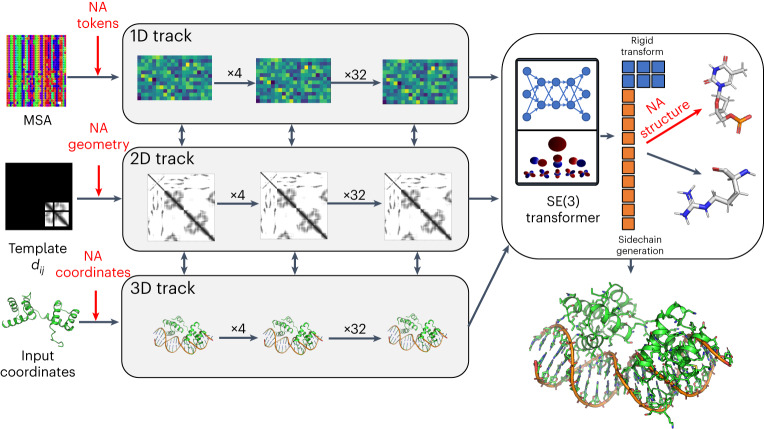
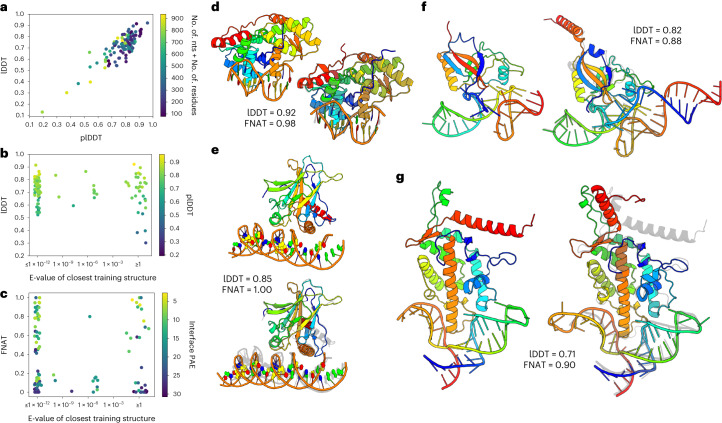
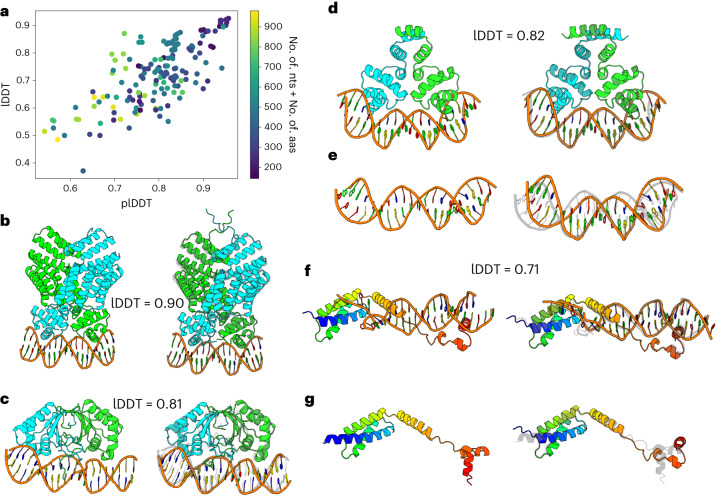
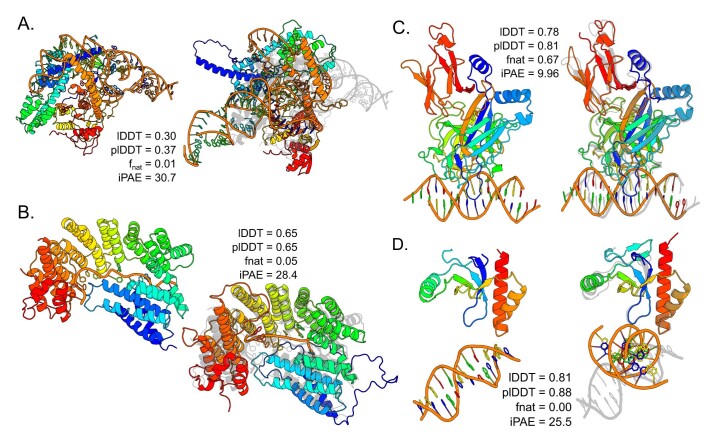
Verification
Claims the paper makes
The claims and statistics of this paper haven’t been checked yet.
Free: it reads the open-access text and checks the first 5 claims that cite a source we can check. Create a free account to check every claim.
Self-check
Percentages, sums and reported differences re-computed from the paper’s own numbers.
The self-check needs the paper’s full text.
Citations
Cites
Gapped BLAST and PSI-BLAST: a new generation of protein database search programs
Altschul, S. (1997) · Nucleic Acids Research · doi:10.1093/nar/25.17.3389 · Cited by 73,302
Highly accurate protein structure prediction with AlphaFold
Jumper, J., Evans, R., Pritzel, A., Green, T., Figurnov, M., Ronneberger, O., Tunyasuvunakool, K., Bates, R., Žídek, A., Potapenko, A., et al. (2021) · Nature · doi:10.1038/s41586-021-03819-2 · Cited by 43,764
Accurate prediction of protein structures and interactions using a 3-track network
Baek, M., DiMaio, F., Anishchenko, I., Dauparas, J., Ovchinnikov, S., Lee, G. R., Wang, J., Cong, Q., Kinch, L. N., Schaeffer, R. D., et al. (2021) · doi:10.1101/2021.06.14.448402 · Cited by 5,549 · cited 2×
“For predicting protein components, machine learning-guided approaches like RoseTTAFold 4 and Alpha-Fold 5 are highly accurate, while RNA structure prediction has used a combination of Monte Carlo sampling approaches 6–9 as well as deep learning methods 10,11 .”
MethodSelf-citationHHblits: lightning-fast iterative protein sequence searching by HMM-HMM alignment
Remmert, M., Biegert, A., Hauser, A., & Söding, J. (2012) · Nature Methods · doi:10.1038/nmeth.1818 · Cited by 2,288
Determination and Inference of Eukaryotic Transcription Factor Sequence Specificity
Weirauch, M. T., Yang, A., Albu, M., Cote, A. G., Montenegro-Montero, A., Drewe, P., Najafabadi, H. S., Lambert, S. A., Mann, I., Cook, K., et al. (2014) · Cell · doi:10.1016/j.cell.2014.08.009 · Cited by 1,785
The Rosetta All-Atom Energy Function for Macromolecular Modeling and Design
Alford, R. F., Leaver-Fay, A., Jeliazkov, J. R., O’Meara, M. J., DiMaio, F. P., Park, H., Shapovalov, M. V., Renfrew, P. D., Mulligan, V. K., Kappel, K., et al. (2017) · Journal of Chemical Theory and Computation · doi:10.1021/acs.jctc.7b00125 · Cited by 1,532
Self-citationHDOCK: a web server for protein–protein and protein–DNA/RNA docking based on a hybrid strategy
Yan, Y., Zhang, D., Zhou, P., Li, B., & Huang, S.-Y. (2017) · Nucleic Acids Research · doi:10.1093/nar/gkx407 · Cited by 1,458
Architecture of the human regulatory network derived from ENCODE data
Gerstein, M. B., Kundaje, A., Hariharan, M., Landt, S. G., Yan, K.-K., Cheng, C., Mu, X. J., Khurana, E., Rozowsky, J., Alexander, R., et al. (2012) · Nature · doi:10.1038/nature11245 · Cited by 1,442
Improved protein structure prediction using predicted interresidue orientations
Yang, J., Anishchenko, I., Park, H., Peng, Z., Ovchinnikov, S., & Baker, D. (2020) · Proceedings of the National Academy of Sciences · doi:10.1073/pnas.1914677117 · Cited by 1,421
Self-citationRfam 14: expanded coverage of metagenomic, viral and microRNA families
Kalvari, I., Nawrocki, E. P., Ontiveros-Palacios, N., Argasinska, J., Lamkiewicz, K., Marz, M., Griffiths-Jones, S., Toffano-Nioche, C., Gautheret, D., Weinberg, Z., et al. (2021) · Nucleic Acids Research · doi:10.1093/nar/gkaa1047 · Cited by 1,045
nhmmer: DNA homology search with profile HMMs
Wheeler, T. J., & Eddy, S. R. (2013) · Bioinformatics · doi:10.1093/bioinformatics/btt403 · Cited by 926
Computed structures of core eukaryotic protein complexes
Humphreys, I. R., Pei, J., Baek, M., Krishnakumar, A., Anishchenko, I., Ovchinnikov, S., Zhang, J., Ness, T. J., Banjade, S., Bagde, S. R., et al. (2021) · Science · doi:10.1126/science.abm4805 · Cited by 542 · cited 2×
“Paired MSAs were generated for complexes with multiple protein chains as described previously 14 .”
BackgroundMethodSelf-citationRNA secondary structure prediction using deep learning with thermodynamic integration
Sato, K., Akiyama, M., & Sakakibara, Y. (2021) · Nature Communications · doi:10.1038/s41467-021-21194-4 · Cited by 468
RNAcentral 2021: secondary structure integration, improved sequence search and new member databases
RNAcentral Consortium, Sweeney, B. A., Petrov, A. I., Ribas, C. E., Finn, R. D., Bateman, A., Szymanski, M., Karlowski, W. M., Seemann, S. E., Gorodkin, J., et al. (2021) · Nucleic Acids Research · doi:10.1093/nar/gkaa921 · Cited by 419
Geometric deep learning of RNA structure
Townshend, R. J. L., Eismann, S., Watkins, A. M., Rangan, R., Karelina, M., Das, R., & Dror, R. O. (2021) · Science · doi:10.1126/science.abe5650 · Cited by 414
Zheng, G., Lu, X.-J., & Olson, W. K. (2009) · Nucleic Acids Research · doi:10.1093/nar/gkp358 · Cited by 310
FARFAR2: Improved De Novo Rosetta Prediction of Complex Global RNA Folds
Watkins, A. M., Rangan, R., & Das, R. (2020) · Structure · doi:10.1016/j.str.2020.05.011 · Cited by 279
Docking, scoring, and affinity prediction in CAPRI
Lensink, M. F., & Wodak, S. J. (2013) · Proteins Structure Function and Bioinformatics · doi:10.1002/prot.24428 · Cited by 249 · cited 1×
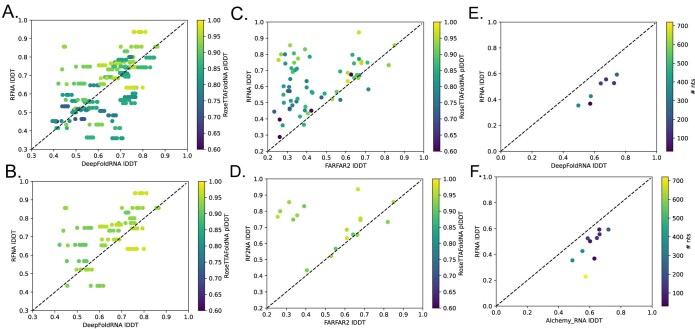
“3 shows the performance of this network compared to the traditional sampling-based FARFAR2 method 4 and the deep learning-based DeepFoldRNA method 15 .”
MethodNPDock: a web server for protein–nucleic acid docking
Tuszynska, I., Magnus, M., Jonak, K., Dawson, W., & Bujnicki, J. M. (2015) · Nucleic Acids Research · doi:10.1093/nar/gkv493 · Cited by 242
Efficient and accurate prediction of protein structure using RoseTTAFold2
Baek, M., Anishchenko, I., Humphreys, I. R., Cong, Q., Baker, D., & DiMaio, F. (2023) · bioRxiv (Cold Spring Harbor Laboratory) · doi:10.1101/2023.05.24.542179 · Cited by 155
Self-citationAssessment of three‐dimensional RNA structure prediction in CASP15
Das, R., Kretsch, R. C., Simpkin, A. J., Mulvaney, T., Pham, P., Rangan, R., Bu, F., Keegan, R. M., Topf, M., Rigden, D. J., et al. (2023) · Proteins: Structure, Function, and Bioinformatics · doi:10.1002/prot.26602 · Cited by 139
Crystal structure of the transfer-RNA domain of transfer-messenger RNA in complex with SmpB
Gutmann, S., Haebel, P., Metzinger, L., Sutter, M., Felden, B., & Ban, N. (2003) · Nature · doi:10.1038/nature01831 · Cited by 138
Grenha, R., Slamti, L., Nicaise, M., Refes, Y., Lereclus, D., & Nessler, S. (2012) · Proceedings of the National Academy of Sciences · doi:10.1073/pnas.1213770110 · Cited by 130
iFoldRNA v2: folding RNA with constraints
Krokhotin, A., Houlihan, K., & Dokholyan, N. V. (2015) · Bioinformatics · doi:10.1093/bioinformatics/btv221 · Cited by 121
An induced fit mechanism regulates p53 DNA binding kinetics to confer sequence specificity
Petty, T. J., Emamzadah, S., Costantino, L., Petkova, I., Stavridi, E. S., Saven, J. G., Vauthey, E., & Halazonetis, T. D. (2011) · The EMBO Journal · doi:10.1038/emboj.2011.127 · Cited by 117
Wang, J., Mao, K.-K., Zhao, Y., Zeng, C., Xiang, J., Zhang, Y., & Xiao, Y. (2017) · Nucleic Acids Research · doi:10.1093/nar/gkx386 · Cited by 117
Structural basis for protein-RNA recognition in telomerase
Huang, J., Brown, A. F., Wu, J., Xue, J., Bley, C. J., Rand, D. P., Wu, L., Zhang, R., Chen, J. J. ‐., & Lei, M. (2014) · Nature Structural & Molecular Biology · doi:10.1038/nsmb.2819 · Cited by 82
The 3D structure of Kaposi sarcoma herpesvirus LANA C-terminal domain bound to DNA
Hellert, J., Weidner-Glunde, M., Krausze, J., Lünsdorf, H., Ritter, C., Schulz, T. F., & Lührs, T. (2015) · Proceedings of the National Academy of Sciences · doi:10.1073/pnas.1421804112 · Cited by 73
Predicting RNA Structure with Vfold
Zhao, C., Xu, X., & Chen, S.-J. (2017) · Methods in Molecular Biology · doi:10.1007/978-1-4939-7231-9_1 · Cited by 50
ParaDock: a flexible non-specific DNA--rigid protein docking algorithm
Banitt, I., & Wolfson, H. J. (2011) · Nucleic Acids Research · doi:10.1093/nar/gkr620 · Cited by 41
MARTINI-Based Protein-DNA Coarse-Grained HADDOCKing
Honorato, R. V., Roel-Touris, J., & Bonvin, A. M. J. J. (2019) · Frontiers in Molecular Biosciences · doi:10.3389/fmolb.2019.00102 · Cited by 36
Assessment of three-dimensional RNA structure prediction in CASP15
(2023) · doi:10.1101/2023.04.25.538330 · Cited by 31
Shevtsov, M. B., Streeter, S. D., Thresh, S.-J., Świderska, A., McGeehan, J. E., & Kneale, G. G. (2015) · Acta Crystallographica Section D Biological Crystallography · doi:10.1107/s139900471402690x · Cited by 14
Šoltysová, M., Sieglová, I., Fábry, M., Brynda, J., Škerlová, J., & Řezáčová, P. (2021) · Acta Crystallographica Section D Structural Biology · doi:10.1107/s2059798321009633 · Cited by 10
Probst, M., Aeschimann, W., Chau, T. T. H., Langenegger, S. M., Stocker, A., & Häner, R. (2016) · Nucleic Acids Research · doi:10.1093/nar/gkw644 · Cited by 8
Cited by
Accurate structure prediction of biomolecular interactions with AlphaFold 3
Abramson, J., Adler, J., Dunger, J., Evans, R., Green, T., Pritzel, A., Ronneberger, O., Willmore, L., Ballard, A. J., Bambrick, J., et al. (2024) · Nature · doi:10.1038/s41586-024-07487-w · Cited by 15,861
De novo design of protein structure and function with RFdiffusion
Watson, J. L., Juergens, D., Bennett, N. R., Trippe, B. L., Yim, J., Eisenach, H. E., Ahern, W., Borst, A. J., Ragotte, R. J., Milles, L. F., et al. (2023) · Nature · doi:10.1038/s41586-023-06415-8 · Cited by 3,506
Self-citationGeneralized biomolecular modeling and design with RoseTTAFold All-Atom
Krishna, R., Wang, J., Ahern, W., Sturmfels, P., Venkatesh, P., Kalvet, I., Lee, G. R., Morey-Burrows, F. S., Anishchenko, I., Humphreys, I. R., et al. (2024) · Science · doi:10.1126/science.adl2528 · Cited by 978
Self-citationChai-1: Decoding the molecular interactions of life
Discovery, C., Boitreaud, J., Dent, J., McPartlon, M., Meier, J., Reis, V., Rogozhnikov, A., & Wu, K. (2024) · doi:10.1101/2024.10.10.615955 · Cited by 517
Ahdritz, G., Bouatta, N., Floristean, C., Kadyan, S., Xia, Q., Gerecke, W., O’Donnell, T. J., Berenberg, D., Fisk, I., Zanichelli, N., et al. (2024) · Nature Methods · doi:10.1038/s41592-024-02272-z · Cited by 439
Metadata
- Authors
- Baek, M., McHugh, R., Anishchenko, I., Jiang, H., Baker, D., & DiMaio, F.
- Affiliations
- Seoul National University (KR)
- University of Washington (US)
- University of California, Berkeley (US)
- Howard Hughes Medical Institute (US)
- Corresponding author
- DiMaio, Frank
- Venue
- Nature Methods
- Published
- 2023-11-23
- Volume
- 21
- Issue
- 1
- Pages
- 117-121
- ISSN
- 1548-7091 (ISSN-L)
- 1548-7105
- PMC
- PMC10776382
- OpenAlex
- W4388946853
- Cited by
- 372
- References
- 35
- Citations by year
- 2026: 108 · 2025: 144 · 2024: 107 · 2023: 12
- FWCI
- 33.06
- Type
- journal article
- Language
- en
- Open access
- hybrid
- doi.org
- Licence
- cc-by
- creativecommons.org/licenses/by/4.0 (tdm)
- creativecommons.org/licenses/by/4.0 (vor)
- Locations
- Nature Methods (publishedVersion, cc-by)
- PubMed Central (publishedVersion, cc-by)
- PubMed (publishedVersion)
- Funders
- U.S. Department of Health & Human Services | NIH | National Institute of General Medical Sciences (GM123089)
- Topics
- Life Sciences › Biochemistry, Genetics and Molecular Biology › Molecular Biology › Protein Structure and Dynamics
- Life Sciences › Biochemistry, Genetics and Molecular Biology › Molecular Biology › RNA and protein synthesis mechanisms
- Life Sciences › Biochemistry, Genetics and Molecular Biology › Molecular Biology › Machine Learning in Bioinformatics
- Keywords
- protein-nucleic acid complexes, protein-RNA complex, protein-DNA complex, RoseTTAFold, structure prediction, confidence estimation, RNA-binding proteins, DNA-binding proteins, protein design
- MeSH terms
- DNA, DNA-Binding Proteins, Nucleic Acids, RNA
About these checks
Registry, retraction, Cites and statistics results are computed, not judged, with one exception: a printed reference that no index lists is read once by a model before it counts as a citation error. Claims are extracted by a model and kept only when their quote appears verbatim in the text; each cited source is then checked, with a model’s help, for whether it says what the claim relies on. Those verdicts can be wrong — read the claim’s quote and the cited source before relying on one.
Statistics and arithmetic are recomputed, not judged.
Confidence bands are shown only for fields calibrated on our annotated test set. None is calibrated yet, so no band is shown.
What counts as a claim ›How we measure confidence ›How we check this ›
Are you an author, or do you see a problem with this page? Request a review
Data sources
Bibliographic data: Semantic Scholar, OpenAlex, Crossref.
Contains information from the Semantic Scholar Academic Graph Datasets, made available under the ODC Attribution License (ODC-BY 1.0).
Semantic Scholar’s data is described in: Kinney, R., et al. (2023). The Semantic Scholar Open Data Platform. arXiv:2301.10140.
