

Atom-level enzyme active site scaffolding using RFdiffusion2
Open accessPublished version of a preprint
The DOI matches its Crossref record; 75 of the 76 references it cites were found in a registry or an index; none of the 30 sources its claims cite is checked for support yet.
Abstract
Designing new enzymes typically begins with idealized arrangements of catalytic functional groups around a reaction transition state, then attempts to generate protein structures that precisely position these groups. Current AI-based methods can create active enzymes but require predefined residue positions and rely on reverse-building residue backbones from side-chain placements, which limits design flexibility. Here we show that a new deep generative model, RoseTTAFold diffusion 2 (RFdiffusion2), overcomes these constraints by designing enzymes directly from functional group geometries without specifying residue order or performing inverse rotamer generation. RFdiffusion2 successfully generates scaffolds for all 41 active sites in a diverse benchmark, compared to 16 using previous methods. We further design enzymes for three distinct catalytic mechanisms and identify active candidates after experimentally testing fewer than 96 sequences in each case. These results highlight the potential of atomic-level generative modeling to create de novo enzymes directly from reaction mechanisms.
Overview
CoChat Summary
TL;DR
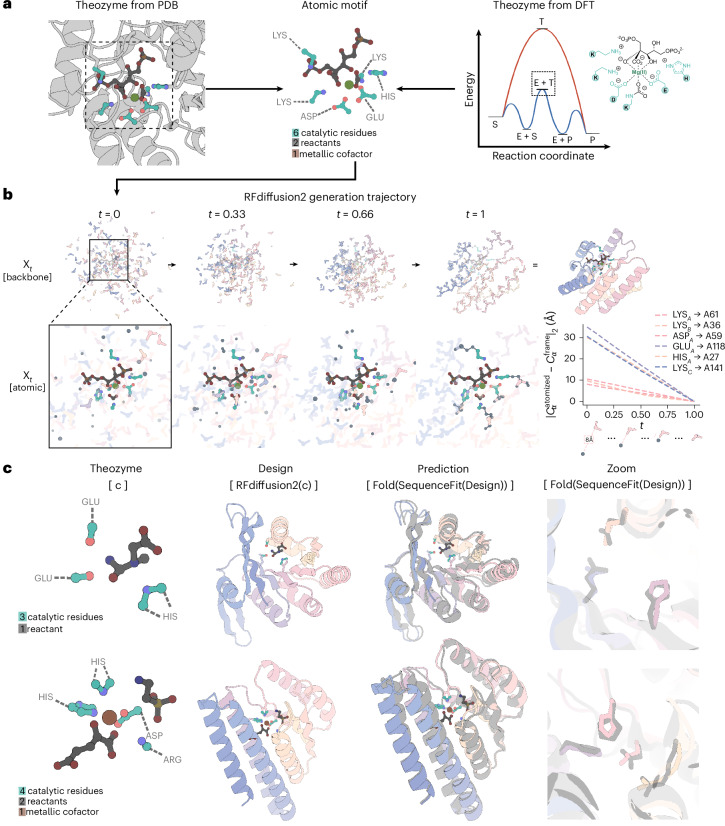
RFdiffusion2 is a flow-matching generative model that scaffolds atom-level enzyme active sites directly from theozyme functional-group geometries without prespecified residue indices or inverse rotamer sampling. It solved all 41 AME benchmark cases versus 16 for RFdiffusion and yielded experimentally active designed enzymes for multiple reactions after screening fewer than 96 sequences per case.
Key findings
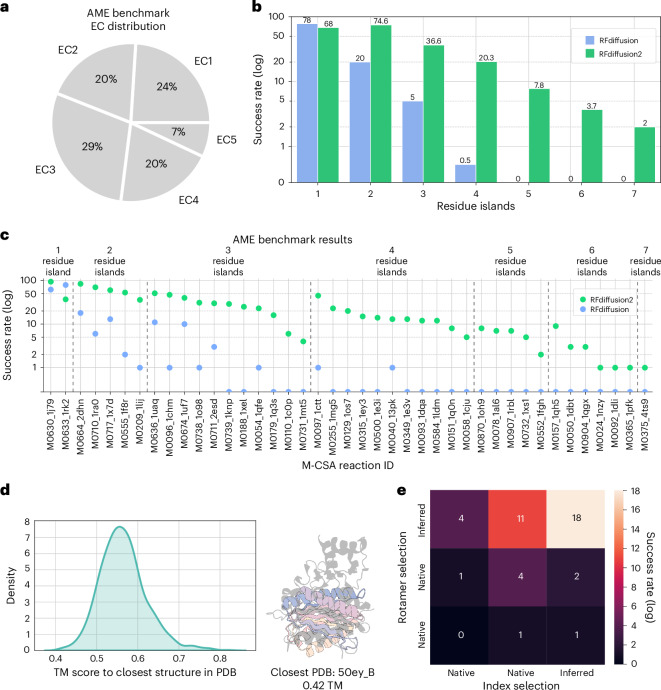
- On the new AME benchmark of 41 active sites spanning EC classes 1–5, RFdiffusion2 found at least one in silico success for 41/41 cases, compared with 16/41 for RFdiffusion, and outperformed RFdiffusion on 40/41 cases.
- Inferring both rotamer and sequence index gave the best performance; naive inverse rotamer and index sampling failed at four residue islands, achieving no in silico successes.
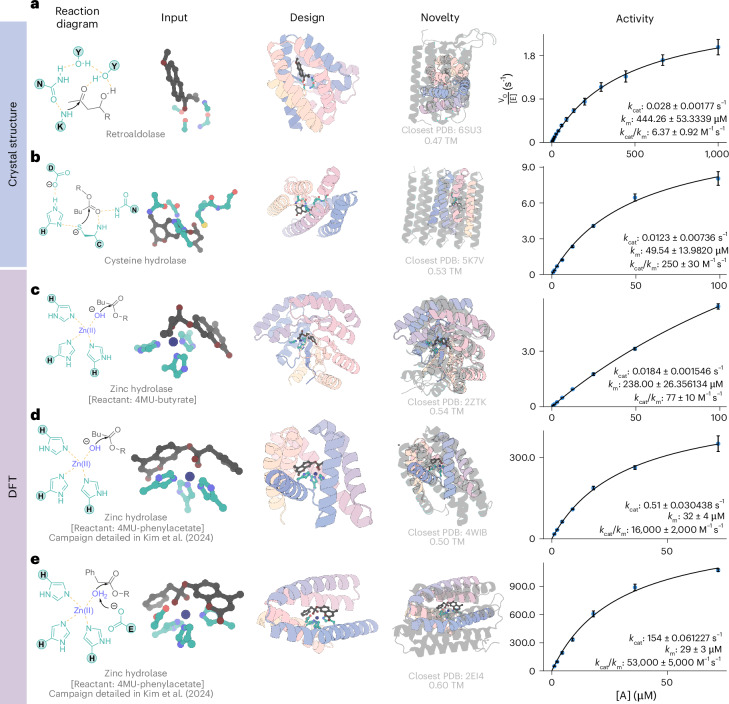
- Experimental campaigns found active enzymes while testing fewer than 96 designs per case: a retroaldolase with kcat/KM = 6.34 ± 0.92 M−1s−1, a cysteine hydrolase with kcat/KM = 248 ± 34 M−1s−1, and zinc hydrolases with kcat/KM = 77 ± 10, 16,000 ± 2,000, and 53,000 ± 5,000 M−1s−1.
- Successful designs were structurally novel: most successful in silico designs had closest-PDB TM scores between 0.5 and 0.6, with representative experimental designs showing TM scores of 0.47–0.60 to their closest PDB structures.
Methods
- RFdiffusion2 extends the RoseTTAFold All-Atom architecture with atomic and unindexed motif conditioning and is trained with a flow-matching objective on PDB biomolecular structures, including protein–small-molecule, protein–metal, and covalently modified protein complexes; training used 24 A100 Nvidia GPUs for 17 days.
- The AME benchmark was curated from M-CSA active sites cross-referenced with PARITY, yielding 41 cases; for each case, 100 backbones were generated, eight sequences were assigned with LigandMPNN, and structures were refolded with Chai-1, with in silico success defined as catalytic-residue heavy-atom RMSD <1.5 Å for at least one sequence and no ligand clashes within 1.5 Å.
- Experimental designs used input theozymes from native crystal structures or DFT-computed transition-state geometries, followed by RFdiffusion2 scaffolding, LigandMPNN sequence assignment, structure-prediction filtering, and Michaelis–Menten kinetics after testing fewer than 96 designs per case.
Limitations
- The paper states that RFdiffusion2-designed enzymes are not as active as native enzymes, that theozymes may not capture all interactions needed for high activity, and that the AME benchmark is limited to PDB motifs derived from native M-CSA annotations and does not measure enzymes with multiple transition states.
- Evident from the text: in silico success is a structural criterion (catalytic heavy-atom RMSD and clash filters), and the paper notes that scaffolding these atoms does not necessarily generate catalytically proficient enzymes; experimental validation covers only a small number of reactions/cases.
Model-written summary. Check it against the paper before relying on it.
Integrity signals
Registry
Cites
Statistics
Figures
Verification
Claims the paper makes
0 Valid · 0 Not valid · 14 Not checked · 57 Own results and interpretations
A result the paper reports from its own data — it cites no other source for it, so there is none to check. The quote shows it is in the paper.
In the paper
“We find the difficulty of a benchmark case correlates with the complexity of the motif, which we quantify with the number of ‘residue islands’, the number of contiguous segments of catalytic residues in the original PDB structure.”
§ Atom-level enzyme active site scaffolding using RFdiffusion2 > Results > AME benchmark
plainstates an associationn = 41- Asserted: passes — The authors put it forward as true.
- Checkable: passes — It can be checked against evidence.
- Load-bearing: unclear — It is unclear whether the paper’s conclusions depend on it.
- Based: passes — The paper gives a reason why it holds.
A result the paper reports from its own data — it cites no other source for it, so there is none to check. The quote shows it is in the paper.
In the paper
“RFdiffusion2 outperforms the prior state of the art methods on in silico benchmarks”
§ Atom-level enzyme active site scaffolding using RFdiffusion2 > Discussion
plainstates a cause- Asserted: passes — The authors put it forward as true.
- Checkable: passes — It can be checked against evidence.
- Load-bearing: passes — The paper’s conclusions depend on it.
- Based: passes — The paper gives a reason why it holds.
In the paper
“We tested activity of the in vitro transcription/translation-produced proteins using racemic Methodol as a substrate and found four variants that show detectable levels of retroaldolase activity in our semiquantitative assay40.”
§ Atom-level enzyme active site scaffolding using RFdiffusion2 > Results > In vitro experiments
What the sources say
- Not checked yetcites [40] Anishchenko, I. et al. Modeling protein-small molecule conformational ensembles with PLACER. Proc. Natl Acad. Sci.USA 122, e2427161122 (2025). 41187076 PMC12625923 source
plain- Asserted: passes — The authors put it forward as true.
- Checkable: passes — It can be checked against evidence.
- Load-bearing: passes — The paper’s conclusions depend on it.
- Based: passes — The paper gives a reason why it holds.
None of the sources cited for this claim have been checked yet.
In the paper
“higher than previously designed zinc hydrolases50,51.”
§ Atom-level enzyme active site scaffolding using RFdiffusion2 > Results > In vitro experiments
What the sources say
- Not checked yetcites [50] Hoffnagle, A. M. & Tezcan, F. A. Atomically accurate design of metalloproteins with predefined coordination geometries. J. Am. Chem. Soc. 145, 14208–14214 (2023). 37352018 PMC10439731 source
- Not checked yetcites [51] Der, B. S. et al. Metal-mediated affinity and orientation specificity in a computationally designed protein homodimer. J. Am. Chem. Soc. 134, 375–385 (2012). 22092237 PMC3257401 source
plain- Asserted: passes — The authors put it forward as true.
- Checkable: passes — It can be checked against evidence.
- Load-bearing: passes — The paper’s conclusions depend on it.
- Based: passes — The paper gives a reason why it holds.
A result the paper reports from its own data — it cites no other source for it, so there is none to check. The quote shows it is in the paper.
In the paper
“the best design shown exhibited multiple turnover activity with a kcat/KM of 248 ± 34 M−1s−1 for the acylation step”
§ Atom-level enzyme active site scaffolding using RFdiffusion2 > Results > In vitro experiments
plainSingle case- Asserted: passes — The authors put it forward as true.
- Checkable: passes — It can be checked against evidence.
- Load-bearing: passes — The paper’s conclusions depend on it.
- Based: passes — The paper gives a reason why it holds.
37 more claims
Create a free account to see all 71 claims and to verify the 30 references still open.
- It may state two separate claims as one. 22
- The quote only partly states this claim. 5
- Probably not a substantial claim. 3
Self-check
Percentages, sums and reported differences re-computed from the paper’s own numbers.
Each contradiction between two passages listed here was confirmed by an independent check.
Rated minor: it would not touch a result — a value no result rests on, a p-value that stays on the same side of the significance level, or a conflict that is clerical, resolved elsewhere in the paper, or outside its own findings.
In the paper
§ Atom-level enzyme active site scaffolding using RFdiffusion2 > Atomic motif conditioning
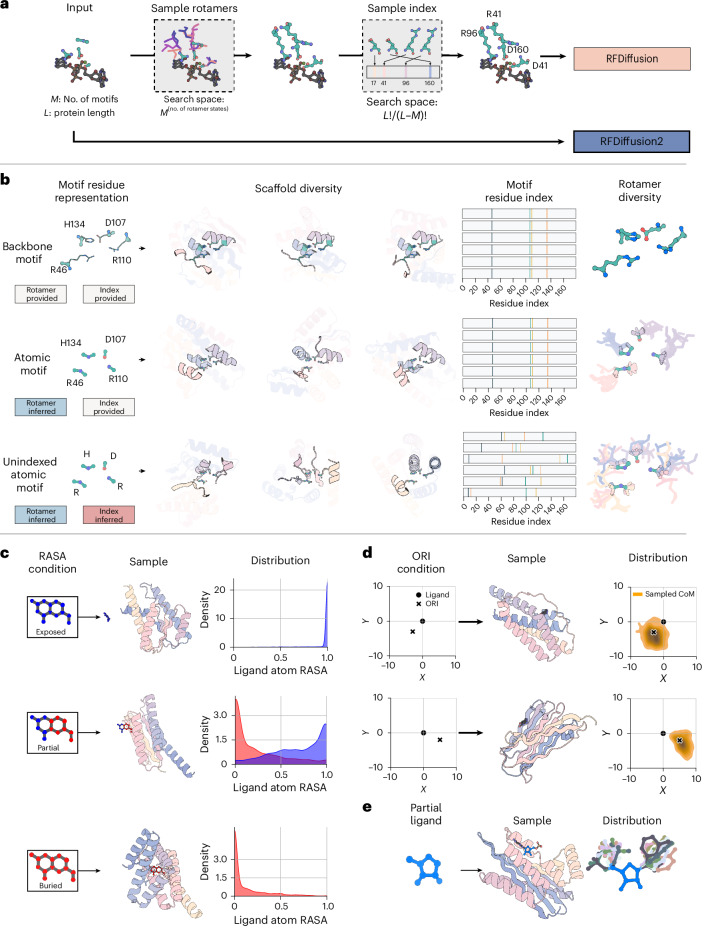
“We find RFdiffusion2 can, given partial ligand coordinates, sample physically realistic conformers for the entire ligand (Fig. 2d)”
§ Atom-level enzyme active site scaffolding using RFdiffusion2 > Atomic motif conditioning
“e, RFdiffusion2 can be provided with partial ligand input in which case it must sample the remaining ligand degrees of freedom while generating the protein.”
Citations
Cites
Adam: A Method for Stochastic Optimization
Kingma, D. P., & Ba, J. (2014) · arXiv · doi:10.48550/arxiv.1412.6980 · Cited by 98,946
Highly accurate protein structure prediction with AlphaFold
Jumper, J., Evans, R., Pritzel, A., Green, T., Figurnov, M., Ronneberger, O., Tunyasuvunakool, K., Bates, R., Žídek, A., Potapenko, A., et al. (2021) · Nature · doi:10.1038/s41586-021-03819-2 · Cited by 43,764 · cited 1×
“Directed evolution campaigns have demonstrated that a catalytic tetrad composed of a nucleophilic lysine enmeshed in a hydrogen-bonding network with two tyrosines and an asparagine can stabilize the transition states of this reaction [38].”
Berman, H. M. (2000) · Nucleic Acids Research · doi:10.1093/nar/28.1.235 · Cited by 40,196 · cited 1×
“Our training dataset consists of biomolecular structures from the Protein Data Bank (PDB) [27] that include proteins, protein–small molecule complexes, protein-metal complexes, and covalently modified proteins, filtering out common solvents and crystallization additives [19].”
Effect of the damping function in dispersion corrected density functional theory
Grimme, S., Ehrlich, S., & Goerigk, L. (2011) · Journal of Computational Chemistry · doi:10.1002/jcc.21759 · Cited by 28,221
Accurate structure prediction of biomolecular interactions with AlphaFold 3
Abramson, J., Adler, J., Dunger, J., Evans, R., Green, T., Pritzel, A., Ronneberger, O., Willmore, L., Ballard, A. J., Bambrick, J., et al. (2024) · Nature · doi:10.1038/s41586-024-07487-w · Cited by 15,861 · cited 2×
“Alternative neural network architectures such as Diffusion Transformers [51] and modules from AlphaFold3 [34] for all-atom tasks could improve RFdiffusion2 which uses the neural network architecture of RFAA.”
Denoising Diffusion Probabilistic Models
Ho, J., Jain, A., & Abbeel, P. (2020) · arXiv · doi:10.48550/arxiv.2006.11239 · Cited by 8,712
Evolutionary-scale prediction of atomic level protein structure with a language model
Lin, Z., Akin, H., Rao, R., Hie, B., Zhu, Z., Lu, W., Smetanin, N., Verkuil, R., Kabeli, O., Shmueli, Y., et al. (2022) · doi:10.1101/2022.07.20.500902 · Cited by 5,990
Protein production by auto-induction in high-density shaking cultures
Studier, F. W. (2005) · Protein Expression and Purification · doi:10.1016/j.pep.2005.01.016 · Cited by 5,931
Score-Based Generative Modeling through Stochastic Differential Equations
Song, Y. S., Sohl‐Dickstein, J., Kingma, D. P., Kumar, A., Ermon, S., & Poole, B. (2021) · International Conference on Learning Representations · Cited by 4,981
De novo design of protein structure and function with RFdiffusion
Watson, J. L., Juergens, D., Bennett, N. R., Trippe, B. L., Yim, J., Eisenach, H. E., Ahern, W., Borst, A. J., Ragotte, R. J., Milles, L. F., et al. (2023) · Nature · doi:10.1038/s41586-023-06415-8 · Cited by 3,506
Self-citation
Research works printed but not linked: 1
- Chen, R. T. & Lipman, Y. Flow matching on general geometries. In International Conference on Learning Representations (2024).
Cited by
Items 101–200 of 229
StruCloze: A Unified Framework for Backmapping and Inpainting Biomolecule Structures
Zhu, J., Fan, Z., Li, Z., Zheng, Z., Lindorff‐Larsen, K., & Chen, H. (2026) · Journal of Chemical Theory and Computation · doi:10.1021/acs.jctc.6c00214 · Cited by 2
A Generative Foundation Model for Cryo-EM DensitiesPreprint
Li, Y., Yuan, J., Zhou, Y., Wang, Z., Chen, S. C., Yang, F., Ling, H., Kovalsky, S. Z., Zheng, X., & Gu, Q. (2025) · bioRxiv (Cold Spring Harbor Laboratory) · doi:10.64898/2025.12.29.696802 · Cited by 2
Designing Protein Structures from Natural LanguagePreprint
Lee, J., Li, Y., Qiang, B., Lau, G., Ettinger, A., Smith, N. A., Donovan-Maiye, R., Baker, D., Hajishirzi, H., & Koh, P. W. (2026) · arXiv · doi:10.48550/arxiv.2610.13917 · Cited by 2
Self-citationBiomolecular design through latent reasoning with RFD4-ProteinaPreprint
Corley, N., Didi, K., Kazman, M. W., Brent, R. I., Bauer, M. S., Biswas, R., Bonzanini, J. E., Chazin-Gray, A. M., Chen, J., Favor, A., et al. (2026) · bioRxiv (Cold Spring Harbor Laboratory) · doi:10.64898/2026.11.12.766037 · Cited by 2
“Recent work has shown that such design is possible through precise scaffolding of catalytic active sites [2, 50–58].”
Self-citationKell, D. B., & Roberts, I. (2026) · Chemical Society Reviews · doi:10.1039/d5cs01387a · Cited by 1
Huang, Y. S., Ge, R., Wu, L., Sun, Y., Wang, Z., & Cao, M. (2026) · ACS Synthetic Biology · doi:10.1021/acssynbio.6c00199 · Cited by 1
Li, Y., Su, Y., Jing, Y., & Liu, T. (2025) · bioRxiv (Cold Spring Harbor Laboratory) · doi:10.64898/2025.12.23.696242 · Cited by 1
“Specialized generative models like RFdiffusion1, 2 and 3 construct backbones in a latent space, relying on external inverse folding tools like ProteinMPNN 6 or LigandMPNN 7 to fill or refill in sequences 8–10 .”
Zhu, Z., & Song, C. (2026) · Journal of Chemical Information and Modeling · doi:10.1021/acs.jcim.6c00617 · Cited by 1
Yoon, H., Han, R., Kim, J.-W., & Lee, Y. (2026) · Briefings in Bioinformatics · doi:10.1093/bib/bbag421 · Cited by 1
“More specialized extensions target functional precision: RFdiffusion2 [ 128] scaffolds enzyme active sites by placing catalytic residues without requiring their sequence positions to be specified in advance, addressing a long-standing bottleneck in de novo enzyme design.”
Li, W., Cadet, X. F., Medina-Ortiz, D., Davari, M. D., Sowdhamini, R., Bessafi, M., Damour, C., Li, Y., Miranville, A., de Brevern, A. G., et al. (2026) · International Journal of Molecular Sciences · doi:10.3390/ijms27167151 · Cited by 1
“RFdiffusion2 extends this strategy by accepting atom − level descriptions of functional sites, rendering it particularly suitable for active − site scaffolding, in which the precise reproduction of catalytic atoms or ligand − contact geometries is paramount [31].”
Co-designing sequence and structure of functional de novo enzymes with EnzyGen2Preprint
Song, Z., Liu, H., Zhao, Y., Yang, Y., & Li, L. (2026) · bioRxiv (Cold Spring Harbor Laboratory) · doi:10.64898/2026.03.02.709205 · Cited by 1
“…root-mean-square deviation (RMSD) 2Å), EnzyGen2 consistently outperforms strong, established baselines such as In-2 painting [33], RFdiffusion/ProteinMPNN [23, 29], RFdiffusion2/LigandMPNN [6, 44], and RFdiffu-sion3/LigandMPNN [6, 45], while it generates samples 400 × faster than prior methods.”
Computational design of microbial cell factories for sustainable biomanufacturing
Liu, L., Li, C., & Li, F. (2026) · Green Energy & Environment · doi:10.1016/j.gee.2026.07.001 · Cited by 1
Andris, E., Kormaník, J. M., Kalvoda, T., Řezáč, J., & Rulíšek, L. (2026) · Journal of Chemical Information and Modeling · doi:10.1021/acs.jcim.5c02330 · Cited by 1
Ahsan, W. (2026) · Catalysts · doi:10.3390/catal16070598 · Cited by 1
“These include variational autoencoders (VAEs), generative adversarial networks (GANs), and diffusion-based models such as RFdiffu-sion, which are increasingly used to explore unexplored regions of the protein sequence space [52–55].”
Precision gene editing: From proof-of-concept to curative therapies
Cui, T., Li, B., Cai, B., Wang, H., & Li, W. (2026) · Trends in Molecular Medicine · doi:10.1016/j.molmed.2026.06.004 · Cited by 1
Han, Y., Ding, H., & Cui, X. (2026) · Food Bioscience · doi:10.1016/j.fbio.2026.109664 · Cited by 1
Using generative AI to transform peptide hits into small molecule leads
Mills, J., & Lau, Y. H. (2026) · Beilstein Journal of Organic Chemistry · doi:10.3762/bjoc.22.51 · Cited by 1
An Energy Landscape Approach to Miniaturizing Enzymes using Protein Language Model EmbeddingsPreprint
Lála, J., Agrawal, H., Dong, F., Wells, J., & Angioletti‐Uberti, S. (2026) · bioRxiv (Cold Spring Harbor Laboratory) · doi:10.64898/2026.03.04.709378 · Cited by 1
Wang, H., Hua, T., Wang, M., Meng, B., Zhang, Y., Jiang, C., Gao, Y., Yang, H., & Bo, J. (2026) · Advanced Science · doi:10.1002/advs.76202 · Cited by 1
Design-Evolution Synergy Enables New-to-Nature Enzyme ChemistryPreprint
Li, Z., Zhang, R. K., Xie, P., Kelly, J., Zhang, Y., Qin, Z., Lambert, T., Mukhopadhyay, O., Hanley, D., Danson, A. E., et al. (2026) · bioRxiv (Cold Spring Harbor Laboratory) · doi:10.64898/2026.10.01.754751 · Cited by 1
Modular Input–Output Biosensor Design Using De Novo Protein Switches
Wang, J., Chen, J. Y.-H., Xi, C., Arteage-Organiz, E., & Yeh, A. H.-W. (2026) · ACS Sensors · doi:10.1021/acssensors.6c00882 · Cited by 1
“Looking ahead, we anticipate that de novo/AI-guided computational protein design 51–56 will continue to accelerate the generation of first-pass biosensor prototypes with desirable target specificity and flexible output compatibility.”
Leveraging Auxiliary Potentials in RFDiffusion for the Design of NA-Binding Proteins
Geraseva, E., Bokov, G. V., Polovnikov, V., & Golovin, A. V. (2026) · Journal of Chemical Information and Modeling · doi:10.1021/acs.jcim.6c00109 · Cited by 1
Programming N-linked glycan composition through de novo protein designPreprint
Lunn-Halbert, M. C., Allen, J. D., Krishna, R., Анна, М., Li, X., Lopatto, E. D. B., Pinkner, J. S., Möller, C., Ahern, W., Mendoza, J., et al. (2026) · bioRxiv (Cold Spring Harbor Laboratory) · doi:10.64898/2026.10.07.757460 · Cited by 1
“Such studies, combined with continued improvements in all-atom design and prediction methods, should enable increasingly fine control over site-specific glycan composition 42,50 .”
InfluentialSelf-citationProgrammable biodegradation: Lipase-driven microplastic degradation via AI and omics
Majumder, D., Dutta, A., Lahiri, D., & Nag, M. (2026) · Preparative Biochemistry & Biotechnology · doi:10.1080/10826068.2026.2720085 · Cited by 1
Learning protein function through autonomous experimental interactionPreprint
Brooks, C., Notin, P., & Romero, P. A. (2026) · bioRxiv (Cold Spring Harbor Laboratory) · doi:10.64898/2026.08.14.744985 · Cited by 1
Lear, A., Bunzel, H. A., & Mulholland, A. J. (2026) · bioRxiv (Cold Spring Harbor Laboratory) · doi:10.64898/2026.09.09.750330 · Cited by 1
“8, 52, 53 While state-of-the-art state-of-the-art pipelines typically”
RFOptimization: Guiding Design Optimization with All-Atom Structure PredictionPreprint
Zhang, O., Wang, J., Thompson, T. R., You, Z., Song, Z., DiMaio, F., & Baker, D. A. (2026) · bioRxiv (Cold Spring Harbor Laboratory) · doi:10.64898/2026.09.04.749184 · Cited by 1
“Prior work such as RFdiffusion2[3] has enabled scaffolding of catalytic motifs by jointly diffusing backbone frames and catalytic residue atoms, but performance degrades sharply on motifs split across many residue islands[14].”
Self-citationDe novo design of protease-activatable cytokine prodrugsPreprint
Shin, H., Tello, J. G., Kim, C. J., Chun, J.-H., Peprah, F., Parent, B. D., Atajanova, T., Mahmud, R. A. I., Qiang, L., Aguirre, A. J., et al. (2026) · bioRxiv (Cold Spring Harbor Laboratory) · doi:10.64898/2026.09.19.752834 · Cited by 1
Self-citationDe Novo Design of Catalytically Active Salen-Binding Proteins
Bakanas, I. J., Horst, M., Ouchida, S., Jung, S., Šimunić, L., Lombardi, A., & DeGrado, W. F. (2026) · Journal of the American Chemical Society · doi:10.1021/jacs.6c08768 · Cited by 1
Liu, G., He, M., Sun, L., 成福仙, & Zhang, Y. (2026) · bioRxiv (Cold Spring Harbor Laboratory) · doi:10.64898/2026.04.21.719907 · Cited by 1
PartiDesign: A structure-sequence co-design paradigm for practical all-to-all biomolecules designPreprint
Jin, Z., Zhang, X., Kang, Y., & Hou, T. (2026) · bioRxiv (Cold Spring Harbor Laboratory) · doi:10.64898/2026.11.03.763860 · Cited by 1
Advances in the application of artificial intelligencein protein design
Liu, S., Zhang, R., & Li, J. (2026) · Chinese Science Bulletin (Chinese Version) · doi:10.1360/csb-2026-0591 · Cited by 1
Emyx: Fast and efficient all-atom protein generationPreprint
Williams, N. H., Haddadin, W., Ferla, M. P., Schneider, C., Woodall, N. B., Sedgwick, R., Madsen, C. D., Hopkins, A. L., Pires, D. E. V., & Pyzer‐Knapp, E. O. (2026) · arXiv · doi:10.48550/arxiv.2606.19377 · Cited by 1
“More recent models [8, 12, 13] overcome this by using unindexed motif scaffolding, allowing the model to select motif indices along the chain, thus substantially improving success rates.”
InfluentialChain of Structures: Connecting Reasoning and Generation for Protein DesignPreprint
Cai, Q., Xu, M., Yan, J., Wang, Z., Liu, Y., Pei, Q., & Zhang, Z. (2026) · bioRxiv (Cold Spring Harbor Laboratory) · doi:10.64898/2026.10.09.758133 · Cited by 1
Design and preparation of artificial heme-copper enzymes
Heidari, H., Phan, D. T., Lawson, D., & Lu, Y. (2025) · Methods in enzymology on CD-ROM/Methods in enzymology · doi:10.1016/bs.mie.2025.08.004 · Cited by 1
Full-atom neural network design of thermostable biocatalysts
Geronimo, B. D., Zuson, J., Udženija, A., Miles, U. Z., Leitner, T., Chánique, A. M., McManus, C. T., Iyer, S., Teijeiro-Juiz, R., Winkler, A., et al. (2026) · Chem Catalysis · doi:10.64898/2026.04.20.719482 · Cited by 1
Deep learning based design of buried hydrogen bond networks with HBDesignerPreprint
Dieckhaus, H., Harvey, B. T., Mulikova, T., Horenstein, J. T., Nicely, N. I., Randolph, N. Z., & Kuhlman, B. A. (2026) · bioRxiv (Cold Spring Harbor Laboratory) · doi:10.64898/2026.06.08.730848 · Cited by 1
Protenix-Mini+: efficient structure prediction model with scalable pairformerPreprint
Qiang, B., Gong, C., Chen, X., Zhang, Y., & Xiao, W. (2025) · arXiv · doi:10.48550/arxiv.2510.12842 · Cited by 1
“Yet, questions remain around efficiency and generalizing to unseen biomolecules, especially for screening of de novo designed protein [2, 30, 38].”
Trion-1: Unifying Language, Protein Sequence, and Structure with Diffusion Language ModelsPreprint
Lu, T., Yang, K., Feng, J., Qiu, K., Ouyang, Y., Wu, Y., Zhang, X., Wang, L., Ma, W.-Y., & Zhou, H. (2026) · arXiv · doi:10.48550/arxiv.2610.31215 · Cited by 1
Learning the limits of protein structure models with NMR chemical shiftsPreprint
Zhao, C., Nesr, G. E., Chen, Y., & Wayment-Steele, H. K. (2026) · bioRxiv (Cold Spring Harbor Laboratory) · doi:10.64898/2026.11.12.766294 · Cited by 1
ProteinSketch translates spatial intuition into protein design with bimanual interaction in VRPreprint
Ma, D., Lee, J., Lee, H. C., Lee, S.-H., Oh, Y. G., Kim, Y.-E., Jin, T., Sutthiwanna, S., Lee, S.-J., Jeon, W., et al. (2026) · bioRxiv (Cold Spring Harbor Laboratory) · doi:10.64898/2026.07.19.739460 · Cited by 1
Templating and confining calcium phosphate mineralization within designed protein assembliesPreprint
Yu, L. T., Li, X., Pyles, H., Patni, A. P., Borst, A. J., Bethel, N. P., Kwon, P. S., Weidle, C., Kibler, R. D., Carr, K. D., et al. (2026) · bioRxiv (Cold Spring Harbor Laboratory) · doi:10.64898/2026.01.14.699524 · Cited by 1
“Recent advances in deep learning based protein design methods such as RFdiffusion( 19 – 21 ), and ProteinMPNN and related methods ( 22 , 23 ) now allow the creation of proteins with precisely defined shapes and side-chain chemistries ( 24 – 29 ).”
Self-citationProgrammable amide bond formation using de novo ligasesPreprint
Salike, S., Flügel, T., Gantz, M., Moroz, S. S., Hunt, A. C., Jones, H., Singh, A., Corley, N., Didi, K., Brent, R. I., et al. (2026) · bioRxiv (Cold Spring Harbor Laboratory) · doi:10.64898/2026.11.08.765178 · Cited by 1
“We used RFDiffusion2 (RFD2) 12 to generate protein backbones scaffolding this site, and selected designs in which both substrates occupied buried binding pockets (Supplementary Methods).”
InfluentialSelf-citationCrystal structure of the first de novo designed phosphotriesterase ZAPP-1Preprint
Woodbury, S. M., Kim, D., Mendoza, J., Kang, A., Nguyen, H., Bera, A. K., & Baker, D. A. (2026) · bioRxiv (Cold Spring Harbor Laboratory) · doi:10.64898/2026.11.17.767279 · Cited by 1
“Building on our recent advances in atomic active site scaffolding and metallohydrolase design [2–4], we used RFdiffusion3 to design de novo phosphotriesterases, enzymes that hydrolyze neurotoxic organophosphates with broad applications in environmental decontamination and medical counter-measures [1].”
Self-citationComputational Redesign of an Antifreeze Protein Using Deep LearningPreprint
Calia, C. N., Altunc, A. J., Eufemio, R. J., Alvarado, B. O., Huynh, J. D., Oh, E., Burkart, M. D., Meister, K., & Paesani, F. (2026) · bioRxiv (Cold Spring Harbor Laboratory) · doi:10.64898/2026.06.21.733612
Li, Y., Zhao, Y., Zhou, L., Huang, C., Xu, Q., Chen, Y., Zheng, Q., Fan, K., Yang, J., & Cao, D. (2026) · bioRxiv (Cold Spring Harbor Laboratory) · doi:10.64898/2026.08.26.747172
PhytoNB: AI-enabled Nanobody Design in Plants
Wu, T., Wang, Z., Zhao, A., Xia, F., Lou, Y., Yin, C., Xu, Y., Zhang, J., Wang, X., & CHENG, Q. (2026) · Maize Sciences · doi:10.2738/ms.2026.0004
Coluzza, I. (2026) · Elsevier eBooks · doi:10.1016/b978-0-323-99507-8.00090-1
Hu, R.-E., & Ng, I. (2026) · Chemical Engineering Journal · doi:10.1016/j.cej.2026.180351
CatESO: Differentiable Enzyme Sequence Optimization Guided by Substrate-Aware K cat Prediction
Gan, Z., Xu, Y., Xu, J., Wu, Z., Huang, J., Yin, J., Chen, G., & Zhang, J. Z. H. (2026) · Journal of the American Chemical Society · doi:10.1021/jacs.6c14365
Synzymes 2.0: Engineering catalytic function with artificial intelligence and advanced materials
Mohammad, S. F., Ali, F., & Shynara, M. (2026) · Biocatalysis and Biotransformation · doi:10.1080/10242422.2026.2688362
Machine learning approaches in protein-protein and protein-drug binding
Schlichthaerle, T. (2026) · Elsevier eBooks · doi:10.1016/b978-0-323-99507-8.00061-5
Recent advances in AI-driven biotherapeutic discovery using protein generative models
Kim, H., Lee, H., Song, J., & Lee, J. (2026) · Digital Discovery · doi:10.1039/d6dd00222f
Function-guided design of active enzymesPreprint
Hu, M., Wu, L., Yang, Y., Li, F., & Zhu, L. (2026) · bioRxiv (Cold Spring Harbor Laboratory) · doi:10.64898/2026.06.27.735025
LocAlign: Local Protein Structural Alignment with Geometric Deep LearningPreprint
Ravid, H., Tubiana, J., & Wolfson, H. J. (2026) · bioRxiv (Cold Spring Harbor Laboratory) · doi:10.64898/2026.01.24.701262
“For instance, when aligning two catalytic triads of serine proteases (say, of Subtilisin and Trypsin), the side chains atoms of the catalytic residues would be closely aligned whereas the backbone atoms may not be [Ahern et al., 2025].”
Deep-learning-based design of an orthogonal self-labeling protein from K-Ras(G12C)Preprint
Mou, J., Leong, W., Gao, S., Slaw, K., McGill, M., Donovan, K. A., Metivier, R. J., Sendker, F. L., Kong, Q., Lin, D., et al. (2026) · bioRxiv (Cold Spring Harbor Laboratory) · doi:10.64898/2026.09.27.754867
Generative design of programmable asymmetric β-barrel nanoporesPreprint
Philomin, A., Sonigra, R., Majumder, S., Lin, H.-J., Li, Y., Xue, F., Kibler, R. D., Baldus, C. K., Trapido, E., Medeiros, A., et al. (2026) · bioRxiv (Cold Spring Harbor Laboratory) · doi:10.64898/2026.06.04.729630
“RFDiffusion2 23 (RFD2) is able to scaffold atom-level sites and handle ligands while retaining most features of RFDiffusion 24 .”
Self-citationVoid-X: A generative void-filling model for predicting atomic packing in proteins
Yang, J., Yuan, J., & Chou, J. J. (2026) · Proceedings of the National Academy of Sciences · doi:10.1073/pnas.2607035123
Tuly, J. A., Zeng, Z., Tian, Y., Zhu, S., Mahmud, S. M. H., Yun, J., Zhang, G., Zhang, Y., Zabed, H. M., Li, J., et al. (2026) · Green Carbon · doi:10.1016/j.greenca.2026.05.006
Flagellar pocket receptors as entry point for protein-based drugs against kinetoplastid parasites
Attala, L., Vernetti, C., & Araya, E. R. (2026) · Exploration of Drug Science · doi:10.37349/eds.2026.1008179
Prospecting the protein design landscape
Riccabona, J. R., Stonig, K. T., Meiler, J., Schoeder, C. T., & Fernández‐Quintero, M. L. (2026) · FEBS Letters · doi:10.1002/1873-3468.70459
Machine Learning Empowers Enzyme Discovery, Structure Prediction, Engineering, and Design
王木强, Jiang, L., Yu, H., Yu, J., Zheng, W., & Wu, J. (2026) · ACS Catalysis · doi:10.1021/acscatal.6c07060
Liu, Q., Hu, Z., Ouyang, B., Zhao, W., Zhao, J., Hong, M., Zhao, X., & Wei, D. (2026) · Renewable and Sustainable Energy Reviews · doi:10.1016/j.rser.2026.117193
Advances in de novo protein design for anti-infective applications
Yin, J., 顾子春, Sun, Y., & Tao, L. (2026) · Chinese Science Bulletin (Chinese Version) · doi:10.1360/csb-2026-0714
Generative Modeling of Entangled Polymers with a Distance-Based Variational Autoencoder
Chiarantoni, P., Serra, O., Mowlaei, M. E., Choutipalli, V. S. K., DelloStritto, M. J., Shi, X. M., Klein, M. L., & Carnevale, V. (2026) · Journal of Chemical Theory and Computation · doi:10.1021/acs.jctc.5c01953
Nelson, S. E., Martinusen, S. G., Pho, R., Long, L. F., & Denard, C. A. (2026) · Biochemical Journal · doi:10.1042/bcj20260152
Busto, S. G., Eschbach, E., Hopf, T. A., Sander, C., Bacallado, S., & Marks, D. S. (2026) · bioRxiv (Cold Spring Harbor Laboratory) · doi:10.64898/2026.10.15.759402
“The phenotypically coupled sub-networks define machinery that should be preserved during library diversification or potentially co-transplanted alongside the active site during de novo design 61 .”
Engineering peroxygenases for pharmaceutical applications: recent advances and future perspectives
Feng, L., Kumar, A., Schwaneberg, U., & Sárria, M. P. (2026) · Chemical Science · doi:10.1039/d6sc04536g
Random repeats open a route into folded protein space
Murray, J. W. (2026) · Proceedings of the National Academy of Sciences · doi:10.1073/pnas.2620768123
Multiplexed Pan Soluble Ligandome Assaying via OASISPreprint
Lee, Y.-H., Doctor, Y., Zhang, Y., Kumar, S., Rainaldi, J., Pan, E., & Mali, P. (2025) · bioRxiv (Cold Spring Harbor Laboratory) · doi:10.64898/2025.12.21.695830
“Recent advances have been made towards reliable in silico candidate design of peptide binders( 26 , 27 ), which require downstream in vitro experimental validation to assess both affinity and activity.”
Guo, X., Sun, H., Hao, Y., Kurgan, L., Song, J., & Li, F. (2026) · Current Protocols · doi:10.1002/cpz1.70487
“Just like computational tools in other subfields of bioinformatics (Ahern et al., 2025; Basu et al., 2025; Bennett et al., 2026; Boadu et al., 2025; Chen et al., 2026; Guo, Guan, et al., 2025; Guo, Ran, & Li, 2025; Hao et al., 2025; Jiang et al., 2025; Liu et al., 2025; Meng et al., 2025; Ran et…”
MoE-Bind: Guiding De Novo Protein Binder Generation with Sparse ExpertsPreprint
Sarkar, D., & Sarkar, C. (2026) · bioRxiv (Cold Spring Harbor Laboratory) · doi:10.64898/2026.06.13.732043
“Computational protein binder design has been dominated by structure-dependent meth-ods such as RFDiffusion [11] and AlphaProteo [12], which require high-resolution target structures and explicit binding-site specifications.”
Expert interviews and use cases
Kumar, R. (2025) · Elsevier eBooks · doi:10.1016/b978-0-443-33362-0.00013-8
Objective curriculum-guided design of multi-property proteinsPreprint
Liu, L., Zhao, J., Xie, X., Xu, S., Ren, M., Zhang, X., He, Z., Liu, F., Yu, C., Wang, K., et al. (2026) · bioRxiv (Cold Spring Harbor Laboratory) · doi:10.64898/2026.05.25.727596
Scaffolding Protein Mimics Using a DNA NanostructurePreprint
Sleiman, H. F., Zhao, F., Yang, T. P., Saliba, D., Das, T., Asohan, J., & Guarné, A. (2026) · Research Square · doi:10.21203/rs.3.rs-7348237/v1
De novo design of ligand binding and sensing with a physics based generative approachPreprint
Zhang, Y., Ke, Y., Zhi, R., Jin, Q., Feng, Y., Wang, C., Fang, M., Liao, J., Chen, D., Liu, J., et al. (2026) · bioRxiv (Cold Spring Harbor Laboratory) · doi:10.64898/2026.07.13.738243
“Recently, deep learning-based generative models have enabled the design of proteins with promising ligand-binding capabilities 22,23,24,25,26 .”
Computational design of blue melanin by motif‐scaffolding a pentapeptide‐repeat protein
Lee, D. S., Park, B., Salgado, S., Dolgin, J., & Kaplan, D. L. (2026) · Protein Science · doi:10.1002/pro.70718
NomadFlow: unindexed multi-motif scaffolding with independently mobile rigid groupsPreprint
Permyakov, I., Geraseva, E., & Golovin, A. V. (2026) · bioRxiv (Cold Spring Harbor Laboratory) · doi:10.64898/2026.10.01.754115
“…develops unindexed motif scaffolding: the motif is supplied as a condition, through motif tokens for instance, and the correspondence between motif elements and positions in the generated sequence is learned during training (RFdiffusion2, ProteinZen, La-Proteina, RFdiffusion3 and others [18–21]).”
Beyond Sequence Optimization in Enzyme Engineering: Protein Maturation and Operational Stability
Paik, S., & Han, S. (2026) · International Journal of Molecular Sciences · doi:10.3390/ijms27219682
Debruyne, R., & Pucci, F. (2026) · Nucleic Acids Research · doi:10.1093/nar/gkag1069
AI Protein Design of N-Acetylgalactosamine Deacetylase for Universal Blood Type Conversion
Marotta, N., & Pérez, A. (2026) · UF Journal of Undergraduate Research · doi:10.32473/ufjur.28.141673
Rodil, A., & Deska, J. (2026) · ChemRxiv · doi:10.26434/chemrxiv.15011213/v1
Structural bias in machine learning-guided peptide designPreprint
Aldas-Bulos, V. D., & Plisson, F. (2026) · bioRxiv (Cold Spring Harbor Laboratory) · doi:10.64898/2026.05.06.721805
Unleashing AI for preclinical drug developmentPreprint
Kumar, H. D., Yu, Y., Yang, Z., Wang, B., Hu, X., Xu, H., Zhan, X., Zhou, H., Wen, J., & Zhou, X. (2026) · ChemRxiv · doi:10.26434/chemrxiv.15010246/v1
A revolução da inteligência artificial para o melhoramento de enzimas industriais.
Bergmann, J. C., de OLIVEIRA, L. C. A., dos SANTOS, M. N., FERREIRA, V. S. R., MACHADO, K. D. S., MARINS, L. F., & Quirino, B. F. (2026) · infoteca-e (Brazilian Agricultural Research Corporation)
Efficient and Scalable Deep Learning Systems for Protein Design
Randolph, N. Z. (2025) · Carolina Digital Repository (University of North Carolina at Chapel Hill) · doi:10.17615/mxzc-7s37
Flows, straight but not so fast: Exploring the design space of Rectified Flows in Protein DesignPreprint
Chen, J., Mathis, S. V., Harris, C., Didi, K., & Lió, P. (2025) · arXiv · doi:10.48550/arxiv.2510.24732
“Models belonging to this class include RFDiffusion 1 and 2 (Watson et al., 2023; Ahern et al., 2025), FrameDiff (Yim et al., 2023b), FrameFlow (Yim et al., 2023a) and FoldFlow (Bose et al., 2024), and QFlow (Yue et al., 2025).”
Gardiner, S. (2026) · ScholarsArchive (Brigham Young University)
Evaluator-in-the-Loop Monte Carlo Tree Search via LLM Agents for Motif Scaffolding in Protein DesignPreprint
Hu, H., Gungordo, O., Xiong, S., & Fekri, F. (2026) · arXiv · doi:10.48550/arxiv.2610.02924
“…diffusion-based protein design has enabled direct generation of diverse scaffolds around prescribed structural motifs (Watson et al., 2023; Butcher et al., 2025), with subsequent methods extending this paradigm toward more flexible and atomically specified motif constraints (Ahern et al., 2026).”
Zeng, Z., & Xu, C. (2026) · bioRxiv (Cold Spring Harbor Laboratory) · doi:10.64898/2026.10.19.760047
“7, 8 and 11).”
Harnessing artificial intelligence to engineer phage-derived enzymes for next-generation food safety
Zhang, F., Gao, J., Ma, S., Wu, S., Pei, X., Yang, X., Zhang, Z., Song, L., Wei, T., & Chen, M. (2026) · Trends in Food Science & Technology · doi:10.1016/j.tifs.2026.105887
Canopy: A Heterograph Foundation Model for Metabolic EngineeringPreprint
Bowden, J., Legon, L., & Surae, S. (2026) · arXiv · doi:10.48550/arxiv.2607.06224
“Diffusion-and flow-matching-based generative models are seeing rapid uptake for protein backbones and enzyme active sites (Li et al., 2026; Ahern et al., 2026), but target single molecules rather than whole-strain phenotypes.”
Zhang, J., Zhang, J., Pan, Y., Liu, G., & Yao, Y. (2026) · Biotechnology Advances · doi:10.1016/j.biotechadv.2026.109096
Liu, J. X., Ibarraran, S., Hu, F., Yang, S., Feng, X. A., Park, A., Aneesh, A., Bintu, L., Dunn, A. R., & Rotskoff, G. M. (2026) · arXiv · doi:10.48550/arxiv.2610.02189
Liu, Y., Wang, H., Zhang, X., & 茶桂宏 (2026) · Artificial Intelligence in the Life Sciences · doi:10.1016/j.ailsci.2026.100193
Deep Learning for Protein Complex Prediction and DesignPreprint
Xie, Z. (2026) · arXiv · doi:10.48550/arxiv.2605.11189
Integrating Machine-learning and Ultra-high-throughput Screening for Enzyme spaces explorationPreprint
Ke, Y., Zhang, Y., Fang, M., Zhao, J., Zhu, H., Xu, Z., & Cao, L. (2026) · bioRxiv (Cold Spring Harbor Laboratory) · doi:10.64898/2026.06.23.733994
Li, W., Cadet, X., Medina-Ortiz, D., Charton, P., Davari, M. D., Li, Y., Damour, C., Miranville, A., de Brevern, A., & Cadet, F. (2026) · Artificial Intelligence in the Life Sciences · doi:10.1016/j.ailsci.2026.100191
From Traditional Protein Engineering to AI-Driven Design: Principles, Methods, and Applications
Cheng, Z. (2026) · Theoretical and Natural Science · doi:10.54254/2753-8818/2026.hz35307
Metadata
- Authors
- Ahern, W., Yim, J., Tischer, D., Salike, S., Woodbury, S. M., Kim, D., Kalvet, I., Kipnis, Y., Coventry, B., Altae-Tran, H. R., Bauer, M. S., Barzilay, R., Jaakkola, T. S., Krishna, R., & Baker, D.
- Affiliations
- University of Washington (US)
- MIT Computer Science and Artificial Intelligence Laboratory (US)
- Howard Hughes Medical Institute (US)
- Corresponding author
- Krishna, Rohith
- Baker, David
- ORCID
- Venue
- Nature Methods
- Published
- 2025-12-03
- Volume
- 23
- Issue
- 1
- Pages
- 96-105
- ISSN
- 1548-7091 (ISSN-L)
- 1548-7105
- PMC
- PMC12791007
- OpenAlex
- W4416955829
- Cited by
- 229
- References
- 71
- Citations by year
- 2026: 185 · 2025: 44
- FWCI
- 43.03
- Type
- journal article
- Language
- en
- Open access
- hybrid
- doi.org
- Licence
- cc-by-nc-nd
- creativecommons.org/licenses/by-nc-nd/4.0 (tdm)
- creativecommons.org/licenses/by-nc-nd/4.0 (vor)
- Locations
- Nature Methods (publishedVersion, cc-by-nc-nd)
- bioRxiv (Cold Spring Harbor Laboratory) (submittedVersion, cc-by)
- Europe PMC (PubMed Central) (publishedVersion, cc-by-nc-nd)
- PubMed Central (publishedVersion, cc-by-nc-nd)
- PubMed (publishedVersion)
- Funders
- National Science Foundation (1918839, 2141064, DGE-214-0004, 2140004)
- Howard Hughes Medical Institute
- Bill and Melinda Gates Foundation (INV-010680)
- Sanofi
- Open Philanthropy Project
- Defense Advanced Research Projects Agency
- Defense Threat Reduction Agency
- Topics
- Life Sciences › Biochemistry, Genetics and Molecular Biology › Molecular Biology › Protein Structure and Dynamics
- Life Sciences › Biochemistry, Genetics and Molecular Biology › Molecular Biology › Enzyme Catalysis and Immobilization
- Life Sciences › Pharmacology, Toxicology and Pharmaceutics › Drug Discovery › Computational Drug Discovery Methods
- Keywords
- de novo enzyme design, transition state, deep generative models, catalytic mechanism, protein structure generation
- MeSH terms
- Algorithms, Enzymes, Models, Molecular, Protein Conformation, Software, Protein Engineering, Catalytic Domain
About these checks
Registry, retraction, Cites and statistics results are computed, not judged, with one exception: a printed reference that no index lists is read once by a model before it counts as a citation error. Claims are extracted by a model and kept only when their quote appears verbatim in the text; each cited source is then checked, with a model’s help, for whether it says what the claim relies on. Those verdicts can be wrong — read the claim’s quote and the cited source before relying on one.
A language model drew the claims from the paper on 2026-11-28, under version 3 of the claim definition (model deepseek-v4.1-flash, prompt extract-v3).
A second model labelled each claim on 2026-11-28 (model jev-1.13-20260917, definition revision gold-guideline-v0.2).
Statistics and arithmetic are recomputed, not judged.
Confidence bands are shown only for fields calibrated on our annotated test set. None is calibrated yet, so no band is shown.
What counts as a claim ›How we measure confidence ›How we check this ›
Are you an author, or do you see a problem with this page? Request a review
Data sources
Bibliographic data: Semantic Scholar, OpenAlex, Crossref.
Contains information from the Semantic Scholar Academic Graph Datasets, made available under the ODC Attribution License (ODC-BY 1.0).
Semantic Scholar’s data is described in: Kinney, R., et al. (2023). The Semantic Scholar Open Data Platform. arXiv:2301.10140.
