

Atom-level enzyme active site scaffolding using RFdiffusion2
Open accessPublished version of a preprint
The DOI matches its Crossref record; 75 of the 76 references it cites were found in a registry or an index; none of the 30 sources its claims cite is checked for support yet.
Abstract
Designing new enzymes typically begins with idealized arrangements of catalytic functional groups around a reaction transition state, then attempts to generate protein structures that precisely position these groups. Current AI-based methods can create active enzymes but require predefined residue positions and rely on reverse-building residue backbones from side-chain placements, which limits design flexibility. Here we show that a new deep generative model, RoseTTAFold diffusion 2 (RFdiffusion2), overcomes these constraints by designing enzymes directly from functional group geometries without specifying residue order or performing inverse rotamer generation. RFdiffusion2 successfully generates scaffolds for all 41 active sites in a diverse benchmark, compared to 16 using previous methods. We further design enzymes for three distinct catalytic mechanisms and identify active candidates after experimentally testing fewer than 96 sequences in each case. These results highlight the potential of atomic-level generative modeling to create de novo enzymes directly from reaction mechanisms.
Overview
CoChat Summary
TL;DR
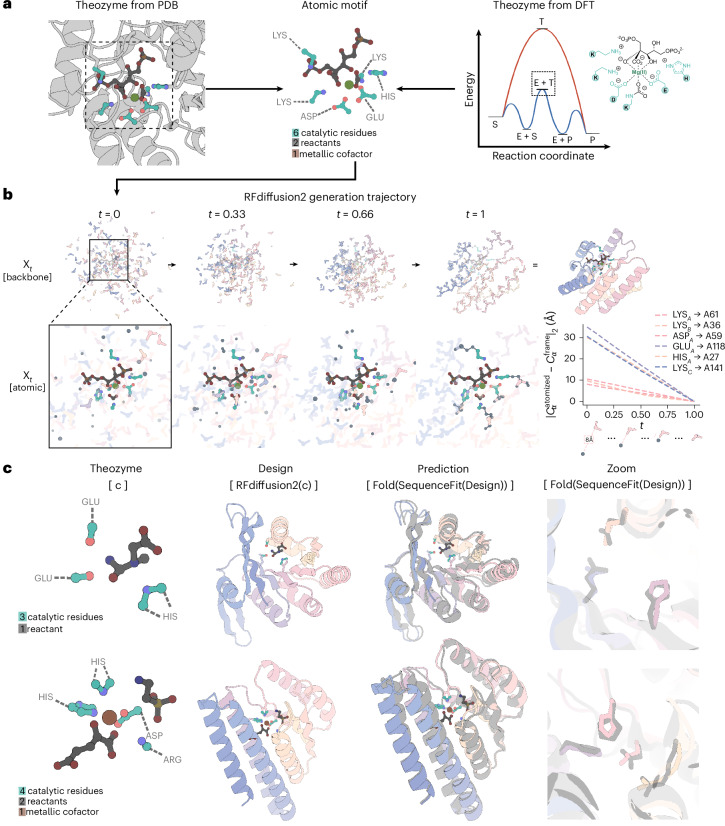
RFdiffusion2 is a flow-matching generative model that scaffolds atom-level enzyme active sites directly from theozyme functional-group geometries without prespecified residue indices or inverse rotamer sampling. It solved all 41 AME benchmark cases versus 16 for RFdiffusion and yielded experimentally active designed enzymes for multiple reactions after screening fewer than 96 sequences per case.
Key findings
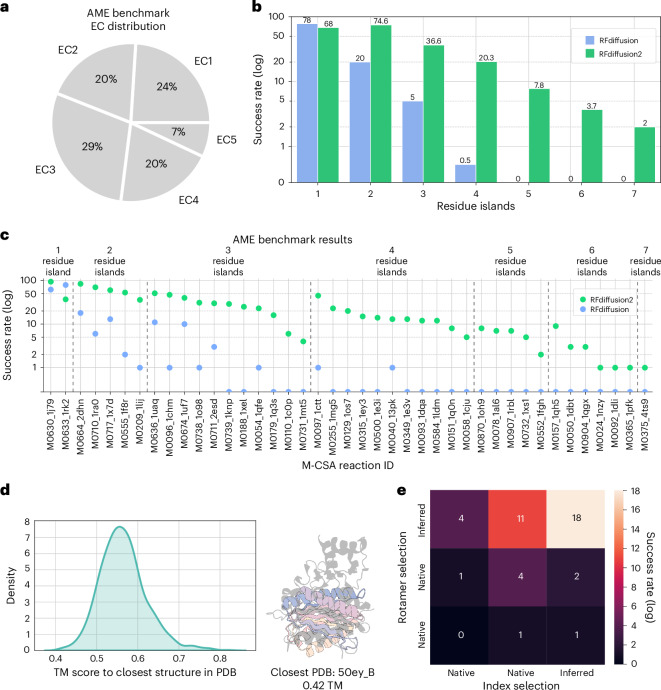
- On the new AME benchmark of 41 active sites spanning EC classes 1–5, RFdiffusion2 found at least one in silico success for 41/41 cases, compared with 16/41 for RFdiffusion, and outperformed RFdiffusion on 40/41 cases.
- Inferring both rotamer and sequence index gave the best performance; naive inverse rotamer and index sampling failed at four residue islands, achieving no in silico successes.
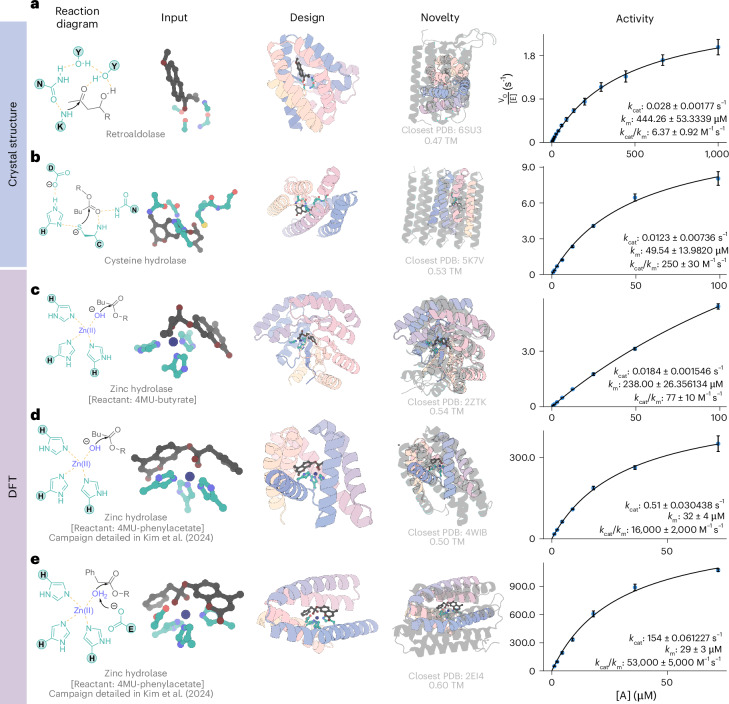
- Experimental campaigns found active enzymes while testing fewer than 96 designs per case: a retroaldolase with kcat/KM = 6.34 ± 0.92 M−1s−1, a cysteine hydrolase with kcat/KM = 248 ± 34 M−1s−1, and zinc hydrolases with kcat/KM = 77 ± 10, 16,000 ± 2,000, and 53,000 ± 5,000 M−1s−1.
- Successful designs were structurally novel: most successful in silico designs had closest-PDB TM scores between 0.5 and 0.6, with representative experimental designs showing TM scores of 0.47–0.60 to their closest PDB structures.
Methods
- RFdiffusion2 extends the RoseTTAFold All-Atom architecture with atomic and unindexed motif conditioning and is trained with a flow-matching objective on PDB biomolecular structures, including protein–small-molecule, protein–metal, and covalently modified protein complexes; training used 24 A100 Nvidia GPUs for 17 days.
- The AME benchmark was curated from M-CSA active sites cross-referenced with PARITY, yielding 41 cases; for each case, 100 backbones were generated, eight sequences were assigned with LigandMPNN, and structures were refolded with Chai-1, with in silico success defined as catalytic-residue heavy-atom RMSD <1.5 Å for at least one sequence and no ligand clashes within 1.5 Å.
- Experimental designs used input theozymes from native crystal structures or DFT-computed transition-state geometries, followed by RFdiffusion2 scaffolding, LigandMPNN sequence assignment, structure-prediction filtering, and Michaelis–Menten kinetics after testing fewer than 96 designs per case.
Limitations
- The paper states that RFdiffusion2-designed enzymes are not as active as native enzymes, that theozymes may not capture all interactions needed for high activity, and that the AME benchmark is limited to PDB motifs derived from native M-CSA annotations and does not measure enzymes with multiple transition states.
- Evident from the text: in silico success is a structural criterion (catalytic heavy-atom RMSD and clash filters), and the paper notes that scaffolding these atoms does not necessarily generate catalytically proficient enzymes; experimental validation covers only a small number of reactions/cases.
Model-written summary. Check it against the paper before relying on it.
Integrity signals
Registry
Cites
Statistics
Figures
Verification
Claims the paper makes
0 Valid · 0 Not valid · 14 Not checked · 57 Own results and interpretations
A result the paper reports from its own data — it cites no other source for it, so there is none to check. The quote shows it is in the paper.
In the paper
“We find the difficulty of a benchmark case correlates with the complexity of the motif, which we quantify with the number of ‘residue islands’, the number of contiguous segments of catalytic residues in the original PDB structure.”
§ Atom-level enzyme active site scaffolding using RFdiffusion2 > Results > AME benchmark
plainstates an associationn = 41- Asserted: passes — The authors put it forward as true.
- Checkable: passes — It can be checked against evidence.
- Load-bearing: unclear — It is unclear whether the paper’s conclusions depend on it.
- Based: passes — The paper gives a reason why it holds.
A result the paper reports from its own data — it cites no other source for it, so there is none to check. The quote shows it is in the paper.
In the paper
“RFdiffusion2 outperforms the prior state of the art methods on in silico benchmarks”
§ Atom-level enzyme active site scaffolding using RFdiffusion2 > Discussion
plainstates a cause- Asserted: passes — The authors put it forward as true.
- Checkable: passes — It can be checked against evidence.
- Load-bearing: passes — The paper’s conclusions depend on it.
- Based: passes — The paper gives a reason why it holds.
In the paper
“We tested activity of the in vitro transcription/translation-produced proteins using racemic Methodol as a substrate and found four variants that show detectable levels of retroaldolase activity in our semiquantitative assay40.”
§ Atom-level enzyme active site scaffolding using RFdiffusion2 > Results > In vitro experiments
What the sources say
- Not checked yetcites [40] Anishchenko, I. et al. Modeling protein-small molecule conformational ensembles with PLACER. Proc. Natl Acad. Sci.USA 122, e2427161122 (2025). 41187076 PMC12625923 source
plain- Asserted: passes — The authors put it forward as true.
- Checkable: passes — It can be checked against evidence.
- Load-bearing: passes — The paper’s conclusions depend on it.
- Based: passes — The paper gives a reason why it holds.
None of the sources cited for this claim have been checked yet.
In the paper
“higher than previously designed zinc hydrolases50,51.”
§ Atom-level enzyme active site scaffolding using RFdiffusion2 > Results > In vitro experiments
What the sources say
- Not checked yetcites [50] Hoffnagle, A. M. & Tezcan, F. A. Atomically accurate design of metalloproteins with predefined coordination geometries. J. Am. Chem. Soc. 145, 14208–14214 (2023). 37352018 PMC10439731 source
- Not checked yetcites [51] Der, B. S. et al. Metal-mediated affinity and orientation specificity in a computationally designed protein homodimer. J. Am. Chem. Soc. 134, 375–385 (2012). 22092237 PMC3257401 source
plain- Asserted: passes — The authors put it forward as true.
- Checkable: passes — It can be checked against evidence.
- Load-bearing: passes — The paper’s conclusions depend on it.
- Based: passes — The paper gives a reason why it holds.
A result the paper reports from its own data — it cites no other source for it, so there is none to check. The quote shows it is in the paper.
In the paper
“the best design shown exhibited multiple turnover activity with a kcat/KM of 248 ± 34 M−1s−1 for the acylation step”
§ Atom-level enzyme active site scaffolding using RFdiffusion2 > Results > In vitro experiments
plainSingle case- Asserted: passes — The authors put it forward as true.
- Checkable: passes — It can be checked against evidence.
- Load-bearing: passes — The paper’s conclusions depend on it.
- Based: passes — The paper gives a reason why it holds.
37 more claims
Create a free account to see all 71 claims and to verify the 30 references still open.
- It may state two separate claims as one. 22
- The quote only partly states this claim. 5
- Probably not a substantial claim. 3
Self-check
Percentages, sums and reported differences re-computed from the paper’s own numbers.
Each contradiction between two passages listed here was confirmed by an independent check.
Rated minor: it would not touch a result — a value no result rests on, a p-value that stays on the same side of the significance level, or a conflict that is clerical, resolved elsewhere in the paper, or outside its own findings.
In the paper
§ Atom-level enzyme active site scaffolding using RFdiffusion2 > Atomic motif conditioning
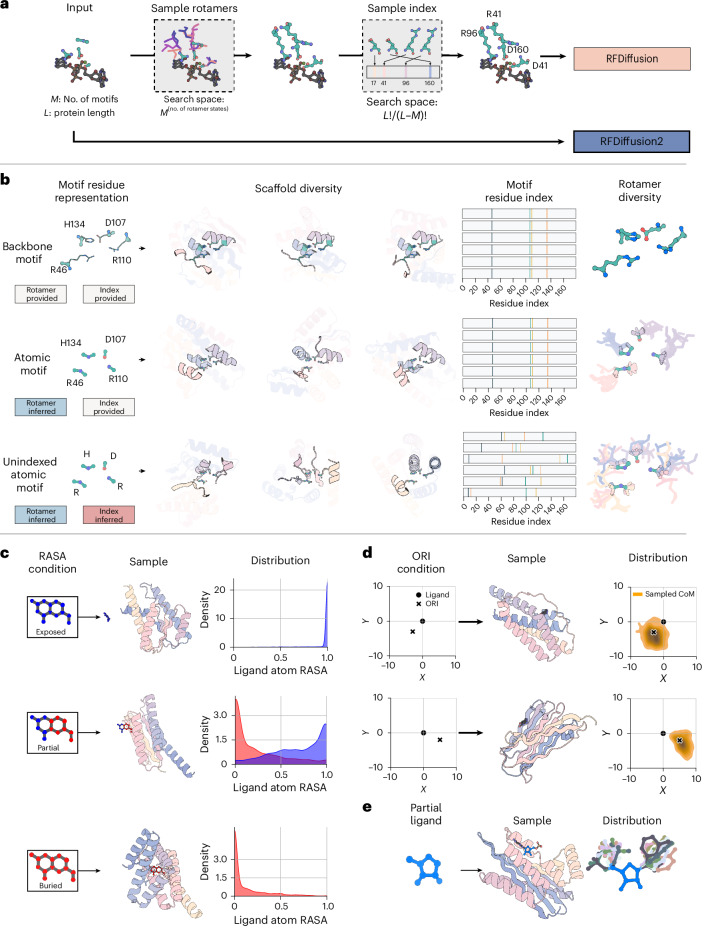
“We find RFdiffusion2 can, given partial ligand coordinates, sample physically realistic conformers for the entire ligand (Fig. 2d)”
§ Atom-level enzyme active site scaffolding using RFdiffusion2 > Atomic motif conditioning
“e, RFdiffusion2 can be provided with partial ligand input in which case it must sample the remaining ligand degrees of freedom while generating the protein.”
Citations
Cites
Adam: A Method for Stochastic Optimization
Kingma, D. P., & Ba, J. (2014) · arXiv · doi:10.48550/arxiv.1412.6980 · Cited by 98,946
Highly accurate protein structure prediction with AlphaFold
Jumper, J., Evans, R., Pritzel, A., Green, T., Figurnov, M., Ronneberger, O., Tunyasuvunakool, K., Bates, R., Žídek, A., Potapenko, A., et al. (2021) · Nature · doi:10.1038/s41586-021-03819-2 · Cited by 43,764 · cited 1×
“Directed evolution campaigns have demonstrated that a catalytic tetrad composed of a nucleophilic lysine enmeshed in a hydrogen-bonding network with two tyrosines and an asparagine can stabilize the transition states of this reaction [38].”
Berman, H. M. (2000) · Nucleic Acids Research · doi:10.1093/nar/28.1.235 · Cited by 40,196 · cited 1×
“Our training dataset consists of biomolecular structures from the Protein Data Bank (PDB) [27] that include proteins, protein–small molecule complexes, protein-metal complexes, and covalently modified proteins, filtering out common solvents and crystallization additives [19].”
Effect of the damping function in dispersion corrected density functional theory
Grimme, S., Ehrlich, S., & Goerigk, L. (2011) · Journal of Computational Chemistry · doi:10.1002/jcc.21759 · Cited by 28,221
Accurate structure prediction of biomolecular interactions with AlphaFold 3
Abramson, J., Adler, J., Dunger, J., Evans, R., Green, T., Pritzel, A., Ronneberger, O., Willmore, L., Ballard, A. J., Bambrick, J., et al. (2024) · Nature · doi:10.1038/s41586-024-07487-w · Cited by 15,861 · cited 2×
“Alternative neural network architectures such as Diffusion Transformers [51] and modules from AlphaFold3 [34] for all-atom tasks could improve RFdiffusion2 which uses the neural network architecture of RFAA.”
Denoising Diffusion Probabilistic Models
Ho, J., Jain, A., & Abbeel, P. (2020) · arXiv · doi:10.48550/arxiv.2006.11239 · Cited by 8,712
Evolutionary-scale prediction of atomic level protein structure with a language model
Lin, Z., Akin, H., Rao, R., Hie, B., Zhu, Z., Lu, W., Smetanin, N., Verkuil, R., Kabeli, O., Shmueli, Y., et al. (2022) · doi:10.1101/2022.07.20.500902 · Cited by 5,990
Protein production by auto-induction in high-density shaking cultures
Studier, F. W. (2005) · Protein Expression and Purification · doi:10.1016/j.pep.2005.01.016 · Cited by 5,931
Score-Based Generative Modeling through Stochastic Differential Equations
Song, Y. S., Sohl‐Dickstein, J., Kingma, D. P., Kumar, A., Ermon, S., & Poole, B. (2021) · International Conference on Learning Representations · Cited by 4,981
De novo design of protein structure and function with RFdiffusion
Watson, J. L., Juergens, D., Bennett, N. R., Trippe, B. L., Yim, J., Eisenach, H. E., Ahern, W., Borst, A. J., Ragotte, R. J., Milles, L. F., et al. (2023) · Nature · doi:10.1038/s41586-023-06415-8 · Cited by 3,506
Self-citation
Research works printed but not linked: 1
- Chen, R. T. & Lipman, Y. Flow matching on general geometries. In International Conference on Learning Representations (2024).
Cited by
Items 201–229 of 229
Kouassi, J. R. (2026) · uO Research (University of Ottawa) · doi:10.20381/ruor-32227
Design of enantioselective photoenzymes by scaffolding mirror image catalytic sitesPreprint
Hardy, F. J., Crawshaw, R., Didier, C., Kohn, A. R., Gallois, F. J., Lauko, A., Pellock, S. J., Kalvet, I., Green, A. P., & Baker, D. A. (2026) · bioRxiv (Cold Spring Harbor Laboratory) · doi:10.64898/2026.10.16.759720
“To build enzymes using these theozymes, we used RFdiffusion2 ( 32 ). which allows for backbone generation without specifying the sequence position and backbone coordinates of a motif residue.”
Self-citationDo in-silico metrics filter designed enzymes for catalysis?Preprint
Zhang, Z., Zhang, W. E., & Deng, Z. (2026) · arXiv · doi:10.48550/arxiv.2610.24437
“AME RMSD (active-site accuracy; adapted from the criterion of the Atomic Motif Enzyme benchmark [8], which superposes on the backbone of the catalytic residues).”
Local energetic coupling enhances the expressivity of chemical computationPreprint
Tuccio, M., Rocks, J. W., & Goldford, J. E. (2026) · arXiv · doi:10.48550/arxiv.2609.17339
“Combining CRNs constructed from more realistic chemical reaction mechanisms with recently developed machine learning tools for enzyme discovery [41] and design [42] may provide a suit-6 able design suite to guide experiments.”
TriGlue: a Biology-Inspired Generative Model for Generating Molecular Glue-Induced Ternary ComplexPreprint
Yan, Y., Yan, S., Tang, H., Sun, Y., & Dai, E. (2026) · arXiv · doi:10.48550/arxiv.2607.22143
“This breakthrough has catalyzed a broad spectrum of generative approaches, including RFDiffusion for enzyme design [40, 41], SE(3)-Diffusion for protein backbone generation [42], Boltzgen for binder design [43], and peptide design [44, 23, 45].”
IMPRESS: AI-coupled HPC workflows for protein designPreprint
Khare, S. D., Jha, S., Hooten, M., Liyanaarachchi, A., Alsaadi, A., & Goliyad, M. (2026) · bioRxiv (Cold Spring Harbor Laboratory) · doi:10.64898/2026.11.13.766417
Synthetic nanobodies for drug discovery—Design, construction, optimization, and applications
Xie, Y., Tian, Z., Wen, Y., & Zheng, F. (2026) · FEBS Letters · doi:10.1002/1873-3468.70500
TorchCraft: Unified binder design by inverting an all-atom structure predictorPreprint
TorchCraft Team, Liu, Y., Shen, Z., Li, Z., Huang, X., Liu, J., Gao, S., Yu, Q., Qin, X., Zhang, Y., et al. (2026) · arXiv · doi:10.48550/arxiv.2609.19770
Stöhr, M., & Martínez, T. J. (2026) · ChemRxiv · doi:10.26434/chemrxiv.15010422/v1
Tang, Y., Qi, P., Xing, J., Li, J., Chen, Y., Gu, W., & Zhu, C. (2026) · Angewandte Chemie International Edition · doi:10.1002/anie.2745660
Tang, Y., Qi, P., Xing, J., Li, J., Chen, Y., Gu, W., & Zhu, C. (2026) · Angewandte Chemie · doi:10.1002/ange.2745660
Parametric and AI-Assisted Design of Right-Handed Four-Helix Coiled CoilsPreprint
Kluge, P., Useini, A., Shabani, F., Kieslich, B., Kazimir, A., Sträter, N., Lamers, C., Gemming, S., & Kuenze, G. (2026) · bioRxiv (Cold Spring Harbor Laboratory) · doi:10.64898/2026.11.14.766675
“[14, 15] Nevertheless, parametric backbone generation remains advantageous when precise and systematic control over geometric features is required.”
Zink, A. (2026) · EPub Bayreuth (University of Bayreuth) · doi:10.15495/epub_ubt_00009694
FIDIA: Function-Informed Sequence Design via Inference-Aligned Policy Optimization
Li, M., Li, F., Tao, Y., & Deng, Y. (2026) · International Conference on Machine Learning
Machine learning and AI in enzyme engineering: From sequence representation to de novo design
Matsushita, T., & Saitō, Y. (2026) · Biophysics and Physicobiology · doi:10.2142/biophysico.bppb-v24.s004
Recent Trends and Developments in Biocatalysis
Ngo, A., Yayci, A., Terholsen, H., Argyrou, A., Tischler, D., & Schmidt, S. (2026) · ChemBioChem · doi:10.1002/cbic.70616
“To scaffold an active site, the exact positions and orientations of cata‐ lytic residues still had to be designed, fixed, and filtered in advance before backbone generation could begin [104].”
Ligand-Conditioned Discrete Diffusion for Protein Sequence-Structure Co-DesignPreprint
Wei, C., Xu, F., Sun, M., Liu, Z., Wang, L., Jia, T., Zhou, Y., & Zhang, Y. (2026) · arXiv · doi:10.48550/arxiv.2605.27413
“…distributions of large-scale training data, recent data-driven generative models have transformed protein design, shifting the field from traditional physics-based and evolutionary-profile-guided design methods [1, 2] toward diffusion-based generative models [3, 4, 5, 6, 7, 8, 9, 10, 11, 12, 13].”
Cheng, X., Bian, J., Zheng, Y., Yu, Y., Liu, Q., Yang, G.-Y., & Hong, L. (2026) · Science China Life Sciences · doi:10.1007/s11427-026-3498-8
Duan, J., Zhang, R., Zhang, G., Qu, H., Peng, J., Liu, S., & Chen, T. (2026) · International Conference on Machine Learning
Deep generative protein design needs a lab partner
Yeh, H., Ganesan, S., & Ferguson, A. L. (2026) · Current Opinion in Structural Biology · doi:10.1016/j.sbi.2026.103440
Tavera, E. L. (2026) · NVA (Nasjonalt vitenarkiv)
Designing Consensus Catalytic Geometries for De Novo Multistep Enzymes
Alvarez, J. S. (2026) · uO Research (University of Ottawa) · doi:10.20381/ruor-32252
Programmable functional RNA design with a virtual scientist
Huang, H. K., Zhang, T., Hong, L., Lin, Z., He, D., Wang, J., Wu, T., Li, H., Han, D., Yu, L., et al. (2026) · Nature Biotechnology · doi:10.1038/s41587-026-03362-3
Investigation of design principles for metal-binding and conductive protein assemblies
USDOE Office of Science (SC), & Baker, D. A. (2025) · OSTI OAI (U.S. Department of Energy Office of Scientific and Technical Information) · doi:10.2172/2589052
Self-citationStructuur-gebaseerd ontwerp van kleine moleculen en eiwit liganden tegen het LEDGF PWWP domain
Vantieghem, T. (2025) · Lirias
Designing substrate-specific metalloproteases
Liu, H. (2026) · Vita · doi:10.15302/vita.2026.08.0063
Stabilization and Functionalization of an Enzyme Complex via Modular In Situ ConjugationPreprint
Pérez, J. L., Hutchins, G. H., Klintrot, R., Poc, P., Soares, L., Drienovská, I., Hennig, S., Neubacher, S., & Grossmann, T. N. (2026) · ChemRxiv · doi:10.26434/chemrxiv.15008156/v1
CODesign: Consistency from Data to Trajectory in All-Atom Protein Binder Co-DesignPreprint
Mo, Y., Qiang, B., Lin, H., Wang, Q., Du, G., Zhang, O., & Heng, P. A. (2026) · arXiv · doi:10.48550/arxiv.2610.01773
“Although two-stage methods have achieved strong results in monomer and enzyme design, their low pass rates on challenging targets make them inefficient [1, 29].”
De Novo Design of C–H Hydroxylation Enzymes with Programmed SelectivitiesPreprint
Kalvet, I., Jeung, J.-U., Gao, S., Andrews, A. C., Wenke, B. B., Smithson, R., Mendoza, J., Nguyen, H., Joyce, E., Kang, A., et al. (2026) · bioRxiv (Cold Spring Harbor Laboratory) · doi:10.64898/2026.11.12.766315
“We used RFdiffusion2 ( 40 ) and RFdiffusion3 ( 41 ) (RFD2 and RFD3) to build new protein structures around this minimal theozyme geometry in an unindexed fashion, allowing the model to dynamically solve the primary sequence positions and rotamers of the catalytic residues.”
Self-citation
Metadata
- Authors
- Ahern, W., Yim, J., Tischer, D., Salike, S., Woodbury, S. M., Kim, D., Kalvet, I., Kipnis, Y., Coventry, B., Altae-Tran, H. R., Bauer, M. S., Barzilay, R., Jaakkola, T. S., Krishna, R., & Baker, D.
- Affiliations
- University of Washington (US)
- MIT Computer Science and Artificial Intelligence Laboratory (US)
- Howard Hughes Medical Institute (US)
- Corresponding author
- Krishna, Rohith
- Baker, David
- ORCID
- Venue
- Nature Methods
- Published
- 2025-12-03
- Volume
- 23
- Issue
- 1
- Pages
- 96-105
- ISSN
- 1548-7091 (ISSN-L)
- 1548-7105
- PMC
- PMC12791007
- OpenAlex
- W4416955829
- Cited by
- 229
- References
- 71
- Citations by year
- 2026: 185 · 2025: 44
- FWCI
- 43.03
- Type
- journal article
- Language
- en
- Open access
- hybrid
- doi.org
- Licence
- cc-by-nc-nd
- creativecommons.org/licenses/by-nc-nd/4.0 (tdm)
- creativecommons.org/licenses/by-nc-nd/4.0 (vor)
- Locations
- Nature Methods (publishedVersion, cc-by-nc-nd)
- bioRxiv (Cold Spring Harbor Laboratory) (submittedVersion, cc-by)
- Europe PMC (PubMed Central) (publishedVersion, cc-by-nc-nd)
- PubMed Central (publishedVersion, cc-by-nc-nd)
- PubMed (publishedVersion)
- Funders
- National Science Foundation (1918839, 2141064, DGE-214-0004, 2140004)
- Howard Hughes Medical Institute
- Bill and Melinda Gates Foundation (INV-010680)
- Sanofi
- Open Philanthropy Project
- Defense Advanced Research Projects Agency
- Defense Threat Reduction Agency
- Topics
- Life Sciences › Biochemistry, Genetics and Molecular Biology › Molecular Biology › Protein Structure and Dynamics
- Life Sciences › Biochemistry, Genetics and Molecular Biology › Molecular Biology › Enzyme Catalysis and Immobilization
- Life Sciences › Pharmacology, Toxicology and Pharmaceutics › Drug Discovery › Computational Drug Discovery Methods
- Keywords
- de novo enzyme design, transition state, deep generative models, catalytic mechanism, protein structure generation
- MeSH terms
- Algorithms, Enzymes, Models, Molecular, Protein Conformation, Software, Protein Engineering, Catalytic Domain
About these checks
Registry, retraction, Cites and statistics results are computed, not judged, with one exception: a printed reference that no index lists is read once by a model before it counts as a citation error. Claims are extracted by a model and kept only when their quote appears verbatim in the text; each cited source is then checked, with a model’s help, for whether it says what the claim relies on. Those verdicts can be wrong — read the claim’s quote and the cited source before relying on one.
A language model drew the claims from the paper on 2026-11-28, under version 3 of the claim definition (model deepseek-v4.1-flash, prompt extract-v3).
A second model labelled each claim on 2026-11-28 (model jev-1.13-20260917, definition revision gold-guideline-v0.2).
Statistics and arithmetic are recomputed, not judged.
Confidence bands are shown only for fields calibrated on our annotated test set. None is calibrated yet, so no band is shown.
What counts as a claim ›How we measure confidence ›How we check this ›
Are you an author, or do you see a problem with this page? Request a review
Data sources
Bibliographic data: Semantic Scholar, OpenAlex, Crossref.
Contains information from the Semantic Scholar Academic Graph Datasets, made available under the ODC Attribution License (ODC-BY 1.0).
Semantic Scholar’s data is described in: Kinney, R., et al. (2023). The Semantic Scholar Open Data Platform. arXiv:2301.10140.
