

Atom-level enzyme active site scaffolding using RFdiffusion2
Open accessPublished version of a preprint
The DOI matches its Crossref record; 75 of the 76 references it cites were found in a registry or an index; none of the 30 sources its claims cite is checked for support yet.
Abstract
Designing new enzymes typically begins with idealized arrangements of catalytic functional groups around a reaction transition state, then attempts to generate protein structures that precisely position these groups. Current AI-based methods can create active enzymes but require predefined residue positions and rely on reverse-building residue backbones from side-chain placements, which limits design flexibility. Here we show that a new deep generative model, RoseTTAFold diffusion 2 (RFdiffusion2), overcomes these constraints by designing enzymes directly from functional group geometries without specifying residue order or performing inverse rotamer generation. RFdiffusion2 successfully generates scaffolds for all 41 active sites in a diverse benchmark, compared to 16 using previous methods. We further design enzymes for three distinct catalytic mechanisms and identify active candidates after experimentally testing fewer than 96 sequences in each case. These results highlight the potential of atomic-level generative modeling to create de novo enzymes directly from reaction mechanisms.
Overview
CoChat Summary
TL;DR
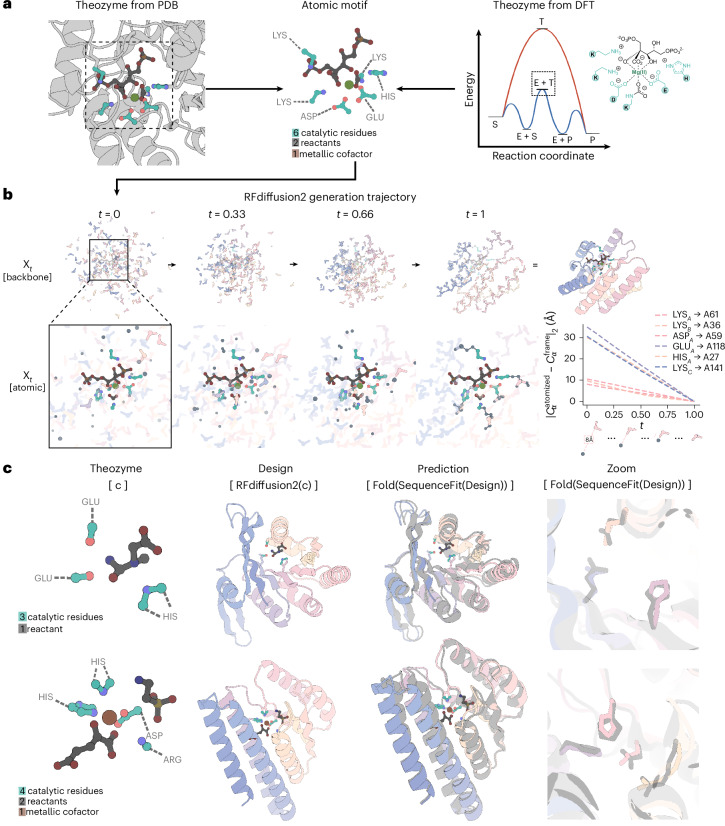
RFdiffusion2 is a flow-matching generative model that scaffolds atom-level enzyme active sites directly from theozyme functional-group geometries without prespecified residue indices or inverse rotamer sampling. It solved all 41 AME benchmark cases versus 16 for RFdiffusion and yielded experimentally active designed enzymes for multiple reactions after screening fewer than 96 sequences per case.
Key findings
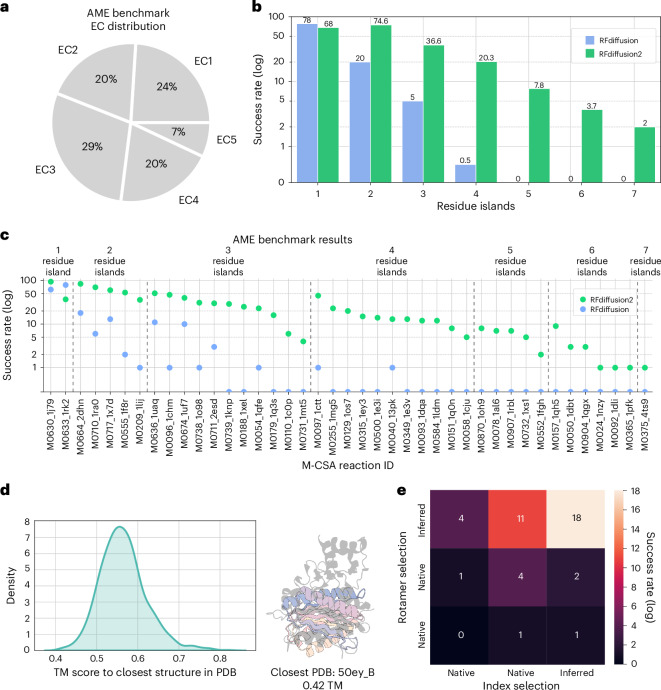
- On the new AME benchmark of 41 active sites spanning EC classes 1–5, RFdiffusion2 found at least one in silico success for 41/41 cases, compared with 16/41 for RFdiffusion, and outperformed RFdiffusion on 40/41 cases.
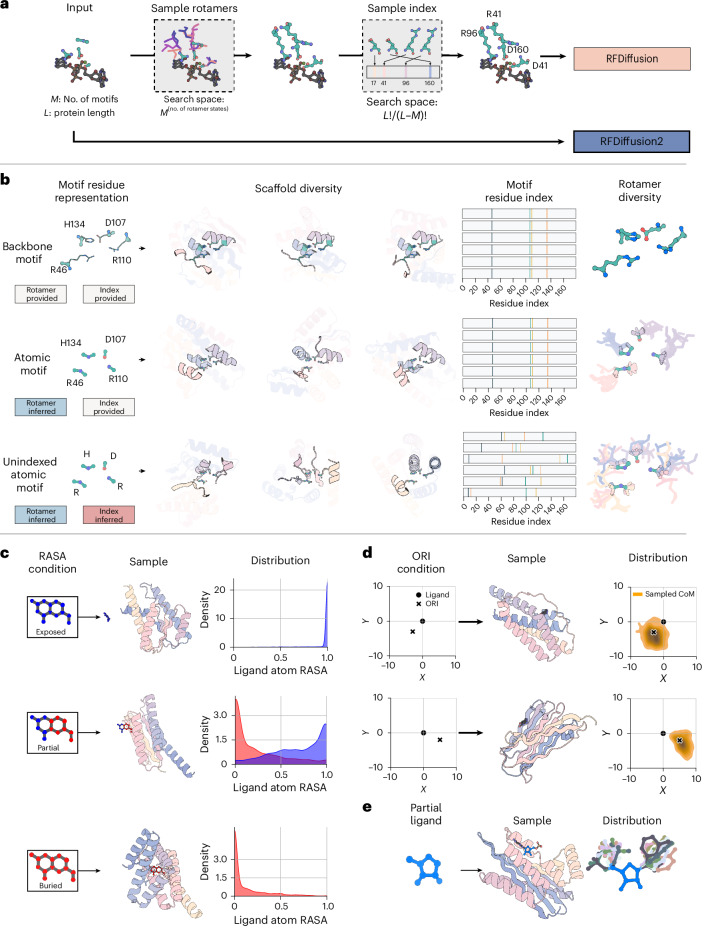
- Inferring both rotamer and sequence index gave the best performance; naive inverse rotamer and index sampling failed at four residue islands, achieving no in silico successes.
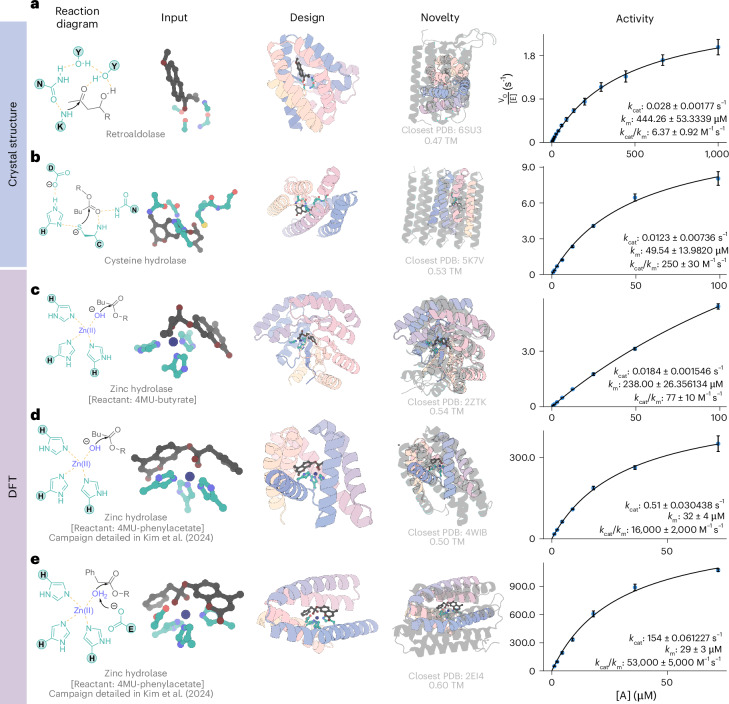
- Experimental campaigns found active enzymes while testing fewer than 96 designs per case: a retroaldolase with kcat/KM = 6.34 ± 0.92 M−1s−1, a cysteine hydrolase with kcat/KM = 248 ± 34 M−1s−1, and zinc hydrolases with kcat/KM = 77 ± 10, 16,000 ± 2,000, and 53,000 ± 5,000 M−1s−1.
- Successful designs were structurally novel: most successful in silico designs had closest-PDB TM scores between 0.5 and 0.6, with representative experimental designs showing TM scores of 0.47–0.60 to their closest PDB structures.
Methods
- RFdiffusion2 extends the RoseTTAFold All-Atom architecture with atomic and unindexed motif conditioning and is trained with a flow-matching objective on PDB biomolecular structures, including protein–small-molecule, protein–metal, and covalently modified protein complexes; training used 24 A100 Nvidia GPUs for 17 days.
- The AME benchmark was curated from M-CSA active sites cross-referenced with PARITY, yielding 41 cases; for each case, 100 backbones were generated, eight sequences were assigned with LigandMPNN, and structures were refolded with Chai-1, with in silico success defined as catalytic-residue heavy-atom RMSD <1.5 Å for at least one sequence and no ligand clashes within 1.5 Å.
- Experimental designs used input theozymes from native crystal structures or DFT-computed transition-state geometries, followed by RFdiffusion2 scaffolding, LigandMPNN sequence assignment, structure-prediction filtering, and Michaelis–Menten kinetics after testing fewer than 96 designs per case.
Limitations
- The paper states that RFdiffusion2-designed enzymes are not as active as native enzymes, that theozymes may not capture all interactions needed for high activity, and that the AME benchmark is limited to PDB motifs derived from native M-CSA annotations and does not measure enzymes with multiple transition states.
- Evident from the text: in silico success is a structural criterion (catalytic heavy-atom RMSD and clash filters), and the paper notes that scaffolding these atoms does not necessarily generate catalytically proficient enzymes; experimental validation covers only a small number of reactions/cases.
Model-written summary. Check it against the paper before relying on it.
Integrity signals
Registry
Cites
Statistics
Figures
Verification
Claims the paper makes
0 Valid · 0 Not valid · 14 Not checked · 57 Own results and interpretations
A result the paper reports from its own data — it cites no other source for it, so there is none to check. The quote shows it is in the paper.
In the paper
“We find the difficulty of a benchmark case correlates with the complexity of the motif, which we quantify with the number of ‘residue islands’, the number of contiguous segments of catalytic residues in the original PDB structure.”
§ Atom-level enzyme active site scaffolding using RFdiffusion2 > Results > AME benchmark
plainstates an associationn = 41- Asserted: passes — The authors put it forward as true.
- Checkable: passes — It can be checked against evidence.
- Load-bearing: unclear — It is unclear whether the paper’s conclusions depend on it.
- Based: passes — The paper gives a reason why it holds.
A result the paper reports from its own data — it cites no other source for it, so there is none to check. The quote shows it is in the paper.
In the paper
“RFdiffusion2 outperforms the prior state of the art methods on in silico benchmarks”
§ Atom-level enzyme active site scaffolding using RFdiffusion2 > Discussion
plainstates a cause- Asserted: passes — The authors put it forward as true.
- Checkable: passes — It can be checked against evidence.
- Load-bearing: passes — The paper’s conclusions depend on it.
- Based: passes — The paper gives a reason why it holds.
In the paper
“We tested activity of the in vitro transcription/translation-produced proteins using racemic Methodol as a substrate and found four variants that show detectable levels of retroaldolase activity in our semiquantitative assay40.”
§ Atom-level enzyme active site scaffolding using RFdiffusion2 > Results > In vitro experiments
What the sources say
- Not checked yetcites [40] Anishchenko, I. et al. Modeling protein-small molecule conformational ensembles with PLACER. Proc. Natl Acad. Sci.USA 122, e2427161122 (2025). 41187076 PMC12625923 source
plain- Asserted: passes — The authors put it forward as true.
- Checkable: passes — It can be checked against evidence.
- Load-bearing: passes — The paper’s conclusions depend on it.
- Based: passes — The paper gives a reason why it holds.
None of the sources cited for this claim have been checked yet.
In the paper
“higher than previously designed zinc hydrolases50,51.”
§ Atom-level enzyme active site scaffolding using RFdiffusion2 > Results > In vitro experiments
What the sources say
- Not checked yetcites [50] Hoffnagle, A. M. & Tezcan, F. A. Atomically accurate design of metalloproteins with predefined coordination geometries. J. Am. Chem. Soc. 145, 14208–14214 (2023). 37352018 PMC10439731 source
- Not checked yetcites [51] Der, B. S. et al. Metal-mediated affinity and orientation specificity in a computationally designed protein homodimer. J. Am. Chem. Soc. 134, 375–385 (2012). 22092237 PMC3257401 source
plain- Asserted: passes — The authors put it forward as true.
- Checkable: passes — It can be checked against evidence.
- Load-bearing: passes — The paper’s conclusions depend on it.
- Based: passes — The paper gives a reason why it holds.
A result the paper reports from its own data — it cites no other source for it, so there is none to check. The quote shows it is in the paper.
In the paper
“the best design shown exhibited multiple turnover activity with a kcat/KM of 248 ± 34 M−1s−1 for the acylation step”
§ Atom-level enzyme active site scaffolding using RFdiffusion2 > Results > In vitro experiments
plainSingle case- Asserted: passes — The authors put it forward as true.
- Checkable: passes — It can be checked against evidence.
- Load-bearing: passes — The paper’s conclusions depend on it.
- Based: passes — The paper gives a reason why it holds.
37 more claims
Create a free account to see all 71 claims and to verify the 30 references still open.
- It may state two separate claims as one. 22
- The quote only partly states this claim. 5
- Probably not a substantial claim. 3
Self-check
Percentages, sums and reported differences re-computed from the paper’s own numbers.
Each contradiction between two passages listed here was confirmed by an independent check.
Rated minor: it would not touch a result — a value no result rests on, a p-value that stays on the same side of the significance level, or a conflict that is clerical, resolved elsewhere in the paper, or outside its own findings.
In the paper
§ Atom-level enzyme active site scaffolding using RFdiffusion2 > Atomic motif conditioning
“We find RFdiffusion2 can, given partial ligand coordinates, sample physically realistic conformers for the entire ligand (Fig. 2d)”
§ Atom-level enzyme active site scaffolding using RFdiffusion2 > Atomic motif conditioning
“e, RFdiffusion2 can be provided with partial ligand input in which case it must sample the remaining ligand degrees of freedom while generating the protein.”
Citations
Cites
Adam: A Method for Stochastic Optimization
Kingma, D. P., & Ba, J. (2014) · arXiv · doi:10.48550/arxiv.1412.6980 · Cited by 98,946
Highly accurate protein structure prediction with AlphaFold
Jumper, J., Evans, R., Pritzel, A., Green, T., Figurnov, M., Ronneberger, O., Tunyasuvunakool, K., Bates, R., Žídek, A., Potapenko, A., et al. (2021) · Nature · doi:10.1038/s41586-021-03819-2 · Cited by 43,764 · cited 1×
“Directed evolution campaigns have demonstrated that a catalytic tetrad composed of a nucleophilic lysine enmeshed in a hydrogen-bonding network with two tyrosines and an asparagine can stabilize the transition states of this reaction [38].”
Berman, H. M. (2000) · Nucleic Acids Research · doi:10.1093/nar/28.1.235 · Cited by 40,196 · cited 1×
“Our training dataset consists of biomolecular structures from the Protein Data Bank (PDB) [27] that include proteins, protein–small molecule complexes, protein-metal complexes, and covalently modified proteins, filtering out common solvents and crystallization additives [19].”
Effect of the damping function in dispersion corrected density functional theory
Grimme, S., Ehrlich, S., & Goerigk, L. (2011) · Journal of Computational Chemistry · doi:10.1002/jcc.21759 · Cited by 28,221
Accurate structure prediction of biomolecular interactions with AlphaFold 3
Abramson, J., Adler, J., Dunger, J., Evans, R., Green, T., Pritzel, A., Ronneberger, O., Willmore, L., Ballard, A. J., Bambrick, J., et al. (2024) · Nature · doi:10.1038/s41586-024-07487-w · Cited by 15,861 · cited 2×
“Alternative neural network architectures such as Diffusion Transformers [51] and modules from AlphaFold3 [34] for all-atom tasks could improve RFdiffusion2 which uses the neural network architecture of RFAA.”
Denoising Diffusion Probabilistic Models
Ho, J., Jain, A., & Abbeel, P. (2020) · arXiv · doi:10.48550/arxiv.2006.11239 · Cited by 8,712
Evolutionary-scale prediction of atomic level protein structure with a language model
Lin, Z., Akin, H., Rao, R., Hie, B., Zhu, Z., Lu, W., Smetanin, N., Verkuil, R., Kabeli, O., Shmueli, Y., et al. (2022) · doi:10.1101/2022.07.20.500902 · Cited by 5,990
Protein production by auto-induction in high-density shaking cultures
Studier, F. W. (2005) · Protein Expression and Purification · doi:10.1016/j.pep.2005.01.016 · Cited by 5,931
Score-Based Generative Modeling through Stochastic Differential Equations
Song, Y. S., Sohl‐Dickstein, J., Kingma, D. P., Kumar, A., Ermon, S., & Poole, B. (2021) · International Conference on Learning Representations · Cited by 4,981
De novo design of protein structure and function with RFdiffusion
Watson, J. L., Juergens, D., Bennett, N. R., Trippe, B. L., Yim, J., Eisenach, H. E., Ahern, W., Borst, A. J., Ragotte, R. J., Milles, L. F., et al. (2023) · Nature · doi:10.1038/s41586-023-06415-8 · Cited by 3,506
Self-citation
Research works printed but not linked: 1
- Chen, R. T. & Lipman, Y. Flow matching on general geometries. In International Conference on Learning Representations (2024).
Cited by
BoltzGen: Toward Universal Binder DesignPreprint
Stark, H., Faltings, F., Choi, M., Xie, Y., Hur, E., O’Donnell, T. J., Bushuiev, A., Uçar, T., Passaro, S., Mao, W., et al. (2025) · bioRxiv (Cold Spring Harbor Laboratory) · doi:10.1101/2025.11.20.689494 · Cited by 231
Self-citationDe novo Design of All-atom Biomolecular Interactions with RFdiffusion3Preprint
Butcher, J., Krishna, R., Mitra, R., Brent, R. I., Li, Y., Corley, N., Kim, P. T., Funk, J., Mathis, S. V., Salike, S., et al. (2025) · bioRxiv (Cold Spring Harbor Laboratory) · doi:10.1101/2025.09.18.676967 · Cited by 168
“RFD3 outperforms previous methods [1, 2, 3] in silico on a wide range of protein-protein binding, protein-DNA binding, protein-small molecule binding, and enzyme design tasks, at a fraction of the compute cost.”
InfluentialSelf-citationKoh, H. Y., Zheng, Y., Yang, M., Arora, R., Webb, G. I., Pan, S., Li, L., & Church, G. M. (2025) · Nature Reviews Bioengineering · doi:10.1038/s44222-025-00349-8 · Cited by 152
Computational design of metallohydrolases
Kim, D., Woodbury, S. M., Ahern, W., Tischer, D., Kang, A., Joyce, E., Bera, A. K., Hanikel, N., Salike, S., Krishna, R., et al. (2025) · Nature · doi:10.1038/s41586-025-09746-w · Cited by 109
“To enable sequence-position and side-chain rotamer-agnostic enzyme design, we developed a generative artificial intelligence flow-matching model called RFdiffusion2 30 .”
Self-citationLa-Proteina: Atomistic Protein Generation via Partially Latent Flow Matching
Geffner, T., Didi, K., Cao, Z., Reidenbach, D., Zhang, Z., Dallago, C., Küçükbenli, E., Kreis, K., & Vahdat, A. (2026) · International Conference on Learning Representations · doi:10.48550/arxiv.2507.09466 · Cited by 76
“A similar effect was observed by concurrent work [20, 2].”
AI-Driven Enzyme Engineering: Emerging Models and Next-Generation Biotechnological Applications
Khan, M. F., & Khan, M. T. (2025) · Molecules · doi:10.3390/molecules31010045 · Cited by 69
“…developed by the Baker Lab, directly scaffolds enzyme active sites from sequence-agnostic functional group placements, overcoming prior limitations in residue-level geometry specification and sequence positioning, and successfully designing active catalysts from diverse catalytic sites [71].”
Scaling Atomistic Protein Binder Design with Generative Pretraining and Test-Time Compute
Didi, K., Zhang, Z., Zhou, G., Reidenbach, D., Cao, Z., Cha, S., Geffner, T., Dallago, C., Tang, J., Bronstein, M. M., et al. (2026) · International Conference on Learning Representations · doi:10.48550/arxiv.2603.27950 · Cited by 43
ODesign: A World Model for Biomolecular Interaction DesignPreprint
Zhang, O., Zhang, X., Lin, H., Tan, C., Wang, Q., Mo, Y., Feng, Q., Du, G., Yu, Y., Jin, Z., et al. (2025) · arXiv · doi:10.48550/arxiv.2510.22304 · Cited by 40
“The ref_file is obtained from the Atomic Motif Enzyme (AME) benchmark [3].”
From traditional to AI-driven: The evolution of intelligent enzyme engineering for biocatalysis
Lv, F., Zhang, J., You, S., & Qi, W. (2025) · Biotechnology Advances · doi:10.1016/j.biotechadv.2025.108788 · Cited by 38
How artificial intelligence is reengineering protein engineering
Listgarten, J., & Jiang, H. (2026) · Science · doi:10.1126/science.aec8444 · Cited by 33
Protein Hunter: exploiting structure hallucination within diffusion for protein designPreprint
Cho, Y., Rangel, G., Bhardwaj, G., & Ovchinnikov, S. (2025) · bioRxiv (Cold Spring Harbor Laboratory) · doi:10.1101/2025.10.10.681530 · Cited by 33
“Generative diffusion models like RFdiffusion Watson et al. [2023], Ahern et al. [2025], Butcher et al. [2025], V´azquez Torres et al. [2024] can create novel protein folds, assemblies, and binders for diverse targets including proteins, small molecules, and nucleic acids.”
Artificial Intelligence-Driven de Novo Design of Robust Enzymes to Enhance Their Performance
Tang, M., Ge, F., Li, A., Hu, L., Wang, C., Tang, J., Song, X., Liu, X., Shi, H. S., & Tan, Z. (2025) · ACS Synthetic Biology · doi:10.1021/acssynbio.5c00452 · Cited by 32
Simulating enzyme catalysis with electrostatically embedded machine learning potentials
Gradisteanu, V., Chan, E. W., Hedges, L. O., Malagarriga, M., David, R., de la Puente, M., Laage, D., Tuñón, I., van der Kamp, M. W., & Zinovjev, K. (2026) · Chemical Science · doi:10.1039/d6sc01156j · Cited by 30
“3,4 To improve upon success rates for enzyme activity routinely, and to allow reaching catalytic e ffi ciencies of native enzymes, these work ows typically still require extensive experimental screening, iterative computational-experimental design optimization, or rounds of lab-based directed…”
Improving Protein Sequence Design through Designability Preference OptimizationPreprint
Xue, F., Kubaney, A., Guo, Z., Min, J., Liu, G., Yang, Y., & Baker, D. A. (2025) · arXiv · doi:10.48550/arxiv.2506.00297 · Cited by 30
“These motifs were sourced from the Atomic Motif Ensemble (AME) dataset, as previously characterized in the RFDiffusion2 paper [42].”
Self-citationRecent advances in engineering microbial lipases for industrial applications
Wang, G., Abdella, A., Fakhari, M. A., Dong, J. N., Yang, K., & Yang, S. (2025) · Biotechnology Advances · doi:10.1016/j.biotechadv.2025.108658 · Cited by 29
Illuminating the universe of enzyme catalysis in the era of artificial intelligence
Yang, J., Li, F.-Z., Long, Y., & Arnold, F. H. (2025) · Cell Systems · doi:10.1016/j.cels.2025.101372 · Cited by 27
General Multimodal Protein Design Enables DNA-Encoding of ChemistryPreprint
Rector-Brooks, J., Lambert, T., Skreta, M., Roth, D., Long, Y., Li, Z.-Q., Zhang, X., Cretu, M., Li, F.-Z., Ganapathy, T., et al. (2026) · arXiv · doi:10.48550/arxiv.2604.05181 · Cited by 27
Flow matching meets biology and life science: a survey
Li, Z., Zeng, Z., Lin, X., Fang, F., Qu, Y., Xu, Z., Liu, Z., Ning, X., Wei, T., Liu, G., et al. (2026) · npj Artificial Intelligence · doi:10.1038/s44387-025-00066-y · Cited by 26
“PAFlow 187 introduces prior-guided fl ow matching with a learnable atom-number predictor to steer generation toward high-af fi nity regions and aligning molecule size with pocket geometry.”
Of Revolutions and Roadblocks: The Emerging Role of Machine Learning in Biocatalysis
Vornholt, T., Stockinger, P., Mutný, M., Jeschek, M., Nestl, B. M., Oberdorfer, G., Osuna, S., Pleiss, J., Welner, D. H., Krause, A., et al. (2025) · ACS Central Science · doi:10.1021/acscentsci.5c00949 · Cited by 26
The Role of AI-Driven De Novo Protein Design in the Exploration of the Protein Functional Universe
Zhang, G., Liu, C., Lu, J., Zhang, S., & Zhu, L. (2025) · Biology · doi:10.3390/biology14091268 · Cited by 25
“…bends, and bulges); RFpeptides [92] enhances the generation of macrocyclic peptides with defined topologies, and most recently, RFdiffusion2 [93] enables the direct scaffolding of atomically defined enzyme active sites without the need to pre-specify residue indices or enumerate side-chain…”
Protease engineering: Approaches, tools, and emerging trends
Martinusen, S. G., Nelson, S. E., Slaton, E. W., Long, L. F., Pho, R., Ajayebi, S., & Denard, C. A. (2025) · Biotechnology Advances · doi:10.1016/j.biotechadv.2025.108602 · Cited by 25
Boosting Computational Catalysis and Chemical Reactivity with Artificial Intelligence
Vogiatzis, K. D., Corminbœuf, C., Nova, A., Jorner, K., Kästner, J., Meuwly, M., Schwaller, P., Böttcher, V., Δρόσου, Μ., Fako, E., et al. (2026) · Journal of the American Chemical Society · doi:10.1021/jacs.5c17786 · Cited by 22
“While much of their early success has been in drug discovery, 106,107 flow-matching models have been applied to generate transition-states, 108,109 in inverse design of organocatalysts 110 and enzymes, 111 with recent extensions demonstrating their applicability to heterogeneous catalysis.”
Generalist biological artificial intelligence in modeling the language of life
Rao, V. M., Zhang, S., Plosky, B. S., Hsu, P. D., Wang, B., Zou, J., Žitnik, M., Topol, E. J., & Rajpurkar, P. (2026) · Nature Biotechnology · doi:10.1038/s41587-026-03064-w · Cited by 21
Programmable design of functional proteins from natural language
Dai, F., You, S., Zhu, Y., Gao, Y., Fu, L., Zhou, X., Su, J., Wang, C., Fan, Y., Tan, Q., et al. (2026) · Nature · doi:10.1038/s41586-026-11205-z · Cited by 19
Generative AI for Biosciences: Emerging Threats and Roadmap to BiosecurityPreprint
Zhang, Z., Chakraborty, S., Bedi, A. S., Mathew, E., Saravanan, V., Cong, L., Velasquez, A., Lin‐Gibson, S., Blewett, M. M., Hendrycs, D., et al. (2025) · arXiv · doi:10.48550/arxiv.2510.15975 · Cited by 19
Conditional Protein Structure Generation with Protpardelle-1cPreprint
Lu, T., Shuai, R. W., Kouba, P., Li, Z., Chen, Y., Shirali, A., Kim, J., & Huang, P. (2025) · bioRxiv (Cold Spring Harbor Laboratory) · doi:10.1101/2025.08.18.670959 · Cited by 18
“We leave concatenation along the L dimension, which would allow unindexed motifs as in RFdiffusion2 and La-Proteina, for future work [17, 7].”
De novo enzyme design: Controlling structure to design function
Listov, D., & Fleishman, S. J. (2026) · Current Opinion in Structural Biology · doi:10.1016/j.sbi.2026.103252 · Cited by 16
Jing, B., Sappington, A., Bafna, M., Shah, R., Tang, A., Krishna, R., Klivans, A. R., Diaz, D. J., & Berger, B. (2026) · Nature Machine Intelligence · doi:10.1101/2025.09.03.672144 · Cited by 15
Self-citationFrom data to discovery: leveraging big data in plant natural products biosynthesis research
McConnachie, M. M., Nguyen, T. M., Kim, T., Nguyen, T., & Dang, T. T. (2025) · The Plant Journal · doi:10.1111/tpj.70288 · Cited by 14
“Unlike traditional docking-based approaches, these tools allow the creation of enzymes for uncharacterized reactions and the engineering of existing enzymes with enhanced or altered properties (Ahern et al., 2025; Lauko et al., 2025).”
AI-redesigned starting points and outcomes enhance protein evolution
Krasnow, N. A., Xu, J. Y., Zhang, E. R., Mahadeshwar, G. K., Tao, Y. A., McCreary, J., Hemez, C. F., Brown, L. E., Jiang, W., & Liu, D. R. (2026) · Nature · doi:10.1038/s41586-026-10820-0 · Cited by 14
“Machine learning-based methods have progressed rapidly in the de novo design of enzymes 34–36 .”
SafeProtein: Red-Teaming Framework and Benchmark for Protein Foundation ModelsPreprint
Fan, J., Zhou, Z., Jin, R., Cong, L., Wang, M., & Zhang, Z. (2025) · arXiv · doi:10.48550/arxiv.2509.03487 · Cited by 14
“In parallel, methods such as RFdiffusion series [11, 12] enable de novo protein design via diffusion-based generative modeling.”
Steering generative models for protein design: Aligning and conditioning strategies
Stocco, F., Garibbo, M., & Ferruz, N. (2026) · Current Opinion in Structural Biology · doi:10.1016/j.sbi.2026.103250 · Cited by 14
“1A)[1, 2, 3], and protein language models (pLMs), trained either on masked sequence reconstruction (e.g. ESM [4] or the MSA Transformer[5]) or on autoregressive next-token prediction (e.g. ProtGPT2[6], ProGen2-3[7], and Evo-1/2[8, 9]) (Fig.”
Protein foundation models: a comprehensive survey
Xu, H., Li, L., Pan, S., Cheng, P., Wang, Y., Rong, Z., Feng, L., Huang, X., Wang, S., & Shu, W. (2026) · Science China Life Sciences · doi:10.1007/s11427-025-3147-2 · Cited by 12
Designing AI-programmable therapeutics with the EDEN family of foundation modelsPreprint
Munsamy, G., Ayres, G., Greco, C., Kam, K. Y. K., Minto-Cowcher, G., John, J. S., Bohnuud, T., Bakalar, M. H., Chow, W., Pecoraro, R. J., et al. (2026) · bioRxiv (Cold Spring Harbor Laboratory) · doi:10.64898/2026.01.12.699009 · Cited by 12
Closing the loop: Experimentally validated methods in artificial intelligence–driven protein design
Kosonocky, C. W., Alamdari, S., Yang, K., & Amini, A. P. (2026) · Current Opinion in Structural Biology · doi:10.1016/j.sbi.2026.103272 · Cited by 12
De novo design of cysteine proteases
Choi, H., Bauer, M. S., Coventry, B., Venkatesh, P., Chen, A., Kim, D., Bera, A. K., Kang, A., Nguyen, H., Sadre, S., et al. (2026) · Nature · doi:10.1101/2025.11.21.689808 · Cited by 11
“The cysteine protease enzyme family overcomes this energy barrier by using a hydrogen bonded aspartate–histidine–cysteine catalytic triad that activates the cysteine nucleophile, and an oxyanion hole that stabilizes multiple high-energy intermediates and transition states along the multistep…”
Self-citationAtomic functional site scaffolding in biopolymers with RFdiffusion3
Butcher, J., Krishna, R., Mitra, R., Woodbury, S. M., Kim, D., Brent, R. I., Li, Y., Corley, N., Favor, A., Chen, A., et al. (2026) · Science · doi:10.1126/science.aeh2982 · Cited by 11
Self-citationFinding the dark matter: Large language model‐based enzyme kinetic data extractor and its validation
Wei, G., Ran, X., AI‐Abssi, R., & Yang, Z. (2025) · Protein Science · doi:10.1002/pro.70251 · Cited by 10
“Finally, integration with computational enzymology platforms such as EnzyHTP (Shao et al., 2022, 2023, 2025), AlphaFold2 (Jumper et al., 2021), or Rosetta (Ahern et al., 2025) could streamline structure – function pipelines and enable closed-loop design and discovery.”
Latent generative search unlocks de novo design of untapped biomolecular interactions at scalePreprint
Didi, K., Reidenbach, D., Penner, M., Ravichandran, S., Case, M., Nichols, M., Swanson, E., Reis, A., Prescott, M., Qian, Y. H., et al. (2026) · bioRxiv (Cold Spring Harbor Laboratory) · doi:10.64898/2026.09.12.751118 · Cited by 10
Cai, M., & Liu, T. (2026) · Pharmaceuticals · doi:10.3390/ph19050696 · Cited by 10
“…despite achieving comprehensive in silico success on benchmark active sites, yield experimentally validated enzymes with catalytic efficiencies below those of native enzymes, suggesting that current theozyme-based conditioning may not capture all interactions necessary for high activity [108].”
DiffPepDock: Efficient protein–peptide docking and binder screening via SE (3)‐equivariant diffusion
Wang, Y. X., Wang, F., Feng, L., Zhang, C., & Lai, L. (2025) · Protein Science · doi:10.1002/pro.70338 · Cited by 9
“To enhance robustness and generation diversity, a stochastic centering procedure is applied during both training and inference by perturbing the pocket centroid with Gaussian noise, a strategy conceptually aligned with our previous work (Wang et al., 2024) and RFdiffusion2 (Ahern et al., 2025).”
Lin, Y., Lee, M., Vermani, A., Jiang, E., Cooman, S. D., Špeťko, M., & AlQuraishi, M. (2026) · bioRxiv (Cold Spring Harbor Laboratory) · doi:10.64898/2026.05.01.722168 · Cited by 9
“RFDiffusion 2 (Ahern et al., 2025) adapts the RF-AllAtom (Krishna et al., 2024) architecture to a partial atomization scheme, where a priori known segments of a protein design are encoded using all amino acid atoms, while unknown segments are encoded using reference frames representing only…”
Generative AI techniques for conformational diversity and evolutionary adaptation of proteins
Brownless, A.-L. R., Yehorova, D., Welsh, C. L., & Kamerlin, S. C. L. (2025) · Current Opinion in Structural Biology · doi:10.1016/j.sbi.2025.103135 · Cited by 9
Global dynamics behind enzyme catalysis, evolution, and design
Fas, B. A., Buz, Z. E. A., & Haliloǧlu, T. (2025) · Current Opinion in Structural Biology · doi:10.1016/j.sbi.2025.103131 · Cited by 9
Cochrane, R. R., dos Santos, L. V., & Cai, Y. (2026) · Current Opinion in Biotechnology · doi:10.1016/j.copbio.2026.103503 · Cited by 9
De novo design of phosphotyrosine peptide bindersPreprint
Bauer, M. S., Zhang, J. Z., Wu, K., Lee, G. R., Coventry, B., Silvestri, I. M., Klupt, K. A., Shi, J., Brent, R. I., Li, X., et al. (2025) · bioRxiv (Cold Spring Harbor Laboratory) · doi:10.1101/2025.09.29.678898 · Cited by 9
“RFD2 extended the backbone-level RFdiffusion framework to enable generation of proteins making specific sidechain-small molecule interactions using a flow-matching denoising objective (8, 9).”
Self-citationDing, K., Li, Z., Tu, T., Luo, J., & Luo, Y. (2026) · bioRxiv (Cold Spring Harbor Laboratory) · doi:10.64898/2026.02.03.703560 · Cited by 8
“Beyond annotation, functional residues prioritized by DETANGO provide a rationale starting point for protein engineering, enabling the de-sign of sequences that scaffold key functional sites to recapitulate or modify target functions 86;87 .”
Generative design of sequence specific DNA binding proteinsPreprint
Sehgal, E., Politanska, Y., Mitra, R., Kim, P. T., González-Rodríguez, N., Warrier, T., Kubaney, A., Morishita, A., Quijano, R. N., Butcher, J., et al. (2026) · bioRxiv (Cold Spring Harbor Laboratory) · doi:10.64898/2026.04.27.720408 · Cited by 8
“These generative models have had considerable success in designing protein and small molecule binders, and proficient enzymes 13,14 .”
Self-citationStructural basis for host membrane binding and remodeling by invading malaria parasites
Haile, M. T., Kaxiras, D. A., Zhen, J., Lee, C. L., Jiang, B., Small-Saunders, J. L., & Ho, C.-M. (2026) · Cell · doi:10.1016/j.cell.2026.06.012 · Cited by 8
Beyond evolution: De novo designed protein toolkit rewriting the rules of synthetic biology
Zhang, G., Liu, C., Li, W., Lu, J., Li, A., & Zhu, L. (2025) · Biosafety and Health · doi:10.1016/j.bsheal.2025.09.004 · Cited by 7
Artificial intelligence tools for enzyme engineering and metabolic engineering
Volk, M., Pillalamarri, V. K., Guo, R., Liu, G., & Zhao, H. (2026) · Current Opinion in Biotechnology · doi:10.1016/j.copbio.2026.103522 · Cited by 7
Rieger, W. J., Bodén, M., Arnold, F. H., & Mora, A. (2026) · eLife · doi:10.7554/elife.108186.1 · Cited by 7
Generative artificial intelligence for enzyme design and biocatalysis
Middendorf, L., & Ferruz, N. (2026) · Current Opinion in Chemical Biology · doi:10.1016/j.cbpa.2026.102728 · Cited by 7
Zero-shot de novo design of a metalloenzyme
Nesr, G. E., Dürr, S., Mathews, I. I., Deng, Q. W., Zhao, K., Sarangi, R., Röthlisberger, U., Sunden, F., & Huang, P. (2026) · Science · doi:10.64898/2026.04.23.720277 · Cited by 7
“This methodology is intended to maintain the motif geometry and hopefully recapitulate catalytic function.”
SwitchCraft: A Programmatic Framework for Designing State-Switching Proteins
Jing, B., Bafna, M., Parsan, A., Ni, H. M., Kwabi-Addo, D., Bryson, B. D., Klivans, A. R., & Berger, B. (2026) · International Conference on Machine Learning · doi:10.48550/arxiv.2605.31236 · Cited by 7
“…such techniques have attracted significant attention for their value in drug discovery and have demonstrated de novo design of simple enzymes (Ahern et al., 2025; Butcher et al., 2025), they are fundamentally limited to generating individual structures and therefore cannot accommodate the…”
InstructPro: Natural Language Guided Ligand-Binding Protein DesignPreprint
Song, Z., Hettiarachchi, R., Li, C., Xie, J., & Li, L. M. (2025) · arXiv · doi:10.48550/arxiv.2506.09332 · Cited by 7
“Furthermore, it also obtains lower binding free energy and more number of intermolecular hydrogen bonds between the protein and ligand compared to baselines on the unseen test set.”
ProteinDJ : A high‐performance and modular protein design pipeline
Silke, D., Iskander, J., Pan, J., Thompson, A. P., Papenfuss, A. T., Lucet, I. S., & Hardy, J. M. (2026) · Protein Science · doi:10.1002/pro.70464 · Cited by 6
“The code for RFdiffusion2 (Ahern et al., 2025) was released during submission of our manuscript and includes all-atom design modes, container support and integration of LigandMPNN and Chai-1 down-stream, with example python scripts to run a pipeline.”
De novo design of metalloproteases for targeted amyloid-β cleavage
Qu, Y., Wang, C., Zhu, H., Wang, Y., & Cao, L. (2026) · Vita · doi:10.15302/vita.2026.07.0055 · Cited by 6
AI-enabled protein design facilitates future plant research and crop breeding
Lou, Y., Wu, T., Xia, F., Zhao, A., & Wang, X. (2026) · PLANT PHYSIOLOGY · doi:10.1093/plphys/kiag147 · Cited by 6
Constrained Diffusion for Protein Design with Hard Structural ConstraintsPreprint
Christopher, J. K., Seamann, A., Cui, J., Khare, S. D., & Fioretto, F. (2025) · bioRxiv (Cold Spring Harbor Laboratory) · doi:10.1101/2025.10.15.682365 · Cited by 6
“Although backbone generators such as RFDiffusion (Watson et al., 2023; Ahern et al., 2025) provide major advances in functional conditioning, outputs still require post hoc filtering to ensure stereochemical correctness, and current pipelines continue to rely heavily on rejection sampling.”
VARD: Efficient and Dense Fine-Tuning for Diffusion Models with Value-based RLPreprint
Dai, F., Zhuang, Z., Huang, Y., Huang, S., Liao, B., Wang, D., & Yuan, F. (2025) · arXiv · doi:10.48550/arxiv.2505.15791 · Cited by 6
“This framework has demonstrated broad applicability across multiple modalities, including image generation [Rom-bach et al., 2022], text synthesis [Gong et al., 2022], and protein design [Ahern et al., 2025, Wang et al., 2024].”
Ovo, an open-source ecosystem for de novo protein design
Příhoda, D., Ancona, M., Calounova, T., Kral, A., Polak, L., Hrbáň, H., Dickens, N. J., & Bitton, D. A. (2026) · Communications Biology · doi:10.1038/s42003-026-10497-1 · Cited by 6
“1 – 4 , inverse folding 5,6 , co-folding 7 – 10 and generative diffusion models 11 – 13 , fundamentally transforming protein design, with profound implications for drug and vaccine development and manufacturing 11,14 .”
Dilip, R., Varshney, A., & Valen, D. V. (2026) · International Conference on Machine Learning · doi:10.48550/arxiv.2602.06418 · Cited by 6
“These methods are currently used for applications ranging from the generation of new therapeutics to de novo enzyme de-sign (team et al., 2024; Ahern et al., 2025).”
Gupta, A. K., Esih, H., Gradišar, H., & Jerala, R. (2026) · Materials Advances · doi:10.1039/d5ma00792e · Cited by 5
Consistent Synthetic Sequences Unlock Structural Diversity in Fully Atomistic De Novo Protein DesignPreprint
Reidenbach, D., Cao, Z., Zhang, Z., Didi, K., Geffner, T., Zhou, G., Tang, J., Dallago, C., Vahdat, A., Küçükbenli, E., et al. (2025) · arXiv · doi:10.48550/arxiv.2512.01976 · Cited by 5
“Other methods explore latent spaces [31], modular design [8], or specific tasks [2].”
FragmentFlow: Scalable Transition State Generation for Large MoleculesPreprint
Shprints, R., Holderrieth, P., Nam, J., Gómez‐Bombarelli, R., & Jaakkola, T. (2026) · arXiv · doi:10.48550/arxiv.2602.02310 · Cited by 5
“Recently, TS structures have also been applied to the design of novel inorganic catalysts (Kwon et al., 2018; Maley et al., 2020) and enzymes (Ahern et al., 2025; Braun et al., 2025).”
Self-citationProtein scaffolds: Building blocks for next-generation therapeutics-a review
Penemecha, K., & Bonde, S. (2026) · Journal of Drug Delivery Science and Technology · doi:10.1016/j.jddst.2026.108247 · Cited by 4
Zhang, J., Wang, S., Gao, L., & Li, Q. (2026) · Journal of Biotechnology · doi:10.1016/j.jbiotec.2026.03.012 · Cited by 4
Hao, K., Liu, J. C., Tang, H., Zhang, Y., Sun, Y., Zhang, H., Wang, J., Liu, P., Luo, J., & Zhao, J. B. (2026) · Bioresources and Bioprocessing · doi:10.1186/s40643-026-01096-3 · Cited by 4
“Meanwhile, generative AI, particularly diffusion and inverse-folding models, expands exploration beyond natural sequence space and enables de novo scaffold and active-site design (Ahern et al. 2025; Watson et al. 2023).”
Generative Artificial Intelligence for Function-Driven De Novo Enzyme Design
Xuan, Q., De-hang, W., Shi, Z., Xiaoping, L., & Ma, H. (2025) · Synthetic biology and engineering · doi:10.70322/sbe.2025.10015 · Cited by 4
All-atom protein design via SE(3) flow matching with ProteinZenPreprint
Li, A. J., & Kortemme, T. (2025) · bioRxiv (Cold Spring Harbor Laboratory) · doi:10.1101/2025.10.18.683228 · Cited by 4
“The current dominant paradigm for protein design is backbone-centric: prominent models such as RFDiffusion [4] and Chroma [5] only model backbones, and extensions such as RFDiffusion2 [6] and LigandMPNN [7] introduce more atomic-awareness but still do not consider atomic structures in full detail.”
GeomMotif: A Benchmark for Arbitrary Geometric Preservation in Protein GenerationPreprint
Strashnov, P., Shevtsov, A., Meshchaninov, V., Kardymon, O. L., & Vetrov, D. (2026) · bioRxiv (Cold Spring Harbor Laboratory) · doi:10.64898/2026.04.18.719378 · Cited by 4
“Genie2, La-Proteina, RFdiffusion, and Protpardelle-1c achieve comparable performance (39.4%, 38.8%, 37.8%, and 33.8%, respectively), while FrameFlow and RFdiffusion2 achieve only 23.3% and 17.9%.”
InfluentialIn Cellulo Fabrication of Supramolecular Protein Assemblies
Yang, H., Song, C. W., Lu, J., & Lin, D. (2026) · Chemical Reviews · doi:10.1021/acs.chemrev.5c01095 · Cited by 4
Novack, D., & Filizola, M. (2026) · Current Opinion in Structural Biology · doi:10.1016/j.sbi.2026.103248 · Cited by 4
Designing enzymes for new-to-nature chemistry and non-natural substrates with AlphaProtein NovoPreprint
Wu, Z., Abramson, J., Frerix, T., Chu, A. E., Zhang, R. K., Schulz, L., Danson, A. E., Kwan, T. O. C., Wenliang, L. K., Kelly, J., et al. (2026) · bioRxiv (Cold Spring Harbor Laboratory) · doi:10.64898/2026.10.01.756017 · Cited by 4
“S1) 7,8 .”
Complex enzyme active site scaffolding by iteratively detuned catalytic guidancePreprint
Qian, T., Wang, W., Gao, S., Muraishi, A., Zhao, B., An, D. N., Xue, F., Kazman, M., Mendoza, J., Nguyen, H., et al. (2026) · bioRxiv (Cold Spring Harbor Laboratory) · doi:10.64898/2026.10.02.756307 · Cited by 4
Self-citationEnzyme Kinetic Parameter Prediction via Catalytic Pocket-Augmented Machine Learning
Luo, D., Ji, H., Cheng, S., Wen, K., Qu, X., Cao, M., Hong, L., & Wang, B. (2026) · ACS Catalysis · doi:10.1021/acscatal.6c03874 · Cited by 3
AI-Driven Design of Miniproteins as Potential Allosteric Modulators
Liu, X., Sun, Y., Xia, Y., Li, H., & Yan, Z. (2026) · Pharmaceuticals · doi:10.3390/ph19030480 · Cited by 3
Prediction of protein–protein interactions and co-complex models with deep learning
Zhang, Z., Liu, Y., & Yu, H. (2026) · Current Opinion in Chemical Biology · doi:10.1016/j.cbpa.2026.102703 · Cited by 3
Bailey, J., Spina, S. C., Hu, A., Phan, N., Getman, R. B., & Kimmel, B. R. (2026) · ACS Engineering Au · doi:10.1021/acsengineeringau.5c00099 · Cited by 3
Protein engineering: status report
Ai, H., Arnold, F. H., Barrick, D., Bayley, H., Brownless, A.-L. R., Campbell, R. E., Castells‐Graells, R., Chaiyen, P., Chica, R. A., Chisholm, L. O., et al. (2026) · Protein Engineering Design and Selection · doi:10.1093/protein/gzag020 · Cited by 3
From waste to wealth: AI-driven enzyme innovation for straw transformation
Sun, X., Zhou, L., Li, Y., Shen, Q., Wang, Y., Jia, B., Yao, Y., & Pu, Z. (2026) · Bioresource Technology · doi:10.1016/j.biortech.2026.134875 · Cited by 3
A Blind Spot in Alignment: Quantifying Biosecurity Risks in Large Language ModelsPreprint
Quan, S., Hao, T., Fang, S., Geng, H., Zhou, J., Chen, B., Wang, K., Hong, D., Dai, J., Yang, Y., et al. (2026) · arXiv · doi:10.48550/arxiv.2608.02684 · Cited by 3
“Language models trained on biological sequences can now design novel, functional proteins from scratch (Madani et al., 2023; Nguyen et al., 2024), while diffusion-based methods generate new protein structures (Watson et al., 2023; Ahern et al., 2025).”
General prediction of T cell receptor antigen specificity from sequence using AlphaFold 3
Woods, L., Neff, B., Lahouel, K., Goursaud, A., Mulazimoglu, M., Bates, K., Tomasetti, C., & Altin, J. A. (2026) · Science Advances · doi:10.64898/2026.06.02.729478 · Cited by 3
Understanding how enzymes work: the journey to ensemble–function studies
Herschlag, D., & Du, S. (2026) · FEBS Journal · doi:10.1111/febs.70456 · Cited by 3
“Newer algorithms have substantially improved in generating viable sequences that fold into protein scaffolds around a designated active site [52,53].”
AI Developments for T and B Cell Receptor Modeling and Therapeutic DesignPreprint
Xie, L., Pélissier, A., Shao, Y., & Martínez, M. R. (2026) · arXiv · doi:10.48550/arxiv.2601.17138 · Cited by 3
“More recently, generative models such as RFdiffusion [27, 28] have enabled conditional protein design, accelerating discovery pipelines beyond traditional screening or directed evolution.”
EnzyControl: Adding Functional and Substrate-Specific Control for Enzyme Backbone GenerationPreprint
Song, C., Liu, Z., Huang, H., Wang, L., Wang, Q., Shi, J., Yu, H., Zhou, Y., & Zhang, Y. (2025) · arXiv · doi:10.48550/arxiv.2510.25132 · Cited by 3
“Several lines of work have emerged focusing specifically on enzyme design [4, 28, 29, 30, 31, 32].”
HelixDesign-Binder: A Scalable Production-Grade Platform for Binder Design Built on HelixFold3Preprint
Gao, J., Li, J., Hu, J., Zhang, S., Zhu, K., Huang, Y., Zhang, X., & Fang, X. (2025) · arXiv · doi:10.48550/arxiv.2505.21873 · Cited by 3
“Tools like RFDiffusion [6, 7] are first used to generate binder backbone structures that are spatially compatible with the target surface.”
Harnessing AI to decode protein kinases: Structural, functional, and therapeutic design perspectives
Gomari, M. M., Ntwali, P. V. M., Choupani, E., & Ashayeri, N. (2026) · New Biotechnology · doi:10.1016/j.nbt.2026.02.010 · Cited by 2
From First Principles to Function: How AI Is Reshaping Enzyme Design
Lindner, S., Hardy, F. J., & Hilvert, D. (2026) · Biochemistry · doi:10.1021/acs.biochem.6c00356 · Cited by 2
What deep learning can and cannot (yet) do for enzyme design
Ahr, J. A., de Waal, M. M., Cotet, T., Howell, D. C., & Bunzel, H. A. (2026) · Current Opinion in Chemical Biology · doi:10.1016/j.cbpa.2026.102770 · Cited by 2
Leng, Y., Bao, W., Ma, C., Bao, R., Bao, Y., Zhai, Z., Htar, T. T., & Wang, L. (2026) · Chemical & Biomedical Imaging · doi:10.1021/cbmi.6c00122 · Cited by 2
Proteases in bacteriophage defense systems and their potential in bioengineering
Kalogeropoulos, K., van Beljouw, S. P. B., Feldmann, D., van den Berg, D. F., & Brouns, S. J. J. (2025) · Trends in Biochemical Sciences · doi:10.1016/j.tibs.2025.10.006 · Cited by 2
Nanobodies in biomedicine: from molecular characteristics to fabrication and clinical translation
Cao, C.-K., Xu, X.-Y., Liang, F., Yao, M., Chen, Y., Li, X.-K., & Su, Z. (2026) · Military Medical Research · doi:10.1016/j.mmr.2026.100009 · Cited by 2
Cao, J., Wang, M., Han, Y., Fu, S., She, Y., Yang, X., Wang, J., & El‐Aty, A. M. A. (2026) · Journal of Agricultural and Food Chemistry · doi:10.1021/acs.jafc.6c01905 · Cited by 2
Beyond component optimization: systems-level biodesign for lanthanide recovery
Beliaev, A. S., Stegen, J., Burnum-Johnson, K., Hanikel, N., Alexandrov, K. A., Evans, J. E., Egbert, R. G., Bohutskyi, P., Baker, S., & Bagwell, C. E. (2026) · Current Opinion in Biotechnology · doi:10.1016/j.copbio.2026.103539 · Cited by 2
Coiled Coils as a Programmable Platform for Computational Biosensor Design
Kluge, P., Shabani, F., Gemming, S., & Kuenze, G. (2026) · ChemBioChem · doi:10.1002/cbic.70585 · Cited by 2
“…have extended this method beyond back-bone-level scaffolding: RFdiffusion2 enables atom-level active-site scaffolding for enzyme design [49], whereas RFdiffusion3 extends diffusion-based design to all-atom biomolecular interaction sites involving ligands, nucleic acids, and other…”
EnzyPGM: Pocket-conditioned Generative Model for Substrate-specific Enzyme Design
Lin, Z., Zhang, Z., Zhu, W., Han, T., Fang, X., Fu, T., & Xu, X. (2026) · International Joint Conference on Artificial Intelligence · doi:10.24963/ijcai.2026/622 · Cited by 2
A defence-in-depth strategy for securing AI-driven biological sequence design
Sprang, M., Hassan, H. A., Ektefaie, Y., Schmieder, A., Wasilenko, A., Hanke, M. S., Martín-Peña, R. E., Harkness, R., Götting, J., Murphy, A. E., et al. (2026) · Nature Communications · doi:10.1038/s41467-026-78758-5 · Cited by 2
Pallatom-Ligand: an All-Atom Diffusion Model for Designing Ligand-Binding Proteins
Wang, H., Wang, Q., Ma, R., Guan, J., Wu, W., wang, H., & Dou, J. (2026) · International Conference on Learning Representations · Cited by 2
Metadata
- Authors
- Ahern, W., Yim, J., Tischer, D., Salike, S., Woodbury, S. M., Kim, D., Kalvet, I., Kipnis, Y., Coventry, B., Altae-Tran, H. R., Bauer, M. S., Barzilay, R., Jaakkola, T. S., Krishna, R., & Baker, D.
- Affiliations
- University of Washington (US)
- MIT Computer Science and Artificial Intelligence Laboratory (US)
- Howard Hughes Medical Institute (US)
- Corresponding author
- Krishna, Rohith
- Baker, David
- ORCID
- Venue
- Nature Methods
- Published
- 2025-12-03
- Volume
- 23
- Issue
- 1
- Pages
- 96-105
- ISSN
- 1548-7091 (ISSN-L)
- 1548-7105
- PMC
- PMC12791007
- OpenAlex
- W4416955829
- Cited by
- 229
- References
- 71
- Citations by year
- 2026: 185 · 2025: 44
- FWCI
- 43.03
- Type
- journal article
- Language
- en
- Open access
- hybrid
- doi.org
- Licence
- cc-by-nc-nd
- creativecommons.org/licenses/by-nc-nd/4.0 (tdm)
- creativecommons.org/licenses/by-nc-nd/4.0 (vor)
- Locations
- Nature Methods (publishedVersion, cc-by-nc-nd)
- bioRxiv (Cold Spring Harbor Laboratory) (submittedVersion, cc-by)
- Europe PMC (PubMed Central) (publishedVersion, cc-by-nc-nd)
- PubMed Central (publishedVersion, cc-by-nc-nd)
- PubMed (publishedVersion)
- Funders
- National Science Foundation (1918839, 2141064, DGE-214-0004, 2140004)
- Howard Hughes Medical Institute
- Bill and Melinda Gates Foundation (INV-010680)
- Sanofi
- Open Philanthropy Project
- Defense Advanced Research Projects Agency
- Defense Threat Reduction Agency
- Topics
- Life Sciences › Biochemistry, Genetics and Molecular Biology › Molecular Biology › Protein Structure and Dynamics
- Life Sciences › Biochemistry, Genetics and Molecular Biology › Molecular Biology › Enzyme Catalysis and Immobilization
- Life Sciences › Pharmacology, Toxicology and Pharmaceutics › Drug Discovery › Computational Drug Discovery Methods
- Keywords
- de novo enzyme design, transition state, deep generative models, catalytic mechanism, protein structure generation
- MeSH terms
- Algorithms, Enzymes, Models, Molecular, Protein Conformation, Software, Protein Engineering, Catalytic Domain
About these checks
Registry, retraction, Cites and statistics results are computed, not judged, with one exception: a printed reference that no index lists is read once by a model before it counts as a citation error. Claims are extracted by a model and kept only when their quote appears verbatim in the text; each cited source is then checked, with a model’s help, for whether it says what the claim relies on. Those verdicts can be wrong — read the claim’s quote and the cited source before relying on one.
A language model drew the claims from the paper on 2026-11-28, under version 3 of the claim definition (model deepseek-v4.1-flash, prompt extract-v3).
A second model labelled each claim on 2026-11-28 (model jev-1.13-20260917, definition revision gold-guideline-v0.2).
Statistics and arithmetic are recomputed, not judged.
Confidence bands are shown only for fields calibrated on our annotated test set. None is calibrated yet, so no band is shown.
What counts as a claim ›How we measure confidence ›How we check this ›
Are you an author, or do you see a problem with this page? Request a review
Data sources
Bibliographic data: Semantic Scholar, OpenAlex, Crossref.
Contains information from the Semantic Scholar Academic Graph Datasets, made available under the ODC Attribution License (ODC-BY 1.0).
Semantic Scholar’s data is described in: Kinney, R., et al. (2023). The Semantic Scholar Open Data Platform. arXiv:2301.10140.
