

Atom-level enzyme active site scaffolding using RFdiffusion2
Open accessPublished version of a preprint
The DOI matches its Crossref record; 75 of the 76 references it cites were found in a registry or an index; none of the 30 sources its claims cite is checked for support yet.
Abstract
Designing new enzymes typically begins with idealized arrangements of catalytic functional groups around a reaction transition state, then attempts to generate protein structures that precisely position these groups. Current AI-based methods can create active enzymes but require predefined residue positions and rely on reverse-building residue backbones from side-chain placements, which limits design flexibility. Here we show that a new deep generative model, RoseTTAFold diffusion 2 (RFdiffusion2), overcomes these constraints by designing enzymes directly from functional group geometries without specifying residue order or performing inverse rotamer generation. RFdiffusion2 successfully generates scaffolds for all 41 active sites in a diverse benchmark, compared to 16 using previous methods. We further design enzymes for three distinct catalytic mechanisms and identify active candidates after experimentally testing fewer than 96 sequences in each case. These results highlight the potential of atomic-level generative modeling to create de novo enzymes directly from reaction mechanisms.
Overview
CoChat Summary
TL;DR
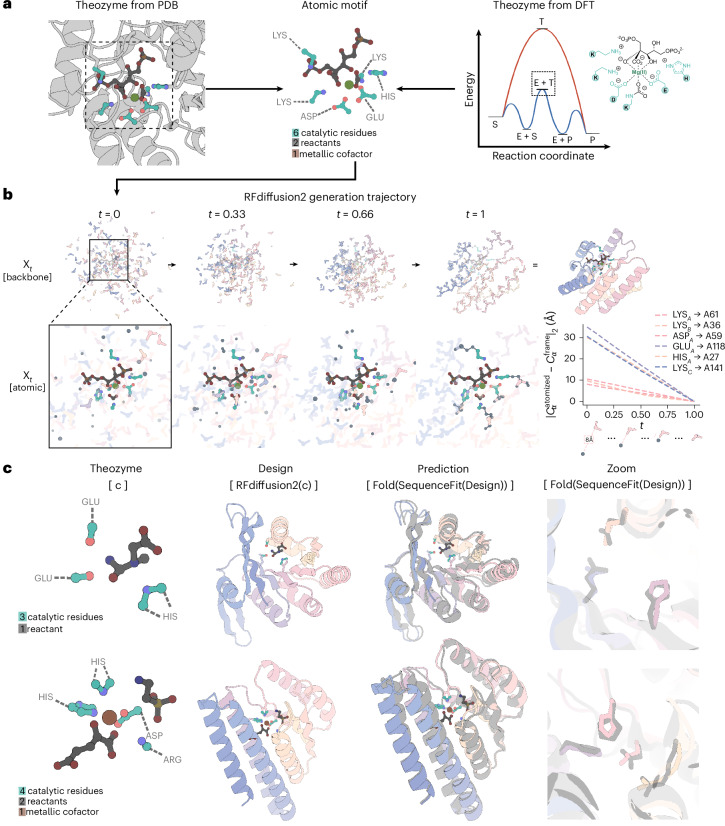
RFdiffusion2 is a flow-matching generative model that scaffolds atom-level enzyme active sites directly from theozyme functional-group geometries without prespecified residue indices or inverse rotamer sampling. It solved all 41 AME benchmark cases versus 16 for RFdiffusion and yielded experimentally active designed enzymes for multiple reactions after screening fewer than 96 sequences per case.
Key findings
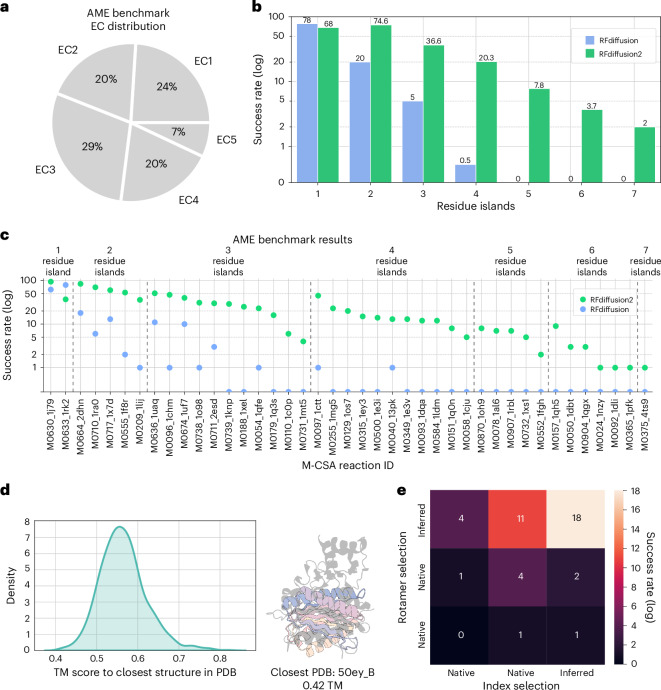
- On the new AME benchmark of 41 active sites spanning EC classes 1–5, RFdiffusion2 found at least one in silico success for 41/41 cases, compared with 16/41 for RFdiffusion, and outperformed RFdiffusion on 40/41 cases.
- Inferring both rotamer and sequence index gave the best performance; naive inverse rotamer and index sampling failed at four residue islands, achieving no in silico successes.
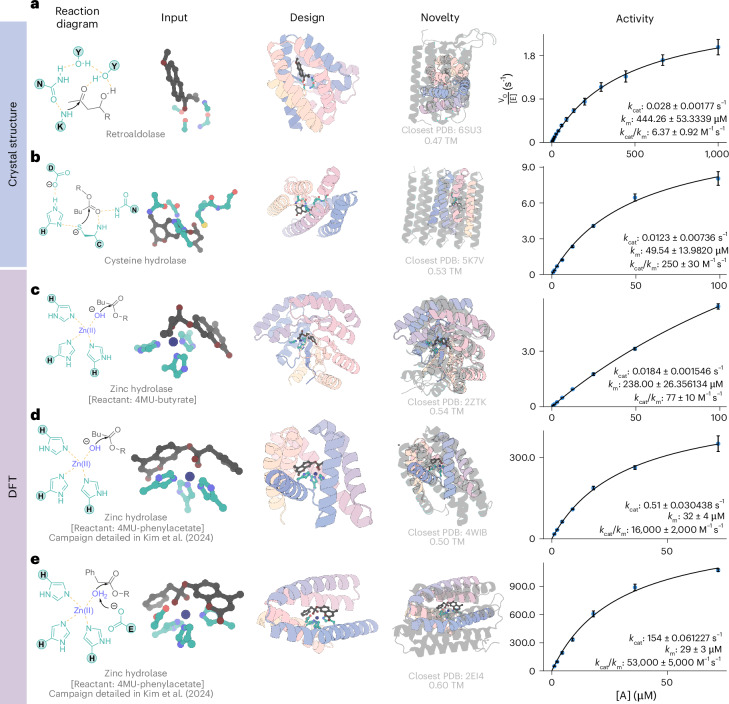
- Experimental campaigns found active enzymes while testing fewer than 96 designs per case: a retroaldolase with kcat/KM = 6.34 ± 0.92 M−1s−1, a cysteine hydrolase with kcat/KM = 248 ± 34 M−1s−1, and zinc hydrolases with kcat/KM = 77 ± 10, 16,000 ± 2,000, and 53,000 ± 5,000 M−1s−1.
- Successful designs were structurally novel: most successful in silico designs had closest-PDB TM scores between 0.5 and 0.6, with representative experimental designs showing TM scores of 0.47–0.60 to their closest PDB structures.
Methods
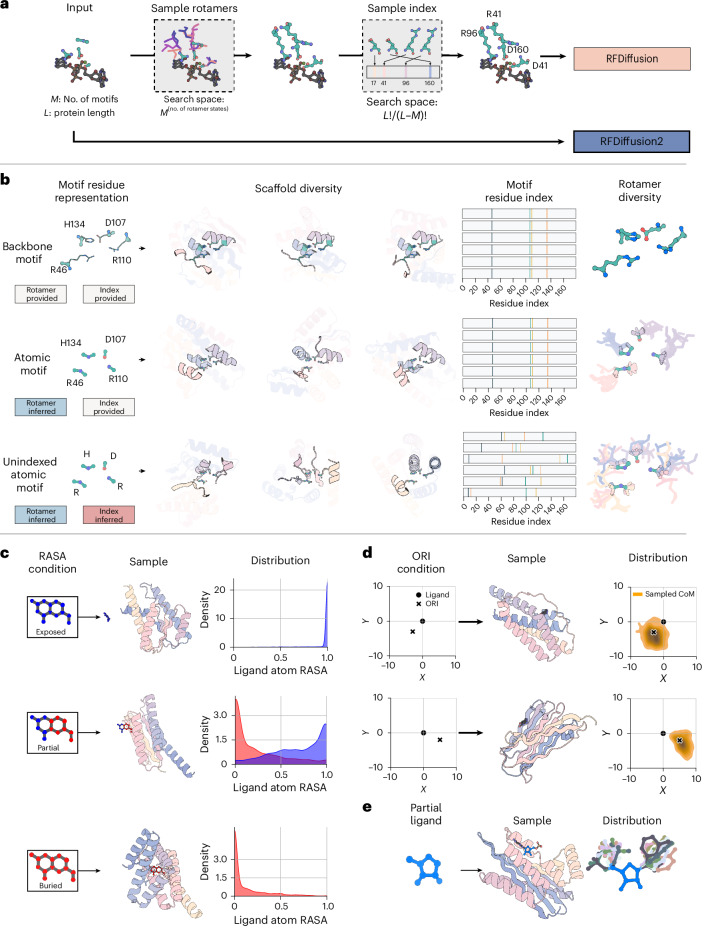
- RFdiffusion2 extends the RoseTTAFold All-Atom architecture with atomic and unindexed motif conditioning and is trained with a flow-matching objective on PDB biomolecular structures, including protein–small-molecule, protein–metal, and covalently modified protein complexes; training used 24 A100 Nvidia GPUs for 17 days.
- The AME benchmark was curated from M-CSA active sites cross-referenced with PARITY, yielding 41 cases; for each case, 100 backbones were generated, eight sequences were assigned with LigandMPNN, and structures were refolded with Chai-1, with in silico success defined as catalytic-residue heavy-atom RMSD <1.5 Å for at least one sequence and no ligand clashes within 1.5 Å.
- Experimental designs used input theozymes from native crystal structures or DFT-computed transition-state geometries, followed by RFdiffusion2 scaffolding, LigandMPNN sequence assignment, structure-prediction filtering, and Michaelis–Menten kinetics after testing fewer than 96 designs per case.
Limitations
- The paper states that RFdiffusion2-designed enzymes are not as active as native enzymes, that theozymes may not capture all interactions needed for high activity, and that the AME benchmark is limited to PDB motifs derived from native M-CSA annotations and does not measure enzymes with multiple transition states.
- Evident from the text: in silico success is a structural criterion (catalytic heavy-atom RMSD and clash filters), and the paper notes that scaffolding these atoms does not necessarily generate catalytically proficient enzymes; experimental validation covers only a small number of reactions/cases.
Model-written summary. Check it against the paper before relying on it.
Integrity signals
Registry
Cites
Statistics
Figures
Verification
Claims the paper makes
0 Valid · 0 Not valid · 14 Not checked · 57 Own results and interpretations
A result the paper reports from its own data — it cites no other source for it, so there is none to check. The quote shows it is in the paper.
In the paper
“We find the difficulty of a benchmark case correlates with the complexity of the motif, which we quantify with the number of ‘residue islands’, the number of contiguous segments of catalytic residues in the original PDB structure.”
§ Atom-level enzyme active site scaffolding using RFdiffusion2 > Results > AME benchmark
plainstates an associationn = 41- Asserted: passes — The authors put it forward as true.
- Checkable: passes — It can be checked against evidence.
- Load-bearing: unclear — It is unclear whether the paper’s conclusions depend on it.
- Based: passes — The paper gives a reason why it holds.
A result the paper reports from its own data — it cites no other source for it, so there is none to check. The quote shows it is in the paper.
In the paper
“RFdiffusion2 outperforms the prior state of the art methods on in silico benchmarks”
§ Atom-level enzyme active site scaffolding using RFdiffusion2 > Discussion
plainstates a cause- Asserted: passes — The authors put it forward as true.
- Checkable: passes — It can be checked against evidence.
- Load-bearing: passes — The paper’s conclusions depend on it.
- Based: passes — The paper gives a reason why it holds.
In the paper
“We tested activity of the in vitro transcription/translation-produced proteins using racemic Methodol as a substrate and found four variants that show detectable levels of retroaldolase activity in our semiquantitative assay40.”
§ Atom-level enzyme active site scaffolding using RFdiffusion2 > Results > In vitro experiments
What the sources say
- Not checked yetcites [40] Anishchenko, I. et al. Modeling protein-small molecule conformational ensembles with PLACER. Proc. Natl Acad. Sci.USA 122, e2427161122 (2025). 41187076 PMC12625923 source
plain- Asserted: passes — The authors put it forward as true.
- Checkable: passes — It can be checked against evidence.
- Load-bearing: passes — The paper’s conclusions depend on it.
- Based: passes — The paper gives a reason why it holds.
None of the sources cited for this claim have been checked yet.
In the paper
“higher than previously designed zinc hydrolases50,51.”
§ Atom-level enzyme active site scaffolding using RFdiffusion2 > Results > In vitro experiments
What the sources say
- Not checked yetcites [50] Hoffnagle, A. M. & Tezcan, F. A. Atomically accurate design of metalloproteins with predefined coordination geometries. J. Am. Chem. Soc. 145, 14208–14214 (2023). 37352018 PMC10439731 source
- Not checked yetcites [51] Der, B. S. et al. Metal-mediated affinity and orientation specificity in a computationally designed protein homodimer. J. Am. Chem. Soc. 134, 375–385 (2012). 22092237 PMC3257401 source
plain- Asserted: passes — The authors put it forward as true.
- Checkable: passes — It can be checked against evidence.
- Load-bearing: passes — The paper’s conclusions depend on it.
- Based: passes — The paper gives a reason why it holds.
A result the paper reports from its own data — it cites no other source for it, so there is none to check. The quote shows it is in the paper.
In the paper
“the best design shown exhibited multiple turnover activity with a kcat/KM of 248 ± 34 M−1s−1 for the acylation step”
§ Atom-level enzyme active site scaffolding using RFdiffusion2 > Results > In vitro experiments
plainSingle case- Asserted: passes — The authors put it forward as true.
- Checkable: passes — It can be checked against evidence.
- Load-bearing: passes — The paper’s conclusions depend on it.
- Based: passes — The paper gives a reason why it holds.
37 more claims
Create a free account to see all 71 claims and to verify the 30 references still open.
- It may state two separate claims as one. 22
- The quote only partly states this claim. 5
- Probably not a substantial claim. 3
Self-check
Percentages, sums and reported differences re-computed from the paper’s own numbers.
Each contradiction between two passages listed here was confirmed by an independent check.
Rated minor: it would not touch a result — a value no result rests on, a p-value that stays on the same side of the significance level, or a conflict that is clerical, resolved elsewhere in the paper, or outside its own findings.
In the paper
§ Atom-level enzyme active site scaffolding using RFdiffusion2 > Atomic motif conditioning
“We find RFdiffusion2 can, given partial ligand coordinates, sample physically realistic conformers for the entire ligand (Fig. 2d)”
§ Atom-level enzyme active site scaffolding using RFdiffusion2 > Atomic motif conditioning
“e, RFdiffusion2 can be provided with partial ligand input in which case it must sample the remaining ligand degrees of freedom while generating the protein.”
Citations
Cites
Adam: A Method for Stochastic Optimization
Kingma, D. P., & Ba, J. (2014) · arXiv · doi:10.48550/arxiv.1412.6980 · Cited by 98,946
Highly accurate protein structure prediction with AlphaFold
Jumper, J., Evans, R., Pritzel, A., Green, T., Figurnov, M., Ronneberger, O., Tunyasuvunakool, K., Bates, R., Žídek, A., Potapenko, A., et al. (2021) · Nature · doi:10.1038/s41586-021-03819-2 · Cited by 43,764 · cited 1×
“Directed evolution campaigns have demonstrated that a catalytic tetrad composed of a nucleophilic lysine enmeshed in a hydrogen-bonding network with two tyrosines and an asparagine can stabilize the transition states of this reaction [38].”
Berman, H. M. (2000) · Nucleic Acids Research · doi:10.1093/nar/28.1.235 · Cited by 40,196 · cited 1×
“Our training dataset consists of biomolecular structures from the Protein Data Bank (PDB) [27] that include proteins, protein–small molecule complexes, protein-metal complexes, and covalently modified proteins, filtering out common solvents and crystallization additives [19].”
Effect of the damping function in dispersion corrected density functional theory
Grimme, S., Ehrlich, S., & Goerigk, L. (2011) · Journal of Computational Chemistry · doi:10.1002/jcc.21759 · Cited by 28,221
Accurate structure prediction of biomolecular interactions with AlphaFold 3
Abramson, J., Adler, J., Dunger, J., Evans, R., Green, T., Pritzel, A., Ronneberger, O., Willmore, L., Ballard, A. J., Bambrick, J., et al. (2024) · Nature · doi:10.1038/s41586-024-07487-w · Cited by 15,861 · cited 2×
“Alternative neural network architectures such as Diffusion Transformers [51] and modules from AlphaFold3 [34] for all-atom tasks could improve RFdiffusion2 which uses the neural network architecture of RFAA.”
Denoising Diffusion Probabilistic Models
Ho, J., Jain, A., & Abbeel, P. (2020) · arXiv · doi:10.48550/arxiv.2006.11239 · Cited by 8,712
Evolutionary-scale prediction of atomic level protein structure with a language model
Lin, Z., Akin, H., Rao, R., Hie, B., Zhu, Z., Lu, W., Smetanin, N., Verkuil, R., Kabeli, O., Shmueli, Y., et al. (2022) · doi:10.1101/2022.07.20.500902 · Cited by 5,990
Protein production by auto-induction in high-density shaking cultures
Studier, F. W. (2005) · Protein Expression and Purification · doi:10.1016/j.pep.2005.01.016 · Cited by 5,931
Score-Based Generative Modeling through Stochastic Differential Equations
Song, Y. S., Sohl‐Dickstein, J., Kingma, D. P., Kumar, A., Ermon, S., & Poole, B. (2021) · International Conference on Learning Representations · Cited by 4,981
De novo design of protein structure and function with RFdiffusion
Watson, J. L., Juergens, D., Bennett, N. R., Trippe, B. L., Yim, J., Eisenach, H. E., Ahern, W., Borst, A. J., Ragotte, R. J., Milles, L. F., et al. (2023) · Nature · doi:10.1038/s41586-023-06415-8 · Cited by 3,506
Self-citationDegradation rates of plastics in the environment
Chamas, A., Moon, H., Zheng, J., Qiu, Y., Tabassum, T., Jang, J. H., Abu-Omar, M., Scott, S. L., & Suh, S. (2020) · ACS Sustainable Chemistry & Engineering · doi:10.1021/acssuschemeng.9b06635 · Cited by 3,463 · cited 1×
“Harnessing this mechanism for arbitrary substrates would enable the design of de novo enzymes capable of hydrolyzing environmental pollutants with long half-lives [46, 47].”
Fast and accurate protein structure search with Foldseek
van Kempen, M., Kim, S. S., Tumescheit, C., Mirdita, M., Lee, J., Gilchrist, C. L. M., Söding, J., & Steinegger, M. (2022) · doi:10.1101/2022.02.07.479398 · Cited by 2,598
Fast and accurate protein structure search with Foldseek
van Kempen, M., Kim, S. S., Tumescheit, C., Mirdita, M., Lee, J., Gilchrist, C. L. M., Söding, J., & Steinegger, M. (2024) · Nature Biotechnology · doi:10.1038/s41587-023-01773-0 · Cited by 2,596 · cited 1×
“The successful designs from RFdiffusion2 are quite different from any protein in the training set as measured by FoldSeek [36] and TM-score [37](Figure 3D).”
Scoring function for automated assessment of protein structure template quality
Zhang, Y., & Skolnick, J. (2004) · Proteins: Structure, Function, and Bioinformatics · doi:10.1002/prot.20264 · Cited by 2,392 · cited 1×
“The successful designs from RFdiffusion2 are quite different from any protein in the training set as measured by FoldSeek [36] and TM-score [37](Figure 3D).”
MDTraj: A Modern Open Library for the Analysis of Molecular Dynamics Trajectories
McGibbon, R. T., Beauchamp, K. A., Harrigan, M. P., Klein, C., Swails, J. M., Hernández, C. X., Schwantes, C. R., Wang, L.-P., Lane, T. J., & Pande, V. S. (2015) · Biophysical Journal · doi:10.1016/j.bpj.2015.08.015 · Cited by 2,373
Watson, J. L., Juergens, D., Bennett, N. R., Trippe, B. L., Yim, J., Eisenach, H. E., Ahern, W., Borst, A. J., Ragotte, R. J., Milles, L. F., et al. (2022) · doi:10.1101/2022.12.09.519842 · Cited by 2,369
Self-citationScalable Diffusion Models with Transformers
Peebles, W., & Xie, S. (2023) · 2023 IEEE/CVF International Conference on Computer Vision (ICCV) · doi:10.1109/iccv51070.2023.00387 · Cited by 2,284
Scalable Diffusion Models with Transformers
Peebles, W., & Xie, S. (2022) · arXiv · doi:10.48550/arxiv.2212.09748 · Cited by 2,284
Score-Based Generative Modeling through Stochastic Differential Equations
Song, Y., Sohl-Dickstein, J., Kingma, D. P., Kumar, A., Ermon, S., & Poole, B. (2020) · arXiv · doi:10.48550/arxiv.2011.13456 · Cited by 1,953 · cited 1×
“A method capable of scaffolding complex theozymes described at the atom level would have wide-spread applications for enzyme design and beyond [16–18].”
Extended tight‐binding quantum chemistry methods
Bannwarth, C., Caldeweyher, E., Ehlert, S., Hansen, A., Pracht, P., Seibert, J., Spicher, S., & Grimme, S. (2021) · WIREs Computational Molecular Science · doi:10.1002/wcms.1493 · Cited by 1,662
Environment and exposure to solvent of protein atoms. Lysozyme and insulin
Shrake, A., & Rupley, J. A. (1973) · Journal of Molecular Biology · doi:10.1016/0022-2836(73)90011-9 · Cited by 1,375 · cited 1×
“With RFdiffusion2, we set out to extend RosettaFold diffusion All-Atom (RFdiffusionAA) [19] to generate structures conditioned on these minimal active site descriptions (Figure 1).”
Chemical and biological catalysis for plastics recycling and upcycling
Ellis, L. D., Rorrer, N. A., Sullivan, K. P., Otto, M., McGeehan, J. E., Román-Leshkov, Y., Wierckx, N., & Beckham, G. T. (2021) · Nature Catalysis · doi:10.1038/s41929-021-00648-4 · Cited by 1,201 · cited 1×
“Harnessing this mechanism for arbitrary substrates would enable the design of de novo enzymes capable of hydrolyzing environmental pollutants with long half-lives [46, 47].”
De Novo Computational Design of Retro-Aldol Enzymes
Jiang, L., Althoff, E. A., Clemente, F. R., Doyle, L., Röthlisberger, D., Zanghellini, A., Gallaher, J. L., Betker, J. L., Tanaka, F., Barbas, C. F., et al. (2008) · Science · doi:10.1126/science.1152692 · Cited by 1,174 · cited 1×
“To our knowledge, RFdiffusion is the only deep learning method that has been shown to successfully design de novo enzymes [1, 2].”
Self-citationGeneralized biomolecular modeling and design with RoseTTAFold All-Atom
Krishna, R., Wang, J., Ahern, W., Sturmfels, P., Venkatesh, P., Kalvet, I., Lee, G. R., Morey-Burrows, F. S., Anishchenko, I., Humphreys, I. R., et al. (2024) · Science · doi:10.1126/science.adl2528 · Cited by 978 · cited 3×
“With RFdiffusion2, we set out to extend RosettaFold diffusion All-Atom (RFdiffusionAA) [19] to generate structures conditioned on these minimal active site descriptions (Figure 1).”
Self-citationSiT: Exploring Flow and Diffusion-Based Generative Models with Scalable Interpolant Transformers
Ma, N., Goldstein, M., Albergo, M. S., Boffi, N. M., Vanden-Eijnden, E., & Xie, S. (2024) · Lecture notes in computer science · doi:10.1007/978-3-031-72980-5_2 · Cited by 932
Macromolecular modeling and design in Rosetta: recent methods and frameworks
Leman, J. K., Weitzner, B. D., Lewis, S. M., Adolf-Bryfogle, J., Alam, N., Alford, R. F., Aprahamian, M., Baker, D., Barlow, K. A., Barth, P., et al. (2020) · Nature Methods · doi:10.1038/s41592-020-0848-2 · Cited by 888
Self-citationBoltz-1 Democratizing Biomolecular Interaction Modeling
Wohlwend, J., Corso, G., Passaro, S., Getz, N., Reveiz, M., Leidal, K., Swiderski, W., Atkinson, L., Portnoi, T., Chinn, I., et al. (2024) · bioRxiv (Cold Spring Harbor Laboratory) · doi:10.1101/2024.11.19.624167 · Cited by 815
Self-citationEMERGING ROLES FOR CYSTEINE PROTEASES IN HUMAN BIOLOGY
Chapman, H. A., Riese, R. J., & Shi, G.-P. (1997) · Annual Review of Physiology · doi:10.1146/annurev.physiol.59.1.63 · Cited by 786 · cited 1×
“Enzymes which catalyze ester hydrolysis perform many cellular functions [40] and have numerous industrial applications [41, 42].”
From nature to industry: Harnessing enzymes for biocatalysis
Buller, R., Lutz, S., Kazlauskas, R. J., Snajdrova, R., Moore, J. C., & Bornscheuer, U. T. (2023) · Science · doi:10.1126/science.adh8615 · Cited by 706
The Strep-tag system for one-step purification and high-affinity detection or capturing of proteins
Schmidt, T. G., & Skerra, A. (2007) · Nature Protocols · doi:10.1038/nprot.2007.209 · Cited by 631
Flow Matching Guide and CodePreprint
Lipman, Y., Havasi, M., Holderrieth, P., Shaul, N., Le, M., Karrer, B., Chen, R. T. Q., López-Paz, D., Ben-Hamu, H., & Gat, I. (2024) · arXiv (Cornell University) · doi:10.48550/arxiv.2412.06264 · Cited by 562
Chai-1: Decoding the molecular interactions of life
Discovery, C., Boitreaud, J., Dent, J., McPartlon, M., Meier, J., Reis, V., Rogozhnikov, A., & Wu, K. (2024) · doi:10.1101/2024.10.10.615955 · Cited by 517
Maximum Allowed Solvent Accessibilites of Residues in Proteins
Tien, M. Z., Meyer, A. G., Sydykova, D. K., Spielman, S. J., & Wilke, C. O. (2013) · PLoS ONE · doi:10.1371/journal.pone.0080635 · Cited by 511 · cited 1×
“Lastly, for any ligand present, we sample a random connected subgraph of its heavy atoms to be provided as a motif with Relative Accessible Surface Area (RASA) [28] labels for each atom in the ligand intermittently provided.”
Scaffolding protein functional sites using deep learning
Wang, J., Lisanza, S., Juergens, D., Tischer, D., Watson, J. L., Castro, K. M., Ragotte, R., Saragovi, A., Milles, L. F., Baek, M., et al. (2022) · Science · doi:10.1126/science.abn2100 · Cited by 487
Self-citationDeep learning methods for designing proteins scaffolding functional sites
Wang, J., Lisanza, S., Juergens, D., Tischer, D., Anishchenko, I., Baek, M., Watson, J. L., Chun, J. H., Milles, L. F., Dauparas, J., et al. (2021) · doi:10.1101/2021.11.10.468128 · Cited by 487
Self-citationDe novo design of luciferases using deep learning
Yeh, A. H.-W., Norn, C., Kipnis, Y., Tischer, D., Pellock, S. J., Evans, D., Ma, P., Lee, G. R., Zhang, J. Z., Anishchenko, I., et al. (2023) · Nature · doi:10.1038/s41586-023-05696-3 · Cited by 441 · cited 1×
“Pre-deep learning methods such as RosettaMatch searched through sets of already existing native or designed [6] scaffolds for possible placements of the catalytic residues.”
Self-citationCampbell, A., Yim, J., Barzilay, R., Rainforth, T., & Jaakkola, T. (2024) · arXiv (Cornell University) · doi:10.48550/arxiv.2402.04997 · Cited by 429 · cited 1×
“Finally, we expect that co-designing the protein sequence [13] and side chains [52] outside the active site could lead to more favorable pocket interactions with the substrate and potentially enable sequence-based guidance based on experimental kinetics data.”
Self-citationAlternate States of Proteins Revealed by Detailed Energy Landscape Mapping
Tyka, M. D., Keedy, D. A., André, I., DiMaio, F., Song, Y., Richardson, D. C., Richardson, J. S., & Baker, D. (2011) · Journal of Molecular Biology · doi:10.1016/j.jmb.2010.11.008 · Cited by 410
Self-citationNew algorithms and an in silico benchmark for computational enzyme design
Zanghellini, A., Jiang, L., Wollacott, A. M., Cheng, G., Meiler, J., Althoff, E. A., Röthlisberger, D., & Baker, D. (2006) · Protein Science · doi:10.1110/ps.062353106 · Cited by 359 · cited 2×
“This ability to condition on individual atoms rather than entire residues allows us to forgo inverse rotamer sampling [7] used in previous approaches and instead allow the model to simultaneously infer an appropriate rotamer and scaffold.”
Self-citationThe road to fully programmable protein catalysis
Lovelock, S. L., Crawshaw, R., Basler, S., Levy, C., Baker, D., Hilvert, D., & Green, A. P. (2022) · Nature · doi:10.1038/s41586-022-04456-z · Cited by 343 · cited 1×
“This active site description, called a theozyme, describes placement of protein functional groups around the reaction transition state(s) and any reaction cofactors [4, 5].”
Self-citationEmergence of a catalytic tetrad during evolution of a highly active artificial aldolase
Obexer, R., Godina, A., Garrabou, X., Mittl, P. R. E., Baker, D., Griffiths, A. D., & Hilvert, D. (2017) · Nature Chemistry · doi:10.1038/nchem.2596 · Cited by 312 · cited 2×
“Directed evolution campaigns have demonstrated that a catalytic tetrad composed of a nucleophilic lysine enmeshed in a hydrogen-bonding network with two tyrosines and an asparagine can stabilize the transition states of this reaction [38].”
Self-citationAtomic context-conditioned protein sequence design using LigandMPNN
Dauparas, J., Lee, G. R., Pecoraro, R., An, L., Anishchenko, I., Glasscock, C., & Baker, D. (2025) · Nature Methods · doi:10.1038/s41592-025-02626-1 · Cited by 279 · cited 1×
“We assign 8 sequences to each structure with LigandMPNN [32], conditioned on the backbone, catalytic residue sidechain, and ligand coordinates.”
Self-citationHallucinating symmetric protein assemblies
Wicky, B. I. M., Milles, L. F., Courbet, A., Ragotte, R. J., Dauparas, J., Kinfu, E., Tipps, S., Kibler, R. D., Baek, M., DiMaio, F., et al. (2022) · Science · doi:10.1126/science.add1964 · Cited by 240
Self-citationTrends and innovations in industrial biocatalysis for the production of fine chemicals
Panke, S., Held, M., & Wubbolts, M. (2004) · Current Opinion in Biotechnology · doi:10.1016/j.copbio.2004.06.011 · Cited by 239 · cited 1×
“Enzymes which catalyze ester hydrolysis perform many cellular functions [40] and have numerous industrial applications [41, 42].”
Computational design of serine hydrolases
Lauko, A., Pellock, S. J., Sumida, K. H., Anishchenko, I., Juergens, D., Ahern, W., Jeung, J., Shida, A. F., Hunt, A., Kalvet, I., et al. (2025) · Science · doi:10.1126/science.adu2454 · Cited by 235 · cited 3×
“To our knowledge, RFdiffusion is the only deep learning method that has been shown to successfully design de novo enzymes [1, 2].”
Self-citationRibeiro, A. J. M., Holliday, G. L., Furnham, N., Tyzack, J. D., Ferris, K., & Thornton, J. M. (2018) · Nucleic Acids Research · doi:10.1093/nar/gkx1012 · Cited by 235 · cited 1×
“An in silico enzyme motif scaffolding benchmark was introduced in RFdiffusion [12, 29] which contained one active site from each of the five most represented Enzyme Commission (EC) classes in the Mechanism and Catalytic Site Atlas (M-CSA) [30].”
Fast protein backbone generation with SE(3) flow matchingPreprint
Yim, J., Campbell, A., Foong, A. Y. K., Gastegger, M., Jiménez-Luna, J., Lewis, S., Satorras, V. G., Veeling, B. S., Barzilay, R., Jaakkola, T., et al. (2023) · arXiv · doi:10.48550/arxiv.2310.05297 · Cited by 206 · cited 1×
“With RFdiffusion2, we set out to extend RosettaFold diffusion All-Atom (RFdiffusionAA) [19] to generate structures conditioned on these minimal active site descriptions (Figure 1).”
Self-citationHoly Grails for Computational Organic Chemistry and Biochemistry
Houk, K. N., & Liu, F. (2017) · Accounts of Chemical Research · doi:10.1021/acs.accounts.6b00532 · Cited by 204 · cited 1×
“A method capable of scaffolding complex theozymes described at the atom level would have wide-spread applications for enzyme design and beyond [16–18].”
Robust design and optimization of retroaldol enzymes
Althoff, E. A., Wang, L., Jiang, L., Giger, L., Lassila, J. K., Wang, Z., Smith, M. D., Hari, S. B., Kast, P., Herschlag, D., et al. (2012) · Protein Science · doi:10.1002/pro.2059 · Cited by 203
Self-citationFlow Matching for Generative Modeling
Lipman, Y., Chen, R. T. Q., Ben-Hamu, H., Nickel, M., & Le, M. (2022) · arXiv · doi:10.48550/arxiv.2210.02747 · Cited by 192 · cited 1×
“With RFdiffusion2, we set out to extend RosettaFold diffusion All-Atom (RFdiffusionAA) [19] to generate structures conditioned on these minimal active site descriptions (Figure 1).”
Computational Design of Catalytic Dyads and Oxyanion Holes for Ester Hydrolysis
Richter, F., Blomberg, R., Khare, S. D., Kiss, G., Kuzin, A. P., Smith, A. J. T., Gallaher, J., Pianowski, Z., Helgeson, R. C., Grjasnow, A., et al. (2012) · Journal of the American Chemical Society · doi:10.1021/ja3037367 · Cited by 168 · cited 1×
“…the 48 designs that were screened experimentally, several displayed detectable activity (Figure 16A); the best design shown exhibited multiple turnover activity with a k cat /K M of 248 ± 34 M − 1 s − 1 for the acylation step, exceeding previous results [45] for the same leaving group (Figure 4B).”
Self-citationBuller, A. R., & Townsend, C. A. (2013) · Proceedings of the National Academy of Sciences · doi:10.1073/pnas.1221050110 · Cited by 166
Efficient and accurate prediction of protein structure using RoseTTAFold2
Baek, M., Anishchenko, I., Humphreys, I. R., Cong, Q., Baker, D., & DiMaio, F. (2023) · bioRxiv (Cold Spring Harbor Laboratory) · doi:10.1101/2023.05.24.542179 · Cited by 155
Self-citationScaling Rectified Flow Transformers for High-Resolution Image Synthesis
Esser, P., Kulal, S., Blattmann, A., Entezari, R., Müller, J., Saini, H., Levi, Y., Lorenz, D., Sauer, A., Boesel, F., et al. (2024) · arXiv · doi:10.48550/arxiv.2403.03206 · Cited by 140 · cited 1×
“With RFdiffusion2, we set out to extend RosettaFold diffusion All-Atom (RFdiffusionAA) [19] to generate structures conditioned on these minimal active site descriptions (Figure 1).”
Protenix - Advancing Structure Prediction Through a Comprehensive AlphaFold3 Reproduction
ByteDance AML AI4Science Team, Chen, X., Zhang, Y., Lu, C., Ma, W., Guan, J., Gong, C., Yang, J., Zhang, H., Zhang, K., et al. (2025) · bioRxiv (Cold Spring Harbor Laboratory) · doi:10.1101/2025.01.08.631967 · Cited by 128
Flow Straight and Fast: Learning to Generate and Transfer Data with Rectified Flow
Liu, X., Gong, C., & Liu, Q. (2022) · arXiv · doi:10.48550/arxiv.2209.03003 · Cited by 124 · cited 1×
“With RFdiffusion2, we set out to extend RosettaFold diffusion All-Atom (RFdiffusionAA) [19] to generate structures conditioned on these minimal active site descriptions (Figure 1).”
Building Enzymes through Design and Evolution
Hossack, E. J., Hardy, F. J., & Green, A. P. (2023) · ACS Catalysis · doi:10.1021/acscatal.3c02746 · Cited by 112 · cited 1×
“This active site description, called a theozyme, describes placement of protein functional groups around the reaction transition state(s) and any reaction cofactors [4, 5].”
Metal-Mediated Affinity and Orientation Specificity in a Computationally Designed Protein Homodimer
Der, B. S., Machius, M., Miley, M. J., Mills, J. L., Szyperski, T., & Kuhlman, B. (2012) · Journal of the American Chemical Society · doi:10.1021/ja208015j · Cited by 111 · cited 1×
“We found the best enzyme for the 4MU-B reactant had a k cat /K M of 77 ± 10 M − 1 s − 1 , higher than previously designed zinc hydrolases [48, 49].”
Computational design of metallohydrolases
Kim, D., Woodbury, S. M., Ahern, W., Tischer, D., Kang, A., Joyce, E., Bera, A. K., Hanikel, N., Salike, S., Krishna, R., et al. (2025) · Nature · doi:10.1038/s41586-025-09746-w · Cited by 109 · cited 2×
“The rotamer and sequence indices are sampled during the RFdiffusion2 trajectories, increasing the diversity of possible solutions to the motif scaffolding problem.”
Self-citationEngineered enzymes for improved organic synthesis
Hult, K., & Berglund, P. (2003) · Current Opinion in Biotechnology · doi:10.1016/s0958-1669(03)00095-8 · Cited by 107
Analog Bits: Generating Discrete Data using Diffusion Models with Self-Conditioning
Chen, T., Zhang, R., & Hinton, G. (2022) · arXiv · doi:10.48550/arxiv.2208.04202 · Cited by 97 · cited 1×
“With RFdiffusion2, we set out to extend RosettaFold diffusion All-Atom (RFdiffusionAA) [19] to generate structures conditioned on these minimal active site descriptions (Figure 1).”
Catalyzing the future: recent advances in chemical synthesis using enzymes
Reisenbauer, J. C., Sicinski, K. M., & Arnold, F. H. (2024) · Current Opinion in Chemical Biology · doi:10.1016/j.cbpa.2024.102536 · Cited by 96 · cited 1×
“A method capable of scaffolding complex theozymes described at the atom level would have wide-spread applications for enzyme design and beyond [16–18].”
An all-atom protein generative model
Chu, A. E., Kim, J., Cheng, L., El Nesr, G., Xu, M., Shuai, R. W., & Huang, P.-S. (2024) · Proceedings of the National Academy of Sciences · doi:10.1073/pnas.2311500121 · Cited by 88 · cited 1×
“Finally, we expect that co-designing the protein sequence [13] and side chains [52] outside the active site could lead to more favorable pocket interactions with the substrate and potentially enable sequence-based guidance based on experimental kinetics data.”
Lin, Y., Lee, M., Zhang, Z., & AlQuraishi, M. (2024) · arXiv (Cornell University) · doi:10.48550/arxiv.2405.15489 · Cited by 87
Improved motif-scaffolding with SE(3) flow matching
Yim, J., Campbell, A., Mathieu, É., Foong, A. Y. K., Gastegger, M., Jiménez-Luna, J., Lewis, S., Satorras, V. G., Veeling, B. S., Noé, F., et al. (2024) · Transactions on machine learning research · doi:10.48550/arxiv.2401.04082 · Cited by 78
Self-citationComputational enzyme design by catalytic motif scaffolding
Braun, M., Tripp, A., Chakatok, M., Kaltenbrunner, S., Fischer, C., Stoll, D., Bijelic, A., Elaily, W., Totaro, M. G., Moser, M., et al. (2026) · Nature · doi:10.1038/s41586-025-09747-9 · Cited by 73
Computational enzyme design by catalytic motif scaffolding
Braun, M., Tripp, A., Chakatok, M., Kaltenbrunner, S., Fischer, C., Stoll, D., Bijelic, A., Elaily, W., Totaro, M. G., Moser, M., et al. (2024) · doi:10.1101/2024.08.02.606416 · Cited by 73
Structure of monoclinic papain at 1.60 Å resolution
Pickersgill, R. W., Harris, G. W., & Garman, E. F. (1992) · Acta Crystallographica Section B Structural Science · doi:10.1107/s0108768191006572 · Cited by 72 · cited 1×
“We took the relative positions of these atoms from the crystal structure of a Papaya cysteine hydrolase (PDB: 1PPN [43]), and oriented a conformer of our reactant (4MU-Butyrate) according to the known optimal geometries for nucleophilic attack by the cysteine, proton donation by the histidine, and…”
Modeling protein–small molecule conformational ensembles with PLACER
Anishchenko, I., Kipnis, Y., Kalvet, I., Zhou, G., Krishna, R., Pellock, S. J., Lauko, A., Lee, G. R., An, L., Dauparas, J., et al. (2025) · Proceedings of the National Academy of Sciences · doi:10.1073/pnas.2427161122 · Cited by 37 · cited 1×
“( right) The distances between the C α coordinates of the unindexed, atomized residues and the backbone residues they superimpose at t = 1.”
Self-citationHarris, G. W., Pickersgill, R. W., Howlin, B. J., & Moss, D. S. (1992) · Acta Crystallographica Section B Structural Science · doi:10.1107/s0108768191006663 · Cited by 34
Stochastic Interpolants: A Unifying Framework for Flows and Diffusions
Albergo, M. S., Boffi, N. M., & Vanden-Eijnden, E. (2023) · arXiv · doi:10.48550/arxiv.2303.08797 · Cited by 32 · cited 2×
“A method capable of scaffolding complex theozymes described at the atom level would have wide-spread applications for enzyme design and beyond [16–18].”
Atomically Accurate Design of Metalloproteins with Predefined Coordination Geometries
Hoffnagle, A. M., & Tezcan, F. A. (2023) · Journal of the American Chemical Society · doi:10.1021/jacs.3c04047 · Cited by 29 · cited 1×
“We found the best enzyme for the 4MU-B reactant had a k cat /K M of 77 ± 10 M − 1 s − 1 , higher than previously designed zinc hydrolases [48, 49].”
Design and optimization of enzymatic activity in a de novo β‐barrel scaffold
Kipnis, Y., Chaib, A. O., Vorobieva, A. A., Cai, G., Reggiano, G., Basanta, B., Kumar, E., Mittl, P. R. E., Hilvert, D., & Baker, D. A. (2022) · Protein Science · doi:10.1002/pro.4405 · Cited by 29
Self-citationRanking Enzyme Structures in the PDB by Bound Ligand Similarity to Biological Substrates
Tyzack, J. D., Fernando, L., Ribeiro, A. J. M., Borkakoti, N., & Thornton, J. M. (2018) · Structure · doi:10.1016/j.str.2018.02.009 · Cited by 22 · cited 1×
“We cross referenced the 958 hand-curated catalytic active sites downloaded from the M-CSA with the Proportion of Atoms Residing In Identical Topology (PARITY) [31] dataset and selected reactions with PDB crystal structures where all reactants and cofactors were present.”
MotifBench: A standardized protein design benchmark for motif-scaffolding problemsPreprint
Zheng, Z., Zhang, B., Didi, K., Yang, K., Yim, J., Watson, J. L., Chen, H., & Trippe, B. L. (2025) · arXiv (Cornell University) · doi:10.48550/arxiv.2502.12479 · Cited by 18 · cited 2×
“An in silico enzyme motif scaffolding benchmark was introduced in RFdiffusion [12, 29] which contained one active site from each of the five most represented Enzyme Commission (EC) classes in the Mechanism and Catalytic Site Atlas (M-CSA) [30].”
Self-citationSequence-Augmented SE(3)-Flow Matching For Conditional Protein Backbone Generation
Huguet, G., Vuckovic, J., Fatras, K., Thibodeau-Laufer, E., Lemos, P., Islam, R., Liu, C.-H., Rector-Brooks, J., Akhound-Sadegh, T., Bronstein, M., et al. (2024) · arXiv · doi:10.48550/arxiv.2405.20313 · cited 2×
“With RFdiffusion2, we set out to extend RosettaFold diffusion All-Atom (RFdiffusionAA) [19] to generate structures conditioned on these minimal active site descriptions (Figure 1).”
Research works printed but not linked: 1
- Chen, R. T. & Lipman, Y. Flow matching on general geometries. In International Conference on Learning Representations (2024).
Cited by
BoltzGen: Toward Universal Binder DesignPreprint
Stark, H., Faltings, F., Choi, M., Xie, Y., Hur, E., O’Donnell, T. J., Bushuiev, A., Uçar, T., Passaro, S., Mao, W., et al. (2025) · bioRxiv (Cold Spring Harbor Laboratory) · doi:10.1101/2025.11.20.689494 · Cited by 231
Self-citationDe novo Design of All-atom Biomolecular Interactions with RFdiffusion3Preprint
Butcher, J., Krishna, R., Mitra, R., Brent, R. I., Li, Y., Corley, N., Kim, P. T., Funk, J., Mathis, S. V., Salike, S., et al. (2025) · bioRxiv (Cold Spring Harbor Laboratory) · doi:10.1101/2025.09.18.676967 · Cited by 168
“RFD3 outperforms previous methods [1, 2, 3] in silico on a wide range of protein-protein binding, protein-DNA binding, protein-small molecule binding, and enzyme design tasks, at a fraction of the compute cost.”
InfluentialSelf-citationKoh, H. Y., Zheng, Y., Yang, M., Arora, R., Webb, G. I., Pan, S., Li, L., & Church, G. M. (2025) · Nature Reviews Bioengineering · doi:10.1038/s44222-025-00349-8 · Cited by 152
Computational design of metallohydrolases
Kim, D., Woodbury, S. M., Ahern, W., Tischer, D., Kang, A., Joyce, E., Bera, A. K., Hanikel, N., Salike, S., Krishna, R., et al. (2025) · Nature · doi:10.1038/s41586-025-09746-w · Cited by 109
“To enable sequence-position and side-chain rotamer-agnostic enzyme design, we developed a generative artificial intelligence flow-matching model called RFdiffusion2 30 .”
Self-citationLa-Proteina: Atomistic Protein Generation via Partially Latent Flow Matching
Geffner, T., Didi, K., Cao, Z., Reidenbach, D., Zhang, Z., Dallago, C., Küçükbenli, E., Kreis, K., & Vahdat, A. (2026) · International Conference on Learning Representations · doi:10.48550/arxiv.2507.09466 · Cited by 76
“A similar effect was observed by concurrent work [20, 2].”
Metadata
- Authors
- Ahern, W., Yim, J., Tischer, D., Salike, S., Woodbury, S. M., Kim, D., Kalvet, I., Kipnis, Y., Coventry, B., Altae-Tran, H. R., Bauer, M. S., Barzilay, R., Jaakkola, T. S., Krishna, R., & Baker, D.
- Affiliations
- University of Washington (US)
- MIT Computer Science and Artificial Intelligence Laboratory (US)
- Howard Hughes Medical Institute (US)
- Corresponding author
- Krishna, Rohith
- Baker, David
- ORCID
- Venue
- Nature Methods
- Published
- 2025-12-03
- Volume
- 23
- Issue
- 1
- Pages
- 96-105
- ISSN
- 1548-7091 (ISSN-L)
- 1548-7105
- PMC
- PMC12791007
- OpenAlex
- W4416955829
- Cited by
- 229
- References
- 71
- Citations by year
- 2026: 185 · 2025: 44
- FWCI
- 43.03
- Type
- journal article
- Language
- en
- Open access
- hybrid
- doi.org
- Licence
- cc-by-nc-nd
- creativecommons.org/licenses/by-nc-nd/4.0 (tdm)
- creativecommons.org/licenses/by-nc-nd/4.0 (vor)
- Locations
- Nature Methods (publishedVersion, cc-by-nc-nd)
- bioRxiv (Cold Spring Harbor Laboratory) (submittedVersion, cc-by)
- Europe PMC (PubMed Central) (publishedVersion, cc-by-nc-nd)
- PubMed Central (publishedVersion, cc-by-nc-nd)
- PubMed (publishedVersion)
- Funders
- National Science Foundation (1918839, 2141064, DGE-214-0004, 2140004)
- Howard Hughes Medical Institute
- Bill and Melinda Gates Foundation (INV-010680)
- Sanofi
- Open Philanthropy Project
- Defense Advanced Research Projects Agency
- Defense Threat Reduction Agency
- Topics
- Life Sciences › Biochemistry, Genetics and Molecular Biology › Molecular Biology › Protein Structure and Dynamics
- Life Sciences › Biochemistry, Genetics and Molecular Biology › Molecular Biology › Enzyme Catalysis and Immobilization
- Life Sciences › Pharmacology, Toxicology and Pharmaceutics › Drug Discovery › Computational Drug Discovery Methods
- Keywords
- de novo enzyme design, transition state, deep generative models, catalytic mechanism, protein structure generation
- MeSH terms
- Algorithms, Enzymes, Models, Molecular, Protein Conformation, Software, Protein Engineering, Catalytic Domain
About these checks
Registry, retraction, Cites and statistics results are computed, not judged, with one exception: a printed reference that no index lists is read once by a model before it counts as a citation error. Claims are extracted by a model and kept only when their quote appears verbatim in the text; each cited source is then checked, with a model’s help, for whether it says what the claim relies on. Those verdicts can be wrong — read the claim’s quote and the cited source before relying on one.
A language model drew the claims from the paper on 2026-11-28, under version 3 of the claim definition (model deepseek-v4.1-flash, prompt extract-v3).
A second model labelled each claim on 2026-11-28 (model jev-1.13-20260917, definition revision gold-guideline-v0.2).
Statistics and arithmetic are recomputed, not judged.
Confidence bands are shown only for fields calibrated on our annotated test set. None is calibrated yet, so no band is shown.
What counts as a claim ›How we measure confidence ›How we check this ›
Are you an author, or do you see a problem with this page? Request a review
Data sources
Bibliographic data: Semantic Scholar, OpenAlex, Crossref.
Contains information from the Semantic Scholar Academic Graph Datasets, made available under the ODC Attribution License (ODC-BY 1.0).
Semantic Scholar’s data is described in: Kinney, R., et al. (2023). The Semantic Scholar Open Data Platform. arXiv:2301.10140.
