

Aci-bench: a Novel Ambient Clinical Intelligence Dataset for Benchmarking Automatic Visit Note Generation
Open accessThe DOI matches its Crossref record; 39 of the 40 references it cites were found in a registry or an index; 22 of the 27 sources its claims cite were checked for support.
Abstract
Recent immense breakthroughs in generative models such as in GPT4 have precipitated re-imagined ubiquitous usage of these models in all applications. One area that can benefit by improvements in artificial intelligence (AI) is healthcare. The note generation task from doctor-patient encounters, and its associated electronic medical record documentation, is one of the most arduous time-consuming tasks for physicians. It is also a natural prime potential beneficiary to advances in generative models. However with such advances, benchmarking is more critical than ever. Whether studying model weaknesses or developing new evaluation metrics, shared open datasets are an imperative part of understanding the current state-of-the-art. Unfortunately as clinic encounter conversations are not routinely recorded and are difficult to ethically share due to patient confidentiality, there are no sufficiently large clinic dialogue-note datasets to benchmark this task. Here we present the Ambient Clinical Intelligence Benchmark ( aci-bench ) corpus, the largest dataset to date tackling the problem of AI-assisted note generation from visit dialogue. We also present the benchmark performances of several common state-of-the-art approaches.
Overview
CoChat Summary
TL;DR
The paper introduces aci-bench, a public benchmark corpus for generating clinical visit notes from doctor-patient dialogue, comprising 207 role-played encounter-note pairs across three note-generation modes. It also reports baseline results for retrieval, BART/BioBART, LED, and OpenAI models, finding that division-based generation helps fine-tuned models while GPT-4 achieves the best medical-concept score.
Key findings
- aci-bench is presented as the largest public corpus for AI-assisted note generation from visit dialogue, with 207 encounters split into train (67), validation (20), and three test sets (40 each); it includes virtassist, virtscribe, and aci subsets.
- In full-note test set 1, BART + FTSAMSum (Division) achieved the highest ROUGE scores: ROUGE-1 53.46, ROUGE-2 25.08, ROUGE-L 48.62; GPT-4 achieved the highest medcon score of 57.78, with ROUGE-1 51.76, ROUGE-2 22.58, ROUGE-L 45.97.
- Division-based generation improved BART- and LED-based models over full-note generation, with reported increases of 1–14 points in full-note ROUGE and medcon, and around 20% average-score increases for objective_exam, objective_results, and assessment_and_plan divisions.
- ASR versus human transcription and ASR versus ASR-corrected transcripts did not show remarkable note-generation performance differences, with approximately 1 F1 point differences across test sets and metrics for the evaluated BART + FTSAMSum (Division) setup.
Methods
- The corpus was created from role-played doctor-patient encounters and expert-generated clinical notes, with three subsets: virtual assistant, virtual scribe, and ambient clinical intelligence; transcripts include human transcription and/or ASR versions depending on subset.
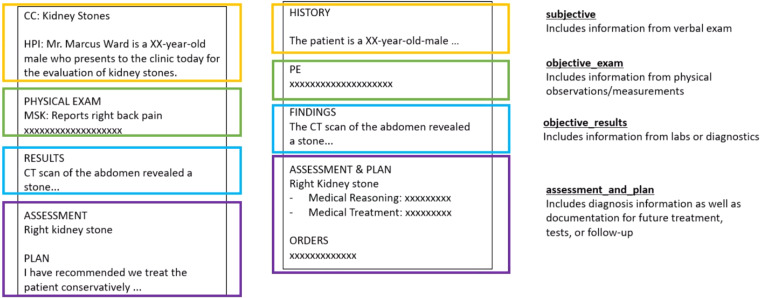
- Notes were cleaned by annotating and removing unsupported note text, with four annotators and a reported partial span overlap agreement of 0.85 F1; notes were partitioned into four contiguous divisions: subjective, objective_exam, objective_results, and assessment_and_plan.
- Baselines included transcript copy-and-paste, retrieval-based methods, BART/BioBART, LED, and OpenAI models; evaluation used ROUGE, BERTScore, BLEURT, and a UMLS concept-based medcon metric, at both full-note and division levels.
Limitations
- The paper states the data is small and synthetically produced by medical annotators or patient actors in a single institution, so it may not statistically represent all health topics, speech variations, or note formats in the real world.
- The paper states content creators were limited and based in a Nuance product demonstration studio in Eastern Massachusetts, with demographic details such as age, education, origin, and schooling not captured; note format variations were intentionally limited, and EMR structured-data incorporation was not modeled.
- The paper notes ASR errors were tolerable under its automatic metrics but could matter clinically for particular medical facts; the text also makes evident that the benchmark uses role-played rather than real clinical encounters and that evaluation relies heavily on automatic metrics.
Model-written summary. Check it against the paper before relying on it.
Integrity signals
Registry
Cites
Statistics
Figures
Verification
Claims the paper makes
12 Valid · 3 Not valid · 4 Not checked · 140 Own results and interpretations
Some cited sources support this claim and some don’t — read each source’s verdict below.
In the paper
“Unfortunately as clinic encounter conversations are not routinely recorded and are difficult to ethically share due to patient confidentiality, there are no sufficiently large clinic dialogue-note datasets to benchmark this task.”
- Also stated in: § Background & Summary · plain
“However, a massive bottleneck in understanding the state-of-the-art is the lack of publicly share-able data to train and evaluate12.”
§ Aci-bench: a Novel Ambient Clinical Intelligence Dataset for Benchmarking Automatic Visit Note Generation > Abstract
What the sources say
- Supportedcites [12] Quiroz, J. C. et al. Challenges of developing a digital scribe to reduce clinical documentation burden. NPJ Digital Medicine2, 114, 10.1038/s41746-019-0190-1. PMC6874666 31799422 source
Challenge 5 (page not provided) says large medical-conversation repositories are typically proprietary and not shared, and describes a lack of publicly available corpora. Challenge 4 explains that evaluating conversation-to-summary generation requires paired conversations and gold-standard summaries. Together, these passages support the claimed lack of a sufficiently large public dialogue-note dataset for benchmarking. (LLM, conf=0.89)
- Disputedcites [13] Ben Abacha, A., Yim, W., Fan, Y. & Lin, T. An empirical study of clinical note generation from doctor-patient encounters. In Proceedings of the 17th Conference of the European Chapter of the Association for Computational Linguistics, 2291–2302 (Association for Computational Linguistics, Dubrovnik, Croatia, 2023). sourceExperimental — accuracy not yet measured
The Introduction says publicly available dialogue-note data had been lacking, but reports that this paper introduces a publicly available dataset of 1,700 dialogue-note pairs at a scale intended for evaluation. The Conclusion says its public release provides baselines for comparison. The Limitations clarify that the dialogues are simulated, so the paper does support the narrower point that public benchmarks of real encounter conversations remained lacking. (LLM, conf=0.86)
Checked by a reasoning model — may be wrong.
- Supportedcites [14] Papadopoulos Korfiatis, A., Moramarco, F., Sarac, R. & Savkov, A. PriMock57: A dataset of primary care mock consultations. In Proceedings of the 60th Annual Meeting of the Association for Computational Linguistics (Volume 2: Short Papers), 588–598, 10.18653/v1/2022.acl-short.65 (Association for Computational Linguistics, Dublin, Ireland, 2022). source
The Introduction (page unavailable) says transcript-and-note datasets used in studies are generally proprietary, making methods difficult to compare; it identifies only a 70-consultation psychiatric dataset as an existing open-access candidate. The Abstract and Section 5 (pages unavailable) describe the authors’ own public dataset of 57 consultations as a note-generation benchmark. Together, these support the claim that no sufficiently large public dialogue-note benchmark was available, while acknowledging that smaller benchmarks exist. (LLM, conf=0.86)
plain- Asserted: passes — The authors put it forward as true.
- Checkable: passes — It can be checked against evidence.
- Load-bearing: passes — The paper’s conclusions depend on it.
- Based: passes — The paper gives a reason why it holds.
- Also stated in: § Background & Summary · plain
The cited sources support only part of this claim — read each source’s verdict below.
In the paper
“The note generation task from doctor-patient encounters, and its associated electronic medical record documentation, is one of the most arduous time-consuming tasks for physicians.”
- Also stated in: § Background & Summary · plain
“Physicians have expressed concerns that writing notes in electronic health records (EHRs) takes more time than using traditional paper or dictation methods.”
§ Aci-bench: a Novel Ambient Clinical Intelligence Dataset for Benchmarking Automatic Visit Note Generation > Abstract
What the sources say
- Partly supportedcites [1] McDonald, C. J. et al. Use of internist’s free time by ambulatory care electronic medical record systems. JAMA internal medicine174, 1860–1863, 10.1001/jamainternmed.2014.4506. PMC13370722 25200944 sourceExperimental — accuracy not yet measured
The Results report that 63.9% of surveyed ambulatory-care internists said note writing took longer after EMR adoption, and the Discussion describes a large loss of free time. This supports the time-consuming aspect, but the paper does not establish that encounter-note generation is among physicians’ most arduous tasks or compare it with other tasks. (LLM, conf=0.85)
- Partly supportedcites [2] Embi, P. J. et al. Computerized provider documentation: findings and implications of a multisite study of clinicians and administrators. Journal of the American Medical Informatics Association: JAMIA20, 718–726, 10.1136/amiajnl-2012-000946. PMC3721152 23355462 sourceExperimental — accuracy not yet measured
The Results (‘Workflow alteration and disruption’) describe electronic documentation as time-consuming, and the Discussion calls the time and effort of creating notes major workflow disruptors. The paper does not compare note generation with physicians’ other tasks or establish that it is among their most arduous. (LLM, conf=0.84)
plain- Asserted: passes — The authors put it forward as true.
- Checkable: passes — It can be checked against evidence.
- Load-bearing: passes — The paper’s conclusions depend on it.
- Based: passes — The paper gives a reason why it holds.
- Also stated in: § Background & Summary · plain
A result the paper reports from its own data — it cites no other source for it, so there is none to check. The quote shows it is in the paper.
In the paper
“The partial span overlap agreement was 0.85 F1.”
§ Aci-bench: a Novel Ambient Clinical Intelligence Dataset for Benchmarking Automatic Visit Note Generation > Methods > Data cleaning and annotation
plain- Asserted: passes — The authors put it forward as true.
- Checkable: passes — It can be checked against evidence.
- Load-bearing: unclear — It is unclear whether the paper’s conclusions depend on it.
- Based: passes — The paper gives a reason why it holds.
A result the paper reports from its own data — it cites no other source for it, so there is none to check. The quote shows it is in the paper.
In the paper
“During this initial dataset creation, imaginary EHR injections were placed within the note to contribute to realism, though many without basis from the conversation.”
§ Aci-bench: a Novel Ambient Clinical Intelligence Dataset for Benchmarking Automatic Visit Note Generation > Methods > Data cleaning and annotation
plainstates a cause- Asserted: passes — The authors put it forward as true.
- Checkable: passes — It can be checked against evidence.
- Load-bearing: unclear — It is unclear whether the paper’s conclusions depend on it.
- Based: passes — The paper gives a reason why it holds.
A result the paper reports from its own data — it cites no other source for it, so there is none to check. The quote shows it is in the paper.
In the paper
“In general, the aci-bench dataset had on average shorter notes, at 492 tokens versus 683 tokens for the consult dataset.”
§ Aci-bench: a Novel Ambient Clinical Intelligence Dataset for Benchmarking Automatic Visit Note Generation > Technical Validation > Comparison with real data
plainn = 163- Asserted: passes — The authors put it forward as true.
- Checkable: passes — It can be checked against evidence.
- Load-bearing: unclear — It is unclear whether the paper’s conclusions depend on it.
- Based: passes — The paper gives a reason why it holds.
65 more claims
Create a free account to see all 159 claims and every source verdict.
- Probably not a substantial claim. 56
- It may state two separate claims as one. 47
- The quote only partly states this claim. 1
Claims other papers make about this one
Each is checked against this paper’s own text: does it say what the citing paper says it does?
The source backs part of the claim, not all of it — or backs it for a different population, condition or comparison.
In the citing paper
“Many previous clinical NLP studies rely primarily on quantitative metrics for evaluation41,52–54.”
From Adapted large language models can outperform medical experts in clinical text summarization (2024) · cites this paper as [41]
Experimental — accuracy not yet measuredThe cited source says what the claim attributes to it.
In the citing paper
“As we are not the first to employ these datasets, Extended Data Table 4 contains quantitative metric scores from other works25,27,41,52–54 that developed methods specific to each individual summarization task.”
From Adapted large language models can outperform medical experts in clinical text summarization (2024) · cites this paper as [41]
The check wasn’t confident either way, so it gives no verdict — never disputed.
In the citing paper
“For correctness, the metrics BERTScore44 (measuring semantics) and MEDCON41 (measuring medical concepts) correlated most strongly with reader preference; meanwhile, the BLEU42 metric (measuring syntax) correlated most with completeness and least with conciseness.”
From Adapted large language models can outperform medical experts in clinical text summarization (2024) · cites this paper as [41]
Experimental — accuracy not yet measured
Self-check
Percentages, sums and reported differences re-computed from the paper’s own numbers.
Each contradiction between two passages listed here was confirmed by an independent check.
Rated minor: it would not touch a result — a value no result rests on, a p-value that stays on the same side of the significance level, or a conflict that is clerical, resolved elsewhere in the paper, or outside its own findings.
In the paper
§ Aci-bench: a Novel Ambient Clinical Intelligence Dataset for Benchmarking Automatic Visit Note Generation > Technical Validation > Comparison with real data
“The percentage of note sentences annotated with different labels show across the board lower percentages in the consult data.”
§ Aci-bench: a Novel Ambient Clinical Intelligence Dataset for Benchmarking Automatic Visit Note Generation > Technical Validation > Comparison with real data
“| DICTATION | 8 | 4 |”
Rated minor: it would not touch a result — a value no result rests on, a p-value that stays on the same side of the significance level, or a conflict that is clerical, resolved elsewhere in the paper, or outside its own findings.
In the paper
§ Aci-bench: a Novel Ambient Clinical Intelligence Dataset for Benchmarking Automatic Visit Note Generation > Technical Validation > Comparison with real data
“the fraction of crossing annotations (0.67 and 0.95) for the consult and aci-bench corpus respectively”
§ Aci-bench: a Novel Ambient Clinical Intelligence Dataset for Benchmarking Automatic Visit Note Generation > Technical Validation > Comparison with real data
“| fraction crossing annotations | 0.67 | 0.75 |”
Rated minor: it would not touch a result — a value no result rests on, a p-value that stays on the same side of the significance level, or a conflict that is clerical, resolved elsewhere in the paper, or outside its own findings.
In the paper
“The aci-bench dataset also exhibits shorter dialogue lengths, by approximately 100 tokens and 20 sentences; as well a shorter notes by approximately 100 tokens (Table 5).”
§ Aci-bench: a Novel Ambient Clinical Intelligence Dataset for Benchmarking Automatic Visit Note Generation > Technical Validation > Comparison with real data
Reported 100 · recomputed 302
Rated minor: it would not touch a result — a value no result rests on, a p-value that stays on the same side of the significance level, or a conflict that is clerical, resolved elsewhere in the paper, or outside its own findings.
In the paper
“The aci-bench dataset also exhibits shorter dialogue lengths, by approximately 100 tokens and 20 sentences; as well a shorter notes by approximately 100 tokens (Table 5).”
§ Aci-bench: a Novel Ambient Clinical Intelligence Dataset for Benchmarking Automatic Visit Note Generation > Technical Validation > Comparison with real data
Reported 20 · recomputed 61
Citations
Cites
Lewis, M., Liu, Y., Goyal, N., Ghazvininejad, M., Mohamed, A., Levy, O., Stoyanov, V., & Zettlemoyer, L. (2020) · Proceedings of the 58th Annual Meeting of the Association for Computational Linguistics · doi:10.18653/v1/2020.acl-main.703 · Cited by 8,821 · cited 1×
“BART-based We employ the SOTA transformer model, bidirectional autoregressive transformer (BART) 23 .”
MethodLewis, M., Liu, Y., Goyal, N., Ghazvininejad, M., Mohamed, A., Levy, O., Stoyanov, V., & Zettlemoyer, L. (2019) · arXiv · doi:10.48550/arxiv.1910.13461 · Cited by 8,816 · cited 1×
“BART-based We employ the SOTA transformer model, bidirectional autoregressive transformer (BART) 23 .”
MethodMIMIC-III, a freely accessible critical care database
Johnson, A. E. W., Pollard, T. J., Shen, L., Lehman, L.-W. H., Feng, M., Ghassemi, M., Moody, B., Szolovits, P., Anthony Celi, L., & Mark, R. G. (2016) · Scientific Data · doi:10.1038/sdata.2016.35 · Cited by 8,141
BioBERT: a pre-trained biomedical language representation model for biomedical text mining
Lee, J., Yoon, W., Kim, S., Kim, D., Kim, S., So, C. H., & Kang, J. (2020) · Bioinformatics · doi:10.1093/bioinformatics/btz682 · Cited by 7,218
BERTScore: Evaluating Text Generation with BERT
Zhang, T., Kishore, V., Wu, F., Weinberger, K. Q., & Artzi, Y. (2019) · arXiv · doi:10.48550/arxiv.1904.09675 · Cited by 2,865
Longformer: The Long-Document Transformer
Beltagy, I., Peters, M. E., & Cohan, A. (2020) · arXiv · doi:10.48550/arxiv.2004.05150 · Cited by 2,281 · cited 1×
“We leverage the Longformer-Encoder-Decoder (LED) architecture 26 , which incorporates an attention mechanism that can scale up to longer sentences.”
MethodSparks of Artificial General Intelligence: Early experiments with GPT-4
Bubeck, S., Chandrasekaran, V., Eldan, R., Gehrke, J., Horvitz, E., Kamar, E., Lee, P., Lee, Y. T., Li, Y., Lundberg, S., et al. (2023) · arXiv · doi:10.48550/arxiv.2303.12712 · Cited by 1,526
BLEURT: Learning Robust Metrics for Text Generation
Sellam, T., Das, D., & Parikh, A. P. (2020) · arXiv · doi:10.48550/arxiv.2004.04696 · Cited by 1,005 · cited 4×
“To consolidate the various evaluation metrics, we first take the average of the three ROUGE submetrics as ROUGE, and the average of ROUGE, BERTScore, BLEURT, and medcon scores as the final evaluation score.”
MethodInfluentialBLEURT: Learning Robust Metrics for Text Generation
Sellam, T., Das, D., & Parikh, A. (2020) · Proceedings of the 58th Annual Meeting of the Association for Computational Linguistics · doi:10.18653/v1/2020.acl-main.704 · Cited by 1,005
A Discourse-Aware Attention Model for Abstractive Summarization of Long Documents
Cohan, A., Dernoncourt, F., Kim, D. S., Bui, T., Kim, S., Chang, W., & Goharian, N. (2018) · Proceedings of the 2018 Conference of the North American Chapter of the Association for Computational Linguistics: Human Language Technologies, Volume 2 (Short Papers) · doi:10.18653/v1/n18-2097 · Cited by 658 · cited 1×
“We also include its variant, which is finetuned on the Pubmed dataset 27 , to enhance the model’s summarization ability in the biomedical context.”
Background
Research works printed but not linked: 6
- Podder, V., Lew, V. & Ghassemzadeh, S. SOAP notes. In StatPearls (StatPearls Publishing). 29489268
- Yim, W., Yetisgen, M., Huang, J. & Grossman, M. Alignment annotation for clinic visit dialogue to clinical note sentence language generation. In Proceedings of the Twelfth Language Resources and Evaluation Conference, 413–421 (European Language Resources Association, Marseille, France, 2020).
- Jurafsky, D. & Martin, J. H. Speech and language processing: An introduction to speech recognition, computational linguistics and natural language processing. Upper Saddle River, NJ: Prentice Hall (2008).
- Gliwa, B., Mochol, I., Biesek, M. & Wawer, A. SAMSum corpus: A human-annotated dialogue dataset for abstractive summarization. In Proceedings of the 2nd Workshop on New Frontiers in Summarization, 70–79, 10.18653/v1/D19-5409 (Association for Computational Linguistics, Hong Kong, China, 2019). · DOI · Paper page
- Soldaini, L. & Goharian, N. Quickumls: a fast, unsupervised approach for medical concept extraction. In MedIR workshop, sigir, 1–4 (2016).
- Hall, J. K. Teaching and researching: Language and culture (Routledge).
Cited by
Adapted large language models can outperform medical experts in clinical text summarization
Van Veen, D., Van Uden, C., Blankemeier, L., Delbrouck, J.-B., Aali, A., Bluethgen, C., Pareek, A., Polacin, M., Reis, E. P., Seehofnerová, A., et al. (2024) · Nature Medicine · doi:10.1038/s41591-024-02855-5 · Cited by 891
“For this task, we employed the ACI-Bench dataset 41,82–84 , which contains (1) 207 doctor–patient conversations and (2) corresponding patient visit notes, which were first generated by a seq2seq model and subsequently corrected and validated by expert medical scribes and physicians.”
InfluentialBedi, S., Liu, Y., Orr-Ewing, L., Dash, D., Koyejo, S., Callahan, A., Fries, J. A., Wornow, M., Swaminathan, A., Lehmann, L. S., et al. (2024) · doi:10.1101/2024.04.15.24305869 · Cited by 738
Testing and Evaluation of Health Care Applications of Large Language Models: A Systematic Review
Bedi, S., Liu, Y., Orr-Ewing, L., Dash, D., Koyejo, S., Callahan, A., Fries, J. A., Wornow, M., Swaminathan, A., Lehmann, L. S., et al. (2025) · JAMA · doi:10.1001/jama.2024.21700 · Cited by 662
Who Validates the Validators? Aligning LLM-Assisted Evaluation of LLM Outputs with Human Preferences
Shankar, S., Zamfirescu-Pereira, J. D., Hartmann, B., Parameswaran, A., & Arawjo, I. (2024) · Proceedings of the 37th Annual ACM Symposium on User Interface Software and Technology · doi:10.1145/3654777.3676450 · Cited by 151
Clinical Text Summarization: Adapting Large Language Models Can Outperform Human Experts
Veen, D. V., Uden, C. V., Blankemeier, L., Delbrouck, J.-B., Aali, A., Bluethgen, C., Pareek, A., Polacin, M., Reis, E. P., Seehofnerova, A., et al. (2023) · doi:10.21203/rs.3.rs-3483777/v1 · Cited by 892
“Lastly, there has been significant work on summarizing extended conversations between a doctor and patient into patient visit summaries [1, 53, 89].”
BackgroundMethodInfluentialDoes AI-powered clinical documentation enhance clinician efficiency: a longitudinal study.
Liu, T.-L., Hetherington, T. C., Dharod, A., Carroll, T., Bundy, R., Nguyen, H., Bundy, H. E., Isreal, M., McWilliams, A., & Cleveland, J. A. (2024) · NEJM AI · doi:10.1056/aioa2400659 · Cited by 65
AI Scribes in Health Care: Balancing Transformative Potential With Responsible Integration
Leung, T. I., Coristine, A. J., & Benis, A. (2025) · JMIR Medical Informatics · doi:10.2196/80898 · Cited by 99
“…of omissions and hallucinations found in some studies underscore the need to evaluate for potential diagnostic errors or other long-term safety risks stemming from AI-generated content [4,10,29-32 , 39-42 Another major unexamined area is the impact on tangible clinical outcomes and patient safety.”
Holistic evaluation of large language models for medical tasks with MedHELM
Bedi, S., Cui, H., Fuentes, M., Unell, A., Wornow, M., Banda, J. M., Kotecha, N., Keyes, T., Mai, Y., Oez, M., et al. (2026) · Nature Medicine · doi:10.1038/s41591-025-04151-2 · Cited by 59
Self-citationBen Abacha, A., Yim, W.-W., Adams, G., Snider, N., & Yetisgen, M. (2023) · Proceedings of the 5th Clinical Natural Language Processing Workshop · doi:10.18653/v1/2023.clinicalnlp-1.52 · Cited by 20
“We encouraged the participants to apply the models developed for this task to generate additional data for tasks A and B. (Yim et al., 2023) collections.”
MethodSelf-citationSummQA at MEDIQA-Chat 2023:In-Context Learning with GPT-4 for Medical Summarization
Mathur, Y., Rangreji, S., Kapoor, R., Palavalli, M., Bertsch, A., & Gormley, M. R. (2023) · arXiv · doi:10.48550/arxiv.2306.17384 · Cited by 18
“There were 67 conversations in the training split of the dataset (Yim et al., 2023); these dialogues and reference summaries are significantly longer than those for Task A, as these dialogues encompass an entire conversation between a patient and a doctor.”
BackgroundSummQA at MEDIQA-Chat 2023: In-Context Learning with GPT-4 for Medical Summarization
Mathur, Y., Rangreji, S., Kapoor, R., Palavalli, M., Bertsch, A., & Gormley, M. R. (2023) · Clinical Natural Language Processing Workshop (ClinicalNLP) · doi:10.18653/v1/2023.clinicalnlp-1.51 · Cited by 36
A perspective for adapting generalist AI to specialized medical AI applications and their challenges
Wang, Z., Wang, H., Danek, B. P., Li, Y., Mack, C. D., Arbuckle, L., Biswal, D., Poon, H., Wang, Y., Rajpurkar, P., et al. (2025) · npj Digital Medicine · doi:10.1038/s41746-025-01789-7 · Cited by 51
“Additionally, we discuss some potential improvements of those use cases.”
A Justice-First Approach to Ambient Intelligence in Healthcare
Herington, J., & Cho, M. K. (2025) · The American Journal of Bioethics · doi:10.1080/15265161.2025.2497972 · Cited by 17
“…models (LLMs), this sensor information can be used to identify trends in healthcare resource utilization, monitor quality of care in operating theaters (Gershov et al. 2023), monitor patient symptoms (Othmani and Muzammel 2023), and automatically document health-care interactions (Yim et al. 2023).”
Ionescu, B. E., Müller, H., Drăgulinescu, A., Yim, W.-W., Abacha, A. B., Snider, N., Adams, G., Yetişgen, M., Rückert, J., de Herrera, A. G. S., et al. (2023) · Lecture notes in computer science · doi:10.1007/978-3-031-42448-9_25 · Cited by 28
“The 2023 MEDIQA-SUM challenge includes data from two collections: MTS-Dialog [10] and ACI-BENCH [50]”
Self-citationExploring the Feasibility of GPT-4 as a Data Extraction Tool for Renal Surgery Operative Notes
Hsueh, J. Y., Nethala, D., Singh, S. M., Hyman, J. A., Gelikman, D. G., Linehan, W. M., & Ball, M. W. (2024) · Urology Practice · doi:10.1097/upj.0000000000000599 · Cited by 13
Clinical AI Scribes in primary care: accuracy, error severity and implications for clinical practice
Draper, T. C., Cox, T., Lamb-Riddell, K., Moretti, L. A., McCormick, J., Trowell, S., Kiely, J., & Luxton, R. (2025) · BMJ Digital Health & AI · doi:10.1136/bmjdhai-2025-000092 · Cited by 10
“12 These include automated approaches, eg, ROUGE (Recall-Oriented Understudy for Gisting Evaluation) and BERT (Bidirectional Encoder Repre-sentations from Transformers), 22–25 and also manual approaches 26–28 in which the clinical notes are compared with the ground-truth original audio file.”
Impact of acoustic and informational noise on AI-generated clinical summaries
Draper, T. C., Leake, J., Lamb-Riddell, K., Cox, T. M., McCormick, J., Trowell, S., Kiely, J., & Luxton, R. W. (2025) · BMJ Digital Health & AI · doi:10.1136/bmjdhai-2025-000057 · Cited by 10
RaTEScore: A Metric for Radiology Report GenerationPreprint
Zhao, W., Wu, C., Zhang, X., Zhang, Y., Wang, Y., & Xie, W. (2024) · medRxiv · doi:10.1101/2024.06.24.24309405 · Cited by 61
“While intuitive, these metrics fail to capture negation or synonyms in sentences, thus neglecting the semantic factuality; (ii) Embedding Similarity Metrics, like BERTScore (Zhang et al., 2019), provide better semantic awareness but fail to emphasize key medical terms, leading to overlooked errors in critical conclusi…”
BackgroundMethodSuhail, D., Wong, Z. Y., Ubhi, J. S., Kungwengwe, G., Faderani, R., & Mosahebi, A. (2025) · International Journal of Medical Informatics · doi:10.1016/j.ijmedinf.2025.106113 · Cited by 15
Bedmutha, M. S., Bascom, E., Sladek, K. R., Tobar, K., Casanova-Pérez, R., Andreiu, A., Bhat, A. S., Mangal, S., Wood, B. R., Sabin, J., et al. (2024) · JAMIA Open · doi:10.1093/jamiaopen/ooae106 · Cited by 12
How well do multimodal LLMs interpret CT scans? An auto-evaluation framework for analyses
Zhu, Q., Hou, B., Mathai, T. S., Mukherjee, P., Jin, Q., Chen, X., Wang, Z., Cheng, R., Summers, R. M., & Lu, Z. (2025) · Journal of Biomedical Informatics · doi:10.1016/j.jbi.2025.104864 · Cited by 14
Reviewing clinical knowledge in medical large language models: Training and beyond
Li, Q. Y., Liu, H., Guo, C., Gao, C., Chen, D., Wang, M., Gao, F., van Harmelen, F., & Gu, J. (2025) · Knowledge-Based Systems · doi:10.1016/j.knosys.2025.114215 · Cited by 20
Wang, J., Yao, Z., Mitra, A., Osebe, S., Yang, Z., & Yu, H. Q. (2023) · Clinical Natural Language Processing Workshop (ClinicalNLP) · doi:10.18653/v1/2023.clinicalnlp-1.49 · Cited by 24
Clinical Text Generation: Are We There Yet?
Hiebel, N., Ferret, O., Fort, K., & Névéol, A. (2025) · Annual Review of Biomedical Data Science · doi:10.1146/annurev-biodatasci-103123-095202 · Cited by 12
“These medical concepts can be extracted in the candidate and reference to be compared (MEDCON (108)).”
Improving Clinical Note Generation from Complex Doctor-Patient Conversation
Li, Y., Wu, S., Smith, C., Lo, T., & Liu, B. (2025) · Lecture notes in computer science · doi:10.1007/978-981-96-8186-0_17 · Cited by 25
Improving Summarization with Human Edits
Yao, Z., Schloss, B., & Selvaraj, S. P. P. (2023) · Conference on Empirical Methods in Natural Language Processing (EMNLP) · doi:10.18653/v1/2023.emnlp-main.158 · Cited by 29
Brake, N., & Schaaf, T. (2024) · Findings of the Association for Computational Linguistics: NAACL 2024 · doi:10.18653/v1/2024.findings-naacl.25 · Cited by 6
C-PATH: Conversational Patient Assistance and Triage in Healthcare System
Shi, Q. F., Han, Q., & Soares, C. (2025) · IEEE International Conference on Digital Health (ICDH) · doi:10.1109/icdh67620.2025.00016 · Cited by 7
“In addition, we leveraged PubmedQA [14], MedQA-USMLE [13], and MedMCQA [22] to inject domain knowledge during pretraining, and used MTS-Dialog [1] and ACI-BENCH [32] to support summarization fine-tuning.”
Automated Clinical Note Section Identification Using Transfer Learning and Contextual Embeddings
Nair, N., Achan, P., Nedungadi, P., & Nair, S. (2023) · Global Conference on Information Technologies and Communications (GCITC) · doi:10.1109/gcitc60406.2023.10425802 · Cited by 6
“Furthermore, the comprehension of the contextual aspects of prescribed pharmaceuticals holds great potential to optimize subsequent processes, such as the re-ordering of prescriptions [8],[9],[10].”
BackgroundSharma, A., Feldman, D., & Jain, A. (2023) · Clinical Natural Language Processing Workshop (ClinicalNLP) · doi:10.18653/v1/2023.clinicalnlp-1.28 · Cited by 18
“The Task B and Task C training (validation) set consists of 67 (20) pairs of conversations and full clinical notes (Yim et al., 2023).”
BackgroundGarcía-Agúndez, A., Schmajuk, G., & Yazdany, J. (2024) · Seminars in Arthritis and Rheumatism · doi:10.1016/j.semarthrit.2024.152584 · Cited by 6
clulab at MEDIQA-Chat 2023: Summarization and classification of medical dialogues
Özler, K. B., & Bethard, S. J. (2023) · Clinical Natural Language Processing Workshop (ClinicalNLP) · doi:10.18653/v1/2023.clinicalnlp-1.19 · Cited by 5
“, 2023) 1201 100 200 B and C (Yim et al., 2023) 67 20 40”
What do clinicians edit in ambient AI-drafted clinical documentation? A qualitative content analysis
Guo, Y., Hu, D., Yang, Z., Kim, S., Tran, B. D., Lee, J., Vallabhaneni, S., Zehrung, R., Sutari, S., Tam, S., et al. (2026) · Journal of the American Medical Informatics Association · doi:10.1093/jamia/ocag073 · Cited by 20
CACER: Clinical concept Annotations for Cancer Events and Relations
Fu, Y., Ramachandran, G. K., Halwani, A. S., McInnes, B. T., Xia, F., Lybarger, K., Yetişgen, M., & Uzuner, Ö. (2024) · Journal of the American Medical Informatics Association · doi:10.1093/jamia/ocae231 · Cited by 6
“LLMs excel in tasks demanding medical knowledge and advanced reasoning and have achieved high performance in complex tasks, like medical exams [68], common-sense reasoning [69], and dialogue summarization [70].”
BackgroundSelf-citationWhat Do Clinicians Edit in Ambient AI-Drafted Clinical Documentation? A Qualitative Content AnalysisPreprint
Guo, Y., Hu, D., Yang, Z., et al. (2026) · medRxiv · doi:10.64898/2026.01.05.26343473 · Cited by 3
Evaluating privacy leakages in LLM-driven ambient clinical documentation
Chim, J., Pearson, J., Schofield, D., & Liakata, M. (2026) · Frontiers in Digital Health · doi:10.3389/fdgth.2026.1761624 · Cited by 6
“…method and associated leakage detection procedure for privacy-aware information sharing tasks, and use them to construct a privacy-focused extension of the Ambient Clinical Intelligence Benchmark [aci-bench; (20)] targeting third-party personal information in clinical documentation (Section 2.1).”
InfluentialSerapio, A., Chen, T. L., Tangsombatvisit, B., Fields, B. K. K., Yu, Y., Guo, Y., Kim, S. K., Miao, B. Y., Sushil, M., Hess, C. P., et al. (2026) · Radiology · doi:10.1148/radiol.253238 · Cited by 2
Ambient technology in epilepsy clinical practice
Kakwan, H., Rousseau, J. F., Moura, L. M. V. R., & Sheikh, I. (2025) · Epilepsia Open · doi:10.1002/epi4.70066 · Cited by 3
“17,18,30”
Teddysum at MEDIQA-Chat 2023: an analysis of fine-tuning strategy for long dialog summarization
Jeong, Y., Han, J.-H., Chae, K. M., Cho, Y., Seo, H., Lim, K., Choi, K., & Hahm, Y. (2023) · Clinical Natural Language Processing Workshop (ClinicalNLP) · doi:10.18653/v1/2023.clinicalnlp-1.42 · Cited by 2
“... (Yim et al., 2023) dataset.”
BackgroundMedStructGen: A Two-Stage Method for Medical Record Generation Using Large Language Models
Ma, Z., Liu, R., & Wang, Y. (2025) · IEEE International Conference on Parallel and Distributed Systems (ICPADS) · doi:10.1109/icpads67057.2025.11323208 · Cited by 1
Mandalapu, S. A., & Stawicki, S. P. (2026) · Artificial intelligence · doi:10.5772/intechopen.1013390 · Cited by 2
LLM-Based Dictation Detection from Doctor-Patient Conversations
Chen, S., Elyaderani, M. K., Su, J., Burger, S., & Schaaf, T. (2025) · IEEE Workshop on Automatic Speech Recognition and Understanding (ASRU) · doi:10.1109/asru65441.2025.11434612 · Cited by 1
“For evaluation on public datasets, we use ACI-Bench [20], which comprises 207 role-played DoPaCos across three speech modes: Virtual Assistant (VA), Virtual Scribe (VS), and Ambient Clinical Intelligence (ACI).”
InfluentialDigital Medical Catalog: Harnessing AI for Automated Classification and Analysis of Medical Data
Ruvunangiza, J. B., & Valderrama, C. A. (2026) · AI in Medicine · doi:10.3390/aimed1020010 · Cited by 1
“Seamlessly embedding these NLP capabilities in established clinical workflows and managing the profound heterogeneity of healthcare data sources continue to be significant barriers to widespread implementation [3].”
KOSMOS: Ontology-Based Knowledge Graph Scaffolding for Medical Documentation Generation
Henry, R., & Gong, J. (2026) · Information · doi:10.3390/info17040355 · Cited by 2
“The ACI-BENCH benchmark is a shared setting for evaluating SOAP generation from clinician–patient conversations [20].”
InfluentialA Modular Evaluation of AI-Assisted Clinical Documentation
Delaunay, J., Sarkis, M., Solé‐Casals, J., & Cusidó, J. (2026) · Applied Sciences · doi:10.3390/app16146961 · Cited by 1
Sarpong, C., Lin, A., & Nowrangi, R. (2025) · doi:10.2196/preprints.86342
Multimorbidity measurement strategies for predicting hospital visits
Neves, B. D., Moreira, J. M., Gonçalves, S., Cerejo, J., Mota, I., Silva, N. A., Leite, F., & Silva, M. J. (2025) · BMC Health Services Research · doi:10.1186/s12913-025-13817-z
Kanpa, V. N., D’Onofrio, D., Samanta, N., Tada, M., & Patel, S. (2025) · medRxiv · doi:10.64898/2025.12.10.25341937
Clinical Answer Generation Based on Few-Shot Learning
Chaudhuri, S., Saha, D., & Das, D. (2025) · International Conference on Research in Computational Intelligence and Communication Networks (ICRCICN) · doi:10.1109/icrcicn68210.2025.11364910
“Fine-tuning LLMs like GPT or, more specifically, BioGPT for domain-specific clinical datasets [25] might lead to better answers and reduced hallucinations, as it might be able to get more semantic meanings from the note excerpts and patient narratives.”
Dynamic Retrieval Strategy for Summarizing Doctor–Patient Dialogues with RAG
Shi, Y., & Hu, X. T. (2025) · IEEE International Conference on Big Data (BigData) · doi:10.1109/bigdata66926.2025.11402171
“The ACI-bench dataset focuses on summarizing doctor-patient conversations into an “assessment and plan” format, which contains 207 doctor-patient dialogues and their corresponding visit notes [26].”
MTS-Dialog-Bangla: A Dataset and Benchmark for Bangla Clinical Dialogue-to-Note Summarization
Manarat, A. S., Hossain, S., Ishrak, K., & Zannat, A. (2026) · International Conference on Electrical, Computer & Telecommunication Engineering (ICECTE) · doi:10.1109/icecte69292.2026.11429289
“[6 ] Yim et al. (2023) introduced ACI-Bench, a comprehensive dataset consisting of 207 complete dialogue-note pairs across virtual assistant, scribe, and natural conversation contexts.”
Deep Learning in Medical Speech to Text: Methods and Challenges
Sztabinski, M., & Weichbroth, P. (2026) · Symmetry · doi:10.3390/sym18060885 · Cited by 1
Wang, Q., Yong, X. Y. X., Wang, Y., Zhongyan, L., Wang, X., & Gao, J. (2026) · Applied Soft Computing · doi:10.1016/j.asoc.2026.115605
Furtado, N. G., & Furtado, J. V. (2026) · Research Square · doi:10.21203/rs.3.rs-10255415/v1
Shoumi, M. N., Harada, K., Oshita, H., Sakashita, S., & Inoue, S. (2026) · BioMedInformatics · doi:10.3390/biomedinformatics6040047
“8.”
InfluentialYu, S., He, Y., Li, P., Wu, C., Zhang, P., Li, J., & Tian, Y. (2026) · Intelligent Medicine · doi:10.1016/j.imed.2026.08.001
Readability of AI-Generated Patient Visit Summaries in Orthopedic Surgery: Retrospective Analysis
Major, E. L., Shah, V. P., Carroll, A. N., Goetz, J. R., Malempati, C. S., & Badarudeen, S. (2026) · Journal of Medical Internet Research · doi:10.2196/87283
“…traditional methods, AI tools use natural language processing and real-time audio recordings of patient-provider conversations to generate dynamic summaries that simplify medical jargon and integrate patient-specific concerns, potentially addressing the limitations of current materials [9,17,18].”
Discharge-agents: A few-shot multi-agent collaborative framework for discharge summary generation
Che, Z.-H., Chen, Z., & Xu, Y. (2026) · Pattern Recognition Letters · doi:10.1016/j.patrec.2026.09.003
Sivagnanam, B., Rajiakodi, S., Abdulkader, R., & Chakravarthi, B. R. (2026) · Network Modeling Analysis in Health Informatics and Bioinformatics · doi:10.1007/s13721-026-00876-3
“Additionally, some researchers used datasets based on doctor-patient conversations, such as ACI-Bench (Yim et al. 2023), and structured Chinese EMR 2 (Electronic Medical Records) datasets (Zhao et al. 2023).”
Xiaoyuan, G., Wang, Y., Wang, Z., Yuan, J., Huang, S., Zhang, X.-Y., Sun, Z., Xing, Y., Liu, Y., Wu, X., et al. (2026) · Journal of Medical Internet Research · doi:10.2196/90870
Petrov, I., Ivanova, O., & Smirnov, D. (2025) · Journal of Health Informatics and Digital Systems · doi:10.68159/q456290795
Al-Qahtani, Y., Al-Salem, F., & Al-Harbi, A. (2024) · Journal of Health Informatics and Digital Systems · doi:10.68159/o358775030
Vera, L., Craveiro, O., Malheiro, R., Dias, M., & Correia, R. (2026) · Machine Learning and Knowledge Extraction · doi:10.3390/make8100305
Remfry, E., Conway, A., Adatia, N., & Khalil, S. (2026) · BMJ Innovations · doi:10.1136/bmjinnov-2026-001648
Beyond Literal Summarization: Redefining Hallucination for Medical SOAP Note Evaluation
Vachhani, B., Shrisvastava, K., Nema, P., & Chiranthan, S. (2026) · arXiv · doi:10.48550/arxiv.2604.14829 · Cited by 1
“Early work on visit note generation in [6] noted that neural models frequently introduced diagnoses not supported by by the source dialogue.”
Multimorbidity Measurement Strategies for Predicting Hospital Visits
Neves, B., Moreira, J. M., Gonçalves, S., Cerejo, J., Mota, I., Silva, N. A., Leite, F., & Silva, M. J. (2025) · doi:10.21203/rs.3.rs-6515465/v1
Metadata
- Authors
- Yim, W.-W., Fu, Y., Ben Abacha, A., Snider, N., Lin, T., & Yetisgen, M.
- Affiliations
- Microsoft (United States) (US)
- University of Washington (US)
- Nuance Communications (United States) (US)
- Corresponding author
- Yim, Wen-wai
- Venue
- Scientific Data
- Published
- 2023-09-06
- Volume
- 10
- Issue
- 1
- Pages
- 586-586
- ISSN
- 2052-4463 (ISSN-L)
- PMC
- PMC10482860
- OpenAlex
- W4386492483
- Cited by
- 64
- References
- 40
- Citations by year
- 2026: 23 · 2025: 21 · 2024: 11 · 2023: 9
- Type
- data paper
- Language
- en
- Open access
- gold
- doi.org
- Licence
- cc-by
- creativecommons.org/licenses/by/4.0 (tdm)
- creativecommons.org/licenses/by/4.0 (vor)
- Locations
- Scientific Data (publishedVersion, cc-by)
- PubMed Central (publishedVersion, cc-by)
- PubMed (publishedVersion)
- arXiv (Cornell University) (submittedVersion, cc-by)
- DOAJ (DOAJ: Directory of Open Access Journals) (submittedVersion, cc-by-sa)
- arXiv (Cornell University) (cc-by)
- Topics
- Physical Sciences › Computer Science › Artificial Intelligence › Machine Learning in Healthcare
- Health Sciences › Medicine › Health Informatics › Artificial Intelligence in Healthcare and Education
- Health Sciences › Health Professions › Health Information Management › Electronic Health Records Systems
- Keywords
- clinical note generation, benchmark dataset, electronic health records, doctor-patient dialogue, generative models, evaluation metrics, AI-assisted documentation
- MeSH terms
- Artificial Intelligence, Health Facilities, Humans, Benchmarking, Electronic Health Records
About these checks
Registry, retraction, Cites and statistics results are computed, not judged, with one exception: a printed reference that no index lists is read once by a model before it counts as a citation error. Claims are extracted by a model and kept only when their quote appears verbatim in the text; each cited source is then checked, with a model’s help, for whether it says what the claim relies on. Those verdicts can be wrong — read the claim’s quote and the cited source before relying on one.
The claim verdicts this report counts are experimental: their accuracy is not yet measured.
A language model drew the claims from the paper on 2026-10-10, under version 3 of the claim definition (model deepseek-v4.1-flash, prompt extract-v3).
A second model labelled each claim on 2026-10-10 (model jev-1.13-20260917, definition revision gold-guideline-v0.2).
Cited sources are checked with a language model’s help (gpt-6-sol).
Statistics and arithmetic are recomputed, not judged.
Confidence bands are shown only for fields calibrated on our annotated test set. None is calibrated yet, so no band is shown.
What counts as a claim ›How we measure confidence ›How we check this ›
Are you an author, or do you see a problem with this page? Request a review
Data sources
Bibliographic data: Semantic Scholar, OpenAlex, Crossref.
Contains information from the Semantic Scholar Academic Graph Datasets, made available under the ODC Attribution License (ODC-BY 1.0).
Semantic Scholar’s data is described in: Kinney, R., et al. (2023). The Semantic Scholar Open Data Platform. arXiv:2301.10140.
