

Aci-bench: a Novel Ambient Clinical Intelligence Dataset for Benchmarking Automatic Visit Note Generation
Open accessThe DOI matches its Crossref record; 39 of the 40 references it cites were found in a registry or an index; 22 of the 27 sources its claims cite were checked for support.
Abstract
Recent immense breakthroughs in generative models such as in GPT4 have precipitated re-imagined ubiquitous usage of these models in all applications. One area that can benefit by improvements in artificial intelligence (AI) is healthcare. The note generation task from doctor-patient encounters, and its associated electronic medical record documentation, is one of the most arduous time-consuming tasks for physicians. It is also a natural prime potential beneficiary to advances in generative models. However with such advances, benchmarking is more critical than ever. Whether studying model weaknesses or developing new evaluation metrics, shared open datasets are an imperative part of understanding the current state-of-the-art. Unfortunately as clinic encounter conversations are not routinely recorded and are difficult to ethically share due to patient confidentiality, there are no sufficiently large clinic dialogue-note datasets to benchmark this task. Here we present the Ambient Clinical Intelligence Benchmark ( aci-bench ) corpus, the largest dataset to date tackling the problem of AI-assisted note generation from visit dialogue. We also present the benchmark performances of several common state-of-the-art approaches.
Overview
CoChat Summary
TL;DR
The paper introduces aci-bench, a public benchmark corpus for generating clinical visit notes from doctor-patient dialogue, comprising 207 role-played encounter-note pairs across three note-generation modes. It also reports baseline results for retrieval, BART/BioBART, LED, and OpenAI models, finding that division-based generation helps fine-tuned models while GPT-4 achieves the best medical-concept score.
Key findings
- aci-bench is presented as the largest public corpus for AI-assisted note generation from visit dialogue, with 207 encounters split into train (67), validation (20), and three test sets (40 each); it includes virtassist, virtscribe, and aci subsets.
- In full-note test set 1, BART + FTSAMSum (Division) achieved the highest ROUGE scores: ROUGE-1 53.46, ROUGE-2 25.08, ROUGE-L 48.62; GPT-4 achieved the highest medcon score of 57.78, with ROUGE-1 51.76, ROUGE-2 22.58, ROUGE-L 45.97.
- Division-based generation improved BART- and LED-based models over full-note generation, with reported increases of 1–14 points in full-note ROUGE and medcon, and around 20% average-score increases for objective_exam, objective_results, and assessment_and_plan divisions.
- ASR versus human transcription and ASR versus ASR-corrected transcripts did not show remarkable note-generation performance differences, with approximately 1 F1 point differences across test sets and metrics for the evaluated BART + FTSAMSum (Division) setup.
Methods
- The corpus was created from role-played doctor-patient encounters and expert-generated clinical notes, with three subsets: virtual assistant, virtual scribe, and ambient clinical intelligence; transcripts include human transcription and/or ASR versions depending on subset.
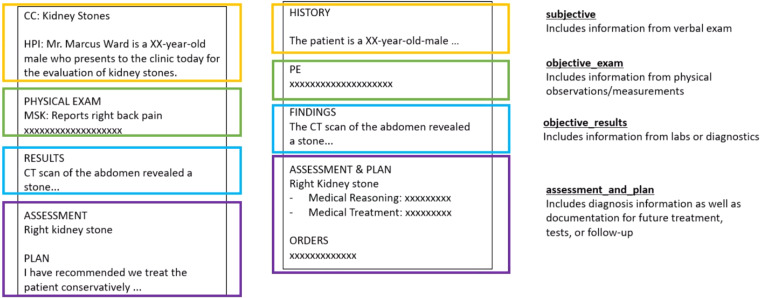
- Notes were cleaned by annotating and removing unsupported note text, with four annotators and a reported partial span overlap agreement of 0.85 F1; notes were partitioned into four contiguous divisions: subjective, objective_exam, objective_results, and assessment_and_plan.
- Baselines included transcript copy-and-paste, retrieval-based methods, BART/BioBART, LED, and OpenAI models; evaluation used ROUGE, BERTScore, BLEURT, and a UMLS concept-based medcon metric, at both full-note and division levels.
Limitations
- The paper states the data is small and synthetically produced by medical annotators or patient actors in a single institution, so it may not statistically represent all health topics, speech variations, or note formats in the real world.
- The paper states content creators were limited and based in a Nuance product demonstration studio in Eastern Massachusetts, with demographic details such as age, education, origin, and schooling not captured; note format variations were intentionally limited, and EMR structured-data incorporation was not modeled.
- The paper notes ASR errors were tolerable under its automatic metrics but could matter clinically for particular medical facts; the text also makes evident that the benchmark uses role-played rather than real clinical encounters and that evaluation relies heavily on automatic metrics.
Model-written summary. Check it against the paper before relying on it.
Integrity signals
Registry
Cites
Statistics
Figures
Verification
Claims the paper makes
12 Valid · 3 Not valid · 4 Not checked · 140 Own results and interpretations
Some cited sources support this claim and some don’t — read each source’s verdict below.
In the paper
“Unfortunately as clinic encounter conversations are not routinely recorded and are difficult to ethically share due to patient confidentiality, there are no sufficiently large clinic dialogue-note datasets to benchmark this task.”
- Also stated in: § Background & Summary · plain
“However, a massive bottleneck in understanding the state-of-the-art is the lack of publicly share-able data to train and evaluate12.”
§ Aci-bench: a Novel Ambient Clinical Intelligence Dataset for Benchmarking Automatic Visit Note Generation > Abstract
What the sources say
- Supportedcites [12] Quiroz, J. C. et al. Challenges of developing a digital scribe to reduce clinical documentation burden. NPJ Digital Medicine2, 114, 10.1038/s41746-019-0190-1. PMC6874666 31799422 source
Challenge 5 (page not provided) says large medical-conversation repositories are typically proprietary and not shared, and describes a lack of publicly available corpora. Challenge 4 explains that evaluating conversation-to-summary generation requires paired conversations and gold-standard summaries. Together, these passages support the claimed lack of a sufficiently large public dialogue-note dataset for benchmarking. (LLM, conf=0.89)
- Disputedcites [13] Ben Abacha, A., Yim, W., Fan, Y. & Lin, T. An empirical study of clinical note generation from doctor-patient encounters. In Proceedings of the 17th Conference of the European Chapter of the Association for Computational Linguistics, 2291–2302 (Association for Computational Linguistics, Dubrovnik, Croatia, 2023). sourceExperimental — accuracy not yet measured
The Introduction says publicly available dialogue-note data had been lacking, but reports that this paper introduces a publicly available dataset of 1,700 dialogue-note pairs at a scale intended for evaluation. The Conclusion says its public release provides baselines for comparison. The Limitations clarify that the dialogues are simulated, so the paper does support the narrower point that public benchmarks of real encounter conversations remained lacking. (LLM, conf=0.86)
Checked by a reasoning model — may be wrong.
- Supportedcites [14] Papadopoulos Korfiatis, A., Moramarco, F., Sarac, R. & Savkov, A. PriMock57: A dataset of primary care mock consultations. In Proceedings of the 60th Annual Meeting of the Association for Computational Linguistics (Volume 2: Short Papers), 588–598, 10.18653/v1/2022.acl-short.65 (Association for Computational Linguistics, Dublin, Ireland, 2022). source
The Introduction (page unavailable) says transcript-and-note datasets used in studies are generally proprietary, making methods difficult to compare; it identifies only a 70-consultation psychiatric dataset as an existing open-access candidate. The Abstract and Section 5 (pages unavailable) describe the authors’ own public dataset of 57 consultations as a note-generation benchmark. Together, these support the claim that no sufficiently large public dialogue-note benchmark was available, while acknowledging that smaller benchmarks exist. (LLM, conf=0.86)
plain- Asserted: passes — The authors put it forward as true.
- Checkable: passes — It can be checked against evidence.
- Load-bearing: passes — The paper’s conclusions depend on it.
- Based: passes — The paper gives a reason why it holds.
- Also stated in: § Background & Summary · plain
The cited sources support only part of this claim — read each source’s verdict below.
In the paper
“The note generation task from doctor-patient encounters, and its associated electronic medical record documentation, is one of the most arduous time-consuming tasks for physicians.”
- Also stated in: § Background & Summary · plain
“Physicians have expressed concerns that writing notes in electronic health records (EHRs) takes more time than using traditional paper or dictation methods.”
§ Aci-bench: a Novel Ambient Clinical Intelligence Dataset for Benchmarking Automatic Visit Note Generation > Abstract
What the sources say
- Partly supportedcites [1] McDonald, C. J. et al. Use of internist’s free time by ambulatory care electronic medical record systems. JAMA internal medicine174, 1860–1863, 10.1001/jamainternmed.2014.4506. PMC13370722 25200944 sourceExperimental — accuracy not yet measured
The Results report that 63.9% of surveyed ambulatory-care internists said note writing took longer after EMR adoption, and the Discussion describes a large loss of free time. This supports the time-consuming aspect, but the paper does not establish that encounter-note generation is among physicians’ most arduous tasks or compare it with other tasks. (LLM, conf=0.85)
- Partly supportedcites [2] Embi, P. J. et al. Computerized provider documentation: findings and implications of a multisite study of clinicians and administrators. Journal of the American Medical Informatics Association: JAMIA20, 718–726, 10.1136/amiajnl-2012-000946. PMC3721152 23355462 sourceExperimental — accuracy not yet measured
The Results (‘Workflow alteration and disruption’) describe electronic documentation as time-consuming, and the Discussion calls the time and effort of creating notes major workflow disruptors. The paper does not compare note generation with physicians’ other tasks or establish that it is among their most arduous. (LLM, conf=0.84)
plain- Asserted: passes — The authors put it forward as true.
- Checkable: passes — It can be checked against evidence.
- Load-bearing: passes — The paper’s conclusions depend on it.
- Based: passes — The paper gives a reason why it holds.
- Also stated in: § Background & Summary · plain
A result the paper reports from its own data — it cites no other source for it, so there is none to check. The quote shows it is in the paper.
In the paper
“The partial span overlap agreement was 0.85 F1.”
§ Aci-bench: a Novel Ambient Clinical Intelligence Dataset for Benchmarking Automatic Visit Note Generation > Methods > Data cleaning and annotation
plain- Asserted: passes — The authors put it forward as true.
- Checkable: passes — It can be checked against evidence.
- Load-bearing: unclear — It is unclear whether the paper’s conclusions depend on it.
- Based: passes — The paper gives a reason why it holds.
A result the paper reports from its own data — it cites no other source for it, so there is none to check. The quote shows it is in the paper.
In the paper
“During this initial dataset creation, imaginary EHR injections were placed within the note to contribute to realism, though many without basis from the conversation.”
§ Aci-bench: a Novel Ambient Clinical Intelligence Dataset for Benchmarking Automatic Visit Note Generation > Methods > Data cleaning and annotation
plainstates a cause- Asserted: passes — The authors put it forward as true.
- Checkable: passes — It can be checked against evidence.
- Load-bearing: unclear — It is unclear whether the paper’s conclusions depend on it.
- Based: passes — The paper gives a reason why it holds.
A result the paper reports from its own data — it cites no other source for it, so there is none to check. The quote shows it is in the paper.
In the paper
“In general, the aci-bench dataset had on average shorter notes, at 492 tokens versus 683 tokens for the consult dataset.”
§ Aci-bench: a Novel Ambient Clinical Intelligence Dataset for Benchmarking Automatic Visit Note Generation > Technical Validation > Comparison with real data
plainn = 163- Asserted: passes — The authors put it forward as true.
- Checkable: passes — It can be checked against evidence.
- Load-bearing: unclear — It is unclear whether the paper’s conclusions depend on it.
- Based: passes — The paper gives a reason why it holds.
65 more claims
Create a free account to see all 159 claims and every source verdict.
- Probably not a substantial claim. 56
- It may state two separate claims as one. 47
- The quote only partly states this claim. 1
Claims other papers make about this one
Each is checked against this paper’s own text: does it say what the citing paper says it does?
The source backs part of the claim, not all of it — or backs it for a different population, condition or comparison.
In the citing paper
“Many previous clinical NLP studies rely primarily on quantitative metrics for evaluation41,52–54.”
From Adapted large language models can outperform medical experts in clinical text summarization (2024) · cites this paper as [41]
Experimental — accuracy not yet measuredThe cited source says what the claim attributes to it.
In the citing paper
“As we are not the first to employ these datasets, Extended Data Table 4 contains quantitative metric scores from other works25,27,41,52–54 that developed methods specific to each individual summarization task.”
From Adapted large language models can outperform medical experts in clinical text summarization (2024) · cites this paper as [41]
The check wasn’t confident either way, so it gives no verdict — never disputed.
In the citing paper
“For correctness, the metrics BERTScore44 (measuring semantics) and MEDCON41 (measuring medical concepts) correlated most strongly with reader preference; meanwhile, the BLEU42 metric (measuring syntax) correlated most with completeness and least with conciseness.”
From Adapted large language models can outperform medical experts in clinical text summarization (2024) · cites this paper as [41]
Experimental — accuracy not yet measured
Self-check
Percentages, sums and reported differences re-computed from the paper’s own numbers.
Each contradiction between two passages listed here was confirmed by an independent check.
Rated minor: it would not touch a result — a value no result rests on, a p-value that stays on the same side of the significance level, or a conflict that is clerical, resolved elsewhere in the paper, or outside its own findings.
In the paper
§ Aci-bench: a Novel Ambient Clinical Intelligence Dataset for Benchmarking Automatic Visit Note Generation > Technical Validation > Comparison with real data
“The percentage of note sentences annotated with different labels show across the board lower percentages in the consult data.”
§ Aci-bench: a Novel Ambient Clinical Intelligence Dataset for Benchmarking Automatic Visit Note Generation > Technical Validation > Comparison with real data
“| DICTATION | 8 | 4 |”
Rated minor: it would not touch a result — a value no result rests on, a p-value that stays on the same side of the significance level, or a conflict that is clerical, resolved elsewhere in the paper, or outside its own findings.
In the paper
§ Aci-bench: a Novel Ambient Clinical Intelligence Dataset for Benchmarking Automatic Visit Note Generation > Technical Validation > Comparison with real data
“the fraction of crossing annotations (0.67 and 0.95) for the consult and aci-bench corpus respectively”
§ Aci-bench: a Novel Ambient Clinical Intelligence Dataset for Benchmarking Automatic Visit Note Generation > Technical Validation > Comparison with real data
“| fraction crossing annotations | 0.67 | 0.75 |”
Rated minor: it would not touch a result — a value no result rests on, a p-value that stays on the same side of the significance level, or a conflict that is clerical, resolved elsewhere in the paper, or outside its own findings.
In the paper
“The aci-bench dataset also exhibits shorter dialogue lengths, by approximately 100 tokens and 20 sentences; as well a shorter notes by approximately 100 tokens (Table 5).”
§ Aci-bench: a Novel Ambient Clinical Intelligence Dataset for Benchmarking Automatic Visit Note Generation > Technical Validation > Comparison with real data
Reported 100 · recomputed 302
Rated minor: it would not touch a result — a value no result rests on, a p-value that stays on the same side of the significance level, or a conflict that is clerical, resolved elsewhere in the paper, or outside its own findings.
In the paper
“The aci-bench dataset also exhibits shorter dialogue lengths, by approximately 100 tokens and 20 sentences; as well a shorter notes by approximately 100 tokens (Table 5).”
§ Aci-bench: a Novel Ambient Clinical Intelligence Dataset for Benchmarking Automatic Visit Note Generation > Technical Validation > Comparison with real data
Reported 20 · recomputed 61
Citations
Cites
Lewis, M., Liu, Y., Goyal, N., Ghazvininejad, M., Mohamed, A., Levy, O., Stoyanov, V., & Zettlemoyer, L. (2020) · Proceedings of the 58th Annual Meeting of the Association for Computational Linguistics · doi:10.18653/v1/2020.acl-main.703 · Cited by 8,821 · cited 1×
“BART-based We employ the SOTA transformer model, bidirectional autoregressive transformer (BART) 23 .”
MethodLewis, M., Liu, Y., Goyal, N., Ghazvininejad, M., Mohamed, A., Levy, O., Stoyanov, V., & Zettlemoyer, L. (2019) · arXiv · doi:10.48550/arxiv.1910.13461 · Cited by 8,816 · cited 1×
“BART-based We employ the SOTA transformer model, bidirectional autoregressive transformer (BART) 23 .”
MethodMIMIC-III, a freely accessible critical care database
Johnson, A. E. W., Pollard, T. J., Shen, L., Lehman, L.-W. H., Feng, M., Ghassemi, M., Moody, B., Szolovits, P., Anthony Celi, L., & Mark, R. G. (2016) · Scientific Data · doi:10.1038/sdata.2016.35 · Cited by 8,141
BioBERT: a pre-trained biomedical language representation model for biomedical text mining
Lee, J., Yoon, W., Kim, S., Kim, D., Kim, S., So, C. H., & Kang, J. (2020) · Bioinformatics · doi:10.1093/bioinformatics/btz682 · Cited by 7,218
BERTScore: Evaluating Text Generation with BERT
Zhang, T., Kishore, V., Wu, F., Weinberger, K. Q., & Artzi, Y. (2019) · arXiv · doi:10.48550/arxiv.1904.09675 · Cited by 2,865
Longformer: The Long-Document Transformer
Beltagy, I., Peters, M. E., & Cohan, A. (2020) · arXiv · doi:10.48550/arxiv.2004.05150 · Cited by 2,281 · cited 1×
“We leverage the Longformer-Encoder-Decoder (LED) architecture 26 , which incorporates an attention mechanism that can scale up to longer sentences.”
MethodSparks of Artificial General Intelligence: Early experiments with GPT-4
Bubeck, S., Chandrasekaran, V., Eldan, R., Gehrke, J., Horvitz, E., Kamar, E., Lee, P., Lee, Y. T., Li, Y., Lundberg, S., et al. (2023) · arXiv · doi:10.48550/arxiv.2303.12712 · Cited by 1,526
BLEURT: Learning Robust Metrics for Text Generation
Sellam, T., Das, D., & Parikh, A. P. (2020) · arXiv · doi:10.48550/arxiv.2004.04696 · Cited by 1,005 · cited 4×
“To consolidate the various evaluation metrics, we first take the average of the three ROUGE submetrics as ROUGE, and the average of ROUGE, BERTScore, BLEURT, and medcon scores as the final evaluation score.”
MethodInfluentialBLEURT: Learning Robust Metrics for Text Generation
Sellam, T., Das, D., & Parikh, A. (2020) · Proceedings of the 58th Annual Meeting of the Association for Computational Linguistics · doi:10.18653/v1/2020.acl-main.704 · Cited by 1,005
A Discourse-Aware Attention Model for Abstractive Summarization of Long Documents
Cohan, A., Dernoncourt, F., Kim, D. S., Bui, T., Kim, S., Chang, W., & Goharian, N. (2018) · Proceedings of the 2018 Conference of the North American Chapter of the Association for Computational Linguistics: Human Language Technologies, Volume 2 (Short Papers) · doi:10.18653/v1/n18-2097 · Cited by 658 · cited 1×
“We also include its variant, which is finetuned on the Pubmed dataset 27 , to enhance the model’s summarization ability in the biomedical context.”
BackgroundHonnibal, M., Montani, I., Honnibal, M., Peters, H., Samsonov, M., Geovedi, J., Regan, J., Orosz, G., Kristiansen, S. L., R., et al. (2018) · Zenodo (CERN European Organization for Nuclear Research) · doi:10.5281/zenodo.1212303 · Cited by 536
SAMSum Corpus: A Human-annotated Dialogue Dataset for Abstractive Summarization
Gliwa, B., Mochol, I., Biesek, M., & Wawer, A. (2019) · Proceedings of the 2nd Workshop on New Frontiers in Summarization · doi:10.18653/v1/d19-5409 · Cited by 424 · cited 1×
“We also include its two variants: (1) a version with continued pre-training on PubMed abstract 24 , aimed at learning domain-specific language and knowledge, and (2) a version fine-tuned on the SAMSum corpus 25 , designed to enhance the model’s performance on conversational summarization tasks.”
MethodCheXpert: A Large Chest Radiograph Dataset with Uncertainty Labels and Expert Comparison
Irvin, J., Rajpurkar, P., Ko, M., Yu, Y., Ciurea-Ilcus, S., Chute, C., Marklund, H., Haghgoo, B., Ball, R., Shpanskaya, K., et al. (2019) · Proceedings of the AAAI Conference on Artificial Intelligence · doi:10.1609/aaai.v33i01.3301590 · Cited by 392 · cited 1×
“This is similar to the CheXpert evaluation for radiology summarization however our concepts are not restricted to 14 predetermined categories, and do not include weightings or assertion status 31 .”
MethodThe Pyramid Method: Incorporating human content selection variation in summarization evaluation
Nenkova, A., Passonneau, R., & McKeown, K. (2007) · ACM Transactions on Speech and Language Processing · doi:10.1145/1233912.1233913 · Cited by 307
Effects of gender and regional dialect on prosodic patterns in American English
Clopper, C. G., & Smiljanic, R. (2011) · Journal of Phonetics · doi:10.1016/j.wocn.2011.02.006 · Cited by 162 · cited 1×
“These and other factors may contribute to speech and language patterns 37 .”
BackgroundChallenges of developing a digital scribe to reduce clinical documentation burden
Quiroz, J. C., Laranjo, L., Kocaballi, A. B., Berkovsky, S., Rezazadegan, D., & Coiera, E. (2019) · npj Digital Medicine · doi:10.1038/s41746-019-0190-1 · Cited by 162 · cited 1×
“However, a massive bottleneck in understanding the state-of-the-art is the lack of publicly share-able data to train and evaluate 12 .”
BackgroundThe Use of Medical Scribes in Health Care Settings: A Systematic Review and Future Directions
Shultz, C. G., & Holmstrom, H. L. (2015) · The Journal of the American Board of Family Medicine · doi:10.3122/jabfm.2015.03.140224 · Cited by 139
Toll, E. (2012) · JAMA · doi:10.1001/jama.2012.4946 · Cited by 114
Generating SOAP Notes from Doctor-Patient Conversations Using Modular Summarization Techniques
Krishna, K., Khosla, S., Bigham, J., & Lipton, Z. C. (2021) · Proceedings of the 59th Annual Meeting of the Association for Computational Linguistics and the 11th International Joint Conference on Natural Language Processing (Volume 1: Long Papers) · doi:10.18653/v1/2021.acl-long.384 · Cited by 97
Use of Internist's Free Time by Ambulatory Care Electronic Medical Record Systems
McDonald, C. J., Callaghan, F. M., Weissman, A., Goodwin, R. M., Mundkur, M., & Kuhn, T. (2014) · JAMA Internal Medicine · doi:10.1001/jamainternmed.2014.4506 · Cited by 83 · cited 5×
“We also include its two variants: (1) a version with continued pre-training on PubMed abstract24, aimed at learning domain-specific language and knowledge, and (2) a version fine-tuned on the SAMSum corpus25, designed to enhance the model’s performance on conversational summarization tasks.”
InfluentialEmbi, P. J., Weir, C., Efthimiadis, E. N., Thielke, S. M., Hedeen, A. N., & Hammond, K. W. (2013) · Journal of the American Medical Informatics Association · doi:10.1136/amiajnl-2012-000946 · Cited by 74
Development and evaluation of a clinical note section header terminology.
(2008) · PubMed Central · Cited by 65
Michalopoulos, G., Williams, K. B., Singh, G., & Lin, T. (2022) · Findings of the Association for Computational Linguistics: EMNLP (Findings of EMNLP) · doi:10.18653/v1/2022.findings-emnlp.349 · Cited by 58
Self-citationGenerating Medical Reports from Patient-Doctor Conversations Using Sequence-to-Sequence Models
Enarvi, S., Amoia, M., Del-Agua Teba, M., Delaney, B., Diehl, F., Hahn, S., Harris, K., McGrath, L., Pan, Y., Pinto, J., et al. (2020) · Proceedings of the First Workshop on Natural Language Processing for Medical Conversations · doi:10.18653/v1/2020.nlpmc-1.4 · Cited by 56
Self-citationAn Empirical Study of Clinical Note Generation from Doctor-Patient Encounters
Ben Abacha, A., Yim, W.-W., Fan, Y., & Lin, T. (2023) · Proceedings of the 17th Conference of the European Chapter of the Association for Computational Linguistics · doi:10.18653/v1/2023.eacl-main.168 · Cited by 54
Self-citationHealth inequalities in Germany and in international comparison: trends and developments over time
Koch-Institut, R. (2018) · RKI-Bib1 (Robert Koch-Institut) · doi:10.17886/rki-gbe-2018-036 · Cited by 40 · cited 1×
“On the other hand, social-economic status has been shown to be a factor on the types of health complaints of patient populations 38,39 .”
BackgroundTran, B. D., Chen, Y., Liu, S., & Zheng, K. (2020) · Journal of the American Medical Informatics Association · doi:10.1093/jamia/ocaa020 · Cited by 38 · cited 1×
“In the spirit of this approach, we adopt several variations to generate the clinical note: (1) the longest speaker’s turn, (2) the longest doctor’s turn, (3) the first two and the last ten speaker’s turns, (4) the first two and the last ten doctors turns and (5) the entire transcript.”
MethodLeveraging Pretrained Models for Automatic Summarization of Doctor-Patient Conversations
Zhang, L., Negrinho, R., Ghosh, A., Jagannathan, V., Hassanzadeh, H. R., Schaaf, T., & Gormley, M. R. (2021) · Findings of the Association for Computational Linguistics: EMNLP 2021 · doi:10.18653/v1/2021.findings-emnlp.313 · Cited by 37
PriMock57: A Dataset Of Primary Care Mock Consultations
Papadopoulos Korfiatis, A., Moramarco, F., Sarac, R., & Savkov, A. (2022) · Proceedings of the 60th Annual Meeting of the Association for Computational Linguistics (Volume 2: Short Papers) · doi:10.18653/v1/2022.acl-short.65 · Cited by 23
Li, M., Chen, X., Yang, M., Gao, S., Zhao, D., & Yan, R. (2021) · Proceedings of the AAAI Conference on Artificial Intelligence · doi:10.1609/aaai.v35i15.17565 · Cited by 22
Yim, W.-W., & Yetisgen, M. (2021) · Proceedings of the Second Workshop on Natural Language Processing for Medical Conversations · doi:10.18653/v1/2021.nlpmc-1.2 · Cited by 19
Self-citationTiedemann, J. (2011) · Synthesis lectures on human language technologies · doi:10.1007/978-3-031-02142-8 · Cited by 19
From dictations to clinical reports using machine translation
Finley, G. P., Salloum, W., Sadoughi, N., Edwards, E., Robinson, A., Axtmann, N., Brenndoerfer, M., Miller, M., & Suendermann‐Oeft, D. (2018) · Conference of the North American Chapter of the Association for Computational Linguistics: Human Language Technologies (NAACL-HLT) · doi:10.18653/v1/n18-3015 · Cited by 12
Social Markers in Language and Speech
Pitts, M. J., & Gallois, C. (2019) · Oxford Research Encyclopedia of Psychology · doi:10.1093/acrefore/9780190236557.013.300 · Cited by 9 · cited 1×
“…that speech cues including lexical, syntactic, pragmatic (e.g. what a speaker implies) and paralinguistic (e.g. pitch tone), can act as a social identity marker for an individual, which is an accumulation of the persons' experiences including age, gender, class, social identity, etc 35,36 .”
BackgroundHammami, N., Gobina, I., Lukoševičiūtė, J., Kostičová, M., Lyyra, N., Gariepy, G., Šmigelskas, K., Baban, A., Malinowska-Cieślik, M., & Elgar, F. J. (2023) · Current Psychology · doi:10.1007/s12144-022-03038-6 · Cited by 9 · cited 1×
“On the other hand, social-economic status has been shown to be a factor on the types of health complaints of patient populations 38,39 .”
BackgroundNonlinguistic Factors that Affect the Degree of Foreign Accent in Second Language Mandarin
Freeborn, L., & Rogers, J. (2019) · Studies in Chinese Linguistics · doi:10.2478/scl-2019-0003 · Cited by 4 · cited 1×
“…the United States, the person’s English understanding, speech, and writing may be close to that of a Californian American, depending on factors such as the age of immigration, years of formal schooling, subjects’ own aptitude for recognizing pronunciations and interest in social activities 40 .”
BackgroundLi, M., Chen, X., Yang, M., et al. (2020) · arXiv (Cornell University) · doi:10.48550/arxiv.2012.07419 · Cited by 4
Yim, W.-W., Fu, Y., Ben Abacha, A., Snider, N., lin, T., & Yetisgen, M. (2023) · figshare · doi:10.6084/m9.figshare.22494601 · Cited by 2
Self-citationOpenAI, Achiam, J., Adler, S., Agarwal, S., Ahmad, L., Akkaya, I., Aleman, F. L., Almeida, D., Altenschmidt, J., Altman, S., et al. (2023) · arXiv · doi:10.48550/arxiv.2303.08774 · cited 1×
“This is consistent as GPT4 is known to have been trained with more parameters and has had shown to have made impressive performances across a variety of human tasks 33,34 .”
Background
Research works printed but not linked: 6
- Podder, V., Lew, V. & Ghassemzadeh, S. SOAP notes. In StatPearls (StatPearls Publishing). 29489268
- Yim, W., Yetisgen, M., Huang, J. & Grossman, M. Alignment annotation for clinic visit dialogue to clinical note sentence language generation. In Proceedings of the Twelfth Language Resources and Evaluation Conference, 413–421 (European Language Resources Association, Marseille, France, 2020).
- Jurafsky, D. & Martin, J. H. Speech and language processing: An introduction to speech recognition, computational linguistics and natural language processing. Upper Saddle River, NJ: Prentice Hall (2008).
- Gliwa, B., Mochol, I., Biesek, M. & Wawer, A. SAMSum corpus: A human-annotated dialogue dataset for abstractive summarization. In Proceedings of the 2nd Workshop on New Frontiers in Summarization, 70–79, 10.18653/v1/D19-5409 (Association for Computational Linguistics, Hong Kong, China, 2019). · DOI · Paper page
- Soldaini, L. & Goharian, N. Quickumls: a fast, unsupervised approach for medical concept extraction. In MedIR workshop, sigir, 1–4 (2016).
- Hall, J. K. Teaching and researching: Language and culture (Routledge).
Cited by
Adapted large language models can outperform medical experts in clinical text summarization
Van Veen, D., Van Uden, C., Blankemeier, L., Delbrouck, J.-B., Aali, A., Bluethgen, C., Pareek, A., Polacin, M., Reis, E. P., Seehofnerová, A., et al. (2024) · Nature Medicine · doi:10.1038/s41591-024-02855-5 · Cited by 891
“For this task, we employed the ACI-Bench dataset 41,82–84 , which contains (1) 207 doctor–patient conversations and (2) corresponding patient visit notes, which were first generated by a seq2seq model and subsequently corrected and validated by expert medical scribes and physicians.”
InfluentialBedi, S., Liu, Y., Orr-Ewing, L., Dash, D., Koyejo, S., Callahan, A., Fries, J. A., Wornow, M., Swaminathan, A., Lehmann, L. S., et al. (2024) · doi:10.1101/2024.04.15.24305869 · Cited by 738
Testing and Evaluation of Health Care Applications of Large Language Models: A Systematic Review
Bedi, S., Liu, Y., Orr-Ewing, L., Dash, D., Koyejo, S., Callahan, A., Fries, J. A., Wornow, M., Swaminathan, A., Lehmann, L. S., et al. (2025) · JAMA · doi:10.1001/jama.2024.21700 · Cited by 662
Who Validates the Validators? Aligning LLM-Assisted Evaluation of LLM Outputs with Human Preferences
Shankar, S., Zamfirescu-Pereira, J. D., Hartmann, B., Parameswaran, A., & Arawjo, I. (2024) · Proceedings of the 37th Annual ACM Symposium on User Interface Software and Technology · doi:10.1145/3654777.3676450 · Cited by 151
Clinical Text Summarization: Adapting Large Language Models Can Outperform Human Experts
Veen, D. V., Uden, C. V., Blankemeier, L., Delbrouck, J.-B., Aali, A., Bluethgen, C., Pareek, A., Polacin, M., Reis, E. P., Seehofnerova, A., et al. (2023) · doi:10.21203/rs.3.rs-3483777/v1 · Cited by 892
“Lastly, there has been significant work on summarizing extended conversations between a doctor and patient into patient visit summaries [1, 53, 89].”
BackgroundMethodInfluential
Metadata
- Authors
- Yim, W.-W., Fu, Y., Ben Abacha, A., Snider, N., Lin, T., & Yetisgen, M.
- Affiliations
- Microsoft (United States) (US)
- University of Washington (US)
- Nuance Communications (United States) (US)
- Corresponding author
- Yim, Wen-wai
- Venue
- Scientific Data
- Published
- 2023-09-06
- Volume
- 10
- Issue
- 1
- Pages
- 586-586
- ISSN
- 2052-4463 (ISSN-L)
- PMC
- PMC10482860
- OpenAlex
- W4386492483
- Cited by
- 64
- References
- 40
- Citations by year
- 2026: 23 · 2025: 21 · 2024: 11 · 2023: 9
- Type
- data paper
- Language
- en
- Open access
- gold
- doi.org
- Licence
- cc-by
- creativecommons.org/licenses/by/4.0 (tdm)
- creativecommons.org/licenses/by/4.0 (vor)
- Locations
- Scientific Data (publishedVersion, cc-by)
- PubMed Central (publishedVersion, cc-by)
- PubMed (publishedVersion)
- arXiv (Cornell University) (submittedVersion, cc-by)
- DOAJ (DOAJ: Directory of Open Access Journals) (submittedVersion, cc-by-sa)
- arXiv (Cornell University) (cc-by)
- Topics
- Physical Sciences › Computer Science › Artificial Intelligence › Machine Learning in Healthcare
- Health Sciences › Medicine › Health Informatics › Artificial Intelligence in Healthcare and Education
- Health Sciences › Health Professions › Health Information Management › Electronic Health Records Systems
- Keywords
- clinical note generation, benchmark dataset, electronic health records, doctor-patient dialogue, generative models, evaluation metrics, AI-assisted documentation
- MeSH terms
- Artificial Intelligence, Health Facilities, Humans, Benchmarking, Electronic Health Records
About these checks
Registry, retraction, Cites and statistics results are computed, not judged, with one exception: a printed reference that no index lists is read once by a model before it counts as a citation error. Claims are extracted by a model and kept only when their quote appears verbatim in the text; each cited source is then checked, with a model’s help, for whether it says what the claim relies on. Those verdicts can be wrong — read the claim’s quote and the cited source before relying on one.
The claim verdicts this report counts are experimental: their accuracy is not yet measured.
A language model drew the claims from the paper on 2026-10-10, under version 3 of the claim definition (model deepseek-v4.1-flash, prompt extract-v3).
A second model labelled each claim on 2026-10-10 (model jev-1.13-20260917, definition revision gold-guideline-v0.2).
Cited sources are checked with a language model’s help (gpt-6-sol).
Statistics and arithmetic are recomputed, not judged.
Confidence bands are shown only for fields calibrated on our annotated test set. None is calibrated yet, so no band is shown.
What counts as a claim ›How we measure confidence ›How we check this ›
Are you an author, or do you see a problem with this page? Request a review
Data sources
Bibliographic data: Semantic Scholar, OpenAlex, Crossref.
Contains information from the Semantic Scholar Academic Graph Datasets, made available under the ODC Attribution License (ODC-BY 1.0).
Semantic Scholar’s data is described in: Kinney, R., et al. (2023). The Semantic Scholar Open Data Platform. arXiv:2301.10140.
