

Unsuppressible Repetition Suppression and exemplar-specific Expectation Suppression in the Fusiform Face Area
Open accessThe DOI matches its Crossref record; 40 of the 40 references it cites were found in a registry or an index.
Abstract
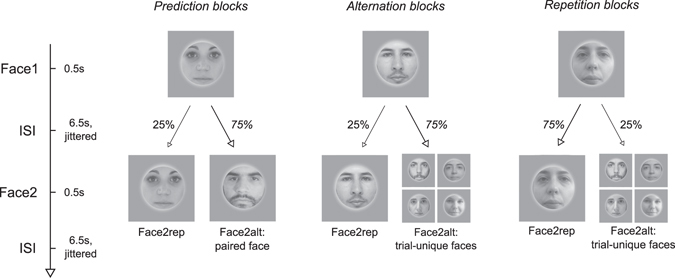
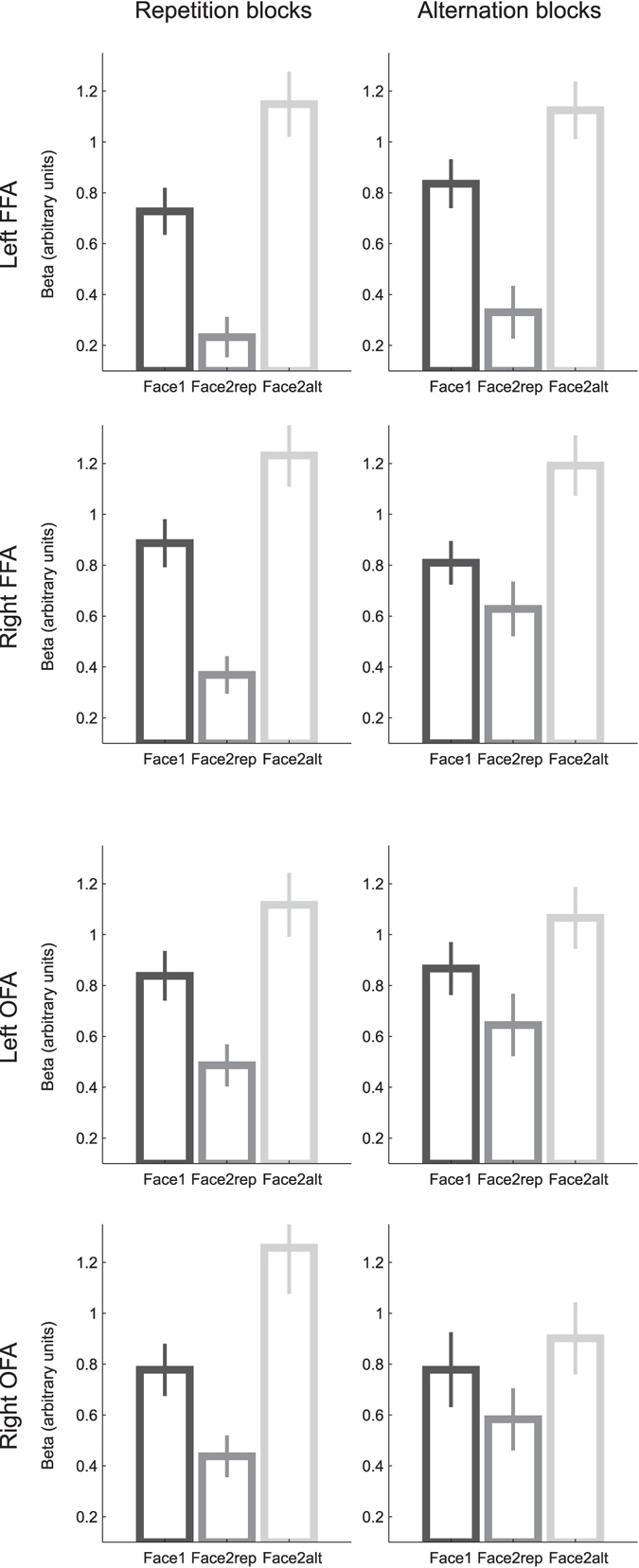
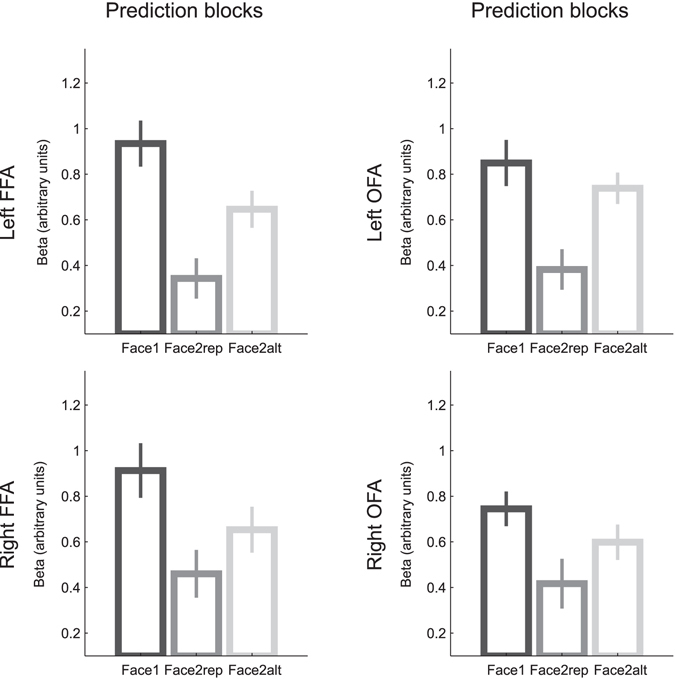
Recent work casts Repetition Suppression (RS), i.e. the reduced neural response to repeated stimuli, as the consequence of reduced surprise for repeated inputs. This research, along with other studies documenting Expectation Suppression, i.e. reduced responses to expected stimuli, emphasizes the role of expectations and predictive codes in perception. Here, we use fMRI to further characterize the nature of predictive signals in the human brain. Prior to scanning, participants were implicitly exposed to associations within face pairs. Critically, we found that this resulted in exemplar-specific Expectation Suppression in the fusiform face-sensitive area (FFA): individual faces that could be predicted from the associations elicited reduced FFA responses, as compared to unpredictable faces. Thus, predictive signals in the FFA are specific to face exemplars, and not only generic to the category of face stimuli. In addition, we show that under such circumstances, the occurrence of surprising repetitions did not trigger enhanced brain responses, as had been recently hypothesized, but still suppressed responses, suggesting that repetition suppression might be partly ‘unsuppressible’. Repetition effects cannot be fully modulated by expectations, which supports the recent view that expectation and repetition effects rest on partially independent mechanisms. Altogether, our study sheds light on the nature of expectation signals along the perceptual system.
Overview
The claims and statistics of this paper haven’t been checked yet.
Free: it reads the open-access text and checks the first 5 claims that cite a source we can check. Create a free account to check every claim.
Integrity signals
Registry
Cites
Statistics
Figures
Verification
Claims the paper makes
The claims and statistics of this paper haven’t been checked yet.
Free: it reads the open-access text and checks the first 5 claims that cite a source we can check. Create a free account to check every claim.
Claims other papers make about this one
Each is checked against this paper’s own text: does it say what the citing paper says it does?
The cited source says what the claim attributes to it.
In the citing paper
“For instance, Pajani et al. 70 observed ES in FFA BOLD activity in response to specifically predicted facial identities relative to nonpredicted faces.”
From Evaluating the neurophysiological evidence for predictive processing as a model of perception (2020) · cites this paper as [70]
Self-check
Percentages, sums and reported differences re-computed from the paper’s own numbers.
The self-check needs the paper’s full text.
Citations
Cites
Brainard, D. H. (1997) · Spatial Vision · doi:10.1163/156856897x00357 · Cited by 19,702
Rao, R. P. N., & Ballard, D. H. (1999) · Nature Neuroscience · doi:10.1038/4580 · Cited by 5,483
A theory of cortical responses.
Friston, K. (2005) · Philosophical Transactions of the Royal Society B: Biological Sciences · doi:10.1098/rstb.2005.1622 · Cited by 4,578
Natural Image Statistics and Neural Representation
Simoncelli, E. P., & Olshausen, B. A. (2001) · Annual Review of Neuroscience · doi:10.1146/annurev.neuro.24.1.1193 · Cited by 2,460
Repetition and the brain: neural models of stimulus-specific effects
Grill-Spector, K., Henson, R., & Martin, A. (2006) · Trends in Cognitive Sciences · doi:10.1016/j.tics.2005.11.006 · Cited by 2,256
Serial dependence in visual perception
Fischer, J., & Whitney, D. (2014) · Nature Neuroscience · doi:10.1038/nn.3689 · Cited by 806
Less Is More: Expectation Sharpens Representations in the Primary Visual Cortex
Kok, P., Jehee, J. F. M., & de Lange, F. P. (2012) · Neuron · doi:10.1016/j.neuron.2012.04.034 · Cited by 798
A Neural Mechanism for Working and Recognition Memory in Inferior Temporal Cortex
Miller, E. K., Li, L., & Desimone, R. (1991) · Science · doi:10.1126/science.1962197 · Cited by 706
A Hierarchy of Time-Scales and the Brain
Kiebel, S. J., Daunizeau, J., & Friston, K. J. (2008) · PLoS Computational Biology · doi:10.1371/journal.pcbi.1000209 · Cited by 694
Neural repetition suppression reflects fulfilled perceptual expectations
Summerfield, C., Trittschuh, E. H., Monti, J. M., Mesulam, M.-M., & Egner, T. (2008) · Nature Neuroscience · doi:10.1038/nn.2163 · Cited by 692
Shape perception reduces activity in human primary visual cortex
Murray, S. O., Kersten, D., Olshausen, B. A., Schrater, P., & Woods, D. L. (2002) · Proceedings of the National Academy of Sciences · doi:10.1073/pnas.192579399 · Cited by 496
Adaptation: from single cells to BOLD signals
Krekelberg, B., Boynton, G. M., & van Wezel, R. J. A. (2006) · Trends in Neurosciences · doi:10.1016/j.tins.2006.02.008 · Cited by 494
Stimulus Predictability Reduces Responses in Primary Visual Cortex
Alink, A., Schwiedrzik, C. M., Kohler, A., Singer, W., & Muckli, L. (2010) · The Journal of Neuroscience · doi:10.1523/jneurosci.3730-10.2010 · Cited by 435
Attention reverses the effect of prediction in silencing sensory signals
Kok, P., Rahnev, D., Jehee, J. F. M., Lau, H. C., & de Lange, F. P. (2012) · Cerebral Cortex · doi:10.1093/cercor/bhr310 · Cited by 430
Experience can change the 'light-from-above' prior
Adams, W. J., Graf, E. W., & Ernst, M. O. (2004) · Nature Neuroscience · doi:10.1038/nn1312 · Cited by 377
Expectation and Surprise Determine Neural Population Responses in the Ventral Visual Stream
Egner, T., Monti, J. M., & Summerfield, C. (2010) · The Journal of Neuroscience · doi:10.1523/jneurosci.2770-10.2010 · Cited by 350
Sawamura, H., Orban, G. A., & Vogels, R. (2006) · Neuron · doi:10.1016/j.neuron.2005.11.028 · Cited by 336
Todorovic, A., & de Lange, F. P. (2012) · The Journal of Neuroscience · doi:10.1523/jneurosci.2227-12.2012 · Cited by 326
Statistical learning of visual transitions in monkey inferotemporal cortex
Meyer, T., & Olson, C. R. (2011) · Proceedings of the National Academy of Sciences · doi:10.1073/pnas.1112895108 · Cited by 325
Serial Dependence in the Perception of Faces
Liberman, A., Fischer, J., & Whitney, D. (2014) · Current Biology · doi:10.1016/j.cub.2014.09.025 · Cited by 324
Repetition suppression and its contextual determinants in predictive coding
Auksztulewicz, R., & Friston, K. (2016) · Cortex · doi:10.1016/j.cortex.2015.11.024 · Cited by 307
Striatal Prediction Error Modulates Cortical Coupling
den Ouden, H. E. M., Daunizeau, J., Roiser, J., Friston, K. J., & Stephan, K. E. (2010) · The Journal of Neuroscience · doi:10.1523/jneurosci.4458-09.2010 · Cited by 304
Evoked brain responses are generated by feedback loops
Garrido, M. I., Kilner, J. M., Kiebel, S. J., & Friston, K. J. (2007) · Proceedings of the National Academy of Sciences · doi:10.1073/pnas.0706274105 · Cited by 296
fMRI Repetition Suppression: Neuronal Adaptation or Stimulus Expectation?
Larsson, J., & Smith, A. T. (2012) · Cerebral Cortex · doi:10.1093/cercor/bhr119 · Cited by 264
Gotts, S. J., Chow, C. C., & Martin, A. (2012) · Cognitive Neuroscience · doi:10.1080/17588928.2012.670617 · Cited by 213
The suppression of repetition enhancement: A review of fMRI studies
Segaert, K., Weber, K., de Lange, F. P., Petersson, K. M., & Hagoort, P. (2013) · Neuropsychologia · doi:10.1016/j.neuropsychologia.2012.11.006 · Cited by 195
Serial Dependence in Perceptual Decisions Is Reflected in Activity Patterns in Primary Visual Cortex
St. John-Saaltink, E., Kok, P., Lau, H. C., & de Lange, F. P. (2016) · The Journal of Neuroscience · doi:10.1523/jneurosci.4390-15.2016 · Cited by 191
Human Scalp Electroencephalography Reveals that Repetition Suppression Varies with Expectation
Summerfield, C., Wyart, V., Johnen, V. M., & de Gardelle, V. (2011) · Frontiers in Human Neuroscience · doi:10.3389/fnhum.2011.00067 · Cited by 145
Kaliukhovich, D. A., & Vogels, R. (2011) · Cerebral Cortex · doi:10.1093/cercor/bhq207 · Cited by 131
De Baene, W., & Vogels, R. (2010) · Cerebral Cortex · doi:10.1093/cercor/bhp277 · Cited by 128
Can predictive coding explain repetition suppression?
Grotheer, M., & Kovács, G. (2016) · Cortex · doi:10.1016/j.cortex.2015.11.027 · Cited by 108
Sources of adaptation of inferior temporal cortical responses
Vogels, R. (2016) · Cortex · doi:10.1016/j.cortex.2015.08.024 · Cited by 97
Single-unit activity in temporal association cortex of the monkey.
Gross, C. G., Schiller, P. H., Wells, C., & Gerstein, G. L. (1967) · Journal of Neurophysiology · doi:10.1152/jn.1967.30.4.833 · Cited by 90 · cited 10×
“024), but not in the left FFA (F(1,26) = 8e-2, p = 0.”
BackgroundInfluentialRepetition Probability Does Not Affect fMRI Repetition Suppression for Objects
Kovacs, G., Kaiser, D., Kaliukhovich, D. A., Vidnyanszky, Z., & Vogels, R. (2013) · Journal of Neuroscience · doi:10.1523/jneurosci.3423-12.2013 · Cited by 86
Repetition Probability Effects Depend on Prior Experiences
Grotheer, M., & Kovács, G. (2014) · The Journal of Neuroscience · doi:10.1523/jneurosci.5326-13.2014 · Cited by 83
Stimulus repetition probability effects on repetition suppression are position invariant for faces
Kovács, G., Iffland, L., Vidnyánszky, Z., & Greenlee, M. W. (2012) · NeuroImage · doi:10.1016/j.neuroimage.2012.02.038 · Cited by 61
Predictive coding for motion stimuli in human early visual cortex
Schellekens, W., Wezel, R. J. A. V., Petridou, N., Ramsey, N. F., & Raemaekers, M. A. H. (2014) · Brain Structure and Function · doi:10.1007/s00429-014-0942-2 · Cited by 45 · cited 3×
“Analyzing both hemispheres separately, we found that the critical Repetition × Repetition Probability interaction was significant in the right FFA (F(1,27) = 5.”
BackgroundThe contribution of surprise to the prediction based modulation of fMRI responses
Amado, C., Hermann, P., Kovács, P., Grotheer, M., Vidnyánszky, Z., & Kovács, G. (2016) · Neuropsychologia · doi:10.1016/j.neuropsychologia.2016.02.003 · Cited by 39
Repetition probability effects for inverted faces
Grotheer, M., Hermann, P., Vidnyánszky, Z., & Kovács, G. (2014) · NeuroImage · doi:10.1016/j.neuroimage.2014.08.006 · Cited by 38
When does repetition suppression depend on repetition probability?
Kovács, G., & Vogels, R. (2014) · Frontiers in Human Neuroscience · doi:10.3389/fnhum.2014.00685 · Cited by 31
Research works printed but not linked: 2
- Grill-Spector K Henson R Martin A Repetition and the brain: neural models of stimulus-specific effects Trends Cogn Sci 2006 10 14 23 10.1016/j.tics.2005.11.006 16321563 · DOI · Paper page
- Auksztulewicz R Friston K Repetition suppression and its contextual determinants in predictive coding Cortex 2016 26861557 PMC5405056 · DOI · Paper page
Cited by
Evaluating the neurophysiological evidence for predictive processing as a model of perception
Walsh, K. S., McGovern, D. P., Clark, A., & O'Connell, R. G. (2020) · Annals of the New York Academy of Sciences · doi:10.1111/nyas.14321 · Cited by 333
Carbajal, G. V., & Malmierca, M. S. (2018) · Trends in Hearing · doi:10.1177/2331216518784822 · Cited by 236
Evaluating the evidence for expectation suppression in the visual system
Feuerriegel, D., Vogels, R., & Kovács, G. (2021) · Neuroscience & Biobehavioral Reviews · doi:10.1016/j.neubiorev.2021.04.002 · Cited by 98
Huber‐Huber, C., Buonocore, A., Dimigen, O., Hickey, C., & Melcher, D. (2019) · NeuroImage · doi:10.1016/j.neuroimage.2019.06.059 · Cited by 47
Feuerriegel, D., Churches, O. F., Coussens, S. W., & Keage, H. A. D. (2017) · NeuroImage · doi:10.1016/j.neuroimage.2017.12.029 · Cited by 44
“Future research controlling for stimulus novelty may be able to identify and isolate stimulus feature predictability effects in repetition designs, which have received little attention in the repetition suppression literature (but see Pajani et al., 2017; Feuerriegel, 2016).”
Background
Metadata
- Authors
- Pajani, A., Kouider, S., Roux, P., & de Gardelle, V.
- Affiliations
- Centre National de la Recherche Scientifique (FR)
- Université de Versailles Saint-Quentin-en-Yvelines (FR)
- Venue
- Scientific Reports
- Published
- 2017-03-13
- Volume
- 7
- Issue
- 1
- Pages
- 160-160
- ISSN
- 2045-2322 (ISSN-L)
- PMC
- PMC5428004
- OpenAlex
- W2594639224
- Cited by
- 25
- References
- 40
- Citations by year
- 2025: 3 · 2024: 4 · 2023: 1 · 2022: 1 · 2021: 2 · 2020: 4 · 2019: 2 · 2018: 7 · 2017: 1
- FWCI
- 2.20
- Type
- journal article
- Language
- en
- Open access
- gold
- doi.org
- Licence
- cc-by
- creativecommons.org/licenses/by/4.0 (tdm)
- creativecommons.org/licenses/by/4.0 (vor)
- Locations
- Scientific Reports (publishedVersion, cc-by)
- PubMed Central (publishedVersion, cc-by)
- PubMed (publishedVersion)
- HAL (submittedVersion, other-oa)
- RePEc: Research Papers in Economics (submittedVersion)
- DOAJ (DOAJ: Directory of Open Access Journals) (submittedVersion, cc-by-sa)
- Funders
- Agence Nationale de la Recherche (ANR-10-IDEX-0001, ANR-10-IDEX0001-02., ANR-10-IDEX, ANR-10-LABX-0087, ANR-16, ANR-10, ANR-10-LABX, ANR-16-CE28-0002, IDEX-0001-02)
- Ministère de l'Enseignement Supérieur et de la Recherche
- Topics
- Life Sciences › Neuroscience › Cognitive Neuroscience › Face Recognition and Perception
- Life Sciences › Neuroscience › Cognitive Neuroscience › Visual perception and processing mechanisms
- Life Sciences › Neuroscience › Cognitive Neuroscience › Neural and Behavioral Psychology Studies
- Keywords
- repetition suppression, fusiform face area, face perception, predictive coding, surprise
About these checks
Registry, retraction, Cites and statistics results are computed, not judged, with one exception: a printed reference that no index lists is read once by a model before it counts as a citation error. Claims are extracted by a model and kept only when their quote appears verbatim in the text; each cited source is then checked, with a model’s help, for whether it says what the claim relies on. Those verdicts can be wrong — read the claim’s quote and the cited source before relying on one.
Statistics and arithmetic are recomputed, not judged.
Confidence bands are shown only for fields calibrated on our annotated test set. None is calibrated yet, so no band is shown.
What counts as a claim ›How we measure confidence ›How we check this ›
Are you an author, or do you see a problem with this page? Request a review
Data sources
Bibliographic data: Semantic Scholar, OpenAlex, Crossref.
Contains information from the Semantic Scholar Academic Graph Datasets, made available under the ODC Attribution License (ODC-BY 1.0).
Semantic Scholar’s data is described in: Kinney, R., et al. (2023). The Semantic Scholar Open Data Platform. arXiv:2301.10140.
