

Comparison of DNA-, PMA-, and RNA-based 16S rRNA Illumina sequencing for detection of live bacteria in water
Open accessThe DOI matches its Crossref record; 47 of the 47 references it cites were found in a registry or an index.
Abstract
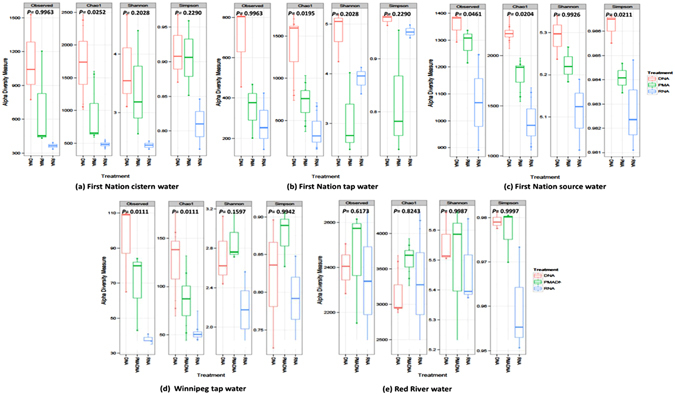
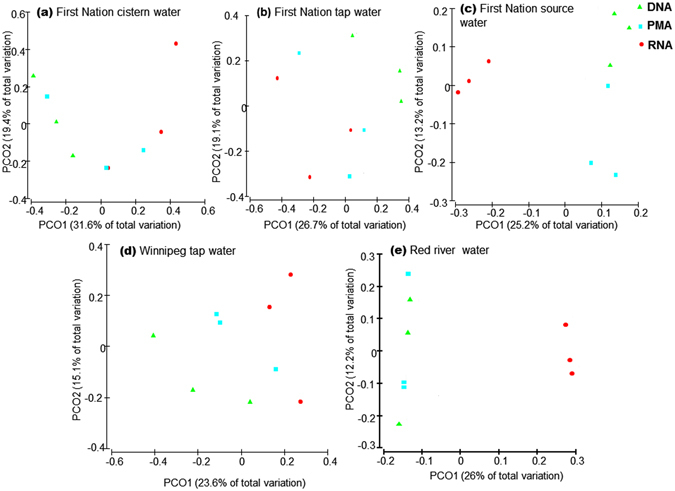
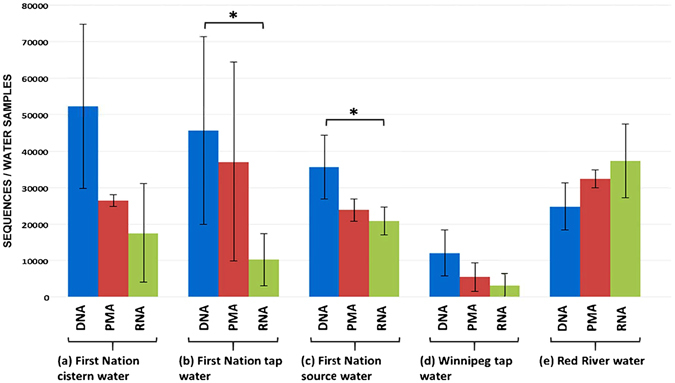
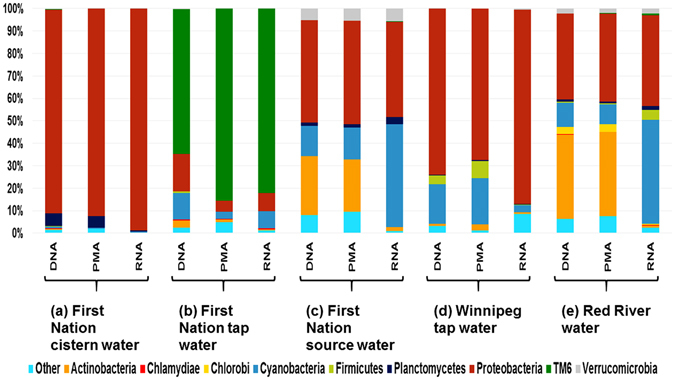
The limitation of 16S rRNA gene sequencing (DNA-based) for microbial community analyses in water is the inability to differentiate live (dormant cells as well as growing or non-growing metabolically active cells) and dead cells, which can lead to false positive results in the absence of live microbes. Propidium-monoazide (PMA) has been used to selectively remove DNA from dead cells during downstream sequencing process. In comparison, 16S rRNA sequencing (RNA-based) can target live microbial cells in water as both dormant and metabolically active cells produce rRNA. The objective of this study was to compare the efficiency and sensitivity of DNA-based, PMA-based and RNA-based 16S rRNA Illumina sequencing methodologies for live bacteria detection in water samples experimentally spiked with different combination of bacteria (2 gram-negative and 2 gram-positive/acid fast species either all live, all dead, or combinations of live and dead species) or obtained from different sources (First Nation community drinking water; city of Winnipeg tap water; water from Red River, Manitoba, Canada). The RNA-based method, while was superior for detection of live bacterial cells still identified a number of 16S rRNA targets in samples spiked with dead cells. In environmental water samples, the DNA- and PMA-based approaches perhaps overestimated the richness of microbial community compared to RNA-based method. Our results suggest that the RNA-based sequencing was superior to DNA- and PMA-based methods in detecting live bacterial cells in water.
Overview
The claims and statistics of this paper haven’t been checked yet.
Free: it reads the open-access text and checks the first 5 claims that cite a source we can check. Create a free account to check every claim.
Integrity signals
Registry
Cites
Statistics
Figures
Verification
Claims the paper makes
The claims and statistics of this paper haven’t been checked yet.
Free: it reads the open-access text and checks the first 5 claims that cite a source we can check. Create a free account to check every claim.
Claims other papers make about this one
Each is checked against this paper’s own text: does it say what the citing paper says it does?
In the citing paper
“The importance of retaining the ability for cell-free DNA detection from culture-negative samples from dead organisms is also why incorporation of a propidium monoazide treatment step to select for DNA from live organisms may not be clinically useful as an enrichment method for mNGS102.”
From Clinical metagenomics (2019) · cites this paper as [102]
Self-check
Percentages, sums and reported differences re-computed from the paper’s own numbers.
The self-check needs the paper’s full text.
Citations
Cites
1 retracted
Lagier, J.-C., Khelaifia, S., Alou, M. T., Ndongo, S., Dione, N., Hugon, P., Caputo, A., Cadoret, F., Traore, S. I., Seck, E. H., et al. (2016) · Nature Microbiology · doi:10.1038/nmicrobiol.2016.203 · Cited by 951 · cited 1×
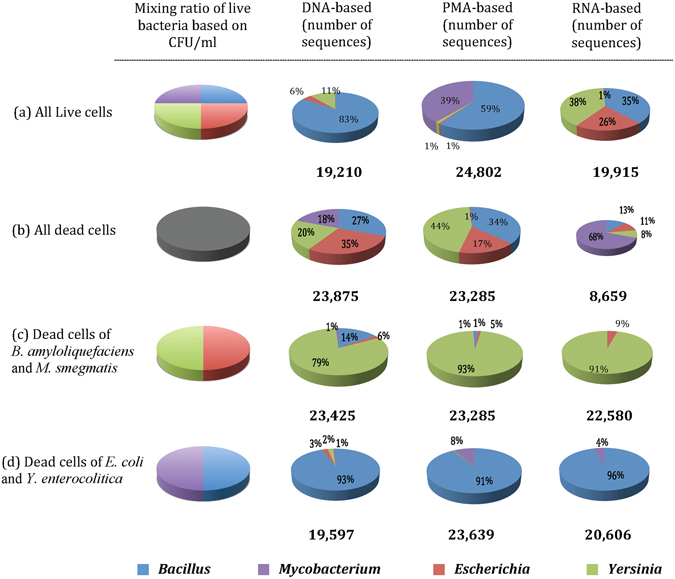
“5 × 10⁴ CFU/ml in triplicate as follow: (1) four live bacterial species, (2) four dead bacterial species, (3) dead gram-positive and acid-fast species plus live gram-negative species, (4) dead gram-negative species plus live gram-positive and acid-fast species, and (5) HPLC grade water without any bacterial culture (n…”
MethodRetractedQIIME allows analysis of high-throughput community sequencing data
Caporaso, J. G., Kuczynski, J., Stombaugh, J., Bittinger, K., Bushman, F. D., Costello, E. K., Fierer, N., Peña, A. G., Goodrich, J. K., Gordon, J. I., et al. (2010) · Nature Methods · doi:10.1038/nmeth.f.303 · Cited by 34,887
Search and clustering orders of magnitude faster than BLAST
Edgar, R. C. (2010) · Bioinformatics · doi:10.1093/bioinformatics/btq461 · Cited by 20,826
Naïve Bayesian Classifier for Rapid Assignment of rRNA Sequences into the New Bacterial Taxonomy
Wang, Q., Garrity, G. M., Tiedje, J. M., & Cole, J. R. (2007) · Applied and Environmental Microbiology · doi:10.1128/aem.00062-07 · Cited by 19,885
FLASH: fast length adjustment of short reads to improve genome assemblies
Magoč, T., & Salzberg, S. L. (2011) · Bioinformatics · doi:10.1093/bioinformatics/btr507 · Cited by 15,366
UCHIME improves sensitivity and speed of chimera detection
Edgar, R. C., Haas, B. J., Clemente, J. C., Quince, C., & Knight, R. (2011) · Bioinformatics · doi:10.1093/bioinformatics/btr381 · Cited by 15,114
FastTree 2 – Approximately Maximum-Likelihood Trees for Large Alignments
Price, M. N., Dehal, P. S., & Arkin, A. P. (2010) · PLoS ONE · doi:10.1371/journal.pone.0009490 · Cited by 14,894
Greengenes, a Chimera-Checked 16S rRNA Gene Database and Workbench Compatible with ARB
DeSantis, T. Z., Hugenholtz, P., Larsen, N., Rojas, M., Brodie, E. L., Keller, K., Huber, T., Dalevi, D., Hu, P., & Andersen, G. L. (2006) · Applied and Environmental Microbiology · doi:10.1128/aem.03006-05 · Cited by 10,891
Ultra-high-throughput microbial community analysis on the Illumina HiSeq and MiSeq platforms
Caporaso, J. G., Lauber, C. L., Walters, W. A., Berg-Lyons, D., Huntley, J., Fierer, N., Owens, S. M., Betley, J., Fraser, L., Bauer, M., et al. (2012) · The ISME Journal · doi:10.1038/ismej.2012.8 · Cited by 8,839
UniFrac: a New Phylogenetic Method for Comparing Microbial Communities
Lozupone, C., & Knight, R. (2005) · Applied and Environmental Microbiology · doi:10.1128/aem.71.12.8228-8235.2005 · Cited by 8,227
Deciphering the biology of Mycobacterium tuberculosis from the complete genome sequence
Cole, S. T., Brosch, R., Parkhill, J., Garnier, T., Churcher, C., Harris, D., Gordon, S. V., Eiglmeier, K., Gas, S., Barry, C. E., et al. (1998) · Nature · doi:10.1038/31159 · Cited by 7,847
The Complete Genome Sequence of Escherichia coli K-12
Blattner, F. R., Plunkett, G., Bloch, C. A., Perna, N. T., Burland, V., Riley, M., Collado-Vides, J., Glasner, J. D., Rode, C. K., Mayhew, G. F., et al. (1997) · Science · doi:10.1126/science.277.5331.1453 · Cited by 7,452
PyNAST: a flexible tool for aligning sequences to a template alignment
Caporaso, J. G., Bittinger, K., Bushman, F. D., DeSantis, T. Z., Andersen, G. L., & Knight, R. (2010) · Bioinformatics · doi:10.1093/bioinformatics/btp636 · Cited by 3,396
Nocker, A., Cheung, C.-Y., & Camper, A. K. (2006) · Journal of Microbiological Methods · doi:10.1016/j.mimet.2006.04.015 · Cited by 1,073
Blazewicz, S. J., Barnard, R. L., Daly, R. A., & Firestone, M. K. (2013) · The ISME Journal · doi:10.1038/ismej.2013.102 · Cited by 878
Release and persistence of extracellular DNA in the environment
Nielsen, K. M., Johnsen, P. J., Bensasson, D., & Daffonchio, D. (2007) · Environmental Biosafety Research · doi:10.1051/ebr:2007031 · Cited by 614
The guanine and cytosine content of genomic DNA and bacterial evolution.
Muto, A., & Osawa, S. (1987) · Proceedings of the National Academy of Sciences · doi:10.1073/pnas.84.1.166 · Cited by 578
Waterborne Pathogens: Detection Methods and Challenges
Ramírez-Castillo, F., Loera-Muro, A., Jacques, M., Garneau, P., Avelar-González, F., Harel, J., & Guerrero-Barrera, A. (2015) · Pathogens · doi:10.3390/pathogens4020307 · Cited by 571
Opportunistic pathogens enriched in showerhead biofilms
Feazel, L. M., Baumgartner, L. K., Peterson, K. L., Frank, D. N., Harris, J. K., & Pace, N. R. (2009) · Proceedings of the National Academy of Sciences · doi:10.1073/pnas.0908446106 · Cited by 557 · cited 1×
“5 × 10⁴ CFU/ml in triplicate as follow: (1) four live bacterial species, (2) four dead bacterial species, (3) dead gram-positive and acid-fast species plus live gram-negative species, (4) dead gram-negative species plus live gram-positive and acid-fast species, and (5) HPLC grade water without any bacterial culture (n…”
MethodThe truth about metagenomics: quantifying and counteracting bias in 16S rRNA studies
Vaginal Microbiome Consortium (additional members), Brooks, J. P., Edwards, D. J., Harwich, M. D., Rivera, M. C., Fettweis, J. M., Serrano, M. G., Reris, R. A., Sheth, N. U., Huang, B., et al. (2015) · BMC Microbiology · doi:10.1186/s12866-015-0351-6 · Cited by 528
Rumen Microbiome Composition Determined Using Two Nutritional Models of Subacute Ruminal Acidosis
Khafipour, E., Li, S., Plaizier, J. C., & Krause, D. O. (2009) · Applied and Environmental Microbiology · doi:10.1128/aem.00739-09 · Cited by 515
Self-citationFittipaldi, M., Nocker, A., & Codony, F. (2012) · Journal of Microbiological Methods · doi:10.1016/j.mimet.2012.08.007 · Cited by 425
Selinger, D. W., Saxena, R. M., Cheung, K. J., Church, G. M., & Rosenow, C. (2003) · Genome Research · doi:10.1101/gr.912603 · Cited by 359
Pan, Y., & Breidt, F. (2007) · Applied and Environmental Microbiology · doi:10.1128/aem.01198-07 · Cited by 269
Drinking water microbiology — from measurement to management
Proctor, C. R., & Hammes, F. (2015) · Current Opinion in Biotechnology · doi:10.1016/j.copbio.2014.12.014 · Cited by 199 · cited 1×
“5 × 10⁴ CFU/ml in triplicate as follow: (1) four live bacterial species, (2) four dead bacterial species, (3) dead gram-positive and acid-fast species plus live gram-negative species, (4) dead gram-negative species plus live gram-positive and acid-fast species, and (5) HPLC grade water without any bacterial culture (n…”
MethodHierro, N., Esteve-Zarzoso, B., González, A., Mas, A., & Guillamón, J. M. (2006) · Applied and Environmental Microbiology · doi:10.1128/aem.00388-06 · Cited by 199
Bleve, G., Rizzotti, L., Dellaglio, F., & Torriani, S. (2003) · Applied and Environmental Microbiology · doi:10.1128/aem.69.7.4116-4122.2003 · Cited by 185
Death of the Escherichia coli K-12 strain W3110 in soil and water
Bogosian, G., Sammons, L. E., Morris, P. J., O’Neil, J. P., Heitkamp, M. A., & Weber, D. B. (1996) · Applied and Environmental Microbiology · doi:10.1128/aem.62.11.4114-4120.1996 · Cited by 181
New perspectives on viable microbial communities in low-biomass cleanroom environments
Vaishampayan, P., Probst, A. J., La Duc, M. T., Bargoma, E., Benardini, J. N., Andersen, G. L., & Venkateswaran, K. (2013) · The ISME Journal · doi:10.1038/ismej.2012.114 · Cited by 169
Genome-wide survey of mRNA half-lives in Bacillus subtilis identifies extremely stable mRNAs
Hambraeus, G., von Wachenfeldt, C., & Hederstedt, L. (2003) · Molecular Genetics and Genomics · doi:10.1007/s00438-003-0883-6 · Cited by 157
Varma, M., Field, R., Stinson, M. K., Rukovets, B., Wymer, L. J., & Haugland, R. A. (2009) · Water Research · doi:10.1016/j.watres.2009.05.031 · Cited by 148
Determination of viable wine yeast using DNA binding dyes and quantitative PCR
Andorrà, I., Esteve‐Zarzoso, B., Guillamón, J. M., & Mas, A. (2010) · International Journal of Food Microbiology · doi:10.1016/j.ijfoodmicro.2010.10.003 · Cited by 136
McDowell, D. G., Burns, N. A., & Parkes, H. C. (1998) · Nucleic Acids Research · doi:10.1093/nar/26.14.3340 · Cited by 132
Nocker, A., Richter‐Heitmann, T., Montijn, R. C., Schuren, F. H. J., & Kort, R. (2010) · PubMed · doi:10.2436/20.1501.01.111 · Cited by 130 · cited 1×
“For the PMA treatment, a modified method based on Hellein et al.30 and Nocker et al.10 was used.”
MethodGENETIC RELATEDNESS IN THE FAMILY ENTEROBACTERIACEAE
Sanderson, K. E. (1976) · Annual Review of Microbiology · doi:10.1146/annurev.mi.30.100176.001551 · Cited by 128
Pacheco, S. A., Hsu, F.-F., Powers, K. M., & Purdy, G. E. (2013) · Journal of Biological Chemistry · doi:10.1074/jbc.m113.473371 · Cited by 123
Derakhshani, H., Tun, H. M., & Khafipour, E. (2016) · Journal of Basic Microbiology · doi:10.1002/jobm.201500420 · Cited by 120
Self-citationElizaquível, P., Sánchez, G., & Aznar, R. (2011) · Food Control · doi:10.1016/j.foodcont.2011.12.003 · Cited by 113 · cited 1×
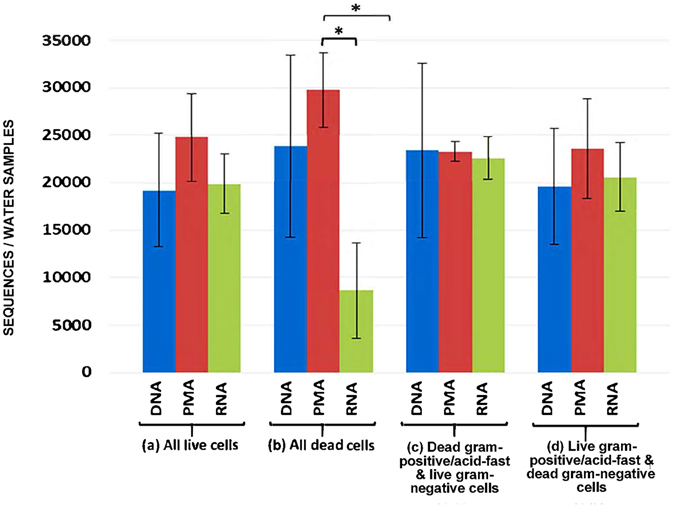
“001) in the RNA-based method (8,659) compared to DNA- (23,875) and PMA-based (29,753) methods.”
MethodLøvdal, T., Hovda, M. B., Björkblom, B., & Møller, S. G. (2011) · Journal of Microbiological Methods · doi:10.1016/j.mimet.2011.01.027 · Cited by 105 · cited 1×
“001) in the RNA-based method (8,659) compared to DNA- (23,875) and PMA-based (29,753) methods.”
MethodGensberger, E. T., Polt, M., Konrad-Köszler, M., Kinner, P., Sessitsch, A., & KOSTIC, T. M. (2014) · Water Research · doi:10.1016/j.watres.2014.09.022 · Cited by 99
DNA recovery and direct detection of Tn5 sequences from soil
Selenska, S., & Klingmüller, W. (1991) · Letters in Applied Microbiology · doi:10.1111/j.1472-765x.1991.tb00559.x · Cited by 96 · cited 1×
“001) in the RNA-based method (8,659) compared to DNA- (23,875) and PMA-based (29,753) methods.”
MethodBarcina, I., & Arana, I. (2009) · Reviews in Environmental Science and Bio/Technology · doi:10.1007/s11157-009-9159-x · Cited by 71 · cited 1×
“5 × 10⁴ CFU/ml in triplicate as follow: (1) four live bacterial species, (2) four dead bacterial species, (3) dead gram-positive and acid-fast species plus live gram-negative species, (4) dead gram-negative species plus live gram-positive and acid-fast species, and (5) HPLC grade water without any bacterial culture (n…”
MethodMorin, N. J., Gong, Z., & Li, X. (2004) · Clinical Chemistry · doi:10.1373/clinchem.2004.036814 · Cited by 69
Rogers, G. B., & Bruce, K. D. (2010) · Molecular Diagnosis & Therapy · doi:10.1007/bf03256391 · Cited by 45
Moore, R. L., & Brubaker, R. R. (1975) · International Journal of Systematic Bacteriology · doi:10.1099/00207713-25-4-336 · Cited by 43
Haack, S. K., Duris, J. W., Kolpin, D. W., Fogarty, L. R., Johnson, H. E., Gibson, K. E., Focazio, M. J., Schwab, K. J., Hubbard, L. E., & Foreman, W. T. (2015) · Applied and Environmental Microbiology · doi:10.1128/aem.04195-14 · Cited by 30
Hellein, K. N., Kennedy, E. M., Harwood, V. J., Gordon, K. V., Wang, S. Y., & Lepo, J. E. (2012) · Journal of Microbiological Methods · doi:10.1016/j.mimet.2012.01.015 · Cited by 21
Research works printed but not linked: 1
- Cornell, J. A. Experiments with Mixtures: Designs, Models, and the Analysis of Mixture Data. Third Edition edn, (John Wiley & Sons, 2011).
Cited by
Chiu, C. Y., & Miller, S. A. (2019) · Nature Reviews Genetics · doi:10.1038/s41576-019-0113-7 · Cited by 1,620
Perrin, Y., Bouchon, D., Delafont, V., Moulin, L., & Héchard, Y. (2018) · Water Research · doi:10.1016/j.watres.2018.11.013 · Cited by 137
Metagenomics Approaches for the Detection and Surveillance of Emerging and Recurrent Plant Pathogens
Piombo, E., Abdelfattah, A., Droby, S., Wisniewski, M., Spadaro, D., & Schena, L. (2021) · Microorganisms · doi:10.3390/microorganisms9010188 · Cited by 146
Host DNA depletion efficiency of microbiome DNA enrichment methods in infected tissue samples
Heravi, F. S., Zakrzewski, M., Vickery, K., & Hu, H. (2020) · Journal of Microbiological Methods · doi:10.1016/j.mimet.2020.105856 · Cited by 123
Garel, M., Bonin, P., Martini, S., Guasco, S., Roumagnac, M., Bhairy, N., Armougom, F., & Tamburini, C. (2019) · Frontiers in Microbiology · doi:10.3389/fmicb.2019.00453 · Cited by 113
“Beyond RNA instability and bias originating from DNA/RNA extraction and amplification, the rRNA- overcomes rDNA-based approach for detecting live prokaryotic cells in water (Li et al., 2017).”
Metadata
- Authors
- Li, R., Tun, H. M., Jahan, M., Zhang, Z., Kumar, A., Dilantha Fernando, W. G., Farenhorst, A., & Khafipour, E.
- Affiliations
- Yunnan Agricultural University (CN)
- University of Alberta (CA)
- University of Manitoba (CA)
- Corresponding author
- Farenhorst, Annemieke
- Khafipour, Ehsan
- Venue
- Scientific Reports
- Published
- 2017-07-18
- Volume
- 7
- Issue
- 1
- Pages
- 5752-5752
- ISSN
- 2045-2322 (ISSN-L)
- PMC
- PMC5515937
- OpenAlex
- W2734785751
- Cited by
- 203
- References
- 47
- Citations by year
- 2026: 16 · 2025: 33 · 2024: 33 · 2023: 22 · 2022: 31 · 2021: 29 · 2020: 16 · 2019: 15 · 2018: 7 · 2017: 1
- FWCI
- 8.05
- Type
- journal article
- Language
- en
- Update notices
- correction (2018-11-22)
- Open access
- gold
- doi.org
- Licence
- cc-by
- creativecommons.org/licenses/by/4.0 (tdm)
- creativecommons.org/licenses/by/4.0 (vor)
- Locations
- Scientific Reports (publishedVersion, cc-by)
- PubMed Central (publishedVersion, cc-by)
- PubMed (publishedVersion)
- Topics
- Physical Sciences › Environmental Science › Ecology › Microbial Community Ecology and Physiology
- Physical Sciences › Environmental Science › Ecology › Environmental DNA in Biodiversity Studies
- Life Sciences › Biochemistry, Genetics and Molecular Biology › Molecular Biology › Genomics and Phylogenetic Studies
- Keywords
- 16S rRNA gene sequencing, live bacteria detection, propidium monoazide, drinking water microbiology, water quality monitoring, false positive detection
- MeSH terms
- Azides, Bacteria, DNA, Bacterial, Propidium, RNA, Ribosomal, 16S, Water Microbiology, Reproducibility of Results, Microbial Viability, High-Throughput Nucleotide Sequencing, Microbiota
About these checks
Registry, retraction, Cites and statistics results are computed, not judged, with one exception: a printed reference that no index lists is read once by a model before it counts as a citation error. Claims are extracted by a model and kept only when their quote appears verbatim in the text; each cited source is then checked, with a model’s help, for whether it says what the claim relies on. Those verdicts can be wrong — read the claim’s quote and the cited source before relying on one.
Statistics and arithmetic are recomputed, not judged.
Confidence bands are shown only for fields calibrated on our annotated test set. None is calibrated yet, so no band is shown.
What counts as a claim ›How we measure confidence ›How we check this ›
Are you an author, or do you see a problem with this page? Request a review
Data sources
Bibliographic data: Semantic Scholar, OpenAlex, Crossref.
Contains information from the Semantic Scholar Academic Graph Datasets, made available under the ODC Attribution License (ODC-BY 1.0).
Semantic Scholar’s data is described in: Kinney, R., et al. (2023). The Semantic Scholar Open Data Platform. arXiv:2301.10140.
