

Reducing mitochondrial reads in ATAC-seq using CRISPR/Cas9
Open accessPublished version of a preprint
The DOI matches its Crossref record; 15 of the 15 references it cites were found in a registry or an index.
Abstract
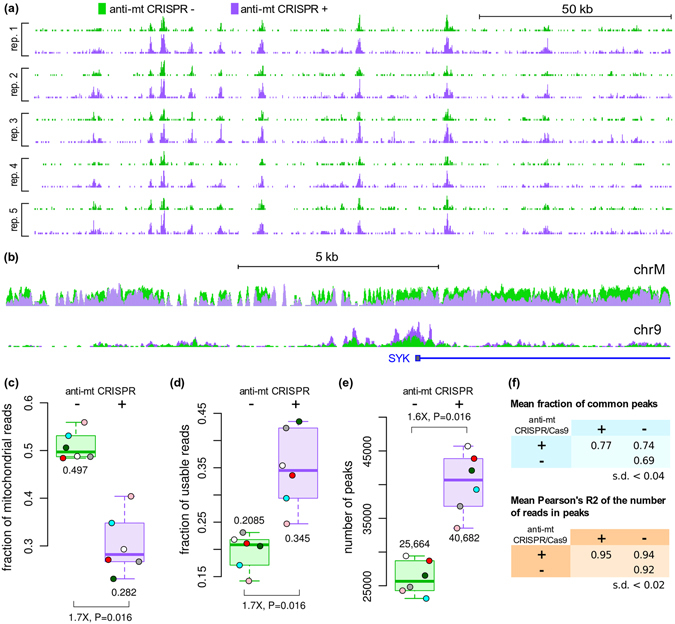
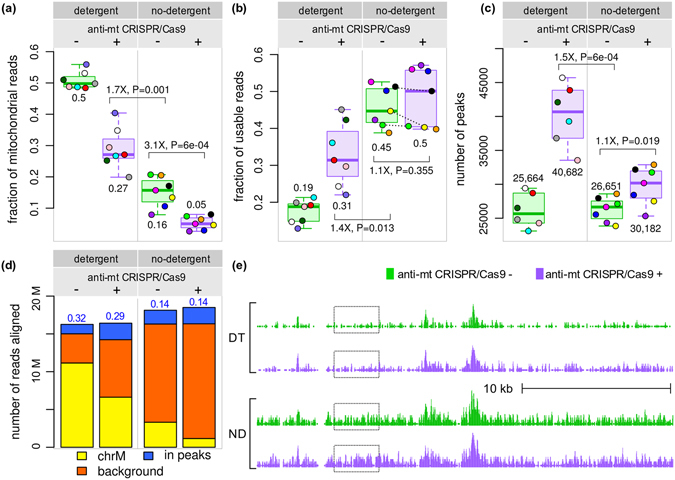
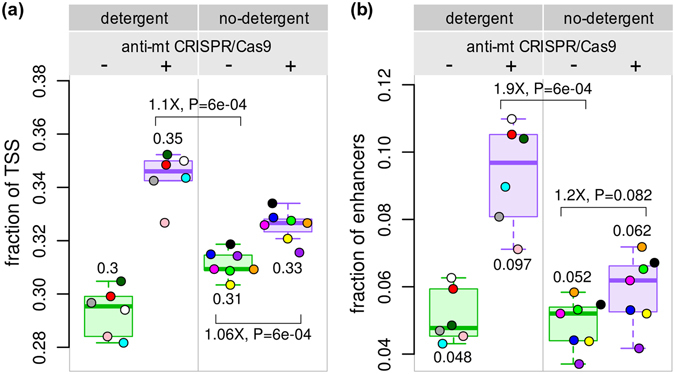
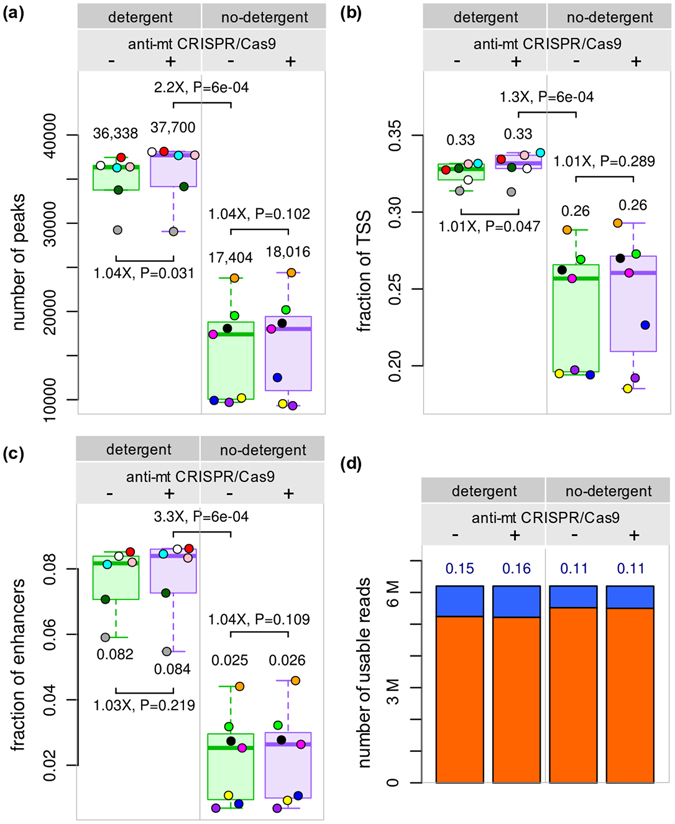
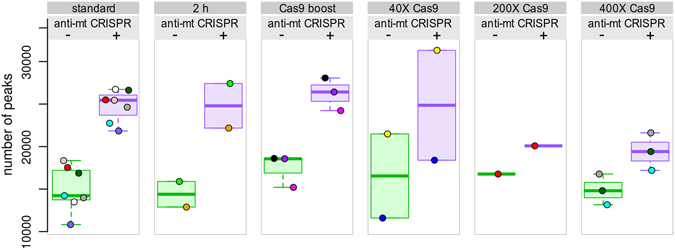
ATAC-seq is a high-throughput sequencing technique that identifies open chromatin. Depending on the cell type, ATAC-seq samples may contain ~20–80% of mitochondrial sequencing reads. As the regions of open chromatin of interest are usually located in the nuclear genome, mitochondrial reads are typically discarded from the analysis. We tested two approaches to decrease wasted sequencing in ATAC-seq libraries generated from lymphoblastoid cell lines: targeted cleavage of mitochondrial DNA fragments using CRISPR technology and removal of detergent from the cell lysis buffer. We analyzed the effects of these treatments on the number of usable (unique, non-mitochondrial) reads and the number and quality of peaks called, including peaks identified in enhancers and transcription start sites. Both treatments resulted in considerable reduction of mitochondrial reads (1.7 and 3-fold, respectively). The removal of detergent, however, resulted in increased background and fewer peaks. The highest number of peaks and highest quality data was obtained by preparing samples with the original ATAC-seq protocol (using detergent) and treating them with CRISPR. This strategy reduced the amount of sequencing required to call a high number of peaks, which could lead to cost reduction when performing ATAC-seq on large numbers of samples and in cell types that contain a large amount of mitochondria.
Overview
The claims and statistics of this paper haven’t been checked yet.
Free: it reads the open-access text and checks the first 5 claims that cite a source we can check. Create a free account to check every claim.
Integrity signals
Registry
Cites
Statistics
Figures

Verification
Claims the paper makes
The claims and statistics of this paper haven’t been checked yet.
Free: it reads the open-access text and checks the first 5 claims that cite a source we can check. Create a free account to check every claim.
Claims other papers make about this one
Each is checked against this paper’s own text: does it say what the citing paper says it does?
The cited source says what the claim attributes to it.
In the citing paper
“Furthermore, the assay for transposase-accessible chromatin by sequencing (ATAC-seq) is able to get access to DNA sequences in open chromatin and to produce high quality data with a low background in a high-through output way (311).”
From Epigenetic Modifications in Stress Response Genes Associated With Childhood Trauma (2019) · cites this paper as [311]
Self-check
Percentages, sums and reported differences re-computed from the paper’s own numbers.
The self-check needs the paper’s full text.
Citations
Cites
R: A Language and Environment for Statistical Computing
R Core Team (2025) · doi:10.32614/r.manuals · Cited by 352,181
Fast gapped-read alignment with Bowtie 2
Langmead, B., & Salzberg, S. L. (2012) · Nature Methods · doi:10.1038/nmeth.1923 · Cited by 56,400
Cutadapt removes adapter sequences from high-throughput sequencing reads
Martin, M. (2011) · EMBnet.journal · doi:10.14806/ej.17.1.200 · Cited by 33,889
BEDTools: a flexible suite of utilities for comparing genomic features
Quinlan, A. R., & Hall, I. M. (2010) · Bioinformatics · doi:10.1093/bioinformatics/btq033 · Cited by 27,437
Model-based Analysis of ChIP-Seq (MACS)
Zhang, Y., Liu, T., Meyer, C. A., Eeckhoute, J., Johnson, D. S., Bernstein, B. E., Nusbaum, C., Myers, R. M., Brown, M., Li, W., et al. (2008) · Genome Biology · doi:10.1186/gb-2008-9-9-r137 · Cited by 18,386
Multiplex Genome Engineering Using CRISPR/Cas Systems
Cong, L., Ran, F. A., Cox, D., Lin, S., Barretto, R., Habib, N., Hsu, P. D., Wu, X., Jiang, W., Marraffini, L. A., et al. (2013) · Science · doi:10.1126/science.1231143 · Cited by 15,339
Heinz, S., Benner, C., Spann, N., Bertolino, E., Lin, Y. C., Laslo, P., Cheng, J. X., Murre, C., Singh, H., & Glass, C. K. (2010) · Molecular Cell · doi:10.1016/j.molcel.2010.05.004 · Cited by 13,382
Buenrostro, J. D., Giresi, P. G., Zaba, L. C., Chang, H. Y., & Greenleaf, W. J. (2013) · Nature Methods · doi:10.1038/nmeth.2688 · Cited by 6,422 · cited 1×
“The ATAC-seq technique makes use of the Tn5 transposase, an optimized hyperactive transposase that fragments and tags the genome with sequencing adapters in regions of open chromatin(1).”
MethodIntegrative analysis of 111 reference human epigenomes
Roadmap Epigenomics Consortium, Kundaje, A., Meuleman, W., Ernst, J., Bilenky, M., Yen, A., Heravi-Moussavi, A., Kheradpour, P., Zhang, Z., Wang, J., et al. (2015) · Nature · doi:10.1038/nature14248 · Cited by 6,368 · cited 4×
“Epigenome Roadmap (9) 15-state ChromHMM coordinates were obtained from http://egg2.”
BackgroundMethodInfluentialSelf-citationGENCODE: The reference human genome annotation for The ENCODE Project
Harrow, J., Frankish, A., Gonzalez, J. M., Tapanari, E., Diekhans, M., Kokocinski, F., Aken, B. L., Barrell, D., Zadissa, A., Searle, S., et al. (2012) · Genome Research · doi:10.1101/gr.135350.111 · Cited by 4,585 · cited 3×
“Transcription start sites were obtained from the Gencode (8) GRCh38 basic set (ftp://ftp.”
MethodInfluential
Cited by
Epigenetic Modifications in Stress Response Genes Associated With Childhood Trauma
Jiang, S., Postovit, L., Cattaneo, A., Binder, E. B., & Aitchison, K. J. (2019) · Frontiers in Psychiatry · doi:10.3389/fpsyt.2019.00808 · Cited by 288
Chromatin accessibility profiling methods
Minnoye, L., Marinov, G. K., Krausgruber, T., Pan, L., Marand, A. P., Secchia, S., Greenleaf, W. J., Furlong, E. E. M., Zhao, K., Schmitz, R. J., et al. (2021) · Nature Reviews Methods Primers · doi:10.1038/s43586-020-00008-9 · Cited by 206
Wang, X., He, L., Goggin, S. M., Saadat, A., Wang, L., Sinnott-Armstrong, N., Claussnitzer, M., & Kellis, M. (2018) · Nature Communications · doi:10.1038/s41467-018-07746-1 · Cited by 159
Genomic methods in profiling DNA accessibility and factor localization
Klein, D. C., & Hainer, S. J. (2019) · Chromosome Research · doi:10.1007/s10577-019-09619-9 · Cited by 120
Calviello, A. K., Hirsekorn, A., Wurmus, R., Yusuf, D., & Ohler, U. (2019) · Genome biology · doi:10.1186/s13059-019-1654-y · Cited by 113
Detect accessible chromatin using ATAC-sequencing, from principle to applications
Sun, Y., Miao, N., & Sun, T. (2019) · Hereditas · doi:10.1186/s41065-019-0105-9 · Cited by 106
Barnett, K. R., Decato, B. E., Scott, T. J., Hansen, T. J., Chen, B., Attalla, J., Smith, A. D., & Hodges, E. C. (2020) · Molecular Cell · doi:10.1016/j.molcel.2020.01.004 · Cited by 101
Quantification, Dynamic Visualization, and Validation of Bias in ATAC-Seq Data with ataqv
Orchard, P., Kyono, Y., Hensley, J., Kitzman, J. O., & Parker, S. C. J. (2020) · Cell Systems · doi:10.1016/j.cels.2020.02.009 · Cited by 97
Transforming ecology and conservation biology through genome editing
Phelps, M. P., Seeb, L. W., & Seeb, J. E. (2020) · Conservation Biology · doi:10.1111/cobi.13292 · Cited by 92
Lareau, C. A., Liu, V., Muus, C., Praktiknjo, S. D., Nitsch, L., Kautz, P., Sándor, K., Yin, Y., Gutierrez, J. C., Pelka, K., et al. (2023) · Nature Protocols · doi:10.1038/s41596-022-00795-3 · Cited by 79
Yin, S., Lu, K., Tan, T., Tang, J., Wei, J., Liu, X., Hu, X., Wan, H., Huang, W., Fan, Y., et al. (2020) · Nature Communications · doi:10.1038/s41467-020-14368-z · Cited by 56
Song, L., & Xie, K. (2020) · Microbiome · doi:10.1186/s40168-020-00859-0 · Cited by 55
Single-Cell Multiomics Techniques: From Conception to Applications
Dimitriu, M. A., Lazar-Contes, I., Roszkowski, M., & Mansuy, I. M. (2022) · Frontiers in Cell and Developmental Biology · doi:10.3389/fcell.2022.854317 · Cited by 53
Profiling Chromatin Accessibility at Single-Cell Resolution
Sinha, S., Satpathy, A. T., Zhou, W., Ji, H., Stratton, J. A., Jaffer, A., Bahlis, N. J., Morrissy, A. S., & Biernaskie, J. A. (2021) · Genomics Proteomics & Bioinformatics · doi:10.1016/j.gpb.2020.06.010 · Cited by 50
Kannan, S., Miyamoto, M., Lin, B. L., Zhu, R., Murphy, S., Kass, D. A., Andersen, P., & Kwon, C. (2019) · Circulation Research · doi:10.1161/circresaha.119.315493 · Cited by 50
Analyzing Circulating Tumor Cells One at a Time
Ortiz, V., & Yu, M. (2018) · Trends in Cell Biology · doi:10.1016/j.tcb.2018.05.004 · Cited by 48
“In addition, contaminating mitochondrial reads in ATAC-seq can potentially lead to low-coverage data sets [67].”
BackgroundLandscape of Germline and Somatic Mitochondrial DNA Mutations in Pediatric Malignancies
Tříska, P., Kaneva, K., Merkurjev, D., Sohail, N., Falk, M. J., Triche, T. J., Biegel, J. A., & Gai, X. (2019) · Cancer Research · doi:10.1158/0008-5472.can-18-2220 · Cited by 48
Unique and assay specific features of NOMe-, ATAC- and DNase I-seq data
Nordström, K. J. V., Schmidt, F., Gasparoni, N., Salhab, A., Gasparoni, G., Kattler, K., Müller, F., Ebert, P., Costa, I. G., Pfeifer, N., et al. (2019) · Nucleic Acids Research · doi:10.1093/nar/gkz799 · Cited by 41
CRISPR-Cap: multiplexed double-stranded DNA enrichment based on the CRISPR system
Lee, J., Lim, H., Jang, H. S., Hwang, B., Lee, J. H., Cho, J., Lee, J. H., & Bang, D. (2018) · Nucleic Acids Research · doi:10.1093/nar/gky820 · Cited by 40
Considerations in the analysis of plant chromatin accessibility data
Bubb, K. L., & Deal, R. B. (2020) · Current Opinion in Plant Biology · doi:10.1016/j.pbi.2020.01.003 · Cited by 39
CRISPR/Cas9-targeted removal of unwanted sequences from small-RNA sequencing libraries
Hardigan, A. A., Roberts, B. S., Moore, D. E., Ramaker, R. C., Jones, A. L., & Myers, R. M. (2019) · Nucleic Acids Research · doi:10.1093/nar/gkz425 · Cited by 37
Genome-wide ATAC-see screening identifies TFDP1 as a modulator of global chromatin accessibility
Ishii, S., Kakizuka, T., Park, S., Tagawa, A., Sanbo, C., Tanabe, H., Ohkawa, Y., Nakanishi, M., Nakai, K., & Miyanari, Y. (2024) · Nature Genetics · doi:10.1038/s41588-024-01658-1 · Cited by 37
Gordon, W. E., Baek, S., Nguyen, H. P., Kuo, Y., Bradley, R., Fong, S., Kim, N., Galazyuk, A. V., Lee, I., Ingala, M. R., et al. (2024) · Nature Communications · doi:10.1038/s41467-023-44186-y · Cited by 37
Dual detection of chromatin accessibility and DNA methylation using ATAC-Me
Guerin, L. N., Barnett, K. R., & Hodges, E. C. (2021) · Nature Protocols · doi:10.1038/s41596-021-00608-z · Cited by 35
Bibliometric Analysis of ATAC-Seq and Its Use in Cancer Biology via Nucleic Acid Detection
Zhao, Y., Zhang, X., Song, Z., Wei, D., Wang, H., Chen, W., Sun, G., Ma, W., & Chen, K. (2020) · Frontiers in Medicine · doi:10.3389/fmed.2020.584728 · Cited by 31
Sieber, K. B., Batorsky, A., Siebenthall, K. T., Hudkins, K. L., Vierstra, J. D., Sullivan, S. T., Sur, A., McNulty, M. T., Sandstrom, R. S., Reynolds, A. P., et al. (2019) · Journal of the American Society of Nephrology · doi:10.1681/asn.2018030309 · Cited by 31
Kim, B., Kim, Y., Shin, S., Lee, S., Choi, Y., & Lee, K. (2022) · Cancer Cell International · doi:10.1186/s12935-022-02504-2 · Cited by 29
excluderanges: exclusion sets for T2T-CHM13, GRCm39, and other genome assemblies
Ogata, J. D., Mu, W., Davis, E. S., Xue, B., Harrell, J. C., Sheffield, N. C., Phanstiel, D. H., Love, M. I., & Dozmorov, M. G. (2023) · Bioinformatics · doi:10.1093/bioinformatics/btad198 · Cited by 29
Analytical Approaches for ATAC‐seq Data Analysis
Smith, J. P., & Sheffield, N. C. (2020) · Current Protocols in Human Genetics · doi:10.1002/cphg.101 · Cited by 25
Molecular and computational approaches to map regulatory elements in 3D chromatin structure
Lee, B. H., & Rhie, S. K. (2021) · Epigenetics & Chromatin · doi:10.1186/s13072-021-00390-y · Cited by 19
Dynamic chromatin accessibility landscape changes following interleukin-1 stimulation
Barter, M. J., Cheung, K., Falk, J., Panagiotopoulos, A., Cosimini, C., O’Brien, S., Teja-Putri, K., Neill, G. W., Deehan, D. J., & Young, D. A. (2020) · Epigenetics · doi:10.1080/15592294.2020.1789266 · Cited by 19
Tao, Y., He, C., Lin, D., Gu, Z., & Pu, W. (2023) · Genes · doi:10.3390/genes14112092 · Cited by 16
CRISPR-Cas9-based repeat depletion for high-throughput genotyping of complex plant genomes
Rossato, M., Marcolungo, L., Antoni, L. D., Lopatriello, G., Bellucci, E., Cortinovis, G., Frascarelli, G., Nanni, L., Bitocchi, E., Vittori, V. D., et al. (2023) · Genome Research · doi:10.1101/gr.277628.122 · Cited by 15
Ribocutter: Cas9-mediated rRNA depletion from multiplexed Ribo-seq librariesPreprint
Wilkins, O. G., & Ule, J. (2021) · bioRxiv (Cold Spring Harbor Laboratory) · doi:10.1101/2021.07.14.451473 · Cited by 12
Designing and implementing programmable depletion in sequencing libraries with DASHitPreprint
Dynerman, D., Lyden, A., Quan, J., Caldera, S., McGeever, A., Dimitrov, B., King, R., Cirolia, G., Tan, M., Sit, R. V., et al. (2020) · bioRxiv (Cold Spring Harbor Laboratory) · doi:10.1101/2020.01.12.891176 · Cited by 11
Bioinformatics of Epigenomic Data Generated From Next-Generation Sequencing
Hsu, F., Gohain, M., Chang, P. P.-C., Lu, R. J.-H., & Chen, P. (2018) · Elsevier eBooks · doi:10.1016/b978-0-12-812215-0.00004-2 · Cited by 9
Establishing an optimized ATAC-seq protocol for the maize
Hsieh, J. A., Lin, P.-Y., Wang, C.-T., Lee, Y.-J., Chang, P. P.-C., Lu, R. J.-H., Chen, P., & Wang, R. (2024) · Frontiers in Plant Science · doi:10.3389/fpls.2024.1370618 · Cited by 9
Bioinformatics of epigenetic data generated from next-generation sequencing
Sheu, C.-Y. L., Huang, Y., Lin, P.-Y., Lin, G.-J., & Chen, P. (2023) · Elsevier eBooks · doi:10.1016/b978-0-443-18661-5.00006-3 · Cited by 5
A workflow for simplified analysis of ATAC-cap-seq data in R
Shrestha, R. K., Ding, P., Jones, J. D. G., & MacLean, D. (2018) · GigaScience · doi:10.1093/gigascience/giy080 · Cited by 5
Davis, I. J., & Pattenden, S. G. (2018) · Elsevier eBooks · doi:10.1016/b978-0-12-812433-8.00003-4 · Cited by 5
Assessing chromatin accessibility in maize using ATAC-seqPreprint
Lee, Y.-J., Chang, P. P.-C., Lu, R. J.-H., Chen, P., & Wang, R. (2019) · bioRxiv (Cold Spring Harbor Laboratory) · doi:10.1101/526079 · Cited by 5
Advances in scCUT&Tag and computational analysis for single-cell gene regulatory element mapping
Wu, J., Wahiduzzaman, M., Yin, P., Sun, P., Chen, H., Ding, Y., & Wang, J. (2026) · Briefings in Bioinformatics · doi:10.1093/bib/bbag015 · Cited by 4
Calviello, A. K., Hirsekorn, A., Wurmus, R., Yusuf, D., & Ohler, U. (2018) · bioRxiv (Cold Spring Harbor Laboratory) · doi:10.1101/284364 · Cited by 3
CHEX-seq detects single-cell genomic single-stranded DNA with catalytical potential
Lu, Y., Lee, J., Li, J., Allu, S., Wang, J., Kim, H., Bullaughey, K., Fisher, S. A., Nordgren, E., Rosario, J. G., et al. (2023) · Nature Communications · doi:10.1038/s41467-023-43158-6 · Cited by 3
Computational Epigenomics and Its Application in Regulatory Genomics
Jhanwar, S. (2018) · Springer eBooks · doi:10.1007/978-981-13-1562-6_6 · Cited by 2
Profiling the epigenomic landscape of late embryonic and adult mouse hind limb muscles
Queeno, S. R., Okamoto, A. S., Callahan, D. M., O’Neill, M. C., Capellini, T. D., & Sterner, K. N. (2026) · Scientific Reports · doi:10.1038/s41598-025-32705-4 · Cited by 1
Pottinger, T. D., Pesce, L. L., Gacita, A. M., Montefiori, L. E., Hodge, N., Kearns, S. D., Salamone, I. M., Pacheco, J. A., Rasmussen‐Torvik, L. J., Smith, M. E., et al. (2020) · bioRxiv (Cold Spring Harbor Laboratory) · doi:10.1101/2020.05.10.087130 · Cited by 1
Self-citationSingle Cell Spatial Chromatin Analysis of Fixed Immunocytochemically Identified Neuronal CellsPreprint
Lee, J., Lu, Y., Wang, J., Li, J., Fisher, S. A., Nordgren, E., Rosario, J. G., Anderson, S. A., Ulyanova, A. V., Brem, S. S., et al. (2019) · bioRxiv (Cold Spring Harbor Laboratory) · doi:10.1101/780387
Sadiyah, F., & Roychoudhuri, R. (2019) · Current Protocols in Immunology · doi:10.1002/cpim.84
Guerrero, L. A., Pollard, K. N., & Bay, R. A. (2025) · bioRxiv (Cold Spring Harbor Laboratory) · doi:10.1101/2025.08.24.672008
Montefiori, L. E. (2019) · Knowledge@UChicago (University of Chicago) · doi:10.6082/px8tq-se365
Self-citationProfiling the landscape of long non- coding RNAs in the Chinese hamster ovary cell transcriptome
Motheramgari, K. (2020) · Dublin City University Open Access Institutional Repository (Dublin City University)
Single-Cell Sequencing and Multi-Omic Technologies in Acute Myeloid Leukemia: A Literature Review
Chowdhury, T.-S. (2025) · Undergraduate Research in Natural and Clinical Science and Technology (URNCST) Journal · doi:10.26685/urncst.890
Genetic and Epigenetic Investigations on Pulmonary Hypertension Syndrome in Meat Type- Chickens
Alzahrani, K. (2018) · Journal of the Arkansas Academy of Science
Identifying and rectifying aberrant RNA metabolism in amyotrophic lateral sclerosis
Wilkins, O. G. (2023) · UCL Discovery (University College London)
Ding, X. (2018) · heiDOK (Heidelberg University) · doi:10.11588/heidok.00023963
Metadata
- Authors
- Montefiori, L., Hernandez, L., Zhang, Z., Gilad, Y., Ober, C., Crawford, G., Nobrega, M., & Jo Sakabe, N.
- Affiliations
- University of Chicago (US)
- Duke University (US)
- Venue
- Scientific Reports
- Published
- 2017-05-26
- Volume
- 7
- Issue
- 1
- Pages
- 2451-2451
- ISSN
- 2045-2322 (ISSN-L)
- PMC
- PMC5446398
- OpenAlex
- W2949074346
- Cited by
- 54
- References
- 15
- Citations by year
- 2026: 2 · 2025: 1 · 2024: 3 · 2023: 7 · 2022: 4 · 2021: 5 · 2020: 10 · 2019: 14 · 2018: 8
- FWCI
- 3.57
- Type
- journal article
- Language
- en
- Open access
- gold
- doi.org
- Licence
- cc-by
- creativecommons.org/licenses/by/4.0 (tdm)
- creativecommons.org/licenses/by/4.0 (vor)
- Locations
- Scientific Reports (publishedVersion, cc-by)
- bioRxiv (Cold Spring Harbor Laboratory) (acceptedVersion, cc-by)
- Europe PMC (PubMed Central) (publishedVersion, other-oa)
- PubMed Central (publishedVersion, cc-by)
- PubMed (publishedVersion)
- DOAJ (DOAJ: Directory of Open Access Journals) (submittedVersion, cc-by-sa)
- Funders
- March of Dimes Foundation
- Northwestern University
- University of Chicago
- National Institutes of Health
- National Institute of General Medical Sciences (GM007197, T32GM007197)
- National Institute of Diabetes and Digestive and Kidney Diseases (P30DK020595)
- Topics
- Life Sciences › Biochemistry, Genetics and Molecular Biology › Molecular Biology › Genomics and Chromatin Dynamics
- Life Sciences › Biochemistry, Genetics and Molecular Biology › Molecular Biology › Chromatin Remodeling and Cancer
- Life Sciences › Biochemistry, Genetics and Molecular Biology › Molecular Biology › CRISPR and Genetic Engineering
- Keywords
- ATAC-seq, mitochondrial reads, CRISPR/Cas9, open chromatin, enhancers, transcription start sites, detergent removal, cell lysis buffer, sequencing cost reduction, lymphoblastoid cell lines, peak calling
- MeSH terms
- Cell Line, Cell Nucleus, DNA, Mitochondrial, Humans, Lymphocytes, Mitochondria, High-Throughput Nucleotide Sequencing, CRISPR-Cas Systems
About these checks
Registry, retraction, Cites and statistics results are computed, not judged, with one exception: a printed reference that no index lists is read once by a model before it counts as a citation error. Claims are extracted by a model and kept only when their quote appears verbatim in the text; each cited source is then checked, with a model’s help, for whether it says what the claim relies on. Those verdicts can be wrong — read the claim’s quote and the cited source before relying on one.
Statistics and arithmetic are recomputed, not judged.
Confidence bands are shown only for fields calibrated on our annotated test set. None is calibrated yet, so no band is shown.
What counts as a claim ›How we measure confidence ›How we check this ›
Are you an author, or do you see a problem with this page? Request a review
Data sources
Bibliographic data: Semantic Scholar, OpenAlex, Crossref.
Contains information from the Semantic Scholar Academic Graph Datasets, made available under the ODC Attribution License (ODC-BY 1.0).
Semantic Scholar’s data is described in: Kinney, R., et al. (2023). The Semantic Scholar Open Data Platform. arXiv:2301.10140.
