

Metacognitive impairments extend perceptual decision making weaknesses in compulsivity
Published version of a preprint
The DOI matches its Crossref record; 27 of the 27 references it cites were found in a registry or an index.
Abstract
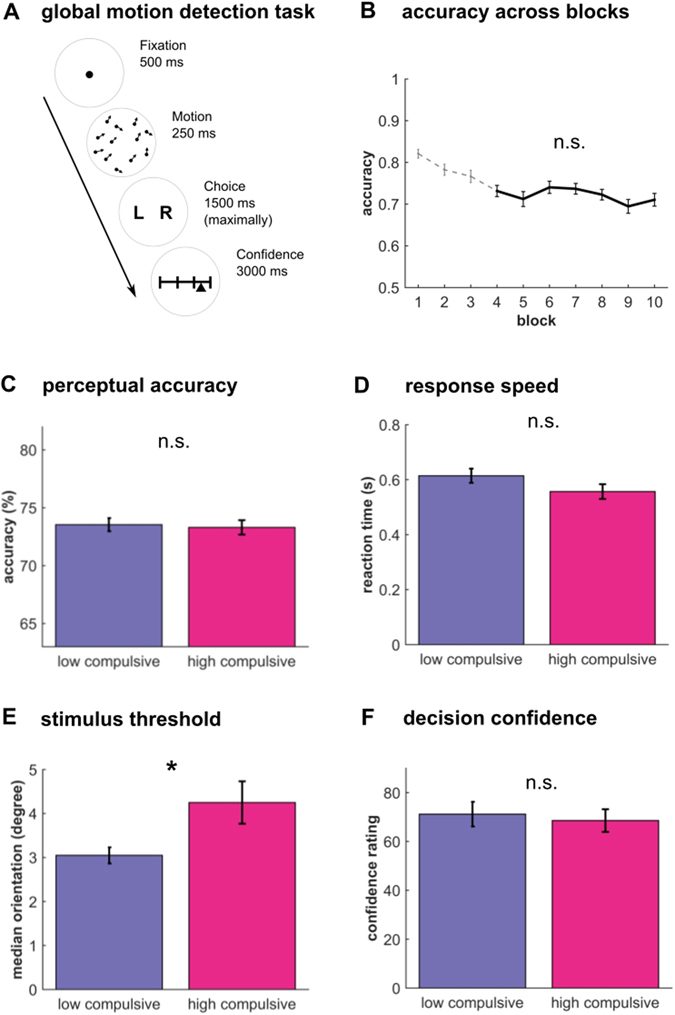
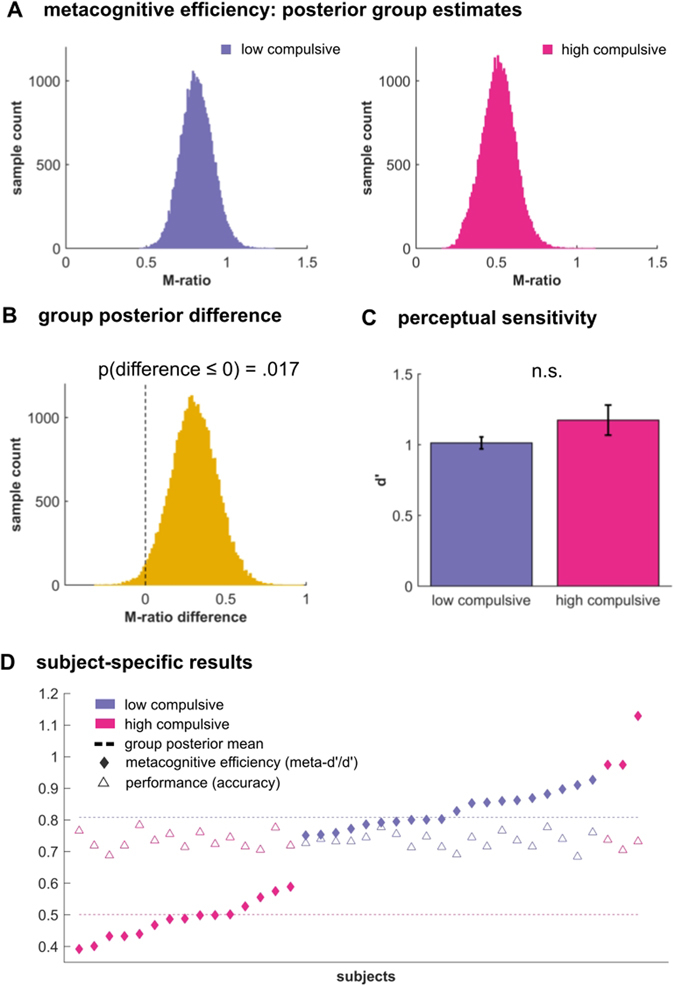
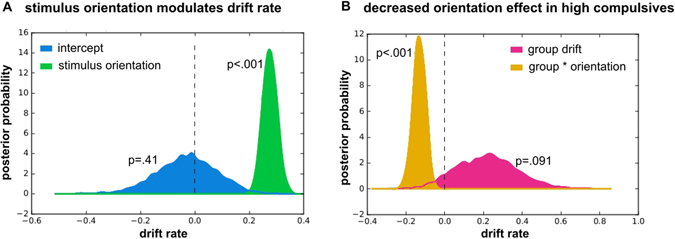
Awareness of one’s own abilities is of paramount importance in adaptive decision making. Psychotherapeutic theories assume such metacognitive insight is impaired in compulsivity, though this is supported by scant empirical evidence. In this study, we investigate metacognitive abilities in compulsive participants using computational models, where these enable a segregation between metacognitive and perceptual decision making impairments. We examined twenty low-compulsive and twenty high-compulsive participants, recruited from a large population-based sample, and matched for other psychiatric and cognitive dimensions. Hierarchical computational modelling of the participants’ metacognitive abilities on a visual global motion detection paradigm revealed that high-compulsive participants had a reduced metacognitive ability. This impairment was accompanied by a perceptual decision making deficit whereby motion-related evidence was accumulated more slowly in high compulsive participants. Our study shows that the compulsivity spectrum is associated with a reduced ability to monitor one’s own performance, over and above any perceptual decision making difficulties.
Overview
The claims and statistics of this paper haven’t been checked yet.
Free: it reads the open-access text and checks the first 5 claims that cite a source we can check. Create a free account to check every claim.
Integrity signals
Registry
Cites
Statistics
Figures
Verification
Claims the paper makes
The claims and statistics of this paper haven’t been checked yet.
Free: it reads the open-access text and checks the first 5 claims that cite a source we can check. Create a free account to check every claim.
Claims other papers make about this one
Each is checked against this paper’s own text: does it say what the citing paper says it does?
The cited source says what the claim attributes to it.
In the citing paper
“our findings of disrupted metacognition in high-CIT individuals is consistent with recent findings of lowered metacognitive efficiency in high versus low compulsive participants who were matched for depression and anxiety symptoms (55).”
From Psychiatric Symptom Dimensions Are Associated With Dissociable Shifts in Metacognition but Not Task Performance (2018) · cites this paper as [55]
Self-check
Percentages, sums and reported differences re-computed from the paper’s own numbers.
The self-check needs the paper’s full text.
Citations
Cites
Metacognition and cognitive monitoring: A new area of cognitive–developmental inquiry
Flavell, J. H. (1979) · American Psychologist · doi:10.1037/0003-066x.34.10.906 · Cited by 11,282
The Neural Basis of Decision Making
Gold, J. I., & Shadlen, M. N. (2007) · Annual Review of Neuroscience · doi:10.1146/annurev.neuro.29.051605.113038 · Cited by 3,764
What i think and feel: A revised measure of children's manifest anxiety
Reynolds, C. R., & Richmond, B. O. (1978) · Journal of Abnormal Child Psychology · doi:10.1007/bf00919131 · Cited by 1,741
Diffusion decision model: Current issues and history
Ratcliff, R., Smith, P. L., Brown, S. D., & McKoon, G. (2016) · Trends in Cognitive Sciences · doi:10.1016/j.tics.2016.01.007 · Cited by 1,630
Fleming, S. M., & Lau, H. C. (2014) · Frontiers in Human Neuroscience · doi:10.3389/fnhum.2014.00443 · Cited by 1,408
Visual fixations and the computation and comparison of value in simple choice
Krajbich, I., Armel, C., & Rangel, A. (2010) · Nature Neuroscience · doi:10.1038/nn.2635 · Cited by 1,408
Modelling cognition in emotional disorder: the S-REF model
Wells, A., & Matthews, G. (1996) · Behaviour Research and Therapy · doi:10.1016/s0005-7967(96)00050-2 · Cited by 1,067
HDDM: Hierarchical Bayesian estimation of the Drift-Diffusion Model in Python
Wiecki, T. V., Sofer, I., & Frank, M. J. (2013) · Frontiers in Neuroinformatics · doi:10.3389/fninf.2013.00014 · Cited by 1,047
Neurocognitive endophenotypes of impulsivity and compulsivity: Towards dimensional psychiatry
Robbins, T. W., Gillan, C. M., Smith, D. G., de Wit, S., & Ersche, K. D. (2012) · Trends in Cognitive Sciences · doi:10.1016/j.tics.2011.11.009 · Cited by 1,003
Maniscalco, B., & Lau, H. (2012) · Consciousness and Cognition · doi:10.1016/j.concog.2011.09.021 · Cited by 883
Relating Introspective Accuracy to Individual Differences in Brain Structure
Fleming, S. M., Weil, R. S., Nagy, Z., Dolan, R. J., & Rees, G. (2010) · Science · doi:10.1126/science.1191883 · Cited by 809
Self-citationThe neural basis of metacognitive ability
Fleming, S. M., & Dolan, R. J. (2012) · Philosophical Transactions of the Royal Society B: Biological Sciences · doi:10.1098/rstb.2011.0417 · Cited by 747
Self-citationTwo-stage dynamic signal detection: A theory of choice, decision time, and confidence.
Pleskac, T. J., & Busemeyer, J. R. (2010) · Psychological Review · doi:10.1037/a0019737 · Cited by 722
Characterizing a psychiatric symptom dimension related to deficits in goal-directed control
Gillan, C. M., Kosinski, M., Whelan, R., Phelps, E. A., & Daw, N. D. (2016) · eLife · doi:10.7554/elife.11305 · Cited by 586
Rounis, E., Maniscalco, B., Rothwell, J. C., Passingham, R. E., & Lau, H. (2010) · Cognitive Neuroscience · doi:10.1080/17588921003632529 · Cited by 407
Anatomical coupling between distinct metacognitive systems for memory and visual perception
McCurdy, L. Y., Maniscalco, B., Metcalfe, J., Liu, K. Y., de Lange, F. P., & Lau, H. (2013) · The Journal of Neuroscience · doi:10.1523/jneurosci.1890-12.2013 · Cited by 299
A common mechanism underlies changes of mind about decisions and confidence
van den Berg, R., Anandalingam, K., Zylberberg, A., Kiani, R., Shadlen, M. N., & Wolpert, D. M. (2016) · eLife · doi:10.7554/elife.12192 · Cited by 270
Metacognitive therapy for obsessive–compulsive disorder: A case series
Fisher, P. L., & Wells, A. (2008) · Journal of Behavior Therapy and Experimental Psychiatry · doi:10.1016/j.jbtep.2006.12.001 · Cited by 240 · cited 1×
“1B) for the remaining seven blocks (F (6, 222) = 1.”
BackgroundGwilliam, P., Wells, A., & Cartwright‐Hatton, S. (2004) · Clinical Psychology & Psychotherapy · doi:10.1002/cpp.402 · Cited by 201
Cognitive confidence in obsessive-compulsive disorder: Distrusting perception, attention and memory
Hermans, D., Engelen, U., Grouwels, L., Joos, E., Lemmens, J., & Pieters, G. (2008) · Behaviour Research and Therapy · doi:10.1016/j.brat.2007.11.001 · Cited by 196
Unexpected arousal modulates the influence of sensory noise on confidence
Allen, M., Frank, D., Schwarzkopf, D. S., Fardo, F., Winston, J. S., Hauser, T. U., & Rees, G. (2016) · eLife · doi:10.7554/elife.18103 · Cited by 182
Self-citationSubjective uncertainty and limbic hyperactivation in obsessive‐compulsive disorder
Stern, E. R., Welsh, R. C., Gonzalez, R., Fitzgerald, K. D., Abelson, J. L., & Taylor, S. F. (2013) · Human Brain Mapping · doi:10.1002/hbm.22038 · Cited by 102
Noradrenaline blockade specifically enhances metacognitive performance
Hauser, T. U., Allen, M., Purg, N., Moutoussis, M., Rees, G., & Dolan, R. J. (2017) · eLife · doi:10.7554/elife.24901 · Cited by 87
Self-citationHauser, T. U., Iannaccone, R., Dolan, R. J., Ball, J., Hättenschwiler, J., Drechsler, R., Rufer, M., Brandeis, D., Walitza, S., & Brem, S. (2017) · Psychological Medicine · doi:10.1017/s0033291716003305 · Cited by 86
Self-citationHauser, T. U., Moutoussis, M., Iannaccone, R., Brem, S., Walitza, S., Drechsler, R., Dayan, P., & Dolan, R. J. (2017) · PLOS Computational Biology · doi:10.1371/journal.pcbi.1005440 · Cited by 85
Self-citationMetacognitive ability correlates with hippocampal and prefrontal microstructure
Allen, M., Glen, J. C., Müllensiefen, D., Schwarzkopf, D. S., Fardo, F., Frank, D., Callaghan, M. F., & Rees, G. (2017) · NeuroImage · doi:10.1016/j.neuroimage.2017.02.008 · Cited by 85
Self-citationAn explorative study on metacognition in obsessive-compulsive disorder and panic disorder
Cucchi, M., Bottelli, V., Cavadini, D., Ricci, L., Conca, V., Ronchi, P., & Smeraldi, E. (2012) · Comprehensive Psychiatry · doi:10.1016/j.comppsych.2011.09.008 · Cited by 58
Research works printed but not linked: 32
- Batha K Carroll M Metacognitive training aids decision making Aust. J. Psychol. 2007 59 64 69 10.1080/00049530601148371 · DOI
- APA. Diagnostic and statistical manual of mental disorders: DSM-5 (American Psychiatric Association, 2013). · DOI · Paper page
- Myers SG Wells A Obsessive-compulsive symptoms: the contribution of metacognitions and responsibility J. Anxiety Disord. 2005 19 806 817 10.1016/j.janxdis.2004.09.004 16076426 · DOI · Paper page
- Boschen MJ Vuksanovic D Deteriorating memory confidence, responsibility perceptions and repeated checking: comparisons in OCD and control samples Behav. Res. Ther. 2007 45 2098 2109 10.1016/j.brat.2007.03.009 17459333 · DOI
- Moritz S Jacobsen D Willenborg B Jelinek L Fricke S A check on the memory deficit hypothesis of obsessive-compulsive checking Eur. Arch. Psychiatry Clin. Neurosci. 2006 256 82 86 10.1007/s00406-005-0605-7 16041557 · DOI
- Moritz S Kloss M von Eckstaedt FV Jelinek L Comparable performance of patients with obsessive–compulsive disorder (OCD) and healthy controls for verbal and nonverbal memory accuracy and confidence:: Time to forget the forgetfulness hypothesis of OCD? Psychiatry Res. 2009 166 247 253 10.1016/j.psychres.2008.02.006 19285350 · DOI
- Nedeljkovic M Moulding R Kyrios M Doron G The relationship of cognitive confidence to OCD symptoms J. Anxiety Disord. 2009 23 463 468 10.1016/j.janxdis.2008.10.001 19022617 · DOI · Paper page
- Tolin DF Memory and memory confidence in obsessive-compulsive disorder Behav. Res. Ther. 2001 39 913 927 10.1016/S0005-7967(00)00064-4 11480832 · DOI · Paper page
- Hauser, T. U., Eldar, E. & Dolan, R. J. Neural mechanisms of harm-avoidance learning: A model for obsessive-compulsive disorder? JAMA Psychiatry doi:10.1001/jamapsychiatry.2016.1938 (2016). 27654061 · DOI
- Fear CF Healy D Probabilistic reasoning in obsessive-compulsive and delusional disorders Psychol. Med. 1997 27 199 208 10.1017/S0033291796004175 9122300 · DOI · Paper page
- Ben Shachar A Lazarov A Goldsmith M Moran R Dar R Exploring metacognitive components of confidence and control in individuals with obsessive-compulsive tendencies J. Behav. Ther. Exp. Psychiatry 2013 44 255 261 10.1016/j.jbtep.2012.11.007 23268236 · DOI
- Dar R Rish S Hermesh H Taub M Fux M Realism of confidence in obsessive-compulsive checkers J. Abnorm. Psychol. 2000 109 673 678 10.1037/0021-843X.109.4.673 11195991 · doi:10.1037/0021-843x.109.4.673 · Paper page
- Önen S Karakaş Uğurlu G Çayköylü A The relationship between metacognitions and insight in obsessive-compulsive disorder Compr. Psychiatry 2013 54 541 548 10.1016/j.comppsych.2012.11.006 23312877 · DOI
- Green, D. M. & Swets, J. A. Signal Detection Theory and Psychophysics (John Wiley and Sons, 1966).
- Banca, P. et al. Evidence Accumulation in Obsessive-Compulsive Disorder: the Role of Uncertainty and Monetary Reward on Perceptual Decision-Making Thresholds. Neuropsychopharmacol. Off. Publ. Am. Coll. Neuropsychopharmacol. doi:10.1038/npp.2014.303 (2014). PMC4349497 25425323 · DOI · Paper page
- Kim J Selective impairment in visual perception of biological motion in obsessive-compulsive disorder Depress. Anxiety 2008 25 E15 25 10.1002/da.20402 17994588 · DOI
- Vértes, P. E. et al. Gene transcription profiles associated with inter-modular hubs and connection distance in human functional magnetic resonance imaging networks. Philos. Trans. R. Soc. Lond. B. Biol. Sci. 371 (2016). PMC5003862 27574314 · DOI · Paper page
- Whitaker, K. J. et al. Adolescence is associated with genomically patterned consolidation of the hubs of the human brain connectome. Proc. Natl. Acad. Sci. 201601745, doi:10.1073/pnas.1601745113 (2016). PMC4987797 27457931 · DOI · Paper page
- Burns GL Keortge SG Formea GM Sternberger LG Revision of the Padua Inventory of obsessive compulsive disorder symptoms: Distinctions between worry, obsessions, and compulsions Behav. Res. Ther. 1996 34 163 173 10.1016/0005-7967(95)00035-6 8741724 · DOI · Paper page
- Costello EJ Angold A Scales to assess child and adolescent depression: checklists, screens, and nets J. Am. Acad. Child Adolesc. Psychiatry 1988 27 726 737 10.1097/00004583-198811000-00011 3058677 · DOI · Paper page
- Wechsler, D. Wechsler Abbreviated Scale of Intelligence (The Psychological Corporation: Harcourt Brace & Company, 1999). · DOI · Paper page
- Patton JH Stanford MS Barratt ES Factor structure of the Barratt impulsiveness scale J. Clin. Psychol. 1995 51 768 774 10.1002/1097-4679(199511)51:6<768::AID-JCLP2270510607>3.0.CO;2-1 8778124 · DOI · Paper page
- Cornsweet TN The staircrase-method in psychophysics Am. J. Psychol. 1962 75 485 491 10.2307/1419876 13881416 · DOI · Paper page
- Fleming, S. M. HMeta-d: hierarchical Bayesian estimation of metacognitive efficiency from confidence ratings. Neurosci. Conscious. 3 (2017). PMC5858026 29877507 · DOI · Paper page
- Fitzgerald LM Arvaneh M Dockree PM Domain-specific and domain-general processes underlying metacognitive judgments Conscious. Cogn. 2017 49 264 277 10.1016/j.concog.2017.01.011 28222381 · DOI · Paper page
- Baird B Mrazek MD Phillips DT Schooler JW Domain-specific enhancement of metacognitive ability following meditation training J. Exp. Psychol. Gen. 2014 143 1972 1979 10.1037/a0036882 24820248 · DOI · Paper page
- Fleming SM Action-specific disruption of perceptual confidence Psychol. Sci. 2015 26 89 98 10.1177/0956797614557697 25425059 PMC4361353 · DOI · Paper page
- Krajbich I Rangel A Multialternative drift-diffusion model predicts the relationship between visual fixations and choice in value-based decisions Proc. Natl. Acad. Sci. USA 2011 108 13852 13857 10.1073/pnas.1101328108 21808009 PMC3158210 · DOI · Paper page
- Krajbich I Lu D Camerer C Rangel A The attentional drift-diffusion model extends to simple purchasing decisions Front. Psychol. 2012 3 193 10.3389/fpsyg.2012.00193 22707945 PMC3374478 · DOI · Paper page
- Cavanagh JF Subthalamic nucleus stimulation reverses mediofrontal influence over decision threshold Nat. Neurosci. 2011 14 1462 1467 10.1038/nn.2925 21946325 PMC3394226 · DOI · Paper page
- Moran R Teodorescu AR Usher M Post choice information integration as a causal determinant of confidence: Novel data and a computational account Cognit. Psychol. 2015 78 99 147 10.1016/j.cogpsych.2015.01.002 25868113 · DOI · Paper page
- Dimaggio, G. & Lysaker, P. H. Metacognition and Severe Adult Mental Disorders: From Research to Treatment (Routledge, 2010). · DOI · Paper page
Cited by
Obsessive-compulsive disorder: Puzzles and prospects
Robbins, T. W., Vaghi, M. M., & Banca, P. (2019) · Neuron · doi:10.1016/j.neuron.2019.01.046 · Cited by 510
Rouault, M., Seow, T., Gillan, C. M., & Fleming, S. M. (2018) · Biological Psychiatry · doi:10.1016/j.biopsych.2017.12.017 · Cited by 393
Cognitive impairment in substance use disorders
Ramey, T., & Regier, P. S. (2019) · CNS Spectrums · doi:10.1017/s1092852918001426 · Cited by 208
“However, impairments of metacognition can have negative consequences on decision-making, such as being overconfident about a poor decision or lacking confidence in a better decision.(134,135) The scope of metacognitive impairment in substance use disorders has not been well researched, despite it being a striking and…”
BackgroundIn the body's eye: the computational anatomy of interoceptive inference
Allen, M., Levy, A., Parr, T., & Friston, K. J. (2022) · PLOS Computational Biology · doi:10.1371/journal.pcbi.1010490 · Cited by 185
Self-citationConfidence drives a neural confirmation bias
Rollwage, M., Loosen, A., Hauser, T. U., Moran, R., Dolan, R. J., & Fleming, S. M. (2020) · Nature Communications · doi:10.1038/s41467-020-16278-6 · Cited by 183
Self-citation
Metadata
- Authors
- Hauser, T. U., Allen, M., NSPN Consortium, Bullmore, E. T., Goodyer, I., Fonagy, P., Jones, P., Fearon, P., Prabhu, G., Moutoussis, M., St Clair, M., Cleridou, K., Dadabhoy, H., Granville, S., Harding, E., Hopkins, A., Isaacs, D., King, J., Kokorikou, D., Mills, H., Pantaleone, S., Rees, G., & Dolan, R. J.
- Venue
- Scientific Reports
- Published
- 2017-07-26
- Volume
- 7
- Issue
- 1
- ISSN
- 2045-2322
- PMC
- PMC5529539
- Cited by
- 76
- References
- 27
- Language
- en
- Update notices
- correction (2018-04-11)
- Licence
- creativecommons.org/licenses/by/4.0 (tdm)
- creativecommons.org/licenses/by/4.0 (vor)
About these checks
Registry, retraction, Cites and statistics results are computed, not judged, with one exception: a printed reference that no index lists is read once by a model before it counts as a citation error. Claims are extracted by a model and kept only when their quote appears verbatim in the text; each cited source is then checked, with a model’s help, for whether it says what the claim relies on. Those verdicts can be wrong — read the claim’s quote and the cited source before relying on one.
Statistics and arithmetic are recomputed, not judged.
Confidence bands are shown only for fields calibrated on our annotated test set. None is calibrated yet, so no band is shown.
What counts as a claim ›How we measure confidence ›How we check this ›
Are you an author, or do you see a problem with this page? Request a review
Data sources
Bibliographic data: Semantic Scholar, OpenAlex, Crossref.
Contains information from the Semantic Scholar Academic Graph Datasets, made available under the ODC Attribution License (ODC-BY 1.0).
Semantic Scholar’s data is described in: Kinney, R., et al. (2023). The Semantic Scholar Open Data Platform. arXiv:2301.10140.
