

Cardiorespiratory optimization during improvised singing and toning
Open accessThe DOI matches its Crossref record; 29 of the 29 references it cites were found in a registry or an index.
Abstract
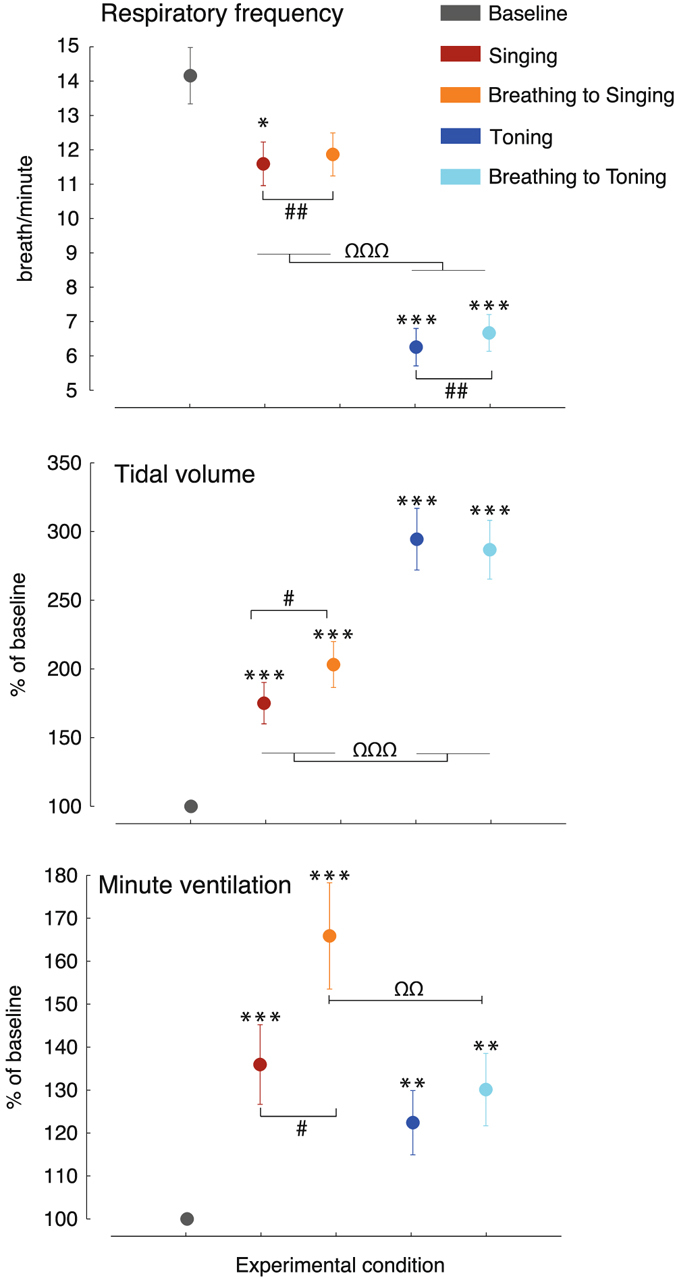
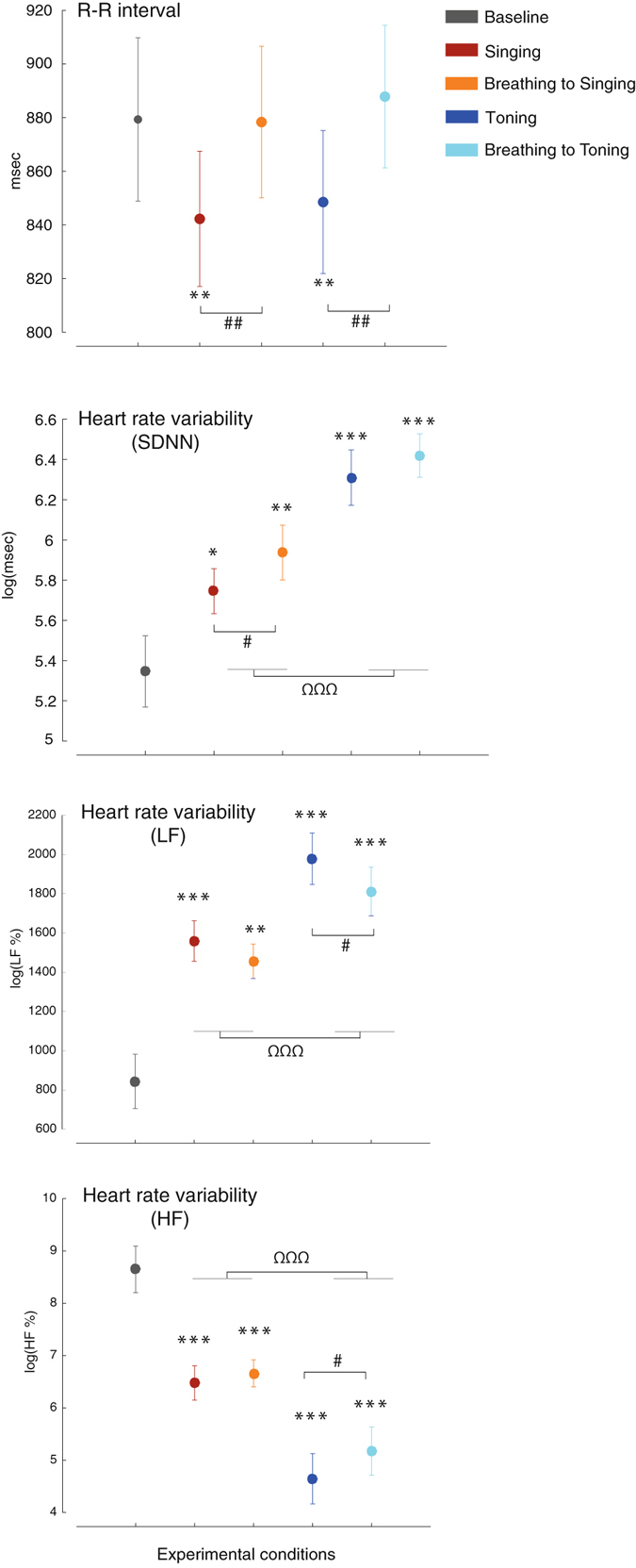
We evaluated the effect of different forms of singing on cardiorespiratory physiology, and we aimed at disentangling the role of breathing from that of vocal production. Cardiorespiratory recordings were obtained from 20 healthy adults at rest and during: a) singing of familiar slow songs as in the standard form of Western culture; b) improvised vocalization of free vowel sounds, known as toning . To disentangle the role of breathing from that of vocal production, we compared the vocal conditions with matched breathing-only conditions. Toning significantly improved heart rate variability, ventilatory efficiency and slowed respiration to almost exactly six breaths per minute (p < 0.001), a pattern that is known to optimize cardiovascular function and that coincides with the period of endogenous circulatory rhythms. Singing songs also positively impacted cardiorespiratory function, although to a lesser extent. The breathing pattern imposed upon participants in the absence of vocal production was sufficient to generate the physiological benefits. The effects of toning are similar to what has been previously described as a result of engaging in formal breathing exercises. Toning and singing may offer an engaging and cost effective tool to trigger beneficial respiratory patterns and the related cardiovascular benefits.
Overview
The claims and statistics of this paper haven’t been checked yet.
Free: it reads the open-access text and checks the first 5 claims that cite a source we can check. Create a free account to check every claim.
Integrity signals
Registry
Cites
Statistics
Figures
Verification
Claims the paper makes
The claims and statistics of this paper haven’t been checked yet.
Free: it reads the open-access text and checks the first 5 claims that cite a source we can check. Create a free account to check every claim.
Claims other papers make about this one
Each is checked against this paper’s own text: does it say what the citing paper says it does?
The source backs part of the claim, not all of it — or backs it for a different population, condition or comparison.
In the citing paper
“Due to the active part of breathing and using the own voice as an instrument, it has been shown that singing has a positive impact on the cardiorespiratory system [4, 83].”
From The effects of a music and singing intervention during pregnancy on maternal well-being and mother-infant bonding: a randomised, controlled study. (2021) · cites this paper as [4]
Experimental — accuracy not yet measuredThe cited source says what the claim attributes to it.
In the citing paper
“Toning increased HRV, promoted a spontaneous breathing rhythm near 0.1 Hz, and HR rose similarly to singing [29].”
From Mapping the Neurophysiological Link Between Voice and Autonomic Function: A Scoping Review (2025) · cites this paper as [29]
The cited source says what the claim attributes to it.
In the citing paper
“When comparing different vocalizations, Bernardi et al. (2017) documented that toning elicited stronger autonomic responses than song singing.”
From Mapping the Neurophysiological Link Between Voice and Autonomic Function: A Scoping Review (2025) · cites this paper as [29]
Self-check
Percentages, sums and reported differences re-computed from the paper’s own numbers.
The self-check needs the paper’s full text.
Citations
Cites
(2008) · Medical Entomology and Zoology · Cited by 7,477
Thayer, J. F., Yamamoto, S. S., & Brosschot, J. F. (2010) · International Journal of Cardiology · doi:10.1016/j.ijcard.2009.09.543 · Cited by 2,276
Effects of Work Stress on Ambulatory Blood Pressure, Heart Rate, and Heart Rate Variability
Vrijkotte, T. G. M., van Doornen, L. J. P., & de Geus, E. J. C. (2000) · Hypertension · doi:10.1161/01.hyp.35.4.880 · Cited by 755
Effect of rosary prayer and yoga mantras on autonomic cardiovascular rhythms: comparative study
Bernardi, L., Sleight, P., Bandinelli, G., Cencetti, S., Fattorini, L., Wdowczyc-Szulc, J., & Lagi, A. (2001) · BMJ · doi:10.1136/bmj.323.7327.1446 · Cited by 486
Joseph, C. N., Porta, C., Casucci, G., Casiraghi, N., Maffeis, M., Rossi, M., & Bernardi, L. (2005) · Hypertension · doi:10.1161/01.hyp.0000179581.68566.7d · Cited by 394
Clift, S. M., & Hancox, G. (2001) · Journal of the Royal Society for the Promotion of Health · doi:10.1177/146642400112100409 · Cited by 297
Effects of respiratory apparatus on breathing pattern
Askanazi, J., Silverberg, P. A., Foster, R. J., Hyman, A. I., Milic-Emili, J., & Kinney, J. M. (1980) · Journal of Applied Physiology · doi:10.1152/jappl.1980.48.4.577 · Cited by 291
Slow Breathing Increases Arterial Baroreflex Sensitivity in Patients With Chronic Heart Failure
Bernardi, L., Porta, C., Spicuzza, L., Bellwon, J., Spadacini, G., Frey, A. W., Yeung, L. Y. C., Sanderson, J. E., Pedretti, R., & Tramarin, R. (2002) · Circulation · doi:10.1161/hc0202.103311 · Cited by 274
Modulatory effects of respiration
Bernardi, L., Porta, C., Gabutti, A., Spicuzza, L., & Sleight, P. (2001) · Autonomic Neuroscience · doi:10.1016/s1566-0702(01)00267-3 · Cited by 255
Busch, V., Magerl, W., Kern, U., Haas, J., Hajak, G., & Eichhammer, P. (2012) · Pain Medicine · doi:10.1111/j.1526-4637.2011.01243.x · Cited by 251
Research works printed but not linked: 1
- Ramshur J. T. Design, Evaluation, and Application of Heart Rate Variability Software (HRVAS). Master’s thesis, The University of Memphis (2010).
Cited by
Wulff, V., Hepp, P., Wolf, O. T., Balan, P., Hagenbeck, C., Fehm, T., & Schaal, N. K. (2021) · Archives of gynecology and obstetrics · doi:10.1007/s00404-020-05727-8 · Cited by 101
Jones, B., Sharpe, P., Iddon, C. R., Hathway, E. A., Noakes, C. J., & Fitzgerald, S. (2021) · Building and Environment · doi:10.1016/j.buildenv.2021.107617 · Cited by 96
“[56], in the absence of data on aerosols generated by singing we use the vocalisation data of Morawska et al.”
Effects of music on the cardiovascular system
Kulinski, J. P., Ofori, E. K., Visotcky, A. M., Smith, A. A. H., Sparapani, R., & Fleg, J. L. (2021) · Trends in Cardiovascular Medicine · doi:10.1016/j.tcm.2021.06.004 · Cited by 121
“[29] showed that 7 minutes each of toning (a form of improvisation-based open vowel vocalization), singing, and breathing all increased HRV (SDNN) acutely (n = 20 healthy subjects, mean age: 24, 70% female).”
BackgroundPentikäinen, E., Pitkäniemi, A., Siponkoski, S., Jansson, M., Louhivuori, J., Johnson, J. K., Paajanen, T. I., & Särkämö, T. (2021) · PLoS ONE · doi:10.1371/journal.pone.0245666 · Cited by 100
“Physiologically, singing has a positive impact on cardiorespiratory functions [32, 33], and the emotional gains of singing are linked to the secretion of endocannabinoids, immunoglobulins, and cortisol [34, 35].”
BackgroundBinaural Beats through the Auditory Pathway: From Brainstem to Connectivity Patterns
Perez, H. D. O., Dumas, G., & Lehmann, A. (2020) · eNeuro · doi:10.1523/eneuro.0232-19.2020 · Cited by 99
“, 2016), and repetitive and rhythmic stimuli (such as mantras or tones) are widely used in contemplative and religious practices with positive physiological impact (Bernardi et al., 2001; Bernardi et al., 2017).”
BackgroundSelf-citationChanges in mood, oxytocin, and cortisol following group and individual singing: a pilot study
Good, A., & Russo, F. A. (2022) · Psychology of Music · doi:10.1177/03057356211042668 · Cited by 46
“The element of rhythmic breathing associated with singing has been shown to positively impact the physiology of the cardiorespiratory system (Bernardi et al., 2017).”
BackgroundLewis, A. P., Philip, K. E. J., Lound, A., Cave, P., Russell, J., & Hopkinson, N. S. (2021) · BMJ Open Respiratory Research · doi:10.1136/bmjresp-2021-000996 · Cited by 58
Review of Perioperative Music Medicine: Mechanisms of Pain and Stress Reduction Around Surgery
Ginsberg, J. P., Raghunathan, K., Bassi, G. S., & Ulloa, L. (2022) · Frontiers in Medicine · doi:10.3389/fmed.2022.821022 · Cited by 46
Physiological demands of singing for lung health compared with treadmill walking
Philip, K. E. J., Lewis, A. P., Buttery, S. C., McCabe, C., Manivannan, B., Fancourt, D. E., Orton, C. M., Polkey, M. I., & Hopkinson, N. S. (2021) · BMJ Open Respiratory Research · doi:10.1136/bmjresp-2021-000959 · Cited by 37
Longitudinal effects of choir singing on aging cognition and wellbeing: a two-year follow-up study
Pentikäinen, E., Kimppa, L., Pitkäniemi, A., Lahti, O., & Särkämö, T. (2023) · Frontiers in Human Neuroscience · doi:10.3389/fnhum.2023.1174574 · Cited by 32
“In addition, singing has been connected to physiological benefits, such as improving cardiorespiratory functions (Bernardi et al., 2017; Fu et al., 2018), and it can even aid in rehabilitation of motor and cognitive functioning as well as speech production in aging-related neurological illnesses,…”
BackgroundPhysiological Influences of Music in Perception and Action
Wright, S., Bégel, V., & Palmėr, C. (2022) · Cambridge University Press eBooks · doi:10.1017/9781009043359 · Cited by 31
Interpersonal synchrony when singing in a choir
Delius, J. A. M., & Müller, V. (2023) · Frontiers in Psychology · doi:10.3389/fpsyg.2022.1087517 · Cited by 45
“How is this achieved in the case of choral singing where many different aspects need to be adapted to each other? Not only does the rhythm and timing of a song need to be synchronized in real time, the tone and melody sung by each member of the group also needs to match in order for the song to be pleasing to the ear…”
BackgroundBalkan, B. A., Chang, Y., Sparnaaij, M., Wouda, B., Boschma, D., Liu, Y., Yuan, Y., Daamen, W., de Jong, M. C. M., Teberg, C., et al. (2024) · PLoS Computational Biology · doi:10.1371/journal.pcbi.1011956 · Cited by 26
Exploring the Experience and Effects of Vocal Toning
Snow, S., Bernardi, N. F., Sabet-Kassouf, N., Moran, D., & Lehmann, A. (2018) · Journal of Music Therapy · doi:10.1093/jmt/thy003 · Cited by 22
Self-citationImprovisation is a novel tool to study musicality
Weiss, M. W., & Peretz, I. (2022) · Scientific Reports · doi:10.1038/s41598-022-15312-5 · Cited by 13
Self-citationGalinha, I. C., Pinal, D., Lima, M. L., & Palmeira, A. L. (2021) · Psychosocial Intervention · doi:10.5093/pi2021a3 · Cited by 17
“For example, GS and toning (i.e., voicing an open vowel sound at a given pitch during an exhalation) were shown to positively affect respiratory function in young adults (Bernardi et al., 2017).”
BackgroundCarvalho, M. E. S., Rincón, R., Gameiro, M., & Rodrigues, H. F. (2021) · Nordic Journal of Music Therapy · doi:10.1080/08098131.2021.2004612 · Cited by 10
“(Pierce, 1998) and improvised singing and toning in adults (Bernardi et al., 2017; Snow et al., 2018).”
BackgroundAcute effects of singing on cardiovascular biomarkers
Somayaji, K., Frenkel, M. M., Tabaza, L., Visotcky, A. M., Ruck, T. K., Ofori, E. K., Widlansky, M. E., & Kulinski, J. P. (2022) · Frontiers in Cardiovascular Medicine · doi:10.3389/fcvm.2022.869104 · Cited by 9
Singing Improves Oxygen Saturation in Simulated High-Altitude Environment
Idrose, A. M., Juliana, N., Azmani, S., Yazit, N. A. A., Muslim, M. S. A., Ismail, M., & Amir, S. N. (2020) · Journal of Voice · doi:10.1016/j.jvoice.2020.06.031 · Cited by 8
Effect of Various Lengths of Respiration on Heart Rate Variability during Simple Bhramari (Humming)
Trivedi, G. Y., Kathirvel, S., Sharma, K. H., & Saboo, B. (2023) · International Journal of Yoga · doi:10.4103/ijoy.ijoy_113_23 · Cited by 7
“[1,3,5,14,15,48] Reviews of humming or Bhramari also have not provided any additional insight on the resonance frequency for humming/Bhramari and Chanting, with variations in breathing length for a few Bhramari research.”
BackgroundSimultaneous monitoring of vocal doses and breathing patterns in professional singers
Cunsolo, F., Ottaviani, V., Capobianco, S., Calcinoni, O., & Dellacà, R. L. (2022) · Computers in Biology and Medicine · doi:10.1016/j.compbiomed.2022.105352 · Cited by 7
Viola, E., Martorana, M., Airoldi, C., Caristia, S., Ceriotti, D., Vito, M. D., Tucci, R., Meini, C., Guiot, G., & Faggiano, F. (2024) · Acta Psychologica · doi:10.1016/j.actpsy.2024.104204 · Cited by 5
The physiological demands of Singing for Lung Health compared to treadmill walkingPreprint
Philip, K. E. J., Lewis, A. P., Buttery, S. C., McCabe, C., Manivannan, B., Fancourt, D. E., Orton, C. M., Polkey, M. I., & Hopkinson, N. S. (2020) · medRxiv · doi:10.1101/2020.12.08.20245746 · Cited by 4
Mapping the Neurophysiological Link Between Voice and Autonomic Function: A Scoping Review
Morales-Luque, C., Carrillo-Franco, L., López-González, M. V., González-García, M., & Dawid-Milner, M. S. (2025) · Biology · doi:10.3390/biology14101382 · Cited by 3
“Toning increased HRV, promoted a spontaneous breathing rhythm near 0.1 Hz, and HR rose similarly to singing [29].”
InfluentialPersonality Traits of Choral Singers and Their Association with Perceived Mental Well-Being
Robens, S., Monstadt, A., Hagen, A., & Ostermann, T. (2025) · Behavioral Sciences · doi:10.3390/bs15050570 · Cited by 5
“…cardiovascular functioning (Bernardi et al., 2017; Gick & Nicol, 2015; Lewis et al., 2016; Vickhoff et al., 2013), strengthens immune competence (Bernardi et al., 2017; Kreutz et al., 2005), stimulates cognitive functions (Mansens et al., 2018; Pentikäinen et al., 2021), and elevates mood…”
Scarratt, R. J., Dietz, M. J., Vuust, P., Kleber, B., & Jespersen, K. V. (2025) · Cognitive Affective & Behavioral Neuroscience · doi:10.3758/s13415-025-01342-9 · Cited by 10
“For example, singing is used in therapy to increase relaxation and mood, which we could be seeing in effect here (Bella et al., 2015; Bernardi et al., 2017; Countinho et al., 2014; Kang et al., 2018).”
Fuertes, A., Jones, R. V., Larriva, M. T. B., Vergés, R., & Forcada, N. (2025) · Indoor Air · doi:10.1155/ina/4153784 · Cited by 3
“…concentration of CO 2 was recorded in the occupational therapy rooms which may be explained by the higher CO 2 production associated with increased breathing rates for activities, such as singing and loud speech [32], being undertaken by the nursing homes residents and their therapists in groups.”
Bagherimohamadipour, M., Hammad, M. Y., Visotcky, A. M., Sparapani, R., & Kulinski, J. P. (2025) · Frontiers in Cardiovascular Medicine · doi:10.3389/fcvm.2025.1546462 · Cited by 4
The physiological demands of Singing for Lung Health compared to treadmill walkingPreprint
Philip, K. E. J., Lewis, A. P., Buttery, S. C., McCabe, C., Manivannan, B., Fancourt, D. E., Orton, C. M., Polkey, M. I., & Hopkinson, N. S. (2020) · Research Square · doi:10.21203/rs.3.rs-124158/v1 · Cited by 7
Samsonov, V. A., Kovalenko, A. N., Kastyro, I. V., Lazareva, L., Kalmykov, I. K., Elizbaryan, I., & Popadyuk, V. I. (2026) · The European Physical Journal Special Topics · doi:10.1140/epjs/s11734-026-02177-2 · Cited by 2
“Some studies indicate that singing, particularly with slow, melodic phrases, can induce favorable vagal effects similar to paced breathing, increasing HRV, and synchronizing heart rhythms among singers [4, 16–19].”
Digital Concert Experience: An Online Research Project on Live Streaming During the Pandemic
Kreuzer, M., Wald‐Fuhrmann, M., Weining, C., Meier, D., O’Neill, K., Tschacher, W., Tröndle, M., & Egermann, H. (2023) · Music business research · doi:10.1007/978-3-031-42975-0_6 · Cited by 3
Quantification of human aerosol emission by measuring different breathing patterns
Firle, C., Meyer-Plath, A., Pöther, D.-C., & Kujath, P. (2025) · Journal of Aerosol Science · doi:10.1016/j.jaerosci.2025.106680 · Cited by 1
INTEGRATION OF VOCAL AND STAGE-SPEECH TRAINING OF FUTURE ACTORS
Коленко, А., Іваненко, О., & Голосняк, В. В. (2025) · Musical art in the educological discourse · doi:10.28925/2518-766x.2025.109 · Cited by 1
Avni, T., & Salomon-Gimmon, M. (2026) · The Arts in Psychotherapy · doi:10.1016/j.aip.2026.102469 · Cited by 1
de Castilla, J. L. L. (2022) · HUMAN REVIEW International Humanities Review / Revista Internacional de Humanidades · doi:10.37467/revhuman.v11.4003 · Cited by 1
The Effect of Taizé Prayer on Stress and Stress Resilience of Young Adults in Nonclinical Settings
Suryanto, Y. I., Agustiningsih, D., & Sofro, Z. M. (2024) · Pastoral Psychology · doi:10.1007/s11089-024-01144-9 · Cited by 3
“When singing a slow song, a person tends to slow their breath (Bernardi et al., 2017).”
Zhu, Z., Zhu, Z., Sun, Y., Wang, T., Lu, Y., Che, W., Liu, W., & Xu, Y. (2024) · Clinical Interventions in Aging · doi:10.2147/cia.s458675 · Cited by 1
Niebuhr, O., & Barbosa, P. A. (2025) · Cambridge University Press eBooks · doi:10.1017/9781009105194.016 · Cited by 1
Singing and music making: physiological responses across early to later stages of dementia
Walker, N., Crutch, S. J., West, J., Jones, F. W., Brotherhood, E., Harding, E., & Camic, P. M. (2021) · Wellcome Open Research · doi:10.12688/wellcomeopenres.16856.1 · Cited by 5
Singing and music making: physiological responses across early to later stages of dementia
Walker, N., Crutch, S. J., West, J., Jones, F. W., Brotherhood, E., Harding, E., & Camic, P. M. (2022) · Wellcome Open Research · doi:10.12688/wellcomeopenres.16856.3 · Cited by 4
Cotterell, L. F. (2021) · Griffith Research Online · doi:10.25904/1912/4086
Improvisation: A novel tool to study musicalityPreprint
Weiss, M. W., & Peretz, I. (2021) · doi:10.31234/osf.io/xev3w
Self-citationFuertes, A., Jones, R. V., Larriva, M. T. B., & Forcada, N. (2023) · SSRN Electronic Journal · doi:10.2139/ssrn.4666742
Effect of Lifestyle Choices on Cerebrospinal Fluid Pulsations
Trivedi, G. Y., Kathirvel, S., Nagendra, H. R., Trivedi, R. G., Saboo, B., & Ramani, H. (2024) · Journal of Applied Consciousness Studies · doi:10.4103/jacs.jacs_42_23
Parikh, J. J., & Sheth, M. S. (2024) · International Journal of Phonosurgery & Laryngology · doi:10.5005/jp-journals-10023-1260
de Castilla, J. L. L. (2022) · HUMAN REVIEW International Humanities Review / Revista Internacional de Humanidades · doi:10.37819/humanrev.v13i1.1100 · Cited by 1
“Gracias al canto y al ejercicio respiratorio para el canto, mejora también la oxigenación de la sangre en el organismo, contribuyendo a la regulación del ritmo cardiaco y de la presión arterial (Bernardi et al., 2017).”
Rüdiger, S., & Dayter, D. (2025) · Cambridge University Press eBooks · doi:10.1017/9781009105194.014
Steinmetz, A., Hönning, A., Käckenmester, W., Schmehl, I., Secara, M., Biffar, S., Kim, I., Bahçesular, K., Lehnert, B., Lehnert, K., et al. (2026) · Annals of Physical and Rehabilitation Medicine · doi:10.1016/j.rehab.2025.102073
Ruiz-Blais, S., Bernardi, N. F., Intartaglia, B., Snow, S., & Lehmann, A. (2026) · PLoS ONE · doi:10.1371/journal.pone.0345719
“…square of successive differences (RMSSD) of consecutive RR intervals as an estimate of vagal HRV. Previous studies used LF, HF, and SDNN as measures of HRV [18,55], which we obtain here to validate the smaller dataset (16 participants, compared to the previous report using 20 participants [18]).”
InfluentialSelf-citationLi, Y. (2026) · Frontiers in Psychology · doi:10.3389/fpsyg.2026.1783731
Metadata
- Authors
- Bernardi, N. F., Snow, S., Peretz, I., Orozco Perez, H. D., Sabet-Kassouf, N., & Lehmann, A.
- Affiliations
- International Laboratory for Brain, Music and Sound Research (CA)
- Concordia University (CA)
- Centre for Research on Brain Language and Music (CA)
- Corresponding author
- Bernardi, N. F.
- Venue
- Scientific Reports
- Published
- 2017-08-14
- Volume
- 7
- Issue
- 1
- Pages
- 8113-8113
- ISSN
- 2045-2322 (ISSN-L)
- PMC
- PMC5556092
- OpenAlex
- W2745137655
- Cited by
- 52
- References
- 29
- Citations by year
- 2026: 5 · 2025: 9 · 2024: 7 · 2023: 5 · 2022: 8 · 2021: 12 · 2020: 5 · 2018: 1
- FWCI
- 1.27
- Type
- journal article
- Language
- en
- Open access
- gold
- doi.org
- Licence
- cc-by
- creativecommons.org/licenses/by/4.0 (tdm)
- creativecommons.org/licenses/by/4.0 (vor)
- Locations
- Scientific Reports (publishedVersion, cc-by)
- PubMed Central (publishedVersion, cc-by)
- PubMed (publishedVersion)
- DOAJ (DOAJ: Directory of Open Access Journals) (submittedVersion, cc-by-sa)
- Funders
- Helsingin Yliopisto
- Concordia University
- Topics
- Health Sciences › Medicine › Cardiology and Cardiovascular Medicine › Heart Rate Variability and Autonomic Control
- Social Sciences › Psychology › Social Psychology › Music Therapy and Health
- Health Sciences › Medicine › Physiology (medical) › Cardiovascular and exercise physiology
- Keywords
- toning, improvised singing, cardiopulmonary physiology, heart rate variability, ventilatory efficiency, slow-paced breathing, phonation, breathing exercises, breathing pattern
- MeSH terms
- Adult, Breathing Exercises, Cardiovascular System, Female, Heart Rate, Humans, Male, Music, Respiration, Voice, Young Adult, Respiratory Rate, Singing
About these checks
Registry, retraction, Cites and statistics results are computed, not judged, with one exception: a printed reference that no index lists is read once by a model before it counts as a citation error. Claims are extracted by a model and kept only when their quote appears verbatim in the text; each cited source is then checked, with a model’s help, for whether it says what the claim relies on. Those verdicts can be wrong — read the claim’s quote and the cited source before relying on one.
Statistics and arithmetic are recomputed, not judged.
Confidence bands are shown only for fields calibrated on our annotated test set. None is calibrated yet, so no band is shown.
What counts as a claim ›How we measure confidence ›How we check this ›
Are you an author, or do you see a problem with this page? Request a review
Data sources
Bibliographic data: Semantic Scholar, OpenAlex, Crossref.
Contains information from the Semantic Scholar Academic Graph Datasets, made available under the ODC Attribution License (ODC-BY 1.0).
Semantic Scholar’s data is described in: Kinney, R., et al. (2023). The Semantic Scholar Open Data Platform. arXiv:2301.10140.
