

The DOI matches its Crossref record; 82 of the 82 references it cites were found in a registry or an index.
Omega-3 fatty acids correlate with gut microbiome diversity and production of N-carbamylglutamate in middle aged and elderly women
Open accessAbstract
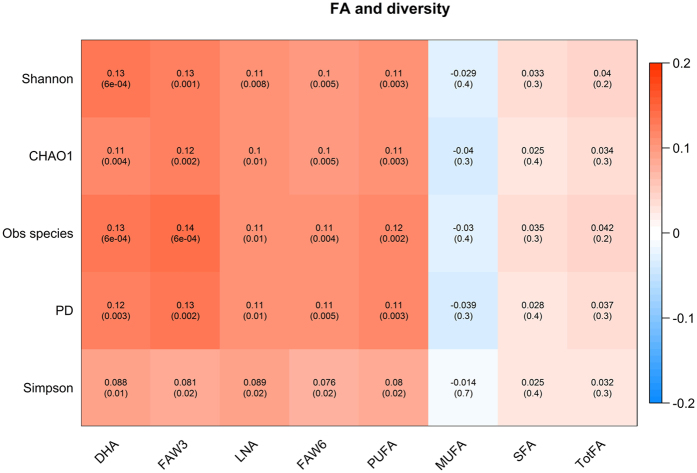
Abstract Omega-3 fatty acids may influence human physiological parameters in part by affecting the gut microbiome. The aim of this study was to investigate the links between omega-3 fatty acids, gut microbiome diversity and composition and faecal metabolomic profiles in middle aged and elderly women. We analysed data from 876 twins with 16S microbiome data and DHA, total omega-3, and other circulating fatty acids. Estimated food intake of omega-3 fatty acids were obtained from food frequency questionnaires. Both total omega-3and DHA serum levels were significantly correlated with microbiome alpha diversity (Shannon index) after adjusting for confounders (DHA Beta(SE) = 0.13(0.04), P = 0.0006 total omega-3: 0.13(0.04), P = 0.001). These associations remained significant after adjusting for dietary fibre intake. We found even stronger associations between DHA and 38 operational taxonomic units (OTUs), the strongest ones being with OTUs from the Lachnospiraceae family (Beta(SE) = 0.13(0.03), P = 8 × 10 −7 ). Some of the associations with gut bacterial OTUs appear to be mediated by the abundance of the faecal metabolite N-carbamylglutamate. Our data indicate a link between omega-3 circulating levels/intake and microbiome composition independent of dietary fibre intake, particularly with bacteria of the Lachnospiraceae family. These data suggest the potential use of omega-3 supplementation to improve the microbiome composition.
Overview
The claims and statistics of this paper haven’t been checked yet.
Run the check — free, no account needed. It reads the open-access text and checks the sources it cites.
Integrity signals
Registry
Cites
Statistics
Figures
Verification
Claims the paper makes
The claims and statistics of this paper haven’t been checked yet.
Run the check — free, no account needed. It reads the open-access text and checks the sources it cites.
Claims other papers make about this one
Each is checked against this paper’s own text: does it say what the citing paper says it does?
The source backs part of the claim, not all of it — or backs it for a different population, condition or comparison.
In the citing paper
“Docosahexaenoic acid levels from subjects on an omega-3 diet strongly correlated with 38 operational taxonomic units from the Lachnospiraceae family (Menni et al., 2017)”
From The Microbiota-Gut-Brain Axis (2019) · cites this paper as Menni et al., 2017
Experimental — accuracy not yet measuredIn the citing paper
“In humans, healthier polyunsaturated fatty acids (e.g., omega-3 PUFAs) promote the growth of beneficial bacteria, including butyrate producers such as Lactobacillus, Lachnospira, Roseburia, and Bifidobacterium (81), and are correlated with higher microbial diversity as well as taxa from the families Lachnospiraceae and Ruminococcaceae (82).”
From Diet and the Microbiota–Gut–Brain Axis: Sowing the Seeds of Good Mental Health (2021) · cites this paper as [82]
In the citing paper
“A recent study comparing 876 middle aged female subjects showed that the administration of omega-3 was able to modulate gut microbiota by significantly increasing α diversity (Menni et al., 2017).”
From The Microbiota-Gut-Brain Axis (2019) · cites this paper as Menni et al., 2017
Self-check
Percentages, sums and reported differences re-computed from the paper’s own numbers.
The self-check needs the paper’s full text.
Citations
Cites
1 retracted
Lin, G., Zhu, S., Wu, Y., Song, C., Wang, W., Zhang, Y., Chen, Y.-L., & He, Z. (2017) · Scientific Reports · doi:10.1038/s41598-017-03231-9 · Cited by 35
RetractedQIIME allows analysis of high-throughput community sequencing data
Caporaso, J. G., Kuczynski, J., Stombaugh, J., Bittinger, K., Bushman, F. D., Costello, E. K., Fierer, N., Peña, A. G., Goodrich, J. K., Gordon, J. I., et al. (2010) · Nature Methods · doi:10.1038/nmeth.f.303 · Cited by 34,887
Greengenes, a Chimera-Checked 16S rRNA Gene Database and Workbench Compatible with ARB
DeSantis, T. Z., Hugenholtz, P., Larsen, N., Rojas, M., Brodie, E. L., Keller, K., Huber, T., Dalevi, D., Hu, P., & Andersen, G. L. (2006) · Applied and Environmental Microbiology · doi:10.1128/aem.03006-05 · Cited by 10,891
Global patterns of 16S rRNA diversity at a depth of millions of sequences per sample
Caporaso, J. G., Lauber, C. L., Walters, W. A., Berg-Lyons, D., Lozupone, C., Turnbaugh, P. J., Fierer, N., & Knight, R. D. (2010) · Proceedings of the National Academy of Sciences · doi:10.1073/pnas.1000080107 · Cited by 9,944
den Besten, G., van Eunen, K., Groen, A. K., Venema, K., Reijngoud, D.-J., & Bakker, B. M. (2013) · Journal of Lipid Research · doi:10.1194/jlr.r036012 · Cited by 5,048
Gut microbiota composition correlates with diet and health in the elderly
Claesson, M. J., Jeffery, I. B., Conde, S., Power, S. E., O’Connor, E. M., Cusack, S., Harris, H. M. B., Coakley, M., Lakshminarayanan, B., O’Sullivan, O., et al. (2012) · Nature · doi:10.1038/nature11319 · Cited by 3,314
Human Genetics Shape the Gut Microbiome
Goodrich, J. K., Waters, J. L., Poole, A. C., Sutter, J. L., Koren, O., Blekhman, R., Beaumont, M., Van Treuren, W., Knight, R., Bell, J. T., et al. (2014) · Cell · doi:10.1016/j.cell.2014.09.053 · Cited by 3,164
Self-citationTotal energy intake: implications for epidemiologic analyses.
WILLETT, W., & STAMPFER, M. J. (1986) · American Journal of Epidemiology · doi:10.1093/oxfordjournals.aje.a114366 · Cited by 2,751
RE: “TOTAL ENERGY INTAKE: IMPLICATIONS FOR EPIDEMIOLOGIC ANALYSES”
Palmgren, J., & Kushi, L. H. (1991) · American Journal of Epidemiology · doi:10.1093/oxfordjournals.aje.a115841 · Cited by 2,712
The Electronic Medical Records and Genomics (eMERGE) Consortium, Wood, A. R., The MIGen Consortium, The PAGE Consortium, Study, T. L. C., Esko, T., Yang, J., Vedantam, S., Pers, T. H., Gustafsson, S., et al. (2014) · Nature Genetics · doi:10.1038/ng.3097 · Cited by 1,853
Cited by
Sorted by citations
Cryan, J. F., O'Riordan, K. J., Cowan, C. S. M., Sandhu, K. V., Bastiaanssen, T. F. S., Boehme, M., Codagnone, M. G., Cussotto, S., Fulling, C., Golubeva, A. V., et al. (2019) · Physiological Reviews · doi:10.1152/physrev.00018.2018 · Cited by 5,286
The Controversial Role of Human Gut Lachnospiraceae
Vacca, M., Celano, G., Calabrese, F. M., Portincasa, P., Gobbetti, M., & De Angelis, M. (2020) · Microorganisms · doi:10.3390/microorganisms8040573 · Cited by 1,688
Gut Microbiome: Profound Implications for Diet and Disease
Hills, R. D., Pontefract, B., Mishcon, H. R., Black, C. A., Sutton, S. C., & Theberge, C. R. (2019) · Nutrients · doi:10.3390/nu11071613 · Cited by 1,143
Nogal, A., Valdes, A. M., & Menni, C. (2021) · Gut Microbes · doi:10.1080/19490976.2021.1897212 · Cited by 917
Self-citationImpact of Omega-3 Fatty Acids on the Gut Microbiota
Costantini, L., Molinari, R., Farinon, B., & Merendino, N. (2017) · International Journal of Molecular Sciences · doi:10.3390/ijms18122645 · Cited by 741
Metadata
- Authors
- Menni, C., Zierer, J., Pallister, T., Jackson, M. A., Long, T., Mohney, R. P., Steves, C. J., Spector, T. D., & Valdes, A. M.
- Affiliations
- King's College London (GB)
- Sanford Burnham Prebys Medical Discovery Institute (US)
- Metabolon (United States) (US)
- Corresponding author
- Valdes, Ana M.
- ORCID
- Venue
- Scientific Reports
- Published
- 2017-09-11
- Volume
- 7
- Issue
- 1
- Pages
- 11079-11079
- ISSN
- 2045-2322 (ISSN-L)
- PMC
- PMC5593975
- OpenAlex
- W2751449101
- Cited by
- 237
- References
- 82
- Citations by year
- 2026: 9 · 2025: 23 · 2024: 24 · 2023: 28 · 2022: 32 · 2021: 43 · 2020: 26 · 2019: 30 · 2018: 15 · 2017: 7
- FWCI
- 8.67
- Type
- journal article
- Language
- en
- Open access
- gold
- doi.org
- Locations
- Scientific Reports (publishedVersion, cc-by)
- PubMed Central (publishedVersion, cc-by)
- PubMed (publishedVersion)
- Archivio Istituzionale della Ricerca (Universita Degli Studi Di Milano) (submittedVersion, other-oa)
- DOAJ (DOAJ: Directory of Open Access Journals) (submittedVersion)
- Research Portal (King's College London) (submittedVersion, cc-by)
- Site cant be reached (submittedVersion, cc-by)
- PuSH - Publication Server of Helmholtz Zentrum München (submittedVersion)
- Funders
- Wellcome Trust (FP7/2007–2013, MR/M016560/1)
- National Institute for Health and Care Research (FP7/2007–2013, NF-SI-0507-10228, MR/M016560/1, NF-SI-0514-10027)
- King's College London
- European Commission (2007–2013, FP7 2007-2013, 603946, FP7/2007, MR/M016560/1)
- University of Nottingham
- National Institutes of Health (FP7/2007-2013, 1dp2od007444-01)
- Medical Research Council (FP7/20072013, MR/N030125/1, MR/N01183X/1, MR/M016560/1)
- National Institute of Diabetes and Digestive and Kidney Diseases (R01DK093595)
- Topics
- Life Sciences › Biochemistry, Genetics and Molecular Biology › Molecular Biology › Gut microbiota and health
- Health Sciences › Nursing › Nutrition and Dietetics › Fatty Acid Research and Health
- Health Sciences › Medicine › Public Health, Environmental and Occupational Health › Nutritional Studies and Diet
- Keywords
- omega-3 fatty acids, docosahexaenoic acid, gut microbiota diversity, N-carbamylglutamate, fecal metabolomics, Lachnospiraceae, middle-aged women, older women, dietary fiber intake, serum fatty acids, dietary intake, twins, omega-3 supplementation
- MeSH terms
- Gastrointestinal Microbiome, Aged, Aged, 80 and over, Docosahexaenoic Acids, Feces, Female, Glutamates, Humans, Middle Aged, Biomarkers, Fatty Acids, Omega-3, Fatty Acids, Omega-6, Biodiversity, Metabolomics, Metabolome
About these checks
Registry, retraction, Cites and statistics results are computed, not judged, with one exception: a printed reference that no index lists is read once by a model before it counts as a citation error. Claims are extracted by a model and kept only when their quote appears verbatim in the text; each cited source is then checked, with a model’s help, for whether it says what the claim relies on. Those verdicts can be wrong — read the claim’s quote and the cited source before relying on one.
Statistics and arithmetic are recomputed, not judged.
Confidence bands are shown only for fields calibrated on our annotated test set. None is calibrated yet, so no band is shown.
What counts as a claim ›How we measure confidence ›How we check this ›
Are you an author, or do you see a problem with this page? Request a review
