

The DOI matches its Crossref record; 60 of the 60 references it cites were found in a registry or an index.
Distinct gut microbiome patterns associate with consensus molecular subtypes of colorectal cancer
Open accessPublished version of a preprint
Abstract
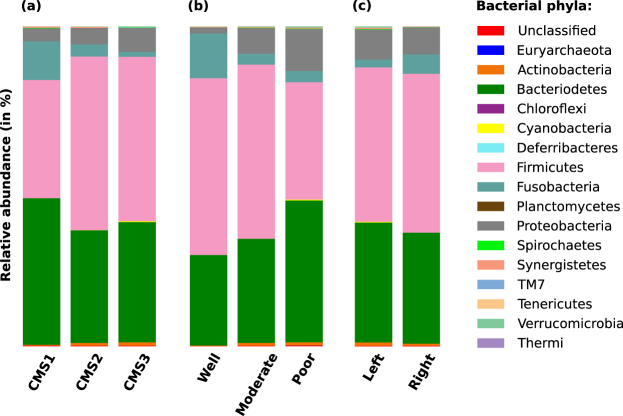
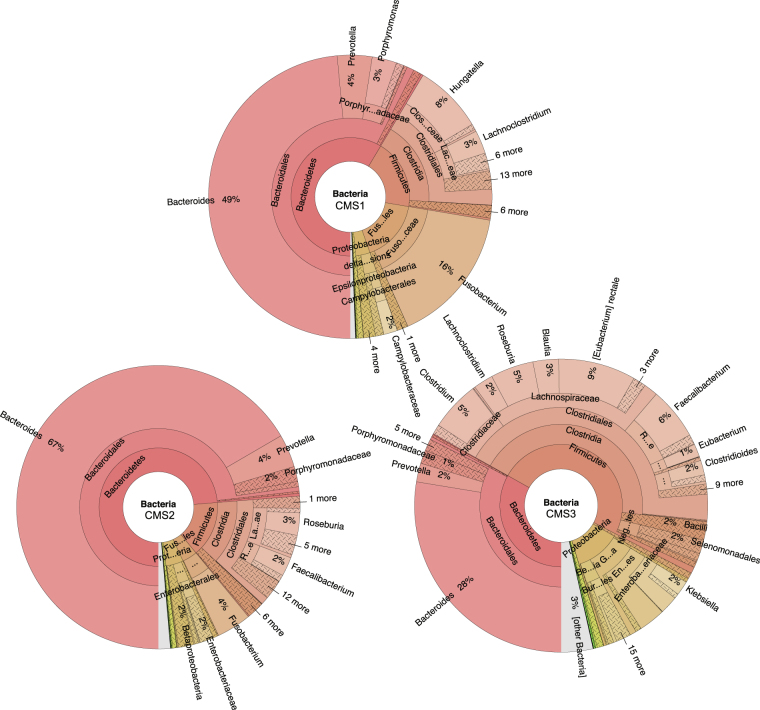
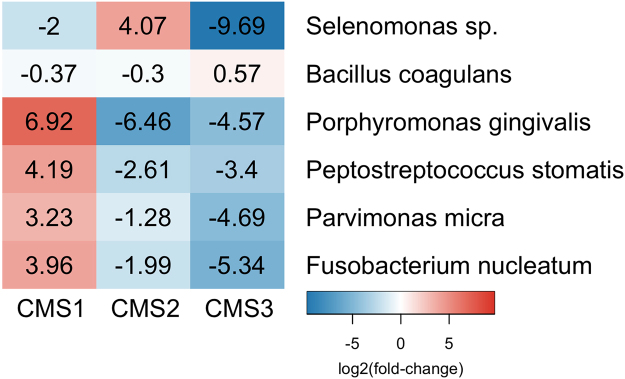
Colorectal cancer (CRC) is a heterogeneous disease and recent advances in subtype classification have successfully stratified the disease using molecular profiling. The contribution of bacterial species to CRC development is increasingly acknowledged, and here, we sought to analyse CRC microbiomes and relate them to tumour consensus molecular subtypes (CMS), in order to better understand the relationship between bacterial species and the molecular mechanisms associated with CRC subtypes. We classified 34 tumours into CRC subtypes using RNA-sequencing derived gene expression and determined relative abundances of bacterial taxonomic groups using 16S rRNA amplicon metabarcoding. 16S rRNA analysis showed enrichment of Fusobacteria and Bacteroidetes, and decreased levels of Firmicutes and Proteobacteria in CMS1. A more detailed analysis of bacterial taxa using non-human RNA-sequencing reads uncovered distinct bacterial communities associated with each molecular subtype. The most highly enriched species associated with CMS1 included Fusobacterium hwasookii and Porphyromonas gingivalis. CMS2 was enriched for Selenomas and Prevotella species, while CMS3 had few significant associations. Targeted quantitative PCR validated these findings and also showed an enrichment of Fusobacterium nucleatum, Parvimonas micra and Peptostreptococcus stomatis in CMS1. In this study, we have successfully associated individual bacterial species to CRC subtypes for the first time.
Overview
The claims and statistics of this paper haven’t been checked yet.
Run the check — free, no account needed. It reads the open-access text and checks the sources it cites.
Integrity signals
Registry
Cites
Statistics
Figures
Verification
Claims the paper makes
The claims and statistics of this paper haven’t been checked yet.
Run the check — free, no account needed. It reads the open-access text and checks the sources it cites.
Claims other papers make about this one
Each is checked against this paper’s own text: does it say what the citing paper says it does?
In the citing paper
“A study associated F nucleatum with the consensus molecular subtype 1 of CRC,32”
From Influence of the Gut Microbiome, Diet, and Environment on Risk of Colorectal Cancer (2020) · cites this paper as [32]
Self-check
Percentages, sums and reported differences re-computed from the paper’s own numbers.
The self-check needs the paper’s full text.
Citations
Cites
Moderated estimation of fold change and dispersion for RNA-seq data with DESeq2
Love, M. I., Huber, W., & Anders, S. (2014) · Genome Biology · doi:10.1186/s13059-014-0550-8 · Cited by 95,106
The Sequence Alignment/Map format and SAMtools
Li, H., Handsaker, B., Wysoker, A., Fennell, T., Ruan, J., Homer, N., Marth, G., Abecasis, G., Durbin, R., & 1000 Genome Project Data Processing Subgroup (2009) · Bioinformatics · doi:10.1093/bioinformatics/btp352 · Cited by 62,041
Subramanian, A., Tamayo, P., Mootha, V. K., Mukherjee, S., Ebert, B. L., Gillette, M. A., Paulovich, A., Pomeroy, S. L., Golub, T. R., Lander, E. S., et al. (2005) · Proceedings of the National Academy of Sciences · doi:10.1073/pnas.0506580102 · Cited by 53,625 · cited 2×
“The biological categories and corresponding gene-sets used in the analysis were extracted from MSigDB[29] (version 5.2).”
MethodInfluentialSTAR: ultrafast universal RNA-seq aligner
Dobin, A., Davis, C. A., Schlesinger, F., Drenkow, J., Zaleski, C., Jha, S., Batut, P., Chaisson, M., & Gingeras, T. R. (2013) · Bioinformatics · doi:10.1093/bioinformatics/bts635 · Cited by 51,709
Robinson, M. D., McCarthy, D. J., & Smyth, G. K. (2010) · Bioinformatics · doi:10.1093/bioinformatics/btp616 · Cited by 41,364 · cited 1×
“0) [25], we identified bacterial taxa whose abundances are significantly different among CMS subtypes.”
BackgroundQIIME allows analysis of high-throughput community sequencing data
Caporaso, J. G., Kuczynski, J., Stombaugh, J., Bittinger, K., Bushman, F. D., Costello, E. K., Fierer, N., Peña, A. G., Goodrich, J. K., Gordon, J. I., et al. (2010) · Nature Methods · doi:10.1038/nmeth.f.303 · Cited by 34,887
Cancer incidence and mortality worldwide: Sources, methods and major patterns in GLOBOCAN 2012
Ferlay, J., Soerjomataram, I., Dikshit, R., Eser, S., Mathers, C., Rebelo, M., Parkin, D. M., Forman, D., & Bray, F. (2015) · International Journal of Cancer · doi:10.1002/ijc.29210 · Cited by 28,766
HTSeq—a Python framework to work with high-throughput sequencing data
Anders, S., Pyl, P. T., & Huber, W. (2015) · Bioinformatics · doi:10.1093/bioinformatics/btu638 · Cited by 21,464 · cited 1×
“1p1)[20] for each sample and the raw read counts were transformed to TPM values using R and Bioconductor package DESeq2 (v1.”
MethodFLASH: fast length adjustment of short reads to improve genome assemblies
Magoč, T., & Salzberg, S. L. (2011) · Bioinformatics · doi:10.1093/bioinformatics/btr507 · Cited by 15,366
Comprehensive molecular characterization of human colon and rectal cancer
The Cancer Genome Atlas Network (2012) · Nature · doi:10.1038/nature11252 · Cited by 8,499
Cited by
Sorted by citations
Items 201–227 of 227
Bairi, K. E., Amrani, M., & Maleb, A. (2020) · Springer eBooks · doi:10.1007/978-3-030-53821-7_5 · Cited by 1
Korobkova, L., Morin, E. L., Aoued, H. S., Sannigrahi, S., Garza, K., Siebert, E. R., Walum, H., Cabeen, R. P., Sánchez, M. M., & Dias, B. G. (2023) · bioRxiv (Cold Spring Harbor Laboratory) · doi:10.1101/2023.02.23.529808 · Cited by 1
“While Kraken is typically used to map DNA sequences to the bacterial genome, studies suggest the utility of using it to align RNA sequences to the same (Chen et al., 2018; Flygare et al., 2016; Neves et al., 2017; Purcell et al., 2017; Reck et al., 2015; Swanson et al., 2020; Tarallo et al., 2019).”
MethodCharacterisation of cancer stem cells and the renin-angiotensin system in colon adenocarcinoma
Munro, M. J. (2021) · Open Access Victoria University of Wellington | Te Herenga Waka (Figshare) · doi:10.26686/wgtn.14331389 · Cited by 1
Relation between Gut Microbiota and Cancer
Malik, H. I., & Qadir, M. I. (2021) · THE JOURNAL OF MICROBIOLOGY AND MOLECULAR GENETICS · doi:10.52700/jmmg.v2i1.28
“Considering that these characteristics characterize recurrent neoplasia, F. nucleatum could have a role in CRC establishment via the serrated route (Mima et al., 2016; Yu et al., 2017; Rashtak et al., 2017; Purcell et al., 2017; Bullman et al., 2017).”
BackgroundWarrier, S. K., Williams, E., Prabhakaran, S., Farmer, K. C., & Kong, J. C. H. (2022) · ANZ Journal of Surgery · doi:10.1111/ans.17680
“The combination of early transluminal pressure (both radial and later longitudinally), macro- and microvascular changes as well as the evolving understanding of gut microbiome all play their part in the ultimate fate of the anastomoses.(1) These in-turn are influenced by key technical factors such as adequate blood fl…”
BackgroundLuo, D., Liao, S., Li, Y., Lai, H., Lin, Y., & Liao, X. (2022) · Research Square · doi:10.21203/rs.3.rs-1966858/v1
Impact du microbiote intestinal dans les cancers colorectaux
Fidelle, M., Chen, J., Roberti, M. P., Kroemer, G., & Zitvogel, L. (2023) · Bulletin de l Académie Nationale de Médecine · doi:10.1016/j.banm.2023.09.009
Kvich, L., Fritz, B. G., Zschach, H., Terkelsen, T., Raskov, H., Høst-Rasmussen, K., Jakobsen, M. R., Gheorghe, A., Gögenür, I., & Bjarnsholt, T. (2023) · bioRxiv (Cold Spring Harbor Laboratory) · doi:10.1101/2023.10.20.563034
“F. nucleatum has been well studied over the last couple of years, and multiple studies have found an enrichment of this bacterium in CRC tissue 44 47 48 .”
Gut microbiota in the combined treatment of colorectal cancer using autoprobiotics
Ермоленко, Е. И., Alekhina, G., Кащенко, В. А., Захаренко, А. А., Тен, О. А., Morozova, A. S., Tsapieva, A., Ilyina, A. S., Сергеевич, О. Т., Евгеньевна, П. О., et al. (2024) · Экспериментальная и клиническая гастроэнтерология · doi:10.31146/1682-8658-ecg-218-10-63-76
Goffredo, P., Troester, A. M., Wolf, J. M., Rudser, K. D., Church, T. R., & Shaukat, A. (2024) · The American Journal of Gastroenterology · doi:10.14309/ajg.0000000000003256
Postbiotics, Gut Microbiota, and Colorectal Cancer: Implications for Immunotherapy
Abdelwahab, M. M., Shahin, M. H., Supranoto, Y. T. N., Gamil, A. H., & Ghattas, A. S. (2025) · Cancer drug discovery and develogment/Cancer drug discovery and development · doi:10.1007/978-3-031-86065-2_16
Caries influences the composition of oral microorganisms in male children with ASD
Meng, S., Huang, W., Peng, B., Zhao, X., Feng, Q., Liu, W., Liu, W., Wang, L., Ge, L., Lin, R., et al. (2025) · Microbial Pathogenesis · doi:10.1016/j.micpath.2025.107904 · Cited by 1
Metagenomic profiling of cancer-causing genes
Mukherjee, P., & Saha, R. (2025) · Elsevier eBooks · doi:10.1016/b978-0-443-33351-4.00004-0
Consensus molecular subtypes and gene expression in early-onset colorectal cancer
Waddell, O., Sulit, A. K., Wilson, K., Ramsey, R., Heriot, A. G., Frizelle, F. A., & Purcell, R. V. (2025) · Colorectal Cancer · doi:10.1080/1758194x.2025.2562798
Dai, W., Li, C., Li, T., Hu, J., & Heping Zhang, D. (2022) · Figshare · doi:10.6084/m9.figshare.20115633
Role of the gut microbiome in the development of colorectal cancer
Shanbhag, A. P. (2026) · Elsevier eBooks · doi:10.1016/b978-0-443-40483-2.00040-6
Analyse de l'impact de Parvimonas micra sur les cellules coliques de l'hôte
Bergsten, E. (2020) · theses.fr (ABES) · doi:10.70675/c82d5d0ez084dz4ae6za044zfede1667bb46
The Role of the Microbiome in Cancer Development
Wang, Y., Shi, Y., Duan, J., Tang, H., Liu, S., & Yang, J. (2026) · Cancer Biome and Targeted Therapy · doi:10.66505/cbtt.v1i1.19
Machida, E., Takamizawa, Y., Takayanagi, D., Cho, H., Shida, D., Yamada, M., Asami, Y., Ono, H., Takeuchi, M., Hamamoto, R., et al. (2026) · JNCI Cancer Spectrum · doi:10.1093/jncics/pkag036
“37 The differentiation of these bacterial phyla into genera is presented in Table S3.”
The Microbiome and Cancer: Exploring the Gut Connection
Om, H., Reshamwala, S. M. S., & Devarajan, P. V. (2026) · BENTHAM SCIENCE PUBLISHERS eBooks · doi:10.2174/9798898814113126010010
Southward, T., Zhuang, Y., Tam, A., Minsky, H. B., Ferri, J., Michel, J. H., Wu, S., Wu, X., Larman, T., Housseau, F., et al. (2026) · The Journal of Infectious Diseases · doi:10.1093/infdis/jiag247
“While data suggest distinct microbiome composition in CRC biopsies of different molecular subtypes [30 – 33] and a linkage between host gene mutations and downstream microbiota changes [34], there are limited studies investigating functional impacts of the microbiota in tumors expressing distinct…”
Zhu, Y., Luo, S., Luo, Y., Guo, Z., Jiang, Y., Ma, Q., Fu, X., Zheng, C., You, F., Kuang, Q., et al. (2026) · Virulence · doi:10.1080/21505594.2026.2673632
“Based on transcriptome and metagenome sequencing, Purcell et al. [46] discovered that P. stomatis , along with F. nucleatum and P. gingivalis , was highly enriched in CMS1 compared to the other molecular subtypes (Figure 1(D)).”
Frebault, J., Troester, A. M., Mott, S. L., Weaver, L., Hassan, I., Shaukat, A., Marmor, S., & Goffredo, P. (2026) · Journal of Gastrointestinal Surgery · doi:10.1016/j.gassur.2026.102476
McCartney, C., Hajjar, R., & Santos, M. M. (2026) · Frontiers in Microbiology · doi:10.3389/fmicb.2026.1774501 · Cited by 1
“…to inulin (Kolida et al., 2007), has been shown in healthy volunteers, there exists a lack of studies characterizing microbial and host response to dietary fiber in patients with CRC, who have been shown to harbor distinct microbiome characteristics (Marchesi et al., 2011; Purcell et al., 2017).”
Chen, M., Dong, X., Zhang, H., Zhong, W., & Wang, B. (2026) · Medicine · doi:10.1097/md.0000000000049390
“[59] CMS2 is characterized by Selenomonas and Prevotella species correlating with integrin and Wnt/MYC pathway activation.”
Virulome over taxonomy: refining the driver-passenger model in colorectal carcinogenesis
Glazunova, E. V., Kurnosov, A., Bogacheva, A., Makarov, V., & Zlobovskaya, O. A. (2026) · Frontiers in Cellular and Infection Microbiology · doi:10.3389/fcimb.2026.1858868
“…are actively exploring the roles of Peptostreptococcus anaerobius (Long et al., 2019; Liu et al., 2024; Piccinno et al., 2025), Parvimonas micra (Purcell et al., 2017; Yachida et al., 2019; Glazunova et al., 2025; Piccinno et al., 2025), Enterococcus faecalis (Golin ́ ska, 2013; Ferchichi et…”
InfluentialSerna, G., Obón‐Santacana, M., Baraibar, I., Moratalla-Navarro, F., Napoli, S., Ruíz‐Pace, F., Mulet-Margalef, N., Guinó, E., Alonso, L., Boleda, L., et al. (2026) · ESMO Open · doi:10.1016/j.esmoop.2026.108342
Metadata
- Authors
- Purcell, R. V., Visnovska, M., Biggs, P. J., Schmeier, S., & Frizelle, F. A.
- Affiliations
- University of Otago (NZ)
- Massey University (NZ)
- Corresponding author
- Purcell, Rachel V.
- Venue
- Scientific Reports
- Published
- 2017-09-14
- Volume
- 7
- Issue
- 1
- Pages
- 11590-11590
- ISSN
- 2045-2322 (ISSN-L)
- PMC
- PMC5599497
- OpenAlex
- W2950036522
- Cited by
- 227
- References
- 60
- Citations by year
- 2026: 16 · 2025: 24 · 2024: 21 · 2023: 34 · 2022: 33 · 2021: 40 · 2020: 20 · 2019: 21 · 2018: 17
- FWCI
- 6.48
- Type
- journal article
- Language
- en
- Open access
- gold
- doi.org
- Locations
- Scientific Reports (publishedVersion, cc-by)
- bioRxiv (Cold Spring Harbor Laboratory) (acceptedVersion)
- PubMed Central (publishedVersion, cc-by)
- PubMed (publishedVersion)
- DOAJ (DOAJ: Directory of Open Access Journals) (submittedVersion)
- Funders
- Hugh Green Foundation
- Maurice and Phyllis Paykel Trust
- Colorectal Surgical Society of Australia and New Zealand
- Topics
- Life Sciences › Biochemistry, Genetics and Molecular Biology › Molecular Biology › Gut microbiota and health
- Health Sciences › Dentistry › Periodontics › Oral microbiology and periodontitis research
- Health Sciences › Medicine › Oncology › Colorectal Cancer Treatments and Studies
- Keywords
- colorectal cancer, gut microbiota, consensus molecular subtypes, Fusobacterium nucleatum, Porphyromonas gingivalis, Prevotella, bacterial taxa, tumor molecular subtypes, 16S rRNA metabarcoding
- MeSH terms
- Gastrointestinal Microbiome, Adult, Aged, Aged, 80 and over, Female, Humans, Male, Middle Aged, RNA, Ribosomal, 16S, Biomarkers, Tumor, Colorectal Neoplasms, Reproducibility of Results, Gene Expression Regulation, Neoplastic, Computational Biology, Gene Expression Profiling, Metagenome, Metagenomics, Transcriptome
About these checks
Registry, retraction, Cites and statistics results are computed, not judged, with one exception: a printed reference that no index lists is read once by a model before it counts as a citation error. Claims are extracted by a model and kept only when their quote appears verbatim in the text; each cited source is then checked, with a model’s help, for whether it says what the claim relies on. Those verdicts can be wrong — read the claim’s quote and the cited source before relying on one.
Statistics and arithmetic are recomputed, not judged.
Confidence bands are shown only for fields calibrated on our annotated test set. None is calibrated yet, so no band is shown.
What counts as a claim ›How we measure confidence ›How we check this ›
Are you an author, or do you see a problem with this page? Request a review
