

The DOI matches its Crossref record; 60 of the 60 references it cites were found in a registry or an index.
Insect-based diet, a promising nutritional source, modulates gut microbiota composition and SCFAs production in laying hens.
Open accessAbstract
Insects could be potential nutritional sources both for humans and animals. Among these, Hermetia illucens, with good amount of chitin and proteins, represents a suitable diet replacement for laying hens. Little is known about insect diet effects on the microbial ecology of the gastrointestinal tract and bacterial metabolites production. In this study we investigated the effect of H. illucens larvae meal administration on cecal microbiota and short chain fatty acids (SCFAs) production in laying hens. 16S rDNA sequencing showed strong differences between cecal microbiota of soybean (SD) and insect diet (ID) groups both in type and relative abundance (unweighted and weighted beta diversity) of microbial species. In particular, Bacteroides plebeius, Elusimicrobium minutum, Alkaliphilus transvaalensis, Christensenella minuta, Vallitalea guaymasensis and Flavonifractor plautii represented the principal contributors of changes in gut microbiota composition of ID group (FDR p-values < 0.05). Of these, F. plautii, C. minuta and A. transvaalensis have the potential to degrade the chitin’s insect meal and correlated with the observed high levels of gut SCFAs produced in ID group. These microorganisms may thus connect the chitin degradation with high SCFAs production. Our results suggest H. illucens as a potential prebiotic by well feeding gut microbiota.
Overview
The claims and statistics of this paper haven’t been checked yet.
Run the check — free, no account needed. It reads the open-access text and checks the sources it cites.
Integrity signals
Registry
Cites
Statistics
Figures
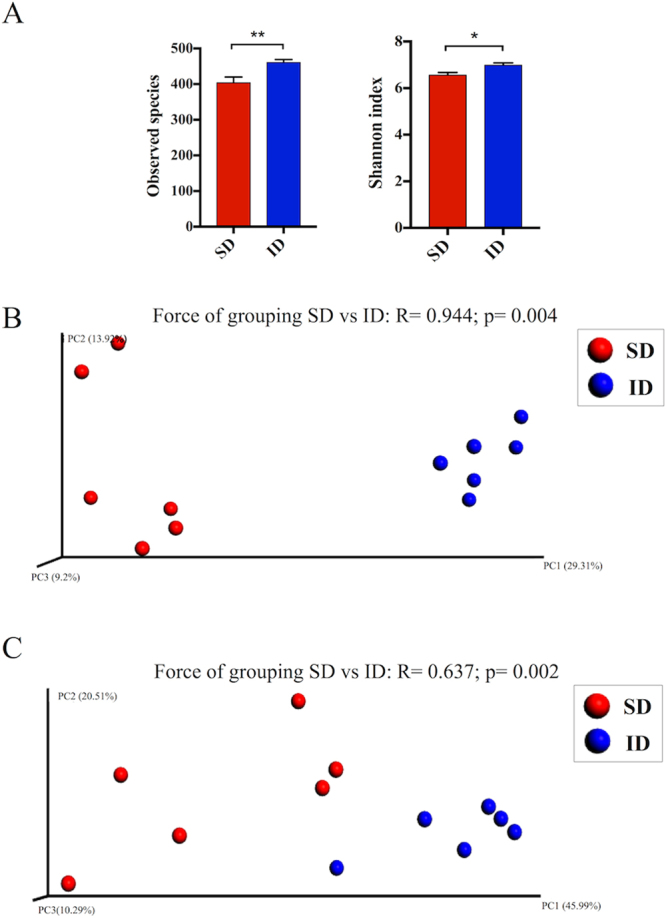
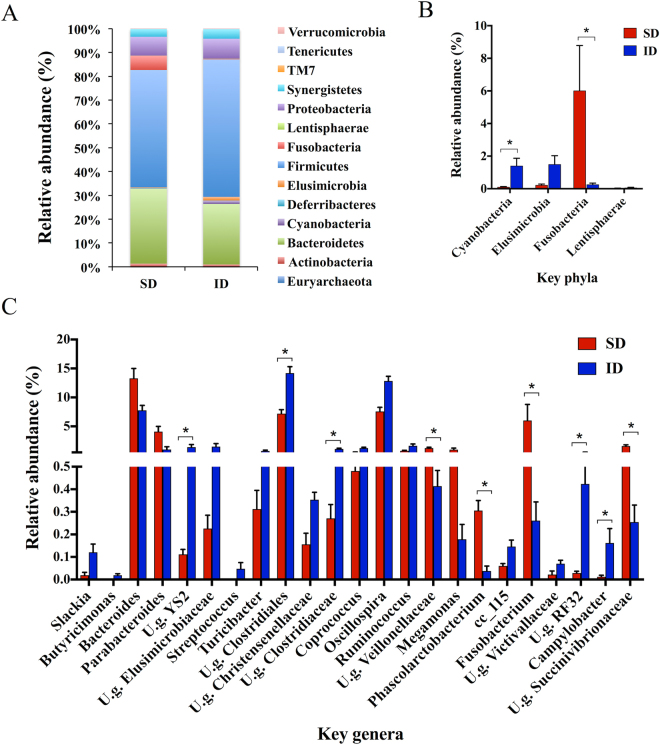
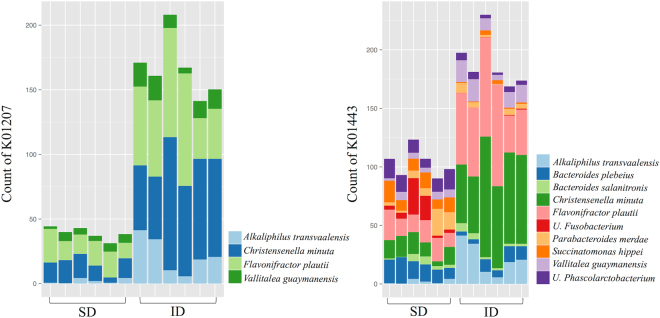
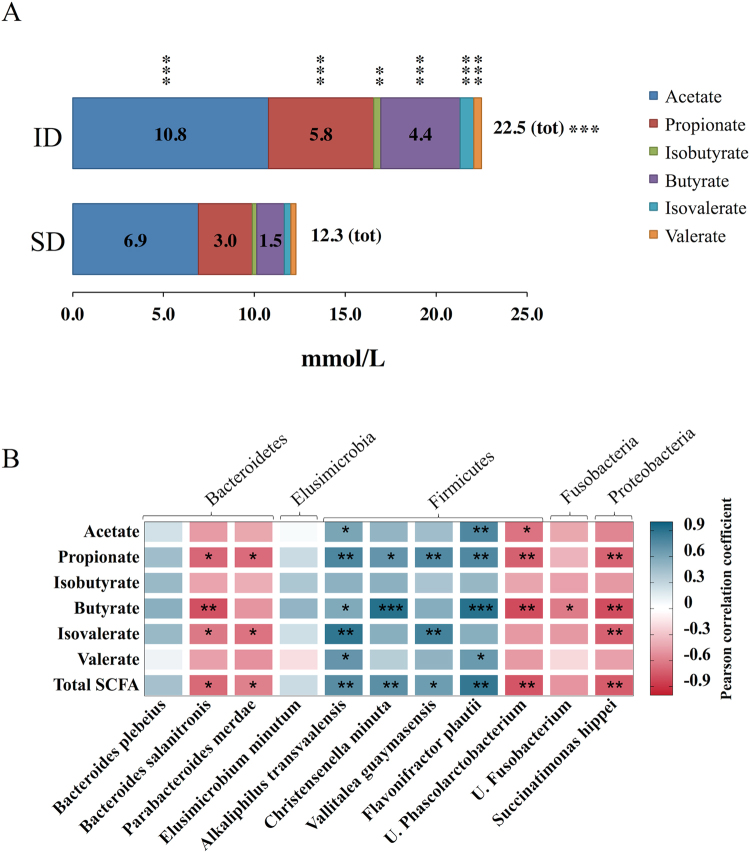
Verification
Claims the paper makes
The claims and statistics of this paper haven’t been checked yet.
Run the check — free, no account needed. It reads the open-access text and checks the sources it cites.
Claims other papers make about this one
Each is checked against this paper’s own text: does it say what the citing paper says it does?
The source backs part of the claim, not all of it — or backs it for a different population, condition or comparison.
In the citing paper
“HI contains chitin which exhibits antimicrobial properties (Borrelli et al., 2017).”
From Insect Derived Lauric Acid as Promising Alternative Strategy to Antibiotics in the Antimicrobial Resistance Scenario (2021) · cites this paper as Borrelli et al., 2017
Experimental — accuracy not yet measuredThe cited source says what the claim attributes to it.
In the citing paper
“Insect diet might also promote metabolic shifts, including the increased production of microbiota-derived short-chain fatty acids (SCFAs) such as butyrate, acetate, and propionate (Borrelli et al., 2017)”
From Insect Derived Lauric Acid as Promising Alternative Strategy to Antibiotics in the Antimicrobial Resistance Scenario (2021) · cites this paper as Borrelli et al., 2017
Self-check
Percentages, sums and reported differences re-computed from the paper’s own numbers.
The self-check needs the paper’s full text.
Citations
Cites
QIIME allows analysis of high-throughput community sequencing data
Caporaso, J. G., Kuczynski, J., Stombaugh, J., Bittinger, K., Bushman, F. D., Costello, E. K., Fierer, N., Peña, A. G., Goodrich, J. K., Gordon, J. I., et al. (2010) · Nature Methods · doi:10.1038/nmeth.f.303 · Cited by 34,887
Non‐parametric multivariate analyses of changes in community structure
Clarke, K. R. (1993) · Australian Journal of Ecology · doi:10.1111/j.1442-9993.1993.tb00438.x · Cited by 14,449
Greengenes, a Chimera-Checked 16S rRNA Gene Database and Workbench Compatible with ARB
DeSantis, T. Z., Hugenholtz, P., Larsen, N., Rojas, M., Brodie, E. L., Keller, K., Huber, T., Dalevi, D., Hu, P., & Andersen, G. L. (2006) · Applied and Environmental Microbiology · doi:10.1128/aem.03006-05 · Cited by 10,891
Predictive functional profiling of microbial communities using 16S rRNA marker gene sequences
Langille, M. G. I., Zaneveld, J., Caporaso, J. G., McDonald, D., Knights, D., Reyes, J. A., Clemente, J. C., Burkepile, D. E., Vega Thurber, R. L., Knight, R., et al. (2013) · Nature Biotechnology · doi:10.1038/nbt.2676 · Cited by 9,116
KEGG as a reference resource for gene and protein annotation
Kanehisa, M., Sato, Y., Kawashima, M., Furumichi, M., & Tanabe, M. (2016) · Nucleic Acids Research · doi:10.1093/nar/gkv1070 · Cited by 7,387
Changes of Intestinal Functions in Liver Cirrhosis
Fukui, H., & Wiest, R. (2016) · Inflammatory Intestinal Diseases · doi:10.1159/000444436 · Cited by 6,820
Quality control and preprocessing of metagenomic datasets
Schmieder, R., & Edwards, R. A. (2011) · Bioinformatics · doi:10.1093/bioinformatics/btr026 · Cited by 5,119
PEAR: a fast and accurate Illumina Paired-End reAd mergeR
Zhang, J., Kobert, K., Flouri, T., & Stamatakis, A. (2014) · Bioinformatics · doi:10.1093/bioinformatics/btt593 · Cited by 4,497
Gut microbiota in health and disease
Sekirov, I., Russell, S. L., Antunes, L. C. M., & Finlay, B. B. (2010) · Physiological Reviews · doi:10.1152/physrev.00045.2009 · Cited by 4,182
Formation of propionate and butyrate by the human colonic microbiota
Louis, P., & Flint, H. J. (2017) · Environmental Microbiology · doi:10.1111/1462-2920.13589 · Cited by 3,028
Cited by
Sorted by citations
Surendra, K. C., Tomberlin, J. K., van Huis, A., Cammack, J. A., Heckmann, L.-H. L., & Khanal, S. K. (2020) · Waste Management · doi:10.1016/j.wasman.2020.07.050 · Cited by 456
Wang, Z., Chen, W.-H., Li, S.-X., He, Z.-M., Zhu, W.-L., Ji, Y.-B., Wang, Z., Zhu, X.-M., Yuan, K., Bao, Y.-P., et al. (2021) · Molecular Psychiatry · doi:10.1038/s41380-021-01113-1 · Cited by 307
Gut Microbiota Features in Young Children With Autism Spectrum Disorders
Coretti, L., Paparo, L., Riccio, M. P., Amato, F., Cuomo, M., Natale, A., Borrelli, L., Corrado, G., De Caro, C., Comegna, M., et al. (2018) · Frontiers in Microbiology · doi:10.3389/fmicb.2018.03146 · Cited by 266
Self-citationPotential health benefits of edible insects
Nowakowski, A. C., Miller, A. C., Miller, M. E., Xiao, H., & Wu, X. (2021) · Critical Reviews in Food Science and Nutrition · doi:10.1080/10408398.2020.1867053 · Cited by 265
Terova, G., Rimoldi, S., Ascione, C., Gini, E., Ceccotti, C., & Gasco, L. (2019) · Reviews in Fish Biology and Fisheries · doi:10.1007/s11160-019-09558-y · Cited by 244
Metadata
- Authors
- Borrelli, L., Coretti, L., Dipineto, L., Bovera, F., Menna, F., Chiariotti, L., Nizza, A., Lembo, F., & Fioretti, A.
- Affiliations
- University of Naples Federico II (IT)
- Institute for Experimental Endocrinology and Oncology (IT)
- Corresponding author
- Borrelli, Luca
- ORCID
- Venue
- Scientific Reports
- Published
- 2017-11-24
- Volume
- 7
- Issue
- 1
- Pages
- 16269-16269
- ISSN
- 2045-2322 (ISSN-L)
- PMC
- PMC5701250
- OpenAlex
- W2768218657
- Cited by
- 263
- References
- 60
- Citations by year
- 2026: 18 · 2025: 37 · 2024: 33 · 2023: 39 · 2022: 36 · 2021: 31 · 2020: 37 · 2019: 25 · 2018: 7
- FWCI
- 17.53
- Type
- journal article
- Language
- en
- Open access
- gold
- doi.org
- Locations
- Scientific Reports (publishedVersion, cc-by)
- Europe PMC (PubMed Central) (publishedVersion, cc-by)
- PubMed Central (publishedVersion, cc-by)
- PubMed (publishedVersion)
- Funders
- Università degli Studi di Firenze
- Topics
- Life Sciences › Agricultural and Biological Sciences › Insect Science › Insect Utilization and Effects
- Life Sciences › Agricultural and Biological Sciences › Animal Science and Zoology › Animal Nutrition and Physiology
- Life Sciences › Biochemistry, Genetics and Molecular Biology › Molecular Biology › Gut microbiota and health
- Keywords
- Hermetia illucens, insect meal, laying hens, gut microbiota, short-chain fatty acids, cecal microbiota, chitin degradation, prebiotics, soybean diet, Flavonifractor plautii, Christensenella minuta, Bacteroides plebeius, poultry nutrition
- MeSH terms
- Gastrointestinal Microbiome, Animals, Animal Feed, Chickens, Diet, Fatty Acids, Volatile, Female, Insecta
About these checks
Registry, retraction, Cites and statistics results are computed, not judged, with one exception: a printed reference that no index lists is read once by a model before it counts as a citation error. Claims are extracted by a model and kept only when their quote appears verbatim in the text; each cited source is then checked, with a model’s help, for whether it says what the claim relies on. Those verdicts can be wrong — read the claim’s quote and the cited source before relying on one.
Statistics and arithmetic are recomputed, not judged.
Confidence bands are shown only for fields calibrated on our annotated test set. None is calibrated yet, so no band is shown.
What counts as a claim ›How we measure confidence ›How we check this ›
Are you an author, or do you see a problem with this page? Request a review
