

Brain-to-Brain Synchrony during Naturalistic Social Interactions
Open accessThe DOI matches its Crossref record; 76 of the 78 references it cites were found in a registry or an index; 5 of the 63 sources its claims cite were checked for support.
Abstract
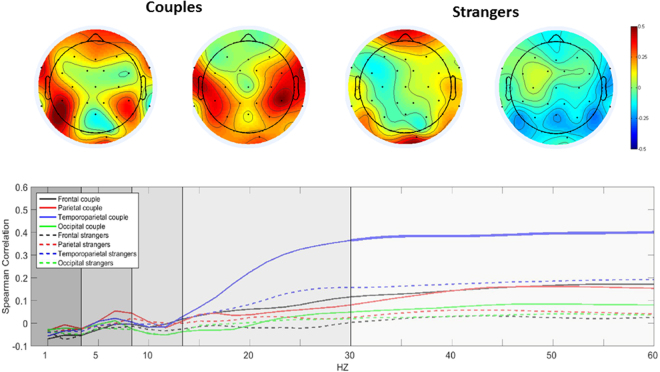
The evolution of humans as a highly social species tuned the brain to the social world; yet the mechanisms by which humans coordinate their brain response online during social interactions remain unclear. Using hyperscanning EEG recordings, we measured brain-to-brain synchrony in 104 adults during a male-female naturalistic social interaction, comparing romantic couples and strangers. Neural synchrony was found for couples, but not for strangers, localized to temporal-parietal structures and expressed in gamma rhythms. Brain coordination was not found during a three-minute rest, pinpointing neural synchrony to social interactions among affiliative partners. Brain-to-brain synchrony was linked with behavioral synchrony. Among couples, neural synchrony was anchored in moments of social gaze and positive affect, whereas among strangers, longer durations of social gaze and positive affect correlated with greater neural synchrony. Brain-to-brain synchrony was unrelated to episodes of speech/no-speech or general content of conversation. Our findings link brain-to-brain synchrony to the degree of social connectedness among interacting partners, ground neural synchrony in key nonverbal social behaviors, and highlight the role of human attachment in providing a template for two-brain coordination.
Overview
CoChat Summary
TL;DR
Using hyperscanning EEG during a naturalistic male-female interaction, the study found brain-to-brain gamma synchrony localized to temporal-parietal areas in romantic couples but not strangers. This neural synchrony was linked to social gaze and positive affect and was absent during rest, suggesting social connectedness and nonverbal behavior shape two-brain coordination.
Key findings
- Couples showed significant temporal-parietal gamma (30–60 Hz) power correlation during interaction, R = 0.389, p = 0.0028, whereas strangers did not, R = 0.102, p = 0.10; couples had higher gamma correlation than strangers, t = −3.02, p = 0.004.
- Gamma synchrony was not significant at rest for couples (R = 0.16, p = 0.10) or strangers (R = 0.07, p = 0.10), but among couples it increased significantly from rest to interaction, t = 3.8801, p = 0.00075.
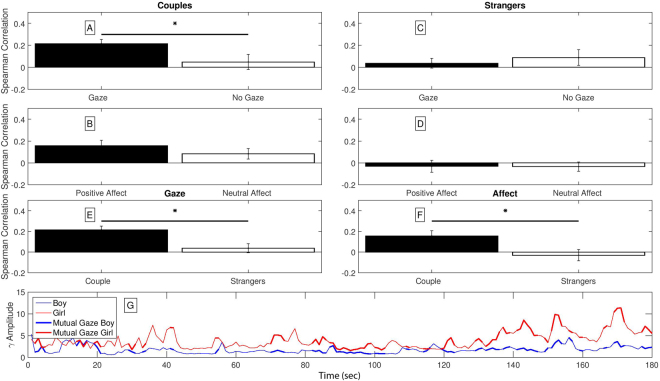
- Couples spent more time in social gaze than strangers (M = 93%, SD = 2.08 vs. M = 78.66%, SD = 1.66; t = 19.86, p = 0.0001), and couples’ gamma synchrony was higher during social gaze than no gaze, t = 2.03, p = 0.05; positive affect showed a marginal effect, t = 1.57, p = 0.065.
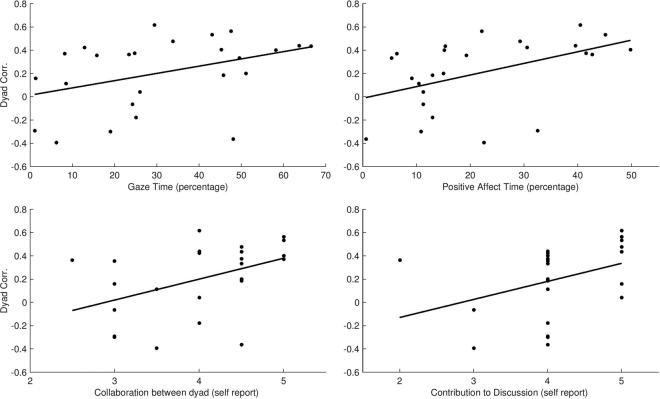
- Among strangers, longer social gaze and positive affect correlated with greater gamma synchrony, R = 0.431, p = 0.0323 and R = 0.566, p = 0.0031, respectively; speech duration and conversation content did not differ between groups.
Methods
- 104 healthy adults initially participated as 52 male-female dyads: 24 cohabitating romantic couples and 25 stranger dyads in final analyses after exclusions (final sample 98 individuals).
- Participants completed a 3-minute rest and then a 5-minute naturalistic positive “fun day” conversation while simultaneous 32-electrode EEG was recorded; interactions were videotaped and micro-coded for gaze, affect, and speech.
- EEG power was analyzed by frequency bands and ROIs using Spearman correlations between partners, with Stockwell transform for continuous data, LORETA for source estimation, and FDR correction for multiple comparisons.
Limitations
- The paper states that hyperscanning EEG during naturalistic interaction affords less exact brain localization and less exact task-parameter modeling than fMRI or MEG, and that EEG source localization could not pinpoint exact regions.
- The paper states that no third group of familiar non-romantic friends was included, so familiarity could not be fully separated from romantic love.
- The paper notes that the positive-affect finding was marginal and should be treated with caution, and that the strangers’ collaboration correlation did not survive FDR correction; evident from the design, the correlational approach cannot establish causal direction.
Model-written summary. Check it against the paper before relying on it.
Integrity signals
Registry
Cites
Statistics
Figures
Verification
Claims the paper makes
3 Valid · 2 Not valid · 39 Not checked · 57 Own results and interpretations
None of the sources cited for this claim have been checked yet.
In the paper
“Gamma activity recorded from temporal-parietal areas has been linked with a range of social abilities that support social connectedness, such as theory-of-mind, cognitive appraisal, and emotion regulation8,35,36.”
§ Brain-to-Brain Synchrony during Naturalistic Social Interactions > Introduction
What the sources say
- Not checked yetcites [8] Cohen, M. X., David, N., Vogeley, K. & Elger, C. E. Gamma-band activity in the human superior temporal sulcus during mentalizing from nonverbal social cues. Psychophysiology46 (2009). 18992070 source
- Not checked yetcites [35] Kang J-H The modulation of parietal gamma oscillations in the human electroencephalogram with cognitive reappraisal Neuroreport 2012 23 995 999 10.1097/WNR.0b013e32835a6475 23076117 source
- Could not verifycites [36] Symons AE El-Deredy W Schwartze M Kotz SA The Functional Role of Neural Oscillations in Non-Verbal Emotional Communication Front. Hum. Neurosci. 2016 10 239 10.3389/fnhum.2016.00239 27252638 PMC4879141 sourceExperimental — accuracy not yet measured
Our copy's gamma sections ('Perception of Emotion from Facial Expressions > Gamma (>30 Hz)' and the Conclusion) tie gamma to feature integration, sensory selection and the binding of emotionally salient input, localised to amygdala, OFC, STS and later occipital/parietal/prefrontal responses (Luo et al., 2007–2010; Sato et al., 2011; Jung et al., 2011; Müsch et al., 2014) — so it does touch gamma in temporal/parietal regions, but only for emotion perception from facial expressions. No passage in our copy links gamma to theory of mind, cognitive appraisal or emotion regulation (searched: 'theory of mind', 'temporoparietal junction', 'mentalizing', 'social cognition', 'cognitive appraisal', 'emotion regulation', 'reappraisal'); the only social-cognition mention is beta band activity and biological motion (Pavlova, 2012; Jabbi et al., 2015, Beta section). The claim's substantive association is therefore neither stated nor contradicted by our copy, and no alternative source is named in it (the citing sentence carries three reference numbers, 8, 35, 36). (LLM, conf=0.65)
plainstates an association- Asserted: passes — The authors put it forward as true.
- Checkable: passes — It can be checked against evidence.
- Load-bearing: passes — The paper’s conclusions depend on it.
- Based: passes — The paper gives a reason why it holds.
The cited sources support only part of this claim — read each source’s verdict below.
In the paper
“Overall, these studies indicate that the degree of social connectedness among partners impacts the level of neural synchrony in temporal-parietal structures.”
§ Brain-to-Brain Synchrony during Naturalistic Social Interactions > Introduction
What the sources say
- Partly supportedcites [29] Dikker S Silbert LJ Hasson U Zevin JD On the Same Wavelength: Predictable Language Enhances Speaker-Listener Brain-to-Brain Synchrony in Posterior Superior Temporal Gyrus J. Neurosci. 2014 34 6267 6272 10.1523/JNEUROSCI.3796-13.2014 24790197 PMC4004812 sourceExperimental — accuracy not yet measured
The Results and Discussion (page numbers unavailable in our copy) report greater speaker–listener synchrony in left posterior superior temporal gyrus when language is more predictable. They do not examine whether the partners’ degree of social connectedness affects that synchrony; the reported factor is linguistic predictability. (LLM, conf=0.86)
- Partly supportedcites [31] Tang H Interpersonal brain synchronization in the right temporo-parietal junction during face-to-face economic exchange Soc. Cogn. Affect. Neurosci. 2015 11 23 32 10.1093/scan/nsv092 26211014 PMC4692317 sourceExperimental — accuracy not yet measured
Tang et al. (2016) do report the substance of the claim: the Discussion states that interpersonal brain synchronization in rTPJ 'increased with shared intentionality between partners', and the fNIRS Results give the supporting statistic — coherence in CH14 positively correlated with shared intentionality for face-to-face (r = 0.28, P = 0.046) but not for face-blocked (r = 0.02, P = 0.89), with no other channels significant. However, the source's construct is 'shared intentionality' (sharing psychological states), not 'social connectedness' as such, and the association is a modest correlation confined to one rTPJ channel under face-to-face interaction only; the authors hedge it as possibly 'an indicator of shared intentionality' rather than something that 'impacts' synchrony. The causal, unconditional phrasing of the citing sentence and its generalization to temporo-parietal structures beyond rTPJ go beyond what this paper shows. (LLM, conf=0.72)
- Not checked yetcites [32] Liu N NIRS-based hyperscanning reveals inter-brain neural synchronization during cooperative Jenga game with face-to-face communication Front. Hum. Neurosci. 2016 10 1 11 27014019 PMC4782164
hedgedstates a cause- Asserted: passes — The authors put it forward as true.
- Checkable: passes — It can be checked against evidence.
- Load-bearing: passes — The paper’s conclusions depend on it.
- Based: passes — The paper gives a reason why it holds.
- Partly supported
The cited sources support only part of this claim — read each source’s verdict below.
In the paper
“For our couples, who have been in a committed relationship for some time, such familiarity can lead to greater neural synchrony, when familiar actions56 and communications57 are incorporated as neural predictions and pave the way for greater brain coordination.”
§ Brain-to-Brain Synchrony during Naturalistic Social Interactions > Discussion
What the sources say
- Partly supportedcites [56] Grush R The emulation theory of representation: motor control, imagery, and perception Behav. Brain Sci. 2004 27 377 442 15736871 sourceExperimental — accuracy not yet measured
Our copy of Grush's target article (with commentaries and reply) does support the mechanistic half of the claim: the nervous system runs forward models/emulators that turn a current motor command into a neural prediction of its sensory consequences (sect. 5.3, 'the perceptual system is producing a prediction - an a priori estimate - of what the next visual scene will be on the basis of the current visual scene and the current motor command'), that these emulators are plastic and trained by prior experience (sect. 2.2; Stein's reply 'the best trainer of the emulator/memory is experience'), and, tentatively, that an 'external biomechanical emulator' can model the movements of other individuals (sect. R10). What our copy nowhere addresses is the distinctive part of the claim: couples in committed relationships, partner familiarity, and any resulting inter-brain neural synchrony or 'brain coordination' — searched for 'neural synchrony', 'interpersonal', 'joint action between two people', 'couples' with no passage. The synchrony-in-couples conclusion therefore rests on the citing authors, not on this source. (LLM, conf=0.68)
- Not checked yetcites [57] Schwanenflugel PJ Shoben EJ The influence of sentence constraint on the scope of facilitation for upcoming words J. Mem. Lang. 1985 24 232 252 10.1016/0749-596X(85)90026-9 source
plainstates a cause- Asserted: passes — The authors put it forward as true.
- Checkable: passes — It can be checked against evidence.
- Load-bearing: passes — The paper’s conclusions depend on it.
- Based: passes — The paper gives a reason why it holds.
- Partly supported
The cited sources support only part of this claim — read each source’s verdict below.
In the paper
“As behavioral synchrony is linked with attachment status, with couples and close friends expressing more synchrony than strangers26,34, it is reasonable to expect that romantic partners in a long-term relationship would display more behavioral and neural synchrony as compared to strangers and that neural synchrony would localize to temporo-parietal areas.”
§ Brain-to-Brain Synchrony during Naturalistic Social Interactions > Introduction
What the sources say
- Not checked yetcites [26] Ulmer-Yaniv A Affiliation, reward, and immune biomarkers coalesce to support social synchrony during periods of bond formation in humans Brain Behav. Immun. 2016 56 SRC- 130 139 10.1016/j.bbi.2016.02.017 26902915 source
- Partly supportedcites [34] Latif N Barbosa AV Vatiokiotis-Bateson E Castelhano MS Munhall KG Movement coordination during conversation PLoS One 2014 9 1 10 10.1371/journal.pone.0105036 PMC4132081 25119189 sourceExperimental — accuracy not yet measured
Latif et al. (2014) support the close-friends half of the claim: Experiment 1 Results (Movement Analysis) state 'Friends show significantly higher correlations than strangers at all lags' (Fig. 2 caption) and 'friends had higher correlation than strangers (p<0.0001)' (Fig. 3), and the Abstract reports that 'individuals familiar with each other coordinated their movements more frequently'. However, our copy contains nothing on romantic couples or attachment status: the study used only friend pairs and stranger pairs, and searches for 'couples / romantic partners / attachment' returned only friend-vs-stranger passages (Introduction, Discussion). The 'linked with attachment status' framing and the couples extension are therefore not attributable to this source. (LLM, conf=0.80)
plainstates an association- Asserted: passes — The authors put it forward as true.
- Checkable: passes — It can be checked against evidence.
- Load-bearing: passes — The paper’s conclusions depend on it.
- Based: passes — The paper gives a reason why it holds.
A result the paper reports from its own data — it cites no other source for it, so there is none to check. The quote shows it is in the paper.
In the paper
“and positive affect, t (two tailed) = 2.53, p = 0.015 (Fig. 2E,F).”
§ Brain-to-Brain Synchrony during Naturalistic Social Interactions > Results > Connecting Behavioral and Neural Synchrony
plainstates an association- Asserted: passes — The authors put it forward as true.
- Checkable: passes — It can be checked against evidence.
- Load-bearing: passes — The paper’s conclusions depend on it.
- Based: passes — The paper gives a reason why it holds.
57 more claims
Create a free account to see all 101 claims and to verify the 58 references still open.
- It may state two separate claims as one. 17
- Probably not a substantial claim. 28
Claims other papers make about this one
Each is checked against this paper’s own text: does it say what the citing paper says it does?
The source backs part of the claim, not all of it — or backs it for a different population, condition or comparison.
In the citing paper
“Another electroencephalography study tested neural alignment between romantic dyads and unacquainted dyads, and found elevated coupling in the DMN during mutual gaze and smiling107.”
From The default mode network: where the idiosyncratic self meets the shared social world (2021) · cites this paper as [107]
Experimental — accuracy not yet measuredThe source backs part of the claim, not all of it — or backs it for a different population, condition or comparison.
In the citing paper
“Social synchrony is essential for human bonding and has been associated with positive affect and prosocial behavior.[ 50 ]”
From Loneliness and the Social Brain: How Perceived Social Isolation Impairs Human Interactions (2021) · cites this paper as [50]
Experimental — accuracy not yet measured
Statistics that don’t add up
Each reported p-value recomputed from its test statistic and degrees of freedom, each partial η² from its F, and each ratio, mean difference or B printed with a p checked against its own confidence interval.
Rated minor: it would not touch a result — a value no result rests on, a p-value that stays on the same side of the significance level, or a conflict that is clerical, resolved elsewhere in the paper, or outside its own findings.
In the paper
“F (2,148) = 7.48, p = 0.02”
§ Brain-to-Brain Synchrony during Naturalistic Social Interactions > Results > Connecting Behavioral and Neural Synchrony
Reported p = .02 · recomputed p < .001
Statistics recomputed
Every reported test result, recomputed from its test statistic and degrees of freedom. A result shows as not adding up only once an independent check has confirmed it.
- Doesn’t add upF(2, 148) = 7.48reported p = .02 · recomputed p < .001
“F (2,148) = 7.48, p = .02”
- ConsistentF(1, 148) = 12.64reported p = 0 · recomputed p < .001
“F (1,148) = 12.64, p = .00”
Self-check
Percentages, sums and reported differences re-computed from the paper’s own numbers.
Self-check results appear here once an independent check has confirmed them.
Citations
Cites
Controlling the False Discovery Rate: A Practical and Powerful Approach to Multiple Testing
Benjamini, Y., & Hochberg, Y. (1995) · Journal of the Royal Statistical Society Series B: Statistical Methodology · doi:10.1111/j.2517-6161.1995.tb02031.x · Cited by 109,482
(2014) · Climate Change 2013 – The Physical Science Basis · doi:10.1017/cbo9781107415324.004 · Cited by 23,880
(1969) · Cited by 18,340
Oostenveld, R., Fries, P., Maris, E., & Schoffelen, J.-M. (2011) · Computational Intelligence and Neuroscience · doi:10.1155/2011/156869 · Cited by 10,323
Social Relationships and Mortality Risk: A Meta-analytic Review
Holt-Lunstad, J., Smith, T. B., & Layton, J. B. (2010) · PLoS Medicine · doi:10.1371/journal.pmed.1000316 · Cited by 7,272 · cited 2×
“We conducted two separate frequency calculations; (1) continuous: for the rest and the social interaction paradigms and (2) epochs-based analyses: only for the social interaction paradigm.”
BackgroundMethodMental Models: Towards a Cognitive Science of Language, Inference, and Consciousness
Ford, M., & Johnson-Laird, P. N. (1985) · Language · doi:10.2307/414498 · Cited by 4,419
Statistics corner: A guide to appropriate use of correlation coefficient in medical research.
(2012) · Europe PMC (PubMed Central) · Cited by 4,239
An internal model for sensorimotor integration
Wolpert, D. M., Ghahramani, Z., & Jordan, M. I. (1995) · Science · doi:10.1126/science.7569931 · Cited by 3,553
Localization of the complex spectrum: the S transform
Stockwell, R. G., Mansinha, L., & Lowe, R. P. (1996) · IEEE Transactions on Signal Processing · doi:10.1109/78.492555 · Cited by 3,486
ERPLAB: an open-source toolbox for the analysis of event-related potentials
Lopez-Calderon, J., & Luck, S. J. (2014) · Frontiers in Human Neuroscience · doi:10.3389/fnhum.2014.00213 · Cited by 2,584
Research works printed but not linked: 1
- Feldman R a). The neurobiology of mammalian parenting and the biosocial context of human caregiving Horm. Behav. 101016jyhbeh10001 2015 77 SRC- 3 17 26453928
Cited by
Items 301–400 of 474
The Neural Dynamics of Interpersonal Synchrony
Dippong, J., & Overton, J. (2025) · Handbooks of sociology and social research · doi:10.1007/978-3-031-95615-7_18 · Cited by 2
Interbrain synchrony and its potential role in modulating the impact of traumatic events
Mayo, O., Molcho-Fisher, Y., Avnor, Y., & Shamay‐Tsoory, S. (2025) · Translational Psychiatry · doi:10.1038/s41398-025-03770-0 · Cited by 2
“Considering that interbrain synchrony, the temporal alignment of neural activities between interacting partners [17 – 19], was shown to play a key role in supporting interpersonal connectedness [20], it may serve as a potentially promising biomarker of interpersonal interaction quality.”
Social contingency in embodied neural networks relies on co-constructed dynamical mechanisms
Severino, G. J., Winkler, S. L., Beer, R. D., & Barwich, A. (2026) · Philosophical Transactions of the Royal Society B Biological Sciences · doi:10.1098/rstb.2025.0098 · Cited by 2
Yu, Y., Zhao, H., Liu, M. Q., Gao, C., & Li, W. (2026) · Neuropsychologia · doi:10.1016/j.neuropsychologia.2026.109402 · Cited by 2
Müller, & Lindenberger, U. (2026) · Nonlinear Dynamics · doi:10.1007/s11071-025-12153-5 · Cited by 2
Pedagogy of care: Compassion as self-transcendence—The Kohlberg memorial lecture of 2025
Pessi, A. B. (2026) · Journal of Moral Education · doi:10.1080/03057240.2026.2636317 · Cited by 3
“…brains into sync in real time, highlighting how warm social connection supports emotional attunement and shared understanding (Hirsch et al., 2017; Kinreich et al., 2017; Redcay & Schilbach, 2019) Also, in schools, for instance, service-learning requirements do more than benefit others; they…”
Schwartz, L., Shilo, C., Hayut, O., Brandet, J., Lévy, J., Peleg, I., & Feldman, R. (2026) · Communications Psychology · doi:10.1038/s44271-026-00468-x · Cited by 2
“Previous hyperscanning studies have successfully employed interaction paradigms of 2 – 3 minutes to identify signi fi cant neural coupling in infancy 25,28 , adulthood 20,59 , and mother-adolescentdyads in both face-to-faceand remoteinteractioncontexts 19,21 – 23 .”
Self-citationIwayama, T., Matsumoto, A., Saneyoshi, A., Oi, H., Yanagida, A., Noma, H., Nakajima, S., & Nakamura‐Taira, N. (2024) · Japanese Psychological Research · doi:10.1111/jpr.12561 · Cited by 2
Chen, Y., Zhao, Y., & Deng, X. (2025) · Applied Psychology Health and Well-Being · doi:10.1111/aphw.70002 · Cited by 2
Vital Entanglements on Planet Earth. The full significance of health to political ecology
Geiselhart, K. (2025) · GAIA - Ecological Perspectives for Science and Society · doi:10.14512/gaia.34.4.13 · Cited by 2
The Enigma of Mind: A Theory of Evolution and Conscious Experience
Lin, A., & Lomas, D. (2022) · Cambridge University Press eBooks · doi:10.1017/9781009232517.009 · Cited by 2
MEG correlates of speech planning in simple vs. interactive picture naming in children and adults
Goldman, E., Dargham, S. B., Lai, M. C.-H., Guda, A., Fallon, J., Hauptman, M., Reinoso, A., Phillips, S. F., Abrams, E. B., Parrish, A., et al. (2023) · PLoS ONE · doi:10.1371/journal.pone.0292316 · Cited by 2
“Prior work investigating synchrony during conversation implicates the left posterior STG [34], the posterior superior temporal sulcus (pSTS), and temporo-parietal junction (TPJ) [35].”
BackgroundAttachment Traumatology: Interpersonal neurosynchronistic phylogenesis
Riordan, J. P. (2023) · Journal of Applied Neurosciences · doi:10.4102/jan.v2i1.7 · Cited by 2
Capturing Context Is Not Enough: The Embodied Impact of Story and Emotion in Ethnographic Film
Lemelson, R., & Tucker, A. (2020) · Cambridge University Press eBooks · doi:10.1017/9781108695374.023 · Cited by 2
An auditory interface for realtime brainwave similarity in dyads
Winters, R. M., & Koziej, S. (2020) · Audio Mostly Conference (AM) · doi:10.1145/3411109.3411147 · Cited by 2
““synchronized") during cooperative and interpersonal interactions [1, 4, 6].”
BackgroundStendel, M. S., Ramstead, M. J. D., & Veissière, S. P. L. (2020) · Cambridge University Press eBooks · doi:10.1017/9781108695374.026 · Cited by 2
Sexual coordination in a whole-brain map of prairie-vole pair-bondingPreprint
Gustison, M. L., Muñoz-Castañeda, R., Osten, P., & Phelps, S. M. (2023) · eLife · doi:10.7554/elife.87029.1 · Cited by 2
Spenger, D. (2025) · doi:10.25593/open-fau-2227 · Cited by 2
Tan, S. H. J., Leuk, S. P. J., & Teo, W.-P. (2026) · NeuroImage · doi:10.1016/j.neuroimage.2026.121906 · Cited by 1
Yang, M., & He, W. (2024) · Chinese Science Bulletin (Chinese Version) · doi:10.1360/tb-2023-1337 · Cited by 2
Liu, X., Li, X., & Deng, X. (2025) · Journal of Applied Developmental Psychology · doi:10.1016/j.appdev.2025.101837 · Cited by 1
Zhao, Y., Gui, H., Chin, T., Li, Y., Yue, Y., & Liu, Q. (2025) · Journal of Knowledge Management · doi:10.1108/jkm-11-2023-1060 · Cited by 1
Robledo, J.-P., Cross, I. R. M., Phillips, M., Kearney, J., & Taylor, J. R. (2026) · Neuroscience & Biobehavioral Reviews · doi:10.1016/j.neubiorev.2026.106826 · Cited by 1
Key, A. P. F., Inman, A. J., Chambers, K., Ford, A., Kjeldsen, C. P., & Neel, M. L. (2025) · Psychophysiology · doi:10.1111/psyp.70188 · Cited by 1
Hadi, C. (2024) · Kajian Psikologi dan Kesehatan Mental. · doi:10.35912/kpkm.v2i2.5529 · Cited by 1
What Are Gamma Waves (And How Are They Relevant to Clinical Psychiatry)?
Rocks, D. L., Sharpley, C. F., Bitsika, V., & Odierna, G. L. (2025) · Applied Sciences · doi:10.3390/app152312668 · Cited by 1
Zheng, Y., Zhao, X., Pi, Z., Li, X., & Wang, Z. (2026) · Learning and Individual Differences · doi:10.1016/j.lindif.2026.102873 · Cited by 1
Samraksha, N., Sangeetha, S. R., & Duraisamy, P. (2026) · Journal of Psychosexual Health · doi:10.1177/26318318261421672 · Cited by 1
“23,24,26 fMRI and fNIRS rely on the correlation of hemodynamic time courses (BOLD or oxygenated hemoglobin signals), reflecting slower metabolic coupling rather than direct neural oscillations.”
The Influence of Leadership Coaching Competencies on the Success of Digital Transformation Projects
Ivaaturi, K. (2026) · Universal Library of Innovative Research and Studies · doi:10.70315/uloap.ulirs.2026.0301010 · Cited by 1
Lin, L., Li, Q., Yue, Z., Yaxin, D., Chen, H., Chen, Y., Zhu, J., Han, Y., Yin, S., Guan, L., et al. (2026) · Autism Research · doi:10.1002/aur.70209 · Cited by 1
“…deeper insights into the heterogeneity of ASD by measuring multimodal physiological data, such as parent–child oxytocin levels (R. Feldman et al. 2010), heart rate variability, or neural activity (Kinreich et al. 2017), to more directly explore the biological underpinnings of affective synchrony.”
Making contact: Practical kinds for hyperscanning in psychotherapy
Hinrichs, N. (2026) · Philosophy and the Mind Sciences · doi:10.33735/phimisci.2026.12254 · Cited by 1
Bridging Lab and Life: A Dual‐Person Paradigm for Social Interaction Research
Nöring, V., Krismann, L., Franz, M., Rottstädt, F., & Croy, I. (2026) · Psychophysiology · doi:10.1111/psyp.70292 · Cited by 1
The Role of Different Thoughts in Tacit Coordination and Its Malleability by Interventions
Newman, L. A., Cao, M., Täuber, S., & van Vugt, M. (2026) · Journal of Cognition · doi:10.5334/joc.503 · Cited by 1
Jiang, L., Zou, Q., & Yu, S. (2026) · Biological Psychology · doi:10.1016/j.biopsycho.2026.109367 · Cited by 1
How Digital Screen Use Alienates Human Societies: A Treatise on Social Magic and Its Decadence
Halldórsson, V. (2026) · Routledge eBooks · doi:10.4324/9781003468080 · Cited by 1
Partner Pen Play in Parallel (PPPiP): A New PPPiParadigm for Relationship Improvement
Mikhailova, A., & Friedman, D. (2018) · Arts · doi:10.3390/arts7030039 · Cited by 1
Empathy and Inter-brain Synchrony During Online Collaboration
Falcon, M. (2020) · Helda - University of Helsinki Institutional Repository · Cited by 1
Cities, Psychosis, and Social Defeat
Sayanvala, F., Bornstein, L., Choudhury, S., Shah, J. L., Weinstock, D., & Gold, I. (2020) · Cambridge University Press eBooks · doi:10.1017/9781108695374.025 · Cited by 1
Stout, D. (2020) · Cambridge University Press eBooks · doi:10.1017/9781108695374.005 · Cited by 1
Choudhury, S., & Berson, J. (2020) · Cambridge University Press eBooks · doi:10.1017/9781108695374.020 · Cited by 1
A calculus of probability or belief? Neural underpinnings of social decision-making in a card game
Chen, Y., Youk, S., Wang, P. T., Pinti, P., & Weber, R. (2023) · Neuropsychologia · doi:10.1016/j.neuropsychologia.2023.108635 · Cited by 2
Luo, H., Cai, Y., Lin, X., & Duan, L. F. (2024) · Biomedical Optics Express · doi:10.1364/boe.542554 · Cited by 1
“IBS is believed to rise on the foundation of the social information transfer and processing between interacting individuals, and reflect their mental processes during the interaction such as understanding, mentalizing, empathy and so on [16–18].”
Functional Near-Infrared Spectroscopy Hyperscanning Study in Psychological Counseling
Wang, W., Chen, L., Hu, Y., & Zhang, Y. (2025) · Journal of Visualized Experiments · doi:10.3791/67183 · Cited by 1
Dai, X., Chen, L., Zhou, Q., & Zhang, Y. (2025) · Psychotherapy Research · doi:10.1080/10503307.2025.2491479 · Cited by 1
“The rTPJ plays an important role in establishing positive relationships and may be associated with cognitive empathy (e.g., Atique et al., 2011) or social connectedness (Kinreich et al., 2017).”
‘You won’t get left behind’: immersive insights into a running mental health peer support group
Turton, R., Papathomas, A., & Alcock, K. (2025) · Qualitative Research in Sport Exercise and Health · doi:10.1080/2159676x.2025.2525271 · Cited by 1
“This links to social synchrony, defined as the performance of coordinated behaviour between people (Kinreich et al. 2017), and this has been associated with increased bonding, compassion, and prosocial behaviour (Mogan, Fischer, and Bulbulia 2017).”
Ishii, C., Fuseda, K., & Watanabe, H. (2025) · Japanese Journal of Physiological Psychology and Psychophysiology · doi:10.5674/jjppp.2603si · Cited by 1
Stuldreher, I. V. (2019) · Research Repository (Delft University of Technology) · Cited by 1
The Impact of Different Forms of Verbal Interaction on Neural Synchronization in Romantic CouplesPreprint
Hu, S., Zhang, P., Gong, X., Liu, C., Lv, Z., & Hou, J. (2023) · PsyArXiv (OSF Preprints) · doi:10.31234/osf.io/dmquj · Cited by 1
Papoutselou, E. (2023) · Nottingham ePrints (University of Nottingham) · Cited by 1
Passaro, M. J. (2026) · Preprints.org · doi:10.20944/preprints202512.1395.v2 · Cited by 1
Literary Analysis and Weak Theories
Moses, O. (2020) · Cambridge University Press eBooks · doi:10.1017/9781108695374.022
Experience-Dependent Plasticity in the Hippocampus
West, G. L., & Bohbot, V. D. (2020) · Cambridge University Press eBooks · doi:10.1017/9781108695374.019
Putri, F. D. (2020) · Enlighten: Theses (The University of Glasgow) · doi:10.5525/gla.thesis.81744
Emotional physiological synchrony and its relation with cognitive performance
Peltonen, N. (2020) · Helda - University of Helsinki Institutional Repository
The Temporal Structure of Neural Processes Underlying Human Precision Grasp Computations
Guo, L. (2020) · TSpace (University of Toronto)
Douglas, C. L. (2021) · DalSpace (Dalhousie University)
Schönherr, D. (2019) · Common Library Network (Der Gemeinsame Bibliotheksverbund) · doi:10.22032/dbt.38613
Brain mechanisms of parenting in co-parenting spouses and parent-child dyads
Azhari, N. A. (2021) · DR-NTU (Nanyang Technological University) · doi:10.32657/10356/152297
Social attention in the real world: Theoretical and empirical limits
Holleman, G. A. (2021) · Utrecht University Repository (Utrecht University) · doi:10.33540/1050
Horváth, T. L., Hirsch, J., & Molnár, Z. (2022) · Elsevier eBooks · doi:10.1016/b978-0-12-818093-8.00008-2
Popper, M., & Castelnovo, O. (2022) · Edward Elgar Publishing eBooks · doi:10.4337/9781802203523.00010
How Social Coordination and Cooperation are Achieved
Kirmayer, L. J., Worthman, C. M., Kitayama, S., Lemelson, R., & Cummings, C. A. (2020) · Cambridge University Press eBooks · doi:10.1017/9781108695374.013
Kirmayer, L. J., Worthman, C. M., Kitayama, S., Lemelson, R., & Cummings, C. A. (2020) · Cambridge University Press eBooks · doi:10.1017/9781108695374.001
The Co-emergence of Culture, Mind, and Brain
Kirmayer, L. J., Worthman, C. M., Kitayama, S., Lemelson, R., & Cummings, C. A. (2020) · Cambridge University Press eBooks · doi:10.1017/9781108695374.004
Kirmayer, L. J., Worthman, C. M., Kitayama, S., Lemelson, R., & Cummings, C. A. (2020) · Cambridge University Press eBooks · doi:10.1017/9781108695374.008
(2021) · Emerald Group Publishing Limited eBooks · doi:10.1108/978-1-80071-833-320211015
Kirmayer, L. J., Worthman, C. M., Kitayama, S., Lemelson, R., & Cummings, C. A. (2020) · Cambridge University Press eBooks · doi:10.1017/9781108695374.017
Kirmayer, L. J., Worthman, C. M., Kitayama, S., Lemelson, R., & Cummings, C. A. (2020) · Cambridge University Press eBooks · doi:10.1017/9781108695374.029
耕彦, 小. (2019) · Journal of the Society of Biomechanisms · doi:10.3951/sobim.43.3_179
Rana, K. D., Khan, S., Hämäläinen, M., & Vaina, L. M. (2022) · bioRxiv (Cold Spring Harbor Laboratory) · doi:10.1101/2022.06.19.496738
“The gamma-band is shown to be involved in bottom-up sensory processing (Bastos et al., 2015; Khan et al., 2018; Kinreich et al., 2017) has been suggested to be a physiological fingerprint of attention (Jensen et al.”
BackgroundNeural Correlates of Cue-Evoked Synchronous Fear Responses
Rashid, M., & Murugan, M. (2023) · Biological Psychiatry · doi:10.1016/j.biopsych.2022.12.005
eLife Assessment: Sexual coordination in a whole-brain map of prairie-vole pair-bonding
McCarthy, M. M. (2023) · eLife · doi:10.7554/elife.87029.1.sa3
Huff, C., & Furchert, A. (2023) · Wiley eBooks · doi:10.1002/9781118817995.ch2
The state of interbrain synchrony research across 20 years: A hyperscanning retrospectivePreprint
Wiggers, J., & Crafa, D. (2023) · PsyArXiv (OSF Preprints) · doi:10.31234/osf.io/5cb7f
Measuring Acoustic Social Worlds: Reflections on a Study of Multi-Agent Human InteractionPreprint
Proksch, S., Reeves, M., Spivey, M. J., & Balasubramaniam, R. (2023) · PsyArXiv (OSF Preprints) · doi:10.31234/osf.io/a7gpn
Cognitive Properties of Behavioural Synchronization
Lamontagne, A., & Gaunet, F. (2023) · Springer eBooks · doi:10.1007/978-3-031-48449-0_4
eLife Assessment: Sexual coordination in a whole-brain map of prairie vole pair bonding
McCarthy, M. M. (2023) · eLife · doi:10.7554/elife.87029.2.sa3
Newman, L. A., Cao, M., Täuber, S., & van Vugt, M. K. (2024) · PsyArXiv (OSF Preprints) · doi:10.31234/osf.io/ymr6w
Author Response: Sexual coordination in a whole-brain map of prairie vole pair bonding
Gustison, M. L., Muñoz-Castañeda, R., Osten, P., & Phelps, S. M. (2024) · eLife · doi:10.7554/elife.87029.3.sa4
Neoh, M. J. Y. (2024) · DR-NTU (Nanyang Technological University) · doi:10.32657/10356/174933
Asiry, O., Abdullah, A., Eltoukhy, M. M., & Faye, I. (2024) · SSRN Electronic Journal · doi:10.2139/ssrn.4819366
Developmental Social Neuroscience
Harris, J. C., & Coyle, J. T. (2024) · Oxford University Press eBooks · doi:10.1093/med/9780199928118.003.0011
Right brain-to-right brain psychoterapy
Schore, A. N. (2024) · SETTING · doi:10.3280/set2024-048002
The Metaverse, Immersive Virtual Reality and its Implications on Human Behavior
Perri, D. (2025) · Frontiers research topics · doi:10.3389/978-2-8325-6149-2
Jia, S., Liu, Q., Tu, N., Qin, Y., Wang, S., Lyu, Q., Liu, Y., Huo, Z., Song, X., Wang, S., et al. (2025) · bioRxiv (Cold Spring Harbor Laboratory) · doi:10.1101/2025.04.29.651215
Rojas, C. A. A. (2025) · Revista Interamericana de Psicología Ocupacional · doi:10.71332/rha5cz70
“Recent research has revealed that neural synchronization among team members can predict group performance, highlighting the importance of cohesion and effective communication for successful collaboration (Kinreich et al., 2017).”
Loh, C. L., Zapata-Fonseca, L. I., James, M. M., Dumas, G., & Froese, T. (2025) · bioRxiv (Cold Spring Harbor Laboratory) · doi:10.1101/2025.06.18.660494
Macarenco, M.-M., Opariuc‐Dan, C., & Georgescu, T. (2025) · European Journal of Psychotraumatology · doi:10.1080/20008066.2025.2520636
Conscious Quantum Field Hypothesis (CQFH) v2.4Preprint
Koski, A. G. (2025) · OSF Preprints (OSF Preprints) · doi:10.31219/osf.io/x97ds_v2
Pico, M. L., Maindal, H. T., Grunnet, L. G., Damm, P., Jensen, D. M., Ovesen, P., Dahl‐Petersen, I. K., Vinter, C. A., Kampmann, U., Mathiesen, E. R., et al. (2025) · Diabetes Obesity and Metabolism · doi:10.1111/dom.70017
“12,15,16 Behavioural synchrony may even intensify in couples as they transition to parenthood.”
Burns, A., Tomashin, A., Atia, B., Gilboa, A., Cohen, S., & Gordon, I. (2025) · Research Square · doi:10.21203/rs.3.rs-6874510/v1
New Research on Attachment and its Clinical Implications
Felipe Lecannelier, A. (2025) · Springer eBooks · doi:10.1007/978-3-031-98319-1_9
Pollock, J., Pfeiffer, M., Sigelmier, G., & Miller, C. (2025) · Handbooks of sociology and social research · doi:10.1007/978-3-031-95615-7_6
Dimitriev, A., & Sagitov, A. (2025) · Authorea · doi:10.22541/au.176037787.74155743/v1
Brain-Wide Subnetworks within and between Naturally Socializing Typical and Autism Model MicePreprint
Marmor, O., Terner, R., Khuory, V., Ginzburg, S., Amal, H., & Gilad, A. (2025) · bioRxiv (Cold Spring Harbor Laboratory) · doi:10.1101/2025.10.16.682530
Understanding Family Dynamics Through a Neurocognitive Lens
Held, R. F., Lorusso, A. M., Hogenhuis, A., Kluwer, E. S., & Hortensius, R. (2025) · Journal of Family Theory & Review · doi:10.1111/jftr.70018
Study of Interbrain Synchronization in Different Status
Huang, Z., Xu, Z., Li, S., Hou, T., & Dong, W. (2025) · Social Medicine and Health Management · doi:10.23977/socmhm.2025.060205
“Through EEG recordings of brain synchronization during natural social interactions [23], the results showed that the partner group exhibited significantly higher gamma rhythm synchronization in the TPJ compared to the stranger group.”
Metadata
- Authors
- Kinreich, S., Djalovski, A., Kraus, L., Louzoun, Y., & Feldman, R.
- Affiliations
- Bar-Ilan University (IL)
- Reichman University (IL)
- Corresponding author
- Feldman, Ruth
- Venue
- Scientific Reports
- Published
- 2017-12-06
- Volume
- 7
- Issue
- 1
- Pages
- 17060-17060
- ISSN
- 2045-2322 (ISSN-L)
- PMC
- PMC5719019
- OpenAlex
- W2772502723
- Semantic Scholar
- 10efdff5e233a5f7f8bd6e9d7a7a872190d02ecc
- Cited by
- 402
- References
- 78
- Citations by year
- 2026: 41 · 2025: 66 · 2024: 51 · 2023: 45 · 2022: 53 · 2021: 38 · 2020: 74 · 2019: 21 · 2018: 13
- FWCI
- 42.27
- Type
- journal article
- Language
- en
- Open access
- gold
- doi.org
- Licence
- cc-by
- creativecommons.org/licenses/by/4.0 (tdm)
- creativecommons.org/licenses/by/4.0 (vor)
- Locations
- Scientific Reports (publishedVersion, cc-by)
- PubMed Central (publishedVersion, cc-by)
- PubMed (publishedVersion)
- DOAJ (DOAJ: Directory of Open Access Journals) (submittedVersion)
- Topics
- Social Sciences › Psychology › Social Psychology › Action Observation and Synchronization
- Life Sciences › Neuroscience › Cognitive Neuroscience › Neural dynamics and brain function
- Life Sciences › Neuroscience › Endocrine and Autonomic Systems › Neuroendocrine regulation and behavior
- Keywords
- brain-to-brain synchrony, neuronal synchronization, social interaction, romantic partners, strangers, social gaze, positive affect, temporal-parietal cortex, gamma oscillations, behavioral synchrony, social connectedness, attachment
- MeSH terms
- Adult, Brain, Electroencephalography, Female, Humans, Interpersonal Relations, Male, Social Behavior, Gamma Rhythm
About these checks
Registry, retraction, Cites and statistics results are computed, not judged, with one exception: a printed reference that no index lists is read once by a model before it counts as a citation error. Claims are extracted by a model and kept only when their quote appears verbatim in the text; each cited source is then checked, with a model’s help, for whether it says what the claim relies on. Those verdicts can be wrong — read the claim’s quote and the cited source before relying on one.
The claim verdicts this report counts are experimental: their accuracy is not yet measured.
A language model drew the claims from the paper on 2026-10-05, under version 3 of the claim definition (model deepseek-v4.1-flash, prompt extract-v3).
A second model labelled each claim on 2026-10-05 (model jev-1.13-20260917, definition revision gold-guideline-v0.2).
Cited sources are checked with a language model’s help (qwen3.8-omni-flash and gpt-6-sol).
Statistics and arithmetic are recomputed, not judged.
Confidence bands are shown only for fields calibrated on our annotated test set. None is calibrated yet, so no band is shown.
What counts as a claim ›How we measure confidence ›How we check this ›
Are you an author, or do you see a problem with this page? Request a review
Data sources
Bibliographic data: Semantic Scholar, OpenAlex, Crossref.
Contains information from the Semantic Scholar Academic Graph Datasets, made available under the ODC Attribution License (ODC-BY 1.0).
Semantic Scholar’s data is described in: Kinney, R., et al. (2023). The Semantic Scholar Open Data Platform. arXiv:2301.10140.
