

Brain-to-Brain Synchrony during Naturalistic Social Interactions
Open accessThe DOI matches its Crossref record; 76 of the 78 references it cites were found in a registry or an index; 5 of the 63 sources its claims cite were checked for support.
Abstract
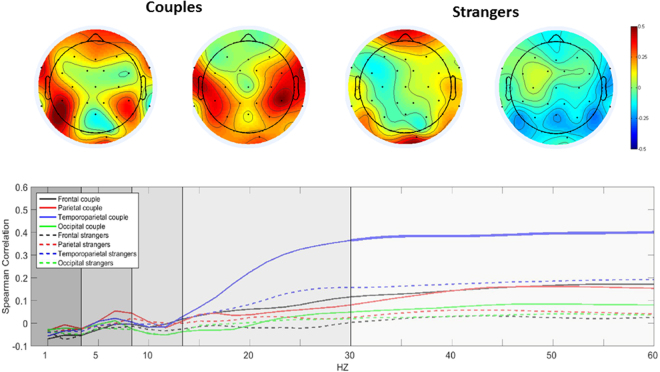
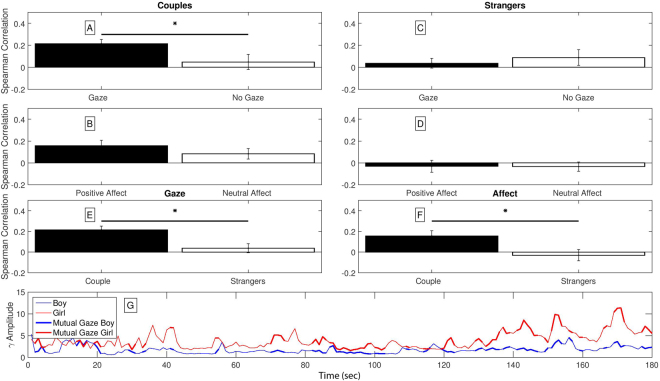
The evolution of humans as a highly social species tuned the brain to the social world; yet the mechanisms by which humans coordinate their brain response online during social interactions remain unclear. Using hyperscanning EEG recordings, we measured brain-to-brain synchrony in 104 adults during a male-female naturalistic social interaction, comparing romantic couples and strangers. Neural synchrony was found for couples, but not for strangers, localized to temporal-parietal structures and expressed in gamma rhythms. Brain coordination was not found during a three-minute rest, pinpointing neural synchrony to social interactions among affiliative partners. Brain-to-brain synchrony was linked with behavioral synchrony. Among couples, neural synchrony was anchored in moments of social gaze and positive affect, whereas among strangers, longer durations of social gaze and positive affect correlated with greater neural synchrony. Brain-to-brain synchrony was unrelated to episodes of speech/no-speech or general content of conversation. Our findings link brain-to-brain synchrony to the degree of social connectedness among interacting partners, ground neural synchrony in key nonverbal social behaviors, and highlight the role of human attachment in providing a template for two-brain coordination.
Overview
CoChat Summary
TL;DR
Using hyperscanning EEG during a naturalistic male-female interaction, the study found brain-to-brain gamma synchrony localized to temporal-parietal areas in romantic couples but not strangers. This neural synchrony was linked to social gaze and positive affect and was absent during rest, suggesting social connectedness and nonverbal behavior shape two-brain coordination.
Key findings
- Couples showed significant temporal-parietal gamma (30–60 Hz) power correlation during interaction, R = 0.389, p = 0.0028, whereas strangers did not, R = 0.102, p = 0.10; couples had higher gamma correlation than strangers, t = −3.02, p = 0.004.
- Gamma synchrony was not significant at rest for couples (R = 0.16, p = 0.10) or strangers (R = 0.07, p = 0.10), but among couples it increased significantly from rest to interaction, t = 3.8801, p = 0.00075.
- Couples spent more time in social gaze than strangers (M = 93%, SD = 2.08 vs. M = 78.66%, SD = 1.66; t = 19.86, p = 0.0001), and couples’ gamma synchrony was higher during social gaze than no gaze, t = 2.03, p = 0.05; positive affect showed a marginal effect, t = 1.57, p = 0.065.
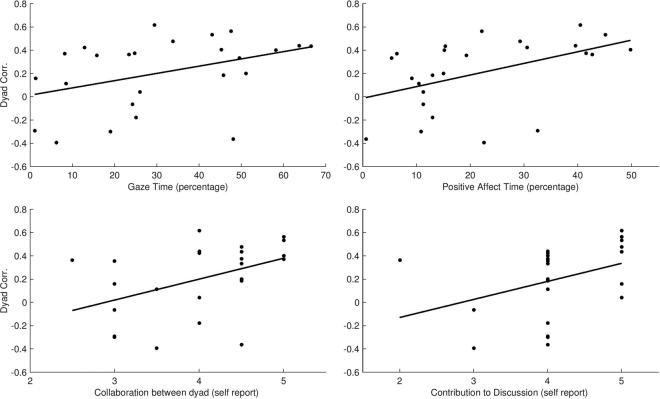
- Among strangers, longer social gaze and positive affect correlated with greater gamma synchrony, R = 0.431, p = 0.0323 and R = 0.566, p = 0.0031, respectively; speech duration and conversation content did not differ between groups.
Methods
- 104 healthy adults initially participated as 52 male-female dyads: 24 cohabitating romantic couples and 25 stranger dyads in final analyses after exclusions (final sample 98 individuals).
- Participants completed a 3-minute rest and then a 5-minute naturalistic positive “fun day” conversation while simultaneous 32-electrode EEG was recorded; interactions were videotaped and micro-coded for gaze, affect, and speech.
- EEG power was analyzed by frequency bands and ROIs using Spearman correlations between partners, with Stockwell transform for continuous data, LORETA for source estimation, and FDR correction for multiple comparisons.
Limitations
- The paper states that hyperscanning EEG during naturalistic interaction affords less exact brain localization and less exact task-parameter modeling than fMRI or MEG, and that EEG source localization could not pinpoint exact regions.
- The paper states that no third group of familiar non-romantic friends was included, so familiarity could not be fully separated from romantic love.
- The paper notes that the positive-affect finding was marginal and should be treated with caution, and that the strangers’ collaboration correlation did not survive FDR correction; evident from the design, the correlational approach cannot establish causal direction.
Model-written summary. Check it against the paper before relying on it.
Integrity signals
Registry
Cites
Statistics
Figures
Verification
Claims the paper makes
3 Valid · 2 Not valid · 39 Not checked · 57 Own results and interpretations
None of the sources cited for this claim have been checked yet.
In the paper
“Gamma activity recorded from temporal-parietal areas has been linked with a range of social abilities that support social connectedness, such as theory-of-mind, cognitive appraisal, and emotion regulation8,35,36.”
§ Brain-to-Brain Synchrony during Naturalistic Social Interactions > Introduction
What the sources say
- Not checked yetcites [8] Cohen, M. X., David, N., Vogeley, K. & Elger, C. E. Gamma-band activity in the human superior temporal sulcus during mentalizing from nonverbal social cues. Psychophysiology46 (2009). 18992070 source
- Not checked yetcites [35] Kang J-H The modulation of parietal gamma oscillations in the human electroencephalogram with cognitive reappraisal Neuroreport 2012 23 995 999 10.1097/WNR.0b013e32835a6475 23076117 source
- Could not verifycites [36] Symons AE El-Deredy W Schwartze M Kotz SA The Functional Role of Neural Oscillations in Non-Verbal Emotional Communication Front. Hum. Neurosci. 2016 10 239 10.3389/fnhum.2016.00239 27252638 PMC4879141 sourceExperimental — accuracy not yet measured
Our copy's gamma sections ('Perception of Emotion from Facial Expressions > Gamma (>30 Hz)' and the Conclusion) tie gamma to feature integration, sensory selection and the binding of emotionally salient input, localised to amygdala, OFC, STS and later occipital/parietal/prefrontal responses (Luo et al., 2007–2010; Sato et al., 2011; Jung et al., 2011; Müsch et al., 2014) — so it does touch gamma in temporal/parietal regions, but only for emotion perception from facial expressions. No passage in our copy links gamma to theory of mind, cognitive appraisal or emotion regulation (searched: 'theory of mind', 'temporoparietal junction', 'mentalizing', 'social cognition', 'cognitive appraisal', 'emotion regulation', 'reappraisal'); the only social-cognition mention is beta band activity and biological motion (Pavlova, 2012; Jabbi et al., 2015, Beta section). The claim's substantive association is therefore neither stated nor contradicted by our copy, and no alternative source is named in it (the citing sentence carries three reference numbers, 8, 35, 36). (LLM, conf=0.65)
plainstates an association- Asserted: passes — The authors put it forward as true.
- Checkable: passes — It can be checked against evidence.
- Load-bearing: passes — The paper’s conclusions depend on it.
- Based: passes — The paper gives a reason why it holds.
The cited sources support only part of this claim — read each source’s verdict below.
In the paper
“Overall, these studies indicate that the degree of social connectedness among partners impacts the level of neural synchrony in temporal-parietal structures.”
§ Brain-to-Brain Synchrony during Naturalistic Social Interactions > Introduction
What the sources say
- Partly supportedcites [29] Dikker S Silbert LJ Hasson U Zevin JD On the Same Wavelength: Predictable Language Enhances Speaker-Listener Brain-to-Brain Synchrony in Posterior Superior Temporal Gyrus J. Neurosci. 2014 34 6267 6272 10.1523/JNEUROSCI.3796-13.2014 24790197 PMC4004812 sourceExperimental — accuracy not yet measured
The Results and Discussion (page numbers unavailable in our copy) report greater speaker–listener synchrony in left posterior superior temporal gyrus when language is more predictable. They do not examine whether the partners’ degree of social connectedness affects that synchrony; the reported factor is linguistic predictability. (LLM, conf=0.86)
- Partly supportedcites [31] Tang H Interpersonal brain synchronization in the right temporo-parietal junction during face-to-face economic exchange Soc. Cogn. Affect. Neurosci. 2015 11 23 32 10.1093/scan/nsv092 26211014 PMC4692317 sourceExperimental — accuracy not yet measured
Tang et al. (2016) do report the substance of the claim: the Discussion states that interpersonal brain synchronization in rTPJ 'increased with shared intentionality between partners', and the fNIRS Results give the supporting statistic — coherence in CH14 positively correlated with shared intentionality for face-to-face (r = 0.28, P = 0.046) but not for face-blocked (r = 0.02, P = 0.89), with no other channels significant. However, the source's construct is 'shared intentionality' (sharing psychological states), not 'social connectedness' as such, and the association is a modest correlation confined to one rTPJ channel under face-to-face interaction only; the authors hedge it as possibly 'an indicator of shared intentionality' rather than something that 'impacts' synchrony. The causal, unconditional phrasing of the citing sentence and its generalization to temporo-parietal structures beyond rTPJ go beyond what this paper shows. (LLM, conf=0.72)
- Not checked yetcites [32] Liu N NIRS-based hyperscanning reveals inter-brain neural synchronization during cooperative Jenga game with face-to-face communication Front. Hum. Neurosci. 2016 10 1 11 27014019 PMC4782164
hedgedstates a cause- Asserted: passes — The authors put it forward as true.
- Checkable: passes — It can be checked against evidence.
- Load-bearing: passes — The paper’s conclusions depend on it.
- Based: passes — The paper gives a reason why it holds.
- Partly supported
The cited sources support only part of this claim — read each source’s verdict below.
In the paper
“For our couples, who have been in a committed relationship for some time, such familiarity can lead to greater neural synchrony, when familiar actions56 and communications57 are incorporated as neural predictions and pave the way for greater brain coordination.”
§ Brain-to-Brain Synchrony during Naturalistic Social Interactions > Discussion
What the sources say
- Partly supportedcites [56] Grush R The emulation theory of representation: motor control, imagery, and perception Behav. Brain Sci. 2004 27 377 442 15736871 sourceExperimental — accuracy not yet measured
Our copy of Grush's target article (with commentaries and reply) does support the mechanistic half of the claim: the nervous system runs forward models/emulators that turn a current motor command into a neural prediction of its sensory consequences (sect. 5.3, 'the perceptual system is producing a prediction - an a priori estimate - of what the next visual scene will be on the basis of the current visual scene and the current motor command'), that these emulators are plastic and trained by prior experience (sect. 2.2; Stein's reply 'the best trainer of the emulator/memory is experience'), and, tentatively, that an 'external biomechanical emulator' can model the movements of other individuals (sect. R10). What our copy nowhere addresses is the distinctive part of the claim: couples in committed relationships, partner familiarity, and any resulting inter-brain neural synchrony or 'brain coordination' — searched for 'neural synchrony', 'interpersonal', 'joint action between two people', 'couples' with no passage. The synchrony-in-couples conclusion therefore rests on the citing authors, not on this source. (LLM, conf=0.68)
- Not checked yetcites [57] Schwanenflugel PJ Shoben EJ The influence of sentence constraint on the scope of facilitation for upcoming words J. Mem. Lang. 1985 24 232 252 10.1016/0749-596X(85)90026-9 source
plainstates a cause- Asserted: passes — The authors put it forward as true.
- Checkable: passes — It can be checked against evidence.
- Load-bearing: passes — The paper’s conclusions depend on it.
- Based: passes — The paper gives a reason why it holds.
- Partly supported
The cited sources support only part of this claim — read each source’s verdict below.
In the paper
“As behavioral synchrony is linked with attachment status, with couples and close friends expressing more synchrony than strangers26,34, it is reasonable to expect that romantic partners in a long-term relationship would display more behavioral and neural synchrony as compared to strangers and that neural synchrony would localize to temporo-parietal areas.”
§ Brain-to-Brain Synchrony during Naturalistic Social Interactions > Introduction
What the sources say
- Not checked yetcites [26] Ulmer-Yaniv A Affiliation, reward, and immune biomarkers coalesce to support social synchrony during periods of bond formation in humans Brain Behav. Immun. 2016 56 SRC- 130 139 10.1016/j.bbi.2016.02.017 26902915 source
- Partly supportedcites [34] Latif N Barbosa AV Vatiokiotis-Bateson E Castelhano MS Munhall KG Movement coordination during conversation PLoS One 2014 9 1 10 10.1371/journal.pone.0105036 PMC4132081 25119189 sourceExperimental — accuracy not yet measured
Latif et al. (2014) support the close-friends half of the claim: Experiment 1 Results (Movement Analysis) state 'Friends show significantly higher correlations than strangers at all lags' (Fig. 2 caption) and 'friends had higher correlation than strangers (p<0.0001)' (Fig. 3), and the Abstract reports that 'individuals familiar with each other coordinated their movements more frequently'. However, our copy contains nothing on romantic couples or attachment status: the study used only friend pairs and stranger pairs, and searches for 'couples / romantic partners / attachment' returned only friend-vs-stranger passages (Introduction, Discussion). The 'linked with attachment status' framing and the couples extension are therefore not attributable to this source. (LLM, conf=0.80)
plainstates an association- Asserted: passes — The authors put it forward as true.
- Checkable: passes — It can be checked against evidence.
- Load-bearing: passes — The paper’s conclusions depend on it.
- Based: passes — The paper gives a reason why it holds.
A result the paper reports from its own data — it cites no other source for it, so there is none to check. The quote shows it is in the paper.
In the paper
“and positive affect, t (two tailed) = 2.53, p = 0.015 (Fig. 2E,F).”
§ Brain-to-Brain Synchrony during Naturalistic Social Interactions > Results > Connecting Behavioral and Neural Synchrony
plainstates an association- Asserted: passes — The authors put it forward as true.
- Checkable: passes — It can be checked against evidence.
- Load-bearing: passes — The paper’s conclusions depend on it.
- Based: passes — The paper gives a reason why it holds.
57 more claims
Create a free account to see all 101 claims and to verify the 58 references still open.
- It may state two separate claims as one. 17
- Probably not a substantial claim. 28
Claims other papers make about this one
Each is checked against this paper’s own text: does it say what the citing paper says it does?
The source backs part of the claim, not all of it — or backs it for a different population, condition or comparison.
In the citing paper
“Another electroencephalography study tested neural alignment between romantic dyads and unacquainted dyads, and found elevated coupling in the DMN during mutual gaze and smiling107.”
From The default mode network: where the idiosyncratic self meets the shared social world (2021) · cites this paper as [107]
Experimental — accuracy not yet measuredThe source backs part of the claim, not all of it — or backs it for a different population, condition or comparison.
In the citing paper
“Social synchrony is essential for human bonding and has been associated with positive affect and prosocial behavior.[ 50 ]”
From Loneliness and the Social Brain: How Perceived Social Isolation Impairs Human Interactions (2021) · cites this paper as [50]
Experimental — accuracy not yet measured
Statistics that don’t add up
Each reported p-value recomputed from its test statistic and degrees of freedom, each partial η² from its F, and each ratio, mean difference or B printed with a p checked against its own confidence interval.
Rated minor: it would not touch a result — a value no result rests on, a p-value that stays on the same side of the significance level, or a conflict that is clerical, resolved elsewhere in the paper, or outside its own findings.
In the paper
“F (2,148) = 7.48, p = 0.02”
§ Brain-to-Brain Synchrony during Naturalistic Social Interactions > Results > Connecting Behavioral and Neural Synchrony
Reported p = .02 · recomputed p < .001
Statistics recomputed
Every reported test result, recomputed from its test statistic and degrees of freedom. A result shows as not adding up only once an independent check has confirmed it.
- Doesn’t add upF(2, 148) = 7.48reported p = .02 · recomputed p < .001
“F (2,148) = 7.48, p = .02”
- ConsistentF(1, 148) = 12.64reported p = 0 · recomputed p < .001
“F (1,148) = 12.64, p = .00”
Self-check
Percentages, sums and reported differences re-computed from the paper’s own numbers.
Self-check results appear here once an independent check has confirmed them.
Citations
Cites
Controlling the False Discovery Rate: A Practical and Powerful Approach to Multiple Testing
Benjamini, Y., & Hochberg, Y. (1995) · Journal of the Royal Statistical Society Series B: Statistical Methodology · doi:10.1111/j.2517-6161.1995.tb02031.x · Cited by 109,482
(2014) · Climate Change 2013 – The Physical Science Basis · doi:10.1017/cbo9781107415324.004 · Cited by 23,880
(1969) · Cited by 18,340
Oostenveld, R., Fries, P., Maris, E., & Schoffelen, J.-M. (2011) · Computational Intelligence and Neuroscience · doi:10.1155/2011/156869 · Cited by 10,323
Social Relationships and Mortality Risk: A Meta-analytic Review
Holt-Lunstad, J., Smith, T. B., & Layton, J. B. (2010) · PLoS Medicine · doi:10.1371/journal.pmed.1000316 · Cited by 7,272 · cited 2×
“We conducted two separate frequency calculations; (1) continuous: for the rest and the social interaction paradigms and (2) epochs-based analyses: only for the social interaction paradigm.”
BackgroundMethodMental Models: Towards a Cognitive Science of Language, Inference, and Consciousness
Ford, M., & Johnson-Laird, P. N. (1985) · Language · doi:10.2307/414498 · Cited by 4,419
Statistics corner: A guide to appropriate use of correlation coefficient in medical research.
(2012) · Europe PMC (PubMed Central) · Cited by 4,239
An internal model for sensorimotor integration
Wolpert, D. M., Ghahramani, Z., & Jordan, M. I. (1995) · Science · doi:10.1126/science.7569931 · Cited by 3,553
Localization of the complex spectrum: the S transform
Stockwell, R. G., Mansinha, L., & Lowe, R. P. (1996) · IEEE Transactions on Signal Processing · doi:10.1109/78.492555 · Cited by 3,486
ERPLAB: an open-source toolbox for the analysis of event-related potentials
Lopez-Calderon, J., & Luck, S. J. (2014) · Frontiers in Human Neuroscience · doi:10.3389/fnhum.2014.00213 · Cited by 2,584
Research works printed but not linked: 1
- Feldman R a). The neurobiology of mammalian parenting and the biosocial context of human caregiving Horm. Behav. 101016jyhbeh10001 2015 77 SRC- 3 17 26453928
Cited by
Items 401–474 of 474
Do Humans (and Animals) Think in Poetic Language?Preprint
Tozzi, A. (2025) · Preprints.org · doi:10.20944/preprints202511.1166.v1
Falcinelli, I., Fini, C., & Borghi, A. M. (2025) · Frontiers in Neuroscience · doi:10.3389/fnins.2025.1724845
Nagy, P., Béres, L., Tóth, B., Winkler, I., Barthel, B., & Háden, G. P. (2025) · NeuroImage · doi:10.1016/j.neuroimage.2025.121661 · Cited by 1
Passaro, M. J. (2025) · Preprints.org · doi:10.20944/preprints202512.1395.v1
Methods to evaluate mouse dorsal cortical function during social and innate behaviors
Michelson, N. J. (2025) · cIRcle (University of British Columbia) · doi:10.14288/1.0448323
Ngombe, N. (2022) · Aston Publications Explorer (Aston University) · doi:10.48780/publications.aston.ac.uk.00044271
Moik, M. A. (2019) · Unipub UB Graz (Universität Graz)
Loh, C. (2023) · Open Research Exeter (University of Exeter)
Cues For Synchrony: Exploring Social Drivers of Synchronous Interactions Across Neurodevelopment
Carnevali, L. (n.d.) · Padua Research Archive (University of Padova)
Hughes, D. (2024) · UEA Digital Repository (University of East Anglia)
McTigue, A. (2022) · CU Scholar (University of Colorado Boulder)
Beyond Smiles: Cooperativeness as the Key Determinant of Cooperative Behavior
Deng, X. (2025) · Institutional Repositories DataBase (IRDB)
Hermans, K. S. F. M. (2021) · Lirias
Inter-brain Neural Dynamics in Interacting Biological and Artificial Intelligence Systems
Phi, N. T. (2025) · eScholarship (California Digital Library)
Hakim, U. (2025) · UCL Discovery (University College London)
Quality of Parent-Child Interactions within Different Book Contexts
Tensun, F. (2020) · CU Scholar (University of Colorado Boulder)
Veneziani, G. (2025) · IRIS Research product catalog (Sapienza University of Rome)
Inter‐Turn Silences: Duration, Interpretation and Mechanisms
Thomas, A. M., Gladhill, K. A., & Kaschak, M. P. (2025) · Language and Linguistics Compass · doi:10.1111/lnc3.70027
Ortak Hareketin Sinirsel Mekanizmaları
Usal, K. A. (2023) · OpenMETU (Middle East Technical University)
Durán, E. (2025) · The Conversation · doi:10.64628/aao.ns6rypws9
Sevastidis, J., Clark, G., Henneberg, M., Storm, L., Burlakoti, A., Saniotis, A., & You, W. (2025) · Anthropological Review · doi:10.18778/1898-6773.88.4.01
“Specific analysis of the number of loci synchronized between conspecifics should be compared on a gradient from solitary to highly social primates; IBNS most likely exists on such a gradient under-pinned by familiarity with conspecifics as seen in humans (Kinreich et al. 2017; Kurihara et al. 2024).”
Rovelli, K., & Balconi, M. (2025) · Social Neuroscience · doi:10.1080/17470919.2025.2607065
“Previous hyperscanning studies in interactive settings have demonstrated the validity of concise time windows when data quality is ensured (Angioletti & Balconi, 2022; Balconi & Fronda, 2021; Balconi et al., 2025; Causse et al., 2017; Kinreich et al., 2017 ; Talamonti et al., 2022).”
Durán, E. M. (2025) · The Conversation · doi:10.64628/aao.uyd6wvq7f
Introduction to the Role of Adaptivity in Social Interaction Science
Hendrikse, S. C. F., Treur, J., & Koole, S. L. (2025) · Studies in systems, decision and control · doi:10.1007/978-3-031-99968-0_1
Die geosoziale Frage: Zur Gegenwart und Zukunft sozialgeographischer Forschung
Runkel, S., Kauer, D., & Everts, J. (2025) · Sozial- und Kulturgeographie · doi:10.14361/9783839471852
Es gibt keinen Planeten B: Grundzüge einer Sozialgeographie des beherbergenden Raumes
Geiselhart, K. (2025) · Sozial- und Kulturgeographie · doi:10.14361/9783839471852-015
Herpai, P., Guglielmini, S., Amstad, C., Buff, J., Scholkmann, F., & Wolf, M. (2026) · Advances in experimental medicine and biology · doi:10.1007/978-3-032-10389-5_21
Durán, E. (2026) · The Conversation · doi:10.64628/adg.fvscme9nk
Gan, X., Yu, L., Shuyi, L., Luo, Y., & Hu, Y. (2026) · Biological Psychology · doi:10.1016/j.biopsycho.2026.109215
The impact of language context on inter-brain synchrony in bilingual families
Papoutselou, E., Saravanan, N., Mai, G., Harrison, S. C., Sezer, H. D., & Hartley, D. E. H. (2026) · Frontiers in Cognition · doi:10.3389/fcogn.2025.1695132
“…that interactions with familiar individuals, such as parents or romantic partners, elicit higher neural synchrony compared to strangers (Kinreich et al., 2017; Reindl et al., 2022), reinforcing the idea that emotional familiarity and relational context are key drivers of inter-brain…”
Wang, Y., Zhang, J., Hua, L., Mao, Y., Leong, C., Gao, F., & Yuan, Z. (2026) · Neuroscience · doi:10.1016/j.neuroscience.2026.02.032
Neural Synchrony Between Socially Interacting Language Models
Zhang, Z., Zhu, W., Han, C., Wang, Y., & Ji, H. (2026) · International Conference on Learning Representations · doi:10.48550/arxiv.2602.17815
“The strength of IBS varies with social attributes such as interpersonal closeness and personality traits (Kinreich et al., 2017; Bevilacqua et al., 2019).”
EEG Hyperscanning Techniques for Assessment of Mutual Engagement
Sharif, A. (2024) · Tampere University Institutional Repository (Tampere University)
Franz, K. S. (2025) · TSpace (University of Toronto)
Hannan, L., Pascal, C., & Bertram, T. (2026) · European Early Childhood Education Research Journal · doi:10.1080/1350293x.2026.2631608
HyperDance: Real-Time Vibrotactile Stimulation Feedback of Inter-Brain Connectivity in Partner Dance
Roque, T. R., Sun, R., Yi–Luen, E., & Leslie, G. A. (2026) · International Conference on Tangible, Embedded, and Embodied Interaction (TEI) · doi:10.1145/3731459.3773332
“Past studies have correlated higher levels of IBC engagement in joint attention tasks [7], cooperation [11], social closeness [12, 27], and gesture synchronization [29], suggesting a neural basis for empathy, shared understanding, and social connection.”
Simon, S., Bhadra, D., Saha, S., Munda, S., Das, J., & Arun, S. P. (2026) · bioRxiv (Cold Spring Harbor Laboratory) · doi:10.64898/2026.03.12.711496
Alanazi, A. F. (2026) · International Journal of Science and Research Archive · doi:10.30574/ijsra.2026.18.3.0507
Practical rhythm: integrating sound and attunement into psychiatric care
Elnazer, H. Y. (2026) · BJPsych Bulletin · doi:10.1192/bjb.2025.10208
Zelevich, O., Fuchs, H., & Fuchs, H. (2025) · HAL
Douglas, C. L., Tremblay, A., & Newman, A. J. (2026) · Journal of Cognitive Neuroscience · doi:10.1162/jocn.a.2595
Pavithra, P., Bernacchi, J. K. B., Ahmed, S., McDermott, G., McCarron, M., McCallion, P., McGlinchey, E., & Valdés, A. L. (2026) · Frontiers in Neuroergonomics · doi:10.3389/fnrgo.2026.1757738
“…studies have examined social interaction across a range of social situations (e.g., child-parent interactions, familiar vs. unfamiliar conditions) and task conditions (e.g., passive tasks, interactive and non-interactive economic games) (Kinreich et al., 2017; Léné et al., 2021; Wang et al., 2018).”
A Shared Look: Detecting Deepfakes with Inter-Subject Neural Synchrony
Hu, S., Zha, Z., Jia, D., Hu, Y., Liu, G., Lin, Y., Shen, C., & Lv, Z. (2026) · CHI Conference on Human Factors in Computing Systems · doi:10.1145/3772318.3793208
“We acknowledge that our sample size (15 pairs, N=30) is smaller than typical behavioral studies, yet it aligns with established standards in hyperscanning research due to the complexity of dyadic recording [25, 33, 33, 65].”
Social attachment shapes interbrain synchronyPreprint
Murphy, K. Z., Brusman, L. E., Kozorovitskiy, Y., & Donaldson, Z. R. (2026) · bioRxiv (Cold Spring Harbor Laboratory) · doi:10.64898/2026.04.15.718291
Daučianskaitė-Kubilevičienė, A., & Zydziunaite, V. (2026) · Verlag Julius Klinkhardt eBooks · doi:10.35468/6233
Valenzuela, L., Cavallaro, R., Mangeng, A., Pérez-Arenas, X., Carollo, A., Esposito, G., Medel, V., & Soto, V. (2026) · NeuroImage · doi:10.1016/j.neuroimage.2026.122116
Rocks, D. L., Sharpley, C. F., & Evans, I. D. (2026) · Psychiatry International · doi:10.3390/psychiatryint7040153
Digital Photo-Elicited Storytelling and Alpha-Band EEG Dynamics in Older Adult–Caregiver DyadsPreprint
Khemthong, S., & Chatthong, W. (2026) · medRxiv · doi:10.64898/2026.07.09.26357346
Alpha-Band EEG Dynamics During Naturalistic Storytelling Interaction in Older Adult–Caregiver DyadsPreprint
Khemthong, S., & Chatthong, W. (2026) · medRxiv · doi:10.64898/2026.07.09.26357345
EEG Alpha Modulation During Museum Storytelling in Older Dyads: An Occupational Engagement StudyPreprint
Khemthong, S., & Chatthong, W. (2026) · Research Square · doi:10.21203/rs.3.rs-10300580/v1
Hierarchical processing of continuous natural language: From monologue to conversation
Wang, M., & Lu, C. (2026) · Brain and Language · doi:10.1016/j.bandl.2026.105815
Delta oscillations in human communication
Kokkinou, A., & Orgs, G. (2026) · Neuroscience & Biobehavioral Reviews · doi:10.1016/j.neubiorev.2026.106918
Hwang, E., Shin, S., Lee, A., Kim, W., Yoon, H.-G., Kwon, Y., Seo, D., Kim, D., Kim, E., & Lee, E. (2026) · Nature Communications · doi:10.1038/s41467-026-77939-6
Zhang, K., Pei, X., Yuan, J., Zhao, Y., Fu, Z., Yang, H., Xu, X., Cui, Z., & Cao, Q. (2026) · CNS Neuroscience & Therapeutics · doi:10.1002/cns.71088
Li, S., Liu, T., & Zhang, M. (2026) · Brain Research · doi:10.1016/j.brainres.2026.150517
(2025) · Directory of Open access Books (OAPEN Foundation)
Douglas, C. L., Tremblay, A., & Newman, A. J. (2025) · DalSpace (Dalhousie University)
Amplitude without phase: interpersonal movement coordination grades inter-brain couplingPreprint
Tasnim, N., Delauder, R. M., Aychman, M. M., Moore, Z., Gahagan, M., Purevtugs, J., Newpol, J., Frank, R., Grizzell, G., Nobriga, G., et al. (2026) · bioRxiv (Cold Spring Harbor Laboratory) · doi:10.64898/2026.09.09.750441
“…that spontaneous movement coupling (head nods, gaze alignment, postural matching) is stronger between individuals with closer relationships(Bell, 2020; Bernieri, 1988; Feldman, 2007; Kinreich et al., 2017), ultimately forming the substrate of nonverbal communication(Bernieri and Rosenthal, 1991).”
Park, J., Emery, L. F., & Leong, Y. C. (2026) · bioRxiv (Cold Spring Harbor Laboratory) · doi:10.64898/2026.09.11.751017
“Hyperscanning paradigms, where neural activity is simultaneously recorded from both partners, have further shown that couples exhibit interbrain synchrony during cooperative tasks (26), handholding (27), and brief conversations (28, 29).”
Annen, Y. (2026) · SSRN Electronic Journal · doi:10.2139/ssrn.7470398
言語的コミュニケーション中における情報伝達の度合いと身体運動の同期との関係の解明と応用
Tsuchiya, A. (2023) · Institutional Repositories DataBase (IRDB)
The Parent-Child Relational Neuroscience of Resilience Framework
Azhari, A., & Khoo, V. Q. L. (2026) · Parenting · doi:10.1080/15295192.2026.2733266
Positive interactions and active mentalizing facilitate inter-brain synchronization in couples
Schneider, I., Moreau, Q., Neudecker, D., Herpertz, S. C., & Dumas, G. (2026) · Social Cognitive and Affective Neuroscience · doi:10.1093/scan/nsag083
“Social gaze, positive affect, and a topic of agree-ment—all factors which support social connectedness and a positive interaction—have also been identified to increase neuronal synchronization (Kinreich et al .”
Magee, G., Colwell, J., Kelley, S. M., Mohammad, Y., Zhang, Y., Boas, D. A., Kiran, S., Varkanitsa, M., Meier, E. L., & Yücel, M. A. (2026) · bioRxiv (Cold Spring Harbor Laboratory) · doi:10.64898/2026.09.28.755138
“Stronger IBS has been observed between familiar partners, including friends, romantic partners, and long-term collaborators, than between unfamiliar dyads (Kinreich et al., 2017; Zhao et al., 2024).”
Bai, Y., & Zhang, Q. (2026) · Brain Research · doi:10.1016/j.brainres.2026.150594
Positive emotional synchrony and intimacy satisfaction: evidence from a multidimensional assessment
Duan, X., Hou, J., Jing, W., & Song, Q. (2026) · Cognition & Emotion · doi:10.1080/02699931.2026.2746408
李, 鑫. (2026) · Advances in Psychology · doi:10.12677/ap.2026.1610483
Leener, M. D., Sfeir, M., Galdiolo, S., & Rossignol, M. (2026) · Neuroscience & Biobehavioral Reviews · doi:10.1016/j.neubiorev.2026.107056
Computational modeling of social interactions
Votinov, M. (2026) · Elsevier eBooks · doi:10.1016/b978-0-443-34080-2.00020-2
Han, H., Zhao, Z., Lin, L., Li, C., & Jin, X. (2026) · Social Cognitive and Affective Neuroscience · doi:10.1093/scan/nsag087
Yoneta, N., Watanabe, H., Shimojo, A., Takano, K., Saito, T., Yagyu, K., Shiraishi, H., Yokosawa, K., & Boasen, J. (2022) · doi:10.3389/fnins.2022.790057.s001
Metadata
- Authors
- Kinreich, S., Djalovski, A., Kraus, L., Louzoun, Y., & Feldman, R.
- Affiliations
- Bar-Ilan University (IL)
- Reichman University (IL)
- Corresponding author
- Feldman, Ruth
- Venue
- Scientific Reports
- Published
- 2017-12-06
- Volume
- 7
- Issue
- 1
- Pages
- 17060-17060
- ISSN
- 2045-2322 (ISSN-L)
- PMC
- PMC5719019
- OpenAlex
- W2772502723
- Semantic Scholar
- 10efdff5e233a5f7f8bd6e9d7a7a872190d02ecc
- Cited by
- 402
- References
- 78
- Citations by year
- 2026: 41 · 2025: 66 · 2024: 51 · 2023: 45 · 2022: 53 · 2021: 38 · 2020: 74 · 2019: 21 · 2018: 13
- FWCI
- 42.27
- Type
- journal article
- Language
- en
- Open access
- gold
- doi.org
- Licence
- cc-by
- creativecommons.org/licenses/by/4.0 (tdm)
- creativecommons.org/licenses/by/4.0 (vor)
- Locations
- Scientific Reports (publishedVersion, cc-by)
- PubMed Central (publishedVersion, cc-by)
- PubMed (publishedVersion)
- DOAJ (DOAJ: Directory of Open Access Journals) (submittedVersion)
- Topics
- Social Sciences › Psychology › Social Psychology › Action Observation and Synchronization
- Life Sciences › Neuroscience › Cognitive Neuroscience › Neural dynamics and brain function
- Life Sciences › Neuroscience › Endocrine and Autonomic Systems › Neuroendocrine regulation and behavior
- Keywords
- brain-to-brain synchrony, neuronal synchronization, social interaction, romantic partners, strangers, social gaze, positive affect, temporal-parietal cortex, gamma oscillations, behavioral synchrony, social connectedness, attachment
- MeSH terms
- Adult, Brain, Electroencephalography, Female, Humans, Interpersonal Relations, Male, Social Behavior, Gamma Rhythm
About these checks
Registry, retraction, Cites and statistics results are computed, not judged, with one exception: a printed reference that no index lists is read once by a model before it counts as a citation error. Claims are extracted by a model and kept only when their quote appears verbatim in the text; each cited source is then checked, with a model’s help, for whether it says what the claim relies on. Those verdicts can be wrong — read the claim’s quote and the cited source before relying on one.
The claim verdicts this report counts are experimental: their accuracy is not yet measured.
A language model drew the claims from the paper on 2026-10-05, under version 3 of the claim definition (model deepseek-v4.1-flash, prompt extract-v3).
A second model labelled each claim on 2026-10-05 (model jev-1.13-20260917, definition revision gold-guideline-v0.2).
Cited sources are checked with a language model’s help (qwen3.8-omni-flash and gpt-6-sol).
Statistics and arithmetic are recomputed, not judged.
Confidence bands are shown only for fields calibrated on our annotated test set. None is calibrated yet, so no band is shown.
What counts as a claim ›How we measure confidence ›How we check this ›
Are you an author, or do you see a problem with this page? Request a review
Data sources
Bibliographic data: Semantic Scholar, OpenAlex, Crossref.
Contains information from the Semantic Scholar Academic Graph Datasets, made available under the ODC Attribution License (ODC-BY 1.0).
Semantic Scholar’s data is described in: Kinney, R., et al. (2023). The Semantic Scholar Open Data Platform. arXiv:2301.10140.
