

Connectome-harmonic decomposition of human brain activity reveals dynamical repertoire re-organization under LSD
Open accessPublished version of a preprint
The DOI matches its Crossref record; 78 of the 78 references it cites were found in a registry or an index.
Abstract
Recent studies have started to elucidate the effects of lysergic acid diethylamide (LSD) on the human brain but the underlying dynamics are not yet fully understood. Here we used ’connectome-harmonic decomposition’, a novel method to investigate the dynamical changes in brain states. We found that LSD alters the energy and the power of individual harmonic brain states in a frequency-selective manner. Remarkably, this leads to an expansion of the repertoire of active brain states, suggestive of a general re-organization of brain dynamics given the non-random increase in co-activation across frequencies. Interestingly, the frequency distribution of the active repertoire of brain states under LSD closely follows power-laws indicating a re-organization of the dynamics at the edge of criticality. Beyond the present findings, these methods open up for a better understanding of the complex brain dynamics in health and disease.
Overview
The claims and statistics of this paper haven’t been checked yet.
Free: it reads the open-access text and checks the first 5 claims that cite a source we can check. Create a free account to check every claim.
Integrity signals
Registry
Cites
Statistics
Figures
Verification
Claims the paper makes
The claims and statistics of this paper haven’t been checked yet.
Free: it reads the open-access text and checks the first 5 claims that cite a source we can check. Create a free account to check every claim.
Claims other papers make about this one
Each is checked against this paper’s own text: does it say what the citing paper says it does?
The source backs part of the claim, not all of it — or backs it for a different population, condition or comparison.
In the citing paper
“Intriguingly, hallucinogenic compounds expanded the repertoire of these harmonic modes (Atasoy et al., 2017), increasing spectral diversity and shifting the distribution of modes toward power-law distributions, a putative—albeit controversial (Touboul and Destexhe, 2017)—hallmark of criticality (Fontenele et al., 2019).”
From An Integrated World Modeling Theory (IWMT) of Consciousness (2020) · cites this paper as Atasoy et al., 2017
Experimental — accuracy not yet measured
Self-check
Percentages, sums and reported differences re-computed from the paper’s own numbers.
The self-check needs the paper’s full text.
Citations
Cites
Large-scale brain networks and psychopathology: a unifying triple network model
Menon, V. (2011) · Trends in Cognitive Sciences · doi:10.1016/j.tics.2011.08.003 · Cited by 4,168 · cited 6×
“Even for simple hallucinations, it is now understood that no one single brain area is responsible, but rather the interaction of multiple brain areas (51).”
InfluentialDynamic functional connectivity: Promise, issues, and interpretations
Hutchison, R. M., Womelsdorf, T., Allen, E. A., Bandettini, P. A., Calhoun, V. D., Corbetta, M., Della Penna, S., Duyn, J. H., Glover, G. H., Gonzalez-Castillo, J., et al. (2013) · NeuroImage · doi:10.1016/j.neuroimage.2013.05.079 · Cited by 2,962
Carhart-Harris, R. L., Bolstridge, M., Rucker, J., Day, C. M. J., Erritzoe, D., Kaelen, M., Bloomfield, M., Rickard, J. A., Forbes, B., Feilding, A., et al. (2016) · The Lancet Psychiatry · doi:10.1016/s2215-0366(16)30065-7 · Cited by 1,540 · cited 1×
“Such an action may explain the increasing body of evidence supporting the therapeutic potential of psychedelic drugs for treating disorders such as OCD (65), depression (66, 67) and addictions (68).”
Self-citationThe default mode network and self-referential processes in depression
Sheline, Y. I., Barch, D. M., Price, J. L., Rundle, M. M., Vaishnavi, S. N., Snyder, A. Z., Mintun, M. A., Wang, S., Coalson, R. S., & Raichle, M. E. (2009) · Proceedings of the National Academy of Sciences · doi:10.1073/pnas.0812686106 · Cited by 1,480 · cited 2×
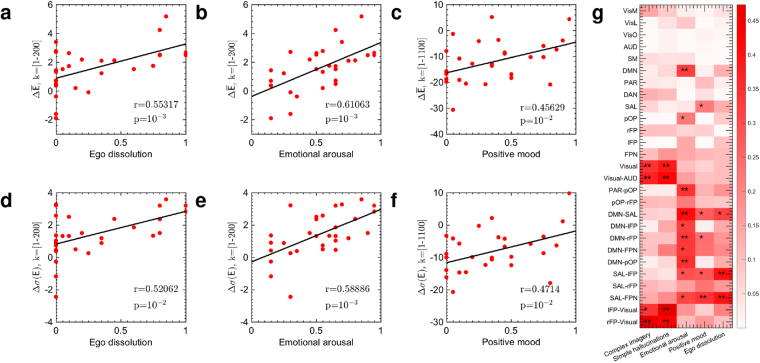
“All four pairs of networks, DMN-SAL, DMN-rFP, DMN-pOP, PAR-pOP, which significantly correlated with the ratings of emotional arousal, have been previously reported to show increased functional connectivity under LSD (17) and the DMN specifically has been linked to mood and emotion (51, 54, 55, 57, 60).”
Carhart-Harris, R. L., Leech, R., Hellyer, P. J., Shanahan, M., Feilding, A., Tagliazucchi, E., Chialvo, D. R., & Nutt, D. (2014) · Frontiers in Human Neuroscience · doi:10.3389/fnhum.2014.00020 · Cited by 1,252 · cited 1×
“ψ ψ α α = | | | | r r t t ( , ) ( ( ) , ( ) ) (11) i j i j”
Self-citationHuman hallucinogen research: guidelines for safety
Johnson, M., Richards, W., & Griffiths, R. (2008) · Journal of Psychopharmacology · doi:10.1177/0269881108093587 · Cited by 1,203 · cited 1×
“The importance of so-called ‘set and setting’ have been much emphasized by those working with psychedelics in humans (61, 62) and the very definition of the word ‘psychedelic’ is intended to refer to the putative”
Neural correlates of the psychedelic state as determined by fMRI studies with psilocybin
Carhart-Harris, R. L., Erritzoe, D., Williams, T., Stone, J. M., Reed, L. J., Colasanti, A., Tyacke, R. J., Leech, R., Malizia, A. L., Murphy, K., et al. (2012) · Proceedings of the National Academy of Sciences · doi:10.1073/pnas.1119598109 · Cited by 1,172 · cited 2×
“The presented method goes beyond the conventional fMRI analyses previously used to measure changes in brain activity under psychedelics (10, 56), to enable the study of fundamental properties of the relevant brain states and how these relate to important principles of dynamical systems, such as whole-brain criticality.”
Self-citationEmergent complex neural dynamics
Chialvo, D. R. (2010) · Nature Physics · doi:10.1038/nphys1803 · Cited by 1,165 · cited 2×
“the property of being optimally poised between order and disorder) has been hypothesised to reflect and underlie its advanced functionality (32, 37); remarkably however, here, using the above-described connectome-harmonic decomposition, we discover a tonic brain state (the LSD state), which exhibits more pronounced si…”
Long-Range Temporal Correlations and Scaling Behavior in Human Brain Oscillations
Linkenkaer-Hansen, K., Nikouline, V. V., Palva, J. M., & Ilmoniemi, R. J. (2001) · The Journal of Neuroscience · doi:10.1523/jneurosci.21-04-01370.2001 · Cited by 1,149 · cited 6×
“Finally, although in this study we apply this technqiue to fMRI data in order to extract the neural signatures of the LSD state, application of the connectome-harmonic decomposition can also be easily extended to other functional neuroimaging datasets such as MEG or high density scalp EEG.”
InfluentialPsilocybin induces schizophrenia-like psychosis in humans via a serotonin-2 agonist action
Vollenweider, F. X., Vollenweider-Scherpenhuyzen, M. F. I., Bäbler, A., Vogel, H., & Hell, D. (1998) · NeuroReport · doi:10.1097/00001756-199812010-00024 · Cited by 1,018 · cited 1×
“As with other classic psychedelic drugs (47), LSD’s principal psychoactive effects are mediated by serotonin 2A receptor agonism, and 5-HT2AR signalling has reliably been shown to induce cortical excitation (48).”
Research works printed but not linked: 2
- Grof, S. Realms of the human unconscious: Observations from LSD research (Viking Press: London, 1979).
- Chung, F. R. Spectral graph theory, vol. 92 (American Mathematical Soc., 1997).
Cited by
Items 201–221 of 221
Bhattacharjee, S., Sivakumar, P. T., Venkatasubramanian, G., Oishi, K., Tsapkini, K., Chen, S. A., Rapp, B. C., Desmond, J. E., Sathyaprabha, T. N., Udupa, K., et al. (2025) · Alzheimer s Research & Therapy · doi:10.1186/s13195-025-01737-3
“For instance, it has been used to investigate states of consciousness, including during anaesthesia [25–28], altered states, and disorders of consciousness [29–34].”
Functional Connectome Dynamics and Brain Plasticity
Sadaghiani, S. (2025) · Oxford University Press eBooks · doi:10.1093/oxfordhb/9780197677131.013.12
Does Connectome Harmonic Analysis Pass the Spin Test?
Vock, R., Grigis, A., Dufumier, B., & Duchesnay, É. (2025) · Lecture notes in computer science · doi:10.1007/978-3-032-05162-2_27
Meðferðir við vímuefnavanda : gætu hugvíkkandi efni verið ákjósanlegur valkostur í meðferðum?
Víðisdóttir, H. S., & Þórsdóttir, G. B. (2021) · Skemman
(2019) · ORBi (University of Liège)
The neuroscience of creative perception: From visual ambiguity to neuroacoustics
Bellemare, A. (2024) · Spectrum Research Repository (Concordia University)
Past Psychedelic Use Predicts Divergent ThinkingPreprint
Pope, G. J., Timmermann, C., Trender, W. R., Hellyer, P. J., Bălăeţ, M., & Laukkonen, R. (2026) · arXiv (Cornell University) · doi:10.48550/arxiv.2601.04380
Hayashi, S., & 林, シ. (2026) · Institutional Repositories DataBase (IRDB) · doi:10.15102/0002001099
LSD Relaxes Structural Constraints on Brain Dynamics: A Connectome Harmonic MEG StudyPreprint
Subramani, V., Pascarella, A., Brunel, J., Harel, Y., Muthukumaraswamy, S. D., Carhart-Harris, R. L., Jerbi, K., Lioi, G., & Farrugia, N. (2026) · bioRxiv (Cold Spring Harbor Laboratory) · doi:10.64898/2026.03.02.709138
“Rather than inducing a global shift toward decoupling, LSD produces a selective rebalancing of SFC across cognitive and affective systems, arguing against a unitary account of psychedelics-induced “disorganization” often inferred from BOLD-based studies [16].”
InfluentialSelf-citationFischman, L. G. (2026) · Psychedelics · doi:10.1016/j.psyche.2026.100013
Wójcik, M., Orlowski, P., Adamczyk, S., Lenartowicz, P., Hobot, J., Wierzchoń, M., & Bola, M. (2026) · bioRxiv (Cold Spring Harbor Laboratory) · doi:10.64898/2026.03.30.711922
Athéa, H. (2024) · theses.fr (ABES) · doi:10.70675/d1402550z7fe9z4237z90d2z4845d24c1bde · Cited by 1
de Paiva, F. B., Zhao, M., Zhao, M., Philibert‐Rosas, S., Brace, C. J., Moe, E., Haworth, S. E., Hermann, B. P., Chung, M. K., & Struck, A. F. (2026) · bioRxiv (Cold Spring Harbor Laboratory) · doi:10.64898/2026.04.06.715875
dos Santos, J. C. C., Bolan, S. J., da Silva, G. L., Viana, G. L., Rico, E. P., & Gonçalves, C. L. (2026) · Journal of Psychiatric Research · doi:10.1016/j.jpsychires.2026.06.035
Shinozuka, K., Dumanis, S. B., & Williams, N. (2026) · Springer eBooks · doi:10.1007/978-3-032-31497-0_6
Translational Neuroscience: Foundations for Precision Therapies
Nikolich, K., & Malenka, R. C. (2026) · Springer eBooks · doi:10.1007/978-3-032-31497-0
Hilal, F. F., Benkeddada, R., Jeanblanc, J., Sourty, M., Fall, S., Utama, R., Soltanpour, S., Kulkarni, P. P., Naassïla, M., Hamida, S. B., et al. (2026) · bioRxiv (Cold Spring Harbor Laboratory) · doi:10.64898/2026.09.03.748807
Niedernhuber, M., Suay, D., Lenggenhager, B., Müller, M., Scheidegger, M., Dornbierer, D., & Aicher, H. (2026) · Journal of Psychopharmacology · doi:10.1177/02698811261481062
HAM-BGT: Harmonic-Aware Multimodal Brain Graph Transformer for Brain Disease Diagnosis
Xu, H., Feng, J., Zhang, D., Tian, Z., & Du, S. (2026) · Lecture notes in computer science · doi:10.1007/978-3-032-38239-9_25
Mind your head: Entropic Brain, irruption theory and the intelligibility problem
Cogo, B. (2026) · Phenomenology and the Cognitive Sciences · doi:10.1007/s11097-026-10227-2
Metadata
- Authors
- Atasoy, S., Roseman, L., Kaelen, M., Kringelbach, M. L., Deco, G., & Carhart-Harris, R. L.
- Affiliations
- Universitat Pompeu Fabra (ES)
- Imperial College London (GB)
- Aarhus University (DK)
- Institució Catalana de Recerca i Estudis Avançats (ES)
- Corresponding author
- Atasoy, Selen
- ORCID
- Venue
- Scientific Reports
- Published
- 2017-12-15
- Volume
- 7
- Issue
- 1
- Pages
- 17661-17661
- ISSN
- 2045-2322 (ISSN-L)
- PMC
- PMC5732294
- OpenAlex
- W2949283084
- Semantic Scholar
- 4af7f9dd9b6f140500062abe9ad9bcbd80acf241
- Cited by
- 214
- References
- 77
- Citations by year
- 2026: 17 · 2025: 29 · 2024: 32 · 2023: 31 · 2022: 24 · 2021: 28 · 2020: 22 · 2019: 20 · 2018: 9 · 2017: 1
- FWCI
- 17.64
- Type
- journal article
- Language
- en
- Open access
- gold
- doi.org
- Licence
- cc-by
- creativecommons.org/licenses/by/4.0 (tdm)
- creativecommons.org/licenses/by/4.0 (vor)
- Locations
- Scientific Reports (publishedVersion, cc-by)
- bioRxiv (Cold Spring Harbor Laboratory) (acceptedVersion)
- Europe PMC (PubMed Central) (publishedVersion, cc-by)
- PubMed Central (publishedVersion, cc-by)
- PubMed (publishedVersion)
- RECERCAT (Consorci de Serveis Universitaris de Catalunya) (publishedVersion, other-oa)
- DOAJ (DOAJ: Directory of Open Access Journals) (submittedVersion)
- eScholarship (California Digital Library) (submittedVersion, cc-by)
- Max Planck Digital Library (submittedVersion, other-oa)
- Scopus (Elsevier) (submittedVersion)
- MPG.PuRe (Max Planck Society) (submittedVersion, other-oa)
- Repositori digital de la UPF (Universitat Pompeu Fabra) (submittedVersion, cc-by)
- Spiral (Imperial College London) (submittedVersion, cc-by)
- Funders
- European Commission (HBP SGA1, 720270, HORIZON2020)
- Agencia Estatal de Investigación (PSI2016-75688-P)
- FP7 Ideas: European Research Council (295129, 615539)
- Topics
- Social Sciences › Psychology › Clinical Psychology › Psychedelics and Drug Studies
- Life Sciences › Neuroscience › Cognitive Neuroscience › Functional Brain Connectivity Studies
- Life Sciences › Neuroscience › Cognitive Neuroscience › Neural dynamics and brain function
- Keywords
- LSD, lysergic acid diethylamide, brain dynamics, power-law distribution, criticality, CO activation, psychedelics, human brain activity
- MeSH terms
- Adult, Brain, Energy Metabolism, Female, Hallucinogens, Humans, Lysergic Acid Diethylamide, Magnetic Resonance Imaging, Male, Models, Theoretical, Music, Nervous System Physiological Phenomena, Young Adult, Connectome, Healthy Volunteers
About these checks
Registry, retraction, Cites and statistics results are computed, not judged, with one exception: a printed reference that no index lists is read once by a model before it counts as a citation error. Claims are extracted by a model and kept only when their quote appears verbatim in the text; each cited source is then checked, with a model’s help, for whether it says what the claim relies on. Those verdicts can be wrong — read the claim’s quote and the cited source before relying on one.
Statistics and arithmetic are recomputed, not judged.
Confidence bands are shown only for fields calibrated on our annotated test set. None is calibrated yet, so no band is shown.
What counts as a claim ›How we measure confidence ›How we check this ›
Are you an author, or do you see a problem with this page? Request a review
Data sources
Bibliographic data: Semantic Scholar, OpenAlex, Crossref.
Contains information from the Semantic Scholar Academic Graph Datasets, made available under the ODC Attribution License (ODC-BY 1.0).
Semantic Scholar’s data is described in: Kinney, R., et al. (2023). The Semantic Scholar Open Data Platform. arXiv:2301.10140.
