

Palladium gates for reproducible quantum dots in silicon
Open accessThe DOI matches its Crossref record; 59 of the 60 references it cites were found in a registry or an index.
Abstract
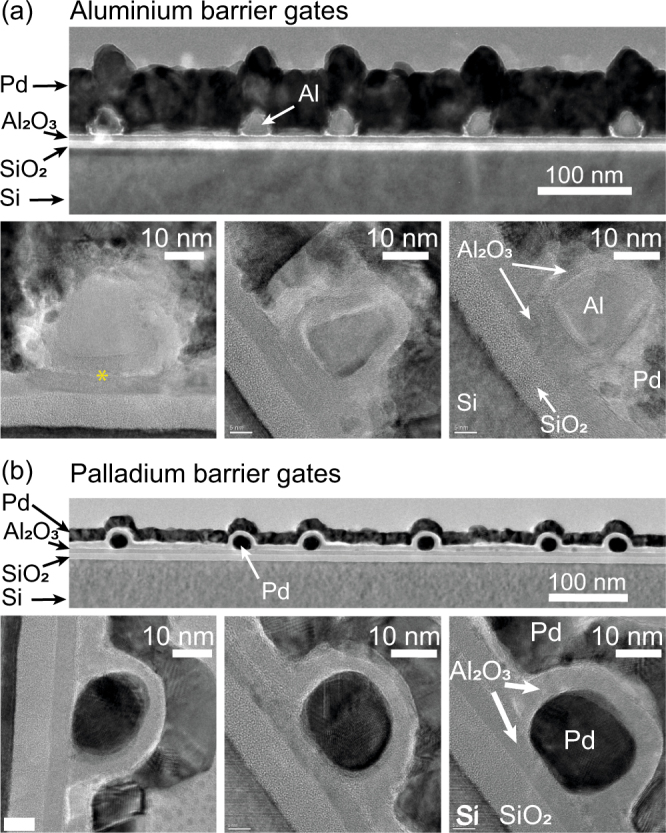
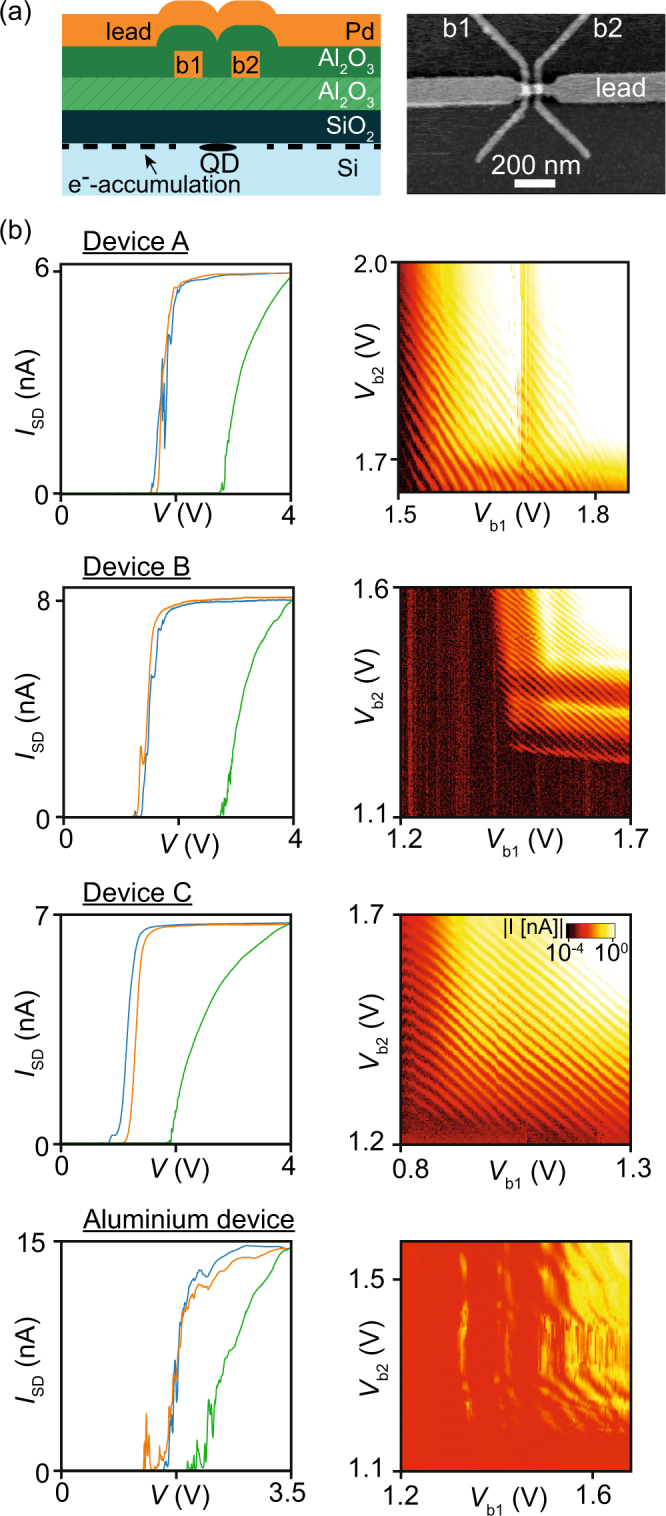
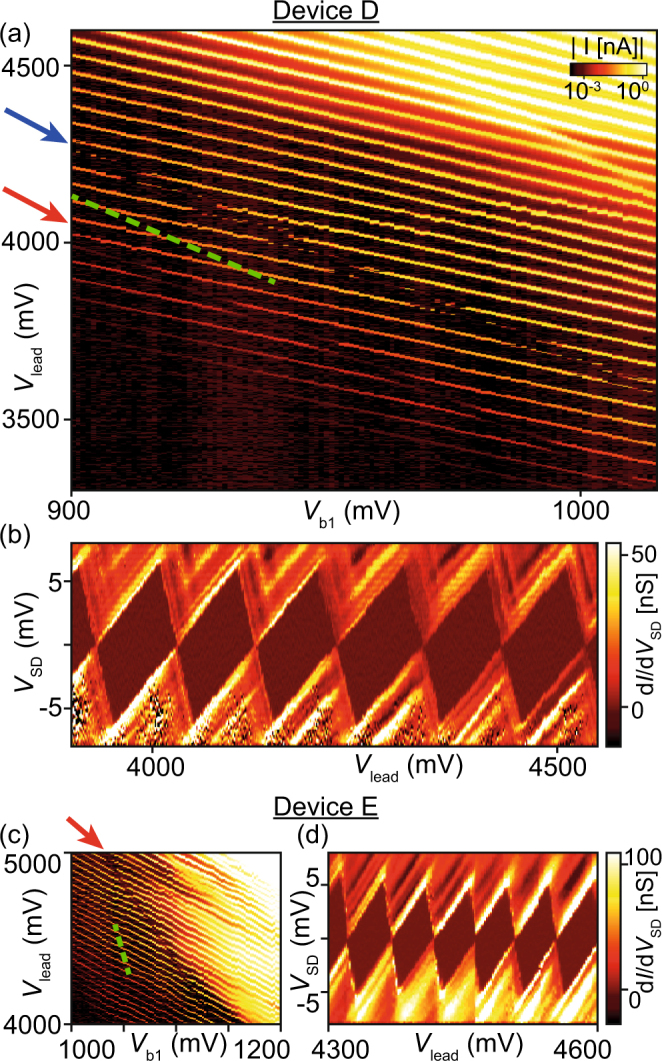
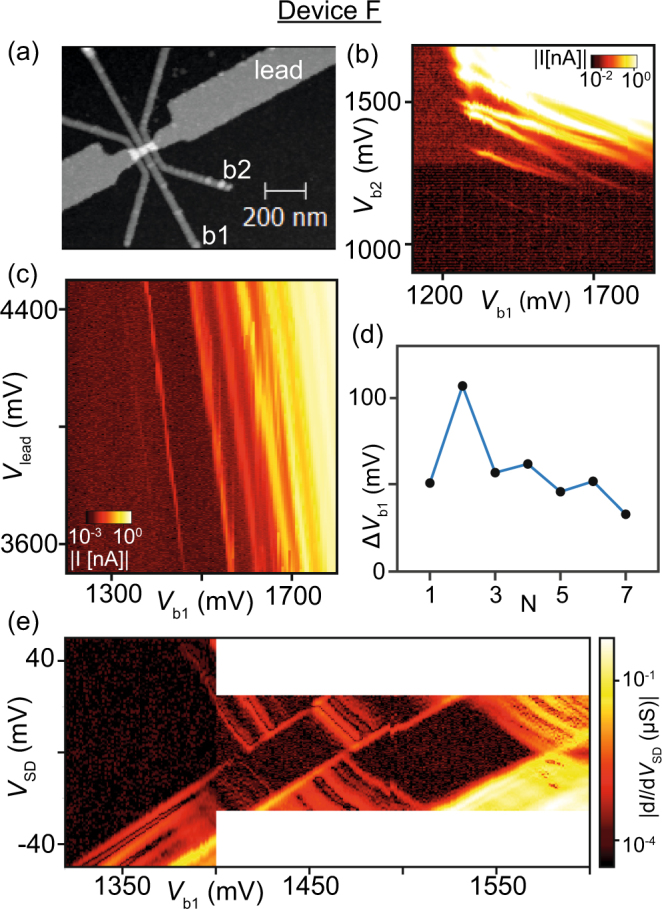
We replace the established aluminium gates for the formation of quantum dots in silicon with gates made from palladium. We study the morphology of both aluminium and palladium gates with transmission electron microscopy. The native aluminium oxide is found to be formed all around the aluminium gates, which could lead to the formation of unintentional dots. Therefore, we report on a novel fabrication route that replaces aluminium and its native oxide by palladium with atomic-layer-deposition-grown aluminium oxide. Using this approach, we show the formation of low-disorder gate-defined quantum dots, which are reproducibly fabricated. Furthermore, palladium enables us to further shrink the gate design, allowing us to perform electron transport measurements in the few-electron regime in devices comprising only two gate layers, a major technological advancement. It remains to be seen, whether the introduction of palladium gates can improve the excellent results on electron and nuclear spin qubits defined with an aluminium gate stack.
Overview
The claims and statistics of this paper haven’t been checked yet.
Free: it reads the open-access text and checks the first 5 claims that cite a source we can check. Create a free account to check every claim.
Integrity signals
Registry
Cites
Statistics
Figures
Verification
Claims the paper makes
The claims and statistics of this paper haven’t been checked yet.
Free: it reads the open-access text and checks the first 5 claims that cite a source we can check. Create a free account to check every claim.
Self-check
Percentages, sums and reported differences re-computed from the paper’s own numbers.
The self-check needs the paper’s full text.
Citations
Cites
Quantum computation with quantum dots
Loss, D., & DiVincenzo, D. P. (1998) · Physical Review A · doi:10.1103/physreva.57.120 · Cited by 6,840
A silicon-based nuclear spin quantum computer
Kane, B. E. (1998) · Nature · doi:10.1038/30156 · Cited by 3,779
Spins in few-electron quantum dots
Hanson, R., Kouwenhoven, L. P., Petta, J. R., Tarucha, S., & Vandersypen, L. M. K. (2007) · Reviews of Modern Physics · doi:10.1103/revmodphys.79.1217 · Cited by 2,665
(1994) · Metal Powder Report · doi:10.1016/0026-0657(94)90443-x · Cited by 1,986
Electron transport through double quantum dots
van der Wiel, W. G., De Franceschi, S., Elzerman, J. M., Fujisawa, T., Tarucha, S., & Kouwenhoven, L. P. (2002) · Reviews of Modern Physics · doi:10.1103/revmodphys.75.1 · Cited by 1,820
Shell Filling and Spin Effects in a Few Electron Quantum Dot
Tarucha, S., Austing, D. G., Honda, T., van der Hage, R. J., & Kouwenhoven, L. P. (1996) · Physical Review Letters · doi:10.1103/physrevlett.77.3613 · Cited by 1,329
Zwanenburg, F. A., Dzurak, A. S., Morello, A., Simmons, M. Y., Hollenberg, L. C. L., Klimeck, G., Rogge, S., Coppersmith, S. N., & Eriksson, M. A. (2013) · Reviews of Modern Physics · doi:10.1103/revmodphys.85.961 · Cited by 1,210
Self-citationKouwenhoven, L. P., Austing, D. G., & Tarucha, S. (2001) · Reports on Progress in Physics · doi:10.1088/0034-4885/64/6/201 · Cited by 1,118
An addressable quantum dot qubit with fault-tolerant control-fidelity
Veldhorst, M., Hwang, J. C. C., Yang, C. H., Leenstra, A. W., de Ronde, B., Dehollain, J. P., Muhonen, J. T., Hudson, F. E., Itoh, K. M., Morello, A., et al. (2014) · Nature Nanotechnology · doi:10.1038/nnano.2014.216 · Cited by 940
A two-qubit logic gate in silicon
Veldhorst, M., Yang, C. H., Hwang, J. C. C., Huang, W., Dehollain, J. P., Muhonen, J. T., Simmons, S., Laucht, A., Hudson, F. E., Itoh, K. M., et al. (2015) · Nature · doi:10.1038/nature15263 · Cited by 919
Cited by
Scaling silicon-based quantum computing using CMOS technology
Gonzalez-Zalba, M. F., de Franceschi, S., Charbon, E., Meunier, T., Vinet, M., & Dzurak, A. S. (2021) · Nature Electronics · doi:10.1038/s41928-021-00681-y · Cited by 272
Probing single electrons across 300-mm spin qubit wafers
Neyens, S., Zietz, O. K., Watson, T. F., Luthi, F., Nethwewala, A., George, H. C., Henry, E., Islam, M., Wagner, A. J., Borjans, F., et al. (2024) · Nature · doi:10.1038/s41586-024-07275-6 · Cited by 178
“For spin qubits today, process variation and yield are significant challenges [10, 11, 12].”
BackgroundQuantum dot arrays in silicon and germanium
Lawrie, W. I. L., Eenink, H. G. J., Hendrickx, N. W., Boter, J. M., Petit, L., Amitonov, S. V., Lodari, M., Paquelet Wuetz, B., Volk, C., Philips, S. G. J., et al. (2020) · Applied Physics Letters · doi:10.1063/5.0002013 · Cited by 140
Self-citationSpin Lifetime and Charge Noise in Hot Silicon Quantum Dot Qubits
Petit, L., Boter, J. M., Eenink, H. G. J., Droulers, G., Tagliaferri, M. L. V., Li, R., Franke, D. P., Singh, K. J., Clarke, J. S., Schouten, R. N., et al. (2018) · Physical Review Letters · doi:10.1103/physrevlett.121.076801 · Cited by 125
Single-spin qubits in isotopically enriched silicon at low magnetic field
Zhao, R., Tanttu, T., Tan, K. Y., Hensen, B., Chan, K. W., Hwang, J. C. C., Leon, R. C. C., Yang, C. H., Gilbert, W., Hudson, F. E., et al. (2019) · Nature Communications · doi:10.1038/s41467-019-13416-7 · Cited by 93
Metadata
- Authors
- Brauns, M., Amitonov, S. V., Spruijtenburg, P.-C., & Zwanenburg, F. A.
- Affiliations
- Institute of Science and Technology Austria (AT)
- University of Twente (NL)
- Corresponding author
- Brauns, Matthias
- Zwanenburg, Floris A.
- Venue
- Scientific Reports
- Published
- 2018-04-09
- Volume
- 8
- Issue
- 1
- Pages
- 5690-5690
- ISSN
- 2045-2322 (ISSN-L)
- PMC
- PMC5890286
- OpenAlex
- W2759847830
- Cited by
- 35
- References
- 60
- Citations by year
- 2026: 2 · 2025: 3 · 2024: 1 · 2023: 5 · 2022: 2 · 2021: 10 · 2020: 6 · 2019: 4 · 2018: 2
- FWCI
- 2.52
- Type
- journal article
- Language
- en
- Open access
- gold
- doi.org
- Licence
- cc-by
- creativecommons.org/licenses/by/4.0 (tdm)
- creativecommons.org/licenses/by/4.0 (vor)
- Locations
- Scientific Reports (publishedVersion, cc-by)
- Europe PMC (PubMed Central) (publishedVersion, cc-by)
- PubMed Central (publishedVersion, cc-by)
- PubMed (publishedVersion)
- arXiv (Cornell University) (submittedVersion)
- DOAJ (DOAJ: Directory of Open Access Journals) (submittedVersion)
- University of Twente Research Information (submittedVersion, cc-by)
- arXiv (Cornell University)
- Funders
- Nederlandse Organisatie voor Wetenschappelijk Onderzoek (14167)
- Topics
- Physical Sciences › Physics and Astronomy › Condensed Matter Physics › Quantum and electron transport phenomena
- Physical Sciences › Physics and Astronomy › Atomic and Molecular Physics, and Optics › Semiconductor Quantum Structures and Devices
- Physical Sciences › Engineering › Electrical and Electronic Engineering › Advancements in Semiconductor Devices and Circuit Design
- Keywords
- palladium gate, native oxide, gate-defined quantum dots, few-electron regime, electron transport, spin qubits, nuclear spin qubits
About these checks
Registry, retraction, Cites and statistics results are computed, not judged, with one exception: a printed reference that no index lists is read once by a model before it counts as a citation error. Claims are extracted by a model and kept only when their quote appears verbatim in the text; each cited source is then checked, with a model’s help, for whether it says what the claim relies on. Those verdicts can be wrong — read the claim’s quote and the cited source before relying on one.
Statistics and arithmetic are recomputed, not judged.
Confidence bands are shown only for fields calibrated on our annotated test set. None is calibrated yet, so no band is shown.
What counts as a claim ›How we measure confidence ›How we check this ›
Are you an author, or do you see a problem with this page? Request a review
How to cite
Cite CoChat for the checks on this page, and the paper for its own findings.
- This page
- CoChat. (2026). Citation check: Palladium gates for reproducible quantum dots in silicon. https://app.cochat.ai/papers/10.1038/s41598-018-24004-y
- The paper
- Brauns, M., Amitonov, S. V., Spruijtenburg, P.-C., & Zwanenburg, F. A. (2018). Palladium gates for reproducible quantum dots in silicon. Scientific Reports. https://doi.org/10.1038/s41598-018-24004-y
Data sources
Bibliographic data: Semantic Scholar, OpenAlex, Crossref.
Contains information from the Semantic Scholar Academic Graph Datasets, made available under the ODC Attribution License (ODC-BY 1.0).
Semantic Scholar’s data is described in: Kinney, R., et al. (2023). The Semantic Scholar Open Data Platform. arXiv:2301.10140.
