

Nannochloropsis oceanica, a novel natural source of rumen-protected eicosapentaenoic acid (EPA) for ruminants
Open accessThe DOI matches its Crossref record; 52 of the 52 references it cites were found in a registry or an index.
Abstract
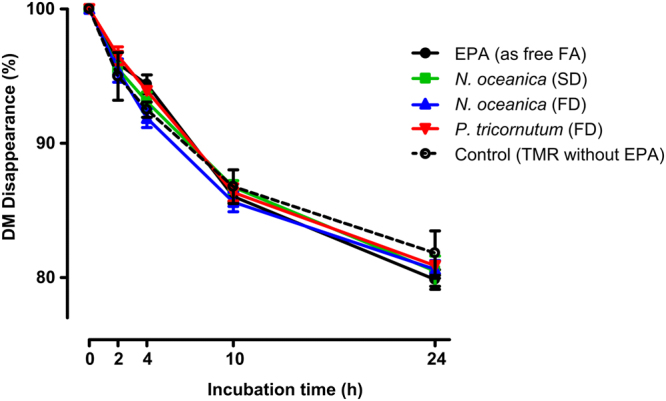
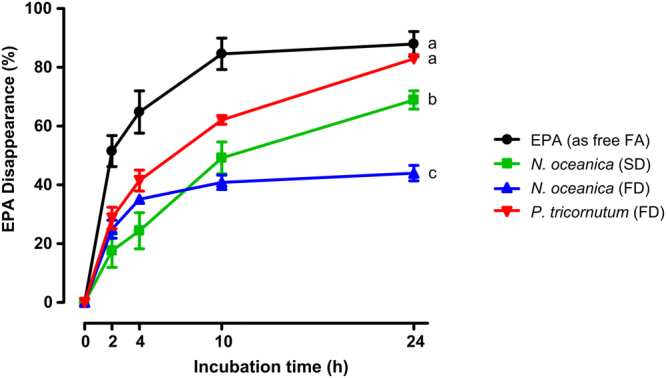
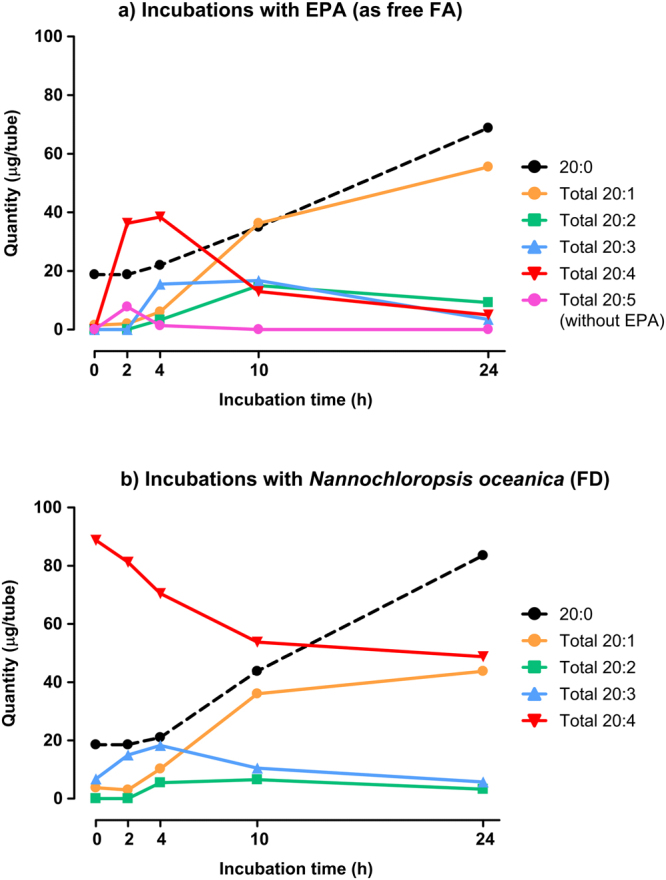
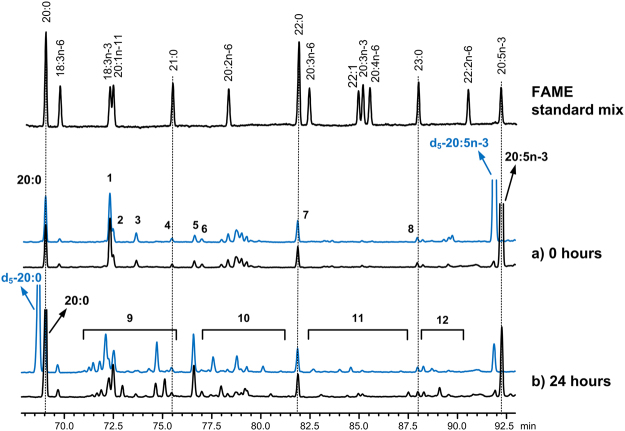
We hypothesize that whole microalga biomass is a natural rumen-protected source of eicosapentaenoic acid (EPA, 20:5n-3) for ruminants. To test our hypothesis, we studied the ruminal biohydrogenation of EPA from two microalgae, Nannochloropsis oceanica and Phaeodactylum tricornutum using in vitro incubations with rumen fluid. A total mixed ration was incubated with: no EPA (control), EPA as free-fatty acid, N. oceanica spray-dried (SD), N. oceanica freeze-dried (FD), or P. tricornutum FD. The kinetics of EPA disappearance and of products formed during the 24 hours of incubation were evaluated, and complemented by deuterated-EPA incubation. Results showed that EPA metabolism from the N. oceanica was remarkably reduced compared with the P. tricornutum and free-EPA, and this reduction was even more effective with the N. oceanica FD. Our data also indicates that neither feed dry matter disappearance nor rumen microbial markers (branched-chain fatty acids and dimethyl acetals) were affected by EPA-sources. We reported for the first time the kinetics of EPA biohydrogenation class products and the unequivocal formation of 20:0 from EPA. Overall, N. oceanica shows a strong potential to be used as a natural dietary source of EPA to ruminants, nevertheless further studies are needed to verify its protection in vivo.
Overview
The claims and statistics of this paper haven’t been checked yet.
Free: it reads the open-access text and checks the first 5 claims that cite a source we can check. Create a free account to check every claim.
Integrity signals
Registry
Cites
Statistics
Figures
Verification
Claims the paper makes
The claims and statistics of this paper haven’t been checked yet.
Free: it reads the open-access text and checks the first 5 claims that cite a source we can check. Create a free account to check every claim.
Self-check
Percentages, sums and reported differences re-computed from the paper’s own numbers.
The self-check needs the paper’s full text.
Citations
Cites
European Guidelines on cardiovascular disease prevention in clinical practice (version 2012)
Authors/Task Force Members:, Perk, J., De Backer, G., Gohlke, H., Graham, I., Reiner, Ž., Verschuren, M., Albus, C., Benlian, P., Boysen, G., et al. (2012) · European Heart Journal · doi:10.1093/eurheartj/ehs092 · Cited by 8,490
2016 European Guidelines on cardiovascular disease prevention in clinical practice
Piepoli, M. F., Hoes, A. W., Agewall, S., Albus, C., Brotons, C., Catapano, A. L., Cooney, M.-T., Corrà, U., Cosyns, B., Deaton, C., et al. (2016) · European Heart Journal · doi:10.1093/eurheartj/ehw106 · Cited by 6,457
Authors/Task Force Members, Piepoli, M. F., Hoes, A. W., Agewall, S., Albus, C., Brotons, C., Catapano, A. L., Cooney, M.-T., Corrà, U., Cosyns, B., et al. (2016) · European Journal of Preventive Cardiology · doi:10.1177/2047487316653709 · Cited by 1,334
Fats and fatty acids in human nutrition. Report of an expert consultation.
(2010) · PubMed · Cited by 990
Jenkins, T. C., Wallace, R. J., Moate, P. J., & Mosley, E. E. (2008) · Journal of Animal Science · doi:10.2527/jas.2007-0588 · Cited by 790
Recent developments in altering the fatty acid composition of ruminant-derived foods
Shingfield, K. J., Bonnet, M., & Scollan, N. D. (2013) · Animal · doi:10.1017/s1751731112001681 · Cited by 500
Microalgae as feed ingredients for livestock production and meat quality: A review
Madeira, M. S., Cardoso, C., Lopes, P. A., Coelho, D., Afonso, C., Bandarra, N. M., & Prates, J. A. M. (2017) · Livestock Science · doi:10.1016/j.livsci.2017.09.020 · Cited by 473
Ultrastructure and Composition of the Nannochloropsis gaditana Cell Wall
Scholz, M. J., Weiss, T. L., Jinkerson, R. E., Jing, J., Roth, R., Goodenough, U., Posewitz, M. C., & Gerken, H. G. (2014) · Eukaryotic Cell · doi:10.1128/ec.00183-14 · Cited by 436
Fao, R. N., eng, C. P. D., Fao, J., & Fats, W. E. C. O. (2010) · Cited by 406
Cell disruption and lipid extraction for microalgal biorefineries: A review
Lee, S. Y., Cho, J. M., Chang, Y. K., & Oh, Y.-K. (2017) · Bioresource Technology · doi:10.1016/j.biortech.2017.06.038 · Cited by 377
Cited by
Microalgae n-3 PUFAs Production and Use in Food and Feed Industries
Remize, M., Brunel, Y., Silva, J. L., Berthon, J.-Y., & Filaire, E. (2021) · Marine Drugs · doi:10.3390/md19020113 · Cited by 214
“The algae’s thick cell walls protect the healthy compound from metabolization by rumen microbiota, inducing a full enrichment in the EPA for better ruminant development and health without inhibiting the growth and activity of rumen bacteria [232].”
BackgroundSelf-citationReview: Improving the nutritional, sensory and market value of meat products from sheep and cattle
Pethick, D. W., Hocquette, J.-F., Scollan, N. D., & Dunshea, F. R. (2021) · animal · doi:10.1016/j.animal.2021.100356 · Cited by 71
KHOLIF, A. E., Gouda, G. A., & Hamdon, H. A. (2020) · Animals · doi:10.3390/ani10122453 · Cited by 36
“[11] reported that Nannochloropsis is a natural dietary source of EPA for ruminants.”
BackgroundIgou, T., Zhong, S., Reid, E., & Chen, Y. (2023) · Environmental Science & Technology · doi:10.1021/acs.est.2c07578 · Cited by 31
Fabjanowska, J., Kowalczuk-Vasilev, E., Klebaniuk, R., Milewski, S., & Gümüş, H. (2023) · Animals · doi:10.3390/ani13223589 · Cited by 39
“…the energy value of ruminant animal feed without reducing its digestibility is achieved through the use of appropriate additives in the form of specially formulated fats called rumen-protected fats, including calcium soaps, which provide an important safeguard against rumen biohydrogenation [63].”
BackgroundMeehan, D. J., Cabrita, A. R. J., Silva, J., Fonseca, A. J. M., & Maia, M. R. G. (2021) · Algal Research · doi:10.1016/j.algal.2021.102284 · Cited by 33
Vitor, A. C., Francisco, A., Silva, J., Pinho, M., Huws, S., Santos‐Silva, J., Bessa, R. J. B., & Alves, S. P. (2021) · Scientific Reports · doi:10.1038/s41598-021-01255-w · Cited by 28
Uthaiah, N. M., Sreedhar, R. V., & Sheikh, A. Y. (2025) · Algal Research · doi:10.1016/j.algal.2025.103897 · Cited by 29
Vitor, A. C., Godinho, M. C., Francisco, A., Silva, J., Almeida, J. M., Fialho, L., Soldado, D., Jerónimo, E., Scollan, N. D., Huws, S., et al. (2022) · Meat Science · doi:10.1016/j.meatsci.2022.109053 · Cited by 22
The effect of Nannochloropsis oceanica feed inclusion on rabbit muscle proteome
Ribeiro, D. M., Bandarrinha, J., Nanni, P., Alves, S. P., Martins, C. F., Bessa, R. J. B., Falcão-e-Cunha, L., & de Almeida, A. M. (2020) · Journal of Proteomics · doi:10.1016/j.jprot.2020.103783 · Cited by 18
“Improving the nutritional value of meat is an effective way of reducing cardiovascular diseases [6,10], which is particularly important in the current scenario, where meat consumption is steadily increasing in several regions of the world, particularly in developing countries [29].”
BackgroundBesharati, M., Giannenas, Ι., Palangı, V., Ayaşan, T., Noorian, F., Maggiolino, A., & Lorenzo, J. M. (2022) · Animals · doi:10.3390/ani12111400 · Cited by 18
“Biohydrogenation is the process in the rumen during which hydrogen is added to the double bonds of unsaturated fatty acids [15,16].”
BackgroundBaiden, N., Gandini, C., Goddard, P., & Sayanova, O. V. (2022) · Algal Research · doi:10.1016/j.algal.2022.102927 · Cited by 16
Montoya‐Arroyo, A., Lehnert, K., Lux, P. E., Jiménez, V. M., Esquivel, P., Silva‐Benavides, A. M., Vetter, W., & Frank, J. (2021) · Journal of Food Composition and Analysis · doi:10.1016/j.jfca.2021.104325 · Cited by 13
Nutritional value of microalgae for ruminants and implications from microalgae production
Lamminen, M. (2021) · CABI Reviews · doi:10.1079/pavsnnr202116054 · Cited by 17
Esakkimuthu, S., Siddiqui, S. A., Cherif, M., & Saadaoui, I. (2023) · Bioresource Technology Reports · doi:10.1016/j.biteb.2023.101746 · Cited by 14
Zhang, F., Wu, Z., Su, Q., Sa, R., Zhang, Y., Zhang, X., Hou, S., & Gui, L. (2025) · Food Research International · doi:10.1016/j.foodres.2025.115893 · Cited by 11
Whole cell microalgae: potential to transform industry waste into sustainable ruminant feed
Picknell, K. J., Poddar, N., McCauley, J. I., Chaves, A. V., & Ralph, P. J. (2025) · Bioresource Technology · doi:10.1016/j.biortech.2025.132547 · Cited by 8
Kaewpila, C., Gunun, P., Tongkasee, P., Puangploy, P., & Khota, W. (2025) · Scientific Reports · doi:10.1038/s41598-025-05095-w · Cited by 9
“However, due to biohydrogenation in the rumen, only approximately 100 g/kg of total unsaturated fatty acids escape the rumen and remain available for ruminant utilization 30 .”
Yang, L., Duan, B., & Lu, Q. (2025) · Frontiers in Nutrition · doi:10.3389/fnut.2025.1664674 · Cited by 13
Díaz, N. F., Muñoz, S., Medina, A., Riquelme, C. E., & Lozano‐Muñoz, I. (2025) · Life · doi:10.3390/life15030455 · Cited by 9
“[56] and ash content (24.47”
InfluentialHoque, M. N., Rahman, M. S., Sarkar, M. M. H., Habib, M. A., Akter, S., Banu, T. A., Goswami, B., Jahan, I., Hossain, M. A., Khan, M. S., et al. (2023) · PLoS ONE · doi:10.1371/journal.pone.0278134 · Cited by 8
“oceanica is a chief source of eicosapentaenoic acid (EPA, 20:5n-3) and docosahexaenoic acid (DHA, 22:6 n-3) recommended for humans use due to their beneficial effects including anti-atherogenic, anti-thrombotic and anti-inflammatory properties [52, 53].”
BackgroundMakmur, M., Yanza, Y. R., Fitri, A., Syarifuddin, S., Ridwan, R., & Jayanegara, A. (2023) · Veterinary Integrative Sciences · doi:10.12982/vis.2023.067 · Cited by 8
DHA- and EPA-rich oil from microalgae
Lupette, J. (2023) · Elsevier eBooks · doi:10.1016/b978-0-323-99196-4.00035-8 · Cited by 5
Neves, M., Ferreira, A. L. K., Antunes, M., Silva, J., Mendes, S., Gil, M. M., & Tecelão, C. (2021) · Applied Sciences · doi:10.3390/app11188747 · Cited by 5
Baila, C., Joy, M., Bertolín, J. R., Alves, S. P., Bessa, R. J. B., Blanco, M., & Lobón, S. (2023) · Journal of Agricultural and Food Chemistry · doi:10.1021/acs.jafc.3c05902 · Cited by 7
“…equipped with a SP-2560 (100 m × 0.25 mm × 0.20 μ m film thickness, Supelco, Bellefonte, PA, USA) capillary column with the chromatographic conditions described by Alves et al. 24 The FA determinations were performed by comparison with ruminal chromatograms of Alves et al. 23 and Alves and Bessa.”
MethodInfluentialKhozin‐Goldberg, I., & Sayanova, O. V. (2019) · Grand challenges in biology and biotechnology · doi:10.1007/978-3-030-25233-5_7 · Cited by 5
Effect of 10 freshwater microalgae on in vitro methane mitigation and rumen fermentation
Li, Y., Bagnoud-Velásquez, M., Zhang, Y., Wang, K., Punčochářová, L., Kunz, C., Dubois, S., Peng, R., Brahier, A. B., Wahl, F., et al. (2025) · Journal of Dairy Science · doi:10.3168/jds.2024-25749 · Cited by 6
Nutritional Value of Nannochloropsis oceanica for Weaner Piglets
Chaves, A. A. M., Ribeiro, D. M., Martins, C. F., Fernandes, T., Maia, M. R. G., Fonseca, A. J. M., Cabrita, A. R. J., Alves, S. P., Pinho, M., Bessa, R. J. B., et al. (2024) · Animals · doi:10.3390/ani14243575 · Cited by 6
“The fatty acid methyl esters of the faeces, diets, and microalgae were prepared by direct transesterification and analysed by gas chromatography with flame ionisation detection (GC-FID), as described by Alves et al. [19].”
Hoque, M. N., Rahman, M. S., Sarkar, M. M. H., Habib, M. A., Hossain, M. A., Khan, M. S., & Islam, T. (2022) · bioRxiv (Cold Spring Harbor Laboratory) · doi:10.1101/2022.02.17.480819 · Cited by 2
Digestibility and Nutritional Value of Microalga Tetraselmis sp. for Weaner Piglets
Chaves, A. A. M., Martins, C. F., Ribeiro, D. M., Maia, M. R. G., Fonseca, A. J. M., Cabrita, A. R. J., Alves, S. P., Mourato, M. P., Pinho, M., Bessa, R. J. B., et al. (2025) · Animals · doi:10.3390/ani15070967 · Cited by 1
“…in methanol followed by hydrochloric acid in methanol and analyzed using gas chromatography with flame ionization detection (GC-FID) equipped with a capillary column (SP-2560, 100 m × 0.25 mm × 0.20 µ m; Supelco Inc., Bellefonte, PA, USA), following the method described by Alves et al. [23].”
InfluentialPedro, M. F., Matzapetákis, M., Maia, M. R. G., Fonseca, A. J. M., Cabrita, A. R. J., Alves, S. P., Freire, J. P. B., Bessa, R. J. B., Zervoú, M., & de Almeida, A. M. (2025) · ACS Agricultural Science & Technology · doi:10.1021/acsagscitech.5c00646 · Cited by 1
Willett, M., Campbell, M., Schoenfeld, E., & Callcott, E. T. (2022) · Animals · doi:10.3390/ani12151943 · Cited by 1
“[64] reported that n-3 long chain PUFA content in meat products of ruminants was relatively low at (2–40 mg/100 g) without supplementation of N.”
BackgroundEnzymatic deconstruction of complex biomass of microalgae for organic molecules
Ghodke, P. K., Raj, A., Pillai, N., & Murugesan, Y. K. (2025) · Elsevier eBooks · doi:10.1016/b978-0-443-24110-9.00014-1
In vitro evaluation of microalgae as a source of polyunsaturated fatty acids for ruminants
Marcos, C. N., Heras-Molina, A., de Evan, T., Carro, M. D., Gómez-Serrano, C., Terré, M., Pérez‐Garnelo, S. S., & Astiz, S. (2025) · Journal of Applied Phycology · doi:10.1007/s10811-025-03579-w
“Complex carbohydrates and other components of the microalgal cell wall may be difficult for ruminal microorganisms to break down, whereas these structures are more susceptible to the acidic and enzymatic digestion that occurs post-ruminally (Alves et al. 2018).”
Microalgae and its impact on ruminant nutrition and health
Adegbeye, M. J., Jack, A. A., Sierra-Alarcón, A. M., Inyang, U., Elghandour, M. M. M. Y., Maggiolino, A., Palo, P. D., & Salem, A. Z. M. (2025) · Elsevier eBooks · doi:10.1016/b978-0-443-22080-7.00016-8
Integrative nutritional and biotechnological approaches to improve rumen lipid metabolism—A review
Ahmed, M. G., Zeid, S., El-Zarkouny, S. Z., & Elwakeel, E. A. (2026) · Animal Feed Science and Technology · doi:10.1016/j.anifeedsci.2026.116943 · Cited by 1
Metadata
- Authors
- Alves, S. P., Mendonça, S. H., Silva, J. L., & Bessa, R. J. B.
- Affiliations
- University of Lisbon (PT)
- Corresponding author
- Alves, Susana P.
- Venue
- Scientific Reports
- Published
- 2018-07-06
- Volume
- 8
- Issue
- 1
- Pages
- 10269-10269
- ISSN
- 2045-2322 (ISSN-L)
- PMC
- PMC6035222
- OpenAlex
- W2810654499
- Cited by
- 36
- References
- 52
- Citations by year
- 2026: 1 · 2025: 12 · 2024: 1 · 2023: 7 · 2022: 5 · 2021: 7 · 2020: 2 · 2019: 1
- FWCI
- 4.22
- Type
- journal article
- Language
- en
- Open access
- gold
- doi.org
- Licence
- cc-by
- creativecommons.org/licenses/by/4.0 (tdm)
- creativecommons.org/licenses/by/4.0 (vor)
- Locations
- Scientific Reports (publishedVersion, cc-by)
- Europe PMC (PubMed Central) (publishedVersion, other-oa)
- PubMed Central (publishedVersion, cc-by)
- PubMed (publishedVersion)
- DOAJ (DOAJ: Directory of Open Access Journals) (submittedVersion)
- Funders
- Fundação para a Ciência e a Tecnologia (UID/CVT/00276/2013, SFRH/BPD/76836/2011, Project UID/CVT/00276/2013)
- Topics
- Life Sciences › Agricultural and Biological Sciences › Animal Science and Zoology › Ruminant Nutrition and Digestive Physiology
- Life Sciences › Agricultural and Biological Sciences › Animal Science and Zoology › Animal Nutrition and Physiology
- Health Sciences › Nursing › Nutrition and Dietetics › Fatty Acid Research and Health
- Keywords
- Nannochloropsis oceanica, eicosapentaenoic acid, ruminants, ruminal biohydrogenation, Phaeodactylum tricornutum, microalgae feed, branched-chain fatty acids, dimethyl acetals, omega-3 fatty acids
- MeSH terms
- Animals, Diet, Hydrogenation, Rumen, Ruminants, Eicosapentaenoic Acid, Biomass, Microalgae
About these checks
Registry, retraction, Cites and statistics results are computed, not judged, with one exception: a printed reference that no index lists is read once by a model before it counts as a citation error. Claims are extracted by a model and kept only when their quote appears verbatim in the text; each cited source is then checked, with a model’s help, for whether it says what the claim relies on. Those verdicts can be wrong — read the claim’s quote and the cited source before relying on one.
Statistics and arithmetic are recomputed, not judged.
Confidence bands are shown only for fields calibrated on our annotated test set. None is calibrated yet, so no band is shown.
What counts as a claim ›How we measure confidence ›How we check this ›
Are you an author, or do you see a problem with this page? Request a review
Data sources
Bibliographic data: Semantic Scholar, OpenAlex, Crossref.
Contains information from the Semantic Scholar Academic Graph Datasets, made available under the ODC Attribution License (ODC-BY 1.0).
Semantic Scholar’s data is described in: Kinney, R., et al. (2023). The Semantic Scholar Open Data Platform. arXiv:2301.10140.
