

The DOI matches its Crossref record; 31 of the 32 references it cites were found in a registry or an index.
How algorithmic popularity bias hinders or promotes quality
Open accessAbstract
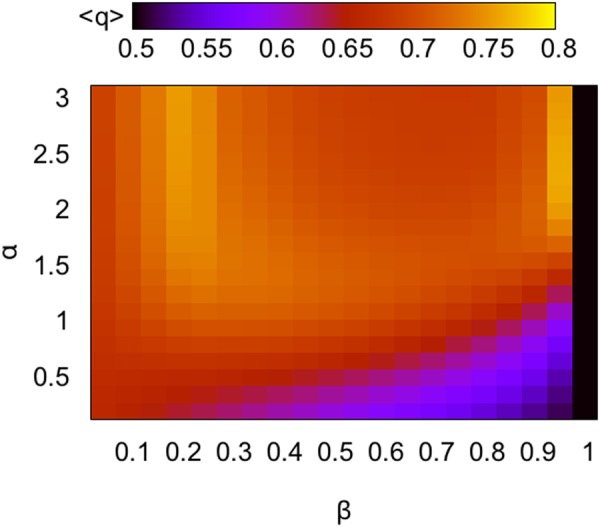
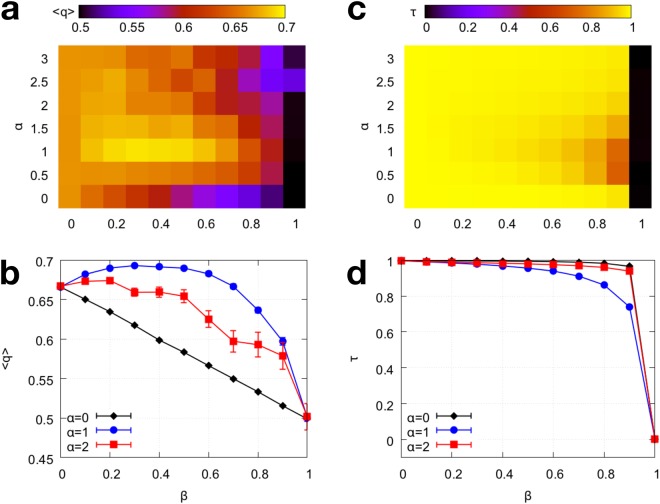
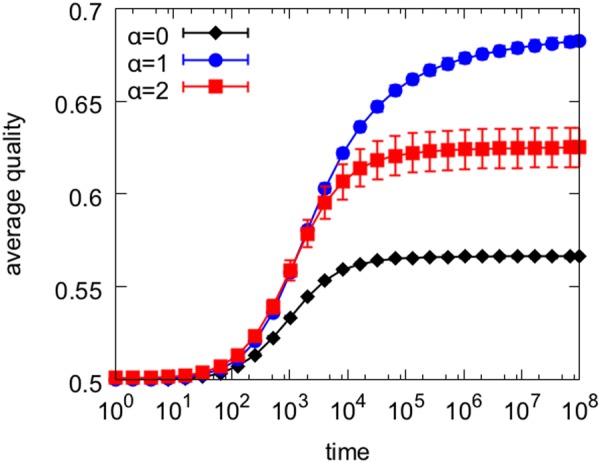
Algorithms that favor popular items are used to help us select among many choices, from top-ranked search engine results to highly-cited scientific papers. The goal of these algorithms is to identify high-quality items such as reliable news, credible information sources, and important discoveries–in short, high-quality content should rank at the top. Prior work has shown that choosing what is popular may amplify random fluctuations and lead to sub-optimal rankings. Nonetheless, it is often assumed that recommending what is popular will help high-quality content “bubble up” in practice. Here we identify the conditions in which popularity may be a viable proxy for quality content by studying a simple model of a cultural market endowed with an intrinsic notion of quality. A parameter representing the cognitive cost of exploration controls the trade-off between quality and popularity. Below and above a critical exploration cost, popularity bias is more likely to hinder quality. But we find a narrow intermediate regime of user attention where an optimal balance exists: choosing what is popular can help promote high-quality items to the top. These findings clarify the effects of algorithmic popularity bias on quality outcomes, and may inform the design of more principled mechanisms for techno-social cultural markets.
Overview
The claims and statistics of this paper haven’t been checked yet.
Run the check — free, no account needed. It reads the open-access text and checks the sources it cites.
Integrity signals
Registry
Cites
Statistics
Figures
Verification
Claims the paper makes
The claims and statistics of this paper haven’t been checked yet.
Run the check — free, no account needed. It reads the open-access text and checks the sources it cites.
Claims other papers make about this one
Each is checked against this paper’s own text: does it say what the citing paper says it does?
The cited source says what the claim attributes to it.
In the citing paper
“Optimizing for popularity even seems to lower the overall quality of content (Ciampaglia et al., 2018).”
From Social Drivers and Algorithmic Mechanisms on Digital Media. (2024) · cites this paper as Ciampaglia et al., 2018
Self-check
Percentages, sums and reported differences re-computed from the paper’s own numbers.
The self-check needs the paper’s full text.
Citations
Cites
1 retracted
Limited individual attention and online virality of low-quality information
Qiu, X., Oliveira, D. F. M., Shirazi, A. S., Flammini, A., & Menczer, F. (2017) · Nature Human Behaviour · doi:10.1038/s41562-017-0132 · Cited by 207
Self-citationRetractedEmergence of Scaling in Random Networks
Barabási, A.-L., & Albert, R. (1999) · Science · doi:10.1126/science.286.5439.509 · Cited by 36,135
A Simple Model of Herd Behavior
Banerjee, A. V. (1992) · The Quarterly Journal of Economics · doi:10.2307/2118364 · Cited by 6,556
Experimental Study of Inequality and Unpredictability in an Artificial Cultural Market
Salganik, M. J., Dodds, P. S., & Watts, D. J. (2006) · Science · doi:10.1126/science.1121066 · Cited by 2,231 · cited 4×
“created a music-sharing platform to determine under which conditions one can predict popular musical tracks [29].”
BackgroundResultInfluentialFerrara, E., Varol, O., Davis, C., Menczer, F., & Flammini, A. (2016) · Communications of the ACM · doi:10.1145/2818717 · Cited by 1,973
Self-citationEveryone's an influencer: quantifying influence on twitter
Bakshy, E., Hofman, J. M., Mason, W. A., & Watts, D. J. (2011) · Proceedings of the fourth ACM international conference on Web search and data mining · doi:10.1145/1935826.1935845 · Cited by 1,689
Competition and multiscaling in evolving networks
Bianconi, G., & Barabási, A.-L. (2001) · Europhysics Letters (EPL) · doi:10.1209/epl/i2001-00260-6 · Cited by 1,067
How social influence can undermine the wisdom of crowd effect
Lorenz, J., Rauhut, H., Schweitzer, F., & Helbing, D. (2011) · Proceedings of the National Academy of Sciences · doi:10.1073/pnas.1008636108 · Cited by 1,017
Social Influence Bias: A Randomized Experiment
Muchnik, L., Aral, S., & Taylor, S. J. (2013) · Science · doi:10.1126/science.1240466 · Cited by 892 · cited 1×
“Furthermore, knowledge of what is popular can be construed as a form of social influence; an individual’s behavior may be guided by choices of peers or neighbors [23, 19, 20, 18, 29, 2, 6].”
BackgroundWhy Copy Others? Insights from the Social Learning Strategies Tournament
Rendell, L., Boyd, R., Cownden, D., Enquist, M., Eriksson, K., Feldman, M. W., Fogarty, L., Ghirlanda, S., Lillicrap, T., & Laland, K. N. (2010) · Science · doi:10.1126/science.1184719 · Cited by 811
Research works printed but not linked: 5
- Sunstein, C. R. Republic.com 2.0. Princeton university press (2009).
- Pariser, E. The filter bubble: How the new personalized Web is changing what we read and how we think. Penguin (2011).
- Adler, M. Stardom and talent. American economic review 75(1), 208–12 (1985).
- Dawkins, R. The selfish gene. Oxford university press (1989).
- Bell, E J., Owen, T., Brown, P D., Hauka, C. & Rashidian, N. The platform press: how Silicon Valley reengineered journalism. Technical report, Tow Center for Digital Journalism (2017).
Cited by
Sorted by citations
A Survey on Bias and Fairness in Machine Learning
Mehrabi, N., Morstatter, F., Saxena, N., Lerman, K., & Galstyan, A. (2022) · ACM Computing Surveys · doi:10.1145/3457607 · Cited by 5,812
The spread of low-credibility content by social bots
Shao, C., Ciampaglia, G. L., Varol, O., Yang, K.-C., Flammini, A., & Menczer, F. (2018) · Nature Communications · doi:10.1038/s41467-018-06930-7 · Cited by 1,125
Self-citationThe spread of low-credibility content by social bots
Shao, C., Ciampaglia, G. L., Varol, O., Yang, K.-C., Flammini, A., & Menczer, F. (2018) · RePEc: Research Papers in Economics · Cited by 574
Self-citationSocial Media, Echo Chambers, and Political Polarization
Barberá, P. (2020) · Social Media and Democracy · doi:10.1017/9781108890960.004 · Cited by 373
Anatomy of an online misinformation network
Shao, C., Hui, P.-M., Wang, L., Jiang, X., Flammini, A., Menczer, F., & Ciampaglia, G. L. (2018) · PLoS ONE · doi:10.1371/journal.pone.0196087 · Cited by 282
Self-citationThe spread of fake news by social botsPreprint
Shao, C., Ciampaglia, G. L., Varol, O., Flammini, A., & Menczer, F. (2017) · arXiv (Cornell University) · Cited by 249
Self-citationSocial influence and unfollowing accelerate the emergence of echo chambers
Sasahara, K., Chen, W., Peng, H., Ciampaglia, G. L., Flammini, A., & Menczer, F. (2021) · Journal of Computational Social Science · doi:10.1007/s42001-020-00084-7 · Cited by 211
Self-citationControlling Fairness and Bias in Dynamic Learning-to-Rank
Morik, M., Singh, A., Hong, J., & Joachims, T. (2020) · International ACM SIGIR Conference on Research and Development in Information Retrieval (SIGIR) · doi:10.1145/3397271.3401100 · Cited by 228
Misinformation, Disinformation, and Online Propaganda
Guess, A. M., & Lyons, B. A. (2020) · Social Media and Democracy · doi:10.1017/9781108890960.003 · Cited by 284
Social Drivers and Algorithmic Mechanisms on Digital Media.
Metzler, H., & Garcia, D. (2024) · Perspectives on Psychological Science · doi:10.1177/17456916231185057 · Cited by 204
“Optimizing for popularity even seems to lower the overall quality of content (Ciampaglia et al., 2018).”
BackgroundUser-centered Evaluation of Popularity Bias in Recommender Systems
Abdollahpouri, H., Mansoury, M., Burke, R., Mobasher, B., & Malthouse, E. C. (2021) · ACM Conference on User Modeling, Adaptation and Personalization (UMAP) · doi:10.1145/3450613.3456821 · Cited by 161
Ethical Framework for Harnessing the Power of AI in Healthcare and Beyond
Nasir, S., Khan, R. A., & Bai, S. (2024) · IEEE Access · doi:10.1109/access.2024.3369912 · Cited by 152
Drukker, K., Chen, W., Gichoya, J. W., Gruszauskas, N. P., Kalpathy-Cramer, J., Koyejo, S., Myers, K. J., Sá, R. C., Sahiner, B., Whitney, H. M., et al. (2023) · Journal of Medical Imaging · doi:10.1117/1.jmi.10.6.061104 · Cited by 149
Crowdsourced geospatial data quality: challenges and future directions
Basiri, A., Haklay, M., Foody, G. M., & Mooney, P. (2019) · International Journal of Geographical Information Systems · doi:10.1080/13658816.2019.1593422 · Cited by 135
Connecting user and item perspectives in popularity debiasing for collaborative recommendation
Boratto, L., Fenu, G., & Marras, M. (2020) · Information Processing & Management · doi:10.1016/j.ipm.2020.102387 · Cited by 139
Modelling opinion dynamics in the age of algorithmic personalisation
Perra, N., & Rocha, L. E. C. (2019) · Scientific Reports · doi:10.1038/s41598-019-43830-2 · Cited by 139
Facts and Where to Find Them: Empirical Research on Internet Platforms and Content Moderation
Keller, D., & Leerssen, P. (2020) · Data Archiving and Networked Services (DANS) · doi:10.1017/9781108890960
Siegel, A. A. (2020) · Cambridge University Press eBooks · doi:10.1017/9781108890960.005 · Cited by 123
Responsible media technology and AI: challenges and research directions
Trattner, C., Jannach, D., Motta, E., Meijer, I. C., Diakopoulos, N. A., Elahi, M., Opdahl, A. L., Tessem, B., Borch, N. T., Fjeld, M., et al. (2021) · AI and Ethics · doi:10.1007/s43681-021-00126-4 · Cited by 126
YouTube and Education: A Scoping Review
Shoufan, A., & Mohamed, F. (2022) · IEEE Access · doi:10.1109/access.2022.3225419 · Cited by 143
Wang, A., Ramaswamy, V., & Russakovsky, O. (2022) · ACM Conference on Fairness, Accountability, and Transparency (FAccT) · doi:10.1145/3531146.3533101 · Cited by 122
Ciampaglia, G. L. (2017) · Journal of Computational Social Science · doi:10.1007/s42001-017-0005-6 · Cited by 84
Self-citation(2024) · ACM eBooks · doi:10.1145/3674127 · Cited by 86
Neutral bots probe political bias on social media
Chen, W., Pacheco, D. F., Yang, K.-C., & Menczer, F. (2021) · RePEc: Research Papers in Economics · Cited by 68
Self-citationRight and left, partisanship predicts (asymmetric) vulnerability to misinformation
Nikolov, D., Flammini, A., & Menczer, F. (2021) · Harvard Kennedy School Misinformation Review · doi:10.37016/mr-2020-55 · Cited by 76
Self-citationNeutral bots probe political bias on social media
Chen, W., Pacheco, D. F., Yang, K.-C., & Menczer, F. (2021) · Nature Communications · doi:10.1038/s41467-021-25738-6 · Cited by 106
Self-citationDemocratic Transparency in the Platform Society
Gorwa, R., & Ash, T. G. (2020) · Cambridge University Press eBooks · doi:10.1017/9781108890960.013 · Cited by 71
Auditing News Curation Systems: A Case Study Examining Algorithmic and Editorial Logic in Apple News
Bandy, J., & Diakopoulos, N. A. (2020) · Proceedings of the International AAAI Conference on Web and Social Media · doi:10.1609/icwsm.v14i1.7277 · Cited by 66
Misinformation and Its Correction
Wittenberg, C., & Berinsky, A. J. (2020) · Cambridge University Press eBooks · doi:10.1017/9781108890960.009 · Cited by 64
Auditing Algorithmic Bias on Twitter
Bartley, N., Abeliuk, A., Ferrara, E., & Lerman, K. (2021) · 13th ACM Web Science Conference 2021 · doi:10.1145/3447535.3462491 · Cited by 62
Íñiguez, G., Pineda, C., Gershenson, C., & Barabási, A.-Ĺ. (2022) · Nature Communications · doi:10.1038/s41467-022-29256-x · Cited by 69
Yalçın, E., & Bilge, A. (2022) · Information Processing & Management · doi:10.1016/j.ipm.2022.103100 · Cited by 57
Flow of online misinformation during the peak of the COVID-19 pandemic in Italy
Caldarelli, G., Nicola, R. D., Petrocchi, M., Pratelli, M., & Saracco, F. (2021) · EPJ Data Science · doi:10.1140/epjds/s13688-021-00289-4 · Cited by 60
Research Challenges of Digital Misinformation: Toward a Trustworthy Web
Ciampaglia, G. L., Mantzarlis, A., Maus, G., & Menczer, F. (2018) · AI Magazine · doi:10.1609/aimag.v39i1.2783 · Cited by 55
Self-citationPublic awareness and attitudes towards search engine optimization
Lewandowski, D., & Schultheiß, S. (2022) · Behaviour and Information Technology · doi:10.1080/0144929x.2022.2056507 · Cited by 71
Fairness metrics and bias mitigation strategies for rating predictions
Ashokan, A., & Haas, C. (2021) · Information Processing & Management · doi:10.1016/j.ipm.2021.102646 · Cited by 47
Castioni, P., Andrighetto, G., Gallotti, R., di Sorrentino, E. P., & Domenico, M. D. (2022) · Royal Society Open Science · doi:10.1098/rsos.220716 · Cited by 43
Political audience diversity and news reliability in algorithmic ranking
Bhadani, S., Yamaya, S., Flammini, A., Menczer, F., Ciampaglia, G. L., & Nyhan, B. J. (2022) · Nature Human Behaviour · doi:10.1038/s41562-021-01276-5 · Cited by 45
Self-citationPeralta, A. F., Neri, M., Kertész, J., & Íñiguez, G. (2021) · Physical review. E · doi:10.1103/physreve.104.044312 · Cited by 51
Bots and Computational Propaganda: Automation for Communication and Control
Woolley, S. (2020) · Cambridge University Press eBooks · doi:10.1017/9781108890960.006 · Cited by 41
Facts and Where to Find Them: Empirical Research on Internet Platforms and Content Moderation
Keller, D., & Leerssen, P. (2020) · Cambridge University Press eBooks · doi:10.1017/9781108890960.011 · Cited by 39
A review on individual and multistakeholder fairness in tourism recommender systems
Banerjee, A., Banik, P., & Wörndl, W. (2023) · Frontiers in Big Data · doi:10.3389/fdata.2023.1168692 · Cited by 40
The Unfairness of Popularity Bias in Book Recommendation
Naghiaei, M., Rahmani, H. A., & Dehghan, M. (2022) · Communications in computer and information science · doi:10.1007/978-3-031-09316-6_7 · Cited by 36
Ranking educational channels on YouTube: Aspects and issues
Tadbier, W., & Shoufan, A. (2021) · Education and Information Technologies · doi:10.1007/s10639-020-10414-x · Cited by 43
The few-get-richer: a surprising consequence of popularity-based rankings?
Germano, F., Gómez, V., & Mens, G. L. (2019) · The Web Conference · doi:10.1145/3308558.3313693 · Cited by 37
It Is Different When Items Are Older
Huang, J., Oosterhuis, H., & de Rijke, M. (2022) · ACM International Conference on Web Search and Data Mining (WSDM) · doi:10.1145/3488560.3498375 · Cited by 34
Choosing YouTube Videos for Self-Directed Learning
Mohamed, F., & Shoufan, A. (2022) · IEEE Access · doi:10.1109/access.2022.3174368 · Cited by 43
Democratic Creative Destruction? The Effect of a Changing Media Landscape on Democracy
Nielsen, R. K., & Fletcher, R. (2020) · Cambridge University Press eBooks · doi:10.1017/9781108890960.008 · Cited by 35
Tibber, M. S., & Silver, E. (2022) · The Cognitive Behaviour Therapist · doi:10.1017/s1754470x22000034 · Cited by 39
Fairness for machine learning software in education: A systematic mapping study
Pham, N., Ngoc, H. P., & Nguyen‐Duc, A. (2024) · Journal of Systems and Software · doi:10.1016/j.jss.2024.112244 · Cited by 48
Italian Twitter semantic network during the Covid-19 epidemic
Mattei, M., Caldarelli, G., Squartini, T., & Saracco, F. (2021) · EPJ Data Science · doi:10.1140/epjds/s13688-021-00301-x · Cited by 30
Tang, X., Zhang, L., & Yuan, K. (2024) · Journal of Destination Marketing & Management · doi:10.1016/j.jdmm.2024.100859 · Cited by 30
Popularity Bias in Recommender Systems: The Search for Fairness in the Long Tail
Carnovalini, F., Rodà, A., & Wiggins, G. A. (2025) · Information · doi:10.3390/info16020151 · Cited by 35
Comparative Media Regulation in the United States and Europe
Fukuyama, F., & Grotto, A. (2020) · Cambridge University Press eBooks · doi:10.1017/9781108890960.010 · Cited by 28
Online Political Advertising in the United States
Fowler, E. F., Franz, M. M., & Ridout, T. N. (2020) · Cambridge University Press eBooks · doi:10.1017/9781108890960.007 · Cited by 26
Biases in scholarly recommender systems: impact, prevalence, and mitigation
Färber, M., Coutinho, M., & Yuan, S. (2023) · Scientometrics · doi:10.1007/s11192-023-04636-2 · Cited by 31
The Hoaxy Misinformation and Fact-Checking Diffusion Network
Hui, P.-M., Shao, C., Flammini, A., Menczer, F., & Ciampaglia, G. L. (2018) · Proceedings of the International AAAI Conference on Web and Social Media · doi:10.1609/icwsm.v12i1.14986 · Cited by 24
Self-citationStenzl, A., Sternberg, C. N., Ghith, J., Serfass, L., Schijvenaars, B. J. A., & Sboner, A. (2021) · British Journal of Urology · doi:10.1111/bju.15662 · Cited by 25
Yalçın, E., & Bilge, A. (2023) · Concurrency and Computation Practice and Experience · doi:10.1002/cpe.7647 · Cited by 24
Effect of collaborative-filtering-based recommendation algorithms on opinion polarization
Bellina, A., Castellano, C., Pineau, P., Iannelli, G., & Marzo, G. D. (2023) · Physical review. E · doi:10.1103/physreve.108.054304 · Cited by 27
#CoronaVirus and public health: the role of social media in sharing health information
Kothari, A., Walker, K. K., & Burns, K. S. (2022) · Online Information Review · doi:10.1108/oir-03-2021-0143 · Cited by 28
Conclusion: The Challenges and Opportunities for Social Media Research
Persily, N., & Tucker, J. A. (2020) · Cambridge University Press eBooks · doi:10.1017/9781108890960.014 · Cited by 24
Can Crowdsourcing Rescue the Social Marketplace of Ideas?
Yasseri, T., & Menczer, F. (2023) · Communications of the ACM · doi:10.1145/3578645 · Cited by 22
Self-citationManipulating Twitter through Deletions
Torres-Lugo, C., Pote, M., Nwala, A. C., & Menczer, F. (2022) · Proceedings of the International AAAI Conference on Web and Social Media · doi:10.1609/icwsm.v16i1.19355 · Cited by 26
Self-citationChizari, N., Shoeibi, N., & Garcı́a, M. N. M. (2022) · Electronics · doi:10.3390/electronics11203301 · Cited by 21
Choice models and recommender systems effects on users’ choices
Hazrati, N., & Ricci⋆, F. (2023) · User Modeling and User-Adapted Interaction · doi:10.1007/s11257-023-09366-x · Cited by 30
Analysing the Effect of Recommendation Algorithms on the Spread of Misinformation
Fernández, M., Bellogín, A., & Cantador, I. (2024) · ACM Web Science Conference (WebSci) · doi:10.1145/3614419.3644003 · Cited by 24
Evaluating Entity Disambiguation and the Role of Popularity in Retrieval-Based NLP
Chen, A., Gudipati, P., Longpre, S., Ling, X., & Singh, S. (2021) · doi:10.18653/v1/2021.acl-long.345 · Cited by 28
Chung, M. (2023) · Internet Research · doi:10.1108/intr-07-2022-0578 · Cited by 22
Comparing educational and dissemination videos in a STEM YouTube channel: A six-year data analysis
Lijo, R., Sánchez, J. J. C., & Quevedo, E. (2024) · Heliyon · doi:10.1016/j.heliyon.2024.e24856 · Cited by 20
Quantifying the vulnerabilities of the online public square to adversarial manipulation tactics
Truong, B. T., Lou, X., Flammini, A., & Menczer, F. (2024) · PNAS Nexus · doi:10.1093/pnasnexus/pgae258 · Cited by 28
Self-citationThe spread of misinformation by social botsPreprint
Shao, C., Ciampaglia, G. L., Varol, O., Flammini, A., & Menczer, F. (2017) · arXiv (Cornell University) · Cited by 18
Self-citationThe gender gap in scholarly self-promotion on social media
Peng, H., Teplitskiy, M., Romero, D. M., & Horvát, E.-Á. (2025) · Nature Communications · doi:10.1038/s41467-025-60590-y · Cited by 17
Stray, J. (2023) · Analytics · doi:10.3390/analytics2020020 · Cited by 17
The long-term impact of ranking algorithms in growing networks
Zhang, S., Medo, M., Lü, L., & Mariani, M. S. (2019) · Information Sciences · doi:10.1016/j.ins.2019.03.021 · Cited by 17
Biases in Recommendation System
Bhadani, S. (2021) · ACM Conference on Recommender Systems (RecSys) · doi:10.1145/3460231.3473897 · Cited by 15
Recommender Systems and Supplier Competition on Platforms
Fletcher, A., Ormosi, P. L., & Savani, R. (2023) · Journal of Competition Law & Economics · doi:10.1093/joclec/nhad009 · Cited by 17
Chung, M., & Wihbey, J. (2024) · Harvard Kennedy School Misinformation Review · doi:10.37016/mr-2020-155 · Cited by 15
How Twitter data sampling biases U.S. voter behavior characterizations
Yang, K.-C., Hui, P.-M., & Menczer, F. (2022) · PeerJ Computer Science · doi:10.7717/peerj-cs.1025 · Cited by 14
Self-citationSimulating News Recommendation Ecosystems for Insights and Implications
Zhang, G., Li, D., Gu, H., Lu, T., Shang, L., & Gu, N. (2024) · IEEE Transactions on Computational Social Systems · doi:10.1109/tcss.2024.3381329 · Cited by 18
Modeling Language Usage and Listener Engagement in Podcasts
Reddy, S., Lazarova, M., Yu, Y., & Jones, R. (2021) · doi:10.18653/v1/2021.acl-long.52 · Cited by 16
Opinion formation on social networks with algorithmic bias: dynamics and bias imbalance
Peralta, A. F., Kertész, J., & Íñiguez, G. (2021) · Journal of Physics Complexity · doi:10.1088/2632-072x/ac340f · Cited by 17
Analyzing ‘Near Me’ Services: Potential for Exposure Bias in Location-based Retrieval
Banerjee, A., Patro, G. K., Dietz, L. W., & Chakraborty, A. (2020) · IEEE International Conference on Big Data (BigData) · doi:10.1109/bigdata50022.2020.9378476 · Cited by 13
Filter bubble effect in the multistate voter model
Iannelli, G., Marzo, G. D., & Castellano, C. (2022) · Chaos An Interdisciplinary Journal of Nonlinear Science · doi:10.1063/5.0079135 · Cited by 13
Feng, Y., & Xie, Q. (2023) · Journal of Promotion Management · doi:10.1080/10496491.2023.2279768 · Cited by 14
Wang, C., Shi, Y., Guo, X., & Chen, G. (2024) · Information Systems Research · doi:10.1287/isre.2023.0181 · Cited by 12
Gao, J., Zuo, F., Yang, D., Tang, Y., Ozbay, K., & Seeley, M. (2025) · Journal of Transportation Engineering Part A Systems · doi:10.1061/jtepbs.teeng-8675 · Cited by 11
The Digital Misinformation Pipeline
Ciampaglia, G. L. (2017) · Springer eBooks · doi:10.1007/978-3-658-19567-0_25 · Cited by 12
Self-citationUnderstanding and mitigating multi-sided exposure bias in recommender systems
Mansoury, M. (2022) · ACM SIGWEB Newsletter · doi:10.1145/3566100.3566103 · Cited by 13
Upvote or Downvote ABA for Autism? Content and Support in Reddit Posts
Saar, K. W., Saar, M., Bellon-Harn, M. L., Harn, W. E., Boyd, R. L., & Manchaiah, V. K. C. (2023) · Journal of Consumer Health on the Internet · doi:10.1080/15398285.2023.2193932 · Cited by 13
Almahmoud, J., DeLine, R. A., & Drucker, S. M. (2021) · Proceedings of the ACM on Human-Computer Interaction · doi:10.1145/3463934 · Cited by 11
The effects of trust and influence on the spreading of low and high quality information
Oliveira, D. F. M., & Chan, K. (2019) · Physica A Statistical Mechanics and its Applications · doi:10.1016/j.physa.2019.03.034 · Cited by 11
Auditing Source Diversity Bias in Video Search Results Using Virtual Agents
Urman, A., Makhortykh, M., & Ulloa, R. (2021) · International World Wide Web Conference (WWW) · doi:10.1145/3442442.3452306 · Cited by 11
T-RECS: A Simulation Tool to Study the Societal Impact of Recommender SystemsPreprint
Lucherini, E., Sun, M. D., Winecoff, A., & Narayanan, A. (2021) · arXiv (Cornell University) · doi:10.48550/arxiv.2107.08959 · Cited by 11
Persily, N., & Tucker, J. A. (2020) · Cambridge University Press eBooks · doi:10.1017/9781108890960.002 · Cited by 11
Exploring potential biases towards blockbuster items in ranking-based recommendations
Yalçın, E. (2022) · Data Mining and Knowledge Discovery · doi:10.1007/s10618-022-00860-1 · Cited by 10
Reproducing Popularity Bias in Recommendation: The Effect of Evaluation Strategies
Daniil, S., Cuper, M., Liem, C. C. S., van Ossenbruggen, J., & Laura Hollink, A. (2023) · ACM Transactions on Recommender Systems · doi:10.1145/3637066 · Cited by 9
Castells, P., & Jannach, D. (2024) · ACM eBooks · doi:10.1145/3674127.3674131 · Cited by 10
A Survey on Bias in Machine Learning Research
Mikołajczyk, A., & Grochowski, M. (2025) · IEEE Access · doi:10.1109/access.2025.3649998 · Cited by 10
Analysing the Effect of Recommendation Algorithms on the Amplification of MisinformationPreprint
Fernández, M., Bellogín, A., & Cantador, I. (2021) · arXiv (Cornell University) · doi:10.48550/arxiv.2103.14748 · Cited by 41
Metadata
- Authors
- Ciampaglia, G. L., Nematzadeh, A., Menczer, F., & Flammini, A.
- Affiliations
- Indiana University Bloomington (US)
- Corresponding author
- Ciampaglia, Giovanni Luca
- Venue
- Scientific Reports
- Published
- 2018-10-29
- Volume
- 8
- Issue
- 1
- Pages
- 15951-15951
- ISSN
- 2045-2322 (ISSN-L)
- PMC
- PMC6206065
- OpenAlex
- W2732691751
- Cited by
- 204
- References
- 32
- Citations by year
- 2026: 13 · 2025: 23 · 2024: 41 · 2023: 25 · 2022: 25 · 2021: 33 · 2020: 27 · 2019: 8 · 2018: 5
- FWCI
- 9.32
- Type
- journal article
- Language
- en
- Open access
- gold
- doi.org
- Locations
- Scientific Reports (publishedVersion, cc-by)
- Europe PMC (PubMed Central) (publishedVersion, other-oa)
- PubMed Central (publishedVersion, cc-by)
- PubMed (publishedVersion)
- arXiv (Cornell University) (submittedVersion)
- DOAJ (DOAJ: Directory of Open Access Journals) (submittedVersion)
- IUScholarWorks Open (Indiana University) (submittedVersion)
- arXiv (Cornell University)
- Funders
- James S. McDonnell Foundation (220020274)
- National Science Foundation (CCF-1101743)
- Topics
- Physical Sciences › Physics and Astronomy › Statistical and Nonlinear Physics › Complex Network Analysis Techniques
- Physical Sciences › Computer Science › Information Systems › Recommender Systems and Techniques
- Physical Sciences › Physics and Astronomy › Statistical and Nonlinear Physics › Opinion Dynamics and Social Influence
- Keywords
- popularity bias, algorithmic ranking, cultural market, exploration costs, user attention, recommendation algorithms, information quality, search engine ranking, citation ranking
- MeSH terms
- Algorithms, Quality Control, Social Media
About these checks
Registry, retraction, Cites and statistics results are computed, not judged, with one exception: a printed reference that no index lists is read once by a model before it counts as a citation error. Claims are extracted by a model and kept only when their quote appears verbatim in the text; each cited source is then checked, with a model’s help, for whether it says what the claim relies on. Those verdicts can be wrong — read the claim’s quote and the cited source before relying on one.
Statistics and arithmetic are recomputed, not judged.
Confidence bands are shown only for fields calibrated on our annotated test set. None is calibrated yet, so no band is shown.
What counts as a claim ›How we measure confidence ›How we check this ›
Are you an author, or do you see a problem with this page? Request a review
