

Detailed characterization of the Arthrospira type species separating commercially grown taxa into the new genus Limnospira (Cyanobacteria)
Open accessThe DOI matches its Crossref record; 35 of the 36 references it cites were found in a registry or an index.
Abstract
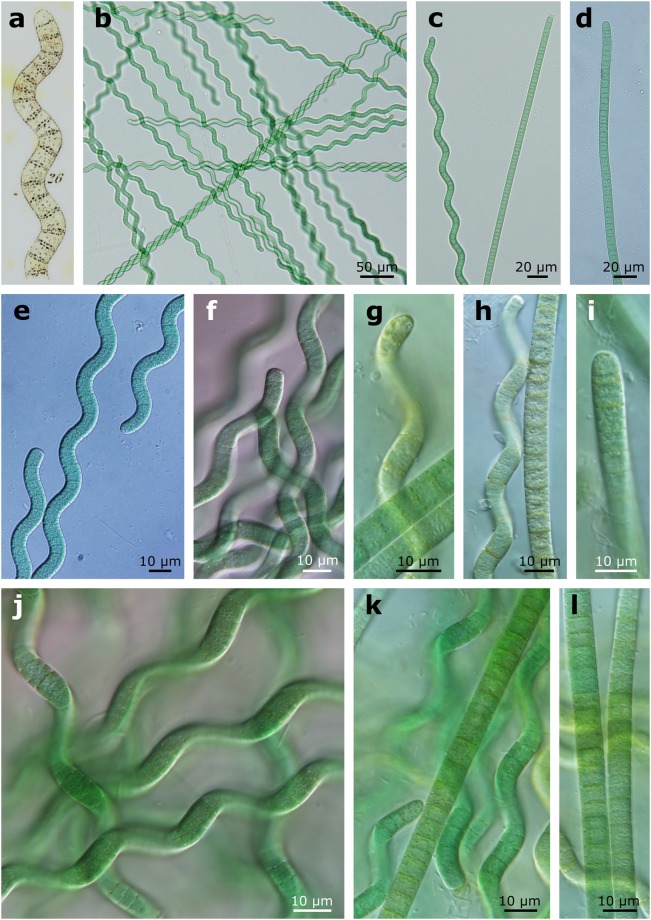
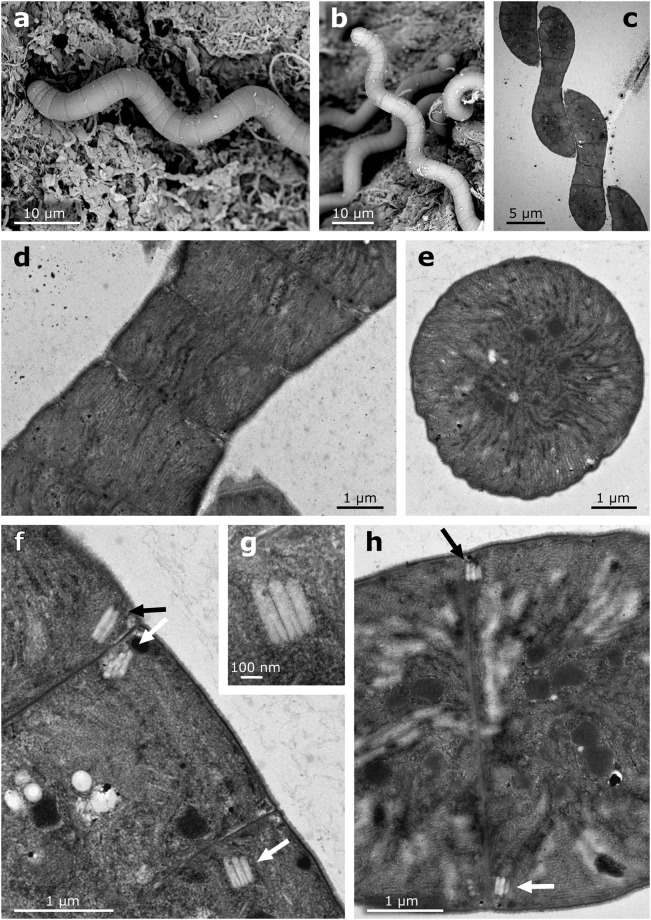
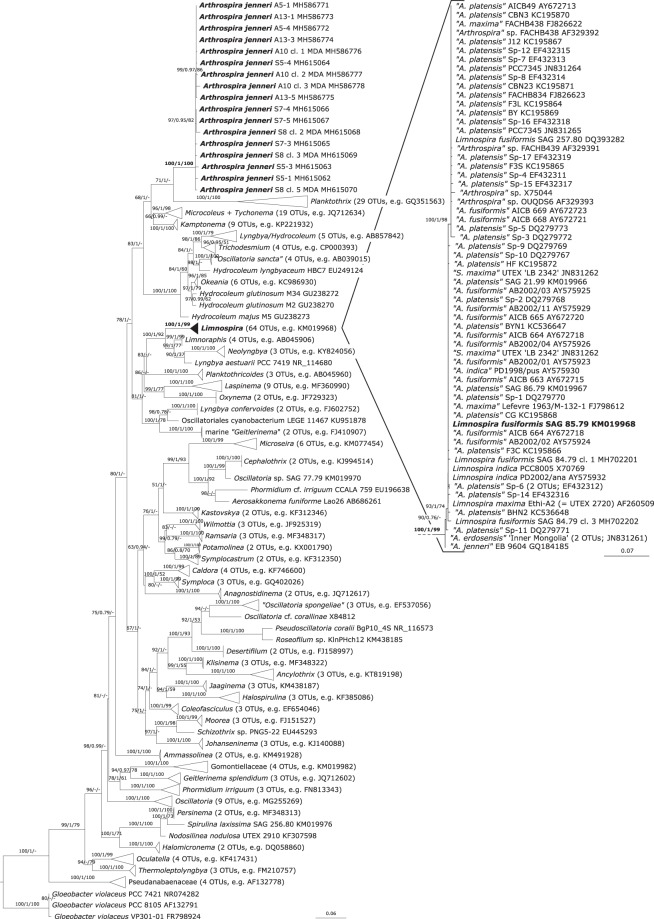
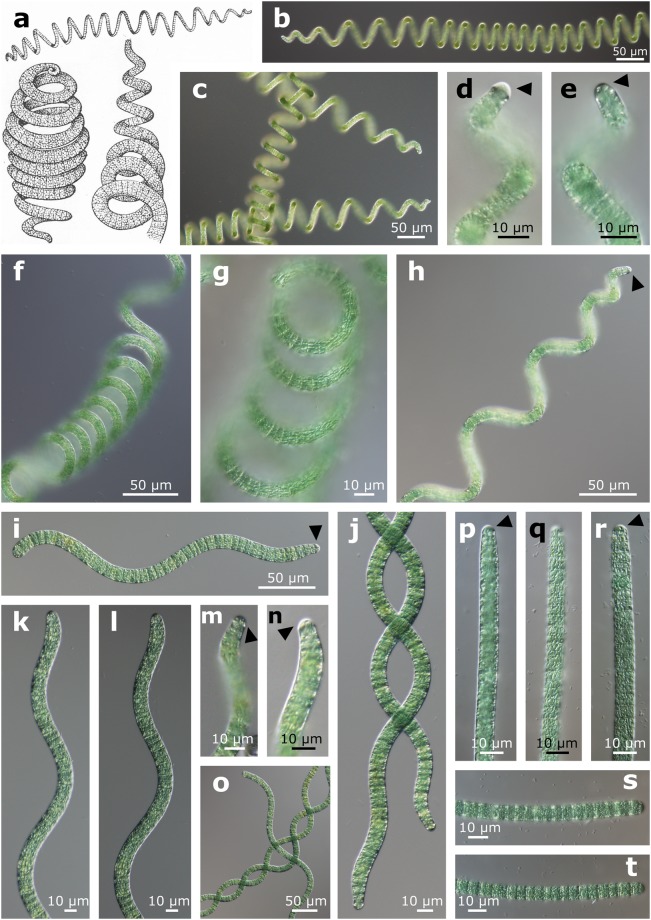
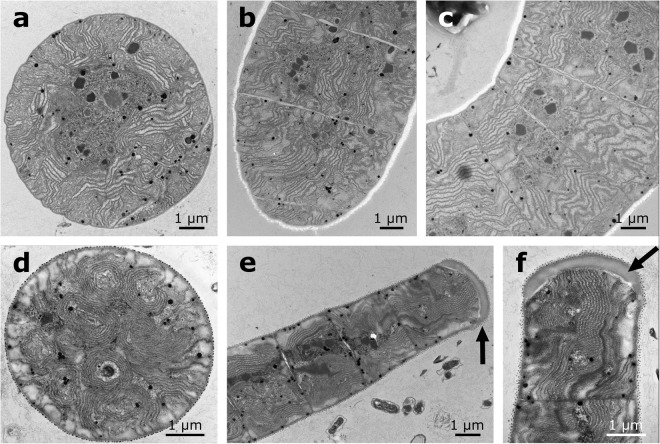
The genus Arthrospira has a long history of being used as a food source in different parts of the world. Its mass cultivation for production of food supplements and additives has contributed to a more detailed study of several species of this genus. In contrast, the type species of the genus ( A. jenneri ), has scarcely been studied. This work adopts a polyphasic approach to thoroughly investigate environmental samples of A. jenneri , whose persistent bloom was noticed in an urban reservoir in Poland, Central Europe. The obtained results were compared with strains designated as A. platensis, A. maxima , and A. fusiformis from several culture collections and other Arthrospira records from GenBank. The comparison has shown that A. jenneri differs from popular species that are massively utilized commercially with regard to its cell morphology, ultrastructure and ecology, as well as its 16S rRNA gene sequence. Based on our findings, we propose the establishment of a new genus, Limnospira , which currently encompasses three species including the massively produced L . ( A .) fusiformis and L . ( A .) maxima with the type species Limnospira fusiformis .
Overview
The claims and statistics of this paper haven’t been checked yet.
Free: it reads the open-access text and checks the first 5 claims that cite a source we can check. Create a free account to check every claim.
Integrity signals
Registry
Cites
Statistics
Figures
Verification
Claims the paper makes
The claims and statistics of this paper haven’t been checked yet.
Free: it reads the open-access text and checks the first 5 claims that cite a source we can check. Create a free account to check every claim.
Claims other papers make about this one
Each is checked against this paper’s own text: does it say what the citing paper says it does?
The source backs part of the claim, not all of it — or backs it for a different population, condition or comparison.
In the citing paper
“Further studies of Arthrospira species revealed severe differences between the type strain A. jenneri and commercially produced strains [26].”
From Spirulina/Arthrospira/Limnospira—Three Names of the Single Organism (2024) · cites this paper as [26]
Experimental — accuracy not yet measuredThe source backs part of the claim, not all of it — or backs it for a different population, condition or comparison.
In the citing paper
“Finally, at this moment, the name Limnospira is proposed for economically important species that include formally known A. maxima, A. fusiformis, and A. platensis [26].”
From Spirulina/Arthrospira/Limnospira—Three Names of the Single Organism (2024) · cites this paper as [26]
Experimental — accuracy not yet measuredThe source backs part of the claim, not all of it — or backs it for a different population, condition or comparison.
In the citing paper
“Summarizing the taxonomical pirouettes of spirulina, one can conclude that three groups of organisms are distinguished at present:Spirulina spp.—12 species with the type strain Spirulina subsalsa;Arthrospira spp.—about 35 species with the type strain Arthrospira jenneri;Limnospira spp.—4 species with the type strain Limnospira fusiformis (formerly Spirulina fusiformis), as well as Limnospira (”
From Spirulina/Arthrospira/Limnospira—Three Names of the Single Organism (2024) · cites this paper as [26]
Experimental — accuracy not yet measuredThe source backs part of the claim, not all of it — or backs it for a different population, condition or comparison.
In the citing paper
“Nowadays, spirulina species are classified into three genera: Spirulina, Arthrospira, and Limnospira.”
From Spirulina/Arthrospira/Limnospira—Three Names of the Single Organism (2024) · cites this paper as [26]
Experimental — accuracy not yet measuredThe cited source says what the claim attributes to it.
In the citing paper
“When Limnospira spp. was separated from Arthrospira in 2019, there was doubt about A. platensis; it was not definitely assigned to the Limnospira clade [26].”
From Spirulina/Arthrospira/Limnospira—Three Names of the Single Organism (2024) · cites this paper as [26]
1 more claim about this paper
Create a free account to see every claim other papers make about this one.
Self-check
Percentages, sums and reported differences re-computed from the paper’s own numbers.
The self-check needs the paper’s full text.
Citations
Cites
MEGA6: Molecular Evolutionary Genetics Analysis Version 6.0
Tamura, K., Stecher, G., Peterson, D., Filipski, A., & Kumar, S. (2013) · Molecular Biology and Evolution · doi:10.1093/molbev/mst197 · Cited by 47,205
MEGA7: Molecular Evolutionary Genetics Analysis Version 7.0 for Bigger Datasets
Kumar, S., Stecher, G., & Tamura, K. (2016) · Molecular Biology and Evolution · doi:10.1093/molbev/msw054 · Cited by 44,059
MrBayes 3.2: Efficient Bayesian Phylogenetic Inference and Model Choice Across a Large Model Space
Ronquist, F., Teslenko, M., van der Mark, P., Ayres, D. L., Darling, A., Höhna, S., Larget, B., Liu, L., Suchard, M. A., & Huelsenbeck, J. P. (2012) · Systematic Biology · doi:10.1093/sysbio/sys029 · Cited by 27,843
Kearse, M., Moir, R., Wilson, A., Stones-Havas, S., Cheung, M., Sturrock, S., Buxton, S., Cooper, A., Markowitz, S., Duran, C., et al. (2012) · Bioinformatics · doi:10.1093/bioinformatics/bts199 · Cited by 20,027
jModelTest 2: more models, new heuristics and parallel computing
Darriba, D., Taboada, G. L., Doallo, R., & Posada, D. (2012) · Nature Methods · doi:10.1038/nmeth.2109 · Cited by 16,785
16S ribosomal DNA amplification for phylogenetic study
Weisburg, W. G., Barns, S. M., Pelletier, D. A., & Lane, D. J. (1991) · Journal of Bacteriology · doi:10.1128/jb.173.2.697-703.1991 · Cited by 11,934
MAFFT online service: multiple sequence alignment, interactive sequence choice and visualization
Katoh, K., Rozewicki, J., & Yamada, K. D. (2019) · Briefings in Bioinformatics · doi:10.1093/bib/bbx108 · Cited by 8,909
W-IQ-TREE: a fast online phylogenetic tool for maximum likelihood analysis
Trifinopoulos, J., Nguyen, L.-T., von Haeseler, A., & Minh, B. Q. (2016) · Nucleic Acids Research · doi:10.1093/nar/gkw256 · Cited by 5,504
PCR primers to amplify 16S rRNA genes from cyanobacteria
Nübel, U., Garcia-Pichel, F., & Muyzer, G. (1997) · Applied and Environmental Microbiology · doi:10.1128/aem.63.8.3327-3332.1997 · Cited by 1,513
Multifunctional Biohybrid Magnetite Microrobots for Imaging-Guided Therapy
Yan, X., Zhou, Q., Vincent, M., Deng, Y., Yu, J., Xu, J., Xu, T., Tang, T., Bian, L., Wang, Y.-X. J., et al. (2017) · Science Robotics · doi:10.1126/scirobotics.aaq1155 · Cited by 893
Improving the coverage of the cyanobacterial phylum using diversity driven genome sequencing
Shih, P. M., Wu, D., Latifi, A., Axen, S. D., Fewer, D. P., Talla, E., Calteau, A., Cai, F., Tandeau de Marsac, N., Rippka, R., et al. (2013) · Proceedings of the National Academy of Sciences · doi:10.1073/pnas.1217107110 · Cited by 800
Spirulina, the edible microorganism.
Ciferri, O. (1983) · Microbiological Reviews · doi:10.1128/mmbr.47.4.551-578.1983 · Cited by 745
Komárek, J., Kaštovský, J., Mareš, J., & Johansen, J. R. (2014) · ASEP · Cited by 709
Taton, A., Grubisic, S., Brambilla, E., De Wit, R., & Wilmotte, A. (2003) · Applied and Environmental Microbiology · doi:10.1128/aem.69.9.5157-5169.2003 · Cited by 475
Antioxidant activity of different fractions of Spirulina platensis protean extract
Piñero Estrada, J. (2001) · Il Farmaco · doi:10.1016/s0014-827x(01)01084-9 · Cited by 447
Production of spirulina biomass: Effects of environmental factors and population density
Vonshak, A., Abeliovich, A., Boussiba, S., Arad, S., & Richmond, A. (1982) · Biomass · doi:10.1016/0144-4565(82)90028-2 · Cited by 237
Komarek, J. (2006) · ALGAE · doi:10.4490/algae.2006.21.4.349 · Cited by 165
Impact of algal research in aquaculture
Wikfors, G. H., & Ohno, M. (2001) · Journal of Phycology · doi:10.1046/j.1529-8817.2001.01136.x · Cited by 159
Genomic DNA amplification by the multiple displacement amplification (MDA) method
Lasken, R. S. (2009) · Biochemical Society Transactions · doi:10.1042/bst0370450 · Cited by 145
Sili, C., Torzillo, G., & Vonshak, A. (2012) · Springer eBooks · doi:10.1007/978-94-007-3855-3_25 · Cited by 113
Carvalho, J. C. M., Francisco, F. R., Almeida, K. A., Sato, S., & Converti, A. (2004) · Journal of Phycology · doi:10.1111/j.1529-8817.2004.03167.x · Cited by 83
Melack, J. M. (1979) · Limnology and Oceanography · doi:10.4319/lo.1979.24.4.0753 · Cited by 82
MORPHOLOGICAL REVERSION OF SPIRULINA (ARTHROSPIRA) PLATENSIS (CYANOPHYTA): FROM LINEAR TO HELICAL1
Wang, Z. P., & Zhao, Y. (2005) · Journal of Phycology · doi:10.1111/j.1529-8817.2005.00087.x · Cited by 64
Earth Food Spirulina (Arthrospira): Production and Quality Standarts
Koru, E. (2012) · Food Additive · doi:10.5772/31848 · Cited by 59
Mareš, J., Lara, Y. J., Dadáková, I., Hauer, T., Uher, B., Wilmotte, A., & Kaštovský, J. (2015) · Journal of Phycology · doi:10.1111/jpy.12273 · Cited by 48
Self-citationBallot, A., Dadheech, P. K., & Krienitz, L. (2004) · Algological Studies/Archiv für Hydrobiologie, Supplement Volumes · doi:10.1127/1864-1318/2004/0113-0037 · Cited by 43
Liu, H., Chen, H., Wang, S., Liu, Q., Li, S., Song, X., Huang, J., Wang, X., & Jia, L. (2017) · Bioresource Technology · doi:10.1016/j.biortech.2017.12.046 · Cited by 37
Li, R., Debella, H. J., & Carmichael, W. W. (2001) · Phycologia · doi:10.2216/i0031-8884-40-4-367.1 · Cited by 36
The modern classification of cyanoprokaryotes [Cyanobacteria]
Komárek, J. (2005) · Oceanological and Hydrobiological Studies · Cited by 34
LewisOscar, F., Nithya, C., Alharbi, S. A., Alharbi, N. S. H. A., & Thajuddin, N. (2018) · Microbial Pathogenesis · doi:10.1016/j.micpath.2018.01.046 · Cited by 32
Oyoo‐Okoth, E., Muchiri, M., Shivoga, W. A., Miller, S. N., Rasowo, J., & Ngugi, C. C. (2009) · Lakes & Reservoirs Science Policy and Management for Sustainable Use · doi:10.1111/j.1440-1770.2009.00392.x · Cited by 28
Contribution of long-term tide components to sea level variations
Wiśniewski, B. (2005) · Oceanological and Hydrobiological Studies · Cited by 16
Rapid reversible macromorphological changes inSpifulina platensis
van Eykelenburg, C., & Fuchs, A. (1980) · Die Naturwissenschaften · doi:10.1007/bf01086309 · Cited by 11
Liu, Y., Wang, Z., Lin, S., Yu, G., & Li, R. (2013) · Phycologia · doi:10.2216/13-142.1 · Cited by 10
Knysak, P., & Żelazna‐Wieczorek, J. (2017) · Oceanological and Hydrobiological Studies · doi:10.1515/ohs-2017-0012 · Cited by 2
Research works printed but not linked: 12
- Iltis, A. Algues des eaux natroné du Kanem (Tchad). Cah. O.R.S.T.O.M., Hydrobiol. 7(1), 25–54 (In French, with English summary) (1973).
- Tefera G Hailu D Tsegaye Z Importance of Arthrospira Spirulina in Sustainable Development Int. J. Curr. Trend. Pharmacobiol. Med. Sci. 2016 1 2 60 68
- Gomont M Monographie des Oscillariées (Nostocacées Homocystées), Deuxième partie. - Lyngbyées Annls. Sci. Nat. Bot. 1892 7 16 91 264
- Komárek J Lund JWG What is “Spirulina platensis” in fact? Algol. Stud. 1990 58 1 13
- Komárek, J. & Anagnostidis, K. Cyanoprokaryota II, Oscillatoriales, (eds Büdel, B., Gärtner, G., Krienitz, L. & Schagerl M.) 1–757 (Elsevier GmbH, 2005).
- Stizenberger E Spirulina und Arthrospira (nov. gen.) Hedwigia 1854 1 7 32 34
- Voronichin NN K biologii mineralizovanych vodojemov Kulundinskoj stepi. Trudy Soveta Izucheniu Prirodnych Resursov, Ser Sibirsk. 1934 8 177 183
- Gardner NL New Pacific coast marine algae I Univ. Calif. Publ. Bot. 1917 6 377 416
- Desikachary, T. V. & Jeeji Bai, N. Studies in Spirulina. (eds Seshadri, C. V. & Jeeji Bai, N.) 12–21 (Spirulina. ETTA National Symposium MCRC, Madras, 1992).
- Hindák F Morphology of trichomes in Spirulina fusiformis Voronichin from Lake Bogoria, Kenya Arch. Hydrobiol. Suppl. 1985 71 201 218
- Kufferath H Contribution à l'étude de la flore algologique du Luxembourg meridionale. Chlorophycees (exclus. Desmidiacées), Flagellates et Cyanophycées Ann. Biol. Lac. 1914 2 231 271
- Zapomělová E Řeháková K Znachor P Komárková J Morphological diversity of coiled planktonic types of the genus Anabaena (cyanobacteria) in natural populations - taxonomic consequences Cryptogam. Algol. 2007 28 353 371
Cited by
Spínola, M. P., Mendes, A. R., & Prates, J. A. M. (2024) · Foods · doi:10.3390/foods13223656 · Cited by 146
Wu, J. Y., Tso, R., Teo, H. S., & Haldar, S. (2023) · Frontiers in Nutrition · doi:10.3389/fnut.2023.1277343 · Cited by 126
Chittapun, S., Jonjaroen, V., Khumrangsee, K., & Charoenrat, T. (2020) · Algal Research · doi:10.1016/j.algal.2020.101789 · Cited by 126
Spirulina for Skin Care: A Bright Blue Future
Ragusa, I., Nardone, G. N., Zanatta, S., Bertin, W., & Amadio, E. (2021) · Cosmetics · doi:10.3390/cosmetics8010007 · Cited by 104
“[3]), such as the most popular Spirulina platensis and Spirulina maxima.”
BackgroundCyanobacteria and microalgae in supporting human habitation on Mars
Mapstone, L. J., Leite, M. N., Purton, S., Crawford, I. A., & Dartnell, L. (2022) · Biotechnology Advances · doi:10.1016/j.biotechadv.2022.107946 · Cited by 92
Metadata
- Authors
- Nowicka-Krawczyk, P., Mühlsteinová, R., & Hauer, T.
- Affiliations
- University of Łódź (PL)
- University of South Bohemia in České Budějovice (CZ)
- Corresponding author
- Hauer, Tomáš
- Venue
- Scientific Reports
- Published
- 2019-01-24
- Volume
- 9
- Issue
- 1
- Pages
- 694-694
- ISSN
- 2045-2322 (ISSN-L)
- PMC
- PMC6345927
- OpenAlex
- W2913175331
- Cited by
- 185
- References
- 36
- Citations by year
- 2026: 32 · 2025: 28 · 2024: 41 · 2023: 37 · 2022: 16 · 2021: 17 · 2020: 12 · 2019: 2
- FWCI
- 5.12
- Type
- journal article
- Language
- en
- Open access
- gold
- doi.org
- Licence
- cc-by
- creativecommons.org/licenses/by/4.0 (tdm)
- creativecommons.org/licenses/by/4.0 (vor)
- Locations
- Scientific Reports (publishedVersion, cc-by)
- Europe PMC (PubMed Central) (publishedVersion, cc-by)
- PubMed Central (publishedVersion, cc-by)
- PubMed (publishedVersion)
- DOAJ (DOAJ: Directory of Open Access Journals) (submittedVersion)
- Funders
- Ministerstvo Školství, Mládeže a Tělovýchovy (LM2010005, LM2015062-CzechBioImaging, LM2015062)
- Topics
- Physical Sciences › Environmental Science › Environmental Chemistry › Aquatic Ecosystems and Phytoplankton Dynamics
- Life Sciences › Agricultural and Biological Sciences › Ecology, Evolution, Behavior and Systematics › Biocrusts and Microbial Ecology
- Life Sciences › Agricultural and Biological Sciences › Ecology, Evolution, Behavior and Systematics › Protist diversity and phylogeny
- Keywords
- Arthrospira, new genus, Arthrospira fusiformis, Arthrospira maxima, Spirulina platensis, polyphasic characterization, 16S rRNA gene, cell morphology, ultrastructure, cyanobacterial blooms, urban reservoirs
- MeSH terms
- Cyanobacteria, Phylogeny, Poland, RNA, Ribosomal, 16S, Spirulina
About these checks
Registry, retraction, Cites and statistics results are computed, not judged, with one exception: a printed reference that no index lists is read once by a model before it counts as a citation error. Claims are extracted by a model and kept only when their quote appears verbatim in the text; each cited source is then checked, with a model’s help, for whether it says what the claim relies on. Those verdicts can be wrong — read the claim’s quote and the cited source before relying on one.
Statistics and arithmetic are recomputed, not judged.
Confidence bands are shown only for fields calibrated on our annotated test set. None is calibrated yet, so no band is shown.
What counts as a claim ›How we measure confidence ›How we check this ›
Are you an author, or do you see a problem with this page? Request a review
Data sources
Bibliographic data: Semantic Scholar, OpenAlex, Crossref.
Contains information from the Semantic Scholar Academic Graph Datasets, made available under the ODC Attribution License (ODC-BY 1.0).
Semantic Scholar’s data is described in: Kinney, R., et al. (2023). The Semantic Scholar Open Data Platform. arXiv:2301.10140.
