

Clostridium ramosum regulates enterochromaffin cell development and serotonin release
Open accessThe DOI matches its Crossref record; 67 of the 67 references it cites were found in a registry or an index.
Abstract
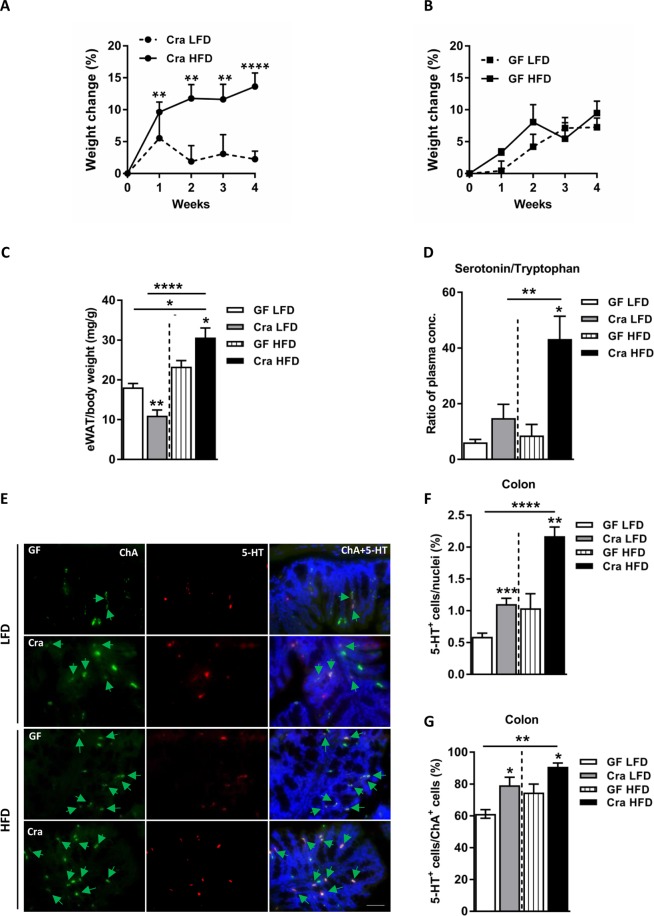
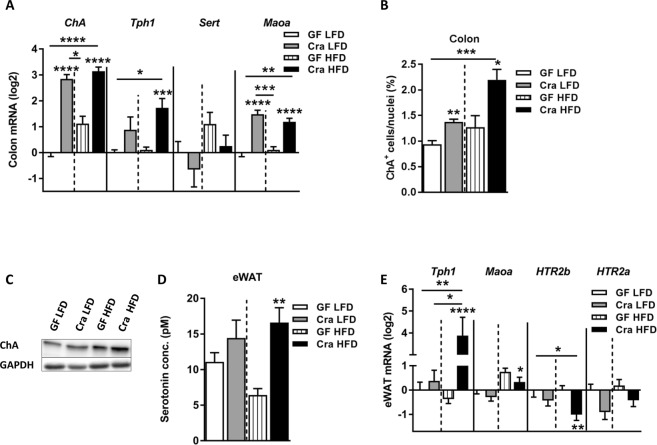
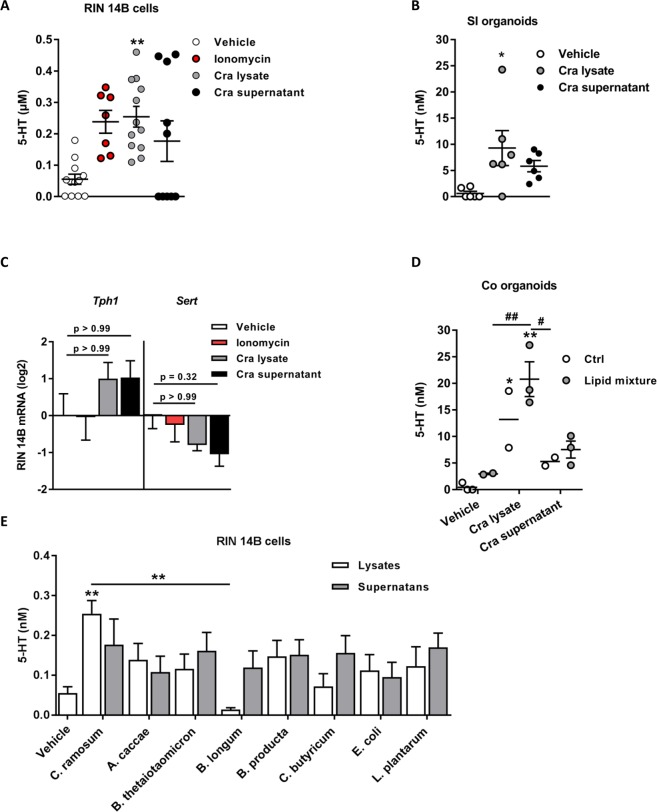
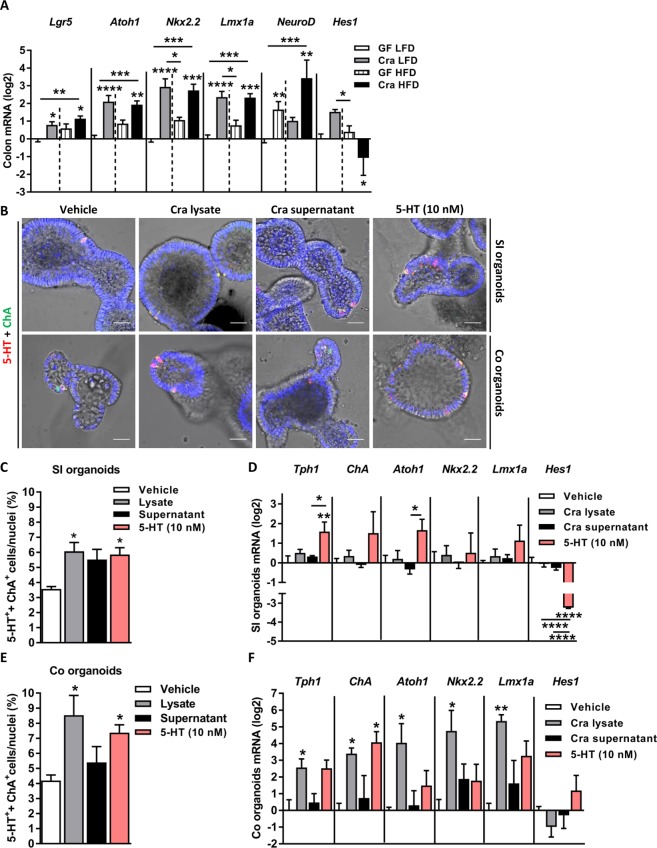
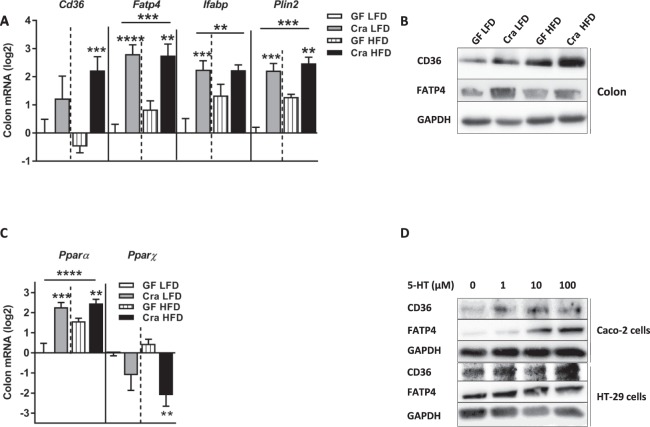
Peripheral serotonin (5-hydroxytryptamine: 5-HT) synthesized in the intestine by enterochromaffin cells (ECs), plays an important role in the regulation of peristaltic of the gut, epithelial secretion and promotes the development and maintenance of the enteric neurons. Recent studies showed that the indigenous gut microbiota modulates 5-HT signalling and that ECs use sensory receptors to detect dietary and microbiota-derived signals from the lumen to subsequently transduce the information to the nervous system. We hypothesized that Clostridium ramosum by increasing gut 5-HT availability consequently contributes to high-fat diet-induced obesity. Using germ-free mice and mice monoassociated with C . ramosum , intestinal cell lines and mouse organoids, we demonstrated that bacterial cell components stimulate host 5-HT secretion and program the differentiation of colonic intestinal stem progenitors toward the secretory 5-HT-producing lineage. An elevated 5-HT level regulates the expression of major proteins involved in intestinal fatty acid absorption in vitro , suggesting that the presence of C . ramosum in the gut promotes 5-HT secretion and thereby could facilitates intestinal lipid absorption and the development of obesity.
Overview
The claims and statistics of this paper haven’t been checked yet.
Free: it reads the open-access text and checks the first 5 claims that cite a source we can check. Create a free account to check every claim.
Integrity signals
Registry
Cites
Statistics
Figures
Verification
Claims the paper makes
The claims and statistics of this paper haven’t been checked yet.
Free: it reads the open-access text and checks the first 5 claims that cite a source we can check. Create a free account to check every claim.
Self-check
Percentages, sums and reported differences re-computed from the paper’s own numbers.
The self-check needs the paper’s full text.
Citations
Cites
Bradford, M. M. (1976) · Analytical Biochemistry · doi:10.1016/0003-2697(76)90527-3 · Cited by 255,302
Human gut microbes associated with obesity
Ley, R. E., Turnbaugh, P. J., Klein, S., & Gordon, J. I. (2006) · Nature · doi:10.1038/4441022a · Cited by 8,785
Single Lgr5 stem cells build crypt-villus structures in vitro without a mesenchymal niche
Sato, T., Vries, R. G., Snippert, H. J., van de Wetering, M., Barker, N., Stange, D. E., van Es, J. H., Abo, A., Kujala, P., Peters, P. J., et al. (2009) · Nature · doi:10.1038/nature07935 · Cited by 7,204
A metagenome-wide association study of gut microbiota in type 2 diabetes
Qin, J., Li, Y., Cai, Z., Li, S., Zhu, J., Zhang, F., Liang, S., Zhang, W., Guan, Y., Shen, D., et al. (2012) · Nature · doi:10.1038/nature11450 · Cited by 6,762
Obesity alters gut microbial ecology
Ley, R. E., Bäckhed, F., Turnbaugh, P., Lozupone, C. A., Knight, R. D., & Gordon, J. I. (2005) · Proceedings of the National Academy of Sciences · doi:10.1073/pnas.0504978102 · Cited by 6,176
Richness of human gut microbiome correlates with metabolic markers
Le Chatelier, E., Nielsen, T., Qin, J., Prifti, E., Hildebrand, F., Falony, G., Almeida, M., Arumugam, M., Batto, J.-M., Kennedy, S., et al. (2013) · Nature · doi:10.1038/nature12506 · Cited by 4,662
Indigenous bacteria from the gut microbiota regulate host serotonin biosynthesis
Yano, J. M., Yu, K., Donaldson, G. P., Shastri, G. G., Ann, P., Ma, L., Nagler, C. R., Ismagilov, R. F., Mazmanian, S. K., & Hsiao, E. Y. (2015) · Cell · doi:10.1016/j.cell.2015.02.047 · Cited by 3,614
Gut metagenome in European women with normal, impaired and diabetic glucose control
Karlsson, F. H., Tremaroli, V., Nookaew, I., Bergström, G., Behre, C. J., Fagerberg, B., Nielsen, J., & Bäckhed, F. (2013) · Nature · doi:10.1038/nature12198 · Cited by 3,115
PPARγ signaling and metabolism: the good, the bad and the future
Ahmadian, M., Suh, J. M., Hah, N., Liddle, C., Atkins, A. R., Downes, M., & Evans, R. M. (2013) · Nature Medicine · doi:10.1038/nm.3159 · Cited by 2,016
PPARγ Is Required for Placental, Cardiac, and Adipose Tissue Development
Barak, Y., Nelson, M. C., Ong, E. S., Jones, Y. Z., Ruiz-Lozano, P., Chien, K. R., Koder, A., & Evans, R. M. (1999) · Molecular Cell · doi:10.1016/s1097-2765(00)80209-9 · Cited by 1,956
Cited by
Items 101–151 of 151
The Impacts of Microbiota on Animal Development and Physiology
Walsh, K. T., & Guillemin, K. J. (2022) · Progress in inflammation research · doi:10.1007/978-3-030-91051-8_6 · Cited by 6
Tingler, A. M., Figuereo, Y. F., Engevik, K. A., Weis, V. G., Krigsman, A., Engevik, M. A., & Walker, S. J. (2026) · Digestive Diseases and Sciences · doi:10.1007/s10620-026-09667-2 · Cited by 8
Serotonin and the gut microbiome: Pathways, functions, and health implications
Abubaker, S., Miri, S., & Hammami, R. (2026) · The Microbe · doi:10.1016/j.microb.2026.100668 · Cited by 8
Chen, W., Shui, M., Wei, Z., Gao, W., Liu, X., & Lei, Q. (2026) · Frontiers in Cardiovascular Medicine · doi:10.3389/fcvm.2026.1726522 · Cited by 6
“…5-HT acts as a neurotransmitter, and both are involved in cardiovascular function. metabolic disorders are closely associated with cardiovascular diseases, such as hypertension and atherosclerosis, as well as various conditions, including irritable bowel syndrome and depression (63, 64).”
5-Hydroxytryptamine promotes non-small cell lung cancer metastasis via the SNRPG/WT1/CDK14 Axis
Sun, J., Liu, C., Chen, S., Zhou, H., Liu, X., Wang, F.-R., Luo, Y., Zang, D., & Chen, J. (2025) · Molecular Biomedicine · doi:10.1186/s43556-025-00312-4 · Cited by 6
“For example, Clostridium ramo-sum enhances 5-HT production in colon ECs [31].”
Host-microbiota interactions regulate gut serotonergic signaling: implications for hypertension
Kumar, H. S., & Zubcevic, J. A. (2025) · American Journal of Physiology-Cell Physiology · doi:10.1152/ajpcell.00608.2025 · Cited by 5
Gut microbiota-derived indole metabolites in depression: mechanisms and therapeutic potential
Wang, X., Liu, R., Liu, J., Lin, Y., & Zhou, M. (2026) · European Journal of Pharmacology · doi:10.1016/j.ejphar.2026.178720 · Cited by 5
Seyoum, M. M., Assumpcao, A. L. F. V., Caputi, V., Ashwell, C. M., Honaker, C. F., Daniels, K. M., Lyte, M., Siegel, P. B., Taylor, R. L., & Lyte, J. M. (2025) · Poultry Science · doi:10.1016/j.psj.2025.104943 · Cited by 4
“…findings suggest that the cecal microbiota, especially taxa such as Clostridia , may play a role in regulating local and systemic serotonin concentrations (Mandi ´ c et al., 2019; Yano et al., 2015), which in turn could influence intestinal health and the immune system ’ s response to pathogens.”
Contributions of multiple transport mechanisms to intestinal uptake of serotonin
Asaji, S., Funai, Y., Seki, Y., Tamai, I., & Shirasaka, Y. (2024) · Journal of Pharmaceutical Sciences · doi:10.1016/j.xphs.2024.07.020 · Cited by 2
Sleep, gut microbiota, and mind-body medicine
Das, M., Muralitharan, G., Saini, S., & Patra, S. (2025) · Brain Behavior and Immunity Integrative · doi:10.1016/j.bbii.2025.100128 · Cited by 4
Kuo, T.-H., Wu, P., Liu, P., Chuang, Y., Tai, C.-J., Kuo, M., Chiu, Y., & Lin, Y. (2025) · International Journal of Molecular Sciences · doi:10.3390/ijms262110463 · Cited by 3
Sato, M., Nakamura, M., Nakamura, A., Takahashi, H., Azuma, S., & Kuda, T. (2025) · Food and Humanity · doi:10.1016/j.foohum.2025.100884 · Cited by 2
He, Z., Guo, N., yu, C., Zou, T., Lu, H., Lv, Y., Wang, T., & Dong, H. X. (2026) · Animal Microbiome · doi:10.1186/s42523-026-00518-z · Cited by 2
Wang, S., Chen, D., Ji, X., Shen, Q., Yu, Y., Wu, P., & Tang, G. (2024) · Frontiers in Veterinary Science · doi:10.3389/fvets.2024.1403493 · Cited by 4
Hatch, K., Horseman, T. S., Parajuli, B., Murphy, E. K., Cole, R. N., O’Meally, R. N., Perl, D. P., Burmeister, D. M., & Iacono, D. (2025) · International Journal of Molecular Sciences · doi:10.3390/ijms26178121 · Cited by 3
“Glutamate [20] Down Serotonin [21] Rummeliibacillus GABA [22] Firmicutes d14 p = 0.00261 N/A Dopamine [23] d14 p = 0.00099 Down Acetylcholine [18] Down Coprococcus SCFA [24] Norepinephrine d14 p = 0.00854 Serotonin [25] Down Carnobacterium d14 p = 0.01426 Tyrosine [26] Down Norepinephrine [27]…”
InfluentialPathak, N. K., Nandeshwar, N., Sahoo, P., Pradhan, A. K., Singha, T., Datta, P. K., & Tripathy, U. (2025) · Scientific Reports · doi:10.1038/s41598-025-16254-4 · Cited by 3
Yan, M., Wu, C., Xu, W., Tao, G., Fei, Z., & Jiang, H. (2025) · Natural Product Communications · doi:10.1177/1934578x251387007 · Cited by 1
Tracing NAD+ metabolism uncovers adaptive coordination between host and microbiome during colitis
Alsaadi, A. I., Wehkamp, L., Pothakamury, A. A., Yahia, M. S., Prasad, P., Gilloteau, C., Sadler, J., Smith, J. D., Jenkins, B. C., Diven, G. S., et al. (2026) · Cell Reports · doi:10.1016/j.celrep.2026.117730 · Cited by 4
“38 However, the flux of Trp to serotonin was not altered in other tissues, including colonic tissues (Figure 5C).”
Tryptophan Signaling Molecules in Children with Different Developmental Dynamics of Obesity
Shatova, O. P., Kolesnikova, I. M., Yagodkina, E. M., Kaydoshko, S. S., Михайлович, Г. А., Roumiantsev, S. A., & Shestopalov, A. V. (2024) · Journal of Evolutionary Biochemistry and Physiology · doi:10.1134/s002209302404001x · Cited by 1
Raka, F., Hoffman, S., Nady, A., Guan, H. C., Zhang, R., Wang, H., Khan, W. I., & Adeli, K. (2024) · Endocrinology · doi:10.1210/endocr/bqae112 · Cited by 4
Flint, H. J. (2020) · Fascinating life sciences · doi:10.1007/978-3-030-43246-1_8 · Cited by 1
Microbe-derived indole tunes organ-function and links microbe metabolites to biological ageingPreprint
Xing, P. Y., Jayaraman, A., Zhang, G. W., Martin, K. A., Faylon, L. E., Kjelleberg, S. J., Rice, S. A., Wang, Y., Bello, A. T., Holmes, E. C., et al. (2023) · bioRxiv (Cold Spring Harbor Laboratory) · doi:10.1101/2023.01.24.525337 · Cited by 2
“On the other hand, mono-colonization of GF mice with Clostridium ramosum succeeds in promoting enterochromaffin cell differentiation and serotonin production, facilitating intestinal fatty acid absorption and modulating metabolic functions (Mandic et al, 2019).”
BackgroundMechanism of Action of Intestinal Microorganisms and Progress in Head and Neck TumorsPreprint
Su, X., Fa-qiang, M., & Jin, F. (2024) · Preprints.org · doi:10.20944/preprints202401.0092.v1
Gut microbiota plays a role in irritable bowel syndrome by regulating 5-HT metabolism
Feng, Y., Hang, L., Zhou, Y., Jiang, F.-R., & Yuan, J. (2022) · World Chinese Journal of Digestology · doi:10.11569/wcjd.v30.i21.941
Gao, C., Shao, D., Wang, C., Kuang, Y., Lu, J., Zeng, D., He, J., & Qiu, X. (2023) · Clinical and Translational Medicine · doi:10.1002/ctm2.1470
Features of the Gut Microbiota in Patients with Polycystic Ovary Syndrome
Дмитриевна, К. Е., Muravieva, V. V., Леонидовна, И. Е., Skorobogatiy, A. V., Zhigalova, K. N., Kozlova, A. A., Priputnevich, T. V., & Евгеньевна, Ч. Г. (2023) · Annals of the Russian academy of medical sciences · doi:10.15690/vramn6442 · Cited by 1
Level of tryptophan signaling molecules in children with different dynamics of obesity development
Shatova, O. P., Kolesnikova, I. M., Yagodkina, E. M., Kaydoshko, S. S., Михайлович, Г. А., Roumiantsev, S. A., & Shestopalova, A. V. (2024) · Журнал эволюционной биохимии и физиологии · doi:10.31857/s0044452924040022
The microbiome mechanism behind depression and treatment prospects of targeting intestinal microbes
Jiang, K., Wang, H., Zeng, Z., Shi, X., Liu, L., Wu, G., & Tan, Y. (2025) · Reviews in Medical Microbiology · doi:10.1097/mrm.0000000000000421
Yu, M., Xu, M., Wang, G., Feng, J., & Zhang, M. (2025) · Poultry Science · doi:10.1016/j.psj.2025.105225 · Cited by 2
“(Mandi ´ c, et al., 2019).”
Chen, G., Cao, L., Zhao, H., Li, T., Xiong, Z., Li, C., Jia, Y., Song, J., Liu, Y., & Liu, S. (2025) · SSRN Electronic Journal · doi:10.2139/ssrn.5252470
Faraj, S., Joblin-Mills, A., Sequeira, I. R., Leiu, K. H., Tung Nguyenc, T., Wallbank, J. A., Fraser, K., Miles-Chan, J. L., Poppitt, S. D., & Taylor, M. W. (2025) · Metabolites · doi:10.3390/metabo15080522
“This is notable due to E. ramosum ’s documented impact on host metabolism via enhancing intestinal lipid absorption via serotonin-mediated enterochromaffin cell development [49] and promoting high-fat-diet-induced obesity in mouse models [78].”
Additional file 5 of Regulation of serotonin production by specific microbes from piglet gut
Liu, Z., Ling, Y., Peng, Y., Han, S., Ren, Y., Jing, Y., Fan, W., Su, Y., Mu, C., & Zhu, W. (2024) · Figshare · doi:10.6084/m9.figshare.26608227
Liu, J., Xi, K., Zhang, L., Han, M., Wang, Q., & Liu, X. (2024) · Figshare · doi:10.6084/m9.figshare.24946333
Additional file 2 of Regulation of serotonin production by specific microbes from piglet gut
Liu, Z., Ling, Y., Peng, Y., Han, S., Ren, Y., Jing, Y., Fan, W., Su, Y., Mu, C., & Zhu, W. (2024) · Figshare · doi:10.6084/m9.figshare.26608218
Liu, J., Xi, K., Zhang, L., Han, M., Wang, Q., & Liu, X. (2024) · Figshare · doi:10.6084/m9.figshare.26660137
Liu, J., Xi, K., Zhang, L., Han, M., Wang, Q., & Liu, X. (2024) · Figshare · doi:10.6084/m9.figshare.24946639
Additional file 1 of Regulation of serotonin production by specific microbes from piglet gut
Liu, Z., Ling, Y., Peng, Y., Han, S., Ren, Y., Jing, Y., Fan, W., Su, Y., Mu, C., & Zhu, W. (2024) · Figshare · doi:10.6084/m9.figshare.26608215
Additional file 3 of Regulation of serotonin production by specific microbes from piglet gut
Liu, Z., Ling, Y., Peng, Y., Han, S., Ren, Y., Jing, Y., Fan, W., Su, Y., Mu, C., & Zhu, W. (2024) · Figshare · doi:10.6084/m9.figshare.26608221
Additional file 4 of Regulation of serotonin production by specific microbes from piglet gut
Liu, Z., Ling, Y., Peng, Y., Han, S., Ren, Y., Jing, Y., Fan, W., Su, Y., Mu, C., & Zhu, W. (2024) · Figshare · doi:10.6084/m9.figshare.26608224
Xing, J., Jiang, Z., Jing, X., Li, Y., Guo, F., Liu, P., Liu, Z., & Sun, N. (2026) · Annals of General Psychiatry · doi:10.1186/s12991-026-00686-x
“For instance, Clostridium ramosum significantly upregulates TPH1 expression and increases intestinal 5-HT content [44]; Lactobacillus rhamnosus and Bifidobacterium longum can elevate TPH2 and 5-HT levels, exerting anti-depressant effects [45].”
Zhang, Q. F., Cheng, K., Zhao, J., Jin, Y., Deng, J., Wei, S., Ji, F., & Ma, X. (2026) · Infection and Chemotherapy · doi:10.3947/ic.2026.0011
“C. ramosum is a gut commensal, but recently it has been increasingly recognized as an opportunistic agent capable of causing invasive disease including bacteremia, intra-abdominal abscesses, and soft tissue infections in immunocompromised adults [4-8].”
Nikhil, J., Thirumoorthy, C., Sharma, P., Kumar, V., Varambally, S. S., & Gokulakrishnan, K. (2026) · Journal of Neurochemistry · doi:10.1111/jnc.70504
“Additionally, emerging evidence suggests that gut microbiota, specifically sporulating bacteria including Clostridium ramo-sum , could enhance peripheral SER biosynthesis and influence TRY metabolism (Yano et al. 2015; Mandić et al. 2019).”
Zhao, X., Xiao, S., Ma, X., Qi, Y., Liu, Z., Xu, X., Chang, C., Wu, J., Gong, Z., Shao, B., et al. (2026) · Food Research International · doi:10.1016/j.foodres.2026.119908 · Cited by 1
Mansour, R. M., Alam-ElDein, K. M., Mageed, S. S. A., El-Sayyad, G. S., Ghanem, A., Shaker, A. A. S., Mohammed, O. A., Farag, D. A. A., abdelnaby, M., Hathout, A., et al. (2026) · European Journal of Neuroscience · doi:10.1111/ejn.70606
“Clostridium ramosum has been shown to elevate intestinal 5-HT levels by markedly upregulating Tph1 expression (Mandić et al. 2019).”
Alterations in Gut Microbiota and Serum Metabolome Are Associated with Postpartum Depression
Li, S., Pi, M., Yang, Z., Ma, X., Jinjun, Y., & Zhou, Y. (2026) · Nutrients · doi:10.3390/nu18152562
Microbiome‐Phytochemical Crosstalk Along the Gut‐Brain Axis in Alzheimer and Parkinson's Disease
Emon, M., Rahaman, M. M., Sarder, D., Shadin, M., Neela, S. A., Wangchuk, P., & Sarker, S. (2026) · MicrobiologyOpen · doi:10.1002/mbo3.70374
“For instance, spore‐forming Clostridia activates enterochromaffin cells to produce 5‐HT from tryptophan (Mandić et al. 2019), whereas Lactobacillus and Enterococcus facilitate the conversion of tyrosine to L ‐DOPA (Song et al. 2025), thereby modulating dopaminergic neuro-transmission.”
Metabolic Outputs of the Gut Microbiome: Implications for Epilepsy
Gallucci, A., Guo, X., Shukla, D., & Campbell, S. L. (2026) · Cells · doi:10.3390/cells15161492
Ncir, W. B., Frikha, H., Derbel, R., Belgith, I., Ammous-Boukhris, N., Mokdad‐Gargouri, R., Abdellhedi, F., Feki, M. M., & Keskes, L. (2026) · World Journal of Microbiology and Biotechnology · doi:10.1007/s11274-026-05228-x
“…lipid absorption through the upregulation of the fatty acid transporters CD36 and FATP4 and influences host metabolic homeostasis by modulating intes - tinal serotonin signaling, making it a biologically plausible contributor to hypercholesterolemia (Mandić et al. 2019; Woting et al. 2014).”
Meng, X., Tian, C., Zhu, Y., & Zheng, D. (2026) · Microorganisms · doi:10.3390/microorganisms14092108
“The serotonin (5-hydroxytryptamine, 5-HT) pathway occurs predominantly in the enterochromaffin (EC) cells of the intestinal mucosa [30,31], and is regulated by gut microbial metabolites that modulate Tph1 expression—the gene encoding the rate-limiting enzyme tryptophan hydroxylase 1 (TPH1) for…”
Li, S., Ren, X., Wei, M., Wang, C., Zhang, X., Li, N., huang, Y., Li, R., Liu, Z., Fu, X., et al. (2026) · Food Bioscience · doi:10.1016/j.fbio.2026.110278
Metadata
- Authors
- Mandić, A. D., Woting, A., Jaenicke, T., Sander, A., Sabrowski, W., Rolle-Kampcyk, U., von Bergen, M., & Blaut, M.
- Affiliations
- German Institute of Human Nutrition (DE)
- Corresponding author
- Mandić, Ana D.
- Venue
- Scientific Reports
- Published
- 2019-02-04
- Volume
- 9
- Issue
- 1
- Pages
- 1177-1177
- ISSN
- 2045-2322 (ISSN-L)
- PMC
- PMC6362283
- OpenAlex
- W2911259027
- Semantic Scholar
- 74638b37382f832d47689d42f13293c2d96aa6c8
- Cited by
- 150
- References
- 67
- Citations by year
- 2026: 18 · 2025: 22 · 2024: 26 · 2023: 22 · 2022: 21 · 2021: 21 · 2020: 13 · 2019: 7
- FWCI
- 5.13
- Type
- journal article
- Language
- en
- Open access
- gold
- doi.org
- Licence
- cc-by
- creativecommons.org/licenses/by/4.0 (tdm)
- creativecommons.org/licenses/by/4.0 (vor)
- Locations
- Scientific Reports (publishedVersion, cc-by)
- Europe PMC (PubMed Central) (publishedVersion, other-oa)
- PubMed Central (publishedVersion, cc-by)
- PubMed (publishedVersion)
- DOAJ (DOAJ: Directory of Open Access Journals) (submittedVersion)
- Funders
- Deutsche Forschungsgemeinschaft (CRC 1052 &#x201C;Mechanism of Obesity)
- Topics
- Life Sciences › Biochemistry, Genetics and Molecular Biology › Molecular Biology › Gut microbiota and health
- Health Sciences › Medicine › Gastroenterology › Gastrointestinal motility and disorders
- Life Sciences › Neuroscience › Endocrine and Autonomic Systems › Regulation of Appetite and Obesity
- Keywords
- Clostridium ramosum, enterochromaffin cells, serotonin release, gut microbiota, high-fat diet-induced obesity, intestinal organoids, intestinal fatty acid absorption, germ-free mice, monoassociation, enteric neurons
- MeSH terms
- Bacillota, Animals, Cell Line, Enterochromaffin Cells, Organoids, Serotonin, Serotonin Receptor Agonists, Mice
About these checks
Registry, retraction, Cites and statistics results are computed, not judged, with one exception: a printed reference that no index lists is read once by a model before it counts as a citation error. Claims are extracted by a model and kept only when their quote appears verbatim in the text; each cited source is then checked, with a model’s help, for whether it says what the claim relies on. Those verdicts can be wrong — read the claim’s quote and the cited source before relying on one.
Statistics and arithmetic are recomputed, not judged.
Confidence bands are shown only for fields calibrated on our annotated test set. None is calibrated yet, so no band is shown.
What counts as a claim ›How we measure confidence ›How we check this ›
Are you an author, or do you see a problem with this page? Request a review
Data sources
Bibliographic data: Semantic Scholar, OpenAlex, Crossref.
Contains information from the Semantic Scholar Academic Graph Datasets, made available under the ODC Attribution License (ODC-BY 1.0).
Semantic Scholar’s data is described in: Kinney, R., et al. (2023). The Semantic Scholar Open Data Platform. arXiv:2301.10140.
