

Clostridium ramosum regulates enterochromaffin cell development and serotonin release
Open accessThe DOI matches its Crossref record; 67 of the 67 references it cites were found in a registry or an index.
Abstract
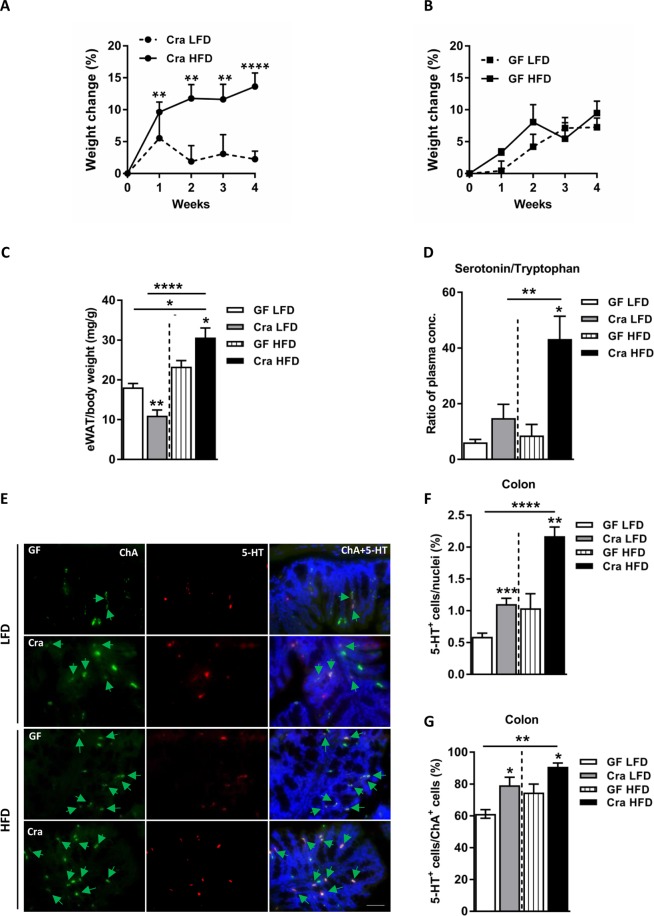
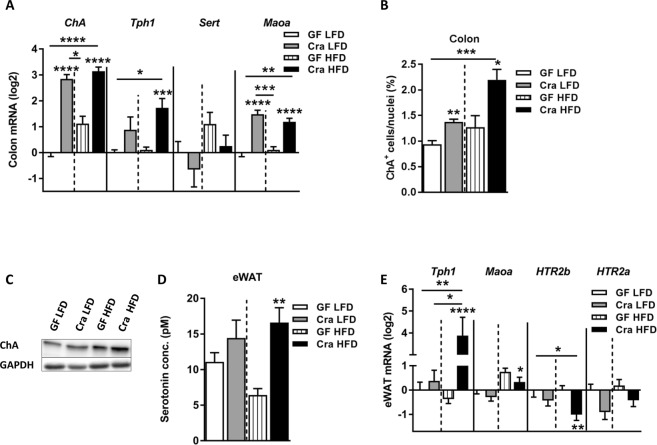
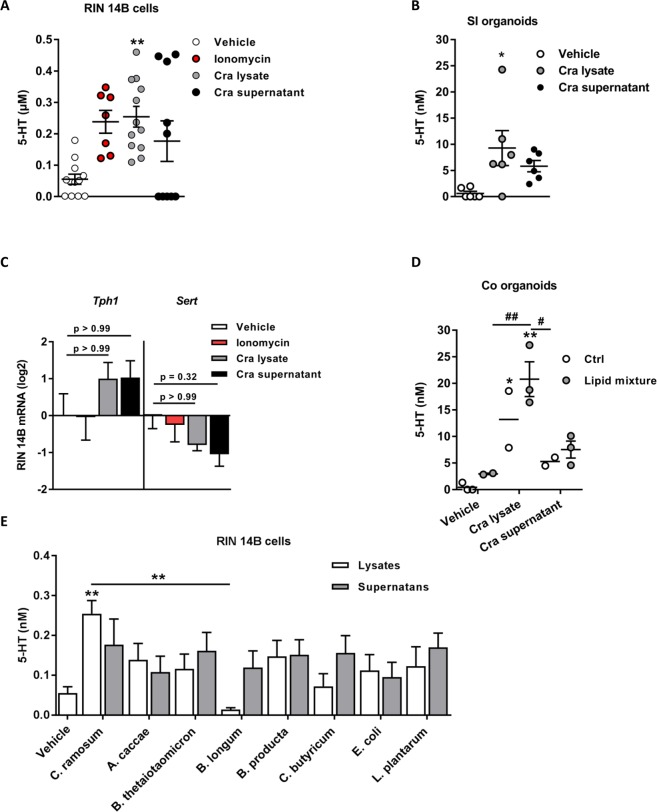
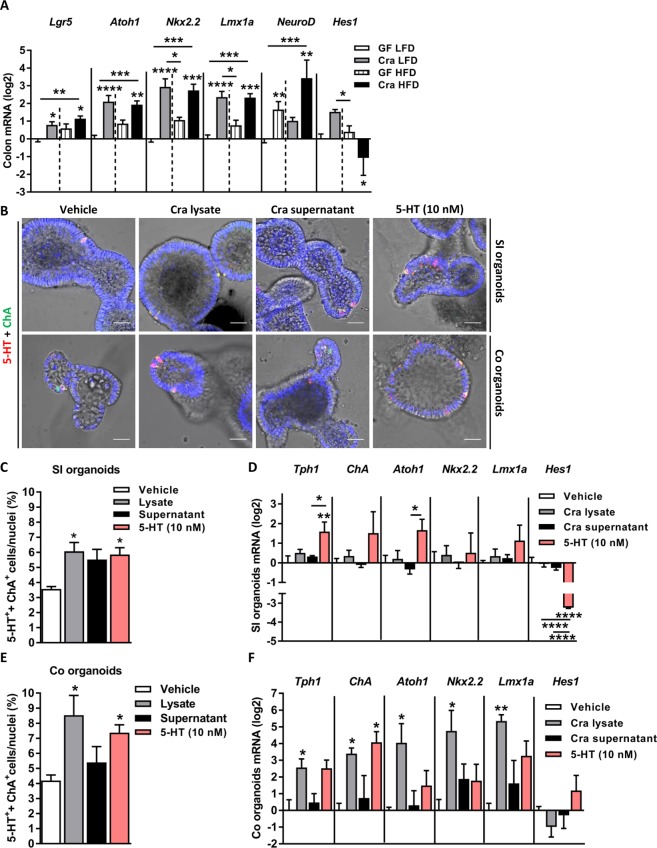
Peripheral serotonin (5-hydroxytryptamine: 5-HT) synthesized in the intestine by enterochromaffin cells (ECs), plays an important role in the regulation of peristaltic of the gut, epithelial secretion and promotes the development and maintenance of the enteric neurons. Recent studies showed that the indigenous gut microbiota modulates 5-HT signalling and that ECs use sensory receptors to detect dietary and microbiota-derived signals from the lumen to subsequently transduce the information to the nervous system. We hypothesized that Clostridium ramosum by increasing gut 5-HT availability consequently contributes to high-fat diet-induced obesity. Using germ-free mice and mice monoassociated with C . ramosum , intestinal cell lines and mouse organoids, we demonstrated that bacterial cell components stimulate host 5-HT secretion and program the differentiation of colonic intestinal stem progenitors toward the secretory 5-HT-producing lineage. An elevated 5-HT level regulates the expression of major proteins involved in intestinal fatty acid absorption in vitro , suggesting that the presence of C . ramosum in the gut promotes 5-HT secretion and thereby could facilitates intestinal lipid absorption and the development of obesity.
Overview
The claims and statistics of this paper haven’t been checked yet.
Free: it reads the open-access text and checks the first 5 claims that cite a source we can check. Create a free account to check every claim.
Integrity signals
Registry
Cites
Statistics
Figures
Verification
Claims the paper makes
The claims and statistics of this paper haven’t been checked yet.
Free: it reads the open-access text and checks the first 5 claims that cite a source we can check. Create a free account to check every claim.
Self-check
Percentages, sums and reported differences re-computed from the paper’s own numbers.
The self-check needs the paper’s full text.
Citations
Cites
Bradford, M. M. (1976) · Analytical Biochemistry · doi:10.1016/0003-2697(76)90527-3 · Cited by 255,302
Human gut microbes associated with obesity
Ley, R. E., Turnbaugh, P. J., Klein, S., & Gordon, J. I. (2006) · Nature · doi:10.1038/4441022a · Cited by 8,785
Single Lgr5 stem cells build crypt-villus structures in vitro without a mesenchymal niche
Sato, T., Vries, R. G., Snippert, H. J., van de Wetering, M., Barker, N., Stange, D. E., van Es, J. H., Abo, A., Kujala, P., Peters, P. J., et al. (2009) · Nature · doi:10.1038/nature07935 · Cited by 7,204
A metagenome-wide association study of gut microbiota in type 2 diabetes
Qin, J., Li, Y., Cai, Z., Li, S., Zhu, J., Zhang, F., Liang, S., Zhang, W., Guan, Y., Shen, D., et al. (2012) · Nature · doi:10.1038/nature11450 · Cited by 6,762
Obesity alters gut microbial ecology
Ley, R. E., Bäckhed, F., Turnbaugh, P., Lozupone, C. A., Knight, R. D., & Gordon, J. I. (2005) · Proceedings of the National Academy of Sciences · doi:10.1073/pnas.0504978102 · Cited by 6,176
Richness of human gut microbiome correlates with metabolic markers
Le Chatelier, E., Nielsen, T., Qin, J., Prifti, E., Hildebrand, F., Falony, G., Almeida, M., Arumugam, M., Batto, J.-M., Kennedy, S., et al. (2013) · Nature · doi:10.1038/nature12506 · Cited by 4,662
Indigenous bacteria from the gut microbiota regulate host serotonin biosynthesis
Yano, J. M., Yu, K., Donaldson, G. P., Shastri, G. G., Ann, P., Ma, L., Nagler, C. R., Ismagilov, R. F., Mazmanian, S. K., & Hsiao, E. Y. (2015) · Cell · doi:10.1016/j.cell.2015.02.047 · Cited by 3,614
Gut metagenome in European women with normal, impaired and diabetic glucose control
Karlsson, F. H., Tremaroli, V., Nookaew, I., Bergström, G., Behre, C. J., Fagerberg, B., Nielsen, J., & Bäckhed, F. (2013) · Nature · doi:10.1038/nature12198 · Cited by 3,115
PPARγ signaling and metabolism: the good, the bad and the future
Ahmadian, M., Suh, J. M., Hah, N., Liddle, C., Atkins, A. R., Downes, M., & Evans, R. M. (2013) · Nature Medicine · doi:10.1038/nm.3159 · Cited by 2,016
PPARγ Is Required for Placental, Cardiac, and Adipose Tissue Development
Barak, Y., Nelson, M. C., Ong, E. S., Jones, Y. Z., Ruiz-Lozano, P., Chien, K. R., Koder, A., & Evans, R. M. (1999) · Molecular Cell · doi:10.1016/s1097-2765(00)80209-9 · Cited by 1,956
Cited by
Tryptophan Metabolism: A Link Between the Gut Microbiota and Brain
Gao, K., Mu, C.-L., Farzi, A., & Zhu, W.-Y. (2020) · Advances in Nutrition · doi:10.1093/advances/nmz127 · Cited by 1,029
“Previous studies have demonstrated that commensal bacteria— especially spore-forming bacteria of the mouse and human microbiota—promote serotonin biosynthesis in colonic ECs via a metabolite/cell component–dependent mechanism (47, 48).”
BackgroundTian, P., Chen, Y., Zhu, H., Wang, L., Qian, X., Zou, R., Zhao, J., Zhang, H., Qian, L., Wang, Q., et al. (2022) · Brain, Behavior, and Immunity · doi:10.1016/j.bbi.2021.11.023 · Cited by 356
The role of gut dysbiosis in Parkinson’s disease: mechanistic insights and therapeutic options
Wang, Q., Luo, Y., Ray Chaudhuri, K., Reynolds, R., Tan, E.-K., & Pettersson, S. (2021) · Brain · doi:10.1093/brain/awab156 · Cited by 281
Microbiota Metabolites in Health and Disease
McCarville, J. L., Chen, G. Y., Cuevas, V. D., Troha, K., & Ayres, J. S. (2020) · Annual Review of Immunology · doi:10.1146/annurev-immunol-071219-125715 · Cited by 241
The ever-changing roles of serotonin
Jones, L. A., Sun, E. W., Martin, A. M., & Keating, D. J. (2020) · The International Journal of Biochemistry & Cell Biology · doi:10.1016/j.biocel.2020.105776 · Cited by 240
The function of gut microbiota in immune-related neurological disorders: a review
Sittipo, P., Choi, J., Lee, S., & Lee, Y. K. (2022) · Journal of Neuroinflammation · doi:10.1186/s12974-022-02510-1 · Cited by 221
“The gut microbiota and their bacterial metabolites can promote the differentiation of ISCs toward the secretory 5-HT-producing lineage and stimulate 5-HT secretion, resulting in increased circulating 5-HT levels [118, 119].”
BackgroundThe promise of the gut microbiome as part of individualized treatment strategies
Schupack, D. A., Mars, R. A. T., Voelker, D. H., Abeykoon, J. P., & Kashyap, P. C. (2022) · Nature Reviews Gastroenterology & Hepatology · doi:10.1038/s41575-021-00499-1 · Cited by 217
Focus on the essentials: tryptophan metabolism and the microbiome-gut-brain axis
Gheorghe, C. E., Martin, J. A., Manriquez, F. V., Dinan, T. G., Cryan, J. F., & Clarke, G. (2019) · Current Opinion in Pharmacology · doi:10.1016/j.coph.2019.08.004 · Cited by 212
Gut microbiota modulates neurotransmitter and gut-brain signaling
Qu, S., Yu, Z., Zhou, Y., Wang, S., Jia, M., Chen, T., & Zhang, X. (2024) · Microbiological Research · doi:10.1016/j.micres.2024.127858 · Cited by 186
The Role of the Gut Microbiota in Lipid and Lipoprotein Metabolism
Yu, Y., Raka, F., & Adeli, K. (2019) · Journal of Clinical Medicine · doi:10.3390/jcm8122227 · Cited by 160
Salminen, A. (2023) · Journal of Molecular Medicine · doi:10.1007/s00109-023-02289-5 · Cited by 169
“, Clostridium ramosum, are major enhancers of serotonin production in enterochromaffin cells [83].”
BackgroundSuda, K., & Matsuda, K. (2022) · International Journal of Molecular Sciences · doi:10.3390/ijms23031172 · Cited by 140
Enhanced cultured diversity of the mouse gut microbiota enables custom-made synthetic communities
Afrizal, A., Jennings, S. A. V., Hitch, T. C. A., Riedel, T., Basic, M., Panyot, A., Treichel, N. S., Hager, F. T., Wong, E. O.-Y., Wolter, B., et al. (2022) · Cell Host & Microbe · doi:10.1016/j.chom.2022.09.011 · Cited by 133
Li, X., Zhang, Z., Zabed, H. M., Yun, J., Zhang, G., & Qi, X. (2021) · Molecular Nutrition & Food Research · doi:10.1002/mnfr.202000461 · Cited by 135
Direct and indirect mechanisms by which the gut microbiota influence host serotonin systems
Legan, T. B., Lavoie, B. A., & Mawe, G. M. (2022) · Neurogastroenterology & Motility · doi:10.1111/nmo.14346 · Cited by 132
Modulation of immunity by tryptophan microbial metabolites
Li, S. (2023) · Frontiers in Nutrition · doi:10.3389/fnut.2023.1209613 · Cited by 136
“Studies have revealed that commensal bacteria promote serotonin biosynthesis in colonic enterochromaffin cells through a mechanism involving metabolites and cell components (110, 111).”
BackgroundProchazkova, P., Roubalova, R., Dvorak, J., Tlaskalova-Hogenova, H., Cermakova, M., Tomasova, P., Sediva, B., Kuzma, M., Bulant, J., Bilej, M., et al. (2019) · Microorganisms · doi:10.3390/microorganisms7090338 · Cited by 93
“This effect was observed mainly in spore-forming bacteria, such as Clostridium, in the gut microbiome [48].”
BackgroundA systematic review on the role of microbiota in the pathogenesis and treatment of eating disorders
Carbone, E. A., D'Amato, P., Vicchio, G., De Fazio, P., & Segura-Garcia, C. (2021) · European Psychiatry · doi:10.1192/j.eurpsy.2020.109 · Cited by 87
“The altered homeostasis in gut microbiota seems related to the altered secretion of serotonin [100] and the crossreactive mechanisms through the productions of autoantibodies 10 Elvira Anna Carbone et al.”
BackgroundGut-brain axis serotonergic responses to acute stress exposure are microbiome-dependent
Lyte, J. M., Gheorghe, C. E., Goodson, M. S., Kelley‐Loughnane, N., Dinan, T. G., Cryan, J. F., & Clarke, G. (2020) · Neurogastroenterology & Motility · doi:10.1111/nmo.13881 · Cited by 77
Enteric Microbiota-Mediated Serotonergic Signaling in Pathogenesis of Irritable Bowel Syndrome
Mishima, Y., & Ishihara, S. (2021) · International Journal of Molecular Sciences · doi:10.3390/ijms221910235 · Cited by 88
Yang, K., Li, G., Li, Q., Wang, W., Zhao, X. X., Shao, N., Qiu, H., Liu, J., Xu, L., & Zhao, J. (2025) · Cell & Bioscience · doi:10.1186/s13578-025-01385-y · Cited by 108
“This aligns with studies showing a positive correlation between Ruminococcus torques and enterochromaffin cells, IBS-SSS, degree of abdominal pain, frequency of abdominal pain, and frequency of defecation [90, 91].”
Intestinal enteroids/organoids: A novel platform for drug discovery in inflammatory bowel diseases
Yoo, J. H., & Donowitz, M. (2019) · World Journal of Gastroenterology · doi:10.3748/wjg.v25.i30.4125 · Cited by 85
Gut microbiota supports male reproduction via nutrition, immunity, and signaling
Cai, H., Cao, X., Qin, D., Liu, Y., Liu, Y., Hua, J., & Peng, S. (2022) · Frontiers in Microbiology · doi:10.3389/fmicb.2022.977574 · Cited by 84
“Cellular components of Clostridium ramosum have also been shown to stimulate host ECs to secrete 5-HT and modify the colonic stem cells to differentiate into lineages that secrete 5-HT (Mandic et al., 2019).”
BackgroundGut microbiota is involved in male reproductive function: a review
Lv, S., Huang, J., Luo, Y., Wen, Y., Chen, B., Qiu, H., Chen, H., Yue, T., He, L., Feng, B., et al. (2024) · Frontiers in Microbiology · doi:10.3389/fmicb.2024.1371667 · Cited by 88
Rosés, C., Cuevas‐Sierra, A., Quintana, S., Riezu‐Boj, J. I., Martínez, J. A., Milagro, F. I., & Barceló, A. (2021) · Nutrients · doi:10.3390/nu13020636 · Cited by 77
“Although this species has previously been linked to increased fatty acid absorption [59,60] and systemic inflammation [61], this sequence also shares a close homology with other species such as Erysipelatoclostridium saccharogumia and Clostridium cocleatum.”
BackgroundLayunta, E., Buey, B., Mesonero, J. E., & Latorre, E. (2021) · Frontiers in Endocrinology · doi:10.3389/fendo.2021.748254 · Cited by 73
Zhou, H., Lu, S.-Z., Yu, Z.-S., Zhang, J., & Mei, Z. (2023) · Phytomedicine · doi:10.1016/j.phymed.2023.155251 · Cited by 63
The interplay between microbiota and brain-gut axis in epilepsy treatment
Zhu, H., Wang, W., & Li, Y. (2024) · Frontiers in Pharmacology · doi:10.3389/fphar.2024.1276551 · Cited by 74
Qin, W., Xu, B., Chen, Y., Yang, W., Xu, Y., Huang, J., Duo, T., Mao, Y., Zhou, G., Yan, X., et al. (2022) · Animal nutrition · doi:10.1016/j.aninu.2022.08.004 · Cited by 53
“C. ramosum is an anaerobic, spore-forming, gram-positive bacterium that promotes serotonin (5-hydroxytryptamine, 5-HT) secretion, and thereby modulating intestinal secretion and inflammation (Liu et al., 2021; Mandi c et al., 2019).”
BackgroundKezer, G., Paramithiotis, S., Khwaldia, K., Harahap, I. A., Čagalj, M., Šimat, V., Smaoui, S., Elfalleh, W., Özoğul, F., & Esatbeyoglu, T. (2025) · Frontiers in Microbiology · doi:10.3389/fmicb.2025.1651965 · Cited by 68
Regulatory effect of gut microbes on blood pressure
Yan, D., Sun, Y. Q., Zhou, X., Si, W., Liu, J., Li, M., & Wu, M. (2022) · Animal Models and Experimental Medicine · doi:10.1002/ame2.12233 · Cited by 51
Early life interaction between the microbiota and the enteric nervous system
Foong, J. P. P., Hung, L. Y., Poon, S., Savidge, T., & Bornstein, J. C. (2020) · American Journal of Physiology-Gastrointestinal and Liver Physiology · doi:10.1152/ajpgi.00288.2020 · Cited by 55
Involvement of Gut Microbiota in Schizophrenia and Treatment Resistance to Antipsychotics
Manchia, M., Fontana, A., Panebianco, C., Paribello, P., Arzedi, C., Cossu, E., Garzilli, M., Montis, M. A., Mura, A., Pisanu, C., et al. (2021) · Biomedicines · doi:10.3390/biomedicines9080875 · Cited by 51
“Interestingly, Erysipelatoclostridium ramosum has been shown to be involved in the synthesis of serotonin in the intestine [51], with a plausible link with the development of obesity but possibly also in creating an imbalance in the neurochemical signaling of this pathway relevant for SCZ by limiting the availability…”
BackgroundHost–microbe serotonin metabolism
Nunzi, E., Pariano, M., Costantini, C., Garaci, E., Puccetti, P., & Romani, L. R. (2024) · Trends in Endocrinology and Metabolism · doi:10.1016/j.tem.2024.07.014 · Cited by 56
“…and platelets [57,123 Alternatively, some bacteria – such as spore-forming microbes [24] (including Clostridium ramnosus [44]) – may indirectly affect serotonin levels by modulating the host ’ s tryptophan hydroxylase-1 (TPH1), SERT, and monoamine oxidase (MAO)…”
BackgroundThe bidirectional nature of microbiome-epithelial cell interactions
Solis, A. G., Klapholz, M., Zhao, J., & Levy, M. (2020) · Current Opinion in Microbiology · doi:10.1016/j.mib.2020.06.007 · Cited by 50
Potential Roles of Enterochromaffin Cells in Early Life Stress-Induced Irritable Bowel Syndrome
Tao, E., Zhu, Z., Hu, C., Long, G., Chen, B., Guo, R. C., Fang, M., & Jiang, M. (2022) · Frontiers in Cellular Neuroscience · doi:10.3389/fncel.2022.837166 · Cited by 51
Yadav, H., Jaldhi, Bhardwaj, R., Anamika, A., Bakshi, A., Gupta, S., & Maurya, S. K. (2023) · Life Sciences · doi:10.1016/j.lfs.2023.122022 · Cited by 53
The Urine Metabolome of Young Autistic Children Correlates with Their Clinical Profile Severity
Mussap, M., Siracusano, M., Noto, A., Fattuoni, C., Riccioni, A., Rajula, H. S. R., Fanos, V., Curatolo, P., Barberini, L., & Mazzone, L. (2020) · Metabolites · doi:10.3390/metabo10110476 · Cited by 52
Gut-Bone Axis: A Non-Negligible Contributor to Periodontitis
Jia, X., Yang, R., Li, J., Жао, Л., Zhou, X., & Xu, X. (2021) · Frontiers in Cellular and Infection Microbiology · doi:10.3389/fcimb.2021.752708 · Cited by 50
Crichton, M., Marshall, S., Marx, W., Isenring, E. A., & Lohning, A. E. (2023) · Nutrition Reviews · doi:10.1093/nutrit/nuac115 · Cited by 70
Linking serotonin homeostasis to gut function: Nutrition, gut microbiota and beyond
Jiang, L., Han, D., Hao, Y., Song, Z., Sun, Z., & Dai, Z. (2023) · Critical Reviews in Food Science and Nutrition · doi:10.1080/10408398.2023.2183935 · Cited by 48
“Of note, the maintenance of 5-HTRs signaling by dietary means such as carbohydrates, amino acids/proteins, bioactive natural compounds, and robust gut microbiota is essential for supporting normal gut function (Liang et al. 2018; Mandic et al. 2019; Wang et al. 2020).”
Chapin, A. A., Rajasekaran, P. R., Quan, D. N., Hu, L., Herberholz, J., Bentley, W. E., & Ghodssi, R. (2020) · Microsystems & Nanoengineering · doi:10.1038/s41378-020-00184-4 · Cited by 44
Microbial modulation of tryptophan metabolism links gut microbiota to disease and its treatment
Zhao, P., Chen, Y., Zhou, S., & Li, F. (2025) · Pharmacological Research · doi:10.1016/j.phrs.2025.107896 · Cited by 49
Parolisi, S., Montanari, C., Borghi, E., Cazzorla, C., Zuvadelli, J., Tosi, M., Barone, R. M. E., Bensi, G., Bonfanti, C., Dionisi‐Vici, C., et al. (2023) · Pharmacological Research · doi:10.1016/j.phrs.2023.106952 · Cited by 37
Hua, H., Huang, C., Liu, H., Xu, X., Xu, X., Wu, Z., Liu, C., Wang, Y. Y., & Yang, C. (2022) · Neuropharmacology · doi:10.1016/j.neuropharm.2022.109272 · Cited by 37
Lee, D. H., Seong, H., Chang, D., Gupta, V. K., Kim, J., Cheon, S., Kim, G., Sung, J., & Han, N. S. (2023) · npj Science of Food · doi:10.1038/s41538-023-00195-1 · Cited by 42
Montgomery, T. L., Peipert, D., & Krementsov, D. N. (2024) · Immunological Reviews · doi:10.1111/imr.13343 · Cited by 38
“133,147,148 Altogether, there are a number of unique tryptophan-derived bacterial metabolites that have the potential to impact host physiology in the context of CNS autoimmune disease, as discussed in more detail below.”
The Role of Gut Microbiota in Hypertension Pathogenesis and the Efficacy of Antihypertensive Drugs
Xiong, Y., Xiong, Y., Zhu, P., Wang, Y., Yang, H., Zhou, R., Shu, Y., Zhou, H., & Li, Q. (2021) · Current Hypertension Reports · doi:10.1007/s11906-021-01157-2 · Cited by 37
Regulation of serotonin production by specific microbes from piglet gut
Liu, Z., Ling, Y., Peng, Y., Han, S., Ren, Y., Jing, Y., Fan, W., Su, Y., Mu, C., & Zhu, W. (2023) · Journal of Animal Science and Biotechnology/Journal of animal science and biotechnology · doi:10.1186/s40104-023-00903-7 · Cited by 40
“However, the reasons for the discrepancy across cell types remained unknown in this study, which may be consequences of different origins and physiological characteristics in IPEC-J2 and RIN-14B cells [16, 40, 41].”
BackgroundInfluence of Gut Microbiota on Mental Health via Neurotransmitters: A Review
Liu, T., Feenstra, K. A., Heringa, J., & Huang, Z. (2020) · Journal of Artificial Intelligence for Medical Sciences · doi:10.2991/jaims.d.200420.001 · Cited by 44
Contribution of the microbiome for better phenotyping of people living with obesity
Ciaula, A. D., Bonfrate, L., Khalil, M., Garruti, G., & Portincasa, P. (2023) · Reviews in Endocrine and Metabolic Disorders · doi:10.1007/s11154-023-09798-1 · Cited by 43
Singh, S. V., Ganguly, R., Jaiswal, K., Yadav, A. K., Kumar, R., & Pandey, A. K. (2023) · World Journal of Clinical Cases · doi:10.12998/wjcc.v11.i19.4458 · Cited by 33
Bi, M., Feng, L., He, J., Liu, C., Wang, Y., Jiang, H., & Liu, S. (2022) · Ageing Research Reviews · doi:10.1016/j.arr.2022.101759 · Cited by 34
Fecal microbiota transplantation for irritable bowel syndrome: An intervention for the 21st century
El‐Salhy, M., Patcharatrakul, T., & Gonlachanvit, S. (2021) · World Journal of Gastroenterology · doi:10.3748/wjg.v27.i22.2921 · Cited by 37
Cheng, J., Li, W., Wang, Y., Cao, Q. N., Ni, Y., Zhang, W., Guo, J., Chen, B., Zang, Y., & Zhu, Y. (2021) · Microbial Biotechnology · doi:10.1111/1751-7915.13968 · Cited by 37
Intestinal Flora Disruption and Novel Biomarkers Associated With Nasopharyngeal Carcinoma
Jiang, H., Li, J., Zhang, B., Huang, R., Zhang, J., Chen, Z., Shang, X., Li, X., & Nie, X. (2019) · Frontiers in Oncology · doi:10.3389/fonc.2019.01346 · Cited by 34
“ramosum could stimulate the secretion of 5-HT from ECs, which can promote the level of 5-HT in plasma (46).”
BackgroundTryptophan‐synthesizing bacteria enhance colonic motility
Legan, T. B., Lavoie, B. A., Norberg, E. S., Ley, I. C., Tack, S., Tompkins, T. A., Wargo, M. J., & Mawe, G. M. (2023) · Neurogastroenterology & Motility · doi:10.1111/nmo.14629 · Cited by 30
Tryptophan metabolites and gut microbiota play an important role in pediatric migraine diagnosis
Liu, J., Xi, K., Zhang, L., Han, M., Wang, Q., & Liu, X. (2024) · The Journal of Headache and Pain · doi:10.1186/s10194-023-01708-9 · Cited by 32
“Studies have found that gut microbiota can metabolize tryptophan, both through the serotonin pathway and the kynurenine pathway, resulting in the production of metabolites such as serotonin, kynurenine, kynurenic acid (KYNA), and qui-nolinic acid (QUIN) [7–9].”
BackgroundThe microbiota–gut–brain axis: A novel nutritional therapeutic target for growth retardation
Qi, M., Tan, B., Wang, J., Liao, S., Deng, Y., Ji, P., Song, T., Zha, A., & Yin, Y. (2021) · Critical Reviews in Food Science and Nutrition · doi:10.1080/10408398.2021.1879004 · Cited by 29
“Administration of Clostridium ramnosum could improve the 5-HT biosynthesis in colonic EECs of mice and humans, and further promote the growth (Yano et al. 2015; Mandic et al. 2019).”
BackgroundJiang, S., & Miao, Z. (2023) · PubMed Central · Cited by 42
Tryptophan metabolism and the intestinal microbiota: Implications for inflammatory bowel disease
Hua, X., Chen, Y., Ding, S., & Fang, J. Q. (2025) · Microbiological Research · doi:10.1016/j.micres.2025.128280 · Cited by 32
Yang, J., Wang, P., Liu, T., Lin, L., Li, L., Kou, G., Zhou, R., Li, P., & Li, Y. (2021) · BMC Microbiology · doi:10.1186/s12866-021-02380-2 · Cited by 29
“They suggested that gut microbiota can influence the development of colonic epithelial progenitor cells towards EC cells [21], which is consistent with our speculation.”
BackgroundResultWang, Q., Guo, Y., Zhang, K., Zhang, L., Geng, S., Shan, C., Liu, P., Zhu, M., Jin, Q.-Y., Zhong-ying, L., et al. (2021) · Frontiers in Cellular and Infection Microbiology · doi:10.3389/fcimb.2021.771088 · Cited by 29
“In contrast, NRF promoted diurnal rhythm of Clostridium (Lachnospiraceae_NK4A136_group, Ruminococcaceae_UCG-013, and Roseburia), which are related to promoting the synthesis of serotonin by intestinal chromaffin cells (Yano et al., 2015; Mandic et al., 2019).”
BackgroundȘchiopu, C. G., Ștefănescu, C., Boloș, A., Diaconescu, S., Gîlcă-Blanariu, G.-E., & Ștefănescu, G. (2022) · Microorganisms · doi:10.3390/microorganisms10112199 · Cited by 31
“The ideas of this study are currently investigated for possible Crohn’s disease future research [31].”
BackgroundSun, Y., Wang, S., Liu, B., Hu, W., & Zhu, Y. (2023) · International Journal of Molecular Sciences · doi:10.3390/ijms241310820 · Cited by 24
“Some bacteria, such as Clostridium ramosum, substantially boost 5-hydroxytryptamine production in intestinal chromogranin cells [87].”
BackgroundRecent advances in the application of microbiota transplantation in chickens
Zhao, H., Comer, L., Akram, M. Z., Corion, M., Li, Y., & Everaert, N. (2025) · Journal of Animal Science and Biotechnology/Journal of animal science and biotechnology · doi:10.1186/s40104-025-01233-6 · Cited by 25
A Comprehensive Review of Nutritional Influences on the Serotonergic System
Tang, J., Krushelnycky, L., Shaqo, A., & Cho, C. E. (2025) · Advances in Nutrition · doi:10.1016/j.advnut.2025.100524 · Cited by 34
“Alternatively, the contribution of the gut microbiota to host serotonin concentrations is increasingly recognized, including certain spore-forming bacteria such as Clostridium ramosum , which have been found to stimulate EC cells to synthesize serotonin [6,112].”
Vuong, H. E., Coley, E. J. L., Kazantsev, M., Cooke, M. E., Rendon, T. K., Paramo, J., & Hsiao, E. Y. (2021) · Behavioural Brain Research · doi:10.1016/j.bbr.2021.113353 · Cited by 22
Parkinson’s Disease and the Metal–Microbiome–Gut–Brain Axis: A Systems Toxicology Approach
Forero-Rodríguez, L. J., Josephs‐Spaulding, J., Flor, S., Pinzón, A. M., & Kaleta, C. (2021) · Antioxidants · doi:10.3390/antiox11010071 · Cited by 26
“Presently, it is well-described that irritable bowel disease (IBD) and other inflammatory diseases of the GI are closely associated with PD risk [21–24].”
BackgroundInfluentialMetabolomics-based mass spectrometry methods to analyze the chemical content of 3D organoid models
Murphy, S. E., & Sweedler, J. V. (2022) · The Analyst · doi:10.1039/d2an00599a · Cited by 20
“Though researchers have analyzed the neurotransmitter release of organoids, 73,74 no studies to date have analyzed organoid release after stimulation in order to compare their function to parent tissue.”
Hatayama, K., Ebara, A., Okuma, K., Tokuno, H., Hasuko, K., Masuyama, H., Ashikari, I., & Shirasawa, T. (2023) · Biomedicines · doi:10.3390/biomedicines11071789 · Cited by 21
Evidence-Based Analysis of Neurotransmitter Modulation by Gut Microbiota
Liu, T., & Huang, Z. (2019) · Lecture notes in computer science · doi:10.1007/978-3-030-32962-4_22 · Cited by 20
Clostridium ramosum rapidly identified by MALDI-TOF MS. A rare gram-variable agent of bacteraemia.
Legaria, M. C., García, S. D., Tudanca, V., Barberis, C. M., Cipolla, L., Cornet, L., Famiglietti, A. M. R., Stecher, D., & Vay, C. A. (2020) · Access Microbiology · doi:10.1099/acmi.0.000137 · Cited by 18
He, Y., Zhao, C., Su, N., Yang, W., Yang, H., Yuan, C., Zhang, N., Hu, X., & Fu, Y. (2024) · Cell Reports · doi:10.1016/j.celrep.2024.114585 · Cited by 24
Promoting cognitive health through the nexus of gut microbiota and dietary phytochemicals
Luo, L. (2025) · Frontiers in Nutrition · doi:10.3389/fnut.2025.1636131 · Cited by 18
Regulation of Pain Perception by Microbiota in Parkinson Disease
Manjarres, Z., Calvo, M., & Pacheco, R. (2023) · Pharmacological Reviews · doi:10.1124/pharmrev.122.000674 · Cited by 15
Loss of Znt8 function in diabetes mellitus: risk or benefit?
Barragán-Álvarez, C. P., Padilla‐Camberos, E., Díaz, N. F., Cota-Coronado, A., Hernández-Jiménez, C., Bravo‐Reyna, C., & Diaz-Martinez, N. E. (2021) · Molecular and Cellular Biochemistry · doi:10.1007/s11010-021-04114-4 · Cited by 18
Rokkas, T., & Hold, G. L. (2023) · European Journal of Gastroenterology & Hepatology · doi:10.1097/meg.0000000000002519 · Cited by 16
Gao, K., Chen, C.-L., Ke, X.-Q., Yu, Y.-X., Chen, S., Liu, G.-C., Wang, H.-F., & Li, Y.-J. (2022) · Beneficial Microbes · doi:10.3920/bm2022.0052 · Cited by 17
The 5-HT-related gut-brain axis in obesity
Jiang, C., Zhan, Q., & Zeng, C. (2024) · Life Sciences · doi:10.1016/j.lfs.2024.123171 · Cited by 14
Wang, R., Gan, C., Mao, R., Chen, Y., Yan, R., Li, G., Xiong, T., & Guo, J. (2025) · Frontiers in Immunology · doi:10.3389/fimmu.2024.1477902 · Cited by 17
Ghannoum, M. A., Long, L. A., Bunick, C. G., Rosso, J. Q. D., Gamal, A., Tyring, S. K., McCormick, T. S., & Grada, A. A. (2022) · Antibiotics · doi:10.3390/antibiotics11030324 · Cited by 15
“Moreover, sarecycline showed significantly higher MICs, when compared to minocycline, against Clostridium bolteae (a bacterium reported to play a role in induction of T regulatory cells in mice colon) [38], and Erysipelatoclostridium ramosum (previously known as Clostridium ramosum) which was shown to have a regulator…”
Meng, R., Dong, W., Gao, J., Lu, C.-R., Zhang, C., Liao, Q., Chen, L., Wu, H., Hu, J., Wei, W., et al. (2022) · Indian Journal of Microbiology · doi:10.1007/s12088-022-01003-2 · Cited by 14
“Clostridium ramosum was reported to cause a downregulation of PPAR-c expression in the intestine [23], suggesting that it may aggravate Mtb infection.”
BackgroundPotential role of milk bioactive peptides on the serotonergic system and the gut-brain axis
Buey, B., Layunta, E., Latorre, E., & Mesonero, J. E. (2022) · International Dairy Journal · doi:10.1016/j.idairyj.2022.105534 · Cited by 16
Dheer, R., & Young, V. B. (2020) · Current Opinion in Gastroenterology · doi:10.1097/mog.0000000000000691 · Cited by 11
Microbial Indoles: Key Regulators of Organ Growth and Metabolic Function
Xing, P. Y., Agrawal, R., Jayaraman, A., Martin, K. A., Zhang, G. W., Ngu, E.-L., Faylon, L. E., Kjelleberg, S. J., Rice, S. A., Wang, Y., et al. (2024) · Microorganisms · doi:10.3390/microorganisms12040719 · Cited by 11
Khoshnevisan, K., Chehrehgosha, M., Conant, M., Meftah, A. M., Baharifar, H., Ejtahed, H., Angoorani, P., Gholami, M., Sharifi, F., Maleki, H., et al. (2022) · Journal of Applied Microbiology · doi:10.1111/jam.15533 · Cited by 12
“Findings proved that relations between specific types of bacteria can alter disease outcome due to their involvement in specific molecules' metabolism (Mandić et al., 2019).”
BackgroundMethodInfluentialShen, N., Dimitrova, N., Ho, C. H.-C., Torres, P. J., Camacho, F. R., Cai, Y., Vuyisich, M., Tanton, D., & Banavar, G. S. (2021) · medRxiv · doi:10.1101/2021.08.13.21262051 · Cited by 14
“ramosum, a feature observed in our diseased cohorts, is an opportunistic bacterium that may promote intestinal absorption of glucose and fat in obesity (Mandić et al., 2019; Woting et al., 2014), has also been shown to be T2D-enriched in a metagenomic study of a Chinese cohort (Qin et al.”
BackgroundPostoperative delayed gastric emptying: may gut microbiota play a role?
Wang, Z., Liu, C., Hu, K., Zuo, M., Tian, Z., Wei, Y., Zhou, Q., & Li, Q. (2024) · Frontiers in Cellular and Infection Microbiology · doi:10.3389/fcimb.2024.1449530 · Cited by 13
Bacteria Engineered to Produce Serotonin Modulate Host Intestinal Physiology
Mavros, C. F., Bongers, M., Neergaard, F. B. F., Cusimano, F. A., Sun, Y., Kaufman, A., Richardson, M., Kammler, S., Kristensen, M., Sommer, M. O. A., et al. (2024) · ACS Synthetic Biology · doi:10.1021/acssynbio.4c00453 · Cited by 11
The Role of Gut Dysbiosis in the Pathophysiology of Tinnitus: A Literature Review
Megantara, I., Wikargana, G. L., Dewi, Y. A., Permana, A. D., & Sylviana, N. (2022) · The International Tinnitus Journal · doi:10.5935/0946-5448.20220005 · Cited by 11
“Studies conducted and Mandic et al. (2019) showed that gut microbiota, namely Bifidobacterium dentium and Clostridium ramosum could regulate the production of 5-HT but not directly from de novo synthesis of 5-HT due to the lack of genes involved in 5-HT production.”
BackgroundCsászár-Nagy, N., Bob, P., & Bókkon, I. (2022) · Journal of Integrative Neuroscience · doi:10.31083/j.jin2105148 · Cited by 13
Bloemendaal, M., Veniaminova, E. A., Anthony, D. C., Вячеславовна, Г. А., Vlaming, P., Khairetdinova, A. H., Cespuglio, R., Lesch, K., Vásquez, A. A., & Strekalova, T. V. (2023) · Nutrients · doi:10.3390/nu15133048 · Cited by 13
Nutrition and the gut microbiome: a symbiotic dialogue influencing health and disease
Ray, S., & Shankaran, P. (2026) · Frontiers in Nutrition · doi:10.3389/fnut.2026.1761992 · Cited by 16
Zheng, Y., Lei, Y., Zhao, P., Zhang, D., Shen, J., Zhang, G., Wei, R., Liu, H., Liu, X., He, Y., et al. (2024) · Ecology and Evolution · doi:10.1002/ece3.11189 · Cited by 10
“Previous research has shown that Clostridium ramosum regulates enterochro-maffin cell development and serotonin release (Mandić et al., 2019), while Clostridium scindens converts glucocorticoids to androgens, a group of male steroid hormones, through side-chain cleavage (Ridlon et al., 2013).”
ResultHeterochronic Fecal Microbiota Transfer Reverses Hallmarks of the Aging Murine Gut, Eye and BrainPreprint
Parker, A., Romano, S., Ansorge, R., Aboelnoer, A., Gall, G. L., Savva, G. M., Telatin, A., Jones, E. J., Baker, D., Rudder, S. J., et al. (2021) · SSRN Electronic Journal · doi:10.2139/ssrn.3811833 · Cited by 8
Plateau Environment, Gut Microbiota, and Depression: A Possible Concealed Connection?
Qiao, Y., Cheng, R., Li, X., Zheng, H., Guo, J., Wei, L., Gao, T., & Bi, H. (2025) · Current Issues in Molecular Biology · doi:10.3390/cimb47070487 · Cited by 10
“In this process, two different isoforms of TPH, TPH1 and TPH2, mediate nonneuronal and neuronal 5-HT biosynthesis [117].”
Tryptophan Metabolism and the Microbiome-Gut-Brain Axis
Clarke, G. A., Villalobos-Manríquez, F., & Marin, D. C. (2021) · Oxford University Press eBooks · doi:10.1093/oxfordhb/9780190931544.013.13 · Cited by 14
Sayers, B., Wijeyesekera, A., & Gibson, G. R. (2021) · Journal of Functional Foods · doi:10.1016/j.jff.2021.104753 · Cited by 11
Ткачева, О. Н., Klimenko, N. S., Kashtanova, D. A., Tyakht, A., Maytesyan, L., Akopyan, A. A., Игоревич, К. С., & Strazhesko, I. D. (2023) · Microorganisms · doi:10.3390/microorganisms11041036 · Cited by 8
“ramosum (previously Clostridium ramosum) that has been reported as a frequent cause of bacteremia and a contributor to high-fat diet-induced obesity [72].”
Background
Metadata
- Authors
- Mandić, A. D., Woting, A., Jaenicke, T., Sander, A., Sabrowski, W., Rolle-Kampcyk, U., von Bergen, M., & Blaut, M.
- Affiliations
- German Institute of Human Nutrition (DE)
- Corresponding author
- Mandić, Ana D.
- Venue
- Scientific Reports
- Published
- 2019-02-04
- Volume
- 9
- Issue
- 1
- Pages
- 1177-1177
- ISSN
- 2045-2322 (ISSN-L)
- PMC
- PMC6362283
- OpenAlex
- W2911259027
- Semantic Scholar
- 74638b37382f832d47689d42f13293c2d96aa6c8
- Cited by
- 150
- References
- 67
- Citations by year
- 2026: 18 · 2025: 22 · 2024: 26 · 2023: 22 · 2022: 21 · 2021: 21 · 2020: 13 · 2019: 7
- FWCI
- 5.13
- Type
- journal article
- Language
- en
- Open access
- gold
- doi.org
- Licence
- cc-by
- creativecommons.org/licenses/by/4.0 (tdm)
- creativecommons.org/licenses/by/4.0 (vor)
- Locations
- Scientific Reports (publishedVersion, cc-by)
- Europe PMC (PubMed Central) (publishedVersion, other-oa)
- PubMed Central (publishedVersion, cc-by)
- PubMed (publishedVersion)
- DOAJ (DOAJ: Directory of Open Access Journals) (submittedVersion)
- Funders
- Deutsche Forschungsgemeinschaft (CRC 1052 &#x201C;Mechanism of Obesity)
- Topics
- Life Sciences › Biochemistry, Genetics and Molecular Biology › Molecular Biology › Gut microbiota and health
- Health Sciences › Medicine › Gastroenterology › Gastrointestinal motility and disorders
- Life Sciences › Neuroscience › Endocrine and Autonomic Systems › Regulation of Appetite and Obesity
- Keywords
- Clostridium ramosum, enterochromaffin cells, serotonin release, gut microbiota, high-fat diet-induced obesity, intestinal organoids, intestinal fatty acid absorption, germ-free mice, monoassociation, enteric neurons
- MeSH terms
- Bacillota, Animals, Cell Line, Enterochromaffin Cells, Organoids, Serotonin, Serotonin Receptor Agonists, Mice
About these checks
Registry, retraction, Cites and statistics results are computed, not judged, with one exception: a printed reference that no index lists is read once by a model before it counts as a citation error. Claims are extracted by a model and kept only when their quote appears verbatim in the text; each cited source is then checked, with a model’s help, for whether it says what the claim relies on. Those verdicts can be wrong — read the claim’s quote and the cited source before relying on one.
Statistics and arithmetic are recomputed, not judged.
Confidence bands are shown only for fields calibrated on our annotated test set. None is calibrated yet, so no band is shown.
What counts as a claim ›How we measure confidence ›How we check this ›
Are you an author, or do you see a problem with this page? Request a review
Data sources
Bibliographic data: Semantic Scholar, OpenAlex, Crossref.
Contains information from the Semantic Scholar Academic Graph Datasets, made available under the ODC Attribution License (ODC-BY 1.0).
Semantic Scholar’s data is described in: Kinney, R., et al. (2023). The Semantic Scholar Open Data Platform. arXiv:2301.10140.
