

Neuronal message passing using Mean-field, Bethe, and Marginal approximations
Open accessThe DOI matches its Crossref record; 94 of the 95 references it cites were found in a registry or an index.
Abstract
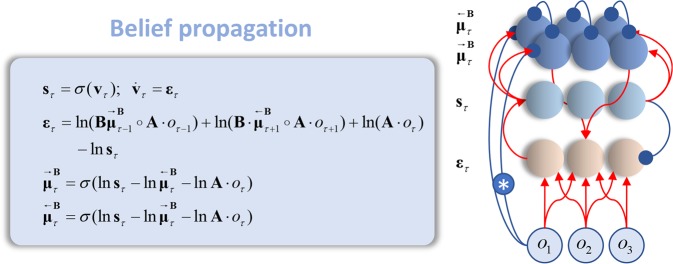
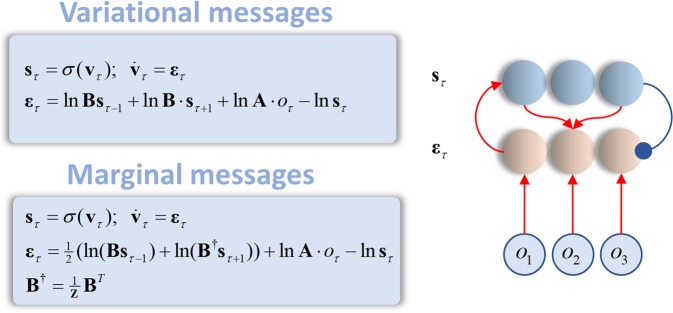
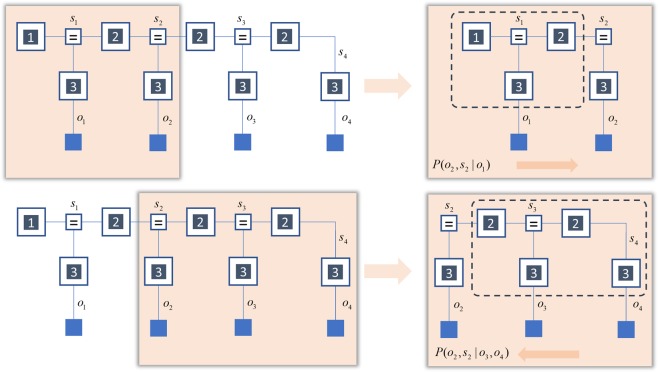
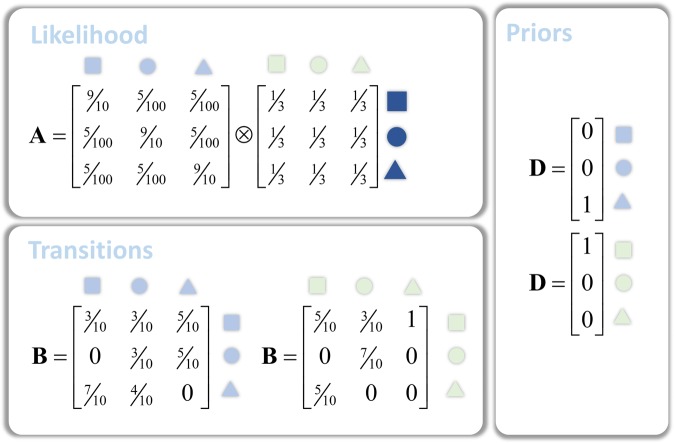
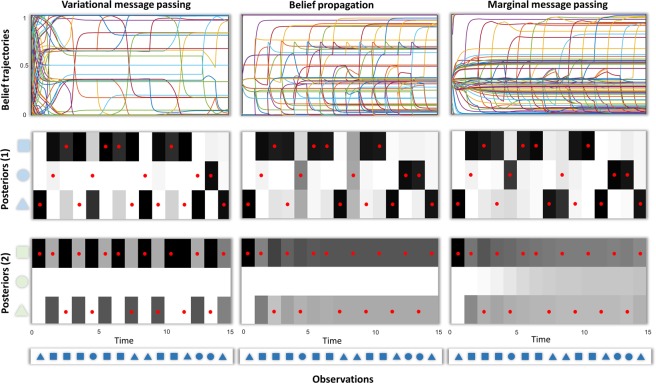
Neuronal computations rely upon local interactions across synapses. For a neuronal network to perform inference, it must integrate information from locally computed messages that are propagated among elements of that network. We review the form of two popular (Bayesian) message passing schemes and consider their plausibility as descriptions of inference in biological networks. These are variational message passing and belief propagation – each of which is derived from a free energy functional that relies upon different approximations (mean-field and Bethe respectively). We begin with an overview of these schemes and illustrate the form of the messages required to perform inference using Hidden Markov Models as generative models. Throughout, we use factor graphs to show the form of the generative models and of the messages they entail. We consider how these messages might manifest neuronally and simulate the inferences they perform. While variational message passing offers a simple and neuronally plausible architecture, it falls short of the inferential performance of belief propagation. In contrast, belief propagation allows exact computation of marginal posteriors at the expense of the architectural simplicity of variational message passing. As a compromise between these two extremes, we offer a third approach – marginal message passing – that features a simple architecture, while approximating the performance of belief propagation. Finally, we link formal considerations to accounts of neurological and psychiatric syndromes in terms of aberrant message passing.
Overview
The claims and statistics of this paper haven’t been checked yet.
Free: it reads the open-access text and checks the first 5 claims that cite a source we can check. Create a free account to check every claim.
Integrity signals
Registry
Cites
Statistics
Figures
Verification
Claims the paper makes
The claims and statistics of this paper haven’t been checked yet.
Free: it reads the open-access text and checks the first 5 claims that cite a source we can check. Create a free account to check every claim.
Claims other papers make about this one
Each is checked against this paper’s own text: does it say what the citing paper says it does?
The source backs part of the claim, not all of it — or backs it for a different population, condition or comparison.
In the citing paper
“However, we do believe that inference and learning in CSCG can be achieved using biologically plausible mechanisms (15, 22).”
From Space is a latent sequence: A theory of the hippocampus (2024) · cites this paper as [22]
Experimental — accuracy not yet measuredThe cited source says what the claim attributes to it.
In the citing paper
“From an FEP-AI perspective, this synchrony-enhanced communication would facilitate information sharing among (and marginalization over) coupled dynamics, thereby organizing message passing (or belief propagation) for inference (Parr and Friston, 2018a; Parr et al., 2019).”
From An Integrated World Modeling Theory (IWMT) of Consciousness (2020) · cites this paper as Parr et al., 2019
The cited source says what the claim attributes to it.
In the citing paper
“Therefore, the communication of information regarding sub-system internal states (via MBs, definitionally) to the larger systems of which they are part is the propagation of a probabilistic belief—e.g., marginal message passing (Parr et al., 2019)—and so overall hierarchical organization of systems and sub-systems must instantiate HPP.”
From An Integrated World Modeling Theory (IWMT) of Consciousness (2020) · cites this paper as Parr et al., 2019
Self-check
Percentages, sums and reported differences re-computed from the paper’s own numbers.
The self-check needs the paper’s full text.
Citations
Cites
Maximum Likelihood from Incomplete Data Via the EM Algorithm
Dempster, A. P., Laird, N. M., & Rubin, D. B. (1977) · Journal of the Royal Statistical Society Series B: Statistical Methodology · doi:10.1111/j.2517-6161.1977.tb01600.x · Cited by 50,444
A New Approach to Linear Filtering and Prediction Problems
Kalman, R. E. (1960) · Journal of Basic Engineering · doi:10.1115/1.3662552 · Cited by 31,751 · cited 1×
“By 97 and generalised filtering 98 (the basis of predictive coding schemes 99 and inversion of dynamic causal models 100 ).”
BackgroundReinforcement Learning: An Introduction
(2005) · IEEE Transactions on Neural Networks · doi:10.1109/tnn.2004.842673 · Cited by 24,496
A tutorial on hidden Markov models and selected applications in speech recognition
Rabiner, L. R. (1989) · Proceedings of the IEEE · doi:10.1109/5.18626 · Cited by 22,743 · cited 1×
“Note that the classical ‘forward-backward’ algorithm 68 is a special case of the belief propagation applied to an HMM.”
Background(1988) · Cited by 16,582
An Information-Maximization Approach to Blind Separation and Blind Deconvolution
Bell, A. J., & Sejnowski, T. J. (1995) · Neural Computation · doi:10.1162/neco.1995.7.6.1129 · Cited by 8,986
Irreversibility and heat generation in the computing process
Landauer, R. (1961) · IBM Journal of Research and Development · doi:10.1147/rd.53.0183 · Cited by 4,980
Graphical Models, Exponential Families, and Variational Inference
Wainwright, M. J., & Jordan, M. I. (2007) · now publishers, Inc. eBooks · doi:10.1561/9781601981851 · Cited by 2,959
Rhythms for cognition: communication through coherence
Fries, P. (2015) · Neuron · doi:10.1016/j.neuron.2015.09.034 · Cited by 2,725 · cited 1×
“Communication between brain areas is sometimes framed in terms of oscillatory processes, where coherence of oscillations determines the influence of one set of neurons over another 22 .”
BackgroundThe Bayesian brain: The role of uncertainty in neural coding and computation
Knill, D. C., & Pouget, A. (2004) · Trends in Neurosciences · doi:10.1016/j.tins.2004.10.007 · Cited by 2,588 · cited 1×
“( ) ( ) ( ) ( ) (1) s s s t t s s s t t”
Research works printed but not linked: 6
- Deneve, S. In Advances in neural information processing systems. 353–360.
- Dauwels, J. In Information Theory, 2007. ISIT 2007. IEEE International Symposium on. 2546–2550 (IEEE).
- Jaakkola, T., Singh, S. P. & Jordan, M. I. In Advances in neural information processing systems. 345–352.
- Heskes, T. In Advances in neural information processing systems. 359–366.
- Weller, A., Tang, K., Sontag, D. & Jebara, T. In 30th Conference on Uncertainty in Artificial Intelligence, UAI. (AUAI Press, 2014).
- Nowlan, S. J. In Advances in neural information processing systems. 574–582.
Cited by
Items 101–133 of 133
Albarracin, M., de Jager, S., & Hyland, D. (2025) · Entropy · doi:10.3390/e27050522 · Cited by 4
“Learning emerges as agent actions correct predictive mismatches [23], with message-passing algorithms mimicking neuronal processes [24].”
Active Inference Successor Representations
Millidge, B., & Buckley, C. L. (2023) · Communications in computer and information science · doi:10.1007/978-3-031-28719-0_11 · Cited by 3
Corcoran, A. W., Haun, A. M., Dorman, R., Tononi, G., Friston, K. J., & Pennartz, C. M. A. (2026) · Neuroscience & Biobehavioral Reviews · doi:10.1016/j.neubiorev.2026.106742 · Cited by 2
Self-citationPrediction in action: Toward an empirical science of active inference
Lageman, J., Fahrenfort, J. J., & Slagter, H. A. (2026) · Neuroscience & Biobehavioral Reviews · doi:10.1016/j.neubiorev.2026.106817 · Cited by 2
Revealing human sensitivity to a latent temporal structure of changes
Marković, D., Reiter, A. M. F., & Kiebel, S. J. (2022) · Frontiers in Behavioral Neuroscience · doi:10.3389/fnbeh.2022.962494 · Cited by 2
“…of between reversal duration ( Yu, 2015 ), (ii) the update of beliefs about states and temporal templates derived via approximate inference ( Parr et al., 2019 ; Yu and Kobayashi, 2003 ), and (iii) the action selection, that is the planning process, cast as active inference ( Friston et…”
BackgroundSelf-citationOnline System Identification in a Duffing Oscillator by Free Energy Minimisation
Kouw, W. M. (2020) · Communications in computer and information science · doi:10.1007/978-3-030-64919-7_6 · Cited by 2
“Specifically, variational message passing minimises free energy [5,13,18].”
BackgroundBauermeister, J., & Lanillos, P. (2023) · Communications in computer and information science · doi:10.1007/978-3-031-28719-0_8 · Cited by 2
“We model the problem under the discrete state-space formulation of active inference [17]1.”
MethodA General Space of Belief Updates for Model Misspecification in Bayesian NetworksPreprint
Li, T. (2023) · arXiv (Cornell University) · doi:10.48550/arxiv.2311.05248 · Cited by 2
“One way to realize belief update in Bayesian networks is as various message passing schemes [10].”
BackgroundEvaluation of “As-Intended” Vehicle Dynamics Using the Active Inference Framework
Kidera, K., Miyaguchi, T., & YANAGISAWA, H. (2026) · Communications in computer and information science · doi:10.1007/978-3-032-16955-6_15 · Cited by 1
“MMP is regarded as one of the most promising variational inference algorithms in active inference [9].”
The active construction of past episodes
Parr, T., Pezzulo, G., & Friston, K. J. (2026) · Translational Neuroscience · doi:10.1515/tnsci-2025-0391 · Cited by 1
Self-citationZhao, C., Chen, S., Li, J., Xie, M., Hu, H., Cheng, H., Zeng, Z., & (4829), Y. L. (2026) · Fundamental Research · doi:10.1016/j.fmre.2026.04.038 · Cited by 1
Silva, A. M., Truelove, R., Millán, A. C., & Limongi, R. (2026) · Brain Sciences · doi:10.3390/brainsci16080771 · Cited by 1
“At the algorithmic level, belief updating over CO states is computed through marginal message-passing [52].”
Liang, C. L., Jiang, H., Lin, S., Li, H., & Wang, B. (2020) · Advanced Intelligent Systems · doi:10.1002/aisy.202000172 · Cited by 1
Point estimate observers: A new class of models for perceptual decision making.
Schütt, H. H., Yoo, A. H., Calder-Travis, J. M., & Ma, W. J. (2023) · Psychological Review · doi:10.1037/rev0000402 · Cited by 1
Bounded Rational Decision Networks With Belief Propagation
Schmid, G., Gottwald, S., & Braun, D. A. (2024) · Neural Computation · doi:10.1162/neco_a_01719 · Cited by 2
Parr, T., Pezzulo, G., & Friston, K. J. (2025) · Cognitive Neuroscience · doi:10.1080/17588928.2025.2537960 · Cited by 2
“…relevance for the hardware (Muir & Sheik, 2025) or wetware (Isomura et al., 2023; Kagan et al., 2022) used to solve such problems, as solutions based upon distributed sparse message passing might be very well suited for the sorts of synaptic communication in biological brains (Parr et al., 2019).”
Self-citationActive inference for action-unaware agents
Torresan, F., Suzuki, K., Kanai, R., & Baltieri, M. (2026) · Neurocomputing · doi:10.1016/j.neucom.2026.134399 · Cited by 1
Maren, A. J. (2022) · arXiv (Cornell University) · doi:10.48550/arxiv.2209.04087 · Cited by 1
“There is already a substantial body of work on message-passing, and prior work by Yedidia et al. (2002) [29], Wainwright and Jordan (2008) [12], and Parr et al. (2019) [35] discuss message-passing methods that reference the cluster variation method.”
BackgroundBouttier, V. (2021) · theses.fr (ABES) · doi:10.70675/940d047az3ce3z4943zbbb3z08f2e7a9d573 · Cited by 4
Cycles of Discourse, Speech Dysfluency, and Active InferencePreprint
Parr, T., Demirel, B., Saleh, Y., & Manohar, S. (2026) · arXiv (Cornell University) · doi:10.48550/arxiv.2607.22180 · Cited by 1
“…standard inferential message passing schemes (Friston et al., 2017b; Schwöbel et al., 2018; Yedidia et al., 2005)—whose sparse dependency structure share much with the sparse network architectures observed in synaptic communication (Bastos et al., 2012; George & Hawkins, 2009; Parr et al., 2019).”
Self-citationModelling and Measuring the Predictive Brain
Whyte, C. J. (2020) · The Sydney eScholarship Repository (The University of Sydney)
Directed walk in probability space that locates mean field solutions to spin models
Shen, Y., & Willard, A. P. (2022) · Physical review. E · doi:10.1103/physreve.106.044132
The path forward for modeling action-oriented cognition as active inference
Smith, R. S. (2023) · Physics of Life Reviews · doi:10.1016/j.plrev.2023.06.010
Parr, T. (2025) · Physics of Life Reviews · doi:10.1016/j.plrev.2025.07.016
Self-citationHierarchical active inference for cognitive architectures
Proietti, R. (2023) · AMS Dottorato Institutional Doctoral Theses Repository (University of Bologna) · doi:10.48676/unibo/amsdottorato/10920
Free Energy-Based Modeling of Emotional Dynamics in Video Advertisements
Ushio, T., Onishi, K., & YANAGISAWA, H. (2025) · IEEE Access · doi:10.1109/access.2025.3647675
“In practice, the state distribution q ( s τ ) can be obtained using standard inference schemes such as marginal message passing [15].”
Freud’s Model of the Mind Within a Predictive Processing Neuroscientific Paradigm
Stänicke, E., Hovet, B. S., & Stänicke, L. I. (2026) · Entropy · doi:10.3390/e28030318
“We have two fundamental ways of reducing free energy: perceptual inference and active inference [56].”
Spike-Timing-Dependent Plasticity for Bernoulli Message Passing
Adamiat, S., Kouw, W. M., & de Vries, B. (2026) · Communications in computer and information science · doi:10.1007/978-3-032-16955-6_6
Message Passing-Based Inference in an Autoregressive Active Inference Agent
Kouw, W. M., Nisslbeck, T. N., & Nuijten, W. W. L. (2026) · Communications in computer and information science · doi:10.1007/978-3-032-16955-6_16 · Cited by 2
Development and study of coadaptive interactive systems
Dechaux, A. (2024) · theses.fr (ABES) · doi:10.70675/24336488z62bdz4b32zbc69z1620e376bc34
Renormalising Generative Models for Active Inference: Foundations, Derivations, and VerificationPreprint
Zaghw, K., Pashea, A., Pritsch, M., Nuijten, W. W. L., Friston, K. J., & Costa, L. D. (2026) · arXiv (Cornell University) · doi:10.48550/arxiv.2608.09512
“From Local Discrete Models to RGMs The local updates use standard variational-message-passing and Dirichlet–categorical conjugacy for discrete graphical models [11,7,9]; Appendix A.1 records the generic identity used below.”
Self-citationLimongi, R., Oguntoye, O., & Silva, A. M. (2026) · Behavioral Sciences · doi:10.3390/bs16101853
“This updating is implemented through marginal message passing (Parr et al., 2019; Smith et al., 2022), with variational free energy supplying the objective function: Minimizing variational free energy reduces the divergence between the approximate posterior, q(s), and the Bayesian posterior, P ( s…”
Berndt, L. C. S., & Shaw, A. D. (2026) · Frontiers in Human Neuroscience · doi:10.3389/fnhum.2026.1917153
“At present, their empirical strengths are most pronounced in neurobiological modelling (Friston et al., 2007; Friston K. J., 2008; Parr et al., 2019) and constrained control simulations (Millidge, 2020; Tschantz et al., 2020).”
Metadata
- Authors
- Parr, T., Markovic, D., Kiebel, S. J., & Friston, K. J.
- Affiliations
- Wellcome Centre for Human Neuroimaging (GB)
- Technische Universität Dresden (DE)
- Corresponding author
- Parr, Thomas
- Venue
- Scientific Reports
- Published
- 2019-02-13
- Volume
- 9
- Issue
- 1
- Pages
- 1889-1889
- ISSN
- 2045-2322 (ISSN-L)
- PMC
- PMC6374414
- OpenAlex
- W2918957485
- Cited by
- 128
- References
- 95
- Citations by year
- 2026: 10 · 2025: 10 · 2024: 7 · 2023: 16 · 2022: 17 · 2021: 32 · 2020: 27 · 2019: 9
- FWCI
- 9.69
- Type
- journal article
- Language
- en
- Open access
- gold
- doi.org
- Licence
- cc-by
- creativecommons.org/licenses/by/4.0 (tdm)
- creativecommons.org/licenses/by/4.0 (vor)
- Locations
- Scientific Reports (publishedVersion, cc-by)
- Europe PMC (PubMed Central) (publishedVersion, cc-by)
- PubMed Central (publishedVersion, cc-by)
- PubMed (publishedVersion)
- DOAJ (DOAJ: Directory of Open Access Journals) (submittedVersion)
- UCL Discovery (University College London) (submittedVersion)
- Funders
- Rosetrees Trust (173346)
- Deutsche Forschungsgemeinschaft (SFB 940/2, Project A9)
- Wellcome Trust (088130/Z/09/Z)
- Topics
- Physical Sciences › Computer Science › Artificial Intelligence › Bayesian Modeling and Causal Inference
- Life Sciences › Neuroscience › Cognitive Neuroscience › Neural dynamics and brain function
- Physical Sciences › Computer Science › Artificial Intelligence › Neural Networks and Applications
- Keywords
- variational message passing, belief propagation, mean-field approximation, Bethe approximation, free energy principle, hidden Markov models, factor graphs, marginal posterior, neuropsychiatric disorders
About these checks
Registry, retraction, Cites and statistics results are computed, not judged, with one exception: a printed reference that no index lists is read once by a model before it counts as a citation error. Claims are extracted by a model and kept only when their quote appears verbatim in the text; each cited source is then checked, with a model’s help, for whether it says what the claim relies on. Those verdicts can be wrong — read the claim’s quote and the cited source before relying on one.
Statistics and arithmetic are recomputed, not judged.
Confidence bands are shown only for fields calibrated on our annotated test set. None is calibrated yet, so no band is shown.
What counts as a claim ›How we measure confidence ›How we check this ›
Are you an author, or do you see a problem with this page? Request a review
Data sources
Bibliographic data: Semantic Scholar, OpenAlex, Crossref.
Contains information from the Semantic Scholar Academic Graph Datasets, made available under the ODC Attribution License (ODC-BY 1.0).
Semantic Scholar’s data is described in: Kinney, R., et al. (2023). The Semantic Scholar Open Data Platform. arXiv:2301.10140.
