

Neuronal message passing using Mean-field, Bethe, and Marginal approximations
Open accessThe DOI matches its Crossref record; 94 of the 95 references it cites were found in a registry or an index.
Abstract
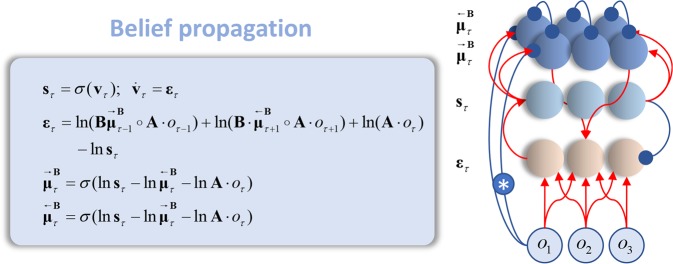
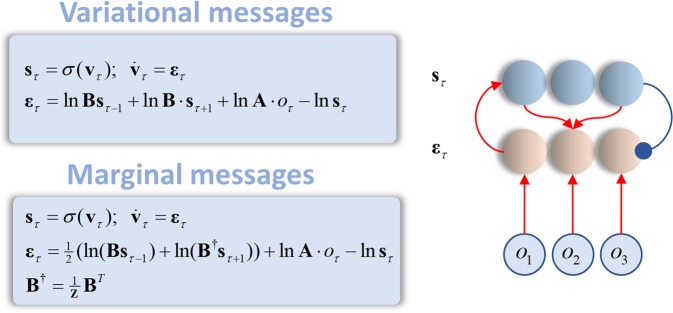
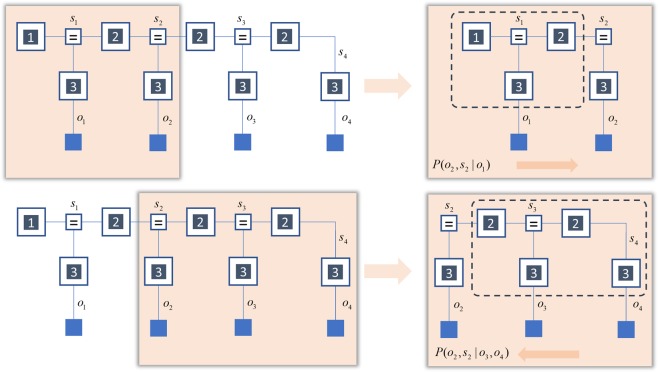
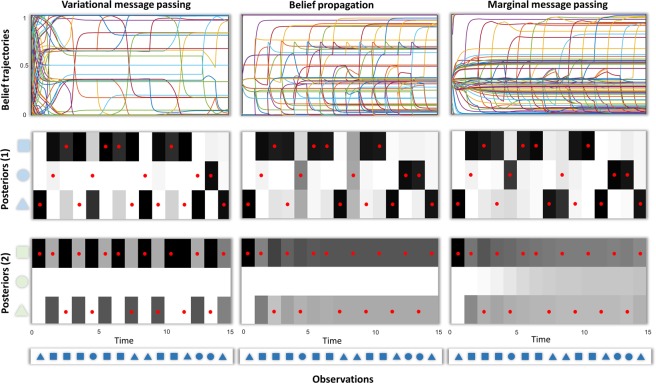
Neuronal computations rely upon local interactions across synapses. For a neuronal network to perform inference, it must integrate information from locally computed messages that are propagated among elements of that network. We review the form of two popular (Bayesian) message passing schemes and consider their plausibility as descriptions of inference in biological networks. These are variational message passing and belief propagation – each of which is derived from a free energy functional that relies upon different approximations (mean-field and Bethe respectively). We begin with an overview of these schemes and illustrate the form of the messages required to perform inference using Hidden Markov Models as generative models. Throughout, we use factor graphs to show the form of the generative models and of the messages they entail. We consider how these messages might manifest neuronally and simulate the inferences they perform. While variational message passing offers a simple and neuronally plausible architecture, it falls short of the inferential performance of belief propagation. In contrast, belief propagation allows exact computation of marginal posteriors at the expense of the architectural simplicity of variational message passing. As a compromise between these two extremes, we offer a third approach – marginal message passing – that features a simple architecture, while approximating the performance of belief propagation. Finally, we link formal considerations to accounts of neurological and psychiatric syndromes in terms of aberrant message passing.
Overview
The claims and statistics of this paper haven’t been checked yet.
Free: it reads the open-access text and checks the first 5 claims that cite a source we can check. Create a free account to check every claim.
Integrity signals
Registry
Cites
Statistics
Figures
Verification
Claims the paper makes
The claims and statistics of this paper haven’t been checked yet.
Free: it reads the open-access text and checks the first 5 claims that cite a source we can check. Create a free account to check every claim.
Claims other papers make about this one
Each is checked against this paper’s own text: does it say what the citing paper says it does?
The source backs part of the claim, not all of it — or backs it for a different population, condition or comparison.
In the citing paper
“However, we do believe that inference and learning in CSCG can be achieved using biologically plausible mechanisms (15, 22).”
From Space is a latent sequence: A theory of the hippocampus (2024) · cites this paper as [22]
Experimental — accuracy not yet measuredThe cited source says what the claim attributes to it.
In the citing paper
“From an FEP-AI perspective, this synchrony-enhanced communication would facilitate information sharing among (and marginalization over) coupled dynamics, thereby organizing message passing (or belief propagation) for inference (Parr and Friston, 2018a; Parr et al., 2019).”
From An Integrated World Modeling Theory (IWMT) of Consciousness (2020) · cites this paper as Parr et al., 2019
The cited source says what the claim attributes to it.
In the citing paper
“Therefore, the communication of information regarding sub-system internal states (via MBs, definitionally) to the larger systems of which they are part is the propagation of a probabilistic belief—e.g., marginal message passing (Parr et al., 2019)—and so overall hierarchical organization of systems and sub-systems must instantiate HPP.”
From An Integrated World Modeling Theory (IWMT) of Consciousness (2020) · cites this paper as Parr et al., 2019
Self-check
Percentages, sums and reported differences re-computed from the paper’s own numbers.
The self-check needs the paper’s full text.
Citations
Cites
Maximum Likelihood from Incomplete Data Via the EM Algorithm
Dempster, A. P., Laird, N. M., & Rubin, D. B. (1977) · Journal of the Royal Statistical Society Series B: Statistical Methodology · doi:10.1111/j.2517-6161.1977.tb01600.x · Cited by 50,444
A New Approach to Linear Filtering and Prediction Problems
Kalman, R. E. (1960) · Journal of Basic Engineering · doi:10.1115/1.3662552 · Cited by 31,751 · cited 1×
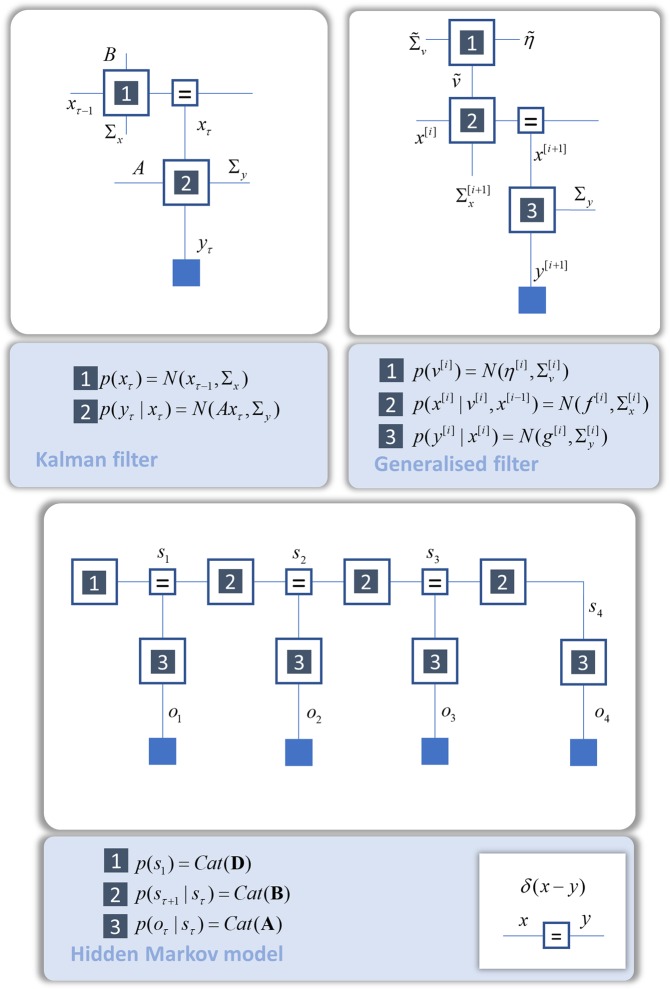
“By 97 and generalised filtering 98 (the basis of predictive coding schemes 99 and inversion of dynamic causal models 100 ).”
BackgroundReinforcement Learning: An Introduction
(2005) · IEEE Transactions on Neural Networks · doi:10.1109/tnn.2004.842673 · Cited by 24,496
A tutorial on hidden Markov models and selected applications in speech recognition
Rabiner, L. R. (1989) · Proceedings of the IEEE · doi:10.1109/5.18626 · Cited by 22,743 · cited 1×
“Note that the classical ‘forward-backward’ algorithm 68 is a special case of the belief propagation applied to an HMM.”
Background(1988) · Cited by 16,582
An Information-Maximization Approach to Blind Separation and Blind Deconvolution
Bell, A. J., & Sejnowski, T. J. (1995) · Neural Computation · doi:10.1162/neco.1995.7.6.1129 · Cited by 8,986
Irreversibility and heat generation in the computing process
Landauer, R. (1961) · IBM Journal of Research and Development · doi:10.1147/rd.53.0183 · Cited by 4,980
Graphical Models, Exponential Families, and Variational Inference
Wainwright, M. J., & Jordan, M. I. (2007) · now publishers, Inc. eBooks · doi:10.1561/9781601981851 · Cited by 2,959
Rhythms for cognition: communication through coherence
Fries, P. (2015) · Neuron · doi:10.1016/j.neuron.2015.09.034 · Cited by 2,725 · cited 1×
“Communication between brain areas is sometimes framed in terms of oscillatory processes, where coherence of oscillations determines the influence of one set of neurons over another 22 .”
BackgroundThe Bayesian brain: The role of uncertainty in neural coding and computation
Knill, D. C., & Pouget, A. (2004) · Trends in Neurosciences · doi:10.1016/j.tins.2004.10.007 · Cited by 2,588 · cited 1×
“( ) ( ) ( ) ( ) (1) s s s t t s s s t t”
Irreversibility and heat generation in the computing process
Landauer, R. (2000) · IBM Journal of Research and Development · doi:10.1147/rd.441.0261 · Cited by 2,585
Canonical Microcircuits for Predictive Coding
Bastos, A. M., Usrey, W. M., Adams, R. A., Mangun, G. R., Fries, P., & Friston, K. J. (2012) · Neuron · doi:10.1016/j.neuron.2012.10.038 · Cited by 2,421
Self-citationHandbuch der physiologischen Optik
Helmholtz, H. L. F. (2011) · DFG Viewer (DFG Viewer) · Cited by 1,947
Graphical Models, Exponential Families, and Variational Inference
Wainwright, M. J., & Jordan, M. I. (2008) · Foundations and Trends® in Machine Learning · doi:10.1561/2200000001 · Cited by 1,820 · cited 2×
“To mitigate these issues, higher order approximations have been proposed that are based on cluster variational meth-ods and the Kikuchi approximation 59,62,63 .”
BackgroundMethodConstructing Free-Energy Approximations and Generalized Belief Propagation Algorithms
Yedidia, J. S., Freeman, W. T., & Weiss, Y. (2005) · IEEE Transactions on Information Theory · doi:10.1109/tit.2005.850085 · Cited by 1,617
Predictive coding under the free-energy principle
Friston, K., & Kiebel, S. (2009) · Philosophical Transactions of the Royal Society B: Biological Sciences · doi:10.1098/rstb.2008.0300 · Cited by 1,579 · cited 1×
“By 97 and generalised filtering 98 (the basis of predictive coding schemes 99 and inversion of dynamic causal models 100 ).”
BackgroundSelf-citationActive inference: a process theory
Friston, K., FitzGerald, T., Rigoli, F., Schwartenbeck, P., & Pezzulo, G. (2017) · Neural Computation · doi:10.1162/neco_a_00912 · Cited by 1,156 · cited 2×
“In short, all three schemes have a potential biological validity in that belief dynamics can be expressed in a form closely related to that of neuronal mass dynamics (please see 32 for further details).”
BackgroundSelf-citationLondon, M., & Häusser, M. (2005) · Annual Review of Neuroscience · doi:10.1146/annurev.neuro.28.061604.135703 · Cited by 1,149 · cited 1×
“However, dendritic computations 57 may have the potential to rescue belief propagation in this regard; i.e., it is possible that forwards and backwards Figure 6.”
BackgroundThe cost of cortical computation.
Lennie, P. (2003) · Current Biology · doi:10.1016/s0960-9822(03)00135-0 · Cited by 1,134 · cited 1×
“Appealing to minimum wire length principles 54 and taking note of the metabolic 55 and therefore informational 56 costs of individual neurons, this network has a substantial structural advantage over that given by belief propagation.”
BackgroundThe dynamic brain: from spiking neurons to neural masses and cortical fields
Deco, G., Jirsa, V. K., Robinson, P. A., Breakspear, M., & Friston, K. (2008) · PLoS Computational Biology · doi:10.1371/journal.pcbi.1000092 · Cited by 1,084 · cited 1×
“The softmax (normalised exponential) functions have a high degree of biophysical plausibility, as the density dynamics of spiking neuron populations have a similar form 45 , where synaptic input is converted into firing rates that can be propagated along axons to other neural populations.”
BackgroundSelf-citationStatistical Mechanics, A Set of Lectures
Feynman, R. P., & Mullin, W. J. (1974) · American Journal of Physics · doi:10.1119/1.1987797 · Cited by 1,046
Baum, L. E., & Eagon, J. A. (1967) · Bulletin of the American Mathematical Society · doi:10.1090/s0002-9904-1967-11751-8 · Cited by 1,036 · cited 1×
“The ‘forward-backward’ algorithm (hence belief propagation) is also used in the inference step of the Baum-Welch algorithm 69 .”
MethodLisman, J. E., Coyle, J. T., Green, R. W., Javitt, D. C., Benes, F. M., Heckers, S., & Grace, A. A. (2008) · Trends in Neurosciences · doi:10.1016/j.tins.2008.02.005 · Cited by 1,010 · cited 1×
“That this is due to a failure of subtraction by an inhibitory interneuron is consistent with data suggesting disruptions in the balance of excitatory and inhibitory synaptic activity 91–93 in patients with psychosis.”
ResultCommunication in neuronal networks
Laughlin, S. B., & Sejnowski, T. J. (2003) · Science · doi:10.1126/science.1089662 · Cited by 950
An Introduction to factor graphs
Loeliger, H. (2004) · IEEE Signal Processing Magazine · doi:10.1109/msp.2004.1267047 · Cited by 905 · cited 2×
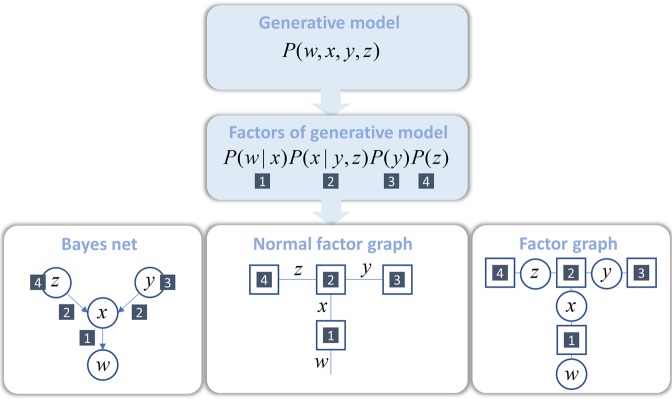
“The result is known as a normal factor graph 13,20 .”
BackgroundA Unifying Review of Linear Gaussian Models
Roweis, S., & Ghahramani, Z. (1999) · Neural Computation · doi:10.1162/089976699300016674 · Cited by 869 · cited 2×
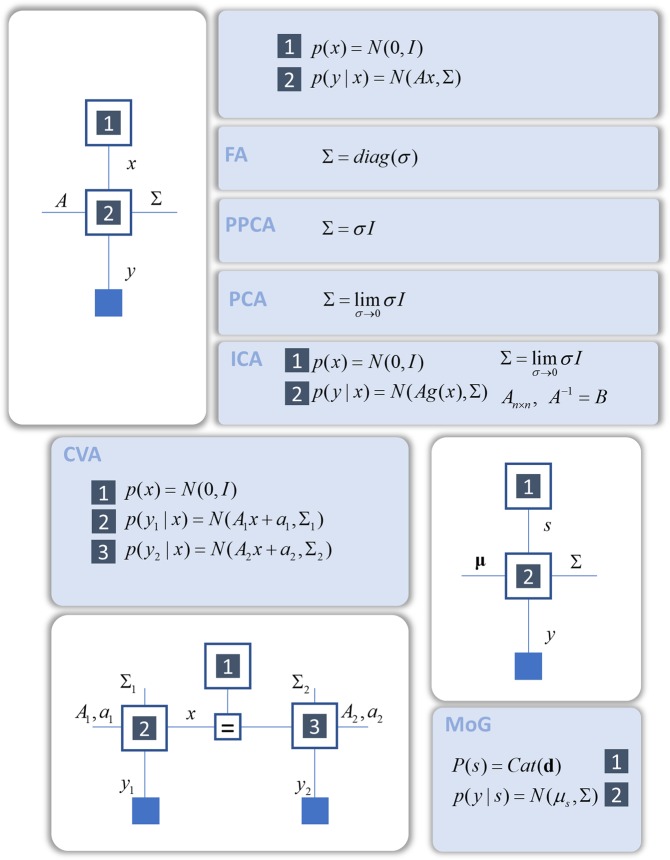
“This Figure illustrates static models of the sort that underlie factor analysis (FA), probabilistic principle component analysis (PPCA), and principal component analysis (PCA) 21 .”
MethodAction and behavior: a free-energy formulation
Friston, K. J., Daunizeau, J., Kilner, J., & Kiebel, S. J. (2010) · Biological Cybernetics · doi:10.1007/s00422-010-0364-z · Cited by 866 · cited 3×
“This is equivalent to minimising their variational free energy 3 .”
BackgroundMethodSelf-citationThe Computational Anatomy of Psychosis
Adams, R. A., Stephan, K. E., Brown, H. R., Frith, C. D., & Friston, K. J. (2013) · Frontiers in Psychiatry · doi:10.3389/fpsyt.2013.00047 · Cited by 850 · cited 1×
“Theories of schizophrenia 86 , autism 88,89 , and visual neglect 87 (among others) that appeal to pathological prior beliefs may be interpreted as deficits in any of the message passing schemes described here.”
BackgroundSelf-citationGregory, R. L. (1980) · Philosophical Transactions of the Royal Society of London. B, Biological Sciences · doi:10.1098/rstb.1980.0090 · Cited by 789 · cited 3×
“Crucially, we have expressed all three schemes in terms of differential equations describing evolution of beliefs over time (Figs 5 and 6).”
BackgroundMethodResultActive inference and epistemic value
Friston, K., Rigoli, F., Ognibene, D., Mathys, C., Fitzgerald, T., & Pezzulo, G. (2015) · Cognitive Neuroscience · doi:10.1080/17588928.2015.1020053 · Cited by 731 · cited 2×
“A generic account of brain function that subsumes the Bayesian brain – and various forms of predictive processing such as predictive coding – is active inference 30 .”
BackgroundMethodSelf-citationFriston, K., FitzGerald, T., Rigoli, F., Schwartenbeck, P., O⿿Doherty, J., & Pezzulo, G. (2016) · Neuroscience & Biobehavioral Reviews · doi:10.1016/j.neubiorev.2016.06.022 · Cited by 674
Self-citation(2005) · Edinburgh Research Explorer (University of Edinburgh) · doi:10.5555/1046920.1088695 · Cited by 650
Codes on graphs: normal realizations
Forney, G. D. (2001) · IEEE Transactions on Information Theory · doi:10.1109/18.910573 · Cited by 642
An aberrant precision account of autism
Lawson, R. P., Rees, G., & Friston, K. J. (2014) · Frontiers in Human Neuroscience · doi:10.3389/fnhum.2014.00302 · Cited by 641
Self-citationStructure and function of the cerebral cortex
Shipp, S. (2007) · Current Biology · doi:10.1016/j.cub.2007.03.044 · Cited by 638 · cited 1×
“Sensory input (via the thalamus) predominantly targets granular layers of cortex 77,78 , which excite more superficial cells and are disynaptically inhibited by them in turn 79 .”
BackgroundHohwy, J. (2016) · Noûs · doi:10.1111/nous.12062 · Cited by 578 · cited 1×
“This account derives from the imperative for living crea-tures to maximise Bayesian model evidence or, more simply, engage in self-evidencing 31 .”
BackgroundInferring the rules of interaction of shoaling fish
Herbert-Read, J. E., Perna, A., Mann, R. P., Schaerf, T. M., Sumpter, D. J. T., & Ward, A. J. W. (2011) · Proceedings of the National Academy of Sciences · doi:10.1073/pnas.1109355108 · Cited by 555 · cited 1×
“It will be interesting to see whether the same principles of local message passing can be scaled up to collective behaviour 80,81 , with individuals exchanging information with their neighbours; or whether it can be scaled down to the computations performed by biochemical networks 82 .”
BackgroundThe Factor Graph Approach to Model-Based Signal Processing
Loeliger, H.-A., Dauwels, J., Hu, J., Korl, S., Ping, L., & Kschischang, F. R. (2007) · Proceedings of the IEEE · doi:10.1109/jproc.2007.896497 · Cited by 526
Bayesian Brain: Probabilistic Approaches to Neural Coding
(2006) · The MIT Press eBooks · doi:10.7551/mitpress/9780262042383.001.0001 · Cited by 511
A Probabilistic Interpretation of Canonical Correlation Analysis
Bach, F., & Jordan, M. I. (2005) · Cited by 474
Adults with autism overestimate the volatility of the sensory environment
Lawson, R. P., Mathys, C., & Rees, G. (2017) · Nature Neuroscience · doi:10.1038/nn.4615 · Cited by 470 · cited 1×
“Theories of schizophrenia 86 , autism 88,89 , and visual neglect 87 (among others) that appeal to pathological prior beliefs may be interpreted as deficits in any of the message passing schemes described here.”
BackgroundEvidence for sensory prediction deficits in schizophrenia
Shergill, S. S., Samson, G., Bays, P. M., Frith, C. D., & Wolpert, D. M. (2005) · American Journal of Psychiatry · doi:10.1176/appi.ajp.162.12.2384 · Cited by 432
Thomson, A. M. (2002) · Cerebral Cortex · doi:10.1093/cercor/12.9.936 · Cited by 420 · cited 1×
“Sensory input (via the thalamus) predominantly targets granular layers of cortex 77,78 , which excite more superficial cells and are disynaptically inhibited by them in turn 79 .”
BackgroundThe graphical brain: Belief propagation and active inference
Friston, K. J., Parr, T., & de Vries, B. (2017) · Network Neuroscience · doi:10.1162/netn_a_00018 · Cited by 415 · cited 3×
“6 forms part of the cortical microcircuit proposed for active inference in Markov decision processes 52 , and can be extended for generative models associated with precision parameters 53 , and for continuous state space models 10 .”
BackgroundSelf-citationTowards a mathematical theory of cortical micro-circuits
George, D., & Hawkins, J. (2009) · PLoS Computational Biology · doi:10.1371/journal.pcbi.1000532 · Cited by 404 · cited 1×
“The use of separate populations of neurons that represent messages and marginals resembles previous accounts of belief propagation in neuronal networks 15,48 .”
BackgroundLinking Connectivity, Dynamics, and Computations in Low-Rank Recurrent Neural Networks
Mastrogiuseppe, F., & Ostojic, S. (2018) · Neuron · doi:10.1016/j.neuron.2018.07.003 · Cited by 391 · cited 1×
“This would allow for rewiring 72 of the network to deal with a different (HMM) generative model if the way in which data were generated changed.”
MethodBuesing, L., Bill, J., Nessler, B., & Maass, W. (2011) · PLoS Computational Biology · doi:10.1371/journal.pcbi.1002211 · Cited by 384 · cited 1×
“For an interpretation of belief propagation in terms of spiking neurons, see 46,47 .”
BackgroundActive Inference, Curiosity and Insight
Friston, K. J., Lin, M., Frith, C. D., Pezzulo, G., Hobson, J. A., & Ondobaka, S. (2017) · Neural Computation · doi:10.1162/neco_a_00999 · Cited by 351 · cited 1×
“39 but lead to rather different interpretations of false inference in neurological and psychiatric disorders.”
BackgroundSelf-citationNeural elements for predictive coding
Shipp, S. (2016) · Frontiers in Psychology · doi:10.3389/fpsyg.2016.01792 · Cited by 340 · cited 1×
“Current circuit-level research shows a high degree of consistency with the form of the neuronal networks presented here 74–76 , but these data are not sufficient to confidently disambiguate between the two architectures.”
BackgroundNeural masses and fields in dynamic causal modeling
Moran, R., Pinotsis, D. A., & Friston, K. (2013) · Frontiers in Computational Neuroscience · doi:10.3389/fncom.2013.00057 · Cited by 255 · cited 2×
“8. models 67 .”
MethodSelf-citationUncertainty, epistemics and active inference
Parr, T., & Friston, K. J. (2017) · Journal of The Royal Society Interface · doi:10.1098/rsif.2017.0376 · Cited by 252 · cited 1×
“6 forms part of the cortical microcircuit proposed for active inference in Markov decision processes 52 , and can be extended for generative models associated with precision parameters 53 , and for continuous state space models 10 .”
BackgroundSelf-citationActive inference and agency: optimal control without cost functions
Friston, K., Samothrakis, S., & Montague, R. (2012) · Biological Cybernetics · doi:10.1007/s00422-012-0512-8 · Cited by 241 · cited 2×
“19 ), the discussion here generalises to other generative models.”
BackgroundMethodSelf-citationDeep temporal models and active inference
Friston, K. J., Rosch, R., Parr, T., Price, C., & Bowman, H. (2017) · Neuroscience & Biobehavioral Reviews · doi:10.1016/j.neubiorev.2017.04.009 · Cited by 237 · cited 1×
“6 forms part of the cortical microcircuit proposed for active inference in Markov decision processes 52 , and can be extended for generative models associated with precision parameters 53 , and for continuous state space models 10 .”
BackgroundSelf-citationWorking memory, attention, and salience in active inference
Parr, T., & Friston, K. J. (2017) · Scientific Reports · doi:10.1038/s41598-017-15249-0 · Cited by 227
Self-citationHaeusler, S., & Maass, W. (2006) · Cerebral Cortex · doi:10.1093/cercor/bhj132 · Cited by 221 · cited 2×
“Reversing the signs (excitation-inhibition), it is plausible that inhibitory interneurons in layer IV in receipt of sensory input 74 could play this role; inducing an inhibition in the granular cells in response to sensory input (as opposed to exciting them in its absence).”
BackgroundPlanning and navigation as active inference
Kaplan, R., & Friston, K. J. (2018) · Biological Cybernetics · doi:10.1007/s00422-018-0753-2 · Cited by 203
Self-citationCircular inferences in schizophrenia
Jardri, R., & Denève, S. (2013) · Brain · doi:10.1093/brain/awt257 · Cited by 201 · cited 5×
“Broadly speaking, computational pathologies can be described in terms of optimal inference using a suboptimal generative model 84–87 , or as broken inferential machinery 4,37 .”
BackgroundInfluentialGeneralised filtering and stochastic DCM for fMRI
Li, B., Daunizeau, J., Stephan, K. E., Penny, W., Hu, D., & Friston, K. (2011) · NeuroImage · doi:10.1016/j.neuroimage.2011.01.085 · Cited by 198 · cited 1×
“By 97 and generalised filtering 98 (the basis of predictive coding schemes 99 and inversion of dynamic causal models 100 ).”
BackgroundSelf-citationAcetylcholine in cortical inference
Yu, A. J., & Dayan, P. (2002) · Neural Networks · doi:10.1016/s0893-6080(02)00058-8 · Cited by 194
Perception and self-organized instability
Friston, K., Breakspear, M., & Deco, G. (2012) · Frontiers in Computational Neuroscience · doi:10.3389/fncom.2012.00044 · Cited by 185 · cited 1×
“Interested readers are referred to 60,64 for more formal treatments of this issue.”
BackgroundSelf-citationVélez-Fort, M., Rousseau, C. V., Niedworok, C. J., Wickersham, I. R., Rancz, E. A., Brown, A. P. Y., Strom, M., & Margrie, T. W. (2014) · Neuron · doi:10.1016/j.neuron.2014.08.001 · Cited by 181
γ-AMINOBUTYRIC-ACID DEFICIENCY IN BRAIN OF SCHIZOPHRENIC PATIENTS
Perry, T., Buchanan, J., Kish, S., & Hansen, S. (1979) · The Lancet · doi:10.1016/s0140-6736(79)90767-0 · Cited by 173
Friston, K., Stephan, K., Li, B., & Daunizeau, J. (2010) · Mathematical Problems in Engineering · doi:10.1155/2010/621670 · Cited by 171
Self-citationObserving the observer (I): meta-bayesian models of learning and decision-making
Daunizeau, J., den Ouden, H. E. M., Pessiglione, M., Kiebel, S. J., Stephan, K. E., & Friston, K. J. (2010) · PLoS ONE · doi:10.1371/journal.pone.0015554 · Cited by 167 · cited 1×
“Broadly speaking, computational pathologies can be described in terms of optimal inference using a suboptimal generative model 84–87 , or as broken inferential machinery 4,37 .”
BackgroundSelf-citationScene Construction, Visual Foraging, and Active Inference
Mirza, M. B., Adams, R. A., Mathys, C. D., & Friston, K. J. (2016) · Frontiers in Computational Neuroscience · doi:10.3389/fncom.2016.00056 · Cited by 165 · cited 1×
“Model comparison, model selection, and model averaging are thought to underwrite the evaluation of behavioural policies that support active engagement with the sensorium 50,51 and inference with hierarchical models 10 .”
BackgroundSelf-citationComputational Neuropsychology and Bayesian Inference
Parr, T., Rees, G., & Friston, K. J. (2018) · Frontiers in Human Neuroscience · doi:10.3389/fnhum.2018.00061 · Cited by 149 · cited 1×
“Many neurological and psychiatric syndromes can be thought of in terms of false inference 83 .”
BackgroundSelf-citationThe GABAergic system in schizophrenia
Blum, B. P., & Mann, J. J. (2002) · The International Journal of Neuropsychopharmacology · doi:10.1017/s1461145702002894 · Cited by 142 · cited 1×
“That this is due to a failure of subtraction by an inhibitory interneuron is consistent with data suggesting disruptions in the balance of excitatory and inhibitory synaptic activity 91–93 in patients with psychosis.”
ResultGraphical Models for Probabilistic and Causal Reasoning
Pearl, J. (1998) · Quantified Representation of Uncertainty and Imprecision · doi:10.1007/978-94-017-1735-9_12 · Cited by 126 · cited 2×
“Local message passing schemes make use of simple update rules that can be applied to a probabilistic generative model 11,12 .”
BackgroundExperimental evidence for circular inference in schizophrenia
Jardri, R., Duverne, S., Litvinova, A. S., & Denève, S. (2017) · Nature Communications · doi:10.1038/ncomms14218 · Cited by 126 · cited 1×
“Belief propagation is at the heart of the circular inference account of neuronal computation 4,27 .”
BackgroundModel averaging, optimal inference, and habit formation
FitzGerald, T. H. B., Dolan, R. J., & Friston, K. J. (2014) · Frontiers in Human Neuroscience · doi:10.3389/fnhum.2014.00457 · Cited by 121 · cited 1×
“Model comparison, model selection, and model averaging are thought to underwrite the evaluation of behavioural policies that support active engagement with the sensorium 50,51 and inference with hierarchical models 10 .”
BackgroundSelf-citationPecevski, D., Buesing, L., & Maass, W. (2011) · PLoS Computational Biology · doi:10.1371/journal.pcbi.1002294 · Cited by 109 · cited 1×
“For an interpretation of belief propagation in terms of spiking neurons, see 46,47 .”
BackgroundOptimal inference with suboptimal models: Addiction and active Bayesian inference
Schwartenbeck, P., FitzGerald, T. H. B., Mathys, C., Dolan, R., Wurst, F., Kronbichler, M., & Friston, K. (2015) · Medical Hypotheses · doi:10.1016/j.mehy.2014.12.007 · Cited by 108
Self-citationConvexity Arguments for Efficient Minimization of the Bethe and Kikuchi Free Energies
Heskes, T. (2006) · Journal of Artificial Intelligence Research · doi:10.1613/jair.1933 · Cited by 100 · cited 1×
“However, a difficulty here is to find a good approximation to the true posterior which makes computation of both the energy and the entropy analytically tractable 59,60 .”
BackgroundMean-field variational approximate Bayesian inference for latent variable models
Consonni, G., & Marin, J. (2006) · Computational Statistics & Data Analysis · doi:10.1016/j.csda.2006.10.028 · Cited by 89 · cited 1×
“While a few revisions to these beliefs occur at later stages, it does not take long to arrive at highly confident beliefs about future states – this over-confidence of posterior beliefs is a well-recognised feature of variational inference under the mean-field approximation 66 .”
BackgroundCultured Cortical Neurons Can Perform Blind Source Separation According to the Free-Energy Principle
Isomura, T., Kotani, K., & Jimbo, Y. (2015) · PLoS Computational Biology · doi:10.1371/journal.pcbi.1004643 · Cited by 88 · cited 1×
“An interesting question then arises; which scheme might explain the ability of biological neural networks to perform statistical procedures such as blind source separation 16 .”
BackgroundHuman visual exploration reduces uncertainty about the sensed world
Mirza, M. B., Adams, R. A., Mathys, C., & Friston, K. J. (2018) · PLOS ONE · doi:10.1371/journal.pone.0190429 · Cited by 85 · cited 2×
“To better accommodate behavioural responses, we could equip the schemes above with an active component 3 , and fit the resulting model to human behaviour 36 .”
MethodSelf-citationUnderstanding Layer 4 of the Cortical Circuit: A Model Based on Cat V1
Miller, K. D. (2003) · Cerebral Cortex · doi:10.1093/cercor/13.1.73 · Cited by 75
IEEE Information Theory Society Newsletter
Médard, M. (2012) · Cited by 68
Active inference, eye movements and oculomotor delays
Perrinet, L. U., Adams, R. A., & Friston, K. J. (2014) · Biological Cybernetics · doi:10.1007/s00422-014-0620-8 · Cited by 65
Self-citationComputing with Competition in Biochemical Networks
Genot, A. J., Fujii, T., & Rondelez, Y. (2012) · Physical Review Letters · doi:10.1103/physrevlett.109.208102 · Cited by 57 · cited 1×
“It will be interesting to see whether the same principles of local message passing can be scaled up to collective behaviour 80,81 , with individuals exchanging information with their neighbours; or whether it can be scaled down to the computations performed by biochemical networks 82 .”
BackgroundBelief Propagation in Networks of Spiking Neurons
Steimer, A., Maass, W., & Douglas, R. (2009) · Neural Computation · doi:10.1162/neco.2009.08-08-837 · Cited by 54 · cited 5×
“This scheme additionally underwrites some theoretical accounts of the anatomy of cortical micro-circuitry 28 , and has been implemented in populations of simulated (spiking) neurons 15,29 .”
BackgroundMethodInfluentialThe Computational Anatomy of Visual Neglect
Parr, T., & Friston, K. J. (2018) · Cerebral Cortex · doi:10.1093/cercor/bhx316 · Cited by 53 · cited 2×
“Broadly speaking, computational pathologies can be described in terms of optimal inference using a suboptimal generative model 84–87 , or as broken inferential machinery 4,37 .”
BackgroundSelf-citationExact Inferences in a Neural Implementation of a Hidden Markov Model
Beck, J. M., & Pouget, A. (2007) · Neural Computation · doi:10.1162/neco.2007.19.5.1344 · Cited by 48
Partition Functions of Normal Factor GraphsPreprint
Forney, G. D., & Vontobel, P. O. (2011) · arXiv (Cornell University) · doi:10.48550/arxiv.1102.0316 · Cited by 47 · cited 1×
“One way to think about this scheme is that a message from a given region of the factor graph is the partition function of that region 43 .”
BackgroundHaken, H. (1996) · Physica D Nonlinear Phenomena · doi:10.1016/0167-2789(96)00080-2 · Cited by 45
Active Inference, Belief Propagation, and the Bethe Approximation
Schwöbel, S., Kiebel, S., & Marković, D. (2018) · Neural Computation · doi:10.1162/neco_a_01108 · Cited by 36 · cited 2×
“As such, all three forms of neuronal message passing are consistent with the principles that underwrite active inference 9 .”
BackgroundSelf-citationThe entropic basis of collective behaviour
Mann, R. P., & Garnett, R. (2015) · Journal of The Royal Society Interface · doi:10.1098/rsif.2015.0037 · Cited by 36 · cited 1×
“It will be interesting to see whether the same principles of local message passing can be scaled up to collective behaviour 80,81 , with individuals exchanging information with their neighbours; or whether it can be scaled down to the computations performed by biochemical networks 82 .”
BackgroundCan circular inference relate the neuropathological and behavioral aspects of schizophrenia?
Leptourgos, P., Denève, S., & Jardri, R. (2017) · Current Opinion in Neurobiology · doi:10.1016/j.conb.2017.08.012 · Cited by 33 · cited 3×
“This plays the role of an ascending ‘loop’, as in circular inference accounts of neuronal computation 4,37 .”
BackgroundMohri, T. (2013) · JOM · doi:10.1007/s11837-013-0738-5 · Cited by 32 · cited 1×
“To mitigate these issues, higher order approximations have been proposed that are based on cluster variational meth-ods and the Kikuchi approximation 59,62,63 .”
MethodSelf-Organization and Compositionality in Cognitive Brains: A Neurorobotics Study
Tani, J. (2014) · Proceedings of the IEEE · doi:10.1109/jproc.2014.2308604 · Cited by 30 · cited 1×
“Both techniques have been used when modelling behaviour and, in general, are suited to describe processes that evolve through time – something that is crucial for biological (as well as robotic 42 ) systems.”
MethodComparative Analysis of Behavioral Models for Adaptive Learning in Changing Environments
Marković, D., & Kiebel, S. J. (2016) · Frontiers in Computational Neuroscience · doi:10.3389/fncom.2016.00033 · Cited by 19
Self-citationNeural Models of Bayesian Belief Propagation
Rao, R. P. N. (2006) · The MIT Press eBooks · doi:10.7551/mitpress/9780262042383.003.0011 · Cited by 18
Spike-Based Probabilistic Inference in Analog Graphical Models Using Interspike-Interval Coding
Steimer, A., & Douglas, R. J. (2013) · Neural Computation · doi:10.1162/neco_a_00477 · Cited by 12 · cited 1×
“An alternative is that one abandons any explicit representation of marginal probabilities, and that neurons represent the messages 15,49 only.”
BackgroundThe Cluster Variation Method: A Primer for Neuroscientists
Maren, A. J. (2016) · Brain Sciences · doi:10.3390/brainsci6040044 · Cited by 9 · cited 1×
“To mitigate these issues, higher order approximations have been proposed that are based on cluster variational meth-ods and the Kikuchi approximation 59,62,63 .”
Method
Research works printed but not linked: 6
- Deneve, S. In Advances in neural information processing systems. 353–360.
- Dauwels, J. In Information Theory, 2007. ISIT 2007. IEEE International Symposium on. 2546–2550 (IEEE).
- Jaakkola, T., Singh, S. P. & Jordan, M. I. In Advances in neural information processing systems. 345–352.
- Heskes, T. In Advances in neural information processing systems. 359–366.
- Weller, A., Tang, K., Sontag, D. & Jebara, T. In 30th Conference on Uncertainty in Artificial Intelligence, UAI. (AUAI Press, 2014).
- Nowlan, S. J. In Advances in neural information processing systems. 574–582.
Cited by
A tale of two densities: active inference is enactive inference
Ramstead, M. J., Kirchhoff, M. D., & Friston, K. J. (2020) · Adaptive Behavior · doi:10.1177/1059712319862774 · Cited by 220
“This optimisation can proceed explicitly as in predictive coding (Rao & Ballard, 1999), belief propagation (Pearl, 1982) and (marginal) neuronal message passing (Parr, Markovic, Kiebel, & Friston, 2019) – depending upon the form of the general model and optimisation scheme.”
BackgroundSelf-citationA step-by-step tutorial on active inference and its application to empirical data
Smith, R., Friston, K. J., & Whyte, C. J. (2022) · Journal of Mathematical Psychology · doi:10.1016/j.jmp.2021.102632 · Cited by 246
Self-citationDeeply Felt Affect: The Emergence of Valence in Deep Active Inference
Hesp, C., Smith, R., Parr, T., Allen, M., Friston, K. J., & Ramstead, M. J. D. (2021) · Neural Computation · doi:10.1162/neco_a_01341 · Cited by 246
“Note the factor of 1 / 2 in posterior state beliefs ¯ s τ results from the marginal message-passing approximation introduced by Parr et al. (2019).”
BackgroundInfluentialSelf-citationActive inference on discrete state-spaces: A synthesis
Da Costa, L., Parr, T., Sajid, N., Veselic, S., Neacsu, V., & Friston, K. (2020) · Journal of Mathematical Psychology · doi:10.1016/j.jmp.2020.102447 · Cited by 226
Self-citationActive Inference: Demystified and Compared
Sajid, N., Ball, P. J., Parr, T., & Friston, K. J. (2021) · Neural Computation · doi:10.1162/neco_a_01357 · Cited by 145
“…we calculate the solution by using a gradient descent (with a default step size, ζ , of 4) on free energy F , which allows us to optimize both action-selection and inference simultaneously, using a mean-field approximation (Beck, Pouget, & Heller, 2012; Parr, Markovic, Kiebel, & Friston, 2019).”
MethodSelf-citation
Metadata
- Authors
- Parr, T., Markovic, D., Kiebel, S. J., & Friston, K. J.
- Affiliations
- Wellcome Centre for Human Neuroimaging (GB)
- Technische Universität Dresden (DE)
- Corresponding author
- Parr, Thomas
- Venue
- Scientific Reports
- Published
- 2019-02-13
- Volume
- 9
- Issue
- 1
- Pages
- 1889-1889
- ISSN
- 2045-2322 (ISSN-L)
- PMC
- PMC6374414
- OpenAlex
- W2918957485
- Cited by
- 128
- References
- 95
- Citations by year
- 2026: 10 · 2025: 10 · 2024: 7 · 2023: 16 · 2022: 17 · 2021: 32 · 2020: 27 · 2019: 9
- FWCI
- 9.69
- Type
- journal article
- Language
- en
- Open access
- gold
- doi.org
- Licence
- cc-by
- creativecommons.org/licenses/by/4.0 (tdm)
- creativecommons.org/licenses/by/4.0 (vor)
- Locations
- Scientific Reports (publishedVersion, cc-by)
- Europe PMC (PubMed Central) (publishedVersion, cc-by)
- PubMed Central (publishedVersion, cc-by)
- PubMed (publishedVersion)
- DOAJ (DOAJ: Directory of Open Access Journals) (submittedVersion)
- UCL Discovery (University College London) (submittedVersion)
- Funders
- Rosetrees Trust (173346)
- Deutsche Forschungsgemeinschaft (SFB 940/2, Project A9)
- Wellcome Trust (088130/Z/09/Z)
- Topics
- Physical Sciences › Computer Science › Artificial Intelligence › Bayesian Modeling and Causal Inference
- Life Sciences › Neuroscience › Cognitive Neuroscience › Neural dynamics and brain function
- Physical Sciences › Computer Science › Artificial Intelligence › Neural Networks and Applications
- Keywords
- variational message passing, belief propagation, mean-field approximation, Bethe approximation, free energy principle, hidden Markov models, factor graphs, marginal posterior, neuropsychiatric disorders
About these checks
Registry, retraction, Cites and statistics results are computed, not judged, with one exception: a printed reference that no index lists is read once by a model before it counts as a citation error. Claims are extracted by a model and kept only when their quote appears verbatim in the text; each cited source is then checked, with a model’s help, for whether it says what the claim relies on. Those verdicts can be wrong — read the claim’s quote and the cited source before relying on one.
Statistics and arithmetic are recomputed, not judged.
Confidence bands are shown only for fields calibrated on our annotated test set. None is calibrated yet, so no band is shown.
What counts as a claim ›How we measure confidence ›How we check this ›
Are you an author, or do you see a problem with this page? Request a review
Data sources
Bibliographic data: Semantic Scholar, OpenAlex, Crossref.
Contains information from the Semantic Scholar Academic Graph Datasets, made available under the ODC Attribution License (ODC-BY 1.0).
Semantic Scholar’s data is described in: Kinney, R., et al. (2023). The Semantic Scholar Open Data Platform. arXiv:2301.10140.
