

Neuronal message passing using Mean-field, Bethe, and Marginal approximations
Open accessThe DOI matches its Crossref record; 94 of the 95 references it cites were found in a registry or an index.
Abstract
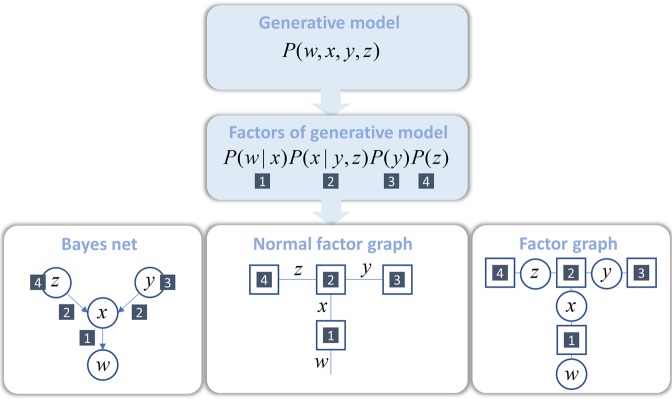
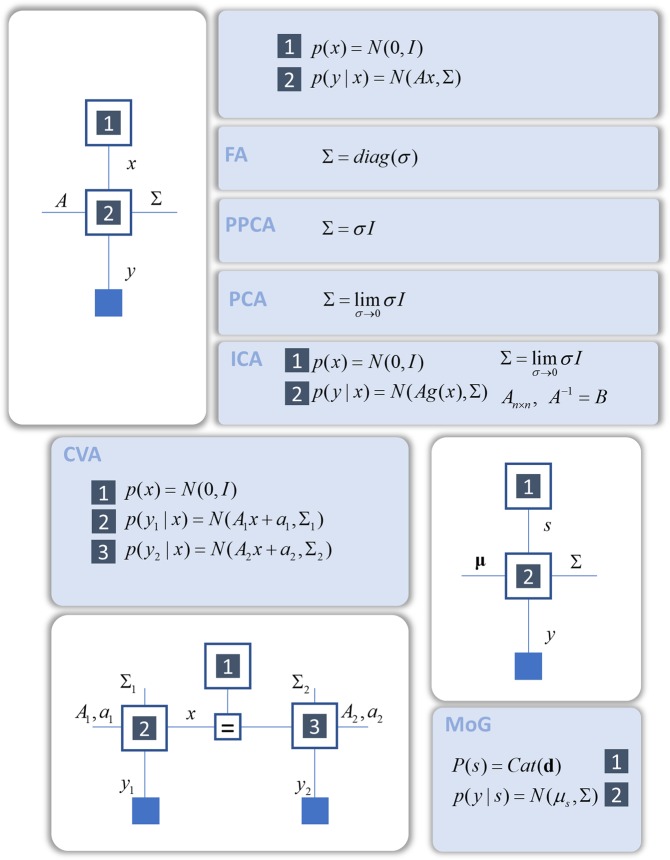
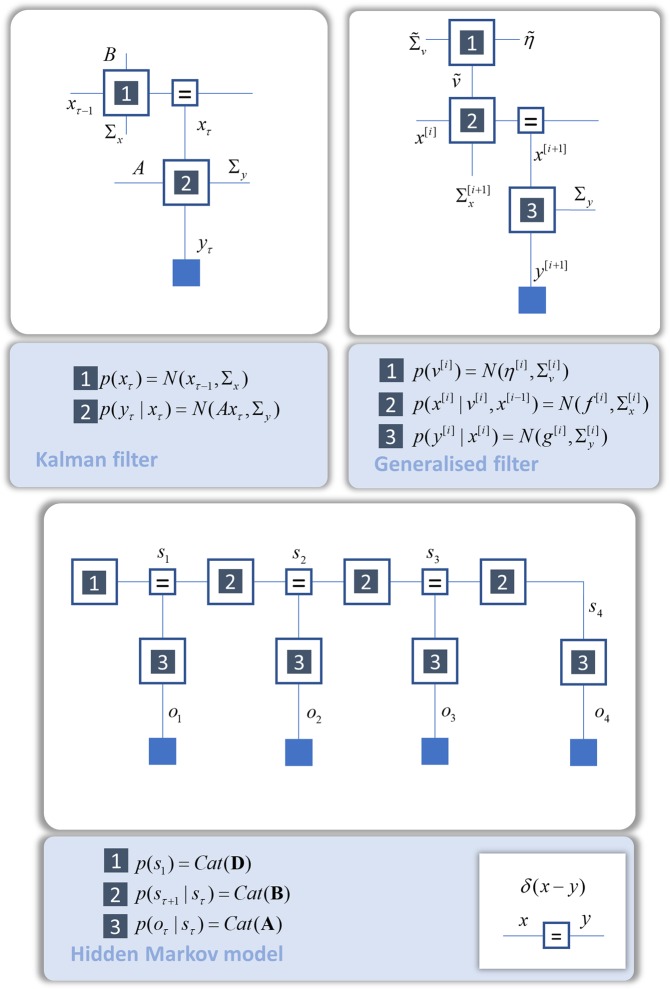
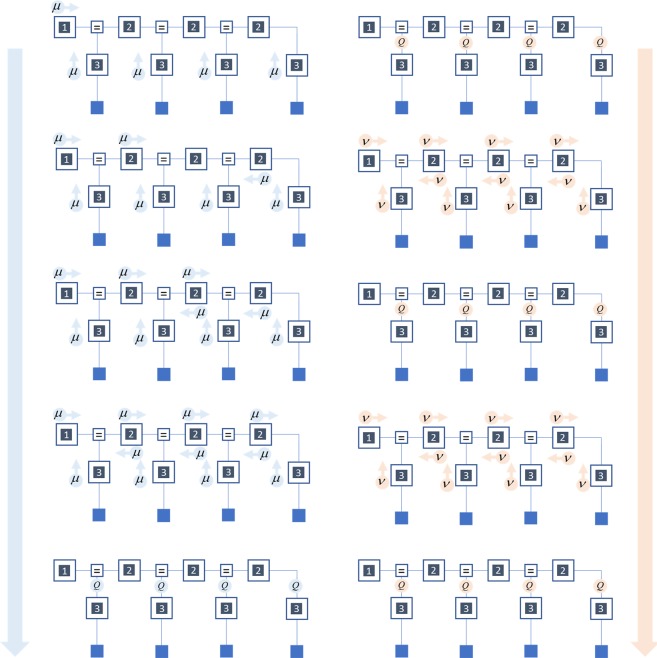
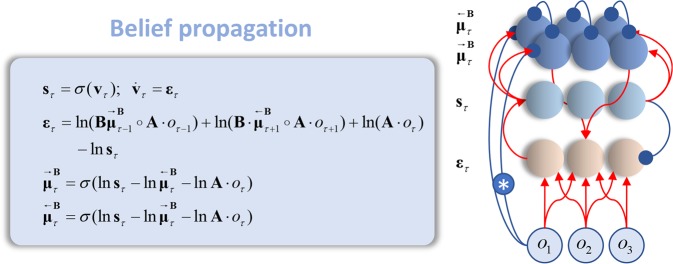
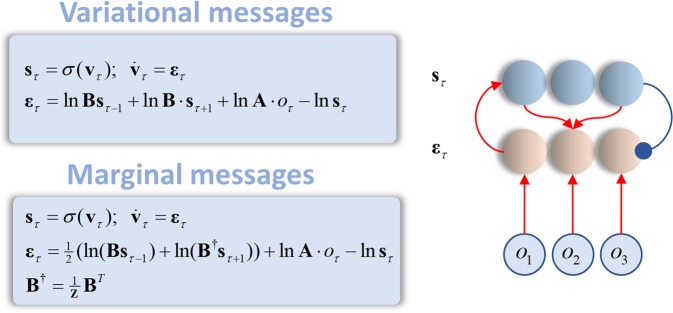
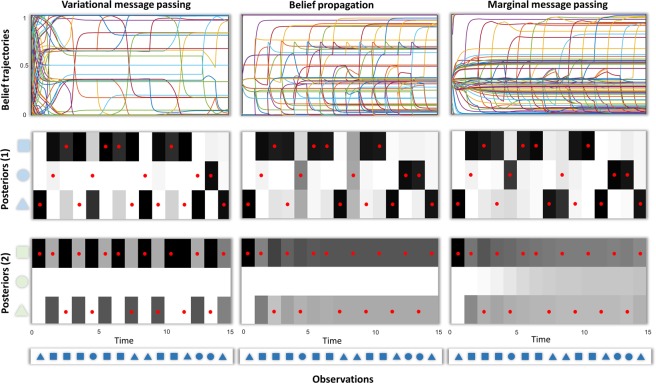
Neuronal computations rely upon local interactions across synapses. For a neuronal network to perform inference, it must integrate information from locally computed messages that are propagated among elements of that network. We review the form of two popular (Bayesian) message passing schemes and consider their plausibility as descriptions of inference in biological networks. These are variational message passing and belief propagation – each of which is derived from a free energy functional that relies upon different approximations (mean-field and Bethe respectively). We begin with an overview of these schemes and illustrate the form of the messages required to perform inference using Hidden Markov Models as generative models. Throughout, we use factor graphs to show the form of the generative models and of the messages they entail. We consider how these messages might manifest neuronally and simulate the inferences they perform. While variational message passing offers a simple and neuronally plausible architecture, it falls short of the inferential performance of belief propagation. In contrast, belief propagation allows exact computation of marginal posteriors at the expense of the architectural simplicity of variational message passing. As a compromise between these two extremes, we offer a third approach – marginal message passing – that features a simple architecture, while approximating the performance of belief propagation. Finally, we link formal considerations to accounts of neurological and psychiatric syndromes in terms of aberrant message passing.
Overview
The claims and statistics of this paper haven’t been checked yet.
Free: it reads the open-access text and checks the first 5 claims that cite a source we can check. Create a free account to check every claim.
Integrity signals
Registry
Cites
Statistics
Figures
Verification
Claims the paper makes
The claims and statistics of this paper haven’t been checked yet.
Free: it reads the open-access text and checks the first 5 claims that cite a source we can check. Create a free account to check every claim.
Claims other papers make about this one
Each is checked against this paper’s own text: does it say what the citing paper says it does?
The source backs part of the claim, not all of it — or backs it for a different population, condition or comparison.
In the citing paper
“However, we do believe that inference and learning in CSCG can be achieved using biologically plausible mechanisms (15, 22).”
From Space is a latent sequence: A theory of the hippocampus (2024) · cites this paper as [22]
Experimental — accuracy not yet measuredThe cited source says what the claim attributes to it.
In the citing paper
“From an FEP-AI perspective, this synchrony-enhanced communication would facilitate information sharing among (and marginalization over) coupled dynamics, thereby organizing message passing (or belief propagation) for inference (Parr and Friston, 2018a; Parr et al., 2019).”
From An Integrated World Modeling Theory (IWMT) of Consciousness (2020) · cites this paper as Parr et al., 2019
The cited source says what the claim attributes to it.
In the citing paper
“Therefore, the communication of information regarding sub-system internal states (via MBs, definitionally) to the larger systems of which they are part is the propagation of a probabilistic belief—e.g., marginal message passing (Parr et al., 2019)—and so overall hierarchical organization of systems and sub-systems must instantiate HPP.”
From An Integrated World Modeling Theory (IWMT) of Consciousness (2020) · cites this paper as Parr et al., 2019
Self-check
Percentages, sums and reported differences re-computed from the paper’s own numbers.
The self-check needs the paper’s full text.
Citations
Cites
Maximum Likelihood from Incomplete Data Via the EM Algorithm
Dempster, A. P., Laird, N. M., & Rubin, D. B. (1977) · Journal of the Royal Statistical Society Series B: Statistical Methodology · doi:10.1111/j.2517-6161.1977.tb01600.x · Cited by 50,444
A New Approach to Linear Filtering and Prediction Problems
Kalman, R. E. (1960) · Journal of Basic Engineering · doi:10.1115/1.3662552 · Cited by 31,751 · cited 1×
“By 97 and generalised filtering 98 (the basis of predictive coding schemes 99 and inversion of dynamic causal models 100 ).”
BackgroundReinforcement Learning: An Introduction
(2005) · IEEE Transactions on Neural Networks · doi:10.1109/tnn.2004.842673 · Cited by 24,496
A tutorial on hidden Markov models and selected applications in speech recognition
Rabiner, L. R. (1989) · Proceedings of the IEEE · doi:10.1109/5.18626 · Cited by 22,743 · cited 1×
“Note that the classical ‘forward-backward’ algorithm 68 is a special case of the belief propagation applied to an HMM.”
Background(1988) · Cited by 16,582
An Information-Maximization Approach to Blind Separation and Blind Deconvolution
Bell, A. J., & Sejnowski, T. J. (1995) · Neural Computation · doi:10.1162/neco.1995.7.6.1129 · Cited by 8,986
Irreversibility and heat generation in the computing process
Landauer, R. (1961) · IBM Journal of Research and Development · doi:10.1147/rd.53.0183 · Cited by 4,980
Graphical Models, Exponential Families, and Variational Inference
Wainwright, M. J., & Jordan, M. I. (2007) · now publishers, Inc. eBooks · doi:10.1561/9781601981851 · Cited by 2,959
Rhythms for cognition: communication through coherence
Fries, P. (2015) · Neuron · doi:10.1016/j.neuron.2015.09.034 · Cited by 2,725 · cited 1×
“Communication between brain areas is sometimes framed in terms of oscillatory processes, where coherence of oscillations determines the influence of one set of neurons over another 22 .”
BackgroundThe Bayesian brain: The role of uncertainty in neural coding and computation
Knill, D. C., & Pouget, A. (2004) · Trends in Neurosciences · doi:10.1016/j.tins.2004.10.007 · Cited by 2,588 · cited 1×
“( ) ( ) ( ) ( ) (1) s s s t t s s s t t”
Research works printed but not linked: 6
- Deneve, S. In Advances in neural information processing systems. 353–360.
- Dauwels, J. In Information Theory, 2007. ISIT 2007. IEEE International Symposium on. 2546–2550 (IEEE).
- Jaakkola, T., Singh, S. P. & Jordan, M. I. In Advances in neural information processing systems. 345–352.
- Heskes, T. In Advances in neural information processing systems. 359–366.
- Weller, A., Tang, K., Sontag, D. & Jebara, T. In 30th Conference on Uncertainty in Artificial Intelligence, UAI. (AUAI Press, 2014).
- Nowlan, S. J. In Advances in neural information processing systems. 574–582.
Cited by
A step-by-step tutorial on active inference and its application to empirical data
Smith, R., Friston, K. J., & Whyte, C. J. (2022) · Journal of Mathematical Psychology · doi:10.1016/j.jmp.2021.102632 · Cited by 246
Self-citationDeeply Felt Affect: The Emergence of Valence in Deep Active Inference
Hesp, C., Smith, R., Parr, T., Allen, M., Friston, K. J., & Ramstead, M. J. D. (2021) · Neural Computation · doi:10.1162/neco_a_01341 · Cited by 246
“Note the factor of 1 / 2 in posterior state beliefs ¯ s τ results from the marginal message-passing approximation introduced by Parr et al. (2019).”
BackgroundInfluentialSelf-citationActive inference on discrete state-spaces: A synthesis
Da Costa, L., Parr, T., Sajid, N., Veselic, S., Neacsu, V., & Friston, K. (2020) · Journal of Mathematical Psychology · doi:10.1016/j.jmp.2020.102447 · Cited by 226
Self-citationA tale of two densities: active inference is enactive inference
Ramstead, M. J., Kirchhoff, M. D., & Friston, K. J. (2020) · Adaptive Behavior · doi:10.1177/1059712319862774 · Cited by 220
“This optimisation can proceed explicitly as in predictive coding (Rao & Ballard, 1999), belief propagation (Pearl, 1982) and (marginal) neuronal message passing (Parr, Markovic, Kiebel, & Friston, 2019) – depending upon the form of the general model and optimisation scheme.”
BackgroundSelf-citationActive Inference: Demystified and Compared
Sajid, N., Ball, P. J., Parr, T., & Friston, K. J. (2021) · Neural Computation · doi:10.1162/neco_a_01357 · Cited by 145
“…we calculate the solution by using a gradient descent (with a default step size, ζ , of 4) on free energy F , which allows us to optimize both action-selection and inference simultaneously, using a mean-field approximation (Beck, Pouget, & Heller, 2012; Parr, Markovic, Kiebel, & Friston, 2019).”
MethodSelf-citationIn the body's eye: the computational anatomy of interoceptive inference
Allen, M., Levy, A., Parr, T., & Friston, K. J. (2022) · PLOS Computational Biology · doi:10.1371/journal.pcbi.1010490 · Cited by 185
“For any set of A , B , C,D, and E parameters, one can then simulate active inference using standard marginal message passing schemes (Parr et al., 2019) to optimize expectations about hidden states of the world – and the action or policy currently being pursued (technically, a policy is a sequence…”
MethodSelf-citationComputational psychiatry: from synapses to sentience
Friston, K. J. (2022) · Molecular Psychiatry · doi:10.1038/s41380-022-01743-z · Cited by 197
Self-citationThe free energy principle made simpler but not too simple
Friston, K., Da Costa, L., Sajid, N., Heins, C., Ueltzhöffer, K., Pavliotis, G. A., & Parr, T. (2023) · Physics Reports · doi:10.1016/j.physrep.2023.07.001 · Cited by 163
“…uses a mean-field approximation, in which the joint distribution over current and future states factorises into marginal distributions at each point in time [this approximation can be finessed by conditioning on previous states, leading to a different (Bethe) variational free energy [160,161]].”
Self-citationFriston, K., Da Costa, L., Hafner, D., Hesp, C., & Parr, T. (2021) · Neural Computation · doi:10.1162/neco_a_01351 · Cited by 117
“This scheme is exact because we have made no mean-field approximations of the sort required by variational message passing (Dauwels, 2007; Friston, Parr, et al., 2017; Parr et al., 2019; Winn & Bishop, 2005).”
MethodSelf-citation(2021) · UCL Discovery (University College London) · Cited by 141
Safron, A. (2020) · Frontiers in Artificial Intelligence · doi:10.3389/frai.2020.00030 · Cited by 133
Generative models, linguistic communication and active inference
Friston, K. J., Parr, T., Yufik, Y., Sajid, N., Price, C. J., & Holmes, E. (2020) · Neuroscience & Biobehavioral Reviews · doi:10.1016/j.neubiorev.2020.07.005 · Cited by 108
Self-citationAn Active Inference Approach to Modeling Structure Learning: Concept Learning as an Example Case
Smith, R., Schwartenbeck, P., Parr, T., & Friston, K. J. (2020) · Frontiers in Computational Neuroscience · doi:10.3389/fncom.2020.00041 · Cited by 99
Self-citationWhence the Expected Free Energy?
Millidge, B., Tschantz, A., & Buckley, C. L. (2021) · Neural Computation · doi:10.1162/neco_a_01354 · Cited by 94
Deep active inference as variational policy gradients
Millidge, B. (2020) · Journal of Mathematical Psychology · doi:10.1016/j.jmp.2020.102348 · Cited by 115
Friston, K. J., Sajid, N., Quiroga-Martinez, D. R., Parr, T., Price, C. J., & Holmes, E. (2021) · Hearing Research · doi:10.1016/j.heares.2020.107998 · Cited by 93
Self-citationGeorge, D., Rikhye, R. V., Gothoskar, N., Guntupalli, J. S., Dedieu, A., & Lázaro-Gredilla, M. (2021) · Nature Communications · doi:10.1038/s41467-021-22559-5 · Cited by 109
Predictive Coding: a Theoretical and Experimental Review
Millidge, B., Seth, A., & Buckley, C. L. (2021) · arXiv · doi:10.48550/arxiv.2107.12979 · Cited by 106
Representation Wars: Enacting an Armistice Through Active Inference
Constant, A., Clark, A., & Friston, K. J. (2021) · Frontiers in Psychology · doi:10.3389/fpsyg.2020.598733 · Cited by 95
Self-citationReinforcement Learning through Active Inference
Tschantz, A., Millidge, B., Seth, A. K., & Buckley, C. L. (2020) · arXiv (Cornell University) · doi:10.48550/arxiv.2002.12636 · Cited by 55
“Active inference also comes equipped with a well-developed neural process theory (Friston et al., 2017a; Parr et al., 2019) which can account for a substantial range of neural dynamics.”
BackgroundSelf-supervision, normativity and the free energy principle
Hohwy, J. (2020) · Synthese · doi:10.1007/s11229-020-02622-2 · Cited by 105
Perceptual awareness and active inference
Parr, T., Corcoran, A. W., Friston, K. J., & Hohwy, J. (2019) · Neuroscience of Consciousness · doi:10.1093/nc/niz012 · Cited by 91
“(Friston et al. 2017a; Parr et al. 2019)], very much like those between neurons in a network.”
BackgroundSelf-citationSmith, R., Lane, R. D., Parr, T., & Friston, K. J. (2019) · Neuroscience & Biobehavioral Reviews · doi:10.1016/j.neubiorev.2019.09.002 · Cited by 89
Self-citationHow particular is the physics of the free energy principle?
Aguilera, M., Millidge, B., Tschantz, A., & Buckley, C. L. (2021) · Physics of Life Reviews · doi:10.1016/j.plrev.2021.11.001 · Cited by 104
Statistical Mechanics of Deep Linear Neural Networks: The Backpropagating Kernel Renormalization
Li, Q., & Sompolinsky, H. (2021) · Physical Review X · doi:10.1103/physrevx.11.031059 · Cited by 122
The predictive global neuronal workspace: a formal active inference model of visual consciousness
Whyte, C. J., & Smith, R. (2021) · Progress in Neurobiology · doi:10.1016/j.pneurobio.2020.101918 · Cited by 84
The Predictive Global Neuronal Workspace: A Formal Active Inference Model of Visual Consciousness
Whyte, C. J., & Smith, R. (2020) · doi:10.1101/2020.02.11.944611 · Cited by 84
Designing ecosystems of intelligence from first principles
Friston, K. J., Ramstead, M. J. D., Kiefer, A. B., Tschantz, A., Buckley, C. L., Albarracin, M., Pitliya, R. J., Heins, C., Klein, B., Millidge, B., et al. (2024) · Collective Intelligence · doi:10.1177/26339137231222481 · Cited by 95
“…nature of message passing in any physical or biophysical realization of an AI system (Dauwels, 2007; Friston et al., 2018; Kschischang et al., 2001; Parr et al., 2019; Winn and Bishop, 2005): messages must be the suf fi cient statistics or parameters of probability distributions (i.e., Bayesian…”
BackgroundSelf-citationOn the Relationship Between Active Inference and Control as Inference
Millidge, B., Tschantz, A., Seth, A. K., & Buckley, C. L. (2020) · Communications in computer and information science · doi:10.1007/978-3-030-64919-7_1 · Cited by 96
Gut inference: A computational modelling approach
Smith, R., Mayeli, A., Taylor, S., Al Zoubi, O., Naegele, J., & Khalsa, S. S. (2021) · Biological Psychology · doi:10.1016/j.biopsycho.2021.108152 · Cited by 66
“It also provides empirical support for the postulated relationship between belief updating and ERPs in active inference (Friston, Parr et al., 2017; Parr, Markovic, Kiebel, & Friston, 2019; Smith, Friston et al., 2021).”
Backgroundpymdp: A Python library for active inference in discrete state spaces
Heins, C., Millidge, B., Demekas, D., Klein, B., Friston, K., Couzin, I. D., & Tschantz, A. (2022) · Journal of Open Source Software · doi:10.21105/joss.04098 · Cited by 70
“, marginal-message passing (Parr et al., 2019)) for the agent to use during state estimation.”
BackgroundSelf-citationThe empirical status of predictive coding and active inference
Hodson, R., Mehta, M., & Smith, R. (2024) · Neuroscience & Biobehavioral Reviews · doi:10.1016/j.neubiorev.2023.105473 · Cited by 69
An Introduction to Predictive Processing Models of Perception and Decision‐Making
Sprevak, M. D., & Smith, R. S. (2023) · Topics in Cognitive Science · doi:10.1111/tops.12704 · Cited by 82
“…experiments of this type have used active inference to propose formal models of selective attention and working memory (Mirza, Adams, Friston, & Parr, 2019; Parr & Friston, 2017; Parr & Friston, 2019; Parr & Friston, 2018; Parr, Rikhye, Halassa, & Friston 2020), cardiac interoception and…”
MethodA primer on Variational Laplace (VL)
Zeidman, P., Friston, K., & Parr, T. (2023) · NeuroImage · doi:10.1016/j.neuroimage.2023.120310 · Cited by 48
Self-citationPrefrontal Computation as Active Inference
Parr, T., Rikhye, R. V., Halassa, M. M., & Friston, K. J. (2020) · Cerebral Cortex · doi:10.1093/cercor/bhz118 · Cited by 48
“In practice, we compensate for this by using the following expression for the gradient (Parr et al. 2019):”
BackgroundMethodSelf-citationThe two kinds of free energy and the Bayesian revolution
Gottwald, S., & Braun, D. A. (2020) · PLoS Computational Biology · doi:10.1371/journal.pcbi.1008420 · Cited by 54
“These contributions are interpreted as local messages passed between the nodes and might be related to brain signals (Parr et al., 2019).”
BackgroundIntegrated world modeling theory expanded: Implications for the future of consciousness
Safron, A. (2022) · Frontiers in Computational Neuroscience · doi:10.3389/fncom.2022.642397 · Cited by 34
“, 2012; Scheeringa and Fries, 2019) via quantized packets of information (as sufficient/summary statistics), so establishing marginal message passing regimes (Parr et al., 2019b).”
BackgroundParr, T., Sajid, N., & Friston, K. J. (2020) · Entropy · doi:10.3390/e22050552 · Cited by 39
Self-citationUnderstanding, Explanation, and Active Inference
Parr, T., & Pezzulo, G. (2021) · Frontiers in Systems Neuroscience · doi:10.3389/fnsys.2021.772641 · Cited by 36
“…the idea that the activity in populations of neurons parameterises this variational density, and that the evolution of this activity ensures the alignment between the variational and exact posterior distributions (Friston and Kiebel, 2009; Bogacz, 2017; Parr et al., 2019; Da Costa et al., 2021).”
BackgroundMethodSelf-citationNeural dynamics under active inference: plausibility and efficiency of information processing
Da Costa, L., Parr, T., Sengupta, B., & Friston, K. (2021) · Entropy · doi:10.3390/e23040454 · Cited by 38
Self-citationReward maximization through discrete active inference
Da Costa, L., Sajid, N., Parr, T., Friston, K., & Smith, R. (2023) · Neural Computation · doi:10.1162/neco_a_01574 · Cited by 35
“This framework has been used to simulate and explain intelligent behavior in neuroscience (Adams et al., 2013; Parr, 2019; Parr et al., 2021; Sajid et al., 2022), psychology and psychiatry (Smith, Khalsa, et al., 2021; Smith, Kirlic, Stewart, Touthang, Kuplicki, Khalsa, et al., 2021; Smith, Kirlic,…”
BackgroundMethodSelf-citationZhang, L., Liu, G., Kong, M., Li, J., Wu, D., Zhou, X., Yang, C., Xia, L., Yang, Z., & Chen, L. (2019) · Bioinformatics · doi:10.1093/bioinformatics/btz542 · Cited by 39
A social inference model of idealization and devaluation.
Story, G. W., Smith, R. S., Moutoussis, M., Berwian, I. M., Nolte, T., Bilek, E., Siegel, J. Z., & Dolan, R. J. (2024) · Psychological Review · doi:10.1037/rev0000430 · Cited by 37
“In brief, this method approximates posterior inference using a variational (marginal) message-passing algorithm that balances the predictive accuracy and complexity of posterior beliefs (Parr et al., 2019).”
MethodFederated inference and belief sharing
Friston, K. J., Parr, T., Heins, C., Constant, A., Friedman, D., Isomura, T., Fields, C., Verbelen, T., Ramstead, M., Clippinger, J., et al. (2024) · Neuroscience & Biobehavioral Reviews · doi:10.1016/j.neubiorev.2023.105500 · Cited by 30
“1 The beliefs in question pertain to latent states, parameters and structures: all of which change to minimise a free energy functional; namely, a variational free energy that incorporates expected free energy (Parr and Friston, 2019).”
BackgroundSelf-citationLimongi, R., Silva, A., Mackinley, M., Ford, S. D., & Palaniyappan, L. K. (2023) · Schizophrenia Bulletin · doi:10.1093/schbul/sbac125 · Cited by 30
The free energy principle induces neuromorphic development
Fields, C., Friston, K. J., Glazebrook, J. F., Levin, M. G., & Marcianò, A. (2022) · Neuromorphic Computing and Engineering · doi:10.1088/2634-4386/aca7de · Cited by 31
“This kind of coarse graining (c.f., carving nature at its joints) is ubiquitous in statistics and physics, where it emerges in the guise of mean field approximations; namely, factorizing a probability density into conditionally independent factors [22, 93, 94, 95, 96].”
Self-citationDeep Active Inference and Scene Construction
Heins, R. C., Mirza, M. B., Parr, T., Friston, K. J., Kagan, I., & Pooresmaeili, A. (2020) · Frontiers in Artificial Intelligence · doi:10.3389/frai.2020.509354 · Cited by 32
“In practice the variational posterior over states is computed as a marginal message passing routine (Parr et al., 2019), where prediction errors ε πτ minimized over time until some criterion of convergence is reached ( ε ≈ 0).”
MethodSelf-citationMann, S. F., Pain, R., & Kirchhoff, M. D. (2022) · Biology & Philosophy · doi:10.1007/s10539-022-09864-z · Cited by 36
“Recent models of variational message passing constitute similar claims, with messagepassing being a distinct way to minimize variational free energy (Parr et al., 2019) – a different implementation and algorithm, but the same computation.”
BackgroundRational thoughts in neural codes
Wu, Z., Kwon, M., Daptardar, S., Schrater, P., & Pitkow, X. (2020) · Proceedings of the National Academy of Sciences · doi:10.1073/pnas.1912336117 · Cited by 27
Space is a latent sequence: A theory of the hippocampus
Raju, R. V., Guntupalli, J. S., Zhou, G., Wendelken, C., Lázaro-Gredilla, M., & George, D. (2024) · Science Advances · doi:10.1126/sciadv.adm8470 · Cited by 25
Whyte, C. J., Hohwy, J., & Smith, R. (2022) · Current Research in Neurobiology · doi:10.1016/j.crneur.2022.100036 · Cited by 24
“Inference within these models is performed through the application of message passing algorithms – most commonly marginal message passing (Parr et al., 2019).”
MethodGeometric methods for sampling, optimization, inference, and adaptive agents
Barp, A., Costa, L. D., França, G., Friston, K. J., Girolami, M., Jordan, M. I., & Pavliotis, G. A. (2022) · Handbook of statistics · doi:10.1016/bs.host.2022.03.005 · Cited by 32
Self-citationDynamic Expectation Maximization Algorithm for Estimation of Linear Systems with Colored Noise
Meera, A. A., & Wisse, M. (2021) · Entropy · doi:10.3390/e23101306 · Cited by 28
Active Inference, Bayesian Optimal Design, and Expected Utility
Sajid, N., Costa, L. D., Parr, T., & Friston, K. J. (2022) · Cambridge University Press eBooks · doi:10.1017/9781009026949.007 · Cited by 27
Self-citationAn Active Inference Approach to Dissecting Reasons for Nonadherence to Antidepressants
Smith, R. S., Khalsa, S. S., & Paulus, M. P. (2019) · Biological Psychiatry Cognitive Neuroscience and Neuroimaging · doi:10.1016/j.bpsc.2019.11.012 · Cited by 22
Neural Belief Propagation for Scene Graph Generation
Liu, D., Bober, M. Z., & Kittler, J. (2023) · IEEE Transactions on Pattern Analysis and Machine Intelligence · doi:10.1109/tpami.2023.3243306 · Cited by 25
“Compared with the ubiquitous mean field approximation applied in the mainstream SGG models, the structural Bethe approximation employed in the proposed NBP method is a better estimation of the log evidence [19].”
MethodCosta, L. D., Sajid, N., Parr, T., Friston, K. J., & Smith, R. S. (2020) · arXiv (Cornell University) · Cited by 23
Self-citationTowards a cross-level understanding of Bayesian inference in the brain
Lin, C., & Garrido, M. I. (2022) · Neuroscience & Biobehavioral Reviews · doi:10.1016/j.neubiorev.2022.104649 · Cited by 23
Active inference and the two-step task
Gijsen, S., Grundei, M., & Blankenburg, F. (2022) · Scientific Reports · doi:10.1038/s41598-022-21766-4 · Cited by 19
Generative models for sequential dynamics in active inference
Parr, T., Friston, K. J., & Pezzulo, G. (2023) · Cognitive Neurodynamics · doi:10.1007/s11571-023-09963-x · Cited by 19
Self-citationNeuromodulatory Control and Language Recovery in Bilingual Aphasia: An Active Inference Approach
Sajid, N., Friston, K. J., Ekert, J. O., Price, C. J., & Green, D. W. (2020) · Behavioral Sciences · doi:10.3390/bs10100161 · Cited by 17
“Variational message passing can be formulated as a gradient descent on variational free energy, using a mean-field approximation [33,34].”
MethodSelf-citationLeptourgos, P., Bouttier, V., Denève, S., & Jardri, R. (2021) · PsyArXiv (OSF Preprints) · doi:10.1016/j.neubiorev.2022.104593 · Cited by 17
On the minimal theory of consciousness implicit in active inference
Whyte, C. J., Corcoran, A. W., Robinson, J., Smith, R., Moran, R. J., Parr, T., Friston, K. J., Seth, A. K., & Hohwy, J. (2026) · Physics of Life Reviews · doi:10.1016/j.plrev.2025.11.002 · Cited by 15
“…algorithm that: 1) performs a gradient decent on variational free energy with respect to states, thereby inferring the value of the approximate posterior over states; and 2) furnishes us with a simple model of neuronal dynamics (for details, see Friston et al., 2017; Parr, Markovic, et al., 2019).”
Self-citationBayesian theories of consciousness: a review in search for a minimal unifying model
Rorot, W. (2021) · Neuroscience of Consciousness · doi:10.1093/nc/niab038 · Cited by 23
Applications of the Free Energy Principle to Machine Learning and NeurosciencePreprint
Millidge, B. (2021) · arXiv (Cornell University) · doi:10.7488/era/1501 · Cited by 18
Beyond Markov: Transformers, memory, and attention
Parr, T., Pezzulo, G., & Friston, K. J. (2025) · Cognitive Neuroscience · doi:10.1080/17588928.2025.2484485 · Cited by 18
“Inference in a factor graph (Dauwels, 2007; Parr et al., 2019; van de Laar & de Vries, 2019) can be formulated as a process of passing messages between nodes, such that each edge can be associated with bidirectional messages used to update beliefs.”
Self-citationRealizing Active Inference in Variational Message Passing: The Outcome-Blind Certainty Seeker
Champion, T., Grześ, M., & Bowman, H. (2021) · Neural Computation · doi:10.1162/neco_a_01422 · Cited by 16
Circular inference predicts nonuniform overactivation and dysconnectivity in brain-wide connectomes
Bouttier, V., Duttagupta, S., Denève, S., & Jardri, R. (2021) · Schizophrenia Research · doi:10.1016/j.schres.2020.12.045 · Cited by 14
Zeidman, P., Ashburner, J., Barnes, G. R., Kowalczyk, O. S., Lambert, C., Litvak, V., Nichols, T. E., Parr, T., Tierney, T. M., & Friston, K. J. (2025) · Cerebral Cortex · doi:10.1093/cercor/bhaf234 · Cited by 14
“Essentially, there are qualitative differences between arrays of OPMs and arrays of cryogenic MEG sensors beyond their wearability.”
InfluentialSelf-citationSafron, A. (2020) · Communications in computer and information science · doi:10.1007/978-3-030-64919-7_15 · Cited by 14
Bayesian Brains and the Rényi Divergence
Sajid, N., Faccio, F., Costa, L. D., Parr, T., Schmidhuber, J., & Friston, K. J. (2022) · Neural Computation · doi:10.1162/neco_a_01484 · Cited by 19
“This has direct consequences for the types of message passing schemes that might be implemented in the brain ([35, 40]).”
BackgroundSelf-citationActive Inference and Epistemic Value in Graphical Models
van de Laar, T., Koudahl, M., van Erp, B., & de Vries, B. (2022) · Frontiers in Robotics and AI · doi:10.3389/frobt.2022.794464 · Cited by 15
“Several authors have attempted to formulate minimization of the EFE by message passing on factor graphs (de Vries and Friston, 2017; Parr et al., 2019; Parr and Friston, 2019; Champion et al., 2021).”
BackgroundUnderstanding the Origin of Information-Seeking Exploration in Probabilistic Objectives for ControlPreprint
Millidge, B., Seth, A. C., & Buckley, C. L. (2021) · arXiv (Cornell University) · doi:10.48550/arxiv.2103.06859 · Cited by 18
A Mathematical Walkthrough and Discussion of the Free Energy PrinciplePreprint
Millidge, B., Seth, A. K., & Buckley, C. L. (2021) · arXiv (Cornell University) · doi:10.48550/arxiv.2108.13343 · Cited by 12
Cancer Niches and Their Kikuchi Free Energy
Sajid, N., Convertino, L., & Friston, K. J. (2021) · Entropy · doi:10.3390/e23050609 · Cited by 10
Self-citationSR-AIF: Solving Sparse-Reward Robotic Tasks From Pixels with Active Inference and World Models
Nguyen, V. D., Yang, Z., Buckley, C. L., & Ororbia, A. G. (2025) · Proceedings - IEEE International Conference on Robotics and Automation/Proceedings · doi:10.1109/icra55743.2025.11127713 · Cited by 14
“…based on both observed data o t and the prior transitioned state p ( s t | s t − 1 , a t − 1 ) is often known as marginal free energy minimization [60], closely related to the mechanisms of variational autoencoders [39] and stochastic variational inference procedures [37]: Minimizing the…”
Simulating lesion-dependent functional recovery mechanisms
Sajid, N., Holmes, E., Hope, T. M. H., Fountas, Z., Price, C. J., & Friston, K. J. (2021) · Scientific Reports · doi:10.1038/s41598-021-87005-4 · Cited by 9
Self-citationCognitive graphs: Representational substrates for planning.
Yoo, J., Chrastil, E. R., & Bornstein, A. M. (2024) · Decision · doi:10.1037/dec0000249 · Cited by 10
“The transition from the uncompressed graph to the fully backed-up form occurs via repeatedly sampling and aggregating features from neighboring nodes, analogous to message passing algorithms (Hamilton, Ying, and Leskovec, 2017; Parr et al., 2019; George et al., 2021).”
Kalman filters as the steady-state solution of gradient descent on variational free energyPreprint
Baltieri, M., & Isomura, T. (2021) · arXiv (Cornell University) · doi:10.48550/arxiv.2111.10530 · Cited by 13
“Related arguments are sometimes used to claim that generative models can be defined to support both active inference and Kalman filtering [79], although the exact definition of such generative models is not provided.”
BackgroundPeraza, J. A., Martínez-Montes, E., Aubert, E., Valdes-Hernandez, P. A., & Mulet, R. (2019) · Neural Networks · doi:10.1016/j.neunet.2019.11.014 · Cited by 9
Natural selection finds natural gradientPreprint
Costa, L. D., Parr, T., Sengupta, B., & Friston, K. J. (2020) · arXiv (Cornell University) · Cited by 10
Self-citationInferential planning in the frontal cortex
Donnarumma, F., Parr, T., Friston, K. J., Whittington, J. C. R., & Pezzulo, G. (2026) · Cell Reports · doi:10.1016/j.celrep.2026.117905 · Cited by 7
Self-citationPossible Principles for Aligned Structure Learning Agents
Costa, L. D., Gavenčiak, T., Hyland, D., Samiei, M., Dragos-Manta, C., Pattisapu, C., Razi, A., & Friston, K. J. (2025) · Neural Computation · doi:10.1162/neco.a.39 · Cited by 8
Self-citationMessage Passing and Metabolism
Parr, T. (2021) · Entropy · doi:10.3390/e23050606 · Cited by 8
“In the brain sciences, active inference offers a principled approach that underwrites theoretical accounts of neuronal networks as performing Bayesian inference [13,14].”
BackgroundSelf-citationThe 2-D Cluster Variation Method: Topography Illustrations and Their Enthalpy Parameter Correlations
Maren, A. J. (2021) · Entropy · doi:10.3390/e23030319 · Cited by 7
“discuss neuronal message passing [24], with a good review of relevant literature.”
BackgroundRamstead, M. J. D., Albarracin, M., Kiefer, A. B., Williford, K., Safron, A., Fields, C., Solms, M., & Friston, K. J. (2023) · PsyArXiv (OSF Preprints) · doi:10.31234/osf.io/6eqxh · Cited by 7
Self-citationJoint modeling of choices and reaction times based on Bayesian contextual behavioral control
Schwöbel, S., Marković, D., Smolka, M. N., & Kiebel, S. J. (2024) · PLoS Computational Biology · doi:10.1371/journal.pcbi.1012228 · Cited by 6
Self-citationRealizing Synthetic Active Inference Agents, Part II: Variational Message Updates
van de Laar, T., Koudahl, M., & de Vries, B. (2024) · Neural Computation · doi:10.1162/neco_a_01713 · Cited by 10
“A biologically plausible view on message passing for AIF is described by (Parr et al., 2019), which combines the strengths of belief propagation and VMP to describe an alternative type of marginal message update.”
Honda, S., & YANAGISAWA, H. (2025) · Research in Engineering Design · doi:10.1007/s00163-025-00456-y · Cited by 8
Inferring What to Do (And What Not to)
Parr, T. (2020) · Entropy · doi:10.3390/e22050536 · Cited by 9
Self-citationReframing the Expected Free Energy: Four Formulations and a Unification
Champion, T., Bowman, H., Marković, D., & Grześ, M. (2026) · Neural Computation · doi:10.1162/neco.a.1491 · Cited by 8
Safron, A. (2023) · Communications in computer and information science · doi:10.1007/978-3-031-28719-0_18 · Cited by 6
Neuron particles capture network topology and behavior from single unitsPreprint
Gupta, G., Rhodes, J. S., Kiani, R., & Bogdan, P. (2021) · bioRxiv (Cold Spring Harbor Laboratory) · doi:10.1101/2021.12.03.471160 · Cited by 5
“133 Topological features of neuronal networks influence the microscopic neuronal dynamics 134 The complex patterns in the neuron spikes are the result of the individual neuron transfer function 135 and the network feeding into each neuronal unit (36, 37).”
BackgroundLimongi, R., Skelton, A. J., Tzianas, L. H., & Silva, A. (2024) · Brain Sciences · doi:10.3390/brainsci14121278 · Cited by 5
Constant, A., Albarracin, M., Perin, M., Thiruvengada, H., & Friston, K. J. (2025) · Frontiers in Sustainable Cities · doi:10.3389/frsc.2025.1571613 · Cited by 6
Self-citationPrest, S. (2026) · Neural Computation · doi:10.1162/neco.a.1534 · Cited by 5
Cognitive Systems, Predictive Processing, and the Self
Rupert, R. D. (2021) · Review of Philosophy and Psychology · doi:10.1007/s13164-021-00577-y · Cited by 7
Mofrad, A. A., Yazidi, A., Mofrad, S. A., Hammer, H. L., & Arntzen, E. (2021) · Neural Computation · doi:10.1162/neco_a_01346 · Cited by 5
“It is noteworthy that the PS model uses Bayesian updating, and therefore this update is in harmony with the PS agent (see Schwöbel, Kiebel, & Markovi´c, 2018, and Parr, Markovic, Kiebel, & Friston, 2019, for modeling goal-directed behavior as an inference process).”
MethodIntegrated world modeling theory (IWMT) revisited
Safron, A. (2019) · doi:10.31234/osf.io/kjngh · Cited by 3
Metadata
- Authors
- Parr, T., Markovic, D., Kiebel, S. J., & Friston, K. J.
- Affiliations
- Wellcome Centre for Human Neuroimaging (GB)
- Technische Universität Dresden (DE)
- Corresponding author
- Parr, Thomas
- Venue
- Scientific Reports
- Published
- 2019-02-13
- Volume
- 9
- Issue
- 1
- Pages
- 1889-1889
- ISSN
- 2045-2322 (ISSN-L)
- PMC
- PMC6374414
- OpenAlex
- W2918957485
- Cited by
- 128
- References
- 95
- Citations by year
- 2026: 10 · 2025: 10 · 2024: 7 · 2023: 16 · 2022: 17 · 2021: 32 · 2020: 27 · 2019: 9
- FWCI
- 9.69
- Type
- journal article
- Language
- en
- Open access
- gold
- doi.org
- Licence
- cc-by
- creativecommons.org/licenses/by/4.0 (tdm)
- creativecommons.org/licenses/by/4.0 (vor)
- Locations
- Scientific Reports (publishedVersion, cc-by)
- Europe PMC (PubMed Central) (publishedVersion, cc-by)
- PubMed Central (publishedVersion, cc-by)
- PubMed (publishedVersion)
- DOAJ (DOAJ: Directory of Open Access Journals) (submittedVersion)
- UCL Discovery (University College London) (submittedVersion)
- Funders
- Rosetrees Trust (173346)
- Deutsche Forschungsgemeinschaft (SFB 940/2, Project A9)
- Wellcome Trust (088130/Z/09/Z)
- Topics
- Physical Sciences › Computer Science › Artificial Intelligence › Bayesian Modeling and Causal Inference
- Life Sciences › Neuroscience › Cognitive Neuroscience › Neural dynamics and brain function
- Physical Sciences › Computer Science › Artificial Intelligence › Neural Networks and Applications
- Keywords
- variational message passing, belief propagation, mean-field approximation, Bethe approximation, free energy principle, hidden Markov models, factor graphs, marginal posterior, neuropsychiatric disorders
About these checks
Registry, retraction, Cites and statistics results are computed, not judged, with one exception: a printed reference that no index lists is read once by a model before it counts as a citation error. Claims are extracted by a model and kept only when their quote appears verbatim in the text; each cited source is then checked, with a model’s help, for whether it says what the claim relies on. Those verdicts can be wrong — read the claim’s quote and the cited source before relying on one.
Statistics and arithmetic are recomputed, not judged.
Confidence bands are shown only for fields calibrated on our annotated test set. None is calibrated yet, so no band is shown.
What counts as a claim ›How we measure confidence ›How we check this ›
Are you an author, or do you see a problem with this page? Request a review
Data sources
Bibliographic data: Semantic Scholar, OpenAlex, Crossref.
Contains information from the Semantic Scholar Academic Graph Datasets, made available under the ODC Attribution License (ODC-BY 1.0).
Semantic Scholar’s data is described in: Kinney, R., et al. (2023). The Semantic Scholar Open Data Platform. arXiv:2301.10140.
