

Downregulation of M-channels in lateral habenula mediates hyperalgesia during alcohol withdrawal in rats
Open accessThe DOI matches its Crossref record; 71 of the 71 references it cites were found in a registry or an index.
Abstract
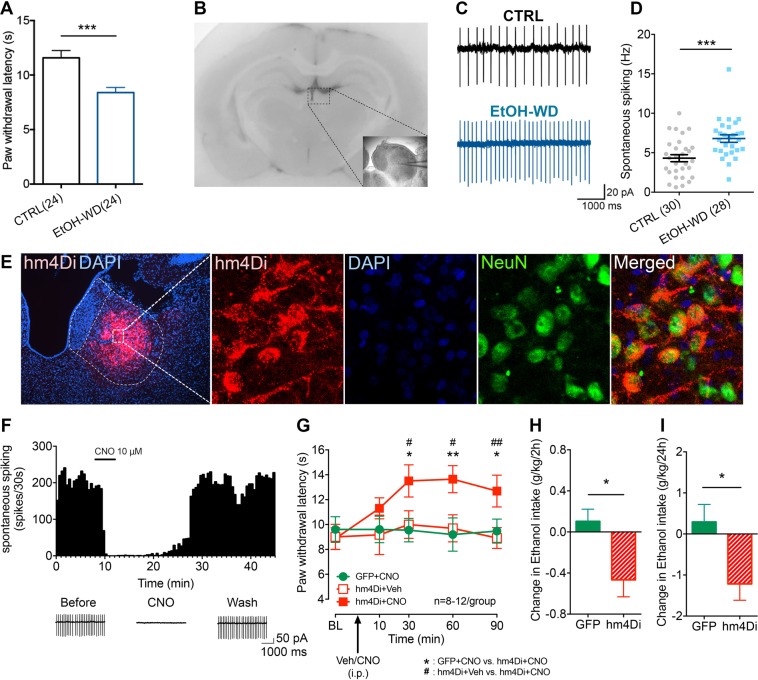
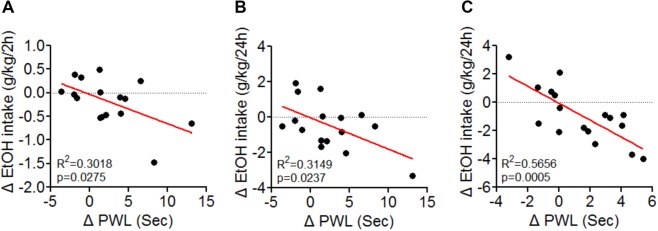
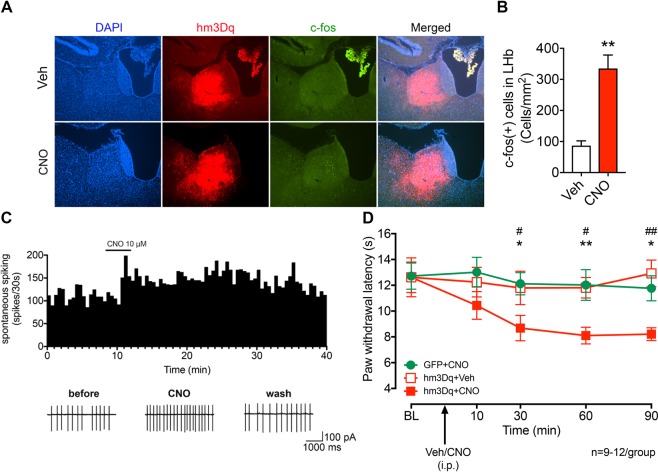
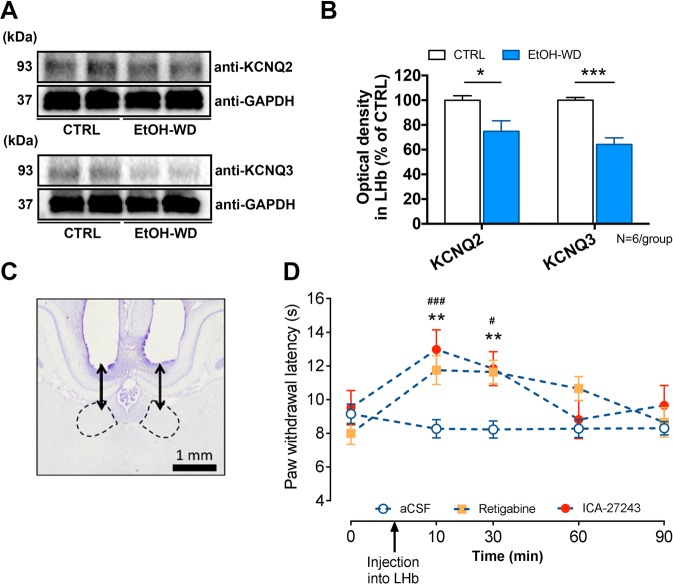
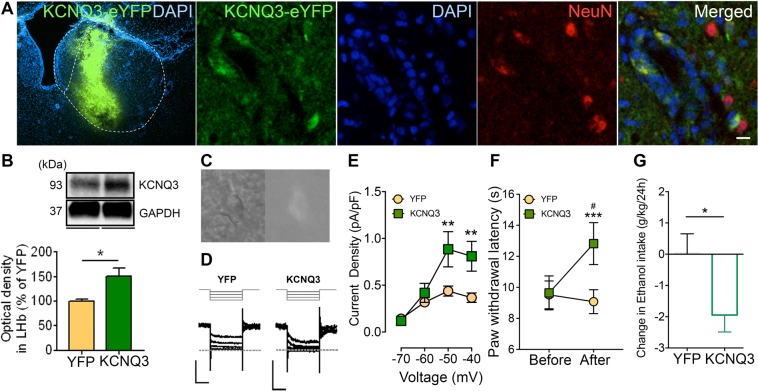
Hyperalgesia often occurs in alcoholics, especially during abstinence, yet the underlying mechanisms remain elusive. The lateral habenula (LHb) has been implicated in the pathophysiology of pain and alcohol use disorders. Suppression of m-type potassium channels (M-channels) has been found to contribute to the hyperactivity of LHb neurons of rats withdrawn from chronic alcohol administration. Here, we provided evidence that LHb M-channels may contribute to hyperalgesia. Compared to alcohol naïve counterparts, in male Long-Evans rats at 24-hours withdrawal from alcohol administration under the intermittent access paradigm for eight weeks, hyperalgesia was evident (as measured by paw withdrawal latencies in the Hargreaves Test), which was accompanied with higher basal activities of LHb neurons in brain slices, and lower M-channel protein expression. Inhibition of LHb neurons by chemogenetics, or pharmacological activation of M-channels, as well as overexpression of M-channels’ subunit KCNQ3, relieved hyperalgesia and decreased relapse-like alcohol consumption. In contrast, chemogenetic activation of LHb neurons induced hyperalgesia in alcohol-naive rats. These data reveal a central role for the LHb in hyperalgesia during alcohol withdrawal, which may be due in part to the suppression of M-channels and, thus, highlights M-channels in the LHb as a potential therapeutic target for hyperalgesia in alcoholics.
Overview
The claims and statistics of this paper haven’t been checked yet.
Free: it reads the open-access text and checks the first 5 claims that cite a source we can check. Create a free account to check every claim.
Integrity signals
Registry
Cites
Statistics
Figures
Verification
Claims the paper makes
The claims and statistics of this paper haven’t been checked yet.
Free: it reads the open-access text and checks the first 5 claims that cite a source we can check. Create a free account to check every claim.
Claims other papers make about this one
Each is checked against this paper’s own text: does it say what the citing paper says it does?
The cited source says what the claim attributes to it.
In the citing paper
“Alcohol withdrawal-induced hyperalgesia and relapse-like alcohol consumption were reversed by the chemogenetic inhibition of lateral habenula neurons, the pharmacological activation of M-channels, and the overexpression of the M-channel subunit potassium voltage-gated channel subfamily KQT member 3 (Kang et al., 2019).”
From Drug Addiction: Hyperkatifeia/Negative Reinforcement as a Framework for Medications Development (2021) · cites this paper as Kang et al., 2019
Self-check
Percentages, sums and reported differences re-computed from the paper’s own numbers.
The self-check needs the paper’s full text.
Citations
Cites
The Rat Brain in Stereotaxic Coordinates
(1982) · Elsevier eBooks · doi:10.1016/c2009-0-63235-9 · Cited by 51,963
Control of memory formation through regulated expression of a CaMKII transgene
Mayford, M., Bach, M. E., Huang, Y.-Y., Wang, L., Hawkins, R. D., & Kandel, E. R. (1996) · Science · doi:10.1126/science.274.5293.1678 · Cited by 1,550
Mechanisms of neuropathic pain
Campbell, J. N., & Meyer, R. A. (2006) · Neuron · doi:10.1016/j.neuron.2006.09.021 · Cited by 1,471
Muscarinic suppression of a novel voltage-sensitive K+ current in a vertebrate neurone
Brown, D. A., & Adams, P. R. (1980) · Nature · doi:10.1038/283673a0 · Cited by 1,444
Ossipov, M. H., Dussor, G. O., & Porreca, F. (2010) · Journal of Clinical Investigation · doi:10.1172/jci43766 · Cited by 1,159
Chemogenetics revealed: DREADD occupancy and activation via converted clozapine
Gomez, J. L., Bonaventura, J., Lesniak, W., Mathews, W. B., Sysa-Shah, P., Rodriguez, L. A., Ellis, R. J., Richie, C. T., Harvey, B. K., Dannals, R. F., et al. (2017) · Science · doi:10.1126/science.aan2475 · Cited by 980
The habenula: from stress evasion to value-based decision-making
Hikosaka, O. (2010) · Nature Reviews Neuroscience · doi:10.1038/nrn2866 · Cited by 955
Pathways modulating neural KCNQ/M (Kv7) potassium channels
Delmas, P., & Brown, D. A. (2005) · Nature Reviews Neuroscience · doi:10.1038/nrn1785 · Cited by 686
Intermittent Access to 20% Ethanol Induces High Ethanol Consumption in Long–Evans and Wistar Rats
Simms, J. A., Steensland, P., Medina, B., Abernathy, K. E., Chandler, L. J., Wise, R., & Bartlett, S. E. (2008) · Alcoholism: Clinical and Experimental Research · doi:10.1111/j.1530-0277.2008.00753.x · Cited by 610
Astroglial Kir4.1 in the lateral habenula drives neuronal bursts in depression
Cui, Y., Yang, Y., Ni, Z., Dong, Y., Cai, G., Foncelle, A., Ma, S., Sang, K., Tang, S., Li, Y., et al. (2018) · Nature · doi:10.1038/nature25752 · Cited by 597
Cited by
Drug Addiction: Hyperkatifeia/Negative Reinforcement as a Framework for Medications Development
Koob, G. F. (2021) · Pharmacological Reviews · doi:10.1124/pharmrev.120.000083 · Cited by 337
“Alcohol withdrawal–induced hyperalgesia and relapse-like alcohol consumption were reversed by the chemogenetic inhibition of lateral habenula neurons, the pharmacological activation ofM-channels, and the overexpression of the M-channel subunit potassium voltage-gated channel subfamily KQT member 3 (Kang et al., 2019).”
BackgroundSemaglutide reduces alcohol intake and relapse-like drinking in male and female rats
Aranäs, C., Edvardsson, C. E., Shevchouk, O. T., Zhang, Q., Witley, S., Blid Sköldheden, S., Zentveld, L., Vallöf, D., Tufvesson-Alm, M., & Jerlhag, E. (2023) · eBioMedicine · doi:10.1016/j.ebiom.2023.104642 · Cited by 158
Marty, V. N., Farokhnia, M., Munier, J. J., Mulpuri, Y., Leggio, L., & Spigelman, I. (2020) · Frontiers in Neuroscience · doi:10.3389/fnins.2020.599646 · Cited by 102
Ketamine exerts its sustained antidepressant effects via cell-type-specific regulation of Kcnq2
Lopez, J. P., Lücken, M. D., Brivio, E., Karamihalev, S., Kos, A., De Donno, C., Benjamin, A., Yang, H., Dick, A. L. W., Stoffel, R., et al. (2022) · Neuron · doi:10.1016/j.neuron.2022.05.001 · Cited by 79
“In the lateral habenula, dysregulation of KCNQ channels mediates hyperalgesia during alcohol withdrawal (Kang et al., 2019).”
Edwards, S., Vendruscolo, L. F., Gilpin, N. W., Wojnar, M., & Witkiewitz, K. A. (2020) · Alcoholism Clinical and Experimental Research · doi:10.1111/acer.14260 · Cited by 89
Li, J., Chen, P., Han, X., Zuo, W., Mei, Q., Bian, E. Y., Umeugo, J., & Ye, J. (2019) · PubMed · Cited by 97
Self-citationKoob, G. F., & Vendruscolo, L. F. (2023) · Current topics in behavioral neurosciences · doi:10.1007/7854_2023_424 · Cited by 54
McIlwrath, S. L., Montera, M. A., Gott, K., Yang, Y., Wilson, C. M., Selwyn, R. G., & Westlund, K. N. (2020) · NeuroImage · doi:10.1016/j.neuroimage.2020.117343 · Cited by 46
Endocannabinoid signaling in the lateral habenula regulates pain and alcohol consumption
Fu, R., Tang, Y. M., Li, W., Ren, Z., Li, D., Zheng, J., Zuo, W., Chen, X., Zuo, Q., Tam, K. L., et al. (2021) · Translational Psychiatry · doi:10.1038/s41398-021-01337-3 · Cited by 45
Self-citationCoffey, K. R., Marx, R. E., Vo, E. K., Nair, S. G., & Neumaier, J. F. (2020) · Neuropsychopharmacology · doi:10.1038/s41386-020-0616-0 · Cited by 39
Borgonetti, V., Roberts, A. J., Bajo, M., Galeotti, N., & Roberto, M. (2023) · British Journal of Pharmacology · doi:10.1111/bph.16091 · Cited by 39
Quadir, S. G., Tanino, S. M., Rohl, C. D., Sahn, J. J., Yao, E. J., Cruz, L. R., Cottone, P., Martin, S. F., & Sabino, V. (2020) · Neuropharmacology · doi:10.1016/j.neuropharm.2020.108409 · Cited by 33
Mao, C., Chen, F. R., Huo, J. H., Zhang, L., Zhang, G. R., Zhang, B., & Zhou, X. Q. (2020) · Human Brain Mapping · doi:10.1002/hbm.25038 · Cited by 33
“…acute experimental pain can activate the bilateral habenula in humans (Shelton, Pendse, et al., 2012), and analgesic effects can be generated by microinjecting morphine into the habenula (Khalilzadeh & Saiah, 2017) or by suppressing the M-channels in the habenula in rats (Kang et al., 2019).”
BackgroundBrandner, A. J., Baratta, A. M., Rathod, R. S., Ferguson, C., Taylor, B. K., & Farris, S. P. (2023) · Journal of Pain · doi:10.1016/j.jpain.2023.02.024 · Cited by 30
McGinn, M. A., Edwards, K. N., & Edwards, S. (2020) · Neurobiology of Pain · doi:10.1016/j.ynpai.2020.100052 · Cited by 29
Alemi, M., Pereira, A. R., Cerqueira-Nunes, M., Monteiro, C., Galhardo, V., & Cardoso-Cruz, H. (2023) · Biomedicines · doi:10.3390/biomedicines11030820 · Cited by 27
“The LHb participates in behavioral and physiological responses to pain-related depression [42], and chemogenetic inhibition of LHb neurons [43] or LHb lesion reduces peripheral pain threshold [19].”
BackgroundEffect of different standard rodent diets on ethanol intake and associated allodynia in male mice
Quadir, S. G., Rohl, C. D., Zeabi, A., Moore, C. F., Cottone, P., & Sabino, V. (2020) · Alcohol · doi:10.1016/j.alcohol.2020.04.003 · Cited by 27
Morgan, A., Adank, D. N., Johnson, K., Butler, E. C., & Patel, S. (2022) · Alcoholism Clinical and Experimental Research · doi:10.1111/acer.14949 · Cited by 21
“withdrawal-induced hyperalgesia is extensively reported in rodents [14-32].”
BackgroundA diencephalic circuit in rats for opioid analgesia but not positive reinforcement
Waung, M. W., Maanum, K. A., Cirino, T. J., Driscoll, J. R., OʼBrien, C., Bryant, S., Mansourian, K. A., Morales, M., Barker, D. J., & Margolis, E. B. (2022) · Nature Communications · doi:10.1038/s41467-022-28332-6 · Cited by 22
Zuo, W., Wu, L., Mei, Q., Zuo, Q., Zhou, Z., Fu, R., Li, W., Wu, W., Matthew, L., & Ye, J.-H. (2019) · Neuropharmacology · doi:10.1016/j.neuropharm.2019.107747 · Cited by 17
Self-citationLateral Habenula and Its Potential Roles in Pain and Related Behaviors
Dai, D., Li, W., Chen, A., Gao, X.-F., & Xiong, L. (2022) · ACS Chemical Neuroscience · doi:10.1021/acschemneuro.2c00067 · Cited by 21
A conceptual framework for the intersection of hyperalgesia and hyperkatifeia in alcohol addiction
Koob, G. F., & Vendruscolo, L. F. (2025) · Alcohol · doi:10.1016/j.alcohol.2025.08.004 · Cited by 17
Patterson, J. T., Koob, G. F., & Anderson, R. I. (2022) · Biological Psychiatry · doi:10.1016/j.biopsych.2022.02.011 · Cited by 11
Coordinated excitatory and inhibitory circuits governing unpredictable threat-induced anxiety
Teng, S.-W., Wang, X., Yao, Z.-X., He, T., Gao, M.-Y., Che, Y.-Y., Wei, X.-Y., Chen, X.-L., Liu, C., & Chen, Z.-Y. (2024) · Cell Reports · doi:10.1016/j.celrep.2024.115146 · Cited by 9
Cucinello‐Ragland, J. A., Mitchell‐Cleveland, R., Trimble, W. B., Urbina, A. P., Yeh, A. Y., Edwards, K. N., Molina, P. E., Peter, L. S., & Edwards, S. (2021) · Neuroscience Letters · doi:10.1016/j.neulet.2021.136119 · Cited by 9
The Emerging Role of LHb CaMKII in the Comorbidity of Depressive and Alcohol Use Disorders
Shor, C., Zuo, W., Eloy, J. D., & Ye, J.-H. (2020) · International Journal of Molecular Sciences · doi:10.3390/ijms21218123 · Cited by 10
“Potentiation of glutamate transmission causes LHb hyperactivity, as occurs in AUDs and DDs [7,13,26,71,77,84] (Figures 1 and 2).”
BackgroundMethodSelf-citationAguilar, J. S., de Carvalho, L. M., Chen, H., Condon, R., Lasek, A. W., & Pradhan, A. A. A. (2024) · Alcoholism Clinical and Experimental Research · doi:10.1111/acer.15273 · Cited by 8
Alcohol use disorder-associated pain: clinical and preclinical evidence
Dong, Y., Buczynski, M. W., & Gregus, A. M. (2025) · Alcohol · doi:10.1016/j.alcohol.2025.08.005 · Cited by 8
Pereira, A. R., Alemi, M., Cerqueira-Nunes, M., Monteiro, C., Galhardo, V., & Cardoso-Cruz, H. (2023) · Neurology International · doi:10.3390/neurolint15040082 · Cited by 10
“The LHb plays a role in the pathogenesis of pain by participating in pain transmission [6], modulating pain intensity [7], and contributing to the emotional component of pain [8].”
BackgroundCui, J., Qian, J., Wang, J., & Shi, L. (2025) · Neurobiology of Disease · doi:10.1016/j.nbd.2025.107049 · Cited by 6
Lee, S., & Edwards, S. (2025) · Physiology & Behavior · doi:10.1016/j.physbeh.2025.114867 · Cited by 7
“M-type potassium channels, which normally act to stabilize membrane potential and dampen neuronal excitability, also undergo dysregulation during alcohol abstinence [67].”
Quadir, S. G., Arleth, G., Cone, M. G., High, M. W., Ramage, M. C., Effinger, D. P., Sanchez, M. E., & Herman, M. A. (2023) · eNeuro · doi:10.1523/eneuro.0055-23.2023 · Cited by 6
Preoperative Alcohol Use, Postoperative Pain, and Opioid Use After Coronary Artery Bypass Surgery
Stombaugh, D. K., Singh, K. E., Malek, A., Kleiman, A. M., Walters, S. M., Zaaqoq, A. M., Dawson, M., McNeil, J. S., Kern, J. A., & Mazzeffi, M. A. (2024) · Journal of Cardiothoracic and Vascular Anesthesia · doi:10.1053/j.jvca.2024.01.010 · Cited by 5
Analgesic effect of oxytocin in alcohol-dependent male and female rats
Marendes, J., Muench, M. A., Young, C. L., Ghaly, A. A., & Tunstall, B. J. (2024) · Alcohol · doi:10.1016/j.alcohol.2024.12.002 · Cited by 5
Pain, Anxiety- and Depression-Like Behaviors in Alcohol-Preferring and -NonPreferring Rats
Ye, J.-H., Bian, E. J., Ye, J.-H., Li, J., Gajewski, M., Shiwalkar, N., Fan, Q., Mei, Q., Fu, R., Zuo, W., et al. (2020) · Neurology and Neurobiology · doi:10.31487/j.nnb.2020.02.05 · Cited by 5
“Recently, the lateral habenula (LHb) has emerged as a key brain region in the pathophysiology of depression, pain, and aversion [21-26].”
BackgroundSelf-citationHabenular molecular targets for depression, impulsivity, and addiction
Srivastava, S., Arenkiel, B. R., & Salas, R. (2023) · Expert Opinion on Therapeutic Targets · doi:10.1080/14728222.2023.2257390 · Cited by 4
Zhao, W., Feng, H.-J., Wang, S., Liu, C., Lv, P.-Y., Zhu, H., Zhang, P.-X., Hu, X., Li, J., & Dong, Y. (2025) · Neuroscience · doi:10.1016/j.neuroscience.2025.01.054 · Cited by 3
Self-citationKv7 channels as pharmacological targets for central nervous system diseases
Miceli, F., Soldovieri, M. V., Barrese, V., & Taglialatela, M. (2026) · Pharmacological Reviews · doi:10.1016/j.pharmr.2026.100153 · Cited by 1
Bennett, A., Lee, J., Kim, H., Kapoor, V., Jury, D., & Kang, S. (2025) · bioRxiv (Cold Spring Harbor Laboratory) · doi:10.1101/2025.06.04.657945 · Cited by 1
Self-citationNeuronal and astrocytic adaptations in the lateral habenula during withdrawal from chronic ethanolPreprint
Bosque-Cordero, K. Y., Hou, S., & Glover, E. J. (2026) · bioRxiv (Cold Spring Harbor Laboratory) · doi:10.64898/2026.08.04.742855 · Cited by 1
(2021) · Elsevier eBooks · doi:10.1016/b978-0-12-816793-9.00001-3
A diencephalic circuit for opioid analgesia but not positive reinforcementPreprint
Waung, M. W., Maanum, K. A., Cirino, T. J., Driscoll, J. R., OʼBrien, C., Bryant, S., Mansourian, K. A., Morales, M., Barker, D. J., & Margolis, E. B. (2020) · bioRxiv (Cold Spring Harbor Laboratory) · doi:10.1101/2020.12.15.422931
The Emerging Role of LHb CaMKII in the Comorbidity of Depressive and Alcohol Use Disorders
Shor, C., Zuo, W., Eloy, J. D., & Ye, J.-H. (2021) · Vide Leaf, Hyderabad eBooks · doi:10.37247/pamol2ed.2.2021.1
Self-citationCai, Z.-J. (2024) · European Journal of Medical and Health Research · doi:10.59324/ejmhr.2024.2(4).15
Lindquist, K. L., Nimitvilai, S., Gonzalez, H. C., Hartman, J. H., Woodward, J. J., Zweifel, L. S., Rinker, J. A., & Mulholland, P. J. (2025) · bioRxiv (Cold Spring Harbor Laboratory) · doi:10.1101/2025.11.07.687180
Opioid withdrawal engages a habenular subpopulation responsive to aversive statesPreprint
Blankenship, L. G., Moore, V., Holcomb, B., Salinas, I., & Sylwestrak, E. (2026) · bioRxiv (Cold Spring Harbor Laboratory) · doi:10.64898/2026.04.29.721196
Peri-adolescent ethanol exposure differentially affects mechanical and thermal sensitivity in rats
Heitkamp, M. C., Marsland, P., Katz, H. S., Zhuo, A., Deak, T., & Karkhanis, A. N. (2026) · Journal of Pain · doi:10.1016/j.jpain.2026.106391
Gaspar, I. L., Micheli, L., Martino, F., Lucarini, E., Ciampi, C., Barrese, V., Miceli, F., Ostacolo, C., Bertamino, A., Ghelardini, C., et al. (2026) · SSRN Electronic Journal · doi:10.2139/ssrn.7289256
Translational evidence for habenula’s role in human addiction: A scoping review
Parisien, C., Abidi, N. H.-E., Khalaf, E., Fortin, J., Pat, N., & Hétu, S. (2026) · Neuroscience & Biobehavioral Reviews · doi:10.1016/j.neubiorev.2026.107021
Metadata
- Authors
- Kang, S., Li, J., Zuo, W., Chen, P., Gregor, D., Fu, R., Han, X., Bekker, A., & Ye, J.-H.
- Affiliations
- Rutgers, The State University of New Jersey (US)
- Corresponding author
- Ye, Jiang-Hong
- Venue
- Scientific Reports
- Published
- 2019-02-25
- Volume
- 9
- Issue
- 1
- Pages
- 2714-2714
- ISSN
- 2045-2322 (ISSN-L)
- PMC
- PMC6389965
- OpenAlex
- W2920611046
- Semantic Scholar
- 8684bddf531b39284883c7f3e24c8e7671472cf9
- Cited by
- 47
- References
- 71
- Citations by year
- 2026: 4 · 2025: 7 · 2024: 5 · 2023: 8 · 2022: 5 · 2021: 4 · 2020: 11 · 2019: 3
- FWCI
- 3.94
- Type
- journal article
- Language
- en
- Open access
- gold
- doi.org
- Licence
- cc-by
- creativecommons.org/licenses/by/4.0 (tdm)
- creativecommons.org/licenses/by/4.0 (vor)
- Locations
- Scientific Reports (publishedVersion, cc-by)
- Europe PMC (PubMed Central) (publishedVersion, other-oa)
- PubMed Central (publishedVersion, cc-by)
- PubMed (publishedVersion)
- Rutgers University Community Repository (Rutgers University) (submittedVersion)
- DOAJ (DOAJ: Directory of Open Access Journals) (submittedVersion)
- Funders
- U.S. Department of Health & Human Services | NIH | National Institute on Alcohol Abuse and Alcoholism (AA021657, AA022292)
- Topics
- Health Sciences › Medicine › Physiology (medical) › Pain Mechanisms and Treatments
- Life Sciences › Biochemistry, Genetics and Molecular Biology › Molecular Biology › Ion channel regulation and function
- Life Sciences › Neuroscience › Cellular and Molecular Neuroscience › Neuroscience and Neuropharmacology Research
- Keywords
- lateral habenula, M-channels, M-type potassium channels, KCNQ3, alcohol withdrawal, hyperalgesia, neuropathic pain, alcoholism, chemogenetics, neuronal hyperactivity, therapeutic target
- MeSH terms
- Alcoholism, Animals, Hyperalgesia, Male, Substance Withdrawal Syndrome, Up-Regulation, Habenula, Rats, Long-Evans, Rats, KCNQ Potassium Channels, KCNQ3 Potassium Channel
About these checks
Registry, retraction, Cites and statistics results are computed, not judged, with one exception: a printed reference that no index lists is read once by a model before it counts as a citation error. Claims are extracted by a model and kept only when their quote appears verbatim in the text; each cited source is then checked, with a model’s help, for whether it says what the claim relies on. Those verdicts can be wrong — read the claim’s quote and the cited source before relying on one.
Statistics and arithmetic are recomputed, not judged.
Confidence bands are shown only for fields calibrated on our annotated test set. None is calibrated yet, so no band is shown.
What counts as a claim ›How we measure confidence ›How we check this ›
Are you an author, or do you see a problem with this page? Request a review
Data sources
Bibliographic data: Semantic Scholar, OpenAlex, Crossref.
Contains information from the Semantic Scholar Academic Graph Datasets, made available under the ODC Attribution License (ODC-BY 1.0).
Semantic Scholar’s data is described in: Kinney, R., et al. (2023). The Semantic Scholar Open Data Platform. arXiv:2301.10140.
