

Evolutionary dynamics of the chromatophore genome in three photosynthetic Paulinella species
Open accessThe DOI matches its Crossref record; 87 of the 87 references it cites were found in a registry or an index.
Abstract
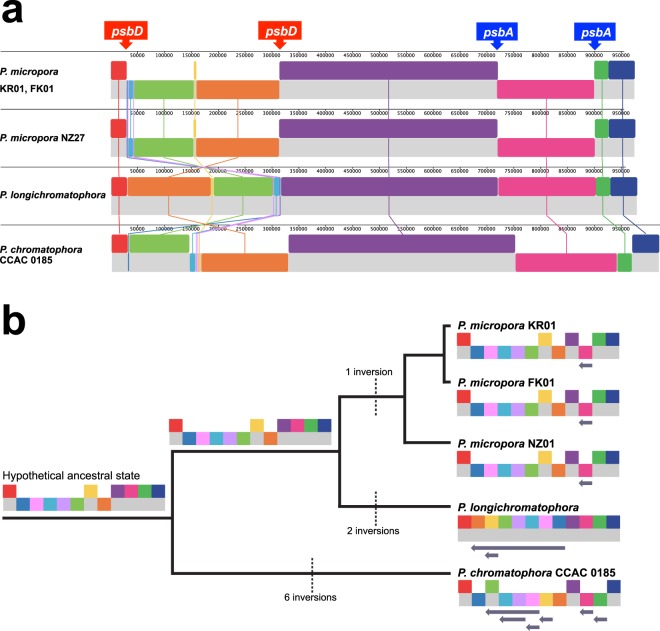
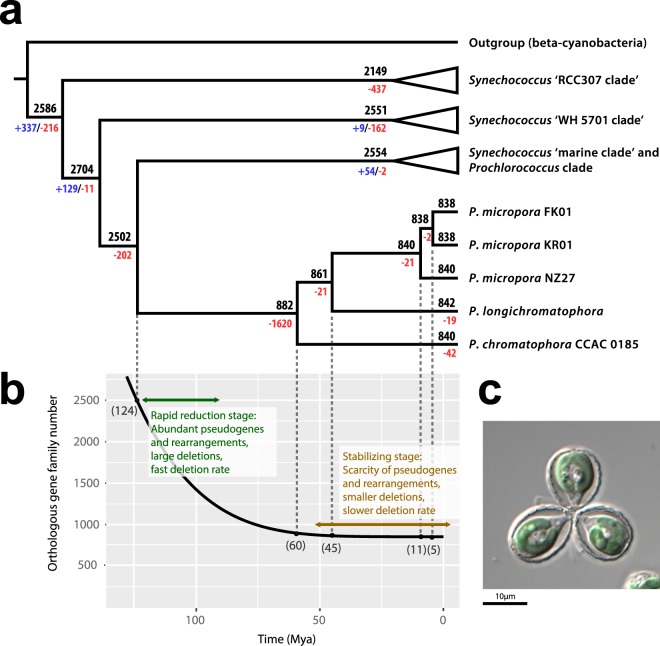
The thecate amoeba Paulinella is a valuable model for understanding plastid organellogenesis because this lineage has independently gained plastids (termed chromatophores) of alpha-cyanobacterial provenance. Plastid primary endosymbiosis in Paulinella occurred relatively recently (90–140 million years ago, Mya), whereas the origin of the canonical Archaeplastida plastid occurred >1,500 Mya. Therefore, these two events provide independent perspectives on plastid formation on vastly different timescales. Here we generated the complete chromatophore genome sequence from P . longichromatophora (979,356 bp, GC-content = 38.8%, 915 predicted genes) and P . micropora NZ27 (977,190 bp, GC-content = 39.9%, 911 predicted genes) and compared these data to that from existing chromatophore genomes. Our analysis suggests that when a basal split occurred among photosynthetic Paulinella species ca. 60 Mya, only 35% of the ancestral orthologous gene families from the cyanobacterial endosymbiont remained in chromatophore DNA. Following major gene losses during the early stages of endosymbiosis, this process slowed down significantly, resulting in a conserved gene content across extant taxa. Chromatophore genes faced relaxed selection when compared to homologs in free-living alpha-cyanobacteria, likely reflecting the homogeneous intracellular environment of the Paulinella host. Comparison of nucleotide substitution and insertion/deletion events among different P . micropora strains demonstrates that increases in AT-content and genome reduction are ongoing and dynamic processes in chromatophore evolution.
Overview
The claims and statistics of this paper haven’t been checked yet.
Free: it reads the open-access text and checks the first 5 claims that cite a source we can check. Create a free account to check every claim.
Integrity signals
Registry
Cites
Statistics
Figures
Verification
Claims the paper makes
The claims and statistics of this paper haven’t been checked yet.
Free: it reads the open-access text and checks the first 5 claims that cite a source we can check. Create a free account to check every claim.
Claims other papers make about this one
Each is checked against this paper’s own text: does it say what the citing paper says it does?
The source backs part of the claim, not all of it — or backs it for a different population, condition or comparison.
In the citing paper
“The differential loss of some genes between the studied chromatophore genomes indicates that genome reduction is still underway, but overall the chromatophore appears to be in a stabilizing stage (i.e., the rate of EGT has significantly decreased).”
From Genomic Insights into Plastid Evolution (2020) · cites this paper as Lhee et al. 2019
Experimental — accuracy not yet measuredThe cited source says what the claim attributes to it.
In the citing paper
“Lhee et al. (2019) showed conservation of gene content and genome structure between the chromatophore genomes of a variety of Paulinella species and strains, suggesting that most of the genome reduction (∼65% of the protein coding genes) occurred in the common ancestor of studied Paulinella species before they diverged from one another.”
From Genomic Insights into Plastid Evolution (2020) · cites this paper as Lhee et al. 2019
Self-check
Percentages, sums and reported differences re-computed from the paper’s own numbers.
The self-check needs the paper’s full text.
Citations
Cites
MAFFT Multiple Sequence Alignment Software Version 7: Improvements in Performance and Usability
Katoh, K., & Standley, D. M. (2013) · Molecular Biology and Evolution · doi:10.1093/molbev/mst010 · Cited by 46,209
KEGG: Kyoto Encyclopedia of Genes and Genomes
Kanehisa, M. (2000) · Nucleic Acids Research · doi:10.1093/nar/28.1.27 · Cited by 37,077
KEGG: Kyoto Encyclopedia of Genes and Genomes
Ogata, H., Goto, S., Sato, K., Fujibuchi, W., Bono, H., & Kanehisa, M. (1999) · Nucleic Acids Research · doi:10.1093/nar/27.1.29 · Cited by 31,232
IQ-TREE: A Fast and Effective Stochastic Algorithm for Estimating Maximum-Likelihood Phylogenies
Nguyen, L.-T., Schmidt, H. A., von Haeseler, A., & Minh, B. Q. (2015) · Molecular Biology and Evolution · doi:10.1093/molbev/msu300 · Cited by 26,046
BLAST+: architecture and applications
Camacho, C., Coulouris, G., Avagyan, V., Ma, N., Papadopoulos, J., Bealer, K., & Madden, T. L. (2009) · BMC Bioinformatics · doi:10.1186/1471-2105-10-421 · Cited by 22,074
Fast, scalable generation of high‐quality protein multiple sequence alignments using Clustal Omega
Sievers, F., Wilm, A., Dineen, D., Gibson, T. J., Karplus, K., Li, W., Lopez, R., McWilliam, H., Remmert, M., Söding, J., et al. (2011) · Molecular Systems Biology · doi:10.1038/msb.2011.75 · Cited by 15,355
PAML 4: Phylogenetic Analysis by Maximum Likelihood
Yang, Z. (2007) · Molecular Biology and Evolution · doi:10.1093/molbev/msm088 · Cited by 13,879
tRNAscan-SE: A Program for Improved Detection of Transfer RNA Genes in Genomic Sequence
Lowe, T. M., & Eddy, S. R. (1997) · Nucleic Acids Research · doi:10.1093/nar/25.5.955 · Cited by 10,905
MUSCLE: a multiple sequence alignment method with reduced time and space complexity
Edgar, R. C. (2004) · BMC Bioinformatics · doi:10.1186/1471-2105-5-113 · Cited by 8,970
BEAST 2: a software platform for Bayesian evolutionary analysis
Bouckaert, R., Heled, J., Kühnert, D., Vaughan, T., Wu, C.-H., Xie, D., Suchard, M. A., Rambaut, A., & Drummond, A. J. (2014) · PLoS Computational Biology · doi:10.1371/journal.pcbi.1003537 · Cited by 6,527
Research works printed but not linked: 1
- Lauterborn RP II. Paulinella chromatophora nov. gen., nov. spec., ein beschalter Rhizopode des Süßwassers mit blaugrünen chromatophorenartigen Einschlüssen Z. Wiss. Zool. 1895 59 537 544
Cited by
Genomic Insights into Plastid Evolution
Sibbald, S. J., & Archibald, J. M. (2020) · Genome Biology and Evolution · doi:10.1093/gbe/evaa096 · Cited by 161
Phytoplankton pangenome reveals extensive prokaryotic horizontal gene transfer of diverse functions
Fan, X., Qiu, H., Han, W., Wang, Y., Xu, D., Zhang, X., Bhattacharya, D., & Ye, N. (2020) · Science Advances · doi:10.1126/sciadv.aba0111 · Cited by 64
Self-citationKrauspe, V., Fahrner, M., Spät, P., Steglich, C., Frankenberg-Dinkel, N., Maček, B., Schilling, O., & Hess, W. R. (2021) · Proceedings of the National Academy of Sciences · doi:10.1073/pnas.2012277118 · Cited by 54
“Homologous genes were also detected in the three available chromatophore genomes of photosynthetic Paulinella species (53).”
Krauspe, V., Fahrner, M., Spät, P., Steglich, C., Frankenberg-Dinkel, N., Macek, B., Schilling, O., & Hess, W. R. (2020) · doi:10.1101/2020.06.14.150680 · Cited by 54
“Homologous genes were also detected in the three available 190 chromatophore genomes of photosynthetic Paulinella species (52).”
BackgroundThe convoluted history of haem biosynthesis
Kořený, L., Oborník, M., Horáková, E., Waller, R. F., & Lukeš, J. (2021) · Biological reviews/Biological reviews of the Cambridge Philosophical Society · doi:10.1111/brv.12794 · Cited by 80
“This so-called chromatophore resembles a free-living cyanobacterium much more than the extant Archaeplastida plastids (Lhee et al., 2019).”
Background
Metadata
- Authors
- Lhee, D., Ha, J.-S., Kim, S., Park, M. G., Bhattacharya, D., & Yoon, H. S.
- Affiliations
- Sungkyunkwan University (KR)
- Pukyong National University (KR)
- Chonnam National University (KR)
- Rutgers, The State University of New Jersey (US)
- Corresponding author
- Yoon, Hwan Su
- Venue
- Scientific Reports
- Published
- 2019-02-22
- Volume
- 9
- Issue
- 1
- Pages
- 2560-2560
- ISSN
- 2045-2322 (ISSN-L)
- PMC
- PMC6384880
- OpenAlex
- W2915660119
- Cited by
- 54
- References
- 86
- Citations by year
- 2026: 4 · 2025: 3 · 2024: 14 · 2023: 2 · 2022: 10 · 2021: 12 · 2020: 7 · 2019: 2
- FWCI
- 2.73
- Type
- journal article
- Language
- en
- Open access
- gold
- doi.org
- Licence
- cc-by
- creativecommons.org/licenses/by/4.0 (tdm)
- creativecommons.org/licenses/by/4.0 (vor)
- Locations
- Scientific Reports (publishedVersion, cc-by)
- Europe PMC (PubMed Central) (publishedVersion, other-oa)
- PubMed Central (publishedVersion, cc-by)
- PubMed (publishedVersion)
- Rutgers University Community Repository (Rutgers University) (submittedVersion)
- Funders
- National Research Foundation (NRF-2016R1A6A1A03012647, NRF-2017R1A2B3001923)
- Ministry of Oceans and Fisheries (20180430)
- Rural Development Administration (PJ01389003)
- National Research Foundation of Korea (NRF‐2017R1A2B3001923, NRF‐2016R1A6A1A03012647, 2017R1A2B3001923, 2016R1A6A1A03012647, PJ01389003)
- Korea Institute of Marine Science and Technology promotion (20180430)
- Topics
- Life Sciences › Agricultural and Biological Sciences › Ecology, Evolution, Behavior and Systematics › Protist diversity and phylogeny
- Life Sciences › Biochemistry, Genetics and Molecular Biology › Molecular Biology › Photosynthetic Processes and Mechanisms
- Life Sciences › Biochemistry, Genetics and Molecular Biology › Genetics › Chromosomal and Genetic Variations
- Keywords
- plastid endosymbiosis, primary endosymbiosis, gene loss, relaxed selection, genome reduction, A+T content, genome evolution
- MeSH terms
- Amoeba, Chromatophores, Symbiosis, Genome, Protozoan, Evolution, Molecular
About these checks
Registry, retraction, Cites and statistics results are computed, not judged, with one exception: a printed reference that no index lists is read once by a model before it counts as a citation error. Claims are extracted by a model and kept only when their quote appears verbatim in the text; each cited source is then checked, with a model’s help, for whether it says what the claim relies on. Those verdicts can be wrong — read the claim’s quote and the cited source before relying on one.
Statistics and arithmetic are recomputed, not judged.
Confidence bands are shown only for fields calibrated on our annotated test set. None is calibrated yet, so no band is shown.
What counts as a claim ›How we measure confidence ›How we check this ›
Are you an author, or do you see a problem with this page? Request a review
How to cite
Cite CoChat for the checks on this page, and the paper for its own findings.
- This page
- CoChat. (2026). Citation check: Evolutionary dynamics of the chromatophore genome in three photosynthetic Paulinella species. https://app.cochat.ai/papers/10.1038/s41598-019-38621-8
- The paper
- Lhee, D., Ha, J.-S., Kim, S., Park, M. G., Bhattacharya, D., & Yoon, H. S. (2019). Evolutionary dynamics of the chromatophore genome in three photosynthetic Paulinella species. Scientific Reports. https://doi.org/10.1038/s41598-019-38621-8
Data sources
Bibliographic data: Semantic Scholar, OpenAlex, Crossref.
Contains information from the Semantic Scholar Academic Graph Datasets, made available under the ODC Attribution License (ODC-BY 1.0).
Semantic Scholar’s data is described in: Kinney, R., et al. (2023). The Semantic Scholar Open Data Platform. arXiv:2301.10140.
