

Megathrust earthquake drives drastic organic carbon supply to the hadal trench.
Open accessThe DOI matches its Crossref record; 49 of the 49 references it cites were found in a registry or an index.
Abstract
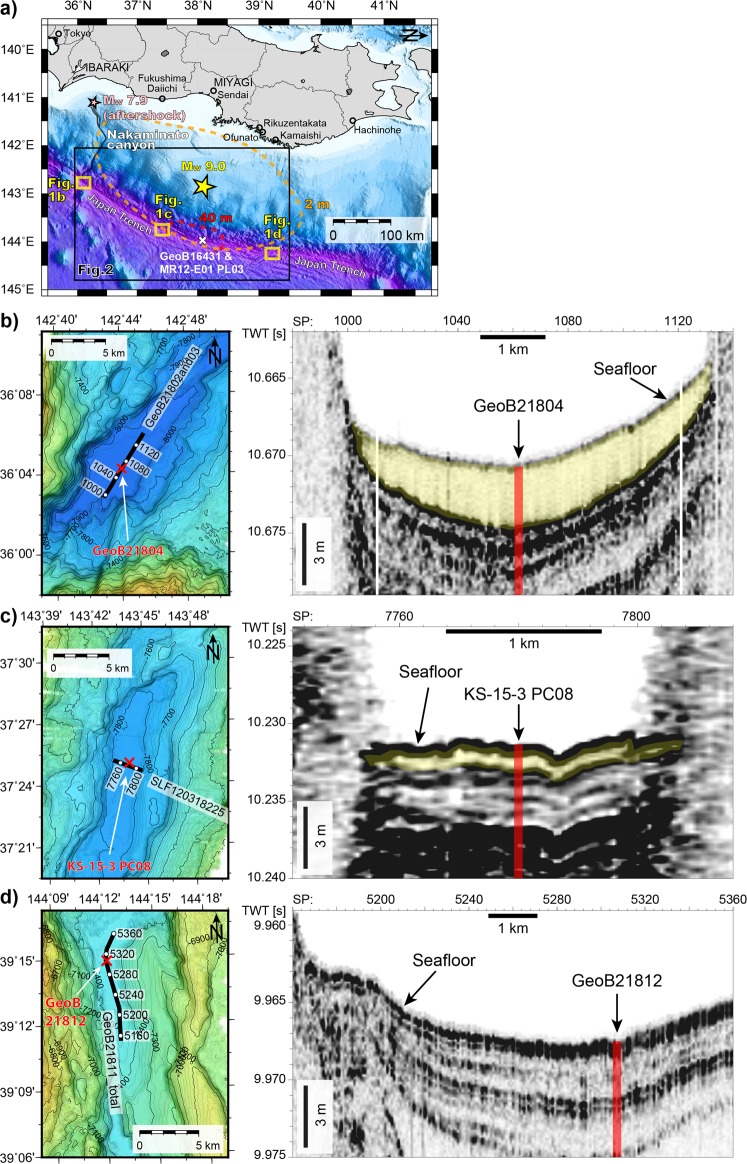
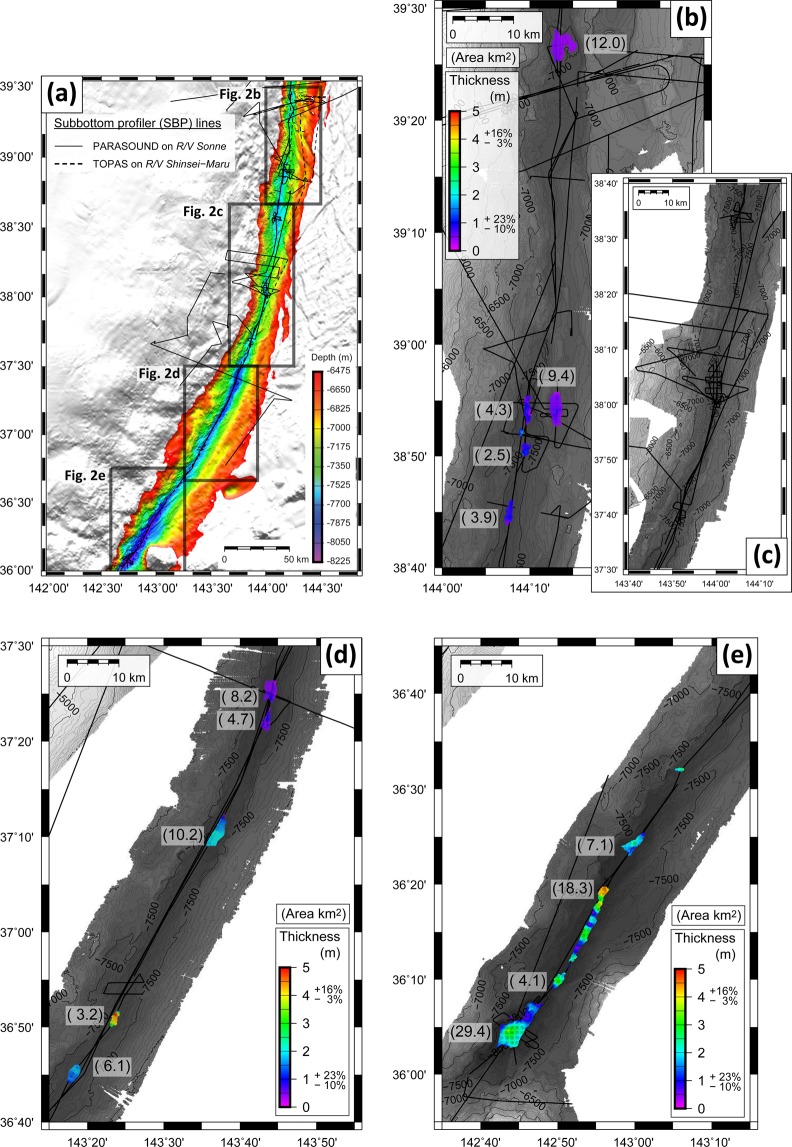
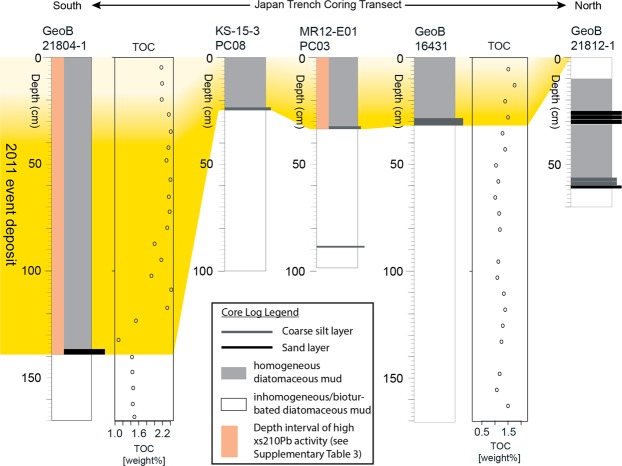
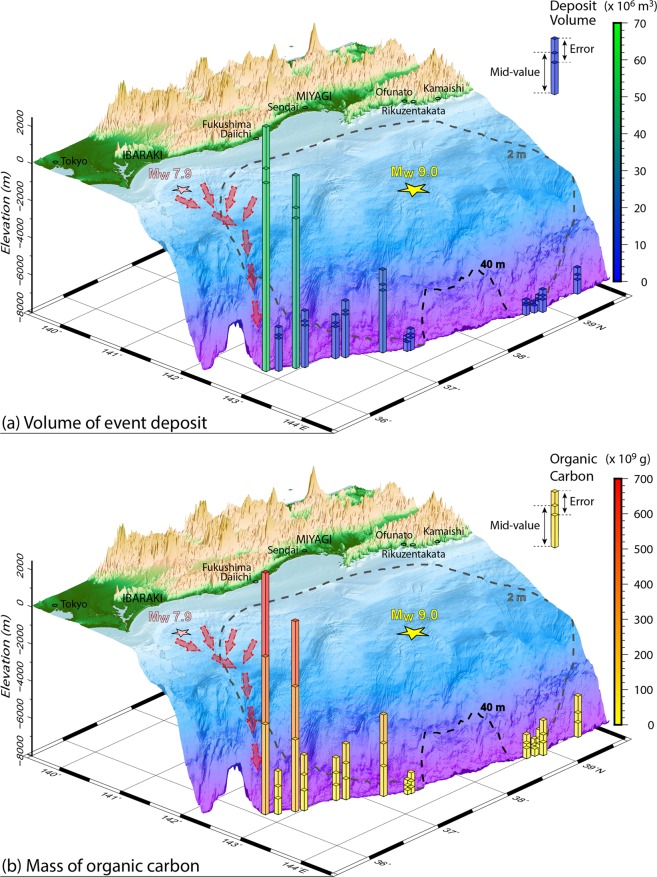
The giant 2011 Tohoku-oki earthquake has been inferred to remobilise fine-grained, young surface sediment enriched in organic matter from the slope into the >7 km deep Japan Trench. Yet, this hypothesis and assessment of its significance for the carbon cycle has been hindered by limited data density and resolution in the hadal zone. Here we combine new high-resolution bathymetry data with sub-bottom profiler images and sediment cores taken during 2012–2016 in order to map for the first time the spatial extent of the earthquake-triggered event deposit along the hadal Japan Trench. We quantify a sediment volume of ~0.2 km 3 deposited from spatially-widespread remobilisation of young surficial seafloor slope sediments triggered by the 2011 earthquake and its aftershock sequence. The mapped volume and organic carbon content in sediment cores encompassing the 2011 event reveals that this single tectonic event delivered >1 Tg of organic carbon to the hadal trench. This carbon supply is comparable to high carbon fluxes described for other Earth system processes, shedding new light on the impact of large earthquakes on long-term carbon cycling in the deep-sea.
Overview
The claims and statistics of this paper haven’t been checked yet.
Free: it reads the open-access text and checks the first 5 claims that cite a source we can check. Create a free account to check every claim.
Integrity signals
Registry
Cites
Statistics
Figures
Verification
Claims the paper makes
The claims and statistics of this paper haven’t been checked yet.
Free: it reads the open-access text and checks the first 5 claims that cite a source we can check. Create a free account to check every claim.
Claims other papers make about this one
Each is checked against this paper’s own text: does it say what the citing paper says it does?
The source backs part of the claim, not all of it — or backs it for a different population, condition or comparison.
In the citing paper
“hadal trenches remain largely unexplored, yet they act as terminal sinks for sediment, organic carbon (OC) and even pollutants (Kioka et al., 2019; Peng et al., in press).”
From Event Stratigraphy in a Hadal Oceanic Trench: The Japan Trench as Sedimentary Archive Recording Recurrent Giant Subduction Zone Earthquakes and Their Role in Organic Carbon Export to the Deep Sea (2019) · cites this paper as Kioka et al., 2019
Experimental — accuracy not yet measuredThe source backs part of the claim, not all of it — or backs it for a different population, condition or comparison.
In the citing paper
“The floor of the trench-axis is relatively shallower at the northern and central trench basins ranging between around 7,400 and 7,700 m, while the southern trench basin north of Daiichi-Kashima Seamount reaches a water depth of 8,030 m (Kioka et al., 2019).”
From Event Stratigraphy in a Hadal Oceanic Trench: The Japan Trench as Sedimentary Archive Recording Recurrent Giant Subduction Zone Earthquakes and Their Role in Organic Carbon Export to the Deep Sea (2019) · cites this paper as Kioka et al., 2019
Experimental — accuracy not yet measuredThe source backs part of the claim, not all of it — or backs it for a different population, condition or comparison.
In the citing paper
“These earthquakes were smaller in size than 2011 earthquake, which may explain that the resulting event deposits and total remobilized sediment volume are much smaller than those for the recent 2011 event found in the southern and central Japan Trench (Kioka et al., 2019).”
From Event Stratigraphy in a Hadal Oceanic Trench: The Japan Trench as Sedimentary Archive Recording Recurrent Giant Subduction Zone Earthquakes and Their Role in Organic Carbon Export to the Deep Sea (2019) · cites this paper as Kioka et al., 2019
Experimental — accuracy not yet measuredThe cited source says what the claim attributes to it.
In the citing paper
“This high spatial resolution results in being uniquely capable of identifying even small depositional basins within the structurally complex and hadal trench-floor system (Kioka et al., 2019).”
From Event Stratigraphy in a Hadal Oceanic Trench: The Japan Trench as Sedimentary Archive Recording Recurrent Giant Subduction Zone Earthquakes and Their Role in Organic Carbon Export to the Deep Sea (2019) · cites this paper as Kioka et al., 2019
Experimental — accuracy not yet measuredThe cited source says what the claim attributes to it.
In the citing paper
“The uppermost acoustically transparent body U1-S01 is the event deposit linked to the 2011 earthquake (Kioka et al., 2019).”
From Event Stratigraphy in a Hadal Oceanic Trench: The Japan Trench as Sedimentary Archive Recording Recurrent Giant Subduction Zone Earthquakes and Their Role in Organic Carbon Export to the Deep Sea (2019) · cites this paper as Kioka et al., 2019
4 more claims about this paper
Create a free account to see every claim other papers make about this one.
Self-check
Percentages, sums and reported differences re-computed from the paper’s own numbers.
The self-check needs the paper’s full text.
Citations
Cites
Plumbing the Global Carbon Cycle: Integrating Inland Waters into the Terrestrial Carbon Budget
Cole, J. J., Prairie, Y. T., Caraco, N. F., McDowell, W. H., Tranvik, L. J., Striegl, R. G., Duarte, C. M., Kortelainen, P., Downing, J. A., Middelburg, J. J., et al. (2007) · Ecosystems · doi:10.1007/s10021-006-9013-8 · Cited by 3,941
Sedimentary organic matter preservation: an assessment and speculative synthesis
Hedges, J. I., & Keil, R. G. (1995) · Marine Chemistry · doi:10.1016/0304-4203(95)00008-f · Cited by 2,536
Carbon, nitrogen, and phosphorus transport by world rivers
Meybeck, M. (1982) · American Journal of Science · doi:10.2475/ajs.282.4.401 · Cited by 2,219
Burdige, D. J. (2007) · Chemical Reviews · doi:10.1021/cr050347q · Cited by 1,310
Berner, R. A. (1982) · American Journal of Science · doi:10.2475/ajs.282.4.451 · Cited by 1,200
A new digital bathymetric model of the world's oceans
Weatherall, P., Marks, K. M., Jakobsson, M., Schmitt, T., Tani, S., Arndt, J. E., Rovere, M., Chayes, D., Ferrini, V., & Wigley, R. (2015) · Earth and Space Science · doi:10.1002/2015ea000107 · Cited by 985
The 2011 Magnitude 9.0 Tohoku-Oki Earthquake: Mosaicking the Megathrust from Seconds to Centuries
Simons, M., Minson, S. E., Sladen, A., Ortega, F., Jiang, J., Owen, S. E., Meng, L., Ampuero, J.-P., Wei, S., Chu, R., et al. (2011) · Science · doi:10.1126/science.1206731 · Cited by 774
Efficient organic carbon burial in the Bengal fan sustained by the Himalayan erosional system
Galy, V., France-Lanord, C., Beyssac, O., Faure, P., Kudrass, H., & Palhol, F. (2007) · Nature · doi:10.1038/nature06273 · Cited by 756
Feast and famine–Microbial life in the deep-sea bed
Jørgensen, B. B., & Boetius, A. (2007) · Nature Reviews Microbiology · doi:10.1038/nrmicro1745 · Cited by 671
Shallow Dynamic Overshoot and Energetic Deep Rupture in the 2011 M w 9.0 Tohoku-Oki Earthquake
Ide, S., Baltay, A., & Beroza, G. C. (2011) · Science · doi:10.1126/science.1207020 · Cited by 645
Global carbon export from the terrestrial biosphere controlled by erosion
Galy, V., Peucker-Ehrenbrink, B., & Eglinton, T. (2015) · Nature · doi:10.1038/nature14400 · Cited by 621
Self-citation210Pb dating by low background gamma counting
Appleby, P. G., Nolan, P. J., Gifford, D. W., Godfrey, M. J., Oldfield, F., Anderson, N. J., & Battarbee, R. W. (1986) · Hydrobiologia · doi:10.1007/bf00026640 · Cited by 617
Metabolic activity of subsurface life in deep-sea sediments
D'Hondt, S., Rutherford, S., & Spivack, A. J. (2002) · Science · doi:10.1126/science.1064878 · Cited by 529
210Pb dating by low background gamma counting
Appleby, P. G., Nolan, P. J., Gifford, D. W., Godfrey, M. J., Oldfield, F., Anderson, N. J., & Battarbee, R. W. (1987) · Paleolimnology IV · doi:10.1007/978-94-009-4047-5_4 · Cited by 475
The 2011 Tohoku-Oki earthquake: displacement reaching the trench axis.
Fujiwara, T., Kodaira, S., No, T., Kaiho, Y., Takahashi, N., & Kaneda, Y. (2011) · Science · doi:10.1126/science.1211554 · Cited by 465
High rates of organic carbon burial in fjord sediments globally
Smith, R. W., Bianchi, T. S., Allison, M., Savage, C., & Galy, V. (2015) · Nature Geoscience · doi:10.1038/ngeo2421 · Cited by 460
Hadal trenches: the ecology of the deepest places on Earth
Jamieson, A. J., Fujii, T., Mayor, D. J., Solan, M., & Priede, I. G. (2010) · Trends in Ecology & Evolution · doi:10.1016/j.tree.2009.09.009 · Cited by 432
High rates of microbial carbon turnover in sediments in the deepest oceanic trench on Earth
Glud, R. N., Wenzhöfer, F., Middelboe, M., Oguri, K., Turnewitsch, R., Canfield, D. E., & Kitazato, H. (2013) · Nature Geoscience · doi:10.1038/ngeo1773 · Cited by 331
Hadal biosphere: Insight into the microbial ecosystem in the deepest ocean on Earth
Nunoura, T., Takaki, Y., Hirai, M., Shimamura, S., Makabe, A., Koide, O., Kikuchi, T., Miyazaki, J., Koba, K., Yoshida, N., et al. (2015) · Proceedings of the National Academy of Sciences · doi:10.1073/pnas.1421816112 · Cited by 315
Structure and Composition of the Plate-Boundary Slip Zone for the 2011 Tohoku-Oki Earthquake
Chester, F. M., Rowe, C., Ujiie, K., Kirkpatrick, J., Regalla, C., Remitti, F., Moore, J. C., Toy, V., Wolfson-Schwehr, M., Bose, S., et al. (2013) · Science · doi:10.1126/science.1243719 · Cited by 284
Coseismic fault rupture at the trench axis during the 2011 Tohoku-oki earthquake.
Kodaira, S., No, T., Nakamura, Y., Fujiwara, T., Kaiho, Y., Miura, S., Takahashi, N., Kaneda, Y., & Taira, A. (2012) · Nature Geoscience · doi:10.1038/ngeo1547 · Cited by 222
Earthquakes drive large-scale submarine canyon development and sediment supply to deep-ocean basins
Mountjoy, J. J., Howarth, J. D., Orpin, A. R., Barnes, P. M., Bowden, D. A., Rowden, A. A., Schimel, A. C. G., Holden, C., Horgan, H. J., Nodder, S. D., et al. (2018) · Science Advances · doi:10.1126/sciadv.aar3748 · Cited by 182
Hadal disturbance in the Japan Trench induced by the 2011 Tohoku–Oki Earthquake.
Oguri, K., Kawamura, K., Sakaguchi, A., Toyofuku, T., Kasaya, T., Murayama, M., Fujikura, K., Glud, R. N., & Kitazato, H. (2013) · Scientific Reports · doi:10.1038/srep01915 · Cited by 177
A revised budget for Cenozoic sedimentary carbon subduction.
Clift, P. D. (2017) · Reviews of Geophysics · doi:10.1002/2016rg000531 · Cited by 150
Kurahashi, S., & Irikura, K. (2011) · Earth Planets and Space · doi:10.5047/eps.2011.06.044 · Cited by 148
Benthic carbon mineralization in hadal trenches: Assessment by in situ O2 microprofile measurements
Wenzhöfer, F., OGURI, K., Middelboe, M., Turnewitsch, R., Toyofuku, T., Kitazato, H., & Glud, R. N. (2016) · Deep Sea Research Part I Oceanographic Research Papers · doi:10.1016/j.dsr.2016.08.013 · Cited by 145
A depocenter of organic matter at 7800 m depth in the SE Pacific Ocean
Danovaro, R., Croce, N. D., Dell’Anno, A., & Pusceddu, A. (2003) · Deep Sea Research Part I Oceanographic Research Papers · doi:10.1016/j.dsr.2003.07.001 · Cited by 142
Moernaut, J., Daele, M. V., Strasser, M., Clare, M. A., Heirman, K., Viel, M., Cárdenas, J., Kilian, R., de Guevara, B. L., Mario Pino, Q., et al. (2015) · Marine Geology · doi:10.1016/j.margeo.2015.10.009 · Cited by 142
Self-citationGeological and historical evidence of irregular recurrent earthquakes in Japan
Satake, K. (2015) · Philosophical Transactions of the Royal Society A: Mathematical, Physical and Engineering Sciences · doi:10.1098/rsta.2014.0375 · Cited by 137
Ikehara, K., Kanamatsu, T., Nagahashi, Y., Strasser, M., Fink, H., Usami, K., Irino, T., & Wefer, G. (2016) · Earth and Planetary Science Letters · doi:10.1016/j.epsl.2016.04.009 · Cited by 129
Self-citationTsunami-generated turbidity current of the 2011 Tohoku-Oki earthquake.
Arai, K., Naruse, H., Miura, R., Kawamura, K., Hino, R., Ito, Y., Inazu, D., Yokokawa, M., Izumi, N., Murayama, M., et al. (2013) · Geology · doi:10.1130/g34777.1 · Cited by 115
Tectonically-triggered sediment and carbon export to the Hadal zone.
Bao, R., Strasser, M., McNichol, A. P., Haghipour, N., McIntyre, C., Wefer, G., & Eglinton, T. I. (2018) · Nature Communications · doi:10.1038/s41467-017-02504-1 · Cited by 115
Self-citationLarge fault slip peaking at trench in the 2011 Tohoku-oki earthquake
Sun, T., Wang, K., Fujiwara, T., Kodaira, S., & He, J. (2017) · Nature Communications · doi:10.1038/ncomms14044 · Cited by 112
Mediterranean megaturbidite triggered by the AD 365 Crete earthquake and tsunami
Polonia, A., Bonatti, E., Camerlenghi, A., Lucchi, R. G., Panieri, G., & Gasperini, L. (2013) · Scientific Reports · doi:10.1038/srep01285 · Cited by 109
McHugh, C. M., Kanamatsu, T., Seeber, L., Bopp, R., Cormier, M.-H., & Usami, K. (2016) · Geology · doi:10.1130/g37650.1 · Cited by 93
Self-citationOnline 13C and 14C Gas Measurements by EA-IRMS–AMS at ETH Zürich
McIntyre, C. P., Wacker, L., Haghipour, N., Blattmann, T. M., Fahrni, S., Usman, M., Eglinton, T. I., & Synal, H.-A. (2017) · Radiocarbon · doi:10.1017/rdc.2016.68 · Cited by 92
Self-citationA slump in the trench: tracking the impact of the 2011 Tohoku-Oki earthquake.
Strasser, M., Kölling, M., Ferreira, C. D. S., Fink, H. G., Fujiwara, T., Henkel, S., Ikehara, K., Kanamatsu, T., Kawamura, K., Kodaira, S., et al. (2013) · Geology · doi:10.1130/g34477.1 · Cited by 90
Self-citationLuo, M., Glud, R. N., Pan, B., Wenzhöfer, F., Xu, Y., Lin, G., & Chen, D. (2018) · Geophysical Research Letters · doi:10.1002/2017gl076232 · Cited by 89
Goda, K., Pomonis, A., Chian, S. C., Offord, M., Saito, K., Sammonds, P. R., Fraser, S. A., Raby, A. C., & Macabuag, J. (2012) · Bulletin of Earthquake Engineering · doi:10.1007/s10518-012-9371-x · Cited by 88
Ikehara, K., Irino, T., Usami, K., Jenkins, R. G., Omura, A., & Ashi, J. (2014) · Marine Geology · doi:10.1016/j.margeo.2014.11.004 · Cited by 83
Self-citationLarge submarine landslides in the Japan Trench: a new scenario for additional tsunami generation.
Kawamura, K., Sasaki, T., Kanamatsu, T., Sakaguchi, A., & Ogawa, Y. (2012) · Geophysical Research Letters · doi:10.1029/2011gl050661 · Cited by 82
Self-citationFurumura, T., Takemura, S., Noguchi, S., TAKEMOTO, T., Maeda, T., Kazuhisa, I. W. A. I., & Padhy, S. (2011) · Landslides · doi:10.1007/s10346-011-0279-3 · Cited by 73
Ikehara, K., Irino, T., Usami, K., Jenkins, R. G., Omura, A., & Ashi, J. (2014) · Marine Geology · doi:10.1016/j.margeo.2014.01.001 · Cited by 72
Self-citationSupercycle in great earthquake recurrence along the Japan Trench over the last 4000 years.
Usami, K., Ikehara, K., Kanamatsu, T., & McHugh, C. M. (2018) · Geoscience Letters · doi:10.1186/s40562-018-0110-2 · Cited by 68
Self-citationFujiwara, T., Ferreira, C. D. S., Bachmann, A. K., Strasser, M., Wefer, G., Sun, T., Kanamatsu, T., & Kodaira, S. (2017) · Geophysical Research Letters · doi:10.1002/2017gl075839 · Cited by 53
Self-citationIkehara, K., Usami, K., Kanamatsu, T., Arai, K., Yamaguchi, A., & Fukuchi, R. (2018) · Geological Society, London, Special Publications · doi:10.1144/sp456.9 · Cited by 42
Self-citationNomaki, H., Arai, K., Suga, H., Toyofuku, T., Wakita, M., Nunoura, T., OGURI, K., Kasaya, T., & Watanabe, S. (2015) · Journal of Oceanography · doi:10.1007/s10872-015-0315-3 · Cited by 29
Nozaki, Y., & Ohta, Y. (1993) · Earth and Planetary Science Letters · doi:10.1016/0012-821x(93)90249-9 · Cited by 25
Kanamatsu, T., Usami, K., McHugh, C. M. G., & Ikehara, K. (2017) · Geochemistry, Geophysics, Geosystems · doi:10.1002/2017gc006878 · Cited by 23
Self-citation
Cited by
Kane, I. A., & Clare, M. A. (2019) · Frontiers in Earth Science · doi:10.3389/feart.2019.00080 · Cited by 476
“Thin-skinned (cm-thick) but areally widespread slope failures have been shown to introduce large quantities of sediment (>0.1 km3) and organic carbon (>1 Tg) to the Japan Trench (Kioka et al., 2019); hence might also be expected to remobilize previously buried microplastics.”
BackgroundInfluentialSediment oxygen consumption: Role in the global marine carbon cycle
Jørgensen, B. B., Wenzhöfer, F., Egger, M., & Glud, R. N. (2022) · Earth-Science Reviews · doi:10.1016/j.earscirev.2022.103987 · Cited by 223
“Using bathymetric mapping, Parasound profiling, and sediment TOC measurements it was estimated that 1 Tg of organic carbon was re-deposited to the interior of the Japan Trench during the Tohoku-oki earthquake in 2011 (Kioka et al., 2019).”
MethodDiversity and distribution of viruses inhabiting the deepest ocean on Earth
Jian, H., Yi, Y., Wang, J., Hao, Y., Zhang, M., Wang, S., Meng, C., Zhang, Y., Jing, H., Wang, Y., et al. (2021) · The ISME Journal · doi:10.1038/s41396-021-00994-y · Cited by 139
“between the sediments of the Mariana Trench, which might be due to frequent earthquakes and sediment slide in this hadal trench [99].”
BackgroundLongest sediment flows yet measured show how major rivers connect efficiently to deep sea
Talling, P. J., Baker, M. L., Pope, E., Ruffell, S. C., Jacinto, R. S., Heijnen, M. S., Hage, S., Simmons, S. M., Hasenhündl, M., Heerema, C. J., et al. (2022) · Nature Communications · doi:10.1038/s41467-022-31689-3 · Cited by 132
Hadal trenches are dynamic hotspots for early diagenesis in the deep sea
Glud, R. N., Berg, P., Thamdrup, B., Larsen, M. B., Stewart, H., Jamieson, A. J., Glud, A., OGURI, K., Sanei, H., Rowden, A. A., et al. (2021) · Communications Earth & Environment · doi:10.1038/s43247-020-00087-2 · Cited by 117
Metadata
- Authors
- Kioka, A., Schwestermann, T., Moernaut, J., Ikehara, K., Kanamatsu, T., McHugh, C. M., dos Santos Ferreira, C., Wiemer, G., Haghipour, N., Kopf, A. J., Eglinton, T. I., & Strasser, M.
- Affiliations
- Universität Innsbruck (AT)
- Geological Survey of Japan (JP)
- Japan Agency for Marine-Earth Science and Technology (JP)
- Queens College, CUNY (US)
- University of Bremen (DE)
- ETH Zurich (CH)
- Corresponding author
- Kioka, A.
- ORCID
- Venue
- Scientific Reports
- Published
- 2019-02-07
- Volume
- 9
- Issue
- 1
- Pages
- 1553-1553
- ISSN
- 2045-2322 (ISSN-L)
- PMC
- PMC6367409
- OpenAlex
- W2911462454
- Cited by
- 84
- References
- 49
- Citations by year
- 2026: 9 · 2025: 11 · 2024: 8 · 2023: 10 · 2022: 11 · 2021: 15 · 2020: 11 · 2019: 7
- FWCI
- 8.25
- Type
- journal article
- Language
- en
- Open access
- gold
- doi.org
- Licence
- cc-by
- creativecommons.org/licenses/by/4.0 (tdm)
- creativecommons.org/licenses/by/4.0 (vor)
- Locations
- Scientific Reports (publishedVersion, cc-by)
- Europe PMC (PubMed Central) (publishedVersion, cc-by)
- PubMed Central (publishedVersion, cc-by)
- PubMed (publishedVersion)
- Repository for Publications and Research Data (ETH Zurich) (publishedVersion, cc-by)
- DOAJ (DOAJ: Directory of Open Access Journals) (submittedVersion)
- ETH Zürich Research Collection (cc-by)
- Funders
- Austrian Science Fund (P29678)
- University of Innsbruck
- Topics
- Physical Sciences › Earth and Planetary Sciences › Earth-Surface Processes › Geological formations and processes
- Physical Sciences › Earth and Planetary Sciences › Geophysics › earthquake and tectonic studies
- Physical Sciences › Environmental Science › Environmental Chemistry › Methane Hydrates and Related Phenomena
- Keywords
- Great East Japan Earthquake, megathrust earthquakes, Japan Trench, hadal trenches, organic carbon supply, sediment remobilization, sediment volume, aftershocks, high-resolution bathymetry, sub-bottom profiling
About these checks
Registry, retraction, Cites and statistics results are computed, not judged, with one exception: a printed reference that no index lists is read once by a model before it counts as a citation error. Claims are extracted by a model and kept only when their quote appears verbatim in the text; each cited source is then checked, with a model’s help, for whether it says what the claim relies on. Those verdicts can be wrong — read the claim’s quote and the cited source before relying on one.
Statistics and arithmetic are recomputed, not judged.
Confidence bands are shown only for fields calibrated on our annotated test set. None is calibrated yet, so no band is shown.
What counts as a claim ›How we measure confidence ›How we check this ›
Are you an author, or do you see a problem with this page? Request a review
Data sources
Bibliographic data: Semantic Scholar, OpenAlex, Crossref.
Contains information from the Semantic Scholar Academic Graph Datasets, made available under the ODC Attribution License (ODC-BY 1.0).
Semantic Scholar’s data is described in: Kinney, R., et al. (2023). The Semantic Scholar Open Data Platform. arXiv:2301.10140.
