

Cancer associated fibroblasts sculpt tumour microenvironment by recruiting monocytes and inducing immunosuppressive PD-1+ TAMs
Open accessThe DOI matches its Crossref record; 56 of the 56 references it cites were found in a registry or an index.
Abstract
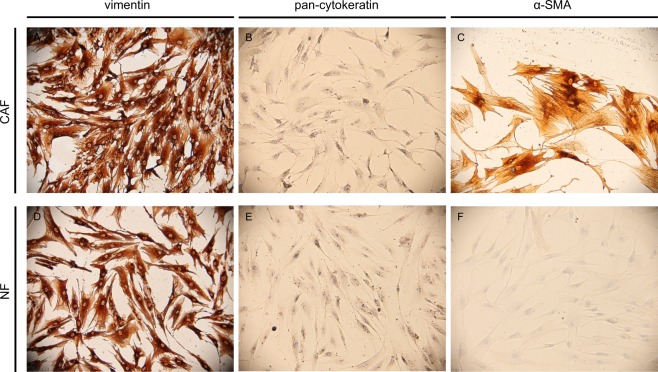
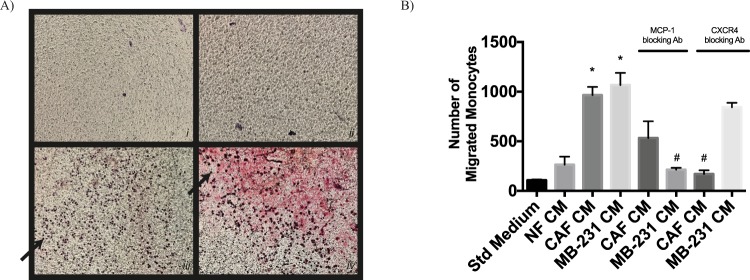
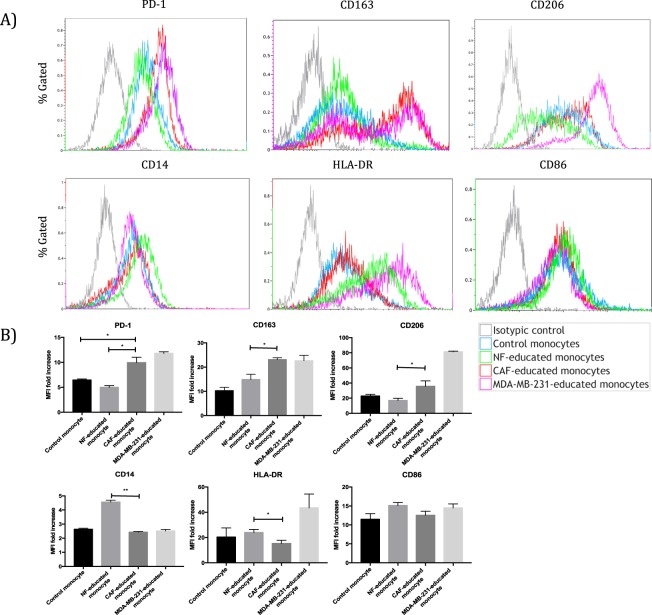
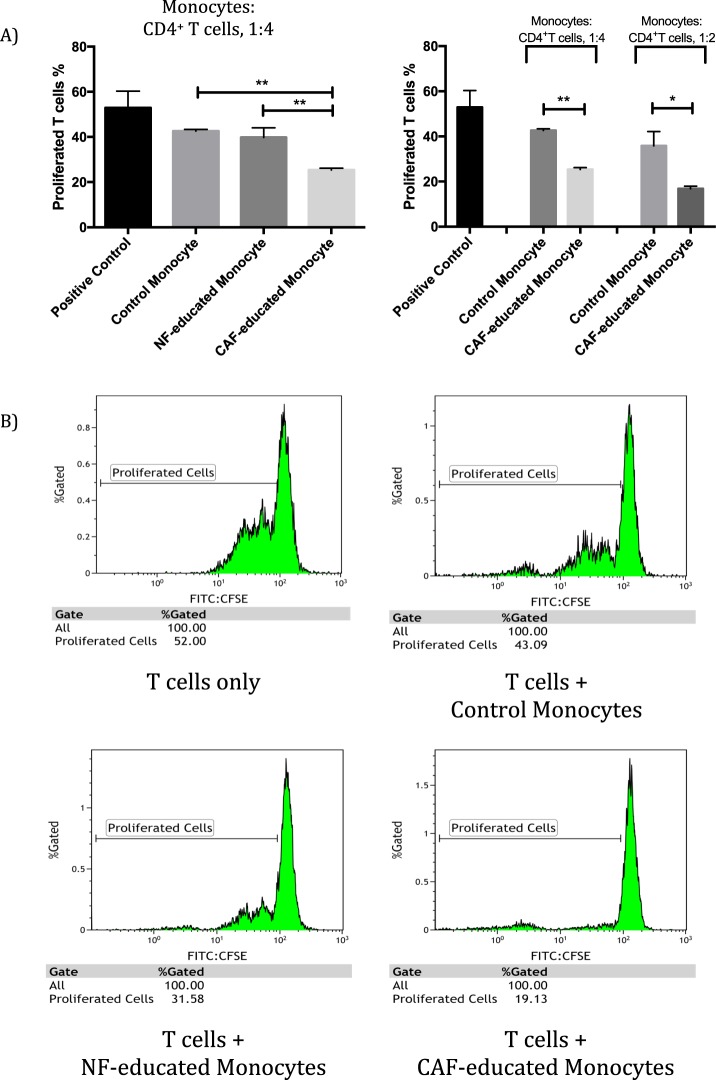
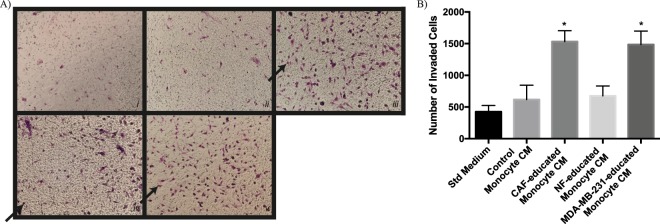
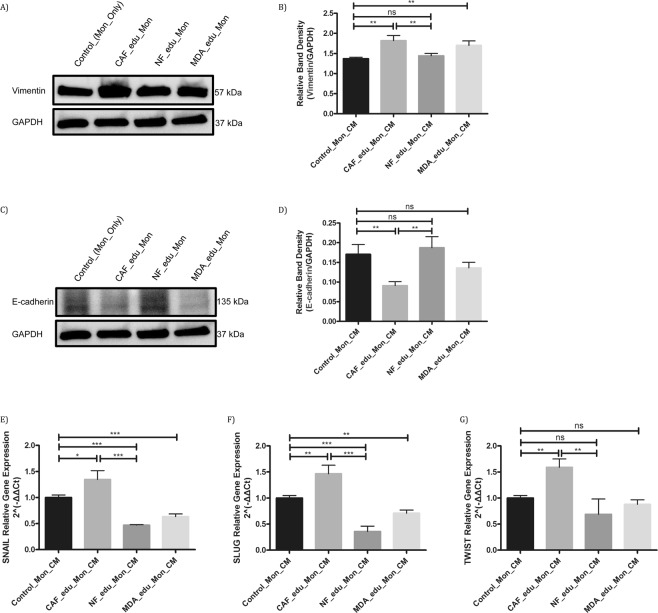
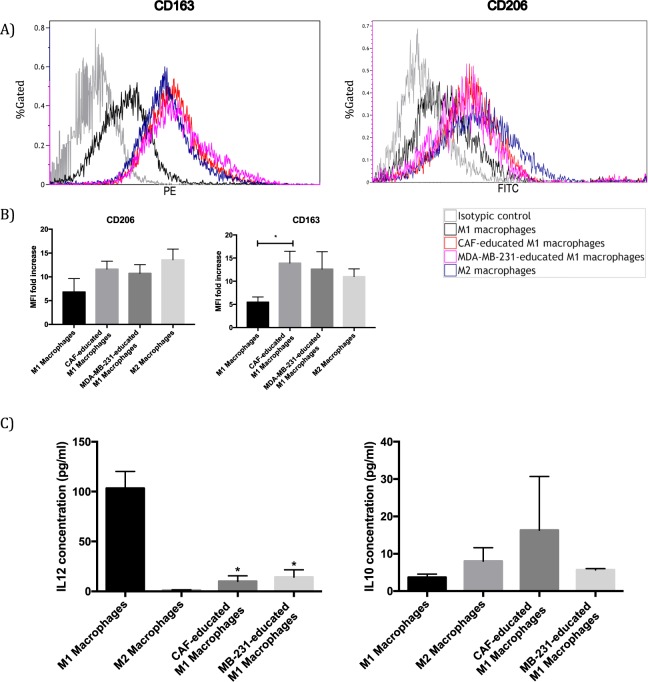
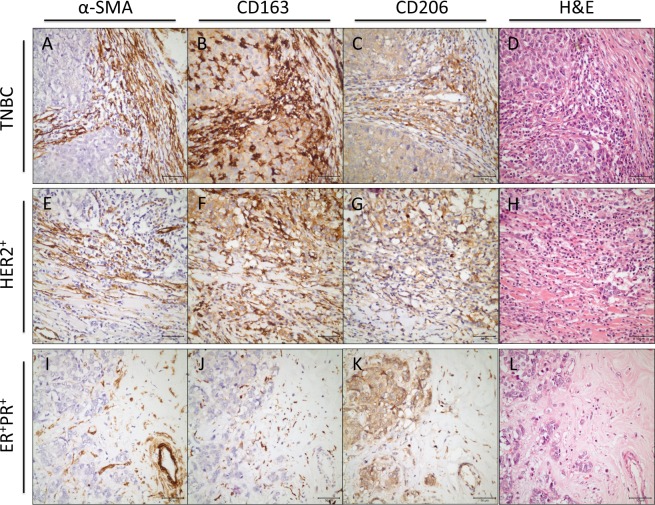
Fibroblasts turn into cancer associated fibroblasts (CAFs) in the tumour microenvironment. CAFs have recently attracted attention for their function as a regulator of immune cell recruitment and function in addition to their tumour-promoting roles. In this study, we aimed to determine the role of CAFs on monocyte recruitment and macrophage polarization in breast cancer. CAFs, which were α-SMA expressing fibroblasts in contrast to normal fibroblasts (NFs), effectively recruited monocytes. Recruitment of monocytes by CAFs might be mediated by monocyte chemotactic protein-1 (MCP-1) as well as stromal cell-derived factor-1 (SDF-1) cytokines. CAFs differentiated the recruited monocytes into M2-like macrophages which are capable of exerting their immunosuppressive roles via the PD-1 axis. CAF-educated monocytes exhibited strong immune suppression unlike NF-educated monocytes and enhanced the motility/invasion of breast cancer cells in addition to increasing the expressions of epithelial–mesenchymal transition (EMT)-related genes and vimentin protein in cancer cells. CAF-educated M1 macrophages displayed increased expression of M2 markers and production of anti-inflammatory cytokine IL-10 in contrast to decreased production of pro-inflammatory cytokine IL-12 compared with control M1 macrophages; suggesting that CAFs were also able to induce the trans-differentiation of M1 macrophages to M2 macrophages. We then investigated the relationship between the infiltration of CAFs and tumour associated macrophages (TAMs) using tissue samples obtained from breast cancer patients. High grade of CAFs significantly correlated with the number of TAMs in human breast cancer tissue samples. It was also associated with higher Ki-67 proliferation index, and higher tumour volume. This result is in line with our finding of increased breast cancer cell proliferation due to the effects of CAF-educated monocytes in vitro. Our results concluded that CAFs play pivotal roles in sculpturing the tumour microenvironment in breast cancer, and therapeutic strategies to reverse the CAF-mediated immunosuppressive microenvironment should be taken into consideration.
Overview
The claims and statistics of this paper haven’t been checked yet.
Free: it reads the open-access text and checks the first 5 claims that cite a source we can check. Create a free account to check every claim.
Integrity signals
Registry
Cites
Statistics
Figures
Verification
Claims the paper makes
The claims and statistics of this paper haven’t been checked yet.
Free: it reads the open-access text and checks the first 5 claims that cite a source we can check. Create a free account to check every claim.
Claims other papers make about this one
Each is checked against this paper’s own text: does it say what the citing paper says it does?
The cited source says what the claim attributes to it.
In the citing paper
“CAFs produce ECM proteins, which prompts immunosuppression of tumor cells by recruiting immunosuppressive cells [64, 65] such as monocytes and inducing immunosuppressive PD-1+ TAMs, as recently shown in breast cancer cells in vitro [66].”
From Tumor microenvironment complexity and therapeutic implications at a glance (2020) · cites this paper as [66]
The check wasn’t confident either way, so it gives no verdict — never disputed.
In the citing paper
“Multiple circulating cytokines and chemokines decreased after FMT in Rs, including CCL2 (MCP1), CXCL8 (IL-8), and IL-18 that have been associated with negative outcomes to anti–PD-1 (32, 33), and IL-12p70 and IFN-γ (Fig. 4A, heatmap).”
From Fecal microbiota transplant overcomes resistance to anti–PD-1 therapy in melanoma patients (2021) · cites this paper as [32]
Experimental — accuracy not yet measured
Self-check
Percentages, sums and reported differences re-computed from the paper’s own numbers.
The self-check needs the paper’s full text.
Citations
Cites
PD-1 and PD-L1 Immune Checkpoint Blockade to Treat Breast Cancer
Hartkopf, A. D., Taran, F.-A., Wallwiener, M., Walter, C. B., Krämer, B., Grischke, E.-M., & Brucker, S. Y. (2016) · Breast Care · doi:10.1159/000453569 · Cited by 30,845
Adverse Renal Effects of Immune Checkpoint Inhibitors: A Narrative Review
Wanchoo, R., Karam, S., Uppal, N. N., Barta, V. S., Deray, G., Devoe, C., Launay-Vacher, V., Jhaveri, K. D., & on behalf of Cancer and Kidney International Network Workgroup on Immune Checkpoint Inhibitors (2017) · American Journal of Nephrology · doi:10.1159/000455014 · Cited by 15,256
Safety, activity, and immune correlates of anti–PD-1 antibody in cancer
Topalian, S. L., Hodi, F. S., Brahmer, J. R., Gettinger, S. N., Smith, D. C., McDermott, D. F., Powderly, J. D., Carvajal, R. D., Sosman, J. A., Atkins, M. B., et al. (2012) · New England Journal of Medicine · doi:10.1056/nejmoa1200690 · Cited by 12,628
Exploring the full spectrum of macrophage activation
Mosser, D. M., & Edwards, J. P. (2008) · Nature Reviews Immunology · doi:10.1038/nri2448 · Cited by 9,144
Inflammation and cancer: back to Virchow?
Balkwill, F., & Mantovani, A. (2001) · The Lancet · doi:10.1016/s0140-6736(00)04046-0 · Cited by 7,746
The chemokine system in diverse forms of macrophage activation and polarization
MANTOVANI, A., SICA, A., SOZZANI, S., ALLAVENA, P., VECCHI, A., & LOCATI, M. (2004) · Trends in Immunology · doi:10.1016/j.it.2004.09.015 · Cited by 6,534
Macrophage activation and polarization: nomenclature and experimental guidelines
Murray, P. J., Allen, J. E., Biswas, S. K., Fisher, E. A., Gilroy, D. W., Goerdt, S., Gordon, S., Hamilton, J. A., Ivashkiv, L. B., Lawrence, T., et al. (2014) · Immunity · doi:10.1016/j.immuni.2014.06.008 · Cited by 6,337
Macrophage plasticity and polarization: in vivo veritas
Sica, A., & Mantovani, A. (2012) · Journal of Clinical Investigation · doi:10.1172/jci59643 · Cited by 6,335
Freeman, G. J., Long, A. J., Iwai, Y., Bourque, K., Chernova, T., Nishimura, H., Fitz, L. J., Malenkovich, N., Okazaki, T., Byrne, M. C., et al. (2000) · The Journal of Experimental Medicine · doi:10.1084/jem.192.7.1027 · Cited by 5,294
Macrophage biology in development, homeostasis and disease
Wynn, T. A., Chawla, A., & Pollard, J. W. (2013) · Nature · doi:10.1038/nature12034 · Cited by 4,684
Cited by
Items 301–308 of 308
Su, P., Zhang, Y., Yu, T., 王元宇, 牟一平, & Jin, W. (2026) · International Immunopharmacology · doi:10.1016/j.intimp.2026.117338
Ye, W., Zhong, L., Wang, X., & Chen, J. (2026) · Frontiers in Immunology · doi:10.3389/fimmu.2026.1941227
Sergeevichev, D., Leonteva, A. A., Kazakova, A., Bogachek, M. V., Ilyina, A., Richter, V. A., & Nushtaeva, A. A. (2026) · Cells · doi:10.3390/cells15191728
安瑞, Hou, S., Hong, M., Zhen, J., Wang, Z., Huang, H., Zhao, W., Liao, M., Yuan, W., & Huang, D. (2026) · PLoS ONE · doi:10.1371/journal.pone.0356359
IGF2BP2 remodels the lung metastatic immune microenvironment to promote bladder cancer metastasis
Bai, M., Liu, T., Wu, H., Yang, X., Yin, Y., Sun, Y., Li, J., Zhou, Z., Ma, Y., Zhao, Z., et al. (2026) · Cellular and Molecular Immunology · doi:10.1038/s41423-026-01474-z
“This is not merely a passive adaptation; rather, tumor cells actively construct “ immune sanctuaries ” through mechanisms such as the secretion of immunomodulatory molecules, functional reprogramming of immune cell subsets, and metabolic remodeling of the microenvironment [11 – 18].”
Zinovkin, D. A., Korneva, Y. S., Arafat, H. M., Shamallakh, O. M., Zinovkina, E. S., Davydov, D. A., Portyanko, A., Slepokurova, I. I., Lyzikova, Y. A., & Pranjol, M. Z. I. (2026) · Frontiers in Immunology · doi:10.3389/fimmu.2026.1876751
The Senescence-Malignancy Axis: An Inflammaging Perspective
Patrono, I., Sonnessa, M., Trerotola, M., Giudetti, A. M., Summa, S. D., Zito, F. A., Saponaro, C., & Vergara, D. (2026) · Antioxidants · doi:10.3390/antiox15101357
“…levels of CCL2 correlate strongly with tumor aggressiveness and poor prognosis in major cancer types, including breast [133], prostate [134], lung [135], hepatocellular [136], pancreatic [137], and CRC [123], as well as in numerous other solid tumors and hematological malignancies [126,138–140].”
Piwócka, O., Kobojek, J., Nowaczyk, P., Piotrowski, I., & Kulcenty, K. (2026) · Reports of Practical Oncology & Radiotherapy · doi:10.5603/rpor.115360
Metadata
- Authors
- Gok Yavuz, B., Gunaydin, G., Gedik, M. E., Kosemehmetoglu, K., Karakoc, D., Ozgur, F., & Guc, D.
- Affiliations
- Hacettepe University (TR)
- Venue
- Scientific Reports
- Published
- 2019-02-28
- Volume
- 9
- Issue
- 1
- Pages
- 3172-3172
- ISSN
- 2045-2322 (ISSN-L)
- PMC
- PMC6395633
- OpenAlex
- W2916860038
- Semantic Scholar
- d39f486d6d7e35d28adf8c6a26081e738d3f2db3
- Cited by
- 292
- References
- 56
- Citations by year
- 2026: 31 · 2025: 28 · 2024: 46 · 2023: 49 · 2022: 52 · 2021: 50 · 2020: 31 · 2019: 5
- FWCI
- 13.79
- Type
- journal article
- Language
- en
- Open access
- gold
- doi.org
- Licence
- cc-by
- creativecommons.org/licenses/by/4.0 (tdm)
- creativecommons.org/licenses/by/4.0 (vor)
- Locations
- Scientific Reports (publishedVersion, cc-by)
- Europe PMC (PubMed Central) (publishedVersion, other-oa)
- PubMed Central (publishedVersion, cc-by)
- PubMed (publishedVersion)
- DOAJ (DOAJ: Directory of Open Access Journals) (submittedVersion)
- Funders
- Hacettepe University Scientific Research Projects Coordination Unit
- Topics
- Life Sciences › Immunology and Microbiology › Immunology › Immune cells in cancer
- Health Sciences › Medicine › Oncology › Cancer Cells and Metastasis
- Life Sciences › Biochemistry, Genetics and Molecular Biology › Molecular Biology › TGF-β signaling in diseases
- Keywords
- cancer-associated fibroblasts, tumor microenvironment, monocyte recruitment, macrophage polarization, tumour-associated macrophages, PD-1, immunosuppression, breast cancer, M2 macrophages, MCP-1, CXCL12, epithelial-mesenchymal transition, tumor invasion, IL-10, IL-12, Ki-67 proliferation index
- MeSH terms
- Cancer-Associated Fibroblasts, Breast Neoplasms, Cell Differentiation, Cell Movement, Female, Humans, Macrophage Activation, Macrophages, Monocytes, Gene Expression Regulation, Neoplastic, Interleukin-10, Interleukin-12, Chemokine CCL2, Ki-67 Antigen, Cell Proliferation, Chemokine CXCL12, Epithelial-Mesenchymal Transition, Tumor Microenvironment, Programmed Cell Death 1 Receptor
About these checks
Registry, retraction, Cites and statistics results are computed, not judged, with one exception: a printed reference that no index lists is read once by a model before it counts as a citation error. Claims are extracted by a model and kept only when their quote appears verbatim in the text; each cited source is then checked, with a model’s help, for whether it says what the claim relies on. Those verdicts can be wrong — read the claim’s quote and the cited source before relying on one.
Statistics and arithmetic are recomputed, not judged.
Confidence bands are shown only for fields calibrated on our annotated test set. None is calibrated yet, so no band is shown.
What counts as a claim ›How we measure confidence ›How we check this ›
Are you an author, or do you see a problem with this page? Request a review
Data sources
Bibliographic data: Semantic Scholar, OpenAlex, Crossref.
Contains information from the Semantic Scholar Academic Graph Datasets, made available under the ODC Attribution License (ODC-BY 1.0).
Semantic Scholar’s data is described in: Kinney, R., et al. (2023). The Semantic Scholar Open Data Platform. arXiv:2301.10140.
