

Differential role of prefrontal, temporal and parietal cortices in verbal and figural fluency: Implications for the supramodal contribution of executive functions
Open accessThe DOI matches its Crossref record; 70 of the 70 references it cites were found in a registry or an index.
Abstract
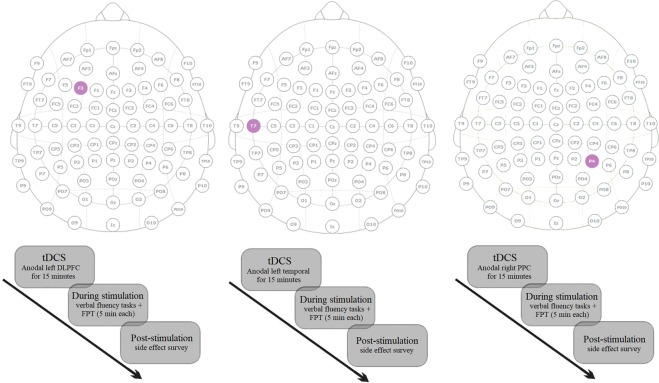
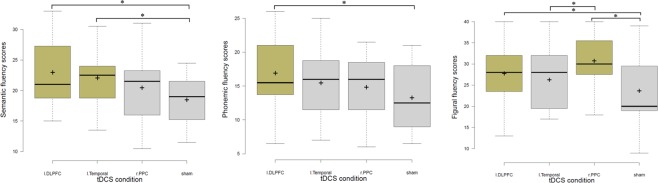
Verbal and figural fluency are related to executive functions (EFs), but the extent to which they benefit from executive resources and their respective cortical representations is not clear. Moreover, different brain areas and cognitive functions are involved in fluency processing. This study investigated effects of modulation of cortical excitability in the left dorsolateral prefrontal cortex (l-DLPFC), left temporal area and right posterior parietal cortex (r-PPC) with transcranial direct current stimulation (tDCS), on verbal and figural fluency. Fifteen healthy adult participants received anodal l-DLPFC (F3), anodal left temporal (T3), anodal r-PPC (P4) and sham tDCS (15 min, 1.5 mA). After five minutes of stimulation, participants underwent the verbal fluency (i.e., semantic and phonemic fluency tasks) and figural fluency tasks. Participants significantly generated more words with phonemic cues during anodal l-DLPFC tDCS and more words with semantic cues during both anodal left temporal and anodal l-DLPFC tDCS. In contrast, they generated more unique figures under anodal r-PPC and anodal l-DLPFC tDCS. Our results implicate that prefrontal regions and EFs are shared anatomical correlates and cognitive processes relevant for both, verbal and figural fluency (supramodal contribution of DLPFC activation), whereas r-PPC and left temporal cortex are more specifically involved in figural and semantic fluency (modality-specific contribution).
Overview
The claims and statistics of this paper haven’t been checked yet.
Free: it reads the open-access text and checks the first 5 claims that cite a source we can check. Create a free account to check every claim.
Integrity signals
Registry
Cites
Statistics
Figures
Verification
Claims the paper makes
The claims and statistics of this paper haven’t been checked yet.
Free: it reads the open-access text and checks the first 5 claims that cite a source we can check. Create a free account to check every claim.
Claims other papers make about this one
Each is checked against this paper’s own text: does it say what the citing paper says it does?
The source backs part of the claim, not all of it — or backs it for a different population, condition or comparison.
In the citing paper
“The quantitative pattern observed in cognitive profiles of ADHD subtypes might also suggest that WM is the underlying basic executive function [49] that affects performance on other cognitive domains [50].”
From ADHD subtype-specific cognitive correlates and association with self-esteem: a quantitative difference (2020) · cites this paper as [50]
Experimental — accuracy not yet measured
Self-check
Percentages, sums and reported differences re-computed from the paper’s own numbers.
The self-check needs the paper’s full text.
Citations
Cites
An Integrative Theory of Prefrontal Cortex Function
Miller, E. K., & Cohen, J. D. (2001) · Annual Review of Neuroscience · doi:10.1146/annurev.neuro.24.1.167 · Cited by 12,803
The neurobiology of semantic memory
Binder, J. R., & Desai, R. H. (2011) · Trends in Cognitive Sciences · doi:10.1016/j.tics.2011.10.001 · Cited by 2,114
Executive Function and the Frontal Lobes: A Meta-Analytic Review
Alvarez, J. A., & Emory, E. (2006) · Neuropsychology Review · doi:10.1007/s11065-006-9002-x · Cited by 1,981
Evidence-based guidelines on the therapeutic use of transcranial direct current stimulation (tDCS)
Lefaucheur, J.-P., Antal, A., Ayache, S. S., Benninger, D. H., Brunelin, J., Cogiamanian, F., Cotelli, M., De Ridder, D., Ferrucci, R., Langguth, B., et al. (2017) · Clinical Neurophysiology · doi:10.1016/j.clinph.2016.10.087 · Cited by 1,826
Self-citationThe Prefrontal Cortex—An Update
Fuster, J. M. (2001) · Neuron · doi:10.1016/s0896-6273(01)00285-9 · Cited by 1,775
Physiological basis of transcranial direct current stimulation
Stagg, C. J., & Nitsche, M. A. (2011) · The Neuroscientist · doi:10.1177/1073858410386614 · Cited by 1,719
Self-citationAndersen, R. A., Snyder, L. H., Bradley, D. C., & Xing, J. (1997) · Annual Review of Neuroscience · doi:10.1146/annurev.neuro.20.1.303 · Cited by 1,486
Gandiga, P. C., Hummel, F. C., & Cohen, L. G. (2006) · Clinical Neurophysiology · doi:10.1016/j.clinph.2005.12.003 · Cited by 1,474
Troyer, A. K., Moscovitch, M., & Winocur, G. (1997) · Neuropsychology · doi:10.1037/0894-4105.11.1.138 · Cited by 1,241
Coding of intention in the posterior parietal cortex
Snyder, L. H., Batista, A. P., & Andersen, R. A. (1997) · Nature · doi:10.1038/386167a0 · Cited by 1,103
Research works printed but not linked: 3
- Lezak, M. D. Neuropsychological assessment. (Oxford University Press, USA, 2004).
- Lezak, M., Howieson, D., Bigler, E. & Tranel, D. Neuropsychological assessment.(5th edn) Oxford University Press. New York, NY (2012).
- Nejati V Rahimzade F Comparison of phonemic and semantic verbal fluency In older adults J. Appl. Psychol. 2008 2 538 548
Cited by
Items 101–127 of 127
Estrada‐Plana, V., Vita‐Barrull, N., March‐Llanes, J., Badia-Bafalluy, A., Ayesa‐Arriola, R., & Moya-Higueras, J. (2026) · Applied Psychology Health and Well-Being · doi:10.1111/aphw.70194
Herbert, C. (2026) · Frontiers in Sports and Active Living · doi:10.3389/fspor.2025.1712545
Verbal fluency in individuals with attention deficit-hyperactivity disorder (ADHD): A meta-analysis
Agahi, Z., & Nejati, V. (2026) · Acta Psychologica · doi:10.1016/j.actpsy.2026.107638
Self-citationHüppi, R. M., Langer, N., Vieira, B. H., & Initiative, T. F. L. D. N. (2026) · medRxiv · doi:10.64898/2026.01.13.26343927
Linking modifiable risk factors to vascular and neurodegenerative brain changes
Khudair, T., Raeesi, S., Zeighami, Y., Kamal, F., Dadar, M., & Morrison, C. (2026) · GeroScience · doi:10.1007/s11357-026-02473-8
Exploring the mechanisms of dopaminergic modulation of neuroplasticity in the human motor cortex
Ghanavati, E. (2025) · Dokumentenrepositorium der RUB (Ruhr University Bochum) · doi:10.13154/294-13333
Self-citationRamme, A., Winter, R. E., Jarzebska, N., Ögel, F., Richter, M. J., Vojtěchová, I., Winter, C., Petrásek, T., Waltereit, R., & Bernhardt, N. R. (2026) · Autism Research · doi:10.1002/aur.70368
Jahn, P., Jendryczko, D., & Nußbeck, F. W. (2026) · Applied Psychological Measurement · doi:10.1177/01466216261453386
TRANSCRANIAL DIRECT CURRENT STIMULATION IN CHILDREN AND ADOLESCENTS WITH ADHD: A CLINICAL TRIAL
de Sá, M. L. O., Collange, L. A., Muszkat, M., & Rizzutti, S. (2026) · doi:10.55905/edicon.978-65-83115-47-8_6
Barboza, C. V. P., Dacal, B. T. S., Sobrinho, N. S. F. R., Pena, A. D. O., Martins, P. K. B., Dourado, S. M., de Oliveira, S. K. N., de Almeida, V. C., de Lima, I. A. F., & Dantas, M. L. (2026) · doi:10.55905/edicon.978-65-83115-47-8_9
PATIENT SAFETY CULTURE IN AN INTENSIVE CARE UNIT OF A PUBLIC HOSPITAL: AN ANALYTICAL STUDY
Barbosa, G. V. A., Morais, K. F., de Negreiros, R. V., Carvalho, J. B., da Silva, A. M., do Nascimento, G.-M. L., Figueiredo, M. S., & de Sousa, S. F. (2026) · doi:10.55905/edicon.978-65-83115-47-8_12
Anze, F. R. M., Schnaider, S. H. D. C., Fonseca, R. F., & Kuwahara, N. (2026) · doi:10.55905/edicon.978-65-83115-47-8_13
DIAGNOSIS OF WATER QUALITY FOR HUMAN CONSUMPTION IN THE MUNICIPALITY OF BREVES, PA
Neto, W. L. P., da Silva, L. A. P., Dantas, M. J. F., da Silva, É. V., Pinheiro, E. A. A., de Carvalho, T. X., de Almeida, F. G. C., & Araujo, R. R. D. S. (2026) · doi:10.55905/edicon.978-65-83115-47-8_15
Silva, A. B. R., Cosenza, R. D. C. A., & Silva, P. C. D. (2026) · doi:10.55905/edicon.978-65-83115-47-8_19
Khudair, T. (2026) · Carleton University's Institutional Repository (MacOdrum Library, Carleton University) · doi:10.22215/etd/2026-17139
Henzler, E. E. L. (2025) · Universidad Peruana Cayetano Heredia Institutional Repository
Pilon, F. (2023) · Papyrus : Institutional Repository (Université de Montréal) · doi:10.71781/26002
Khalil, R., Agnoli, S., Mastria, S., Kondinska, A., Karim, A. A., & Godde, B. (2023) · doi:10.3389/fnins.2023.1238165.s002
The impact of circadian factors on cortical excibility, neuroplasticity, and cognition
Salehinejad, M. A. (2024) · Dokumentenrepositorium der RUB (Ruhr University Bochum) · doi:10.13154/294-12445
Self-citationCai, Y., Hou, Y., Zhu, T., Yin, Y., Ma, C., Li, S., & Sun, W. (2026) · Neurophotonics · doi:10.1117/1.nph.13.2.025009
Durán, K. C. J., & Bonilla, C. M. V. (2024) · Revista Neuropsicologia Latinoamericana · doi:10.5579/rnl.2024.0845
Étude des marqueurs cliniques précoces de la démence dans la maladie de Parkinson
Roy, J. D. (2024) · Archipel (Université du Québec à Montréal)
Salehinejad, M. A., Abdeyazdan, S., Vaziri, Z., & Nejati, V. (2026) · Scientific Reports · doi:10.1038/s41598-026-63241-4
Self-citationMeng, X., Deng, K., Huang, B., Lin, X., Wu, Y., Tao, W., Lin, C., Yang, Y., & Chen, F. (2023) · doi:10.3389/fnhum.2023.1100683.s001
Isella, V., Licciardo, D., Ferri, F., Crivellaro, C., Morzenti, S., Appollonio, I., & Ferrarese, C. (2022) · doi:10.3389/fnagi.2022.969875.s001
Metadata
- Authors
- Ghanavati, E., Salehinejad, M. A., Nejati, V., & Nitsche, M. A.
- Affiliations
- Islamic Azad University, Tehran (IR)
- Leibniz Research Centre for Working Environment and Human Factors (DE)
- Shahid Beheshti University (IR)
- BG University Hospital Bergmannsheil Bochum (DE)
- Corresponding author
- Salehinejad, Mohammad Ali
- Nejati, Vahid
- Venue
- Scientific Reports
- Published
- 2019-03-06
- Volume
- 9
- Issue
- 1
- Pages
- 3700-3700
- ISSN
- 2045-2322 (ISSN-L)
- PMC
- PMC6403289
- OpenAlex
- W2919431650
- Cited by
- 98
- References
- 70
- Citations by year
- 2026: 11 · 2025: 19 · 2024: 7 · 2023: 14 · 2022: 17 · 2021: 12 · 2020: 13 · 2019: 5
- FWCI
- 5.18
- Type
- journal article
- Language
- en
- Open access
- gold
- doi.org
- Licence
- cc-by
- creativecommons.org/licenses/by/4.0 (tdm)
- creativecommons.org/licenses/by/4.0 (vor)
- Locations
- Scientific Reports (publishedVersion, cc-by)
- Europe PMC (PubMed Central) (publishedVersion, other-oa)
- PubMed Central (publishedVersion, cc-by)
- PubMed (publishedVersion)
- DOAJ (DOAJ: Directory of Open Access Journals) (submittedVersion)
- University of Regensburg Publication Server (University of Regensburg) (submittedVersion)
- Informationszentrum Lebenswissenschaften (ZB MED) (submittedVersion, cc-by)
- Funders
- Leibniz-Gemeinschaft
- Topics
- Life Sciences › Neuroscience › Neurology › Transcranial Magnetic Stimulation Studies
- Life Sciences › Neuroscience › Cognitive Neuroscience › Neural and Behavioral Psychology Studies
- Life Sciences › Neuroscience › Cognitive Neuroscience › Neurobiology of Language and Bilingualism
- Keywords
- verbal fluency, figural fluency, executive function, dorsolateral prefrontal cortex, posterior parietal cortex, left temporal cortex, transcranial direct current stimulation, semantic fluency, phonemic fluency, modality-specific processing, cortical excitability
- MeSH terms
- Adult, Brain, Brain Mapping, Cognition, Female, Humans, Male, Neuropsychological Tests, Parietal Lobe, Semantics, Temporal Lobe, Verbal Behavior, Prefrontal Cortex, Mathematical Concepts, Executive Function, Healthy Volunteers, Transcranial Direct Current Stimulation
About these checks
Registry, retraction, Cites and statistics results are computed, not judged, with one exception: a printed reference that no index lists is read once by a model before it counts as a citation error. Claims are extracted by a model and kept only when their quote appears verbatim in the text; each cited source is then checked, with a model’s help, for whether it says what the claim relies on. Those verdicts can be wrong — read the claim’s quote and the cited source before relying on one.
Statistics and arithmetic are recomputed, not judged.
Confidence bands are shown only for fields calibrated on our annotated test set. None is calibrated yet, so no band is shown.
What counts as a claim ›How we measure confidence ›How we check this ›
Are you an author, or do you see a problem with this page? Request a review
Data sources
Bibliographic data: Semantic Scholar, OpenAlex, Crossref.
Contains information from the Semantic Scholar Academic Graph Datasets, made available under the ODC Attribution License (ODC-BY 1.0).
Semantic Scholar’s data is described in: Kinney, R., et al. (2023). The Semantic Scholar Open Data Platform. arXiv:2301.10140.
