

Differential role of prefrontal, temporal and parietal cortices in verbal and figural fluency: Implications for the supramodal contribution of executive functions
Open accessThe DOI matches its Crossref record; 70 of the 70 references it cites were found in a registry or an index.
Abstract
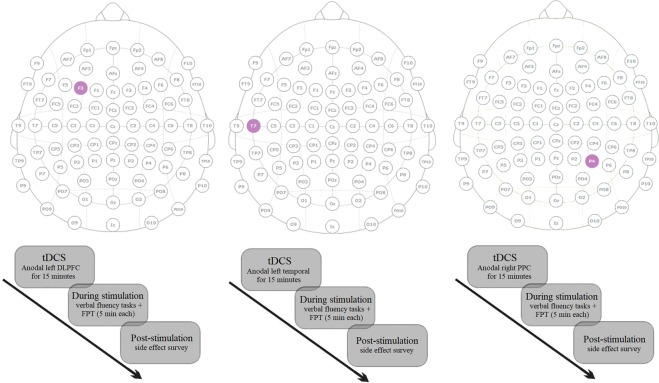
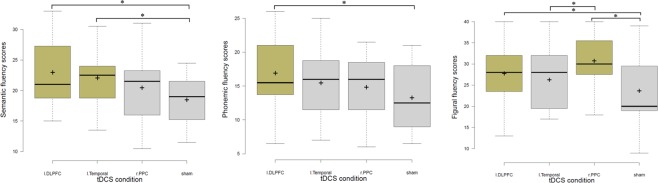
Verbal and figural fluency are related to executive functions (EFs), but the extent to which they benefit from executive resources and their respective cortical representations is not clear. Moreover, different brain areas and cognitive functions are involved in fluency processing. This study investigated effects of modulation of cortical excitability in the left dorsolateral prefrontal cortex (l-DLPFC), left temporal area and right posterior parietal cortex (r-PPC) with transcranial direct current stimulation (tDCS), on verbal and figural fluency. Fifteen healthy adult participants received anodal l-DLPFC (F3), anodal left temporal (T3), anodal r-PPC (P4) and sham tDCS (15 min, 1.5 mA). After five minutes of stimulation, participants underwent the verbal fluency (i.e., semantic and phonemic fluency tasks) and figural fluency tasks. Participants significantly generated more words with phonemic cues during anodal l-DLPFC tDCS and more words with semantic cues during both anodal left temporal and anodal l-DLPFC tDCS. In contrast, they generated more unique figures under anodal r-PPC and anodal l-DLPFC tDCS. Our results implicate that prefrontal regions and EFs are shared anatomical correlates and cognitive processes relevant for both, verbal and figural fluency (supramodal contribution of DLPFC activation), whereas r-PPC and left temporal cortex are more specifically involved in figural and semantic fluency (modality-specific contribution).
Overview
The claims and statistics of this paper haven’t been checked yet.
Free: it reads the open-access text and checks the first 5 claims that cite a source we can check. Create a free account to check every claim.
Integrity signals
Registry
Cites
Statistics
Figures
Verification
Claims the paper makes
The claims and statistics of this paper haven’t been checked yet.
Free: it reads the open-access text and checks the first 5 claims that cite a source we can check. Create a free account to check every claim.
Claims other papers make about this one
Each is checked against this paper’s own text: does it say what the citing paper says it does?
The source backs part of the claim, not all of it — or backs it for a different population, condition or comparison.
In the citing paper
“The quantitative pattern observed in cognitive profiles of ADHD subtypes might also suggest that WM is the underlying basic executive function [49] that affects performance on other cognitive domains [50].”
From ADHD subtype-specific cognitive correlates and association with self-esteem: a quantitative difference (2020) · cites this paper as [50]
Experimental — accuracy not yet measured
Self-check
Percentages, sums and reported differences re-computed from the paper’s own numbers.
The self-check needs the paper’s full text.
Citations
Cites
An Integrative Theory of Prefrontal Cortex Function
Miller, E. K., & Cohen, J. D. (2001) · Annual Review of Neuroscience · doi:10.1146/annurev.neuro.24.1.167 · Cited by 12,803
The neurobiology of semantic memory
Binder, J. R., & Desai, R. H. (2011) · Trends in Cognitive Sciences · doi:10.1016/j.tics.2011.10.001 · Cited by 2,114
Executive Function and the Frontal Lobes: A Meta-Analytic Review
Alvarez, J. A., & Emory, E. (2006) · Neuropsychology Review · doi:10.1007/s11065-006-9002-x · Cited by 1,981
Evidence-based guidelines on the therapeutic use of transcranial direct current stimulation (tDCS)
Lefaucheur, J.-P., Antal, A., Ayache, S. S., Benninger, D. H., Brunelin, J., Cogiamanian, F., Cotelli, M., De Ridder, D., Ferrucci, R., Langguth, B., et al. (2017) · Clinical Neurophysiology · doi:10.1016/j.clinph.2016.10.087 · Cited by 1,826
Self-citationThe Prefrontal Cortex—An Update
Fuster, J. M. (2001) · Neuron · doi:10.1016/s0896-6273(01)00285-9 · Cited by 1,775
Physiological basis of transcranial direct current stimulation
Stagg, C. J., & Nitsche, M. A. (2011) · The Neuroscientist · doi:10.1177/1073858410386614 · Cited by 1,719
Self-citationAndersen, R. A., Snyder, L. H., Bradley, D. C., & Xing, J. (1997) · Annual Review of Neuroscience · doi:10.1146/annurev.neuro.20.1.303 · Cited by 1,486
Gandiga, P. C., Hummel, F. C., & Cohen, L. G. (2006) · Clinical Neurophysiology · doi:10.1016/j.clinph.2005.12.003 · Cited by 1,474
Troyer, A. K., Moscovitch, M., & Winocur, G. (1997) · Neuropsychology · doi:10.1037/0894-4105.11.1.138 · Cited by 1,241
Coding of intention in the posterior parietal cortex
Snyder, L. H., Batista, A. P., & Andersen, R. A. (1997) · Nature · doi:10.1038/386167a0 · Cited by 1,103
Studying and modifying brain function with non-invasive brain stimulation
Polanía, R., Nitsche, M. A., & Ruff, C. C. (2018) · Nature Neuroscience · doi:10.1038/s41593-017-0054-4 · Cited by 1,028
Self-citationRole of the posterior parietal cortex in updating reaching movements to a visual target
Desmurget, M., Epstein, C. M., Turner, R. S., Prablanc, C., Alexander, G. E., & Grafton, S. T. (1999) · Nature Neuroscience · doi:10.1038/9219 · Cited by 831
Default and executive network coupling supports creative idea production
Beaty, R. E., Benedek, M., Barry Kaufman, S., & Silvia, P. J. (2015) · Scientific Reports · doi:10.1038/srep10964 · Cited by 705
Behrmann, M., Geng, J. J., & Shomstein, S. (2004) · Current Opinion in Neurobiology · doi:10.1016/j.conb.2004.03.012 · Cited by 626
Husain, M., & Nachev, P. (2007) · Trends in Cognitive Sciences · doi:10.1016/j.tics.2006.10.011 · Cited by 514
Children's Production on Verbal and Non-Verbal Fluency Tasks
Regard, M., Strauss, E., & Knapp, P. (1982) · Perceptual and Motor Skills · doi:10.2466/pms.1982.55.3.839 · Cited by 513
Birn, R. M., Kenworthy, L., Case, L., Caravella, R., Jones, T. B., Bandettini, P. A., & Martin, A. (2010) · NeuroImage · doi:10.1016/j.neuroimage.2009.07.036 · Cited by 377
Verbal and design fluency in patients with frontal lobe lesions
BALDO, J. V., SHIMAMURA, A. P., DELIS, D. C., KRAMER, J., & KAPLAN, E. (2001) · Journal of the International Neuropsychological Society · doi:10.1017/s1355617701755063 · Cited by 351
Effects of transcranial electrical stimulation on cognition
Kuo, M.-F., & Nitsche, M. A. (2012) · Clinical EEG and Neuroscience · doi:10.1177/1550059412444975 · Cited by 319
Self-citationThe contribution of the human posterior parietal cortex to episodic memory
Sestieri, C., Shulman, G. L., & Corbetta, M. (2017) · Nature Reviews Neuroscience · doi:10.1038/nrn.2017.6 · Cited by 300
A comparison of rCBF patterns during letter and semantic fluency.
Gourovitch, M. L., Kirkby, B. S., Goldberg, T. E., Weinberger, D. R., Gold, J. M., Esposito, G., Van Horn, J. D., & Berman, K. F. (2000) · Neuropsychology · doi:10.1037//0894-4105.14.3.353 · Cited by 294
Prefrontal and parietal contributions to spatial working memory
Curtis, C. E. (2006) · Neuroscience · doi:10.1016/j.neuroscience.2005.04.070 · Cited by 286
The ruff figural fluency test: A normative study with adults
Ruff, R. M., Light, R. H., & Evans, R. W. (1987) · Developmental Neuropsychology · doi:10.1080/87565648709540362 · Cited by 265
FMRI of the prefrontal cortex during overt verbal fluency
Phelps, E. A., Hyder, F., Blamire, A. M., & Shulman, R. G. (1997) · NeuroReport · doi:10.1097/00001756-199701200-00036 · Cited by 254
Nejati, V., Salehinejad, M. A., & Nitsche, M. A. (2018) · Neuroscience · doi:10.1016/j.neuroscience.2017.10.042 · Cited by 243
Self-citationWho Comes First? The Role of the Prefrontal and Parietal Cortex in Cognitive Control
Brass, M., Ullsperger, M., Knoesche, T. R., Cramon, D. Y. V., & Phillips, N. A. (2005) · Journal of Cognitive Neuroscience · doi:10.1162/0898929054985400 · Cited by 236
Gerlach, K. D., Spreng, R. N., Gilmore, A. W., & Schacter, D. L. (2011) · NeuroImage · doi:10.1016/j.neuroimage.2011.01.030 · Cited by 224
Jarbo, K., & Verstynen, T. D. (2015) · The Journal of Neuroscience · doi:10.1523/jneurosci.2636-14.2015 · Cited by 222
Palm, U., Reisinger, E., Keeser, D., Kuo, M.-F., Pogarell, O., Leicht, G., Mulert, C., Nitsche, M. A., & Padberg, F. (2013) · Brain Stimulation · doi:10.1016/j.brs.2013.01.005 · Cited by 202
Self-citationEnriquez‐Geppert, S., Huster, R. J., & Herrmann, C. S. (2013) · International Journal of Psychophysiology · doi:10.1016/j.ijpsycho.2013.02.001 · Cited by 200
Cattaneo, Z., Pisoni, A., & Papagno, C. (2011) · Neuroscience · doi:10.1016/j.neuroscience.2011.03.058 · Cited by 195
The Hopkins Symptom Checklist-25 in screening DSM-III-R axis-I disorders
Veijola, J., Jokelainen, J., Läksy, K., Kantojärvi, L., Kokkonen, P., Järvelin, M.-R., & Joukamaa, M. (2003) · Nordic Journal of Psychiatry · doi:10.1080/08039480310000941 · Cited by 184
Salehinejad, M. A., Ghanavai, E., Rostami, R., & Nejati, V. (2017) · Journal of Affective Disorders · doi:10.1016/j.jad.2016.12.036 · Cited by 176
Self-citationPereira, J. B., Junqué, C., Bartrés-Faz, D., Martí, M. J., Sala-Llonch, R., Compta, Y., Falcón, C., Vendrell, P., Pascual-Leone, Á., Valls-Solé, J., et al. (2013) · Brain Stimulation · doi:10.1016/j.brs.2012.01.006 · Cited by 168
Nejati, V., Salehinejad, M. A., Nitsche, M. A., Najian, A., & Javadi, A.-H. (2020) · Journal of Attention Disorders · doi:10.1177/1087054717730611 · Cited by 163
Self-citationVicario, C. M., Salehinejad, M. A., Felmingham, K., Martino, G., & Nitsche, M. A. (2019) · Neuroscience & Biobehavioral Reviews · doi:10.1016/j.neubiorev.2018.12.012 · Cited by 161
Self-citationQualitative analysis of verbal fluency in depression
Fossati, P., Guillaume, L. B., Ergis, A.-M., & Allilaire, J. (2003) · Psychiatry Research · doi:10.1016/s0165-1781(02)00300-1 · Cited by 154
Biesbroek, J. M., van Zandvoort, M. J. E., Kappelle, L. J., Velthuis, B. K., Biessels, G. J., & Postma, A. (2016) · Brain Structure and Function · doi:10.1007/s00429-015-1033-8 · Cited by 150
Figural fluency: Differential impairment in patients with left versus right frontal lobe lesions
Ruff, R. M., Allen, C. C., Farrow, C. E., Niemann, H., & Wylie, T. (1994) · Archives of Clinical Neuropsychology · doi:10.1093/arclin/9.1.41 · Cited by 140
Plewnia, C., Zwissler, B., Längst, I., Maurer, B., Giel, K., & Krüger, R. (2013) · Cortex · doi:10.1016/j.cortex.2012.11.002 · Cited by 134
The effects of lateralized temporal lobe dysfunction on normal and semantic word fluency
Martin, R. C., Loring, D. W., Meador, K. J., & Lee, G. P. (1990) · Neuropsychologia · doi:10.1016/0028-3932(90)90006-a · Cited by 115
Stolwyk, R. J., Bannirchelvam, B., Kraan, C. M., & Simpson, K. (2015) · Journal of Clinical and Experimental Neuropsychology · doi:10.1080/13803395.2014.988125 · Cited by 113
Goebel, S., Fischer, R., Ferstl, R., & Mehdorn, H. M. (2009) · The Clinical Neuropsychologist · doi:10.1080/13854040802389185 · Cited by 110
Zmigrod, S., Colzato, L. S., & Hommel, B. (2015) · Creativity Research Journal · doi:10.1080/10400419.2015.1087280 · Cited by 109
Leite, J., Carvalho, S., Fregni, F., Boggio, P. S., & Gonçalves, Ó. F. (2012) · Brain stimulation · doi:10.1016/j.brs.2012.10.006 · Cited by 96
Losing sight of the future: Impaired semantic prospection following medial temporal lobe lesions
Race, E., Keane, M. M., & Verfaellie, M. (2013) · Hippocampus · doi:10.1002/hipo.22084 · Cited by 87
Chesters, J., Möttönen, R., & Watkins, K. E. (2018) · Brain · doi:10.1093/brain/awy011 · Cited by 83
The Five-Point Test: Reliability, Validity and Normative Data for Children and Adults
Tucha, L., Aschenbrenner, S., Koerts, J., & Lange, K. W. (2012) · PLoS ONE · doi:10.1371/journal.pone.0046080 · Cited by 80
Impaired verbal and figural fluency after head injury
Ruff, R. (1986) · Archives of Clinical Neuropsychology · doi:10.1016/0887-6177(86)90009-0 · Cited by 76
Ojeda, N., Sánchez, P., Peña, J., Elizagárate, E., Yoller, A. B., Larumbe, J., Gutiérrez, M., Casais, L., & Ezcurra, J. (2010) · The Journal of Nervous and Mental Disease · doi:10.1097/nmd.0b013e3181d61748 · Cited by 75
Reprint of: Transcranial direct current stimulation (tDCS) – Application in neuropsychology
Shin, Y., Foerster, Á., & Nitsche, M. A. (2015) · Neuropsychologia · doi:10.1016/j.neuropsychologia.2015.06.021 · Cited by 72
Self-citationSchmidt, C. S. M., Schumacher, L. V., Römer, P., Leonhart, R., Beume, L.-A., Martin, M., Dreßing, A., Weiller, C., & Kaller, C. P. (2017) · Neuropsychologia · doi:10.1016/j.neuropsychologia.2017.02.019 · Cited by 72
Marumo, K., Takizawa, R., Kinou, M., Kawasaki, S., Kawakubo, Y., Fukuda, M., & Kasai, K. (2013) · NeuroImage · doi:10.1016/j.neuroimage.2013.04.050 · Cited by 68
Temporal accuracy and variability in the left and right posterior parietal cortex
Vicario, C. M., Martino, D., & Koch, G. (2013) · Neuroscience · doi:10.1016/j.neuroscience.2013.04.041 · Cited by 67
Ehlis, A., Haeussinger, F. B., Gastel, A., Fallgatter, A. J., & Plewnia, C. (2015) · NeuroImage · doi:10.1016/j.neuroimage.2015.12.047 · Cited by 55
Verfaellie, M., Bousquet, K., & Keane, M. M. (2014) · Neuropsychologia · doi:10.1016/j.neuropsychologia.2014.06.018 · Cited by 53
Salehinejad, M. A., Nejati, V., & Derakhshan, M. (2016) · Personality and Individual Differences · doi:10.1016/j.paid.2016.11.005 · Cited by 47
Self-citationMurray, L. L. (2016) · Aphasiology · doi:10.1080/02687038.2016.1261248 · Cited by 47
Transcranial Direct Current Stimulation: Protocols and Physiological Mechanisms of Action
Nitsche, M. A., Kuo, M., Paulus, W., & Antal, A. (2014) · Springer eBooks · doi:10.1007/978-1-4939-1408-1_9 · Cited by 46
Self-citationThe reliability of production strategy scores for the Ruff Figural Fluency Test
Ross, T. P., Foard, E., Hiott, F. B., & Vincent, A. (2003) · Archives of Clinical Neuropsychology · doi:10.1093/arclin/18.8.879 · Cited by 44
Wysokiński, A., Zboralski, K., Orzechowska, A., Gałecki, P., Florkowski, A., & Talarowska, M. E. (2010) · Archives of Medical Science · doi:10.5114/aoms.2010.14268 · Cited by 39
Bonino, D., Ricciardi, E., Bernardi, G., Sani, L., Gentili, C., Vecchi, T., & Pietrini, P. (2015) · Neuropsychologia · doi:10.1016/j.neuropsychologia.2015.01.004 · Cited by 34
Ghanavati, E., Nejati, V., & Salehinejad, M. A. (2017) · Journal of Cognitive Enhancement · doi:10.1007/s41465-017-0059-7 · Cited by 31
Self-citationNeuropsychological Characteristics of Verbal and Non-Verbal Fluency in Schizophrenia Patients
Tyburski, E. M., Sokołowski, A., Chęć, M., Pełka-Wysiecka, J., & Samochowiec, A. (2014) · Archives of Psychiatric Nursing · doi:10.1016/j.apnu.2014.09.009 · Cited by 30
Ren, X., Lu, J., Liu, X., Shen, C., Zhang, X., Ma, X., Sun, J., Sun, G., Feng, K., Xu, B., et al. (2017) · Progress in Neuro-Psychopharmacology and Biological Psychiatry · doi:10.1016/j.pnpbp.2017.05.006 · Cited by 26
Longitudinal Study of Performance on the Ruff Figural Fluency Test in Persons Aged 35 Years or Older
van Eersel, M. E. A., Joosten, H., Koerts, J., Gansevoort, R. T., Slaets, J. P. J., & Izaks, G. J. (2015) · PLoS ONE · doi:10.1371/journal.pone.0121411 · Cited by 24
Age-related differences in medial temporal lobe involvement during conceptual fluency
Wang, W., Dew, I. T. Z., & Cabeza, R. E. L. (2014) · Brain Research · doi:10.1016/j.brainres.2014.09.061 · Cited by 22
Verbal and Figural Fluency in Temporal Lobe Epilepsy: Does Hippocampal Sclerosis Affect Performance?
Zalonis, I., Christidi, F., Artemiadis, A., Psarros, C., Papadopoulos, G., Tsivgoulis, G., Gatzonis, S., Siatouni, A., Velonakis, G., Karavasilis, E., et al. (2017) · Cognitive and Behavioral Neurology · doi:10.1097/wnn.0000000000000123 · Cited by 16
Neurocognitive Effects of tDCS in the Healthy Brain
Harty, S., Brem, A., & Kadosh, R. C. (2016) · Springer eBooks · doi:10.1007/978-3-319-33967-2_7 · Cited by 13
Shall we use non-verbal fluency in schizophrenia? – A pilot study
Rinaldi, R., Trappeniers, J., & Lefèbvre, L. (2014) · Psychiatry Research · doi:10.1016/j.psychres.2014.01.029 · Cited by 4
Research works printed but not linked: 3
- Lezak, M. D. Neuropsychological assessment. (Oxford University Press, USA, 2004).
- Lezak, M., Howieson, D., Bigler, E. & Tranel, D. Neuropsychological assessment.(5th edn) Oxford University Press. New York, NY (2012).
- Nejati V Rahimzade F Comparison of phonemic and semantic verbal fluency In older adults J. Appl. Psychol. 2008 2 538 548
Cited by
Hot and cold executive functions in the brain: A prefrontal-cingular network
Salehinejad, M. A., Ghanavati, E., Rashid, M. H. A., & Nitsche, M. A. (2021) · Brain and Neuroscience Advances · doi:10.1177/23982128211007769 · Cited by 340
Self-citationNejati, V., Majdi, R., Salehinejad, M. A., & Nitsche, M. A. (2021) · Scientific Reports · doi:10.1038/s41598-021-81454-7 · Cited by 217
Self-citationAlizadehgoradel, J., Nejati, V., Sadeghi Movahed, F., Imani, S., Taherifard, M., Mosayebi-Samani, M., Vicario, C. M., Nitsche, M. A., & Salehinejad, M. A. (2020) · Brain Stimulation · doi:10.1016/j.brs.2019.12.028 · Cited by 130
Self-citationSalehinejad, M. A., Wischnewski, M., Nejati, V., Vicario, C. M., & Nitsche, M. A. (2019) · PLOS ONE · doi:10.1371/journal.pone.0215095 · Cited by 126
Self-citationSalehinejad, M. A., Nejati, V., Mosayebi-Samani, M., Mohammadi, A., Wischnewski, M., Kuo, M.-F., Avenanti, A., Vicario, C. M., & Nitsche, M. A. (2020) · Neuroscience Bulletin · doi:10.1007/s12264-020-00501-x · Cited by 118
Self-citation
Metadata
- Authors
- Ghanavati, E., Salehinejad, M. A., Nejati, V., & Nitsche, M. A.
- Affiliations
- Islamic Azad University, Tehran (IR)
- Leibniz Research Centre for Working Environment and Human Factors (DE)
- Shahid Beheshti University (IR)
- BG University Hospital Bergmannsheil Bochum (DE)
- Corresponding author
- Salehinejad, Mohammad Ali
- Nejati, Vahid
- Venue
- Scientific Reports
- Published
- 2019-03-06
- Volume
- 9
- Issue
- 1
- Pages
- 3700-3700
- ISSN
- 2045-2322 (ISSN-L)
- PMC
- PMC6403289
- OpenAlex
- W2919431650
- Cited by
- 98
- References
- 70
- Citations by year
- 2026: 11 · 2025: 19 · 2024: 7 · 2023: 14 · 2022: 17 · 2021: 12 · 2020: 13 · 2019: 5
- FWCI
- 5.18
- Type
- journal article
- Language
- en
- Open access
- gold
- doi.org
- Licence
- cc-by
- creativecommons.org/licenses/by/4.0 (tdm)
- creativecommons.org/licenses/by/4.0 (vor)
- Locations
- Scientific Reports (publishedVersion, cc-by)
- Europe PMC (PubMed Central) (publishedVersion, other-oa)
- PubMed Central (publishedVersion, cc-by)
- PubMed (publishedVersion)
- DOAJ (DOAJ: Directory of Open Access Journals) (submittedVersion)
- University of Regensburg Publication Server (University of Regensburg) (submittedVersion)
- Informationszentrum Lebenswissenschaften (ZB MED) (submittedVersion, cc-by)
- Funders
- Leibniz-Gemeinschaft
- Topics
- Life Sciences › Neuroscience › Neurology › Transcranial Magnetic Stimulation Studies
- Life Sciences › Neuroscience › Cognitive Neuroscience › Neural and Behavioral Psychology Studies
- Life Sciences › Neuroscience › Cognitive Neuroscience › Neurobiology of Language and Bilingualism
- Keywords
- verbal fluency, figural fluency, executive function, dorsolateral prefrontal cortex, posterior parietal cortex, left temporal cortex, transcranial direct current stimulation, semantic fluency, phonemic fluency, modality-specific processing, cortical excitability
- MeSH terms
- Adult, Brain, Brain Mapping, Cognition, Female, Humans, Male, Neuropsychological Tests, Parietal Lobe, Semantics, Temporal Lobe, Verbal Behavior, Prefrontal Cortex, Mathematical Concepts, Executive Function, Healthy Volunteers, Transcranial Direct Current Stimulation
About these checks
Registry, retraction, Cites and statistics results are computed, not judged, with one exception: a printed reference that no index lists is read once by a model before it counts as a citation error. Claims are extracted by a model and kept only when their quote appears verbatim in the text; each cited source is then checked, with a model’s help, for whether it says what the claim relies on. Those verdicts can be wrong — read the claim’s quote and the cited source before relying on one.
Statistics and arithmetic are recomputed, not judged.
Confidence bands are shown only for fields calibrated on our annotated test set. None is calibrated yet, so no band is shown.
What counts as a claim ›How we measure confidence ›How we check this ›
Are you an author, or do you see a problem with this page? Request a review
Data sources
Bibliographic data: Semantic Scholar, OpenAlex, Crossref.
Contains information from the Semantic Scholar Academic Graph Datasets, made available under the ODC Attribution License (ODC-BY 1.0).
Semantic Scholar’s data is described in: Kinney, R., et al. (2023). The Semantic Scholar Open Data Platform. arXiv:2301.10140.
