

From Louvain to Leiden: guaranteeing well-connected communities
Open accessThe DOI matches its Crossref record; 30 of the 30 references it cites were found in a registry or an index; 1 of the 26 sources its claims cite were checked for support.
Abstract
Community detection is often used to understand the structure of large and complex networks. One of the most popular algorithms for uncovering community structure is the so-called Louvain algorithm. We show that this algorithm has a major defect that largely went unnoticed until now: the Louvain algorithm may yield arbitrarily badly connected communities. In the worst case, communities may even be disconnected, especially when running the algorithm iteratively. In our experimental analysis, we observe that up to 25% of the communities are badly connected and up to 16% are disconnected. To address this problem, we introduce the Leiden algorithm. We prove that the Leiden algorithm yields communities that are guaranteed to be connected. In addition, we prove that, when the Leiden algorithm is applied iteratively, it converges to a partition in which all subsets of all communities are locally optimally assigned. Furthermore, by relying on a fast local move approach, the Leiden algorithm runs faster than the Louvain algorithm. We demonstrate the performance of the Leiden algorithm for several benchmark and real-world networks. We find that the Leiden algorithm is faster than the Louvain algorithm and uncovers better partitions, in addition to providing explicit guarantees.
Overview
CoChat Summary
TL;DR
The Louvain algorithm can yield arbitrarily badly connected communities, including disconnected ones, especially when iterated. The Leiden algorithm guarantees connected communities and, under iteration, converges to subset-optimal partitions while running faster and finding higher-quality partitions.
Key findings
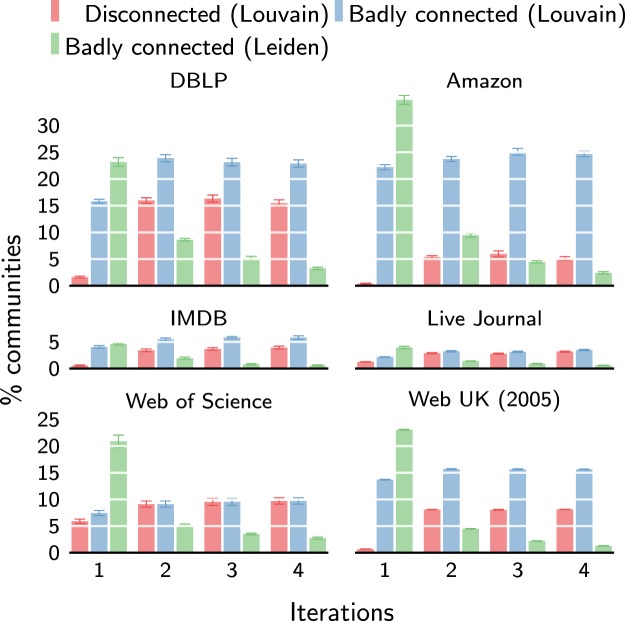
- Louvain may produce arbitrarily badly connected communities; in experiments up to 25% of communities were badly connected and up to 16% were disconnected. First-iteration badly connected percentages included Amazon 23%, DBLP 16%, and Web UK 14%; disconnected communities were usually around 1%, but exceeded 5% for Web of Science in the first iteration and jumped to 16% for DBLP in later iterations. After four iterations, Amazon had 5% disconnected but 25% badly connected communities.
- Leiden guarantees all communities are connected after each iteration, and also γ-separated and γ-connected. After a stable iteration, all nodes are locally optimally assigned and all communities are subpartition γ-dense; asymptotically, all communities are uniformly γ-dense and subset optimal.
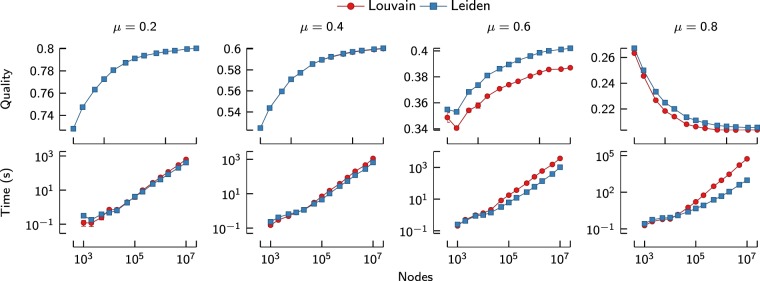
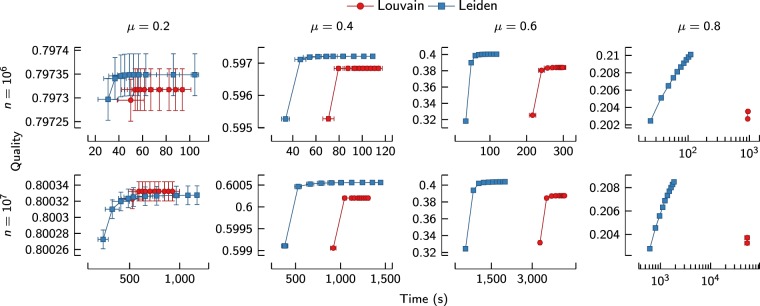
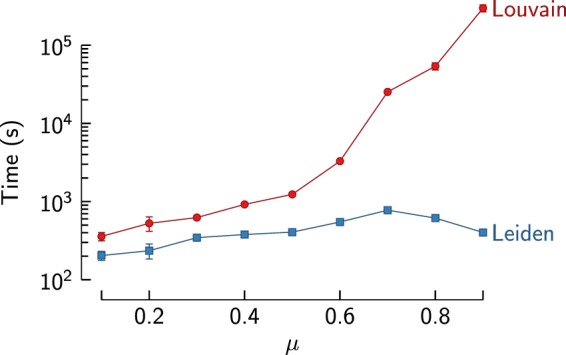
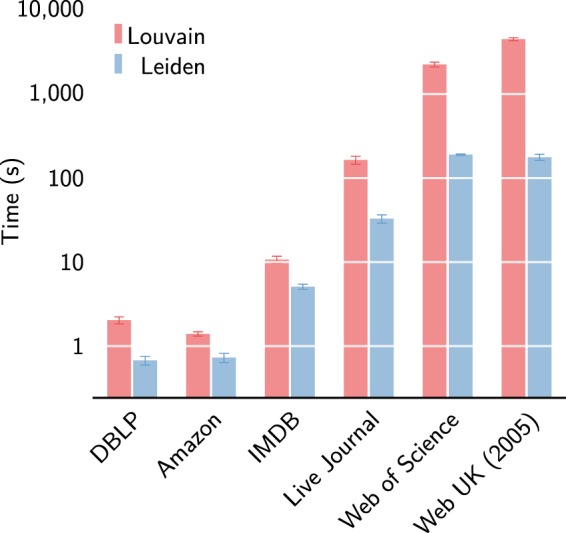
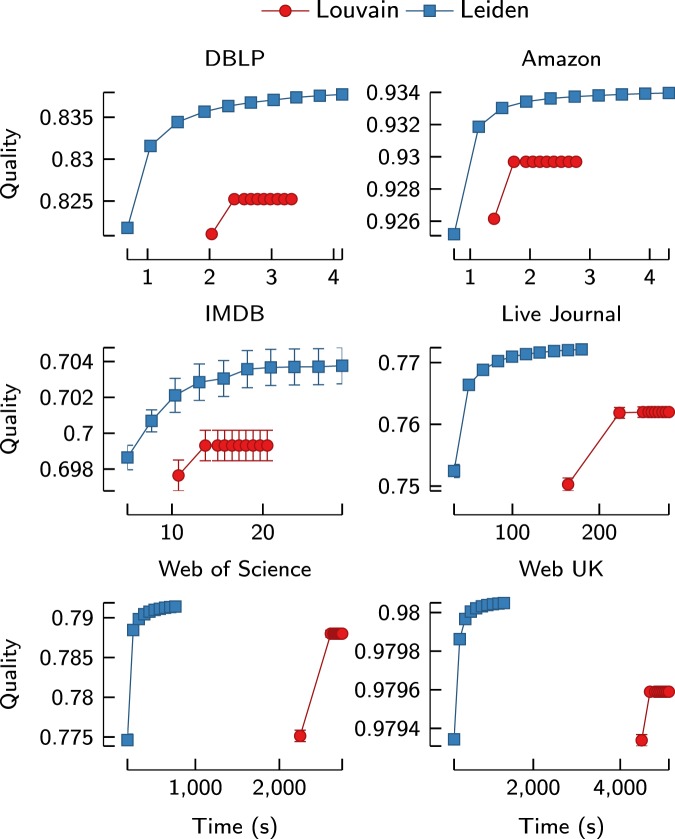
- Leiden was faster than Louvain: first iteration roughly 2–20 times faster on empirical networks, including more than 7× faster for Live Journal, more than 11× for Web of Science, and more than 20× for Web UK. On benchmark networks with difficult partitions (μ = 0.9), Louvain required almost 2.5 days while Leiden needed fewer than 10 minutes; for largest networks Leiden reached 10–100 times faster runtimes.
- Leiden found higher modularity on all six empirical networks: DBLP 0.8387 vs 0.8262, Amazon 0.9341 vs 0.9301, IMDB 0.7069 vs 0.7062, Live Journal 0.7739 vs 0.7653, Web of Science 0.7951 vs 0.7911, and Web UK 0.9801 vs 0.9796.
Methods
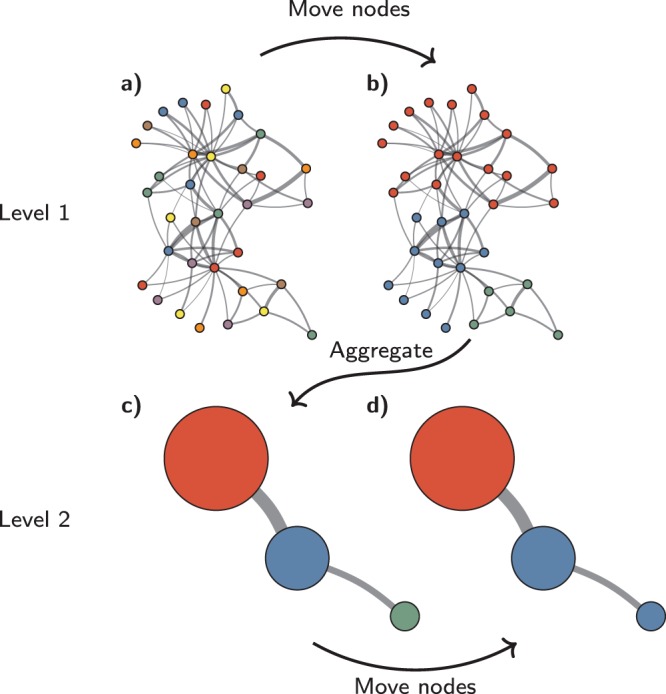
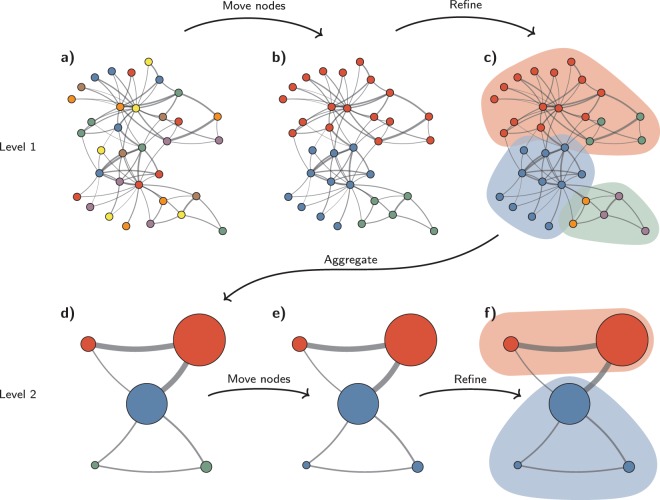
- The paper introduces the Leiden algorithm, which combines local moving, refinement of the partition, and aggregation; proofs of guarantees are relegated to Supplementary Information. It compares Leiden with Louvain on six empirical networks and on benchmark networks.
- Empirical networks: DBLP (317,080 nodes, degree 6.6), Amazon (334,863, 5.6), IMDB (374,511, 80.2), Live Journal (3,997,962, 17.4), Web of Science (9,811,130, 21.2), and Web UK (39,252,879, 39.8). Modularity was used with γ = 1; Table 2 reports maximal modularity after 10 replications of 10 iterations each. Badly connected community analysis was repeated 10 times, with Leiden run on each community’s subnetwork until a stable iteration.
- Benchmark networks ranged from n = 10^3 to n = 10^7 nodes, with community size 50 and CPM as the quality function; the mixing parameter μ varied, 10 iterations were performed, and each parameter set was repeated 10 times. The refinement randomness parameter was θ = 0.01.
Limitations
- The paper states that benchmark networks have only limited value because they are not representative of empirical real-world networks and have a rather simple structure.
- The paper states that counting communities split by Leiden gives only a lower bound on the number of badly connected communities; if Leiden does not find subcommunities, there is no guarantee that modularity cannot be increased by splitting the community.
- Evident from the text: there is no dedicated limitations section; technical details and proofs are relegated to Supplementary Information, and the experimental analysis fixes θ = 0.01 although values roughly in [0.0005, 0.1] are said to provide reasonable results.
Model-written summary. Check it against the paper before relying on it.
Integrity signals
Registry
Cites
Statistics
Figures
Verification
Claims the paper makes
1 Valid · 2 Not valid · 17 Not checked · 142 Own results and interpretations
The cited sources support only part of this claim — read each source’s verdict below.
In the paper
“Hence, the problem of Louvain outlined above is independent from the issue of the resolution limit.”
§ From Louvain to Leiden: guaranteeing well-connected communities > Louvain Algorithm > Badly connected communities
What the sources say
- Partly supportedcites [14] Fortunato S Barthélemy M Resolution Limit in Community Detection Proc. Natl. Acad. Sci. USA 2007 104 36 10.1073/pnas.0605965104 17190818 PMC1765466 sourceExperimental — accuracy not yet measured
Our copy supports the resolution-limit side of the sentence: the Conclusions (VI, p. 7) state that 'the resolution limit of modularity does not rely on particular network structures, but only on the comparison between the sizes of interconnected communities and that of the whole network', the Introduction (p. 1) calls it an 'intrinsic scale' of modularity, and Section V (pp. 5-6) shows the failure persists with simulated annealing, i.e. it is a property of the quality function rather than of one particular optimizer. What the source does not contain is the other term of the comparison: Louvain is never mentioned anywhere in the paper (the Introduction, p. 1, lists only generic greedy procedures [19,20], extremal optimization [21] and simulated annealing [22,23]), and no passage contrasts the resolution limit with an algorithm-specific defect. The independence claim is therefore the citing authors' own inference built on this paper's characterization of the resolution limit. (LLM, conf=0.70)
plain- Asserted: passes — The authors put it forward as true.
- Checkable: passes — It can be checked against evidence.
- Load-bearing: passes — The paper’s conclusions depend on it.
- Based: passes — The paper gives a reason why it holds.
- Partly supported
A result the paper states — it cites no source for it, so there is none to check. The quote shows it is in the paper.
In the paper
“The percentage of badly connected communities is less affected by the number of iterations of the Louvain algorithm.”
§ From Louvain to Leiden: guaranteeing well-connected communities > Experimental Analysis > Badly connected communities
plain- Asserted: passes — The authors put it forward as true.
- Checkable: passes — It can be checked against evidence.
- Load-bearing: unclear — It is unclear whether the paper’s conclusions depend on it.
- Based: passes — The paper gives a reason why it holds.
A result the paper states — it cites no source for it, so there is none to check. The quote shows it is in the paper.
In the paper
“In addition, we prove that, when the Leiden algorithm is applied iteratively, it converges to a partition in which all subsets of all communities are locally optimally assigned.”
- Also stated in: § Introduction · boosted
“In addition, we prove that the algorithm converges to an asymptotically stable partition in which all subsets of all communities are locally optimally assigned.”
§ From Louvain to Leiden: guaranteeing well-connected communities > Abstract
boostedstates a cause- Asserted: passes — The authors put it forward as true.
- Checkable: passes — It can be checked against evidence.
- Load-bearing: passes — The paper’s conclusions depend on it.
- Based: passes — The paper gives a reason why it holds.
- Also stated in: § Introduction · boosted
A result the paper reports from its own data — it cites no other source for it, so there is none to check. The quote shows it is in the paper.
In the paper
“The second iteration of Louvain shows a large increase in the percentage of disconnected communities.”
§ From Louvain to Leiden: guaranteeing well-connected communities > Experimental Analysis > Badly connected communities
plainstates a cause- Asserted: passes — The authors put it forward as true.
- Checkable: passes — It can be checked against evidence.
- Load-bearing: passes — The paper’s conclusions depend on it.
- Based: passes — The paper gives a reason why it holds.
A result the paper reports from its own data — it cites no other source for it, so there is none to check. The quote shows it is in the paper.
In the paper
“In terms of the percentage of badly connected communities in the first iteration, Leiden performs even worse than Louvain, as can be seen in Fig. 4.”
§ From Louvain to Leiden: guaranteeing well-connected communities > Experimental Analysis > Badly connected communities
plain- Asserted: passes — The authors put it forward as true.
- Checkable: passes — It can be checked against evidence.
- Load-bearing: unclear — It is unclear whether the paper’s conclusions depend on it.
- Based: passes — The paper gives a reason why it holds.
115 more claims
Create a free account to see all 162 claims and to verify the 24 references still open.
- Probably not a substantial claim. 23
- It may state two separate claims as one. 23
- The quote only partly states this claim. 1
Claims other papers make about this one
Each is checked against this paper’s own text: does it say what the citing paper says it does?
The cited source says what the claim attributes to it.
In the citing paper
“When compared to six common clustering algorithms, including Leiden25 and CellHarmony26, VFC was the top performing algorithm on every simulation on the T cell data and best performing, on average, on the zebrafish dataset, with a 57% increase in average performance over Louvain, which was the next best algorithm”
From Quantifying the effect of experimental perturbations at single-cell resolution (2021) · cites this paper as [25]
The cited source says what the claim attributes to it.
In the citing paper
“Louvain’s successor Leiden circumvents this issue by yielding guaranteed connected communities and is computationally more efficient52.”
From Best practices for single-cell analysis across modalities (2023) · cites this paper as [52]
The cited source says what the claim attributes to it.
In the citing paper
“However, the Louvain algorithm can lead to arbitrarily poorly connected communities52.”
From Best practices for single-cell analysis across modalities (2023) · cites this paper as [52]
The cited source says what the claim attributes to it.
In the citing paper
“We found that many t-types had total variance substantially above the variances of the k-means clusters (Fig. 5b) and an alternative analysis using entropies of Leiden clustering35 often highlighted the same t-types as variable (Extended Data Fig. 8).”
From Phenotypic variation of transcriptomic cell types in mouse motor cortex (2021) · cites this paper as [35]
The cited source says what the claim attributes to it.
In the citing paper
“Community detection uses the Leiden algorithm [28] with ModularityVertexPartition, producing hierarchical subclustering to depth 3.”
From SuperLocalMemory: Privacy-Preserving Multi-Agent Memory with Bayesian Trust Defense Against Memory Poisoning (2026) · cites this paper as [28]
6 more claims about this paper
Create a free account to see every claim other papers make about this one.
Citations
Cites
Fast unfolding of communities in large networks
Blondel, V. D., Guillaume, J.-L., Lambiotte, R., & Lefebvre, E. (2008) · Journal of Statistical Mechanics: Theory and Experiment · doi:10.1088/1742-5468/2008/10/p10008 · Cited by 21,424 · cited 3×
“The Louvain algorithm 10 is very simple and elegant.”
MethodFinding and evaluating community structure in networks
Newman, M. E. J., & Girvan, M. (2004) · Physical Review E · doi:10.1103/physreve.69.026113 · Cited by 13,931 · cited 2×
“The Leiden algorithm consists of three phases: (1) local moving of nodes, (2) refinement of the partition and (3) aggregation of the network based on the refined partition, using the non-refined partition to create an initial partition for the aggregate network.”
BackgroundMethodComplex brain networks: graph theoretical analysis of structural and functional systems
Bullmore, E., & Sporns, O. (2009) · Nature Reviews Neuroscience · doi:10.1038/nrn2575 · Cited by 11,820
Fortunato, S. (2010) · Physics Reports · doi:10.1016/j.physrep.2009.11.002 · Cited by 11,293 · cited 4×
“The Leiden algorithm consists of three phases: (1) local moving of nodes, (2) refinement of the partition and (3) aggregation of the network based on the refined partition, using the non-refined partition to create an initial partition for the aggregate network.”
BackgroundMethodInfluentialFinding community structure in very large networks
Clauset, A., Newman, M. E. J., & Moore, C. (2004) · Physical Review E · doi:10.1103/physreve.70.066111 · Cited by 7,390 · cited 1×
“Optimising modularity is NP-hard 5 , and consequentially many heuristic algorithms have been proposed, such as hierarchical agglomeration 6 , extremal optimisation 7 , simulated annealing 4,8 and spectral 9 algorithms.”
MethodFinding community structure in networks using the eigenvectors of matrices
Newman, M. E. J. (2006) · Physical Review E · doi:10.1103/physreve.74.036104 · Cited by 4,761
Functional cartography of complex metabolic networks
Guimerà, R., & Nunes Amaral, L. A. (2005) · Nature · doi:10.1038/nature03288 · Cited by 3,983 · cited 2×
“Optimising modularity is NP-hard 5 , and consequentially many heuristic algorithms have been proposed, such as hierarchical agglomeration 6 , extremal optimisation 7 , simulated annealing 4,8 and spectral 9 algorithms.”
MethodNear linear time algorithm to detect community structures in large-scale networks
Raghavan, U. N., Albert, R., & Kumara, S. (2007) · Physical Review E · doi:10.1103/physreve.76.036106 · Cited by 3,502 · cited 2×
“Trying to fix the problem by simply considering the connected components of communities 19–21 is unsatisfactory because it addresses only the most extreme case and does not resolve the more fundamental problem.”
BackgroundBenchmark graphs for testing community detection algorithms
Lancichinetti, A., Fortunato, S., & Radicchi, F. (2008) · Physical Review E · doi:10.1103/physreve.78.046110 · Cited by 3,051 · cited 1×
“To study the scaling of the Louvain and the Leiden algorithm, we rely on a variant of a well-known approach for constructing benchmark networks 28 .”
MethodResolution limit in community detection
Fortunato, S., & Barthélemy, M. (2007) · Proceedings of the National Academy of Sciences · doi:10.1073/pnas.0605965104 · Cited by 3,024 · cited 2×
“The algorithm may yield arbitrarily badly connected communities, over and above the well-known issue of the resolution limit 14 .”
Background
Research works printed but not linked: 2
- Porter MA Onnela J-P Mucha PJ Communities in Networks Not. AMS 2009 56 1082 1097
- Luecken, M. D. Application of multi-resolution partitioning of interaction networks to the study of complex disease. Ph.D. thesis, (University of Oxford, 2016).
Cited by
Items 5,201–5,300 of 7,288
DNPrune-GT: Graph Transformer with Dynamic Neighbor Pruning for Knowledge Graph Reasoning
Zhang, Q., & Gong, Y. (2026) · Lecture notes in computer science · doi:10.1007/978-981-95-5696-0_9
CAGSF: Optimization Algorithm for Network Representation Learning Based on the Community Structure
Xiao, Z., He, J., Cui, D.-X., Ren, W.-P., & Hu, J. (2022) · International Conference on Pattern Recognition and Artificial Intelligence (PRAI) · doi:10.1109/prai55851.2022.9904157
Transferable representations of single-cell transcriptomic dataPreprint
Weinberger, E., & Lee, S. (2021) · bioRxiv (Cold Spring Harbor Laboratory) · doi:10.1101/2021.04.13.439707
Shen, Q., Zhang, S., & Zhang, S. (2025) · Genome Research · doi:10.1101/gr.280821.125
Age-dependent immune responses and resident cell dynamics in young mice following pneumonia
Michki, S. N., Perez, J. V., Varapula, D. A., Thomas, A. J., Vincent, T. L., Singer, B. D., Zepp, J. A., & McGrath‐Morrow, S. A. (2025) · iScience · doi:10.1016/j.isci.2025.114219
Uncovering Molecular Insights into Blood–Brain Barrier Dysfunction in Alzheimer's Disease
Lazaros, K., Krokidis, M. G., Grammenos, G., Adam, S., Exarchos, T. P., Vlamos, P., & Vrahatis, A. G. (2025) · IEEE International Conference on Bioinformatics and Bioengineering (BIBE) · doi:10.1109/bibe66822.2025.00013
MOSAIC: A Structured Multi-level Framework for Probabilistic and Interpretable Cell-type AnnotationPreprint
Yang, M., Qi, J., Lan, M., Huang, J., & Jin, S. (2026) · bioRxiv (Cold Spring Harbor Laboratory) · doi:10.64898/2026.01.31.702798
A cross-tissue POSTN+ fibroblast atlas links periodontal, tumor, and fibrotic stromal nichesPreprint
Wang, C., Yang, H., Lin, M., Wang, Y., & Yang, G. (2026) · bioRxiv (Cold Spring Harbor Laboratory) · doi:10.64898/2026.05.20.726414
Fu, Z., Fu, J., Chen, C. F., Zhang, K., Wang, J., Ran, T., & Wang, S. (2026) · Frontiers in Genetics · doi:10.3389/fgene.2026.1822168
Jia, Q., Goodrich, J. A., & Conti, D. V. (2026) · Bioinformatics · doi:10.1093/bioinformatics/btag395
scHelix: Asymmetric Dual-Stream Integration via Explicit Gene-Level Disentanglement
Yan, X., Zang, Z., Chi, C., Zhou, J., Yu, C., Wu, J., Cheng, S., Yang, F., Luo, J., Lei, Z., et al. (2026) · ACM SIGKDD Conference on Knowledge Discovery and Data Mining (KDD) · doi:10.1145/3770855.3818917
Classification of Tex10-Deficient Spermatogenesis Using Deep Learning
Zhang, G., & Chen, Y. (2026) · IEEE International Conference on Big Data Security on Cloud, IEEE International Conference on High Performance and Smart Computing, and IEEE International Conference on Intelligent Data and Security (BigDataSecurity/HPSC/IDS) · doi:10.1109/ids69480.2026.00028
Zheng, K., Wang, S., Xu, Y., Lei, Q., Zhao, Q., Liang, X. P., Feng, Q., Li, Y., Li, M., Xu, J., et al. (2025) · bioRxiv (Cold Spring Harbor Laboratory) · doi:10.1101/2025.07.23.666288
Guo, H., Cui, Q., Zhang, X., Chen, C., Zheng, W., Cai, C., Wang, X., & Wang, S. (2026) · Genome biology · doi:10.1186/s13059-026-04193-w
Fang, Z., Miao, Z., Lin, J., Xie, Y., Tang, J., Ding, J., & Li, M. (2025) · bioRxiv (Cold Spring Harbor Laboratory) · doi:10.1101/2025.09.30.679123
cspray: Distributed Single Cell Transcriptome AnalysisPreprint
Hawkins, P. G., Swanson, E. M., & Feichtel, M. (2026) · bioRxiv (Cold Spring Harbor Laboratory) · doi:10.64898/2026.02.06.704110
SRSA-VAE: Self-Attention-Based Feature Learning for Single-Cell Multimodal ClusteringPreprint
Das, R., Dey, A., Maulik, U., & Bandyopadhyay, S. (2026) · bioRxiv (Cold Spring Harbor Laboratory) · doi:10.64898/2026.05.06.723212
Noh, J., Shin, Y., Kim, M., & Oh, M. (2026) · Briefings in Bioinformatics · doi:10.1093/bib/bbag395
Additional file 1 of Spatial omics technologies at multimodal and single cell/subcellular level
Park, J., Kim, J., Lewy, T., Rice, C. M., Elemento, O., Rendeiro, A. F., & Mason, C. E. (2023) · Figshare · doi:10.6084/m9.figshare.22608698
An increase in reactive oxygen species underlies neonatal cerebellum repairPreprint
Pakula, A., Nagar, S. E., Bayin, N. S., Christensen, J. B., Stephen, D. N., Reid, A. J., Koche, R. P., & Joyner, A. L. (2025) · eLife · doi:10.7554/elife.102515.2
On the Transparent Predictive Models for Ecological Momentary Assessment Data
Tumanov, K., & Spanakis, G. (2021) · Springer eBooks · doi:10.1007/978-3-030-76409-8_6
Specialised super-enhancer networks in stem cells and neuronsPreprint
Harabula, I., Speakman, L., Musella, F., Fiorillo, L., Zea-Redondo, L., Kukalev, A., Beagrie, R. A., Morris, K. J., Fernandes, L., Irastorza-Azcárate, I., et al. (2025) · bioRxiv (Cold Spring Harbor Laboratory) · doi:10.1101/2025.08.13.670083
An optimized workflow for spatial transcriptomics across early development in XenopusPreprint
Zhou, C., Das, S., Defard, T., Borgman, K. J. E., Seal, S., Kappès, V., Walter, T., Simeonova, I., Almouzni, G., & Monsoro-Burq, A. H. (2026) · bioRxiv (Cold Spring Harbor Laboratory) · doi:10.64898/2026.05.07.723548
Advancing Marketing Video Analysis with Multimodal LLMs and Context-Aware GraphRAGPreprint
Jin, Y., Chakraborty, I., & Chung, K. (2025) · SSRN Electronic Journal · doi:10.2139/ssrn.5517439
Schleicher, J., Gupta, R., Cerletti, D., Sandu, I., Oxenius, A., & Claassen, M. (2025) · PLoS ONE · doi:10.1371/journal.pone.0332406
Reg3β removes aged neutrophils after myocardial infarctionPreprint
Lörchner, H., Esteve, L. C., Detzer, J., Harzenetter, R., Camacho-Pulido, L., Góes, M. E., Waechter, C., Schlattner, S., Günther, S., Kuenne, C. T., et al. (2026) · bioRxiv (Cold Spring Harbor Laboratory) · doi:10.64898/2026.02.19.706868
Statistical Learning for Single-Cell Data Analysis in Oncology
Monnier, L. (2025) · theses.fr (ABES) · doi:10.70675/482f57a1z38ebz48aezb43ez84185dba8d1e
PseudoVelo: Inferring Gene Expression Derivatives Along Pseudotime as Pseudo-Velocity
Zang, X., Shu, X., Zhou, Z., Wang, X., & Wang, J. (2026) · International Journal of Molecular Sciences · doi:10.3390/ijms27146420
Malignant B-cell States Orchestrate Spatially Organized Immune Ecosystems in B-cell LymphomasPreprint
Mondello, P., Sadekova, A., fede, K., Dasari, S., Au, W., Binder, M., Kriukov, K., Meerson, M., Novak, J. P., Yang, Z.-Z., et al. (2026) · Research Square · doi:10.21203/rs.3.rs-10435263/v1
Li, L., Shi, H., Tang, L., & Duan, Y. (2026) · GIScience & Remote Sensing · doi:10.1080/15481603.2026.2694121
Yan, W., Wang, H., Deng, L., Li, C., Ren, J., & Zhao, M. (2025) · China Automation Congress (CAC) · doi:10.1109/cac67268.2025.11487238
Sculley, E. R., Ricemeyer, E. S., Carroll, R. A., Driver, J. P., Smith, J., Kaufman, J., Hearn, C. J., Balic, A., Chen, P. R., Lamont, S. J., et al. (2024) · bioRxiv (Cold Spring Harbor Laboratory) · doi:10.1101/2024.08.05.606414
A Study Partner Recommender System Using a Community Detection Algorithm
Obionwu, C. V., Ilapavuluri, D. P., Broneske, D., & Saake, G. (2024) · Communications in computer and information science · doi:10.1007/978-3-031-67904-9_5
Bailey, N. A., Golino, H. F., & Allen, J. P. (2026) · Family Process · doi:10.1111/famp.70116
PHALCON: phylogeny-aware variant calling from large-scale single-cell panel sequencing datasetsPreprint
Priya, Chowdary, S. B. V., Gautam, A., & Zafar, H. (2024) · bioRxiv (Cold Spring Harbor Laboratory) · doi:10.1101/2024.12.26.630385
Enhancing cell type annotation for cancer transcriptomics using retrieval-augmented generation
杨润芝, Le, N. Q. K., & Chua, M. C. H. (2026) · Cancer Genetics · doi:10.1016/j.cancergen.2026.05.002
CausaMap: A Semi-Supervised Map for Causal Text Mining
Diaf, S. (2025) · IEEE International Conference on Knowledge Graph (ICKG) · doi:10.1109/ickg66886.2025.00014
Precision of Hi-C-Based Metagenome-Assembled Genome Reconstruction across Binning Pipelines
Lukaszewicz, M., Ridenhour, B. J., Top, E. M., & Stalder, T. (2026) · Computational and Structural Biotechnology Reports · doi:10.34133/csbr.0003
Song, X., Chang, S., Seminario‐Vidal, L., Pulido, Á. D. M., Tordesillas, L., Song, X., Reed, R. A., Harkins, A., Whiddon, S., Nguyen, J. V., et al. (2023) · doi:10.1158/2159-8290.c.6549640.v1
The immunological landscape of the area postrema in neuromyelitis optica spectrum disorders
Yu, Q., Takai, Y., Yamazaki, N., Brandl, S., Mair, K. M., Bouderlique, T., Kastriti, M. E., Adameyko, I. I., Höftberger, R., Reindl, M., et al. (2026) · Brain Pathology · doi:10.1111/bpa.70127
Sensitive multimodal profiling of native DNA by transposase-mediated single-molecule sequencingPreprint
Nanda, A. S., Wu, K., Kasinathan, S., Ostrowski, M. S., Clugston, A. S., Satpathy, A. T., Sweet-Cordero, A., Goodarzi, H., & Ramani, V. (2022) · bioRxiv (Cold Spring Harbor Laboratory) · doi:10.1101/2022.08.07.502893
MorphoNet: Morphological sub-region-based structure learning for WSI analysis
Wang, F., Wu, F., Hu, M., He, J., Wang, L., Chen, J., Liang, L., Wang, S., & Yu, L. (2026) · Medical Image Analysis · doi:10.1016/j.media.2026.104061
Measuring Career Growth Related to Organisational Movement for Junior and Senior Researchers
Miura, T., Asatani, K., & Sakata, I. (2022) · Portland International Conference on Management of Engineering and Technology (PICMET) · doi:10.23919/picmet53225.2022.9882578
Ma, H., Zhang, X., Chen, H., & Li, Y. (2026) · BMC Bioinformatics · doi:10.1186/s12859-026-06534-9
Single-cell multi-view clustering based on dual contrastive learning and cross-attention fusion
Hu, M.-Y., Zhu, R., Liu, J.-X., Shang, J.-L., & Dai, L.-Y. (2026) · Expert Systems with Applications · doi:10.1016/j.eswa.2026.132659
Hybrid Encoding and Adaptive Guidance for Enhanced Single-Cell Multi-omics Clustering
Li, J., Wang, H., Yu, J., Liang, C., Zhao, X., Zhao, J., & Sun, Y. (2026) · Interdisciplinary Sciences Computational Life Sciences · doi:10.1007/s12539-026-00827-6
Single-Cell Spatial Proteomics Clustering by Decoupling Spatiality and Expression
Wu, B., Zhang, S., Wang, Y., Ren, L.-R., Du, W., Wang, J., Domeniconi, C., & Yu, G. (2026) · ACM SIGKDD Conference on Knowledge Discovery and Data Mining (KDD) · doi:10.1145/3770855.3818990
Ethnic integration and the value of innovation
Breschi, S., Gagliardi, L., & Yoon, T. (2026) · Strategic Management Journal · doi:10.1002/smj.70108
Borah, K., & Das, H. S. (2025) · Computational Biology and Chemistry · doi:10.1016/j.compbiolchem.2025.108856
Inference of causal interaction networks of gut microbiota using transfer entropy
Park, C., Kim, J., & Lee, J. (2025) · BMC Genomics · doi:10.1186/s12864-025-12384-1
Epithelial stem cells in the premenopausal human vaginaPreprint
Balough, J. L., Schwab, K. E., Stransky, T. M., Chu, T., Cameron, A. R., Babu, S. P., Gurung, S., Rytel, K., Gargett, C. E., Orwig, K. E., et al. (2026) · bioRxiv (Cold Spring Harbor Laboratory) · doi:10.64898/2026.06.03.729864
Ma, H., 黄深思, Wang, H., Zhao, J., & Xia, J. (2026) · IEEE Transactions on Computational Biology and Bioinformatics · doi:10.1109/tcbbio.2026.3697726
Dual-contrastive learning for spatial domain identification in spatial transcriptomics with STAMGC
Zhang, Z., Wen, Q., Xu, J., Meng, Y., Cui, F., & Zhang, Z. (2026) · Genome Research · doi:10.1101/gr.281999.126
Yang, H., Zhang, C., Kim, W., Shi, M., Kılıçlıoğlu, M., Bayram, C., Bolat, İ., Tozlu, Ö. Ö., Baba, C., Yuksel, N., et al. (2024) · eLife · doi:10.7554/elife.98427.1
Han, G., Deng, Q., Marques-Piubelli, M. L., Dai, E., Dang, M., Ma, M. C. J., Li, X., Yang, H., Henderson, J. M., Kudryashova, O. M., et al. (2023) · doi:10.1158/2643-3230.c.6550995
Research themes of family and community physicians in Brazil
Fontenelle, L. F., Rossi, S. V., de Oliveira, M. H. M., Brandão, D. J., & Sarti, T. D. (2023) · AtoZ novas práticas em informação e conhecimento · doi:10.5380/atoz.v12i0.87497
Classificação e evolução de SBPs em contexto de transdução de sinal: interação entre SBPs e Cache
Guedes, A. C. P. (2021) · Digital Library of Theses and Dissertations (Universidade de São Paulo) · doi:10.11606/d.95.2021.tde-25072021-223213
Text analysis and deep learning: A network approachPreprint
Marquart, I. (2021) · arXiv (Cornell University) · doi:10.48550/arxiv.2110.04151
Luzingu, J. K., Hakim, I. A., & Leal-Neto, O. B. (2025) · medRxiv · doi:10.1101/2025.01.12.25320440
Dense stroma limits immunogenic cell death and immunotherapy efficacy in breast cancerPreprint
Tatárová, Z., Moldaner, L., Jakubík, J., Gaidhani, G., Xu, Y., & Blumberg, D. C. (2026) · Research Square · doi:10.21203/rs.3.rs-9896344/v1
de Oca, S. V. M., Acedo-Terrades, A., Martinez, J. F. C., Kirchner, P., Örd, T., Kaikkonen, M. U., Wei, S., Freigang, S., Zlobec, I., & Martínez, M. R. (2026) · bioRxiv (Cold Spring Harbor Laboratory) · doi:10.64898/2026.05.15.725379
GCN-Based Graph Embedding Autoencoder for Single-Cell RNA-Seq Analysis
Xu, L., Shi, Y., Li, Z., Zhu, F., Yan, H., Shi, X., Sun, X., Aung, Y. W., & Daoud, A. M. (2026) · Lecture notes in computer science · doi:10.1007/978-981-92-3450-9_4
Holmgren, A., Edler, D., & Rosvall, M. (2023) · Figshare · doi:10.6084/m9.figshare.23665405
Immunogenomic profiling of circulating T cells in pediatric cancer patients during standard-of-carePreprint
Nabbi, A., Jiang, Y., Espin‐Garcia, O., Mohanraj, S., Pedersen, S., Regala, J., Vernau, L. M., Perazzelli, J., Barrett, D. M., & Pugh, T. J. (2025) · bioRxiv (Cold Spring Harbor Laboratory) · doi:10.1101/2025.01.10.632468
Deng, R., Ren, Y., Hu, K., Zhang, Y., Xu, Y., Zhang, Q., Li, Y., Huang, X., & ZHANG, F. (2026) · Breast Cancer Research · doi:10.1186/s13058-026-02263-2
Resilience of A Learned Motor Behavior After Chronic Disruption of Inhibitory CircuitsPreprint
Török, Z., Luebbert, L., Feldman, J., Duffy, A., Nevue, A. A., Wongso, S., Mello, C. V., Fairhall, A. L., Pachter, L. S., Gonzalez, W. G., et al. (2023) · bioRxiv (Cold Spring Harbor Laboratory) · doi:10.1101/2023.05.17.541057
Török, Z., Luebbert, L., Feldman, J., Duffy, A., Nevue, A. A., Wongso, S., Mello, C. V., Fairhall, A. L., Pachter, L. S., Gonzalez, W. G., et al. (2023) · SSRN Electronic Journal · doi:10.2139/ssrn.4464161
Neural Mechanisms of Context-Sensitive Behavior in the Adult Male Zebra Finch
Anderson, K. L. (2025) · CUNY Academic Works (City University of New York)
The Trilineage Coexistence Observed During the Differentiation of Porcine EPSCs
Zhao, L., Chen, Y., Guo, X., Zhou, M., Guo, T., Ma, J., Zhang, M., Cheng, L., Yu, J., Zhang, Y., et al. (2026) · Cells · doi:10.3390/cells15100954
scPANDA: PAN-Blood Data Annotator with a 10-Million Single-Cell Atlas
Li, C.-X., Huang, C., & Chen, D. (2025) · Chinese Medical Sciences Journal · doi:10.24920/004472
Deb, A., Acharya, M., & Shouche, Y. S. (2026) · The Microbe · doi:10.1016/j.microb.2026.100718
A single-cell transcriptomic atlas of inner ear morphogenesis in zebrafishPreprint
Munjal, A., Kukreja, K., Williams, S., Kawanishi, T., O’Brown, N. M., Ishimatsu, K., Klein, A. M., Tsung-Megason, S. G., & Swinburne, I. A. (2026) · eLife · doi:10.7554/elife.111158
Soriano-Esqué, J. P., Borau, C., Sortino, R., Garma, L. D., Ortega, J. A., Asín, J., & Alcántara, S. (2025) · bioRxiv (Cold Spring Harbor Laboratory) · doi:10.1101/2025.01.09.632137
Nicotinamide riboside prevents mitochondrial dysfunction in nemaline myopathy type 6
Baelde, R., Vonk, L. A., Nollet, E. E., Galli, R., Monteiro, A. F., Bastu, S., Das, B., van Weeghel, M., Schomakers, B. V., Vinten, K. T., et al. (2026) · Human Molecular Genetics · doi:10.1093/hmg/ddag023
Massignani, E., Tichshenko, N., Velghe, K., & Martens, L. (2026) · bioRxiv (Cold Spring Harbor Laboratory) · doi:10.64898/2026.01.20.700550
Zhang, G., Qin, M., Kou, X., Luo, H., Wang, J., & Luo, J. (2026) · Journal of Computational Biology · doi:10.1177/15578666261465432
Zhang, S., Luo, S., Luo, Y., Su, S., Liu, L., Shi, Y., Li, W.-J., Tian, T., & Li, J. (2025) · bioRxiv (Cold Spring Harbor Laboratory) · doi:10.64898/2025.12.15.694341
Hussain, S., Bukhari, N., Khan, A., Yang, Y. W., Ayoub, M., & Wahid, J. A. (2026) · International Conference on Computing, Mathematics and Engineering Technologies (iCoMET) · doi:10.1109/icomet69771.2026.11591805
Multimodal Methods for Knowledge Discovery from Bulk and Single-Cell Multi-Omics Data
Li, Y., Fonseca, G. J., & Ding, J. (2023) · Springer eBooks · doi:10.1007/978-3-031-36502-7_4
Tissue-specificity of gene expression in the Ciona embryo is subtly bimodalPreprint
Veeman, M. T., Palmgren, K. R., & Haas, C. D. (2025) · bioRxiv (Cold Spring Harbor Laboratory) · doi:10.64898/2025.12.30.697136
Incorporating Practical Single Cell and Spatial Transcriptomics Analysis in a Bioinformatics Course
Smiljković, L., Mišić, M. J., Obradović, P., & Kovačević, V. (2024) · International Conference on Electrical, Electronic and Computing Engineering (IcETRAN) · doi:10.1109/icetran62308.2024.10645128
Smith, N. R., Sengupta, S. K., Conley, P., Giske, N. R., Klocke, C. D., Walker, B. S., McPhail, N., Swain, J. R., Yoo, Y. J., Anderson, A. N., et al. (2022) · bioRxiv (Cold Spring Harbor Laboratory) · doi:10.1101/2022.09.30.509798
Dual States of Bmi1-Expressing Intestinal Stem Cells Drive Epithelial DevelopmentPreprint
Smith, N. R., Sengupta, S. K., Giske, N. R., Conley, P., Klocke, C. D., McPhail, N., Swain, J. R., Yoo, Y. J., Nair, A., Anderson, A. N., et al. (2023) · SSRN Electronic Journal · doi:10.2139/ssrn.4661071
Shifting supply chain interdependencies among global automakers
Goto, H., & Souma, W. (2026) · Frontiers in Big Data · doi:10.3389/fdata.2026.1886902
Single-Cell Analysis in the Mouse and Human Mammary Gland
Corbishley, C., Rainford, P., Reed, A. D., & Khaled, W. T. (2025) · Advances in experimental medicine and biology · doi:10.1007/978-3-031-70875-6_4
Andrew, B., Zulcinski, M., Emmett, A., & Westhead, D. R. (2024) · RNA technologies · doi:10.1007/978-3-031-62178-9_9
The Interdependence of Research Funding Concentration, Policy Priorities, and Problem ChoicePreprint
Madsen, E. B. (2021) · SocArXiv (OSF Preprints) · doi:10.31235/osf.io/t5zwx
Predicting Clinical Course from Subcortical Shape in Provisional Tic DisorderPreprint
Che, T., Kim, S., Greene, D. J., Heywood, A. A., Ding, J., Hershey, T. G., Schlaggar, B. L., BLACK, K. J., & Wang, L. (2021) · medRxiv · doi:10.1101/2021.11.04.21265815
A FEMINIST CITATION BURST? TOWARDS A FRAMEWORK FOR EXPERIMENTATION USING THE SCIELO DATABASE
Josiowicz, A. J., Brasil, A., & Carvalho, L. C. (2025) · Sociologia & Antropologia · doi:10.1590/2238-38752025v15211
A TEXT-MINING-BASED SCIENTOMETRIC ANALYSIS OF SUNSPOT NUMBER PREDICTION
Rodríguez, J., Carrasco, V. M. S., & Rodríguez‐Rodríguez, I. (2025) · Kosmìčna nauka ì tehnologìâ · doi:10.15407/knit2025.03.003
Deep learning for improving knowledge of the protein families
Ponamareva, I. (2025) · Apollo (University of Cambridge) · doi:10.17863/cam.129251
Developer engagement in open-source software’s green transition
Vaccargiu, M., Aufiero, S., Bartolucci, S., Neykova, R., Tonelli, R., & Destefanis, G. (2026) · Communications Sustainability · doi:10.1038/s44458-026-00050-w
Spatially multimodal and multiscale network for representation learning from spatial multi-omics
Zhang, F., & Peng, C. (2026) · BMC Genomics · doi:10.1186/s12864-026-12945-y
StaSPE: Stability-Aware Spectral Positional Encoding for Spatial Transcriptomics
He, R., & Ding, Y. (2026) · Lecture notes in computer science · doi:10.1007/978-981-92-3498-1_35
Wang, Y., Liu, Z., & Ma, X. (2024) · Figshare · doi:10.6084/m9.figshare.26724668
Wang, Y., Liu, Z., & Ma, X. (2024) · Figshare · doi:10.6084/m9.figshare.26724671
Wang, Y., Liu, Z., & Ma, X. (2024) · Figshare · doi:10.6084/m9.figshare.25893967
Wang, Y., Liu, Z., & Ma, X. (2024) · Figshare · doi:10.6084/m9.figshare.25893842
Enhancing Structural Minority Visibility in Link Recommendations
Potka, S., Li, I., Kepler, J., & Thomo, A. (2025) · Communications in computer and information science · doi:10.1007/978-3-031-93598-5_5
Metadata
- Authors
- Traag, V. A., Waltman, L., & van Eck, N. J.
- Affiliations
- Leiden University (NL)
- Corresponding author
- Traag, V. A.
- Venue
- Scientific Reports
- Published
- 2019-03-26
- Volume
- 9
- Issue
- 1
- Pages
- 5233-5233
- ISSN
- 2045-2322 (ISSN-L)
- PMC
- PMC6435756
- OpenAlex
- W2897249806
- Semantic Scholar
- 79cdbabb22ef80074f5659430fe6fc97932798f5
- Cited by
- 5,635
- References
- 27
- Citations by year
- 2026: 1250 · 2025: 1281 · 2024: 980 · 2023: 757 · 2022: 639 · 2021: 466 · 2020: 213 · 2019: 46
- FWCI
- 158.78
- Type
- journal article
- Language
- en
- Open access
- gold
- doi.org
- Licence
- cc-by
- creativecommons.org/licenses/by/4.0 (tdm)
- creativecommons.org/licenses/by/4.0 (vor)
- Locations
- Scientific Reports (publishedVersion, cc-by)
- Europe PMC (PubMed Central) (publishedVersion, other-oa)
- PubMed Central (publishedVersion, cc-by)
- PubMed (publishedVersion)
- arXiv (Cornell University) (submittedVersion)
- Leiden Repository (Leiden University) (submittedVersion, cc-by)
- Data Archiving and Networked Services (DANS) (submittedVersion, cc-by)
- DOAJ (DOAJ: Directory of Open Access Journals) (submittedVersion)
- Leiden Repository (Leiden University) (submittedVersion)
- arXiv (Cornell University)
- Topics
- Physical Sciences › Physics and Astronomy › Statistical and Nonlinear Physics › Complex Network Analysis Techniques
- Physical Sciences › Computer Science › Artificial Intelligence › Advanced Clustering Algorithms Research
- Life Sciences › Biochemistry, Genetics and Molecular Biology › Molecular Biology › Bioinformatics and Genomic Networks
- Keywords
- community detection, Louvain algorithm, Leiden algorithm, network partitioning, community connectivity, complex networks
About these checks
Registry, retraction, Cites and statistics results are computed, not judged, with one exception: a printed reference that no index lists is read once by a model before it counts as a citation error. Claims are extracted by a model and kept only when their quote appears verbatim in the text; each cited source is then checked, with a model’s help, for whether it says what the claim relies on. Those verdicts can be wrong — read the claim’s quote and the cited source before relying on one.
The claim verdicts this report counts are experimental: their accuracy is not yet measured.
A language model drew the claims from the paper on 2026-11-23, under version 3 of the claim definition (model deepseek-v4.1-flash, prompt extract-v3).
A second model labelled each claim on 2026-11-23 (model jev-1.13-20260917, definition revision gold-guideline-v0.2).
Cited sources are checked with a language model’s help (qwen3.8-omni-flash).
Statistics and arithmetic are recomputed, not judged.
Confidence bands are shown only for fields calibrated on our annotated test set. None is calibrated yet, so no band is shown.
What counts as a claim ›How we measure confidence ›How we check this ›
Are you an author, or do you see a problem with this page? Request a review
Data sources
Bibliographic data: Semantic Scholar, OpenAlex, Crossref.
Contains information from the Semantic Scholar Academic Graph Datasets, made available under the ODC Attribution License (ODC-BY 1.0).
Semantic Scholar’s data is described in: Kinney, R., et al. (2023). The Semantic Scholar Open Data Platform. arXiv:2301.10140.
